August 22nd was a traumatic day for HP for two reasons:
1) It just had a quarter that makes the Boston Red Sox* look good, taking an $8.9bn loss, fuelled by a massive write-down from its 2008 EDS acquisition and a couple of billion in severance costs from its recent layoff.
2) It cancelled its September global analyst summit. We haven’t seen this type of thing happen since the days of the dotcom bust. A major tech services provider wimping out from facing the analysts at the last-minute?
OK – so the financials were immensely horrible. Having to admit to its shareholders that it paid an obscenely high price for EDS, combined with managing the integration so poorly it’s barely worth a quarter of what it paid for it in today’s market is a bitter pill to swallow. But hey – we’re a forgiving world, right? We love a comeback story, right? Can’t HP become the Bill Clinton of the services business? Didn’t John Travolta resurrect his acting career quite well after Two of a Kind?
Instead, someone in HP has made the decision to run and hide – to cancel their September analyst event, where we had already planned our pub crawls with our friends flying over from Europe, where we were prepared to open our hearts to Meg to find some semblance of hope for the future of the firm.
We know HP is in trouble, now we want to know the recovery plan
As someone told me yesterday, “Meg has to focus on nothing but cost-cutting over the next couple of years”. Well, we know that is the case, but surely there is a growth plan in there somewhere too? Surely HP can share where it sees its future and how it plans to lead the market once again? There was a $2bn profit in those results once you took away all the write-downs….
Sadly, refusing the face the world and communicate the growth plan only fills us with even more dread for the future of the firm. It sends the wrong message. We made the point, with the recent layoffs, that Meg Whitman is doing what she was hired to do – straighten the ship, re-energize the management talent and getting HP on a roadmap to competitiveness. We know HP needs to gets its financial ship in order, so there’s not a lot else to hide, is there? Is confidence with the leadership now so low, that it can no longer take a few pots shots from the analyst peanut-gallery?
What concerns me now is the speed of the needed change HP has to go through here. When IBM hit trouble in the early ’90s, it laid off a (then unprecedented) 60,000 employees, which started its recovery process (around 100,000 employees were let go in total that year – about a quarter of its workforce). HP’s recent restructuring surgery has likely used too blunt a knife to make the sweeping changes it needs, to gets its act together – barely 8% let go at $1.8bn in costs? Doesn’t sound like the sweeping changes it needed to right the ship…
The Bottom-line: Hiding from the analyst community only sends a negative message to the world
Clearly, Meg is realizing she has to perform a lot more aggressive surgery than this to right the ship. However, shying away from the global analyst community sends the wrong message. HP has a lot of positives to sell us – I sat through an interaction discussion this week with one of its BPO leaders and there is still a great customer-centric culture, a solid market footprint and some glimmers of hope for future client wins. We talk to HP customers all the time and their main concern is the direction the firm is taking – not the current performance managing their day-to-day IT and business services needs.
Meg – you need to face the world and share your ambitions. Hiding under the covers only fills us with fear for the firm and all it stands for…
The picture above is taken from a famous British advertising campaign for “HP Sauce” which is actually a very popular “brown” sauce in Britain (tastes a bit like Worcestershire sauce). The campaign that depicts how how awful life would “without HP”
*Readers from the United Kingdom can substitute said analogy with “Liverpool FC”.
Lot’s of reverberations in the rapidly-consolidating talent management services and software world with IBM’s $1.3 bn scoop of RPO and talent software firm Kenexa. The acquisition places IBM in pole position as a Recruiting BPO services provider, however, the big question now is whether it will next acquire a cloud talent platform, or invest in developing the existing Kenexa software.
While some software purists are not overly impressed, we believe this move is significant from a BPO perspective:
Filling the talent gaps has taken center stage as a business requirement. Gaining access to better talent and improving capabilities has become the most elevated business outcome requirement from business operations leaders, as emphasized in our recent global business services study, which we conducted jointly with PwC.
Talent management is a core business management competency. Access to leading edge talent services, analytics, content and software needs to be pervasive across business functions and not solely confined to the HR department. Having firms such as IBM and Accenture pushing Recruiting BPO and talent services at their C-Suite relationships is vital to move the talent management needle into strategic business discussions.
The talent game needs to be about business outcomes, not tactical inputs. While IBM clearly has work to do developing a talent management Cloud platform, we believe it is the business outcomes of the integration of social, analytics, talent software and BPO services which clients really care about most – not solely the tactical elements of a software product.
HfS believes IBM is likely to be eyeing a further acquisition in the talent management software space as Kenexa brings a very strong Recruitment Process Outsourcing competency and IP in employee engagement and compensation, but was still developing out its cloud platform. HfS estimates that two-thirds of Kenexa’s revenues are Recruiting BPO services and about a third directly related to cloud revenues. With a $20 billion cloud budget to spend, talent cloud suites such as Cornerstone OnDemand and SilkRoad are surely being evaluated as potential targets.
The Charles Street Jail (today aptly named the Liberty Hotel) is where tomorrow’s sourcing industry will be shaped this October
It back! And this time its bigger and badder than ever. In fact, this time it’s gonna be so bad we’ve hired out a Bostonian prison* to confine the brain power and restrain the inmates.
The outsourcing industry power brokers gathered at our HfS 50 Executive Council event this past April in New York City for a two-day working session we dubbed the “HfS Sourcing Blueprint Sessions.” With insight provided by HfS Research’s analyst team supporting collaborative sessions involving 41 enterprise outsourcing leaders, who were later joined by a select group of executives representing six of the leading service providers, the HfS 50 Executive Council collectively authored the seminal Blueprint Document for the sourcing industry. Now it’s time for the “Blueprint Sessions 2.0” being held in the city of Boston this October 23-25…
Putting the four blueprint industry challenges into action
This time, there is no get out of jail free as we whip out the magnificent Blueprint Document which so many of you sweated over, to put the recommendations into practice over two and a half days of working sessions:
» Challenge #1: How can we overcome this singular focus on cost that strips the industry of its value?
» Challenge #2: How can we leverage outsourcing as one of a variety of vehicles to achieve business objectives?
» Challenge #3: How can many of the service providers invest smarter in their account management teams?
» Challenge #4: How can buyers and providers really partner to foster innovations into business process outcomes?
We are determined to make the HfS 50 Executive Council the absolute best resource and intimate community for today’s sourcing leaders. Beyond the extraordinary peer networking we encourage, we want our participants to gain tangible opportunities to improve their operations and access the best research and data to support their planing, and we intend to use the Council’s efforts to drive real change in the industry. Oh – and the food and booze will be something to behold…
We are very close to capacity for our upcoming Blueprint Sessions 2.0 taking place October 23-25, 2012 in Boston event so Register Now to secure your spot!
*The Liberty Hotel, Boston, is an example of how a prison can be converted into a five star hotel and meeting venue
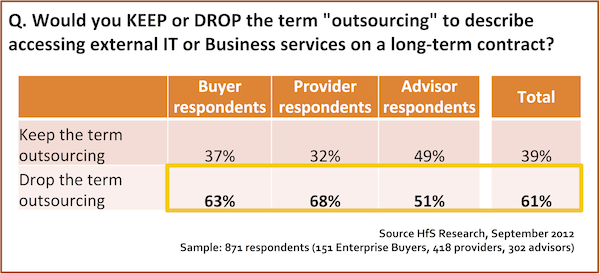
All the stakeholders in the outsourcing industry have finally spoken – 871 enterprise buyers, providers and advisors – in an unprecedented study of broad opinion as to whether it’s finally time to drop the term “outsourcing” for business and IT services.
HfS Research has reached out (see survey) to its unique community of services and operations professionals, and can finally reveal the answers we have long been searching for – that it’s time to re-brand the industry formerly known as outsourcing, with 61% of the industry stakeholders voting to drop the term:
Half of the enterprise buyers responding have over $5bn in revenues, 73% are significant influencers, and most of them have many years of experience with “outsourcing”. HfS would like to thank all of you who took the time to share your opinions on such a pivotal issue.
What’s immediately revealing is that close to two-thirds of buyers and providers are fed up with the term, and the fact it’s almost impossible to remove the image that outsourcing is only about the offshoring of labor, as opposed to engaging with service providers to create business value. The advisor community is evenly split, with a good number of them enjoying the fruits of advising on outsourcing transactions – changing the “O” word is bad for business for many of them. Conversely, there are also many management consultants who would like to remove the term, as it often prevents them from having meaningful and productive discussions with clients, who run a mile when the “O” word crops up.
But what alternative terms have each stakeholder community suggested to replace the “O” word? And what will the termination of the “O” word mean to industry stakeholders? Will they lose their identity, or is this the beginning of a new era?
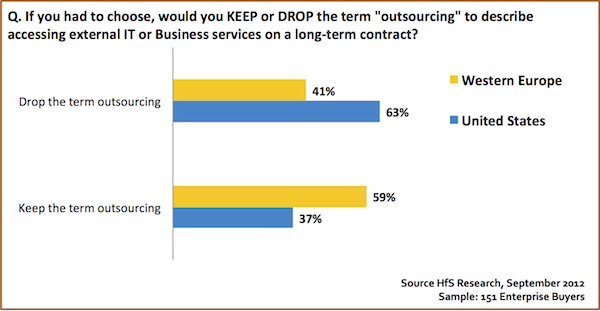
Remember our recent post “Caught in the xeno-bamia crossfire, these are dangerous times for the outsourcing industry“? Well, our new survey on the toxic “O” word has resoundingly proven that negative politics really does sway opinions, as an overwhelming majority of American enterprises want the word scrapped, which is in stark contract to European firms, who are largely happy to keep it:
Now look what you’ve done, President Obama! In all seriousness, Europeans are obviously a lot less bothered by terminology – there is simply a lot less toxicity surrounding the term. The big question is whether these feelings will die down after the US election, or whether the “O” is forever poisoned unto perpetuity? The plot thickens… stay tuned for more
“How do we re-brand outsourcing” was the rallying cry at the NASSCOM BPO Summit in Gurgaon, India, this week. Easy – let’s call it something else… with two-thirds of the buyers and providers voting to drop the term, all we have to do now is agree on a super cool new set of words, and the industry’s current image problems will soon become old wives’ tales.
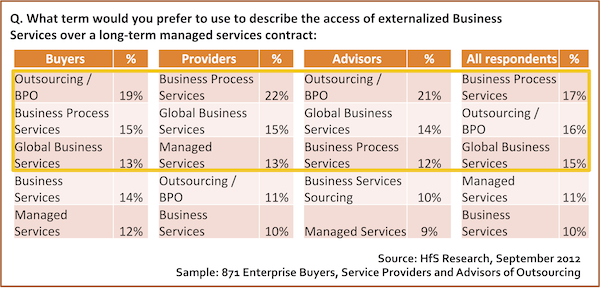
So let’s take a look at the renaming options each industry stakeholder group has voted for (this is for BPO – we asked about ITO separately) :
The beauty of this table is that it doesn’t require a whole lot of analysis. Buyers are so at a loss for alternatives, they couldn’t think of much else and “Outsourcing/BPO” actually came top. Most of the providers just want to swap out “outsourcing” for “services”, while most advisors stuck with BPO, with a growing number, mainly the management consultants, pushing the Global Business Services badge (even though GBS is supposed to represent all forms of sourcing being managed under a holistic governance framework).
The outsourcing industry has a lot of work to do, if it wants to “re-brand”
There is far too much “believe our own bullshit” going on and this industry needs to change how it perceived before it can effectively “rebrand”. People in the industry are complaining that the ignorant masses confuse “outsourcing” with “offshoring”. Well, I hate to be the bearer of bad news, but isn’t the vast majority of ITO/BPO dependent on offshore labor to make the economics work? We should probably just call it “offshore outsourcing” to be even more accurate (eek!).
Look – we all want non-linear growth, to focus on business outcomes, value creation and innovation. We desperately want this industry to be making fast progress in overcoming the four challenges of the HfS 50 Blueprint Document.
The Four Blueprint Challenges facing the outsourcing industry:
» Challenge #1: How can we overcome this singular focus on cost that strips the industry of its value?
» Challenge #2: How can we leverage outsourcing as one of a variety of vehicles to achieve business objectives?
» Challenge #3: How can many of the service providers invest smarter in their account management teams?
» Challenge #4: How can buyers and providers really partner to foster innovations into business process outcomes?
Until these four challenges can be tackled, rebranding the word “outsourcing” is a futile task. Re-branding is all about changing perception – hence, today’s business leaders must be able to associate “outsourcing” with business value creation and true value-partnerships with service providers which are instituting new capabilities into their businesses.
The Bottom-line: Once the outsourcing industry can prove to the world it is evolving, we can use smarter terminology
Yes, “outsourcing” as a term doesn’t convey business value creation, or innovation, or achieving nimble global operations, but this industry needs to demonstrate it is genuinely moving away from the labor arbitrage model, before we can rightfully name it something different. Yes, many new client/provider relationships are now moving in this direction, but we need to see more of it – and have more of it communicated to industry.
Personally, I like the term “business services partnering” as – in many cases – the entire function is not actually outsourced – only elements of it, so in effect these engagements are partnerships with providers to deliver operations, not the outsourcing of operations. Don’t get me wrong, the “O” word will go away – and we – at HfS – will only use the term when we have to , but the industry needs to prove it is winning the battle of the Four Blueprint Challenges before we can genuinely use new terminology without feeling like we just applied some more lipstick to Ms Piggy.
Cindy Carpenter is Research Vice President, HfS Research (click for bio)
So the providers are upping the ante with their acquisition push of late, with Accenture augmenting its regulatory capabilities in pharma with the pick up of Octagon, and IBM making a strong move into recruiting services with Kenexa. Infosys now pipes in by focusing on the tech consulting side with the acquisition of global SAP consulting shop Lodestone. HfS new Research Vice President, Cindy Carpenter joined this morning’s analyst call to investigate further…
Will Infosys Be Able to Get the Lodestone Horses on the Right Track?
Infosys’s acquisition of management consultancy and SAP integrator Lodestone Holdings lines up perfectly with their long-term strategy of moving to higher value services, but this acquisition is a risky way to grow these capabilities. Management consulting firms are usually seen as poor acquisition targets, because the assets go home every night. If they’re not happy, they can usually find plenty of opportunities elsewhere, and the value of what you’ve bought may decline very rapidly. This goes double when the acquiring company is in another country from the acquiree. (We need only look at Capgemini’s struggles with consulting acquisitions in the U.S. to underscore this point.)
Infosys understands the challenge of managing consultants well. On the analyst call discussing the transaction, Infosys Consulting CEO, Steve Pratt, commented that “good consultants are like thoroughbred race horses” – they can be temperamental, but get them excited and point them in the right direction, and they’ll do great things. He also noted that they need a “collaborative environment” and a lot of freedom. This is a very different culture from the culture of most Indian IT outsourcing companies, which tend to be structured and hierarchical, with an emphasis on following methodology, process control and predictability. So how has Infosys grown its integrated consulting and technology business? Very carefully. From its inception in 2004 until just this past year, Infosys Consulting has been a separate company, incubated and nurtured along different rules, operating models and margins. Infosys Consulting is now up to 30,000 employees and part of the parent company, but it still has a distinct footprint (mostly United States) and delivery model (about 30% onsite/70% offshore) compared to the legacy Infosys technology business.
The key to success in this acquisition will be bringing the same kind of understanding of different organizational cultures and models to the integration of Lodestone into the Infosys business. Lodestone’s 750 consultants operate from 17 countries today, but India is not one of them. The company has 200 clients, which means either that their consulting engagements are very small on average, or that they are claiming past and active clients. Contrast this with Infosys’ 711 clients to about 150,000 employees, averaging about 210 employees per client, mostly for ongoing, multi-year engagements.
If Infosys wants to reap downstream revenues from Lodestone’s consulting engagements, it will have to teach Lodestone employees not only about Infosys’ services, but also introduce them to their global delivery model and how to work effectively with their new colleagues in India. Ronnie Hafner, Lodestone’s CEO, has no concern about his employee’s inexperience in this model, but Infosys does plan to groom Lodestone consultants to cross-sell the Infosys offerings and provide training in the Infosys methodology. Remember that they are thoroughbred racehorses – mostly German and Swiss – and give them plenty of room to run.
Key Takeways:
On the positive side, this acquisition fits Infosys’ strategic goals beautifully:
It continues to grow Infosys’ management consulting capabilities and ability to deliver higher services, moving from commodity software maintenance to integrated business platforms.
It adds onsite management consulting teams in Europe (and adds a few consultants in Asia-Pacific and Latin America).
It adds domain knowledge and experience in the verticals of life sciences, auto and manufacturing, where Infosys has a relatively small footprint.
It strengthens Infosys Consulting’s SAP’s practice, bringing it up to 10,000 employees and $1 billion in revenues.
Points for caution:
Infosys will have to bring some of its best consulting and business transformation skills to its own acquisition, if it wants to reap the synergistic value for its global services strategy.
Lodestone’s consultants are widely dispersed, increasing the challenges of integration and retention.
Take the claim that Infosys is acquiring 200 new clients with a grain of salt. Infosys will have an opportunity to introduce itself to these companies, but they may be past clients, too small, or uninterested in India-based services.
Recommendations for Infosys:
Acknowledge that you are bringing together three very different cultures in this acquisition: the EU management consultant culture of Lodestone, the global systems integrator culture of Infosys Consulting, and the India-based technology firm of the legacy Infosys business. You’ve just paid about $450,000 per consultant – now is not the time to waste that recruiting cost. Consider:
Making it a goal to get 1/3 to 1/2 of all Lodestone clients to one of your India delivery centers in the first year, to meet their new colleagues and learn about the Infosys global delivery model and capabilities.
Assigning a buddy from Infosys Consulting to each consultant in Lodestone, whose job it is to provide coaching about their new organization and learn about Lodestone’s capabilities
Bringing together delivery managers from Infosys Consulting, Lodestone and Infosys India to build out new, integrated offerings by vertical. Support new relationships among counterparts with face-to-face working sessions in different geographies.
Cindy Carpenter (pictured above) is Research Vice President at HfS. You can access her bio accessed here.
The Windy City braces for a new storm coming from across the Atlantic…
Eighteen years ago, one man had a vision to take on, improve and ultimately manage the procurement function for British companies.
And what better to call his firm, than the “buyingTeam”? I mean, what else are you supposed to do when you’re in the procurement services business? However, when the affable Matthew Eatough decided to expand his business into the United States, a little whisper in his ear convinced him it was time to sex-up the name and relaunch his firm as ‘Proxima‘ (you can read more here about the relaunch) as they settled into their new Chicago digs.
Today, Proxima has earned a reputation for going far beyond the administrative indirect procurement activities to delivering category management and strategic sourcing solutions for clients such as British Airways, Universal Music and Prudential, with a reputation for tailoring solutions for clients in dire need of improving their procurement processes. Now the firm’s challenge is to broaden its unique brand of procurment expertise into the US market, so I managed to grab some time with Matthew to find out more about the grand Proxima plan…
Phil Fersht (HfS): Matthew, can you tell us a little bit about you and your background and how you came to lead a procurement outsourcing company?
Matthew Eatough (Proxima): It has been a long journey, 18 years. My original move into this business was a slightly odd route. I was involved in the management of a turn-around situation for a relatively small retail and manufacturing business, which was subject to a buy-out in the early 90s.
A large portion of the financial impact of turn-around t was focused around negotiating supplier terms and putting some professionalism into the procurement processes. I don’t think we fully understood what we were doing at the time and I think it was just something we did because it was a financial necessity.
Continuing this cost reducing approach, we gradually became a cost management business which has developed over the years with the latest iteration being from buyingTeam to Proxima.
In many ways, I’ve learned most of what I know about Procurement ‘on the job’ over nearly two decades. The business turn around entry path is quite important and is probably still in my professional DNA. Many elements of Proxima’s methodology, approach, mission and vision look at procurement from a business perspective – which means not only making the procurement function better, but also delivering true value back to the business, enabling the business to achieve its strategic goals and objectives.
PF: Okay, so you’ve been around for 18 years but you’ve only recently decided to make a move into the US market. Why did it take so long… and why now?
ME: In the early 2000s we were much more in the consulting arena than outsourcing. I therefore see the business as a 7 or 8 year old start-up rather than an 18 year old start-up. In terms of ‘why now’, we were very keen to attain critical mass in the UK before expanding into the US.
Matthew Eatough is Chief Executive Officer of Proxima
In order to make our expansion a success, it was necessary to have US fulfillment capabilities to effectively service our blue-chip client base (we have been delivering procurement services for UK based clients in the US for 5 years). Further to this, we needed 2 or 3 stand-alone US reference clients because although I think the US market will respect what’s being done overseas, a US based CFO / CPO will probably be more work with an established business with US clients. We’ve been fortunate to acquire 3 clients in the last year and we are now making a major push to build our capability depth and breadth in the US.
The US is clearly the largest single market, and the most advanced in terms of its appetite or business services and outsourcing. We are also seeing an interesting development in the US in that the market seems to be splitting into several distinct approaches. One approach is of a very standardized, efficiency focused and arguably slightly industrialized approach to procurement. You have the operational BPO firms that really seem to be all about lowering the cost of service delivery which, we think, leaves a large untapped opportunity in the US market for us. Our approach is different; we focus far more on how a company strategically embraces the management of its third party suppliers to power the business. I strongly believe our approach will enable us to succeed in the US.
PF: What are the top two things that you feel differentiate Promixa in today’s market?
ME: A major differentiator is that we fundamentally believe that for procurement to be a transformational experience, there is a level of ‘intimacy’ that needs to be imbued in the client/provider relationship. This intimacy needs to be at both at a delivery level and a senior management level – to really bind and sustain the procurement transformation as opposed to simply running a remote BPO operation. I think that if if this is done well the client gets a whole range of benefits including savings.. However if a business wants to go from immature to world class in the management of procurement to help drive its wider strategy then it also needs to have a more sophisticated approach than simply measuring savings.
Our further differentiator is that our overall USP has nothing to do with labour arbitrage. One of our core strengths is our ability to concentrate the types of processes that are managed better into a shared service delivery centre to drive effectiveness and efficiency whilst at the same time allowing us to invest more of our overall margin into having top-end, on-site client facing resources truly driving change and achieving excellence for our clients giving all of the scale benefits of an outsourcer with all of the intimacy benefits of a top class in-house procurement function…
PF: Our research has shown that it is stand-alone procurement outsourcing deals that have fueled the market growth. We saw 23% growth in the last year and we’ve seen 430 multi-process procurement outsourcing contracts now in play. Would you class yourself specifically as a pure play procurement firm at this point or are you getting involved with broader deals with multi-tower aspects?
ME: We are focused on (and very clear believers in) the benefits of being a pure play procurement provider. We think not being a pure play has business compromises at almost every turn. Multi tower deals often disguise the exceptional ROIs available in procurement. Multi tower providers often use procurement results to hide otherwise mediocre business cases for wider F&A mega deals.
PF: We were talking earlier about some of the differences between the business cultures in the US and the UK… as you move into the market here, how would you classify doing business in the US compared to the UK in the outsourcing space?
ME: I think there is at least one book to be written on that subject so I’m not going to attempt to cover that whole ground. In my experience, the differences are that obviously regional geography and local culture is much less of an issue when dealing with US companies.
I think a complexity is that we are divided by common language and you have to be extremely careful to make sure you have fully understood the situation – particularly when we are talking about the softer elements or the HR issues associated with procurement outsourcing. I think there is also an issue that (at least superficially) US corporate management appears to be much more value seeking from its supply base than many Europeans. As such, I think it is much easier to engage with them around understanding the procurement transformation and outsourcing approach.
From my perspective, a big difference between the markets is that certainly at initial stages of discussion, US corporates are far more interested in how we deliver the benefits whereas in Europe they are far more interested in what the benefits are going to be.
I think this is best shown through things like attention given by US executives around what technology is being used and what procurement methodologies are being applied. Whilst in Europe, greater attention tends to be given what they are going to get.
PF: Our recent research with over 500 buyers of outsourcing across the UK and the US found that US businesses understand that they need to transform processes and they need to access new talent caliber to get results. Conversely, a lot of the continental European businesses don’t feel they need change what they do, or their talent. Why do you think there is this differently mentality?
ME: I think that, at its heart, this isn’t just a procurement issue and this applies to the whole outsourcing journey in the US, which is probably 20 years older than it is in Europe. You also have to remember that outside of the UK, the difficulties in actually effecting organizational change as it relates to talent or organizational structure is very constraining for management.
PF: How do you intend to service the US clients from a global nature? Are you looking to increase delivery and capability category in the US or are you going to try and deliver a lot of these from other locations?
ME: We have a strong global category strategy with local category directors supporting this across all our clients. Our fundamental belief is that we are not simply bringing a labour arbitrage solution to clients, what we are bringing is a relationship and deploying intimate market relevant expertise. In order to do that you have to offer local capability. We are busy developing our US team out of Chicago to deliver this.
PF: Tell us a bit about your facility in the UK. How many clients do you service out of that today, and how do you see that evolving over time?
ME: Currently we service 20 large, blue-chip clients out of our on-shore facility in South Wales (United Kingdom). We have about 100 people based there who are entirely focused on running the various category related events and data/analytical processes plus managing many of the various technology solutions and systems for these clients.
The centre offers our clients deep category expertise and a broad range of capabilities that are internationally scalable. We are trying to segment most categories into higher added value (which we seek to deliver very close to the client) and lower added value (which may very well be some of the lower levels of category expertise and are more simpler or homogenous categories).
PF: Who do you find is your ultimate client in the enterprise? Is it the CPO is it the CFO, is it shared services executives? Where do you typically find the new opportunity for yourself?
ME: I think we typically only have two economic buyers – split 50/50 in terms of CFOs and CPOs. Both tend to use our services in slightly different ways.
I think CPOs typically are looking for an augmentation of what they do. The CPOs that we work with generally managing the entire supply chain – and are looking to effectively outsource their indirects.
The CFOs that we work with are responsible for providing end-to-end capability to the business. We really become accountable as a CPO in those environments.
I do think it is an interesting differentiation and the underlying deliverables are very similar but it’s a different message to the client’s business.
PF: The final question I have is around technology. Are you being very technology agnostic around your approach and focusing much more on the process at this point, or are you looking to get more involved in some of these platform-based deals?
ME: I think we, the provider community, is on a journey and I don’t think any one is getting this 100% correct right now. If you look at the history of the major providers, their origins were in the dot.com era during the late 90s, early 2000s in which they invested massively in technology and automation systems and I think ultimately they probably got very modest returns. Capgemini made the acquisition of IBX and in my mind it is unclear that this has given them any positive differentiation as a procurement outsourcer… I’m not sure anybody, including IBM, has the greatest technology narrative in this market. I don’t think anyone has yet cracked the correct positioning of technology in procurement outsourcing.
Also, through our multi-client shared services model, we are running a very large procurement function. Getting the technology, work load, customer relationship management, supplier relationship management and specific procurement application right is absolutely essential. That’s increasingly where the market seems to be moving at the moment. That’s increasingly about Proxima and how we use technology to provide a great service rather than how we use technology to embed ourselves in the client.
I think there is another side to the technology question which is where we have much more of a position, which is how CRM can help with stakeholder management.
So in answer to your question, we are really technology agnostic and we are very happy to operate client’s platforms or happy to provide them with our own technology. We really don’t want technology to be any sort of barrier to engaging with a client in anyway. To do that I feel we have to be both flexible and agnostic.
PF: When you look at how you are building a procurement services firm, what would your advice be for procurement professionals… some of them might be a little nervous about outsourcing. What would your advice be to them in terms of how they can develop their career paths and get involved in more strategic decisions within the enterprise?
ME: I think you have touched on something that is very intriguing and that probably exists more in the procurement world than in any other functional discipline and whilst I think there are signs that it’s changing it’s still noticeable issue in procurement that there is a distrust with many in-house procurement professionals about the career merits of outsourcing providers. I find that genuinely a backward looking view of the world. If I were a young procurement professional I would think some time working on the provider side would be great for my development regardless of whether I intend to stay there forever. I think you can get a completely different set of experiences in a provider environment than you can get in-house..
I think you can accelerate the level and range of experiences you get probably on a 3 or 5 to 1 ratio – I think two years of provider experience is equivalent to 6 years in-house in the early stages of a professional career.
PF: Do you think this use of the word outsourcing in the vernacular and the perception it implies is getting a bit dated? In the old days outsourcing was really about ‘lift-and-shift’. It was moving IT staff, it was moving F&A staff out of the organization and using offshore augmentation, but today most of the providers don’t want to take on a lot of new staff – its more about a service. It is really about “business services” today and not “outsourcing services”?
ME: I think you touch on something really interesting. One of the problems we collectively have as an industry is when we say outsourcing, we mean added value and services but the client often hears BPO, which is fundamentally labour and technology arbitrage and cranking a handle. I think there is a really interesting analogy around marketing services agencies (which in essence is an outsourced industry). These agencies don’t call themselves outsourcers because they would contend that they are really about having a value adding partnership with their customers over many years. However, because they are marketers they have been much cleverer about avoiding the BPO label. I do think we need to find a new collective description of this sector which clearly positions us somewhere between a consulting and BPO proposition.
PF: Matthew – it’s been a pleasure hearing our story and am sure many of our readers will be wishing you the best as you expand your business Stateside.
Matthew Eatough (pictured) is CEO of Proxima. You can read more about Proxima by visiting their new website.


 August 22nd was a traumatic day for HP for two reasons:
 Lot’s of reverberations in the rapidly-consolidating talent management services and software world with IBM’s $1.3 bn scoop of RPO and talent software firm Kenexa. The acquisition places IBM in pole position as a Recruiting BPO services provider, however, the big question now is whether it will next acquire a cloud talent platform, or invest in developing the existing Kenexa software.