So for the first time since the ’08-09 crash, we’re finally starting to see the impact of a commodotizing services market, as HP makes plans to shed 30K jobs this week.
HP may have had some war wounds inflicted on itself with the standardized services models of today, but there is still the opportunity to position itself to win the higher value engagements of tomorrow
However, I believe HP is a symptom of a commodotizing and standardizing IT/business services industry – it’s recent woes have forced it to take corrective action that many of its competitors will surely have to also take in the future.
The bottom line is that several providers of HP’s ilk are getting overbloated – and have been for a while – and simply can’t continue to remain competitive in today’s market under the old rules of yesteryear. It’s time to trim the fat. And while other analysts are claiming HP is an anomaly in the services business, I don’t agree – we’ll see several other service providers make corrections to their workforce sizes in the coming months. The old “butts on seats” services model has to transform or we’ll all be on a race to the lowest common denominator.
Meg Whitman is doing what she was hired to do – straighten the ship, re-energize the management talent and getting HP on a roadmap to competitiveness. However, this is the start of a long process to correct the utterly rudderless policies of Léo Apotheker’s short-lived, but very damaging, spell as CEO. While a 10% layoff is tough to take, this is likely not going to be the last workforce correction we’ll see from Whitman this year.
How has HP found itself as the first Tier One IT Services provider (since the recession) to start shrinking its workforce?
Léo Apotheker had left HP in a sorry state from which it is proving tough to recover. During his ill-fated 10-month leadership spell leading up to his dismissal in September of last years, he’d helped wipe 40% off of its stock valuation and $30bn from its market cap. His corporate leadership decisions were well documented in HfS, and the resulting financial performance has proven tough from which to recover, with little upward movement since Meg Whitman’s appointment as CEO.
HP is a victim of its own success as it helped create today’s commodity services market. The Tier 1 IT outsourcing providers (Accenture, CSC, HP and IBM) are slowly discovering their success in standardizing the IT outsourcing market is no longer demanding such bulky staff delivery requirements. The movement away from asset heavy deals and heavy staff transitions no longer necessitates the mammoth-like deals of yesteryear.
HP’s previous leadership failed to build on its EDS acquisition, which has ceded much of its market position. EDS was one of the original pioneers of ITO, typifying the mega-million dollar IT infrastructure deals of the 80’s, 90’s and early 2000’s. However, as that business suffered from squeezing margins and the focus away from heavy asset-transfer, EDS developed one of the industry’s stellar SAP development and maintenance practices. And when HP, also a major proponent of SAP services, acquired EDS in 2008, it was expected the combined outfit would go from strength to strength as a powerhouse enterprise IT/business services provider. Instead, we witnessed the likes of Infosys, TCS and Wipro infiltrate the SAP services market; Accenture and IBM develop genuine offshore competitiveness to fight the Indian low-cost wave; while Deloitte and Capgemini have remained competitive as consultants and integrators. HP, CSC and a few other “old school” ITOs became paralyzed in a state of denial as their market competitiveness was quickly eroded.
With Mark Hurd obsessing about HP’s hardware business, and his successor Apotheker seemingly trying to turn HP into a software firm (or at least we’ll credit him with trying to achieve something), HP clearly lost focus on its EDS business, while a global recession wasn’t exactly helping matters. Additionally, HP’s BPO business has remained relatively stagnant since the EDS merger – and is only now showing signs of a resurgence with Whitman placing new management talent to energize its clients and refocus its staff.
The move to the Cloud has further leveled the playing field. Cloud computing deals are further placing the onus away from enterprises purchasing hardware assets and their related labor intensive services. Moreover, the new wave of Cloud deals is signaling an end to long-term lock-in contracts and more choice to the enterprise buyers. We actually see this as an opportunity for the quality infrastructure providers, such as HP, investing in tech personnel who can develop Cloud-based apps and infrastructure environments for clients. Cloud isn’t further commodotizing the game – it’s democratizing it, giving buyers more choice and easier access to talent, away from contract lock-ins and inferior services. The commodity offshore players are scared of Cloud (remember our old friend, HCL’s CEO Vineet Nayar?), where you can’t compete simply by hiring armies of ABAP programmers fresh from college.
The Bottom-line: HP is addressing its problems – and it won’t be the only provider going down this path
Finding differentiation between standard IT services these days is almost impossible. Armies of Indian delivery personnel and competitive rate cards provide the engine of today’s standardized IT services industry. Those providers with the smartest pricing and personnel factories will win that game. The real differentiation points are unraveling higher up the services stack with the development of offerings that achieve business objectives, based on outcomes that are tied to them. It’s going to be those providers that can integrate services, with domain specialities to solve complex problems (not all businesses can slam in an SAP or Oracle and be done with it), and those companies seeking to make radical changes to their internal operations to compete globally, where they can take advantage of globalized shared services and outsourcing, and the disruptive potential of Cloud. HP may have had some war wounds inflicted on itself with the standardized services models of today, but there is still the opportunity to position itself to win the higher value engagements of tomorrow. That game has only just begun…
With all the quick-thinking and finesse of an Italian analyst in a Hollywood Hills salami shop, here’s HfS Research’s Tony Filippone imparting the scoop on why SAP just bought Ariba…
With its $4.3 billion cash offer, SAP answered every procurement technologist’s question, “Who is going to buy Ariba?” While this acquisition will rupture the procurement technology universe, HfS believes the real question that supply chain and finance professionals must ask is, “Now that SAP finally has a credible commerce network, can I eliminate and automate processes I’ve been busily outsourcing?”
It Didn’t Happen Overnight
Give credit to Ariba’s leadership. Over the last few years, Ariba’s CEO Bob Calderoni and President Kevin Costello bet the farm on cloud technology and the networked economy. With the introduction of cloud-based 10s1, they took their focus off gritty areas, like category management, usability, and procurement process management, and jumped into technology’s cloudy fray. This was a “check the box” exercise for any technology company. Yet, the real jewel was Ariba’s supplier network. With the help of procurement teams bent on mandating its use among suppliers, Ariba’s supplier network swelled to $319 billion in commerce transactions spanning 730,000 companies. Ariba’s network fees doubled. SAP noticed.
In the meantime, Calderoni sold Ariba’s services arm to Accenture 18 months ago. This clarified Ariba’s technology-focused strategy. It also eliminated the largest objection larger technology firms had about acquiring Ariba – the services. Technology firms want nothing to do with services as they can neither manage nor sell them effectively. In the end, Ariba became a feature-rich, cloud-based platform with one of the world’s largest B2B commerce networks.
What It Means to the Industry
SAP customers gain network capability that automates their O2C and P2P processes.With an installed license base of 190,000 customers, SAP enters the cloud technology world with a real commercial network. This exposes SAP’s industrial, manufacturing, and CPG clients to a modern method of conducting O2C and P2P business. SAP’s customers are likely to rapidly adopt the network. In the wake of SAP customers’ adoption of the Ariba network, business owners should seek to consider bolder, more transformations alternatives to outsourcing their finance and accounting processes. Quit emailing POs, and start electronically flipping them to eliminate manual effort and obtain the true contract value you negotiated.
Other technology players are left picking over the leftovers.SAP eliminated one its competitors, while IBM’s Emptoris acquisition eliminated another. Two heavy weights are gone, and in their wakes lay a large number of low-priced, niche procurement solutions that are left to fight it out. While buyers will always have some interest in pure play solutions, choices for enterprise buyers are more limited. Expect the smaller players to focus on usability and niche process solutions, like supplier relationship management. However, seamlessly automating a company’s global payables team through an established network dwarfs the differentiation of better-looking user interfaces.
Outsourcing service providers face a new landscape. With SAP customers poised to adopt a network, finance and accounting outsourcing service providers will face lower volumes of manually transactions. Service providers that can help buyers transform their processes are positioned best to service clients and win new ones. However, this isn’t a simple technology issue solved by templates. Supplier network adoption and onboarding is a complicated, tactical task and finance and procurement teams will need operational expertise to handle the transition. In addition, SAP’s partner model for its On-Demand services may open new opportunities for service providers that had previously relied on Ariba’s cloud suite.
Procurement and supply chain gets shoved into driver’s seat. With SAP’s sales force pushing Ariba’s network, expect CPO’s to feel the pressure to take more control of their firms’ end-to-end P2P strategy. Whereas few enterprises currently consolidate sourcing, procurement, and payables teams, Ariba’s network will force organizations to reconsider if they want to tap into the true value of seamless source-to-pay processes. More importantly, supply management executives will be given a better network to manage direct goods and services. As a result, CPOs and supply chain leaders will feel the pressure to manage source-to-pay in an end-to-end fashion.
Tony Filippone is EVP for Research, HfS Research (click for bio)
The Bottom-Line: SAP’s Acquisition is a Good One
After the dust settles and SAP integrates Ariba’s sourcing, procurement, and contract management capability into its suite (or vice versa, which could create quite a bit of dust, but represents a fine network-based model for B2B commerce), SAP and Ariba’s customers come out as winners. Customers will get better features, a more broadly adopted cloud-based delivery model, and a rapidly expanding commerce network that reduces the inefficiencies of manual P2P processes. However, despite all the hype SAP has created about its On-Demand solutions, can the German software firm really manage a network and B2B community-based solution?
Ron Walker (foreground) patiently waits for his KPMG colleague and former EquaTerra CEO Mark Toon (background)
Picture the scene… the first time I met Ron Walker was back in about 2005 at a Hawaiian Luau in Southern California (I think it was meant to be an EquaTerra “strategy” offsite). From my recollection, the guy was clearly hungover, looked like he’d frequented one-too-many MickeyD drive-thrus as he schlapped around the States doing sales calls, and was sporting a Bermuda shirt and shorts to boot.
Seven years later, I find myself at some conference in Florida, when this suave, well-shaven, slimline gentleman approached me donning a sports jacket with brass-buttons and a consultant’s grin on his face. Now there’s one transformation the outsourcing business can be proud of: Ron Walker as a Big-4 Consulting Partner.
Yes indeed – Ron Walker, one of the original EquaTerra founding executives has lived the sourcing dream… from start up advisors and providers right through to a global management consultancy. So we thought it high-time we caught up with Ron to talk about his colorful career and how the EquaTerra/KPMG merger was faring over a year on… and how different the sourcing world is looking today compared to those crazy days of the outsourcing boom.
Phil Fersht: Ron – you’ve been around the sourcing industry for quite sometime now. Maybe you could get everybody a little bit of insight into your background and how you got into this industry and a bit about your early career.
Ron Walker: Hey Phil – I actually started my career in the aerospace industry and was fortunate enough to work in the office of the president, where we did some initial shared services and outsourcing work. I then moved over to Arthur Anderson where I worked in the business consulting group and had a successful run working on both the consulting side and the outsourcing piece. I helped build the shared service centre that Arthur Anderson was setting up for General Motors, which was one of the largest finance outsourcing opportunities at the time. As part of that process, I made several key contacts and had the opportunity to ‘found’ the initial finance and accounting pure-play start up called LeapSource. I was part of that initial launch, until we transitioned it over and that didn’t quite go as successfully as we had quite hoped – it was during the Exult stage on the HR side.
After Arthur Anderson, I went to (order-to-cash provider) Creditek when the company was being openly courted by Genpact. I worked with the folks from TPI and ultimately connected with my former partner Mark Toon (who was at TPI at the time) and helped found EquaTerra in 2003. So, I’ve been part of EquaTerra from the very beginning. I think I was officially employee number 6 in the line up there. Most of the roles were developing and I enjoyed multiple roles and activities during the EquaTerra experience. Ultimately, when EquaTerra became a part of KPMG, I kind of went full circle… now I’m running the F&A practice within the KPMG shared services and outsourcing advisory space.
Phil: Going back to those heady days when EquaTerra was founded, how would you describe the industry today compared to what it was like then?
Ron: When we founded EquaTerra, at the time outsourcing was definitely becoming the tool of preference for many the executives to help quickly and easily wring out costs in the organization. The challenge was that most of the business process outsourcing that was done at that time was really driven from an IT mentality, and people weren’t really taken into consideration the complexity of business processes. EquaTerra was actually founded as both a shared service and outsourcing advisory firm but because of the business trends at that time, outsourcing advisory was the predominant work that we did.
A lot of companies weren’t capable of understanding how to do a contract with a service provider on the business process side versus the IT side, which was much more mature and easier to measure as far as some of the service levels are concerned. We went to work creating governance models and service levels and really pioneered a lot of the thinking that is taking place today. What I’m seeing today, now we’re 8-10 years further on, is that shared services models are swinging back into fashion. Businesses are looking more at a blended model of how they are delivering services and – in the back office particularly – they are looking at shared services and process improvements, technology platforms and some specific outsourcing – which isn’t only centered on driving out costs. It’s come full circle -particularly when you look at what happened during the last financial crisis: A lot of companies quickly went offshore or outsourced and didn’t do it quite the right way because they were trying to gain cost benefits – and their service delivery models and their quality of service have suffered since. I’d say most of the activity we’re seeing in the marketplace right now is related to fixing some of those service delivery quality issues that they have been experiencing over the last few years because they were really focused on cost versus quality.
Phil: Back in the day, we all really thought everything was going towards an outsource model, didn’t we?
Ron: Yeah, we really did. We were all looking at (basically) leveraging the global scale, capabilities and the platforms that the service providers were either implementing, or claiming that they were going to implement, to drive the future. That was what we really thought was going to take place. It just never quite took off. It certainly has a place and it’s quite effective in a lot of situations, but we haven’t seen the growth that we thought we would see – at least early on.
Phil: So what changed? Why did we move from the ‘everything should move to outsourcing’ to this blended approach we have today? We just completed a massive research study, we spoke to nearly 2000 finance professionals and only 10% of them felt that a BPO model was predominant for them, while 50% leaned towards shared services as their predominant model, with BPO being viewed as more of an augmenting capability for them.
Ron: If you go all the way back to why outsourcing was so attractive… we were in such a growth mode and companies growing hand over fist and just trying to keep up with demand and the gogo years of the Internet bubble. Outsourcing was the predominant way of getting folks in and the growth covered a lot of mistakes. Then many organizations went off and did just that, and they started scrutinizing their service delivery models and becoming less naïve – they started understanding that the service provider, although doing a good job for the most part, had their flaws and issues as well. It just didn’t quite work out for everyone, and we had several failures, which made other organizations a little bit wary as to what they were going to do going forward.
So they (buyers) started getting more intelligent, and in this day and age of information sharing is the ability of collaborating with colleagues and advisors and simply going to classes and looking up stuff on the Internet. They became a lot more knowledgeable about what the right things were to do. The promise of BPO never really delivered the full cost benefits and they certainly had their delivery challenges… and then they started looking at their own service delivery models and abilities to change. They did see things, the technology started to become cheaper, such as forms of cloud operating or software operating platforms that they could move to, and it became easier to just look at other options which hadn’t been available in the past. Where the outsourcing model had been attractive in the past it didn’t quite deliver, so companies started looking at options they could do themselves – or in pieces.
Phil: Do you think it is the same for IT as well or do you think the IT space has gone down to a much more aggressive model towards outsourcing?
Ron: Both are still growing, it’s not as if they are going away – they will still be a predominant option for many companies. I think IT has a larger implementation base than business processes, and it is more mature and easier to operate, particularly when you look at infrastructure. However, it’s still going to be a long time before companies reach their IT nirvana – especially with the new opportunities presented by the cloud. They still have infrastructure support requirements and it is a relatively inexpensive option to go to an outsourcing provider. They’ve got they’ve got scale, capabilities and they’re a lot more able to measure the success of that versus the business processes, where it’s less tangible to define what success looks like. I think ITO will continue to be a predominant part of options and it provides significant cost advantage just because of the large scale, operability and the way service providers are able to offer their services.
Phil: Do you think the BPO space is ever going to get to the scale of the IT space or do you think it is too complex in nature at this point?
Ron: I don’t know. I know in several industries we’re talking about the business process platforms becoming more predominant. If you look at some of the financial services, health care areas that will be an option. It’s too early to tell whether it will be larger or not. As some software providers start to offer different solutions, I think that organizations are going to look at that as solutions rather than these BPO (business) platforms – it’s simply a lot cheaper to implement a piece of software to improve a process, than to try and change the whole process and outsource the processing at the same time.
Phil: Do you think the key is really labour arbitrage? Let’s be honest, it worked in IT because you are literally subbing out specific onshore skills with the same skill offshore minus half the cost. It’s just harder to do that with processes that aren’t so cut and dried.
Ron: You can’t underestimate labour arbitrage but that’s a one trick pony. You get the labour arbitrage – it’s a one-time shot. This is where many organizations are challenged. They are able to take advantage of that labour arbitrage lets say up to 70 or 80% if they were just comparing labour, but where they fail a lot of the time, is to do the proper planning and put in the proper procedures, and that starts to add cost… and then you do loose efficiencies by putting in either offshore or offsite. That labour arbitrage begins to diminish over time. You can’t underestimate it because that’s an area where you can hide a lot of mistakes because you can get such a large cost-savings benefit from something initially. What we’re finding, is once you’ve done that, it is extremely hard to improve your processes or transform processes because service providers, or even your own captive shared service centers, are incented on maintaining their own FTE base, regardless of what your contract says. They measure their success on how many FTEs they have doing the process.
Some service providers are different than others, but what I’ve just described is the mentality of the majority of them. This kind of labor arbitrage makes it very difficult to make business process improvements and add software components that can further streamline process and eliminate unnecessary FTE costs. Some of the highest activity we’re seeing with our clients (at KPMG) is that as they are reservicing their entire service delivery model – pulling stuff back onshore or pulling stuff back inhouse, because they simply can’t get the service providers to cooperate with them on a rational basis to put in new software platforms or to eliminate positions entirely.
Phil: So now you’ve moved into a management-consulting environment. Are you starting to see some of these issues differently than you did before?
Ron: Yes we are. Moving into KPMG and seeing the benefits of a much broader consulting organization, with much more diversified skillsets than we had at EquaTerra, we are seeing a much broader picture of what the options are for clients today. I don’t think that’s just the KPMG effect for us, I think that is truly where the market has been moving.
Phil: What have you heard from clients (particularly the larger ones) that they have too much dependence on offshore, and need to change the model. Is that something you’re seeing?
Ron: Balance is one of the discussions but its really about a value for services decision. Particularly the large organizations, a lot of them put a lot overseas to reduce costs and they just didn’t do it properly so their service delivery model is not as successful as they had hoped… so they are relooking at that and bring it back onshore. Bringing it back onshore is a lot cheaper now than it was, say, 5 years ago. Our onshore rates and ability to deliver services has become more effective these days, and then when you look at critical operating models, it just makes sense to keep some folks closer than others. And the other thing that we learned through our financial service clients is they had a hard time in rationalizing their own recruitment model and subsequent ability to train and retain staff so they can promote them through the ranks. So when they put so much offshore, they lose some of that ability.
Phil: Just to talk a bit about your experience, EquaTerra was such a heartbeat of the business during the last decade and externally the perception has been that it’s been embedded pretty successfully into the KPMG organization. But there was a very distinct culture in EquaTerra that had been developed over the years. Do you feel that has been maintained well?
Ron: It is different, there’s no denying that, but let’s just start with some of our numbers. We had a very highly experienced team at EQ (20+ years on average) and what we did expect, as we moved into KPMG, was a different culture …but I think it was the right time.
I think most of our folks have adapted and were looking for a change and many of our experienced senior people were looking for a career reinvigoration by sharing their experiences within the KPMG model. They are able to work within KPMG and leverage their knowledge and resources to younger folks and help them along with their careers. It’s been more positive than I ever expected and an easier fit than I expected. That’s not to say there are not challenges, there always are. KPMG is much more conservative than EquaTerra ever was and they have a lot more processes and policies to follow… and we weren’t accustomed to that as a startup. That has probably slowed some of our actions down but, frankly, some of that had to be done. It will probably take another 6-12 months to really shuffle everything out through the process.
I’ll ask you, you’ve been integrating with us on a frequent basis… have you seen us lose some of our EquaTerra culture through the businesses you’ve been talking to?
Phil: I have definitely seen some maturity in some of the EquaTerra folks that I bump into. For example, there was a large gathering of (former) EquaTerra people recently in Florida and it really hit home to me how the group had been kept together. The feeling I came away with was they had retained much of that spirit and culture and were settling in well into a bigger, more mature organization and were gearing up very much to increase market share in the industry. And a lot of the former talent that had actually left the company had come back.
Ron: Right! I’d say that some of the KPMG leadership knew that there was an enthusiasm within our organization and a love of the work that we do and platform we have. Today, the clients we can now interact with has really reinvigorated some of the folks. I think we’ve done a great job of just looking at the current industry opportunity and how KMPG has provided us new pathways to keep our career fresh.
Phil: Ron, I wanted to talk a little bit about the future and this global business services framework – I know KPMG has been very hot on this topic. We just completed this study and coming out of the results, one of the things that really hit home to us was the increased recognition from finance leaders of the capabilities that providers brought to them – whether they operate shared services or outsourcing. What gets us scratching our heads is that this means service providers need to start to sell to shared services organizations more effectively, which means there needs to be a change in how this stuff (outsourcing) is actually talked about and positioned within an organization. At the same time I think clients have to understand more about how service providers operate in order to get more out of them. What is your take on this? Where do you really see this moving particularly from a finance perspective?
Ron: I think the challenge is that a lot of times companies don’t know how to get that best bang for their buck out of the service providers that they’re engaging with, which is why we see the dichotomy there. The other aspect of it that I still think is always the stopping point is technology. When you look at where you get true benefit: the people, capabilities and knowledge – that’s moveable but the technology is such a large component. Within finance, you’re pretty much stuck on the original ERP that the company has because its usually too expensive to replace or roll out, so service providers are either forced to utilize the legacy system of a company or if they want to go through a new implementation, its typically very expensive. What might change on that is NetSuite or Workday finance that is going to have the ability to make that a lot cheaper and offer a potential platform service for the service providers. In the end, I think it is an issues for every organization… although they say they want to do it, it is very difficult and challenging to try and integrate, whether it is a service provider or a new technology on a cost-effective basis, unless they are fully committed. There are easy things: for example, you can outsource T&E, AP, AR etc, but when it comes back to that legacy ERP system, until there is an option for fixing that, I don’t see a wholesale switch out.
Phil: Finally, when you look back at your career, would you have done anything differently?
Ron: Probably everything, but I really enjoyed the journey so I don’t know. I have really enjoyed the career and the progression between Arthur Anderson and EquaTerra. Frankly, the first few years of my EquaTerra experience had been the most satisfying of my entire professional career but I’m having the same kind of fun and interest and professional growth within KPMG, so I wouldn’t have predicted this path, but I probably would have made it a little less tenuous in some cases (looking at some of the start ups I had done) but, overall, it has been a spectacular experience and I probably got 10x number of years of experience for my age just because of the things we’ve been able to do.
Phil: One final final question. If you were given 1 billion dollars tomorrow what’s the first thing you would do?
Ron: Probably a long vacation with my family because we’ve been working really hard for the last year or so. I need to think about what I would do with the rest of it.
Phil: Ron Walker, thanks for the time today – a frank and rewarding conversation I know many of our readers will enjoy!
Ron Walker (pictured left and right) is Principal, Shared Services and Outsourcing Advisory at KPMG. Click for bio
At HfS we see customers who externalize business or IT processes as falling into three distinct camps:
1) The “Lights On” camp. Let’s make no bones about it, we just want to drive out expense without any costly disasters occurring. We don’t see any strategic value in these processes, and as long as it’s cheaper to have someone else run them and they don’t impede our business, then we’re happy with that outcome. We only want a small governance team that causes us few headaches and keeps the lights on. We don’t want to hear about problems, or additional investment requirements. We’ll revisit the engagement when the renewal is up to see if we squeeze a few more bucks out of the supplier. If the whole things messes up, the chances are we’ll all be long gone, in any case, and our successors can deal with it. As long as our shareholders are happy with the immediate returns, that’s the main thing.
2) The “Efficiency” camp. We don’t see a hell of a lot of competitive differentiation in these processes, but we do recognize that there’s more than an initial 30% we can lop off the budget if we’re smart about this. So let’s plan for phased process improvement and additional layers of processes to externalize in the future. We’ll build a governance team of Six-Sigma blackbelts to oversee a 5 year cost-efficiency plan. Maybe we’ll take 20% savings now and reinvest 10% in inhouse skills and some consulting support to ensure further efficiency gains will be made down the road.
3) The “Transform” camp. We’ve learned that simply moving work offshore is only a short-term cost reduction measure – these costs will eventually reappear if we only perform an onshore-to-offshore staff exchange. We’re simply not going to “kick the can down the road” for someone else to deal with them. We’ve learned that failing to invest in process improvement, once we’ve moved processes into either into our own shared service center, or into the hands of a third-party provider, will result in the stagnation of that business function. We’ve also learned that outsourcing as much work as some providers and outsourcing advisors tell us we can, isn’t always going to provide the answer – it’s outsourcing those processes that make sense, and working with the provider to inject their ideas and capabilities into improving our overall business function. And our providers need to understand our institutional processes and issues (no matter how messed up they may be) – or, at least, provide us with account managers who have that capability. They need to understand how to help us improve our business outcomes, based on the combination of our inhouse teams, our shared services and what we have externalized to third parties.
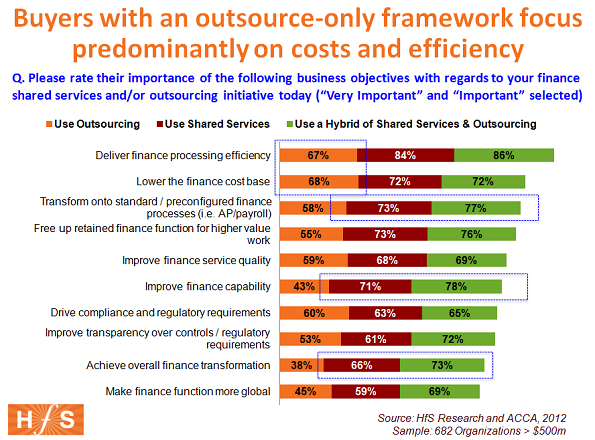
Our recent study, which we conducted with ACCA, canvassed the business objectives of close to 700 organizations with over $500m in annual revenues spread across the globe. We asked them what their prime business objectives are, based on their outsourcing or shared services initiatives, related to their finance functions:
So let’s take a look at how these camps are with regards to how today’s organizations operate their global finance functions:
Predominant model = Outsourcing. Around two-thirds are focused heavily on keeping costs on plan and ensuring efficient performance, and a good 50-60% of them place importance on standardizing process, meeting compliance goals and keeping the quality of service to the organization high. However, less than half place importance on transformation (38%), globalizing processes (45%) and improving finance capability (43%). This strongly implies that most of those firms operating their finance in a predominantly outsourced model are in the “Lights On” and “Efficiency” camps.
Predominant model = Shared Services or Hybrid Shared Services & Outsourcing. The differences between these models and the outsource-only model are striking. Firstly, these organizations are a lot more purposeful across all business objectives, which strongly suggested they feel in much more control over the finance functions and are striving to make both efficiency and transformative improvements. Secondly, it’s those organizations with a balance between Shared Services and Outsourcing, which have the most pronounced determination to achieve overall finance transformation (73%), improve their finance capability (78%) and globalizing finance processes (69%). Not only that, but they are also more focused than anyone with achieving efficiency (86%), standardizing processes (77%) and keeping costs low (72%). It’s strikingly clear that it’s the Hybrid organizations that are achieving the balance between being efficient, but also are viewing their finance function in a much more strategic light – hence these organizations appear to cross over both the “Efficiency” and “Transform” camps.
The Bottom-line: As Business Transformation Services are born, Labor Arbitrage Outsourcing Services can be ring-fenced
It’s almost as if many organizations in the outsource-only category are giving up the ghost on making innovations or strategic improvements to their finance. True, many orgs may be new to outsourcing and are merely focused on getting through the day, and also true, most outsourcing deals are (annoyingly) signed by senior executives who delegate the governance to operations teams with little clue as to what the business objective were, so only focus on meeting contractual metrics. It’s as if their world has been frozen, and they have now become resigned to maintaining the status quo.
This have some pretty serious ramifications to the outsourcing business – those buyers who only care about cost and basic risk mitigation (the “Lights On” guys) will probably never change (unless they get acquired by firms with more ambitious finance goals). So providers should give them what they want – reactive account managers who’ll jump through hoops to keep labor costs down and hit those SLA green lights, for the sole purpose of making everyone look good (even though most of those SLAs were pretty pointless in the first place).
Conversely, those organizations that have retained a good proportion of their shared services still hold out hope that they can find new ways of delivering value to their organizations, and they can leverage the capabilities of their providers to help them (read our earlier piece on this topic).
Hence, the rallying cry to the industry known as “outsourcing” is simple:
Buyers must re-evaluate their provider mix. Decide which camp you are in and create the right environment to succeed. If you are a buyer and want more than “Lights On” outsourcing, then find a provider which has the domain and consultative capabilities to work with you. If you’re stuck with a provider which simply doesn’t have the skills and capabilities devoted to you that you need, then you have a serious problem and you need to find a way to either ring-fence them and find additional third-party talent, or get rid of them altogether.
Providers must ring-fence their clients to allocate their talent appropriately. If you are a provider and want more clients in the “Efficiency” and “Transform” camps, ensure you have dedicated your higher caliber talent to supporting your existing clients in those camps, and they will form the base with which you’ll win your next 10-20 deals. You’ll always have a good portion of “Lights On” clients (you know who they are), so give then what they want and devote your higher caliber talent elsewhere. If clients want basic services at the lowest prices, then give then just that! However, it’s high-time to segment the industry so we can all focus on delivering value, and not solely cost-cutting.
Click here to read more findings from the ground-breaking HfS Research / ACCA Global “Sourcing Success in Finance Study” by clicking here.
HfS launches its inaugural advisor board (click for bios)
We’re delighted to (finally) unveil our very first research advisory board!
Now in our third year of operations, we – at HfS – have tried to differentiate ourselves in the research analyst community by providing practical insight, guidance and coaching based on real business experience, to compliment our analysts’ strategic vision for the future of global enterprise operations.
To this end, HfS invited a great group of people to form its research advisory board to help shape the HfS research agenda: some have have real experience executing operations in buy-side enterprises; some are the most influential thought leaders in the business services and technology industry; some have founded research companies; some are leading academics; some are industry events CEOs. And here they are (in alphabetical order):
Jason Busch, Founder and CEO, Azul Partners and SpendMatters
One of the leading technology pundits and thought leaders and author of the famous “SpendMatters” blog. A fellow whisky connoisseur
Naomi Lee Bloom, Managing Partner, Bloom & Wallace
The undisputed leading industry voice and thought leader in Human Resources technology. Also authors her blog “In Full Bloom”. Known as the matriarch of HR.
Sarah Clayton, Global Director, Strategy and Planning at Shared Services & Outsourcing Network
Has masterminded 16 years of success leading the IQPC’s shared services conferences spanning the globe
Fred McClimans, Founder, 2020F and Current Analysis
Founded esteemed technology analyst organization Current Analysis
Lee Coulter, CEO Shared Services, Ascension Health
Globally respected voice in the IT services, BPO and shared services strategy. Helped found HfS in 2010.
Dr. Simon Croom, Professor of Supply Chain at the University of San Diego
A globally recognized authority on supply chain management who has made a significant contribution to the study of e-procurement, supply chain strategy and operations improvement
Dawn Tiura Evans, President and Chief Executive Officer, Sourcing Interests Group
Leads the respected Sourcing Interests Group, the leading membership organization for sourcing and procurement executives
Professor Sir Alan Fersht, Fellow, Gonville & Caius College, Cambridge University
A world leading scientist and has co-founded three biotech companies. He was knighted in 2003 for his work on protein science. Yes – he is Phil’s Dad.
Dr. Iraj Fooladi, Douglas C. Mackay Chair in Finance, Dalhousie University
One of the world’s most respected economists and finance academics
Todd Furniss, Founder and President, glendonTodd Capital
Respected private equity leader in the technology enabled services industry. Developed his reputation as COO of Everest Group, during its rise to prominence.
John Haworth, Head of Globalization Center of Excellence, Cigna Corporation
Leads BPO for the $25bn healthcare insurer, and renowned career outsourcing evangelist
Ian Maher, Head of Sourcing, Hanover Insurance
Leads sourcing and BPO initiatives for the insurance services major
Ray Wang, Founder and CEO, Constellation Research
The software industry’s most widely recognized analyst and author of leading enterprise software blog “A Software Insider’s Point of View”. The most pervasive man in technology.
Roxanna Wall, Global COO, Flow Products Operations at UBS AG
A growing reputation as one of the industry’s leading BPO and shared services governance practitioners, first with American Express and now with UBS
Professor Leslie Willcocks, Head of Outsourcing Unit, London School of Economics
Internationally renowned technology and outsourcing expert, and widely recognized and the leading academic in the field of outsourcing
Full bios of the HfS Research Advisory Board can be viewed here.
Here’s a rare chance to learn how some organizations have evolved their BPO relationships from being merely “operationally efficient” through to being genuinely “transformative”. Please join us next Wednesday June 20th at 10:00 EDT | 16:00 CET | 15:00 BST | 07:00 PDT | 22:00 SGT for a discussion on how to add some serious velocity to the BPO experience. Our panel of five BPO gurus (or at least they would like you to think they are) include:
Phil Fersht, CEO – HfS Research
Mike Ward, Senior Director, Finance Operations – Cisco Systems
Professor Leslie Willcocks, Head of Outsourcing Unit – London School of Economics
Charles Sutherland, BPO Growth Platform – Accenture
Eric Simonson, Managing Partner of Research – Everest Group
You know we'll deliver everything in those 80 slides…
One of the major gripes at the recent HfS 50 Executive Council summit was the issue sourcing executives have with their provider account managers – “they just don’t understand our business” was the common cry.
So who better to lament the woes of lost sales pursuits than HfS Research Fellow and industry agitator Deborah Kops…
Building a BPO sales team
Now that I have your attention, let’s talk about how buyers whether the current parlor game of stealing sales guys from competitors really moves the revenue dial very far in light of the way clients buy business process outsourcing. Seems to me everyone is out there desperately looking for sales superstars. Do they exist? Is it worth the time and effort to find them, only to be disappointed at least half the time? Shouldn’t the industry be more focused on attracting the right solutions team, rather than assembling a sales team that’s hit or miss?
If you’re like me, you get at least a call a week from a search consultant desperate to find a crackerjack sales guy. This paragon should have a great rolodex, deep domain knowledge (retail and media seem to be awfully popular these days), a W-2 that confirms his track record, happy to travel 90% of the time, a global point of view (read: can sell offshore delivery and be culturally sensitive to legacy ownership) and willing to take a low base, say $150,000 with “a lot of upside.” Nothing less will suffice. And if the search consultant is told to reach for the stars, the successful candidate should bring a decade or more of industry or white shoe consulting experience, have a book of business ready to sign, and be viewed as an industry thought leader.
Let’s get real; the industry has very few salespeople who come even close to this profile. And those who do are either very happy with, or so aligned (read: shackled by commission payouts) with their current employer that only frustration with management, or the enticement of a better brand in conjunction with the promise of megabucks will induce them to move.
Yet providers continue to play the get the sales guy game, creating a class of what one of my good search consultant friends terms ‘mercenaries,’ who have neither produced much tangible revenue (but talk a good game), nor have stayed in an organization long enough to make an indelible impact on the company’s fortunes. Failing to attract a superstar, or get their hands on a mercenary, providers seem to settle for candidates who need on-the-job training, or come from other business sectors, say ITO or software sales, hoping against hope that they’ll magically become business process super salesmen overnight.
Is the effort to build a sales team in light of the dearth available talent misguided? What do the buyers really think about being barraged by sales guys with the wrong skills? Have you ever met with a corporate sourcing leader who pulls out a pile of cards, representing almost every one of the outsourcing majors and minors, then grouses about the fact that he/she often wastes x hours watching a sales guy wend his way through an 80 page deck that looks very much like all the others? I’ve heard the whinging, and had the pleasure myself; I’ve unfortunately seen some very good providers mentally struck off a buyer’s list because someone with an excess of confidence but no problem solving skills–and carrying a quota— is playing the sales funnel game, making 100 calls to possibly get one deal.
But does a program based upon canvassing activities really result in sales? Let’s be honest—aren’t most sales based upon a potent platform combining brand, the right level of executive management attention, so-called “chemistry” and the right solution? Even if the sales guy is good, if he doesn’t have this platform behind him, he most likely won’t win the business. Conversely, if the sales guy is inexperienced, won’t he be a deterrent to a sale even backed by the right brand and delivery capability?
This is not to say that buyers don’t want to spend time with an experienced sales person. I don’t know a buyer who will say he’s wasting his time talking to someone who brings deep understanding of the client’s particular function or domain, and is expert at synthesizing what he knows to come up with a range of solutions. Sales in the BPO industry are not based on PowerPoints, golf, and fancy dinners, but real thought leadership and problem-solving skills.
I suspect provider executive management knows full well that only a few sales people are able to move the dial; in fact, I know they do. Over a few drinks, I’ve had more than a few senior leaders privately admit that building an effective BPO sales team is very much a hit-or-miss proposition, and that when it comes to closing the deal, it’s not the efforts of a few eager blokes; rather it comes down to factors such as brand, executive commitment, value for money, and track record that tip the opportunity into the closed column.
Is there an alternative to playing the build the sales team game? Certainly brand is critical to the sale, but like Rome it’s not built in a day, or even in a year, and can’t impact a quarterly reporting cycle or two. So it begs the question: in an industry where the differentiator is purportedly a superior solution, be it more technology-enabled, insight-rich, client-centric, or cost-effective, why aren’t the phones ringing off the hook searching for superlative solutions guys–folks who can walk, talk, figure out ways to smite cost and promote efficiencies, and create enterprise value at a single bound? Why does the typical BPO org chart segregate sales and solutions when the solution is the sale? Wouldn’t providers be better served if they lusted after solutions guys that have the same polish, consultative and relationship skills as the sales guys?
The Bottom-line: Put the solutions expert at the front of the sales pursuit, not the sales guys
Deborah Kops, Research Fellow, HfS Research
Shouldn’t the solutions guys be put front and center, making the first call to the clients? Why are they often left toiling in the proverbial back room, doing the heavy lifting, only to be put in front of the client when there’s the potential of a deal? Why does the sales guy get the glory—and the commission—when it is the solution that sells? Is there something wrong with this picture?
So the next time you award…or close…an outsourcing deal, think about who and what really got the deal done? Was it a “can’t go wrong brand?” Or the right level attention from the senior-most management? Was there a chemistry that radio’d “I can really work effectively with these guys”? Most likely, it was down to a solution that checked all the boxes? Chances are it was not the antics of an inexperienced sales guy.
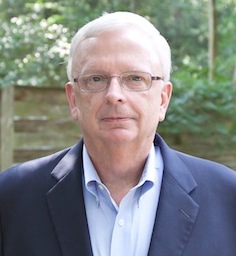
HfS Research Fellow, Pete Ackerson takes a break from gardening to pose for HfS
There’s been one dependable, consistent voice in the world of HR operations, quietly plying his trade leading the HR shared service center for a 325,000 employee retailer (Sears), as one of the first employees of the first end-to-end HR outsourcer (Exult), and, more recently, as one of the most respected and in-demand HR specialists for one of the big consulting shops (Deloitte). And he’s managed to do it always with an uncanny ability to speak his mind and never get in any trouble… so surely a poor fit with HfS then.
And when we got the news that “Pragmatic” Pete Ackerson was “retiring” we just couldn’t turn down the chance to have him spend a few hours each week sharing his lifetime of HR experiences with us – in-between tending to his rhododendrons and his vegetable patch (or whatever it is that retired people do). So… without further ado, here’s Pete Ackerson introducing himself as the newest HfS Research Fellow…
Reminders about the dark ages
Phil Fersht has asked me to join his band of analysts, pranksters, and pundits…with an emphasis on the Human Resources field. I thought I’d start off with a reminder of how far we have come and how far we have not moved ahead. As a resident gray hair…and happy to have it…I’ve been through most of the changes over the last X number of years.
Recordkeeping was a manila folder, payroll was calculated in pencil on ledgers and paid in cash, weekly (!), regulations were related to FLSA, policies were more local than national, being good at HR-stuff was how to get promoted, HR executives never made it out of HR. Some of that has changed, but some still remains as it was. If anything significant has changed (other than technologies and regulations), it has been the career path of HR executives. While few HR execs make it to the CEO-level, the competencies and contributions have changed…and for the better.
My experience has included senior HR generalist and specialist roles in a very large corporation, officer- level positions in a start-up HR outsourcing firm, and until recently, a consulting role in a Big-4 professional services firm. All have contributed to my knowledge and competencies…and to the fun I have had in these roles (well, not all the time).
I made a career choice early in my career…I opted to stay in HR roles in an organization that didn’t value HR except as an expeditor of stuff. My last role in the large corporation was being responsible for HR shared services, including payroll for 325,000 employees. I did many things right, but not everything. On the things that didn’t go well…and we all have our stories…I finally got to the point where I could not only learn from them, but also feel free to ensure that others do not go down that path. Teaching turned out to be what I loved to do best, and adding experiences (war stories) to knowledge makes the story more believable to those in your organization and to clients.
While most “HR-types” tend to drive to senior generalist roles (“I am a business partner”), what was of more interest to me was the value HR process and technology can bring to an organization. This interest caused me to focus on the administrative part of HR (back-office)…not to make HR better, but to enhance the value of people to the organization.
What I’m going to focus on with these epistles over the next months is the value, tools, and techniques of HR Shared Services and Business Process Outsourcing. In that I’m an operator at heart, we will not focus on the grand strategy of any of these, but instead look at pragmatic solutions. While I love elegant solutions, I place more value on solutions that work.
One thing we all need to learn about driving value through HR is there is no right answer; there is no single solution to anything. An example of this is tied to the question of internal vs. external delivery of services…which is better…the answer is “yes”. I will spend some time on this topic in the next installment (if Phil lets me continue).
If any of you have any subjects you would like dissected, please let me know. In the meantime, I have some weighty topics, some axes to grind, dragons to slay, and some knowledge to impart to what I hope will be an enthusiastic and kind audience.
Peter Ackerson (click for bio) is Research Fellow, HR Shared Services and Outsourcing, HfS Research. You can also email him here.