Remember the good old days, when sourcing advisors mercilessly roamed the earth in search of inexperienced enterprise executives in desperate need of experts to get them through their outsourcing transactions?
You’d a thought today’s prospective buyer of outsourcing would be able to crunch some numbers, do some research and make some difficult decisions themselves. Obviously, with deal sizes shrinking and growth slowing in today’s tentative market, more enterprises must surely be running their own deals? In this stinky economy, enterprises must be tightening the purse-strings and muddling through a lot of this stuff themselves.
Of course they’re not! Welcome to Corporate America and Corporate Whatever, where executives still want someone else to make their contentious decisions for them… oh, and do all the heavy-lifting too.
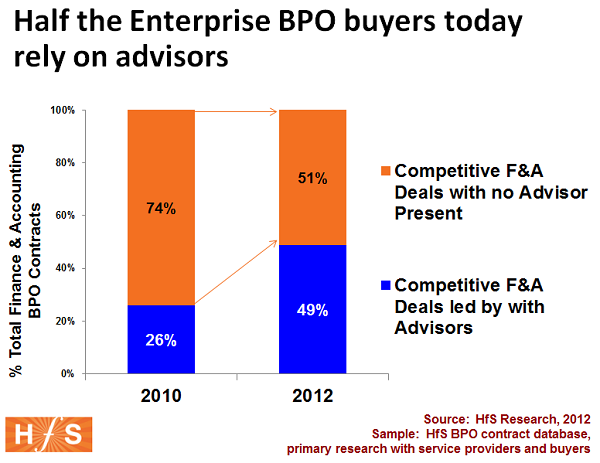
And without further ado, we can exclusively reveal that half of the competitive F&A engagements over the last year had an advisor stuck on them to get them to contract – double the proportion of two years’ ago:
So why, pray tell, are advisors in even greater demand in today’s maturing and cautious market?
Advisors are much cheaper than they used to be. We’ve seen advisors run deals as low as $30K for a quick “back of an envelope business case” and a three vendor negotiation bake-off. Compare this to the lowest price point of $300K just a couple of years’ ago. Even some of the management consultants have figured out how to wangle their internal fee structures to do this stuff for competitive project rates. On the flip-side, we’ve seen McKinsey sniffing around BPO with their clients, so some are still willing to pay top rates…
Much more data is available, which simplifies the consulting process. In the dino-sourcing days, some advisors would charge ridiculous sums of money to perform such tasks as drafting vendor profiles, averaging price benchmarks and crafting service levels. Not to mention the ridiculous science some of them developed around architecting business cases. Firstly, most of the research needed to support outsourcing down-selection and contracting is available off-the-shelf from analysts such as HfS (ahem). Secondly, most of today’s contracts (sadly) are too frequently copied and pasted from each other, and new buyers can enjoy the same insane manifestation of SLAs and clauses that make little business sense, but make them feel they are going to get incredible provider performance, once the ink has dried.
Most executives hate taking on onerous and resource intensive work-tasks. It never ceases to amaze me that the first thing every consultant has to do when he or she evaluates a BPO engagement, is to request the client documents their processes. And 90% of the time the consultant ends up doing it for the client (and bills another hundred grand for the privilege). And don’t even get me started on running operational analysis, mapping out the workflows etc.
External validation during an initial transaction can still be incredibly valuable. While people can claim that the whole outsourcing transaction process has become commodotized, there is still an enormous about of risk involved – and while less money needs be spent on many of the tasks mentioned above, having third party validation on selecting the right provider and getting a decent price can (and usually does) save millions – and a great deal of pain if a lousy service provider is selected. I recall a recent example where an advisor showed up at a client for two days and saved them $5m off the TCV of the contract and made sure they went with the best provider – and he only charged about $30K for the time and effort involved.
Providers continue to recommend advisors for a competitive deals. The average pursuit costs for a provider chasing a complex engagement can go well over the million-dollar mark in some instances (even though they are getting smart at slimming down their own sales pursuit resources). And an inexperienced client can make the provider jump through all sorts of hoops – and there isn’t much the provider can do… but jump through them. Plus, we’ve seen some buyers take providers all the way up the aisle and then get cold feet, with no warning. Providers have peace of mind that a decent advisor will rarely allow this to happen – and they also are comforted by the fact that if the buyer is paying for the advisor, they are actually serious about going through with the deal. Obviously, if the provider is in pole position for a sole source deal, the last thing they would want is an advisor who’d come in and recommend some competitive bidding…
The Bottom-line: Transactional advisory lives to see another day
While the combination of increasing commodization of basic BPO services and an ever-smartening buyer, seemed to signal the end of transactional advisory services, the consulting industry has found a way to adapt to keep itself relevant and much more price-friendly, while still being in a strong position to help clients deal with the sensitive and political task of outsourcing. However, as the deals get smaller and the role of BPO proliferates into one vehicle of many for business operations leaders, the consulting community will need to increases its broader sourcing skill-set to deal with blended shared services/BPO models, and have a great degree of process knowledge and consulting finesse to deal with complex corporate situations. There’s a reason why the likes of KMPG, McKinsey and PwC are in this space – they see the bigger picture that BPO transactional support is one arrow of many that they need in their quiver to help operations leaders with ever-increasing global needs to keep their companies competitive.
Missed today’s revved-up BPO discussion? How could you? What else were you doing?
In any case, we recorded the track for you! Click here for a rare chance to hear how some organizations have evolved their BPO relationships from being merely “operationally efficient” through to being genuinely “transformative” for their businesses across finance, HR, customer management and other industry-specific processes. Or… as we put it today, going from low performance to high performance. Yes… it’s time to stop leaving the money on the table.
Phil Searle, Research Fellow, Shared Services Strategies (Click for bio)
In true HfS style, we’ve managed to persuade another industry legend, while he was propping up the bar at some event (again most likely in Orlando, but this one’s a little fuzzy) to contribute some of his life’s work to our charitable research service. And again, in true HfS style, what was discussed over a couple of single malts is translated word for word for public consumption shortly after said inebriated conversation.
So, without further ado, we’ve invited shared services kahuna, Phil Searle, to share with us all exactly why he was bemoaning the fact that so many enterprises today are moving at a glacial pace when it comes to shifting work into their expensively assembled shared services centers, let alone give it to their outsourcing partner to manage…
Failure to Launch
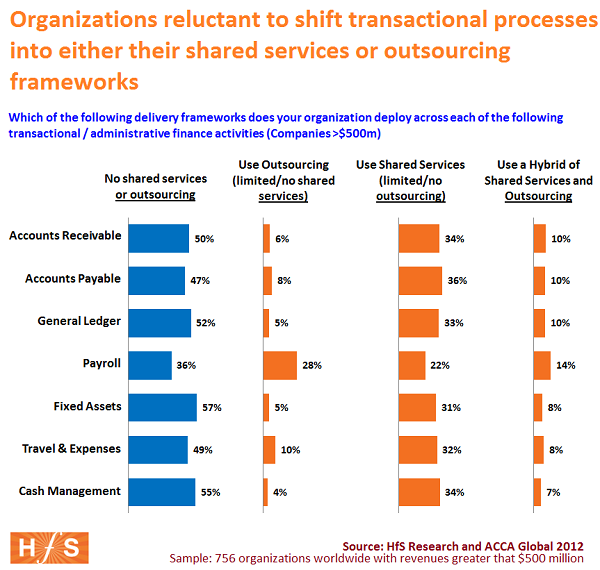
On the surface, it appears that most enterprises today are taking full advantage of both shared services and outsourcing – last year, HfS Research’s State of Outsourcing study revealed that 97% of large organizations greater than $1B in revenues outsource to a degree, and 90% have a shared service capability in place. However, HfS research’s latest survey data, conducted with accounting association ACCA, emphatically demonstrates that only a modest fraction of business process has actually been shifted to either the shared service center or the outsourcing partner. In most cases, over two-thirds of transactional process work is still, bewilderingly, sitting in the business units, despite the proven business benefits of centralizing processes.
According to various, widely published research, it seems that the vast majority of “large” companies today are making use of shared services, business process outsourcing (BPO), or both. Indeed, the implementation and operation of shared services and BPO has helped many organizations save millions of dollars/euros/pounds, improve internal service delivery and enhance the control environment. This is what we call the potential “triple benefit” of shared services and BPO). Yet, despite the obvious value, why do so many firms limit the scope of shared services, BPO and broader global business services programs?
The results show exactly how much scope organizations exclude from their shared services or outsourcing strategy. Frankly, the numbers are not that impressive. For example, 47 percent of respondents exclude accounts payable, generally regarded as one of the least “core” and strategic processes, from their shared servicing and outsourcing efforts. The figures are just slightly more impressive for payroll, with 36 percent of firms excluding it from their shared services or outsourcing strategies. More startling is fixed assets, one of the most frequently included processes in outsourcing and shared services programs. Nearly 56 percent of respondents still have no shared servicing or outsourcing in place. The amount of scope kept out of shared services and outsourcing strategies is quite staggering.
The same study also illustrates that while “moving up the value chain” has long been pointed to as being on the growth path for internal shared services and outsourcing, the reality is that few organizations have shifted higher value processes into their shared services and outsourcing programs. Perhaps for certain functions this is not surprising. For example, 75 percent of respondents have no shared servicing and/or outsourcing in place for financial planning and analysis while tax filing and tax analysis are largely outsourced or included in shared services performed (although only a slight majority, as 43 percent and 46 percent of respondents, respectively, stating that these are still performed in house).
While many organizations adopt shared services and outsourcing to some extent, their programs are still nowhere near as broad and comprehensive as they could be. While delivering accounts payable services from a shared service center may deliver some benefits to the organization, in the scheme of things and in the light of the potential scope, if this is all they have done, it is no big deal! Organizations today are still leaving so much opportunity on the table.
Looking forward, is this good news or bad news for shared services professionals and the outsourcing providers?
The answer probably is that it is both. As highlighted, opportunities abound. Practice and evidence strongly suggests that, where shared services or outsourcing is implemented in the right way (and there is definitely a wrong way to do this!), the benefits can be very compelling. So, organizations have plenty of runway left to deliver much more value to their “host” businesses. Furthermore, for small to medium sized companies and organizations in the public sector, the opportunity can only be described as massive! For example, shared services in the public sector is relatively new and broader outsourcing even newer.
The bad news is that there are real, embedded constraints that have meant that organizations have not moved forward with shared services or outsourcing as far and as fast as they really could or should have.
The “safer to do nothing” attitude needs to be overcome
We have all heard about the importance of change management to the successful implementation of shared services and outsourcing solutions. However, it is so poorly described and even more poorly actioned in practice. Change management is not just about “communication, communication, and communication” – it is far more than this. We cannot go into here our detailed views on the impact of poor understanding and approach to change management, except to say that we have seen both great and awful examples, and everything in between. Unfortunately, the ‘not so good-to-awful’ tends to predominate. This delays change, limits growth and constrains realization of the benefits. (Read more in our 2011 study Misunderstood and Poorly Handled: Change Management for Outsourcing).
This also links to the fact that, in the real world, organizations always exhibit a great deal of opposition, at least initially, to taking work and responsibilities out from the local business units/departments/countries and moving them to a new organizational service delivery structure. Why is this? It is pretty obvious really. Organizations are “downsizing” scope, responsibility and the size of local teams in favor of more “centralized” delivery structures. And often, many people are directly impacted in terms of their roles and responsibilities, and some of course may lose their jobs.
In addition, there is often great skepticism at the local level about centralization and a lack of trust in “Corporate”. This is sometimes quite well justified. This links to another great mistake sometimes made. While there is so much talk about “serving the internal customer”, the methodology to actually put this in place – what is called the customer relationship management framework – is rarely as robust or as comprehensive as it should be. It is “all about the customer.” but sometimes the reality does not reflect this. There are many components of a truly effective Customer Relationship Management (CRM) framework in support of shared services and outsourcing programs and all should be considered to ensure success and, critically, to develop broad, long-term buy-in. Centralization is not the same as shared services, and it certainly guarantees no success. And “your mess for less” outsourcing achieves labor arbitrage, but is not going to build any sort of internal desire for more of the same either.
The financial payback times can often be longer than desired, and therefore this can delay making the decision to actually do something. It is also much easier and “safer” to do nothing. We have seen many examples of what is sometimes described as “analysis paralysis”. We prefer to call it a lack of will. Linked to this is what we call “negative collaboration”.
There is definitely the need for positive collaboration as part of effective change management and CRM, but there is also the danger of too much collaboration. Consensus is important and any significant change program should encourage constructive criticism, but eventually stakeholders must make a decision and support it, even if they need to agree to disagree. After all, if everyone has to be happy before anything is done, then nothing will get done.
The Bottom-line: Organizations must avoid being railroaded from their ultimate goal
There will always be the “what’s in it for me” winners and losers. The key is how to identify who is in which bracket, be honest and clear and support the change, but not be railroaded from the ultimate goal, which will ultimately impact people, by design and necessity.
It is no surprise that there is still huge scope and opportunity for shared services and BPO. Our frustration is that the “practitioner and provider community” has not done a better job at selling the benefits, driving broader take-up, and implementing truly customer-focused solutions supported by real change management. There are for sure many excellent examples of success, but there have also been less well-publicized failures. There remains such a significant amount of untapped value. While shared services and outsourcing continues to grow and expand, it still does not grab as much attention in the C-Suite or in general business economics as it should. There is still a tremendous amount of work that needs to be done if this is to change.
Phil Searle, pictured above, is HfS Research Fellow covering Shared Services Strategies. You can view his full bio here and download a copy of his recent research article here.
Life been just dandy since you took 30% off your department’s fixed costs, that you’ll never need to do anything much again in your career… except stare at a spreadsheet? Just love keeping those lights on and squeezing penalty payments out of your provider? No need to improve anything, because the way your firm does things is simply perfect?
Then you won’t need to waste time with us and leading buy-side organizations from the HfS 50 Executive Council in Boston this October…
Yes, the Blueprint Sessions are back to add real momentum to the recommendations we discussed with 41 leading buyers executives and six of the top providers in New York City this past April. The key themes are as follows:
1.Overcoming the singular focus on cost that strips the industry of value;
2.Leveraging outsourcing as one of a variety of vehicles to achieve business objectives;
3.The need for service providers to invest smarter in their account management teams; and
4.The need for buyers and providers to partner to foster innovations into business and IT process outcomes.
So if none of this interests you, you won’t want to email us for more information to find out if this session’s right for you or your organization.
Finally….a Blueprint for this outsourcing business (click to access)
Ever wondered what would happen if you locked 41 outsourcing buyer executives in a room for a couple of days, then brought in six of the leading providers to have an afternoon’s discussion? Well, now you can read for yourself, as today we unveil our first Blueprint report for this curious industry known as “outsourcing”.
Captured in the Blueprint are the four key challenges the buyers agreed are facing the outsourcing industry today:
1. Overcoming the singular focus on cost that strips the industry of value;
2. Leveraging outsourcing as one of a variety of vehicles to achieve business objectives;
3. The need for service providers to invest smarter in their account management teams; and
4. The need for buyers and providers to partner to foster innovations into business and IT process outcomes.
And we (eventually) agreed on 21 definitive recommendations to help ensure this industry (whatever we decide to call it) doesn’t slide into the trap of commoditization. So what are you waiting for… download your free Blueprint now!
I would like to personally thank all of you HfS 50 Executive Council Members who made such great contributions to the development of the report, the service providers who left the PowerPoint at home and dropped the sales speak for an afternoon, and the HfS research team for all their considerable efforts in making this happen.
However, this is only the start. This is just a report with facts and recommendations. The real work starts now in trying to action many of these recommendations and changing the way this business actually operates. I can’t wait to meet many of you again in Boston this October where we will start putting these plans into action,
So we’re now one election away from the biggest outsourcing opportunity ever… the healthcare insurance industry trying to figure out how to move from a B2B to a B2C model. Quite simply, the insurance companies ain’t gonna figure out how to send a nuclear warhead into their service and IT operations… they’ll turn to the outsourcers to do it for them. Tony Filippone, who actually managed much of Wellpoint’s operations for nine years (a $62 billion healthcare insurer) might know a thing or two about the implications healthcare reform will likely have…
In terms of politics, it’s not over. Today’s Supreme Court healthcare reform decision simply clarified two issues. First, that the individual mandate is a constitutional tax, not an unconstitutional act by Congress to regulate commerce. Second, if states choose not to expand Medicaid benefits, they can elect to not follow the law without losing all of their Federal funding. More legal detail can be found here.
Any hope by Republicans to overturn the law in the courts is now officially dead. This is largely due to former president George W. Bush’s nominee for Chief Justice, John Roberts (oh the irony). Chief Justice Roberts sided with the liberal side of the court on the interpretation of the individual mandate as a tax. Some legal scholars’ interpretation of the minority’s written dissent suggest that Roberts changed his position in the last few weeks, but we will never know, due to the Supreme Court’s tradition of privacy.
All Republican political hopes are now pinned on winning both a majority in the Senate and the presidential election. With 22 Democratic seats in the 33 contested in this election, political analysts suggest a Republican majority in the Senate isn’t far fetched. A majority is necessary to repeal the law using the same reconciliation tactics Democrats used to pass the law to avoid a filibuster. However, political analysts aren’t as sure who will win the presidential election.
One thing they are sure of: Mitt Romney’s election platform will feature accusations that President Obama’s major increase in taxes will kill jobs and that President Obama lied when he said healthcare reform was not a new tax. Frankly, the country would benefit from both parties collaborating on important changes that could benefit everyone, such as tort reform and creating more competition and consumer flexibility by allowing insurance to be sold across state lines.
While the healthcare insurance industry will likely contribute to the Republican presidential and senate election funds over the next four months, the health insurers have no choice but to address serious operational inefficiencies and develop strong market strategies for individual products. According to the AMA, one in 10 claims are still incorrectly paid.
If Obama wins the presidential election, healthcare reform will cause many companies to drop group coverage and individuals will be required to buy insurance through Federal or state exchanges. Overnight, the huge business-to-business group health insurance market will turn into a consumer market free-for-all. Insurers will need to compete on price, service quality, hospital and physician network quality, and their ability to improve the health of their customers. All in a market where services are regulated, profits capped, and products are sold on transparent public exchanges. Much of the healthcare insurance industry will finally have a burning platform to radically overhaul decades of inefficiencies, or risk declining profits, Clearly, healthcare reform does little to address the quality, cost, or accessibility of care. It particularly focuses on insurance while ignoring tort reform, poor medical practices, and providing sufficient quantity of practitioners to meet the growing demand. Any way you cut it, cost reform needs to follow and the outsourcing industry has a huge role to play in helping force this change.
The Three Major Operational Problems Facing Heath Insurers
The first major problem is that health insurers currently have weak individual product operations. Sales teams have relied heavily on brokers, whose future looks similar to the travel agency industry following the advent of online booking websites. Individual underwriting and enrollment processes currently take weeks (or months) with today’s relatively low volumes, while organizations like Geico can issue car insurance in hours or days. Unlike the credit card industry, customer profitability analytics are weak and risk-based marketing strategies are nascent. Health insurers need vastly improved capabilities.
The second major problem is outdated processes and service. With today’s technology, there is no excuse for inefficient offline batch processing of eligibility, claims adjudication, and pricing that takes weeks or months to resolve and is so prone to error it created a mini-market for retrospective claims overpayment and underpayment audit services. Customers must be able to swipe their card at point of purchase, know immediately what they are eligible to receive, and review prices. When they leave, they should settle their bill. However, few insurers process their medical claims and billing in real-time. If insurers really want to differentiate on service, they’ll need to dramatically improve their operational capability, not just their customer web portals.
The third major problem facing insurers is the viability of their claims to improve the health of their customers. Can they really do it? On a one-on-one basis and on the scale required in tomorrow’s larger individual market? Most insurers leverage third party wellness services that cater to commercial group accounts where messaging arrives in employee’s inboxes via human resources. Almost no third party care management companies have the scale to manage the health of millions of members in a meaningful way. Disease management companies face the same hurdle.
The Bottom Line: Open Enrollment Begins in 2013 and many Insurers will have no choice but to turn to the outsourcers
Moving from a B2B to a B2C model with insurance is a huge step and requires a very different delivery model. It’s like asking employees to select their own payroll provider individually to process their paychecks. The scale required in increasing their customer support is going to put unprecedented strain on their cost models. This may create an entirely new outsourcing model where the insurers simply outsource many of their services to other outsourcers who have much more discipline and experience in scalable service delivery. Enter the likes of Accenture, Cognizant, Dell, Genpact, IBM, Infosys, Wipro and Xerox.
Tony Filippone is Executive VP for Research (click for bio)
Up to this point, insurers have competed by reducing costs, largely by consolidating operations and systems and, where permitted by state insurance regulators, leveraging offshore labor arbitrage. While organizations may be able to survive healthcare reform by continuing these approaches, but they wont thrive. Significant investment is necessary to simply prepare for open enrollment that is months away, but an enormous amount of capital is necessary to decisively win market share over the three year rollout of the reforms which continues through 2017. To win a piece of this influx, services providers must flexibly support tactical backfill requests to overcome near-term shortcomings. Yet, strategic partnerships are necessary to bridge the bigger gaps, which means many of the service providers have to change their arbitrage-based approaches to focus on transformation and invest in capabilities their customers need.
Name the one person who’s never present in an outsourcing business case evaluation, provider down-selection or contract terms meeting, but has a real vested interested in the discussion? And no, it’s not your shrink.
Having the Chief Security Officer (CSO) show-up during your outsourcing meetings is akin to your inviting a cardiac specialist to a no-holds-barred steak dinner with all the trimmings. The CSO is the ultimate party-pooper, the much-derided control-freak who cares little for business outcomes, only the potential disasters that may arise along the way. Why bring them along to put a spanner in the works (unless that’s your agenda….)?
HfS Research Director, Jim Slaby, never shy to call out the inanities of today’s quirky corporate cultures, has been working under cover to find out how the CSO party-poopers were being engaged in the whole outsourcing experience….
Managing Security and Risk in BPO Engagements
The most overlooked, swept-aside and brushed-under-the-carpet issue in outsourcing is the lame effort most buyers make to manage their exposure to security risk in outsourcing engagements. As a self-styled security nerd, I’m frequently horrified by the lip service that many outsourcing buyers and providers give to security. Bring up the “S” word with buyers and their eyes glaze over; ask providers for a briefing on the security capabilities of their outsourcing offerings and they run a mile. Why is this topic so eagerly avoided in today’s global business environment? In an increasingly regulated world full of increasingly sophisticated security threats, aren’t buyers and providers alike courting disaster here?
If you work in the enterprise security space long enough, you come to understand Scott Adams’s Dilbert parody of an evil, sadistic Chief Security Officer (CSO), a pointy-eared fellow called Mordac, the Preventer of Information Services. Mordac embodies the stereotype of intrusive, overly arcane IT security regimes, the kind that seem designed to hinder useful business processes and add layers of complexity to simple tasks, to say nothing of inflating costs and frankly boring you to death.
For instance, why exactly does your password need to be at least eight characters and include a mix of uppercase, lowercase, numbers and special characters? (Actually, that’s not considered great password practice any more: eight characters are pretty easy to crack with brute force, and users have a tendency to scribble hard-to-remember passwords on Post-It notes.) Or, why won’t IT let you connect your iPad to the corporate network when it is less vulnerable to endpoint malware than your Windows laptop? What’s the point of this restrictive new company policy on employee use of social media?
Of course, you probably have an inkling that it’s a scary world out there, full of criminals who look at your databases of customer / patient / payment-card information like a pack of hungry wolves gazes at a flock of baby lambs. You may recognize that, despite the intricate defenses your CSO has erected around your company’s precious data assets, many breaches occur at the hands of malicious insiders — but as often through the garden-variety laziness and inattention of otherwise well-meaning employees. You may know rather less about emerging new threats, like the gangs of elite programmers whom the Chinese military is giving unlimited time and funds to discover new ways to penetrate and crash your systems, part of a new strategic front in the geopolitical struggle for world dominance.
And have you considered how many people are touching your critical data assets, with multiple providers comprising hundreds of thousands of employees around the globe managing many of your back office business and IT operations? Have you given any thought to what their subcontractors are doing, whether they present any data privacy or compliance risks that aren’t covered by your contract with your primary provider? Feeling any agita yet?
We have already demonstrated that some of the appeal of those endlessly-hyped cloud-based services is the ease with which line-of-business managers can go out and help themselves to cheap, on-demand virtual-server cycles: so easy, so fast, so flexible! Not to mention the appeal of not suffering the onerous requirements that IT security is likely to impose if they get involved.
Yes, addressing security concerns up front takes time and adds costs, making the business case for your outsourcing project more challenging. But unlike Mordac, CSOs and smart outsourcing executives are focusing on security for sound business reasons: weighing business risk against business advantage, performing a sober cost-benefit analysis on business processes and the technologies that underpin them. That’s what we’re about, or should be about — and if your industry is one that comes under regulatory scrutiny of any kind, the stakes get much higher for everybody in a hurry.
Fortunately for us, many of you veteran BPO buyers understand that security and risk management are not just annoying layers of overhead that must grudgingly be accommodated. You recognize that the security threat environment is getting more complicated and sophisticated with every passing quarter. Further, you realize that your management is increasingly aware what’s going on: in particular, compliance scrutiny has a way of tuning the antennae of your C-suite to the adverse effects of security breaches on company profitability, brand equity, and the trust of your partners and customers.
Finally, you grasp that effective security and risk management cannot be properly achieved as a bolt-on, a layer of spackle and paint slapped on after the deal is mostly done. Rather, it has to be imbued in the DNA of every member of the sourcing team, inculcated into the skulls of your legal staff via first-hand experience of the relevant security technologies, settled into the bones of the provider evaluation and contract negotiation processes, kept well-toned after the signing with diligent monitoring and auditing.
We spoke to a Fortune 200 company about its security experiences with BPO
HfS Research was fortunate to have the lead sourcing and security executives from one such security-savvy buyer talk with us at length (under NDA about the company’s identity) about exactly how they achieve these goals. It’s a frank and fascinating look inside the end-to-end BPO sourcing process as managed by a Fortune 200 company in a highly-regulated industry that has, knock wood, managed to avoid a headline-grabbing security breach so far. We believe that their exacting processes and relentless focus on working security into every aspect of their provider vetting, contracting, and auditing processes — like the long, slow application of low-temperature applewood smoke turns tough, stringy pork shoulder into tender, delicious barbecue – is directly responsible for that enviable security track record in BPO.
James R Slaby is Research Director, Sourcing Security and Risk Strategies (click for bio)
Entitled “Managing Security and Risk in BPO Engagements”, it’s a rare, detailed look at how one of the big boys works security and risk management into its BPO sourcing process programmatically, from top-to-bottom and start-to-finish, and thereby does it right. For providers, it offers insight into how to put on the kind of good security showing that wins the favor of such a buyer, gaining entrance to its “charmed circle” of preferred providers and winning a coveted invitation to compete for all that buyer’s future deals. Regardless of which side of the table you sit on, it’s six pages that are well worth your time.
However you like to wile away those sultry summer hours, we can be pretty sure it’s not dreaming up merit badges for outsourcers. Maybe it’s time to introduce our notorious Deborah Kops to the local bridge club, or growing vegetables or something….”Lord, no!” I hear you cry. In that case, take it away DK…
Outsourcing Provider Merit Badges
Given the demographics of the industry, it’s probably as stretch to think that many of us know that this year marks the 100th anniversary of the founding of the Girl Scouts. As someone who was a Girl Scout until she was 18 (because co-ed canoe trips were relatively unsupervised—I was not good at knots), and still has her badge sash, I think it’s only appropriate that outsourcing providers have their very own merit badges, too.
Let’s cut the hype about training and certifications—the reality of the outsourcing industry is that you’re not truly a member of the club until you’ve earned sufficient stripes to join the pantheon of those who are battered, bruised, tested and tried—and inextricably dedicated to making outsourcing the model of choice for global—and not-so-global–enterprises everywhere for functions big and small; core or non-core; rules-based and complex; offshore, nearshore, and even onshore; automated or leveraging labor arbitrage, regardless of domain.
So, providers of the world, examine your experience to see if you’ve earned Deborah’s top 10 meritbadges. And if you can suggest some that I’ve missed, I’ll ask my personal badge maker to get busy.
BID FODDER BADGE The award of the bid fodder badge signifies that the client that you’ve chased for nigh on a year was just using you to put leverage on his current provider to shape up, give some concessions and slash their FTE cost to an under market rate. Or said client had a provider all picked out and opened up the bid process merely to keep the procurement police at bay.
Then, when the inevitable happens, you suffer the agony of hearing all the internal “I told you sos” as you try to justify the fact that you’ve just spent precious time and resource, not to mention trotted out your company’s great and good to the final presentation. After you earn this badge, pick yourself out of the slough of despond, make a promise that you’ll listen to your intuition next time, and only pursue client opportunities without entrenched incumbents or that are not pre-sold.
SCOPE SHRINKAGE BADGE The RFP clearly set forth that the client was outsourcing end to-end in virtually every geography, encompassing all business lines. But by the time the down select numbers three, what was purported to be a cool 1000 heads transitioning over three years shrunk down to accounts payable in Scandinavia (with the promise of untold sourcing riches if it is deemed by the businesses…at their sole discretion… to be successful.)
Talk about throwing a spanner into the works. The infrastructure guys have factored the deal into their facility plans. Your investors finally believe your sales and marketing strategy is paying off. Your CEO has all but named the deal in the last earnings call. Your spouse has emotionally spent the commission. And you’re left with a little pilot with fees that don’t even cover the cost of the pursuit. Consider yourself as having entered the big leagues. Wear your badge with pride.
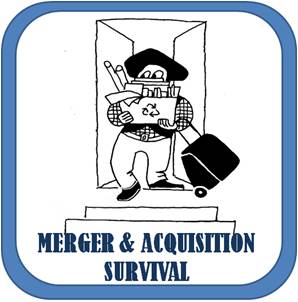
M&A SURVIVAL BADGE In an era of consolidation, surviving the marriage of two provider cultures and coming on top—or at least with your position intact—takes a rare set of skills: exuding just the right amount of enthusiasm for what may seem a nonsensical combination; (privately) mourning the loss of the culture you loved; and backing the right political horse, all the while subtly threatening to move on if you don’t get what you want without looking like you’re not a team player.
If your company is the conqueror, being nice to your new colleagues after trashing them in the marketplace when they were the worthy competition earns you credits. And if you are one of the vanquished, the speed with which you are able to pick up the new corporate speak helps you attain the prize.
If you gain responsibility and scope (not to mention a fatter paycheck) through the integration, give yourself 10 extra points. But if the deal is a temporary setback and puts you out on the street, remember that M&A in the outsourcing world is now a fact of life, and ensure you suss out the intentions of your next employer….and vest immediately if you are sold…as you proudly display your badge.
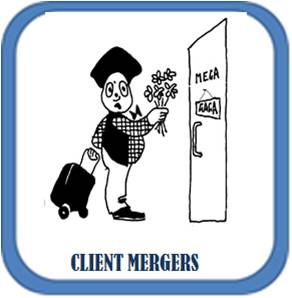
CLIENT MERGER BADGEAfter a year’s pursuit, and eons getting the operations to green on the dashboard, suddenly your client merges with or is acquired by another company, either with a full complement of provider relationships, or an entrenched cultural aversion to anything ending in –sourcing. And it appears that your client is not calling the shots.
No matter that you’ve saved enough dosh for the client to purchase the Queen Mary II, or that there’s so much satisfaction with your delivery that the relationship manager sings your praises at every SSON or IAOP event; your contract appears to be the outsourcing equivalent of a marked man.
So you enter the survival fray, looking for chinks in the other providers’ armor. You tout out the big guns to demonstrate your undying commitment to the relationship. You start preparing a “compelling value proposition” to proactively head off a client loss. And you put the screws on the delivery team, telling them that 99 percentile performance is now a given. But either the other provider is best golfing buddies with the surviving CEO, or there’s no way on God’s green earth that the company will export jobs offshore, even if it means 200% savings. Give yourself extra credit for a valiant effort, keep in touch with your client because he or she is sure to end up as a buyer elsewhere, and sew on your merged out of a deal badge.
NEW MAN-AT-THE-TOP-BADGE With the first generation of outsourcing leaders now counting their millions while they jet around to play on the world’s leading golf courses, their successors are a very different kettle of fish. The pioneers are now out of the business; the new breed of leader has very different pressures: avoiding being acquired; containing cost in the face of competition and currency fluctuations; satisfying increasingly demanding shareholders; and creating differentiation in a market where clients believe that most cats are black in the night.
Whether the new man has is a superb politician, having been groomed internally to take on a new job, or brought in from the outside without any direct experience in the business (the so-called “strategic” hire), change is inevitable. Those changes could range from the seemingly ridiculous such as forbidding business class travel on 15 hour flights—to the sublime, moving into new lines of business with nary a credential in the entire company. And if the new chief is an outsider, you can bet your booties that he’ll soon transport the culture (and henchmen) from his previous gig.
If you can keep your place in the new org chart, immediately award yourself the badge. It means that you either have 1), a godfather somewhere in the business; 2), good karma; or 3), pictures of someone important. However, if you see the handwriting on the wall soon after he moves into the corner office, and are able to land a better position without being obvious about your loss of power and prestige, you win, too.
MUSICAL CHAIRS BADGE You’ve done such a stellar job selling, solutioning or operating in the insurance domain that management thinks you can learn shipping overnight. Or perhaps you’ve done a great job in India, but someone in power thinks it’s time for you to deliver the same results wearing a Boston Red Sox cap.
Your boss, working on the premise that smart people in the outsourcing industry can do anything, calls your bluff and asks you to open up the Kazakhstani market. He preys on your fealty, reminding you that he accommodated your request to transfer for personal reasons several years ago, and dangles a few hundred shares in front of you while he not-so-subtly tells you that you will be the spoiler in his game of musical chairs. Get the badge either for being a good sport, performing with grace in the new role, or being able to keep your old job despite the fact that you played havoc with the new organizational schema.
10 MONTHS AWAY-FROM-HOME-BADGE Nothing screams outsourcing bona fides like spending the best part of the year solutioning or transitioning in any country where a visa is required. No matter where you are stationed, chances are your company will land a deal big enough to demand the personal sacrifice of spending untold months in a hotel room, serviced apartment or guest house where 1), you cannot swing a cat without hitting the walls; 2), the color beige drives you to drink; 3), there are no English channels on the telly; or 4), mosquitoes have taken up occupancy. And although the company is allegedly family friendly, you’re only permitted one week off every 2 months.
Give yourself points for missing your wedding anniversary or your child’s first day of school, while still being on good terms with your spouse. Add an extra credit if you get a local colleague to help you track down a peace offering in the form of a good deal on an I-Pad for your teen or diamond earrings for your wife. Tick the days off in your diary while you recite the mantra “never again.” And fasten the badge in a very prominent place, sending the message that you already gave at the office.
ECONOMIZE FOR THE GOOD OF THE COMPANY BADGE As outsourcing margins decline, your management starts to scrutinize every cost. Getting permission to travel or use your cell phone overseas requires something akin to divine intervention. Business class travel (except for a select few) and staying at run-of-the-mill Marriotts are now seen as unjustifiable and unaffordable luxuries. No matter that you’re expected to roll off 15 hour flights with barely sufficient time to wash up in an airport lounge before making that make-or-break client presentation, or the guest house’s air conditioning hasn’t worked for two years—it’s considered inappropriate to waste the company’s money on frivolous expenditures.
In the name of economy, open reqs to fill authorized client service positions, even when paid for by the client, must go to the top of the house before HR will start the search. Attending an industry event means completing a 20 page business case. Making do with a laptop that still runs Windows 2003 is good for the soul.
If you can hold your tongue while the boss spends lots of dosh branding a sports event, or after you find out the ice sculptures at the client event cost $2500 each, you’ve earned your badge. Better yet, if you can get a $125 per night deal in a New York hotel without bedbugs, you’re an economizer extraordinaire.
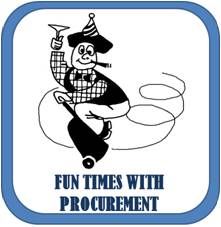
FUN TIMES WITH PROCUREMENT BADGE 100 page RFIs sent to 14 providers in order to be “compliant.” Best and final bids required without any discussion of actual scope. Questions about your company that are so invasive they ought to be covered by the Official Secrets Act. e-Auctions that make a mockery out of any solutioning process. These stories…and more…render outsourcing truths much stranger than fiction. Whether the procurement department is actually driving the deal, or is carefully monitoring the sourcing leader’s every move, understanding that their modus operandi sometimes can be summed up as the three Cs—control, cutting cost, and compliance—will help you get through selection and contract.
Give yourself credit if you find a way to skirt around the procurement rules without being obvious. Pat yourself on the back if your partner in crime is the sourcing leader. Pump the air if you are still on speaking terms with the procurement manager when the contract is signed (after all, he’ll be monitoring contract compliance going forward). And praise the client’s procurement department to the skies when you write up the case study.
INABILITY TO PLEASE THE CLIENT BADGEThe transition is spot on target, or the operating stats meet all SLAs. There’s barely a stray yellow on a very green dashboard. The delivery team’s attrition is within normal bounds. Yet no matter what you do, short of getting on your hands and knees outside the client’s office (or giving him your firstborn), nothing is right. Or ever will be. Either the client team is playing a very elaborate and expensive game of gotcha, or they hold a residual grudge that the good old days of internal command and control are long gone.
Your account leader dreads every Monday morning’s email abuse, and threatens to quit every Tuesday. Supervisors shudder when the client makes his floor rounds during the quarterly business review. Staff refuses assignment to the client, believing that is the equivalent of the career kiss of death.
If you survive a QBR without losing flesh, it’s five points towards your badge. If your boss is entirely sympathetic and does not blame you, award yourself another five. If the client gives your firm a glowing reference, understand that the sun, moon and stars are aligned for the first time in 20 years, and don’t tempt fate by asking again. If the client renews and expands scope, praise whichever deity you believe in. (And move ever so deftly to get reassigned to another account.)
Deborah Kops, Research Fellow, HfS Research… thriving on meritocracy
How many of these badges have you earned? Perhaps it’s time to set up a scout troop replete with a Provider Pledge (paraphrasing the Girl Scout pledge). So hand over heart and repeat after me, “On my honor, I will try, to do my duty to attract and scale good clients, to deliver value better, faster and cheaper, with transparency and good governance for all.”
Stay tuned for the Client’s Outsourcing Merit Badges. You deserve them as well.
We are inviting you to share your views and experiences, in the strictest confidence, on the pros and cons of outsourcing IT and business processes TO the United States of America, compared with other global regions:
Essentially, we need your deep opinion on:
Is the USA a viable outsourcing location?
How successful have your company’s efforts been?
And if you haven’t tried the US yet, then why not?
It’s more important than ever to gather the candid views of business executives like yourself to understand how the USA can be more competitive as a global location for accessing talent and improving business operations.
As a thank you for your time, we will share an executive report of the study findings and give you the option of entering you into the prize draw for an iPad3.
Your candid views and experiences are always so important in supporting the research we conduct at HfS, so please spend a few minutes with us on such a hot topic.
We are also grateful to our friends at the Sourcing Interests Group for supporting the study.







 So we’re now one election away from the biggest outsourcing opportunity ever… the healthcare insurance industry trying to figure out how to move from a B2B to a B2C model. Quite simply, the insurance companies ain’t gonna figure out how to send a nuclear warhead into their service and IT operations… they’ll turn to the outsourcers to do it for them. Tony Filippone, who actually managed much of Wellpoint’s operations for nine years (a $62 billion healthcare insurer) might know a thing or two about the implications healthcare reform will likely have…