Twenty-twelve has already seen three major outsourcing provider name-dumpings with Xerox phasing out ACS, in addition to procurement outsourcers Buying Team and ICG Commerce re-branding themselves Proxima and Procurian respectively.
Brian Robinson is Research Director, HfS Research (click for bio)
However, a more surprising move has recently transpired with iGATE Patni deleting the last fives letters of its name to call itself simply “iGATE”. While you can understand Xerox preferring their more famous and recognized brand to ACS, and the procurement guys simply wanted to sound sexier, it’s curious why iGATE would drop the famous Patni brand barely a year after its merger. You would have thought the lesser-known iGATE leadership would prefer to maintain the legendary technology services brand founded by three brothers, Narendra Patni, Gajendra Patni and Ashok Patni, in 1978?
So we asked HfS’ IT services guru, Brian Robinson to discuss why...
iGATE Patni to delist the Patni name from the Indian bourse
This month iGATE Corp announced that it had raised an additional $265 million to buy-out the remaining shareholders of Patni stock and to delist Patni from the Indian bourse. More importantly, the company will likely remove the Patni name from its future go-to-market and branding strategies.
This comes on the heels of what must have been a long year for the organization. You will likely recall that iGATE announced its intent to take a majority stake in Patni in early 2011. At the time, industry and financial analysts were up in arms: revenues and key clients were at risk, attrition was a concern, and divergent cultures might not find equal footing. We first wrote about the acquisition in January of 2011. We then completed a 360 degree assessment of the organization in Q1 of this year distilling the company’s strengths and opportunities for future improvement. For our most recent assessment, iGATE Patni gave us unfettered access to both senior staff and clients.
So what did we find in our most recent study? 1) not a single client opted to leave iGATE Patni for reasons of change of control following the merger in January 2011, 2) the organization continues to impress it clients, which include some of the most mature buyers of services, and 3) they continue to meet financial estimates set by a broad range of financial analysts. Additionally, management has set an aggressive target to reach $3B in revenues by 2017. But, if all was going smoothly, then why would iGATE Patni splash out $265 million to tighten its marketing program? Three reasons:
Control, Ego and Business strategy
1. Control: without full control, their management risks that an active shareholder could interfere or disrupt their future roadmap. Buying up the remaining Patni shares mitigates this threat and management opted to pull this trigger sooner rather than later.
2. Ego: iGATE is known to be an aggressive group of managers. They set high standards for themselves and their clients, and this attitude comes right from the top. Phaneesh Murthy, CEO, has done what many in the industry thought was impossible: acquire a larger service provider by levering up his balance sheet. The strategy has worked so far – iGATE Patni has surpassed the billion dollar revenue threshold. His team still has a lot of work to do, but first he wants to cement his role as leader.
3. Business strategy: In order to reach the 2017 target, management will need to integrate the two delivery organizations. The company could chose to do this while managing a dual-brand. We think this option would simply confuse both clients and internal management. The better choice would be to integrate the company under one brand reducing the associated complexity, time and resources. Moreover, working a single brand will give management the runway they need to evolve the companies combined strengths into new value propositions and services.
Some pundits question why iGATE would retire the Patni name. Founded by three Patni brothers, the company is one of the forefathers of an industry that has helped transform India. Moreover, the company has an outstanding reputation for consistent service delivery to its clients. Both are qualities that many smaller organizations pay for dearly. Our research indicates that management may discard the Patni name, but not the strong delivery attributes that made it successful. As we note in our 360 degree assessment, the company will need to focus on several key areas beyond branding in order to reach its growth targets.
So here is our short list of predictions the industry observers will likely see at iGATE Patni following this recent announcement. The company will: 1) delist the Patni name from the Indian bourse, 2) drop the Patni brand from all go-to-market and branding materials, and most importantly 3) fully integrate the two company’s delivery organizations. To date, the union of iGATE Patni has primarily been client facing.
Clients’ and prospects’ reports regarding the changes will likely be mixed. iGATE Patni’s largest clients – in terms of revenue – will likely report little or only minimal changes to their services and transformation programs. These key accounts are critical to stable cash flows and to overall company stability. Any change here will trickle in over time. Prospects and smaller clients will likely see the introduction of the company’s iTOPS model for outcome based pricing. At the heart of iTOPS is iGATE Patni’s willingness to make investments in parallel with clients in order to produce continuous improvements. Many clients need additional time to transform their services to enable output based pricing, and iGATE Patni often invests along with its clients. These investments involve both process and technology and result in a business platform for the client.
The services industry will likely reflect positively on the announcement and the continued integration of the two companies for the following reason: continued success would highlight that mid-tier providers – not only the global majors – can integrate their acquisitions to bring new capabilities and scale to a broader brand name. Other mid-tier provides will leverage the iGATE Patni model as a precedent to qualify and build acquisition and integration plans. Most importantly, if the industry sees even a small uptick in consolidation stemming from this acquisition, then buyers will have a greater number of qualified global services provider to choose from.
Some observers may conclude that iGATE Patni management paid a high value to retire the Patni name. But further reflection shows that this investment is more about completing the process of integration started in early 2011 and positioning the company to reach its stretch 2017 targets.
Brian Robinson (pictured above) is Research Director, Business and IT Services Strategies, HfS Research. You can read his 360-degree assessment of the iGate (Patni) organization by clicking here.
Deborah Kops, Research Fellow, HfS Research (after a couple of aspirin)
Not many people have marketed for providers, bought from providers and negotiated with providers as much as Deb Kops over the last 50 years or so. She has heard more vernacular, more puff and fluff than anyone… and now it’s time to answer her plea:
I’m dreaming of a great provider website
When I’m trying to keep up with the latest sourcing trend, I take a look at provider websites. While I always learn a thing or two, and get a good sense for where the industry is going, I generally come away with a headache, not only trying to read what’s on the page, but more important, grasping the message. I’d like to think I have at least an average intellect, but when some of these sites are written to try to impress someone with three PhDs in applied logic, I move onto the next search. And that’s not good.
It bollixes me that the best thing to hit outsourcing marketing since offshore locations is the advent of the website — inexpensive, flexible, interactive, data-rich, with worldwide reach, and offering the potential for clear differentiation. Yet why are outsourcing providers’ websites such an abysmal lot when, for many, they are buyers’ first introduction to a provider?
After a casual perusal of a variety of websites, and a blinking headache, I’d thought I’d share the website sins against mankind that our industry regularly commits. They are such simple-to-fix transgressions that they are almost comical. But when a website is the front door for many buyers, it’s a serious matter. Read my list of most egregious transgressions:
Plain English. No, you don’t get extra credit for sentences that ramble on for ten lines, with a liberal sprinkling of every word ending in “tion” that’s currently found in the dictionary. And this is not just a diatribe against websites written in so-called Indian English. Many other sites — British, American, you name it — are equally guilty.
Speaking of plain English, if as a provider you have global aspirations, the lingua franca is American English spelling and syntax, just as it is for most global businesses. I know it’s hard to give up s for z, and use the term batch for class, or know more in place of learn more, but Americans are a parochial lot. If you are putting up only one website, it should be targeted to American readers. After all, rumor has it that we are the most aggressive outsourcers.
And since we’re on the topic of plain English, please don’t coin new words. I cannot find re-devising in the dictionary — or thoughtsharing, for that matter.
No jargon. If I were queen, I’d make it a criminal offense to use the following words: enhance, enable, transform, partner, passion, and innovation. They are used so liberally, they either become meaningless or the reader automatically redacts them. Whatever happened to simple words such as improve, fix, change, speed, deliver? Do the writers of these sites really believe that the use of big words impresses the reader?
Many provider sites also manufacture acronyms as code for new nomenclature in order to appear more sophisticated. Does the reader take the time to understand an alphabet soup that is best used internally?
Fewer adjectives. As a corollary to the use of big words, look at the majority of outsourcing sites and you’ll see a liberal sprinkling of adjectives in an effort to impress. Please understand that all firsts are pioneering by nature, or that a 14-year continuous period is by its very nature sustained, or that if you are committed to excellence, then truly should go without saying. Marketers pushing pioneering firsts, sustained continuity and truly committed should truly be committed.
Unsubstantiated boasts. How many sites start out with “[company] is the leader in outsourcing?” And then the reader hunts through the site to find that mysterious third party that says it’s so. Suffice it to say, leadership is something that is not self-proclaimed, but recognized by the industry. If a third party says you are a leader, or superior to the industry in any way, it holds water. If there’s no independent attribution or accolade, tread very lightly. Braggadocio (an unfortunate big word) does not go down well with good clients.
Parity across offerings. Ok, 50 percent of your revenue is in utilities, while most of your solutions revolve around finance and accounting. But you want the world to know that you also have expertise in banking, higher education and retail; visitors should also be aware that you have an HR gig or two, and that you know your way around a trading platform. But your site is overwhelmingly devoted to your strengths, with a full complement of solution descriptions, white papers, customer accolades, webinar podcasts and other artifacts, often on a microsite, while the other industry or service solutions have a scant one or two paragraph description.
Convince me that you are serious about growing other verticals or horizontals by taking the time to invest in putting something of import on the site: some thought leadership or perhaps a webinar. Let me know you have some insight, or at least a point of view into the industry’s challenge — that if it’s important enough to invest in the target market, you’ve taken the time to invest in solutions and opinions.
“Lopsided” sites persuade no one. Don’t purport to be a full service, multi-industry provider when your website reads, to paraphrase the movie “Four Weddings and a Funeral,” like “Four Hobbies and a Business.”
News I can actually use. Now I am very pleased that xx company won the Silver Pigeon award (which I’ve never heard of), and very happy that they have the dosh to exhibit at the upcoming Source to Us symposium. I’m also delighted to know that the chief executive looks smashing in cricket gear, or that the company is sponsoring the gold cup at the World Mud Wrestling Finals. But I’d much rather know about the fact that the provider found a way to link a retailer’s order to cash process with that of his supplier, cutting out 10 days of AR, featured prominently on the home page, or that there is a corporate initiative to bring more diversity into the management ranks.
Original branding. While I’m banning jargon, I’d also like to ban the use of iStockPhoto. Yes, it’s easy to use and free, but when I see the same graphics over and over again (you know which ones I am referring to — the one with the flow chart drawn by a hand on a transparency, and those Gumby-like creatures that either hold hands or march in formation to scream “team,” or various iterations of a spreadsheet.) If your brand is worth promoting, it’s worth thinking through a graphic idiom and investing in iconography that really encapsulates the brand.
White space and large print. There are no extra points awarded for packing 10,000 words in a remarkably small font onto one web page. And given the fact that digital is an inexpensive and flexible way to communicate, the cost should never get in the way. Give our eyes a rest, and invest in a little white space that frankly highlights some of the words of wisdom on the page. Regarding fonts: it may be my advanced age, but I cannot fathom why providers are so attracted to fonts that require someone with 20/20 vision to take out a magnifying glass. It detracts from the message.
Easy navigation. Less is more when it comes to navigation. It’s not uncommon for outsourcing sites to have such a complicated wireframe that has enough dropdowns to fill a small stadium. By the time one has clicked five times, they’re finished — and may be missing out on something you really want them to know.
About Us sections that actually are about you. Locating a page describing the leadership is sometimes like looking for a needle in a haystack. For the life of me, I cannot find a friendly face on many outsourcing websites.
Like most of us, I’d like to know more about the people I am dealing with — in addition to CEO, the CFO and the chief counsel. After all, it’s not executive management who do the work, it’s the business line leaders and the solution heads. And when the provider is of offshore heritage but purports to be global, I’d love to see a roster of leaders that does not look like an IIM yearbook, with a stray foreign exchange student or two. And for those of you who think your brand trumps all, and it’s not necessary to post pix and bios, think again: we learn a lot from the type of people you hire, their level of experience, and how they complement each other. Ultimately, propinquity (another sesquipedalian noun, sorry) rules: people do business with people who are like them, so we look to see if there are leaders we can relate to.
Dynamism and currency. Don’t think websites are just a “put ‘em up and forget about it” task. A good website must be managed each and every day. Take off the archives of events that features webinars back in 2007. Solvency II may be last year’s issue, not front and center this year. What the CFO thought about the future of finance and accounting outsourcing in 2009 is no longer of general interest. If Joe is no longer with the company, take his title off your artifacts. Keep it current, make sure it’s relevant.
The Bottom-line: This is easily fixable. Now fix, please
The good news is that all of this is easily fixable — if management starts thinking about how the reader perceives the site. A wise partner of mine once told me that it’s not enough to focus on what you are saying — it’s how the listener hears you. Taking a cue from him, it’s time for the industry to start looking at their websites as buyers do.
Deborah Kops is Research Fellow, HfS Research (click here for bio)
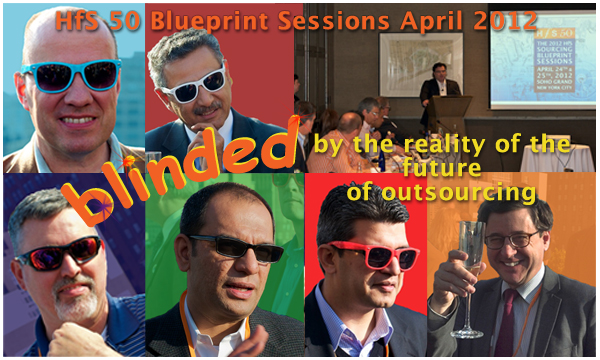
This was the ringing endorsement that came out of this week’s “HfS 50 Sourcing Executive Council Blue Print Sessions” in New York City. Two days, 40 buyers representing $5bn of outsourcing spend, collaborating together for a whole day and a half, then greeted by six providers to engage in one of the most revealing, pure and pivotal discussions ever on the direction the sourcing and services industry is heading. Stay tuned for the Blue Print document.
And a very big personal thank you for all you people who are supporting this initiative (you know who you are)
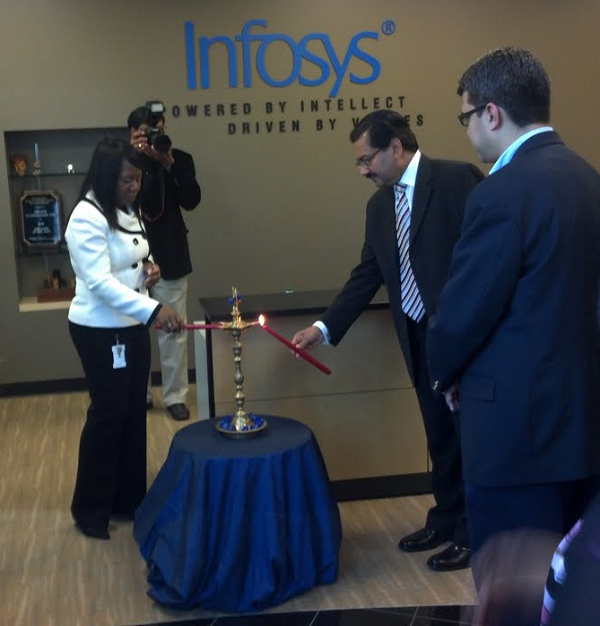
We’ve been blessed today to be present at the official unveiling of InfosysBPO’s first onshore US facility in Atlanta, primed to grow from an initial 200 seats to 1000 in the coming months. Initial clients to be serviced here largely comprise a mix of insurance and healthcare processes, however, Infosys is also keen to move horizontal services into the center as it expands. We see this as a further milestone in the global BPO industry as service providers are expanding their US service delivery capabtility to cater for client processes which benefit significantly from onshore talent. As we see increasing numbers of industry specific processes being sourced, we fully expect further expansion of onshore centers. Yes, the US is fast-becoming a hot location for BPO services – who’d a thunk it?
The traditional Indian ceremony of "lighting the lamp" is conducted by India's Consul General Ajit Kumar (center), overseen by Infosys BPO's COO Ritesh Idnani (right)
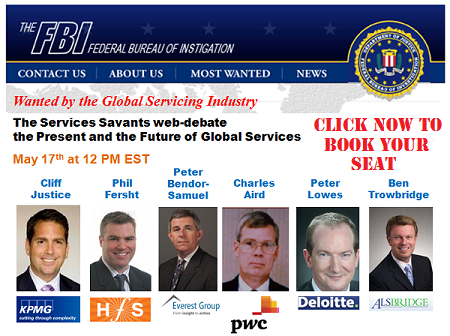
Ever wondered what would happen if you brought the six most prominent IT and business services savants together for a one-hour debate on the future of the sourcing and services world? Well, wonder no more as this becomes a reality on 17th May at 12pm EST, 5pm BST:
Our six panelists are primed to debate the issues and take your questions:
Cliff Justice, Partner & U.S. Leader, Shared Services and Outsourcing Advisory – KPMG
Phil Fersht, Founder and CEO – HfS Research
Peter Bendor-Samuel, CEO – Everest Group
Charlie Aird, Global and US Shared Services and Outsourcing Leader – PricewaterhouseCoopers
Peter Lowes, Principal – Deloitte Consulting
Ben Trowbridge, CEO – Alsbridge
Where we will attempting to divert them from shameless sales pitches to discuss the following topics:
What does the enterprise IT and business process outsourcing and shared services industry really look like today? Is it a genuine “industry” or simply the globalization of business?
What is working for enterprise services clients – where (and why) are they struggling?
How are services buyers and providers defining “success” today – and does this need to change?
What impact is a “factory mentality” having on outsourcing? Is there anything we can do to change this, or are we already in a race to the bottom?
How can (and should) advisors help the industry – and what differentiates today’s advisory firms in the market?
How has cloud computing impacted the enterprise – is it everything we thought it was going to be?
What measures can both enterprise clients and service providers take to improve sourcing relationships and achieve more business value?
What are everyone’s recommendations on next steps for the future of the services and sourcing industry?
At the end of the day, it’s not all about outsourcing and it’s not all about shared services; it’s about focusing on how to globalize processes, how to transform finance (and other) functions, and how to govern it all in a global business services context. There is no dominant model, it’s more about achieving the right balance across all delivery models to achieve the best business goals.
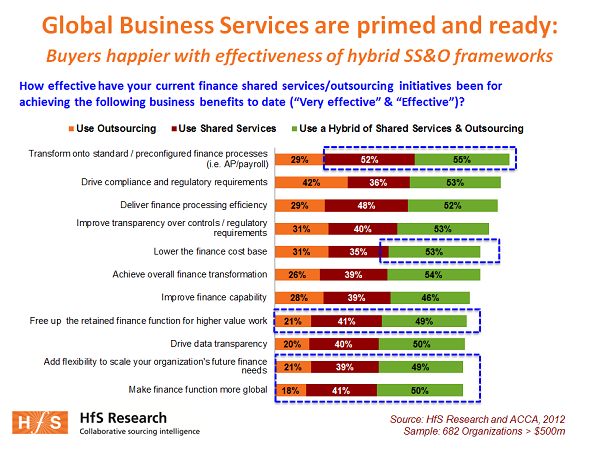
In conjunction with global accounting body ACCA, We spoke to 682 large organizations currently running finance in either an outsourced or shared service framework (or both) – and the results are emphatic: those organizations relying predominantly on outsourced delivery, or predominantly shared services, are viewing their finance delivery performance much more skeptically:
Why do these results signal the decline of the “predominantly outsourced” model?
1) Expectations are clearly higher with outsourcing… and they’re not being met. Only the ability to meet compliance and regulatory goals (42%) is brushing up notably well with the outsourced finance functions. Everything else is mediocre-to-average, in terms of meeting finance performance objectives. This is because many buyers’ outsourcing environments are relatively nascent, and their expectations were likely set to a high level when they embarked upon their engagements. In addition, most governance staff can clearly recall what it was like before outsourcing, and find their new environment a struggle to get things ticking over like they were in the old days. Buyers are clearly finding it hard to make productivity improvements to their finance processes when they outsource heavily, with the main reasons being the cost and complexity of dealing with providers’ change-order processes and also the fact they the operational people running the engagements on both the buyer and provider side are too junior to make decisions. Instead, they get absorbed into the table-stakes of meeting SLAs and running things on budget. Other reasons we will discuss further in our upcoming Sourcing Blueprint document. Our concern at HfS is that if buyers and providers allow these relationships to stagnate, we could get left facing a dangerous commodozitation of operational process outsourcing.
2) Shared Services delivery models aren’t faring much better. Those buyers sticking predominantly to a shared service model for finance are also suffering similarly mediocre performance levels to their outsourcing peers. Only their ability to standardize processes is really coming though as a major plus, with 52% experience really effective results to-date. Clearly, they find it easier to make tweaks to process flows and delivery quality issues. However, when you consider that most of these buyers have been doing shared services for an average time-span of 10-20 years, compared with 1-7 years for outsourcing, you have to conclude that a pure shared services model is not the best answer for those buyers seeking to continually improve their finance performance.
3) Hybrid shared services and outsourcing frameworks are reaping the best results. Those buyers operating hybrid SS&O frameworks are experiencing better finance performance in every single performance category. Clearly a strong, centralized retained organization that augments its shared services processes with outsourced options are enjoying the best of both worlds. Most notably, 54% of the hybrid buyers are finding genuine effectiveness with their ability to transform their finance functions, and similar proportions are encouraged by their ability to transform onto standard processes, meet compliance goals and even globalize their finance operations. Essentially, those buyers that are retaining more of their talent and working with their providers to help with achieving broader finance goals (at least initially), are developing their finance operating structure much more effectively. This indicates that buyers who leverage outsourcing to fulfill specific needs and blend it more effectively with their overall finance operations, are more comfortable with where they are going. At the end of the day, it’s not all about outsourcing and it’s not all about shared services; it’s about focusing on how to globalize processes, how to transform finance (and other) functions, and how to govern it all in a global business services context. There is no dominant model, it’s more about achieving the right balance across all delivery models to achieve the best goals.
The Bottom-line: Many buyers have little choice but to find GBS partners, or face a purgatory of inferior BPO and shared services
Buyers need staff who are ready to embrace these new global services environments. We’ve been hearing many buyers talk about populating their retained teams with staff who’ve only really ever worked in a globally sourced environment. And on the service provider side, buyers need delivery teams which can work with these retained teams to meet their business objectives, in addition to cranking out the administrative work. Should a provider fail to do much more than facilitate standard process delivery (yes, we all know they exist) the buyer needs to evaluate how to bring in external help to plug the gaps to globalize processes and work consultatively and strategically with the retained team.
We are now seeing the rise of Global Business Services partners to work with buyers in “process integration” roles, where they can help their clients’ retained teams manage their whole business services mix across outsourced, shared services and inhouse models. This is not too dissimilar from the service integrator roles we have seen in the IT world, with some of the higher-value integrators stepping up to help their clients manage the whole morass of service delivery. However, unlike IT where it’s easier to disaggregate services and run multi-vendor environments, it’s a lot more challenging when you deal with business processes, hence we expect those buyers with provider partners which have invested in domain capabilities to have a major advantage over those providers which really can’t do much more than provide butts on seats.
We see a true divide developing between the providers only focused on standard delivery, and those which have high-caliber process experts on their bench. The problem is many buyers today do not discover how poor their provider is until after then signed the deal, and it’s not easy to put in requests for consultative help after they’ve outsourced. However, for many buyers, they don’t have a lot of choice but to start campaigning internally for funds to improve their current sourcing delivery frameworks because they are far too beholden to the capabilities of the provider they signed up with.
Essentially, if your provider is starting to sound and acts like a glorified staffing company, you might just want to open up conversations with GBS partners which can work with you to optimize what you have already invested in. However, we recommend you’re MUCH better off finding this out before you give them the kitchen sink…
Co-authors and offshore evangelists Basab Pradhan and Gaurav Rastogi (click to view their new book)
One of the most influential and popular figures in the development of India’s services business over the last couple of decades is Basab Pradhan. I personally got to know Basab when he became part of the esteemed blogging syndicate “Enterprise Irregulars” last year, where I was impressed by his pragmatic and visionary approach to global sourcing, as he was finalizing his new book “Offshore: India’s Services Juggernaut“.
Basab made his name in the industry by climbing the ranks at Infosys during its hyper-growth years, where he led the global sales and marketing function until 2005. This year, Infy managed to persuade him to rejoin the firm to be instrumental in helping position the firm for this new phase of the industry.
So we managed to convince Basab to park his Chevy Volt electric car for few minutes, which he passionately drives around the Bay area, and claims to have recently clocked 108 miles per gallon. We were also joined by his colleague, co-scribe and Kindle-fanatic, Gaurav Rastogi, who’s spent the last nine years leading global sales effectiveness and learning for Infosys.
Phil Fersht (HfS): How is the Chevy Volt doing? If it blew up tomorrow, would you get another one?
Basab Pradhan: It’s doing great! I am up to 108 mpg. The news of it blowing up in tests were highly exaggerated. No such worries here.
Phil: So…tell us about your recently published, co-authored book, Offshore: India’s Services Juggernaut.
Gaurav Rastogi: The premise is very simple. While many books have been written about India and offshoring, very little has been said about how the Indian offshoring industry came to be, what it means for a company to be Indian, what impact this industry has had on the Indian economy, how it works, where it’s at right now, and what makes it successful. And the headlines you read about offshoring are the equivalent of bumper sticker stories. So we set out to characterize, demystify and explain the Indian offshoring industry.
Basab: We talk a lot about how the industry is changing, and the shifts are quite perceptible if you observe the industry. For example, at the early part of the 21st century, it was all about the new offshore or global delivery model (GDM), and the cost savings, flexibility and other advantages it could bring to buyers, But it’s no longer about the GDM. In fact, buyers today, especially in the U.S. and U.K., assume a GDM is built into their solutions, and they don’t select service providers based on those they feel can safely take them across the GDM chasm. Now, they’re buying on the capabilities they used to before GDM came along – what’s the value, does the service provider understand my business, does it understand the particular solution, does it have the right people to lead the project, etc.
Phil: Where do you think India is going to go next with its development in the global sourcing industry? Which areas do you think are going to be most successful for the country, and where do you think we may be in a bubble?
Basab: There are quite a few interesting things coming along, such as offshoring of marketing processes in the life sciences industry and technical support offered directly to consumers. But while there are great opportunities in these types of emerging, non-hanging-fruit areas, you can’t just throw people at them. You need specialized skills and a delivery model solution that can address the advanced needs and requirements.
Phil: We’ve seen an increasing number of Indian providers open facilities across the U.S., in Massachusetts, in Michigan, and even your new center in Atlanta. How is this impacting the sourcing business for India?
The Chevvy Volt hybrid: lease one for the cost of 10 developer-hours per month
Basab: One of the chapters in our book, called India Versus Rest of the World, looks at your question from several different aspects. First, we believe that hiring in our clients’ markets will only go one way – up – because of many reasons. With the kind of work we do with clients, it’s getting to the point where the sophistication of the solution is such that you need people with industry skills, not just technical skills, and the sophistication of the industry and how it works in advanced markets is ahead of that in developing markets like India. Of course proximity matters and you want to be closer to your clients, and so you have to hire more in the markets. In-market hiring also reduces risk, and it’s just good business. In fact, we see that hiring in the markets is going to keep going up at a higher proportion compared to the growth of the company.
Gaurav: Another way we look at this question is the blurring of boundaries, how the company of the future is likely to have a global workforce, a global management structure and global ownership…none of it is Indian. We believe that the definition of what makes a company Indian is weak, that it will continue to weaken, and that it will be increasingly difficult to tell which companies are Indian and which are not.
Basab: Earlier this year you had a post on your blog about Indian companies being the New Phoenicians…and there’s a lot of truth in that. These firms, whether they’re headquartered in India or not, whether they’re largely Indian management or not, they are the new trans-nationals. They are companies that belong nowhere but are comfortable everywhere. That’s where I think a lot of this is headed.
Gaurav: A term we use in our book is “Frankenfirm”. A company with headquarters in one country, a CEO from another, the largest market in yet another, and the workforce in a fourth. That’s what companies that started out in India or have a big base in India are soon going to look like that.
Phil: In our view, the IT services industry has pretty much been ceded to India. While Western providers are trying to come in and undercut the Indian providers’ prices, the buyers are saying, “Look, these guys were smart, they got in 10 years ago, they have institutional knowledge of our processes, we like working with them, there’s an energy about them, and a ‘forgiveness factor’ has developed over time.” Do you think it’s going to be as easy for Indian firms in emerging BPO areas like those you mentioned earlier – such as marketing processes for life sciences companies – or will it be a challenge down the road?
Basab: Before the Indian IT industry made any headway into package implementation – SAP, Oracle, etc. – we had the same type of question. Could we have the same success with it as we did with ADM? But companies were doing 10’s of millions of dollars worth of implementation at the same client for a year, and lowering the cost of delivery by a tenth was just waiting to happen. So we had to build and hire the skills to be able to do it, we also did things our own way, e.g., establishing our own academies for training, and we built a thriving business out of it. So going back to the notion of blurred boundaries and what is an Indian firm… what differentiates a company is its ability to understand the business problem, create solutions and put value at a lower cost on the table for the client. It’s going to happen in emerging BPO areas as well.
Phil: Going back to our philosophy about the New Phoenicians, with which you agreed…we’ve seen over the last 50 years or more many nations, like Singapore and Japan and more recently China, rise in the industrial world with big economic growth spurts, largely due to development of a culture of hard work, effort and innovation. But many of these countries have become complacent, and are now struggling to find new growth. Do you think India runs the same risk of reaching a level of complacency, or do you think the culture, make-up and DNA is different?
Basab: I think it’s very important to recognize India’s success in offshore services has come about without the government’s support. Which means that it’s due almost entirely to alignment of demographics and market forces. That said, can India become complacent? Absolutely. But at this point the demographics are in the right direction, there are large companies now operating in India so the management culture you talk about has become prevalent, and there are hundreds of thousands of people working in and feeding this industry. So in that sense, the dynamo is beginning to roll and it will take time before it winds down.
Phil: We’ve spoken privately about the fascinating race going on between the big SWITCH* providers. How do you see this playing out? Infosys is one of the big growth success stories of the last decade, but you’re running into fierce competition from the likes of TCS and Cognizant, as well as Accenture from a Western standpoint. How can Infosys keep its edge and differentiate itself from the rest of the pack?
Basab: You’re very right that this industry has become much more competitive. In the early days, it was like there was this gold rush where there weren’t yet any stakes in the ground. But suddenly all the ground – or most of it – was seemingly taken, and what is left is harder to mine for gold. That’s kind of the situation we’re in. There’s hand to hand combat going on in every account, and we have to figure out ways to keep increasing the value we provide to our clients, and focusing on the right things such as the people in the company, how we organize our efforts in the market, how we continue to focus on quality and embedded IP. At the end of the day you won’t hear stories about quality. But that’s why clients give you business. If you fail at delivering something, no matter how fancy it was, you’re not going to get more business, because there are hungry competitors in the account waiting to take it up. So we are going keep our focus on quality AND a shift to business outcomes.
Phil: In terms of the next wave of growth for the big Indian firms, we’re seeing much greater willingness to invest in large clients, particularly in areas where there are significant domain requirements and business process needs. And in many ways it makes sense because you can take on a big client, make a profit and gain a lot of the domain skills you need to grow. It almost seems like the days of acquiring other providers are numbered. Do you think we’ll see big acquisitions come back into this space, or will growth come more organically from clients?
Gaurav: I think it will differ from company to company, based on their individual appetite for growth and what they want to do from a stock market and shareholder standpoint. Infosys has a lot of cash in the bank, so if we were to acquire more companies it would be to gain capabilities, skills and geographical coverage…not for growth.
Phil: Would you write another book?
Guarav: That is, if people are still reading books in the future. My guess is that people will have the patience to read essays in the form of Kindle Singles, but would not dare to consume too much non-fiction in one setting. Would want to write a series of inter-connected essays? Absolutely!
Phil: If you had to bet your mortgage on it, what will the outsourcing industry really look like in 10 years?
Basab: Big. Lots of technology mixed in. Much less hub-and-spokey compared to today.
Gaurav: The industry will be dramatically different from how it is today. Companies that are now beginning to look alike will separate once again into leaders and laggards. The blowback against globalization will become stronger initially, but will abate in the longer term. An economic boom or two would help with that. Meanwhile, the software industry is already changing dramatically, and that will have serious consequences for the IT outsourcing industry as well. India may still lead as a destination, but major companies will have a global footprint, which includes serious local hiring in major markets.
What I can’t resolve in my mind is how the companies will continue to manage an intelligent workforce of 200k-1 million people without resorting to an efficient bureaucracy (an oxymoron) or to a dictatorial style (and how long that can last). What may happen is that the larger companies may find their size untenable and, bacteria-like, choose to undergo binary fission into more manageable enterprises. Or, all of us may finally figure out how to make money from ideas instead of people’s time. We talk about this in the book in our chapter on hiring. Needless to say, these are purely my views, and do not represent the views of my employer, or to our clients.
Phil: Gents – it’s been a pleasure chatting with you both and I look forward to having our HfS readers load up your new book on their Kindle apps!
The book “Offshore: India’s Services Juggernaut”, is available in book stores and on amazon.com.
We’re awarding an HfS bravery medal to ISG analyst Stanton Jones for pointing a nuclear missile at the credibility of Gartner’s recent Magic Quadrant for Managed Hosting. Stanton doesn’t mince words as he declares:
“Did you know that of the companies listed on the Managed Hosting Magic Quadrant referenced above, less than half would be capable of supporting a transformational infrastructure sourcing initiative with a multinational company, or that only 10 percent could support the same for a global company?”
Stanton then seizes the opportunity to pitch his firm’s own capabilities: “ISG is comfortable (and confident) in making this statement because we’re on the ground every day with both buyers and sellers of IT services. This unique position gives us unprecedented insight into what suppliers are really capable of delivering to clients — clients that trust us to help them vet providers in a fair, transparent way to make sure the vendor will help them solve their ultimate business problem.”
While I have no doubt that Stanton’s knowledge of providers’ IT sourcing capabilities is top-notch (I have always been impressed by the caliber and culture ISG’s people), I think we need to look at this accusation in a broader context:
1) ISG lives in a world where it’s all about outsourcing – how about the other 72% of enterprises? Our recent studies show that only 28% of large enterprise rely predominantly on an outsourced model for IT infrastructure. While Stanton correctly states that ”less than half of these providers would be capable of transformational infrastructure sourcing initiatives”, he conveniently ignores that fact that most of Gartner’s clients – and the majority of large enterprises, probably don’t care too much about these capabilities. They may just want a quick no-nonsense glance at managed hosting providers. I’m sure Gartner’s clients who do care about “transformative sourcing cababilities” would call them up to find out more.
2) ISG makes the vast majority of its income facilitating and negotiating outsourcing transactions – doesn’t this bias its research? I can speak from personal experience that it’s really tough trying to produce “unbiased” research when working for a company that makes most of its money from clients undertaking outsourcing engagements. The bottom-line is your firm is vested in the success of outsourcing, and your research will always be pressured to advocate the benefits of outsourcing. At the end of the day, the consultants want to wave research in front of their clients that supports the case for doing an outsourcing transaction, because that’s how they get paid. However, for those companies who’ve already made the decision to outsource, or are renegotiating existing outsourcing contracts, ISG’s research is likely to be highly pertinent and relevant.
3) All quality consultants conduct good research and thought-leadership, but they’re not trying to badge themselves as research companies. In sourcing, some of the best research comes from the likes of PwC, KPMG, AT Kearney, Deloitte etc – in fact, we even showcase some of it at our BPO Resource Center. However, they do research to enhance their eminence and consultative credibility, and they make every effort to make it widely available and accessible to enterprise decision makers. I don’t think I have ever read a detailed piece of ISG (or TPI) research in my entire career beyond their quarterly index calls. I am sure it’s great, but it’s not easily accessible or widely available to the industry at large. If they truly want to become a research firm, then let’s have a gander at some and we can all form our own opinions.
The Bottom-line: Outsourcing specialists need to base their business models more broadly than solely on outsourcing if they want to take on the traditional analysts
Love them or loath them, Gartner serves the vast majority of IT buyers, whether or not they outsource. Moreover, Gartner is predominantly a research firm and IT strategy advisor, who I haven’t ever seen facilitate an IT outsourcing deal (I’ve seen them dabble in it in the past, but they never really got anywhere). ISG is a great outsourcing consultant, and has consistently been the industry-leader for facilitating IT outsourcing transactions for the last couple of decades.
Stanton Jones is Analyst, Emerging Technology at ISG
While Gartner could clearly do a better job researching the sourcing transformational capabilities of providers, ISG could similarly do a better job producing research for the 72% of enterprises who haven’t done a lot of IT outsourcing. If I’m a CIO and need some unbiased validation of my overarching IT strategy, I’ll be likely to call Gartner (among others) for an independent viewpoint. If I was doing an outsourcing deal and needed specific advice and data around how to do my transaction and develop my shortlist, ISG will surely be on my list of experts to call.
As we have painfully laid out here time and time again… it’s not all about outsourcing!
The HfS 50 Blueprint Sessions 2.0 will be a continuation of the hugely successful summit that took place at the Soho Grand in New York in April 2012, where 41 senior recipients of outsourcing services, joined by six of the leading outsourcing services providers on the second day, started the ground work for a Blueprint document that delivers a roadmap for the future direction of the outsourcing industry. And as you can see, it was a blinding experience…
We still haven’t quite forgiven those of you for not being one of the 1,200 people who signed up to hear six of the most influential IT and business services savants debate on the future of sourcing and services. I mean – what else were you doing? Was it really that important?
However, in our spirit of forgiving even the unforgivable, here’s a replay of the event – just click on the image below:
And as usual, we’re giving far too much away for free, so…here’s your own copy of THE-SERVICES-SAVANTS-SLIDES.