When God created “outsourcing”, she/he/it clearly had a sense of humor. I mean, how do you encourage people who offloaded a chunk of their low-end processes offshore to get together and form an “industry”?
Sure, you can pull together those providers and consultants who’ve made a fortune orchestrating the “offloading” to get together and feel good about what they do (or at least convince themselves they should feel good about it) but the reality is, outsourcing “networks” are strange concoctions of individuals striving to feel part of a “community” that doesn’t really exist.
Let’s cut to the chase here – “outsourcing”, for most buyers, is like purchasing a wedding dress – a one-time transaction followed by seven years of relationship struggles and future legal wrangles. I mean, when was the last time the missus went to a wedding dress convention?
In this context, how can you encourage buyers to get together to spend days-on-end reliving that one-time purchasing experience with the fervor of a civil war battle re-enactment? Do service providers really think they are going to meet hordes of “outsourcing buyers” in wedding-dress selection mode when they splurge forty grand sponsoring the room keys at some event? Of course they don’t – they just like the fantasy that if they flash their brand everywhere, something positive will happen.
What’s broken here is the fact that “outsourcing” is broken terminology and isn’t a real industry. Most of tomorrow’s deals are not going to involve major staff transitions from buyer to provider as part of the deal – today those engagements are on the wane as most of the bloated buyers have been progressively trimming their fat in recent years. Moreover, most of the providers today have the capacity they need to service their clients and will only entertain major “lifts and shifts” of employees if these deals are strategic to their growth ambitions, and involve the transition of both domain expertise and technology assets.
If your firm decides to select a new marketing agency, you don’t automatically declare “we outsourced marketing”. Instead, you make the point that your firm is augmenting its expertise in marketing. Noone alludes to the fact that your firm may have discretely offloaded a few marketing staff in the process, as they weren’t relevant with many of today’s marketing demands, such as advanced analytics and social business strategy.
Exactly the same applies with processes such as procurement, finance, claims management, software development etc. Most firms rarely transition out more than a quarter of their functions in an outsourcing engagement, they are simply increasing their focus on being relevant with today’s needs.
At HfS, we are proud to boast a vast array of networks which actually total 130,000 individuals – but you can hardly classify the commonality across these people as “outsourcing” – that is just one component of many, which constitutes the orchestration of global operations. We have broad groups of shared services specialists, outsourcing governance pros, finance and procurement executives, business analysts, customer services managers, IT leaders, systems architects and functional heads etc. We have clusters of Big-5 consultants who focus on anything from outsourcing to tax advice and service providers who’d do anything to remove the term “outsourcing” from the Oxford English and Webster dictionaries.
The Bottom-line: Are you an outsourcing pro, or a global business pro?
So isn’t it high-time we stopped convincing ourselves there really is an outsourcing industry? If you base your entire career living in a perpetual outsourcing transaction-cycle involving hordes of staff transfers and staff re-badging, then, fair enough – YOU REALLY ARE AN OUTSOURCING PROFESSIONAL. However, if you want to focus your career on improving processes, finding new and creative ways to improve companies’ productivity and growth, and leverage today’s availability of global talent into the bargain, aren’t you probably what we are calling a GLOBAL BUSINESS SERVICES PRO?
So we managed to whip up a tidal wave of emotion and opinion when we made the call that the “outsourcing industry”, in its current state is, quite frankly, a sham. When over 30,000 people read something, there’s a reason why… so let’s drill down into what this all means.
Outsourcing has an image problem, not a delivery problem. The intent of the blog was to deplore the shoddy image of outsourcing in today’s economy and the discuss the lousy job the industry – as a whole – has done in defining itself. It wasn’t to slam the premise behind outsourcing, or the performance of engagements: the “industry” produces wads of cash and healthy margins while saving buyers lots and lots of money (our own research emphatically supports this fact).
Buyers and providers are desperate to alter the perception of “outsourcing”, it’s the intermediary businesses profiting from vendor marketing dollars which are afraid of change. I have never had so many “Thank God you called it” emails from buyers and providers this week. The only people we have upset are some of the events firms and advisors/analysts who take money from service provider marketing people, as this paints their whole modus operandi in a bad light. I even got some hate mail from a couple of entities, whose entire businesses survive on extracting marketing dollars from services providers, because they claim they would lose their identity if we stopped lauding the “outsourcing” vernacular. They are worried that if outsourcing gets submerged into the business “mainstream”, service providers will park their marketing dollars with entities who are marketing/promoting/analyzing real business services and not only “outsourcing”. While many intermediaries constantly complain that buyers wary of outsourcing are afraid of change, why don’t they practice what they preach and change their own philosophy – and then their clients will follow?
Buyer networks need to be focused on the business end-game of outsourcing, not the “act” itself. “Outsourcing” as we call it today, really is a component of a business function, not the business function itself. It is a means to an end, not the end itself. It’s not dissimilar from the Cloud computing concept, except it’s about externalizing services, not IT infrastructure. Regardless of business function, Cloud has relevance as an enabler to achieve better things – and it’s the same for “outsourcing”. I would prefer to see us creating broader communities around business objectives and have process-externalization and expertise augmentation as a key part of each discussion. For example, you can’t go to a conference focused on creating better global finance operations, without discussing shared services and offshoring / BPO. However, the core focus of that network is about achieving more productive, relevant and global finance, where senior people can have rational and objective-led discussions on global operating models that can take better advantage of global talent and technology.
“Outsourcing” common interests should be segmented into two “industries”: 1) Labor Arbitrage and 2) Business Services:
1) The Labor Arbitrage Industry. Let’s face some home-truths here – much of “outsourcing” as it exists today really is labor arbitrage for most of the lower value work in IT, F&A, Procurement, CRM etc. The common thread among buyers is more how to manage LABOR ARBRITRAGE effectively, than anything else. So why doesn’t that industry simply call itself the “labor arbitrage industry” and focus itself on how to improve processes once part (or all) of them have been moved offshore – essentially, “we’ve done our lift and shift, now let’s see how we can make it better, as opposed to running the same cr*p for less”. For some buyers today, all they really care about (sadly) is labor arbitrage and making a few adjustments here and there to make the experience more bearable for themselves. Hence, if achieving little more than operational efficiency and low-cost delivery is all they care really about, then let’s have them flourish in their very own industry focused on this very practice. A spade is a spade, so let’s stop bullsh*tting around the bush here.
2) The Business Services Industry. Conversely, when we get into the new generation of expertise augmentation engagements, the focus is on a broader range of processes where – in many cases – labor arbitrage isn’t really possible. For example, with pharmacovigilance, the chances are that “buyers” need added help with compliance and quality measures that they simply do not have, and there really aren’t any staff that can be laid off to offset the cost of the incremental services. Moreover, with even more commonly-used horizontal processes such as procurement and HR, most “buyers” don’t have excess fat to burn – they have already trimmed their inhouse teams to the bone (i.e. many firms have one HR rep to as many as 200 staff). They need new services and help, not a replacement of inhouse labor. So… for those of us who care about achieving new value and new productivity and feel we have a pretty strong handle on labor arbitrage these days, let’s focus on Business Services and the process acumen, domain expertise, technology and global delivery required to make this all happen.
The key is to bring the global services discussion to the real business table, and not create some oddball assortment of offshoring experts who are alienating themselves by creating their own little siloed network.The more the “outsourcing” industry (as we have been calling it) remains in its silo, the harder it’s ever going to be to have the global business model discussion with the real business function leaders. We have to move the needle on this issue, or we’re going to become part of a dying breed. However, we need to start setting the new agenda on how business function leaders approach expertise augmentation. They’re the people we have to be talking to. Join us in our cause!
Too many people scan headlines and don’t absorb the real facts – you know who you are. Yes, we sensationalized the headline to get the eyeballs this critical issue warrants. However, if you actually read the bloody piece, you’d realize we were not debating the pros and cons of outsourcing itself, we were highlighting what the industry needs to do to become more relevant to the real business decision makers (i.e. less wedding-dress and more marriage).
Pressure from buyers to create more accurate terminology for what we commonly, but incorrectly, term as “outsourcing” for IT and business processes has spurred dictionary publisher, Merriam-Webster, to remove the term from their next edition.
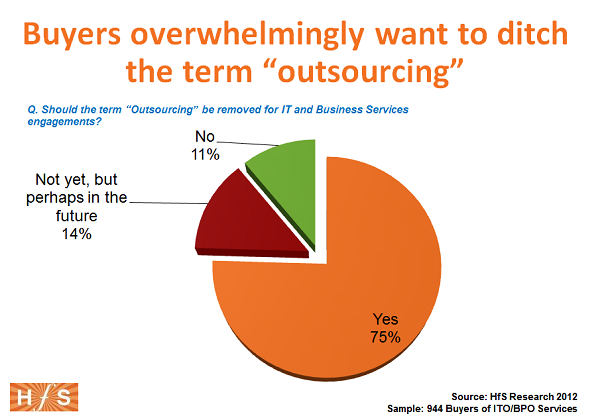
Instead, when firms purchase services from technology or business services providers, these engagements will be termed as “expertise augmentation” services. The heritage dictionary publisher, which has provided language information since 1806, finally made the decision to remove the term, based on the latest survey conducted by HfS Research, where three-quarters of buyers emphatically declared their wish to drop the term:
HfS Research has been agitating to ditch the term since 2008, with our now-famous post “Is it time to dump the term ‘outsourcing?’” which first caught the dictionary giant’s attention. However, it was our recent piece accusing the whole outsourcing industry of being a “sham” which finally forced the issue.
“When HfS first raised the issue back in 2008, we didn’t feel it was the right time, but that last piece, coupled with their latest study, finally forced the issue”, commented Ashley Webster, President and CEO for Merriam-Webster online. “The HfS team has been really helpful advising on these terminology changes with their research and insight into what people want to do with that awful word.”
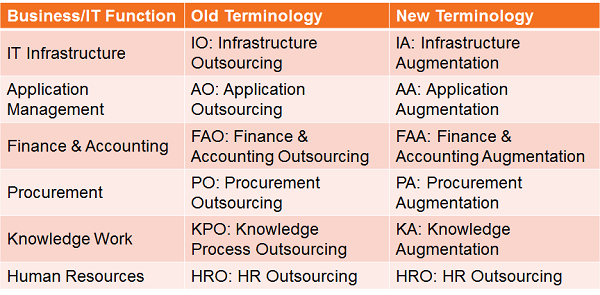
And the exciting news is that we can give you a sneak-preview of the following changes, to be published for common use in the English-speaking business world:
As you can see, the term “augmentation” has been widely adopted for most of the major business functions that have endured “outsourcing” in the past, with the exception of HR. “When we looked at the data, we found that most companies didn’t want to augment HR, they just wanted to get rid of it”, added Webster. “So we felt it more appropriate to stay with the term “HRO”.
Ashley Webster is President and CEO, Merriam-Webster
We felt this move may be a bit of a political hot-potato, so we managed to catch some time with Republican presidential nominee-hopeful Rick Santorum, while we was canvassing voters in Yankton County, South Dakota. “This is simply Obama painting over the cracks of his failed presidency as our jobs continue to flood out of our country. Removing ‘outsourcing’ from the dictionary is not going to solve the problem; removing Obama will. When I am President, I will make sure these outsourced jobs come back home and the only outsourcing we do will be the current residents of the White House.”
Conversely, Democratic senator, Charles Schumer, whose political brilliance has been frequently lauded on HfS, welcomes the move. “Removing outsourcing from the dictionary is proof that all my proposed policies have worked. Now outsourcing ceases to exist, I can go back to campaigning for the 35-hour working week.”
Just remember folks… you heard it here first!
Oh, and by the way….
Please tell us you didn't fall for it again?
And while we’re reminiscing about falling for April Fools’ gags, here is 2011’s classic:
One of the critical areas we believe is too-frequently neglected in today’s business operations planning is security and risk.
With the amount of data flitting between hundreds of global locations and millions of servers -to how much risk are your operations, today, being exposed? How many local and regional regulations are you flouting? How does the introduction of multiple service providers and SaaS applications exacerbate the issues?
And that’s not all – what about your staff’s personal devices (and those of your providers’ staff) that get plugged into your corporate network on a daily basis? And even that trusty Apple device you use to make your own IT experience that little but more pleasant?
Because that's where the money is…
At HfS, we have been quietly exploring what today’s organizations are doing (or not doing) to protect themselves, which is why we brought in security and risk analyst veteran Jim Slaby last year (read some of his research here). While he’s been running the treadmill of the obvious security issues and threats, he’s also been uncovering those in areas such as your Apple device – yes – YOUR APPLE DEVICE MAY NOT BE AS SAFE AS IT APPEARS.
Over to you Mr Slaby to reveal more…
Flashback kicks the myth of Apple invincibility squarely in the jewels
Reporter: “Why do you rob banks, Mr. Sutton?”
Willie Sutton: “Because that’s where the money is.” *
Apple has long enjoyed a reputation for making computers that were largely immune to the viruses and other malware that have long afflicted Microsoft systems. Indeed, Microsoft practically created a hundred-billion-dollar security aftermarket — Symantec, McAfee, and countless other security vendors large and small owe their existence to the lousy job Microsoft did architecting its products to resist various security threats.
But good OS design was only one of Apple’s advantages; the other was that it only represented a tiny fraction of the enterprise and consumer markets for server and PC operating systems and applications. If you were a black hat, you developed malware to rob sensitive data from Microsoft machines because that’s where the money was. Of course, the world keeps spinning: Apple now has a market cap that seems destined to hit a trillion dollars, and everybody in your organization wants to connect their personal iPad or iPhone to your network. So the malware developers of the world have naturally turned their sights on Apple.
While this isn’t their first try, the bad guys are getting better at penetrating Apple’s once apparently impervious peel. They scored a big, splashy coup last week when news hit the business press about Flashback, also known as Fakeflash, malware targeting the OS X operating system that successfully compromised more than half a million Mac desktops and laptops before Apple managed to issue a patch for it last week.
In its early versions, Flashback was a trojan horse that pretends to be an Adobe Flash installer or Apple’s Software Update tool. Users agreed to install Flash (to view some online video) or run an Apple software update, but the malware instead installed a backdoor that wreaks a variety of mischief like “click fraud”, generating fake clicks to boost revenue from pay-per-click and pay-per-impression ads (for which the bad guys collect a kickback). But it could potentially do other harm, like collecting passwords and card numbers for resale to identity thieves and credit-card fraudsters. Flashback kept evolving, and now exploits a Java vulnerability to deliver its malware payload via drive-by download; now all the user has to do to get infected is visit a poisoned website.
Flashback thus joins a small but growing collection of increasingly sophisticated malware threats like last year’s DevilRobber, a backdoor that steals passwords and electronic cash tokens from infected Macs. Apple is responding with new security improvements to defeat exploits like these, but as the Windows malware and mitigation seesaw has long demonstrated, this will inevitably become an arms race — attackers will keep uncovering new vulnerabilities in Apple’s security armor as long as they smell profit in it.
Add to this the growing pressure in enterprises to support the BYOD (Bring Your Own Device) trend, to let employees and contractors connect their personally owned smartphones and tablets to enterprise applications, and it’s easy to see that there’s a whole new Pandora’s box of endpoint security issues just beginning to crack open. And they’re not all Apple OS X or iOS devices, which are still relatively exploit-free: many of them run Google’s Android OS, itself the target of a growing and already better-established boom in malware development.
The IT consumerization trend, in which business partners and customers will want to transact online business with enterprises from consumer devices and mobile applications that the CSO’s team can’t easily monitor or control, will only make this issue more urgent. HfS Research examined these trends in more detail in our recent report, “BYOD in the Age of Cloud Services and IT Consumerization”. To recap one of its recommendations, CSOs need to stop hoping this issue will just go away, or pretending they can just say no to the new welter of mobile endpoints and applications.
Likewise, as BYOD and IT consumerization gather momentum, services providers ought to be exploring the opportunity to help buyers tackle the emerging challenge of mobile endpoint management, starting with consulting and managed security services. If there’s one thing that Flashback has taught us, it’s that the 21st-century Willie Suttons have figured out that there’s gold in them Apples, they’ve already cased the joint, and they’re coming for yours.
* Sutton robbed a hundred US banks to the tune of $2M over a forty-year criminal career that began in the 1920s. He claimed his most notorious quote was actually made up by a reporter, but became so famous for it that he eventually gave up arguing the point.
James R Slaby (pictured left) is Research Director, Sourcing Security and Risk Strategies for HfS. You can view his bio and research here.
While the world still known as “outsourcing” was quaking in fear at being renamed “augmentation” (hehe), we received some interesting notes from people with alternative suggestions for their beloved industry.
Unfortunately, some of these people had failed to read the full posting to figure out it was an April 1st wind-up, but, what the hell, it inspired some pretty good debate!
We liked this suggestion, from outsourcing evangelist, Bobby Varanasi:
Very interesting indeed. Wondering if the marketplace will accept the replacement term “augmentation”. Personally I think the term “augmentation” indicates – restrictively – that service providers only do that, augment and nothing else. However the marketplace has grown significantly on the back of “new” capabilities providers have brought to the table of buyers, not by augmenting but by “installing” or “instituting” practices, solutions etc and made the buyer organizations look smarter!!!
Good point Bobby. Let’s be realistic here:
a) “Augmentation of existing operations”. When a provider is “augmenting” a process (or cluster of processes), they’re improving it, they’re removing some unnecessary sub-tasks, or even tweaking it to work with a new software application. Whatever they’re doing, they’re trying to make it function more effectively in an externalized environment that likely involves staff on both client and provider teams.
b) “Instituting new practices and capabilities”. The nirvana, to which most ambitious providers aspire, is to have their clients move onto “shared” solutions they bring to the table that have pre-configured quality process flows and technology underpinnings that they can implement across their multiple clients, resulting in more profitable engagements for them, increased price-competitiveness in the market and – hopefully – new capabilities and improvements to delight the end-customer and win even more customers.
The outsourcing industry is caught in a “chicken and egg” situation
Hence, we would class augmentation efforts as process improvement (i.e. labor arbitrage with a few tweaks), and what Bobby is suggesting – instituting new practices – as something akin to “innovation”, as this involves new, and often unique, methods and capabilities to make buyers be more successful. There’s no doubt the industry wants to shift outsourcing engagements away from mere augmentation to the actual institution of new capabilities, however, the missing link is clearly whether the service providers can be incentivized to invest in their clients, with clients similarly being incentivized to make more radical overhauls of what they have. Clearly, we have a “chicken and egg” situation going on in today’s outsourcing business.
Whatever we call “outsourcing”, one thing is clear: providers’ capabilities are the key to the future success for finance
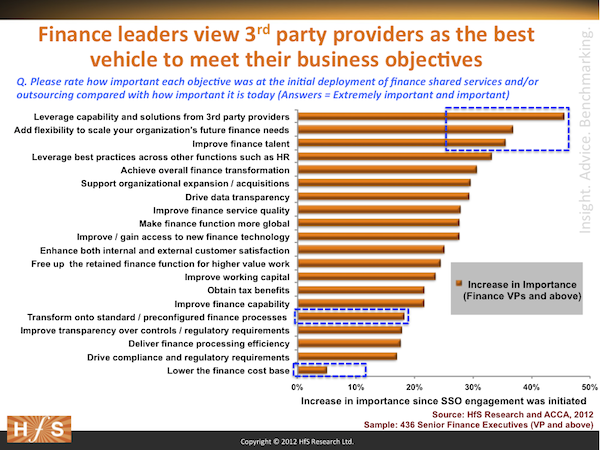
Enough of this theoretical buffoonery; let’s go ask 436 senior finance leaders from organizations with current shared services and outsourcing (SSO) models about their current business objectives – and how those have changed since they originally embarked on their SSO adventure:
This brand new data, a sneak preview of what’s to come from the recent HfS Research/ACCA study, compares the importance of business objectives made by finance leaders when they initiated their SSO engagements with how those same objectives have changed today. Let’s summarize the significant points:
Finance leaders really want to increase their access to capability and solutions from 3rd party service providers. Finance leaders have viewed this criteria as increasing by 46% in importance since they embarked on their SSO. This clearly implies they have seen what providers can/are bringing to the table up-close and have realized these attributes are what they need to reach new levels of success. This is a significant cultural shift from years-gone-by, when they over-relied on inhouse staff development and heavy ERP investments to improve finance with limited help from the outside. Most finance organizations today are tired of constantly fighting ERP dysfunction and poor process quality and are more focused on third parties to bring new ideas/best-practices/technologies to the table. Moreover, as we have been seeing repeatedly at HfS, clients are increasingly recognizing the cultures and internal capabilities of their service providers and want to nurture these skills and learning environments into their own finance organizations.
Improving talent and flexibility to scale the finance organization is paramount. While leveraging provider capability is the most significantly growing objective, improving finance talent and scaling finance are close behind. We see the desire from function heads to globalize processes and have their internal managers get a better handle on scaling finance to service the needs of the business, as critical goals of finance leaders today. Clearly service providers, in addition to management consultants, are in increasing demand to help their clients develop smarter global delivery models that encompass their available talent across shared services, outsourcing and inhouse teams. It’s no longer about clients managing each delivery model in silos – it’s about bringing them all together as one cohesive framework.
Standardizing process is desirable, but not a lot of companies are really doing it. This objective only grew by 20%, which will disappoint some providers which are banking on pushing their clients into more radical overhauls of some of their internal processes to adopt their own workflows and best practices. In many ways, this really is telling us finance leaders are more focused on augmenting what they have, than completely overhauling processes with better ones. Everyone says they want access to best-in-class processes, they say they want to blow up non-core / not critical processes and have them standardized and made more efficient – so why, pay tell, do they not do it. We use the payroll example a lot, the most commonly outsourced finance/HR process, whereby many CFOs / CHROs long gave up the ghost that there was any real strategic advantage keeping payroll inhouse, but even that case, barely a third of mid-large organizations have actually outsourced it?
The Bottom-line: Service providers are in pole position to provide the value clients need, however, there needs to be some give-and-take on both sides to move beyond mere “augmentation”
The augmenting versus instituting argument really sums up where we all are as an industry at present; providers want to institute offerings that they can scale (standardize) and execute well, whereas buyers want the execution without the standardization. They want providers to bring them all the goodies at competitive prices to make them look really good, but are yet to really embrace the internal change they have to go through in order to get the outcomes that they want.
The key is for the chickens and the eggs is to figure out together which ones came first. OK – that makes no sense! The key is for the buyers and providers to figure out the right ways to engage, so that both are incentivized to invest in the relationship and the outcomes together. There has to be a bit of give-and-take – i.e. buyers need to understand that providers want scale and utility and would like to leverage their capabilities with other clients and not just them. Similarly, providers need to understand that buyers’ needs are often complex and it’s not always “clear cut outsourcing”. As our research will reveal shortly, far more buyers rely predominantly on shared services delivery models, and outsourcing engagements still tend to be treated as discreet, augmented support services. In these cases, providers need to (at least at first) accept they need to work within the confines of their clients’ global delivery models that many not always suit them.
Both sides need to look at the bigger picture to work out how to really find future value from each other. Providers need to stop managing each client like a P&L and clients need to be prepared to understand what will encourage providers to share more of their delights.
Stay tuned for Part II where we’ll take a deeper dive into the potential for Global Business Services across finance operations
At HfS, we’re breaking the traditional mould of the “industry analyst firm” by doing four “disruptive” things:
1) We don’t only serve clients within the confines of the CIO’s organization. We believe that business processes actually matter to organizations today, and while the likes of Gartner and Forrester invest all their analyst resources really just looking at IT, we get right into the weeds of business functions by developing analyst talent that covers industy processes, such as insurance, healthcare payor, utilities, energy and manufacturing, in addition to core horizontal markets, namely finance, procurement, supply chain and HR. We believe IT enables process and we cover it through the eyes of the business function leader.
2) We’re building a team with real hands-on sourcing experience. We really don’t believe you can only cover sourcing as an analyst sitting in an ivory tower, if you haven’t spent some pain-time in the trenches. While it’s great talking about it, you’ve really got to have been there, to talk the language clients understand.
3) We’re a pure research firm. We’ve never got sucked into the world of ranking suppliers or writing puff pieces to make our money – we’re focused on great analyst relationships where clients can have us as their partner all year round. If a client is comparing vendor A with Vendor B, they call us up to learn the real deal. Service relationships have many fine nuances that depend on culture, flexibility, consultative prowess – we don’t believe you can put them in a box like a piece of software, and start ranking everyone. If suppliers want some puffery for their PowerPoint, they can either find someone else who’ll do that for them, or if they’re brave, have us meet their clients and write about them!
4) We’re not all about a “paywall”. We hate the fact you can never get anything free from most research firms. They have a duty to educate, in addition to make money, so why not expose some of their wares to the public to enhance their reputations? At HfS, we make a point of making about half our researchfreemium, as we believe clients will want to invest in an analyst relationship when they frequently read our research. We’re now up to 20 people in shy over two years. Maybe we’re onto something?
As always, we truly appreciated the support and readership of all 75,000 of you and welcome your comments and suggestions.
Missed last week’s down-and-dirty Procurement BPO slug-fest between LA’s Tony “Turbo-Charged” Filippone and Long Island’s Bill “Bomber” Humber? Don’t sweat it, as here’s the replay of these two Industry heavy weights (and we’re not just talking about their waistlines)…
And if you want to request a copy of the slides, please drop a polite email to Tom Ivory.
What happened to Deputy Poole, we heard many cry after his two recent HfS contributions reflecting on why the word of BPO just happens to be the way it is…
David Poole (pictured left) somewhere en route back to the UK
Well, we can confirm the wild rumors that he turned up at Shared Services & Outsourcing Week masquerading as an analyst as completely unfounded.
He was, in fact, being steadfastly pursued by $7.5 billion Business Services giant Serco to head up their UK and European services operations. While we were secretly hoping he was going to become the next Sheriff of Nottingham, he clearly couldn’t resist another chance to point his top-down shooter at the BPO business. Or it may have been the salary, but let’s give him the benefit of the doubt.
So… without further ado, here’s the long-awaited third tranche, entitled…
Why do so many companies get SO hung up on technology decisions?
When it comes to technology, particularly when it comes to back office horizontal services like HR, Finance and Procurement, I’ve never understood why so many companies get SO hung up on technology decisions and so bought into spending huge sums of money paying consultants to reinvent the same wheel over and over again. Of course I can say that now that I’m not employed by a [Platinum] Partner of SAP, a [Diamond] Partner of Oracle or a [Titanium] Partner of Microsoft. Frankly it’s always been nuts to invest millions in bespoking the accounts payable screens or putting logo’s on the journal voucher entry screen so the accounts clerk remembers who he works for. Today, however, apart from core systems of record and arguably key master data systems it’s even more crazy. BPO providers can take care of practically all of the non-core system requirements using ‘one to many’ software as a service solutions that are significantly more functional (again due to much greater investment), efficient, connected, secure and most importantly at a fraction of the cost of providing those system internally. And CIO’s (hint: as long as they are credited with the decision) love to offload these complex sub systems to external knowledgeable providers allowing them to focus their overworked IT functions on keeping the core systems up and running.
The interesting development in this whole BPO technology arena is the increasing granularity that it allows. You see BPO providers know how to link and integrate their best practice process models to the supporting technologies. The smart ones can then only provide the technology actually needed to provide the processes. It’s a bit like a restaurant menu with a wine pairing. So not only do you get access to the best practice models, you only need to use (and pay for) the specific components of the technology that you need to deliver the specific sub processes that are being provided. This allows true fit for purpose service delivery delivered in the most efficient way possible.
David Poole is the recently anointed CEO UK & Europe, Global Services at Serco. You can read his full bio here


 When God created “outsourcing”, she/he/it clearly had a sense of humor. I mean, how do you encourage people who offloaded a chunk of their low-end processes offshore to get together and form an “industry”?






 At HfS, we’re breaking the traditional mould of the “industry analyst firm” by doing four “disruptive” things: