In today’s sourcing business, many people just love to evangelize on the realities of the cut-throat global business climate to greedy executives, eager to hit profitability targets.
However, the one time I can truly tell you this is a highly sensitive and (often) harsh business, is when I have had to trawl the offices of organizations to spend time with staff whose jobs were clearly on the line. I had to reassure them they had to “get on the train” and go through a detailed activity analysis of their day-to-day job, so we could document how to replicate some (or all) of their tasks for someone to conduct in some lower-wage location. I can honestly tell you my experiences in the field will stay with me thoughout my career… and beyond. It’s one thing actually firing someone – that’s a 15 minute cut-and-dried conversation – however, convincing someone they have to help train their potential offshore replacement is another conversation entirely!
Our new contributing analyst, Deborah Kops (visit her website at www.sourcingchange.com), gives us some practical advice on how to tackle these change management issues with sensitivity and practicality. Over to you, Debs:
Outsourcing Change Management: No fun for the soon forgotten
Most religions have a name for the deliberate avoidance of association with, and the habitual isolation of, an individual or group. Jehovah’s Witnesses call it disfellowshipping; Jews call it cherem; Wiccans call it reculement, and the Amish call it medung, or avoidance. Whatever it’s called, the implicit ostracism that those who are politely called “affected staff” feel as a result of outsourcing is destructive—to them, to the retained staff, and ultimately to the success of the sourcing.
Deborah Kops, Contributing Analyst, HfS Research (click for bio)
Whether our jobs have been outsourced or not, many of us have experienced the workplace version of shunning. The scenarios look something like this: you’re on someone’s list for termination; or Sally got the promotion rather than you; or the organization’s being downsized and there is not an easily identifiable role for you. Sometimes we know intuitively because the boss and his henchmen become less cordial, or cannot look you in the eye, or omit to invite you to the weekly meeting; in other situations, you’ve been told you might be restructured but the jury’s still out. In any event, if you show any distress or your performance declines, management quickly uses your behavior to justify whatever decision they have made about your future. And that very same management writes you off their proverbial books, already moving on to the next business challenge.
Outsourcing is the only business change I know where employees are told their jobs are moving offshore, yet they are expected be good really sports and continue to process checks/answer calls/manage claims until the day they are escorted out the door, personal effects in arms. And our managers think their “restructuring” tasks are over, and it’s on to making sure the transition doesn’t go pear-shaped.
While we all sympathize with the pain of the affected staff, few organizations train their managers to deal with the fine art of making teams redundant and keeping productivity high in preparation for a change in business architecture like outsourcing. And the task isn’t something we can toss over the transom to our HR partners, which is the common outsourcing change management technique. They are not walking the office each and every day, dealing with visible angst, dwindling morale, loads of coffee room chitchat and challenging knowledge transfer.
Without the right approach to redundancy, transformation leaders are drained of emotional energy, and respond inappropriately. The retained team closely watches management’s behavior, and develops a lack of trust. The departing staff demoralizes those who are staying, and trash the corporate brand. And processes have the potential to break down, performance declines and knowledge transfer is subpar. But by following a few simple rules, the pressures on all parties can be reduced.
Did you hear that one about the British geophysicist who became an accountant, ran an African engineering business, has been a COO, CIO and CFO, before winding his way into the sourcing business with Accenture, and subsequently Capgemini, where he helped jump-start their BPO business?
Today, Chris Stancombe has worked in BPO for nearly a decade, and now heads Capgemini’s Global Finance and Accounting Outsourcing practice. And one of the first things you’ll notice when you meet Chris is he doesn’t mince words… he cuts right to the chase. And that’s exactly what we wanted him to do with the HfS crowd when we recently caught up to ask Chris how he sees sourcing in this economy shaping up, and get his views of what customers are looking for (or should be looking for) today…
Phil Fersht: Chris, thanks for joining us today. When you look at the market landscape today, how do you sum it up in terms of what clients are looking for, and how things have changed since the recession, in terms of the kinds of conversations you are having?
Chris Stancombe, Global Head of Finance and Accounting Outsourcing, Capgemini
Chris Stancombe: I think it is quite interesting because it depends upon the maturity of the client and of the advisor. We are in an interesting time where there are renegotiations happening. There are some mature clients who have achieved the benefits from labor arbitrage. Now, they are looking for a partner who is going to help them with process expertise and driving realization of technology investments. I think that there has been a fair degree of wasted money invested in technology without really building and improving process. Consequently they believe that they lost the return on their investment. I think with some of the more mature clients and some of the more mature advisors the conversation is much more amicable. “You have got the capability. Yes, you have the global delivery centers. What we really want to talk to about now is your process expertise. How are you going to help us solve our challenges and how can we work together as a partner?”
At the same time, you do also have some clients who are still dipping their toe in the water and still thinking outsourcing is just about “lift and shift”. I think that the trick is finding those clients who you believe have the potential to mature into much more of a partnership relationship because they think that more than just lift and shift is interesting to an organization like Capgemini. We want to showcase what we do. We want to provide low cost process delivery and be an extension of our clients’ finance function. We should be challenging back to them as we work for that organization and we are employees of that organization. At Capgemini, we want our people to have that attitude back to their clients: challenging, supportive and making a difference.
Phil: Okay, so you talked about those who are still undecided that are dipping their toe in the water. What do you think would drive them over the edge and actually encourage them to take the plunge?
Chris: There are many internal things where they are in desperate need for a business case. Maybe they are not getting the quality or the transparency of information that they want, or the strategic intent to reshape their organization. We work with companies like Unilever who are creating global business services and service companies to support their initiatives and create strategic value. They are used to outsourcing. They understand it, and recognize how they bring benefits through partners. Internally, they recognize that they need a strategy, and that they need to be positioned and have the authority to make change in process and technology so they can drive towards that realization. They can eliminate waste if they have the authority to eliminate steps, automate, and use that investment in technology for the better.
Phil: Do you think that the attitude towards finance and BPO now is any different than it was maybe two or three years ago?
Chris: I think that it depends upon the client. It is more accepted and the suppliers are more mature. We aren’t the only people who have matured. There is more separation and fewer horror stories in the marketplace. Some days I feel very positive about it as you meet people who understand. Other days you meet people who it is all new to. So I think there is still some way to go.
Phil: In terms of shared services, a few years ago I think many people in the industry were forecasting the demise of shared services and this truly hasn’t happened. What is playing now for the company that is very invested in shared services operations and do see those companies morphing more into BPO or do you think that the larger opportunity is with those firms that don’t know very matured shared services?
Chris: I don’t see why anybody would invest in a shared-services center – it doesn’t make any sense to me as it is not their core business. However, people do. They think that they have the scale to make it worth their while. We clearly advise them that we can do it for them. You need to look at your long-term vision for a shared services center. A big part of the benefit is through consolidation but you only get that once. The next part is labor arbitrage and you choose the right price. The ability to continue to provide the right price is something that we will not lose. It is not just the location e.g. Eastern Europe, India, or the Philippines. As the inflation of prices increases in India, the potential for low cost delivery is worldwide. There will be a constant need to reinvent and to move and this is something that an outsourcing partner is much better positioned for. Once you start looking at these challenges, what is the long-term future for shared service organizations? We have used shared service centers and captives to grow our business model and I think that will continue.
Phil: So, in a nutshell, how is Capgemini different? Why would you see your company, in the marketplace, as being different from your competitors?
Chris: Although we are of European origin, we are a truly global company, embracing different cultures. We are a very collaborative organization. We have an absolute passion, seeing ourselves as a professional services organization. The qualified accountants that work for me are proud to be accountants and finance professionals. They are not just managers. They want to make a difference and are motivated by driving the industry forward. I think that is a big change.
Phil: Chris, we’ve talked about types of clients that are right for these companies, and it’s getting clear now that certain value propositions work differently with certain clients with F&A services. We’ve also talked a little bit about providers being extensions of companies’ finance departments, so does that mean that you’re selectively choosing which clients to go after now? I think that, until recently, it’s been a bit of a rat-race in the market, everyone bidding on every opportunity. Do you feel that the market now is maturing a bit where you are picking and choosing, that this might not be the right client us versus this is?
Chris: We have a stringent qualification process in which we evaluate whether or not we can win. To those that we qualify in, we match the value proposition that we just discussed giving us a greater chance of winning. If a company is just focusing on the lowest costs, then clearly you can’t change control of that. That’s fine but this is not the way we work so we would disqualify it. We know the type of cultural fit so we also take that into account.
Phil: You talked a bit earlier about most clients need to have a longer-term vision for their finance function whether they have shared services or not. Coming out of this recession and looking at the new landscape do you see BPO as heavily embedded in that vision still or do you think it’s becoming a bit of a mixed bag?
Chris: Absolutely. There are some enlightened clients that recognize now that they can use BPO not just for the short-term processes, but to help deliver cultural and transformational change into organizations. In most global companies there is a strong desire to operate and be seen by their clients as one standard global enterprise regardless of which entity you visit. They recognize that the discipline of shared services and the discipline of BPO can bring help and resources to drive that change. They can rely on providers like Capgemini to be a partner to help them achieve their global vision.
Phil: There is so much talk about transformation when companies go through F&A in particular, that we have seen so many examples of companies who seem to jump at the low cost option moving transformation further down the road. What is going to happen to companies that don’t transform? They do a cheap BPO and in two years time the CFO can turn and say, “That was great but what comes next?” What is going to happen to those businesses? Do you feel that every provider out there is going to be able to help them get to that next level?
Chris: We have a number of those types of transactions. Within two years the client comes back to you, “That’s great, but what have you done for me lately? You made budget cuts or whatever it was, but what is the step change now and how are you helping me?” I think there is a constant demand from clients to be excited which is not unreasonable. If the client isn’t chasing you asking for more, then that is a pretty stagnant relationship. As you know, we have innovation reports twice a year with our clients and we are constantly investing in assets. We are always trying new things to keep our clients excited and to deliver value to them whether that is around driving efficiency or effectiveness, delivering more value for the organization or increased control. We try to organize around those four things. We also bring innovation in pricing and commercial terms, whether it is FTE based, fixed, or transaction based pricing. We assess what is the right commercial mechanism and the right measures and the key performance indicators that you should be using and how can we better align our delivery to them. We are constantly challenging ourselves and being challenged by the client to get better. Our obsession is to be the best at what we do. We invest in our product offerings, capabilities and in our people to make sure that we deliver value to our clients. If someone has a rather boring and mundane relationship with their provider then that is probably the fault of both parties and they both need to see whether they can do something exciting about it. If the provider hasn’t got good assets, good people and a strong desire to be the best at what they are doing then they aren’t the best provider for that organization.
Phil: When we look at the build out in the IT business, we have very much reached a stage now where clients will tend to use one predominant provider their offshore work, but then bring in a different provider to integrate it, to do more of the complex work and be more aligned with the business. Do you think that is going to have to happen in F&A eventually where if you are using a low cost offshore provider to do a bunch of back office but they are clearly not up on the skills and the expertise to transform and drive innovation, that the buyer is going to have no choice but to look into bringing in additional talent from other providers?
Chris: I think they should be. It is interesting that you talk about that. To some extent when we structure solutions, we have an industrialized piece so we are tempted to look at finances. You record transactions and that should be very industrialized and then through the reporting period function you report those transactions so that you’ve got some data and current information. Then you analyze that information to produce some insight. We take some action that then delivers a different outcome. It should be done as efficiently and effectively as possible. You produce a receivables report; someone should look at it and say, “Okay, where do I now prioritize? How do I improve my collections? How do I get my cash in quicker or more cash in the door?” You produce lots of insight and pass back to the collections group, who then drive that improvement outcome. We segment our view of the world in that way.
Phil: Do you feel that you are having more technology conversations with the clients now when you talk about F&A? How can you bring in new financial systems or upgrades? How can you build analytics and dashboards? Do you feel that is very much part of the conversation now or do you still feel it is a process conversation first and the IT stuff comes in later?
Chris: It is interesting. They want to do the process issue first. People still think about what is your cost in India versus your cost somewhere else and then deal with it. Then you get, “How are you going to help me with my processes, how are you going to drive that change?” On the more mature conversations we have the command center concept where we standardize all of our dashboards. It’s all about enabling different multi-shore delivery centers through lots of communication and lots of reporting. We use standard KPIs, and standard definitions in every different center that we work. As you know, we have created a global process model to enable standardization of delivery and consistent measurement from one center to another because you need to know the stop points of the transaction and all activity within a process. So we have invested quite heavily in standardization of definitions and underpinning enablement workflow modules for each process to provide visibility, which makes sure we always understand how we do those things and where we should focus our efforts to improve.
On the Cott Beverages engagement that has just gone live, we took the client’s new SAP build, and in parallel, used the global process model and worked with our technology services [TS] colleagues to build a new SAP platform for the client. We went live on that in less than nine months from start to finish. The benefits that we move into the BPO situation in that scenario pay for the TS bill. The whole story on Cott is pretty strong and it’s what clients are looking for. In such tough business conditions you have to contemplate a little more risk. Obviously they have pushed that risk to us, we contracted for that risk and we will deal with it. We used some SAP template work that TS had already invested in. We used a metal process model to deliver process designs that were built into it so the whole process was accelerated. We don’t need to train our people on the old processes because we switched straight from the old process to the new process. We used our finance academy approach, to train people on the new process model and it was done. I remember when I started ten years ago that transformational outsourcing was a big buzz word. No one believed in it. I think it’s here. We built a process model and took over 300 roles on the client side within nine months delivering service across Europe. The client released some of their 300 people. We brought 200 people in India. So it worked out a business case itself all through this transformed process model. Not lift and shift and then fix it. There is another example of a company that had a strong desire to make change happen quickly.
Phil: So finally, Chris, if you could have your time again… you are graduating from the university… would you choose to do this or do something different?
Chris: (laughs) All right. I have no regrets in my career really. I like working cross sector and I like working with very bright people. I like being at the forefront of my profession. So when I think about everything I could have done, I probably should have left industry sooner. But, you know, I learned a lot, I did a lot, and traveled a lot, lots around culture and how change happens. I think I probably should have spent a little less time with one industry sector. Multi-sector working with very bright people is very exciting, very interesting.
Phil: Excellent – that was a very good answer! Thank you very much, Chris, for the interview and we look forward to sharing this with our readers.
Christopher Stancombe (pictured above) is Global Head of Finance and Accounting BPO for Capgemini.
New data from the Central & Eastern European Outsourcing Association (CEEOA) points toward more sourcing dollars, pounds and euros being spent in the region. However, reaching the Promised Land isn’t always the smooth ride you may have been anticipating when the train was leaving the station. Here’s our take…
Global Sourcing Buyers: Tread Carefully Through Europe
Buyers care where their providers are because stability, talent pool, infrastructure and the business and legal environment, determine how successful the relationship is going to be. Central and Eastern Europe is a fragmented region where cost, quality and scale varies.
However, firms that use a scorecard can identify different country clusters and start to make the right investment decision. As a rule of thumb, buyers find multilingual capability, stability and higher costs in the center of Europe while lower costs, IT engineering skills and higher risk toward the east. HfS Research recommends doing your due diligence with care: Score the various countries to ensure alignment with your requirements (ITO or BPO) and use site visits as an essential part of the investigative process.
Buyers Need support To Navigate the Region
Global sourcing buyers face a bewildering array of destinations to support their global delivery strategies but just because an economics minister says a country is a nearshore destination doesn’t mean it actually is. Firms buy services from a vendor rather than a country. But the country’s geopolitical stability, business environment, human capital, rule of law and general infrastructure underpins how successful the relationship is going to be. HfS believes buyers have to navigate the Central and Eastern European region carefully because:
It’s not India: Central and Eastern Europe is vast. From Albania, Poland to the Ukraine what you will find varies just as much as the music, language and food. While India tends to operate as one entity in buyers’ minds, this region doesn’t and you won’t find an umbrella organization like India’s Nasscom supporting you as you investigate setting up or selecting a provider to work with. Proceed with care.
Service scope varies. Multilingual support or low cost software engineering? It’s not clear to buyers which locations they should look at for specific services (or where to encourage their service providers to invest) and no umbrella organization can really help. Poland is a well-established service delivery location for F&A BPO. Together with Romania, Poland, they offer strong language capability to support multilingual front/back office support for pan-European firms. Countries in the east of the region such as Ukraine or Belarus offer strong technical IT capability.
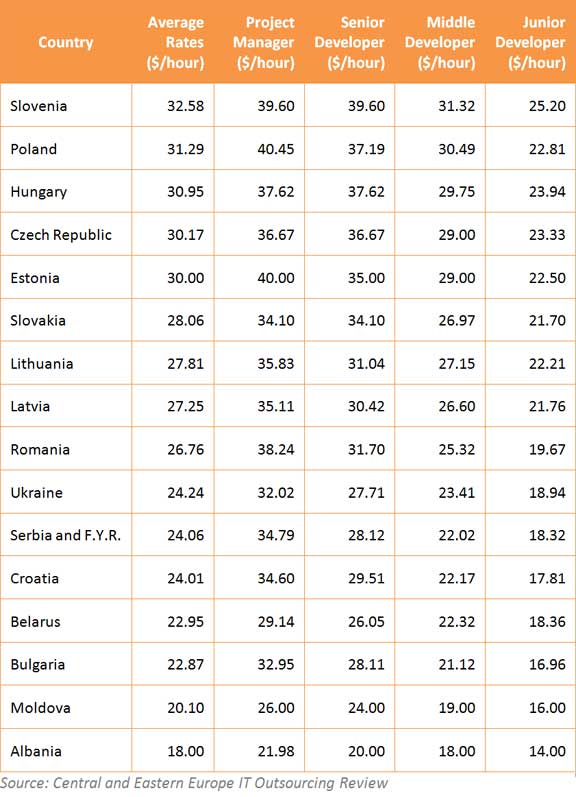
Cost, quality and scale differ. CEEOA data reveals rock bottom rates for custom software development in Albania—see Exhibit 1. Closer analysis reveals countries like Lithuania, Croatia, Moldova, Latvia, Slovenia or Albania are extremely immature markets for software engineering services and questions concerning scale are paramount. Future projections of IT graduates entering into the market really matter—your firm may well find staffing problems hit if a large service provider moves near your chosen city or if one of your larger competitors decides to do so. Quality varies with the local staffing pool: Ukraine has a huge number of CMMI and ISO benchmarks in play but has to be checked to ensure service delivery can scale?
Exhibit 1: Software Development Rates Don’t Tell the Whole Story
Cut through the confusion with a scorecard
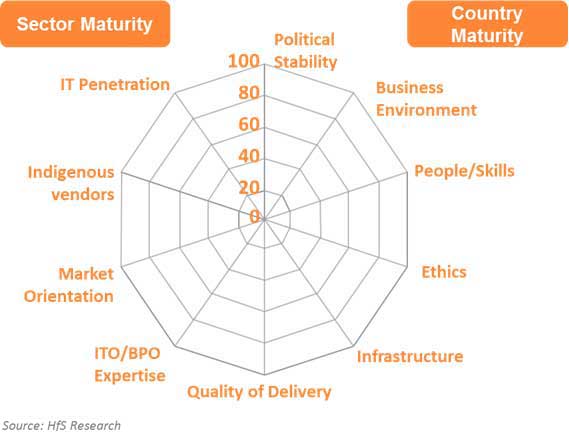
Buyers need to measure the maturity and attractiveness of a potential location in Central and Eastern Europe by following a scorecard approach. Measuring the country’s maturity (i.e., political and economic stability, business environment, people, and infrastructure) against its IT maturity (i.e., IT penetration; local vendor landscape; market orientation, industry expertise and the quality of delivery) provides a vital decision tool for buyers—see Exhibit 2. Our own analysis reveals that the region divides into several clusters set around:
Maturity: Poland, Hungry, Czech Republic are the well-established locations but Poland really is the region’s star. Lots of brochureware, best practices and government support encourages firms to set up shop in the country. There is a broad spectrum of cities and shiny new business parks; it’s easy to get to and around with good infrastructure coupled with strong universities and high IT literacy rates. Poland is the defacto choice for many international firms looking at the region.
Stability: European Union membership makes it easier for buyers to do business. Many countries included in the CEEOA study enjoy EU status and are geopolitically stable (some more than others). Investment incentives, IP protection, labour laws and anti-corruption legislation are in place to protect buyers. One firm revealed to HfS Research that doing business within the EU is easier from a travel/visa perspective and that EU data security practices offer peace of mind.
Cost: Rates in the mature central belt in Europe are higher whereas in East they are lower. IT rates in the Czech Republic which is tapped out for capacity beyond Prague and Bruno (there only really two major delivery locations in the Czech Republic). Labor arbitrage has almost disappeared and IT rate cards are almost on a par with onshore rates in the UK for example. Another client revealed to HfS how their Polish IT rate cards now come in around 25% than what they pay onshore (it used to be 40%) but they continue to use the region because it’s less risky, its infrastructure works and it’s easier to do business. Costs are lower in Romania but there’s a racier climate in which to do business so buyers have to weigh up the cost versus risk.
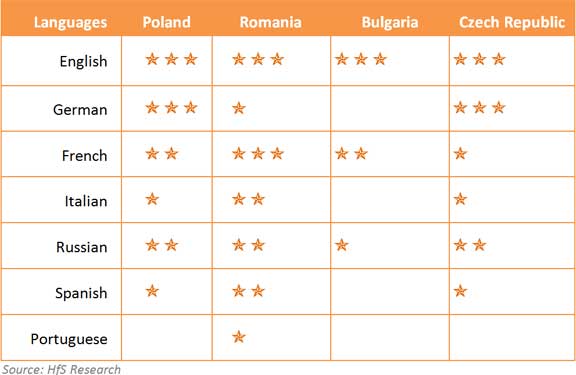
Language. Firms looking for multilingual support will view language capability as critical to decision making. Few countries have a talent pool proficient in all European languages but English is a given in most locations and local providers will offer multilingual support in another anchor language. History and geography play role with Polish service delivery centers able to offer German support while Romanian service centers tie in closely to French, Spanish and Italian speakers—see Exhibit 3.
IT expertise. High standards of IT literacy are found across the region and many governments run dedicated schemes to encourage more IT graduates into the marketplace to support a budding nearshore industry. The region has historically strong engineering tradition and the academic infrastructure to support technical training. Buyers will find pockets of engineering brilliance in Belarus, Ukraine and Russia and can compete with the best that India has to offer.
Exhibit 2: HfS Scorecard for Global Sourcing Buyers
Exhibit 3: Mapping Multilingual Capability
Key Takeaways
Due Diligence Counts
Cost and scale will always be an issue for Europe’s nearshore industry when compared with India but there are advantages for those looking to service pan European customers with multilingual support or those that want low cost software development as part of broader global delivery strategy. HfS Research recommends buyers:
Use the scorecard as the first run. Weight the scorecard according to your requirements. Some firms will prioritize service providers in nearshore destinations for language capability or functional skills such as F&A services. Others will prioritize scale and delivery capability for low cost IT engineering services.
Use site visits as an essential part of the investigative process. Only meeting your intended partners on their home soil will enable you to assess whether your cultures match well enough to ensure a smooth working relationship. Instincts count when examining the supplier, its extended organization, and the executives who will work with you.
Leverage autonomy to drive discounts. The region’s diversity offers you a negotiation lever. Countries offer financial incentives for attracting firms so investigate if there’s any money on the table from location rebates which could sweeten your decision to set up shop. Lobbying by your company or local partners help make the economics of the business case and the final rates you pay more attractive.
Seek out local support organizations. Look for investment agencies that can help maintain interactions between the government, industry and replicating best practices among the country’s IT leaders.
Learn to assemble a plane in mid-air like Coca-Cola's Bill Johnson (click for more info)
According to our buddy Bill Johnson, who runs global finance Finance Shared Services for Coca-Cola Refreshments:
“Launching a Shared Services organization more than a decade ago was a bit like assembling an airplane in mid-air.”
And to add to the experience, try on-sourcing some of these processes to an F&A BPO provider… Bill is very involved with our conference partner, SSON, and he adds, “We ultimately prevailed thanks to knowledge sharing on the part of our fellow practitioners, many of whom with which we connected at SSON events. Having now available a formal set of learning materials in a one-stop-shopping format will provide a great supplement to that traditional approach.”
Have you ever wondered what would happen if you pulled together the views, intentions and experiences of over 1000 buy-side enterprises and the real deal industry view of all the FAO engagements to-date… AND THEN pulled this all together into a one hour festive feast of FAO that you can access for free on December 15th?
Have you ever wondered what would happen if you pulled together a motley crew of Americans, Brits, Italians and some French-sounding chap, who claim to be the world’s foremost experts in FAO?
Well then – we have the show for you, featuring the following cream-of-the-crop from the HfS-EquaTerra Actionable Insight alliance:
Phil Fersht will reveal new HfS Research industry findings from its 2010 FAO deal review and present the views and intentions of several hundred HfS research subscribers
Stan Lepeak, Claudio Altini and Rick Bertheaud (see bios) will give you the low-down of best practices and insights from their client interactions, in addition to revealing some snippets from their brand new FAO service provider performance study.
If you are interested in attending the webcast on 15th December at 11.00am Eastern Time, emailAllison Norman with the subject header FAO webcast, and she’ll set you up. Be quick to reserve your spot as places are limited.
Savvy CIOs are developing themselves into Cloud-enablers by honing their sourcing and service integration skills. Our Cloud Business Services study, conducted in conjunction with the Outsourcing Unit at the London School of Economics, contrasts many differing views and expectations from business and IT executives about Cloud business services… however, both sides do agree on one thing — the crucial enablement role that IT executives must adopt in order to provision Cloud business services.
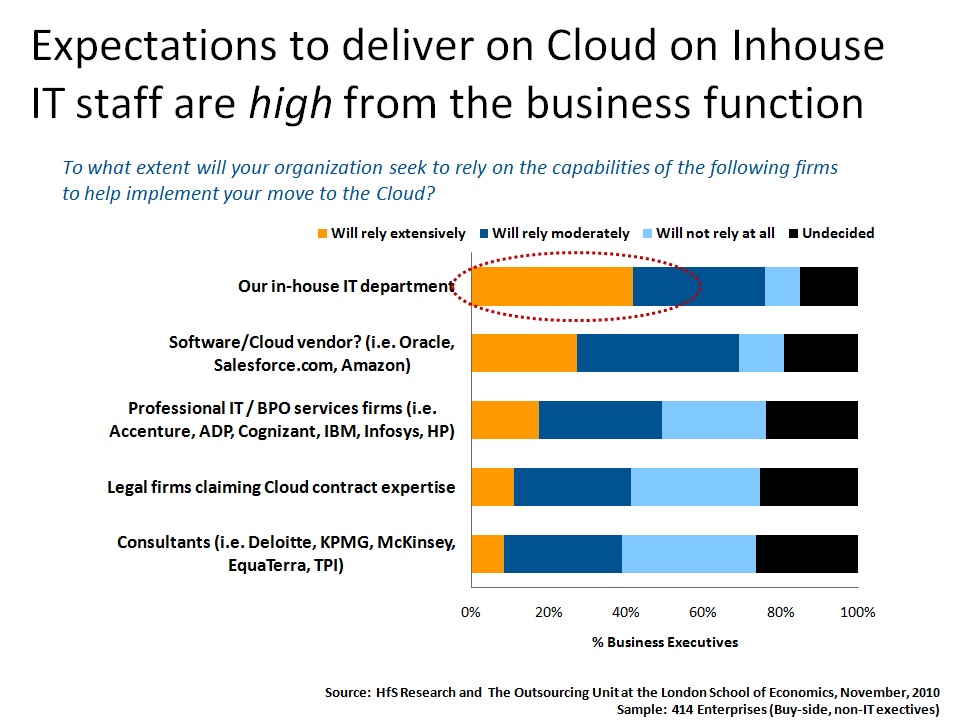
While business execs are more gung-ho on Cloud than their risk-averse IT counterparts, both sides agree on who should enable this – it’s going to be the IT function. The survey reveals that 42 per-cent of business respondents expect to rely extensively on their own in-house IT function to implement a move to the Cloud:
The bottom-line: Cloud business services creates a massive opportunity for the IT department to realign itself to the business
HfS sees the future of the inhouse IT function as being the conduit between the business and the providers delivering Cloud business services. The successful IT executives will be those who develop governance expertise in sourcing and service integration to make Cloud a reality.
Business stakeholders want Cloud, and they know smart CIOs can mitigate their risks. However, HfS believes IT professionals must tool-up to deliver cloud to their business stakeholders, otherwise they risk a gap growing between business demand and IT supply. Tooling-up for the Cloud calls on CIOs to develop new internal skills and embracing third-party expertise to accelerate the sourcing of Cloud services. Security, compliance, and integration are huge issues that predicate success with Cloud, as our survey will reveal when released later this week. Running due diligence on service providers is critical to ensure any potential cracks in service delivery do not cataclysmically impact performance. Stay tuned for more…
I recently heard a true tale being recounted where a service provider’s RFP response arrived at the prospective client’s headquarters with a child’s lolly-pop stick stuck to the opening page.
Nothing beats first impressions when a provider declares its intention to be your service partner. It’s like someone viewing your profile on an Internet dating site – if you fail to pass muster with that first encounter, you’ll most likely get jettisoned to the rejection pile before you even get to show up for the first date.
Many of you in the sourcing industry will have come across Jolie Newman at some point in your lives – she has tirelessly supported companies such as EquaTerra, Exult, Millbank Tweed and SSON over the years as a communications specialist. Jolie has even helped out HfS on occasion with her editing skills (and she frequently remarks on our typos…). After many years of toil, Jolie’s realized that many service providers are just plain awful at submitting a pristine proposal when they are seeking a sourcing marriage with a client. So she’s launched her own company, aptly-named “ProEdit Solutions“, that’s focused on helping service providers put their best foot forward when they respond to RFI and RFPs – and we, at HfS, feel she fully deserves a plug for her new firm’s services.
Quite why she turned her back on a budding career as an opera singer to trawl through details on payroll-support abandon rates, I will never fully comprehend, but she’s a super-nice lady who deserves every success with her new venture…. so over to you, Jolie:
The secret of outsourcing success – write to read
In the words of Nathaniel Hawthorne, “easy reading is damn hard writing.” With apologies to this 19th century romanticist obsessed with the inherent evil of humanity, when reading outsourcing proposals, presentations and sales collateral I’d say the reading is pretty damn hard!
In an industry in which differentiation is critical and prospective buyers look for quality in every meeting and communication, it’s surprising that few providers invest in the development of clear, concise and compelling proposals and presentations. Granted, while clients and advisors sometimes force providers down rabbit holes with the number of irrelevant questions for which they demand answers, reading their RFP responses sometimes takes the likes of a cryptographer to decipher.
“Cut and paste,” florid sentences in incorrect business English that run on for a paragraph, “non answers” and lack of proof points all detract from a provider’s message to its prospects. But document after document repeats the same mistakes. Is it haste? Hubris? Inability to string together a cogent, coherent sentence? A lack of comprehending the correlation between clear and concise technical communication and company growth?
Most providers understand the importance of communicating in an existing client relationship, but when it comes to explaining their value propositions in the written word, they are at a loss. Therein lies the problem – without good, high quality communications on the front end, which speaks to the needs of their prospects, providers unwittingly miss out on deals.
It’s a big ask to think the staff of offshore and nearshore providers can suddenly forsake “In-glish” for American or British business English. But it is fair game to ask them to close the communications gap, developing proposals, marketing and sales materials that resonate with their prospects and don’t bore the socks off their readers.
How can providers do so? In our global business environment, one solution is glaringly obvious…”reverse outsource” the creation and editing of their written communications in order to make them readable, cogent and compelling. There are individuals and companies who can help….and the results – stronger RFP responses, understandable collateral – speak for themselves.
We all know that writing is damn hard. But perhaps moving the editing and creation onshore will make for easier reading…
Jolie Newman, pictured above, is founder of ProEdit Solutions, a specialist firm helping outsourcing service providers develop professional RFP/RFI responses. You can email her directly here.
Vineet Nayar, CEO at HCL Technologies, has firmly cemented himself as one of today’s outspoken visionaries in the world of IT services. Never afraid to offer an opinion that may rub a few folks the wrong way, the self-styled CEO booked his ticket to notoriety at HCL’s analyst conference in Boston this past week, where he described Cloud, well, as bullshit.
Unfortunately for Vineet, some of the HfS Research team had also made their way to the sessions, and we weren’t going to let Vineet off lightly, without getting him to share some of his views with our readers. So Phil Fersht and Esteban Herrera were only too pleased to grab some time with him on Thursday after his flamboyant keynote to get him to elaborate a little further…
HfS Research: Thank you for joining us today, Vineet. Can you elaborate on your statement this morning that “Cloud is Bullshit?”
Vineet Nayar: My view on Cloud is that I always look for disruptive technologies that redefine the way the business gets run. If there is a disruptive technology out there that redefines business I am for it. If there is no underlying technology there, and it is just repackaging of a commercial solution, then I do not call it a business trend. I call it hype.
So, whatever we have seen on the Cloud – whether it is virtualization, if it’s available to… now before I go there, and the reason I believe what I’m saying is right, is because you have now a new vocabulary which has come in Cloud, which is called Private Cloud. So now it is very difficult, so what everybody is saying is “yes, it is private Cloud and public Cloud” So, in my vocabulary Private Cloiud is typically data center and when I say Cloud it is about Public Cloud. So let’s be very clear about it.
All the technologies that have come in so far—whether it is VMware on virtualization, which is the driving force in cloud, or Azure or Spring—are available for the enterprise customers to implement in their data center and to create a robust infrastructure which is a shared platform for their applications to deliver to their consumer. So the question I ask is: “Why should they step out from their data center and go into somebody else’s data center which is shared?” Why would they do that?
They would do it because they believe that with shared infrastructure, assumption one, they will get a better return on investment. Now, that did not happen with grid computing with IBM and IBM On Demand has been a very big campaign.
Is there something I see out there that tells me it will happen now? Yes, it is happening where your usage requirement is time bound—that means you need it for three months for SAP testing, you need it for one month a year for tax consolidation. But, am I going to put my IP on the Cloud, am I going to put my financial accounts on the Cloud, and I going to put my HR applications on the cloud? I have not seen any technical reasons for that to happen.
Then the second reason you can do that is there is commercial benefit that somebody is offering you, which is flexibility of you being able to use the infrastructure at a higher or lower on a significant level—that means you can go up 50% or down 50%. When you look at the pricing available for those kinds of flexibilities, they are commercially unattractive. Which leads me to believe that whoever is selling services of variable infrastructure as Cloud is selling them as leasing connections, rather than selling them as true variable connections. I don’t have a problem with that because there is no underlying technology which makes sharing more productive rather than not sharing. So if there’s no underlying technology, obviously it has to be leasing connections.
And then we go to applications like leasing of Azure, which creates a bus so you have to create more efficient applications rather than inefficient applications. I believe Azure will be a standard tool for creating applications inside the organization so that people, whenever they use those features and services, will use them inside the organization.
So, do I need to I need to go out on the Cloud to use azure or Spring? The answer is no. the only reason I would go out on the Cloud is for shared services—for applications which are not available for me to buy. Salesforce.com now you can buy as an enterprise license. So the purity of the Cloud is also going away. And you will see a lot of Salesforce.com being inside the enterprise because they will reuse their existing infrastructure.
Now, public citizen services is an area which would lend itself to application sharing. And the same is true with communities coming together—export communities, auto component manufacturing communities—whose owners on a standalone basis are not big enough to buy an ERP system but can come together and buy a shared ERP system.
Now, you can force me to call it Cloud. Or you can force me to say that they will an entrepreneur out there who will see an opportunity to construct a data center, construct and ERP, charge everybody a fee and say that my business is to serve you—and you create a shared services platform.
So my view is that I have not seen anything from a technology point of view which is not available for the enterprise for usage for me to get very excited and saying, “Hey all of this is going to move to the Cloud.” And that’s the reason I’m not as bullish about the Cloud as somebody else is.
HfS Research: You mention about shared services and I think that’s interesting. Do you see the growth of these “shared services” happening more with the small to mid-market businesses? And it’s those companies, as they get bigger, where everything they’re getting, is being provisioned as a shared service in the Cloud. Whereas it’s the large enterprises—the global 2000—where there’s a lot of legacy IT apps and infrastructure, and the business case for Cloud isn’t quite there yet.
Vineet: I think if you take it two-by-two—if you take small and medium enterprises and large enterprises, short term and long term: The small and medium enterprises for long term, and the large organizations for long term is where the Cloud or shared services will be used. That means, if I want to do testing for three months, large organizations will use it. A small organization testing for three months—no one will give them the shared services. So the small guy will have to commit long term and the larger guy will find usage in short term. Those two quadrants will be where the opportunity should be.
I’m glad you’re using the word shared services. Shared services will be there. So what happens is I can create my enterprise data center and allow people to share it. And you can, if you like, force me to call it Cloud.
I don’t call it Cloud.
HfS Research: You mentioned about the Private Cloud, one of the things I’ve said sometimes—and it’s not been well received—but I wonder if you’d agree, is that Private Cloud is nothing more than a re-architecture of your existing apps and infrastructure. There’s nothing terribly innovative or different about it, except that some of the technical architecture behind it may have changed.
Vineet: I think there is one difference. And that difference is that everybody asks the CIO, “Have you implemented Cloud?” And the CIO gets away by saying, “Yes,” when you call what you’re rightly saying is an enterprise re-architecture of your internal data center as Private Cloud.
So the Private Cloud vocabulary is a convenient way of shutting down any conversations around Cloud. So that’s the reason I support Private Cloud in my CIO conversations, otherwise it is exactly what you’ve said. Otherwise you are saying, “How come you have no strategy for Cloud?” Every board is asking for a Cloud strategy. So you might as well have a Private Cloud strategy and call it a Cloud strategy and get it over with and put a tick in the box and get on with life.
HfS: Let me switch to some perceptions that the analyst community and certainly your competitors have, and that is that on both sides of the Atlantic you’re winning a lot of sole source deals. So that the growth is clearly there. There’s a perception and I’m not sure you’ve been too public about it as a deliberate strategy. And I wonder if you can comment on whether it’s deliberate—and whether it is or isn’t, why are you winning those? What’s the difference?
Vineet: I want to be careful in answering that one. (Laughs) So, the answer is, yes we are winning a lot of sole source deals. And it is deliberate to keep quiet about it. And the reason for that is that we are increasingly finding that our whole business benefit-based approach starts very early in the cycle. And if we are able to convince our customer on the business benefit, then sourcing becomes an irrelevant issue. Where the amount of IT spend irrelevant compared to the business benefit, we are able to do sole source. And that is what our focus is.
HfS: Now everybody’s jealous of you because you are getting many sole source deals, which is clearly a more cost-efficient way to sell. What is it that you, as HCL, are doing differently that allows you to do it and your competitors not so much?
Vineet: I would just say that we have figured out a few things, which lends itself to business benefits. We have figured out a lot of things that don’t. And we are in the business of focusing on the few and ignoring the many. Sharp targeting.
HfS: That’s actually one of my other questions, but I’m going to skip to the most rumor and innuendo-fueled of my questions. The extraordinary success of HCL in terms of growth is really driven by your personality and you getting personally involved in the sales cycle with senior clients. You’re nodding your head so that may or may not be true. What happens to the organization as it continues to grow? Can you stretch yourself that thin?
Vineet: First, it is more a fear in the mind of a losing sales guy. It’s very easy to justify why you lost is because Vineet was personally there. So the rumor as you rightly said is forming in the excuse of why you lost the deal and that my CEO was never there. And you can’t dispute that logic. However, I can assure you that not a single CIO will buy complex transformation transactions based on my limited knowledge of his business and my limited knowledge of the solution we’re offering. My knowledge in both cases is very limited. He will buy only because on the ground he sees people with higher energy, higher passion, innovative solutions, aggressive pricing, more business case, more aligned. So my role in HCL is around strategy, as you saw, making sure that what I presented to you is delivered inside the organization. Today, I am in the US meeting you. The next five days I am only spending with employees. I am going to Seattle, then I’m going to San Francisco, then I’m going to Dallas, then I’m going to London, then I’m going to Paris, then I head home. I have three customer meetings during this trip. I truly believe in what I say—that if I can get my people fired up they will do the magic. So that’s one.
Number two, what happens when I’m no longer there? That’s a very interesting conversation. I truly believe, you must understand that I was the CEO and promoter of HCL Comnet. When I left HCL Comnet it was $70 million. Then I was replaced by another guy—Anant Gupta—who is not as much an extravert as I am. He has a different personality. He has taken that company from $70 million to $550 million—far faster than I did in bringing the company to $70 million. Why? Because you must understand at HCL it is not personality and charisma, and presentation which makes a difference. If you remove all of that and look at the thought in the presentation—the thought in the presentation could not have come from me. It’s not one person who can think through that because the subjects we cover are cultural, technology, customer relationship, employee management are a culmination of thought. Now when the organization is moving toward a strategy that is unique, and starts thinking in that fashion, the leader doesn’t matter. And, therefore, Comnet as an example from 2005-2010, if I’m not in HCL Technology, I can assure you it will grow faster.
HfS: Some would have their doubts. But let me go to one of the cornerstones of your strategy which is very catchy. I think it’s very powerful with customers. I think it’s a great marketing tool, which is the Employee First culture and you back that up with action. However, I still think from our interaction with buyers, many know that HCL is employee first, but if I ask them what does that mean, they can’t answer that. So I think HCL has a gap there that still needs to be addressed, because while it’s catchy and compelling I don’t know that people know the difference between being an employee at HCL and doing the same role at one of your competitors. Can you talk a little about that?
Vineet: I think that that’s true—that one of the failures at HCL is the fact we’ve not been effective at communicating what it is. But let me flip the coin on the other side. The other side is that every single one of our customers knows what Employee First is—every single customer knows. Every single one of my 70,000 employees knows what Employee First, Customer Second is. Every one of my competitors know what EFCS is. And it’s just a matter of time. In my mind, a great idea is going to catch on. Whether it still does a good job or not a good job, if the idea it will reach over the years; if the idea is bad, irrespective of my marketing it, it is not going to reach over the years.
One of the reasons I have held back on glitz around Employee First is because what you rightly said in the beginning is it’s a great marketing tool. I don’t believe so and I do not want it to be seen that way, I don’t want it to be projected that way, I don’t be used that way.
I think it’s a great idea. It’s a great journey of experiment that started in HCL. Let it take 10 years to reach its end destination. Any management guru you talk about they know about Blue Ocean; everybody knows what Blue Ocean is all about. In the first three years nobody knew anything about that book or the concept. After three years, everybody knows it. So, with Employee First, we’re not in a hurry. You must understand, my company thinks five years at a time. I don’t think one year at a time. In 2015, if you can show me any CIO who does not know about what Employee First is, I think that is going to be an interesting conversation.
HfS: The part I’m still curious about is the employee experience. How does an HCL employee, or someone who’s considering becoming an HCL employee, know the difference?
Vineet: Let me explain what Employee First, Customer Second is, then let me explain how an employee experiences it, how a customer experiences it, how a potential employee experiences it.
What is your core business? To create value for your customer—differentiated value. Where does value get created? In the interface of our employees and customers. Who creates the value? The employees create it. What should the business of manager and management be? Enthusing and encouraging employees to create value for your customers so that you can grow faster. That’s the concept in a box.
OK. How does an employee feel it? There is a 360-degree appraisal system happening right now—including my appraisal. If you come into the company, you see CEO, my manager, my manager’s manager and you’re being asked to rate them. There was another analyst in before you, and I asked him what do you think is different between HCL and anybody else, because they’d done this customer support feedback and HCL was number one in an independent assessment of customer satisfaction—ahead of IBM, Accenture, and everybody else. So I asked, “What is it that you heard?” And he told me that “HCL knows how to say no.” And I said that, where did HCL learn how to say no? Well, if you’re doing your boss’s appraisal you get a different degree of confidence. So that’s the first experience that happens.
Number two, your boss suddenly is very nice to you. What can I do for you, what value can I create for you? So at least he’s nice three months before the 360 and three months after the 360. So you six months out of one year I have made your boss in your service. And in each passing year it becomes better and better. You feel empowered. You feel encouraged.
Third, the energy level in the organization is very high. Why? Because of the collaborative culture. Because of open appraisal systems, politics is not there. Everybody knows if you’re playing politics, your employees are going to screw you up. The whole company is going to know about it. You can’t play that. It’s not just your team. Your 360 is done by his team, his team, his team because if you are negatively influencing his team performance you’re going to see it in 360. So an employee feels energized, motivated, collaborative, and he has all the tools he knows the company has aligned towards him.
Is it perfect? No.
How does the customer experience it? If you ask them the energy, the enthusiasm, the passion in the eyes of the employees—they have not seen before. And that’s what the customer cares about. He gets a motivated employee rather than a demotivated employee.
A potential employee is sick and tired of the blue book and that a****** who’s his manager. And he says, there must be a better company. That’s a reason 33,000 employees, can you believe it, 33,000 employees in the last six months crossed the border. So there must be something very attractive. And they would not cross after reading a book. They’ll pick up a phone and talk to a friend and say, “This is what happens in my company. What happens?” And the conversation is like this: “That guy is not giving me approval.” “Why do you go to him for approvals?” So when those kinds of conversations happen, you must understand that 77,000 mouths is a lot of mouths—and a lot of Tweets and a lot of blogs.
And that’s one reason I don’t call it marketing. You can’t keep it in a box. Because all of them are talking about it. And when I wrote the first book, I know, Krishna and everybody said, “Vineet don’t do it because there’ll be a lot of people who’ll talk about it.” And that’s exactly what I want. I want my employees to say, “This is not true.”
Go and say it if it is not true.
So that’s what a potential employee sees. Nobody’s challenging it—everybody’s loving it, because all the dirt is in you and I.
HfS: When you look at the next year, and after what we’ve been through in the past two or three years, where are you going to be investing in the next 12 months in terms of your own business.
Vineet: I will be investing, number one, in creating new services around business services—business services and ecosystem business incubation around Cloud, mobility and other stuff. That’s the first investment in service lines. Second, I have to make a huge investment in new generation organization architecture for Gen Y and gender parity. That’s the second area of significant investment. Third, in new geographies: Continental Europe, South Africa, Asia are significant investments for us from a geography point of view. The fourth area is we need have to redefine what our competitive position is going to be with a new competitor. We are creating a new competitor who doesn’t exist today.
I have some assumptions of how technology companies may snuff out competition by suffocating it, by making billions of dollars worth of purchases so that those technologies are not available to us as service providers for our provision to customers. So if you are my competition, that’s the thing you should do. So how are we going to react to that? That’s going to be very important.
And the last is innovation. What is it that HCL needs to do to drive innovation? Because innovation is happening at a very high speed, we don’t understand it to the extent we need to understand it. What is that big idea so that we can transfer momentum behind innovation, so that we can deliver, so that we can be the most innovative company in the IT services landscape by 2015? What is it that we need to do today to get us to that position in 2015? These are the five areas in which we are making investments.
HfS: Thank you so much for your time this afternoon- and for sharing your views with the HfS readers.
Vineet Nayar (pictured above) is Vice Chairman and CEO at HCL Technologies. You can read his full bio here.
Business leaders want to accelerate to Cloud and half of them expect to rely heavily on third party expertise to help them with governance, change management and business process transformation.
HfS Research and The Outsourcing Unit at the London School of Economics have surveyed 1053 organizations on the future of Cloud Business Services
With both Business and IT decision-makers expecting to allocate 30% of their IT budgets to the Cloud over the next five years, Cloud is going to demand new IT and business operating models and radically different sourcing mind-sets from CIOs and business function leaders.
What’s more, it’s creating a major headache for many of today’s service providers, which are enjoying comfortable growth with their ERP and software maintenance and development work. Which service providers truly have the appetite to invest in the consultative expertise and the software development skills to be truly Cloud-capable for their clients, versus those which simply want to shut their eyes to all this and plug away with the same-old IT support work?
Ultimately, Cloud will drive disruptive change in the way services are both received and delivered, the pivotal challenge being whether those who resist this radical shift can ultimately survive.
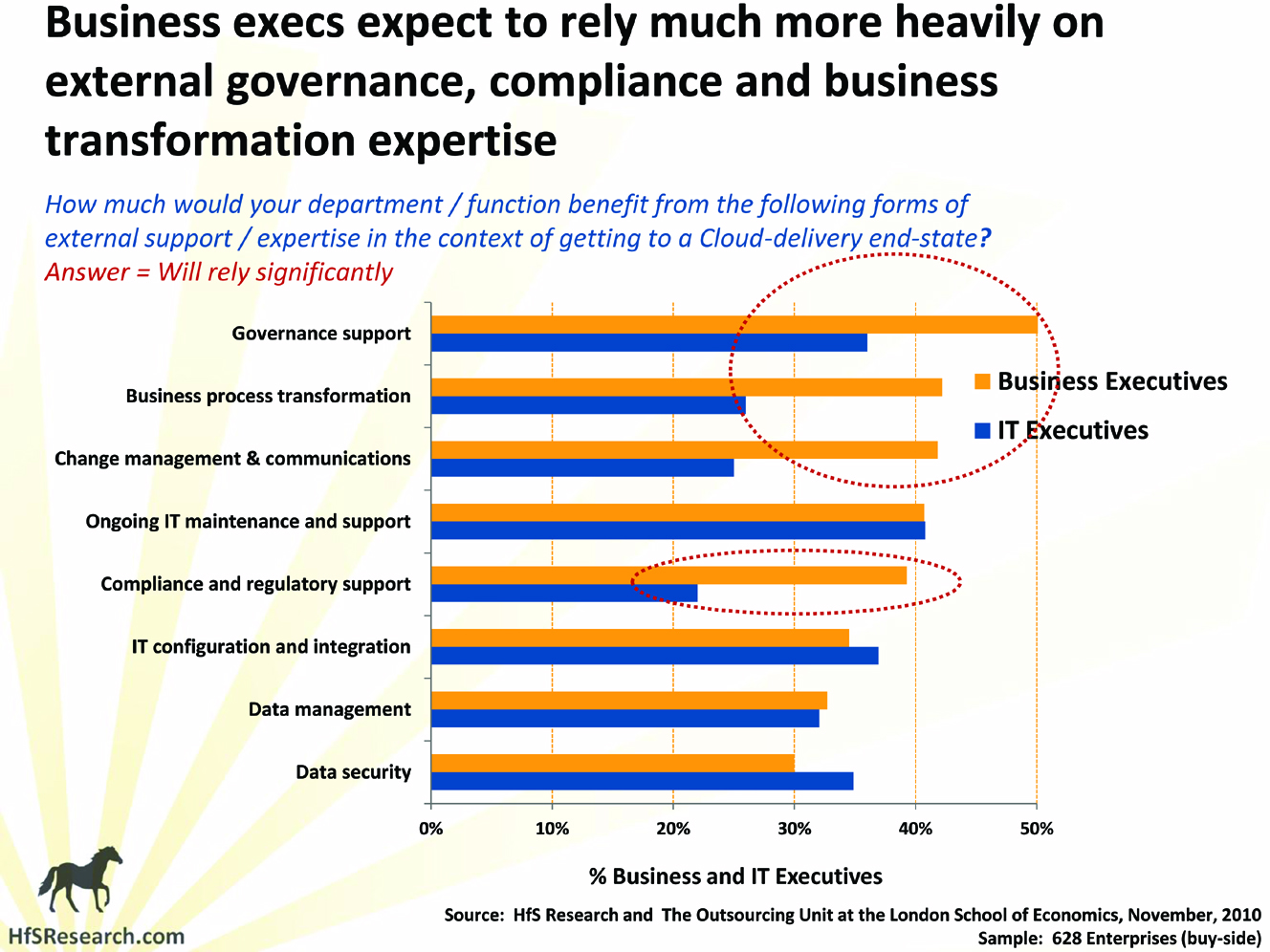
It’s heady stuff, but this is the seismic finding from our Cloud Business Services study, conducted in conjunction with the Outsourcing Unit at the London School of Economics. Essentially, business users want to accelerate to Cloud Business Services, while IT wants to mitigate its many risks. However, we reach a critical impasse with both business and IT looking for external support to make their move to Cloud Business Services a reality…and the different type of support both sides want point towards a profound reorganization around Cloud…
Click to enlarge
The bottom line: Cloud Business Services are going to create a revolution in how organizations provision IT and business services. Business leaders are looking to transform many core businesses processes around Cloud, and show serious intent to make it happen—40% revealed to us how they want support transforming IT and business relationships, and want change management support to make the transformed organization effective. But the eye-opening finding is how critical business leaders view governance capability in achieving a Cloud operating end-state—over 50% of business respondents see governance as critical compared with only 36% of their IT counterparts .
At HfS, we believe we are seeing a new mind-set emerge as firms start to rethink their IT operating models around “digital” governance structures to support the move to Cloud Business Services. Why? Because they expect to source Cloud into the delivery mix and will want their internal IT teams to turn themselves into Service Integrators. Cloud Business Services are not hype: they are going to revolutionize IT delivery and business performance. Vineet correctly pointed out (in his own flamboyant way), that the industry has a long way to go with regards to Cloud-enabling many critical business applications and developing more realistic cost-models, but we’re definitely moving past that hype phase in terms of preparing for disruptive change.


 In today’s sourcing business, many people just love to evangelize on the realities of the cut-throat global business climate to greedy executives, eager to hit profitability targets.

 New data from the Central & Eastern European Outsourcing Association (