Today, we’re delighted to announce the official unveiling of the “HfS 25” – a collection of 25 sourcing leaders working with us behind closed doors with us to help define our industry, the like of which hasn’t been done before.
HfS Research is pulling together an intimate forum for the leading minds who live and breathe sourcing everyday. And what has surprised us, when we reached out to sourcing leaders in the HfS network, is their sheer enthusiasm to be part of this group – they want to get out and network, share ideas, meet peers in other organizations, and add their tuppence to the future direction our industry is taking.
The day of the “sourcing leader” is truly upon us – and the goal of HfS is to produce a vehicle for the collective voices of today’s sourcing leaders to make a difference. Anyhow, we brought onboard Esteban Herrera to help drive this vision into reality, and am delighted today to have him tell you more about this journey that only just beginning…
Why we launched the HfS 25
Shortly after my arrival here at HfS, Phil and I started quietly working on pulling together the most influential network of sourcing buyers that the industry has known. We are delighted to share with you that we have accomplished that goal, and are officially launching the HfS Research Executive Council in 2011 that is already being called the “HfS 25”.
This is an elite group of 25 buy-side (only) sourcing thought leaders, created to be the preeminent influencer of the direction of the sourcing industry. The Council is a by-invitation-only program designed to foster networking, debate, and best-practice sharing amongst the most senior sourcing executives of large global enterprises. This powerful forum will shape the industry, influencing other buyers, service providers and intermediaries across both BPO and ITO areas. HfS will host periodic meetings and contribute by sharing candid, unbiased opinions based on current, highly relevant research data and deep outsourcing expertise. Basically, my job is to get the people together, play host, and provoke!
We have sourcing leaders from many Fortune 500 Insurance, Banking, Retail, Manufacturing, CPG, Utilities, and Oil & Gas industries committed to participate in the program and are looking forward to bringing everyone together early next year (and no, we will not be disclosing the location to non-members!)
Why is this important, you ask? This group, in addition to adding value to each of its members through collaboration with peers, will shape our research agenda, the topics you read about here, and will generally serve as a catalyst for advancing the sophistication and value of the outsourcing industry.
While I realize these are some pretty big claims, I have no doubt, based on the maturity of participant organizations and the enthusiasm of their delegates, that the forum will produce unprecedented insight, exceeding even my lofty expectations.
If you would like to get involved in the HfS 25, please drop us a mail here.
And here we are, like clockwork, jumping on the tackiest, lamest marketing exercise every analyst, consultant, CEO, and wannabe thought-leader always persists in doing… because you are supposed to gasp “Wow – they are predicting the future!”
Firstly, on behalf of HfS, I would like to personally apologize for jumping on the predictions sausage-factory (like we do every year). In fact, someone has probably designed a software package that automates predictions. In fact again, some provider probably runs a “Predictions on Demand” service that underpins the predictions-generating software with a KPO service that customizes your predictions for you;
Secondly, unlike all the other predictors this year, our predictions will automatically expire on 2nd January 2011, so they will no longer be valid, and will simply become an embarrassing attempt to sound impressive, while grossly misrepresenting reality;
Oh, and thirdly, here are our Predictions:
1. The outsourcing industry will see the first Cowboy and Indian mega-merger
In today’s market, the Western providers have been forced to bring their costs in line to be competitive with lower cost offshore-centric Indian service providers, by expanding and optimizing their offshore/nearshore operations. Both the traditional Western providers and the newer Indian breed can offer low-cost services to take on new business. It’s not really about cost anymore, though, as several Indian-headquartered providers continue to gain marketshare in this environment as many outsourcing customers are fond of their work culture. However, many sourcing managers, a rung down from the CIO, have squeezed as much as they can out of the easy work. The app support, the testing, the simple coding is running about as cheap as they can get it – there is little room left for them to maneuver. Hence, the next wave of growth for the Indian providers is to move further up the value chain to win more consultative assignments and service integration work. Several Indian providers are trying to be more like the Western providers, and the smart Western providers have studied the Indians who’ve been eating their lunch, and are working out a game-plan to win back lost business. The cultures are moving closer together, and HfS believes 2011 will see the first mega-merger between a major Indian services provider and one of the Western incumbents.
2. BPO uptake will creep back throughout 2011, as the recovery stutters and buyers pull the trigger on sourcing initiatives, however, many of the deals for the first-time buyer will be small in scope
Many businesses were paralyzed by the Recession and have been operating a “wait and see” strategy through 2010 regarding their Business Process Outsourcing (BPO) options. However, a slowing recovery and a growing pressure to meet budgets will drive a steady wave of increased BPO evaluation and contract signing in 2011, especially in Finance and Accounting and Procurement. HfS demand-side research has pinpointed a strong interest from buyers to increase scope in existing BPO contracts, and close to one-in-four businesses in the mid-market ($1bn – $3bn in revs) are expecting to investigate their first steps into F&A BPO. Moreover, many BPO providers are more determined than ever to “penetrate and radiate” customers with initial small-sized contracts with minimal profit margins, due to the shortage of attractive captive acquisitions and affordable competitive acquisition candidates.
3. IT Outsourcing will have a banner year as market peaks, however growth will tail-off towards year-end as wage-arbitrage begins to become saturated
HfS Research shows that 75% of ERP development work is still carried out onshore, and expects the steady growth of application development and maintenance deals to continue apace throughout the year. However, with much of the “lower hanging fruit” operational software work from the global 2000 moving to offshore-centric providers at such pace, HfS expects to see the first genuine signs of this market reaching its peak towards the end of the year, as buyers exhaust their arbitrage opportunities. The mid-market will provide a lot of new ITO market growth, however, these deals will be smaller in nature and often less profitable for providers, having smaller scope and often high complexity, that will prove a drain on delivery resources.
4. Service integration becomes the new fad, replacing innovation as the buzzword of the day
Too many business have failed to achieve innovation within their outsourcing engagements because they have struggled to bring together common goals and objectives across their sales, general and administrative services. The only way to start achieving new thresholds of productivity is to integrate the management, orchestration and delivery of their sourced operations, where the service integration leadership has the clout, investment and expertise to work with a service integration provider to make this happen.
5. Service providers will start to break out of vertical silos to help their clients collaborate
Outsourcing services customers are increasingly eager to learn from peers and share best practices, but this is continuously challenging for them when their service providers are structured in narrow industry silos and struggle to help them collaborate with clients in other industries. Service provider leadership is also looking at ways to help their delivery teams develop better utility models across multiple clients to drive down their margins, and the only way to do this is break from the industry-silo culture. Moreover, they are suffering from the high cost of sales and marketing by having multiple vertical businesses operating independently from each other.
6. Integrated offerings from service providers with broad capability gain market share. Distinction between BPO and ITO blurs
With the leading IT services providers all heavily pushing BPO capability, there will be increased blurring of offerings as industrialized process solutions become more popular. Process-only BPO will continue to proliferate across horizontal offerings where there is significant labor arbitrage opportunity, namely finance and accounting, order management and procurement, however within industry-specific process, platform-enabled offerings are the only way providers can develop cost-effective utility models across their clients.
7. Many CIOs will thrive or fail because of Cloud demand from their business function leaders
With both Business and IT decision-makers expecting to allocate 30% of their IT budgets to the Cloud over the next five years, it is going to demand new IT and business operating models and radically different sourcing mind-sets from CIOs and business function leaders. The ability to access business applications quicker, faster, cheaper and in a virtual business environment are the major drivers – and it’s the business side of the house which is getting seriously engaged by the potential value than the IT-side, with two-thirds of business leaders seeing huge appeal in the Cloud value proposition. For many CIOs who fail to deliver this value, the business side will be forced to look at alternative avenues for Cloud enablement.
8. Successful advisors shift their business models to be “lighter” or more full featured
The death of the advisory business has long been predicted and failed to materialize. However in 2011 and beyond, buyers will seek a more cost-effective, lighter touch solution from their advisors or seek alternatives. Several trends will contribute to this shift in demand: the significant experience base of enterprise buyers; smaller deals with smaller savings will make expensive consultants hard to justify; industry consolidation is likely, perhaps finally fixing the cost model issues of the advisory world; mid-size buyers looking for advice have many options other than traditional advisory firms. At the high end of the market, however, there is an opportunity to provide a more full-featured offering that goes well beyond transaction facilitation. These clients demand vertical and process expertise, front office integration, cloud strategy, shared services advice, and implementation of all of the above in a single, strategic engagement.
9. Onshore and nearshore alternatives hit the mainstream
A number of economic and political phenomena will contribute to the growth of onshore and nearshore alternatives, primarily the shrinking of the arbitrage gap fueled by a weak dollar and even weaker Latin American and African currencies. Almost all providers are investing heavily in Latin American capability, and will be highly motivated to drive demand to fill their capacity.
10. HfS Research will achieve world-domination
Having rocketed to double-digit employee growth in 2010 (well, reaching a double-digit number of employees), HfS will continue its social-media fuelled surge to change the entire face of the research industry. People want immediate, compelling, data-driven and relevant advice, and have limited patience and ever-reducing attention spans to get it. HfS will be there to deliver it. Its management will become so wealthy they can turn the firm into a not-for-profit and bring Larry King out of retirement to conduct all future HfS blog interviews. In addition, HfS will fire the White House as a client because they won’t give us any tax breaks….
If you believe any these predictions to be disturbing, please contact your local predictions support agent at 1-800-BANDWAGON and we will be happy to assist – remember to press #1 for English, otherwise you’ll get a load of incoherent rubbish . Alternatively, if you think we’re full of it, feel free to say so right here…
Phil Fersht is named "Analyst of the Year" by the Institute of Industry Analyst Relations
It’s a sad day for our industry when you wake up to learn that Phil Fersht has been voted analyst of the year by 150 analyst relations professionals at the Institute of Industry Analyst Relations.
This now means:
**Everything I say is now correct for an entire year
**HfS Research prices get a 10% hike
**Euan can’t argue that our report titles sound like blog posts
**Our predictions sell-by-date gets extended to the 3rd January
In all seriousness, I would like to thank all of your for your support (especially those who voted for me – you know who you are!). This really does prove there is an independent analyst model that can co-exist alongside the big houses, and we’re super-excited about what’s in store for us in 2011.
I also would like to extend my congratulations to my alma-maters IDC and AMR (Gartner) which also achieved significant recognition – I learned the analyst trade during my years there and can recommend to anyone that the analyst career path is an incredibly rewarding one to follow if you are curious, critical and passionate about covering an industry.
One other award worth mentioning is our research partner EquaTerra‘s recognition, which is a culmination of their tireless work to drive independent thought and advice into the market.
Thanks again – it’s a real honor for the HfS team to achieve such widespread industry recognition as we embark on a very ambitious research agenda,
In years gone by, TPI’s Index established itself as a bell-weather for all stakeholders in the outsourcing industry – most outsourcing deals were big, everyone knew what there were, and TPI advised on a good chunk of them. The Index was a reliable checkpoint to know what was going on. However, after their recent Q3 outlook, several industry colleagues expressed concern that TPI wasn’t reflecting market reality, with particular reference to their claim that the BPO industry had taken a 15% nose-dive (see slide 4 here) in 2010.
New HfS Research data that encompasses all current Finance & Accounting (F&A) BPO engagements, reveals two key factors that cause us to question the reliability of the latest TPI Index’s BPO outlook:
1) Advisor-led deals are diminishing
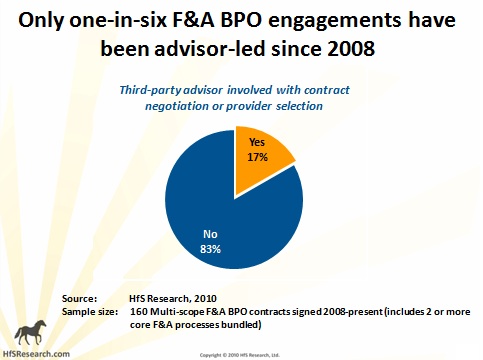
Our latest research of all current multi-process FAO engagements, for example, reveals that five of every six engagements signed since the beginning of 2008 have been orchestrated directly by the customer. Many of these were competitive bids, in addition to sole-sourced situations, but what’s clear is a third-party advisor was not involved in process:
2) The average deal size has fallen below TPI’s radar
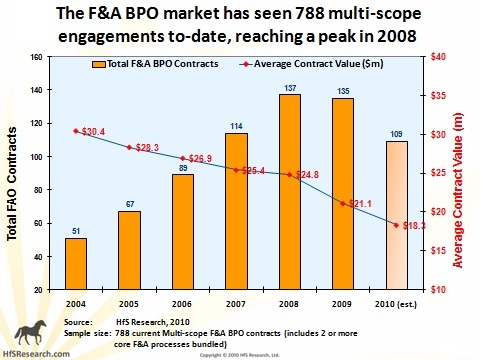
TPI only bases its Index on deals with total contract values greater that $25m. As our new research reveals, the average deal size for for multi-scope F&A BPO engagements in 2010 is $18m, and fell below the $25m level in 2007:
What’s clear is that 2010 wasn’t a banner year for BPO and growth was not spectacular, but the market certainly didn’t contract – there’s an additional $2bn of TCV to add to it, and at least another 100 new deals.
While we commend TPI for performing a valuable service for the industry over the years with its reporting on market trends, it concerns us that such negative reporting is sending mixed signals to the investment community, and other industry stakeholders, that the outsourcing industry is seriously faltering. While TPI’s own stock valuation maybe experiencing a miserable 2010, this shouldn’t reflect on the broader industry, which has managed to continue healthy growth, in spite of the lethargic post-recession economy.
HfS Research and The Outsourcing Unit at the London School of Economics have surveyed 1053 organizations on the future of Cloud Business Services
Today’s CIO is under constant pressure to drive out cost, without impacting business performance. And if tomorrow’s CIO can deliver real business value beyond smart cost-management, then he or she will succeed – and should remain gainfully employed after they’ve stripped out whatever operational cost they can.
Our study blatantly shows CIOs are caught up in an aggressive cycle of providing services to the business that are cheaper to run, faster to access, and more relevant to driving productivity and growth. Gone are the days when CIOs demanded their shareholders underpin massive technology investments in ERP and infrastructure. Those investments have been made, and most CEOs intend never again to make capital outlays of that ilk on technology.
Enter the Cloud. This is driving a new inflection point in the provisioning of business services, that goes far beyond straightforward outsourcing.
So why is Cloud the future?
Simply-put, many of today’s large businesses have already squeezed much of the obvious cost out of their IT departments by having their lower-end support and development needs replaced or supplemented with offshore-based services, while offloading the costly burden of clunky, unnecessary IT hardware to third party IT infrastructure service providers.
For many large business that have maximized their cost-savings potential with outsourcing, Cloud computing gives CEOs hope that another inflection point is upon us, that will not only take out that next 20-30% of cost, but also empower their business functions to access best-in-class services. The potential to slim down the IT department to a “CIO and a crack team of IT service managers” is becoming very real for the sourcing-savvy organization. However, the challenge for the large organization to move to the Cloud is far more cumbersome than most smaller business, which we discussed so vibrantly here.
For the small-to-medum business, Cloud is already pretty much here – and has been for a while. You can access nearly all packaged applications in the Cloud and have a service provider deliver you the services you need via a shared-service utility model. You already have your Ultimates, ADPs, Netsuites, SFDCs and the like processing your pay checks, doing your benefits enrollments, managing your customer and employee data, hosting your accounts etc. in the Cloud – and you can choose how many staff to keep inhouse to service those functions for you, versus having them provisioned by third-party service providers.
Unfortunately, for many of the large businesses using complex ERP apps that are wrenched into all sorts of back-end databases, they are faced with some significant capital investments to find their way to a Cloud-ready environment. And it simply doesn’t suit many of the Cloud-unfriendly software providers to have their clients move to a model that will save them money. The onus is moving to the service providers to build services that can take organizations on a journey of business change and technology change, which we discuss further here.
Our study shows the momentum towards the Cloud is well under way
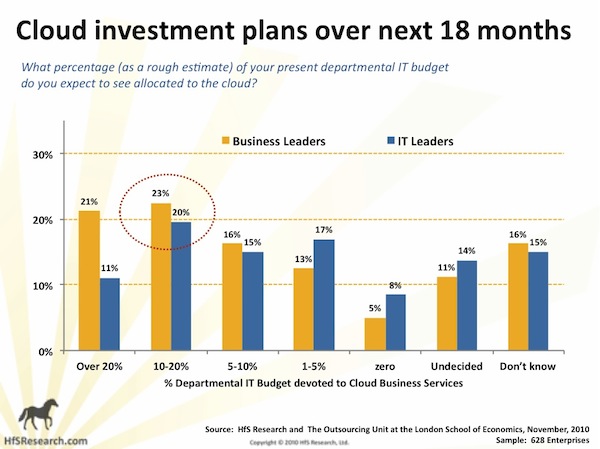
Firstly, both IT and Business leaders already plan to devote a significant portion of their IT budgets to investing in Cloud. While business executives are understandably bullish, it’s significant that a third of IT executives already see at least 10-20% of their budgets going into Cloud services in the medium-term:
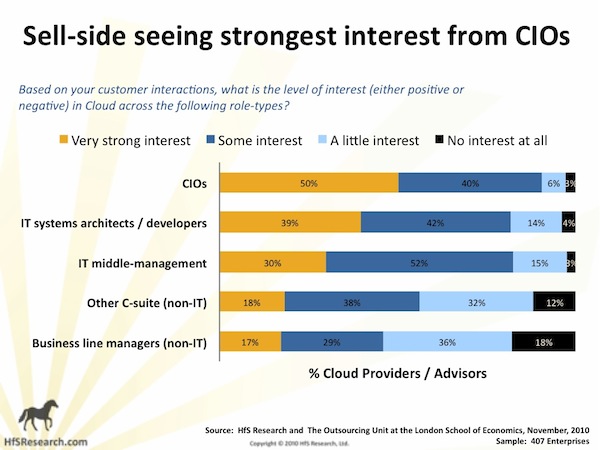
Secondly, the impetus behind Cloud is coming from the top-down. As awareness of Cloud across business leaders increases, so does the pressure on the CIO to develop a Cloud roadmap for their organization. The industry advisors and providers of Cloud see half the CIOs with whom they interact, showing a very strong interest in Cloud, with the less senior IT professionals showing less enthusiasm:
The Bottom-line: CIOs need to broaden their skills beyond provisioning outsourcing delivery and Cloud fits the bill
CIOs need to be seen as innovators, constantly embracing IT delivery models that provide the business with faster, cheaper and more relevant business applications. Many have had to become the conduits for IT outsourcing over recent years, as business leaders demanded cheaper IT provision. The same is happening with Cloud, as more evidence of faster, cheaper, more relevant business services materializes.
Thanks to all of you who took the time to share their views with us on Cloud, and the impact they expect it to have on their organizations: we gleaned the views of over 1000 business (non-IT) executives, IT executives, in addition to industry stakeholders. This has proven to be most comprehensive study ever performed, that has used a vast social media network to canvass such a broad population of our industry.
We would like to thank the Outsourcing Unit at the London School of Economics, which partnered with us to help design and analyze the study, and also John (you know who you are), who introduced us in the first place to make this all happen.
As a special thank you to our industry for investing time to make this study happen, you can access your freemium copy of the executive report “Cloud Will Transform Business As We Know It: The Secret’s In The Source”, by clicking here
Esteban Herrera is appointed Chief Operating Officer, HfS Research
Dear Folks,
As the year draws to a close, I can barely get my head around what we’ve achieved at HfS in 2010:
We’ve built a global team – with more characters joining next year;
We’ve developed a phenomenally ambitious research agenda (stay tuned for the official launch);
We’re about to launch a super-sexy new research website in the New Year;
We were named “Analyst of the Year” by our industry peers at the Institute of Industry Analyst Relations;
We’ve now reached 40,000 subscribers, 40% of whom are sourcing practitioners. We’ve never even thought about buying a list – everyone just found us!
We’ve surveyed the views and buying intentions of more than 8,000 enterprises;
We’ve added 20+ research clients across buyers, advisors and providers of sourcing;
We’ve launched an elite group of sourcing buyers, dubbed the HfS 25, which we’re already having to look at re-branding the HfS 50, due to the enthusiastic interest from so many of you.
And one person who’s really stood out, as we’ve romped through all these milestones, is the most poker-faced advisor-turned-analyst of them all: Esteban Herrera.
Despite my inability to spell his name, plus the fact that he has to put up with me (daily), and his giving up a big-bucks job to help steer this thing, he actually seems to like it here (or that’s what he tells me…).
We are very pleased to announce the promotion of Esteban to the role of Chief Operating Officer for HfS Research. His vast experience advising sourcing customers, combined with his energy, enthusiasm, sense of humor and entrepreneurship will make him a popular pundit and analyst for HfS readers, as we venture towards a very exciting 2011 for our growing organization.
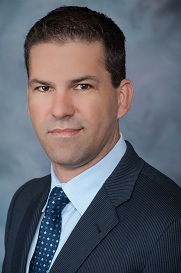
Esteban Herrera (pictured) is Chief Operating Officer for HfS Research. You can access his bio here and reach him at esteban dot herrera at hfsresearch.com. He can also be found on twitter: @eherrerahfs
Most people in the sourcing business have been exposed to the cheeky grin and affable sense of humor of EquaTerra’s Ron Walker. He’s always been at the front end of wheeling and dealing big deals – so most of us were left scratching our heads a couple of years’ ago, when he informed us he was going to focus his energies on developing an advisory practice around Real Estate and Facilities Management Outsourcing (REFMO).
Real-estate Ron wrestles with a Yellow Fin
“People outsource that stuff?” We all asked. Apparently, managing and maintaining global real-estate infrastructure is a big deal and a major overhead for businesses, and they can save a boat-load of money integrating and sourcing the management of these services (Click here to dowload an overview of the market) . So we grabbed some time with Ron to have him explain more to us about REFMO…
HfS Research: Ron, What is REFMO all about, and why should today’s sourcing professionals be interested in it?
Ron Walker: Sourcing professionals should be very interested in REFMO because it is the second or third largest spend category of any company. Only recently has there been an opportunity to integrate the function. Most strategic sourcing organizations have focused on cost reduction via standard procurement techniques. New tools, processes and service provider capabilities have come to the market over the last 2-3 years that have dramatically changed the opportunity to improve service and reduce costs.
The REFM opportunity is similar to where supply chain was 15-20 years ago when executives realized that if you can integrate the entire supply chain, the cost and service improvements are exponential.
HfS Research: Which are the main service providers operating in this market, and typically, who are the main executives on the buy-side which deal with managing these functions?
Ron Walker: The service provider market has changed dramatically over the last several years with many organizations adding both capability and an expanded geographic delivery footprint. Much of the improvement in capabilities and footprint was accomplished via M&A activity. I would say the three providers with the largest capability or geographic footprint are CB Richard Ellis, Johnson Controls and Jones Lang LaSalle. Although there are many regional and/or geographic service providers who are equally qualified for the right circumstances– for example, Sodexo, Veolia, Cushman & Wakefield).
One of the challenges with integrating the REFM function is that the leadership can be fragmented. There is seldom one person responsible for end-to-end REFM. The executive(s) we typically work with include VP/director of facilities, VP/director or real estate (sometimes combined) and often the strategic sourcing executive is involved and/or leading the initiative. We have seen great results when the CFO, COO or CAO have been directly involved because they understand that silos are usually less efficient.
HfS Research: Why has it become increasingly adopted over the last couple of years? What are the main drivers or inhibitors for enterprises?
Ron Walker: There are a number of reasons why organizations are evaluating REFMO. First, REFM is a large spend category that has been under-managed but offers a large opportunity, which means large savings with low capital investment. Second, service provider capabilities have significantly improved. Third, regulatory and risk management requirements have changed, which requires accelerated implementation. Fourth, space optimization requirements have changed through M&A, rationalization and consolidation. Finally, there are added service capabilities like green/sustainability energy programs.
HfS Research: From your hands-on experience of these delivery models for REFMO, what are the typical cost-savings / ROI?
Ron Walker: Typical savings can be anywhere from 7-20% with some organizations exceeding 20% when they include strategic space optimization. If you consider that REFM represents 20-30% of an organization’s cost base, the savings potential is enormous. (Note to readers – you can access some excellent research and information on the REFM market by clicking here)
HfS Research: What are the main hurdles enterprises need to overcome, from your experience, to move into an ideal REFMO end state?
Ron Walker: Many of the hurdles are the same for REMFO as they are with ITO or BPO. However, because this has been a low profile area, we experience additional challenges. The challenges include local/business unit ownership requirements. For example, local plants and campuses like to manage their own space. Then prioritization conflicts with internal strategic sourcing organizations–they get credit for reducing cost by tower while the REFM executive tries to improve service and reduce cost across the entire process. Of course, there’s always the general lack of understanding of sound outsourcing practices, and service providers need to continue down the path of expanding capabilities and footprint while improving overall operational delivery, including governance.
HfS Research: And finally, Ron, what inspired you to lead this practice for EquaTerra?
EquaTerra's Ron Walker (click for bio)
Ron Walker: Since the beginning of EquaTerra, one of my specialties has been to identify and launch new service offerings. With double-digit growth in a fragmented marketplace, we decided it was a great opportunity for me to build the team. There is nothing more exciting than being a part of a rapidly expanding service line!
HfS Research: Ron, thanks for enlightning the HfS community on this market – best of luck devleoping the practice.
When he’s not leading the Real Estate & Facilities Management Advisory, EquaTerra’s Managing Director Ron Walker (pictured here) can usually be found watching his kids on the various sports fields of the Houston area. And when he’s not doing that, you just might find him playing a round of golf or trying to snag a yellow fin tuna off the Pacific Coast. You can contact ron at ron dot walker at equaterra dot com.
As the world prepares to hibernate and recharge its lithium batteries in anticipation of a frenetic 2011, we take a look back at the highlights of 2010, as seen by your friends at HfS Research™…
The year started out as one would expect: with resolutions. Did you keep yours? We tried. But we’re sure a few “transformations” slipped out over the course of the last 12 months. Look back on this post and see how you did: New Year’s outsourcing resolutions for service providers. Anyway, here are some HfS highlights from 2010:
In 2009, we were officially the first to coin the term “New Normal”, only to see every other Joe Schmo latch onto it, but in January it didn’t stop us from revealing the results from our “Seeking the New Normal in Outsourcing Delivery” study…in a six-part blog!
In February, we asked the musical question: Are you Ready for H-Day? Just what was H-Day? Well, if you must know, you’ll find the answer here. That’s right–H-Day was the day HfS Research was borne out of the Horses for Sources blog. Will they make it? Many asked… several doubted, but we’re still here aren’t we, calling out the nonsense… and readying to add some new faces in 2011.
What on earth's an "oxymoron"?
And when it comes to nonsense, we like to give you some answers. So, when a term like Private Cloud comes across our screens, we have to ask: Is it the new Jumbo Shrimp? You know, is a “private cloud” an oxymoron?
As spring arrived, so too did a new healthcare law in the States. We investigated and found a scramble was under way to fine new sources of productivity. See our report here.
Innovation is a word that’s tossed around a lot. And most early adopters of BPO are a tad underwhelmed with what little innovation they’ve achieved, as our survey of 588 shared services and outsourcing executives revealed. However, most buyers realize they need to up their game before they can throw the gauntlet down to their provider – and they also see huge potential for achieving innovation with their BPO endeavors… if you read our “Innovation Purgatory” series.
Happiness is a relative term, isn’t it? But it’s not fun to be unhappy, especially when you’re spending money on the thing that’s displeasing you–namely and outsourcing vendor. So, we wanted to get to the root of it, with Why aren’t I happy with my outsourcer?
It's all about those regular delights…
As the dog days of summer approached in the Northern Hemishpere, we started thinking about, you guessed it, BPO’s billion dollar best-kept secret. In two posts (here and here), we talked with David Andrews, CEO of UK-based pureplay BPO vendor Xchanging plc, which has revenues in excess of $1.1 billion.
You thought we were done with innovation? Not even close. In July, we released a report (Desperately Seeking Innovation in BPO: Enterprises Speak Out), which dug into the results of our earlier survey of 588 shared services and outsourcing executives.
Old buddies Ray Wang and Phil Fersht got together for a wide-ranging discussion. Although there is only one Ray Wang, there are two parts to this discussion (here and here).
Did you know that 110,000 home-based call center jobs were created in the past three years here in the US? We did, thanks to Philip Peters over at Zagada. So NPR came calling and Phil Fersht was on All Things Considered, the American radio network’s afternoon show, in August.
Good things come in threes, right? Well, we found that to be the case as we added Esteban Herrera, Euan Davis and Mark Reed-Edwards to the crew here at HfS Research in September.
No sooner had we been joined by Esteban, Euan and Mark than we turned to marriage counseling, with triathlete, SCUBA diver and outsourcing marriage counselor Liz Cambpell-Evans, who desribes her job this way: “It’s great fun, I often describe my job as an opportunity to meet interesting people and help them solve tough problems.”
George Clooney was Up In The Air, but he’s got nothing on Ritesh Idnani, COO of Infosys’ BPO business. Over a three-part discussion (here, here and here), we got a glimpse at life in the new normal BPO environment, as well as a 35,000-foot view (literally) of his Infosys world.
Negotiations can be tough going. HfS analyst Esteban Herrera has seen weeping, object-throwing, suicide threats, uncontrollable roll-on-the-floor laughter, walk-outs both staged and unplanned, and even a handstand. In October, he detailed the Strange Things Happen at the Negotiation Table.
Euan Davis traveled to Prague in October to attend a CSC analyst event. In that ancient city, Euan liked what he saw. And the CSC event, which outlined twin strategies for dealing with the short- and long-term realities of how customers buy IT and business services, was pretty good, too.
Vineet Nayar, CEO of HCL Technologies, was typically outspoken about Cloud at HCL’s analyst day in Boston in early December. Tweets were flying about madly in the wake of his comment about Cloud being bullsh*t. But don’t be concerned about figuring out just what he meant by that. We went to the source to get an explanation.
And while we were busy examining various forms of animal deposits with Vineet, Deborah Kops, delightful doyenne and describer, was joining the HfS research family to bolster our contributing analyst talent. Debs took little time to wax lyrical about all issues sourcing change with two perceptively poetic and pragmatic pieces: “Imperfect Arbitrage: The implications of generational shift resulting from the globalization of work” and “Outsourcing: no fun for the soon forgotten”.
Not much fun for the soon-forgotten?
So, you’re a sourcing leader looking to discuss your challenges, successes and strategies with your peers? Short of bumping into someone in the Admiral’s Club, where will you be able to do that? With HfS Research, of course. In December, we created the HfS 25™ Sourcing Executive Council. And leaders from far and wide are clamoring to be part of this exclusive forum.
We all like prognosticating. Thinking about what will happen tomorrow, next week, next month or next year is an interesting occupation. Although we’re not futurists or bookies, we gave it a shot in a post here and a podcast here. Check back with us in a year and see how we did.
HfS Research and The Outsourcing Unit at the London School of Economics have surveyed 1053 organizations on the future of Cloud Business Services
It’s been one frantic escapade here on HfS to keep track of all the core issues impacting our sourcing world, and we’re already knee-deep in our 2011 planning for more to come. However, this wouldn’t be at all possible without your collaborative support… and we hope it may long continue as we embark on our journey to bring Research 2.0 to the kitchen table 🙂
Have a terrific holiday, and all the very best wishes for 2011, from the HfS team.
The one common theme that kept cropping up, was their overwhelming admission for more effective change management and communications, business transformation and governance programs. To put this all in a nutshell, many customers must radically change their whole approach to sourcing to break free from inflexible old-world business models, IT strangleholds and rate-card purgatory.
So this year, we are putting a major research emphasis on what measures customers need to address to get moving with their sourcing agendas. And, as if by some higher form of sorcery, we’ve been graced with the presence of Deborah “Sourcing Change” Kops herself to help steer our sourcing change research agenda this year. Over to you, Mrs. Kops…
Happy Sourcing Change Year
My friends at HfS are forecasting a meteorologist’s dream for the sourcing industry— high pressure combinations of Cowboys and Indians, a blizzard of new deals, and very Cloud-y days. In the face of these anticipated patterns, how should buyers prepare for the stormy weather that ultimately impacts results for their organizations? Perhaps it’s time to prepare for the change sourcing represents a bit differently. Here are my top five recommendations for staying warm and dry in 2011.
Approach sourcing as “disorganizing event” Buyers usually restrict their ambition for sourcing to make existing conditions a bit better, faster and cheaper in a more scalable structure. Yet the act of sourcing is a profound opportunity to make indelible changes to the way the organization works—enabling work in new ways, setting new rules, delivering different outcomes, even changing the culture. Think about how you want to change the organization, and solve for it, rather than build a better mousetrap. What do you want sourcing to enable you to do?
Focus on “worst practices” Think about it–the best practices always take care of themselves, yet the worst practices fester and fester. Want to delight your customers by making their lives better? Stop painting a picture about a sourcing nirvana where 200 basis points of the cost of an invoice will solve all ills, and design a solution to get rid of their biggest headaches—inaccurate data, late close, lackadaisical staff on boarding, excessive system downtime. First fix what is inexcusable and downright awful, and customers will start to believe the vision.
Allay all fear The aim of sourcing is about as altruistic as corporate initiatives get. Few dare to argue that the business case benefits aren’t exceptionally compelling. Yet what stops it in its tracks is fear—fear of pushing too fast or treading on important corporate toes on the part of the sponsoring team, fear of not performing on the part of the delivery team, and fear of loss of control on the part of the business lines. If you can allay your own fears, and those of your internal customers, you’re halfway there.
Ditch procurement Is traditional procurement deeply involved in M&A activity? Corporate strategy?Business transformation? Not a chance. While our friends in the CPO’s office have an important role to play in procurement process and governance, they cannot be the major arbiter of taste when it comes to sourcing true corporate change.
Deborah Kops, Contributing Analyst, Sourcing Change Management, HfS Research (click for bio)
Get moving The mantra for sourcing change is the opposite of “speed kills.” Take it as a given that you’ll never please everyone nor get all aspect of the solution right. The sourcing exercise is not a proxy for singing a kind of corporate “kumbaya”—sitting around until everyone holds hands around the campfire. Obvious change is like a revolution—there is a before and an after. Everyone may not like the after, but there is movement, ostensibly to something better.
During the course of the year, Sourcing Change will be working closely with HfS Research to not only help you think about change management differently, but also dimension similar challenges. You’ll know when to put on those boots, and when to put on sunscreen, when an umbrella is in order, and how to batten down for a tornado.