We all make curious decisions in life, like when you accepted your mum’s Facebook invitation… or when Bill O’Reilly decided to be born.
However, these pale in comparison when one of Europe’s finest services analysts traded the corporate upper-echelons of Forrester Research to help kick-start a quirky little feisty research upstart, that was launched out of a blog – with a name no-one the left side of the Atlantic understands. But it happened: Euan Davis really did join HfS Research!
Euan spends so much of his life writing analytical stuff, that he’s never been so nervous as when he’s had to (gasp) put analyst protocol aside and actually write a blog post for the bagel-and-coffee delights of the interested sourcing onlooker. So over to you Mr Davis, to tell us…
Why I decided to Run with the Horses
At the start of April every year my fellow Brits gather in their homes (and the lucky ones, in the pubs) to enjoy one of the greatest spectacles in the horse racing calendar: The Grand National.
Horse racing may well be the sport of Kings, but compared with the Kentucky and Indian Derbies or the Melbourne Cup, the Grand National is the most royally gruelling race, with 30 fences set over a distance of four and a half miles.
Days gone by saw horses and their riders suffer terribly on the National’s staggeringly high jumps. I remember watching in 2001 as only 4 horses finished out of a 40 strong field as the bad weather coupled with the course’s treacherous jumps took their toll—that year a 33/1 outsider won and by luck I liked the name so I backed it. Last year, the bookies favourite won but plenty of times I’ve seen upstarts enter the race and collect the trophy after a spell-bounding 10 minutes later….
In my eyes I see HfS as the young upstart in the research business with its analysts (horses) full of vim and vigour and chomping at the bit to challenge with leading content, robust analysis and long reach into the crowds that come to watch us. But enough of the horse analogies—I have made (and heard) enough already—let’s just say I am delighted to beat HfS.
Readers of my blogs here will find collective thinking into how the evolving services landscape will shape demand and how service providers will respond. I intend to connect tech savvy business leaders, enterprise architects and sourcing executives together with the wider universe of IT/BPO providers to explore the key issues impacting the demand and supply of IT services. HfS provides a platform to share ideas, in addition to broadening the debate.
My research here will focus on three themes that we feel really matter for buyers and sellers of IT/BPO services—
1) Making multisourcing and service integration work. Those of you that have read my research will know how fascinating I find multisourcing and the governance needed to enable it. We are moving to a multi-provider eco-system and customers want their providers to share, collaborate and cooperate together rather than upselling and competing with one another.
My thinking is that some of the larger IT/BPO services firms will morph into collaboration hubs for their clients. They will become “service integrators” and drive the collaboration and cooperation between providers that effective multisourcing needs to drive value. And, as Cloud grows in its maturity—and it will—the role of the service integrator will become really important in minimizing risk, and guaranteeing operability and performance.
2) Sourcing through the Cloud. What analyst worth their salt is going to ignore the biggest game changer in the IT/BPO services industry?! Through all of the jumbled thinking customers get it. New and fresh buyers are emerging from business rather than IT that are keen to experiment. I reckon we’ll see a new generation of business leaders navigating through all the security, risk and compliance issues to create new revenue models based around agile processes that hang around the cloud. As a jaded ex-ASP analyst (remember that?), I was dubious when I first saw the vendors all jump at once, but you know what changed my mind? The iphone….Voucher Cloud changes how and where my family spends its money and the possibilities are endless for other location based services. So many companies are asking questions concerning how they can “Cloudify” their contracts that it’s right that I focus here. We’ve just finished a cloud survey with the London School of Economics to over 1000 IT and business professionals and the results are startling…I will be running excerpts of this study over the next few weeks.
3) IT and BPO services. As a “BITs” analyst (BPO and IT services) of many years I will be continuing coverage of the European IT and BPO landscape. Expect to see HfS cover the main markets for readers that want a global view. Infrastructure and application services, business process outsourcing, and transformation services fall under my European coverage. I will support customers with their service provider evaluations to figure out which the right global delivery acumen for their needs. I will be developing new tools for HfS customers that will allow you to select the right provider for an engagement in an open and easy way.
Euan Davis, Managing Director, European Practice, HfS Research
HfS gives me the opportunity to connect with so many IT and business professionals be they enterprise architects, sourcing practitioners, CIOS on the buying side but also with the IT/BPO providers and I would invite you to contribute your thoughts as you see fit. Expect to see my new research highlighted here, interesting articles that I find and insightful Q&A with those that are grappling with these mega trends and whose experience can deepen our collective understanding. I am very excited to be joining HfS and working with you all.
Cheers!
Euan
Euan Davis (Pictured) can be reached at euan dot davis at HfSResearch.com. He can also be found on twitter: @euandavis. You can read his bio here.
CSC recognizes the need to move away from "old world" thinking… but can it change with the times?
CSC has struck out in a new direction sketching out a long-term position as a “service integrator” and laying out a cloud strategy that goes beyond the usual hype.
CSC needed to realign and refocus as the large outsourcing opportunities declined and its customers transform and trigger demand for new, agile services. It’s a step change for the company— and the right one—as it looks to ditch the baggage from its large outsourcing business and emerge as a trusted partner for its clients. It understands that customers are sourcing cheaper and faster in a fragmenting market and that they want to consume services, while minimizing risk. The real test is whether CSC can channel its pricing and engagement models, its service management frameworks and—critically—its sales team in the same direction as the new IT services ecosystem emerges.
CSC has struck out in a new direction sketching out a long-term position as a “service integrator” and laying out a cloud strategy that goes beyond the usual hype.CSC needed to realign and refocus as the large outsourcing opportunities declined and its customers transform and trigger demand for new, agile services. It’s a step change for the company— and the right one—as it looks to ditch the baggage from its large outsourcing business and emerge as a trusted partner for its clients. It understands that customers are sourcing cheaper and faster in a fragmenting market and that they want to consume services, while minimizing risk. The real test is whether CSC can channel its pricing and engagement models, its service management frameworks and—critically—its sales team in the same direction as the new IT services ecosystem emerges. The vision is right but the implementation is critical…
Download our latest HfS RAPIDInsight to read our full analysis of CSC’s challenges and opportunities ahead.
Euan Davis, Managing Director, European Practice, HfS Research
Many of you sent us mail today regarding the new HfS RAPIDInsight on CSC’s new services integration strategy (see earlier post). Our European research lead, Euan Davis, was at the unveiling of the new strategy in Prague a few days’ ago, and outlines his thoughts further...
I liked what I heard at CSC’s European analyst event. The provider outlined two strategies dealing with the short and long term realities of how you, the customer, buys IT and business services:
1. CSC’s cloud strategy is a short-term play, and I liked it because it recognizes the realities that many customers running down their existing contracts face today –i.e. to radically lower the cost of service delivery and create more flexible sourcing strategies. CSC offers a clear adoption path with lots of tools and support for its customers so they can begin shifting manageable chunks of their existing contracts to the great data centre in the sky. Nice.
2. The more intriguing long term play is CSC’s positioning to be your “Service Integrator.” As a service integrator, CSC would marshal an eco-system of IT/BPO providers on your behalf, setting predefined delivery roles, mutual commitments, swim lanes and incentives for all your providers. CSC sets the model up so each provider shares, collaborates and innovates together and then ensures everyone pulls in the same direction. Nice. Sounds great in theory, right? However, running this model is hugely complicated and it hardly pays out for a player the size of CSC. The revenues accrued for setting up and driving the model for example, can never match what one of CSCs smaller, profitable service lines delivers today, so it begs the question, why? Because they want control and being a service integrator offers them a leg-up as a partner. Moreover, if CSC doesn’t step to the service integrator role, one of its competitors will, and it will get boxed-in as a second tier provider lower down the client food-chain and wind up scrapping for lower-value business with other second tier – and often cheaper – competitors. The real question to ask, is will customers buy into it?
Many will see risks in handing CSC such a vital part of their governance function. Business processes underpinned by IT, need service orchestration to work, no doubt, but would you hand this over to CSC? Some can – and will – always want to do this piece themselves (read our earlier piece on different approaches to service cultures). Others think they have the skills and capabilities needed to quantify risk through an extended services supply chain, and can manage all the moving parts but with cloud it’s only going to get harder and harder.
I do feel the wind is blowing in CSC’s direction however. My conversations with clients point towards more systematic sourcing models built around multiple providers emerging, a phenomenon that all things cloud will drive. Who, or what, does the service integration—in-house or outsourced—is the interesting question. Outsourcing service integration needs some guarantees (or policing) so customers know that the integrator isn’t going to feed its own business but mark my words with ever more sophisticated deal making and governance controls emerging on the buy-side and ever more risky services from the cloud we’re going to see some very interesting set ups emerge over the next few years.
Love to hear your views – either here, or you can email me at euan dot davis at hfsresearch.com
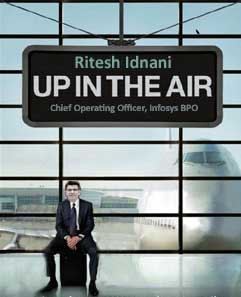
I actually managed to watch “Up in the Air” the other day, and never truly realized how your can forge such a happy little existence for yourself on the road, away from all the stresses and strains of real life.
You can even relocate to a little apartment in Omaha and save on all those living expenses. Not to mention having a 757 named after you. You just need to pray that video conferencing technology doesn’t get too much better in the near term…
Anyways, we digress…when last we left Infosys BPO COO, Ritesh Idnani, in Part II, he was expounding on the shifting BPO landscape, with the increased need for providers to develop their expertise in vertical industries. In our final part, Ritesh elaborates on communication and interaction, and how our industry can rapidly improve collaboration through social media.
Phil Fersht: You mentioned social media impacting things quite considerably. How do you see that impacting our industry – and how is Infosys leveraging it? Do you also see social media presence and expertise becoming increasingly important when servicing your clients?
Ritesh Idnani: There is no denying the fact that the relevance of new media is making a growing imprint on the way we do business. Infosys has a specific unit called “Setlabs,” an organization that really focuses on the emerging technologies. One of the things it has been looking at closely is the impact of social media from a people and business standpoint and, secondly, addressing the question of how do you actually make money out of deploying the relevant social media strategy for your organization. Then we have launched a platform called iEngage in the marketplace that combines social media, e-commerce, supply chain management and collaboration. I think what we are taking to the market today and their industry sectors is to say, “If you got people coming through different channels, communicating with each other through different ways, is there an opportunity to monetize some of that? Is there a way to channel the products and service offering through the social media channels? Is there a different set of individuals you need to actually target those who are frequenting the social media outlet itself? Do they need to come from a certain demographic? Do they need to have certain skill sets and competencies, which are very different from what you might have experienced? And last but not the least, do we need to deliver products in a very different manner than what we have been used to?” Businesses such as retailers, direct to consumer manufacturers and even banks can cut costs, increase sales and improve customer services through social media. But at the same time they understand the importance of controlling the use of social media to ensure they make the most of it
There is a different order of opportunity and dynamics presenting itself today, that is very different than what all of us might have experienced. I think these are the contextual issues that need to be articulated for every individual client and their environment to see what is relevant. These are what we are building into a lot of our offerings on the social media side. What we have also done, from an internal context is that we encourage the use of social media in a manner that is pertinent and relevant. Today not only our leaders contribute to blogs, , but we also encourage domain experts and functional leaders who have a point of view on the industry to go out there and express their point of views. A lot of Infosys opinions and views are today available on the World Wide Web. You may find some very interesting examples not only on our own site but also on industry sites where opinion leaders congregate. I think the second piece of it is where a lot of us at the unit leadership level end up doing chat sessions with people in the organization because we thought that it was important to address a lot of the queries that might come up and a lot of the Gen Y population is very conversant and comfortable with chat and other such media as a way of communication.
We are also using mechanisms whereby we are asking questions and then soliciting responses to those specific questions and using that as a way to see if we get some ideas that by which we can drive business. We use social media on the floors, on the BPO side, to solicit the best ideas that are there that might come from a process associate. Our belief is that some of the best ideas come from the associates on the floor and it’s important to channel that in the right way and social media is one way to do that. So that is a very practical use of how we are trying to generate opportunities that benefit our clients and their business as well. These give you a sense of what we are trying to do both from an internal and external perspective and for clients and for our employees.
Phil: It’s been a personal observation of mine that Infosys is a very open company with its clients and the way that it interacts with the industry. Its refreshing seeing how you engage so openly with everybody at your client events – it really encourages people to talk about their issues, and how to get better at global sourcing. Can you see Infosys at some point leveraging social media channels to have some of your clients interact across client lines? Is that something you can see happening in the near future?
Ritesh: Oh, absolutely. One of the things that we ended up doing is actually launching a BPO community–Colloquium Online. The idea behind that is to actually get clients to leverage social media to interact with each other and enhance peer – sharing of business and industry best practices in an unfiltered and un-doctored environment. I think there are about 45 client organizations who have signed up to that, who are already leveraging the community to interact and see to each other on various topics of issues. We initiate a few of these topic issues but thereafter, it is really the personal interactions that these clients are having with each other and we have just facilitated the same. We do believe that open dialogue is the best way for us to further sharing. The knowledge sharing and resultant industry insights have opened great opportunities to understand businesses up close.
It is also a way to actually ensure that innovations that might be there in one particular sector, is something that can be taken to other industries in a manner that’s most relevant. So we are actually all for it because it allows everyone in the industry to benefit. So the good, the bad and the ugly is actually good. It’s good for our clients and prospects alike.
Another thing that we are doing is we are trying to form industry specific councils. The newspaper sector is a good example of that. We are getting all the newspapers together to share practices around what they are seeing in their sector. The newspaper sector, particularly in the US, doesn’t compete with each other in their markets and therefore they are more than happy to share information as it pertains to their company. You end up having a very open, honest and frank dialogue on what works and what doesn’t work because everyone is grappling on the issues and not just on the cost side. They are also asking, “How do I actually ensure that my business model is going to survive long term?” So those are the second kind of forums that we are trying to put in place for people that meet at regular intervals. We essentially just provide an outlet and thought leadership on a few ideas. Thereafter, it’s really up to them to share what practices are there. Infosys is also going to co-create assets that are relevant for a particular industry sector. So that’s a third kind of intervention that’s out there in the market place that we are trying to do.
Phil: When we look at where things are moving today, and the speed with which things have changed in the industry, what advice would you give to some of the younger practitioners who are involved in sourcing whether on the buy side or sell side? How should they look to develop their careers in our business today?
Ritesh: One of the key messages that I end up telling a lot of folks, whether it’s on the buy or the sell side, is, “Don’t necessarily go for more.” It’s not necessarily about how many people report to you, how much revenue you control, or what kind of business impact you are able to drive especially in the formative years in one’s career. It is really a question of what kind of skill sets you are able to get. Often times, those come not necessarily through what I call vertical growth, which is really more of the same, but it comes through horizontal movements which is moving laterally and picking up a lot of skill sets over a period in time. I think the second thing I would say is it does help to have actually people pick one vertical or one functional area from an expertise standpoint because I think that is always useful to go back on and that is something that people should think about. I think that the third piece of it is everyone needs to always be in a situation where they can’t just end up being aggregators of information but keep looking for learning opportunities. No matter how high you go up in the organization, you cannot get away from that. So I think that’s something that I would encourage people constantly in their careers to keep learning along the way, forget the fact that they have reached to a certain level. They need to not get away from the detail yet focus on what’s strategic. And last but not the least, I have been very fortunate to have had a number of good mentors throughout my career and a balance between my professional life and family life that has worked for me. They have taught me how to develop strong teams, how to stay laser-focused on managing and growing a business, given me a global perspective, and made sure that I stay focused and disciplined on the objectives of whatever business I have run. Also, these folks have been an invaluable sounding board for my ideas, which is critical in thinking through complex business issues. Having mentors or a team with whom you can discuss ideas and who you know will provide unemotional input is key. You do not always need to follow the advice but it is a big mistake if you do not ask for help.
Phil: So finally, Ritesh, I hear from several of your colleagues that you are the most traveled executive in Infosys.. So would you encourage everyone else to do that?
Ritesh Idnani is Chief Operating Officer for Infosys BPO
Ritesh: I think for me it is extremely critical on two fronts, being in front of both my customers and the employees. I think being in front of customers at various points in time is extremely critical to get a pulse of the market and to know where our clients are headed. I think that’s the reason why I like to do this travel at times but I like to travel and meet customers at different stages of the life cycle if you will.
I think that traveling to see employees is critical purely because it is important from their standpoint because they might be in locations that are at far flung spots globally. They need to know what other kinds of opportunities are there, what are the different kinds of things that are happening in the company, what should they be looking forward to, and also some of the key measures that you want them to focus on as well. I think that’s useful and extremely important.
I think it helps the cause of the organization and certainly helps to build many more touch points with both customers and employees. The key message is it is important to be in front of your customers and employees and whether travel is an essential part of that or not is a secondary question.
Phil: Ritesh, on behalf of HfS and our readers, I would like to thank you for your time and look forward very much to hearing more from with you folks again very soon.
Ritesh Idnani (pictured) is COO for Infosys BPO. During his time with the firm, the BPO business for Infosys has scaled ten-fold from a $40m business in 2005 to a $400m+ business in 2010 (the forecast is for Infosys to report revenues anywhere between $405m-$420m by end of current fiscal). He has led two of Infosys’s largest acquisitions in the last 4 years, McCamish Systems, a leading provider of life, annuity and retirement services products in 2009, and the shared service centers of Philips in 2007.
Prior to Infosys, Ritesh held exec roles with PwC and Citigroup. He lives in Basking Ridge NJ with his wife and twin boys.
Euan Davis, Managing Director, European Practice, HfS Research
Euan Davis, Managing Director of our European Research Practice, joined us a month ago, and is already having a big impact over in the land of bowler hats and snaggle-teeth.
What’s more, you’ll have a chance to see him in action up close on November 18, when he’s on a panel at the IIAR London Forum in Central London from 3:45 – 6:30 pm. The session is imaginatively dubbed the “Cloud,” and Euan will be giving the HfS Research view of the Cloud, based on brand-spanking new data our joint study with the London School of Economics, which covered the views and intentions of 1043 companies.
Euan will be chomping at the bit with insights on sourcing via the Cloud, its role in services integration, “Cloudifying” contracts, and – most importantly – the impact of Cloud business services on the Future of Work.
If you’d like to attend, head on over to the IIAR site.
I was sitting through a conference the other day and I realized I’ve been listening the same old “how to do outsourcing” presentations for years. Each presenter just kept reeling off the same old dull-as-dishwater drivel about “labor arbitrage”, “transformation” and “how to eliminate risk”. TELL US SOMETHING WE DON’T KNOW! JEEZ – THIS IS THE SAME FLUFF WE WERE BEING SERVED UP TEN YEARS AGO.
Seriously, if our industry doesn’t pull its head out of the sand and start talking about how businesses can innovate, how they can leverage a globally-sourced environment to be more successful, how new developments in Cloud computing can turn global business models on their heads, we will kill ourselves with freaking BOREDOM.
Maybe I should read the old man’s patter instead… am sure it’s far more inspiring.
HfS Research and the London School of Economics have surveyed 1053 organizations on the future of Cloud Business Services
This week, we’re beginning to unravel the colossus study we just ran with the London School of Economics delving into the future potential of Cloud Business Services.
We managed to receive 1053 participants across business buyers, IT buyers, advisors, providers and industry influencers – if anyone else in the industry has performed such as exhaustive study of Cloud business services, please enlighten us! Thank you to all our loyal readers who completed the study, and our friends at SSON who helped engage their network. A complimentary report of the study findings will be winging its way to you all very soon.
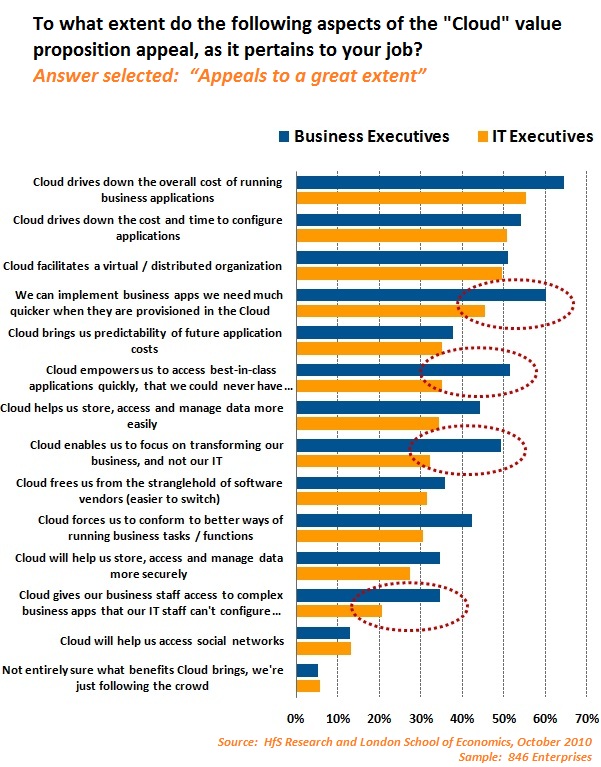
One of the unique angles of our study has been to contrast the views and intentions of the non-IT business community, and solely IT executives. And – as we suspected – the dynamics driving the future direction of Cloud adoption within the business functions is going to come from the business function leaders who “get it”.
Cloud Business Services are no longer hype – both business and IT executives are buying-into the value Cloud can bring to their jobs and their organizations. Let’s examine further:
*The ability to access business applications quicker, faster, cheaper and in a virtual business environment are the major drivers – and it’s the business side of the house which is even more engaged by the potential value than the IT-side.
*Most notably, half the business respondents seriously value the focus Cloud brings to transforming their business, as opposed to their IT. Barely a third of IT respondents were as enthralled by this.
Does this mean that the real impetus behind future adoption of Cloud Business Services is going to come from business function leaders with heavy influence over IT spending for their function? And what role will Cloud Business Services play in altering the make-up of today’s outsourcing and integrated services engagements?
Stay tuned for Part 2, and Part 3… and probably Parts 4 and 5 as well…
Deborah Kops joins HfS Research as Contributing Analyst
There really is only one Deborah Kops. Because if there were two, we’d be in serious trouble. Not too many people can truly say they’ve “been there, seen it, done it” in our lovely sourcing business, but Debs (as only a few of us are allowed to call her) really does have the scars to really prove it.
She was instrumental in PwC’s global business process outsourcing (GBPO) practice in the ’90s before embarking of a tour of sourcing duty that culminated in a three-year experience with WNS, where she was instumental in helping elevate the Indian-headquartered BPO provider to become a serious candidate for major top-tier engagements. Check out her bio for the full rundown of her rumbustious career.
Name me many other woman who have successfully held a market-facing leadership role for such a length of time in the male-dominated world of an offshore outsourcing provider. Apologies if I just flouted all the rules of today’s political-correctness with what I just said – but it’s true.
Many of you know Deborah as a versatile straight shootin’ gal who’s seen the BPO industry’s growing pains through the lens of buyer, provider and consultant. Well, she’s now focusing her prodigious energies…and her pen…on sourcing change management through www.sourcingchange.com, which is the first resource devoted to the issues and challenges of getting stakeholders to adopt, embrace and expand outsourcing relationships.
At HfS Research, our clients are in desperate need of advice and knowledge from peer experiences when they undergo the difficult operational change that accompanies a global sourcing endeavor. Sourcing Change, under Deborah’s leadership, delivers experienced, meaningful advice fill the knowledge gap in the market. Having worked with Deborah for many years, there is no one more qualified to deliver this insight. We look forward to expanding industry understanding through our collaboration with her.
Deborah’s diverse background gives her a unique take on the industry, and her inaugural contribution to HfS Research (click here for freemium access) focuses on a significant tradeoff the industry makes for cost arbitrage—a rapid generational shift to younger workers that we grumble about but don’t really acknowledge. “Imperfect Arbitrage,” starts the debate about the tradeoff we make when we source offshore.
Over the next year, you’ll be able to sample innovative thinking in sourcing change through Deborah’s frequent columns and commentary exclusively for HfS Research. Look for surveys and analyses which, for the first time, portray the actual state of outsourcing change management, and a schedule of webinars and workshops that will help buyers and providers alike enjoy more success. You can reach Deborah at deborah dot kops at sourcingchange dot com.
Sumit Sachdeva, Head of Cognizant's Healthcare BPO Practice, atop Mount Pilatus in the Swiss Alps
Healthcare has been on everyone’s minds in the US, in the wake of the acrimonious legislative fight and with the recent elections.
And when any industry gets the squeeze, us sourcing-folk immediately think “hmmm, will they now do some outsourcing…?”. (Read our earlier piece on the impact of healthcare reform on healthcare payors).
So we thought we’d turn to someone who has the lovely task of actually selling outsourcing to healthcare organizations. Not an easy task – I can assure you, having once worked as an advisor on a healthcare BPO evaluation… and was nearly lynched and deported before being forced to watch an entire viewing of “Scrubs”.
Sumit has spent last 8 years of his career in the Healthcare BPO industry and has seen it evolve. He joined Cognizant BPO in 2006 as a part of the initial management team and has been instrumental in its growth. Prior to Cognizant, Sumit worked with Hexaware and Xerox India in various roles, before relocating over to the States.
A dedicated globe-trotter, you’ll always find Sumit sampling some local cuisine or culture… or even climbing a mountain, like Mount Pilatus, nearly 7,000 feet up in the Swiss Alps. And a mountain’s a pretty good metaphor for the healthcare sector. It’s massive, hard to figure out, and riddled with uncertainty. So we turned to Sumit to brief us on why there’s so much activity in the healthcare sector, and the impact of healthcare reform in the US…
Phil Fersht: Sumit – thanks for taking time to talk to HfS Research today. So tell us about the healthcare business. Why is it so busy right now?
Sumit Sachdeva: Oh, there’s quite a bit of momentum that we have. So that’s keeping us busy. We’re all set for a significant growth this year and are expecting this trend to continue for the next year or two.
Phil:What sort of work are the clients demanding?
Sumit: I think across the board, different types of customers are looking at different pieces of the pie but – once at the table – you can end up having several different discussions! We’re more focused on the vertical services – the very core operational areas within health plans. And there is significant demand in those services I feel.
Phil:So, the fact that you are vertically focused–is that playing to your advantage in the healthcare space?
Sumit: I think so, because what’s happening is that when you go and position yourself as, “Hey, I can do F&A or I can do HRO or I can do procurement” and all of that kind of stuff and then you also say “I can do also claims, etc.,” what happens is that when you’re talking to the business guys who are the core functionaries—not the CFO or not the procurement organization, etc., when they see this array of services, they feel that you are generalist BPO company. Right?
But when we go to them and say, “Hey, you know what? This is our service offering. This is what we will breathe, eat and sleep,” I think we start seeing the discussions are a little more focused.
I think the vertical BPO push and positioning that we have been following for the last three years is now gaining ground in the industry. In fact, in the last analyst session we had in New York, a lot of people were curious about, “Hey, I heard about this vertical BPO. What is it? How is it different?” So I feel that it’s gaining traction. What’s your take on it?
Phil: We’re currently ascertaining the current environment and whether health reform has been impacting sourcing demand from several healthcare organizations. I think it’s taking a long time to get the legislation introduced and then pushed through the key channels. However, we’re definitely seeing increased pressure and interest from the buy-side to look at specific processes. We’re seeing a lot of interest in claims processing, revenue cycle management services, for example. Is that where you folks are seeing most of the growth in terms of your process focus?
Sumit: Yeah. I would put it into different buckets. So if you look at the large plans where they have outsourced a lot of the low-end work, those type of health plans are now starting to look at, “Hey, what else can I do? How can I get ready for this change and reform and control my costs?” So they are pushing things to the next level. So, for example, we’re seeing this huge demand coming in, in terms of benefits configuration because as we all know that the healthcare reform is going to have an impact on the benefits plans. So starting right now, as an example, coverage denial for children with pre-existing conditions has gone away, the lifetime limits have been removed from several plans etc. So there’s a significant demand for how to go about making those changes into the benefits plan. Now if you’re a BPO organization, it’s very difficult for you to get into that space because it’s a fairly high complexity, high domain area. But since we’ve had invested in those kind of domain competencies, it has been easy for us to get in and start growing into that space.
So that’s one example of how the healthcare reform is driving demand in more complex areas. When you come to the smaller and mid-sized plans—typically more of the smaller plans where they’ve had couple of systems or their systems are a little arcane and they’ve been very manual—they are increasingly coming under pressure to do something regarding their whole operations because with the healthcare reform coming in, they know that their costs had to come down. But more importantly they have a looming regulatory requirement of complying with HIPAA 5010 and ICD-10 changes, which are pretty big changes and would require significant outlay. Especially when you have two or more systems, that’s where the dilemma is coming in: “Hey, what do I do with the two systems? Do I remediate two systems and double my 5010 and ICD-10 remediation cost? Or should I use that just as a point and consolidate it into one system? And is my system, the right system—or should I look in the market and get another system?”
So, I think, in that sense you’re seeing a kind of a trend picking up where some of the smaller plans are now looking at more of an end-to-end service. “You bring the platform. You kind of do the whole IT and BPO and infrastructure combined and just give me the service.”
Phil: Do you feel that the way BPO is moving in healthcare, it’s going to remain on a vertically-centric course like this? Or do you think that we’re going to see more horizontal areas like HR and finance open up in time?
Sumit: I think so for some time. I think that the horizontal services will open up. We’re seeing some initial trends however timing is something that we need to look for. The reason why I’m saying timing is that there are only so many balls an organization can juggle at a given point in time. So what’s happening right now is that there is so much pressure and so many changes currently happening in the environment for the next two or three years.
I don’t know how much focus would be there on, for example HR or F&A, which in a health plan environment would have a limited impact on their operations side. To give you a sense of the scale, for example, a large healthplan might have 200 to 300 people in finance and accounting but they would have 5,000 to 7,000 people in claims. So where’s the bigger bang for the buck? That’s something that will probably drive some of that timing.
Phil: Do you feel that most of the client situations you’re getting pulled into require both a technology as well as a process element? Or do you feel a lot of it is very process-only type engagement at this point?
Sumit: I think, like I said, smaller organizations are looking for a lot of platform stuff. The larger organizations understand that a combination of technology and process can play a very key role in terms of driving the process to the next level. And that where IT+BPO Synergy plays a key role. There are two key contextual pictures here
When I interact with customers across the board, one of the things that continuously comes out is: “We know that there are low-hanging fruit that can be leveraged and have a good ROI, if you just look at it in the context of a particular process. But in the context of the larger organization, that ROI is relatively small so we never get that budget or that focus or attention to do this particular kind of IT initiative.” So when we come in as a vendor, we just focus on that particular process. It’s much easier for us to bring that attention and that focus to drive that process improvement. And a lot of times, these kind of opportunities get built in pricing of the contract, etc. So that is one context.
Then the second context is where the customer says, “We understand that there are opportunities for process improvement. And we also know that there are so many different opportunities that we won’t be aware of. So if an organization can come in and drive this process enhancement, they feel that “Okay, I’m going to get the assured benefit of the identified opportunity but there are opportunities to get more.”
So that’s what the buyers are starting to look at and that’s where that whole IT/BPO synergy kind of thing starts to play very effectively.”
Phil: All right, so what do you think are the main barriers holding back firms in the health care from looking at global sourcing right now? Is it still a big barrier for them to cross—to think about using the sources outside of the country etc? What do you see?
Sumit:I think the barriers, if I may say, are, in the current economy—obviously, job losses. Spreading all of that information in the community which they service is an important factor that starts going in their mind.
The second piece is the appetite to undergo that change, because healthcare organizations have typically had the opportunity to continuously increase their premiums, although they have been under pressure to reduce costs. But that pressure has not been as intense as in some other industries, like manufacturing, retail or even banking and financial services.
And the third factor is a tendency of a lot of people internally thinking that, “Hey, we are here for the good of the society. We service the society.” So that is the kind of mentality, especially in the hospital side. But that is changing now because we are seeing that people are saying, “We are doing Social Service, we are not for profit but then I need to be viable to survive. I need to make sure that I’m covering my costs.”
I think those are some of the reasons this industry has been a late starter. But now those perceptions are changing, people are becoming more business- and top-line-, bottom-line-focused. And so that’s why we are seeing a little more traction. It will take a little time for that momentum or inertia to move more in the offshoring and outsourcing direction.
Phil:In terms of the Healthcare Reform Act, is this something that you’re seeing driving a lot of these decisions right now? Is it very much on people’s minds when you talk to your clients or do you still think that it’s being put on the back burner until it actually comes into action? What’s been your experience?
Sumit:I think definitely Healthcare Reform is forcing organizations to rethink their strategy and their business model. There is opportunity and there are challenges. They’re kind of both. A lot of organizations are now realizing that the only way to address the Healthcare Reform is to control your costs or optimize your costs and at the same time, grow. If you do just one of them, the chance of survival will be very limited. So that’s where it gets challenging for the health sector.
If you have to optimize cost then how do you invest in growth? How can you do that in combination?
And that’s where a lot of organizations are thinking about: “Hey, should I look at outsourcing? Should I invest the dollar that I have to focus on growth and then leverage a strong partner to help me in terms of optimizing some of my costs?” I think that’s the kind of thinking that is permeating in the industry in several places that we’ve been interacting and having some discussions with. However people are still kind of absorbing the whole impact.
They’re still strategizing how they are going to look at the next four years in terms of the reform and its impact. Before they were looking at how the first wheel of changes get accepted, acknowledged, etc., and now this anxiety for the November elections is also something that, especially from an outsourcing perspective, is making people, take a wait and watch approach. “Let this election pass. Let’s see what happens. The government policies might take a change or turn or whatever it is.” So I think that’s where a lot of organizations are, especially the medium and the smaller ones. There are certain organizations which are some of the more aggressive organizations have or some of the organizations have already decided that: This is an opportunity to make a big change so let’s go ahead and do that.” So we are seeing more actions in there. They are some of the more progressive organizations.
Phil: Sumit – thanks so much for your time today – our readers will certainly appreciate your insights and experiences.
Sumit Sachdeva (pictured) is Head of Cognizant’s Healthcare Business Process Outsourcing practice. He can be reached at sumit dot sachdeva at cognizant dot com




 I actually managed to watch “Up in the Air” the other day, and never truly realized how your can forge such a happy little existence for yourself on the road, away from all the stresses and strains of real life.