If I had a Euro from each person who’s crowned themselves as the Sovereign of Sourcing, the Czar of Shared Services, or the Bastion of BPO, I’d be able to help Greece pay its next bill. On second thoughts, make that a Dollar…
However, one distinguished gentlemen who’d be embarrassed to even consider making said claims, was involved in setting up shared services and outsourcing frameworks for organizations long before those concepts even existed… and long before many of today’s sourcing professionals were even born.
The Sourcing Skipper himself… PwC's Global and US Leader of Shared Services and Outsourcing Advisory
In Dr. Charles Aird’s four decade-plus career, he’s been a math professor, organized a state supreme court IT system, did business process outsourcing before it was BPO, and pioneered Global Business Services.
For Charlie (as he’s known in the business), it’s really all about planning and structure. He’s been CEO and COO for several industry organizations, and a senior figure in Big 4 management consulting. He’s crafted his career as an internationally recognized expert on evaluating companies and markets for sourcing potential, having lived and worked all over the world — including spells in Saudi Arabia, India, and Singapore, in addition to working in the United States and Europe, Latin America, Asia-Pacific and the Middle East.
Today, he’s avidly shaping the Global and US Practice for PricewaterhouseCoopers Shared Services and Outsourcing Advisory, where he’s clearly not lost his appetite for global travel and working with clients right across the world. In fact, I cannot recall a conversation with him where he wasn’t scrambling to find a quiet corner of whatever airport he happened to be passing through at the time.
Oh… and before we begin our interview, please remember to sign up for this Wednesday’s webcast, where Charlie will join us in discussing the Evolution of Global Business Services.
Part I of this interview focuses on Charlie’s early career and how he’s arrived at his current role in PwC, leading the firm’s US and Global Shared Services and Outsourcing Advisory.
Phil Fersht:You have been a veteran in this industry for many years now. Who is Charlie Aird? How did you get started, and how did your career develop to bring you where you are today?
Charles Aird: To start with, I was ‘outsourced!’ I was a university professor and I got outsourced to Saudi Arabia. Ahmed Zaki Yamani ((Minister of Oil and Mineral Resources from 1962 until 1986 for Saudi Arabia) worked with the King Fahd University of Petroleum and Minerals back in the early 1970s and built the university with help from several American universities such as CAL Tech and MIT. I set up the mathematics department, and helped set up the College of Industrial Management.
When I came back to the US, the Supreme Court of Virginia had consolidated 330 courts under one umbrella. They had no central system — no consolidated HR, finance, you name it. I was the CIO, and brought in project management skills, so we worked with the functional groups to set up shared services — we didn’t call it “shared services,” but that is essentially what they were.
Next,some guys from the university in Saudi set up a computer company and asked me to come back and help them get it off the ground. We ended up doing a lot of the systems work for petroleum companies, putting in systems and centralizing their finance and accounting and HR processes.
Then I went over to Arthur D. Little when it was a major consulting company, actually doing outsourcing advisory. Again, we didn’t call it that, we were just helping the oil industry put in systems and processes around finance, accounting, HR, training, and indirect procurement and also centralizing the marketing of both crude and refined products. Three of us were asked to come and run this whole process — and we weren’t systems integrators — and we managed the process of selecting organizations for these very major projects. I lived in Saudi for a total of 12 years; three years for the university and nine years working on systems during the 1980s.
Phil Fersht:It sounds like a lot of these experiences were the foundations of your outsourcing work?
Charlie Aird: I started doing outsourcing then, from Saudi. I actually tried to outsource to India in the late 1980s, and it was just extraordinarily difficult. Communications in India were very difficult; there was not a great deal of access to what is now the Internet. You had to write specs and then go there; and it was so much back-and-forth that even with the inexpensive resources, it just was not worth doing. So we started bringing staff in from Egypt and Pakistan and the Philippines and primarily doing body shopping into Saudi instead of outsourcing from Saudi.
“I was doing a consulting gig for Shiv Nadar, who was Chairman of HCL, and still is, as a matter of fact. They had started operations in 1976 and were in the manufacturing of PCs and other IT products and wanted to be more of a services company. I did the initial study on the transition. Over time they refined the plan, and came back to me and asked me to be the president of HCL. I spent three years in India and I set up the organization. The sales organization was trying to do early contract manufacturing and couldn’t compete against Taiwan, Thailand, and Malaysia. In India they could do tens of thousands of boards, and the other countries were doing millions — and they couldn’t get the scale out of India.
HCL sold a big deal to a large multinational company and after six months the client became comfortable with our staff in San Diego and South Carolina. We went to them and told them “We can give you half the rate if you move this work to India”, and obviously they liked that idea. We were building the foundation for today’s HCL, now one of the largest Indian service providers. In fact, according to the March 2011 Forbes’ List of the World’s Billionaires, Shiv ranks 182nd with a fortune of $5.6 billion and is the 14th richest person in India.”
We were approached by Ernst & Young about a joint venture in the 1997 or 1998 timeframe, primarily around ERP. We were doing a lot of Y2K work in India, and we weren’t able to pull the venture off. But the guys at E&Y asked me to join them to set up parts of their consulting in India. We built the organization up to more than 300 people in the year I was with E&Y in India, and did a lot of the ERP work for Oracle, SAP and JD Edwards across the world.
I next went to Singapore as an energy partner because of my background, and started a new company as a subsidiary of Ernst & Young’s global client outsourcing organization. I sold more and more outsourcing deals supporting large global companies, not large centers though, because they were just starting to take off in the Asia Pacific region.
Mark Schwartz, who is now with Oracle On Demand, asked me to come back to the states to run global BPO for Deloitte in 2001. AtDeloitte Consulting I was a partner responsible for outsourcing across Asia. I started a center in Singapore, and another in Brussels to pull one particular client. It was difficult because most of the work from Singapore was coming out of the US and Europe. Later, as Deloitte and Touche, they decided to get out of the BPO business and sold it to Convergys. After that, I spent about two years at EquaTerra with Mark Hodges. He and I knew each other, and he asked me to join him as he was starting that company .
Then Paul Horowitz had been starting up the technology group at PwC, and asked me to help set up an outsourcing advisory group focused on ITO. We quickly expanded, but it was obvious that we needed to do BPO work. I convinced the guys that we should include shared services, because our clients would naturally assume that PwC would know how to do finance and accounting and shared service consolidation. We started the shared services and outsourcing group four or five years ago now. I was part of the board, and developed common methodology, processes, pipeline and practices that worked together.
We started selling a number of global deals and expanding rapidly. Today I run both the US and the global Shared Services and Outsourcing Advisory group, which kind of leads into what we call our Business Services Transformation which enables companies to develop global business services. We have seen the market transition from a traditional outsourcing environment to businesses finding they need a combination of outsourcing, shared services, and an organization to manage that.
Our role, our impact on the industry, and ultimately our competitors as a result will go this way — it is now broader, and it is management consulting instead of just running a transaction. Clients are looking for you to help them decide what they should do and help them do the transformation work. They need to change the organization in such a way that they can manage it centrally, so they can standardize processes and have truly global standards. As they plan to roll these things out on a regional basis, you can incorporate the statutory, regulatory, and cultural aspects into the regional organizations that have all been managed from a central core.
Join us shortly for Part II, where Charlie Aird shares his vision of the future of the sourcing industry, the Global Business Services framework he’s spearheading, and a little insight into how he views the changing environment for Big 4 consultants and boutique advisors.
Reetika Joshi joins HfS Research as Principal Analyst, BPO and Analytics Strategies (click for bio)
Did you hear the one about the bubbly young Indian woman from Pune who started working with a bunch of cranky old American and British analysts? Well… after a year of contributing to our research, we’re delighted to announce that Reetika Joshi has joined our full-time team to crank up our – already cranky – BPO and analytics coverage.
Reetika’s been a delight to work with as she’s contributed to our research reports on analytics, insurance, banking – and more recently marketing analytics, retail BPO and the European BPO market. Having her on our team fulltime as we expand our operations in India is a great advancement for HfS, and having her “on the ground” perspective where most of these services are delivered is proving invaluable to our coverage. Anyway, over to you Reetika, for a few words on why you made such a curious career move…
Working with HfS Research as a contributing analyst over the past year has been a great experience for me, prompting my decision to join full-time. HfS brings a practical, powerful and unique voice and approach to the sourcing industry. I have found the research themes to be very relevant and to-the-point; a zeitgeist of the real ‘burning’ issues and opportunities facing the industry today. I’ve always enjoyed being an analyst in this field, and there’s never been a better time – the next few years look to be transformational. I look forward to contributing with an ‘HfS’ perspective on things.
What’s great is, being one of the first team members based in India, I’m excited about covering the next phase of growth for India as an outsourcing hub. The lines are surely blurring for ‘India-based providers’ versus the multinationals. Major providers, whether they are headquartered in India, the US or Europe, have realized the inherent benefits of multiple delivery locations spread across offshore, nearshore and onshore locations. Accordingly, we’re seeing some of those investments over the last few years bear fruit, with increasingly globally dispersed workforces – for ‘India-based providers’, and otherwise. There’s now talk of outsourcing to India slowing down, with the Euro-zone debt crisis and US credit downgrading tightening the major markets. But instead, we’re hearing that the hiring targets for India are on track, and the pipelines are still strong. We’ll leave it to the results of the HfS survey to find out the actual degree of impact, but I think there’s a lot more going on that will dictate growth for these providers. There’s a host of targeted, verticalized solutions (across all major verticals), technologies (cloud, to say the least) and newer markets (APAC, SMEs, mid-market) that will make the difference…and this is where my confidence with HfS comes from. The research agenda packs in just these topics to explore in the next year.
Apart from the third party players, the captive market is also continuing to expand in the country (despite being written off by many). In addition to new setups, several existing captives are in the midst of knocking out new services (allied service areas, high value services such as analytics, etc.) for their parent firms. And they’re not viewing themselves as hidden-away backoffices either. A recent conversation with the strategy team of the captive arm of a global insurance giant sealed the deal for me. When every team member is able to share the collective vision, mission and goals of the parent company, in terms of new markets, products, positioning, etc. and the innovative services and processes needed in the future to get there (and how they can/will contribute as an Indian captive) – that’s when I get the feeling that things are certainly on the right track, and concepts like ‘global delivery’ aren’t just nice to have phrases in the industry vocabulary.
Through HfS, I’ve had the opportunity to have many such interactions, with a wide range of outsourcing buyers, providers (the mammoths and the start-ups), and allied influencers, and I believe this is the driving force of things to come for them. The powerful community that they’ve built up over the last four years is a great source of strength. Dialogue between the buyer and provider community is definitely the need of the hour, and in my view HfS is a pioneer in this field, through initiatives such as HfS 25, power-packed webcasts, and definitely not the least, the debates on this blog! I am very excited to come on board a company that is revolutionizing the way sourcing research is created, distributed and debated, through collaboration and innovation, and I look forward to interacting with you all.
For those of you who enjoyed Part I of our Charlie Aird interview and our webcast with Charlie and Nick Atkin last week, let’s move on to the second tranche, where we talk about the future of the sourcing industry, the Global Business Services framework he’s spearheading, and a little insight into how he views the changing environment for Big 4 consultants and boutique advisors.
Oh… and click here to catch a recording of last week’s webcast, here to download the slides and here to download our recent research paper on Global Business Services.
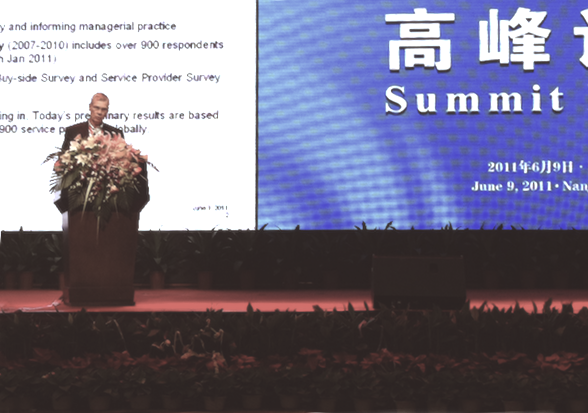
Charlie Aird speaking at a recent conference in Nanjing, Jiansu Province, China
Phil Fersht (HfS):So in terms of “Global Business Services” — which we discussed in our recent paper[i]— can you discuss the concepts and principles behind this? Why this is something you are driving so heavily at PwC?
Charlie Aird (PwC): In the past, organizations sourced ad hoc; by business unit, by country, or region. And they suddenly found they have 40 sourcing arrangements around the world, all with different standards, different governance, and different management and so on. Now they’re saying, why can’t our back office be as efficient as our manufacturing organization? When they are developing a product they usually have some sort of global standard and they have R&D prepared and they link marketing into it; so why should IT, finance and accounting, or HR be any different?
Manyorganizations have seen other companies successfully implement a global model and, and want to see if they can do the same. They find they have different processes all across the world, with different IT infrastructures and applications, and different cultures even in the same corporate environment.
Some clients keep tons of spreadsheets to track this; and you ask them, OK, who is company XYZ? Are they your clients in Brazil, or China? And they don’t know. How many staff do you have doing a particular function around the world? They don’t know. They don’t have visibility into this kind of thing. Then this becomes another special project.
Phil:I think what we’re seeing with organizations today is that their approach to sourcing their global operations is changing, and changing quickly…
Charlie: Absolutely. Todayorganizations are starting to address how they can build something to go into Brazil, for instance, that can be replicated and rolled out in other emerging markets such as China, India, or Eastern Europe, without having to reinvent these things each time. They put together this conceptual model with a set of principles and standards and often manage that from the core, but with global governance having a say in what it does.
From a global perspective, we’ve found that about 20 percent of any requirements — whether they’re statutory, regulatory or about cultures of a particular region or country — have to be taken into account individually. About 80 percent of these factors, they have in common. Some of that 20 percent are things like taxes, for example, a client recently put a lot of work in Costa Rica because of a tax incentive. They are actually taking things out of Brazil and outsourcing to the other country.
Often it takes management consultants to move them into that more standardized environment to help them with change management. One of the major things we do with major sourcing arrangements is change the culture of the organization. I wouldn’t say that sourcing or changing systems is the easy part — but it certainly is less difficult than changing the culture.
Changing and modifying systems, standardizing processes, and doing the project management — there are a number of initiatives associated with all of these. These all are undoubtedly difficult to manage, and quite often people in an organization have their daytime job, and they want experienced people to help them take care of the change management and that is how we are positioning ourselves.
Phil:You have been in advisory services and outsourcing for most of your career but especially in the last decade. How do you see it changing? We’ve had the pure-play boutiques for the last several years, and now we’ve got the management consultants really moving heavily in the space. Do you think the pure-plays will continue, or do you think the management consulting firms will really start to dominate over the next decade?
Charlie: Well, if our thinking is correct, it’s really no longer a transaction but a combination of many functions, and I think the major players like the Big Four, with a consulting heritage, are going to be the ones clients look to. I think it’s clearly not just running a procurement, which some of these organizations are extraordinarily good at — but it takes a multi-faceted approach. I am not sure the boutique guys will have the skill sets to do all of those things.
Phil:In terms of managing transactions, though, this seems to be a pretty lucrative business for the TPIs and all the Alsbridges of this world. Do you think we will see more boutiques enter that space now, or do you think this is getting pretty much commoditized and what we see is what we are going to get?
Charlie: I think it is commoditized, and some firms are trying to transition into other things. The smaller guys will try to at least incorporate some of the things that the big guys have. I have seen some of the smaller players getting more into research, going forward. There are a lot of transactions to be done, and we are finding a lot of organizations that were small- to medium-sized companies are starting to do more of the sourcing. The boutiques are more in the middle-market space. The Big Four organizations are starting to grow their practices and are scaling up, and it is becoming much more difficult for the boutiques to survive.
Phil:When you look at the global business services focus of your firm and the way it is developing, what do you think when you have to look at the industry today, and everything we have been through particularly in the last three or four years? What do you think we will be talking about in five years?
Charlie: It is hard to predict, but it seems like organizations are going back and looking at what they have done for the last five, eight, 10 years, and deciding what to do going forward. I think finding the next low-cost labor arbitrage for sourcing or shared services will be important, whether that is South Vietnam or Indonesia or some place in Africa. Because I think countries like India are quickly moving with price inflation. When I was first there in the early 90s we were paying programmers $100 a month, and now it is significantly more. Cost is always an issue. People will tell you it is compliance and visibility and all those types of things, and that is important — but cost will always remain a major driver.
There are a lot of organizations that probably have not looked at more than just the transaction processing part of this, and so they are looking toward more of the analytics part. Some global companies have moved their financial planning and analysis process offshore. Others have moved a lot of their product and development activities offshore, and others have dabbled in doing that. But this means giving thought to what other things we can put into an offshore environment. And I think we have gained enough knowledge that companies feel more comfortable taking more knowledge-based processes and putting them offshore, so I think there will be significant growth in that area.
Phil:When you look back on your career is there anything you would do differently?
Charlie: Probably try to plan it better. It has seemed so unstructured. That is a tough question, because I have enjoyed all parts of it. It has been interesting and that is what keeps me going. I’m well beyond retirement age and it has been so interesting and I’ve just been having fun doing it, working with all the clients and different cultures. So it has been an exciting ride and I am not sure I would change anything.
Phil:One thing you have talked about is your global experience and living and working in other regions of the world. How strongly do you recommend this to younger executives today? What is the importance of getting global experience and really living in other cultures in your career?
Charlie: When we are recruiting and we see people who have never been out of the United States, we know they are going to go to India or San Palo and see different cultures and it will smack them in the face. We are seeing universities putting people in their MBA program internationally for six months in an overseas environment, so I think as multinationals continue to expand in emerging markets, they expect their consultants will have global experience.
I think it is an absolute necessity to have at least worked if not lived in an international environment, and I would encourage people coming up through the ranks to take an international assignment. For one, it is a great experience. My wife and I just had a fantastic time living in the different environments, and both of our children were born in Saudi Arabia. My daughter went to junior high in India, and she’ll tell you she had the best time of her life there. My wife and I would say Saudi was a great place to raise our children and the sports and all the different actives they have around there were absolutely fantastic.
A lot of partners and directors at PwC come to me with that question. I had a guy who was asked to go to India and his family was really concerned, then I saw him a few months ago and he said it was fantastic. They tell me, “Charlie, everything you said was right, but it was hard to convince my family of that.” So I think it is a great opportunity both professionally and personally to do this kind of thing.
Phil: Charlie, it’s been a pleasure – and am sure our readers at HfS will enjoy reading this discussion.
[i] Fersht, Phil, et al. “The Evolution of Global Business Services: Enhancing the Benefits of Shared Services and Outsourcing.” HfS Research, July 2011 http://www.hfsresearch.com/node/520
Charlie Aird (pictured above), (pictured above) is Global and US Practice Leader for PricewaterhouseCoopers Shared Services and Outsourcing Advisory. He’s been CEO and COO for several industry organizations, and a senior player with Big Four management consulting. He’s an internationally recognized expert on evaluating companies and markets for sourcing. You can view his bio here.
James R Slaby is Research Director, Sourcing Security and Risk Strategies, HfS Research (click for bio)
How many different ways can you spin the wonders of accounts payable outsourcing… or the delights of application testing services? Yes, folks, the outsourcing talk-track can get a little wearing these days. With 97% of enterprises today outsourcing varying degrees of IT and business support operations, the discussion about effective global sourcing needs to move to areas that have a broader business impact, such as how sourcing environments can help or hinder greater finance effectiveness, or more innovative technology, or better talent development… and especially a more secure, risk-effective global environment.
It’s this last area we’ve been intensively focused on bringing to the global sourcing discussion table – with the onset of Cloud, the additions of new sourcing locations, the political and economic instability in today’ world, the quagmire or new regulations and compliance standards.
I’m personally delighted to unveil a very special talent to the sourcing industry – a respected veteran of the infrastructure security world and now seeking to ply his knowledge and experience to supporting global sourcing environments: Jim Slaby. Jim can frequently be found chitchatting with the finest cocktail bar staff in Boston, both before and after (and these days during) a miserable experience enduring the Boston Red Sox. Anyhow, without any further introduction, let’s hand over to Jim himself to explain why he’s joined HfS and what we can expect to see in the coming months…
“The game done changed.” “Game’s the same, just got more fierce.” The Wire, Season 3, “Amsterdam”
As a newly-minted member of the fast-growing HfS Research team, I’ve been asked to share a few thoughts about my coverage area, Sourcing Security & Risk Strategies. I’m thrilled to have a chance to delve into the area of security and risk as it relates to sourcing, which HfS CEO Phil Fersht has been urging me to investigate since we worked together some years ago. In a sentence, I aim to help buyers and providers to better understand, quantify, and mitigate the security threats in sourcing engagements, and find ways to size and share appropriately the concomitant risks among buyers and providers.
In my Giga and Forrester days, I was stubbornly focused on security in the traditional enterprise data center and network environment. But in my most recent stint prior to HfS, running the security and networking practices at tech research firm TheInfoPro, I spent a lot of time interviewing senior IT budget-holders at Fortune 500 companies. One of the most resonant themes that emerged from those conversations was how their enthusiasm for cloud services was muted by their uncertainty about measuring and managing the associated risk. Time and again, security came up as the number one obstacle by a wide margin among large enterprises to moving to the cloud.
So when Phil called me this summer about joining HfS, the timing seemed right. The research community has not paid enough attention to the intersection of sourcing and risk, which suggests an ugly, multi-car pileup is in the offing there. It’s a hotspot that HfS feels uniquely positioned to explicate. Not to pander like a stadium rocker here (“Thank you, Kansas City, you really know how to party!”), but I’m also excited about gaining access to HfS’s subscriber base, the 60,000 highly-engaged business and IT professionals working at the front lines of this issue. Throw in the talent on the HfS Research team (like IT outsourcing maven Robert McNeill, whom I worked with in our salad days at Giga Information Group and Forrester Research), and I feel like I’m not spelunking this particular cave without some very solid backup.
So what are the foundational sourcing security issues that buyers should focus on when evaluating their overall sourcing options and considering service providers? The evaluation framework I intend to build will start with table stakes: assessing a provider’s physical security regime, its mechanisms to quash insider abuse, and its infrastructure for mitigating attacks against the network, the virtualization layer, applications, access controls and mobile platforms. I’ll also be delving into compliance issues across regulatory domains, ensuring we understand where data resides and how it is protected in transit and at rest. In the wake of April’s Amazon EC2 outage, there also appears to be new urgency around understanding provider architectures in reliability and disaster recovery terms. In addition, I will be assessing the global risks of operational interruptions that can be caused by many non- IT factors, such as industrial action, natural disasters and – perhaps most pertinent today – political risk.
Jim and wife Heather enjoying better times at Fenway Park
I believe (or at least fervently hope) that most buyers grasp the fundamental security and risk trade-offs in sourcing projects, that exploiting their advantages in cost, flexibility, and service time-to-market requires placing a lot of trust in providers. As important, I hope we’re crystal-clear that no matter how much operational control you hand off to a provider, you still own the risk. In the event of a breach, regulators and customers will come looking for your head, not your provider’s. Monetary damages can be cold comfort if your provider’s security failings corrode your company’s brand and customer relationships, to say nothing of your career prospects.
This suggests that buyers need to demand better visibility into how their providers are delivering on their contractual obligations around security and risk, ideally in the form of credible audits, monitoring and reporting tools, and other mechanisms to build trust in their ability to protect your data from a welter of threats. Many buyers are finding new issues to worry about, too: attacks from state-sponsored actors, the rise of activist cracking groups like WikiLeaks and Anonymous, and data leakage via social-media channels like Twitter and Facebook.
So I look forward to working with you, the HfS subscriber, to understand your hopes and fears around security and risk in the sourcing arena, to hear your war stories on how providers have succeeded or failed at meeting your expectations around those issues, and to learn what tools, processes, and contractual tactics might improve your trust in them. Uncertainty and opacity around security and risk remain among the thorniest thickets on the path to sourcing; I look to your insight and experience to help me take a chainsaw to them.
Jim Slaby is Research Director, Sourcing Security & Risk Strategies. You can view his bio here.
Anyone want to talk about the future of strategic human capital management?
Isn’t it refreshing when you read someone’s unbridled rant and you just have to say out loud, “Thank god someone finally called it”.
Anyone who’s been exposed to HR conferences will immediately empathize with this raw post by HR and social media blogger Laurie Ruettimann, who I will be avidly reading from now on! Here are a few quotes that just cracked me up:
“I just feel like I’m choking on the ashes of my enemy every time I meet an analyst or a vendor who wants to talk about the future of strategic human capital management”.
“The HR conference circuit operates in the craziest bubble. A bunch of people talking, thinking, and writing about work but no one actually does real work. I know, I know. We’re all knowledge workers and strategists and futurists. But much of the language we use — on stage, in panels, on the expo floor — comes awfully close to denigrating the labor market and creating a pageant out of mediocre technology and solutions.”
“We are wasting time. I’ve spent years with self-aggrandizing fools who couldn’t create jobs in a xxxxxxxxxxxx job factory.”
Tell us what you really feel, Laurie! While a tad cynical (ahem), you’ve reminded me what blogging’s all about – cutting through the fluff and puff and letting out your true feelings about something.
Several leading service providers have been taking a long hard look at themselves in recent months as they come to terms with a new breed of competitors, increasing demands and pricing requirements from clients. These include the likes of CSC, HP and, more recently, leading Indian HQ-ed provider Wipro.
To further exacerbate their situations, we are teetering on the brink of a renewed recession, hence rapid restructuring and renewed strategic focus is critical, if several of these providers are to avoid breaking up and beiing auctioned off. And not everyone can hire the President of eBay to do that for them, as we hear she’s just taken a new job (ahem). HfS analyst Robert McNeill takes a further look at Wipro’s current predicament and poses the question:
Is it Time for Wipro to sell Infocrossing?
As industry tongues continue to wag over whether Wipro is about to divest its Infocrossing data center and infrastructure assets, we believe this is a step in the right direction as the firm refocuses under TK Kurien, and seeks to regain its status as a “Top 3” Indian headquartered services provider.
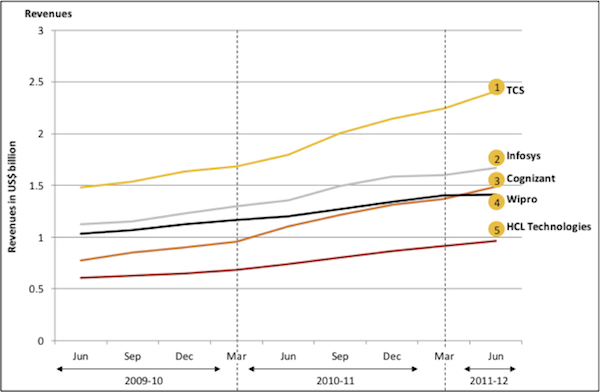
The quarter ending June 2011 marked the point where Wipro was relegated, for the first time, from the top three Indian outsourcers, in terms of revenue, as Cognizant has continued its breathless growth surge to forge ahead:
The Offshore Big Five: Wipro and Cognizant Change Positions
Source: Company Financials
In August 2007, Wipro acquired Infocrossing for $600 million, a firm which then had revenues of around $200 million. Wipro had plans to use Infocrossing as a means to get into the infrastructure outsourcing and hosting business in a big way. However, the Infocrossing unit has largely been operating as a siloed subsidiary, with Wipro failing to launch a more credible hosting or even Cloud play. We have never believed this “asset heavy” business is in the true DNA of Wipro as a business (or as a matter of fact any of the offshore services providers) due to the heavy capital requirements required to lead in this market and the fact that the “asset lite” remote infrastructure management market has taken off into a multi-billion dollar business.
Since 2004 Wipro has been particularly adept at selling remote infrastructure management outsourcing deals from its applications services clients. It has also found success displacing the large asset-intensive outsourcers like CSC, IBM and HP in some existing infrastructure outsourcing engagements. Not having to acquire physical assets or re-badge people, the company has been able to manage many infrastructure services like server monitoring, database management and helpdesk from an offshore location and rely on subcontractors for on-premises work.
But its current infrastructure management business is much like any of the other major offshore providers. Why did Wipro not develop the Infocrossing business to build out significant Infrastructure-as-a-Service (IaaS) offerings and differentiate itself with its close competitors? Simply put, it is now extremely difficult for lower-tier hosting providers to compete without the scale, available capital and technology prowess required for playing in the Cloud. The hosting and IaaS market is fast commoditizing with Cloud service offerings available from the likes of massive infrastructure providers such as Amazon, Google and the Telco providers.
HfS Research Vice President, Robert McNeill (Click for bio)
Wipro’s new CEO, TK Kurien, who is settling into his new role (which he started in Feb 2011) appears to be doing the right things, such as investing time in speaking to Wipro clients and industry stakeholders. We believe that a divestiture of Infocrossing makes sense for Wipro and could be good news for Infocrossing clients if a major Telco is the eventual acquirer. That could mean new investment and solution bundles that take advantage of combined network and hosting assets. Potential acquirers may include the likes of AT&T, BT, DT, Sprint, Verizon, and even NTT that recently acquired hosting/cloud provider Opsource, Centurylink that bought Savvis, and TimeWarnerCable that bought Navisite.
It’s been quite the year for Wipro, as Chairman Premji has sought to refocus his organization and try to keep pace with the (seemingly) relentless growth of both TCS and Cognizant.
As we have discussed, Wipro is a company which has some tough decisions to make to find the right avenues for future growth and investment. The old days of being “all things to all people” is not a strategy that is going to work – and Premji knows it.
Curiously, Premji decided to look internally for his new Chief Executive, when many observers felt it time to recruit some fresh blood from outside. Step up TK Kurien, a deep-thinking type and someone who I have known well during his leadership role in establishing Wipro’s BPO business between 2004 and 2008. TK’s also had great experience in healthcare and life sciences, boasting a former career with General Electric before his Wipro days, also being instrumental helping Wipro develop its footprint in the sector.
So where are TK’s thoughts, as he consider’s Wipro’s options in today’s market? We grabbed a few minutes with him recently to share them with you all.
HfS Research:TK, firstly, congratulations on your promotion to CEO, Wipro. You have now been at the helm for 9 months and we have seen many changes. I’m sure all our clients would be eager to understand your vision for Wipro. How do you respond to those who claim Wipro’s best days are behind them? What is top priority for you over the short term?
TK Kurien: Thanks. Over the past nine months, Wipro has undergone significant transformation with the intent to become more agile, innovative and to provide better value to our customers. Our blueprint of change is in line with the new business reality, where speed, agility and information are not seen as threats but as opportunities. The design principle of our approach is to win the hearts and minds of our customers and our employees.
Technology is a key driver for improved business performance. Our focus hence is in delivering business value through a unique blend of solutions that complement each other at the intersection of Analytics, Mobility and Cloud with a clear aim to provide business benefit. Our view of the world and our solution investments will fall under four broad themes:
1) Innovation in the constrained world: The world of tomorrow is going to be built around constraints – resources, raw material, capital, talent, energy among others. Application of effective technology will profoundly reshape strategy and business models across a wide range of industries.
2) Variabilization of IT to enhance business agility: Maximize business’s ability to innovate by providing an agile and flexible IT. Apply innovative management models including lean, Flex and shared services. Also, Virtualization, Cloud and Collaboration technologies directly lend to variabilize the asset footprint.
3) Consumerization of Technology: Forward looking companies will realize the immense innovation opportunities by integrating consumer technology in enterprise systems.
4) Analytics driven performance improvement: Actionable insights generated through advanced capability will be a key differentiator for continuous competitive advantage.
We are strategically looking at higher value and higher outcome based business.
I believe Wipro is best placed to capitalize on this opportunity due to our technology competency combined with increasing levels of vertical and horizontal domain and business consulting expertise.
HfS Research:We’ve talked a lot about the changing economy and the fundamental changes to clients’ global business models over the recession years. Now with the grim prospect of a Double Dip, how do you plan to have Wipro top-of-mind for business leaders as we venture into this new business climate?
Like everything else, the way I see it is that in every adversity there is an opportunity and really for us this is an opportunity to go back to our customers and build bonds which are far-far stronger and demonstrate how we can help our clients get through these tough times.
In spite of the uncertainties in the business environment, growth opportunities still exist for businesses that can take advantage of disposable income and demographic dividend in certain economies. While core IT spends are under threat, overall technology spends are still rising. Budgets are often getting reallocated/ investigated on a quarterly basis based on demonstration of business value. And to that extent I think the core theme that all of us have learnt coming out of the last recession is flexibility; and we have built that into our systems.
We’ve put together a consulting layer with a vision to wholly integrate with the rest of the business provide a ‘One Wipro’ experience and engage with the customer in a proactive and effective partnership to help them grow the pie and make it meatier. Our conversation with our clients is no longer how we can help them reduce the IT cost, but it is around how we can help them reduce the cost of their transaction. This change opens up so many additional opportunities for us to bring technology into play and improve speed, cost point and client satisfaction. We do not view BPO, IT and Infrastructure as separate and discreet offerings.
HfS Research:It’s great to have a “BPO guy” take the helm! And it’s been encouraging to see the strides Wipro has taken over the last 3-4 years to get a good foothold in the space (see link). How do you plan to take BPO forward for the company – will you be altering the approach and trying some different strategies?
TK Kurien: Wipro BPO is rapidly evolving from executing end-to -end business processes like Order to Cash/Procure to pay to managing end-to -end business functions where Wipro manages both the business process and the underlying systems and platforms. We see IT as an integrated part of our BPO offerings. For me it is Business Process Optimization and not necessarily just Outsourcing. This has led to a quantum leap in process efficiencies; as well as the learning from process execution being ploughed back into IT system improvement. This IT-BPO virtuous cycle is driving huge gains for clients where Wipro manages both IT and BPO and we expect this trend to pick up momentum. The business processes & platforms for Insurance are different from business processes & system for Banking and it is equally important to be knowledgeable of the horizontal processes and the industry. Our added focus on Industry verticals adds a vertical edge to the IT-BPO cycle.
Customers today expect a committed business outcome, visibility, insights and control of their global operations, anytime, anywhere; and vendors that can provide that on demand. What this means is aligning our BPO, IT, infrastructure and consulting assets to provide vertical specific, platform based BPO solutions that can deliver a business outcome. Our BPO assets include a global workforce with 21 locations outside India with expertise in local regulations and language capability, our enterprise process integrator toolkit – Base))); our analytics engine – BASE))) Insights and industry specific end-to -end process management expertise. Couple this with our IT core competence, process optimization capabilities of consulting and our powerful analytics engine and you have what it takes to guarantee an outcome.
I feel that in the world of constraints where there will be focus on doing ‘more from less’ our integrated view of looking at business process will be a differentiator.
HfS Research:Competitors are making major investments in Cloud enabled Business Platforms? Can you outline your strategy and vision for Business Platforms? What are you bringing to market and where will you be competitive?
TK Kurien: Cloud is a huge opportunity for Wipro. Let me share with you some data from a CIO opinion survey across our client base that Wipro consulting team ran earlier this year. The highlight of the study is that while uncertainty prevails on how the supply-side will evolve in coming years, most CIOs expect to significantly increase spend on Cloud (30-50% of total IT spend) once benefits are solidly visible around reduced IT operating costs and enabling focus on ‘core’ activities that add real business value.
We’re advising CIOs to adopt a ‘sense and respond’ approach – creating a cloud incubator as well as changing the IT operating model. Cloud computing offers an opportunity to look at holistic picture of the business process and makes it imperative for IT to have business-natured discussions like
How can an organization achieve faster time to market?
How can an organization match resource requirement to availability for global operations?
Can we migrate to variable cost structure?
Can we leverage economies-of-scale?
Can we access capacity-on-demand?
Wipro understands the transformative potential of cloud computing and that traditional ‘tower’ models will not help push the envelope further on cost savings or time-to-market etc. Wipro also understands that a true cloud, for example, changes the behavior of the organization by recapturing shadow IT, eliminating over-engineering, and removing the IT shop as a roadblock to business value realization.
We have an integrated Cloud Services group which cuts across all verticals and service lines. This has been done to ensure that discussions with clients around cloud computing are elevated to more business-led discussions. This group is responsible for all strategy related discussions on cloud with the clients and ensures that the client has a fairly well rounded picture of ‘To-Be’ state. We are helping many of our clients through cloud advisory, readiness analysis, and implementation and refactoring of applications.
Alongside, Wipro has also developed a portfolio of industry specific business process solutions to be delivered as cloud services from public cloud platforms and our own data centers. As an example of a business platform on cloud, we offer spend analytics on cloud (BPaaS). For a client, we were able to bring $ 30 million savings in data classification and analytics through this integrated infrastructure, application and BPO solution provided on the cloud.
HfS Research:And what – in a year’s time – would you would like business leaders to think of when they hear the word “Wipro”?
TK Kurien: Business leaders should be able to say the following about Wipro in future (and many of our best customers already believe in this) – Trusted partner and an industry thought leader who delivers winning business outcomes for me.
HfS Research: Thanks for taking the time to talk to our readers, TK. We look forward to hearing more from you soon and seeing your plans develop.
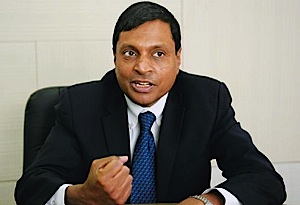
TK Kurien (pictured above) is CEO of IT Business and Executive Director, Wipro Limited. TK is also a member of the Wipro Corporate Executive Council. You can view his full bio here.
ADP, the HR and payroll services giant, is a staple analogy in the BPO business. It has such a dominant command of the payroll market, there’s no room for new entrants (many have tried and limped away); it commands the archetypal “one-to-many” delivery model with regional service hubs in all major geographic regions; it servers for small, mid-sized and large organizations with a sales and delivery infrastructure that can cater for all types of clients; it also has a rightful claim to be the first true “Business-Process-as-a-Service” offering – years ahead of its time – but doesn’t get a lot of plaudits, because there isn’t a lot of sexiness about payroll.
However, don’t tell HfS’ Keith Strodtman that payroll isn’t sexy… he lives and breathes the stuff, however, today he’s going to talk about how ADP is moving “beyond payroll” with its forays into broader talent management and HR technology segments- and – most notably – it’s move into the Recruitment Process Outsourcing (RPO) market with the acquisition of the popular “The RightThing”. Over to you Keith…
ADP has added another tool to its HR BPO toolbox with the acquisition of RPO provider The RightThing. The acquisition of the twenty-year old privately held firm is ADP’s first foray into the RPO market. Terms of the deal were not disclosed but it is clear that ADP is sticking to its “beyond payroll” message to support its growth strategy. Its “beyond payroll” business are already growing about three-times faster than its traditional payroll business, with acquired businesses playing a big role in that growth.
ADP, the world’s largest payroll processor, has used its substantial war chest to completed several acquisitions in the last few years. Examples include: Workscape – a provider of benefits and talent management solutions, AdvancedMD – a medical practice management solution provider, and OneClickHR – a HR technology provider based in the UK. The company has long participated in portions of the recruiting services market with its pre-employment services business that includes background screening (acquired about ten years ago) and talent acquisition software solutions acquired when it bought Virtual Edge in 2006. The additional of The RightThing acquisition takes the company to new levels in the talent acquisition market. Moreover, ADP’s global salesforce has the on-the-ground scale and client-side connections to push RPO services onto its massive client base. ADP can apply its sales and client infrastructure to scale the RightThing business to the next level and compete with the likes of Manpower, Adecco etc.
The RPO market appears to be well-positioned to capitalize on the talent gap megatrend that is emerging globally. Despite high unemployment rates in many of the world’s developed economies, many CEOs have reported that their companies job openings but can’t fill them because they can’t find workers with the proper skills. According to the US Bureau of Labor Statistics, there are 3.2 million unfilled positions in the United States. Companies are looking for solutions, like RPO, that can help them find workers with difficult to find skills.
The RightThing addition also strengths ADP’s multi-process BPO offering. While broad scope multi-process HR BPO deals are not as common as they once were, having an RPO offering gives ADP one more opportunity to get a “foot-in-the-door” to establish a BPO relationship. It also elevates the conversation with customer HR executives, something that will support sales of the recently announce talent management solution that is part of ADP’s new Vantage HR solution.
The RightThing is considered among the leaders in the RPO provider market, which counts more than 20 significant providers. The RightThing’s current customers may not see a lot of near-term upside in this deal, other than the obvious financial stability of ADP – one of only four corporations with a AAA credit rating. But there is probably not a lot of downside either. ADP has traditionally done a pretty good job of retaining customers of acquired companies so there is probably limited risk of The RightThing customers feeling disenfranchised.
If ADP can execute, it could become a huge player in the RPO space, at least in the US market. Global RPO growth may require more acquisitions, as The RightThing is North America-centric. But there is one variable that we think ADP will need to address to truly realize the benefits of this purchase: encouraging its clients to standardize its recruiting process and technology – something at which ADP has proven adept , with its GlobalView and BPO offerings. Their Virtual Edge recruiting product is well established, which they should be able to leverage the platform for broader RPO clients, however, ADP may well look at picking up a recruiting marketing platform (such as Jobs2Web) or other niche solutions such as the HireVue video interviewing product.
However, RPO, and recruiting in general, has not yet been fully embraced by buyers, with a quagmire of technology platforms, fragmented processes and the onset of social media to complicate the issues. Recruiting process and platform standardization will be required if ADP is to be successful at scaling the RPO business to be a mass-market utility solution – but we also view this as a major opportunity for ADP to attack this market. If they figure out how to scale the business, they will have a huge customer base at which to sell these newly acquired services. Regardless of the scale, however, there is little doubt that ADP has strengthened its already market leading BPO business and continues to bolster it “beyond payroll” services.
"Go ahead… just one more slide". HfS' Esteban Herrera saves you a fortune with some free advice
My word, if I get one more spam from someone claiming to help outsourcing providers “get outsourcing leads” through delivering dodgy webcasts (which are probably only attended by other equally desperate outsourcing providers, with similarly deficient sales capabilities), or get invited to take part in a workshop to improve the “velocity of my sales pipeline”, where a paltry $10,000 investment can help my firm meet its $1,000,000,000 target, I think I may throw my Mac out the window and join the Occupy Wall Street demonstration rumbling on down the road.
So let’s save you nice outsourcing providers the time, trouble and expense of getting advice on how not to sell yourself, and give you all the advice you need, right here, right now – and for absolutely nothing. Plus, you can re-invest that time you just saved by filling a bag with foam pies and hurling them at unsuspecting investment bankers.
Esteban Herrera, along with most of the team at HfS, has gone way further than “Death by PowerPoint” on so many occasions that we can now prescribe your very own Exhumation after PowerPoint… over you, Mr H:-
An open letter to Outsourcing Providers: It’s time for your exhumation after PowerPoint
Dear Providers,
We love you. Without you there would be no outsourcing industry and we would not have jobs. More than anything, we want to see you succeed. Why, oh why, must you insist in compromising your own success by practicing death by PowerPoint on your prospects?
I’ve come to believe that business, and our business in particular, really wants audiences to tune out. Through thousands of “orals” and analyst “briefings” I’ve concluded we actually want to put each other to sleep. We don’t care if the audience retains anything we’ve said, and thus bombard them with a slide per minute. Of course, almost none of us talk that fast, and almost all of us leave the good stuff until the end so we rush to it when nobody is paying attention and everyone is bleary-eyed and exhausted.
In my view, providers are the worst offenders, especially when attempting to woo new clients in competitive situations. The presentations and styles often do exactly the opposite of what is intended: they frustrate and alienate potential clients. In the last fifteen years, I’ve seen lots of sales pitches, some very good, most not so. In an effort to help our industry and keep my sanity during my next round of orals with a buyer client, I’ve put together a few tips, which I am sure most of you will ignore.
Ditch the PowerPoint. Clients are so used to “slides” that what will stick out in their mind the most is someone who came to have a conversation with them, not talk at them. In a recent set of orals, one provider had three of six speakers not use slides at all. They finished an hour early of their allotted time, to everyone’s delight, and communicated just as much as anyone else. Engagement, discussion, and relationship-building banter ensued. To say they won the day would be the understatement of the year. More importantly, everyone in the room, including this jaded advisor, remembers them and their story. If you know what you are talking about, you don’t need the damn slide. Plus, you know all your competitors are going to attempt PowerPoint murder, so why not stand out in the crowd?
Ditch that innovation funnel slide. You know which one I’m talking about. Everybody has it. Everybody claims it as their own. And nobody believes it. Kill it.
Start with the “answer.” How about this simple message to start the session: We are going to save you $X million per year, starting in June, while maintaining or increasing all your existing service levels, while absorbing x% of the risk. If your FIRST statement/page/slide doesn’t follow that pattern, you’ve squandered your best opportunity to differentiate and create a lasting impression. Whomever taught this “build-up” to the punch line method of presenting should be sued for malpractice.
Ditch the sales person. Don’t get me wrong, salespeople play a critical role in any pursuit, but they should be seen and not heard. Clients want to speak with subject matter experts and content people. At an intensely competitive pursuit I led last year at a global manufacturer, the sales guy never spoke during presentations, and wasn’t even in the room for the last round (he was outside the door). But I knew he was quarterbacking the effort every step of the way. His team won. I’m sure he didn’t mind being out of the room when his commission check for a $125 million TCV deal came through.
Slides are aids, not crutches. If you must use slides, you should be able to speak at least five minutes per slide. They should help tell the story, not remind you what the story is.
Bring a Customer. That’s right, there is no more powerful marketing than what an existing, happy client can say about you. Persuade one of your happy clients to come and speak on your behalf. Nobody else is going to do it. Fly them first class and put them up for the weekend at a great resort nearby. The good will in the existing relationship alone is worth it. But how impressive will it be to the prospects? Priceless! And existing clients, before you dismiss this thought, think about the favor you will be able to cash in when you need it! This is a win-win and I don’t know why more buyer/providers don’t do it. Sit your customer down in the middle of the room and let the prospect ask questions. Let the customer answer honestly. Your prospect will remember it forever, and probably hire you on that alone.
Engage. These meetings are opportunities to converse. The more one-way the communication, the less likely you are to be successful
Personality counts. One of the most successful providers we see in the market has the uncanny ability to match their delivery/account manager to their prospective client very well. Their delivery capability is no better or worse than anyone else in the market, but prospects tend to fall in love with the lead, and more often than not, buy because of that individual.
I have lots more tips, but eight is a good number to start with. I did not want to be critical without offering some suggestions! I genuinely hope you find these helpful. I’m no presentation coach, but I’m happy to recommend a great one (thanks, Ron D.). Remember, we love you, and we want you to win. And if you don’t curb these bad presentation habits you are going to start losing.
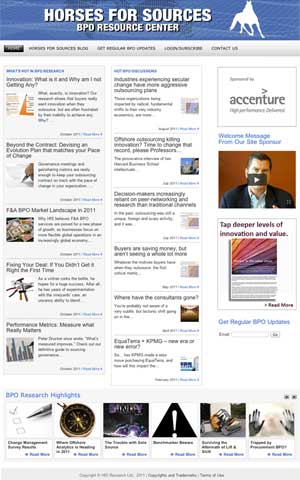
Today, we have launched The BPO Resource Center that’s geared to become THE one-stop shop for anyone seeking to learn more about Business Process Outsourcing – without having to pay thousands of dollars for the privilege.
In fact, you won’t have to pay anything. This is intended to be the site where buyers, providers, investors, advisors, analysts, academics and politicians can swing by to peruse content, download reports, get engaged in dialog or even contribute their own research.
The BPO Resource Center is geared to become a genuine industry resource that encompasses best-practices, next-practices, worst-practices, news, industry data, views and research insight. However, what makes this sight really unique is that we’re opening up the content to the best minds in the business to share their learnings, and this includes other research analyst firms and academia. We’ve kick-started the site with a selection of recent BPO-related research reports, blogs and articles from HfS and will soon be populating this with research from our research competitors and academic peers.
And while we would love to be a non-profit charity for the outsourcing business (we’ll do that when we get rich and retire), we do occasionally need a little help from industry, and we’re delighted to announce that Accenture has become the first executive sponsor of the Center. And before you ask, they do not control or influence our content, they are simply great supporters of HfS as an industry voice and want to help support such a great resource to further the learnings of industry. Plus you get a lovely welcome video from the famous Mike Salvino, head of Accenture’s BPO business, when you log-on.
Many of you on the buy or sell side of outsourcing are great clients of ours and we cannot understate enough now much we value your support as we look to expand our knowledge-sharing for the development of the global sourcing business. The BPO Resource Center is the next stage in the development of the HfS platform as the pre-eminent portal for all things sourcing and shared services, and we strongly urge you to pay it a visit and sample several of the complimentary research reports and discussion pieces.
You’ll see some of the best work of the HfS BPO murderers row that include such reprobates as Tony Filippone, Esteban Herrera, Reetika Joshi, Deborah Kops and yours truly. And here’s the best thing: All you need to do is sign up once, and you’ll forever have free access to all the research, which we will frequently refresh. We’ve also assembled a smattering of the best recent blog posts on the BPO business.
I’d personally love your feedback on this site–what you like, how we can improve it, and anything else you can think of. Please feel free to drop me a line at [email protected].