Whether you buy, sell or advise on outsourcing, please click to complete our brief study and you might win an annual subscription to HfS Research
Organizations have always been wary of outsourcing during recessions. While today it delivers cost-reduction to clients in spades (proven emphatically during our recent state-of-outsourcing study), many organizations have proven, in the past, to push it down the priority-list of radical cost-reduction measures, when they fear for their very existence.
With the threat of a “Double-Dip” recession very much a grim reality, HfS believes this cycle is likely to be broken. Let’s discuss
1) Outsourcing planning has been at an all-time-high coming off the last economic crash. Many companies have been busily planning to increase the scope of their outsourcing contracts in mature outsourcing areas such as IT, call center and print/document management, in addition large numbers seeking to make first-time moves into emerging areas such as F&A and Procurement (see our recent data). We’re also experiencing a shortage of available advisors to help clients with their contracts, with the management consultants and boutique advisors enjoying a strong resurgent in client-demand for advisory services.
2) IT Outsourcing is a proven commodity in today’s market and BPO is no longer a daunting or “unique” strategy. During previous economic slowdowns, many companies regarded outsourcing as potentially disruptive to the business, often viewing it as a unique and somewhat risky strategy. However, as the IT outsourcing market has become a mainstream commodity for the large corporations, whose IT management have honed their expertise with managing outsourcers and global sourcing operations, utilizing offshore IT is today a tried-and-trusted cost reduction tactic employed by the vast majority of the Global 2000. Hence, it was little surprise that the leading offshore IT services providers continued to grow their businesses throughout the last downturn. Moreover, while many areas of BPO that posed substantial cost-reduction gains were definitely viewed as disruptive last time out, we believe services such as F&A BPO are now proven mainstream offerings with over 800 organizations having now taken the plunge.
3) A lot of fat was cut during the last downturn – in many cases, outsourcing is the only option for productivity gains. Quite simply, most organizations can only lay-off so many staff over sequential years of tough conditions, until they reach a point where there is no more wiggle-room to find any more costs to shave. You can only request your managers to increase their numbers of direct staff reports so much, and have them take on only so much extra work, until you get to the point of negative returns from your staff output, In addition, organizations are frequently losing their best staff who’ve been burned out and demoralized during drawn out periods of staff retrenchment. In many cases, outsourcing is the only logical option to open up added resource, and free up your internal talent to focus on adding value to the business, as opposed to plugging leaks. Outsourcing can provide that opportunity to re-energize your top talent, having freed up new resources and eliminated the ongoing cost-pressure.
4) The rise of Global Business Services is encouraging buyers, previously wary of outsourcing, to embed it into their global operations strategies. Our research shows that 90% of enterprises (greater than $1bn revenues) have shared services and 97% manage outsourcing engagements. However, the majority of them have yet to gain from combining shared services and outsourcing into one well integrated management framework, which we term as “Global Business Services”. A well-executed Global Business Services strategy is distinctly different from the narrower focuses of shared services and outsourcing, as it identifies corporate objectives and encourages internal functional silos to collaborate with each other and third party service providers to create breakthrough operational capabilities that drive business outcomes (click here to learn more).
As more global enterprises grapple with managing these hybrid environments, the more new-thinking we are seeing around aligning shared services with outsourcing. Additionally, when you examine the client strategies of the leading management consulting firms, they are all focusing their client advisory on helping them benefit from Global Business Services; it’s no longer about approaching “outsourcing” in a silo, but as an enabling operational lever that enhances a global operations strategy.
5) The realization that we’re in an interconnected global economy is forcing the issues. While the last Recession taught us that our global banking systems were all interconnected, the subsequent issues surrounding government debt have reinforced the issue that our economies are intertwined to the point where we have to consider global issues and global resources in our day-to-day businesses. The capability to leverage global skills, less costly resources, data and knowledge via outsourcing partnerships is becoming increasingly valued by business leaders who want their operations to be global. Moreover, the better providers can support rich analytics across global operations, the more valuable these outsourcing partnerships are becoming for many of the maturing clients. Many organizations know they have little choice but to explore their global sourcing opportunities to survive in this environment – and outsourcing has a major role to play.
6) The middle-market is fast opening up. Traditionally, outsourcing of IT and business process has been reserved for the major corporates, who have much larger arbitrage opportunities, and can command the attention of the top-tier providers. However, the middle-market tier, typically those firms with revenues between $1bn-$3bn is now exploring outsourcing opportunities aggressively, particularly with the second-tier of providers being forced to explore smaller opportunities with such intense competition at the high-end. Moreover, our recent research has shown the satisfaction levels within the mid-market are actually higher than those experienced by the high-end – often because they have to offer-up broader process-scope and need to reach an end-state quicker (click here to view our insights about the “Band-Aid” effect). We believe the success of middle-market outsourcing will drive this market forward, especially in light of the tight economic conditions.
7) The increasing availability of new global sourcing locations. It really isn’t all about India and the Philippines for IT and BPO services these days. It really is a global market for outsourcing, with significant strides gained from Latin America in recent years and the emergence of the USA and Canada as price-competitive “home-shore” locations, especially for sourcing services that require a lot of customer and business intimacy. With states such as Michigan (for example, read GE’s recent announcement) are now proving competitive from a price and talent availability perspective, we believe the make-up of many sourcing engagements are going to involve many broader location options for clients. Moreover, a Double-Dip Recession will only raise the political issues of sourcing locations to new heights, especially with a contentious Presidential election in 2012.
8′) The pressure to explore new productivity thresholds by accessing horizontal and vertical “Business Platform” solutions.
“Business Platforms” enable customers to leverage business services through subscription-oriented, consumption methods via a business platform that integrates Cloud Computing technology, SaaS and Business Process Outsourcing functionality. Business Platforms aim to provide customers with business services that can help drive innovation, flexibility and cost-reduction, while providing business outcomes to clients.
Essentially, providers are looking to business function leaders to bypass their IT departments and acquire “Business Platforms” that are readily available, for example in horizontal areas such as expense management and carbon-management, or industry verticals, such as pharmacovigilance or merchandizing. Today, we’re largely only seeing components of broader business functions being supported in the Cloud by providers, but we expect this to accelerate as providers aspire to offer more Business Platforms as they are developed.
With intense competition between the providers to push Business Platforms to clients, the greater the pressure on business leaders to run pilots and start exploring opportunities to externalize processes with providers where it makes business sense to do so. We firmly believe Business Platforms are the future of outsourcing, as the worlds of IT and business process delivery continue to merge. A Double Dip recession will surely encourage some organizations to look at more radical, disruptive means to reduce cost and improve productivity, and Business Platforms will provide some options to explore.
9) The career path of the global sourcing executive is fast taking-shape. Sourcing is becoming big business. A few short years ago, there were barely enough executives in the industry to fill a lecture-theater, who were true experts in forging a career out of managing complex outsourcing engagements for buyers. In most instances, the responsibility for managing an ITO relationship fell to the CIO, who tended to delegate most of the PMO responsibility to a direct report. Similarly, the CFO would tend to ask their shared services leads to take over the PMO functions for BPO engagements. At first, many resisted and focused too heavily on administering punitive SLA schedules. However, as outsourcing has become mainstream, ambitious senior IT and business operations executives know they need to have proven outsourcing PMO expertise to be taken seriously for career advancement for many leading corporations. They also know that successful outsourcing is only possible by continuous learning and relationship development with their provider partners. HfS has observed a significant mindshift since the last downturn to approach outsourcing more strategically and recognize the benefits it can bring during tough economic times for their business. The focus on blending outsourcing into global operations and shared services is significantly changing the mentality towards embracing what outsourcing has to offer, as opposed to resisting it.
10) And finally, your views, please! Complete our brief survey to share your views, experiences and intentions of outsourcing with the imminent threat of a “Double-Dip” Recession. All answers will be treated with the strictest of confidence, and you can receive a copy of the study findings. Whether you buy, sell or advise outsourcing services, your opinion is highly valued – please click here to complete the survey.
And – as usual – we’ve wangled a great deal for our cost-savvy HfS readers: FREE ADMISSION. That’s right–just use promo code HfS1000 and you’ll get in free.
The roundtable (see agenda) will assemble a compelling group of local and global companies. In addition to hearing from Phil and Dawn, speakers and panelists include:
Hugh Bradlow, CTO, Telstra
Craig Baty, Executive GM Marketing and CTO, Fujitsu ANZ
Brett Murphy, Cloud Computing Executive, IBM
Lou Pagano, Alliances Director, AMP
Brendan Walsh, Managing Partner, ITNewcom
John Dardo, Assistant Commissioner, Australian Taxation Office
Barry Manning, Procurement Line of Business Sales Specialist, SAP
Matt Barrie, CEO, Freelancer.com
Chris Brackin, Strategic Sourcing Category Manager, MMG – Minerals and Metals Group
The agenda will be packed with case studies and panel discussions that will leave you with valuable “next practice” intellectual capital.
Some of the topics include Trends and Best Practices in Sourcing and Outsourcing, Cloud Computing, Best Practices in Supplier Performance Management, Talent Management and Succession Planning, Offshoring and eSourcing.
Our recent State of Outsourcing study, conducted with the Outsourcing Unit at the London School of Economics, has been uncovering many home-truths about why some industries are more motivated than others to externalize their support operations to third-parties.
However, one factor that is continuously being reinforced, is that those organizations being impacted by radical, fundamental shifts to their very industry economics, are more prepared than ever to admit they need to look outside of their current organization boundaries to keep their business operations cost-competitive. Simply-put, secular change crystallizes options for businesses and the outsourcing planning process often becomes more clear-cut as a result.
Buyers today are figuring out where to focus their outsourcing plans to benefit the core business
Increasingly, we are seeing a realization that retaining some processes internally isn’t – in any shape of form – bringing organizations a competitive edge, and these sourcing decisions are no longer only about cost – they represent a fundamental change in the way business leaders now view outsourcing as an integral function of their operations. For example, does a bank lead its market because it processes mortgage applications better than its competitors? Or would its management rather find someone else to process them at lower cost, using industry-standard process flows and technology, while they focus internal competency on business functions that can help them gain marketshare, such as smarter customer targeting, or upselling new product through customer support channels etc. And does a retailer really need to maintain its entire application portfolio inhouse, when it can devote its internal talent and IT resources to improving its customers’ online shopping experience, where it can actually grow its business?
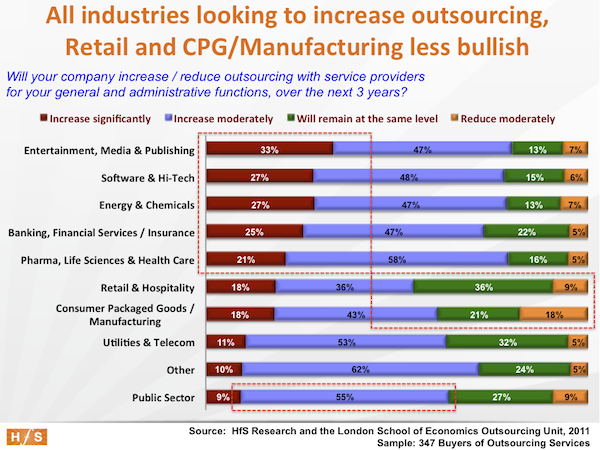
Today’s buyers are getting a lot smarter at figuring out how they can improve their organizations by using the resources and knowledge available through third-party relationships. Examining plans to outsource over the next three years reinforces this mind-shift:
The Secular-Shifters: Gearing up with long-term aggressive outsourcing strategies
The five most bullish industries planing significant increases with outsourcing, are not only basing their planning on their proven, ongoing cost-reduction outcomes (see Part I), but also because the fundamentals of their industries have dramatically shifted in the recent past, for example:
Entertainment, media and publishing:The crash of newspapers and network news; The Web 2.0 impact; Radical new distribution and business models.
Software and Hi-Tech: Rapid commodotization of packaged software models; Impact of Cloud computing on licensing and pricing dynamics; Dominance of India, China and other low-cost nations to drive out the cost of development; Willingness to “Eat their own dog-food” as providers of outsourced services themselves.
Energy & Chemicals: High price volatility for oil products; high capital costs of oil exploration projects; Shortages of talent; Aging infrastructure and constantly-changing compliance requirements.
Insurance: New compliance measures (Solvency II, ObamaCare) causing unprecedented administrative cost and workload; Shortage of risk analysts and actuaries to take on the higher level work.
There are just a few examples of major industries, being shaken to their very foundations, where we can reel off secular shifts driving unprecedented demands on organizations to remain profitable. Is it any coincidence that it’s these industries that are today being the most aggressive with embracing third-parties to redefine their global operations? Secular changes drive bolder, more radical behaviours, and it’s already clear that a more aggressive approach to outsourcing is high on these organizations’ agendas.
The Penny Businesses: Living month-to-month
Industries such as retail and manufacturing, one can argue, have already been through their secular shifts over the last three decades or more. While they have had to experience much fundamental change, for example mass globalization of markets and volatile changes to consumer spending behaviors, the very essence of these industries is still the same – their organizations are focused on inventory management and supply chain optimization, maintaining operating margins and accurately predicting demand. To them, outsourcing has always been an option, and has been readily explored over the years to find more pennies to save. Hence, it’s no surprise that these organizations are more conservative with their long-term operational planning. Moreover, these businesses are typically reactive to market conditions and often radical long-termism doesn’t fit as well with their mentality, especially when faced with uncertain times ahead. In addition, many of them have already shaved their operating costs to the bone, hence digging out new productivity benefits via outsourcing is often challenging – and mistakes can prove fatal in a low-margin business. While heavy outsourcing adopters in the past, we expect these sectors to remain focused on outsourcing, but with a large proportion opting for a more reserved approach.
The Public Sector: Facing up to unprecedented challenges
One industry which is going through more secular change than any today is the Public Sector. Quite simply, national and local government bodies are under unprecedented pressures to drive austerity measures and make long-term plans to drive new productivity programs. This explains why 55% of public sector bodies actually foresee some moderate increase in outsourcing activity over the long-haul. Huge political bodies, such as the US Navy, NASA, the UK Inland Revenue and National Health Service – and even the FBI – all outsource elements of their operational support functions to varying degrees. With increased onshore delivery resources becoming available from several providers, this could well turn out to be a surprisingly large growth sector for outsourcing.
The Bottom-line: New fundamentals are creating new rules, and outsourcing could be a significant beneficiary
Outsourcing would appear to be entering a new era – one where organizations can no longer afford to ignore its benefits. Moreover, as these radical and secular changes to many of our core industries take hold, business leaders simply cannot overlook the competitive advantage outsourcing offers: enabling them to focus on developing competitive advantage. These secular shifts are threatening the survival of many businesses, but at the same time are opening up major opportunities to build smarter, more globalized and leaner organizations. As we venture into unprecedented times of uncertainty that are bringing new challenges, business leaders can no longer afford to cling to many of the methods of yesteryear to steer their organizations, and this data points to a more bold, radical approach to embrace the benefits of global sourcing.
In case you still haven’t, then you must take our new quick-fire survey. Heaven-forbid we’re on the cusp of a tough economic period – so how will this impact outsourcing and shared services dynamics after all we’ve been through this past few years?
Whether you buy, advise or sell outsourcing services, we need to hear from you – and we’ll package up a report of the findings for your time. As always, we appreciate your support for helping our research teams keep close track of the industry.
Today marks an exciting day in the development of HfS Research as a global advisory analyst organization – we have selected sourcing and software PR and communications specialist Gutenberg to orchestrate our global research communications to the Americas, European and Indian markets.
Why this is meaningful
Gutenberg's CEO, Harjiv Singh… beaming after the HfS tie-up
Communicating what global sourcing is all about to real business people is broken. We believe that the biggest problem with the sourcing industry today, is a broad failure to communicate the challenges and opportunities posed by global sourcing to mainstream business people. Accountants, technologists, procurement specialists, operations experts and so forth did not go to outsourcing school and likely never will. Most of today’s providers, advisors, analysts, academics etc are so wrapped up in their own vernacular that they end up marketing and talking to each other as opposed to the people who really matter: the buyers. Our goal at HfS has consistently been to cut through the jargon and explain to business and IT professionals what global sourcing is all about. To do that, we need to take our insight and get it to the broadsheets, the politicians, the lobbyists, the investors, the big business media.
This partnership will tackle the communication challenges of sourcing in a coordinated global fashion. Gutenberg is entrenched in the sourcing industry and understands the core industry communication challenges. In addition, they have prominent teams in India, in addition to the US and Europe. Much of the heartbeat of the sourcing industry is emanating from India, with a feverish media industry – and their issue has often been to get the issues discussed globally. We believe our combined global teams can work together to change this dynamic. With the growing HfS presence in India and Europe, in addition to the US, we believe this is an ideal partnership to bring together the global story.
We have also invited Harjiv Singh (CEO, Gutenberg) to contribute to our blog to drive some lively discussion on the core communications issues plaguing our sourcing industry today. He can get away with saying anything with that smile 🙂
A lot has changed over the last five years in the outsourcing business. Has it really? I hear you cry. OK – you may have a point, but one thing is evolving – the emergence of some of the major Indian service providers as credible HR delivery firms.
When Indian service providers were originally mentioned as budding HRO providers, many HR executives would respond “we couldn’t possibly entrust such sensitive HR processes with offshore firms”. Since then, many Indian service providers – and other global organizations with large Indian captive organizations, have become exemplars of how to develop, manage and motivate talent.
Nissan liked Genpact so much, they bought their HR…
One US C-suite executive even recently broached the topic of bringing Indian service provider leadership over to the US to help educate US firms on how to develop a competitive talent development culture.
Genpact has been working with Nissan for more than six years, providing finance and accounting, procurement, customer service, supply chain and analytics services. So adding HR services seems a natural extension of these services – even though Genpact has limited client experience of multi-process HRO. Moreover, this is also the reemergence of what we started to see in the pre-Recession days – increased bundling of business processes with a single provider which has a developing knowledge of a client’s institutional processes. Once they have lived their clients’ quirks, challenges, ideals and best-practices, surely the opportunity to broaden into new process areas is a natural extension of the relationship? So let’s hand over to our own HRO provocateur, Keith Strodtman to elaborate further…
Why Genpact has some serious chops to do well at HR Outsourcing
Genpact may not be a well-recognized name in HR circles but in the business process outsourcing (BPO) world they are a premier BPO provider, especially in finance and accounting (F&A), procurement, IT, and other process areas. That said; the company’s recent acquisition of the HR services subsidiary of Nissan Motors in Japan is a significant statement about its ambition in the HR BPO market. According to Anju Talwar, Head of HR services at Genpact, we should expect to see Genpact sign several more strategic HRO customers in the next couple of years. Talwar says Genpact plans utilize the capability gained in the Nissan deal to offer HR services to other customers in Japan and other Asian countries.
Nissan, who had a previous F&A and procurement BPO relationship with Genpact, has expanded the relationship to include HR services to 54,000 employees in more than 20 offices in Japan and other parts of Asia. In all there are about 200 Genpact staff supporting the HR processes. Many of the staff are located in Japan but some work is also processed from a Genpact center in Dalian, China. Genpact has more than 3,000 employees in China. The scope fo the Nissan deal includes: payroll, benefits administration, career development, portions of recruiting, an employee call center, and other HR processes.
Genpact got its start in the 1997 as the internal shared services arm of GE Capital. Know then as GECIS, the Indian captive shared service center served as the back office for many divisions of GE. In 2004, GE sold a share of GECIS to two private equity firms and it became independent in January 2005. This enabled the company to diversify its customer base beyond GE. It changed its name to Genpact and the company went public in 2007. Many of it early non-GE customers hired Genpact to manage finance and accounting transactions like accounts payable, account reconciliations, and payroll. The company now has more than 51,000 employees, $1.26 billion in revenue, and offers a broad range of BPO services.
Payroll was the process the got me talking to Genpact when I was leading the HR outsourcing business at Ceridian. I was looking to increase the efficiency of our managed payroll business and sought a partner to support several payroll processes from an off-shore location. This occurred in 2006 and even then it was clear to me that Genpact wanted to expand into other HR BPO services. In fact, had it not been for the “great recession” we might have seen several more HR BPO contracts signed by Genpact in the last few years.
Payroll is not the only credential that Genpact has built upon to develop its HR BPO business. Its GE heritage has left a deep and innovative HR culture at the company. Talwar points out that many of their HR service engagements begin with a conversation with customers who are interested in emulating some of Genpact’s internal HR programs. This comes as no surprise to me. When I was traveling around India in 2006 talking to several Indian BPO providers, I recall being very impressed with the Genpact’s talent management practices.
HfS Research's HRO Maxima, Keith Strodtman (click for bio)
Its recruiting, performance management, and training processes rivaled the best I had seen anywhere in the world. The GE heritage also embedded a vast Six Sigma competency that is not only used to increase operating efficiency in the outsourcing centers, but is also used extensively in client process improvement engagements.
The outcome of this deal could have a significant impact how much progress Indian outsourcers make in the HR BPO space. In addition to Genpact, Infosys, Wipro, Caliber Point, TCS, and some smaller Indian providers have active HR BPO practices. Each has customers in the North American market but none have experienced rapid growth here. If Genpact has success with the country/ regional model that it has with Nissan, we may see others follow with similar approaches.
Genpact certainly has a lot of skills to employ in the HR BPO market. The Nissan engagement could very well be a significant proof-point that will help propel the company to higher prominence in the HR services marketplace. We should see in the next couple of years if Genpact does indeed continue to “drive” its HRO business to significant growth.
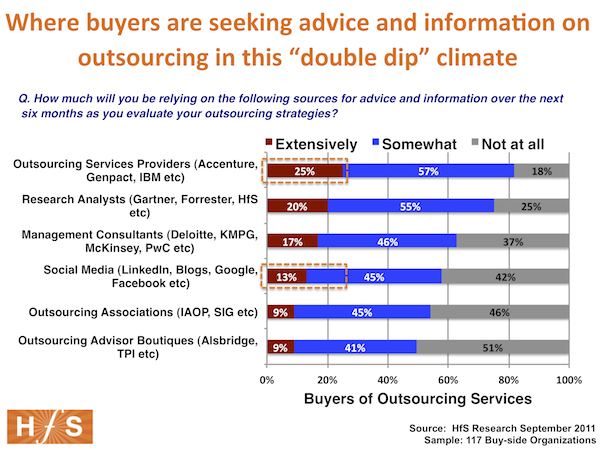
As we push our Outsourcing in a Double-Dip study, we couldn’t resist a quick sneak peak at the data at the half-way point, to get an early indication of how buyers are behaving in this market. And when we ask them where they’re foraging for help and information with outsourcing strategy-making in the coming months, the results are simple: they are turning to whatever sourcing are most easily-accessible and inexpensively-available to them:
Providers – once in a relationship provide a constant source of information. Buyers really start to leverage leverage their providers for help once they start working with them and their destinies become intertwined. Since most organizations today are already in outsourcing relationships, it is very easy for buyers to call up their provider contacts and ask for help and information, even though their experiences are usually limited to only those of their other clients. Moreover, our recent State of Outsourcing Survey revealed that 40% of buyers are yet to be convinced that their providers have the know-how to help produce long-term business benefits for them. In fact, an increasingly large number of providers are asking HfS to help their clients – they have the greatest urgency to educate and keep them informed with objective, credible data and advice.
Analysts – they make themselves accessible. Most large firms already have subscriptions in place to access reports and tee-up calls with analysts to bounce around ideas. Whether the advice is any good is another issue, but the fact that the leading firms make themselves accessible and (relatively) affordable keeps them top of mind when critical decisions need to me made. The downside is that it’s pretty tough to help clients with such complex and sensitive issues such as outsourcing over the one hour phone call, but smart outsourcing buyers know how to leverage these firms to get the datapoints they need.
Management Consultants – have upped their outsourcing game. Consultants have really made their presence felt, with several of them having developed comprehensive expertise to support their clients when the “O” questions start popping up. Smart clients can also squeeze a lot of info out of the without having to summon the MBA bus to their parking lot. Moreover, some of the leading consultants are much better equipped to run small-sized engagements these days, especially with experienced clients who don’t need to overhaul their entire operations strategy to understand which service provider can process their invoices best. Furthermore, buyers see the cost savings opportunities, but realize they need more than $20/hour Indian programmers and $15/hour Filipino call center agents (as we recently revealed here). They need re-engineering, better systems, etc, so many turn to the consultants for help, because their providers haven’t been able to deliver much more than the cost savings.
Social Media – becoming a significant channel for advice. The surprise package here, with close to 60% now leveraging the likes of LI groups (we have more than 14,000 in our group alone), blogs, Google Plus and other tools to get help. Essentially, there are a lot of knowledgeable sourcing folks getting connected these days, and they’re getting easier to seek out.
Associations – ongoing interaction proving valuable. Not to be undone, these entities provide some pretty decent networks to help well over 50% of buyers gain knowledge, and also access experts. For example, our network partner the Sourcing Interests Group hosts a regular stream of interactive webcasts and special interest group discussions to complement their events. They even make our research accessible to their members. Not bad huh?
Outsourcing Advisor Boutiques – great for deal negotiations, but less so for the other stuff. Many clients today are turning to these guys once they are ready to pull the trigger on a deal, but it seems they aren’t being as heavily utilized for general information and advice. Moreover, boutique advisors don’t produce a lot of data and insight that is easy to digest, or freely available. Much of it is written in industry-jargon and their online content often reads more like they are writing to each other than their actual clients. Don’t get me wrong, their content is often superb, but you sometimes need a PhD in the school of outsourcing hard knocks to understand it. The bottom-line is that many advisors simply don’t see the revenue incentive to give anything away for free, and employ too many hard-nosed deal guys that can negotiate an indemnification clause and chaperone site visits during a selection process, but simply don’t know how to evolve a sourcing strategy.
The Bottom-line
Buyers are savvying up on sourcing. There’s a lot of information and advice out there today and a whole array of individuals and firms are willing to provide it. The common theme is that if someone wants the price of a SOX expert in Slovakia, or certification as to whether they’d be nuts handing off their paper-clip purchasing to a Polish procurement provider, they want that knowledge right away. The secret sauce that once obscured outsourcing information has long evaporated, and the challenge now for buyers is to make sure they have consistent, ongoing access to people whom they trust to provide it, without it costing the earth.
(From left-to-right) Report authors Phil Fersht & Robert McNeill (HfS), Kenneth Adler & Akiba Stern (Loeb & Loeb)
We just released a brand new report entitled “Getting Smart About Sourcing for Cloud”. Simply-put, we kinda got the impression that no-one had written a concise document that outlines what on earth is Cloud Computing, why we should care, what hundreds of IT and business leaders think about its impact, what the service providers are developing and offering in the space, and – once you know all that – how you need to think about contracting and executing for it.
So we called up some legal-eagles who are knee-deep in this stuff at Loeb & Loeb, and co-wrote this lovely little report for the benefit of the entire sourcing industry – whether you have interest in buying, advising or servicing Cloud services, this really is a must read for you!
Simply enter your details here and a little pdf will come sailing its way to your inbox…
[email-download download_id=”4″ contact_form_id=”2″]
Newsflash: just because buyers aren’t always in a rush to outsource, doesn’t always mean they are too “short-term focused” or simply “missing the big picture”.
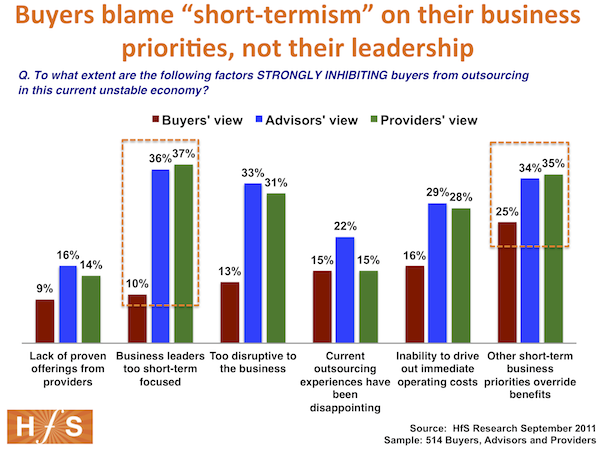
Our latest study shows that many buyer executives are, in actuality, in violent disagreement with many provider and sourcing advisor executives that their business leaders are too “short-term focused”:
When you talk to some (and the operative word being some) advisor and provider executives, they are convinced that every company needs to outsource as much of their operations as they can – and as quickly as they can – so long as they can make the numbers work. It’s this attitude that – in my view – has been holding the outsourcing industry back. Too many provider and advisor executives are overly myopic in their view that business leaders must be “short-term focused”, simply because they don’t pull the trigger on deals fast enough.
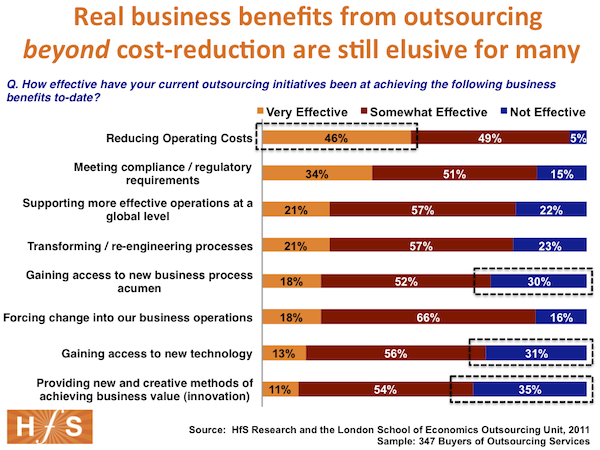
Yes – corporate politics is a critical component of any outsourcing deal, but today’s smart operations and IT leaders all know that the short-term benefits of outsourcing are – by and large – centered on achieving short-term cost-savings from the bottom-line. Our recent State of Outsourcing study reveals this dynamic in spades. Moreover, the data also blatantly demonstrates that buyers are yet to be wholly convinced of the long-term benefits of outsourcing beyond cost-reduction:
What’s more, many business function managers are under intense pressure these days to drive out more tangible cost wherever then can, so their resisting outsourcing (or taking time to do their due diligence) actually implies that many of them are justifiably avoiding rushing into a potentially hazardous irreversible scenario for their organization, if not executed correctly.
So if a business leader was genuinely short-term focused and had done their homework, they’d already know they could score some points with senior management and save mothership a few shekels by doing some outsourcing.
Additionally, only 13% of buyers are concerned about the disruption caused by outsourcing – much less than the third of providers and advisors who believe they are – which tells us the issues holding them back are more a lack of conviction about the benefits of outsourcing, than the sheer horror of the prospect that their help desk ticketing schedules and accounts receivable remittances are going to disappear down a sewer in Chennai and destroy their company.
The Bottom-line: Those providers and advisors which can demonstrate a genuine understanding of their clients’ business pressures, will win out
You do start to wonder whether many advisors and provider executives really have much understanding of their clients’ business pressures beyond cost-reduction – and our recent survey data, discussed above, supports this viewpoint.
When you look at the people some providers employ today, they are often young, hungry sales people who are only focused on “selling cost-reduction”. It’s all they really know and are not experienced enough (or confident enough) to develop and demonstrate a genuine understanding of their clients’ true business pressures. Seeing as many of them previously were trained to sell ERP licenses, or web-development projects, it’s little surprise that they bring this mentality to their clients and end up frustrated that they can’t close deals fast enough.
What’s more, this also makes you question the mentality of several advisor executives, who clearly are laser-focused on pressuring an outsourcing deal negotiation onto their clients, as opposed to investing time to get closer to their overall business dynamics and pressures.
Providers need to start spending less on pointless marketing and investing more in hiring and training higher-caliber consultative client-side executives, who can develop much stronger affinities with their clients. Moreover, advisors which want to do more than number-crunch deals, need to hire a balanced team of business consultants, in addition to deal negotiation specialists.
All-in-all, if buyers only see outsourcing as a cost-reduction lever, they are going to place it in a pecking order of other cost-reduction measures… and it’s not always going to the most effective short-term measure in a tough economy. It’s the job of advisors and providers to educate and demonstrate to buyers the benefits beyond cost-reduction, as opposed to sitting back and complaining that most buyers are short-term focused and paranoid about disruption and change.
Let’s hope this data opens a few eyes before we end up in a depressing race to the bottom, where the lowest cost and very basic operational performance capability, is all that clients can expect from many of today’s providers.
Thanks to all of you for your contributions to this research – your views are articulating loudly and clearly what this industry needs to do raise its game,
No sooner did they rip it off, they put on another one…
We gave Léo Apotheker a strong benefit of the doubt when he recently ripped off HPs proverbial Band-Aid and made a series of tough announcements that could steer HP on a more coherent enterprise path. Sadly for Léo, his board is clearly in a position where they are unhappy with the progress made under him and want to bring in a very different personality in eBay’s Meg Whitman. Coming so soon after the quickfire announcements last month, this can only indicate the HP board are divided on whether Léo was doing what they wanted for the business. They may also have felt that Léo was making decisions without consulting them. Bringing in Whitman indicates they need a strong personnel leader and a consensus builder to repair their fractured leadership and try and come up with a strategy with which they are all comfortable. Whitman is unlikely to be a strategist – she is the type of personality to reset the current position of the firm – and could possibly even reverse some of Léo’s recent decisions (although Autonomy seems like a done-deal).
HfS Research’s COO and SVP of IT Services Research, Esteban Herrera, elaborates further on the situation…
Here at HfS, we do, however, watch one of HP’s businesses very closely—its outsourcing unit. Phil has blogged in the past about the confusion and challenges faced by HP, and let’s face it, it’s never easy to run a company that big, that diversified, and that volatile. There are rampant rumors emanating from several sources that Léo is out and Meg Whitman is in. I don’t know if Mr Apotheker will survive this crisis, but its clear that the outsourcing business has been neglected by two successive CEOs. Within the same week, different HP executives told us that “BPO would be their growth engine” and that “BPO was an afterthought, a business we’d rather not be in.” Within the same week.
Here’s a simple prescription which probably will not save anyone’s job but will likely save HP and its services unit. Instead of spinning off PCs (or in addition to it), spin off services. EDS was once a proud brand and completely dominant. It had its issues, but clarity of mission was not one of them. A lot of the talent that rules our industry was groomed there. HP should package its own services unit with what’s left of EDS and sell it back to the Perot family—hey, I’m not suggesting anything that hasn’t been done before!
I’ve written, somewhat harshly, that HP/EDS represents the past of the outsourcing industry. But it doesn’t have to be that way. The installed base is enormous, and they would love to have a reason not to switch providers when the contracts come to term. But right now, IT buyers are nervous—they see a rudderless division of a troubled company that is insisting on 40-year old commercial models while sticking its head in the sand to avoid modernizing the way services are delivered.
Finally, HP’s problems are not all Léo’s doing. This is an obviously dysfunctional board—they might as well invite WikiLeaks to their supposedly “secret” meetings. There is discord about the direction this company should take, and it is being aired publicly by one or more members of the board. Not even St. Meg of California can fix that.