Before we talk about today’s sizzling blog, many of you have probably been wondering where sourcing’s lone change management warrior, Deb Kops, has been hiding. Was her war against change management avoidance becoming too much? What was she doing when she criss-crossed the world between India, Singapore, Germany, Spain, UK, Netherlands, China, Austria, Japan and the Republic of Texas over recent months? Had she contracted an incurable gastric ailment when she was force-fed a deep fried Texan pickle?
Well, I’m glad to inform you all that nothing has changed as she embarked on another why does no one give a stuff about change management tirade to me last week, but she occasionally does find other wars to wage, while she’s waiting for one of her other wars to come full-circle. And this war is one she first alerted us to over a year back, when she bemoaned the dominance of the male species on most service providers’ management teams. So over you, Ms K to give us your inside view on…
Where the boys are
Looking at any outsourcing provider or advisor’s website brings to mind the title of a 1950s song by Connie Francis. Click on “About Us,” then “Management Team,” and a bevy of good looking thirty- and forty-something guys in sharp suits will peer back at you. Occasionally, you’ll see the anomalous face of someone of the female persuasion managing human resources, marketing or the odd business unit. Is this lack of diversity an issue for the global sourcing industry?
Over the past few years, I’ve met growing numbers of women on the client side at levels ranging from program director to vendor to process manager, from executive sponsor to global sourcing leader to business unit head. Empirically, I’d estimate that in meetings with client side management personnel, at least a third of the team had two x chromosomes.
Under the thesis that people prefer to do business with people who are like them, I profiled the management teams and boards of eight major outsourcing providers generally considered the usual suspects—both based onshore and off, some truly global, some, some pure play and some with a technology/consulting heritage. I then took a gander at the websites of three sourcing advisors to see whether many girls have made it into their management big leagues—defined as having a mug shot on the Web.
While I don’t pretend that a look at 11 websites constitutes rigorous research, the results empirically supported my hunch. Granted, no two companies operate under the same definition of management, with the teams on display ranging from 3 to 33 in number, but out of 165 publicly profiled team members, only 17, or less than 10 percent, were women. Some had none, and there was a marked concentration of women in the so-called “traditional” corporate leadership positions—human resources and marketing, with a stray corporate counsel. There were only two lady business line leaders, and only one woman was appointed to a sales leadership role. Perhaps not surprisingly, non-Indian heritage firms had a higher number of womenin leadership, but not overwhelmingly so.
To complete my evaluation of the state of play in the unholy sourcing trinity of client, provider and advisor, I looked at the websites of three noted sourcing advisory firms. Historically, professional services firms have been strong proponents of the power of gender diversity; consultancies, accountancies and legal firms have been focused on this issue for over 20 years. Bu out of 87 named management positions on the Internet, only six were occupied by women.
These data are not meant to paint the sole picture of the industry’s awareness of the need for gender diversity. Many provider organizations are increasingly sensitive to the issue, incorporating strategies to attract, mentor and promote women within their HR policies. Some have appointed diversity officers, while other operate under the dictate that, all qualifications being equal, hire the person in the skirt or the sari. And women are just now starting to show up in the ranks of a few outsourcing providers’ sales forces, which could be termed the first indication of acceptance and enlightenment.
But working under the assumption that it takes at least 15 years to develop an executive, and a concerted effort to retain him or her in order to benefit, will the complexion of the sourcing industry change soon? And is there a burning platform for that change?
The industry is growing…outsourcing is an accepted business model…and other industries don’t have a scarcity of women, so what’s the issue? Let’s look at the demographics. With almost 43 and 34 percent of women in management in the sourcing export countries of the U.S. and the U.K. alone according to Catalyst (the leading nonprofit membership organization working globally to expand opportunities for women and business), if the numbers in the small sample are indicative of trends in the industry, the corresponding numbers in the provider community don’t match up.
If the workforce numbers alone are not persuasive, go to www.catalyst.com and look for award winners or the advisory board composition. The list of companies whose initiatives ranging from discrete programs to corporate efforts to recruit, retain and advance women mirrors that of about every outsourcing provider’s dream client list. Who would not want to provide services to Avon, Procter & Gamble, Pepsico or JPMorganChase?
Deborah Kops is Research Fellow, Sourcing Change Management, HfS Research (click for bio)
The rationale for greater diversity in the sourcing industry is more than numbers; it’s personal. How often has sourcing scope been expanded because the players forged a relationship on an individual basis? That a strong level of trust between parties meant that problems could be solved fairly and efficiently? Men have never underestimated the power of a round of golf; while women may not choose to play 18 holes, they have other ways of bonding with their clients. With increasing growth in the ranks of women buyers, there should be no doubt about the power of being able to connect on both personal and professional levels.
Cutting the industry some slack, lack of diversity in the management ranks of the global sourcing world is due to the sheer age of the indigenous industry. Only now are women entering the workforce in numbers that will ultimately result in a funnel which will raise them into the management ranks. It can take as many as 10 years to develop women managers; in a fast-moving industry, that’s far too much time.
But pipeline of qualified women aside, the sourcing industry should confront some hard truths when thinking about presenting a more diverse face to their clients:
Myth still in the way Remember when few women could be found in professions such as law or accounting? Even as recently as 20 years ago, management believed that women could not be trusted to stick with their careers, that as soon as some guy came around to marry them, the gals would be off to babies and carpools, wasting many years of training and mentorship. There is still a nagging belief that gals won’t travel, are not as loyal, and just cannot be counted on to solve problems in the same way.
Lukewarm, if any, corporate sensitivity With growth and quality of delivery taking on such overwhelming importance, there is seemingly no reward for efforts perceived as extracurricular—such as workplace diversity— by many outsourcing companies. Attracting and retaining staff is of such import that programs are typically agnostic to gender. And in offshore centers, “best places to work” awards may be seen as nice to have but not truly core to the branding necessary to attract staff.
Unfortunately women, particularly those offshore, are not experienced in drawing attention to the issue constructively. Discussions about gender diversity are often couched as complaints because younger women with few role models and limited experience are not yet fully prepared to make the case about gender diversity. So there is no group pushing from within the industry globally.
No burning client platform to make a change Pushing aggressively against the glass ceiling does not diversity yield; experience indicates that business focuses on diversity issues only when it is in their best interest to do so. No one is yet championing the cause of women in the sourcing industry; only when clients demand diversity in their teams will composition change.
Apathy of women leaders Last year, an informal survey of 20 onshore management women in sourcing indicated that, while the majority saw the lack of women in the industry as an issue for the industry, several believed that advancement to the management ranks was entirely a personal career challenge. There is residual sentiment in many professions that says “I was able to get where I am today on my own; why should I help others and what’s in it for me?”
Is the sourcing industry focused on the issue? Informally, yes– provider leaders—men and women alike—privately acknowledge that gender diversity is an important component of growth and client service equations. Clients of the female persuasion bemoan the fact that the ranks of women in their provider leadership ranks are thin, especially when the 10 to 15 man teams proposing are predominantly, if not entirely, male. Leading executive search firms are increasing being asked to source so-called “diversity candidates.” And Nasscom, amongst other groups, is starting to focus on the participation of women as a critical enabling factor for the growth of the industry.
What will speed up the population of more women in the provider side of the outsourcing industry equation?
Enhancing the visibility of women who have “made it” Many young women in our industry are desperately seeking role models of women who have survived and thrived, taking on roles that drive growth and exemplary client service. Several leading providers are implementing in -house mentoring programs, or supporting external organizations such as Women in Leadership India to show the way. Having access to more and more leaders of the same gender will help give younger female professionals the confidence to develop their careers in the industry.
Applying supplier diversity goals to outsourcing contracts As in any industry, unless clients demand change, progress will be slow. When clients demand that women show up in the pitches, or that some of the work go to a women-owned enterprise, or that engagements are staffed with female account managers and supervisors, gender diversity will become a business imperative.
Appointing male sponsors to champion gender diversity Unfortunately, gender diversity is seen as a women’s issue rather than a business issue. When a woman is appointed to lead an initiative, male colleagues see it as a separate issue that does not impact their futures. However, when a respected male colleague takes the helm of a diversity initiative, management is more likely to take notice.
Appointing women to provider boards of directors or advisory boards The gender diversity message will take on more importance if it starts at the board level. That’s not to say that the gentlemen on the board cannot push the issue with management; having female board members governing performance sends a very strong message that performance is without gender, and women belong at the leadership table.
Perhaps in a few years we’ll find the girls where the boys are in the outsourcing industry. And, as a result, it will become even more successful.
Deborah Kops (pictured above) is Research Fellow for HfS Research, and leads her own practice in sourcing change management entitled SourcingChange (www.sourcingchange.com).
NV "Tiger" Tyagarajan is the new President and CEO, Genpact (click for bio)
One company has done more than most (some argue any) to change the very face of Business Process Outsourcing over the last few years.
Its origins can be found in a world-class finance and accounting captive that commercialized its operations with an army of enthusiastic process geeks, schooled in the arts of LEAN and Six Sigma… and at competitive prices. “Isn’t that the GE company” asked one CFO of me, when I ran him through a potential list of F&A BPO providers candidates, “Get them in, I want to hear what they have to say”.
Indeed, the rise to prominence of Genpact has been nothing short of remarkable, as the firm has reemerged in 2011 hungrier and more acquisitive than ever. Having survived a tough recession for the BPO industry, successfully fending off larger competitors baying for its blood, Genpact has recently taken a new direction: appointing NV “Tiger” Tyagarajan to take the helm from the irrepressible Pramod Bhasin, who preached process so poetically with us last year.
Anyone close to the business has always talked about the “Pramod-Tiger” double-act for several years, with Tiger initially being the US face of the firm, and Pramod coordinating activities from India. More recently, Tiger returned to his native India, not only to reconnect with his first love, cricket, but also to take on the role of COO and ready himself to succeed Pramod, who had inexhaustibly led this firm, since its 1997 inception, to surpass $1 billion in revenue.
Tiger is now settling back into New York – a short train ride from his son’s university in Georgetown, Washington D.C., where he is now in the process of adding his personal leadership style to the Genpact machine. So the $2 billion questions today are: what will Tiger do differently? How will Genpact fare with its leadership team Stateside? How will Genpact continue to evolve its business to move beyond its mainstay finance and accounting service line?
Well, you needn’t wait any longer, as Tiger recently spent some time bringing us up to speed:
Phil Fersht (HfS Research): Good morning Tiger. Before we delve into the current business issues, let’s talk a little bit about your earlier career and about you as an individual.
NV “Tiger” Tyagarajan (Genpact): I did my undergrad in mechanical engineering at the Indian Institute of Technology in Bombay. And while I loved the problem-solving, logic-driven approach that engineering teaches you – and I use that in many situations today – I realized I didn’t want to spend my time with machines. I want to spend my time with people.
So I did my masters at the Indian Institute of Management in India, and specialized in marketing and finance. And I loved those two years. I thought I had found my sweet spot, being able to use logic and numbers and finance while at the same time, driving change through groups of people to get to a decision or a certain point.
My first job was selling, believe it or not, cosmetics for the Indian subsidiary of U.S.-based Chesebrough-Ponds. By my seventh year with the company – which by then had been acquired by Unilever – I had sales management responsibility for the country’s largest region, which accounted for 40 percent of the company’s sales.
That was great management training, and gave me the chance to learn the ropes in managing sales teams, and in understanding consumer and business behavior. But I was getting a little tired of a single product market environment, so I decided to switch to financial services and joined Citibank’s then new retail mortgage lending business. I held six different jobs in three years at Citi. And without going into all the ugly details, I was quickly termed the “cleanup guy”, the person designated to clean up a problem, and one of the ways I did that was by attracting and building up a team of A players. But my fundamental view was that if you really want to succeed, you’ve got to surround yourself with the A players, and I’ve carried that view forward in my career.
By that time, 1994, GE Capital announced it was going to set up a financial services company in India. I read Jack Welch’s two books and fell in love with GE. I knew it was a place where I could spend my entire career, going from credit cards to aircraft engines to healthcare to NBC, without ever leaving the company. I could also at some point in time actually see myself leveraging my engineering background and feeling good about it. So I joined GE Capital – and was probably the third or fourth employee in India – as risk head of its consumer lending business.
I moved to the U.S. in 2002 as the Global Head of Operations and Six Sigma for GE’s commercial lending businesses. Then I joined Gecis, which is now Genpact, and here I am.
Phil: Tiger, we all know what an amazing job Pramod did to get Genpact to where it is today. Can we expect anything radically different under your leadership?
Tiger: With the dynamics and pace of change in our industry, all providers have to be nimble and able to change rapidly, and Genpact did that under Pramod. There will continue to be dramatic changes, but that’s par for the course for us.
A few specific changes I am focused on are:
Significantly growing our investments in domain-led sales and account management folks who have the knowledge and expertise to bring a high degree of sector-specific thought leadership into conversations with clients in vertical industries including banking, capital markets, CPG, pharma, retail, manufacturing, insurance and healthcare
Shifting the center of gravity of the company’s leadership so that 50 percent are located on the ground in client markets. This of course includes my running Genpact from NY
I think the next 10 years will be about the science of processes and the insights gleaned from data analytics. So we’ll build on our unique, 10+ years of deep analytical capabilities across a broad range of industries to help our clients make increasingly smarter decisions
Phil: And is your leadership style very different, or very similar, to Pramod’s?
Tiger: As we both grew up in GE, there are aspects of our leadership styles that are very similar…bias for speed and action, the passion we openly wear on our sleeves, a deep disdain for bureaucracy, etc. But there are also differences in our styles. I get my energy, ideas and passion from conversations with clients, people in the industry, my team and our broad employee base, so I spend a lot of my time on the road in the markets with them. That is core to my style, probably because of all the time I spent in sales – 22 years! I also believe that this is the best way to drive innovation. And with my years spent as a risk leader, I’m a huge believer in the 80-20 rule…in this case, pick a few things you say “yes” to, and say “no” to a whole lot of things, and then drive the “yeses” hard, and with consistency and investments.
In Part I we gave you a little background into Tiger’s rise to prominence and how he’s going to behave a little differently from Pramod. Now let’s delve into the Genpact-specific opportunities and challenges that Tiger will be tackling in his new role as President and CEO. So, without further ado, here’s Part II…
Phil Fersht (HfS Research): Tiger, there’s been a lot of talk lately about the value that Indian companies can bring to U.S. and European firms. People are saying, “These Indian companies are great at training people, have good talent development and succession planning programs and so forth – they bring a lot to the table.” What’s your view? What do you think that Indian firms can bring to U.S. and European companies, and maybe vice versa?
NV “Tiger” Tyagarajan (Genpact): Firms, including us, Cognizant, Infosys and TCS, have all grown at 20 percent plus for many years now. And one of the things that’s gotten us there is a pretty significant hiring, training and culturalization engine that allows us to have one culture across the company in most cases. But we’ve clearly realized that many of our global clients don’t have one culture. It’s actually very fragmented, and the different countries don’t really work well together.
NV "Tiger" Tyagarajan is the new President and CEO, Genpact (click for bio)
So actually, when people talk about innovation in the industry and wonder where it is, I push back and say that the HR and training practices and models in provider companies is truly innovative. In fact, many of our clients turn to us and ask, “Can we take this practice and that practice of yours, and embed them in our organization? Can you teach us how to do it? Can you give us the same tools, methodologies?”
In Genpact’s case, our singular, enterprise-wide culture is very similar to that of GE. Irrespective of what GE office in the world you walk into – whether it’s Canton, Ohio, New York, India, Shanghai or Tokyo –within five minutes you realize you’re in a GE office. The language used is the same. And while each country of course has its own culture, there’s the overarching, action-oriented, boundary-less, performance-driven culture. And global corporations need a culture that cuts across all nations and to some extent supersedes national culture.
I think one of the other things U.S. and European companies can learn from Indian firms is the concept of jugaad, which is an improvisational style of innovation that’s driven by scarce resources and attention to a customer’s immediate needs. In India, nothing is big enough to dedicate a single person, so people get involved in many things and end up being kind of a mixture of many things with knowledge that cuts across a broad spectrum. And because of the environment in India, people have simply learned to find a way to solve a problem, find an answer, in spite of multiple obstacles.
Phil: One of characteristics that makes Genpact stand apart from many of its competitors, is the passion and motivation that’s to apparent in its staff. How do you keep people passionate? Is there a secret to that, or do you think it’s just something very cultural within an organization?
Tiger: Phil, I’m so glad you asked me that, because it’s my one “keeps me awake at night” thing. I do wonder about how to maintain the company’s culture as we keep growing and spreading your wings.
And we are becoming very global. Our growth rate outside of India is faster than in India by a factor of 50 percent, so very quickly we’ll reach a 50/50 split of staff. So, as that happens, and as I continue to shift my leadership team to the markets, which is another big statement I’ve made and I’m making my shift myself, how do you maintain the culture?
One aspect of the culture that we almost put right on top is passion. So, when we hire leaders – and it does begin at hiring – and when we groom younger people into leadership jobs, the one characteristic that we all look for is passion. And we openly talk about it…it’s part of our evaluation criteria. And the world is changing so rapidly that if someone says, “I know this and I know that”, that’s not as important as their passion, ability and willingness to learn.
And – with a bit of the GE in us – we believe that you must wear your passion on your sleeve, and we spend a lot of time injecting passion into our communications within the organization and with our customers. If you don’t, how are you going to influence your team? How are you going to influence your customer into feeling that you fundamentally believe in what you are saying, and therefore, how are you going to make them buy into a ten-year relationship with you?
Also, we all work hard, we all work crazy hours, we all travel a lot, we all have global time zones. Why do that unless you’re in love with what you do? You have to have passion for the work or you should just stop doing it.
Phil: And what other characteristics do you think have made Genpact successful?
Tiger: Genpact’s and my own personal view of the world is that the most successful organizations are the ones that are most nimble. Nimbleness and agility are one of the big differentiators. And that includes speed: speed to market, speed of action, speed of reaction and so on.
I think organizations need two things to be successful. First, you have to thrive on change. Think about it this way: Genpact is becoming a Titanic in terms of size, but how do you make a Titanic go from one direction to 180 degrees in the opposite direction in literally a nanosecond? If you can create that culture – and it is all about culture – in which you can shift the organization’s focus from one to the other very quickly, I think you have a strong competitive edge.
You also need to have your antennas out with your customers, with the market, to be able to capture signals that tell you something is changing, and then be able to signal it back to your organization so it can change as needed. So that’s what my desire to shift the leadership team ofthe company to the market is driven by. I want to make sure that we have enough antenna-signal-picking, innovation-driven leaders, who then can drive the organization in the right direction.
I also believe that breakthrough innovations, which is what I think the industry is looking for and we are looking for with our clients, happens when you are closer to the client. Continuous innovation happens in your factories and your delivery centers. But breakthrough innovation happens when you co-innovate with your clients. So my biggest drive is to co-innovate with clients.
HfS Research is the Analyst Firm of the Year for Outsourcing, while Phil Fersht scoops Analyst of the Year
For some reason, people keep insisting on giving us accolades for being cranky, irritable and disruptive influences on the services industry.
However, the awards we received today (see link here) are an unbelievable validation of our team’s hard work from the International Institute of Analyst Relations (IIAR) – and proof that we’re not just a “flash in the pan” in the industry analyst business. IIAR’s awards are widely recognized as the foremost accolades in the analyst profession, with such a large number of analyst-facing professionals providing the votes.
Today, HfS Research won the individual award for “Analyst of the Year” for a second year in succession (some individual called Phil Fersht now sporting an ego so insufferable, it’s rumored he can’t even stand his own company).
In addition to the individual analyst award, HfS Research topped the charts for “Outsourcing, BPO and Maintenance Analyst Firm of the Year“.
And this time, HfS Research was a runner-up for the overall “Analyst Firm of the Year”, behind the formidable Gartner. Over 260 analyst and influencer relations specialists took part in this year’s survey – by far the greatest number to date, who voted on all the major research analyst organizations, such as IDC, Forrester, Ovum and so forth. According to some of the participants’ entries, success factors included, “intelligent people with common sense”, “Research that is always compelling to read – and our clients like it” said another. One participant went further saying of HfS, “They are the heartbeat in the world of outsourcing and shared services”. My word – has the world gone mad? We’re just a poky 14-analyst set-up where we still re-use our teabags in the morning and have to share two Men’s Wearhouse suits for client meetings (we got the second one free…).
When we won the prestigious IIAR “Analyst of the Year” award last year, it was great to get some recognition for our hard work, but many people sniggered behind our backs that we would fade away pretty quickly. However, to retain that award this year, and also win the runner-up for “Analyst firm of the Year” is a validation that HfS Research is about to enter its third year in operation, with a strong mandate from industry that people are getting some value from our research, love our accessible model and the fact we can provide real data on industry dynamics practically as the happen.
Anyhow, we would like to offer anyone who voted for us a cocktail on us when you see us at some upcoming conference, which we will be able to pay for out of the 20% price hike we’re gonna add to our services.
Thanks again – we really appreciate all the wonderful support, accolades and banter as we rumble into a third year of operations.
While outsourcing clearly provides a vehicle to help under-pressure business leaders coerce some of the change they need to embrace in today’s uncertain economy, most do not view it as the only lever to pull to achieve their goals. The majority of today’s buyers are still trying to figure out what sourcing levers they have at their disposal, uncertain as to the right approach for their organizations.
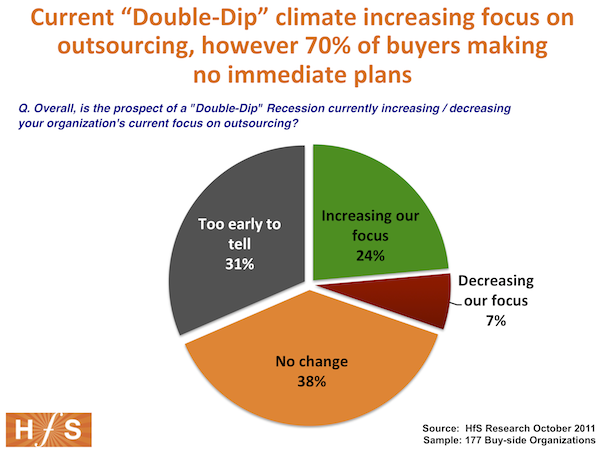
Our new study that covered the intentions and observations of 534 buyers, advisors and providers with their sourcing strategies, in the event of a “Double-Dip” Recession, reveals one major shift in the industry: most buyers now recognize what their businesses need to improve to drive productivity, they simply are struggling to figure out how to marshall their internal and external resources to help them get there. And a rocky economy isn’t helping drive definitive behavior, with seven-out-of-ten buyers expecting either little change in focus when it comes to outsourcing, or they simply do not know what they are going to do:
* Unlike the 2008 crash, which drove shock and awe into the boardrooms of every business, shouldn’t 2011’s threat of economic adversity be precipitating a calmer, more organized approach to business planning?
* While experiences of 2008 have provided an expectation that further catastrophe is just around around the corner, shouldn’t buyers be far more assertive with planning new measures to contain costs and find new areas for productivity and growth?
The Bottom-line: Buyers are looking more broadly than simply outsourcing to drive productivity improvements in today’s climate
Indeed, today’s harsh business realities are driving more focus on organizations aligning both their outsourcing and shared services frameworks (click here to download a copy of our Global Business Services paper), however, are companies panicking and screaming: “Help! We must hurl as many of our fixed administrative costs out of the window asap and deploy as much low-cost service delivery as we can, regardless of the consequences”? Of course they aren’t – they’re also looking at measures such as their ability to have more flexible global operations, to standardize processes across geographies and ERP instances and to align their internal stakeholders more effectively. Cost-control is a measure that is always a constant focus, however outsourcing doesn’t always provide that answer, especially with experienced businesses that have already moved out a lot of tangible cost in areas such as transactional accounting and application support. Outsourcing only provides part of the answer.
As we recently discussed, business leaders are beset by multiple business pressures in today’s climate, and outsourcing provides just one lever among many that they can choose to pull. Only 13% of buyers are concerned about the disruption caused by outsourcing, hence if they currently only view outsourcing as a cost-reduction lever, they are going to place it in a pecking order of other cost-reduction measures… and it’s not always going to the most effective short-term measure in a tough economy. It’s the job of advisors and providers to educate and demonstrate to buyers the benefits beyond cost-reduction and help clients embed outsourcing among their internal governance practices to align its benefits with those provided by internal process improvement and shared services.
We’ll reveal all in Part II coming shortly to an HfS website near you…
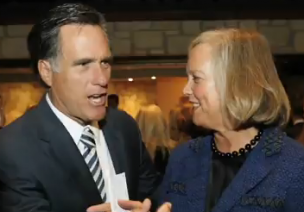
Did HP recruit the right Republican? With the 180-degree strategy flip over the “sale” of its PC division, shouldn’t HP have hired the master of the 180 himself? And is there a difference between “keep” and “couldn’t sell”?
One can ask many questions as to why HP’s new CEO made such a dramatic reversal of Léo Apotheker’s decision barely two months’ ago. There’s nothing wrong with making “180’s” with product and strategy decisions – the very best businesses in the world have been quick to admit bad decisions and correct them. Even the great Steve Jobs made some 180’s in his career… but none of them in barely 2 months.
However, I believe the answer is very simple: HP’s board has had a deep look into its very soul, and had a very scary premonition of where it was headed. It saw its future existence without its heritage hardware businesses, becoming predominantly an enterprise IT services organization with a curious software acquisition. Yes, it was running the risk of morphing into a me-too to IBM. IBM has just appointed a laser-focused services leader in Ginny Rommety to take them forward as a services mammoth. Enterprise services is IBM’s DNA. HP has hired a politician and Internet auctioneer entrepreneur. Hmm…
Did Meg make the right call to keep PCs? Yes – she probably did for three reasons:
1) No-one wanted to buy the division;
2) HP’s board never really wanted to sell it;
3) HP’s board was feeling naked and exposed at the prospect of rebuilding the firm without it.
The jury’s out over whether Meg will turn around a famous company which is now struggling to save its tarnished brand. It’s an immense challenge and will take several months to see any real progress, but reclaiming part of its very soul – making personal computers – will help it rebuild its identity.
For the very first time in my 16-year career, the major driver behind outsourcing is no longer immediate cost reduction. Hallelujah. Praise the Lord.
In the vast majority of cases, sourcing buyers have already enjoyed a fair amount of cost-reduction in recent years with their outsourcing initiatives, so they already expect the basic financials to work for many of the new endeavors they are exploring… hence, attention moves to other business benefits that outsourcing can deliver.
Moreover, most enterprises today that are experienced with outsourcing have already offloaded many of the conspicuous costs with predominantly labor-based engagements, in areas such as software maintenance support, development and testing, and transactional accounting. Their attention is now moving to other (and often more complex) processes and technology areas where they need to dig out real improvements, and outsourcing can potentially provide that trigger.
In days gone by, the old adage about outsourcing that many executives would often declare (off-the-record) has been “let’s take 30%+ off the bottom-line and if we can make some other business improvements with the exercise that’s a bonus, but let’s get the costs out.” Today, they’re saying, “OK, we know where the cost-savings are with outsourcing, now let’s use the experience to get better process and technology for our business”.
The impetus has changed – and while many outsourcing engagements, in the past, have largely fallen flat with delivering business benefits beyond cost-elimination, clearly many executives are getting more experienced and skilled at driving sourcing initiatives, and are confident they can use the endeavor as a change agent to promote and implement much-needed improvements to their business operations.
Our new study that covered the intentions and observations of 534 buyers, advisors and providers with their sourcing strategies, in the event of a “Double-Dip” Recession, reveals what is motivating buyers to outsource in this current climate, and while eliminating cost is still is a core fundamental, buyers are even more focused on achieving greater flexibility to scale their global operations as a prime motivating factor:
Why are these findings significant?
Buyers see little point persisting with their home-made operational processes and are tired of the excuses and inertia. In days gone by, most buyers only wanted to take their existing mess have have it reproduced with the same workflows, the same spaghetti code, the same quirks etc. They would often declare “let’s lift it out, shift it over there and then see if we can transform it at some future point”.
Many buyers have now had some version of failed lift and shift on their unofficial outsourcing resumés today – they’ve realized that once they’ve shifted it, there’s little money, or board-level volition, left to invest in improving process and technology (read here for more on this topic). They know that their chance to rip out the rot is with the lift and shift – not at some divine point in the future when corporate leadership is suddenly going to issue a holy decree that they are going to make process optimization their number one prority. There’s more chance of Donald Trump appearing in a Just for Men commercial…
Buyers being highly motivated to move to common standards drives the development of Business Platforms. Most significantly, is the fact that 80% of buyers are willing to move onto standard processes. They are unconcerned if their closest competitors use the same expense management or claims adjudication processes, the same cash applications or collections tools. They simply want to adopt quality process flows they can deploy effectively and efficiently, if there is no competitive advantage to be gained that necessitates conducting those process in a certain unique manner.
This is huge news for providers seeking to push more productized and one-to-many (or at least one-to-few) utility offerings into the market. The ability to develop some best-in-class processes as Business Platforms, whether they focus on horizontal or vertical process clusters, is becoming a real differentiator in the market, as buyers seek more standardized solutions from their outsourcing engagements. Moreover, more process standardization leads to more Cloud-based BPO services where clients can easily tap-into these Business Platforms without having to grapple with cumbersome on-premise software and and expensive licenses, or contend with resistance from awkward internal IT staff. In short, buyers can start to look at moving from “A to C” with adopting quality standard processes and miss out much of that painful “B” phase (which is often where many get stuck unto perpetuity).
Buyers are looking to globalize their business service management more effectively. The greatest single major-motivator driving outsourcing in today’s environment is this need to have more flexible global operations (43%). Governance leaders are under increasing pressure to move onto single instances of ERP, and develop real end-to-end visibility across their global processes. In olden outsourcing days, far too many organizations would operate their shared services under one management team, and often brought in elements of outsourced IT and business process into siloed vendor management functions which often became disconnected from the broader shared services function. Today’s shared services leaders know they need to integrate the outsourced services much more effectively with their existing processes in order to get anything close to achieving global process effectiveness. They are also highly cognizant of the fact that they can leverage outsourcing as a vehicle to achieving process enhancements that have been back-burnered for years.
Buyers want better technology support. While in the past, much of the motivation behind ITO was simply to drive out the high cost of maintaining support services onshore, the onus has broadened to both ITO and BPO engagements with buyers simply wanting better technology. You only have to look at the pain in the eyes of the long-suffering process-owners, still trying to develop a standard global template for their P2P processes and tie it to one instant of SAP, who still have to spend a fortune each year on multiple services firms to help with Nota Fiscal, China’s Golden Tax or the Russian Tax Code – or simply wind up dropping huge hourly rates on SAP’s consultants to do it for them. They’re fed up with it and patience is wearing thin, with many firms looking to get more bang for their buck when they look at their global outsourcing engagements. At the same time, the leading providers are investing more than ever in global delivery to up their game with their clients. Whether you’re looking for a global SAP build-and-run partnership, or a multi-process finance and procurement BPO, getting top grade IT support is now a major differentiator. “Good enough” is no longer an option.
The Bottom-line: Buyers are more educated with outsourcing and looking for a whole lot more from the experience
Reading into this data confirms what most of us in the business are hearing and seeing everyday from buyers – they’re getting smarter about sourcing and are upping their expectations. They also know they’re likely to be stuck at some end of an outsourcing engagement for most of their career, so they might as well figure out how to do this properly. Gone are the days when you threw your provider under the bus in five minutes – you’re head is now on the block to make it successful for your organization, because it the engagement fails, you fail and someone else will be drafted into your role to fix the mess. You don’t want a reputation for sloppy governance on that outsourcing resumé.
And now we bring you the long-awaited final installment of our recent discussion with Genpact’s new President and CEO, NV “Tiger” Tyagarajan.
NV "Tiger" Tyagarajan is the new President and CEO, Genpact (click for bio)
In Part I, we asked Tiger about his background and how he’s going to be a little different from his predecessor, Pramod Bhasin; Part II focused on Tiger’s immediate and long-term plans for Genpact; And finally, Part III delves into Tiger’s vision for the future of technology and BPO. So, without any further ado, let’s circle back to the eye of the Genpact…
Phil Fersht (HfS Research): Tiger, There’s been a lot of talk about business platforms and bringing together clusters of standard processes, putting them in the cloud, etc. Do you feel the industry’s really moving that way, or do you think it’s a bit of a mixed bag?
NV “Tiger” Tyagarajan (Genpact): I think it’s a mixed bag. Some global companies have deliberately set up independent businesses to enable a “clean sheet of paper” approach. Within that are questions including, “Can we put everything on the cloud?” “Can we wrap services onto a platform and make it standard?” “Can we all buy in to a standard without fighting like cats and dogs about ‘my process’ and ‘your process’”? Here it all boils down to, are we willing to accept a standard even though different people have opposing views?
The second situation is when large corporations are almost forced to venture into emerging markets, e.g., India, China or Brazil, in search of growth. In this scenario, they don’t have to worry about legacy processes and technology, which are expensive and time consuming. And with speed-to-market being so important, they believe they may as well hit the market running without having to invest in technology, instead investing in the cloud for just about everything.
The third scenario is for bespoke solutions for standalone requirements wherein organizations opt to buy, for example, a front-end sales force management tool on the cloud (e.g., Salesforce.com). But the reality is that most of this stuff is typically never integrated into the financial systems of the company, which actually makes it easy to say “I’m buying it.”
Then there are the mid-market companies that are growing rapidly, sometimes at a rate of 25-30 percent. For them, legacy systems don’t matter, because in three years their business will only be half legacy and within five years, it will have gone beyond that.
Similarly, emerging market companies are easily willing to leap frog onto the cloud because of their up to 40 percent growth rate. And for them, as legacy is pretty archaic, their willingness to jump to the cloud is really high.
Let me switch for a second to large corporations and their legacy platforms. We are finding that to be as tough as it was before. The fact is, if I walk into a global pharmaceutical company, even today its 100 (or however many) countries fight with each other on what is the right payables process for them. They are unwilling to sign on to a standard. So, I would argue, if they aren’t willing to sign onto a standard among themselves, the day of signing onto a standard that is a public cloud is far, far away. But I think if they agree to a standard among themselves, at least they can get on to a private cloud, which would be very beneficial.
But I still see that being quite some time away. There’s not enough push happening, primarily because there’s so much legacy and cost sitting out there, plus entrenched decision-making and vested interests. People worry about what’s going to happen to their job if processes go to the cloud. So, I think there’s a little more hype than reality about everything going to the cloud, except in the cases I already talked about where we’re seeing movement.
Phil: My concern is that you see some of the providers persist in selling in the same myopic way they were three or four years ago, and today’s more sophisticated buyers are saying, “We know there’s cost reduction on the table. We really want to get to what you can do for us beyond that, and how can we trust you?” And if all providers are offering essentially the same thing, how does a provider differentiate itself? Is it ownership of the technology or distinctiveness of domain acumen? I think that’s the holy grail right now, and I’d love to hear your thoughts on this…
Tiger: I don’t think that ownership of technology will determine differentiation. I actually believe the reverse is happening. More and more we’re getting to a world in which technology is not owned by anyone. The best technologies are open. The best platforms are open. The best platforms are the ones on which anyone can build on top of them and tweak and change them.
My fundamental view is that technology is only as good as the intelligence you build into it. So I believe that to differentiate ourselves, we have to search the world for the best technology, and then build in the intelligence.
How do you do that? First, you have to understand a process in its granularity: what makes it best in class, how to get there, what works, what doesn’t, and its contexts in both the horizontal and vertical domains in which it belongs. Then… we all know that the world is getting filled with data. There’s more data generated than ever before. If something today is not electronic, the drive to globalization is actually making it more electronic. One of the things I think we’ve done as an industry is help companies become more electronic. We’ve pushed the envelope harder, because without going electronic, you cannot globalize. So, globalization is actually helping digitization and electronicization of information.
Now when you have so much information available electronically and digitally, and it’s so easy to process from a cost perspective since storage is so inexpensive these days, who is building intelligence out of that data? Our argument is that in every industry there are companies that have decided their strategy is going to be building intelligence out of data. Our view is that those are the companies that will truly differentiate themselves, and those that don’t will start falling behind. And in my CEO job I’ve kind of championed smart decision services, where we build insights out of data for our clients, and then take those insights and build them into technology.
I believe that differentiation comes in your ability to generate and build those insights for your clients, not in your ability to handle the platform.
Phil: So, if you could change one thing about the BPO industry today, what would it be?
Tiger: Can I pick two, one at the front end and one at the back end?
Phil: OK, I’ll let you have two…
Tiger: So at the front end, I really think too much time and effort is spent in repetitively going through the same selection process again and again and again, which keeps everyone at an arm’s length in an “I won’t tell you much” situation, for as long as 12-18 months. With how quickly the world moves today, 18 months is a heck of a long time. I don’t know of any other activity in an organization where people are given 18 months to do something. I’m not given 18 months to do anything.
Instead, if you short circuit that, for example, to three months, then you can spend the next nine months, together with your chosen provider, going into the bowels of your organization and really figure out your roadmap to best in class. Then you can accelerate your execution by at least three months.
But more importantly, because you spent nine months together in this venture, I think your solution is going to be much more robust, and will accelerate you to best in class so much faster. And I think the sourcing world has misunderstood this game as compared to buying laptops or travel, etc. It’s a different world. But any time you can move it along more quickly, you bring so much more benefit to the client.
On the back end, I think the openness with which an organization approaches the relationship in order to accomplish the end goal…I can’t do it alone, and you can’t do it alone. We have to do it together. And yet, conversations around, “can we both put some skin in the game?” “You don’t own this, so you don’t worry about it. Let me do it.” “I can’t pay you for outcomes or I can’t share the gains”, just take too long. When we break through those barriers, both companies can gain so much more value.
Phil: Well, there we have it! Thanks so much for all your time with us, Tiger – and all the best with the new job!
Like everyone else, I am disturbed by the economic and social instability in which our world currently finds itself. While the 2008 crash saw us all face a major economic and fiscal reality-check, 2012’s landscape will see us move beyond bailouts and credit downgrades to a world where governments and business leaders need to deal with the societal impact of growing unemployment, worker insecurity and an alarmingly widening gap between the wealthy establishment and the common workers (or, as the Americans love to call them, “the Middle Class”).
We’re already starting to see visible signs of social unrest developing with the “Occupy” demonstrations spreading across the western world. Worryingly, for business leaders and governments, is the fact that there is no imminent prospect of these movements fizzling out. A Double-Dip Recession will exacerbate these issues further and we could be on the cusp of some dramatic and painful changes to the global economic and political landscape.
As we stumble towards this increasing likelihood of a Double-Dip Recession, these are becoming highly sensitive times for our enterprises, and none more so for the buyers, advisors and sellers of outsourcing services operating right in the midst of many of these issues. So what are their expectations, and how do they anticipate their respective businesses to be impacted if things take a nose-dive?
Providers and Advisors are bullish about profiting from a Double-Dip, but must avoid complacency
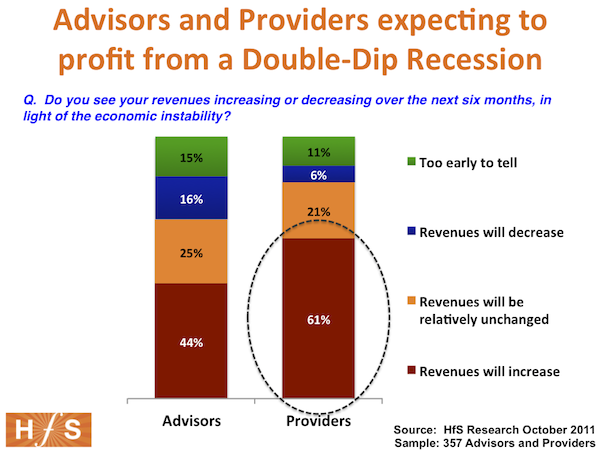
Our new study that covered the intentions and observations of 534 buyers, advisors and providers with their sourcing strategies, in the event of a “Double-Dip” Recession, reveals that the folks advising and selling outsourcing services are feeling pretty bullish that their clients will turn to them for even more help, if things really start to get dicey over the next six months. 61% of provider and 44% of advisor executives are expecting their respective businesses to increase revenues:
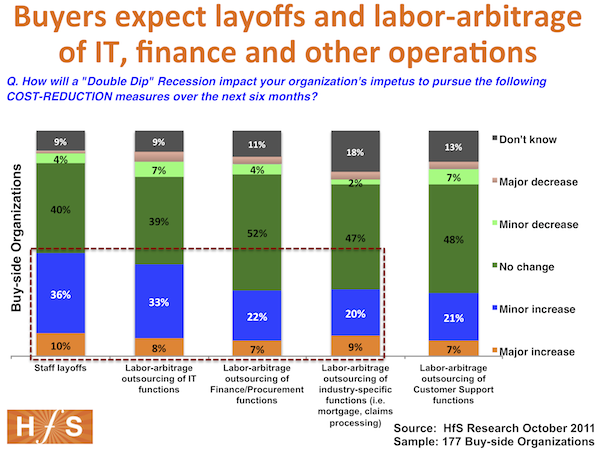
While the sell-side readies itself to enjoy increased profits, close to half of enterprises are expecting layoffs, 40% are sizing up increasing the labor-arbitrage of IT and 30% similarly with finance, procurement, industry-specific and customer management processes:
Business leaders, like political leaders, must not lose touch with their employees during these difficult times – especially over issues such as outsourcing
While most of us are incredibly frustrated with Greek PM Papandreou’s decision to turn to his people for their opinion, let’s pause for a moment – if your government had mismanaged your economy so badly that you were going to be indebted to the Germans and the Chinese for the next few decades, wouldn’t you be feeling a bit miffed? If your CEO was about to sell a major shareholding in your firm to some other entity, and you were a stakeholder in the business, wouldn’t you want a say? If your company’s board had mismanaged its finances so badly, it feels the need to outsource a whole chunk of its operations to some provider who barely understands the intricacies of your company, wouldn’t you want a say?
Surely, lousy management teams run the risk of ripping the very soul out their corporate cultures if they fail to listen to the concerns and recommendations of their people, just like those awful governments who drove their nations to bankruptcy and think they can still fix their problems with even more bailouts and loans, without consulting their people? Do corporate leaders want their workforces to feel like the “99%”? I don’t think so…
And is the 99% really so ignorant about what’s going on that both governments and their business leaders can now operate in a bubble of their own because they know better? Something’s gotten broken here, and it may simply be that many of today’s politicians and business leaders are actually losing touch with their people. This is an alarming and unsustainable trend, and the outsourcing business could be in danger of getting caught up in the complacency.
While news like this will have some advisors and providers excited about hitting their revenue goals, we have to be highly-conscious of the fact that if this data becomes reality, the outsourcing industry is going to arrive at a highly visible and dangerous phase in its development. As we have been at pains to point out – for five years on this site – buyers need to look beyond labor-arbitrage to find any real long-term benefits from outsourcing. However, these issues are going to move beyond buyers simply improving business processes and cutting costs – they are going to become centered on how companies are managing their workforces. Governments are very capable of passing measures very quickly to restrict outsourcing if things get really bad – and they won’t have much choice if the 99% demand it.
The Bottom-line: Outsourcing professionals need to avoid being perceived as the “1%”
Now, more than ever, the outsourcing industry runs the risk of a backlash, if the worst economic fears are realized in the coming weeks and months. A Double-Dip Recession will polarize governments and most likely paralyze uncertain businesses. Most of you who frequent our blog and research sites make a decent living buying, advising or selling sourcing – and we have a collective responsibility to recognize that the very life-blood of organizations and their employees are at stake in the coming months. And if they fail, we will go down with them.
Outsourcing can be a tremendous help for many organizations needing support with improving their processes, globalizing their business operations and accessing better IT, but it is not – and never should be – the only solution to their problems. It should be a vehicle to help companies perform better, to help its staff become more experienced and knowledgeable. All outsourcing stakeholders – buyers, providers and advisors – need to focus, more than ever, on helping organizations approach outsourcing as one supporting component of a holistic solution. In short, buyers and providers need to come closer together to tackle these issues and demonstrate to the world how they are creating value and improving competitive behavior.
We need to demonstrate how making organizations smarter helps create jobs and drive growth – not how making them smaller makes the 1% that little bit richer…
Back in the ’80s, every college kid that wasn’t a computer geek wanted to be a marketeer. It’s definition was simply “Satisfying customers’ needs and wants profitably”.
The three top dogs in the enterprise in those days were often the CEO, the CFO… and the CMO. That ’80s CMO had to to understand the company strategy and have in-depth knowledge of the value of the products and services, while communicating that value to customers. Not only that, he/she had to have detailed knowledge of who their prospective customers were and figure out how to reach them, while convincing the world they had a more desirable offering than the competition. Simply put, the top CMOs were the strategists, the analysts, the go-to-market tacticians and the entrepreneurs all rolled into one super-executive.
Somehow, this function lost much of its strategic relevance over the next couple of decades, becoming a morass of (often dysfunctional) processes, data and workflows, with the CMO becoming an increasingly tactical executive, providing fodder for the sales team. Conversely, the cost and importance of marketing has risen as the effectiveness has fallen away. Sound familiar?
So! Like any function in need of a facelift, a cost-gouge and some “transformation”, let’s consider outsourcing parts of it… so without further ado, let’s shift over to HfS Research’s exocet BPO analyst, Reetika Joshi, to discuss her new report “Marketing BPO Services: Solving the CMO’s Dilemma”, which you can download for limited time at our BPO Resource Center…
CMOs have it tough today, whichever geography or market you look at. They’re stretching dollars for myriad activities in a function that’s undergoing major change. The slow recovery from the recent credit crunch has only made the job tougher for marketers. Rising pressure on company profits has increased the need for companies to renew focus on issues such as pricing strategies, customer buying behavior, campaign management, and customer engagement.
A first-of-its-kind new study by IBM and the Economist Intelligence Cell highlights the four main challenges that keep Chief Marketing Officers up at night: the data explosion, social media, proliferation of channels and devices and shifting consumer demographics (for some reason, global outsourcing featured at #11). An overwhelming majority of the 1700 odd CMOs interviewed admitted that over the next five years, the marketplace as they know it will become highly complex. What’s even more disconcerting is that less than half these CMOs felt they were prepared to handle these complexities. Yikes! How will businesses market themselves in the future, what’s the action plan, you ask? The worldwide consensus revolves around three major pillars of marketing improvement, as IBM and EIC’s C-Suite study found:
– Delivering value to empowered customers by bridging the digital divide and getting to know individuals as well as their markets. This also means implementing new technologies (e.g. to handle big data, mobile apps, social media) and advanced analytics to understand and predict buying behavior better.
– Fostering lasting connections by focusing on online and offline community building to manage the customer lifecycle better, and developing strong ‘corporate characters’ that employees can internalize.
– Capturing value and measuring results, which is where the dreaded marketing ROI is tackled through financial analysis, internal and external resource allocation and analytics adoption to measure and act on the results of marketing programs better.
These are ambitious plans indeed, and they’re not going to be implemented overnight. Checking everything off that list will call for a broad multi-disciplinary team working on several new processes and technologies. This isn’t something that every marketing department can maintain successfully. And here lies the strong case for external help that CMOs can seek today, and the opportunity for outsourcing service providers.
Outsourced functions such as finance and accounting, human resources and customer service have become industry norm in the last decade or so. At this critical stage in the maturity of the outsourcing industry, buyers and sellers are both posing questions about the next big function – can marketing make the cut, and be moved out of the organization? We decided to find out, in our new study, “Marketing BPO Services: Solving the CMO’s Dilemma”.
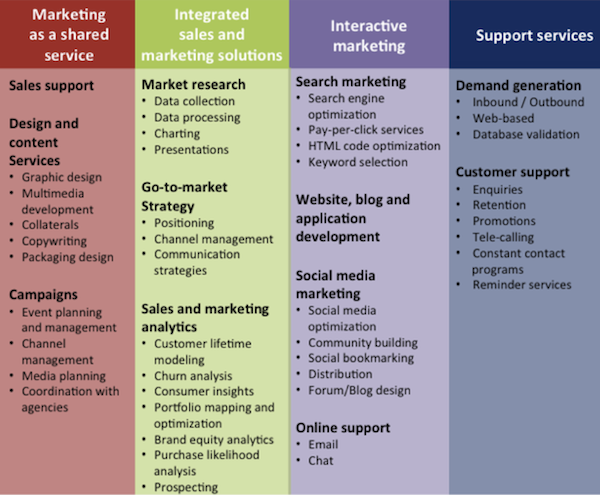
The truth is, marketing departments traditionally already outsource a portion of their marketing function (though this may not be construed as such)– advertising, some promotional activities and event management. Over the years, the services outsourcing industry has started to fulfill demand for a lot more support services under the broad ‘sales and marketing BPO’ category, including customer support and demand generation. The outsourcing of marketing as a horizontal service is in a very nascent stage currently. However, given the increasing pressures for CMOs we just discussed, we believe the scope for outsourced marketing services has expanded exponentially, as the image elaborates.
The range of outsourced marketing services today
Source: “Marketing BPO Services: Solving the CMO’s Dilemma”, HfS Research, October 2011
Now, are companies queued up for miles today, demanding these new fangled ‘integrated sales and marketing solutions’? The short answer is, in comparison with other outsourced services demand in the next year, no.
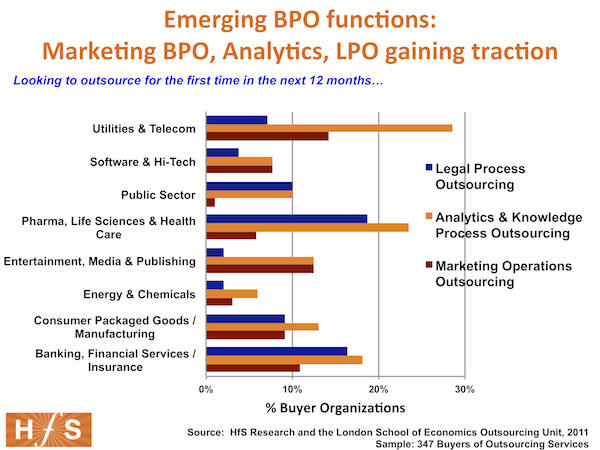
As recent research shows, 25% of the marketplace currently outsources – or intends to evaluate – marketing outsourcing opportunities in the next 12 months. Moreover, we are seeing first-time-buying intentions in the utilities, media, financial services and consumer goods industries, which roughly 10% of organizations expecting a first foray into marketing BPO services over the course of the next year.
The IBM and EIC study corroborates this, with highly pronounced future intent (next 3-5 years) for external partnerships for lead management, customer and data analytics and direct/relationship marketing, followed by IT, call or service center management and tracking and measurement.
It will be some time before these services are structured and formalized in the same manner as other horizontal offerings such as Finance and Accounting and Human Resources. Strategy teams for service providers are trying to place their fingers on the best approach to this vastly untapped market. The two crucial investments for these services include the right talent and technology/infrastructure. The high level of creativity and judgment in these activities necessitates the need to have people with a strong background in marketing, advertising, campaign management and other allied activities. High-end services within marketing require a lot of investment in the correct tools and technology to work on custom process frameworks and delivery for functions such as design, content management, analytics and database management.
Reetika Joshi is Principal Analyst, BPO and Analytics Strategies (click for bio)
The larger service providers often start with the “big ticket” items such as technical support, customer support and F&A before offering marketing services. These services will be outsourced only once trust has been built up between the client and the service provider (and even then, we’re talking about piecemeal deals currently). Buyers and service providers are likely to show more interest in the category as service offerings mature and buyers start to take stock and implement long term plans to transform their marketing activities.
You can download “Marketing BPO Services: Solving the CMO’s Dilemma” for a limited time at ourBPO Resource Center.