PriceIndicator™ is launched! HfS becomes the first analyst to deliver BPO price-benchmarks (click to view details)
Today marks a very special day in the life of HfS Principal Analyst Jamie Snowdon. Not only does he turn the ripe old age of 40, but his life’s work is revealed to all and sundry: the brand-spanking new HfS BPO PriceIndicator™ is officially born (SEE PRESS RELEASE).
Thanks to Jamie and his team’s superhuman efforts, we’ve managed to crank through our database of over 800 live BPO engagements, sift though insurmountable reports on local wage rates, tax policies, inflation and exchange rate fluctuations, infrastructure costs and provider margin-uplifts, to deliver an incredible database of BPO rates across 12 countries and multiple staff roles. Want to know how much a Chinese Sox expert during transition costs? Well, you’ve come to the right place…
So why did we enter this market?
For all the right reasons one offers a new product. There isn’t anything comparable available in the industry, we are in unique position with visibility to over 800 recent BPO deals, and most importantly, our clients are telling us they really, really want it! The number one request we get from buyer clients is for support with pricing – most analyst discussions with buyers (and this applies to most analyst firms) results in the their requesting the analyst validates their rate-cards . We’re simply developing a methodology to support these needs, but use our analyst time to advise them towards smarter pricing strategies. Moreover, one of the main purposes of PriceIndicator™ is to steer the industry towards business outcomes and transactional models (if possible), and away from the creaking rate-card model.
HfS Research’s network produces the largest, most accurate and up to date deal database. Because we’ve earned the trust of both buyers and sellers of outsourcing, we can validate and ensure accuracy in real-time. And because we have an incomparable team of BPO experts who cover, in-depth, all the core horizontal and vertical business processes that are being sourced by enterprises today,
What does the HfS BPO PriceIndicator™ do?
It gives our clients access to up-to-date pricing information for the BPO market. And we’ll soon add Application Development and Maintenance PriceIndicator™, to give our research members even more value from their investment in HfS Research.
It provides all of our clients with a quarterly report on pricing and the trends impacting the fees associated with BPO services
It ensures accuracy by doubling back—we take deal data and normalize it so it is useful, but we verify our conclusions with detailed “ground-up” analysis of all the inputs in over a dozen popular outsourcing destinations. Finally, we leverage our powerful network to validate both of the analyses.
It gives our clients the option of ordering specific data-cuts from our database, narrowing in on pricing, for example, within a certain industry or a secific type of role.
It enables HfS to give clients knowledge and coaching to steer them away from simply relying on “bums on seats” FTE pricing, and to evaluate more strategic pricing methodologies, namely outcome-based and transactional-based approaches.
It addresses a woefully underserved and historically unreliable sector of the benchmarking industry.
So please forgive us – just this once – for a rare sales-pitch. This capability is borne out of years of hard graft and experience from our analyst team, and marks a major inflection point in HfS’ development as an analyst organization, just 14 months after we launched our business.
For more information on HfS BPO PriceIndicator™ please click here for a detailed methodology, and feel free to email Tom Ivory directly here.
Leo's game-plan: Inspired, or just surrounding himself with old chums?
Today, we were greeted with news of the latest in a series of executive hires moving from SAP to HP (see last year’s post on Leo’s appointment), with the announcement that Marty Homlish has joined as Chief Marketing Officer – and yes, his previous employer was… you got it… SAP! This follows several other high-profile executive appointments from… you got it… SAP, such as Marge Breya, Bill Wohl and others.
No disrespect to Marty, who has a stellar reputation from his recent decade-long marketing tenure at SAP, but what is HP doing? Once a thriving hardware and services business locking heads with IBM, its services business has been slipping since even before its EDS acquisition, its BPO business seems to be dropping off a cliff, and now it’s filling its management ranks with ERP veterans. Unless something is brewing that we don’t know about, HP isn’t an ERP vendor.
If HP isn’t plotting a radical move to buy SAP, or some other ERP business, it seems to be letting itself down badly – the firm needs new thinkers who can drive innovation and a new direction into the business, because right now, most industry observers are left scratching their heads trying to figure out what the game-plan is. If HP is looking to acquire SAP, and is readying itself with an already-in-place management team of old-school SAPers, then Leo may be pulling off a masterstroke in forward-thinking leadership that will go down in technology history.
Whatever the case, HP needs to put a stake in the ground – and soon – to let the world know its true strategy, as I, like many of my industry colleagues, am baffled.
This week has marked a pivotal occasion in HfS’ development as a research analyst organization, with our official launch of the HfS BPO PriceIndicator™. As a special thank you for all your support, we are making our flagship 2011 F&A BPO market landcape report available as freemium for our subscribers – but only for one week! So download your copy today. Oh – here’s the exec summary:
The F&A BPO market landscape in 2011:
Re-emerging from the Recession, re-focusing on business outcomes
HfS believes the market for finance and accounting business process outsourcing (F&A BPO) services is poised for a new phase of growth, as businesses recover from the Recession and focus on new strategies to drive more efficient operations in an increasingly global economy. F&A BPO fits the bill for an increasing number of organizations, while some still prefer to maintain their finance and accounting operations in-house.
Outsourcing the number-crunchers… are you ready?
However, one thing is certain – once a company makes the decision to outsource F&A processes, it will be committed to working with a service provider for many years, if not decades, hence, getting this right is going to have a major impact on its culture and operational performance over the long-haul.
This report delivers an unprecedented view of the F&A BPO industry, based on 788 live engagements, where organizations have outsourced two or more core F&A processes to a service provider. In addition to exhaustive contract information, HfS draws upon recent demand-side survey analysis to deliver the complete view of the market dynamics, the service provider landscape and the future expected direction of the industry. Key findings are summarized as follows:
» Untapped market. The market for F&A BPO is largely untapped moving into 2011, with fewer than 800 live engagements and only one-in-six enterprises outsourcing transactional accounting activities to a third party service provider.
» Recovering economy rekindles outsourcing motives. While the F&A BPO market grew rapidly between 2004 and 2008, interest cooled during the Recession as enterprises focused on shorter-term survival measures and put disruptive initiatives, such as BPO, on the backburner. However, with recovery under way, many businesses are refocusing attention on global outsourcing opportunities as a means, not only to reduce operating cost, but also to provide an impetus to globalize operations and transform processes. Consequently, 13% of enterprises are now intending to move into an F&A BPO model over the next year, with strong motivation coming from mid-market organizations ($750m – $3bn revenues).
» Availability of smaller engagement models drives sustainable growth. With engagement sizes falling below $20m total contract value for the first time, and service providers developing more “repeatable” delivery models that can be provisioned across multiple clients, HfS expects 15% annual growth in total F&A BPO expenditure over the next two-to-three years.
» Gainshare incentives becoming an integral component of F&A BPO engagements. With close to 50% of recent engagements involving gainshare (outcome-based) incentives, the aggressive competitive climate will provide attractive opportunities for many enterprises evaluating their first steps into F&A BPO, in addition to experienced buyers seeking more value from their current model. Moreover, gainshare initiatives can provide the differentiation between providers, as opposed to simply low-cost provision, which HfS views as a major step forward in taking F&A BPO value beyond short-term labor-arbitrage savings for clients.
» The competitive landscape takes shape with four clear market leaders. The global F&A BPO market is dominated by Accenture and IBM, with both Capgemini and Genpact providing the major competition for large-scale engagements. However, aggressive competition is expected from a host of other providers eager to secure a stronger market presence, including multi-billion dollar offshore-centric service providers Infosys, TCS and Wipro, in addition to BPO pure-play specialists EXL Service and WNS. Other providers with strong BPO businesses include Xerox and HP, but they have not proven to be as aggressive in the marketplace since recent mergers with ACS and EDS respectively. HfS expects further consolidation in the competitive environment.
» IT-enablement of BPO becoming pivotal to development of services. HfS anticipates increased hybrid IT-BPO engagements where service providers provide application wrappers to enhance process standardization for buyers. More than over half of today’s buyers are now enhancing or replacing their existing finance IT systems with their BPO engagement. However, HfS Research shows that adoption of Cloud computing with finance applications is still some way off for most high-end enterprises.
HfS Research’s new report entitled “The F&A BPO Market Landscape in 2011: Re-emerging from the Recession, Re-focusing on Business Outcomes” is authored by HfS Research’s Founder and CEO Phil Fersht. You can download your freemium copy at our research site.
Tony "The Governator" Filippone joins HfS' research leadership (click for bio)
Fed up leading BPO initiatives for a $60 billion healthcare insurance firm for the last nine years of your life?
Bored with developing new governance structures that cater for multiple back-office processes and managing an assortment of onshore/offshore providers?
Exasperated from pouring though reams of SLAs and pricing schedules?
Stultified by the incessant deluge of PowerPoint from providers and advisors regurgitating and repackaging that same old dog n’ pony show in the vein hope you’ll spare them a few dimes for their efforts?
Finally realized it’s high-time to climb those steps into your very own ivory tower and start telling everyone else how it’s done (or not done)?
Ladies, gentlemen and members of the outsourcing business… please welcome Mr Anthony M. Filippone to the hallowed ground of HfS analyst, industry thought-leader, and, most notably, the role of Governator-Extraordinaire.
I have got to know Tony well over the least four years where he has contributed to our thinking, added some real value to our buyers’ groups, and developed an industry-wide reputation for challenging the status quo of vendor management and governance. Not only is he an out-of-the-box thinker, but he is a prolific writer with a slightly snarky sense of humor, and a great sense of irony. And from mail-and-print through to strategic sourcing and revenue cycle, you won’t meet many people with such a deep, working knowledge and understand of those operational processes that make business tick.
While you can read his bio here, and view the lovely press release here, I’ll hand you straight over to our brand-spanking-new, feisty, no-holds-barred, Research Vice President for Governance, Sourcing and Healthcare strategies himself to tell you why he’s joining the ranks of the crazy-horses…
Why Tony joined HfS Research and what he intends to do here (in his own words)
I am absolutely thrilled to join the experienced, no-nonsense, fun-loving HfS Research team. I’ve formed and led outsourcing and strategic sourcing teams for the last nine years, but the time has come for me to help more organizations make great outsourcing decisions and optimize their outsourcing programs to achieve success. Here is what my aggressive research agenda will bring you:
The “Other 90%” – No organization has truly focused on what happens after the deal is done and the work has transitioned. The vast majority of the discussion in the outsourcing industry focuses on outsourcing solutions, service provider selection, and post-deal transition. I offer two examples:
The IAOP offers a certification program for outsourcing professionals and less than 40 pages of the 353 pages of their body of knowledge covers post-transition governance for buyers and service providers.
Brown and Wilson’s “landmark” 366-page “The Black Book of Outsourcing” has four pages focused on governance and vendor management.
Putting this gap in research and industry focus into perspective, no organization has offered expert, research-based assistance on how to handle the last 54 months of your 60-month contract. My primary role at HfS Research will be to help buyers and service providers learn how to succeed together in managing simple and complex outsourcing programs.
Deep Buy-side Experience – Advisors have extensive experience shaping deals and service providers have extensive process experience. However, HfS Research’s objective, no-BS coverage of the industry, HfS’s relationship with the Sourcing Interests Group (SIG), and the oversubscribed HfS 25 give HfS a unique position to advance the experienced buyer’s perspectives within the outsourcing industry. Since I have lived in the buy-side trenches for the last nine years in governance and procurement roles, my real-world experience will be invaluable to HfS’s community.
Broad BPO Experience – While ITO remains an important part of any organization’s strategy, BPO goes far beyond FAO and HRO and into the hardcore operations of a company. I’ve led large outsourcing initiatives focused on inbound customer service and sales centers, complex back-office transaction processing, inbound mailroom/imaging/data entry, outbound mailroom, and HRO. I will play a critical role at HfS’s development of research in more horizontal BPO categories for buyers and service providers who seek to learn key industry trends.
Healthcare Industry Experience – No American industry is undergoing more change than the healthcare industry due to regulatory changes, the need to provide more cost effective healthcare, and the need to improved health in our communities. Changes in the payor and provider industries will necessitate increased use of outsourcing to lower costs, obtain improve process efficiencies, and improve health outcomes. I will lead HfF’s coverage of the healthcare outsourcing industry.
Tony Filippone (pictured above) has joined HfS Research’s leadership team as Research Vice President, Governance, Sourcing and Healthcare Strategies. He can be emailed at tony dot filippone @ hfsresearch.com, or tweeted @360VendorMgmt
While most of you were out toasting the Sunday dawn sunrise with a glass of Cristal, after a marathon night of ballroom dancing and karaoke, HfS analyst Brian Robinson was busy pouring over the issues surrounding the now-infamous Amazon Cloud-outage. So what better than that 1,301st perspective you must be eagerly craving… over to you Mr Robinson:
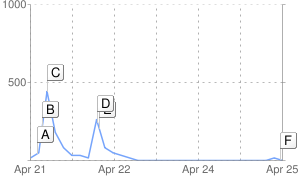
Amazon’s Cloud outage created significant buzz in the markets this weekend: Google’s news archive showed that by mid-day on Friday nearly 500 news sources were reporting on the topic with over 1,300 articles written. I was surprised to see how little coverage some other world events received, many of which are arguably more important. And then I saw a true media casino – the upcoming Royal Wedding.
A quick review of Google stats shows that over 11,000 articles have been written from between 600 to 1,400 sources. It’s not hard to imagine why the Prince has asked for a two year hiatus from the intense pressure and scrutiny post the wedding. I bet Amazon wishes it had a similar ‘get out of jail free’ card to use this weekend. But as a public company, they don’t. Nor have they earned their seat amongst the world’s largest service providers, which has its privileges.
Going forward, Amazon can expect a similar spotlight to highlight both its successes and failures. Why? The Cloud offering is a disruption to the tried and trusted IT and BP services model. Much is at stake and whether it likes it or not, Amazon is one of a few companies that now sits at the fulcrum. I am certain Amazon will improve their response to and management of similar situations should they reoccur. As important, I hope the other participants in the sourcing ecosystem (i.e., buyers, research groups and consultants, and providers) also gain some much needed perspective:
Perspective #1
Buyers: Know your customers’ availability requirements inside and out
Not that M. Zuckerberg and Facebook need any more airtime, but Mark gets his customers’ uptime requirements. As quoted from the Social Network, “…the difference between Facebook and everyone else, we don’t crash, ever! If those servers are down for even a day, our entire reputation is irreversibly destroyed!” Mark understands the value his customers put on availability – do you? Moreover, do you know what you have contracted for and how you are compensated if failure occurs? If not, then it may be worth investing some resources into finding out. Granted, Facebook has a single platform to worry about. Large enterprises have poorly integrated, multi-vendor supported, multi-technology beasts of systems, so there are more points of failure and determining who exactly was responsible for an outage could take longer than measuring the customer impact of said outage.
Perspective #2
Research analysts and consultants: provide pragmatic and objective advice
Traditional media outlets are responsible for reporting on the issues that may impact both customers and businesses. As respected and experienced industry analysts, our responsibility is to further focus discussions on the facts without feeding the media frenzy.
Following a review of the articles written immediately after the incident, I noticed a couple of comments from respected research houses that rained down on the future prospects of Cloud computing. Are these houses becoming as conservative as the IT organizations they influence?
Other, more pragmatic analysts, shared views similar to my own. For example, Vinnie Mirchandani, makes it clear that all service providers have delivery issues but few rarely receive the same media scrutiny. He goes on to propose that all public providers should face the same level of transparency. Although not pragmatic, his point is clear: Amazon has been singled-out: not for what is abnormal in the industry, but for bringing to market a disruptive service that some look to discredit.
Bottom line, big enterprises do not call the media when their own, mostly ancient, data centers take the shape of pears. We are quite certain this happens with more frequency than in outsourced data centers of both the “traditional” and “new” variety. Big data center providers are at greater risk, which is why their data centers tend to be more reliable—but they have downtime too. In fact, traditional providers are just more adept at handling it because, well, it happens more often than any of us ever get to hear about.
Perspective #3
Providers (really the new guys/gals on the block): experience counts in the lion’s den
The world’s largest service providers have many more years of experience than you do – some with 20 with others reaching 30. Yes, your technology is disruptive, but that does not mean you need to drudge through the same pitfalls that your predecessors have already navigated.
Brian Robinson is Senior Analyst, HfS Research (click for bio)
The best organizations will reflect on what has already been learned from the industry veterans and incorporate it into their service delivery plans. This includes, for example, robust disaster recovery plans and proper communications plans. Today’s largest providers have perfected how to be profitable while managing their client expectations and guarding against future failures. They did not learn these lessons overnight, and today’s new companies will benefit by hiring managers that can bring this to light.
And finally here’s even more perspective—the questions we should really be asking:
What is the relative reliability and security of the “new” Cloud offerings from Amazon? Are these offerings objectively a greater risk? Bring us data—not innuendo!
How much money was lost as a result of this outage? We know the damage done to the Amazon brand, but what about its customers’ brands?
In the short time Keith Strodtman has been with us he’s already produced an insightful piece on the Future of Work. And now he’s out and about. On April 19, he went to NorthgateArinso’s analyst day and filed this report as well as a new RAPIDInsight. Take it away, Keith…
NorthgateArinso’s HR and payroll outsourcing roots stem back to its days as a payroll service provider in the United Kingdom called Peterborough Software, later called Rebus Human Resources Services. Northgate Information Solutions acquired Rebus in 2004. Over twenty acquisitions later the company has emerged as one of the largest pure play HR service providers in the world, offering HR outsourcing, HR technology, and HR consulting services. At its analysts and advisor day in Atlanta on April 19th, several of the company’s executives provided an overview of their recent accomplishments, their growth plans, how they operate their business, and the latest on euHReka, their global HRMS solution.
Keith Strodtman, HfS Research Fellow (click for bio)
For those not familiar with NorthgateArinso (NGA), the company, now owned by the private equity firm KKR, was formed when Northgate, the largest payroll service provider in the UK acquired Arinso, a Belgium based HR systems integrator and HRO provider in 2007. While Arinso had a presence in the United States prior to last year, the company made a big splash in the US market in 2010 when it acquired the HRO business of Cincinnati-based Convergys. Smaller acquisitions in Europe and the Asia Pacific region have rounded out the company’s service delivery capability around the globe. According to CEO, Mike Ettling, the company has the assets it needs to compete in the global HR market and has now cemented its focus on customer service improvements and growing the business to $1B in revenue over the next few years.
There is evidence that the company is making progress toward those goals. Despite a challenging economy, the company grew revenues 8.5% in its 2009/2010 fiscal year and increased win rates in its HRO business. The company has made significant investments in its core technology platforms, established an extensive global delivery infrastructure, created a massive library of process standards, is in the midst of a company-wide rollout of Six Sigma, and has been developing the culture and skills it thinks are required for execution excellence and improved customer satisfaction.
NGA has developed an extensive service delivery network spanning more than 30 offices around the world. Major delivery centers can be found in India, Philippines, Malaysia, China, Spain, Argentina, Brazil, Canada, and the United States. They serve thousands of customers from these centers, including 100 global HR BPO customers. One of the fastest growing areas for NGA is global payroll, a service that currently counts about 400 customers.
One of the more interactive parts of the analyst day was during the euHReka overview and demonstration – you have to love the passionate debates between technology leaders and technology analysts. While certainly not the only arrow in NGA’s technology quiver, euHReka is clearly the most critical to the company’s growth plans. The solution can be deployed in both an on-demand (SaaS) model and on-premise at the client site. NGA claims 50 customers currently use euHReka around the world. One final note of interest on the technology front was news of a soon to be announced learning solution partner that will be tightly integrated with euHReka.
Under the leadership of Ettling and several new management team members that include US industry veterans Trey Campbell, Paul Hutchinson, and Brad Everett, the company has bolstered its leadership team with a lot of HRO experience. This combined with several marque wins in 2010 and several more promised in the near future, I don’t expect NGA to remain the relatively unknown brand, at least in the North American market that they once were.
For a business even to consider outsourcing its operations, is a resigned acceptance that it’s not running them very well and it may as well source to a provider that can try and do a better job at it. At the very least, outsourcing will reduce costs and they’ll continue to plod along with more of the same.
Most people still claim they really outsource to save money – of course that’s an immediate benefit, but you wouldn’t even be considering it, if you had operations in place that were really good.
For example, this company wouldn’t have to do a lot of outsourcing:
“We have world-class HR, where we attract and keep top talent to run our business”
“We have superior finance, where we close the books in a week and our management can make rapid, informed business decisions”
“We have great customer support which upsells our products and makes our customers love us”
“And we have great IT brains that works with our business units to develop the applications our departments need, while automating processes to enable the business to be run efficiently.”
If your business is at the point where you view your IT support, HR, finance, procurement, customer service etc. as largely low-value administrative functions, then your functional heads and their supporting teams have failed you. I’m sorry, but if your business operations were run in a manner that could add significant value to your organization, you wouldn’t consider outsourcing them for a minute. I’ve been covering outsourcing for more than a decade, and I still believe in the value that great finance, HR, procurement and IT can give to a business, and it’s a crying shame that so many businesses today are giving up the ghost of finding this value within themselves – they know their business and their institutional processes the best, and looking to ship them off to a third-party is the final admission that their people have failed them. Here’s the hard evidence:
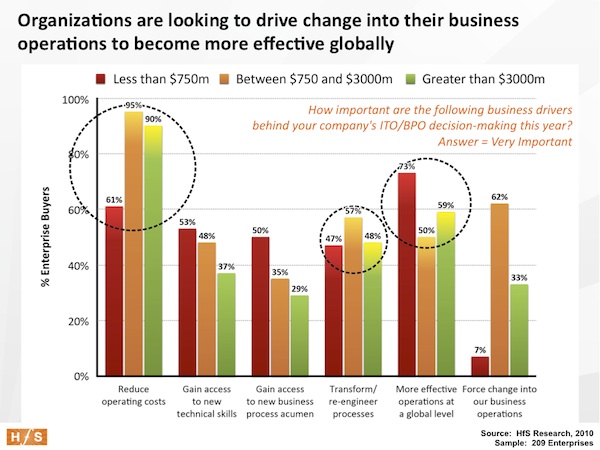
This recent HfS Research study of 209 US and European enterprises found that six-out-of-ten large enterprises are considering outsourcing to achieve more effective global operations. Yes, 90% are looking to save money, which is a clear short-term motivation, but the simple fact that over half of all business are also looking to re-engineer their processes, and achieve greater effectiveness into the bargain, is one major admission that their own operations are not good enough.
Why are so many business seeking to improve their operations?
I blame our education system – and this is endemic across many first-world countries. Why are we not producing enough graduates who are schooled in the value of developing great human resources functions, passionate about providing great talent management to business? Why are we not producing enough finance people, trained to develop a deep understanding of the complex global business needs in todays’ environment? Why are we not producing customer service leaders who believe the customer is still king? Why are we not producing enough IT grads who can apply real business logic to application workflows? The list goes on…
In India, we’re now starting to see several of their leading service providers hire kids straight from high-school at 18, bypassing a university system that clearly isn’t giving them the right training that most businesses today require. Conversely, in China, their education system is tightly interwoven with their economic development. But what about the US, the UK and other countries, where everyone is supposed to go to college and and get some some of degree, before graduating to face a genuine relevance gap between whatever they studied, and those skills employers actually need today?
In the olden days, graduates would start at the bottom, processing invoices, answering the phones etc. and work their way up the company. In today’s environment, if those staff are readily available in other global locations with more relevant training, a more willing attitude – and prepared to work for less (and not have a crippling student loan to repay), that’s where you’ll take your operations.
These are some of the core issues that are really failing today’s businesses, and outsourcing is merely a symptom of these core issues – not the cause! Preventing outsourcing to overseas locations is only going to punish our businesses which are crying out for a support infrastructure that can keep them competitive in today’s markets. The key is to serve up onshore talent that is primed, trained and ready for the needs of todays’ businesses.
Side-note to readers to clarify some points: There is no hard answer to my thoughts outlined in this post, and this is a complex, sensitive topic with many nuances. I am observing long-term macro trends that are shaping corporate behavior. The irrelevance of many college degrees to suit today’s business needs, combined with the financial impact on graduates’ early-stage career behavior, is having a major indirect impact on many businesses’ ultimate decisions to outsource. What is clear, is that there needs to be a complete overhaul of how young talent is developed in our educational system, if government leaders want to fight this ongoing trend of its leading enterprises looking overseas, not only to save money, but to access talent that is ready and willing to be plugged into their operational support functions. It’ll take a long time to reverse this trend, and you do start to wonder if it’s already too late…
Still trying to figure out what we do? Still wondering what all these mischievous-looking chappies are up to? Well, your thirst for knowledge can finally be slaked by attending our hastily-convened special webcast, where we’ll be joined by our friends and partners at the Sourcing Interests Group (SIG) for a one-hour interactive session entitled HfS Research Up Close and Personal on May 5 at 2:00 pm ET.
SIG President and CEO Dawn Evans will join HfS Founder and CEO Phil Fersht, along with HfS COO Esteban Herrera, new HfS Research Governator VP Tony Filippone, and HfS VP of Marketing Mark Reed-Edwards for an hour-long look at HfS. You’ll find out more about the exciting new partnership between HfS and SIG, where we’ll discuss the prolific HfS research agenda, the burning sourcing topics facing todays’ enterprises, plus what’s in store for 2011. We’ll also talk about how how you can get involved, access our research and collaborate with HfS analysts and other SIG members about next practices for sourcing and business:
EXL: Fine wines, fine insurance and now some very smart Bulgarians
EXL and OPI, two of the smaller Finance and Accounting BPO (F&A BPO) providers, and both recently touted as acquisition candidates in HfS Research’s 2011 F&A BPO market landscape, have tied the knot in a surprising merger, in this rapidly-consolidating and transmutating BPO market. Not only that, HfS has officially uncovered the undisputed proven fact that Bulgaria is home to the world’s second-most intelligent people, according to MENSA’s IQ scores. Yes, EXL now has an operation there.
Already this year, we have seen bold moves from HOVS to acquire SourceCorp and Genpact with Headstrong. It appears that the leading “pureplays” (whom we won’t be calling pureplays anymore) are seeking to bolster their scale, service portfolio and industry competency, while several of the larger IT-centric outsourcers watch curiously from the sidelines as their BPO heads anxiously try to convince their boards of tech-lovers that offshore IT services growth isn’t infinite, and if they don’t invest in their BPO competencies soon, will face a very tough task to infiltrate this market in the future.
I have long-admired EXL as a business, since the early days of its IPO – its clients are like a who’s who of insurance giants. EXL has focused expertise in complex areas of insurance, namely risk management, analytics and compliance, in addition to transactional process. It has also been quietly developing its excellent LifePRO platform for or life, health and annuity insurance.
Here’s why this is an excellent acquisition:
EXL has struggled to broaden its client portfolio outside of the insurance sector. OPI brings a host of clients from the services and manufacturing industries.
OPI brings some sales chops to the party that EXL has sorely lacked. While EXL has developed an excellent reputation in niche circles within insurance and BPO, is has struggled to develop an aggressive sales organization, anywhere near comparable with the likes of Genpact, of even WNS. OPI has punched above its weight over the years, largely thanks to an excellent sales organization, which includes some former KPMG partners who came across with the formation of the firm, bringing with them a strong CFO network. OPI also has sales offices in Dallas, Houston, Atlanta, Chicago, LA, New York and DC. If EXL can retain this talent, it has a ready-made front-end to get itself into larger deal discussions. One little-known fact about EXL is the it has one of California’s finest winery tycoons on its board, which will be a strategic bonus when attempting to convince OPI’s management to put off retirement for a couple more years…
OPI adds to EXL’s European and India delivery competency. OPI has a small, but not insignificant, 440-seat operation in Sofia, Bulgaria, that adds to EXL’s existing European center in the Czech Republic, which was formerly Schneider Logistics’ captive operation. Bulgaria’s advanced education was ranked 5th amongst all countries in sciences and 11th in mathematics, according to The World Bank and The Economist, in 2005. Ranking 2nd in the world in IQ tests (MENSA International), Bulgaria also ranks 2nd in the world in SAT scores. The country also has some German, French and Italian language competency. Not bad for F&A huh?
What does this mean to the macro outsourcing environment?
One of the BPO industry’s prized assets just got a lot more expensive. Several of the billion-dollar offshore providers have long-eyed EXL as an acquisition to bolster significantly their BPO competencies – and HfS has been repeatedly informing the market that rumored acquisitions of EXL were baloney. Those outsourcers which could have significantly benefitted from acquiring EXL aren’t (yet) prepared to invest serious money in BPO and are pursuing “organic” growth strategies, while hoping to pick up bargain captives (which don’t really exist, but one can dream). This strategy is now backfiring, with fewer and fewer realistic and affordable acquisition candidates now available.
BPO-centric outsourcers are developing real enterprise delivery competency to compete effectively for the larger-scale deals. While a year ago, many were arguing that BPO “pureplays” were a dying breed, we are seeing several of them acquiring and developing additional scale, consultative, technology and process competency to compete with large-scale outsourcers. The term “BPO Pureplay” is quickly being replaced by “BPO-centric outsourcer”.
Tony Filippone, Research VP, Governance, Sourcing & Healthcare Strategies (click for bio)
When Tony Filippone joined us recently, we knew we were in for a treat. Not only is he a recognized expert in the fields of governance and healthcare, but he’s also a heck of a speaker (he did, after all, snag an MA in Communication Management from the USC’s Annenberg School for Communication).
So, we couldn’t wait to sit down with Tony for a podcast recording to hear what’s in store for you in the coming months, now the “Governator” is officially onboard, and has bags of free time to dedicate to us with the Lakers NBA ambitions emulating the political aspirations of Donald Trump.
So… sit back, relax and enjoy this edition of the HfS Podcast, with Tony “The Governator” Filippone.