Coincidentally, our resident utility player, Esteban Herrera (COO and SVP Research) has a long background in the Utilities space.
So we knew when he teamed up with Reetika Joshi, HfS Research Contributing Analyst for BPO Strategies, we’d see a great result. Now that the report is available on HfSResearch.com, Esteban has taken a breath to give you some background on what he and Reetika uncovered. Take it away Esteban…
Utilities: Next Practices for a Stealth Outsourcing Giant
Shhh… Don’t tell anyone, but while most of us weren’t looking, the utilities industry quietly racked up $25 billion in annual spend on outsourcing—that’s in the US alone! How did this happen? How did this get past the regulators and the unions? Who knew that outsourcing would not only grow, but stick, in this most conservative of industries?
The next generation business platforms for the industry will be built not by utilities themselves, but by collaborative alliances of clients, outsourcing providers, and hardware and software vendors. From plug-in electric cars to alternative sources to a flood of new regulations to demand-response-based pricing, the requirements for change in the industry are simply too many, too frequent, and too capital intensive for each company to develop on their own. It simply is not efficient for the industry if each company builds out its own platform for the next generation business model.
How utilities are being “bullied” for the first time in their long history, with major change (and even the rate of change) being dictated by regulators, customers, and (yikes!) even competitors; and how outsourcing can be a part of the response
As the grid becomes the network, the roles of IT and T&D are on a collision course which will force unprecedented technology and process integration
How some utilities are successfully leveraging outsourcing to ease the demand for talent brought on by the boomer retirement crunch
Which processes and functions have been successfully outsourced to date, and what the future holds
Why it makes good business sense to partner with providers on AMR/AMI, regulatory compliance, smart grid, and next-generation CIS efforts
What industry-specific challenges to expect, how they can lead to failure, and how they can be mitigated
Esteban Herrera, COO, HfS Research (click for bio)
HfS Research believes there are significant differences in the needs and expectations that each industry has around outsourcing. Providers do well to spread horizontal expertise across industries, but they’ll earn their stripes (and lots of customer loyalty) if they also master the vertical expertise. That’s why we are the only outsourcing analysts to have launched a rotating series of vertically focused reports to help buyers understand what outsourcing can do for them next, in their language. For a first taste of this vertically focused coverage, HfS research clients can download this rich new report here. Stay tuned for coming coverage on the other Energy industry, Oil & Gas, as well as Health Care Payer and other verticals.
With that Great Nasty Recession finally behind us, are organizations increasingly turning to outsourcing their IT and business processes, or are they looking at other sourcing strategies to optimize their operations?
What's your outsourcing state? Click here to partake
Whether you buy, sell, advise or analyze outsourcing services, YOUR opinion is critical for our new study we’re conducting with our professorial friends at the Outsourcing Unit of the London School of Economics.
This will take no more than 10 minutes to complete whereby you have can receive a complimentary executive summary of the survey findings and participate in a random draw for an iPad 2. Please remember that we will always treat all your personal data with the strictest confidence.
Keith Strodtman, HfS Research Fellow, was in the Big Apple to attend ADPs’ analyst day. And for the very few of you who don’t know Keith, he was recently running Ceridian’s HRO business for many years, until joining the HfS Research family… so picture the dynamic 🙂
Here’s his report as the firm tries to move beyond payroll. Take it away, Strodders…
Strodtman puts ADP under the glass. Click to read the HfS RAPIDInsight.
ADP Analyst Day Report Out
Fresh off of its solid third quarter earnings release, ADP hosted its annual Analyst Day meeting on May 4 in New York City. The event was held at the New York Hilton, the traditional site of the former HRO World conference that for many years served as an annual “reunion” for those of us in the HRO industry (R.I.P. HRO World). ADP executives, including CEO, Gary Butler, Regina Lee, President of Major Accounts and Small Business, Carlos Rodriguez, President of National Accounts and Employer Services International, Mike Capone, Corporate Vice President and CIO, Jan Siegmund, Chief Strategy Officer and President of Added Value Services and several other senior executives delivered an information packed day full of product updates, market updates, and key initiative overviews. In this post, I will provide a few of the key observations from the event. For a comprehensive report of the day’s information please read my HfS Research Rapid Insight report found at hfsresearch dot com.
Most people are familiar with ADP as a payroll processor, but few providers can claim the broad range of other HR services that ADP has to offer. It HR services include:
Payroll
Benefits administration
Talent management (recruiting and pre-employment screening, performance and succession, learning, and compensation)
Time and labor management
Retirement services
Professional Employer Organization (PEO) services for smaller organizations
Small employer health insurance services
Employer tax services
Most of these services can be delivered in a traditional service bureau model, SaaS, or business process outsourcing (BPO) model.
Keith Strodtman, HfS Research Fellow (click for bio)
A big part of the analyst day was devoted to providing updates on ADP’s key technology initiatives. The company has been investing heavily in a technology refresh over the past several years and they had a lot to show. Product managers demonstrated Workforce Now HCM, the Workscape compensation module, Vantage HCM, and ADP Mobile.
Workforce Now was originally released 18 months ago and already has over 10,000 customers using it. It was originally targeted at companies with less than 1,000 employees. Since then, ADP has refined its target for the product to focus on less complex customers some of which may have more than 1,000 employees. In fact, the company reported that it has more than 70 customers with more than 1,000 employees on the product. Product managers did demonstrations of version 3.0 of the product and it was clear that a number of user enhancements have been made since the initial release.
Vantage HCM is ADP’s new solution targeted at the complex domestic customer market. Like Workforce Now, the product is an integrated suite of HR, benefits, payroll, talent, and time and labor functionality. The product represents a pretty significant leap forward from its predecessor product, ADP Enterprise. Vantage HCM is about to enter pilot customer implementations, launch is planned in the fall, and general availability is targeted for the first quarter of 2012. The company has plans to introduce a global system of record capability in 2012 or 2013, specifics were not provided.
Both Workforce Now 3.0 and Vantage HCM sport ADP’s new Revolution Interface, a rich Web 2.0 interface that provides a user experience that is more like a consumer web experience. A new integrated database, new talent management capabilities, improved search, enhanced workflow, social media integration, and built in business intelligence are some of the new capabilities that should be appealing to customers.
ADP Mobile is the company’s new mobile application that works with both Workforce Now and Vantage HCM. It is evident that ADP has learned a lot from its first mobile solution, ADP RUN, which is targeted at small businesses. I had a chance to play around with the mobile application and found it to be intuitive and functional. ADP Mobile will be available natively on the iPhone and iPad and as a mobile web application for other hand-held devises such as Blackberry and Android.
I was surprised by the speed with which ADP is refreshing its technology platforms. We have come to expect rapid development from smaller technology companies who don’t have a lot of legacy systems and customers but it is a new experience to see a company with such a large legacy base move with such relative speed. It should be interesting to monitor market reaction as the refresh moves into the larger market segments with Vantage HCM.
The HR BPO business is going strong at ADP. They now have over 160 customers live on the large market BPO offerings: Comprehensive Outsourcing Solutions (COS) and GlobalView, with over 80 customers each. The lower mid-market offering, Workforce Now COS, has over 500 customers. A recent ADP/PwC total cost of ownership studies show that COS customer save on average 40% over the cost of performing the same HR processes in-house. Look for the company to continue to invest in broadening the global reach of its BPO service, now available in about 70 countries.
ADP is clearly not the company it was a decade ago. Now with a broad range of HR solutions beyond payroll and technology that can compete well with so called “best of breed” solutions, it will be hard to ignore Big Red in the HR service market.
HfS Research attended Cognizant’s annual analyst meeting earlier this week. And while we attend many of these sessions over the course of the year, Cognizant is at present the darling of the IT offshore services and outsourcing industry for its consistent and impressive growth and positive levels of customer satisfaction, so we thought we’d share some impressions with our readers.
Cognizant's "Future" Quandary: more of the same?
Cognizant is driving its momentum through a framework it calls The Future of Work, a compelling, if undifferentiated, model that integrates thinking about emerging technologies, social media, globalization and the millennial worker. We believe it is the last category that has a shot at actually becoming a winner for the company—everyone else is also talking about the other three, so that’s just really become a race to execute.
However, given that talent makes or breaks this business, and given that the vast majority of Cognizant’s 100,000+ employees are – and will – continue to be millennials, this is a really smart area of focus. If (and this is a big if) it can lend its young-worker expertise to clients, it becomes even more compelling. We don’t see any outsourcing provider with this level of focus and commitment to this topic. Many will talk about it, but with Cognizant the issue feels real, and there are funds and resources committed to it. It will be interesting to see if the same messaging and programs work with Indian millennials as they do Western ones—even if this is the most global generation yet. Work cultures and attitudes can vary greatly across regions and HfS Research sees these differences as real impediments to implement this strategy globally.
Don’t expect any big changes from Frank and his team. It is fairly clear that the answer to the question “What next?” is “More of the Same.” This may not be a bad thing, especially for Cognizant stockholders and employees—they’ve had a good run and would like to see it extended. But we are analysts, not investors, and we crave the bold, the disruptive, the innovative. We’d like to see Cognizant take its enviable industry position and really shake things up, stand the whole offshore business on its head. With $2 billion sitting quietly in the bank, it could make some interesting acquisitions, or even commit to buying up a bigger slice of the BPO market. However, all of the large offshore players have a lot of cash sitting around, and all are reluctant to use it – especially where deals involve stock-dilution. Moreover, with several of their potential acquisition targets merging together (for example Genpact/Headstrong and EXL/OPI), the number of affordable attractive acquisition candidates is diminishing.
What Cognizant does have, is the genuine trust of many of its customers and is in a great position to engage clients in its innovations, beta-projects and break-throughs.
Some additional thoughts after some very productive time with Cognizant’s senior executives:
A lot of focus was on industry-specific solutions and platforms that at times made it sound like Cognizant could become a software company. Every provider struggles with that change and cognizant is no different. While everyone was disciplined in saying that services would be the focus, a few let it slip out that they would not object to a licensing model. And Frank himself made a point of continuing to seek “non-linear” revenues. One way to do that is to sell software.
Brand matters at Cognizant. There is a conscious investment and a high level of professional branding muscle being dedicated to building the brand. HfS sees this a strong long-term investment, but expects the brand that emerges to remain conservative—we’d love to see someone, anyone, in this industry be bold with their brand.
Cognizant is comfortable with its lower margins and correlates them directly to growth. The transparency is refreshing, but one wonders whether investors will continue to reward this strategy when growth inevitably slows down, or when a competitor decides to imitate the strategy.
The company says it paid the highest bonuses in the industry last year. Its clients should be pleased that Cognizant is making an effort to keep employees happy.
The company is sponsoring moves into adjacent white spaces in each of the primary verticals it serves. We’re not sure this will pay off in big ways, since the market is limited and there are contractual limitations in most deals that prevent them from taking knowledge gained at one client and re-selling it to another. These moves don’t feel big enough to make an impact company-wide, but we’ll reserve judgment for a year or so to see how many of these actually take hold and become profitable offerings.
Cognizant needs a much more aggressive BPO strategy to further its business process ambitions. Cognizant seeks to position itself as a Business Process solutions company, a big move from an ADM shop (albeit a very good one), where is can blend together analytics insights and business process process depth, underpinned by IT platforms. It’s obvious they have a lot of work to do. They must grow their BPO business, currently a small fraction of the total, and they must gain many more clients where they are delivering bundled services that include the application, their IP, and the business process, at a minimum. We have deliberated for some time that an acquisition would accelerate this process for the firm, potentially allowing them to leapfrog their competitors. However, with such a strong IT culture and a management team currently lacking a BPO DNA, you do wonder if this is the true direction for a company that has built its foundations on offshore IT work with large US enterprises. IT services competitors such as Accenture, Capgemini and IBM all have BPO at the forefront of their global offerings with multi billion-dollar business units. That is some difference.
HfS Takeaways
While the concepts in the Future of Work are not new, they are difficult to execute and Cognizant seems to be putting its money where its mouth is, even though it is doing so in smaller bites than we would like to see. If indeed Cognizant becomes the first to truly execute against all four major ideas in the framework, especially if it can successfully address the millennial worker internally and externally, it will earn many more years of a leadership position. The client examples the company provided of the framework in action seemed like a bit of a reach, but in fairness, at least they are taking their ideas to clients and trying to make something happen beyond the regular old delivery. Cognizant admits it will take time for all four concepts to stick in the same environment, another refreshing bit of transparency. If, instead, the framework fizzles into the pool of discarded marketing ploys and they can’t “sell” it internally and externally, you can expect to see very little movement in how and what they do. For the time being, that could be a good thing, but one has to wonder whether the company is too enamored with its success now, and that is making it too conservative and too vested in preserving the status quo.
After 14 years, the effervescent Pramod Bhasin, now in his 60th year, is handing the reins to “Tiger” Tyagarajan, the company’s current COO, and long-serving member of the leadership team.
There was never any secret that Tiger would eventually take the helm from Pramod, however, this is interesting timing following its Headstrong acquisition, recent staving off of acquisition speculation, and its successful emergence from the Recession.
Firstly, HfS would like to express its best wishes to Pramod on his new non-executive role, and congratulate him on building a unique BPO organization that took on the likes of Accenture, Capgemini, HP, IBM and Xerox (ACS) when it was merely a commercial spin-off of GE’s F&A captive, to become one of the “Big 4” F&A BPO organizations today, with revenues now well past a billion dollars. You can read a dynamic three-part interview we ran with Pramod last year here. However, it so often takes one type of leader to get a firm to one billion and another to get it to five. The politics change, the amount of “hands on” involvement the CEO can have with clients and staff becomes very challenging, and the role often requires a different type of personality.
HfS believes the forthcoming appointment of Tiger is the right timing, and Tiger is the right man for the job for the following reasons:
1) Bringing in an outsider to a unique culture such as Genpact’s would have been risky. There are few executives in this industry who have a unique understanding of the Genpact culture, and how it has evolved from its GE roots. There are also very few executives who truly understand the operational issues behind successfully delivering, evolving and growing a finance-centric BPO business. Other BPOs which have tried to bring in executives from the outside have not – on the whole – been faring well with the change.
2) With the BPO industry now entering a period of renewed growth and Genpact’s immediate future assured, now is the right time to make this change. As we will soon reveal with the results of our 2011 State of Outsourcing Study, BPO demand in areas such as finance and accounting, procurement and industry-specific processes is rebounding strongly, after many companies’ plans were put on hold during the Recession years. This is not a time for heads-down cost-control and survival tactics, but a time for reinvigorated strategy, for new thinking, proactive client interaction and renewed growth.
3) Tiger has all the right ingredients internally within Genpact for the leadership role. Tiger’s energy and popularity within the Genpact ranks, and intimacy with the US, European and Indian organizations, places him on the right footing to transition seamlessly into the role. Moreover, Tiger has been very close to the heartbeat of the company, its management and investors, since its inception. He’ll implement new ideas and changes to the organization that he’s likely been thinking about for a long time and bring some fresh perspective to the organization.
4) Tiger has the right ingredients externally to lead Genpact. While Pramod has been a vocal and popular figure within India for Genpact over the years, Tiger has spent much of his recent career based in the US, where he has been a visible speaker, thought-leader and recognizable face of the firm, where he is well known by enterprise buyers, investment and industry analysts, sourcing advisors and other industry stakeholders. He has also been close to Genpact’s UK and continental European clients. Provided Genpact identifies a strong COO to support Tiger, HfS sees him an excellent ambassador for the firm as its CEO, especially when he’s freed up from so many of his current day-to-day operational issues.
So what are Tiger’s key challenges?
Evolving Genpact into a truly global firm, and not have all roads lead back to India
Installing a global management team, especially with the integration of the Headstrong acquisition
Investing in the industries where Genpact can lead the market, as opposed to having a “me-too” offering and relying on its GE heritage. This will involve developing both onshore and offshore acumen with industry and process depth. The seeds have already been sewn in consumer goods, manufacturing, life sciences, healthcare, banking and insurance. Now the challenge is to move beyond horizontal F&A services.
Setting the right acquisition path for the future, with the support of the Genpact board. Clearly this entails adding consultative skills, technology platforms and IT-enablement skills in the industry domains that are important to the firm’s growth.
The paper explores challenges and pitfalls for Procurement BPO — from initial design to sourcing, transition and steady-state operations. We make a number of recommendations, including:
Do more in change management before and after the outsourcing. In hindsight, nearly all BPO adopters say they should have done more.
You wouldn’t select a fabulous viola player to teach you guitar; process experience (metaphorically knowing a “string instrument” in this example) matters little compared to deep domain knowledge from the provider.
Think about all of the stages of the BPO process both disparately and as one — from initial sourcing and strategy development to transition, steady state, and ongoing vendor management, each stage brings critical nuance and importance in getting the most from relationships and avoiding potentially costly missteps.
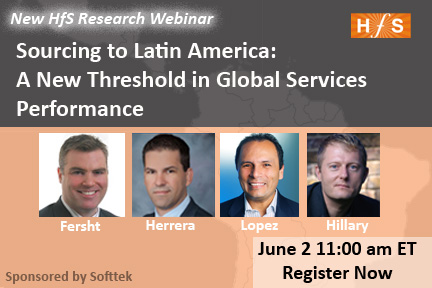
After that taste of the study, we’re sure you’ll want more. So we’ve assembled a stellar panel to delve into Latin America in a special HfS Research Webinar at 11:00 am ET on June 2.
Join HfS Research Founder and CEO Phil Fersht as he’s joined by:
As HfS Research Fellow Keith Strodtman continues to shake the world of HR Outsourcing from its malaise, his next stop was benefits outsourcer Mercer’s analyst sojourn at the sumptuous Starlite Motel, Jersey City. Oh wait – my apologies – I am getting confused with the HfS sales offsite – the Mercer do was at the Mandarin Oriental in D.C. (which, in my opinion, doesn’t really have the personality of the Starlite…). Over to your Keith…
Mercer Analyst Day Report Out
Mercer kicked-off its annual customer conference with an analyst and influencer briefing at the lovely Mandarin Oriental Hotel in Washington D.C. on May 9, 2011. Mercer generates $3.5 billion in revenue from it HR consulting, outsourcing, and investment services businesses. It operates in over 40 countries and has more than 20,000 employees. Mercer executives presenting at the event included Jeff Miller, President and Group Executive – Outsourcing, Pat Milligan, President – Human Capital, Michael Sternklar, US Business Leader – Outsourcing, Mary Tinebra, Global Head of Business Development and Alliance – Outsourcing, and Kim Seals, Global Leader, Human Capital Operations and Technology Solutions. In this post, I will provide a few of the key observations from the event. For a comprehensive report of the day’s information please read my HfS Research RAPIDInsight.
Mercer has three primary business units. Consulting is the largest of the units with about $2.4 billion in revenue. Outsourcing brings in $700 million in revenue and Investment Services brings in $400 million in revenue. The outsourcing unit, which serves 10.1 million employees across 2,800 customers, is comprised of:
Defined benefit administration
Defined contribution administration
Health benefit administration
Absence management
Outsourcing services are delivered from fourteen service centers around the globe, including the largest centers in Gurgaon, India and Norwood, Massachusetts.
Mercer has a large number of large and mid-sized, well known customers across the outsourcing service lines. Last year, the company acquired a long-time benefits co-sourced software partner to expand its presence in the mid-market. The mid-market offering is often bundled with benefits strategy consulting and benefit brokerage services. The company believes that outsourcing value proposition will become even more attractive to companies as they grapple with an increasingly complex legislative environment, especially health care reform. I agree with this view and have seen evidence of sales growth from several providers in the benefits outsourcing market.
In the retirement outsourcing market, the company has developed a number of tools and alliances to help plan participants prepare for their financial future. During the event, product specialists demonstrated some of these tools and they appeared to be intuitive and filled with useful information. One of the web tools called RetireTALK is a public web site. Product executives indicated that mobile apps are on tap in the next six to twelve months. Clearly, mobile apps are an important channel if Mercer hopes to reach busy professionals and younger workers who rely heavily on their mobile devises for information.
Health care reform was also a big topic of discussion at the analyst day event. Steve Raetzman from Mercer Consulting provided an overview of the legislations and the potential implications for businesses. While there are many unanswered questions regarding the legislation, it is clear that there is a lot of work ahead for benefits leaders to determine how to best optimize their company’s benefits offerings. The reform will drive increased enrolment in health plans and lots of questions from employees. Organizations will have to determine if company sponsored plans, insurance exchanges, or some combination offer the best solution given the organization’s business and talent strategies. Benefits consulting firms such as Mercer are sure to see a surge in demand for benefit plan design services as companies grapple with these complex decisions.
Mercer’s Human Capital Consulting business has also seen an increase in business activity since the recession ended. Pat Milligan proclaimed that the global war for talent is back. CEOs are shifting their focus from recession-induced cost cutting to growth and innovation. This shift is happening at the same time that employee confidence and loyalty has taken a hit. Therefore companies need to take a fresh look at their talent strategy and talent management programs. Mercer’s consulting business is helping companies develop engagement, performance management, mobility, and leadership programs in addition to pay and benefit programs to meet the talent challenge.
Human Capital Connect is a new Mercer solution aimed at helping companies manage talent. The solution is a bundle of technology, powered by Peopleclick Authoria, and consulting to support implementation and adoption of the solution. Initially released nine months ago, the company reports a lot of customer interest in the solution but the buying process and time to contract has been slower than anticipated. I believe this could be an important solution for Mercer and will be watching to see if market adoption accelerates going forward.
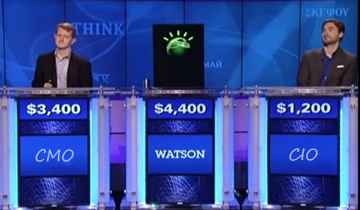
No single business function has been as discombobulated in recent years than marketing. The profound shifts to digital media, the rapid evolution of social media and intensifying globalized business environment, have raised the pressure on CMOs to unprecedented levels.
The answer’s simple, my dear Watson…
The CMO’s job has become a poisoned chalice – he or she is left trying to bring together many disparate functions and processes and report to their leadership how to measure, monitor and plan for future business success. Marketing is all about satisfying customer needs and wants profitably, and delivering a first-class customer experience, and HfS believes that marketing optimization is going to become a growing value-service than the BPO industry needs to deliver: from lead generation through to churn management, from maketing operations though to campaign management.
Bottom-line, the C-Suite cares passionately about how their products and services are marketed: this is not a business function (like others we can mention) which they are prepared to see its effectiveness decline.
HfS analyst Euan Davis, who is examining this secular shift in the world of the CMO, recently took time out to digest IBM’s new bumper CIO survey, and has some takeaways on how the CIO needs to get really close to the CMO to help them through their current predicament. Over to you , Euan…
IBM’s Institute for Business Value (IBM Global Services’ executive research group) announced findings from its huge CIO survey undertaken every 2 years (click here for more details). It’s a massive piece of work involving 3000 one hour face-to-face interviews with CIOs from around the world—this year it has some great news for CMOs.
Basically the CIO study segments CIOs into four main mandates—Leverage, Expand, Transform and Pioneer. Each mandate delivers on a set of goals to the enterprise such as streamlining enterprise operations and increasing effectiveness (leverage); Refining business processes and enhancing collaboration (expand); Changing the industry value chain through improved relationships (transform) and; Radically innovating products markets and business models (pioneer). Most of the CIOs are in the expand mandate and focus on driving better decision making across their businesses—process and product simplification and analytics are top priorities ( 82% of them lead on simplifying internal processes; 72% on driving better real time decisions and 71% looking to take advantage of analytics).
Where the study gets really interesting are the implications that the CIO mandate has for stakeholders around the enterprise—and in particular the Chief Marketing Officer. The CMO still warily eyes the CIO after a history of technology squabbles (we have to use Siebel? You’re kidding me right?); They also remember the promise heralded from its flexible CRM systems that ultimately proved to difficult for the old IT model to deliver on. Social media really has put a rocket under the CMO office—reams of online data needs sorting, categorizing and given meaning to unlock the value that it holds. Digital content sits in all sorts of places with vendors, agencies, removable hard drives and CRM folks as content management systems struggle to cope with workflow. CMOs need support and guidance from their CIOs like never before: Support figuring out how analytics can help them and where they get the IT insight around data management, warehousing, search capabilities and virtual dashboards so they can get closer to their customers and figure out which channel has the best ROI; Guidance into how to build an effective digital platform so that they can track and manage digital assets around the business cost effectively and share them with creative agencies and other external parties when they need to. CMOs need CIO support like never before.
The CIO study suggests both sides are coming together to understand which technologies and tools can best meet the needs of the customer— which tools can extract the highest value from data to enhance knowledge of the customer and which platforms can manage a firm’s digital assets more effectively. At last there is some clear common ground opening up between the CMO and the CIO. The CIO study highlighted what the major innovation plans for CIOs were in 2011: Business intelligence and analytics—83% of CMOs see this as a priority in 2011. And if any member of the C suite needs to use these tools it’s the CMO. Check out IBM’s CIO survey here.
Euan Davis (see bio) is Managing Director for HfS Research’s European Research and specializing in Marketing Optimization services
Let’s face it: Outsourcing is one of the most difficult businesses where you can charge a premium. Margins are constantly squeezed, and the only way to increase profit is either to become more efficient, or win lots of new business (lots is important, because the cost of sales is through the roof, too). CSC, with its latest results, has failed to do either, with flat revenues and declining profits.
It’s hard to be CSC. A perennial subject of acquisition chatter, it has built in poison pills in the form of gnarly government contracts with lots of limitations on who can own them and what can be done with them. This represents a disproportionate part of their revenue when compared to their competitors. This is not all bad. Government work tends to be stable, durable, and high margin, if notoriously slow to close. But acquiring government work is expensive, and if CSC has operationally squeezed out all the margin that it can out of its behemoth public sector contracts, then investors should prepare for many more quarters of bad news. An outsourcing company that is not getting more efficient at constant revenue might just be in trouble.
Again, its hard to be CSC. It lacks the scale of IBM and HP, the brand and loyalty of Accenture, and the relatively low overhead of the leading Indian IT providers. It is, effectively, stuck in the middle, similar in size and approach to European competitors that most of the time don’t bother to compete with these companies we listed. But even those European competitors have a more defined brand and mission in the enterprise world (as opposed to strength in the public sector).
So what can CSC do to show the world better numbers three months from now?
Be absolutely ruthless in streamlining operations. Review every account for opportunties and have the difficult conversations with the clients and account managers.
Turn on the enterprise sales engine. If the excuse for poor performance is “government contracts are slow,” well, then, get out there and win some non-government business!
Invest in the brand, especially in the enterprise market.
Study larger acquisitions that will create a splash while adding scale, new capabilities and price competitiveness. Heaven forbid, maybe it could even start to look at developing some BPO expertise that could be very effective in some of its core industries such as healthcare and manufacturing. It could even look to support public sector shared services initiatives as it seeks to streamline operating costs.
CSC is a capable, trusted veteran of this industry, and it need not disappoint the market—but it does need to refocus and find a new direction, if it is going to keep pace with the competition.










 As HfS Research Fellow