At HfS, we’ve had enough of service providers and their clients raving about how bloody wonderful they all are.
“We have a world-class global delivery operation that guarantees our clients first transformation, then innovation”, said one provider. Yep – we were actually told that!
“Our experience with XXXXX was amazing. They were so responsive and helped us transform our global processes in a way we could never have dreamt when we started out”, said the CFO of a Fortune 1000 outsourcing client. You have to wonder where his next job is being primed…
“We have this incredible culture of driving value to our clients, by making our employees feel empowered to find new thresholds of performance for our clients everyday.” Don’t these guys have the worst attrition in the business?
Meanwhile, one SVP of sourcing (after a few bevvies) did confess to us recently, “I have 5 providers and they’re all c**p. They all oversell and under-deliver. I have given up on any of them doing anything close to what I want them to do, so spend my time squeezing their rates. If they’re going to deliver c**p, we might was well pay them c**p.” Well said, old chap! Another pint?
And other buyer (this one actually sober) stated “If my account rep turns up one more time in my office trying to sell me something, I am going to get his entry card to our building taken away”. Uh, oh…
Yes, folks, it’s time to separate the puff from reality, so HfS Research has finally come up with a spectacular new methodology that – once and for all – will expose this behaviour to industry in all its naked glory…
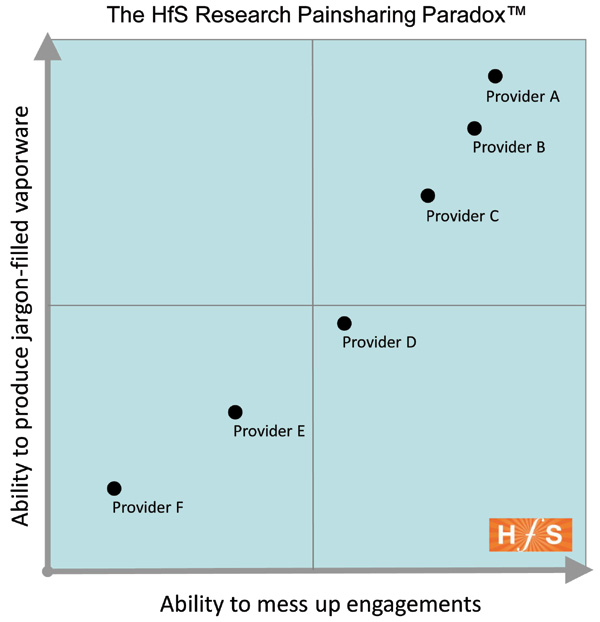
Introducing the HfS Research Painsharing Paradox
Yes, forget gainsharing folks, this is all about painsharing. We’ve deployed an air-tight methodology for placing those pesky providers in their true position in industry, based on their acumen to serve up fluffy puff, correlated by their expertise in messing up all their client engagements:
The Painsharing Paradox Methodology
A Painsharing Paradox (PP) starts its life with a market definition and inclusion criteria. It’s proposed to our group of chief analysts, who are in charge of determining what markets are PP-worthy, whether or not the market is defined in a reasonable way, and so forth. In other words, analysts can’t decide to arbitrarily write a PP, and there’s oversight and a planning process, and an editorial calendar that lays out PP publication schedules for the entire year.
The rest is simple. We figure out which providers have the biggest budgets, and then produce a draft PP – the bigger the marketing budget, the further they are positioned over to the upper-right corner of the grid. Then the bidding process starts. Depending on how much we like them, how many first class boondoggles we’ve been treated to, and how much hard cash they’re prepared to pony up, we’ll maneuver them down the grid towards that hallowed lower-left quadrant, where everyone wants to be.
However, if we feel the provider hasn’t done enough to make us feel special, or once subjected us to two horrible days in a Red Roof Inn in New Jersey (which stays long in the memory), or – heaven forbid – didn’t stump up a nice sum of dough for our coffers, we may decide to leave them stranded in that dreaded right hand corner – sharing the pain of humiliation, with the pain they have subjected on their clients.
And that’s the Paradox… stay tuned for our first one, coming soon. And providers, we have a special PayPal account set up especially for your generation donations – simply email us at [email protected] to get started. Happy painsharing, folks 🙂
Oh, and by the way….
Please tell us you didn't fall for it again?
And while we’re reminiscing about falling for April Fools’ gags, here is 2010’s classic:
Just when you thought you’d had enough sensational news for April 1st, Esteban Herrera, who covers Energy and Utilities industries for HfS, shares his thoughts on Wipro’s big acquisition today…
Wipro CEO, TK Kurien, and his new best friend
Today’s news that Wipro is acquiring SAIC’s Oil & Gas Technology practice for $150M appears to be another complementary addition by the Indian ITES industry’s most aggressive acquirer, provided it’s not a great April fool’s joke. In fact, the funny thing here is that SAIC, long positioned as a leader in this space, has a practice that is only worth $150M. Either SAIC has been excellent at marketing itself as a bigger presence than it was, or Wipro got a steal of a deal.
The motive for the purchase is not difficult to speculate: Upstream Oil & Gas is notoriously conservative and very challenging to penetrate as a new provider. Even if they outsourced their entire back office, that spend is a rounding error compared to their capital and operating budgets for pulling valuable stuff out of the ground and moving it to where their downstream friends can get it to you and me. In addition, Big Oil & Gas has been relatively slow in its embrace of offshore, in part, again, because the savings just aren’t a big enough percentage of the whole pie to get very excited about. Add to that a typically insular, homogeneous and long-tenured workforce and you get one of the toughest walls for offshore firms to climb.
SAIC’s long-term relationships with Tier 1 and mostly Tier 2 upstream Oil & Gas companies and predominantly Western presence, will give a balance and a good entry point to Wipro’s vertical. Wipro will have to work hard to reassure suspicious existing customers to avoid losing them through change of control clauses or non-renewals. The typical challenges of all acquisitions will still apply (culture, financial integration etc.). It is not clear how much of the SAIC portfolio is IT infrastructure business, but at that valuation, it cannot be huge, so we suspect there is more consulting capability and domain expertise than a contribution to Wipro’s effort to win India’s Big 3’s race to win in that space.
We doubt that SAIC customers will see much of a change, other than perhaps some more frequent visits from their friendly Wipro sales reps. Wipro’s customers will gain access to a lot of specialized expertise that may not have been there before.
Esteban Herrera covers Energy & Utilities industries for HfS Research (click for bio)
SAIC employees will probably see the biggest changes, and this is something buyers need to look out for—the last thing you want is to be paying for a provider that spends his or her time looking for a new job or is otherwise distracted with M&A concerns. Wipro paid over USD $100,000 per employee in this transaction with no guarantee that most of them will stay (or that Wipro will want them). One has to wonder what would have happened if it had instead raised industry base salaries by USD $33k and gone out and recruited 1000-1500 industry pros. The customer base might not have come with the investment, but it certainly could have captured the best talent in the business and built a formidable, and perhaps more sustainable, Oil & Gas business.
Esteban Herrera (pictured here) is Chief Operating Officer for HfS Research, who overseas HfS’ coverage of Energy and Utilities markets. You can read our new reports on the Oil and Gas and Utilities industries later this month
So, armed with that info, HfS VP of Marketing Mark Reed-Edwards got together with Esteban Herrera, HfS COO, and Euan Davis, Managing Director of our European Research Practice, to discuss the region and its development in the global sourcing industry.
Listen to the podcast:
[podcast]http://www.horsesforsources.com/wp-content/uploads/2011/03/LatAm-Podcast.mp3[/podcast]
And while you’re about it, why not browse some of our recent research on the LatAm region…
Our recent research on Latin America’s emerging sourcing presence has generated a lot of buzz – not to mention a huge number of downloads. Today’s piece in CIO – “IT Outsourcing in Latin America: 9 Things Your Vendor Won’t Tell You” – sparked some further thinking from HfS analyst Esteban Herrera, who has lived and breathed the LatAm experience. Over to you, Esteban…
Esteban Herrera, Chief Operating Officer, HfS Research (click for bio)
The truth about Latin American outsourcing
Market activity and our recent research have created quite a bit of buzz around Latin America. In my view, it’s about time we have the debate and expose the pros and cons of nearshore destinations. Today’s CIO.com piece, for which I was interviewed, is a good example and accurately portrays some of the challenges of outsourcing in Latin America. However, I find myself, for the first time ever, empathizing with politicians and celebrities who claim to be “quoted out of context.”
The article does reflect some of my statements, but not all of them, and I find myself in disagreement with some of the headlines and conclusions. So allow me to clarify a couple of thoughts, lest people think I woke up yesterday and changed my mind about the vast services potential of the Latin American region.
While more follow-up is often required (by American standards) I’ve always found the total time-to-deliverable in LatAm to actually be shorter than with India, because the wheels of productivity are greased by cultural understanding and proximity, and the fact that when people talk neither party is half asleep.
I don’t know that prices have risen fast. If anything, our research indicates they rose far slower than in India. But small populations of desirable talent invariably lead to wage pressure. The good news is that in those places (like Chile and Costa Rica) we’ve seen pretty much the top of the market.
Saying no is a good thing! For my 10 years as an advisor, my catch phrase to clients was “pick the provider that says no.” Saying “no, we can’t do that,” is an indication of honesty, transparency, and true partnership.
I don’t buy the physical security argument. Baltimore is a more dangerous city than Sao Paulo. Detroit has more murders per capita than any Central American capital. I don’t see anyone refusing to visit GM’s headquarters based on security concerns.
Like any destination, Latin America has its challenges. But at HfS, we’ve come to see the region as a highly desirable component of a global services portfolio, whether you are a buyer or seller.
Stephanie Overby and CIO.com did us all a favor by increasing awareness and highlighting the challenges of the region, which are real. I am seizing the opportunity to highlight that the advantages are real too!
As we clearly pointed out last Autumn, it was going to take one serious investment to get Gen down the aisle. And, as we even more accurately predicted, firms such as Cognizant, weren’t going to make this move anytime soon. Moreover, we can officially proclaim, declare, announce and validate: HfS used to be conceited, but now we’re perfect (ahem).
So why did Genpact buy Headstrong, in the third-largest acquisition ever made by an India-based provider, since Wipro picked up InfoCrossing for a cool $600m in 2007, and HCL-Axon for a similar sum, the following year? And, most importantly, what does this mean for the immediate future of the BPO business?
IT-enabling BPO is getting increasingly important – especially within some high-growth verticals such as financial services
I recall a recent roundtable where eleven insurance sourcing executives were present, all of whom had mature BPO offshore-centric engagements for their insurance-specific processes (e.g. rules-based underwriting and claims processing). One main aspect all of them agreed on: we can only get so far with people-only processes, we need to IT-enable them to find new productivity improvements and business value.
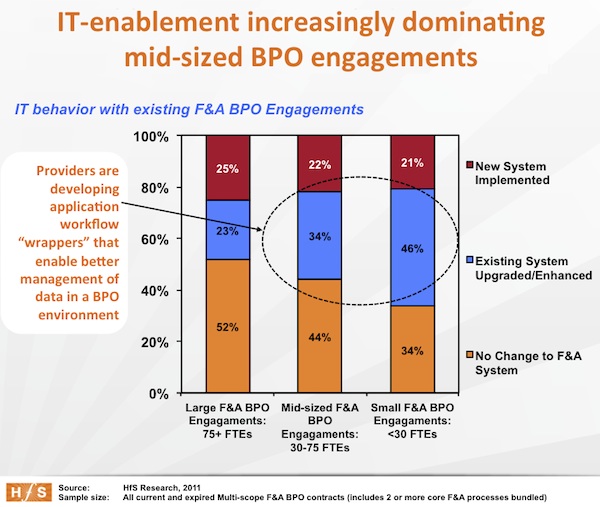
The same applies for several other vertical markets, for example clinical data management in life sciences; but especially in the banking and financial services industries, with processes such as mortgage processing, asset services, trade settlements management and capital markets accounting. Moreover, as the following data from our new Finance & Accounting BPO report illustrates, an increasingly majority of F&A BPO engagements require some form of IT-enablement – especially those engagements of a smaller scale and with middle-market clients, where buyers will leverage the BPO initiative to upgrade their platform, or have the provider introduce its own “wraparound” application layer that will have some pre-developed optimized workflows:
BPO specialists must incorporate IT-enablement and technology management capabilities – and they can be very effective at it
As we’ve seen many of the IT services giants leap into BPO, they have all played on the fact they can provide BPO solutions underpinned by their wonderful IT capabilities. However, when you talk with some of these IT services providers, you’ll quickly find their IT superstars view their BPO groups as some strange assortment of weirdos who like doing things such as processing paychecks and invoices. Meanwhile, some of the pure-play BPOs have actually proven highly competent at helping their clients IT-enable their business processes, whether it be through managing third-party application development, or deploying their own workflow tools.
That isn’t to say all the IT services firms are poor at IT-enabling their BPO, because some are getting very good at it, and even cross-train IT personnel to specialize in BPO deployments. However, some BPO specialists, such as Genpact, have proven capable at IT-enablement, and the Headstrong acquisition demonstrates the firm’s appetite to stay at the forefront of the market. BPO engagements need to be process-led with IT supporting the capability to develop repeatable, scalable and best-in-class processes. That’s the only way these providers can build scale and make decent margins, which in turn allows them to focus on helping their clients find new sources of productivity and growth.
Genpact has set out its stall to compete, not to get bought
There’s no doubt the recent speculation surrounding Genpact’s future hurt the company – and morale hasn’t been too great as a result. That’s just business when you’re a market-leader in a high-growth market with a large number of prestige clients. Speculation of being an acquisition-target doesn’t bode well in deal pursuits, where the last thing prospective clients want is to select a provider to manage their intimate processes, when they may become absorbed by a provider with a completely different culture.
There’s been little doubt Genpact needed to either merge with a strong IT services major, or look to acquire greater IT competency itself. Clearly the latter scenario has won out, with Genpact shelling out $550m on Headstrong. And, while many people have been somewhat confused about this move, what other play was Gen to make, to enhance its IT-enablement competency? Most of the second-tier IT services firms are over-priced (even though Headstrong wasn’t a bargain), and aren’t offering much more than bums-on-seats IT scale. Patni may have been interesting, but iGate won that battle, even though a Genpact-Patni merger would have been a stronger proposition. History is history, and Genpact can now shake off the rumor-mongers and move on with a fresh impetus and attitude with this new direction.
So what are the plusses and minuses?
Plusses:
Headstrong is up the road from the Genpact HQ in Noida, allowing for staff training and easier cultural assimiltion (lots of cricket and football matches). Also, easy to poach staff from neighbouring EXL (just kidding).
Bolster’s Genpact’s industry footprints, positioning and capabilities in the burgeoning capital markets, financial services and healthcare payor verticals at a critical time when competition is very hot from the likes of Accenture, Cognizant, IBM, Infosys and TCS. Financial services has actually been declining at Genpact for the past couple of quarters, where it’s been booming for everyone else. This slide should now be quickly arrested.
Genpact can now own and grow and run its new capital markets and financial markets vertical separate from banking and insurance – the need for institutional knowledge is key for specialization.
Headstrong adds some genuine IT consulting muscle.
Not a lot of client overlap; dilutes GE concentration to less than 30% of total revs on pro forma basis.
Strengthens Genpact’s onshore delivery in the US, UK and Japan – three of the major growth markets for BPO. Also brings China and Europe to the table for driving further growth.
Dampens speculation of them being acquired for a while – only a very small handful of providers could now afford Genpact.
Minuses:
The acquisition was a little “lumpy”, even with a 20% growth rate forecasted and undisclosed profitability (but everyones’ overpriced right now).
Will stretch the current Genpact management model with the expanded onshore presence and capabilities.
Headstrong doesn’t have proprietary platforms that can be immediately leveraged.
Genpact still needs to examine further IT-centric acquisitions to broaden its full-service global capabilities – its cash resources have been heavily depleted after this, hence it will need to look at stock-swap deals.
All-in-all
We were, initially, quite surprised – and curious – with this move, but the more you look into the motives and fit, the more you realize it’s an important forward step for Genpact, at a critical juncture in its corporate development.
What competitive reaction can we expect?
The IT services providers with struggling BPO businesses will be nervous by this play. As we mentioned last year, BPO requires significant investment and patience – and the stakes just got that bit higher. However, we may finally see some BPO investments in the $500m-$1 billion range, with the small number of remaining BPO pure-plays looking increasingly vulnerable. We will also see an acceleration in acquisition of financial services captives, some of which will likely become public knowledge soon.
Exciting times for the BPO business! What do you think?
Fresh from a scintillating summit on Amelia Island in Florida a couple of weeks ago, the Sourcing Interests Group (SIG) is venturing across the pond for its next shindig – its Regional Roundtable meeting in London on May 4 and 5, 2011.
SIG goes on tour to London Town… meet Euan Davis (HfS), Jamie Liddell (Outsource Mag), Michael Stock (formerly of the BBC), John Transier (Unilever) and Dr. Bernd Huber (Google)
And for all you savings-savvy sourcing sentinels, we have secured a saucy 20% discount for HfS readers: Enter the promo code HFS2011UK and select “Non-SIG Member”, when you register here.
This event represents SIG’s first major foray into the UK, and it promises to set new sourcing standards, featuring integral discussions on global business operations strategy, sourcing, shared services and BPO, led by the following renowned sourcing practitioners:
Dr. Bernd Huber, Head of Google’s eSourcing Center of Excellence
Michael Stock, former Head of Business and Partnership at the BBC
John Transier, Unilever’s Global Head of Finance Shared Services
Euan Davis, Managing Director of HfS Research’s European Practice
Here are the main details you need to know:
The Regional Roundtable will kickoff on Wednesday, May 4 at 6:00 PM and will run through 9:00 PM, with cocktails and appetizers, and a panel discussion on on sourcing, outsourcing, offshoring and nearshoring that will include include Jamie “Lid-lifting” Liddell (Editor of Outsource Magazine), and HfS Research’s Managing Director for Europe, Euan Davis. We are assured this cocktail-infused discussion will leave no lids-unlifted.
Thursday, May 5 will run from 9:00 AM to 6:00 PM (yes, you get an extra hour’s kip in the old country), will focus on today’s burning sourcing topics, ranging from government requirements and new legislation affecting business and sourcing, smart supply-chain systems at the macro level, innovative sourcing strategies, governance excellence… and lots more.
The day will start with presentations from SAP, Ariba and SNR Denton, followed by three breakout roundtable sessions, each with different top-of-mind issues on the table; each attendee has the opportunity to attend all three roundtables throughout the day.
Dr. Bernd Huber (Head of eSourcing Center of Excellence for Google) will discuss how Google has evolved over the last 3 years with using eAuctions and how you measure the performance and get the maximum out of eAuctions, as well as various eAuction formats and strategies and their sustainability for procurement.
Michael Stock, formerly of the BBC, and Unilever’s John Transier will lead discussions for the group on smart governance and offshoring and how to govern complex global business operations in today’s environment.
We have secured a 20% discount for HfS readers: Enter the promo code HFS2011UK and select “Non-SIG Member.” Register here.
Join Euan Davis and our friends at SIG for what promises to be a right ol’ sourcing knees-up.
Tom Ivory, our newest Vice President, will keep HfS' clients honest (click for full bio)
No, we haven’t quite emulated McKinsey (just yet), but we have managed to acquire a genuine ivory tower from where we can postulate and preach to the masses… by hiring Tom Ivory. Yes, the Tom Ivory, who once had the audacity to work for research firm Tower Group, where his email address actually was[email protected]…
Tom’s joined HfS’ leadership lead as our Vice President for Client Services to prove that we do actually care about our clients. No really, we care. Despite all out abuse, criticism, mickey-taking and berating, we do want our clients to stay with us – which is why we hired an incredibly tenacious account director with the face of an angel.
Prior to joining HfS Research, Tom served as a Regional Sales Manager for Metastorm (acquired by OpenText in 2011), a leading provider of business process management software. In that role, he successfully managed a territory enabling Fortune 50 companies in the manufacturing, retail and telecommunications industries to improve operational excellence, transformation and business process efficiency. Prior to this appointment, Tom was Manager of Strategic Accounts for TowerGroup (acquired by Corporate Executive Board in 2009). During his tenure at TowerGroup, Tom grew revenue among strategic accounts such as Goldman Sachs, Wells Fargo and JP Morgan Chase and strengthened client relationships by consistently delivering solutions for the challenging and dynamic business and technology needs of the Banking, Insurance and Capital Markets industries.
Tom’s excellent buy-side relationships will be extremely valuable for HfS as we grow our research advisory business, expand our HfS-25 buyers’ council and (soon-to-be-launched) price-benchmarking services. We have also charged him with looking after some of our favorite existing clients, whom we promise we really do care about…
Tom lives in Dallas with his wife Lindsay and their two sons Carter and Cameron. He enjoys travelling around the world with his wife and experiencing new cultures. When he is back at home in Dallas he can usually be found cycling or running around White Rock Lake.
Tom holds a bachelor’s degree from the University of North Carolina at Chapel Hill.
You can tweet Tom @tivory and email him at tom dot ivory at hfsresearch.com, to welcome him into the HfS family. You can view his full bio here.
Deborah Kops has some interesting insights into the current shape of the BPO market, with those providers leading the charge originally emanating from strong consulting backgrounds… over to you, Debs
Consultants in BPO – still lurking in the background, or gone forever?
You’re probably not aware of a very subtle, but tectonic shift going on in the business process outsourcing industry which has implications for all those things that we all tout as benefits of sourcing—innovation, deep domain experience, true client partnerships.
No, when I refer to consultants, I’m not talking about the likes of the sourcing advisors. They’ll continue to survive in one form or another. I am referring to the fact that the pioneers of the outsourcing industry, primarily BPO, came out of consultancy backgrounds. And as they leave the industry due to retirement or the pursuit of other interests, the sourcing community is much less well off.
Think back to the heady early days of BPO in the mid 1990s. Consultants from the Big-whatever-it-was, the then Andersen Consulting and even the likes of the white shoe strategic firms, got a bee in their bonnets that their intimacy with and knowledge of their clients could be harnessed to improve and deliver business processes. They formed business lines with skin in the game, exclusively focused on doing rather than just advising, tapping not only into their own expertise, but that of their partners and colleagues. At that time, moving work to India or even to Poland was a very hard sell to clients, so the value proposition came not from labor arbitrage, but the application of real business improvement tools and techniques in context.
Today, the makeup of provider teams has inextricably changed. Increasingly, those with deep consulting experience are rapidly moving out of the picture, while the leadership now comes from armies of managers whose base of experience is solely time in grade in the outsourcing industry. It’s unfortunately a detriment, not only to the creation of value for the buyer, but for the provider side of the equation. Experience in context–attaining knowledge by working side by side with a client, understanding how they work, and what makes their industry tick—is the greatest benefit of a consulting career.
This is not to say that providers’ rising leaders cannot deliver sourcing benefits beyond cost reduction and follow-the-sun operations; perhaps over time as they gain experience and wisdom, they can. But, in the main, they haven’t acquired the soft and problem-solving skills that come from having the training, intellectual freedom, proximity, and the ability to connect the dots that only consulting experience allows. Rather, their experience is limited to time in grade in delivery centers, or perhaps the five or six times a year when they have direct access to a client during the solution-development process. Their problem-solving skills have been shaped by process, not perception.
And the organizational paradigms in which they operate either can’t-or won’t—adjust due to competitive margin pressure, or perhaps even myopia. As a result, the sourcing landscape is in danger of increasingly becoming commoditized process shops with only a whiff of business value.
Not convinced? For just one proof point, look at HfS Research’s recently released finance and accounting sector analysis. It hasn’t escaped my notice that the majority of the top players come from a consulting pedigree. Are these players better innovators? Do they have a more consultative approach to client relationships? Do they deliver more value? The results beg the question.
Deborah Kops, Contributing Analyst, HfS Research
Call this post the mad musings of a former consultant. But I look around me and see a provider class which is fanatic about process delivery at the expense of those capabilities which create value. They forget that real sourcing benefit comes from the ability to solve a problem, the skills to develop a relationship with a client team at the highest level, and the knowledge of what drives value in an industry from the top down, not the arrogance of process mastery. Perhaps it’s time to change the provider paradigm, or entice a few of those consulting pioneers out of retirement…
Deborah Kops (pictured here) is a regular contributor to HfS Research and runs Sourcing Change, a specialist strategy boutique focusing on the dire need for change management in sourcing. You can read her full bio here.
Outsource Magazine, Spring 2011 issue. Click image to give it a read.
As you may recall, we recently partnered with Outsource Magazine. I’m happy now to share the first issue that includes our contributions. Jamie Liddell (despite jetlag and a screaming 4-month-old) and his crew have put together an absorbing issue – check out the packed table of contents, with features on IT security, call center tech, and labor arbitrage.
If you already scour Outsource, you know what a readable pub it is. If you’re not a regular reader, start today with this issue. I think you’ll enjoy it.
Cloud Cloud Cloud. Whenever you talk to a provider, or IT analyst, consultant or investor these days, the C word inexorably oozes out during whatever dialogue or monologue is taking place. And what we love most about the Cloud, is when we ask that person to define it, there is this inevitable pause before he or she stumbles through various unstructured sentences, before asking us how we define it.
Are you really ready for the "HfS Private Cloud Challenge"?
Never before have we come across such a vague, poorly-defined piece of terminology so many people utter so freely without really understanding it, but feel an irrepressible urge to vocalize it at every given opportunity. At HfS, we’ve become so depressed by the repeated fuzziness of the Cloud, and the startling inability of anyone to put forward a convincing, proven case for the Private Cloud, that our hot-blooded analyst, Esteban Herrera, has deemed it high-time to lay down the gauntlet to you all, so over to you Esteban to explain our new challenge…
It has suddenly become almost as popular to bash the Cloud, as it has to hype it. Personally, I have been a skeptic all along, and don’t even get Phil started on Cloud BPO!
The Public Cloud mostly makes sense, but all of the technologies required have existed in some form for quite some time—they are available and people use them today, so I am not sure what is so “new” about it. At least the economics make sense: lots of companies invest in a single infrastructure with overcapacity, but because of the consolidation and standardization of the offerings, it costs them a whole lot less than developing their own infrastructure, and gives them the ability to scale. Given its limitations, the Public Cloud has been mostly popular with small and medium size.
But the Private Cloud makes my blood boil. Private Clouds are a cynical oxymoron. The whole point of a Cloud is that you share resources and don’t have to own the capacity you need, because its available on demand, so you can pay by the drink. Well, if you own the resources and the capacity, it is inherently limited to what you own, and you’ve already paid for everyone’s drinks at the bar whether they consume them or not!
Check out Wikipedia’s definition:
Private Clouds have attracted criticism because users “still have to buy, build, and manage them” and thus do not benefit from lower up-front capital costs and less hands-on management,[52] essentially “[lacking] the economic model that makes Cloud computing such an intriguing concept”.[54] [55] Enterprise IT organizations use their own private Cloud(s) for mission critical and other operational systems to protect critical infrastructures. [56] Therefore, for all intents and purposes, “Private Clouds” are not an implementation of Cloud computing at all, but are in fact an implementation of a technology subset: the basic concept of virtualized computing.
But HfS is about dialog, and believe it or not we don’t mind being proven wrong, so we are launching the HfS Research Private Cloud Challenge—a fun contest for true innovators in the Private Cloud. Here are the rules:
Entries must describe a Private Cloud solution that has been implemented. Not a server virtualization initiative, not the purchase of Software as a Service, but a true, full-on Cloud model where the technical infrastructure, software, and services are Cloud-based, available on demand, and can scale up or down painlessly.
Each entry must be accompanied by a business case. That’s right, real numbers on spreadsheets, folks! Entries must show in real money the benefits of the Private Cloud implementation. You may also share other benefits that are hard to measure in dollars, but assume we are taking a CFO perspective here.
Your story must be verifiable. We are happy to protect the innocent and will not disclose any name you don’t want us to, but we want to talk to real people who are close enough to the solution and to the numbers to be able to tell us its real.
Do not send us more than 10 pages plus a spreadsheet with the REALIZED business case (not the expected business case). The legions of HfS minions who will have to sort through your thousands of entries are quite busy.
What do you get if you “win”? If you are the first person or organization to convince us that there is business value in a Private Cloud, you will get unparalleled fame in the form of:
Your story will be published on this very blog, where 50,000+ loyal and adoring readers will understand the benefits of private Cloud. You will be tweeted and re-tweeted the world over and every major social media outlet will know you have won the challenge.
You will earn the satisfaction of having crushed my gargantuan ego by proving me wrong, and demonstrating conclusively that I am an ornery, luddite fool.
I will publicly eat my fedora in front of all said subscribers, and have to admit that the Private Cloud is indeed not an oxymoron, but a valuable new way for enterprises to do business.
Email your entries to me at [email protected]. I’m fully prepared for a flooded inbox.