Is it just me, or is it just really irritating when people start using jargon that’s a load of cobblers?
One of the things I have loved about BPO is that the IT evangelists have always steered clear of the topic by a county-mile, because they really don’t understand it.
When I was an analyst covering BPO in the traditional research world, I was fortunate enough to be left alone to get on with my craft, because there were very few analysts who could tackle anything that wasn’t centered on a piece of software, hardware or communications equipment. To them, BPO is the unsexy grunt work that has to support uncool things like actual business processes.
Then along comes the Cloud, and a few ambitious souls from the IT world have dared to mention that mysterious “BPO” word in tandem with their wonderful, nebulous, ill-defined, confusing world of Cloud Computing. Yes, some IT knuckleheads are starting to use phrases like “Cloud BPO players” and “FAO in the Cloud”, or just plain “Our Cloud BPO strategy”. They’ve been dying to use the BPO term for years – and now they’ve seized their chance. Oh my.
Sadly for them, “Cloud BPO” is, simply put, really a load of nonsense in today’s environment. The core fulcrum processes of BPO are the toughest to move into the Cloud, and only the small-to-medium business sector is going to enjoy any modicum of success of moving genuine “BPO” processes, such as finance and HR, into the Cloud in the near-term. And this is mainly with very standardized and straightforward Internet-hosted apps (i.e. simple interface, no integration requirements), as opposed to genuine Cloud-enabled ERP apps that leverage IaaS/PaaS/SaaS architecture.
Our recent study with the Outsourcing Unit at the London School of Economics reveals both the IT executives, Cloud-providers and consultants all clearly agree that most of the core applications supporting BPO processes are the toughest to move into a Cloud environment:
At HfS, we have been at pains to dissect the potential of business processes that can be provisioned by a BPO provider, where its underpinning software and hosted infrastructure are “in the Cloud”. And we’ve gone to even further pains to differentiate between Internet-hosted and genuine Cloud apps. We’ve even coined the term “Cloud Business Services”, because it’s simply more relevant to early-stage client needs to move processes and apps into the Cloud, and has a tight definition as to what a Cloud Business Service actually is.
Core BPO functions, such a finance and HR, are typically serviced by creaking legacy software that is poorly integrated (if at all), or simply embedded into a complex ERP architecture that’s wrenched into back-end systems and databases. Most firms today would have to transition completely onto entirely new Cloud-enabled platforms before they could even consider outsourcing the related processes to a third-party in a “Cloud BPO” model. It’s generally a lot easier with apps that are either already “in the Cloud”, or where it’s simply more desirable to move quickly onto a standard Cloud model, for example Salesforce.com. But that’s not “Cloud BPO” – that’s really just “Cloud”.
It’s just not going to happen anytime soon – the ROI’s not there and the legacy ERP firms aren’t chomping at the bit to derail their license models that have served them so profitably for so many years. Yes, they can outsource their SAP support to an ITO and have them process their paychecks and invoices as part of the contract, but that’s not “Cloud BPO”. That’s “bundled BPO”, or possibly “Platform BPO” (which doesn’t, quite frankly, mean a hell of a lot either).
I’m not trying to be a merchant of doom here, and we do passionately believe in the future potential of the Cloud – as do the vast majority of today’s business and IT executives. However, it’s time to move away from stupid jargon that’s designed to do little more than sound like puff. We are seeing the early beginnings of true “Cloud services / BPO” partnerships around core ERP processes, for example Genpact and Netsuite’s early efforts to offer “F&A BPO in the Cloud” for medium-sized business. We’re also seeing encouraging advancements that both Accenture and IBM are working on, to offer HRO on Workday, which (ahem) could be the true beginnings of “HRO in the Cloud”. But we’re miles away from these offerings being widely adopted, so let’s stick to reality and refer to these services as business services that have elements of Cloud delivery potential. Or just simply “Cloud Business Services”.
Anyhow, enough of my little jargon rant – hopefully you’ll join me, Euan, Prof. Leslie Willcocks and Jimmy Harris for a little chat about Cloud Business Services this coming Thursday – just sign up here. Hey, it’s free, what more do you want?
If there’s been one consistent face of the HR Outsourcing industry over the last decade, one stalwart who’s been staying true to the principles of global HR delivery, despite all its bumps and bruises along the way, its been the former shift foreman at a Detroit car bumper factory who left the New World to join upper-crust English society.
Click to listen in to MSR and BK, noon Eastern time on 16th Feb (recording available)
Step up Mary Sue Rogers (known in local circles simply as “MSR”), who’s General Manager for IBM’s Global HR, Learning and Recruiting Process Services organization.
And if there’s one person qualified to find out more about her passion for payroll, who can slow down her machine-gun talking-speed to the firing rate of a semi-automatic, it’s the indomitable Bill Kutik, who hosts his own aptly-named “The Bill Kutik Radio Show”.
Anyway, MSR will share her insights into why full-service HRO has had a mixed scorecard in its first 10 years; what she will be doing differently in the next 10; the unique technologies used in HRO not usually found in a traditional HR environment; and the critical role of third parties and what they do in successful HRO engagements.
Click here at noon Eastern time today to hear Mary Sue Rogers. Recording is available, so don’t worry if you miss it
In today’s ITO/BPO market, it’s getting harder and harder tell providers apart, when selecting a sourcing engagement partner. Once they can compete on price, have a reasonable track record for operational effectiveness and can transition you to a globally-sourced environment, we really get down the nitty-gritty of how can they really help my business achieve growth and productivity?
HfS is engaging heavily with both buyers and providers of sourcing to understand how buyers can benefit from genuine operational and industry insights to improve their business performance – and we believe the capability offer these analytical insights thought smart governance models is quickly emerging as a major differentiator. And if your main provider isn’t passing muster with their insights, can you find a specialist to add to your sourcing mix that can?
Over the last 15 years, the importance of analytics as a business activity has grown dramatically. While the top brass once used guts and intuition to guide decision making, today, data is the prime weapon in the management arsenal. As data analysis techniques have gotten smarter over the years, analytics have emerged as a specialized function of business employed broadly across industries and functions. Our new HfS Report, imaginatively titled Where offshore analytics is heading in 2011investigates…
Analytics needs today are both horizontal and vertical
When you’re moving major components of your business and IT administration offshore, you need the capability to get rapid data on your global operations. You’d be amazed at the dearth of information many global firms have over the operations, their employees, their supply chain, their finances etc.
However, it’s no longer about having quality “horizontal” analytics. That’s a given, today, as companies increasingly globalize their processes and business functions. Industry-specific analytics techniques are now rapidly evolving, while other, more industry-neutral “functional” analytics services are also gaining popularity due to unified business needs. For example, while a specialized branch of analytics is dedicated to the retail segment (retail sales analytics, merchandising among others), generic supply chain analytics cut across all sectors.
The key verticals for analytics demand today are banking, financial services, insurance, retail, telecom, healthcare and pharmaceutical, advertising, new media and entertainment. Our primary recommendation to buyers is to carefully evaluate their business functions to identify latent areas that may benefit from analytics activity. When a business process (e.g., F&A) is carved out, analytics is easier to apply. But organizations need to seek out hidden opportunities in areas such as risk analytics, buzz analytics and mobile web analytics to compete in the current environment.
Who’s buying offshore analytics?
Fortune 500 companies that have massive data repositories are the most important client group for all service providers: as they sink their teeth into offshore analytics services, its much easier (and cheaper) to add FTEs to existing outsourcing engagements, or existing projects, than create new requisitions for onshore analysts. Enterprises from industry verticals such as consumer goods, financial services and telecom with high exposure and maturity in offshoring are significant buyers for offshored analytics services.
Besides the Fortune 500 companies, service providers are increasingly targeting mid-sized clients to move up the value chain. Some niche service providers are also looking to serve the rapidly growing domestic and regional markets.
Large IT-BPOs and KPOs are trying to cross-sell analytics services to their existing clients, especially as add-ons to engagements in areas such as customer management, F&A, HR and Procurement, where there is a constant ongoing need for better quality and more accessible data. These firms are also trying to focus on creating capabilities in high-value analytics services as value-added differentiators for corporate clients.
Many of the KPOs and smaller BPOs also are also seeking to create specialized capabilities to service parts of analytics projects and eventually take a vertical approach to growth in their chosen niche in order to move up the value chain.
Although both large and mid-sized firms present opportunities for analytics providers, the level of scale and importance attributed to the service differ. Due to the impact of analytics (e.g., efficiency gains, cost savings), the need and savings potentials are more significant for larger buyers in absolute terms, however, as this market becomes increasingly saturated, expect the competition and demand to pick up in the mid-market.
And who’s selling offshore analytics services?
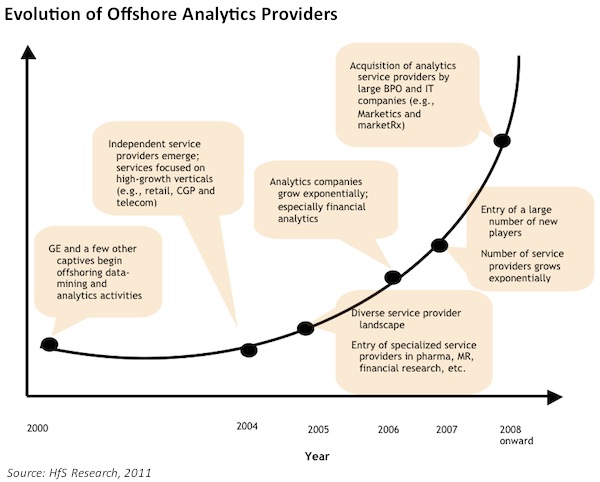
The number of service providers offering analytics services from offshore locations has exponentially increased over the last 5 years. Furthermore, the number of companies with a desire to build an analytics practice will easily be double the number of players in the market today. This huge increase in the number of vendors can be largely attributed to the desire to clone the success of early movers in the analytics space.
In the early 1990s, several companies started using analytics as a tool to derive answers to specific business issues. However, the application of analytics was very limited due to the limited availability of exhaustive historical transactions and research data. Some corporate giants such as GE had begun offshoring transaction processing activities during the 1990s. A lot of this data was then used as raw material for building solutions using techniques in analytics. Captives started offshoring low-end analytics activities:
Eventually, as these processes stabilized, companies started offshoring the entire analytics value chain to their respective captive centers. Today, the scope of analytics services provided out of these captive centers goes beyond business process outsourcing. Several captive centers have large and specialized analytics teams providing solutions to internal clients globally.
The offshore analytics landscape has changed over the last decade from one dominated by captives of large companies, primarily in India. Today, the industry features a large number of providers offering end-to-end specialized analytics solutions to specific verticals. High-value third-party analytics solution providers are focused on providing value beyond cost arbitrage by leveraging a combination of onshore-offshore delivery models and the use of technology. Our forthcoming “HfS Form Guide” evaluates the market footprint and potential of the key analytics service providers.
So who are these providers, how are they specializing, and what makes them different? Read on by downloading your copy of our new report “Where Offshore Analytics is Heading in 2011“.
One of the newest additions to the HfS family is Brian Robinson. Born in Ohio, raised in Florida, educated in Florida and Virginia, Brian was living in the UK when we started talking to him about working for us. In fact, he was renting my London flat, so I was guaranteed he’d give the place a good clean when he moved out to embark on his Italian adventure.
He’s now based in Rome, where he’s starting to learn the language. Give him a few more weeks and he’ll be ordering the Pasta alla Carbonara in the local tongue, while explaining it’ll be far easier to outsource Berlusconi than trying to lock him into a captive. Hmmm… maybe CNN can sign him up for a double-act with Elliot Spitzer?
Brian is an internationalist to say the least, so it comes as no surprise that this Ohio boy uses football (you know, the one where you can’t use your hands) as an analogy for how to nurture leadership teams.
Is it better to build or buy? For the answer, over to you, Brian…
Outsourcing your leadership team: The build vs. buy debate heats up
Were you surprised that Rooney biked home the winning goal in the Manchester derby? I wasn’t. Hands down, the goal was amazing. And it may well go down as one of the best goals ever scored in the Barclays Premiership.
Rooney’s ability to catch the ball at this angle speaks to his unrivalled skill as a footballer. The fact that he was in the match to score the goal speaks to strength and intelligence of the management team running arguably one of the most prolific football teams in the world today. To date, Rooney’s 2010-2011 performance has been lackluster: a mere seven goals in 27 matches. Other players would have been benched or traded by now, but Rooney has something special. He knows it and so does his management.
There are similarities between good companies and good football teams: solid staff employees that consistently make the right decisions at the right time. So if you are the helm of a flagging enterprise, should you nurture management talent internally or go to market for it? A review of several clubs’ performance and related management decisions in the Barclay’s Premiership sheds some light on the subject, but the evidence is far from conclusive.
Take, for example, Manchester City. Today it’s one of the richest clubs in the world, bankrolled at a massive loss by Abu Dhabi’s Sheikh Mansour, which has already changed managers four times in the last five years. Yet, despite all the talent money can buy, they have yet to win a single trophy. In contrast to Manchester City are clubs like Manchester United and Arsenal, which have each kept faith with the same managers for 26 and 14 years’ respectively. Each has a stable and revered management team that coaches some of the world’s best footballers. These two clubs have a combined seven Premiership titles over the last 10 years and are currently ranked number 1 and number 2 in this year’s title race, and have both spent far, far less money on new players than their main title rivals. And then there is Chelsea, who’s spending has been even more magnanimous that Manchester City’s, and results have followed with three Premiership titles and three FA Cup titles in recent years. However, this year, the club is ranked a concerning 5th and is in danger of dropping out of Europe’s elite competition, with an aging team and clear disharmony in their camp. Could changing managers four times in three years be a contributing factor? It certainly has not helped. And the darling club of this year’s season has to be Tottenham.
Consistently strong, but rarely considered a star, the club has been under the management of Harry Redknapp for the last two seasons. Having spent his entire life in the Premiership as player and coach, he has enabled existing players to achieve new heights of performance while attracting new talent to the team on a modest transfer budget and salary ceiling. The result: Tottenham had their highest ever finish in the Premiership last year placing fourth. Moreover, they are in the round of 16 in this year’s Champions League, having beaten both Inter Milan and AC Milan along the way, and are currently ranked fourth in this year’s table. Can Tottenham maintain this level of performance? What is certain, is that decisions both on and off the pitch will contribute to the club’s long-term performance.
I’ve supported a fair share of management teams over the last 13 years, both large and small, and from all parts of the globe. Despite the language barriers and, at times, differences in culture, I have observed that the best managers often share a similar set of attributes. For example, they:
Engender trust among all team members
Reinforce directly and indirectly that no one single player is the linchpin of success
Promote from within the team ranks, more often than not
Empower their team with responsibility and the right to take decisions
Brian Robinson, Senior Analyst, HfS Research (click for bio)
Managers don’t turn these attributes on and off like a light; rather, they build them over time through shared work experiences. More importantly, they give team members the opportunity and time to discover and align shared interests. So why source talent at all if great leadership takes time to nurture? From my experience, senior managers brought in from outside the organization can create a much needed shock to the system. However, when left alone to manage the resulting fall out, they fail. More often than not, it is the tenured managers that adjust, pick up the pieces, and enable the organization to see a new and better day.
So what does this all boil down to? It is my belief that sustained peak performance comes as a result of a long-term focus on and development of talented management. It’s true – great management capability can be bought. But strong and consistent results cannot. And who needs to spend thousands of dollars and hundreds of hours researching this hypothesis when the answer is unfolding every week on pitches across the UK and Europe. Will the debate surrounding leadership outsourcing continue or fizzle? I know I will be watching the Premiership and Champions League to find out.
EquaTerra, or “EQ” as they are commonly known in the trade, has formed part of the heartbeat of the sourcing industry over the last eight years. When three frustrated TPI consultants had finally despaired of their employer ever “getting” BPO, they snuck off to set up their own shop, coined a goofy name, convinced all their buddies to take a leap of blind faith with them, before stripping off at a Luau and shaking their booties at their unsuspecting followers. Yes, these guys were clearly on a path to building a multi-million dollar global advisory outfit that would be submerged into a highly respected auditor and management consultancy.
What was amazing, was the sheer speed with which EQ caught up their industry to become, initially, the leading advisor for HRO and F&A BPO engagements, while quietly developing its competency in ITO. From there, the firm had excited Glen Davidson so much, he publicly resigned from his Accenture job during an awards dinner acceptance speech to announce the establishment of “EquaTerra’s Public Sector” organization. From that moment on, the firm knew no bounds, establishing its software process evaluation tool, EquaSiis and taking over Morgan Chambers’ European advisory organization. They even reached the spectacular heights of doing some research with us!
Meanwhile, the leading management consultancies were still raking in so much coin selling shared services advisory engagements, it was easier for many of them to advise their clients against outsourcing, than actually help them through a sourcing evaluation process. Why risk your $20m-a-year engagement doing shared services improvement for a $1m project to look at outsourcing?
However, the boom in outsourcing had really taken hold by 2006, and the management consulting firms realized they were not equipped to deal with these complex, stressful operational deals (to quote the CEO of one of the boutiques, “This is real workman’s consulting”). AT Kearney, Deloitte, KPMG, PwC – to name a few – started hiring consultants in earnest to win outsourcing advisory work, hoping their superior brands would be enough to swat away these pesky boutiques and their fancy methodologies. “We’re focusing on the strategy side” said one management consulting partner, “And leaving the transactional work to the specialists”. However, the management consulting firms quickly were discovering they could rake in a cool $1m-$3m+ managing an outsourcing transaction cycle,whereas a “Phase 1” strat evaluation rarely netted them more than $500K. Plus, there was never much action with the governance work, as buyers were not resourcing for “change management” (more on this topic to follow soon).
So the management consultancies realized they need to poach the specialists from the boutiques, but were in for a rude awakening when they discovered how much the top talent at Alsbridge, EQ, Everest, TPI et al. were raking in. Plus, these guys were a unique breed – they actually liked the boutique culture, along with the specialism and IP their firms were generating. Bottom-line, these boutiques didn’t fit their compensation models or their cultures. Add to this the fact that “outsourcing” had always been something of a dirty word, and poorly understood by the other consulting practices. Hence, it was pretty clear, as long as five years’ ago, that the best route into the outsourcing game for some of the management consultants was to do the unthinkable and actually acquire one of these boutique firms.
So why didn’t any of them bite the bullet and snap-up up a boutique?
Quite simply, the top consulting brass have struggled with the “build versus buy” decision for the following reasons:
They have persisted with the MBA-model, which just doesn’t work with complex outsourcing deals. Several management consultancies have struggled to understand why they can’t stick a team of 26-year old MBAs onto their clients to crunch through a deal, while the boutiques have a cost structure that enables them to put experienced “workmen” with genuine deal experience, whose rates are often cheaper. And while you can get away with some juniors on ITO deals, with BPO you actually need experienced process experts – not kids.
Outsourcing is still something relatively new and foreign to their classical consulting practices. Outsourcing of IT, and more recently business processes, has grown rapidly over the last decade and many of the consultancies have been slow to adjust. Only now are they recognizing they need this competency, or risk getting edged-out of long-standing clients who are morphing into global outsourcing operating models.
The “hire the leader” tactic to build competency has largely failed. In years gone buy, if niche consultancies were overpriced, the large shops would simply hire the top one or two partners, safe in the knowledge their main delivery guys would follow. This just hasn’t worked too effectively with boutiques, as the top outsourcing advisory talent is well-paid and happy in their boutique environment. Plus the fact there are literally only a couple of dozen real “market makers” in the outsourcing advisory space worth hiring.
The boutiques have wanted too much money. Some of the boutiques today will be wishing they took offers on the table before the Recession, as the consolidating and commodotizing market has knocked down the market value considerably. However, with EQ now out of the frame, there are only a small handful remaining with sufficient scale and IP, and these firms will have renewed hope they can cash-out sometime soon.
So… has KPMG made a wise move purchasing EquaTerra, and how will this impact the industry?
*The outsourcing advisory business is all about talented people, experience and relationships. What has impressed me most about this deal is the fact that KPMG has created 17 new partners from the EQ organization. These people have stuck together for years, have considerable IP, experience and relationships, and are moving over to this new environment together.
*It would have been extremely messy if KPMG had tried to hire away these folks one-by-one. They have retained the top talent and have created careers for them within their organization.
*Quite simply, there is a really bad (and worsening) talent shortage in our industry, and KPMG has just snapped up a good portion of it in one full swoop.
*Now their challenge is to integrate EQ and create a culture the new partners and their teams can get used to. Retaining the core team is critical to the success of this venture. If they can do that well, they will likely have recouped their investment in a few short years, not to mention the new client relationships they can forge as a result of their extended competency.
*If KPMG can’t keep it’s new partners happy and there is a mass exodus, then this acquisition will have failed. Having hired a close-knit group, it does run that risk, and needs to work hard to integrate the EQ people. This merger is all about talent and IP – and they are intertwined.
*KPMG is also very excited about this and took a long, hard look before they took the plunge – it is a big, big deal to them and they have put a stake in the ground to show how serious they are about this business. The firm has clearly chosen this space as the one they want to lead, and should be applauded for making a bold move that none of their competitors have (so far) chosen.
What will be the competitive reaction and new market landscape?
The one “prize” boutique left on the market is TPI, even though it can hardly be called a boutique anymore, with its new-found alignment with Compass. The outsourcing market will have a solid year and its valuation should start to pick up, so I would surprised if any of the large consulting firms, such as Deloitte and PwC, makes a serious move this year.
My prediction for 2011: we now have 4 major players, and they’re no longer boutiques: Deloitte, KPMG, PwC and TPI. Providers will have to re-evaluate their influencer strategies, as more intricate and finessed relationships are required. The old “referral” model is pretty much dead. The remaining boutiques, namely Alsbridge and Everest, should be able to pick off more business, now they have less competition, and can take better advantage of their more flexible cost structures. Yes, we have a sea-change in the industry, but the buyer still has choice and we have better integration of the traditional consulting model and the boutique methodology.
Yes, quite how this ramshackle outfit today celebrates its first birthday is quite beyond me. Exactly one year ago, we bravely declared we were a research company, with a bunch of friends, stringers and part-timers.
Today, we are a fully-loaded experienced research organization with depth and breadth of analyst talent across North America and Europe – with further expansion plans imminent. Hell, decisions used to be so much easier when we had no money…
But seriously, all I can say is a big fat thank you for all your support, encouragement and belief in us as we’ve built something truly game-changing in our industry – and one stat says it all: One year ago we had 16,000 subscribers; today we just surpassed 50,000. One can only guess where we’ll be in another 12 months.
Here’s a shout out to a few of you who’ve played your part…
Amber Wagenknecht (Accenture): For the warning signs (and my ignoring them)
Anthony Calabrese: Just being a sourcing beast
Bill Kutik: Making me laugh – out loud
Bob Cecil and Lowell Williams (EquaTerra/KPMG): Being awesome to work with
Brian Robinson (HfS): From tenant to employee… a truly loyal chap: )
Bruce McCracken: Being there at the start
Chris Barney (Genpact): For Cardiff…
Chris Gattenio, Don Schulman, Bill Payne and MSR (IBM): Believing in us
David Poole and Carina Smith (Capgemini): Believing in us, oh and making the Magic Kingdom bearable
Dawn Evans (SIG): For your super confidence
Deb Kops (Sourcing Change & HfS): Sounding-board and under-rated marketeer
Dennis Howlett: Just being Dennis
Derek Sappenfield (PwC): For believing in us
Ed Nair (Global Services Media): Being a great supporter and simply a great guy
Emma Beaumont and Sarah Clayton (SSON): Making some super cardboard cutouts – and all the plugs during lift-off
Esteban Herrera (HfS): For raising our game
Euan Davis (HfS): For the blind leap of faith
Frank Casale (Outsourcing Institute): For finding a reason to call me everyday
Frank D’Souza (Cognizant): Being our first client
Google Apps: For a cheap, reliable IT platform
Graham Russell (Astrazeneca): The guaranteed entertainment
Jamie Snowdon (HfS): For choosing HfS to make his comeback
Jason Busch (SpendMatters & HfS): For showing how to run a small, feisty business
Jay Desai (Northern Trust): Just calling it how it is
Jeanne Achille (Devon Gp): Giving us a professional veneer (when we really needed one!)
John Hindle, Sarah Thomas, Shari Wenker, Mike Salvino and Kevin Campbell (Accenture): Believing in us from the start, oh and plenty of Pink Champagne and Formula 1
John Transier (Unilever): A great sport
Jolie Newman: Just being helpful
Jonty Woodhouse: For making us legal!
Lee Coulter (Acsension Health): Making me laugh – from the start
Mark Reed-Edwards (HfS): For putting up with me
Michelle Liukin (HfS): The invoice queen
Mike Atwood: Being there in the early days
Mum and Dad: For having complete confidence this would work
My wife: For putting up with all this cr*p
Peter Allen (CSC): Being such a great thinker
Pramod Bhasin, Tiger, Gianni Giacomelli and Bob Pryor (Genpact): Great contributors and supporters
Prof. Leslie Willcocks and Dr. Will Venters (at the London School of Economic): For flouting establishment and partnering with us
Ray Wang (Constellation): Fellow analyst rebel
Ritesh Idnani, Pranay Juyal and Wendy Shlensky (Infosys): Believing in us, and teaching us how to negotiate!
Roxanna Wall (UBS): For always believing in us
Simon Newton (Kimberly Clark): A great sport and a great guy
Stan Lepeak (EquaTerra/KPMG): Keeping the faith
Stephanie Overby (CIO Magazine): For giving us media-cred
The Enterprise Irregulars: For providing a remarkable amount of entertainment and value
The old AMR team (now Gartner): Providing such a great platform for HfS – and not suing us!
The ValueNotes team: For being reliable
Tony Filippone (WellPoint): The vendor governor
TPI: Being good sports…I know I give you a hard time : )
Last week’s outsourcing advisory bombshell wedding between KPMG and EquaTerra may well prove to be a turning point in the way buyers are serviced in the future. Management consultants need to have deep experience, knowledge and data on the operational guts of outsourcing, while boutique advisors need to offer a much broader consultative value proposition for clients who are tackling global operational issues.
HfS’ Esteban Herrera, himself a veteran advisor and consultant prior to venturing into the analyst community, asks the question that many of you raised after last week’s announcement: So what on earth does the future hold for sourcing advisors?
Over to you, Esteban:
Advisors: What next?
KPMG’s acquisition of Equaterra has raised a lot of questions about the future of the advisor business. I, for one, have been forecasting the demise of the traditional advisor model (which, by the way is how I have made my living for the last decade) for at least five years, and the consultants stubbornly prove me wrong by staying in business and acquiring new clients.
That said, I do believe winds of change are blowing, and KPMG may well be on to something—something difficult to pull off, but something potentially special and different. The bad news, for them, but the good news for customers of outsourcing and outsourcing consultants, is that others are onto this idea too. First, let’s look at what is happening:
Every one of my friends in the business believes that “transaction advice” projects are getting smaller and less profitable. This has allowed most firms to contract to their very best folks, but these are folks with lots of years of experience and correspondingly high costs. Nobody has figured out a model where inexperienced “kids” are leveraged by cynical grey-hairs to execute a deal on behalf of a client.
The big clients that can pay hundreds of thousands, if not millions, of dollars for transaction advisory deals have learned their stuff. They’ve done their deals and they don’t need an army of consultants to renegotiate an existing deal or launch a new one.
The next tier of clients, which might benefit from experienced advisors to do deals because it is newer to them, rarely have deals big enough to warrant the investment, so they go at it alone or hire one of the many talented lone rangers who are out there.
Procurement departments are getting more savvy or over-confident, depending on who you ask, but either way they are looking to carry a much heavier load of the work in an outsourcing transaction
While all the major (and minor) advisory firms have made big investments in “governance” and the myriad of things that go on post-transaction, none of them has established a large enough practice to merit much notice. There are a number of reasons for this: rates are too high, additional investment in the deal erodes the business case, the client believes its retained staff should handle these responsibilities (whether they are qualified or not), etc. But I have always felt there is another, more compelling reason not to hire consultants post-transaction: the provider generally knows what they are doing! Every single one of their clients has had to transition, and has had to govern, so they are kind of experts at it. The fox in the henhouse argument falls of deaf ears because outsourcing providers are not nearly as incompetent as many make them out to be, and because paying for transition/governance once is better than paying twice.
So given this precarious state of affairs for transaction advice, what is it that KPMG sees in Equaterra? Why are PWC and Deloitte roaring back into the outsourcing advice business? And why are there constant rumors about the other boutiques being snatched up? I cannot speak for the strategists at these firms, but my take is that even as the deal advice gets commoditized, it is a powerful sub-product in an overall offering that aims to optimize the operating model. Outsourcing is here to stay, and it has to be part of every enterprise’s back office. But it does not replace that enterprises back office. The notion of a single firm that can optimize the entire back office is an attractive one.
But this type of offering requires a very different skill set. Twenty-five years at EDS may have made you an expert at outsourcing IT, but it did not teach you how to run a recalcitrant back office environment that is just plain hard to optimize. In order to do that, you need to combine:
Vertical expertise (which the boutiques, no matter their claims, never had the scale to provide, but the audit/consulting firms have in spades)
Business Process expertise. Nobody knows the gotchas in existing processes as much as the people who spend their lives trying to find them—auditors.
CFO-level relationships. Like it or not, this is where big cost decisions are made. I’ve lost count of the times that a CFO overturned a sourcing-advisor selection in favor of her/his preferred advisor. Advantage audit firms.
Big picture focus—its not about MIPS, or SLAs, or throughput, though all those things matter at some point. It’s about how you build a well oiled machine that supports an enterprise well at a very, very, very low unit cost. I’ll argue that nobody has an advantage here, because if someone had figured it out, we’d know about it because they would have stopped messing with their back office.
Shared services expertise. It’s been painful to watch the outsourcing advisory firms pretend they can do shared services. The large-scale consulting firms have a slight advantage here.
Transaction Expertise. Run them quickly, run them well, run them in such a way that they leave behind a mutually professional relationship that lasts. I’ll give the advantage to the sourcing advisors over the big audit firms on this one.
Esteban Herrera, Chief Operating Officer, HfS Research (click for bio)
Operations focus. This is the holy grail. Can any consultant be valuable enough to stick around for years? It’s rare, but if they combine the six points above with a relentless focus on execution that works in the context of the client’s business strategy, they might get there.
Clearly, I believe the transaction advice is a critical arrow in the quiver of any firm that wants to fix your back office. In fact, they are just not credible without it. The issue for the multi-service firms is this: Can they defeat their own silos to bring the combined capability to a client? The services required to transform the operating model may actually all reside in a single firm today. But no firm I know of can beat the politics inherent in a bunch of partners/executives whose concern is their own P&L, and not the integrated fantasy offering I’ve described above. It’s a challenge that we hope the various firms now playing in this space can embrace.
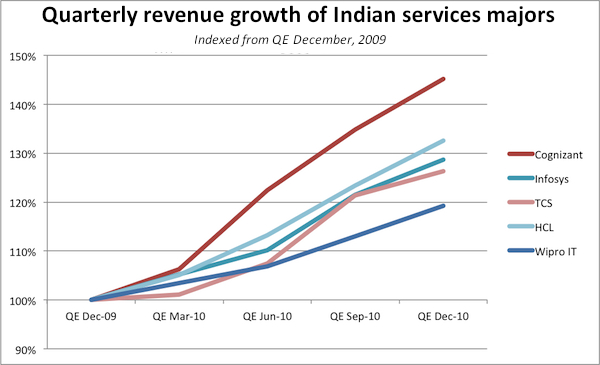
Cognizant had an unprecedenced growth spurt in 2010, attaining annual revenues of $4.59 billion – up 40% year-over-year. We have arrived at the growth peak of offshore IT services, and Cognizant has led this acceleration coming out of the Recession.
Things have certainly kicked on since we talked with President and CEO, Francisco D’Souza, a couple of years’ ago, and what’s alarming for the rest of the industry, is that “Frank” (as Francicso tends to be called these days) isn’t resting now. The company has provided guidance for 2011 predicting revenue growth of at least 26% – and this is a firm that tends to stick to the conservative side of its financial predictions.
So we caught up with Frank this week to discuss the dynamics behind Cognizant’s growth, the state of the services industry, the global economic outlook and (of course) his perspective on the Cloud, among other issues. Here is part 1 of this 2-part interview:
HfS Research: Frank, firstly, congratulations on such a barnstorming financial performance – and over such a prolonged period of time. What’s the “secret sauce” you can share with our readers? Is it all about focus on revenue growth and account management, or are there other critical elements to achieving such prolonged financial success?
Francisco D’Souza: Thank you, Phil, and congratulations to HfS Research for a great inaugural year and to you on being named Analyst of the Year.
As for Cognizant’s success, we have always been very open about our “secret sauce” – we put our client first. Of course every professional services firm approaches the market that way, but we have made some unique business decisions – namely our reinvestment model – to support that principle.
Cognizant manages our non-GAAP (before the impact of equity compensation expense) operating margins in the range of 19 to 20 percent – below that of many of our competitors. We invest that difference back in to our business in a number of different ways.
For example, in strong client facing teams. Our 2-in-a-box model – which pairs an on-site client manager with an offshore delivery manager — provides superior customer intimacy and an enhanced relationship experience. We continue to strengthen that experience through investments in consulting teams and, most recently, in Program Management resources capable of driving large-scale organizational transformation.
We also invest in new service offerings to stay on top of our clients’ evolving business and technology needs. Offerings such as Infrastructure Services, Business Process Outsourcing, Enterprise Analytics, and Engineering & Manufacturing Solutions give us entrée to serve clients in new areas as the offshore “share shift” continues.
And, finally, we hire and retain the best talent in the marketplace. Last year we added over 25,000 associates in over 50 centers across 22 cities around the globe. We improved already strong relationships with key Indian universities – a primary source of talent for the company – and began an undergraduate recruiting program in the US and Europe to capture a new pipeline of strong talent. And we continued to provide the best career opportunities for our existing associates by, for example, promoting nearly a third of our workforce in 2010.
HfS Research: We’ve talked a lot about the changing economy and secular change within industries over the Recession years. Now the fog is lifting, is your outlook any different?
Francisco D’Souza: While we continuously refine our outlook, we see things unfolding the way we had anticipated. The economic environment is generally more stable, IT and Outsourcing budgets seem to be showing modest increases, and Cognizant’s investments over the past few years position us well for growth at the intersection of three large trends.
The first is expansion in the scale and scope of global sourcing to new areas – the so called “share shift”, which accelerated during the Recession. Our clients’ intense focus on operational efficiency served as a catalyst to examine what activities are core to their business and what should be done from somewhere and by someone else. As a result, companies are driving more work and corresponding budget to a global delivery model, thus expanding the addressable market for traditional outsourcing. We also see significant opportunity as we continue to take the offshore model to newer geographic markets such as Europe, AsiaPac, Latin America and the Middle East. In aggregate, scale expansions in to new geographies and scope expansions in to new processes represent a market opportunity that is as large as, if not larger than, the traditional ADM market.
The second is continued spending on discretionary projects as companies embark on transformational programs to address secular changes in their industries. These projects range from companies rationalizing complex back-office infrastructure by consolidating data centers, virtualizing servers, and modernizing legacy applications – to implementing or upgrading packaged software to support efficiency and effectiveness in the middle and back office. Once again, we see clients becoming increasingly comfortable using a global delivery model to execute these large, complex transformational engagements.
And the third is a new set of services and solutions that companies are adopting to embrace the new business models, new technologies and new generation of workers and consumers that form the foundation of a new Future of Work.
HfS Research: Cognizant talks a lot about the Future of Work. In a nutshell, how is Cognizant gearing up to service its clients, bearing in mind this future vision?
Francisco D’Souza: Cognizant has very publicly shared our view that three global trends that are rapidly redefining the “new normal” and reshaping the way forward-thinking companies operate.
The first is a new generation of highly distributed and virtualized business models that push global talent integration to new levels in search of dramatically better efficiency and effectiveness.
The second is a new generation of cloud, mobile, and social technologies that are redefining the range of business problems that technology can help address.
And third is a new generation of workers and consumers that grew up with technology and has dramatically different expectations about how they interact with companies.
Francisco D'Souza, President and CEO of Cognizant (Click for bio)
In this virtualized, globalized environment where new technologies like cloud computing and social networks intersect with the millennial generation, clients are looking for better ways to organize teams, cultivate innovation, allocate resources and reinvent knowledge processes. This is how we define the Future of Work.
To illustrate how we’re gearing up to support clients, let me use two examples. The first example relates to a new class of “Business Process as a Service” (BPaaS) outsourcing solutions. Through the investment in new services that I mentioned earlier, Cognizant can provide clients with a fully integrated solution including IT infrastructure, applications and business process outsourcing to solve a specific business or functional problem. The client pays for the outcome and, generally, does so on a transactional basis. This model appeals to a client base that’s looking to replace fixed capital expense with variable operating costs that scale with demand.
An example of this is the work we are doing at Eli Lilly & Company, where Cognizant is deploying a comprehensive BPaaS solution to support US sales and marketing operations. Our solution covers a range of functions such as sales force planning, sales incentive compensation, customer relationship management, business reporting, data warehousing, analytics and state compliance reporting. We are excited about expanding our portfolio of solutions aligned to these unfolding secular changes.
A second example where we are geared up to help clients is in the adoption of new technologies to improve employee and customer experiences. Today, technology expectations are increasingly being shaped by the consumer world where sleek smartphones, always-on broadband, and boundless virtual personal interactions are the norm. Yet in the corporate world, the technology environment is far different. Clients recognize that the chasm between the state of technology in the consumer and corporate worlds is unsustainable and they are investing to bridge the gap.
We recently developed a mobile application for a global consumer products company that allows delivery personnel to collect competitive intelligence about product placement in retail stores. The application captures information about where competitors’ products are placed in each store, the amount of space they are allotted, and a qualitative opinion of how their own placement stacks up. Once analyzed, this information – which was previously not captured – provides valuable input to promotional decisions.
We increasingly see clients conducting pilots in areas around the Future of Work. While still early days, we are convinced that we are witnessing another large inflection point in the technology industry which will be a significant revenue opportunity in the long term. Our investments in creating practice areas around mobile computing, Cloud computing, social networking and a host of other areas position us well to take advantage of the opportunities raised by the future of work as this market opportunity unfolds over the coming years.
HfS Research: Your peer at HCL recently declared that private Cloud is “overhyped” (ahem) and will struggle to make a real impact. Other providers are jumping on the bandwagon and puffing up the marketing-volume, but many are guilty of defining it incorrectly and confusing the market. What’s your take on the whole thing – isn’t the Cloud a threat to the core offshore business model? India is branded as a good value location where you will get lower cost reliable services, however, doesn’t the ‘Cloud’ concept dilute the Indian brand…e.g., Come to the Cloud, which can be anywhere, not just India and get affordable, reliable, on demand services….any concerns?
Francisco D’Souza: Cloud computing represents a profound paradigm change in the way computing is delivered to end users. I would argue that the impact that Cloud will have on enterprises will be more profound than the impact of the client/server and Internet paradigm shifts. And while it’s true that there’s a lot of hype out there about the Cloud, we should not let the hype obscure the business value that cloud will increasingly deliver as the underlying technologies become more robust, secure and industrial strength.
Having said that, I see the Cloud as accretive to the offshore business model; it is not at all dilutive. Businesses are becoming more technology intensive – not less. So our clients will continue to need access to the best talent – regardless of where that talent is located. We view ourselves as a global service provider, not an Indian service provider. We are continually expanding our delivery network in to new geographies where we can tap in to world-class resources. There is no doubt that India is and will continue to be an incredibly important pool of talent, but by no means is it our only focus.
HfS Research: Clearly, these are the hyper-growth years for the offshore-centric services business, but we all know this growth can’t be sustained at such an intense pace for much longer. How does the offshore IT/BPO industry need to adapt to continue to be successful – where do the winning firms need to invest? Can everyone win out, or do you see only a few of the leading providers really staying the course?
Francisco D’Souza: As I mentioned earlier, there is a considerable amount of opportunity in the market. IT and BPO services represent a large market that remains very underpenetrated by offshore providers. This is especially true as companies rely even more on new technologies and expand the scope of services that they outsource to parlay the efficiency and effectiveness gains they see from IT into new domains. Having said that, I expect growth rates will inevitably slow as companies face the impact of the “law of large numbers”.
From a competitive standpoint, the model is changing. Labor arbitrage has become mainstream requiring providers to innovate and push the envelope to stay in front of evolving client demand. Companies that don’t will struggle to remain relevant. At Cognizant, our reinvestment approach has ensured we sustain our relevance. We are focused on new services – like Engineering & Manufacturing and Enterprise Analytics, delivering complex transformational engagements, and innovating new offerings driven by the Future of Work – such as BPaaS delivery models.
The biggest issue in today’s sourcing industry is the need for a truly independent and high-value environment for sourcing and outsourcing practitioners to collaborate and share knowledge.
The type of environment where buyers and industry folks can meet with each other, share their pain and success, access research, knowledge and data, and have the coaching, education and the advice they need to help their organizations cope with one of the most complex issues facing them today – how to source value from their global business operations.
At HfS, we’ve been micro-focused on helping the sourcing industry get past the puff and fluff to help them access and share research, knowledge and best practices, ideas and views. Oh – and have a bit of fun at the same time.
Today, we are delighted to announce an exclusive industry partnership with the premier membership organization that has served sourcing and outsourcing professionals from Global 1000 companies throughout a 20-year history: the Sourcing Interests Group.
Having personally been associated with SIG for many years and attended many of their events, it has always set itself apart as a venue where senior practitioners feel comfortable sharing their experiences and knowledge. The quality of their events, the detailed effort to develop superior content, debate and speaking line-ups, and its “family” atmosphere has always stood-out. You always came away wanting to be part of the SIG family and planned for their next gathering, as opposed to that “one off” feeling you get at so many other industry gatherings today.
And when their dynamo leader, Dawn Evans, took over the organization a couple of years ago, you could immediately sense the renewed energy and determination within the organization to establish SIG as an innovative networking environment.
So what does this partnership mean?
* SIG’s members have access to HfS Research’s extensive published research and knowledge. HfS has a prolific library of published research covering business process outsourcing (BPO), information technology outsourcing (ITO), cloud business services, shared services and governance strategies in addition to deep coverage of industry trends across financial services, manufacturing, utilities, energy, healthcare, retail and media sectors. HfS’ service provider performance evaluations, pricing strategies, market forecasts and sourcing best practices will also be available to SIG members.
* SIG will host the HfS 25 Sourcing Executive Council during its Global Leadership Summit in Seattle this October. The “HfS 25” is our exclusive research network of leading buy-side sourcing practitioners who meet regularly to share knowledge and experience to help shape the future direction of the sourcing industry. SIG provides the right type of professional environment for our council members to meet a broad network of sourcing practitioners and industry-side executives.
* Other benefits of the partnership include analyst time for members at SIG events, HfS research presentations, workshops and state-of-the-industry discussions at SIG events, and SIG member webinars led by HfS analysts.
Bottom-line: The sourcing industry now has the collaborative environment it has craved. Together, the SIG and HfS teams are providing the collaborative vehicle where sourcing executives can meet, collaborate and extend their learnings – both physically and from their PCs. This is Networking 2.0 – the new collaborative environment where the sourcing industry can create some value for itself – that is sticky, ongoing, self-perpetuating and educational.
We’ll see you all at 2011 SIG Global Sourcing Summit, March 15-17 on beautiful Amelia Island in Florida. If you haven’t already, I encourage you to register today. HfS COO Esteban Herrera will be one of the many speakers at the summit, which features a keynote by Steve Forbes, Chairman of Forbes Media and Editor-in-Chief of Forbes Magazine. We look forward to great year with SIG and many more to come after that.
We have always enjoyed your interaction at support at HfS and are excited to involve so many of your with our broader networking family. Stay tuned for many new ways you can all get involved. I want to personally welcome Dawn Evans and her great team to the HfS family.
Warm regards,
Phil
Phil Fersht | CEO and Head of Research, HfS Research | Tweet @pfersht
For more information in the HfS-SIG partnership, please email us at [email protected]
If Sigmund Freud was alive today, you might just find him at a sourcing trade show avidly observing some unique quirks of human nature.
And when considering his conclusions, you’d likely find him deep in discussion with HfS contributor and part-time behavioral psychologist from SourcingChange, Deb Kops.
Over to you Debs, for your evaluation…
Goin’ to the trade show, and I’m gonna get bu-i-i-is-ness
All weekend a parody of the 60’s song, “Going to the Chapel and I’m going to get married,” was tripping through my head as a result of spending a few days at an industry meeting complete with the proverbial “exhibit hall.” With so much time and resource spent in order to get the seller’s name out. I can tell you what I took away—dishwater coffee and a few logo’d pens, rubber ducks and thumb drives. What did they get?
Think of a trade show in any industry and the same elements come to mind—booths chock a block with graphically glowing descriptors, a great array of giveaways, a tray of chocolate, the proverbial “drop in your business card and win a Kindle,” bowl, and even in this day and age of online collateral, a few brochures declaiming leadership.
As it’s high season for expos, weeks, summits and what have you, it’s clear that the outsourcing and shared services industry hasn’t veered away from this recipe. With exhibitors keen to get prime booth real estate while sponsors happily take their money, it’s a good time to ponder whether spending all that dosh really moves the dial on brand.
Some of us trip through the hall only to register, while others religiously show up during breaks for muffins and popcorn. Some use the hall as a meeting point, while others traipse around each booth for the giveaways which go down so well with the kids we left at home. And perhaps even a few of us are sincerely interested in finding out more about Outsourcing-R-Us, or the advantages of locating a center in Trans-Mesopotamia or even the latest and greatest software that depreciates widgets automatically. But do exhibitors gain brand by setting up? And do we give them the attention they expect to get?
Walk into any exhibit hall and you’ll see a similar cast of characters:
Software vendors. These folks, generally mature guys, selling both platforms and apps to the sourcing industry, are always in their booths and seem to run in packs. Savvy enough to secure the 100 percent corners in the layout—or the spot directly across from the bar, they conscientiously man their booths both during exhibit hours and sessions. You’ll always see two or more together, proudly wearing their logo golf shirts or button-downs. A crowd is always around—is it the sexy set up, the great giveaways or are the folks in attendance already clients who are stopping by?
Niche providerswhose delight at having the marketing money to show up for the first time at a conference is palpably written in their smiles. The shiny new booth is equipped with a backdrop that lists about every service they deliver from any location that any end-user could conceivably want to buy—if they had the inclination to stand there and read the fine print on the list. For the young men who represent these firms, getting a pile of business cards and being able to talk about ‘why they are different’ seems to be the name of the game.
Eco-developersThe lady from Latvia or the man from Mauritius, sitting in a small booth, often seems uncomfortable when you stop by to mention that your grandmother grew up on a farm outside Riga, or that you once enjoyed a great holiday on the beach. Unsure of his or her English, and not wanting to let on that s/he did not fully understand, s/he thrusts a brochure extolling the virtues of locating a delivery center in said region/city.
Deborah Kops, Contributing Analyst, HfS Research (Click for Bio)
ConsultantsExhibit booths can perform like Venus fly catchers for consultants. Every once in a while some guy who is looking for a sourcing advisor just happens to stroll by, making the effort to set up a booth totally worthwhile. And when there are no buyers in site, the booth will serve as a meeting place for team mates who rarely have the opportunity to see each other.
Established providersput up a booth for brand enforcement, generally manning it with the marketing “gal” or guy whose main job seems to be playing go-fer for the brass who show up on Day Two to deliver the plenary speech. Often the booth is unmanned, perhaps under the assumption that the name in lights speaks enough about brand.
Now I’m the last person to say that building brand is not important. Indicating that an organization is part of the sourcing industry by showing up is a good thing. Walking through an exhibit hall is a quick way to see the latest and greatest in apps, new providers, which countries want your business, and, as importantly, meet old friends. And even the coffee is drinkable when it’s free. But do exhibitors get real business? You tell me.


 Is it just me, or is it just really irritating when people start using jargon that’s a load of cobblers?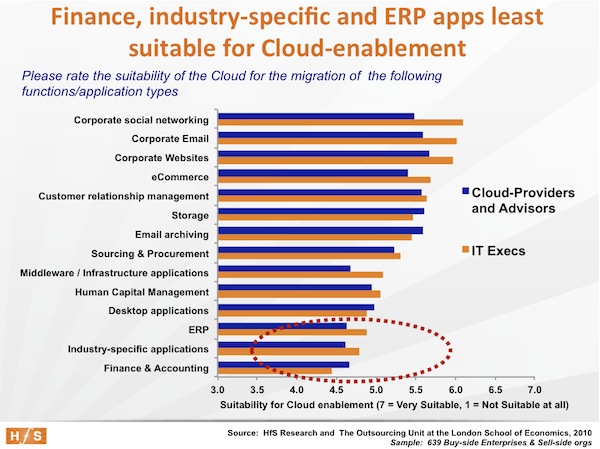




 *It would have been extremely messy if KPMG had tried to hire away these folks one-by-one. They have retained the top talent and have created careers for them within their organization.
 Yes, quite how this ramshackle outfit today celebrates its first birthday is quite beyond me. Exactly