Tune in, crank up the volume, or pop in your headphones in if you’re in the office. A few memories from the HfS team, as we ready for something just a little bit special, coming very soon to a laptop near you. And ask yourself – are you ready?
HfS Research, in partnership with the Outsourcing Unit of the London School of Economics, is hosting a webinar, sponsored by Accenture, featuring the key findings from the groundbreaking study of Cloud Business Services.
Cloudy with a chance of Davis, Willcocks, Fersht and Harris
Join HfS Research Founder and CEO Phil Fersht, HfS Managing Director Euan Davis, Professor Leslie Willcocks, Professor for Work, Technology and Globalization at London School of Economics, and Managing Director of Cloud Services at Accenture Jimmy Harris.
The issues on the table include:
The contrasting views and intentions of business and IT executives towards Cloud Business Services
The impact of Cloud on work culture and delivering competitive advantage
How both business and IT executives need to tool-up and prepare to adopt Cloud Business Services
The crucial role service providers need to play as Cloud Business enablers for today’s organizations
Cloud Will Transform Business As We Know It: The Secret’s In The Source
Thursday, February 17, 2011
11:00 AM – 12:00 PM EST
The “Amazing Horse Race” is the ultimate public bloodbath of the sourcing industry, as the “Buy Team” defends the title it so gloriously won last year in Edinburgh. However, this time it’s not going to be quite as easy…
Your host: Phil Fersht, Founder and Chief Executive Officer, HfS Research
1) The “Sell Team” has been bolstered by signing up Kevin Campbell from the Green Bay Accentures, Sheriff David Poole from Capgemini, Don “Shoot ’em up” Schulman from IBM, and Bob “Pokerface” Pryor from Genpact;
2) The “Influencer Team” miraculously appears from nowhere to feature such sourcing savviness as KMPG’s Cliff “The Judge” Justice, TPI’s Mark “Marvelous” Mayo, EquaTerra’s Bob “Bulldozer” Cecil, alongside HfS’ own Esteban “Evil” Herrera;
3) The “Buy Team” has recruited HfS’ own emeritus, the veteran of dodgy conference game-shows himself, Lee “Anti-vertical silo” Coulter (now with Ascension Health), the MSA master from MassMutual himself, Srini “KPI crusher” Krishnamurthy, Northern Trust’s Jay “Dangerous” Desai, and is rumored to be in discussions with Wal-Mart’s Michael “The Miracle” Lockard about securing his quarterback services. And a mystery buyer, endowed with special sourcing skills, may well be unveiled shortly…
We’ll be at The Peabody in Orlando for the 15th Annual North American Shared Services & Outsourcing Week with our friends from SSON. And on Thursday, March 3 at 8:30 AM, we’re expecting some fireworks.
We’ll be staging the ultimate contest of unbridled wits and cunning, by challenging contestants from the very peaks of the outsourcing industry: those who buy it, those who provide it… and those who influence it. We’ll discuss (and maybe, if you’re lucky) argue about these questions:
You won’t see a CEO being removed after achieving a double-digit growth rate too often, but that’s just what happened, when Wipro’s co-chiefs Suresh Vaswani and Girish Paranjpe stepped down last week.
Wipro eyes a new rhythm after Suresh Vaswani steps aside
And while I am personally excited to see TK Kurien take the helm, with whom I have had some excellent discussions over the years, I am concerned that some of the Indian service providers are so blinkered by today’s short-term explosive growth spurt, they may taking their eye off the long-term plan.
Remember, Mark Hurd was at HP for 5 years before leaving due to non-corporate activities, Sam’s been at IBM for donkey’s years, Vineet’s been leading HCL since 2005 and Frank D’Souza at Cognizant since early 2007. All these guys have led their companies though short-term pain to establish their long-term plans, and I would be highly surprised if any of them stepped away from their roles for a while yet, provided they avoid any late night HfS parties, or dodgy game show panels at conferences.
Wipro’s in good shape… but that’s not enough for Chairman Premji
Whatever the reasons behind the leadership change, you can’t mask the fact that Wipro’s financial performance hasn’t stacked up as impressively as the likes of Cognizant, HCL and TCS, despite reporting third quarter earnings of $294 million, up 10 percent from a year ago, revenues up 12 percent from a year ago, and IT services revenue was up 19 percent from a year ago. However, as we laid out in our 2011 predictions, the offshore IT spurt isn’t infinite, and we fully expect it so slow to a more modest pace towards the end of the year. So will Premji’s impatience to produce numbers as stellar as his competitors be rewarded, or has he already missed this phase of hyper-growth in offshore services?
Wipro has been at the heartbeat of the Indian IT services industry, and more recently BPO, during the offshore services industry’s entire rise to prominence. The firm has been more ambitious than many of its competitors on the acquisition front, notably picking up Spectramind, Infocrossing, Enabler and Inbev’s LatAm BPO center in recent years. Moreover, Wipro has today achieved a larger marketshare of the F&A BPO market than its prime India-headquartered rivals, Infosys, TCS and Cognizant. However, while Wipro delivers IT services as competently as most of the competition – especially with its capabilities around SAP, the company has suffered from a brand identity. It has too often finished second in a down-selections and customers have often struggled to fully understand the firm’s DNA.
The seeds have clearly been sewn for a bright future for the firm, and it clearly provides a wonderful platform for TK to make some telling tweaks. Let’s hope Premji gives him a bit more wiggle-room to take the company in a direction where he feels that Wipro’s not only pushing TCS et al. harder for marketshare, but also is readying itself for the next wave of offshore service growth beyond the current spike. We’ve been promised an interview with TK soon… so stay tuned.
Wipro’s new challenges are industry-wide and not solely confined to them
All-in-all, the challenges facing India’s offshore industry are the same for all the service provides – both traditional incumbents and the expanding offshore firms. These are challenges you can’t mask under a few quarters of rampant profit, they have to be embedded in the very infrastructure of the provider’s delivery model. This means the winners over the long-haul are already re-investing some of these profits on the following areas:
*Moving beyond operational IT work to position themselves as service integrators for clients
*Developing industry domain knowledge to be true consultative partners to clients, and not simply effective implementers of Six-Sigma and LEAN
*Blending business process acumen with industry analytics
*Executing employee development strategies that cross-trains talent across multiple business process and IT disciplines to work proactively with clients to support their innovation roadmaps
*Developing true IaaS and PaaS development capability to take industrialized solutions into a Cloud (shared service) utility model
*Developing real BPO scale that can flex with client needs as deal sizes shrink
Suresh Vaswani (pictured above) steps down as Co-CEO of Wipro. You can read our recent interview with him here.
It’s remarkable how quickly an outsourcing concept can spiral from concept to reality, when the ability to achieve real cost-savings is augmented by accessing insights and flexible resources. And that’s exactly what’s been going on with Legal Process Outsourcing (LPO) since we first broached the concept here two years ago.
Since then, we have witnessed a remarkable confluence of forces establishing the field of Legal Process Outsourcing (LPO):
*A maturing supplier market that cemented confidence in the theory of LPO;
*A growing volume of LPO supply that puts downward pressure on prices but confirms the wisdom of the early movers;
*Law firms remaining under margin pressure;
*In-house legal departments in the public sector and private sector facing significant cost pressure.
They may take away our lives, but they'll never take… OUR LAWYERS!
At HfS, we came across a stray Scotsman wandering the streets of Manhattan, eager to espouse the virtues of LPO to anyone who wanted to hear them – and, guess what, we did. Ed Brooks joins the HfS contributing analyst stable, having had 11 years in the outsourcing and offshoring sector leading over $5 billion worth of deals for the likes of Accenture, EDS and more recently TPI, in areas as diverse as Finance and Accounting, HR, Clinical Research, Customer Services, and Legal Process Outsourcing. Today, Ed runs his own expert program to support LPO buyers, discretely named “The LPO Program“.
Ed has contributed his first RAPIDInsight for HfS, entitled The Legal Process Outsourcing Landscape in 2011, that sets the scene for the industry. He begins with the edict:
LPO: Act Fast; The Offer Ends Soon; First Come, First Served
Anecdotally, these movements are summed up by two specific events in late 2010. First, in November, Thomson Reuters acquired one of the major LPO providers, Pangea3, buying out the same VC firm that had invested early in YouTube, Oracle, etc. While LPO has been around for many years, this was a major global corporation buying into this sector, giving it a new level of validity. No one would have been surprised if a traditional outsourcer like Accenture, IBM, or Wipro had been the buyer, but Thomson Reuters is a data and information company that sees the value of the “Knowledge” more than the “Process Outsourcing.” Combined with the astonishing number of LPO suppliers (we are currently tracking 135 on our LPO Market Watch database), this demonstrated genuine supply-side maturity.
Second, around the same time, at a conference in the Scottish town of Stirling (think Braveheart and you are in the right place), a survey showed that 15% of local authorities were considering outsourcing their legal departments. Public sector cost pressures in the UK are well documented, so the attraction is obvious. The surprise is that the legal department ranks as high as fourth in the priority of functions companies consider outsourcing.
Ed Brooks, Contributing Analyst for Legal Process Outsourcing Strategies, HfS Research
In the wider context it now appears that the Public Sector “gets” LPO, in-house legal departments “get” LPO, and our research shows that even the 83% of law firms that “would not comment” on their use of LPO are at least investigating it. If the Pangea3 deal confirmed the supply-side maturity, this fully confirms the demand-side market maturity.
Ed Brooks (pictured) is an HfS Contributing Analyst covering the field of LPO and leads his own expertise program The LPO Program. He can be contacted via email here.
Procurement BPO engagements aren’t about dating. They’re about getting married, something we actually think many people don’t realize. Remember this one point, and your chances of success with procurement BPO will increase on a log scale.
HfS and SpendMatters' Jason Busch team up to discuss procurement BPO marriages
Never mistake a BPO relationship for advisory or software. You can scrap a consultant’s deck and trash a software package overnight, but BPO is different. Just as in a marriage, you can’t fundamentally fix things if they’re already broken going in.
In Part II of our Procurement BPO market appraisal with SpendMatters’ Jason Busch (pictured here at a recent HfS strategy session), we get straight to the heart of the issues that buyers need to watch out for when evaluating a Procurement BPO endeavour. Essentially, you’re going to be sharing your proverbial corporate bedroom with a service provider, so you may be wise to read our joint paper “Designing an Optimal Procurement BPO Program: Process Expertise and Realized Improvement” first:
Egypt's crisis: The sticky topic of political risk with outsourcing is firmly back on the table
Like everyone else, I’ve been glued to the news the past few days trying to comprehend the enormity of the Egyptian crisis and the possible repercussions across the global sourcing industry.
Without dragging us into a political debate, what’s alarming is the dependence global sourcing has on the Internet and political stability. When the first response of the government, in times of political crisis, is to shut down the Web, this has a massive impact on the nation’s global sourcing infrastructure to support global businesses. While China clearly has the capability to regulate its Internet, you have to ask the question whether smaller, less affluent nations have that level of sophistication.
This is a major concern for businesses when they invest in critical support services in the region. While top-tier providers, such as IBM, Verizon and TCS rely on Egyptian resources, largely for call center work and software support and development, it’s hazardous when the government shuts off the Internet and all hell is breaking loose. What really concerns HfS is the unpredictability of problems like this surfacing, that can seriously impact the security and availability of key support services in areas such as IT services, finance and accounting, payroll, customer services etc.
Egypt, as an example, has proven capable as a good quality resource location for the Middle East, Africa and European regions in areas such as IT, BPO and call center services, and has invested significantly in promoting its capabilities worldwide. For example, Egypt’s Information Technology Industry Development Agency, ITIDA (website currently down) had planned to have a delegation at the forthcoming NASSCOM conference in India, and has invested heavily with McKinsey to support and help develop its capabilities. The country has invested millions to promote its sourcing capabilities – and now, that investment is looking under threat.
The rampant, viral proliferation of social media is clearly fueling unrest in many nations that have high unemployment and undercurrents of dissatisfaction among their younger people. If situations, such as what is currently happening in Egypt, proliferate to other countries with sourcing support services, the first reaction of governments now seems to be to “shut off the Internet”. You have to question how this impacts ITO / BPO services that are hugely reliant on a robust Internet to succeed – not to mention a stable political environment. The Egypt situation is a serious blow to many of the developing nations seeking to take their share of global services, which have potentially questionable political stability.
Advice to organizations with globally-dispersed support operations
1) Ensure your service provider has proven rapid response strategies to cater for unexpected political and geographical risk. In the case of Egypt, this could entail transitioning services to emergency back up units in locations that can service EMEA countries, such as Jordan, Israel, Dubai, or even Poland, Hungary, Czech Republic, Romania or Bulgaria.
2) Ensure you know exactly how and where your provider backs up all your critical data and protects it in the event of a government coup.
3) Ensure you have financial provisions to compensate for business impact as a result of unforeseen political and geographical risk. Ensure these provisions are clearly structured, with appropriate metrics to compensate for business downtime and associated lost revenues.
4) Invest in a political risk analysis of countries where critical business and IT processes are being supported. Compare the risks of occurrences, such as the Egypt situation, with the cost-savings and business benefits of using these locations. Saving 30% from your bottom line will be moot, if you can’t run your business properly for long periods of time!
The bottom-line
What is clear, is that Twitter, Facebook etc. are rapidly inspiring large numbers of people in nations with high unemployment to protest, where they feel their governments don’t “listen” strongly enough to their grievances, and aren’t pushing political reform at the same pace as economic reform. There is real fear now that the uprisings in Iran, Tunisia and now Egypt will continue to exacerbate in other nations, and this is going to have consequential ramifications on global sourcing decisions. Surely, this puts those nations with more mature political systems in a much stronger position to develop their services delivery industries. And in today’s post-recession global environment, this also includes onshore/nearshore/rural shore locations in countries such as the US, UK and Ireland, which have become more attractive in terms of labor costs.
Anyone on the analyst circuit knows the larger-than-life antipodean, Phil Hassey, who’s spent countless hours on soul-destroying coach-class slogs from Sydney to the US to expound the virtues and opportunities in the Asia/Pacific region.
Phil Hassey is HfS Research's new analyst contributor for the Asia/Pacific region
I personally got to know Phil when I was working in Singapore for analyst firm IDC (before I became a cynical blogger), when Phil led the Australian / New Zealand coverage for the firm’s IT/BPO research. I learned quickly that Aussies always make good “whinging” analysts – how many cultures do you know complain all bluddy day long, before hopping off to catch a few waves on Bondi beach at 4.30pm in the afternoon?
Anyhow, Phil’s no-nonsense style led him to establish the Asia/Pacific services research for Springboard Research, before branching out on his lonesome to start his own research venture, “CapioIT”. Well, we couldn’t let a good Aussie slip our gaping need to cover the Asia/Pacific markets, and we’re thrilled that Phil’s thrown hit hat in the horse’s ring to pony up a couple of BPO appraisals of the region for us in 2011. Let’s hear more straight from the Hassey’s mouth…
Phil Hassey muses over the Asia/Pacific BPO market landscape
I am very excited to have the opportunity to work with HfS and the team that Phil has successfully pulled together. As mentioned, I have known Phil for a long time now and have admired the work he has undertaken to drive research innovation in the BPO marketplace.
My first BPO research was undertaken in 2000, when I wrote one of the first reports on the Asia Pacific BPO market focused on CRM BPO. The future was bright at that time as the big offshore providers of CRM services such as Teletech and Sitel increasing investments in offshore centres, particularly in the Philippines with a plan for focus on delivery of services to local Asia Pacific clients. At the same time in late 2000, IBM stated at an AP analyst briefing that they would not be interested in the BPO marketplace.
Whilst a lot has changed in the 11 or years since, embracing of BPO has not been as strong as anticipated. BPO across the Asia Pacific is still a market with clearly unfulfilled potential both in terms of market demand and service provider capability. Obviously the two are linked. IBM, driven by CRM outsourcing through the Daksh acquisition is now a leader in non transactional BPO in the Asia Pacific region alongside Accenture. The call centre/CRM outsourcing market did not mature nearly as quickly as expected.
In Australia, the AP BPO market is at its most mature, however by US standards, unlike IT Outsourcing, it still clearly lags in terms of customer uptake. The last five years have seen a lot of interest in BPO, but ultimately limited commitment from enterprise. I like to joke that 2-3 years ago, there were more BPO pilots in Australia than at Heathrow or JFK airports. The reasons for the lack of enterprise commitment are varied, they include more organised labour forces in Finance and HR and customer care, and outsourcing fatigue through publicised IT Outsourcing problems. Highlighting the opportunity that exists in the market, the lack of providers means that supply side issues are just as important as buy side issues. Accenture and IBM aside, there are very limited services providers that have the requisite scale to successfully provide capabilities in markets in Asia Pacific. This is of course a chicken and egg situation. The deals need to be there to get the investment and I believe the deals will not happen until the investment is made. Some bold calls will be successful if researched well enough.
Across Asia more broadly, strategic BPO is even further from Australia in terms of maturity. The same issues as Australia remain, in a positive note increasing numbers of enterprises are becoming more familiar with the benefits of BPO. Many of the individual country markets do take their lead from a targeted number and type of companies, vendors should firstly identify these enterprises, then focus on them in order to drive BPO adoption more broadly.
Naturally enough, It must be repeated regularly that Asia Pacific is a large and incredibly diverse market that does not take kindly to being generalised in sweeping statements. We have half the world’s population and workforce. A strategy that works in Singapore may not work in neighbouring Malaysia; something that works in India will definitely not work in China. Understanding these subtleties is critical and without practical experience, my experience has highlighted that it takes time and several false steps before success can be enjoyed.
You can read more about Phil’s background here, email him at [email protected], or even find him on the Aussie twitter @phassey
We’re excited to announce a couple of terrific new additions to the core research team at HfS. Our goal is to provide our research clients with a unique blend of “real world” sourcing expertise, backed up with real-time research, market data and analytics. We’re also working with multiple buyers to develop the industry’s first realistic transaction-based BPO pricing model.
To achieve these lofty ambitions, we’re pulling together a blend of quantitative analysts with sourcing experts who “get” what this industry is all about, which takes us to our two new analyst hires, Brian and Jamie:
Brian Robinson
Brian Robinson joins HfS as senior analyst covering sourcing strategies and price benchmarking. With more than 12 years of consulting and industry experience, Brian has lived and worked on four continents, where he’s served clients across a number of industries, including energy, banking and insurance, consumer products, and automotive.
Brian spent the last four years with the outsourcing advisory firm the Everest Group. Progressing from Consultant to Senior Consultant and then to Engagement Director, Brian advised a number of the world’s largest outsourcing buyers and providers. During extended engagements, he served clients onsite in the US, Australia, India, Japan, Canada, the UK, and the Netherlands. Brian holds a B.S. degree in Industrial and Systems Engineering from the University of Florida and a MBA from the Darden School of Business at the University of Virginia. You can read more about Brian here
Jamie Snowdon
Jamie Snowdon joins as Principal Analyst, Market Sizing and Forecasting. Jamie focuses on developing market size data models and forecasting, supporting ITO and BPO price benchmarking analysis, in addition to contributing to HfS written research. Prior to HfS, Jamie spent seven years at analyst firm IDC, where, as Director for IDC’s European services group, he managed all of IDC’s bespoke services research and market modeling and forecasting processes. Jamie specialized in delivering custom market forecast models and forecasting tools for a host of clients. In addition, Jamie ran IDC’s European outsourcing research, covering both IT and business process outsourcing.
Since 2006 Jamie has taken time away from the analyst world studying to complete his law degree, before making his return to the analyst fold with HfS.
We’ve known each other for a while, haven’t we? You’ve seen us evolve from a blog to a research analyst firm over the last four years. Now we’re taking the next step in our evolution and launching our official company website for HfS Research (gasp): HfSResearch.com
Don’t worry, Horses for Sources will remain right here (and with these HuffPo multiples, it’s going nowhere for a while!), but we’ve created a spiffy new home for our research. A special thanks to our marketing chappy, Mark Reed-Edwards and our developer/designer Melanie for burning the late hours these past few weeks. Over to you, Mark, to explain more…
We’ve created an entirely new website for our research content. HfSResearch.com, featuring our new logo (which you may have already seen here and there), went up quietly last week. After working out a few of the bugs you expect (and get!) with a new website, I want you to rush over there right after reading this post. First, though, let me tell you a bit about the site.
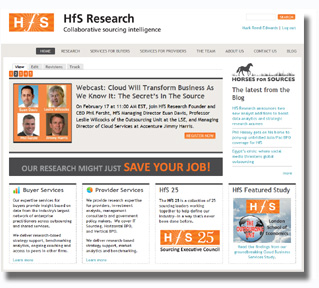
The homepage
From the homepage, you’ll be able to access the latest research from HfS, as well as other hot topics, including the latest Horses for Sources blog posts and featured studies, such as the Cloud Business Services study we conducted with the Outsourcing Unit of the London School of Economics.
You’ll also get an overview of our research services for buyers and providers and links to our rich archive of published research, which we encourage you to browse. And that brings us to that section of the site.
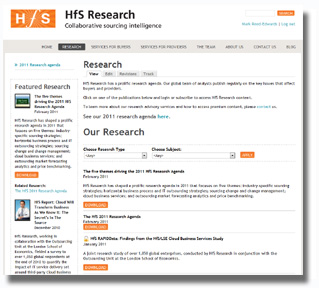
The Research page
On the Research page, you’ll see the wealth of work we’ve done. have the ability to browse the research type, and the subject area.
We’ve got you covered on the following subject areas: Benchmarking, Business Process Outsourcing (BPO), Cloud Business Services, Deal Advice, Europe, Middle East & Africa, European Strategies, F&A BPO, Financial Services Sourcing Strategies, Governance Government and Politics, Healthcare/Pharma Outsourcing, High Tech, HR Outsourcing, HR Strategy, Innovation, IT Outsourcing (ITO), IT Services, Knowledge Process Outsourcing/Analytics, Latin America, Legal Process Outsourcing (LPO), Manufacturing and Retail Sourcing Strategies, Media & Entertainment, Mergers and Acquisitions, Multisourcing, Negotiations, Procurement and Supply Chain Sourcing, Service Provider Coverage, Social Media, Software-as-a-Service (SaaS), Sourcing Change Management, State of the Industry, and Utilites and Energy.
Review our Research Agenda, have a look around and tell us what you think.
The rest of the site
The pages that cover our services for buyers and providers give you an overview of how we’re helping our clients navigate the sourcing industry. You’ll also be able to read more about the HfS 25, our exclusive Sourcing Executive Council. Plus, you’ll get a look at the handsome global team we’ve assembled, and learn a little bit more about HfS and what makes us tick.
If you are a member of this site, you should’ve gotten an email instructing you on how to set yourself up on the new site. If you didn’t get that, drop us a line and we’ll make sure you get sorted right away. I am thrilled to be able to share HfSResearch.com with you. We hope it will serve you well. Like everything on the web, it’s a work in progress. We’ll never really be done with it. But we do want your thoughts. So kick the tires and take the site for a spin. Then give us your feedback so we can continue to improve it.
So, what about the blog you’ve come to know and love?
With AOL buying HuffPo for $315 million, we’re not about to give up on our dream of world content dominance here on the Horses for Sources blog. And we know how much you rely on, and enjoy Horses for Sources. With Valentine’s Day approaching, dare we say, you love it?
So, look for us to make the blog an even more compelling destination in the months to come. In the meantime, continue to enjoy Horses for Sources as well as HfSResearch.com.