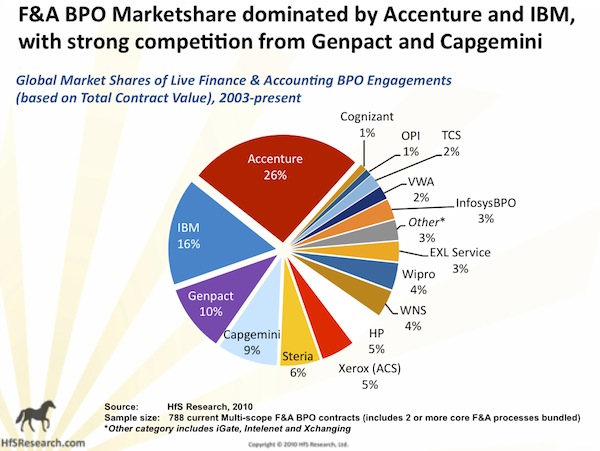
We’ve been wallowing in white papers, plied with PowerPoint and overwhelmed with oratory, but despite all the chest-pumping, the very latest market picture of F&A BPO sends us one very clear message:the market remains dominated by a small handful of established service providers, while the market entrants of recent years have struggled to make a major impact.
Our forthcoming market analysis of the global F&A BPO marketplace, which breaks down 788 current multi-process engagements, to be released shortly on HfS, delves deeper into these market dynamics.
Not a lot has changed in recent years, as over half the market expenditure for all live engagements sits in the hands of three providers, and several of the multi-billion dollar IT services market entrants are clearly struggling to take any significant share away from the “Big 4” incumbent providers; Accenture, IBM,Genpact and Capgemini. HP and Xerox (ACS) have lost some ground, especially in light of their recent mergers, while the smaller pure-plays WNS and EXL are impressively holding their own against the likes of multi-billion dollar offshore giants Wipro, Infosys, TCS and Cognizant.
But won’t this situation change, as deals continue to get smaller?
The prime reason why the “Big 4” F&A BPO providers dominate marketshare, is their ability to pick up multiple deals in the $50m+ range over recent years, increase the scope and renew them – with Accenture proving the most adept at wooing large enterprise clients and cultivating their portfolio. The newcomers, over recent years, have struggled to win many (or, in some cases, any) mega-deals, and have aggressively sought to grow their respective footprints by taking on much smaller-sized engagements – many of which fall into the sub-$5m TCV category.
However, the following data shows the deals steadily decreasing in size, with this year’s average falling below $20m for the first time, so isn’t this shifting the advantage to the newer market entrants, more eager to take on small, less profitable engagements and grow them?
Bottom-line: people-scale is still the key to creating a “plug and play” BPO model
The IT services offshore goliaths, which have recently entered this market, are quickly learning that BPO isn’t IT, and you can’t scale from 10-to-200 employees within each of your clients within a couple of years. Most will be lucky if they can scale from 10-to-30 FTEs over the course of a five-year engagement.
Scaling a global BPO business based on multiple small client engagements is wearing on resources – and profit margins, and the providers scrapping for their share of the smaller business, are faced with a simple choice: Either stick with it and view this as a 10-year journey, or if you simply don’t have the patience or appetite to put in the investment, then get out and refocus your services on other activities.
For those who stay the course (and we expect most will), they need to keep putting in the grind to win small engagements, and attempt to scale their BPO delivery resources, while trying to turn some sort of profit. An acquisition or two along the way wouldn’t hurt, either. However, for the established providers, the simple fact they have much larger delivery resources working on bigger, and – in many cases – significantly more profitable engagements, puts them in a stronger position to compete for the small stuff. They can literally plug in new clients, reallocate personnel, and balance resources – often without having to invest in a lot of additional personnel to service the client. Moreover, having a broad F&A staff-base also helps providers expand into related BPO areas where staff can be trained to work on different processes, for example insurance claims processing, order management, merchandising support, and so on.
Common technology platforms, common process workflows and Cloud provisioning, are all tools to increase the multi-client shared-service capability for providers, but you can’t escape the simple fact you need flexible, ample, people-delivery resources to win the business in the first place.
How can enterprises find unbiased coaching, advice and data to help them make the right sourcing decisions, but then also have the expertise they need to transition into a sourcing environment?
The role of consultants claiming to provide these services has been under constant scrutiny in recent years, as the outsourcing of IT and business processes become a mainstream component of organizational strategy.
Boutique outsourcing advisors have roamed industries for over two decades, providing structured roadmaps for taking enterprises into an outsourcing transaction. Enterprises usually bring them in, once the “O” decision is made, to perform the operational tasks necessary to develop a scoping document, find an appropriate provider, negotiate an agreeable price for themselves, and take it to a transaction. Most of these boutiques tend to be small and specialized, existing in a little world of their own where they hobnob with providers, frequent the same events, speak the same language and regurgitate the same slideware year after year, as not a lot really changes in the world of number-crunching outsourcing deals.
However, in the last couple of years, the major consulting firms have finally realized they need to cater for the demands of an increasing majority of their clients, which have chosen to go down the outsourcing route. The results has been too many competitors chasing advisory engagements that enterprises are increasingly finding too costly. Hence, the outsourcing advisory market is embarking on a wave of consolidation that is likely to result in a different landscape of competitors by the end of the year.
The outsourcing advisor consolidation kicks off with TPI and Compass being paired up
To kick off 2011, the first acquisition involves outsourcing benchmarking consultancy Compass by TPI’s sole investor, Information Services Group (ISG), essentially creating an outsourcing consultancy of several hundred consultants with global breadth, armed with benchmarking capability.
With the increased focus on outsourcing advisory services from management consultants such as Deloitte, KPMG and PwC, the souped-up TPI/Compass creates a super-boutique that can compete effectively in the market for the complex enterprise engagements that require a lot of hourly-billable heavy-lifting. There’s little doubt this merger helps bolster TPI’s credentials as a serious player, now the big boys fancy their piece of the action.
However, when we look at the current enterprise needs for outsourcing support, we see a dire need for enterprises to receive a mixture of consulting advice and data, served up in a less expensive, easier-to-digest format, than the $500-per-hour model. With deals across ITO and BPO getting smaller in scope, and enterprise buyers getting increasingly familiar and knowledgeable about outsourcing, we question whether this latest merger is really addressing the changing market, or whether its merely a continuation of consolidation in the intermediary space.
HfS Research has been alerting its readers and clients for months about the limitations of benchmarking data and the need for a practitioner’s interpretation. From that perspective, the acquisition of Compass by the largest sourcing advisory consultancy makes sense, especially given TPI’s lack of a credible source of industry data. The combined capabilities of the two companies bring them closer to delivering real market intelligence to their customers. However, the economics will be tricky: each is a premium-priced participant in their space. There is a potential for conflicting philosophies too: Compass never succeeded at deal advice, so it could afford to advise clients not to do a deal, whereas TPI, like any advisor, effectively kills the most profitable part of its pipeline if it advises against a deal. You may recall this datapoint from Compass in 2007, which the firm was only too happy to release to the market:
“65 percent of outsourcing contracts terminated before the actual date of termination over the past two years…Two thirds of outsourcing contracts worth more than £20m are ‘unravelling’ before the end of their contract terms.” Compass, 2007 .
What this transaction will mean to industry constituencies
If you are an IT outsourcing buyer, one of your potential advisors just got more formidable, in the sense that they now own data they didn’t before. However, this combination of capabilities is not new: Alsbridge acquired ProBenchmark over two years ago and Everest went the in-house route building the Everest Research Institute, though its mission is more “research” than “data”. Buyers should also beware of the cost of benchmarking. Keeping the databases current and relevant costs money—it may be tempting for buyers to think that they are getting “free” benchmarking with an outsourcing advisory engagement, but sometime, somehow, somebody is going to have to pay for the benchmarks or the business isn’t viable.
If you are a BPO buyer, there’s nothing new for you here, unfortunately. The dearth of reliable industry data is not made any better by the mere combination of two companies. Perhaps this is something the enhanced TPI will seek to address. But there is only so much any company can do given the wide range of BPO solutions on the market today.
If you are an outsourcing provider, your nemesis at the negotiating table has a new weapon. Because Compass’ IT data is relevant and current, it may be used as additional leverage. The benchmarking clause, already a bane of your existence, becomes even more crucial in a TPI deal, because they can actively seek to re-engage every year through Compass’ benchmarking offering, so expect even tougher negotiations. The counter-arguments haven’t really changed, though, and a strategic judo-like move might be to push for greater transparency in the benchmarking methodology, which remains quite obscure across all benchmarking firms today.
If you are a competitor to either one of these companies, you probably should not expect much change. Certainly TPI will bring a more complete and compelling offering to the table, but its competitors by and large have had similar capabilities. HfS does not expect this acquisition to swing more deals one way or the other, and there were probably very few deals in which the two companies went head to head. As TPI and other advisors add benchmarking and research capabilities, it does increase the pressure on the big-firm advisory units (KPMG, PwC, Deloitte, Pillsbury) to add these offerings in order to compete for new business. If you play in the benchmarking space, you can expect to see a push for Compass to benchmark TPI-advised deals, perhaps raising your barriers to entry at some accounts.
Overall HfS Research thinks this deal plugs part of the data gap for TPI and most of the consulting gap for Compass, and in that way is synergistic. However, we do not see major market movement or new offerings as a result. In many ways, this is two of the bigger players, in their respective slices of the industry, coming together to do what many of their smaller competitors have already done.
mmmm… some tasty ADM here, with a sprinkling of BPO
As if he didn’t have enough on his plate already following his rapid rise to HfS fame and glory, we sent Esteban Herrera to mingle with the elite of iGate and Patni to take a closer inspection of the first billion-dollar sourcing marriage of 2011…
At one point, there were over 200 investor-backed ITES providers in India. Today there is one less, as iGate has entered in an agreement acquire a majority stake in Patni. The world does not need 200 ITES outsourcing companies in India, so on that level this is a good thing.
In fact, as mergers go this is a fairly synergistic one: a high-growth, innovative company acquires a bigger but staid, stuck competitor. The vertical strengths of the two companies have little overlap, and the two companies together will sell a respectable billion dollars, giving them some clout in this hyper-fragmented market.
That said, a billion dollars ceased to be a big deal in this market about six or seven years ago, so like much of the other M&A activity we are seeing, this feels like too little too late. iGate has been making the right noises for some time, with outcomes-based pricing and combined BPO/ITO offerings, but one has to wonder why it hasn’t made even more of an impact—if those two characteristics alone are real, they should be eating the lunch of their larger competitors who don’t know how to spell risk and could not break down their organizational silos with a battering ram. But they aren’t. To be sure, adding Patni’s 16,000 or so employees will add scale, but everyone knows that’s not what makes a merger work.
A significant source of concern is the Achilles heel of all acquisitions—will the cultures fit? If you listened to the two company’s calls to brief analysts, it was hard to believe they had actually spoken to each other during the process. Then, this nugget from Patni: “Management, as you know, was not involved in the transaction.” Say what? It appears Patni’s owners and investors pulled the rug out from under their management team, and the mood was palpable even through the phone line. On paper and in principle, this acquisition makes a lot of sense, but execution is what separates the successes from the abysmal failures, and the Day 1 coordination does leave something to be desired. Printed materials and Patni suggest that it will be run as an independent P&L within iGate, but the message from the iGate folks was integration all the way. HfS Research is still wondering why the two companies even had separate calls.
In typical HfS Research style, let’s take a quick look at what this means to the various impacted constituencies:
Customers
iGate’s customers will generally benefit from a more disciplined delivery method espoused by Patni. Patni customers may well take advantage of iGate’s more innovative commercial models to transfer some risk and better align goals. This is all dependent, however, on the delivery teams from both sides being willing to work with each other, teaching, coaching, and knowing when to hold back. If you are a dissatisfied Patni customer (and we don’t know many), this is, of course, an opportunity to trigger your change of control clause.
Shareholders
Patni’s founders and General Atlantic had a decent day. $1.22 billion is not a huge multiple, but given that Patni had its “For Sale” sign out longer than a Nevada foreclosure, it was to be expected. iGate suddenly finds themselves in the world of leveraged buyouts—perhaps not where they intended to be. Debt changes a company’s behavior and iGate is going from having almost none to speak of, to carrying a large burden. There is nothing wrong with debt per se, but management of debt-ridden companies requires a different skillset than managing cash cows. Similarly, investing in leveraged companies requires a different stomach than investing in pristine balance sheets.
Employees
Patni employees can be heard breathing a huge sigh of relief—two plus years of uncertainty have ended. And except for those in the redundant functions (a decided minority) they appear to have pretty good job security post-transaction. iGate has cultivated a decent employer brand and will likely bring some energy and enthusiasm to the ranks of Patni, but it would be unreasonable not to expect turf wars and resentment, especially amongst long-term employees on either side who see themselves as “losing” in the transaction.
Overall, this is a synergistic, common-sense transaction and HfS hopes the combined entity will make a bigger dent in the marketplace, especially with innovative commercial models that better match risk and reward and simplify end-to-end services. At the same time, we doubt that this acquisition is sending shivers of fear into any of the larger competitors. We’ll be monitoring the situation and keeping our readers apprised.
In her latest contribution to HfS Research, contributing analyst Deborah Kops of sourcingchange.com delves into the trials and tribulations of shared services leaders tasked with selling the value to their internal customers…
“In most organizations, believe it or not, shared services delivery models (read: centralization of operations through outsourcing or shared services…or both) is still optional. While the C-suite huffs about new business models and efficiencies, they often espouse the “Build it and they will come” approach, neglecting to use their considerable clout to really change the way the organization works.
“So the poor shared services team is left holding the bag, thinking they’ll get good air cover from the top brass, yet finding out very quickly that they are no different from a third party provider when it comes to sales and marketing. Yet few have the experience or the expertise to go out hat in hand, selling the model as a truly compelling proposition.
“Ultimately, shared services success is simply about growth. If, like a provider, the model can scale across the enterprise, it’s a raging success. But getting there is the trick. In her latest article for HfS Research, Deborah likens shared services growth to eating sushi—most people will eat the ingredients individually, but few like the wrapper…”
Find out more by downloading the article How do you get them to eat sushi over at our Research Page.
What’s your New Year’s resolution? Watching Service Integration too, we bet…
HfS analyst Euan Davis, fresh from his recent escapades with Cloud Business Services, is dedicating 2011 to exploring the synergies created by the acceleration of Cloud Computing and Service Integration. His journey begins with a look at an “intriguing” partnership just inked between Logica and Microsoft… over to you, Mr Davis
So what’s your New Year’s resolution beyond enjoying yourself less and working more? Mine is to shape the debate around Cloud and watch how some IT services firms morph into “Service Integrators.”
Looks like I am in good company too, as I hear Europe’s Logica begins its New Year by inking an intriguing partnership with Microsoft. What, at first glance, looks like a rather mundane partnership really signals something else: That its going to be the business driving Cloud—Logica gets this and so does Microsoft. And each needs the other.
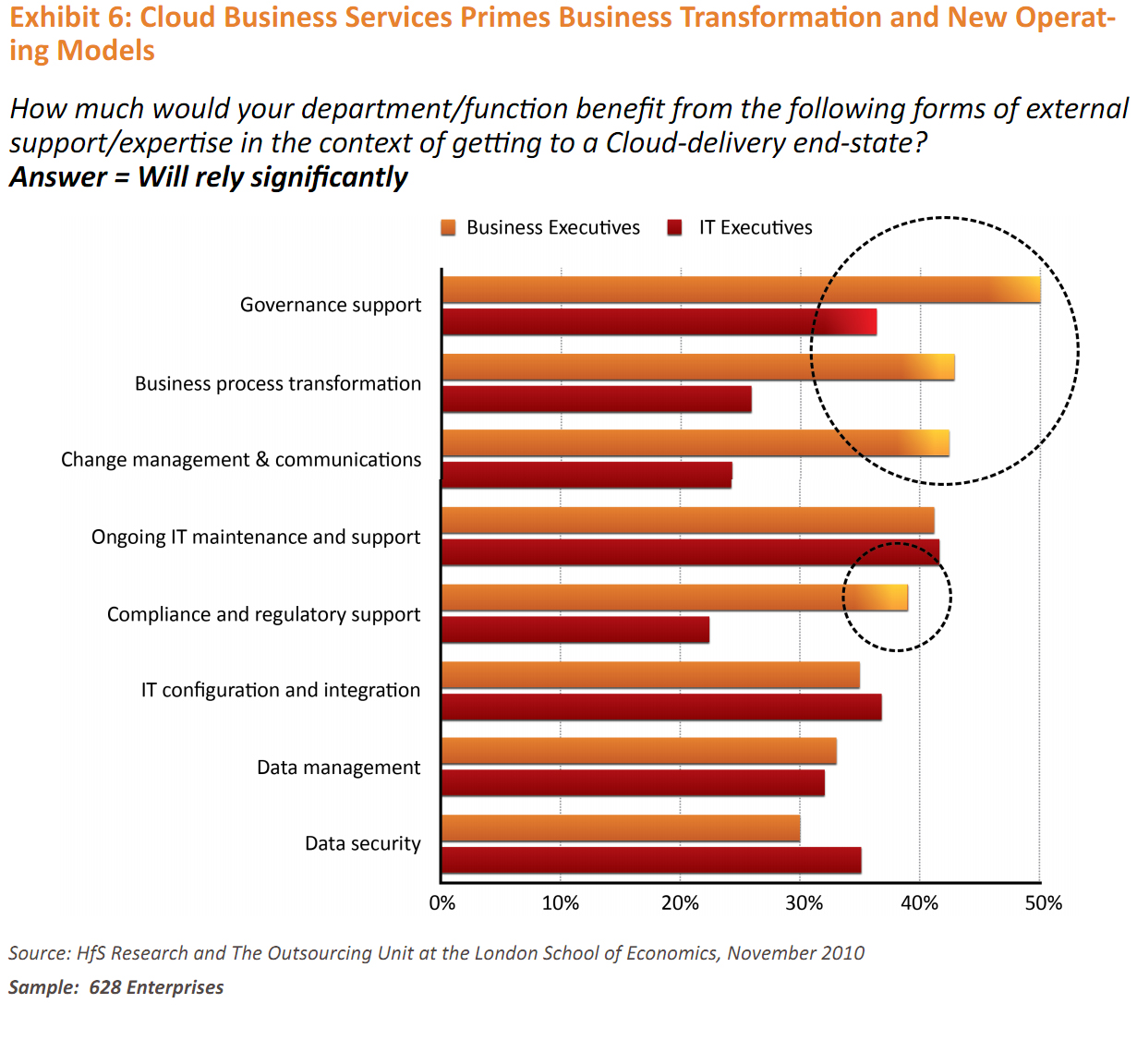
Our latest report shows Cloud Services triggering potentially large-scale business transformations and opening up demand for new operating models as firms look to source, rather than build for Cloud. But who’s going to integrate the services? Will it be the internal IT shop making the complex integration across cloud based services and applications work? My take is that those IT shops that can’t quite cut the mustard face a tough choice—learn how to do it quickly, get someone else to do it, or end their days as a cost centre managed out of existence.
The larger system integrators (like Logica and its peers) are betting that you, the buyer, will look to them to be your “Service Integrator.” That means they get to work with you to set-up and monitor an operating model with each step in the service delivery process mapped out and marked as it crosses out to the Cloud and back again, process by sub-process, right down to the data packet itself. Microsoft’s platform-as-a-service offering Azure certainly helps here with the architecture but Logica is in the driving seat to make Cloud a reality with its customers through its domain expertise and a collaborative DNA (must be its weirdly Nordic DNA) that pulls in a wider ISV community that can innovate and create cloud enabled industry solutions to solve business process problems. My research points towards business thinking the same way about service integration as it makes its journey to cloud—governance, transformation and change management are in the bag of tricks that business executives are looking for to make Cloud a reality—check out what sort of third-party support they are looking, from our recent cloud report:
Click to enlarge.
Mark my words—2011 is going to be a very interesting year and it’s one set of resolutions that I am going to be able to keep.
We were very saddened to learn that Joe Vales passed away this morning peacefully in his sleep. Joe was a pivotal and hugely popular figure in the outsourcing marketplace for many, many, years (long before we were around), and graced many events and occasions with his charm and wit. He was also a highly accomplished and respected marketing veteran, having been pivotal in helping position PwC’s BPO business for a decade, until 2001. Instead of retiring, Joe set up his own advisory firm, which he was still running until his untimely passing this morning. An avid fan of HfS, he will be sorely missed by us, and am sure many of you will be equally saddened by his passing. He was a sweet and lovely guy, who loved his work.
He was most loved by his wife, Louise, five children and grandchild.
Joe’s daughter, Kerryann, adds the following:
“He loved watching people he worked with years ago, when BPO was first getting attention, become the power houses that are shaping the industry today. He considered the nickname given to him “Father of BPO” an honor and working in this industry to this day a privilege.
“For Notre Dame, he was a Varsity letterman for the basketball team and has a plaque on the Hall of Champions out there for his excellence on the team. What college you went to would seem like something most people would let go of at a certain age, but ‘once a Notre Damer, always a Notre Damer’ – and he was always finding a reason to talk about the blue and gold.
“There are so many things that made my dad great. But his favorite word for people he valued was “special.” If he called you “special” you were in his circle for good. I would say my father is without a doubt, special.
“His passion and dedication to his craft was just unparalleled.”
Jason Busch: Expecting more cowbell… and more from Procurement BPO
The struggle with procurement BPO has typically been the belief that either moving labor from higher to lower cost regions, or re-badging employees from corporate to a BPO provider, would alone be enough to achieve results.
This is especially the case where BPO providers streamline transition costs over the duration of a multi-year contract, allowing the BPO customer immediate cost savings and limited (if any) upfront payments for resource investments. The results are often a “one-time” savings, the sourcing general who masterminded the deal is flavor of the quarter, and everyone goes back to their daily grind.
When the sourcing general eventually realizes she or he needs to make additional investments in process transformation and technology, they find it exasperating to go “back to the well”. The CFO is hunting for that next bite of cost-efficiency and is shocked to learn they should have made some discreet investments in their BPO engagement from the onset. Costs are always like hedges… if not carefully managed, they grow back with a vengeance.
To tackle the issue we teamed up with HfS Expert Contributor, Jason Busch of SpendMatters fame. Jason also assumes the role of senior advisor for the coveted HfS Single-Malt Foundation, where he has excelled in his duties.
Lo and behold, our research suggests that this type of behavior, along with other indirect spend challenges, ultimately resulted in many initial BPO endeavors targeting indirect spend inside companies to come up short.
Ever wonder where those banners and pop-up ads you see as you surf the internet come from? We did, too, until we met Scott Golas, VP at Centro and Transis MediaOps, which serves up millions of ad impressions every day.
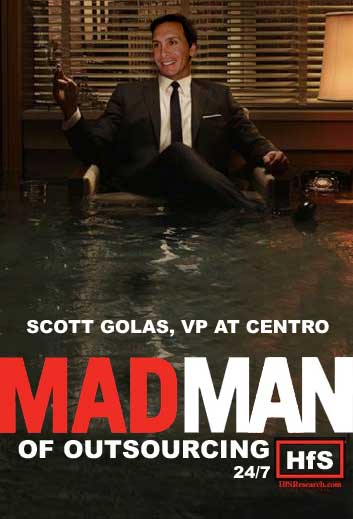
Scott Golas, VP at Centro, Madman of Outsourcing
Scott has developed a unique reputation in the sourcing industry over the years, having been a practice and strategy leader in his earlier career with the likes of PwC, Aon Consulting and, more recently, Booz Allen Hamilton. Hence, it is no surprise to us that he is now helping take the world of online advertising into smartly sourced business models.
What’s caught our attention with Centro, has been the firm’s creation of Transis, a self-described “digital platform surrounded by services”, which forms the centerpiece of a revolutionary new outsourcing service for ad agencies’ online media functions. Transis essentially streamlines the process of planning, negotiating, trafficking and billing so agencies can devote more resources to strategic thinking for their clients.
Centro is now taking the function of advertising-process sourcing to an entirely new level with a new managed services offering, called MediaOps, that will enable advertisers to outsource their entire digital media operations, which are typically onerous to run, and complex to get right. This will allow the ad agencies to focus their talents on creative and targeted ad campaign management.
HfS Research’s Phil Fersht and Mark Reed-Edwards had the chance to catch up with Scott recently. Rather than diving right in to a discussion of Centro, we were interested in learning how Scott got where he is…
Scott Golas, MadMan of Outsourcing
HfS Research: Scott Golas, good morning to you and thank you very much for spending time with us today. Before we dive into talking about Centro and the work you’re doing there, you’ve had a very colorful career, Scott. You’ve worked for numerous different companies. Can you talk a little bit about how you got to where you are today?
Scott Golas: Sure. I won’t go back to the very beginning; you probably don’t have enough tape on your recorder. I began a consulting career prior to Y2K with PwC out on the West Coast around HR transformations and outsourcing large system implementation. I spent most of 2000 after making a foray into the dot-com land bubble with a VC incubator here in Chicago called divine Interventures. For the remainder of the decade, I was either with Aon which is a large insurance brokerage, consulting, and outsourcing firm bringing their offering to market or with an analyst researcher consulting firm. I landed here at Centro in early 2008 and that was really—as most good job interviews or good job offers come—over cocktails at a restaurant. One thing led to another and I joined Centro several months later.
HfS Research: Centro offers some proprietary technology in the media business. Can you tell us a little bit in broad terms what it is Centro does and what’s the core value proposition of the business?
Golas: Yeah, I’ll try not to use acronyms or specific industry technology, but you can think of Centro as basically an operations service provider to agencies, and occasionally directly with brands. It’s all around digital advertising. Anything from the pop-up or banner you see on your laptop to digital out of home (DOOH) to widget that scroll at the bottom of your mobile phone. Anything related to digital. We don’t currently do anything in traditional media, TV, radio, or print. At the end of the day, we facilitate massive amounts of transactions (from concept to cash) between advertisers and publishers.
In this case the publishers are online publishers. Because of the complexity of executing digital, it’s very difficult for agencies and brands to do that efficiently. If you think of an ad that you see for vodka or something like that, that same ad in print is going to be the same ad whether it’s in Forbes, Sports Illustrated, or Fortune. That same ad digitally, if you were to place that on 20 different publisher sites could require 20 different versions depending on the size of the ad, where it was placed, where it fits in the publisher’s rotations and on and on. Digital advertising is much more complex that traditional.
There was a study done not too long ago by the AAAA (American Association of Advertising Agencies) that said that executing digital advertising is three times more difficult than any traditional media. So it’s complicated and expensive to do. The buys are typically smaller and we help advertisers and agencies do that much more efficiently.
HfS Research: So MediaOps is almost like—in simplistic terms, almost like a human platform for digital media?
Golas: That is probably an easy way to explain it, yeah. It’s a digital platform surrounded by services. From one end of the spectrum you can—as an agency, do it all yourself, research, plan, buy, etc… with the publishing community without our involvement, just by utilizing Transis, or we can do it all for you, via Centro Media Service. The new offering, MediaOps, is a hybrid, once you have planned and bought advertising using Transis we’ll help execute, optimize, bill, and collect.
HfS Research: So if I’m trying to sell a product and I want to maximize awareness in advertising through the internet, if I were to use traditional means it would go to media buying agencies or an ad agency. Can you just talk about how much more cost effective and how much—how different it would be leveraging your platform versus a traditional model?
Golas: I guess the biggest distinction is that we focus on the entire spectrum of the advertising continuum, including the mid- to long-tail of the advertising world. So if you just want to buy a network, for example Yahoo or something that’s pretty easy for you as the agency media planner buyer to do, you can do that without us. With most networks, you’re not really sure where your ad is going to end up or when it’s going to run but it will be cheap and you’ll get the impressions (aka volume) that you’re looking for. However if you’re trying to target buyers, if you want to reach 18-34 year old males who bought a Chevy truck in the last year and eat pizza, in certain geographies—you’re going to have difficulty doing that as a media planner buyer. It’s especially difficult to do that for many clients in multiple markets with varying launch dates. This industry still relies heavily on email, faxes, and spreadsheets. If you try and do that with a few publishers you might be able to do that. You’re going to have to negotiate rates, you’re entering into a contract, and you exchange digital assets. Now if you extrapolate our example and want to target the example we just talked about but need to do it nationwide with 30 publishers…you would be hard pressed to do that. That’s where we come in and we help out.
HfS Research: How typically do you support clients when they engage with you and your technology platform (Transis)? Do you generally provide them with round the clock or is it very much the client has to figure it out for themselves? How does that work?
Golas: It’s a fully supported model. It’s a SaaS-based platform. We’ll go out on site and sit with your media planning and buying team for as long as it takes them. We transition them off their spreadsheets, faxes, and paper intensive processes. We’ll upload all their contacts that are sitting in their Outlook databases. We’ll spend days there or a week, whatever it takes to build a plan, get them comfortable with Transis, and eventually wean them off that until they’re more comfortable with it. You find the early adopters within an organization and work with them and they’re the evangelist for the new technology and services.
HfS Research: Okay, so is the idea eventually to have the media buyers access the SaaS platform (Transis) directly, with a license model, and then they essentially get what they need. Or is this normally like a custom approach? How is that model going to work in terms of how the use it on a day to day basis?
Golas: The technology that we launched in 2010 is in adoption by over 50 agencies right now. It’s the initial the beta version of the product. So we’re working very collaboratively to address any kinks and bugs. Right now Centro is involved in about 1 percent of all the digital transactions that happen in the US, that has historically been done through our full service model. We still think there’s a huge marketplace with that other 99 percent of the pie that we can help agencies research, plan, buy, and execute digital. Whether it is completely self-sufficient using the Transis technology or the hybrid model.
HfS Research: Scott, that 1% is not an insignificant number, is it?
Golas: No, it’s a huge dollar amount. There’s a huge advertising market and it’s coming at an ever increasing rate from traditional media to the on-line world. It doesn’t matter what analyst or research report you read it’s about a 90/10 split right now between traditional and digital. The gap between traditional and digital will close at an ever increasing pace.
HfS Research: Scott, what’s your biggest competition out there? Is it DIY, or are there other agencies doing this?
Golas: We’ve got a couple. When I say traditional business, it’s not like we’ve been around as long as Ford or GM. We just celebrated our ninth anniversary, so we haven’t been around that long. Our traditional business is that model I mentioned before; working with agencies who are our primary customers—and hammering out everything once they complete the creative.
Our biggest external competitors—we’re about ten times their size. For the sake of this conversation, a formidable competitor would be Cox Cross Media coming more so from the traditional world than digital. But your comment at the end is on target: our main competition is agencies wanting to do it themselves.
Assuming that they’re even doing digital, and it’s mind boggling how many agencies don’t offer that now, simply because it’s too difficult to do. As you can imagine, most agencies began with traditional roots, and they’re migrating over to learn the digital world. But they were hit hard during the recession we’re coming out of, and budgetary cutbacks, and all the new channels they have to learn, they need help figuring it out so they come to us.
HfS Research: So when you deal directly with a company do you also help them find people to do creative or will you take what another agency has created?
Golas: If it’s a brand directly, the creative work is more so cleaning it up so it works on all the different ad services and technologies on the publisher sites. We’ll get it, we’ll QA it, we’ll check it, we’ll make sure before we load it up, before the campaign is scheduled to go live, that it actually works on the publisher’s site. A lot of our creative work there is fixing it to match standard ad units and sizes. We do work with a lot of smaller and regional agencies that don’t have the creative capabilities, and we help them out as requested.
HfS Research: Okay. How is this platform going to change the traditional advertising model scope? Obviously it’s bringing technology and capability into play, but do you think this could eventually start to cut out the middle man and start so you could just work directly with the corporate buyers?
Golas: Here’s our hope: We’re big fans of advertising in general online and the creative world and what we think has sort of drained out of advertising in the last couple years is that creativity. We hope that by peeling off all the commoditized, very high transactional work that agencies spend time doing, they’ll be able to focus more on what their clients are trying to accomplish and build very cool, creative ads. By working with us, they enhance their capability to find the buyers of their products and have a lot more time to devote working on this strategy and creative with their clients. It’s not an area that we want to play in to be frankly honest with you. We know we do what we do really well and that’s operations and execution. Our bailiwick is anything from post creative to collection. Anything before that is the purview of an agency.
HfS Research: In terms of a lot of the broader outsourcing industry I’m thinking of here, you know I’m thinking of companies like Accenture or Infosys who invest a lot of money in their own—in their own sort of digital content and support services for clients, do you actually think that they might become a future channel for a company like Centro as clients need to get more savvy just around traffic on internet, understanding how to maximize awareness of products and things? Do you think that this at all is going to become bigger than just intelligence for placing advertising but something that can be used more broadly in terms of marketing for clients?
Golas: I would think after a period of time if you look through a genesis of most of outsourcing products or solutions, you know someone is going to make a foray into this arena and prove it can be done really well. It’s usually someone who comes from a strong operational background and marries that up with technology that’s been accelerated or that is going to garner attention. It’s either going to garner attention from the large consulting firms, existing outsourcers, or an existing technology company in the digital landscape who have a lot riding on this, like the Google’s of the world or Yahoo or Microsoft. They all have huge vested interests in search, display, and digital online. If they can make the dollars flow online, which is what we do, I would assume that would be attractive.
HfS Research: How can people actually leverage a tool like this to help them in very quick terms understand how to maximize their digital presence?
Golas: I think one thing to note about Centro—and Transis, which is the name of the technology—is that we’re agnostic. Compared to some of the other ad server or technologies that are out there I can think of—let’s use the biggest one: Google’s purchase of DoubleClick and their ad server a few years ago. There’s a pretty violent reaction from agencies to put their data and all their information on the DoubleClick ad server—just a fear of what Google could do with it. Likewise you hear a lot about demand-side platforms (DSP) and networks. Those are all items that are, I won’t say proprietary, but generally a demand-side platform is only as good as the access to inventory that you have. A DSP by nature is not going to get every publisher on a buying platform. They’re just not, well, one, physically able to do it and publishers are not going to give up that control. Where we fit in is—we don’t care. We plug into any of the back office applications that an agency or publisher works with.
Our SaaS tool Transis sits on the desktops of thousands of publishers right now to help manage these transactions. So if you’re an advertiser worried about rationalizing numbers between ad servers it is a huge task. But that’s how people get paid nowadays. You know, we take that pain out of the process and we try to make it work for both sides. We’ll rationalize the numbers between different servers and technologies so people feel comfortable about getting what they paid for and not over paying.
HfS Research: Okay, that’s interesting. So in terms of how the outsourcing model is going to work or where you think it’s going to play out in the medium term, do you think it’s mainly going to be a product which is going to be a product leveraged by the media agencies and clients will still go to the media agencies and the media agencies will talk with Centro or do you think it’s going to be a mixed model where you’ll have some clients directly with the buyers and others directly with the media agencies? Have you nailed down that strategy yet?
Golas: I haven’t nailed it down. I mean, you hit on really the two major components. The outsourcing solution that we’re bringing to market is called MediaOps and we have clients right now in both of those models so—we have a couple retailers that have Transis on their desktop and we’re handling the execution and likewise we’re working with agencies directly. So the plan as it looks right now is an agency (or brand) utilizing Transis will do all their research, planning, negotiating, and buying. Once an agency executes a contract (insertion order) with a publisher they will hand it off to us and we’ll take the creative assets and pretty much run it all the way through to billing and reconciliation.
HfS Research: Okay. When you look at the growth of the broader BPO market it’s interesting when you look at companies like Aditya Birla Minacs, for example, who do a lot of marketing operations already for some global clients. For example, they work with Apple on distributing iPods through certain networks. I can think of other service providers that are getting intimately involved in the marketing process. Do you think that could be a future channel as well? As these companies get more involved with their clients marketing process to start offering the management of your platform through that channel?
Golas: Yeah, I think that is a very good suggestion. One that we have frequent discussions about on where we should go—whether it’s new technologies to pursue or partner up with or new geographies to go into. This industry is the most dynamic one I’ve been involved in. In the near term it’s really focusing our attention on our full service platform, or Transis (self-service SaaS solution), or the MediaOps service. Getting them up, getting them ready, making sure we’re delivering on what we’re doing and now expanding the access to technologies or geographies. Both Transis and MediaOps are less than a year old. We want to make sure that we have them fully operational and that we’re doing what we’ve committed to before we get over our ski tips.
It’s an excellent suggestion, Phil, one that I’ve seen up on white board amongst many others. But we want to just stay focused though.
HfS Research: Okay. Where do you see the biggest growth potential in this short medium term for the company in terms of services versus the software based solution? I mean I’ll give you an analogy here of a couple of companies who did sales incentive management solutions for sales folks. There is one company called Callidus and another company and they’re called Cipher and it was interesting because Callidus decided they were going to do the one to many model and sell the product through IBM and they’d sell it at like five cents on the dollar and go purely for a licensed sale and have IBM manage all the clients and services rendered around that. Whereas this other company they realized that something like sales incentive management wasn’t something that you could put entirely in a software package without having some element of semi-customization to the client’s needs. They started to build like a support center with about 200 staff in it where they could actually support clients on a kind of subscription model as they leveraged the package. It’s interesting to see how both companies are growing in terms of revenues. Do you think that you’ll be moving more down the line of having a sort of services layer that sort of supports the products than just going straight for licensed sales down the road?
Golas: Right now I believe the later model you described is what we’re pursuing right now. I want to maintain ownership over the technology; we’ve got a large development staff here in Chicago. By nature of our agile development methodology, we roll out new product features every two weeks. So Transis is very dynamic, and we can adapt to handling changes being requested by clients, we can fix things very quickly. We’ll be out in the market really soon. There will be a dedicated software sales force and support organization and also someone selling outsourced services in the support organization.
HfS Research: This has been a fascinating story to hear this unfold and to hear a company that is moving into a broader sort of sourcing strategy with its technology. I mean, for you having spent so many years of your career in the traditional outsourcing business, having been out of it for a while would you ever want to go back to it?
Golas: I’m jumping back in with both feet. I think, unfortunately, outsourcing gets a bad rap at times. People automatically equate it with offshoring, they equate it with layoffs, which is just unfortunately a bad rap for outsourcing guys. I think it’s valuable to us look at how outsourcing has been around organizations back to the early days of payroll outsourcing. I’d be hard pressed to find an organization that doesn’t outsource some component of their operation. I think it’s just the next evolution. The advertising world has been a little slow to jump on the bandwagon but we know that they’ve outsourced IT operations, and some finance operations. So this is a huge component of their business. It’s a component that they frankly, if you could talk to anyone over a drink one night, they’ll tell you that they hate doing. They tell you that they love doing strategy and working with the clients. They love building creative—and solving problems for them, you know—how to get products off the shelf. And what we do is take all that operational, highly transactional, high volume work off their plate so they can focus on doing it.
It sounds repetitive or it sounds like it’s probably a mantra you’ve heard from other outsourcers, but that’s sort of the nature of the beast.
HfS Research: It’s almost comparable to what we’ve seen going on in the legal profession for the last couple of years with legal outsource processing. Where a lot of these little LPO firms have popped up which take on a lot of the administrative work. They can do a lot of discovery work, a lot of the really time consuming administrative tasks, and—which allows lawyers to spend more time with their clients and less time dealing with trivia so the client gets the benefit as well as the lawyer.
HfS Research: It’s interesting to hear these types of models developing in general and it’s great to hear the story that you’ve come out with so would you ever go back to the world of HR outsourcing?
Golas: Typically most companies have no idea where that money’s going, meaning their investment in human capital. So anything you can do to peel away the administrative transaction components of work and allow people to focus on what they’re coming to work to do, not HR—HR as the work that they’re involved in and HR as the functions. It typically comes with newer technology, newer programs, and access to people who are leaders in their areas of business. They are staying abreast of changes and new ideas and they know what’s going on and they can bring new plan designs and new technologies that you wouldn’t have access to. I’d hop back in it, sure. I still maintain that role and responsibility here at Centro. It’s one of our differentiators we believe in the marketplace, our focus on raving fan service is what we’re known for. We have great people, highly motivated, supported with some pretty bad ass technology. I think we’re going to be hard to beat.
HfS Research: Okay and one final question before we wind this up. If you could have your career all over again what would you do differently? Or would you do anything differently?
Golas: I think there’s very little I would do differently. I would have probably stayed working at the Grapevine Lounge, my first night there the Rolling Stones showed up after having played a concert downtown in Soldier Field (Chicago) and did their final set at 3:00 in the morning. Unfortunately I left two days later to take my first union job in the supermarket industry. So that sounds like a pretty cool place to hang out but I’m pretty happy in general. And I’ve learned a hell of a lot.
HfS Research: It’s definitely a matter of doing what you do best—and ad operations is not what agencies do best so it just seems to be an idea whose time has come.
Golas: There was a recent article in Forbes that I remember one interviewee saying the agency of the future’s is going to be ten really cool creative people, a lot of technology and they’re going to outsource everything else.
Our job is to help agencies be successful and I’m sort of paraphrasing our mission. But the way we can do that is to take what they would consider mundane and monotonous, transactional work off their plate. That makes us sound kind of masochistic but that’s what we do. We love it. Those are problems we love to solve and we solve it with great process and cool technology and just a great team here.
HfS Research: Scott – it’s been great catching up after all these years, and seeing you having such an impact on your industry with your experience of the sourcing world. HfS readers will surely be intrigued with all the great work Centro is doing.
Scot Golas (picture above) leads the workforce development, administration, real estate and several business development efforts at Centro, an online media buying technology services company. Scott has been a pioneer in the sourcing world for nearly two decades, having been a practitioner, consultant and strategist with the likes of PwC, Aon Consulting, PA Consulting and Booz Allen Hamilton. He can be reach at scott dot golas at centro dot net.
When our COO Esteban Herrera joined us last year, we definitely got more than we bargained for… try a fluent Spanish and Portuguese speaker with a deep working knowledge and affinity of the assortment of cultures south of the border.
Yes, there’s more to Esteban than merely a sourcing consultant sporting a painful grin after 14 consecutive hours of negotiations. So who better to examine Latin America, the Gigante Durmiendo of outsourcing. He’s written a great RAPIDInsight on the promise (and realities) of Latin America as a sourcing destinations, so let’s hand you over to Esteban to give you the 411…
Latin America: The Next Sourcing Frontier or an Afterthought?
I’ve been encouraged to see many providers paying more than lip service to Latin America as a region for growth and business opportunity.
Sourcing to LatAm: reaching new heights?
Previously the un-loved stepchild of the outsourcing geographies, Latin America does hold promise for those who approach it the right way—and there is more than one right way to approach it.
I have a personal soft spot for the region, since I got my start in offshoring managing service delivery from Brazil and Mexico before the word “offshoring” came to mean what it does today. I had a great time personally, but still to this day I have yet to find a more creative technical team than the one I led in Brazil, or a harder-working team than the one I was privileged to lead in Mexico. I could tell great stories about the quality of work I managed in Argentina, Colombia, and Costa Rica as well.
But you no longer have to take my word for it.
There are hundreds of multi-nationals and service providers delivering back office support from Latin America. A good friend who runs F&A BPO for a provider recently confessed that they had lost a number of deals because they could not adequately support their global clients’ Latin American needs.
I doubt the region can catch up to the Asian powerhouses in scale, but there are a number of value creating approaches to Latin American outsourcing/near-shoring that are proving successful. You can read about them, as well as the region’s advantages and challenges in our latest RAPIDInsight: Latin America: The Next Sourcing Frontier or an Afterthought?
Join Phil Fersht, Susan Cramm and Scott Liebs for "Which Cloud is Right for You?"
As you know, we recently published a groundbreaking study of more than 1000 business and IT executives on the future of Cloud Business Services, based on our work with the Outsourcing Unit of the London School of Economics, which we will be webcasting to the industry next month (stay tuned for the announcement). So we jumped at the chance to join up with CFO Magazine to give you some snippets of what you can expect.
On Thursday, January 27 from 2:00 to 3:00 PM EST, we’ll join CFO Editor-In-Chief Scott Liebs and Susan Cramm, the founder and president of Valuedance. Susan, a former CFO and CIO, is an expert on IT leadership and is the author of 8 Things We Hate About IT. Hmmm, only eight? She obviously doesn’t come here much 🙂
We’ll give you a glimpse at some of our data from our Cloud Business Services study, in additional to helping you get the lowdown on your Cloud options. Please join us.