How do you execute for Global Business Services? Click to find our more…
The complex sourcing options available to global operations leaders today can prescribe real opportunities for business improvement, but can also pose intricate challenges. As we’ve been at pains to point out on HfS over the years, outsourcing is only one vehicle to provoke change, impact cost and provide process improvement opportunities. 90% of enterprises, with over $1bn in annual revenues, have shared services operations, and these need to be aligned more effectively with the 97% of these organizations grappling with governing outsourcing relationships.
So how do you take shared services leaders and blend their expertise with the outsourcing governors? How do you go from fragmented service delivery with multiple points of contact, to a global governance model with a rationalized and centralized administration of third-party service providers?
» Focusing on the Customer – Global Business Services’ processes and technologies enable business unit strategies. Building alignment and sharing a vision is imperative to achieving successful results.
» Building the Service Delivery Model – Achieving economies of scale and scope requires well-defined and common business architecture. Effective organizations have a strategy to construct and leverage their global business service capabilities.
» Aligning Processes and Technology – Providing best practice back office services requires vision, agility, and coordination across multiple functions. It requires a focus on the provision of solutions, not technology.
We’ve been talking about Platform BPO, Cloud BPO and every other permutation of BPO for a very, very long time. So what’s changed, we hear you cry
Buyers are ready to standardize business processes
"Please mind the innovation gap"… click here to find out what Business Platforms are and why they represent the future of outsourcing
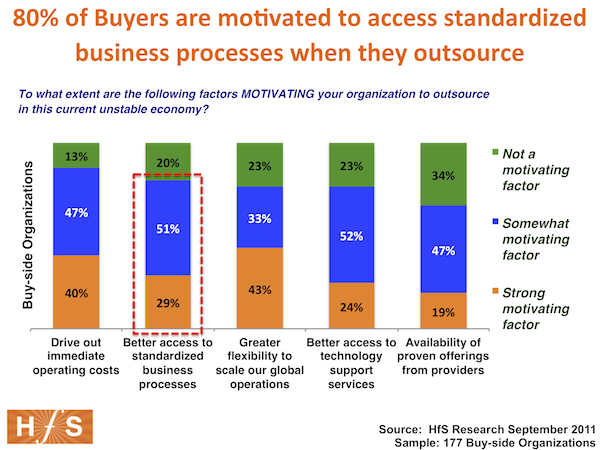
Our recent study that covered the intentions and observations of 534 buyers, advisors and providers with their sourcing strategies, in the event of this seemly ever-present threat of a “Double-Dip” Recession, revealed what is motivating buyers to outsource in this current climate.
While eliminating cost is an ever-present obligation, buyers are also equally focused on achieving greater flexibility to scale and support their global operations – and even more significantly – prepared to explore adopting standardized business processes.
Yes: 80% of buyers are willing to move onto standard processes. They are increasingly unconcerned if their closest competitors use the same expense management or claims adjudication processes, the same cash applications or collections tools. They simply want to adopt quality process flows they can deploy effectively and efficiently, if there is no competitive advantage to be gained that necessitates conducting these processes in a certain unique manner:
Providers have a real incentive to position productized and one-to-many (or at least one-to-few) utility offerings onto buyers
The ability to develop some best-in-class processes as “Business Platforms”, whether they focus on horizontal or vertical process clusters, is becoming a real differentiator in the market, as buyers seek more standardized solutions from their outsourcing engagements. Moreover, more process standardization leads to more Cloud-based BPO services where clients can easily tap-into these Business Platforms without having to grapple with cumbersome on-premise software and expensive licenses, or contend with resistance from awkward internal IT staff. In short, buyers can start to look at moving from “A to C” with adopting quality standard processes and miss out much of that painful “B” phase (which is often where many get stuck unto perpetuity).
So what are Business Platforms?
Business Platforms, enabled by the fusion of Cloud Computing, SaaS and BPO innovations in an integrated singular managed service, are emerging rapidly as the desired “one-to-many” utility service provision for providers and a new source of value for outsourcing buyers.
Buyers can now explore transitioning more rapidly to a desired future state for a specific business process, or set of processes. The gauntlet being laid out to providers, with these Business Platforms, is their ability to support their clients’ transitions quickly and inexpensively. Simply selling “products” is not the concept of business platforms – it is the provider’s ability to work with their customers to facilitate and support the ultimate business outcomes of managing the processes associated with the Business Platform offering.
Business Platforms have four key characteristics:
Business platforms provision managed standardized business processes;
Business Platform owners (services providers) are responsible for managing the business processes associated with the Business Platform and provisioning the people that operate them, the underlying software-as-a-service platform, and the supporting public of provate Cloud infrastructure;
Business Platforms focus on business outputs or outcomes rather than inputs such as labor and physical assets;
Business Platforms service more than one client
Well-executed Business Platforms provide customers with compelling technology-enabled business process services that help drive innovation via process re-engineering, greater business agility and productivity improvements. They are flexible and scalable in the face of global demand fluctuations and provide high-quality process workflows.
The Bottom-line: Business Platforms change the focus to the achievement of outcomes
The days of clients being able to spend multiple-millions of dollars to transform processes as part of a complex outsourcing transformation are fast diminishing. Subscribing to Business Platforms that consolidate infrastructure, middleware software, labor, and process/domain expertise including future investments, as OPEX is attractive to clients. Cheaper to get started, and with output or outcomes-based fees, Business Platforms align with the current budgeting trends evident in the market. Buyers of non-core operational processes do not want to go and ask for CAPEX in this economic climate.
With the paranoia of an impending Double-Dip Recession seemingly forever looming over us, what better than to help your clients get their bills paid?
With competition in Finance and Accounting Business Process Outsourcing (F&A BPO) reaching cut-throat levels (just observe some recent down-select negotiations and you’ll know what I’m talking about), what better than to acquire one of the most attractive onshore order-to-cash (OTC) specialists? With demand for comprehensive F&A BPO coming from both mid-sized, in addition to enterprise-level clients, what better than to acquire an OTC specialist with on-the-ground delivery expertise and a mid-market offering?
Our only surprise at HfS is that is took so long for one of the top tier BPOs to make this move – acquiring the 45-year old heritage accounts receivables and order-to-cash specialist, Vengroff Williams and Associates. A provider steeped in blue-chip clients at the enterprise level, such as Disney, General Electric, News Corp, Microsoft and Tyco, in addition to a raft of mid-sized clients such as Elizabeth Arden, U-Haul, Crescent Healthcare and Office Depot. A provider that has resisted the temptation to develop offshore delivery and focus on smart onshore services. A provider that has developed its own excellent SaaS proprietary order-to-cash technology platform, WebCollect. A provider with an annual client get-together called the “Billion Dollar Forum”, that you just have to go to, as its the closest thing you’ll ever get to feeling like a billionaire…
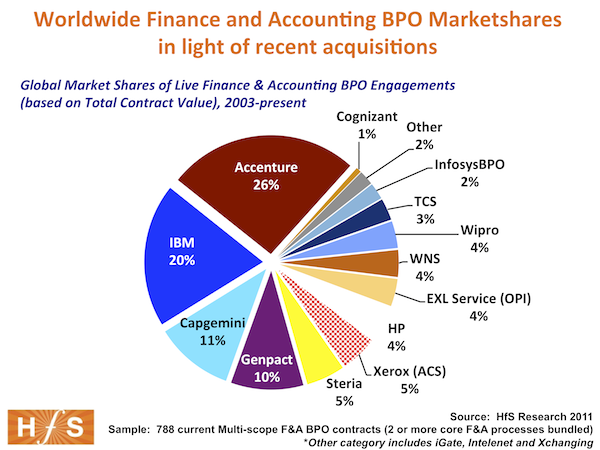
Yes, Capgemini has made a major move towards strengthening its position in the global F&A BPO market by today acquiring VWA – and leaping to third in the market share spot for F&A globally (which may change when we re-cast our data early next year, but for now they’re on podium). You can also read more about our 2011 F&A BPO market landscape and outlook by clicking here.
We believe VWA was one of the few remaining jewels that the major BPOs needed to take a serious look at to bolster their presence and capabilities in order-to-cash. Here is what they are adding to Capgemini’s global BPO business:
Positives of the acquisition
Expands Capgemini’s US onshore presence. Capgemini has traditionally been very strong as an International BPO provider – especially with its European and Asian presence, but has perennially been perceived as lagging in the US, despite having made delivery investments in regions such as Junction City, Kansas. VWA’s addition immediately solves this issue – and actually transforms the US region into a strength for the Capgemini, especially in light of its strong nearshore LatAm presence, with significant investments in countries such as Brazil and Guatemala to help service US clients;
The merger is a good cultural fit. The two firms have been working together on client engagements for some time, and know each other well. Moreover, VWA has a strong employee ownership culture and didn’t take this decision lightly – they wanted their own staff to ratify the deal. Several other potential acquirers have taken a good look at them and this “fit” was not nearly as strong;
Accounts Receivable BPO is booming and Capgemini is now firmly in the game. HfS is observing this market as topping $35bn this year and too many of the existing BPO providers have relied on subcontracting specialists (such as VWA) to provide the AR BPO services. By owning the process, Capgemini is in a significant positon of strength to price deals more aggressively and has more client exposure and capability to explore outcome pricing options. Plus, Capgemini can also go after standalone AR BPO deals and leverage its global presence to be very competitive in this market. Too many of the current crop of F&A BPO engagements have been dominated by accounts payable processes, and this added capability gives Capgemini the chops to go after deals aggressively with heavy OTC components;
VWA brings to the table a quality order-to-cash business platform called “WebCollect“. We believe WebCollect can really help both new and existing clients standardize on quality standard workflows, which our research is abundantly demonstrating is where much of the future of BPO is headed.
VWA’s business takes Capgemini into the middle-market. With saturation occuring at the high-end of the market, attention is turning to the middle-market (the $500m-$3 billion segment), where clients are frequently seeking “bigger-bang” and more comprehensive deals that the top tier providers can comfortably cater. Our recent State of Outsourcing industry study shows the increasing relevance of the middle-market to BPO services areas such as F&A.
This year, Capgemini has BPO as a top-tier service line which will help it capitalize on the acquisition. Rather than submerging BPO as a secondary service line under ITO, which some other service providers persist in doing, Capgemini’s BPO division now enjoys status as a major front-line services category in its own right. While this brings increased financial scrutiny from the board, it also empowers the division to get access to similar sales, marketing and development funds as those enjoyed by other top-line services divisions, such as consulting and IT services. This added marketing muscle will be critical for branding the VWA capabilities, as they are fully merged into the broader BPO division.
Potential challenges posed by the acquisition
Capgemini’s brand in the US. With all roads traditionally leading to Paris, this has been somewhat of a perennial weakness for Capgemini, when competing for US-centric BPO deals. However, major client wins in recent years, such as Coca Cola Enterprises and Avon Products have done a lot to increase awareness and exposure in the US market. Capgemini needs to leverage VWA carefully to improve further the awareness of its significant onshore US presence and brand awareness as an F&A BPO provider.
Too much focus on horizontals versus verticals. With Capgemini’s increasing strengths in F&A, procurement, supply chain and customer management BPO, the firm does run the risk of losing focus in some of the emerging vertical BPO markets, for example banking, insurance, life sciences, healthcare and energy. Capgemini needs to figure out how to develop and position its vertical strengths effectively and not become overly submerged in a horizontal play.
Potential conflicts with existing engagements. VWA is present as primary OTC “subcontractor” on engagements where Capgemini’s competitors are the primary F&A BPO supplier. This could create some contentious issues with regarding to working relationships and contract renewals. However, it could also put Capgemini in the unique position of potentially edging out some of its primary BPO competitors, so this could ultimately provide more opportunities than headaches.
The Bottom-line: this is a very smart acquisition by Capgemini
VWA fills many of the needs Capgemini has as an emerging F&A BPO powerhouse. There aren’t too many BPO acquisitions that appear to be as solid a fit as VWA into Capgemini, and the market for AR BPO is critical for future growth in this space. The next challenge for all BPOs is going to be creating more utility in the market to take on more clients, and the WebCollect platform has great potential to provide a platform this growth. HfS would like to see Capgemini embrace WebCollect and develop it over time to cater for clients with specific vertical requirements, for example in the retail space versus hi-tech and media.
Are you ready for our next installment of HfS’ Live and Unfiltered series, broadcast live infront of the HfS Research community? Well… wait no longer for more no-holds-barred fun, no sponsors, no schmaltz, no selling – just good banter and discussion to share with our industry peers and colleagues. Amd this time we’ll be debating the very “Future of BPO”…
Here’s the line-up…
The Buy-team
Roxanna Wall, Executive Director, Corporate Development at UBS AG
Colin Provine, Global Commodity Director, Honeywell
Ian Maher, Sourcing Management Office, The Hanover Insurance Group
Srinivasan Krishnamurthy, Vice President, Kronos Inc.
The Sell-team
Anoop Sagoo, Managing Director, Business Process Outsourcing, Accenture
One thing’s for sure – we’ve heard a lot of noise from the Indian IT services mammoths over the last five years that they are going to grapple with the likes of Accenture and IBM to become billion-dollar BPO giants. And while Cognizant, Infosys, TCS and Wipro have all made progress developing sizeable BPO businesses, none of them have yet come close to surpassing the size and scale of pureplay Indian BPO leader, Genpact’s $1.5bn turnover. Why is this?
The Indian ITOs have built their companies by occupying “real-estate” in the CIO offices of the Global 2000. They’ve done a phenomenal job piling in the people resources to support application testing, maintenance, help desk and development projects. They’ve developed institutional knowledge of their clients’ IT processes to support the business, which has proven cost-effective for the vast majority of leading global enterprises. Our recent state of outsourcing survey found 97% of $1bn enterprises outsourcing some component of their operations in today’s environment, with most of these organizations involving Indian ITO service providers within their supplier portfolio. However…
Developing BPO footprints requires cementing relationships beyond the walls of the CIO’s office. One of the reason’s for HfS’ success, is our ability to communicate with business function leaders, in addition to IT leaders. This involves understanding and lending value to supporting the business function issues and processes that impact finance, procurement, supply chain, HR and other operational areas. Most of our research competitors are firmly rooted in IT-land and have not invested in personnel that can open communication channels to support the business functions – and most never will.
It’s similar for the Indian IT services firms, as they seek to push business-process led solutions, often enabled by IT, into their clients. While many initially began their forays into BPO by attempting to reach business function leaders through their IT relationship, most have realized that they need a more direct line into the business function than tenuous introductions from the VP of CRM apps. They’ve realized they need to make significant investments in domain-specific personnel (with real process experience) both onshore and offshore, to create awareness and open communication channels, in addition to the scale they need to take on business. They’re also realizing they need patience to convert clients and often start with much smaller engagements and make margin sacrifices.
So let’s take a closer look at one of the up-and-coming Indian firms that’s made a concerted effort to build a top-tier BPO business over recent years: InfosysBPO, who recently invited us, and several other industry influencers, to partake in their anual BPO client event, named “Colloquium 2011“.
Is InfosysBPO ready to challenge for industry leadership? Here is our thinking…
InfosysBPO is now a major BPO contender in the global marketplace. Infosys has quietly gone about building its BPO business streams since its inception via the buyout of FAO provider Progeon, exactly five years’ ago and expects to reach the landmark of $500m in revenues this year. HfS has always been encouraged by the firm’s approach to developing both horizontal and vertical BPO services, and its focus on leveraging its IT heritage to augment its value proposition. Infy is by no means the biggest player in the BPO business nor does it want to be, but it has been able to establish itself as a smart and very respected player in the BPO business.
Overall, it has shown the rest of the industry how to grow profitably and maintain above-industry growth performance. Last fiscal, it grew its business from $352m to $427m, while maintaining operating margins in excess of 20% – the best growth performance than the rest of the BPO market. We believe it has also established strong positions in the retail and consumer products, banking, insurance and manufacturing industry verticals, in addition to the horizontal BPO areas of analytics, sourcing and procurement and finance and accounting.
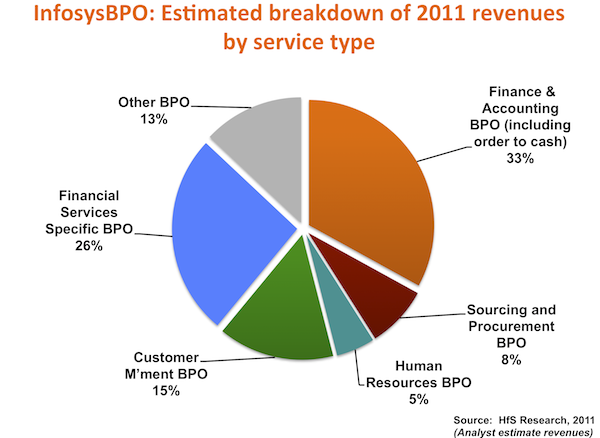
Consequently, today’s business takes on the following estimated revenue-breakdown:
HfS’ opinion of InfosysBPO’s strengths
Its open culture creates greater customer loyalty. Infosys has consistently been one of the most open BPO firms for introducing its customers to each other and instigating open and transparent dialog with industry influencers. Attend any of its BPO customer events and you’ll be surprised by the refreshing openness of the dialog where customers air their operational issues in an open forum and have practical discussion with their peers to share their best (and worst) practices. Too many of their competitors’ events make you feel like all the content is stringently policed and controlled with constant “rah rah” cheerleading of the provider’s performance. With BPO, we are dealing with real people, real business issues and real processes; clients today are too smart to be brainwashed and want to have the open, honest debate regarding how to get better at managing a BPO engagement.
Its organic growth performance has been exemplary. InfosysBPO has done a fabulous job growing its business organically – the best among its peer group of traditional IT offshore competitors. All its major offshore IT competitors have inherited more than 50% of their business from acquisitions:
TCS –$688m out of $919m
Wipro – $235m out of $508m
Cognizant – $150m out of $250
Strong leverage with IT clients. It has leveraged its existing client base on the technology side with more than 60% of the existing BPO accounts also being relationships on the technology side. At the same time, it has been able to drive new business with its dedicated sales team opening several new annuity BPO relationships and using that as a hook to cross-sell and up-sell other Infosys offerings.
Strong vertical process performance. It has focused, over the last couple of years, on expanding its offerings which impact the direct costs of their clients and, hence, the gross margin line as well as impacting revenue of its end customers. Revenue from these vertically-focused offerings today give Infosys BPO more than 35% of its total business, which is significantly higher compared to the rest of the industry, which focuses most of its energy and resources on horizontal BPO offerings.
Focus on business platforms. InfyBPO has focused its energies on converging operations and technology to drive a multiplier effect for its clients which goes far beyond Six Sigma and continuous process improvement. Its heritage in technology has allowed it to lead leveraging Business Platforms (branded as InfosysEdge for different vertical and horizontal areas with 14 platforms actively in the marketplace) as well launch several Technology Value Accelerators (TVAs). Today, Infosys has more than 100 such TVAs in the marketplace in different vertical and horizontal markets. Today, all technology led BPO revenue constitutes more than 20% of the business and is steadily growing in contribution.
Global expansion is broadening its growth potential. InfyBPO has also been able to create a true global organization with local leadership in each of its centers – for example, its Brazilian operations are led by a local Brazilian, its Mexican operations are led by a local Mexican, its Polish operations are led by a local, as well as its Chinese and Philippines operations.
Speed of response and a high degree of customer centricity. With InfyBPO being a subsidiary of the Infosys mothership, it has provided its clients access to executive management, unlike its parent organization which has been a lot slower off the blocks. Having its key senior leadership (Ritesh Idnani – Chief Operating Officer; Gautam Thakkar – Global Head, F & A and Suranjan Pramanik – Global Head, Manufacturing) highly visible in the marketplace – and always available for a beer – is a huge plus compared to some of the other providers.
HfS’ opinion of InfosysBPO’s future challenges
Ability to continue differentiation in a rapidly evolving marketplace. For now, Infosys’ bet on leveraging technology to drive efficiency and effectiveness in their BPO business is paying dividends and they do have an early-mover advantage here. However, the rest of the pack is aggressively pursuing similar game-plans and it is going to require a lot of continued investment and focus to stay in front.
Ensuring client expectations around transformation and innovation are suitably calibrated. Gone are the days of labor arbitrage and process improvement – that’s now tablestakes for BPO. InfyBPO does seem to have taken some relevant steps here with the constitution of an Innovation and Transformation Board for its clients, which helps drive the transformation agenda in a focused and structured manner, however, several of its competitors also have similar iniatives in play with their clients.
Placing BPO at the forefront of the executive Infosys corporate agenda. BPO only represents 8% of the Infosys business today, but is one of the key growth engines and still an investment business rather than a mature business. Will it be able to get a significant mindshare in the overall Infosys enterprise to garner investments? Will it receive the sales, marketing and investment attention it needs to hit $1 billion in the medium term? Bear in mind that Capgemini recently elevated BPO to one its top tier service lines, while Accenture often leads with BPO at its corporate events. In addition, IBM has recently appointed a true services veteran, Ginni Rometty as CEO, a known proponent for growing IBM business process market share.
Over-ambitious profit expectations at the expense of growth re-investments. The InfyBPO business still has higher profits compared to most of the BPO sector. Worryingly, Infosys lost marketshare in the IT services side in 2008, when its other competitors like Accenture, TCS and Cognizant went after growth while maintaining margins in a lower band. Infy’s BPO business could get similarly trapped if it continues to want significantly higher margins than the rest of the sector and not be prepared to make strategic bets in areasit wants to grow (such as TCS’ recent margin-gamble to win the Friends Life insurance deal).
Being over-tentative with its cash investments to develop capabilities. Infosys needs to leverage its cash chest more aggressively as competitors are fast either plugging capability gaps or gaining advantages in markets on the BPO side (such as EXL’s recent acquisition of OPI, Genpact with Headstrong, Accenture with Ariba services, Cognizant with CoreLogic and Capgemini with VWA). Given the greater stickiness of relationships on the BPO side, this will be a critical component for continued success to avoid its competitors gaining scale.
Attrition and availability of talent. These are common industry challenges and cannot be overlooked, especially in the current environment where quality client executive leaders in BPO are becoming scarce. InfyBPO does seem to have taken steps here to arrest attrition and keep it below industry averages, however, it does have some high-performing client executives it needs to ensure are firmly on the train for the future journey.
HfS’ view of acquisitions Infy should look at to grow its BPO business beyond $1Billion
Infosys has been tardy in its acquisitions although its BPO business has been a lot more progressive with 2 acquisitions in the last 4 years. It acquired Philips’s shared services center in 2007, which has now more than doubled in revenue since acquisition. It made a foray in the insurance marketplace with the acquisition of McCamish, in December 2009, which instantly gave it a leadership position in the life and annuities insurance market. The McCamish business has grown more than 40% since acquisition and the pipeline has quadrupled in the last 22 months.
With such proven success with its two previous acquisitions, HfS is surprised Infy hasn’t been more aggressive with making additional investments in new capabilities to augment its market position even further. The market for acquisitions has been hotting up with several of Infosys’s competitors being aggressive in fueling inorganic growth to compensate for their lack of organic growth in the marketplace, such as the examples we mentioned above. Infy will need to look at bolstering its footprint in the following areas – healthcare, utilities, gaining more scale in traditional sourcing, onshore collections etc to ensure it can grows its business beyond $1 billion over the next few years. With its strong position in insurance, for example, it could take a serious look at insurance BPO provider EXL service to cement its position in the sector. Such investments do not come cheap, and will require some bold management decisions in the coming months, if they are to stave off aggressive competitive behavior.
The Bottom-line: A great job to get to this point, but the crucial work starts now
Having been witness to this organization growing from practically nothing to half-a-billion on barely five years, you can only praise InfyBPO and its leadership for a great achievement. One constant tireless figure that deserves a mention has been COO Ritesh Idnani, who has been integral to the division’s development over this period. However, the challenge for InfyBPO now is not only to go after the traditional western providers, such as Accenture, Capgemini and IBM, but also to stave off the canny moves we are seeing from the likes of Cognizant and TCS.
The speed of development of the competition to develop business platforms and secure new capabilities can change the market outlook very, very quickly indeed, and those who rest on their laurels will get left behind very quickly. The Infosys corporate mothership needs to start viewing its BPO division as a critical avenue for future growth and plan strategic investments that may involve some margin sacrifices. By creating a separate operating entity has been smart, but the time is now upon us, where InfyBPO needs more focus than ever from its corporate benefactor.
HfS Research analysts attended Infosys Colloquium2011 to hear how Infosys BPO is working with its clients. Over 150 attendees (clients, partners, analysts and Infosys employees) came together to share perspectives, learn from customers and understand Infosys’s BPO capabilities and new investments. HfS analysts Phil Fersht, Keith Strodtman, and Robert McNeill attended and joined customer panels.
Taking on the Indian outsourcers: too late to make a splash?
HfS Research Fellow and Sourcing Change protagonist Deborah Kops investigates whether India has bowled an unplayable delivery to the rest of the world’s ambitious outsourcing businesses, or if there’s still a chance to nick it over the slips and get on the scoreboard…
Let’s give Indian-legacy providers their due—they arguably initiated, then accelerated acceptance of the concept of working offshore; they’re well-entrenched in some of the best global clients; they’ve set the bar for industrialized delivery—from hiring to training; from process mapping to technology, from delivery to measurement. As a result, sending critical processes over five time zones away is considered safe and smart today. Other countries want to emulate their positioning, ensuring that the names Brazil or Chile, Malaysia or China, South Africa or Kenya, Ukraine or Poland are mentioned in the same breath when global delivery models are under discussion.
Will the market expand rapidly enough to make non-Indian providers a must-add to business models—beyond a language or regional proximity play? Will clients seriously consider providers based in other geos to deliver critical scale for finance and accounting, knowledge or vertical business functions in the near term?
Despite rising costs and increasing attrition rates, it seems, for the foreseeable future, Indian legacy providers will continue to have a leg up on providers headquartered in other countries, with good reason.
Why is challenging for non-Indian offshore providers to penetrate the global outsourcing market?
Reputation.Bad American sitcoms and call center jokes aside, just as Germany has built a reputation for precision engineering, or Italy for fashion, or the French for fine food, today India’s greatest reputational export is globalizing work. It makes no difference that the Koreans can now go toe-to-toe on the manufacture of quality cars, or some of the best new fashion designers are coming out of Turkey, or London has more Michelin-starred restaurants than Paris—Germany, Italy and France are synonymous with great cars, high style and fabulous eating. Similarly, Brand India is outsourcing.
When buyers think of India, they think of the jobs export destination. Whether that reputation is due to timing, compelling wage rates, undisputable demographics, marketing or luck is unimportant; truth is no other destination conjures up the same meaning in the minds of sourcing decision makers. Buyers are aware of the plusses and minuses of sourcing to India and understand the map– Bangalore has strong analytics talent, Chennai the right location for technology and Pune a Mecca for finance and accounting. By contrast, what sort of talent can be found in Uberlandia, Timisoara or Accra?
For the foreseeable future, unless there are explicit language, market, or portfolio risk issues, India’s providers will dominate every long list. What’s helping India reign supreme? Why can’t providers in South Africa, Colombia, Ukraine, Brazil or even China come close to India?
Scale. We acknowledge that without scale, any business is seen as a hobby. Although there is sometimes room in our sourcing portfolio for small, emerging best-in-breed providers, we tend to gravitate to markets and providers with scale to serve our needs, even if we don’t plan to expand. Scale says that other clients are placing the same bet; that we’re dealing with a financially and operationally sound operation; and that the provider will be able to make the right investments to improve our business. Plain and simple, at this point in time, other outsourcing destinations do not have sufficient scale to challenge India.
There are several dimensions to scale—scale of the indigenous industry, scale of the export industry and scale of the individual provider. Scale of the indigenous industry is important: corporate decision makers want comfort that the location will grow as a sourcing destination and the government’s economic development policies are aligned with their goals. Corporations have no interest in being held hostage to the vagaries of political and economic policy in emerging sourcing destinations.
Second, few corporations have any desire to be the only game in town. Going it alone is rarely an option when it comes to designing a global delivery model; the herd instinct is the strongest justification for offshore location decisions. Being the foundation client for a provider’s new center is fraught with risk—will the provider be able to attract the right talent? Will the provider scale quickly enough to keep costs in check? Few organizations have the desire to be the biggest fish in the provider’s pond, even though providers think playing the “special relationship” card is a great enticement. In a maturing market, clients no longer have to take this risk.
Lack of network.Have you looked at the roster of so-called global sourcing leadership in blue chip companies lately? Along with Smith and Johnson, you’ll find an increasing number of names that reflect the map of India—Gupta, Jain, Singh. These sourcing-savvy executives, often groomed by stints in leading Indian providers, or selected because they understand how to do business offshore (read: India), have, in aggregate, extraordinary power to devise corporations’ global delivery maps—and source more work in India.
Although India is certainly a vast country, as a percentage of the population, experienced sourcing professionals are relatively few. So the game of seven degrees of separation works wonders when an Indian outsourcing salesperson knocks on the door of a major bank, telecom or outsourcing advisor. This is not to accuse Indian sourcing executives of any overt bias toward India as a sourcing destination, or India-legacy providers; rather, they go with what and whom they know.
Providers from other locations just don’t have the same network of countrymen in place. Chances are, walking into a meeting and greeting the exec in Sichuan dialect, or chatting about the best place to eat in Lvov, is highly unlikely. So if shared knowledge or experience is not in place as a platform to build the trust necessary to establish a good relationship, it means the non-Indian provider has to work that much harder to gain credibility.
Lack of strategy. When Indian providers first came onshore, market conditions were nascent. Timing and luck were often enough to attain scale. It was possible to play the IT card one day, and boast mastery of business process delivery the very next. If one client wanted insurance process delivery, and another logistics support, the provider could—dare I say it—fake it, leaning on a relationship to get enough time to figure it out.
But in today’s mature market, it’s impossible to grow without a plan. With an established sourcing destination map, and a recognizable roster of Indian-legacy providers, successful market entry by non-Indian offshore providers means playing it more strategically.
It’s no longer enough for a provider to show up at a trade show, throwing up a value proposition and seeing what sticks—ITO, analytics, horizontal or vertical BPO. Second, the all-things-to-all-people approach that worked 10 years ago is now passé. Buyers have moved on, demanding proven track records and deep skill sets before they entertain a relationship. So the non-Indian player, with limited relationships and brand recognition, is forced to declare his hand relative to process and domain.
Lack of investment in marketing. Granted, with a few exceptions, Indian providers are not masters of marketing. Most of them are still struggling with differentiating their brands in a market where one provider’s declared value proposition looks like another’s. But the news is they have some semblance of brand resulting from time in market and success in client penetration, not to mention a boost from the India-as-the-premier-sourcing-location reputation.
The “me-too” marketing approach taken by non-Indian providers is simply not workable. Believing that brand doesn’t matter and that the market is big enough for everyone is a non-starter. They either spend a pittance in marketing, or when they do open their wallets, they get limited bang for their buck, buying ads or showing up at conferences which few clients attend– because the decisions are being made from marcomms managers in Buenos Aires, Kiev, Dalian or Kuala Lumpur. Little attention is paid to deepening relationships with influencers or developing thought leadership as a differentiator. Marketing is treated as a sideline, when it’s the key driver of revenue for new outsourcing market entrants.
Language.English really rules in the outsourcing world. The vast majority of multi-nationals use English as their lingua franca, even if they are based in Germany, Spain or Russia. Industry research and commentary is written primarily in English. Most conferences are held at least in part in English. Computer literacy is heavily dependent on knowledge of English. Buyers want a range of language capability to service particular markets, but who grows a global outsourcing business speaking mainly Finnish, Chinese, Tagalog or French?
Deborah Kops, Research Fellow, Sourcing Change Management, HfS Research (click for bio)
The concept that providers without strong English language skills can simply decouple tasks as “non-language dependent” in order to move delivery anywhere is a belief of mythical proportion. And assuming that client-facing staff with less-than-adequate fluency can successfully grow a business is a similar fallacy. The charm of a thick accent pales when a buyer is negotiating a contract or the transition team is mapping processes.
Language skills imply a degree of cultural understanding. When a student is immersed in English language study, he learns more than grammar. The syntax tells him something about the way native speakers look at the world. Exercises help the student understand why the English are fanatics about gardening, or why Americans love their baseball. Don’t underestimate how language drives context in outsourcing—it makes all the difference to relationship success.
Let’s face it–India has the English advantage in spades. Granted, not all staff speaks like Bostonians or Brummies, but the understanding necessary to communicate is present. Outsourcing is about crossing an organizational divide to forge relationships; if the language issue rears its head as an obstacle, it’s difficult to justify working with the provider, all other things being equal.
So, with the reputation, scale, client networks and language boxes checked by India, how do non-Indian headquartered providers compete? Stay tuned for Part Two.
Fed up with those whiffs of camembert emanating from your latest sales deck illustrating 92 beautifully-crafted graphical representations of your offshore transition methodology, your global delivery model and your “unique” roadmap to achieving innovation? Still wondering why your last three deals went south despite those investments your firm made in PowerPoint designers?
So how can you make the sales process smell less like a Wisconsin dairy farm? Easy – simply join us for our next web event, where we’ll discuss – and officially answer – these questions:
Which common presentation practices are actually detrimental to the efforts?
What are buyer’s pet peeves during sales pitches?
What can buyers do to improve the quality of the communications they receive?
How do successful presenters manage time and use tools like powerpoint?
What makes a presentation memorable?
In outsourcing pitches, how can you achieve differentiation?
How can you separate the hype from the actual capabilities of a provider?
Watch the sparks fly as HfS COO Esteban Herrera leads the discussion with these four cheese-busting industry luminaries:
*Kevin Judice: CIO, PNM Resources (Rumored to turn up to sales pitches with a 12-bore) *John Gustafson: VP, Energy & Utilities, Wipro (Has the bullet-holes to prove it) *David Poole: BPO Executive (A reformed fondue expert and expert salesman) *Chip Wagner: Chief Cheese-Busting Officer, Alsbridge (Spends his days wearing cheese-armor) *Mystery Cheese (We’ll unveil a mystery cheese-buster especially for the occasion!)
"I'll show you how I feel about your license model…"
SAP has made a major move to “Cloudify” its software portfolio with the $3.4bn acquisition of the darling of HR software, SuccessFactors. However, while HfS’ research partner Ray Wang succinctly outlines why this is a winning move for SAP, we do not believe this is particularly good news for BPO service providers and services clients.
This rampant consolidation of business software apps firms makes it tough for service providers to develop their own Business Platform offerings and develop outcome-based delivery models. As we have been discussing at length on HfS, the leading BPO providers are hurriedly developing service offerings that are underpinned by Business Platforms to support transactional, high-volume, standardized processes with very little variation in outputs. HR services are prime candidates to be optimized by Business Platform delivery, epitomized by ADP’s GlobalView payroll and HRO offerings – arguably the industry’s first Business Platform – introduced years before anyone even knew what a Business Platform was.
This means BPO providers have three choices with their Business Platform strategies
Choice 1: Develop and patent their own cloud-based workflows
This is surely where BPO service providers can really clean up, provided they can deliver complete clusters of standard process offerings for their clients that are cloud-based, affordable, scalable, high-quality and – most importantly – can be maintained with quality service personnel that can offer consultative support when needed, as the client seeks to transition onto the offerings. Most BPOs today are developing prototype platforms that they can “productize” as utility services, once they achieve a handful of clients using each offering. Our ongoing research already points to more than 150 business platforms in various nascent stages of development from the BPO providers.
Choice 2: Acquire them from a client or another vendor
Most of the ambitious BPOs are seeking to pick up new clients that deliver the potential to develop industry platforms, such as TCS’ recent $2.2bn Friend’s Life engagement which gives the firm the ability to enhance and deploy insurance systems across multiple insurance clients, and Cognizant’s acquisition of UBS’ India operations to service capital markets clients. In terms of outright vendor acquisitions, the capability to develop platforms is high on the agenda, such as Capgemini’s recent acquisition of VWA and its WebCollect OTC platform, Infosys with McCamish, Accenture with Zenta and IBM with Sterling Commerce.
Choice 3: Partner with a software firm and deliver directly to the client
Both SAP and Oracle have invested heavily in structured programs over recent years to encourage the BPO providers to deliver processing services that are underpinned by their software products. This has included programs to support education and implementation throughout the outsourcing process, in addition to license agreements structured specifically for an outsourced environment. Many BPO “partnerships” have been announced such as Wipro with Oracle and Netsuite with Genpact, however, we’ve yet to see significant evidence of clients chomping at the bit to take up these software/BPO partnership offers. Most of the software firms have “partnered” with as many services providers as possible to maximize their market opportunity, as opposed to co-development and co-investment of product and delivery resources.
While SAP already has been attempting to assemble its own portfolio of Cloud “offerings”, it has been worried about cannibalizing its cash-cow legacy revenue from its ERP licensed products. How SAP structures the licensing and pricing of SuccessFactors is going to dictate whether BPO providers offering HR services will seek to push it proactively to their clients.
SAP joins Oracle in increasing its stranglehold over enterprise software platforms
For service providers seeking to push HR services to large enterprises, it’s increasingly challenging to avoid partnering with either SAP or Oracle in some capacity (Choice 3 above).
For example, if the client already has PeopleSoft or SuccessFactors and wants a BPO provider to service those existing implementations, there really are only two ways for the providers to be competitive from each other:
1) Be cheaper than everyone else. Provide payroll processing or employee-record update services at a lower FTE cost than the next provider. Hmmm… doesn’t sound like a very attractive business for the ambitious provider looking to increase its margins and service value… sounds more like a race to the bottom.
2) Be better than everyone else. Provide HR consultative services, such as succession planning or change management that truly differentiates themselves from their competitors, and allows them to charge higher rates to the clients. Clearly, this is the preferential model for providers seeking higher margin-value, but wouldn’t it be so much more attractive to provide their own workflows and platform?
The dichotomy here is that whatever route BPO service providers decide to take, they can only really achieve price-per-headcount results and can’t truly look at delivering real business outcomes for their clients, if they are delivering someone else’s workflows. For example, being incentivized financially for lowering a client’s employee-attrition, or increasing their employee-satisfaction. Moreover, whichever way they look at it, they are going to have to factor in the hefty Oracle or SAP license fees somewhere along the line.
The bottom-line: SAP and Oracle need to embrace outcome-based service provision to make this attractive for both BPOs and clients alike
SAP and Oracle need to work with service providers to develop outcome-based scenarios for clients. This means they actively need to offer up portions of their license fees to incentivize risk-sharing pricing. This could work if the ERP provider gets paid via the same gain-share model the BPO has structured with its client. However, this is a lot easier-said-than-done, as it’s hard enough for client and provider to broker a gain-share engagement model, let alone invite the software vendor to get involved. (If someone has an example of this type of model actually working in practice, please tell us, as this is where many of these engagements need to be structured in the future – and would be a great advancement for the lawyers and third party advisors, if they dare to venture away from their familiar FTE-based transactions).
Ambitious services providers in the HR space need to look further afield to make smart platform investments. There aren’t too many options left in the market for BPO providers seeking to make their own platform investments. If you read the speculation, Taleo is the next best available, and this isn’t overly attractive, with most of its revenues coming from recruiting. It also puts the spotlight on SuccessFactors’ (arguably) toughest competitor, Cornerstone OnDemand, with its compelling platform of integrated Cloud-based talent management processes.
Beyond Taleo and Cornerstone, there are few public HCM SaaS vendors left worth acquiring, and there is precious little value to be found when examining the HCM start-up space. The darkhorse in all of this is what happens with Workday, and whether it can make itself a more attractive partner for one of the BPOs to make a real play into the HR BPO services market. What would be game-changing, is if one of the leading BPOs were to acquire Workday and create a whole new platform/BPO ecosystem in its own right; however, it’s unlikely that any of them would dare upset their cash-cow Oracle and SAP relationships.
It seems the Oracle/SAP stranglehold is set to continue for a few years’ yet, but the increasing development of the Business Platforms market could be the ultimate force that finally starts to erode their domination.
For better or for worse, for richer, for poorer, until many missed SLAs do us part.
Imagine committing to someone for 15 years? Most marriages are long-divorced by that stage, companies rise and fall, entire countries are created, invaded and may even go bankrupt…
So how about standardizing life assurance and pension policies for said period, which is exactly what TCS’ insurance services delivery subsidiary, Diligenta, has become wedded to in a 15-year, $2.2bn, 1900 employee marital partnership with the UK’s Friends Life. This represents the largest life and pensions BPO engagement by a considerable margin, eclipsing the $1.1bn Prudential contract awarded to Capita in 2007.
At HfS, we believe this move from TCS signals a sea-change in the industry with regards to the growth strategies and ambitions of the leading BPO providers. Simply put, they are no longer keen to acquire each other, and see much more value ingesting large clients with domain and technology value. Taking on new clients, even at low-margins, is simply less risky from an investment perspective, and the value from developing on-shore domain capability and delivery platforms far outweighs absorbing all the unwanted mess you get when you take out competitors.
The BPO Holy Grail is no longer all about scale – it’s also about removing as many manual elements from processes as possible
We’ve been rambling on a lot about Business Platforms of late, and we see this engagement as a genuine move by a provider to develop one that dominates the UK insurance sector. So let’s keep this simple – the other day I made an electronic payment to one of our suppliers. Once the payment was completed, I had generously opted to pay the $25 transaction fee at my end for sending an “international payment” (even though it was all made in US dollars). Still wallowing in the pleasant thoughts about what a nice generous person I was, the next day I received a phone call from said supplier complaining that he had been subjected to a $35 fee from his bank for receiving the payment. “Dude, we’re in the wrong business”, was the conversation that ensued.
Essentially, retail banks are making obscene sums of money from business process transactions that actually entail virtually no human interaction. In this example, both our banks had developed sophisticated Cloud-based transaction systems, and the only human labor costs they were incurring (associated with electronic payments) involved offshore support services to take the odd tech support call, if we couldn’t figure out how to use their online service.
It’s the same with insurance, where the vast majority of processes are standard, high in frequency, completely administrative and commidotizable. Applying for a policy can also be completely automated, based on the applicant’s details (i.e. age, location, previous claims history, desired coverage etc), and so can the claims process, where only occasional human intervention may be required – i.e. making a complex adjudication, occasional routine audits, taking a customer support call etc.
The kernel of this issue is that once the BPO provider has developed a Business Platform that removes much of manual process requirements and can be Cloud-based (i.e. no on-premise software or hardware), their insurance clients can focus their competitive differentiation investments on more subtle nuances – and in many cases it’s purely down to who can deliver their services at the lowest cost, with the most attractive service benefits and the smartest advertising strategy. Essentially, the more automated the process can become, with the least amount of associated labor and IT infrastructure costs, the more competitive the BPO provider can be with its pricing, and the more competitive the insurance client can become, having more resources to focus on better marketing and service differentiation.
So, without further ado, let’s discuss the ins and outs of this strategy:
Positives of the engagement
Absorbing operations from services clients is a lot less expensive and (often) less messy that acquiring other providers. Taking on expensive back office operations is nothing new to TCS, as many recall their $500m punt on Citigroup’s Indian captive just as the last financial crisis was exploding. Clearly, TCS sees more long-term value in absorbing industry-specific scale and capability, than simply acquiring other service providers outright. For example, another play could have been acquiring EXL service, the much-courted, but expensively-valued, service provider with good capability and reputation for servicing insurance companies globally. However, that strategy would have involved either a billion-dollar outlay or a lot of stock changing hands. The Friends Life deal brings to TCS a lot more onshore delivery capability, does not require anything near the initial financial outlay, and given them a predictable path for the future in terms blowing Capita out of the UK insurance sector. At worst, the deal will be neutral to mildy-profitable over the next few years, and doesn’t create a huge hole in TCS’s cash-laden warchest, which it may choose to open if we do hit another recession and some bargain acquisitions appear.
Growing delivery scale in low-cost onshore locations is critical for future BPO development. Unlike the Citi deal three years ago, acquiring additional scale in India is much less attractive today. For starters, most of the providers have what they need in India, or can quickly develop it (or acquire for much cheaper prices these days) if they need it. Adding sizable staff numbers in low cost regions in the UK, such as Peterborough, is comparable with those costs in areas such as Bangalore these days. Moreover, for industries such as insurance with customer-contact requirements, the advantages of up-selling customers and creating competitive edge through quality onshore customer service provision is high.
On-shore investment is politically more important than ever in today’s economy. As we discussed at length recently, the political focus on job creation is reaching intense levels, and could exacerbate very quickly if a further recession occurs. The Indian providers, in particular, are under constant scrutiny regarding their investment activity and immigration strategies. Entering into agreements like this is a major positive for the perception of the outsourcing industry and creates a strong argument for helping clients such as Friends Life be competitive. Moreover, as the leading providers chase more industry-focused engagements that require real domain skills that are tied to both local regulations and process flows, the need for localized delivery is becoming pivotal in the global sourcing delivery mix.
Developing common processes and a business platform will give TCS more teeth as a global insurance BPO provider. Most service providers have struggled to make effective investments in technology platforms that underpin their service delivery, and those that have invested have struggled to develop them effectively in such a way that they can actually sell their platforms multiple times. And by the way, the last point is crucial for the success of this deal – the jury is still out on how much standardization and scale TCS can drive out of this.
Potential to break the linkage between headcount and revenue growth, and the willingness to absorb lower initial margins (or even lose money) to do so. Several of the leading BPO providers, in addition to TCS, are eager to make platform-based BPO services a large proportion of their businesses over time (this has varied between 10 and 33% of future revenues, depending on provider). This suggests that providers are increasingly worried about the longer-term supply-side constraints in India, namely wage appreciation, quality of staff, constant attrition etc. The more that processes can be automated and standardized, the easier it is to train and develop staff, effect uniform process improvements and globalize process flows.
The IT services growth rate is slowing down and this is one way for the likes of TCS to add significant revenue to their bottomline. With the Rupee depreciating, TCS will have higher profitability from the rest of its business, such as BPO services, and this loss can easily be masked. Moreover, the Tata group at large has made successful turnarounds on Jaguar/Landrover and therefore there is a willingness and confidence to make substantial long-term bets, such as this Friend Life engagement.
Challenges with this deal
TCS could find themselves constrained to the UK market. TCS is going to find it challenging to scale these UK-specific investments to insurance sectors in Continental Europe, the US and Asia. Life assurance and pension processes and regulatory issues for UK clients are different from those in other countries, so the current resources acquired in this engagement are likely to be confined to future UK-centric insurance business TCS hopes to win.
This is the largest migration of insurance policies onto a single system ever untertaken in the L&P industry. To be able to migrate 8 million policies onto the TCS BaNCS platform is likely to take 2 to 3 years, which will pose a major challenge in a niche market with only one major competitor, Capita. Essentially, any serious migration issues would quickly make this deal unprofitable for TCS, however, it hopes this new engagement can be as successful as its recent migration of the 3.2 million Phoenix Group policies onto BaNCS.
Platforms are only going to work effectively with transactional high volume standardized processes with very little variation is outputs. While there is a rush in the BPO business for many processes to be “productized” on platform offerings, these are only going to be effective with processes that can be easily automated and require minimal contextual input and customization. While the opportunity to develop platforms to service insurance firms is clear, HfS is concerned too many service providers are already getting carried away with the Business Platform approach, as it’s only going to work with certain industrial and horizontal processes. Hence, the winning BPOs are those which develop competences for both context-based and standardized service provision. We already run the risk of some providers starting to sound like software companies…
From a stock perspective, many Wall St analysts are lukewarm with these platform initiatives. Several investors worry that these investments are going to dilute margins in the near-term and this will impact valuation in the public markets. However, this is because many only care about short-term impacts and do not take the longer view that it takes some short-term pain to achieve long-term benefits. Moreover, too many investors have been blinded by the high-margin profitability of many ITO deals and simply do not understand the different dymanics and nuances that go into a more complex BPO engagement.
The Diligenta proposition does not use wholesale offshoring. This poses a great challenge (and opportunity) for TCS to drive efficiencies through automation and process transformation to make money from the engagement. With such a large base of UK employees, it will have to contend with local UK labor laws and regulations, in addition to a tense political environment with regards to job creation. The Indian offshoring mentality of yesteryear of throwing cheap labor at a problem will never work in this scenario. TCS has no choice but to make this work – and if it can, it will become one of the first leading Indian providers to truly break out of the low-cost wage arbitrage delivery model.
The Bottom Line: TCS makes the boldest move yet of the Indian providers and forces itself to change the FTE game
There’s been so much talk about this move away from the FTE-based model of cheaper bodies to do the same work, but we’ve not seen much of it in practice. However, this deal is different. As much as people like to sneer at the lower margin expectations, the sheer scale of onshore labor investment and the unproven financial model for business platform utility in the L&P business, TCS is forcing itself to make this transformative engagement work. Quite simply, there is little room for error, and there is little patience in the TCS boardroom for unprofitable business. However, TCS has proven to be the most profitable of the Indian giants, and with the ITO model losing steam, it has to look at new business areas to hit the $10bn revenue goal. If it’s ever going to take a risk, now is the time, and this is the right kind of deal that will challenge the firm to embrace new forms of productivity growth. Investing in Friends Life should prove to be a major step forward in evolving their BPO offerings – and surely a much smarter and more cost-effective way to acquire scale, domain depth and extend their BaNCS platform.





 The Indian ITOs have built their companies by occupying “real-estate” in the CIO offices of the Global 2000. They’ve done a phenomenal job piling in the people resources to support application testing, maintenance, help desk and development projects. They’ve developed institutional knowledge of their clients’ IT processes to support the business, which has