Fed up with all the puff and fluff? Comatosed by the motherhood and apple pie? Ready to get the real deal? Well, your pain will be over on August 4th, as we bring you the ultimate unfiltered schmaltz-free one-hour debate on the future of the outsourcing industry.
Join us for a special web-event where four senior provider and four senior buyer executives will lock horns to debate the burning issues of today’s outsourcing business.
The line-up:
The Buy-team:
Simon Newton, VP, Shared Services at Kimberly Clark
Lee Coulter, CEO of Shared Services at Ascension Health
Kevin Judice, CIO at PNM Resources
Jay Desai, SVP of Global Sourcing at Northern Trust
The Sell-team:
Tiger Tyagarajan, CEO at Genpact
Malcolm Frank, SVP, Strategy at Cognizant
Peter Allen, Global Head of Sales and Marketing at CSC
Anoop Sagoo, Global Head of F&A and Procurement BPO at Accenture
The Referee:
Phil Fersht, Founder & CEO, HfS Research
The discussion topics:
How is the role of the provider changing (or needs to change) to help clients find new value?
How is the role of the governance office changing (or needs to change) to move engagements beyond “operational”?
What are the core challenges facing buyers today – and how can they be met?
What are the core challenges facing providers today – and how can they be met?
What are the future technologies and innovations that are going to change the outsourcing game?
Now we know what Cloud Computing is (do we?), what next?
What does the future hold for ITO and BPO? What will it look like in 5 years?
What’s wrong with our business, and what do we – as buyers and providers – need to do to change it?
Top outsourcing correspondent, Stephanie Overby, last week ran a lively discussion over at CIO.com with a couple of Harvard academics, Professors David Pisano and Willy Shih, on that fine vintage topic “How Offshoring Can Kill Innovation”. However, unlike that case of ’86 Margaux in your cellar, we rather fear this argument is beginning to take on a tinge of vinegar. Time to change that ol’ record? Let’s ask HfS COO, Esteban Herrera…
Esteban Herrera (click for bio) may not have got into Harvard, but he sure knows more about outsourcing than them
Esteban Herrera’s take on whether offshore outsourcing is really killing innovation
The provocative interview of two Harvard Business School intellectuals in CIO Magazine is making the rounds and generating some interesting discussion. It will undoubtedly stoke the already heated fires of the sensationalist anti-outsourcing crowd and provide fodder to those who say that offshore outsourcing detracts from the “client” companies’ and countries’ competitiveness.
The problem is that the argument being made, that outsourcing higher-end, higher value business processes will lead to erosion of the ability to innovate is at once obvious and flawed. Professors Pisano and Shih promote the concept of the “industrial commons”, the ecosystem of companies that collaborate and compete in any given industry, I failed to get into Harvard, but I can tell you beyond shadow of doubt that if you outsource, say, R&D, over time your company will cease to be good at R&D. The professors themselves say they are not anti-outsourcing, just cautioning companies not to outsource the wrong things. Well, we wholeheartedly agree, and we also agree on something very simple, which the interview does not make clear: what you can and cannot outsource successfully depends entirely on your strategy! If you want to compete on manufacturing prowess, then you probably should not outsource manufacturing. If you really believe the way you pay your bills is key to that sky-high valuation, then you better stay away from F&A BPO. We at HfS would never advise any of our clients to outsource anything that is fundamentally and uniquely tied to their strategic success.
But the argument falls down pretty quickly, and Dr. Pisano himself provides the evidence: He remarks that because US PC manufacturers outsourced both design and manufacturing, they were left vulnerable to the Apple iPad—no tablet has been as commercially successful as the iPad. True. The problem, of course, is that Apple also outsources BOTH design and manufacturing, making it no different than its would-be competitors. That is because Apple’s strategy is not to win with superior devices (often their products are over-priced and under-featured), but to provide the platform, and thus be the infamous toll-taker, in which consumers can lead their digitally connected lives. Apple writes very little software for its devices. Apple does not write or record the music on iTunes. Apple does not provide the network for its iPhones. What apple does very well is provide me (and you) with the platform in which I can acquire and store my music, organize my personal and business lifestyle, play Words with Friends, write this blog post, watch movies and shows, etc. The remaining competitors fail not because their devices are inferior, but because they see themselves as device companies, not as content delivery companies. It has nothing to do with outsourcing and everything to do with sticking to a successful strategy—one which, in this case, fully embraces the outsourcing of some very high end activities.
P&G, one of the most innovative companies in the world (and one of the most admired for being well managed), deliberately outsources innovation. P&G understands that individuals and other companies will have infinitely greater ability to develop new ideas than themselves, even if they are quite good at new ideas. There’s just much more capacity to innovate outside the walls than inside, and P&G gets that. By being open to external innovation, P&G delivers on more innovations than any of its competitors, in part because it has ceased to see itself as a CPG company, and started to develop a core competency on harnessing and capitalizing on a broad network of innovations. One can use the exact same argument Professors Pisano and Shih make to describe their success. P&G believes so deeply in the concept of industrial commons that it has chose to expand its ecosystem globally, leveraging lots of partners and individuals to bring more (not less) innovation to its products and markets.
In the end, what strikes me about this argument is that it seems to give too much weight to geopolitical boundaries that have been eroding with globalization for three decades. The “industrial commons” need not be limited, today, to one country or one group of companies. The network effect of having suppliers give you room to innovate effectively, or even innovate on your behalf, in combination with embracing a sound strategy, generates more value, more wealth, and more benefits for all parties involved. I am very concerned that the Professors are lending their weight to an argument that erects artificial and unnecessary walls, stifling true innovation and growth.
Nostalgic about that old “Green Issue”, when people actually cared about the impending environmental apocalypse, before the banks crashed and attention dramatically turned to protecting our corporate income? Remember when we proceeded to bail ourselves out, and then stashed the debt with our next generation to figure out how to repay it?
Well, the same is happening to our environment, if our businesses continue to fail to take measures to rollout effective sustainability strategies. While finding a way to repay the Chinese is one thing, repaying our environment, our wildlife and our atmosphere is not nearly as reversible.
To this end, we’re seeing hard evidence that today’s most successful business are also the better sustainability performers. So what can we do to encourage business leaders to be sustainably-smart as they redefine their global operations strategies? It’s high-time for organizations to get smart about their sustainability performance and their overall carbon footprint – and some are already enjoying significant tax-breaks for complying with targets set by environment directives – however most, sadly, are not.
Meanwhile, some of today’s top outsourcing providers are also sensing the opportunity to help their clients meet carbon targets. Sustainability is quickly becoming one of those areas where organizations can benefit much more from a third-party with all the knowledge and compliance practices they need to improve sustainability performance. As with anything that involves regulations and compliance measures – what is the advantage of doing this yourself when someone else can help you do it faster, smarter and can ultimately save you more money?
Jyoti Banerjee is HfS Research Fellow covering sustainability and corporate responsibility strategies (click for bio)
We recognize the urgent need for businesses to source a sustainability plan, and are delighted to announce that Jyoti Banerjee has joined us as a Research Fellow to help educate our industry on the sustainability and corporate social responsibility (CSR) issues impacting us today. I have personally known Jyoti for sixteen years, since was my boss at a UK-based accounting IT consultancy called Tate Bramald Consultancy. My role was to help run their research practice, where we supported the British government with understanding the (then) impending Y2K crisis among other scintillating projects that scared the world into upgrading their creaking finance systems.
Since those heady days, when he has not been busy with his cricket and being a Dad, Jyoti has founded some of Europe’s leading ERP magazines and consulted for a host of leading software providers, in addition to leading a number of IT initiatives for the European Commission. More recently, he has been busy working on a number of projects in the sustainability space, including the specification and creation of one of the world’s first CSR reporting products, and the ground-up conception and specification of a sustainability management software application. Today, he is partner for Fronesys, a just-launched new sustainability advisory boutique, where he will be imparting his wisdom with HfS on sustainability and corporate social responsibility topics as they relate to global sourcing. Over to you Jyoti for a few words…
Six Reasons Why Sustainability Matters To Today’s Businesses
Thanks Phil and HfS Research for agreeing to help us showcase these critical sustainability issues to industry. HfS has developed a tremendous platform for the global services industry, and I am proud to be part of the extended research team.
All-in-all, there’s too much floss around when it comes to sustainability. I want companies to understand their environmental, social and governance impact, and tie that impact to the techniques and metrics they are accustomed to using when making business decisions. It’s all about sustainability, built on hard data, and material to the business performance of the organisation.
If a CEO’s pronouncements were all the evidence we needed that a business was doing something, then sustainability would be top of the strategy charts. In practice, for most companies, word and deed diverge. So how can companies get their deeds to match their words? And really, why should they bother? In our first HfS RAPIDInsight, we lay out six compelling reasons why companies have to get their sustainability actions to speak at least as loudly as their words.
And for all those who don’t care about sustainability at all, just remember this: the best sustainability performers make more money than the worst performers. So it makes terrific financial sense to be wise about business.
Don’t believe me? Check out all six reasons in full, and download your complimentary HfS RAPIDInsight:
Welcome to Part 2 of the Schulman-saga (see Part 1) where the Don talks to us about whether shared services are really dying, the changing role of advisors, and where he sees the BPO industry moving in the future… and what he means by “verticalizing the horizontal”. Isn’t that trying to stand up while you’re lying down? So without further ado, let’s have The Don himself elaborate further…
Phil Fersht: Don, you said to me a year ago that shared services is certainly not dead. Can you elaborate on that?
Don Schulman: Yes, I think you and I agree on this. As you know, back in the mid ‘90s I was one of the leaders in the world of shared services and drove that industry. And I was kind of sad when outsourcing was first created because I thought, “Oh my gosh, this is ending.” But I quickly concluded when I took over this business that, in fact, it’s not ending at all. I believe our clients need to maintain the governance, the management system of classic shared services within their organization. As outsourcers, we become an extension of that. It’s almost like a buy/lease option to the client. Do I own it, or do I lease it? And why would I do one versus the other? Working with an outsourcer gives clients the advantages that come from greater scale and investments in technology that are beyond their own limited capabilities. But it’s much more than that. For companies that actually want innovation, what’s the change that needs to happen, where’s the next big place we’re going to go, what’s the next big technology change, what’s the next big investment I need to make as a company to drive processes? They need to have a transformation partner at their side that is actually on the ground doing the work. That’s how this partnership works.
Phil: How do you view the changing role of advisors and consultants in this space? Do you think that they’re helping drive more sensible deals, or do you think a lot of them are still trying to do things the same way as three or four years ago?
Don: There is definitely aneed for intermediaries in this space, but with the transformation agenda clients have for their providers, the advisor’s role is changing quite dramatically. They still need to issue the RFP and size and rationalize the data to decide which provider is the best fit, but advisors today need to do much more in educating clients on how much work is involved, what this transformation agenda needs to be, and how to select the right partner. And the more consultative the third-party advisors become, both fact-driven and advice-driven, the better off they’ll be in the marketplace. I do see a significant role for them. And I think the fact that there’s this convergence going on in the last few years between the providers’ consulting side, the third-party advisors and working with guys like you that reflects this very well.
Phil: In terms of where the demand is changing, what do you think will be the newer areas of process sourcing we’ll be talking about in a couple of years? Is it looking at untouched complex areas such as marketing processes, is it just continuing to look at F&A and Procurement, or will we get more into verticals? Where do you see this heading?
Donniel "Don" Schulman is GM for F&A and Supply Chain Global Process Services at IBM
Don: I believe verticalizing the horizontal will be the next thing. For example, the mortgage processing industry has a significant influx of issues. But its very distinctive processes rely on the core processes of account reconciliation, collections and customer care, and so we bind them together with unique requirements to serve that market. We believe this verticalization of the horizontals is quickly accelerating and is the key to the future. And we are aggressively pursuing it.
Phil: Do you think we’ll see an increased number of providers coming into these verticals, or do you think we’ll see a roll-up where the big providers slowly absorb niche players?
Don: I think we’re talking about two big pillars here. One is the verticalization of the business and the fact that you need to have a consultative partnership/transformational model to be able to deliver to your clients. And the combination of both will actually stretch the industry quite significantly. I believe that a lot of the low cost bit players will struggle as the industry matures, and that there will be a rationalization and an industry shake-out to a few big players that can really provide both the technology requirements to do the verticalization of the horizontals and the partnering/consultative/transformation to pull it together.
Phil: And finally, Don, If you look back on your own career, would you do anything differently?
Don: As I said, I am very fortunate to have participated in the creation and early stages of two industries, and I’m passionate about what I do. I’ve had the opportunity to learn what partnerships are about and what being an entrepreneur is about. And I think that the resources I’ve been able to leverage as all of this has come together are completely unique and have provided me with a phenomenal opportunity.
Phil: So I guess that’s a no then! Thanks so much for taking a little time to talk with our readers, Don.
Donniel “Don” Schulman (pictured above) is General Manager, Global Finance & Administration and Supply Chain Management for IBM’s Global Process Services (GPS). He is responsible for sales, solutions, delivery and profitability of IBM’s F&A, Procurement and Supply Chain Management GPS worldwide.
HfS Research Director Brian Robinson knows what it’s like to be a small fish in a big pond – he’s about 5’6″ and living in a tiny studio in the middle of Rome.
So who better to look at some other minnows punching above their weight in the world of offshore services? In all seriousness, there are some excellent smaller-scale providers making inroads into the outsourcing market, most notably as the middle market opens up and several enterprises increase their appetite to bring in specialists that will throw their “A” team into the mix. Over to you, Brian, to discuss your brand new report “HfS Buyers’ Guide: The 2011 Offshore Challengers“…
Not the Usual Suspects: HfS names its 2011 Offshore Challengers
Brian Robinson is Research Director, HfS Research (click for bio)
After much deliberation, debate, and a few of bottles of red wine, HfS Research is announcing its 2011 Offshore Challengers: EXL Service, UST Global, MindTree, Hinduja Global Solutions, Hexaware, Intelenet Global Services, and L&T Infotech. All are mid-sized providers of IT and business process services that do some great work with their clients. We detailed our findings here in the first report of our HfS Challengers Series.
When the team first discussed the offshore challengers report, we wanted to highlight those providers in the industry that rarely get the same media attention or focus that other large competitors often receive. As such, we set out to find providers that fit our profile as a Challenger, and, once identified, we dug in deep to find out who they are, what they do, and their plans for future growth.
Through experience, HfS knows that the provider evaluation process can be a right pain in the arse. With this in mind, we structured this report into a Buyer’s Guide by consolidating key operation and financial information and distilling the key capabilities of each through direct interviews with the Challenger’s executive leadership. Finally, we leveraged the firm’s sourcing experience and insight to develop advice for Buyers considering a Challenger. The result is a document that Buyers can leverage to jump-start their evaluations. Future reports in this series will highlight Challengers from Latin America, China, and other relevant outsourcing geographies
Along the way, we learned that despite the Challengers’ smaller size, each has several key – and large – clients that they have supported for a number years. This focus gives them critical domain expertise that they continue to invest in and improve. Additionally, each has group of talented and motivated management teams that continue to push the envelope on service delivery and process efficiency.
Have we spotted a trend here – where large buyers of services rely on smaller providers in a cooperative relationship? In June 2011, niche technology firms QuEST and Cades won a lucrative $300M in a competition against both Infosys and Mahindra Satyam, as reported by the Economic Times here. This evidence supports the fact that, regardless of service type, Buyers seek the right fit between their organization’s needs a provider’s core capabilities. Provider size and scale matters, but they are just two of many key evaluation metrics.
Our report goes a long way to help Buyers identify the relative strengths and limitations of working with a Challenger, and despite our relative enthusiasm for the 2011 list, a Challenger is not always a great match. For example, they have different risk profiles then their larger competitors. Our readers from Europe will also be pleased to see that we have poked and prodded our Challengers to find out what their existing and future plans are in the region. We have included the results of this analysis in our detailed provider summaries and in a special addition to this report entitled, “Are the challengers a fish out of water in Europe?”
As you make your way through our first HfS Challengers Buyer Guide, please shoot us over any comments or feedback – please don’t be shy, we certainly are not. And to our 2011 Challengers, we wish you the best in your continued forays in the services industry. You have earned your spot and we hope to hear about your great client services and support in the near future.
No living member of the human species knows more about healthcare payor BPO than Tony Filippone (this also extends to other species such as consultants, lawyers etc).
Tony "The Governator" Filippone (pictured left) launches his first major report on the state of the healthcare payor industry and the current and future role of BPO services
Prior to his reincarnation as an analyst with HfS Research, Tony spent the last nine years of his existence tackling everything from print and document management, to call center ops and real estate management, through to procurement and strategic sourcing, for $60 billion healthcare payor giant WellPoint. And now the fella gets to elaborate on his experiences and help sustain the issue of healthcare costs beyond a level even more riveting than which young lady Justin Bieber was spotted with last week (no kidding – actually a true fact).
So without further ado, here’s the Governator himself with some snippets of what to expect from his new blockbuster…
The Healthcare Payor BPO Landscape in 2011: Will Reform Shatter a Complacent Industry?
You’ve probably heard the news: health care costs are rising.
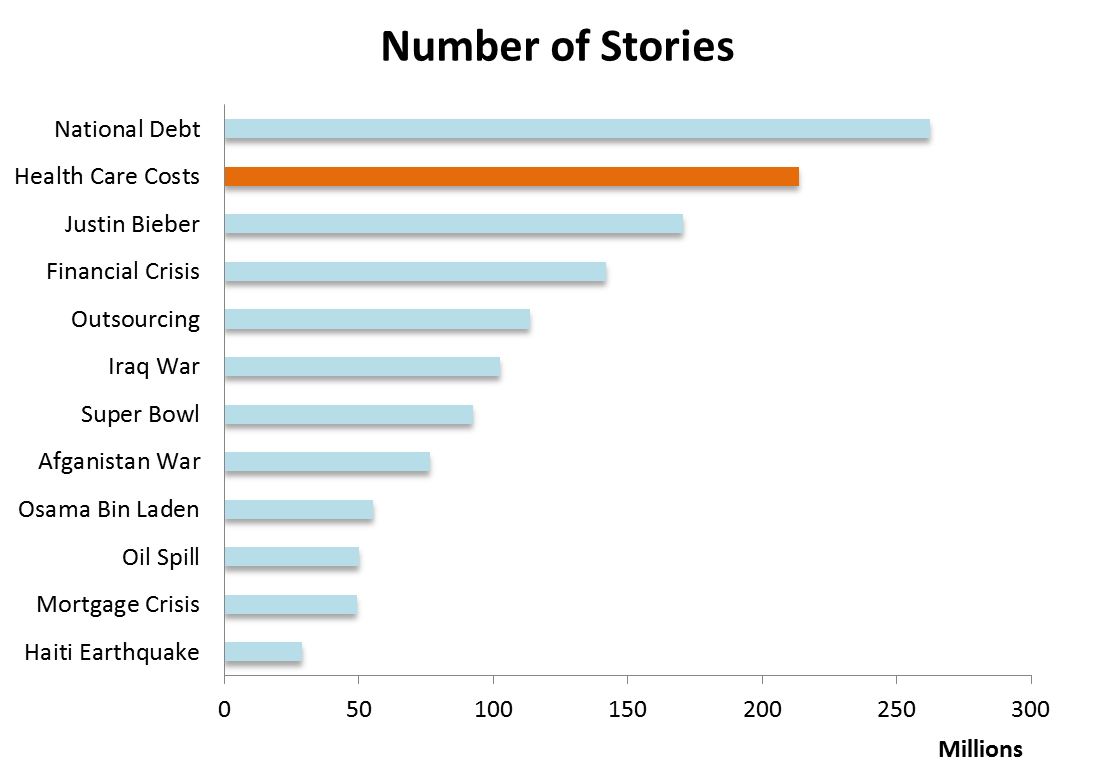
Since 2002, U.S. health care expenditures have doubled. This major increase has dwarfed almost all the major world news stories over the last six years, as shown in Exhibit 1.
Only the U.S. national debt has received more news coverage than health care costs.
Thank goodness it edged out news stories on Justin Bieber.
Exhibit 1: Health Care Costs Dominates News Coverage, 2005-2010
Source: HfS Research/Google, 2011
Health insurance has long been the vehicle most consumers use to access affordable care, whether through employers, federal government programs (Medicare), state government programs (Medicaid and CHIPs), or individually purchased coverage. And, despite the value health care payors provide their customers, payors’ processes are complex, manually intensive, and prone to error. One consumer’s visit to the hospital generates substantial legal paperwork, complex approval processes, coordination of benefits with other insurers, and a blizzard of bills, notices, and follow-up calls that require months to resolve. The processes are so poor that a “mini-industry” of service providers thrives on collecting overpayments and underpayments resulting in several pending lawsuits. The American Medical Association believes payment inaccuracy alone costs the industry $17 billion annually.
To be fair, payors are just one stakeholder in the health care process. Payors, physicians, hospitals, clinics, outpatient treatment facilities, labs, pharmacies, regulators, and medical product companies have conspired to create the greatest dysfunctional customer experience in the modern world (excluding government dysfunctions). No, they have not colluded together with this intention. Rather, by failing to collaboratively find solutions, they have created a politicized, inefficient system. While America’s Health Insurance Plans (AHIP), American Medical Association (AMA), American Hospital Association, Pharmaceutical Research and Manufacturers of America (PhRMA), the Medical Device Manufacturers Association (MDMA), and state and federal regulators have all contributed to substantial improvements in the quality of care, their inability to collaboratively drive out administrative costs is downright shameful. The lack of administrative standards and automation is inexplicable in an industry that represents 16% of the U.S. gross domestic product. Why can’t a consumer go online to evaluate the best care provider options, visit the care provider, swipe a smartcard to reveal electronic health records and benefit eligibility, review a posted price list, receive covered services without additional validation or approval, have prescribed medications automatically shipped to her home, automatically pay for all the above, and get an electronic month end summary of benefits? Instead, many consumers have no idea how much a particular procedure costs until months later when the eligibility and billing issues are resolved.
As unfair as it may seem, health care payors have absorbed the brunt of recent U.S. regulation. The regulation will increase market competitiveness (with health insurance exchanges), intensify administrative cost management (with medical loss ratio maximums), strengthen consumer rights and access (with guaranteed issue, mandates on covered services, elimination of lifetime maximums, and strengthened state insurance regulator powers), and dramatically expand the individual retail market (with individual mandates and financial incentives that may cause groups to drop coverage). Pharmaceutical and medical device manufacturers were hit with higher taxes, but these taxes will likely be passed on to consumers. Physicians and hospitals quietly escaped the blood bath and were left to deploy undefined electronic health records over underdeveloped health information exchanges.
A Sampling of Report Findings
It is in this context of industry upheaval, regulatory changes, and administrative inefficiency that we researched the state of business process outsourcing services provided to the health care payor industry. These services include claims and enrollment processing, customer service, analytics, medical management, finance and accounting, procurement, and print management. Here are some findings are regular readers may find interesting:
HfS Research estimates that health care payor BPO industry to be a $1.2 billion market, which we forecast to grow to $1.9B by 2014. 90% of this market services payors with more than $5 billion in revenues. Primary growth will be driven by increased transaction volumes and new administrative cost reduction initiatives.
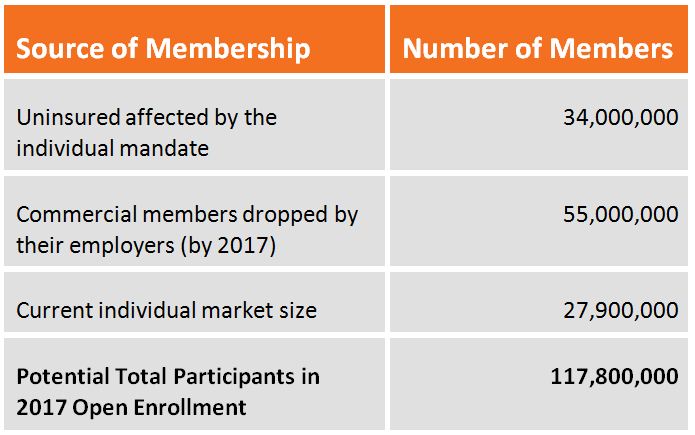
Payors bracing for a radically new and substantially larger individual market. Based on our research, payors are still in the midst of strategy development. However, it is clear that payors will need substantial investments to support the individual market, which may quadruple in size. Especially open enrollment periods in 2014 and 2017.
Exhibit 2: One-Third of Americans Will Participate in Open Enrollment 2017
Source: HfS Research 2011
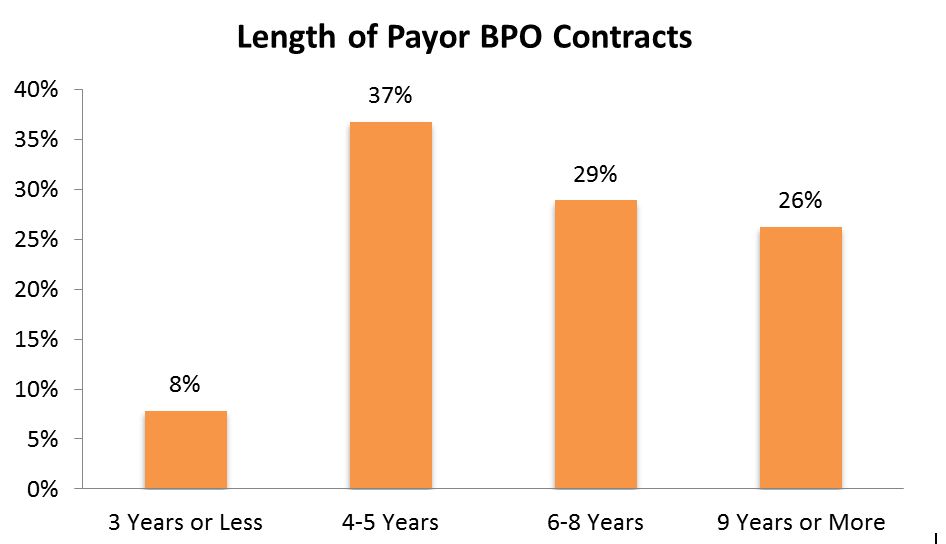
Payors are really conservative. In an industry where average BPO contract terms lasts less than five years, 55% of payors’ contracts have terms of six years or more.
Exhibit 3: Payors Rarely Switch Service Providers
Source: HfS Research 2011
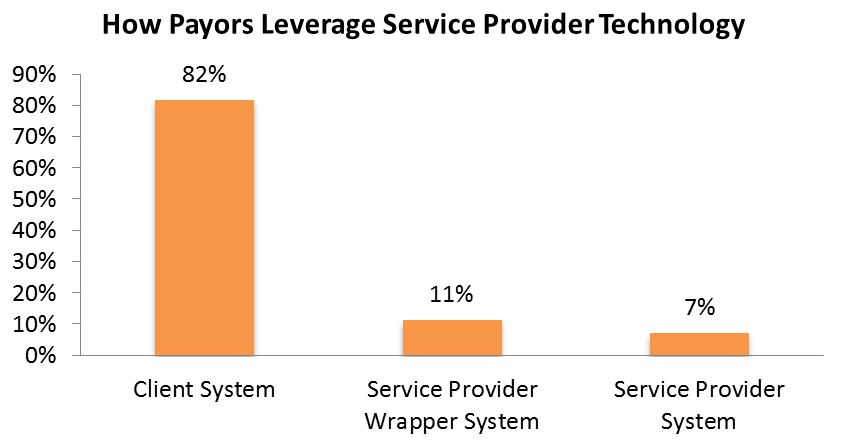
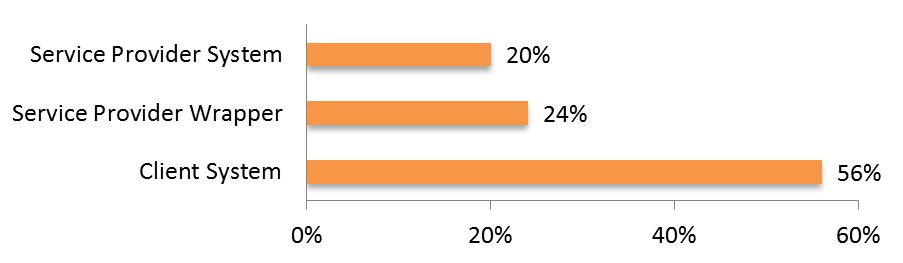
Payors rarely leverage service provider technology. Only 7% of contracts used service provider platforms and 11% of contracts required service providers to provide improved reporting.
Exhibit 4: Payors Expect Little Technology from their Service Providers
Source: HfS Research 2011
A key example of this is in data entry “front-end” processes where paper claims and enrollment forms are entered. Service providers are asked only 20% of the time to provide their own technology solutions.
Exhibit 5: Front-End Processes: Use of Technology
Source: HfS Research 2011
Payors are extremely tactical with their outsourcing initiatives. 48% of all contracts are FTE-based and 32% are based on transaction fees. 40% of contracts had no gainsharing incentive. Those that did focused on sharing process efficiencies, not transformational value.
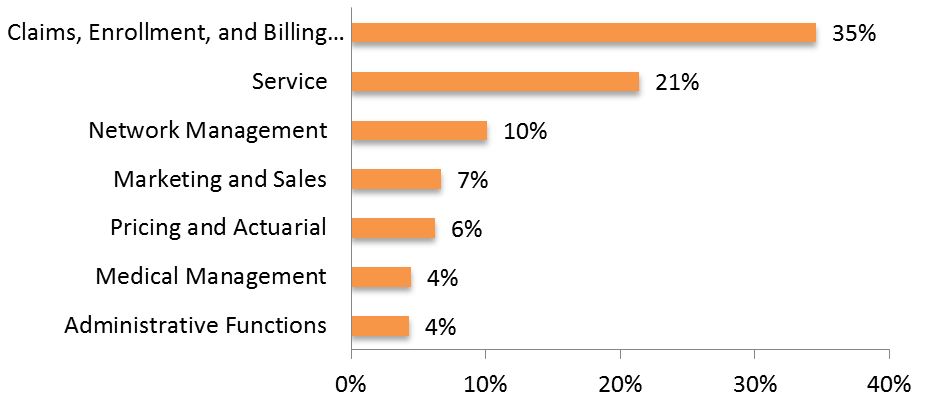
Payors have outsourced little of their value chain. Not surprisingly, payors focus on outsourcing manual processing of claims, enrollment, and billing (35%), while service falls far behind (21%).
Exhibit 6: Healthcare Payor Value Chain Outsourcing Focus
Source: HfS Research 2011
Our report drills into more than 20 sub processes of these major processes in more detail, including use of technology, observations gleamed from data and interviews, identification of outsourcing opportunities, and a short list of service providers to consider.
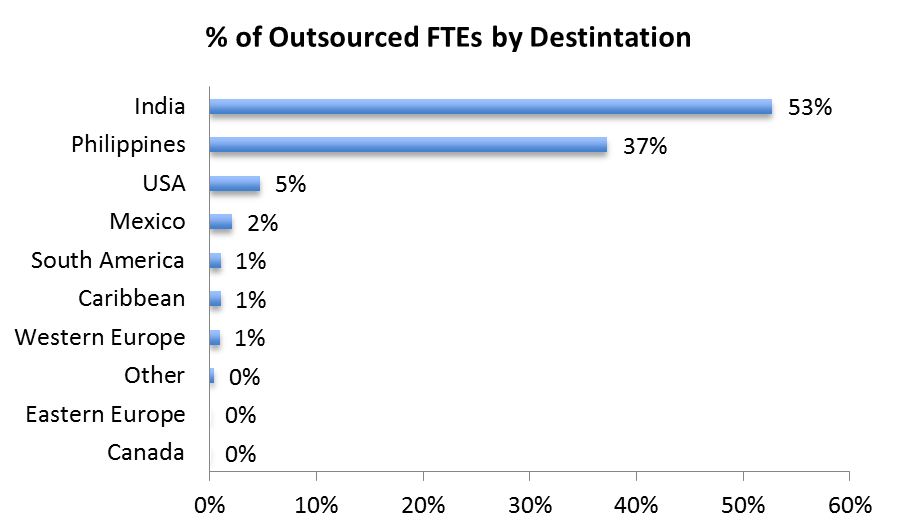
The Philippines plays a major role in payor outsourcing. Unlike financial services and property, casualty, and life insurance, payors have a strong interest in the Philippines (37%).
Exhibit 7: Healthcare Payor Outsourcing Destinations where work is Delivered
Source: HfS Research 2011
Payors tackle outsourcing alone. Only 5% of contracts were negotiated with the assistance of outsourcing advisors or consultants. HfS Research also found that 0% of payors used advisors to stand-up governance teams. On one hand, this indicates advisors’ lack of experience in health care outsourcing compared to in-house staff. On the other hand, maybe payors are too new to outsourcing to know when to ask for help?
Where Does This Leave the Industry?
Obviously, we need to share the juicy details with our subscription members. However, here are a few nuggets worth your consideration:
Payors Cannot Thrive using a Labor Arbitrage Model; Bundled End-to-End ITO/BPO Solutions Pick up the Pace – Leading payors need service providers to leverage best-in-class platforms to drive process efficiencies. Service providers without platforms will fall behind. Platform and system interoperability and integration is key. Using data entry solutions for claims as an example, service providers must leverage a data entry platform that replaces their clients’ platforms, but integrates into existing client provider databases and claims processing platforms. Service providers with platforms that can comprehensively extend the workflow outside of payor systems will lead. Further, given the complexity of the payor processes and heightened regulatory attention, payors will consolidate their provider portfolios in favor of of those that provide end-to-end services.
2014 Open Enrollment Madness – The frenetic Medicare Part D open enrollment period in late 2005 will be dwarfed by the preparations for the 2014 open enrollment period. With Medicare Part D’s winners and losers fresh in mind, almost all the energy of the payors over the next few years will be spent building efficient marketing, sales, broker management and enrollment processes. Scalability and flexibility will be a significant concern.
Offshore Service Providers will Increase Onshore Staff – Due to the combination of conservative decision makers and regulatory restrictions in the payor segment, offshore-only service providers will be at a distinct disadvantage. To overcome this, they will rely increasingly on onshore operations.
HfS research clients can download this new report here.
Join LeAnne and Phil at the 2011 BeEmpowered Event (click for more details)
You have been warned… there’s an HRO schmooze-fest on the horizon, amidst the cool late summer breeze of picturesque Atlanta.
Yes! The HR Outsourcing Association burns white-hot as it integrates the HRO buyers’ group, the RPO Alliance, the Absence Management Academy* – and every other HRO special interest group ever dreamed up – into one star-studded, fully integrated cornucopia of HRO.
Yes! If you still care about HRO, you will be there reminding yourself – and anyone else who will listen – that no matter how bad things get, you can always find nice places to outsource your payroll, benefits and offboarding hotline.
And in case you’re still undecided about dusting off that stagnating Delta airmiles account (which has probably expired), we can exclusively reveal that HfS will be speaking, schmoozing and signing commemorative copies of the famous 2004 HROToday archive editions.
And yes! You’ll also get the chance to find out why Geek Squad and Magnolia Theater reps are just so nice… from LeAnne Anderson, Doyenne of HR services at Best Buy.
We’ll be there for both days, and will participate in a number of the sessions, in addition to our plenary entitled State of the Outsourcing Industry in 2011 – A new era for global business operations strategy, or more of the same? In addition, you dare not miss the Networking Dinner & Awards Gala on the evening of September 21, which promises to take after dinner HRO awards speeches to new heights**.
And not only have we negotiated our readers our usual discount, this time we’ve negotiated a whopping 50% discount for attendance:
To register, simply click here, go to “New Registration”, input “HfS2011” into ID Code and then click on HfS Attendee.
This booking will allow you access to the Wednesday Buyers meeting, the Awards Gala and the Thursday BeEmpowered Networking event where HfS will present.
Oh.. this code is only for use by buyers. If you are a provider, advisor or technology firm, please email Faye Holland for details of sponsorship packages.
We look forward to seeing you in Atlanta!
*We made that one up…
**Unlikely to surpass Glenn Davidson’s 2005 after-dinner resignation speech, but you never know with some of the characters showing up
Brandi Moore: Self-proclaimed expert on "Outsourcing Culture"
We were woken this morning with a nudge from our friends at Outsource Magazine that one of their contributors, Brandi Moore, had dared to take a few pot shots at a report we produced earlier this year that looked at the promise of Latin America as a sourcing location (get your free copy here).
While they were clearly hoping to stir up a little excitement on a Friday lunchtime, when someone wants to label a piece of research “painful”, it warrants a defense from the people who wrote it. So who better than co-author and one of the most knowledgeable people you will ever hope to meet on the topic of Lain American sourcing: Esteban Herrera. Have at it Mr H….
In Brandi Moore’s “painful” interpretation of the joint research we did with Softek about Latin America as a sourcing destination, she manages to disparage an entire industry, ignore the facts, offer tired examples as brilliant self-aggrandizement, and demonstrate a poor understanding of her supposed field of expertise (culture). We often take a tongue-in-cheek approach to our coverage here, but we take the accuracy of our research and reporting very seriously.
As a Latino who spent exactly half his life in the US (Massachusetts, Illinois, Texas) and the other half in various Latin American countries (Costa Rica, Brazil, Mexico), and India (Bangalore), I feel uniquely qualified to comment on cultural impact in cross-cultural communication and work. And as someone who has had the honor of working for two outstanding members of the outsourcing provider industry (Accenture and Infosys) and worked on over 200 outsourcing relationships as an advisor, I have some clue about how culture impacts delivery. It isn’t clear to me that Ms. Moore has ever lived abroad as a professional, and she has never been responsible for service delivery from the provider side of our industry. She does, however, believe that her background in “forensic science” makes her qualified to comment on culture in outsourcing and why most of you seem to be doing it wrong.
Had Ms. Moore checked her facts, she might have saved herself from significant embarrassment. Let’s take some of her wilder assertions and compare them against reality:
1. The article implies that our research was written with American short-sightedness about culture. Had she checked her facts, she would know that the author is a subject of Her Majesty the Queen Elizabeth, his team was British, Argentine (how’s that for cross-cultural collaboration—Falklands and Soccer, anyone?) and Mexican, and the whole thing was edited by a Costa Rican.
2. Had this expert on culture bothered to check the definition, she would know that culture is defined by Merriam Webster as:
a: the integrated pattern of human knowledge, belief, and behavior that depends upon the capacity for learning and transmitting knowledge to succeeding generations;
b: the customary beliefs, social forms, and material traits of a racial, religious, or social group; also : the characteristic features of everyday existence (as diversions or a way of life) shared by people in a place or time;
c: the set of shared attitudes, values, goals, and practices that characterizes an institution or organization;
d: the set of values, conventions, or social practices associated with a particular field, activity, or societal characteristic.
Our report makes the simple but obvious point that shared experiences and values make it easier for communication across cultures. Ms. Moore dismisses the use of credit cards, for example, as relevant in a business culture. Each and every one of my banking clients who offshore customer service for their credit customers would disagree. But that isn’t even the issue, because people with experience will eventually understand both the concept and the process. One of the few correct assertions in the article is that it is ultimately what motivates people that matters. We agree, and it is obvious to us that Western societies have more in common in how they understand work, success, and collaboration, amongst many other things, which is exactly the point we made in our report. The fundamental, Judeo-Christian inspired societal values shared by Europeans and North and South Americans make them more alike, and more likely to understand each other, than when paired with other macro-cultures.
3. Ms. Moore’s article suggests that few if any outsourcers engage in any cultural training beyond “30-minute videos” for their employees. Bull. Companies like Accenture, Cognizant, Wipro, Infosys, and IBM all require cultural training programs of 3 weeks or more for their associates. Even more egregious is the assumption that outsourcers try to tell their clients their offshore resources are culturally identical to Americans (she limits her discussion to the US, though Europe and Asia are also large consumers of outsourced services). Nothing could be further from the truth. I just finished three days of final provider presentations at one of the clients we are advising. Each and every offshore provider (there were five of them) made it abundantly clear that cultural differences are real, they will impact performance, and they will take work. I wonder if Ms. Moore has been involved in the hiring of an offshore provider in the last five years or so.
4. If you understand outsourcing realities, you know that the article misstates the reality of outsourcing relationship dynamics: Ms. Moore says “clients don’t understand why an outsource team member doesn’t speak up because of power distance issues across the team”. This is one more version of the tired “when an Indian co-worker says yes, it doesn’t necessarily mean “yes” Please. I’ve been hearing that one for over a decade. It has some truth to it, but this is reporting? How exactly is this helpful to someone managing an offshore team? How does it help the offshore team understand cultural dynamics? The fact of the matter is that pushing back helps the relationship. Clients and providers understand this.
5. The most ignorant opinion I found in this article, and there were a few to pick from, was the following “It’s difficult for Americans to think about cultural differences because we subsist on the idea that everyone is the same. This idea powers American culture. Without it, Americans would find themselves in the same situation as Norway: confronting radical groups focused on identifying people that hold differing beliefs.” Let’s look at reality:
a. What makes America great, in part, is that it is a melting pot and thus the most tolerant of all cultures. Not immune from discrimination, most Americans, in recognition that this is a land of immigrants and 235 years is but a short time in human history, accept that others are different. My guess is offshoring would not work in the other direction, with Americans serving Indian corporations, for example, because immigration has not been as big a part of India’s (considerably longer) cultural history.
b. The insensitive reference to the recent Norwegian tragedy illustrates a poor understanding of the reality of global terrorism. Perhaps Ms. Moore took the day off during the deadly attempt on Rep. Gabrielle Gifford’s life by an American “focused on identifying individuals who held different beliefs”. Maybe she’s not old enough to remember the Oklahoma City bombings. Perhaps she missed Glenn Beck’s thinly veiled suggestion that the Norwegian students deserved the bloodbath for being at a left-of-center gathering. Norway’s problems are eerily similar to America’s problems, Ms. Moore. The ultimate example of cultural insensitivity may just be to imply that “my terrorists are better than your terrorists”.
Esteban Herrera, COO, HfS Research and co-author of "How Latin America Powers Global IT Delivery"
Had this self-described journalist bothered to check with the authors, or maybe just read the entire report, she would have known that we do not, in fact, equate business culture with Western products or TV shows. But we do acknowledge the reality that a shared experience, especially in the formative years in which we grow up, makes business collaboration significantly easier in our adult lives.
The field of culture in outsourcing is a very, very important one. Ms Moore helps shed light on its importance, but then destroys her arguments in such a way it may never get the attention it deserves.
Tune in, crank up the volume, or pop in your headphones in if you’re in the office. A few summer memories from the HfS team, as we go sit on a beach for a couple of weeks… we really do appreciate all your support. You’ve been part of one heck of a journey (so far)…
HP may have just ripped off its own Band-Aid, relieving the agony quickly and avoiding a slow and painful journey at a time when the economy sits on a knife-edge.
Today marks a jolting and sobering inflection point to a global mega-business that was in serious danger of developing multiple-personality disorder.
We’ve been trying to figure out what HP’s game-plan is for sometime now, as it attempted a multi-faceted series of strategies that go after hardware, software, infrastructure, mobility, consumer technology, IT services and BPO markets. Oh, and there’s Cloud in there somewhere too.
Quite simply, HP loves the high-margins of the enterprise IT business and has been trying to find its sweet-spot. With Léo Apotheker taking the helm, we even predicted a potential move to acquire SAP could be on the cards, especially with the defection of a host of senior SAP executives onto Léo’s team. That may even still happen in the future, but much less likely in the near-term with the current seismic changes going on with the business.
Today’s announcements have been a bold move to redefine the business, as it spins off its PC, Touchpad and WebOS mobile businesses. It also announced its intention to make a $10bn acquisition of enterprise information retrieval software firm, Autonomy. So in one full swoop, the firm is moving away from consumer electronics and defining its future strategy as an enterprise IT systems, software and services provider.
While the IT industry is scoffing with amusement at the quick u-turn made on its tablet strategy (in fact, there’s a TouchPad ad running as I type), its apparent exit from consumer IT and the high price-tag of Autonomy, let’s actually give Léo some credit. He needed to make some tough decisions, and do them quickly. And in the process they’ve stated their reduced earnings outlook. Yes, HP may have just ripped off its own BandAid, relieving the agony quickly and avoiding a slow and painful journey at a time when the economy sits on a knife-edge.
In one full swoop, Léo’s sent his firm on a path where we can actually understand what HP’s game-plan is all about. If HP had continued down its confused previous path, it would surely have faced being broken up and spun-off into all sort of assortments and flavors. Let’s be honest – could we really see HP giving Apple and Google a run in the consumer space? Was HP really in the right shape to lead PC sales in a fast-commodotizing market?
Meanwhile, they’ve clung onto their enterprise IT and services businesses and are slowly rolling out some meaningful strategies that can leverage their global presence, their industry strengths and massive footprint of enterprise clients.
Provided the firm can now structure its units successfully, HP has now chosen its path to go after IBM in the enterprise arena. A smart acquisition or two to bolster its enterprise services presence, a well-executed management and business re-organization, a cohesive and clear marketing plan, and we may yet just see this company start to fulfill some of its potential.







 As you make your way through our first HfS Challengers Buyer Guide, please