As outsourcing becomes increasingly commonplace, buyers are relying more and more on their own means by which to make tough decisions.
In the past, outsourcing was still a unique, foreign and scary activity, and it was always easier for buy-side executives to bring in consultants to make their decisions for them – especially as there were so few trusted data-points and information sources widely available in the industry to support decision-making. Executives didn’t want to get fired for making bad decisions. However, today they know they’ll get fired for the wrong decision regardless of who made it – whether it was theirs’ or McKinsey’s. Mess up outsourcing and your head will be on the block in no time – it’s not like an ERP implementation that can take years for everyone to figure out what was going on, by which time the original selection team had already left, in any case.
Today, buy-side executives are increasingly seeking out the views and experiences of their peers in other organizations, as opposed to putting all their trust in the views and suggestions of consultants. Outsourcing has hit the mainstream and there are many educated people – and prolific information sources available – to provide experience and insight.
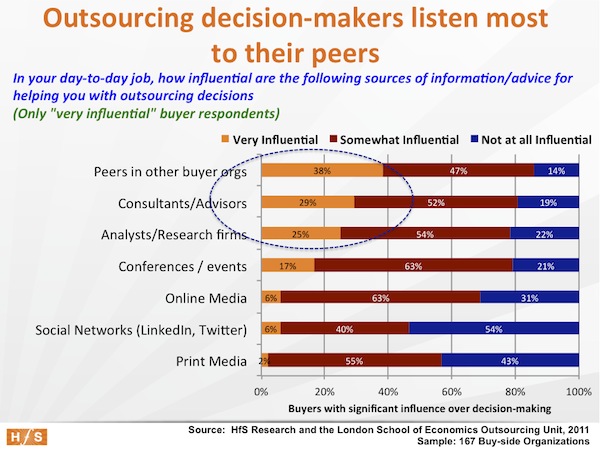
167 of the respondents to our new State of Outsourcing Study conducted with the Outsourcing Unit at the London School of Economics have significant influence over outsourcing decision making, so we asked them where they were seeking information and advice for help with outsourcing decisions:
Buyers overwhelmingly want to hear from each other to further their learnings, with 86% viewing this medium as influential, eclipsing even the influence of consultants and advisors, whose job it is to give advice. This is, by no means, a discredit of the consultant, especially as his/her advice is viewed more highly than researchers, conference content and other media – but it does indicate that buyers trust the experiences of their peers the most.
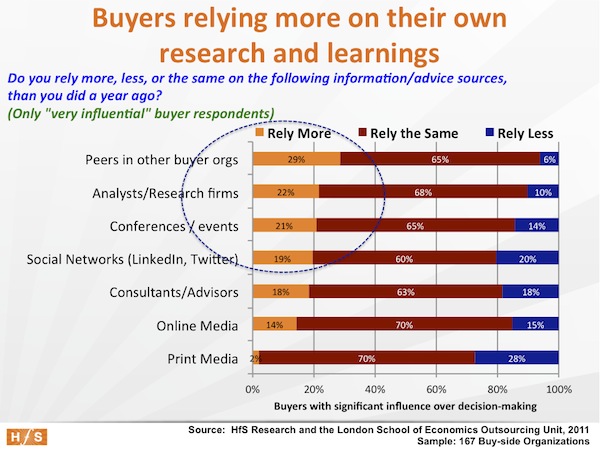
In most cases, buyers will turn to consultants first and foremost, but will want their peers to validate their decisions. HfS also believes this move towards greater peer reliance is because it’s getting harder and harder to tell providers apart – and – in many cases – cut through the PowerPoint and buzzwords to get to the reality of the business. Hence, buyers are increasingly trusting their own investigatory skills and instincts to make the right decisions, as this graphic illustrates:
With close to a third of decision-makers increasing their reliance on their peers and more than a fifth increasing their focus on research and social networking, it’s abundantly clear that buyers are doing more of their own homework when it comes to outsourcing.
Let’s examine further…
Availability of peers is much more commonplace: it’s so much easier today to find other buyers to talk to. Smart providers are working hard to bring their clients and prospects together – they know it’s much more powerful to have their clients sell for them. Moreover, it’s easy to go online and seek out other buyers and experts in LinkedIn Groups, or join niche forums, where you can connect that very day with a kindred spirit whose advice is often worth ten times that of the $700/hour consultant who just left the building.
Ability to access research and data is much easier: whereas in the past you most likely had to drop fifty grand (or more) to get even a “quick and dirty” analysis of your outsourcing options performed, that is no longer the case if you know where to look. Smaller consultancies and advisors can now swing by and get you the “back of the cigarette packet” evaluation you wanted, as they should have loads of data from similar evaluations they can leverage. They don’t have to start from scratch each time there is a request for a benchmark, or a quick-fire analysis of suitable providers. Why spend a fortune to arrive at the same decision-point? You can now access the price-benchmarks, the provider capability assessments and the market data you need, for far less than you had to spend in the recent past.
Smarter buyers have different needs and are more self-sufficient: we can tell you from our own experience that smart buyers today often even know even more than consultants and providers, when it comes to figuring out how much a landed ABAP developer with 3 years’ experience should cost. And it doesn’t take a genius to figure out what you should be paying for a level 2 accountant in Chennai. And most buyers would prefer to find out for themselves whether they’d prefer to work with an IBM or an Infosys. Most firms today have some experience of outsourcing – and can often transfer internal governance talent to help with related initiatives; for example, we’re seeing several firms have their experienced ITO executives lending their support with less mature BPO disciplines.
The bottom-line
Outsourcing is all about real people, real processes, real business decisions. The secret sauce is applying this to your own business and figuring out the right end-state – and the smartest way of achieving it. Buyers ultimately know their institutional processes, politics and warts themselves – so having them more proactively involved in sifting through today’s socially-networked business environment is only going to help them get the advice and datapoints they really need.
One of those rare discoveries one makes in life, is that procurement people are (by and large) pretty cool individuals. When you think about it, when you spend your days negotiating deals, scouring for bargains and trade-offs, bonuses and discounts – and proving to your colleagues that you’re better at it than they are – having a bit of style about you can go a long way.
Alpar Kamber, Managing Partner, Denali Group
However, we did not know all this until we came across one absolute procurement-esque freak-of-nature, who loves to get very deep on sourcing execution issues while having a glass of Absolut Mandarin in one had and spinning some vinyl with the other. Yes, while Turkish-born Alpar Kamber is not shaking it on the dance floor, or doing a few backflips on his snowboard, or mixing Beyoncé with Lady Gaga, his prime love in life is discussing procurement process. (OK, we just made up the bit about Beyoncé and Lady Gaga – Alpar’s far too classy for those two…)
While we were having some in-depth discussions with Microsoft’s CPO, Tim McBride (don’t forget to read our paper “The CPO in 2011: The Toughest Job in the Global 1000“), it became apparent how important niche specialist BPOs, such as Alpar’s firm Denali, are to the global sourcing mix for many organizations. So we thought we’d take a few minutes to have a discussion with Alpar about the future of the procurement function and the role of the CPO…
Phil Fersht: Tell me a little about yourself, Alpar, your background, where you’ve lived and worked, and how you’ve winded up in the sourcing business?
Alpar Kamber: I grew up in Istanbul, Turkey and studied management science and accounting in College. I joined Arthur Andersen’s Audit and Business Advisory Group, with hopes to get my feet wet in various industries as quickly as I can. I got a chance to meet and interview almost every function in the company, look into business processes that drove the financial statements and how each impacted companies’ health and financial performance.
Procurement caught my eye as I audited various procurement functions as being very in efficient and lots of room for re-engineering (that was the buzz word in the 90s).
Moved to US to pursue my MBA in Pittsburgh, Carnegie Mellon. A young and upcoming start up company, FreeMarkets, caught my eye as they built and executed reverse auctions for corporations to secure goods and services contracts at true market prices. I decided to spend my summer there creating my first (and my client’s first) online auction for $5M global fasteners procurement. Identified over 30% in savings and got C-level attention at this Fortune 200 Company.
I went back there after business school and have done market making, program management, account management, consulting. Then, I moved on to start Denali Sourcing Services.
Phil Fersht: And based on your interactions with clients today, what are the key business challenges they are facing – and how are these challenges impacting the procurement organization?
Alpar Kamber: Procurement’s operating model is changing: the resource model and channels to reach the audience are becoming customer centric, service oriented.
Transactional procurement aside, companies are forming three major functions within their sourcing function: Relationship Management, Category Management and Execution. What’s missing today in many companies is a focus on execution and having a dedicated approach to solving that problem.
Let’s discuss a few tangible objectives that I see in today’s procurement environment.
A. They would like to increase the reach of their procurement organization – or some call it spend under management. Branded program approach: Very few companies embrace the concept of program management. Successful procurement organizations typically have several program managers running programs, launching new initiatives. Some fail, some have glorious success. Branded program rollouts help accomplish a number of things. It helps energize your audience (be it suppliers, company employees or executives) around your objectives and makes it easier for one to drive change and adoption. This is critical in achieving game changing results.
B. They would like to be as effective as possible in managing the spend that they reach. There are many tools available for procurement organizations. Yet, this abundance is confusing to some and convergence has yet to happen. Software, processes, best practices, methodologies, knowledge, market intelligence are all key elements. Most importantly though, skill set and capabilities are the greatest assets that an organization can have to be effective in how they manage spending.
B. Efficiency – do more with less or limited resources and do things much faster without much waste (reduce procurement waste).Today most procurement organizations ask their resources to wear multiple hats. They want them to build relationships and sell procurements’ value proposition to the organization. They want them to understand their categories, supply base and develop strategies that effectively manage spend globally. And finally they want them to write and execute RFPs, negotiate contracts and manage them. These are all very different tasks by nature. Using Adam Smith’s division of labor principles, it is very difficult to drive an efficient model when one is asked to do tasks that are inherently very different. One needs to separate operational execution tasks from those that are strategic and relationship based, and address them separately.
Phil Fersht: What’s different about the role of procurement today, compared to 10 years ago, and what does the procurement executive need to do, to keep adding value internally? How can procurement develop a stronger presence at the corporate table?
Alpar Kamber: This is a pretty common theme that I discuss with procurement executives at various round tables and occasions. Expanding Procurement’s value… If I look at 10 years ago and today, I don’t think the purpose of procurement as a function has changed. The purpose has always been to help improve company profits. What has changed is the perspective and awareness of this purpose among company executives and the tools and resources available to get the work done. Today procurement certainly takes up its place in executive agenda. I even heard that a few company CPOs are joining their earnings calls with the street and making commitments about taking cost out. This is significant. Ten years ago it was still considered back office. This is changing drastically, and at a fast pace.
As my father told me once, “You make money while you are spending money”. I think that has got to sink in within corporate functions as we continue to influence our spending culture. Everybody that spends money in the organization can have a direct (tangible, quantifiable, one-to-one) impact on the company’s financial health and earnings.
The second part of your question – what should the procurement execs do to add value: They need to take risks. Break away from the status quo and try new ways to create efficiencies and effectiveness. They need to listen to their stakeholders for ways they can add value to them, engage with them and continue to align their objectives with procurement’s even if they are different. Roll out new programs, challenge the status quo, ask tough questions, innovate. Also, tap into the existing wealth of knowledge and experience of service providers — partner with them to deliver more value. It all boils down to improving reach of procurement, effectiveness and efficiencies.
Phil Fersht: In terms of broader operational strategy, how can procurement proactively support overall governance of outsourcing and shared services initiatives – i.e. once the routine work is outsourced, what are the strategic initiatives that procurement should be involved with to drive continuous innovations and added quality to the organization?
Alpar Kamber: Look, from an outsourcing perspective, procurement should continue to play an increasing role. Some companies created Chief of BPO roles. While I think that’s fine (due to managing sensitivities and organizational disruption) from a focused approach perspective, to me it’s no different than the procurement function at its core. I think we will see BPO becoming one of the core category management functions under Procurement. Procurement is in the business of managing all external resources (similar to how CFOs and CIOs are managing financial and informational resources) including governing these complex supplier relationships and resources.
The next chapter in procurement is figuring out Vendor Management at an enterprise level. I’ve yet to come across mature enterprise-level vendor management organizations. I think this is due to focus and skill set. As an analogy, in sales organizations you see a group of people (hunters) that is tasked with going out and getting new deals signed (contracts). These are then handed off to account managers (farmers) who make sure that contracts are fulfilled and managed to their full potential. Not only that, but also ensure they grow in value to the company. This mentality needs to transfer to procurement. WThey need to be putting in people with a different mindset (farmers) for managing company contracts and vendors, to ensure optimum value is created and retained. We only work with the tip of the iceberg when we put complex deals in place. It is when we start implementing and actively managing our contracts and vendor relationships that we start going deeper in value creation.
Phil Fersht: How can procurement execs receive the training and education they need to drive strategic sourcing initiatives more effectively and proactively – is there a defined curriculum for this, or do they learn it “as they experience it”?
Alpar Kamber: As I mentioned before, procurement executives need to take risks. They need to hire a few good program managers –- generalists that might have a procurement background but know how to effectively design and execute various programs and drive change. There is still lots of legacy to overcome in todays procurement organizations. Procurement needs to take a leap of faith in launching programs towards changing the legacy. Whether the purpose is to educate the internal audience (employees) about why they exist or to streamline their delivery operations. They each need to be managed under programs that have cross-functional teams. They need to think big and act big to get recognized.
The best training is by doing. Certainly this is an investment on everybody’s part but if you put people with the right skill set on the job, most often value is there.
I’ll give you an example of a company we work with. It all started four years ago with an idea, and a courageous executive willing to allocate the resources to try an innovative operating model and see how it could change the value procurement can bring to the organization. Four years later, after touching almost every employee in the organization that is spending money, his program drives the procurement execution at its core, allowing more senior resources to focus on macro-level problems like relationship building and category management, and the execution team to apply macro-level strategies to project spending.
Phil Fersht: So, if you could define the perfect role for the CPO, what, exactly would that look like?
Alpar Kamber: The perfect role for the CPO is to be the coach of a procurement organization. They need to pick good sourcing athletes, train them well through rigorous but challenging activities and goals, and make sure they put the right people in the right job. Also they should not be afraid to make the right transfers from third parties. But most importantly they need to put out the best game strategy out there. From what I’ve experienced, there is no best practice strategy that will work for the masses. Every company is different. Culture is different, bottlenecks/challenges are different, clock speed is different. Procurement executives that are able to drive effective organizations understand these differences and cater a game plan and an operating model that fits the organization, rather than try what made the person next door successful. It is also very important that services providers understand this difference.
Phil Fersht: And finally, what advice would you give to sourcing professionals today, seeking to further their career development? When you look over your career, what would you have done differently?
Alpar Kamber: I was fortunate enough to see procurement from various lenses. I was an auditor, I was a market maker, I was a contractor bidding for my salary in a reverse auction, I was a program manager building global sourcing programs, I was a program manager receiving procurement services from a provider and now building a company that focuses on sourcing execution. A multi-angle experience.
Today’s procurement professionals need to understand their audience and that there are many — the budget holders, vendors, executives and the company (shareholders). Once they understand the agenda this audience has, they need to think about what is the best way to create net customer value. Value while minimizing waste and effort spent getting there.
And lastly, change. While there has been significant change over the last 10 years within the procurement function, there is still a lot more ahead of us. And the pace is not slowing down. So if you need to be successful in this function, embrace and champion change.
Alpar Kamber is a Managing Partner with Denali Group and the Practice Lead of Denali Sourcing Services. After graduating from Tepper Business School at Carnegie Mellon University, Alpar joined Ariba, formerly FreeMarkets, to build strategic sourcing programs for Fortune 500 companies. You can read more about Alpar and the Denali Group by clicking here.
Download The CPO in 2011: The Toughest Job in the Global 1000 [email-download download_id=”1″ contact_form_id=”2″] HfS Research will share the information you submit with Denali Group, with which we partnered to produce this valuable research.
Gideon Gartner blogs HfS' views about the analyst business (click to read)
So the Grandaddy of great big research, and (arguably) the founding father of today’s IT industry analyst business, Gideon Gartner, picked up on our recent post “Will the industry analyst business be dead in five years?” (Check out his post here).
Gideon’s opinion must be the most sought-after on this topic, and he does a great job being non-committal with his blog on HfS’ piece. However, you do get the distinct impression we struck a chord with him:
“Perhaps his conclusions were overstated, but perhaps not; some version of today’s Advisories will undoubtedly survive. But the comments seem to support his views”
And while the “analyst” industry is unlikely to be buried in a coffin in five years, the amount of attention this discussion has invoked clearly signifies one thing: the traditional analyst business desperately needs to change. We’ll let Mr Gartner have the last word on the topic… for a while anyway.
And if you still haven’t had enough on this topic…
Our friends at the International Institute of Analyst Relations (IIAR) are going to feature a live debate on 13th July at 11.00am ET, where I will be discussing this “crisis” live and taking questions. Click here for more details, or email info at analystrelations.org.
Folks – we constantly get accused of not “blowing our own trumpet” enough and showcasing our research, so today, we’ll have a go!
Back in April, we published our landmark report, The F&A BPO Market Landscape in 2011: Re-emerging from the Recession, re-focusing on Business Outcomes. In that report, we made some predictions on the market, for example:
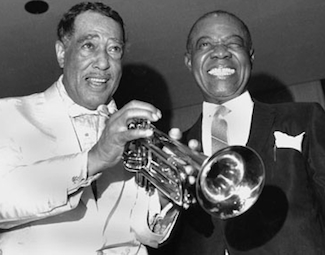
"Louis, have we got some bed-time reading in store tonight…" (Click to download)
* OPI: “Needs to look at M&A opportunities if it wants to compete effectively for larger engagements”;
* Intelenet Global: “Could be effective at winning small-scale engagements with some smart investment in a go-to-market strategy. However, a small client base, limited brand and its late arrival into the US market makes this a hard task. Merging with a larger entity may be a better move.”
Since we published, OPI was acquired by EXL and Intelenet by Serco. Read between the lines and you can start predicting other likely things to happen in the not-so-distant future. It’s as it HfS is your very own self-perpetuating crystal ball (gulp)…
Anyway, in response to the multiple requests for more trumpet-blowing, you can download our blockbuster report absolutely FREE, right here! No forms to fill, no signing your life away to a torrent of daily spam – just plain, free, no-holds-barred research! Yay!
We are in the midst of exciting times in the world of work. Never before has the world’s economy seen such dynamic changes occurring at a rapid pace. These changes are being driven by growth in emerging economies, new enabling technologies, talent gaps, mobile workforce, and perhaps even new motivations in the global workforce. HfS Research, in conjunction with Human Resource Executive Online, is conducting a study to help gain a better understanding of how the future of work is impacting organizations. You can help by participating in a short survey and providing your thoughts on how the future of work is impacting your business or your client’s businesses. The survey can be found here: Future of Work Survey.
In HfS Research Fellow Keith Strodtman’s blog on this topic, The Future of Work – Who Will Lead, we listed some of the future of work drivers that we see in business today. We also suggested that the most successful companies will be those which figure out how to capitalize on the future of work by unleashing the innovative talents of their employees and partners. This of course takes strong leadership. We’d argue that the command-and-control model of management will not be as effective at unleashing innovation as would a decentralized model that puts more information and control into the hands of the people closest to the customer. Doing so will increase an organization’s ability to quickly respond to customers and the market. I think we can all agree that speed to market has never been more important.
Back to leadership, who will lead this type of change in successful organizations? Who are the visionaries that can spot the changing dynamics of work? Who knows which of these dynamics are most important to their company? What role will HR play in all of this? Will they be a change leader? These are just some of the questions that we will try to answer with the results of the Future of Work Survey. It should be interesting to look at some of these questions broken down by respondent group, industry, and organizational size.
So please take a few minutes (it should only take about 7 or 8 minutes) to complete the survey. This is just the beginning of what we at HfS Research hopes will be a long series of insights into how companies can be successful in the Future of Work.
Wouldya believe it, the Swiss, in their typically punctilious fashion, now have an “Anti-PowerPoint Party” with the self-stated goal of having the number of boring PowerPoint presentations on the planet to decrease and the average presentation to become more exciting and more interesting.
The party aspires to become the fourth-largest political party in the country, as you don’t need to be Swiss to join a Swiss-based political party. Clever, eh?
So as I was busily enrolling myself in such a worthwhile cause, I quickly realized that if such a political goal was achieved, the whole outsourcing business would be in serious trouble. For example:
How else could sourcing advisors justify their millions of dollars of fees to develop a 250-strong slide deck, designed to pummel everyone into submission by slide 23?
How else would providers be able to pilfer each others’ decks and claim to be the first to have coined their branded transformation methodology?
How else could management consultants charge clients for change management workshops? Seriously, you think people want to change, as opposed to having hundreds of polished slides describing change processes that executives can discuss for hours?
How else can lawyers send everyone to sleep while that $750/hour clock ticks along?
How else can buyers convince everyone into submission that their procure-to-pay processes are just so un-outsourceable?
How else could analysts bombard everyone with reams of data telling you what you already knew, but at least make you feel better about paying for their services?
So please, please, please do not encourage our Swiss friends to destroy everything we have strived so hard to achieve. Long live PowerPoint and the incredible business benefits it provides!
Remember Cassandra? She was that character in Greek mythology who was granted the gift of incredible insight by the gods, but in the same instance, the gods cursed her so that no one would ever believe her. Welcome to the world of Deborah Kops, as she articulates the findings of our HfS Research / Sourcing Change study. Over to you, Debs…
Shortchanged!
Ever wonder why you have that sinking feeling that your outsourcing program isn’t quite delivering on its promise, despite the fact that your provider is hitting every SLA out of the ballpark? Why most benefits expected in the business case are within reach, yet the business lines’ grumbling continues unabated? Why the retained team just doesn’t “get it,” engaging in guerilla warfare when it’s time to start the next phase of transition? Why the leadership team rejects the concept before you even launch the PowerPoint presentation?
Deborah Kops is taken away before convincing the world of the perils of ignoring change management
Very likely, you’ve been shortchanged. Whenever an organization outsources, it triggers a myriad of changes—organization, process, workflow, technology, and service levels, among others. Change management often gets short shrift because it has to cope with often irrational reactions, may require a “touchy feely” response model, and ultimately forces sourcing sponsorship to confront an uncomfortable truth— compelling business cases alone will not persuade stakeholders to give up control or adjust the way they work. So praying that the noise will just abate over time becomes the default approach.
HfS Research and Sourcing Change have uncovered, for the first time, how buyers really attack outsourcing change management in the groundbreaking study, “Change Management—Not an Imperative for Sourcing Success?” Study results confirm that the secret sauce that makes outsourcing deliver—a structured approach to the adoption of changes resulting from implementation—is still being sidestepped. While most buyers– and providers– give lip service to the need for change management when sourcing, there’s still a lack of understanding of the skills and capabilities that make change management strategically important to an outsourcing deal.
Confusing PowerPoints, email newsletters and town halls with effective change management. DIY approaches to resourcing. Providers who think they support their clients’ change management initiatives. Read all about these observations—and more.
Click here to read the study “Misunderstood and poorly handled: change management for outsourcing”, and stop being shortchanged by outsourcing!
Earlier this year, HfS Research leveraged its vast network of global enterprises to solicit the opinions of buyers and providers of outsourcing attempting to understand how they view the role and importants of change management for outsourcing engagements. The web based survey was completed by 237 respondents with 96 buyers and 141 service providers.
Deborah Kops is Research Fellow for HfS Research and leads her own boutique firm www.sourcingchange.com dedicated to all issues sourcing change management (click for bio)
The one thing that has always baffled me about the European Union, is how they try and unite a hodge-podge of countries which despise each other, when all they really want to do is carry on doing things their way and never take orders from anyone.
They clearly have three goals within the EU:
1. To make pots of money from that expensive Euro (what a great excuse to raise the price of a coffee from 50 cents to $10);
2. To have a powerless European governance system and keep things exactly as they have always been at the local level;
3. To beat the Americans at golf every two years (even though the Irish don’t need any continental help in that regard).
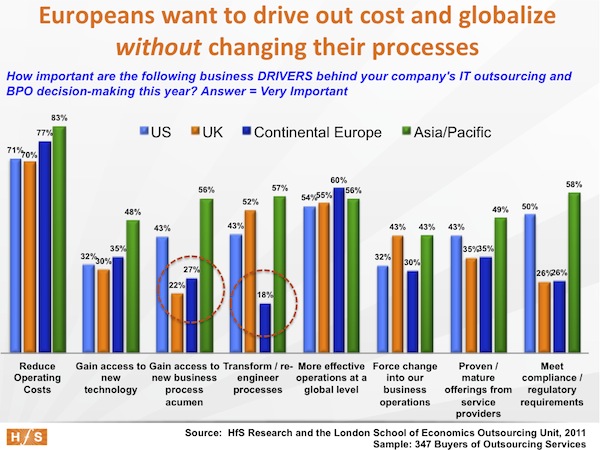
And when you look at the individual outsourcing intentions of continental Europeans versus the other regions, from our new study that we just conducted with the Outsourcing Unit at the London School of Economics, exactly the same philosophy seems to apply:
So what’s really driving outsourcing decision-making across the world?
United States: Let’s save some money, but also use this as an opportunity to globalize operations, transform processes and gain access to compliance standards and business process acumen that we – let’s face it – simply don’t have. Let’s take a realistic view of what we can get from the experience: use it as an opportunity to manage our ropy processes more effectively, but let’s not go overboard with the “forcing change” stuff, or having any fancy new technology thrown at us – as there’s never such a thing as a free lunch, folks.
Britain: Please can we shed the costs and change the bloody processes – but our existing bunch are going to be smart enough to figure it out – and we certainly don’t need to be told what to do – especially by our former colonies. We used to run the world, you know…
Continental Europe: Ah… mes amis! Let’s rip out ze costs, but for ‘eaven’s sake, don’t make any changes to our mother-ship. By all means, sack all the expensive foreign staff in the vorldvide offices and sheeft ze vork to India or Les Philippines, but – we repeat – don’t CHANGE anything!
Asia: You mean we can offload all our terrible back office stuff and have you lot run it for us cheaper and better? Take it now – ALL of it!
So there you have it: HfS sums up world politics and culture in a single chart and blog post.
Our new study of 1350 outsourcing industry stakeholders, conducted with our friends at the Outsourcing Unit at the London School of Economics, continues to reveal home-truths about what’s really going on in the business. Quite alarmingly, we can also reveal that many providers are not entirely in synch with what their customers actually want from them.
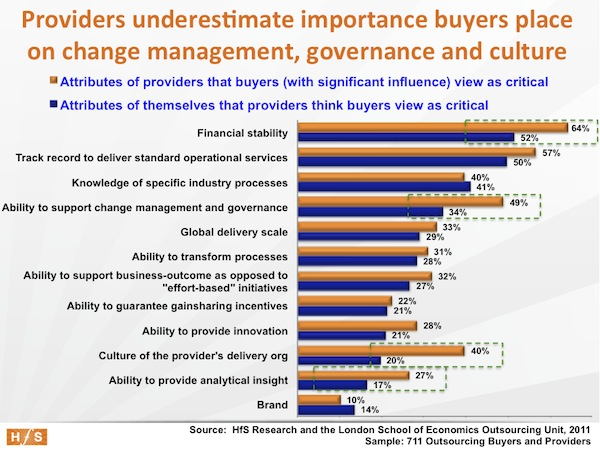
We asked a cross-section of buyers with significant influence over outsourcing decisions, to reveal the critical attributes they seek in a provider. At the same time, we asked providers what attributes they believe their clients deem critical. And – guess what – their are significant gaps between what clients want and what providers think they want:
Providers are underestimating the importance buyers (34% compared to 49%) are placing on their ability to help address their change management and governance challenges. This indicates a significant communication problem is going on in industry – buyers are clearly realizing they need a ton of help and are actually looking to providers to deliver it. We believe some providers are simply unaware of the extent to which buyers are concerned about these issues, and are over-focused on being price-competitive, demonstrating operational delivery capability and risk mitigation.
Moreover, to prove further this communication gap between buyers and providers, 40% of buyers see the culture of a provider’s delivery organization as a critical attribute, compared to only 20% of providers. This begs the question whether many providers ever stop to examine seriously their delivery culture and how it gels with their clients. How can so many miss the importance their culture has on their clients’ decision-making? Again, the answer has to be a lack of good ol’ communication.
Analytical insight is also becoming increasingly important to buyers (27%), with many providers – again – underestimating the extent to which those decision-makers want to learn more about their capabilities. Are providers simply convinced their clients and prospects are only interested in the basic table-stakes of outsourcing?
The bottom-line: understanding and communicating service-culture is the critical component of successful outsourcing
HfS believes that the knowledge and intentions of providers’ clientele is quickly maturing, and they need to find smarter ways to communicate with them, understand what’s really important and invest in their services to respond to their needs. Currently, the outsourcing industry has a problem – providers either aren’t listening to their clients, or simply aren’t being given the environment to listen.
Let’s face facts here – outsourcing has historically been far too reliant on contractual terms, to the detriment of the softer elements that are needed to foster better provider/buyer relationships. And it still is. However, what’s transpiring is that buyers are increasingly looking for more from their provider to help them better manage their outsourcing engagements. They don’t want continually to spend millions each year on consulting support to improve their governance capabilities, their processes, their analytics, their innovation roadmaps etc.; they want this stuff embedded in the day-to-day service-culture of their partner.
HfS ultimately sees three root causes inhibiting this development:
Buyers need to try harder to get the message to providers about what’s really important to them;
Advisors, consultants and intermediaries need to help facilitate (not restrict) more communicative environments for buyers and providers (pre and post contract);
Providers need to spend more time demonstrating how their service-culture is the right fit with prospective buyers, and how they can help them with all the painful change and governance issues they are going to face over the long-haul.
Donniel Schulman is GM for F&A and Supply Chain Global Process Services at IBM
One chap we’ve been trying to get on here for years is known simply as “The Don”… to anyone who knows him.
There aren’t too many people who shun the media spotlight to discuss the intricacies of the ideal end-to-end expense management process. Nor are there too many senior executives who will quantify exactly how many hours, minutes and seconds they shaved off the time it took to execute that process for a client – and demonstrate exactly how they did it.
However, as IBM’s Donniel Schulman’s reputation and influence in the BPO industry has grown in recent years, we’ve finally persuaded the chirpy New Yorker to share some of his story since IBM entered the BPO industry via its 2002 acquisition of PwC Consulting, which included a number of large-scale F&A contracts. Today, Don leads all the finance and accounting, procurement and supply chain managed services, combined under his leadership as an integrated unit.
Phil Fersht (HfS): Don, I’ve described you as one of IBM’s “best-kept secrets”. You’re not on every podium speaking, but instead you tend to be operating behind the scenes running a lot of the F&A and procurement work at IBM. Would you please tell our readers about your background, where you came from and how you got to where you are today?
Don Schulman (IBM): Thanks very much Phil. I’m humbled by your compliment. My career began in banking and financial services, serving primarily in operations roles. After that, I had a boutique consulting firm in the working capital management space, and eventually broke into PwC where I was fortunate enough to be able to lead its financial management businesses worldwide I came to IBM via its 2002 acquisition of PwC Consulting. I actually worked for a while on IBM’s own internal transformation, reporting to the Chairman’s office. And then six or so years ago, after the BPO business had been formally kicked off they asked me to come in and lead this F&A and procurement business. And now I’ve had the terrific opportunity twice in my career to help create a new consulting industry, first in the world of shared services and then in outsourcing.
Phil: So what is it like being one of 400,000?
Don: Interesting question. Let me alter it a bit to what’s it like working for IBM. I think there were two big changes for me in becoming an IBMer. On one hand, it’s like being a kid in a candy shop, having all this accessibility, all this unbelievable stuff- technology, client base, investments. On the other hand, IBM is one of the most disciplined corporations in the world, which is nice to have as a benchmark in my back pocket for my clients. With that discipline, quarterly reporting requires a framework and a frame of mind that in private partnerships and private equity companies you just don’t need to deal with, so it’s been an education process for me. I’m delighted that I’ve been able to work through it, and I actually have a lot of respect for the process. At the same time, my group is a “tip of the arrow” business model. It’s one of the fastest growing businesses in all of IBM, and we get a lot of investment support, both in terms of acquisitions and homegrown investments. We also have a lot of flexibility and freedom – much the same as you have in running your own business – because we’re not the typical IBM technology business. So it’s a nice balance.
Phil: So when you view the current state of the BPO industry today, what do you see the core differences compared to when you first became part of IBM?
Don: I think the most important difference is that BPO began with a focus on consolidation, offshoring, and labor arbitrage,, and the associated efficiencies. But now, the marketplace has really begun to appreciate that it’s really about business process, effectiveness, and intent. There were different fits and starts in this space. I think there are some companies that are here for the long run and really “get” the big idea. And I think there are other companies that hear the rhetoric but can’t get past the “I just want to offshore.” Analysts like you are helping to drive where the industry really needs to go, which is really about effectiveness and business outcomes, and not only about efficiency.
Phil: HfS Research has revealed new demand-side data (see earlier post) showing the market is rebounding quite aggressively coming out of the Recession – particularly with indirect procurement, F&A and strategic sourcing – . What’s your take? Is the market rebounding as quickly as we think it is, or do you think it’s more evaluation?
Don: My first observation is that we thought we were in a Recession-proof business and we were wrong. The business did decline, and we also see that it can come back. But we see it being significantly different than it was in the past. In the past, outsourcing was all about putting out big RFPs, picking up your business, responding to the RFPs, holding people a little bit at arm’s length to figure out who the lowest cost provider was. Now, relationships are changing dramatically. Companies are coming to us saying, “We’re looking for a transformation partner. We want you to partner with us, to consult with us, to help us drive our transformation agenda, and maybe even define our transformation agenda. We want you to provide the big innovation ideas that we need to drive ahead, and take the risk with us as we go down that path.” We see this as a dramatic shift. We see deals becoming much larger because they had been on downward journey, and they’re getting much more complex. They’re not about headcount. They’re about transformation and innovation.
Phil: IBM had been one of the first of the providers to bring together procurement, supply chain and F&A services into one integrated unit. What was the thinking behind that, and how are the areas blending?
Don: There were both strategic and tactical reasons for bringing them together. Strategically, we realized that a lot of the outcome-based kinds of deliverables we’re providing – whether it’s working capital or sourcing – are actually the same in both functions. Also, the operational proficiency in procurement and F&A are actually very similar. Therefore, the investments we make, the way we approach the business model, the way we approach the value propositions and even the way we deliver the operations all become very similar. However, the biggest thing by far was the concept of end-to-end source to pay, going what I call “inside-out” from sourcing a vendor all the way out to the payables, and from the payment all the way back in. And by combining procurement and F&A in what we call collaborative commerce, there’s a real opportunity to drive end-to-end. In fact, we’re forcing the end-to-end.
Phil: In the supply chain space, I was excited when IBM acquired Sterling Commerce, in addition to several other tech companies with specific supply chain competencies. How is that fitting into a broader sourcing context for you?
Don: With the acquisition of software like Sterling, there’s some overlap we’re trying to sort through, but we’re very excited about it. We believe it gives us a unique opportunity to take a piece of middleware like Sterling and modify, codify and configure it very uniquely to the supply chain market with the tactical kinds of activities that we do in our operations, and provide it to our clients on a need-be basis. And Sterling is just one example of many pieces of software that we’re doing this with.
Stay tuned for Part 2 (you can read here), where we discuss whether shared services is really dying, how Don views the changing role of advisors, and where he sees the BPO industry moving in the future…
Donniel “Don” Schulman (pictured above) is General Manager, Global Finance & Administration and Supply Chain Management for IBM’s Global Process Services (GPS). He is responsible for sales, solutions, delivery and profitability of IBM’s F&A, Procurement and Supply Chain Management GPS worldwide.