We would like to thank personally all 1,335 of you who took the time to compete our State of Outsourcing 2011 study we’re conducting with the London School of Economics Outsourcing Unit. This is the largest ever study that’s looked at outsourcing, which included all industry stakeholders (buyers – both business ops and IT practitioners, service providers and advisors). A special shout also goes out to our partner, the Sourcing Interests Group, for inviting their members to participate, in addition to our 53,000 loyal readers.
We’ve been sifting through the findings these past few days, and let’s start here:
Engagements struggle to deliver business value beyond cost reduction
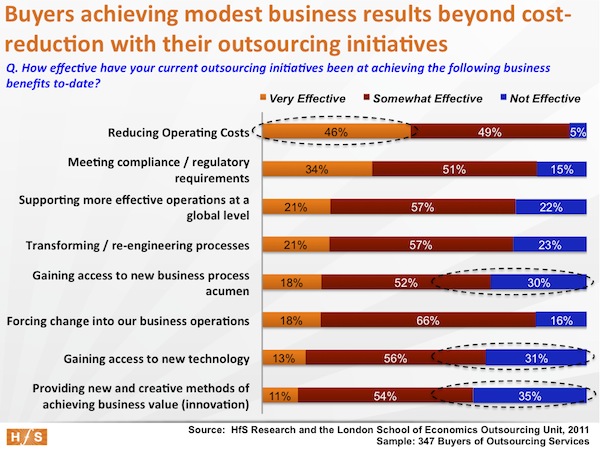
Whatever the motives buyers have when they outsource, the first critical metric they must reach is to save the money they were promised at the onset of the engagement. And we have spectacularly good news for the entire outsourcing industry – the cost savings targets are being met – and being met well, with over 95% of current buyers viewing the engagements as effective for reducing their operating costs. And half of them are really pleased with their cost-reduction progress, the other half seeing progress as “somewhat effective”. However, that’s pretty much where the good news tapers off, as the rest of the results are pretty modest…
After cost-reduction, how is outsourcing faring?
Business Process improvements. Barely one-in-five buyers feel they are experiencing significant improvements from accessing new expertise and transforming processes with their current outsourcing initiatives. Half of them do see some effectiveness gains, while more than a quarter are seeing no effectiveness gains at all with their business processes. Considering many of these processes were likely non-core/non-strategic to begin with, which is why they outsourced them in the first place, it’s unlikely buyers are clamoring for process improvement in the initial phases, instead waiting patiently for their providers to serve up experts, process maps and best practice examples to harmonize processes. As many buyers quickly discover, if process improvement is not in the contract, it will unlikely materialize without additional investment.
HfS believes those providers looking to develop real utility across their clients, proactively need to encourage them to adopt common best-practice process workflows. This means they need the availability of process consultants to drive the agenda with their clients. And these consultants should largely be based onshore (spending time onsite) to work with the retained team. This should be a major differentiator between providers – those that can quickly help clients to evaluate improvements, versus those who simply want to shift as much of the work offshore as quickly as possible and keep margins to a maximum.
Introducing new technology. This is an area where buyers should be experiencing far more effectiveness than they currently are, with 56% only seeing modest progress and 31% none whatsoever. Too many engagements are still largely centered on shifts in labor-based services, as opposed to any genuine technology transformation. It’s hard to gain improvements in processes beyond a certain point if they are not IT-enabled, and clearly most outsourcing clients still run the same processes off the same technology platforms that they were using pre-outsourcing. Like above, clients quickly discover if it’s not in the contract, they needed to budget for it – whether it’s the latest SAP upgrade, or implementation of a new expense management tool. If providers want to build true utility, they not only need their clients to have similar processes, but the more they can be enabled on the same technology, the more replicable and scalable their services will become. And if these technology platforms can be delivered in the Cloud (even for components of functions), the easier they are to provision for clients.
HfS believes providers need to aggressively introduce new platforms to their outsourcing clients, and drive the IT-enablement of their business processes. Those providers which can acquire or develop unique technology IP to support their outsourcing clients are at a clear advantage. If clients are using highly customized IT platforms, for example in the capital markets industry, providers need to have the consultative skills to IT-enable the outsourced business processes effectively.
Innovation. As we discussed last year (read post here), at least 50% of clients take innovation very seriously when they outsource. And where they may be struggling to achieve innovation with their outsourcing engagement today, they at least see the potential to achieve it in the future. Innovation is a progressive goal, once clients have got their processes operational and are in a position to explore new and creative ways to improve growth or productivity. Providers need to work with their clients to develop an innovation agenda as they operationalize their outsourcing model, and their clients need to be encouraged to plan and budget for an innovation strategy from the onset of their engagement. Turning around to the board after two/three years to request budget for “innovation” is going to be a lot harder than if it was embedded into the initial agreement with some contractual provisions to cater for future innovation needs. Once the ink on the outsourcing contract has started to dry, corporate leadership has likely already turned attention to other priorities.
HfS believes innovation needs to be addressed front-and-center – right from the onset of an outsourcing initiative, and not as an afterthought. It’s like changing the wheels of a care while your driving – the world isn’t going to stop suddenly to allow for an innovation plan to be developed. It needs to be in the works constantly as the engagement matures.
The bottom-line
HfS views this data as an important success factor for the outsourcing industry. The initial goal of outsourcing – to drive out cost – has succeeded, and succeeded with flying colors. However, the findings also point out that the sequential business needs that need to be addressed are falling short. Our concern at HfS is that costs are like hedgerows – once trimmed they always grow back. Providers cannot afford their clients to struggle. After their transition to a working operational outsourcing model, corporate leadership isn’t going to keep reminding their shareholders about “that stellar 30% we took off the bottom-line three years ago”. They are going to be looking for their next improvement metric. And the only way to achieve that, is to constantly look at harmonizing process and enabling it with better technology. Outsourcing should provide an opportunity for buyers to take advantage of the talent acumen and IP their provider can deliver. If buyers really do care about continuous improvement, then they will seek out a services partner which can prove, through multiple client experiences, that they have the discipline, culture and motivation to work with them over the long-haul.
FINRA is the largest independent regulator for all securities firms doing business in the United States and its recent proposed rule changes are rattling the world of outsourcing. So what happens when you mix these proposed FINRA regulatory rule changes, a well-known outsourcing partner from law firm powerhouse Loeb & Loeb, LLP, and the HfS Governator?
Well, today’s discussion, reserved especially for your weekend reading pleasure, is co-authored by Akiba Stern and Tony Filippone and focused on getting the dirty, detailed work of governance done right. And for any of you who have the good fortune of never having met Akiba, he is the most feared sight for any service provider around the negotiating table. Don’t let the Jewish jokes and Manhattan charm fool you – this rabbinic lawyer can lobotomize the lox and matzah balls from any proposed litigation. Apologies, Akiba, but when you send us in a picture of Charlie Sheen for your mugshot, you’re asking for trouble 🙂
Anyway, who knew that you could have this much fun making regulations meaningful…
Libertarians, Outsourcing and Lobotomies (LOL) and FINRA
Akiba Stern
There is a vocal group of “anything goes” executives that say crazy things like, “It’s not my problem anymore. It is my vendor’s problem.” and “You hired us to manage this. Don’t stick your nose in my business.” These executives are the libertarians of outsourcing.
For some bizarre reason, they view an outsourcing contract as a lobotomy. Apparently, they believe that, upon signing a contract, they instantaneously have no responsibility to ensure their vendors have the expertise to perform the work or to ensure the outsourced function performs as expected.
Year after year, the buy-side responsibility-lobotomized libertarians do as little work as possible. They look at SLAs and assess performance credits, and angrily call with complaints. Their site audits are international junkets, resembling the Fiesta Bowl marketing “events”. These libertarians eschew statistical methods of quality auditing and rigorous, frequent performance management processes in favor of annual qualitative bitch sessions performance appraisals. The effort to compete renewals is too internally politically overwhelming and the thought of a vendor-to-vendor transition is stroke inducing, no matter the level of incompetence.
Stephen Cohen
The sell-side responsibility-lobotomized libertarians are no more motivated. They direct services to new facilities their clients have never seen, to team members their clients have never met, and subcontract the services to vendors their clients have no idea exist. They use systems that are supposedly best in class and used by other “leading organizations”, but are surprisingly feeble and the reporting is rarely insightful. If a performance hiccup occurs and service credits are given, service credit earn back clauses give these lazy people a chance to paper over damage done to their customers’ customers next month.
Get Hands On, Get It Done Right
We come from the school of “hands on governance and vendor management.” It’s not good enough to be a coach, field the team, and hope for the best. You have to run the sidelines. You have to be the referee on the field ensuring you’re always close to the action. Sometimes, you even need to suit-up and play the game to get a first-hand understanding of the pace, effort, and activities of a real athlete.
So, we have a different perspective: You cannot lobotomize yourself when you outsource a function. You cannot hand over your function to a service provider, structure a nasty limit of liability clause placing the onus of regulatory fines and customer lawsuits on your service provider, neglect your outsourced operation, and then punish your service provider for failure to perform. No matter how core or non-core your outsourced function, you have a fiduciary responsibility to proactively ensure it operates as it should.
And … how hard is it really? Why can’t you have a set of critical metrics you review with the service provider month after month? Why can’t you have the service provider’s key players (their operations team, not their snake oil salespeople) meet with their counterparts EVERY MONTH and go over those metrics, variances from budget, services problems, overbilling, opaque billing, negative trends, etc. Okay, maybe it’s boring but that’s why you are making the big bucks (Or at least that’s why you got saved from being riffed or moved to Bangaluru by your Rabbi in the executive suite. So you really need to do some work and add value to justify your cost – which otherwise reduces the business case results!)
Regulators Mandate Hands On Governance
Apparently, US regulatory bodies agree with me. Most recently, the Financial Industry Regulation Authority (FINRA), which is the securities industry’s independent regulator, proposed for comment a rule change that states:
1) Outsourcing doesn’t absolve you of the responsibility for the outsourced function’s outcomes. You keep responsibility to ensure your vendors perform, no matter what contrivances you write into your contract. When the government auditors come, they will don’t care what your contract says about responsibility. They’ll be coming to your cube and asking you the uncomfortable questions, including why you wrote contrivances into your contract.
2) If your employees need certain qualifications and licenses to perform the work, so do your vendor’s employees. Your work still needs to be performed by people who are legally qualified, licensed, and registered to do the work. You need to be sure they are.
3) You must have a detailed governance and vendor management program with sufficiently rigorous processes that, in the words of FINRA, “should include, without limitation, conducting a due diligence analysis of all of its current or prospective third-party service providers to determine whether they are capable of performing the outsourced activities” and ensure compliance with regulations.
4) Some activities are so important to the stability of your company and the industry that you have to supervise, review, audit transactions, and in some cases, even independently review your vendor’s systems to ensure that they apply the right calculations and processes to your work. The FINRA rules go so far as to say that you’re not only responsible for all the above, but when the auditors come, you, not your vendors, have to explain the details to the auditor. Statements like, “At a high level, I know what they do, but if you want the details, ask my vendor” or “My vendor says its systems are used by many other leading global institutions” are not going to be accepted by the auditor. You must have a rigorous, statistically-based approach to quality audits and you need to independently verify that your vendor’s systems and processes comply.
5) All the same rigor described above applies as much to the subcontractors as it does to the contractors. So, that means if your vendor subcontracts to three other vendors, you, not your prime contractor, have to exercise the detailed governance and vendor management approach to all the subcontractors.
6) For Carrying and Clearing Member Firms, FINRA needs to be notified within 30 days of entering into an outsourcing agreement. In essence, the regulator needs to be quickly made aware that your organization intends to outsource. This includes locations (and changes to locations).
FINRA is not alone. The various banking regulators (Federal Reserve, FDIC, National Credit Union Administration, the Office of the Comptroller of the Currency (OCC), and the (soon to be disbanded under Dodd-Frank) Office of Thrift Supervision), and URAC (health care management accrediting body) all limit delegation of oversight and place strict standards on the clients outsourcing.
What This Means to You
Regardless of your opinion of extending the reach of regulators or our (maybe) tongue-in-cheek perspective on lobotomized outsourcing libertarians, FINRA, and other regulators, are really asking companies to do what they already should be doing:
If your company outsources, you should get actively involved in the governance necessary to ensure outsourced services meet expectations. This means investing in the personnel, processes, and tools required for sound governance.
If your company provides outsourcing services, you should actively involve your customers in the delivery of the services. This means opening the kimono on your staff, processes, and systems to give your clients an unprecedented level of involvement in ensuring your services meet expectations.
We are interested in your perspective on governance. Please leave a comment here or get in touch with Tony “The Governator” Filippone, HfS Research Vice President, Governance and Sourcing Strategies.
If you’re interested in more information about the implications of FINRA’s proposed changes to your outsourcing environment, we encourage you contact Akiba Stern or Steve Cohen, partners at Loeb & Loeb.
Stern has advised clients for 30 years in all aspects of business law, both as in-house counsel and at law firms. Stern concentrates his practice on outsourcing, technology-enabled business transactions, e-commerce, technology transfers, licensing, intellectual property and joint ventures. He also specializes in transactions involving the commercialization of intellectual property.
Cohen focuses his practice on broker-dealer regulation and the securities markets. Cohen advises broker-dealer clients on a wide variety of regulatory and transactional matters, including federal and state registration and compliance issues and SRO membership and compliance issues, including FINRA (formerly NASD), the stock exchanges and the clearing corporations. His clients include major international banks, domestic and foreign investment banks, full service and boutique brokerage firms, clearing firms, transfer agents and hedge funds.
During Part 1 of the largest-ever study that’s looked at outsourcing across both IT and business process, we revealed – beyond any doubt – that outsourcing is now a proven business model for reducing operating costs, with 95% of buyers reporting positive outcomes. Moreover, our study also reveals huge untapped potential for future outsourcing right across both IT and business functions, so surely this means the market is set to explode and we can wield new hockey-stick growth projections? Perhaps… but a few things need to happen first. Let’s investigate…
Strong outsourcing growth potential exists across both mature and virgin outsourcing areas
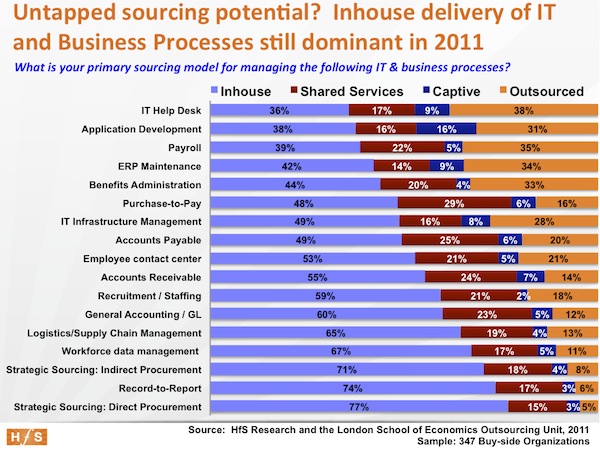
Established outsourcing areas have a lot of runway. As our data across global enterprises illustrates, as many as four-out-of- ten enterprises still primarily conduct mature outsourcing-friendly processes such as IT support, ERP maintenance and application development, payroll and benefits administration inhouse. In fact, with the exception of IT help desk, more enterprises still predominantly manage these processes inhouse than choose to outsource them. This seems unfathomable – right?
Maturing outsourcing processes are poised for heavy growth. For maturing outsourcing areas such as purchase-to-pay, accounts payable/receivable, general accounting etc., 50-60% of enterprises still adopt an inhouse sourcing model, roughly a quarter house them in shared services, while under a fifth have chosen the full outsourcing path. That’s a lot of administrative work still being run at unnecessarily high cost – right?
Emerging outsourcing functions are only just at the beginning of their growth curve. With emerging outsourcing areas, such as record-to-report, strategic sourcing and supply chain management, barely 10% of organizations have chosen to outsource, with the vast majority still clinging to inhouse delivery. OK – these are more complex processes, but not many enterprises are dipping their toe in the water – right?
So with these proven cost-savings on the table, why is outsourcing still in its infancy for so many business support functions?
Buyers are distrusting of providers’ capabilities and haven’t been convinced of the proof-points
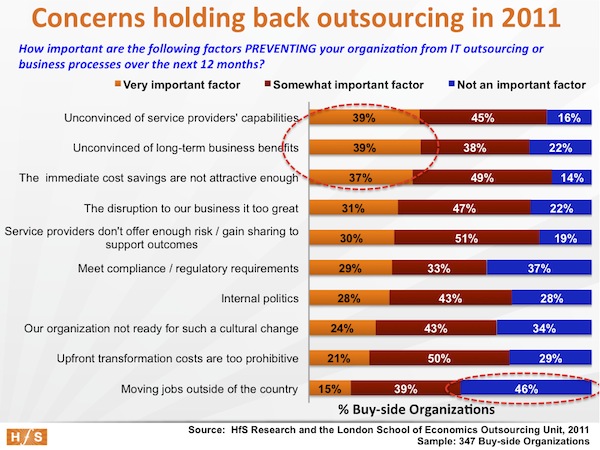
Clearly, many buyers have not been convinced by providers that they can deliver the goods:
Four out-of-ten cite they have yet to be given genuine proof-points that providers have the know-how to produce long-term business benefits for them. So why are they unconvinced?
The industry is polarized around cost. We believe a main reason for slower adoption of emerging outsourcing areas, lies with the fact that outsourcing has becoming polarized around cost as opposed to business value. Advisors and lawyers are too often brought in to develop watertight contracts and swathes of SLAs, which in turn diffuse much of the trust and relationship energy from the relationship before it’s even been signed. In far too many cases, it takes years to establish the level of trust that should have been established before the onset of the contract.
If you’re just inking a help desk deal and want your lowest price per help-ticket, that’s fine, but if you’re looking to globalize your procurement processes, or improve the quality and timeliness of your management reporting, you really need to see what’s under each provider’s kimono before you tie the knot with them.
Many providers lack proof-points and the ability to communicate effectively with buyers. Part of the reason for this, is that many areas of outsourcing are barely a decade old and there aren’t actually a lot of proof points available. Even so, some providers do a lousy job relating to buyers and providing a listening environment where they can have other clients share their experiences. Several providers still have archaic channels to market, whereby they simply fail to communicate with business function leaders who want to learn more about outsourcing and global business operations. Smart, creative relationship energy is required to influence the right business executvies and convince them of what can be achieved in a well-executed global sourcing environment.
The bottom-line
As Part 1 highlighted, buyers are only seeing modest business benefits in areas such as achieving new business process or technology delights. We believe this polarization around cost-reduction is manifesting a distrust among buyers to increase their outsourcing scope into new areas. It’s not about moving jobs out of the country – the core issues are about trust and demonstrating real business value and competency. Moreover, many organizations take a long time to accept such disruptive change as outsourcing – and they require a softer, more value-based and consultative approach to sourcing than simply hard metrics. Cost pressures have dictated much of the growth in outsourcing over the last decade, but it’s clear that many organizations want to see more before they will take the plunge. Remember, today’s corporate decision makers are unlikely to be schooled in the world of global sourcing – they usually come from finance, legal, sales or operations backgrounds. They want to see how outsourcing will really impact their business, and many of them are still yet to be convinced providers are going to deliver business value to which they can relate.
Stay tuned for the next installments in this series, where we will look at trends by industry, company size and by region, in addition to anticipated outsourcing adoption. And your comments and debate are always welcome!
If you participated in our State of Outsourcing 2011 survey (see here and here), you may have been anxiously monitoring your inbox for a notification that you’d won the iPad 2. Well, the anticipation is over, and we can announce that the winner of the drawing is Stephen Kincanon, Vice President – Shared Services at Sara Lee Corporation. Congratulations, Stephen!
We managed to get a moment to talk with Stephen once he’d settled down from the excitement…
iPad 2 winner Stephen Kincanon, Vice President of Shared Services at Sara Lee Corporation
HfS Research: Congratulations Steve on winning the iPad 2. Can you share a little about your role and your involvement with outsourcing?
Stephen Kincanon: At Sara Lee, I am responsible for shared services for North America and the overall relationship with our BPO provider (IBM). As related to outsourcing, I was involved in the business case development, RFI, RFP, vendor selection and transition of Sara Lee’s activities to the BPO provider.
HfS Research: Based on your experiences to date, what would you say are the biggest opportunities and challenges for today’s organizations looking at moving into a global outsourcing business model?
Stephen Kincanon: I believe one of the biggest challenges for today’s organization is making sure there is flexibility with your BPO provider due to the number of changes within the organization such as mergers, acquisitions, divestitures, restructuring, etc. Having a provider that is willing to work with you during these time is critical to the success of your outsourcing and shared services.
The opportunity that comes to mind is finding a single delivery center that can meet the global needs of a company. If a company can have a single location providing BPO services it will reduce overhead costs for both the provider and customer. One of the challenges in this area is finding a low-cost location that has the language capabilities for a global company.
HfS Research: Is there any advice you would share with peers in other organizations, thinking of outsourcing?
Stephen Kincanon: The advice I would share would be: “make sure you select a provider that will be flexible in time of change and willing to work with you in creating solutions and not be focused on contract terms”.
HfS Research: What are your views on HfS and the work we’re doing? Anything we can improve upon?
Stephen Kincanon: HfS provides an unbiased view of the suppliers and trends with outsourcing and helps buyers understand what is coming in the future.
HfS Research: And finally, what will you do with the iPad 2?
Stephen Kincanon: Hide it from my 18 year old daughter.
HfS Research: Thanks Stephen – enjoy the iPad, oh and the BPO experience too 🙂
Outsourcing is a cyclical business – when economies nose-dive, organizations batten down the hatches and wait for the uncertainty to clear, before making decisions that are longer-term in nature and potentially disruptive to the business. Recessions drive short-term behaviors, namely immediate cost-cutting, re-orgs and layoffs. Hence, shaking up the finance, HR and procurement functions with complex, stressful outsourcing initiatives could well detract from the short-term tactical measures to ride-out the economic misery.
Having come through the worst Recession since the bubonic plague, it’s little surprise that much of the outsourcing energy dissipated between 2008 and 2010. Lots of low-risk application development and support work was moved to low-cost providers during this time, as it fitted the “cost-out-quickly with minimal disruption” mentality of many organizations. Consequently, many enterprises still operate their core general and administrative work much the same way they’ve been doing for the last decade or more, and most business function leaders know they have to change.
Our State of Outsourcing 2011 study of 1,335 industry stakeholders, conducted with the Outsourcing Unit at the London School of Economics and supported by our friends at SIG, points to a marked turnaround in outsourcing intentions as global economies reach a period of sustained (albeit limping) recovery. For many organizations today, clearly the short-term counter-recessionary measures have been executed through to fruition, leaving business function leaders under renewed pressure to seek out new operational strategies for driving out cost and improving global effectiveness.
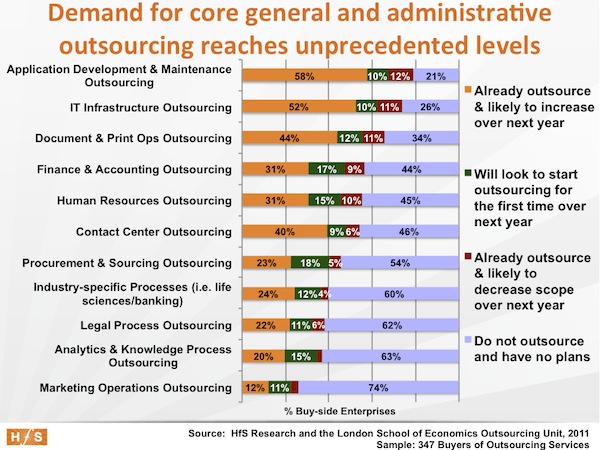
Yes, it’s time to dust off those old outsourcing plans, call your hapless account rep who’s likely given up hope you’ll ever get serious about this, and request to re-examine the delights and possibilities of that promised outsourcing land. And – oh my – are companies revitalizing their interest:
Let’s examine these dynamics:
IT Outsourcing
Well over half of enterprises today are outsourcing a proportion of their apps and infrastructure, and the overwhelming majority (58%) are adding scope to their engagements. Clearly, this is a maturing and (dare we say it) commodotizing marketplace, where buyers are getting increasingly experienced and looking to squeeze more out of their existing service provider portfolios and further reduce their onshore staff numbers. As Part 2 illustrates, many firms still have plenty of IT support still inhouse or in shared services. We expect a heavy polarization by the leading service providers to soak up this high-end enterprise demand, while the less-profitable scraps in the middle market will get fed to the lower-tier providers, and those slipping top tier providers now struggling to maintain their enterprise presence.
Business Process Outsourcing
Procurement BPO: Finally, Procurement BPO is on the table, with 18% of organizations seeking their first forays into an outsourced model over the next 12 months. Organizations are coming off the Recession knowing they have to globalize their procurement processes and leverage the indirect sourcing competences of providers to tighten-up the cash flow. Moreover, providers are aggressively pushing gainshare, risk-sharing proposals at buyers in order to develop scale and category expertise across procurement BPO functions. Procurement BPO doesn’t bode too well with the labor arbitrate-only model – most procurement departments have already been cut to the bone – and merely lumping messy procurement work offshore isn’t, by itself, going to deliver benefits that are going to make this a worthwhile experience. However, there is lots of money to be saved (or gained) when you use more effective procurement technology and have access to category experts. With such a large number of buyers already bedding down their F&A engagements, procurement is the natural next step for may organizations.
Finance & Accounting BPO: As we discussed during our recent F&A market analysis, F&A BPO has emerged aggressively after being back-burnered considerably during the Recession. With 17% of enterprises expecting a first-time move into F&A over the next year, we can anticipate several new engagements to come to fruition, with a projected market growth of 15%. However, we would also add that 85% of F&A discussions currently on the table are being sole-sourced with limited (if any) advisor presence, which makes it challenging for providers to get their clients over the line to take the plunge. There isn’t a lot of education and experience in the market for buyers to get the discipline and data they need to move into an engagement via a sole-source, and we anticipate that many of these engagements will take a lot longer than a year to get finalized. And many will likely never happen.
Human Resources Outsourcing: There are two dynamics driving a healthy growth in the HRO space – the desire from many enterprises to globalize their payrolls, and the need to help with the new compliance and regulatory measures being introduced by ObamaCare. Very few enterprises are still looking at multi-process HR BPO strategies, instead electing to look at single process engagements, often with a diverse mix of providers. We are also seeing increased interest in recruitment process services, as many business seek more flexible staffing models and increased proportions of contingent workers.
Other process areas: “Traditional” BPO areas, such as call center and document and print operations, are clearly on an upswing as business volumes improve and buyers need more support. And with many large enterprise already having existing service contracts in-place, increasing delivery volume and scope is already underway. We’ll dig deeper into the nuances of these more traditional markets in Part 4, coming to a LCD near you very soon.
Industry-specific processes are currently dominated by several high-end insurance companies and banks with a lot of activity in areas such as claims processing and management, compliance support, payments processing and capital markets services. In addition, we are seeing increased interest from some of the big pharma, in areas such as clinical data management and pharmacovigilance services. New BPO markets, such as LPO, marketing operations and analytics are also featuring as areas of planned investment from buyers.
The bottom-line
The outsourcing market is hotter than it’s ever been from an interest and activity perspective. There is barely an unemployed or benched sourcing advisor to be found, and providers are hunting like dogs for new sales reps to develop their bulging pipelines. However, lots of bubble and fizz doesn’t always translate into long-term action. As we discussed during parts 1 and 2, buyers struggle to get a broader picture of outsourcing beyond cost-reduction, and many distrust the providers to mitigate their risk.
Moreover, many buyers clearly struggle to get to a decision-point about such a sensitive and potential disruptive phenomenon as outsourcing. We predict that existing buyers will follow-through with their intentions to increase scope of existing engagements, but many of those intending to outsource a function for the first time, will either fail to make decisions internally, or their expectations with regards cost-savings, are not going to be met – especially the more resource-constrained buyers in the mid-market. We’ll see most activity over the next year with the experienced enterprise-level buyers, while the mid-market takes time to digest its options and seek out providers that can really deliver a business case that makes outsourcing compelling enough for them.
Outsourcing is like ripping off a Band-Aid. Do it slowly, it’s a slow and painful experience. Do it quickly, and the pain is gone before you know it…
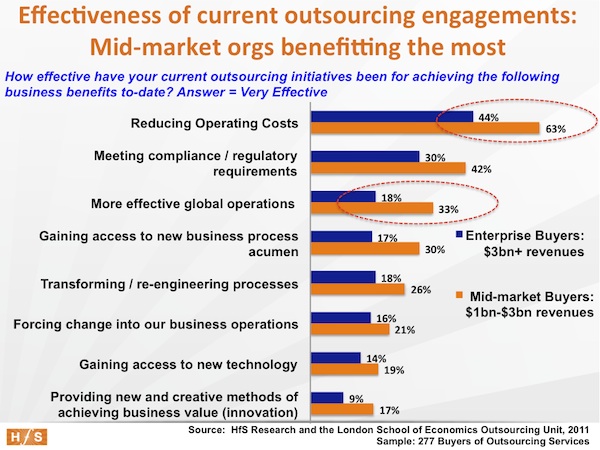
Outsourcing of IT and business process has always been a game for large enterprises, where well-executed large-scale employee transitions have resulted in profitable endeavors for both providers and buyers. But while the large buyers like saving the money (see Part 1), it’s actually the mid-market sector ($1bn-$3bn revenues) which is getting a lot more out of the experience:
This graphic shows where outsourcing has been very effective for organizations. And the mid-market buyers have been enjoying considerably more success in every area – from cost reduction through to global effectiveness, through to getting better business process improvement and technology.
HfS believes much of the reason for this is that mid-market buyers are forced to jump into outsourcing more aggressively to attract a quality provider, which, in turn, is forcing them to transform their operations much more rapidly to incorporate the provider’s global delivery infrastructure. Let’s examine this further…
Why mid-market buyers are enjoying more successful business outcomes when they outsource
Mid-market firms appreciate the global scale, expertise and process acumen providers bring to the table
In the mid-market, organizations are less well-resourced – they often have legacy IT and can’t often afford to have well-paid top-notch finance, procurement, HR and operations talent. Hence, having skilled service providers take on their stuff has been – by and large – a positive experience for them. Their bigger counterparts tend to have more sophisticated ERP and empires of IT, finance, procurement and HR. When the large firms outsource, they don’t really want to change the way they do things – they simply want to run them the same way at a lower operating cost. While a mid-market organization may not wield the same level of aggressive cost reduction through large-scale labor arbitrage as larger enterprises, they clearly enjoy the benefits of accessing improved technology and process expertise.
Mid-market buyers initially outsource a greater proportion of their staff and processes to make the economics work, which is leading to more positive business outcomes
Enterprises usually have a lot more staff supporting business functions, and many of them are today outsourcing in increments, perhaps starting, for example, with accounts payable, before extending to receivables, reporting, procurement and analytics. They are large enough to be able to dictate to suppliers their preferred pace of outsourcing. Many mid-market firms may only have, for example, 150 people in finance and 25 in procurement. They’re pretty much going to have to bundle as many staff into the first deal to attract a top tier provider and don’t have the “luxury” of outsourcing step-by-step.
Moreover, the fact that most of the mid-market buyers have to outsource more processes and staff faster correlates with the increased satisfaction ratings – a more rapid transition to an end-state clearly helps drive transformation and improvements in process.
Many enterprise buyers are outsourcing in an incremental fashion, which doesn’t encourage business transformation
Large enterprises continue to dominate the lion’s share of current outsourcing activity – because they are tending to outsource in smaller increments which, in turn, is inhibiting change and encouraging them to muddle through with their existing processes, which are often inefficient and not very effective in a global outsourcing delivery model.
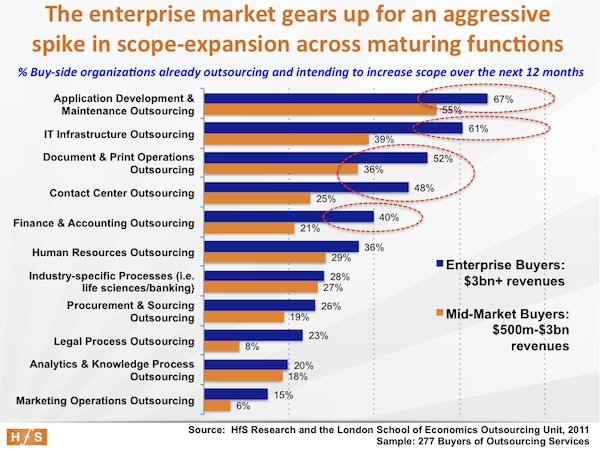
The following graphic illustrates the fact the enterprise buyers are far more active increasing the scope of their existing engagements:
As this data plainly illustrates, large buyers are not holding back when it comes to expanding their outsourcing engagements in established areas where they have eager suppliers swarming all over them to take on more work. For example, 40% of large buyers already outsource parts of their finance and accounting and are looking to grow their engagements, half of them are doing likewise with document and print management, and two-thirds in application development and maintenance.
It really does beg the question: why continually look to increase scope, when you could have outsourced a load of these processes years ago? What were you waiting for?
The bottom-line
Let’s be realistic here – organizations outsource processes that probably aren’t very well run in the first place. Why persist is continuing to run them poorly and take 5 years to reach a point where you finally admit you have to change?
HfS believes the whole “softly, softly” approach to outsourcing that we are seeing from many enterprises, is prolonging the disruptive change a buyer needs to go through to reach its desired global operations end-state. Enterprises clearly struggle to achieve the business benefits of smaller organizations which are forced to bite the bullet and take on new ways of running processes when they outsource.
Moreover, the mid-market is clearly becoming the testing ground to develop more standardized outsourcing models that can be implemented quickly and incorporate quality process workflows. Moreover, the opportunity is clearly there to bring together much more “industrialized” outsourcing solutions that incorporate software IP, analytical outcomes and BPO. HfS strongly believes that providers need to attack the middle market, in addition to the “easy dollars” at the enterprise level, in order to develop a balanced portfolio of clients: enterprise engagements will serve up profit and delivery scale that can be invested in middle-market clients which are road-testing these industrialized solutions of the future.
Having been in and around the analyst business since 1996, I’ve never been short of an opinion or two about the industry. And neither are most people I know… love them or loathe them, analyst firms and their unique individuals stoke the emotions of many who come in regular contact with them. But are the days of the traditional industry analyst firms numbered?
I’ve been both analyst and consultant during my career and work with many buyers, sellers and intermediaries of both technology products and professional services. I’ve worked with the best and worst analysts on the planet. I’ve seen great research developed that was truly unbiased and objective, and also – sadly – been witness to some that was, quite frankly, not.
I’ve seen analysts ride waves and become rock stars, and then lose the plot somewhere along the line before either exiting the industry altogether, or plodding along on the vendor-briefing circuit, eking out their paychecks towards retirement. I also know level-headed analysts who quietly go about their job and produce decent stuff – never making a lot of noise, but effectively doing their job. I’ve also worked with egomaniacs who pander to paying clients and scare the living daylights out of anyone who dare criticize them – or refuse to buy their services. I’ve also worked with absolute numb-skulls who somehow remain employed, despite knowing very little about anything. And I’ve worked with analysts who really know very little, but somehow persuade the world they are visionary thought-leaders.
Yes, the analyst business is a strange place, creating all kinds of weird and wonderful individuals, fueling all kinds of emotions from their respective spheres. However, the world has changed so much these past five years, that it gives me real concern whether there’ll be much of an “industry analyst” business left in another five. Here are my reasons for concern:
Short-term attention-span theater has taken over, and some analyst firms are oblivious. Very few people have the patience, or inclination, to read detailed reports any more. Even just five years’ ago, many people only checked email two or three times a day, allowing them to focus on tasks that required a lot of deep-thinking, reading and writing. Nowadays, most people are checking email constantly, scanning tweets, Facebook status updates, LinkedIn invitations and contributing to whatever social group or network with which they like to spend time. Research needs to be served up in bite-sized chunks to stand any chance of being read. The analyst firms are slowly becoming aware that few people read their stuff anymore, but persist in “checking the boxes”, forcing their analysts to meet their report quotas each year. Their problem is that their product and revenue model is based on numbers of reports and hours of enquiry time – they are serving up expensive macro services, where their clients now want the micro.
There’s too much “research” being produced that’s not telling us anything new. I am actually hearing major IT/BPO providers and C-suite buyside executives declaring that today’s “traditional” research “isn’t relevant to them anymore”. They just don’t see the point in a lot of it. They’ve figured out how to sell/buy their products and services, and dont need some primadonnas in their ivory towers telling them what they already know, using big words such as “ecosystem” and “agility”. They view analysts as useful sounding boards and occasionally get some competitive intel out of them, but that’s really all the value they currently get, beyond favorable positions in scatterplot charts and after-dinner awards.
Too many analysts are following the hype and avoiding reality. How many analysts haven’t started using the word “Cloud” at every opportunity? How many have actually had the stones to challenge the hype and go against the marketing dollars of their paying vendor clients? The more analysts persist in following the hype, the more they are turning off the punters.
Buyers don’t read research these days. Fact. I can tell you from years of experience that buyers will only read a research report if their job depended on it and it’s forced down their throats. However, buyers love learning things that help them do their job better – they like listening to real experts and learning from each other. Analysts need to spend as much time as they can talking with buyers and becoming a focal point for idea-sharing, knowledge, data and validation of their strategies. While some analyst firms know this, many of their analysts rarely have more than two or three buyers in their Rolodex.
"This sums it all up perfectly" (courtesy of Ray Wang)
The large analyst firms lack rock-star visionaries. In years gone by, there were countless big personalities emanating from the Gartners, IDCs, Forresters at al. Sadly, that number has dwindled as these firms felt the need to control and scale their corporate brands and keep their payroll under control. Moreover, the last thing they want are clients calling up demanding to talk with Bill, not Ben. Innovation is bred from people with vision and personality – and the more analysts are “standardized”, the more the personality is drained from the product. Analyst firms need to create new visionaries for clients – and maybe even dust off a few of the old ones knocking around somewhere in the blogosphere. Hell – the retirement age is 70 now, so let’s bring some of the old egos back!
The bottom-line
So there we have it – one guy’s view among many – and am sure many people will get upset with me for calling it how it is, while others will just say, “tell me something new, Phil”. I chose research and analysis as my chosen profession and believe passionately in the value that good expertise, broad thinking and data-driven guidance can bring.
My firm, HfS, couldn’t survive alone merely peddling research reports – we have to deliver products, data and networking opportunities our clients need, to help them do their jobs better. Research has to be about bringing together the voices shaping industry, providing real data to help guide decision-making, and also forcing people to stop, think, and take notice.
At the end of the day, research is discretionary spend – we’ll have another recession one of these days and we’ll have further secular changes to industries, like the last one. Just look at what happened to the worlds of media and journalism. I fear that the analyst business could fall victim, should it fail to keep apace with these fast-changing times.
And if you want to hear even more on this little topic…
Our friends at the International Institute of Analyst Relations (IIAR) are going to feature a live debate on 13th July at 11.00am ET, where I will be discussing this “crisis” live and taking questions. Click here for more details, or email info at analystrelations.org.
Having been blogging for over four years, I’m used to putting down my thoughts and concerns about things I care about. I normally don’t think about it too much, I just write and enjoy the banter and discussion it creates. It’s like having a “virtual pint” with friends, peers and colleagues.
So when I received many notes, emails, calls and comments after my weekend rant (which I barely categorized as a “rant” when I published it on Sunday), I suddenly realized this thing was going “viral” – especially when dangerous Dennis Howlett picked it up! How had I managed to hit such a raw nerve? I throw the outsourcing business under the bus everyday, and noone bats an eyelid!
By Monday morning, several analysts informed me that the piece had been all over Forrester, Gartner and IDC, among other places. So why, pay tell, did only one Gartner analyst openly dare to contribute a comment (and a good one), while several consumers of research (buyers and vendors), in addition to analyst relations professionals, were only too keen to chip in? The fact that they all read it and pinged it around so prolifically suggests they care – but why they are not willing to defend themselves sends another – very clear – message.
I never said the analyst industry was going to be “dead”, I simply (admittedly) followed blogger-protocol of throwing out a slightly bonkers and controversial headline to get you to read it. I wanted us to debate whether it would be “dead” if it failed to keep apace with such unprecedented shifts in the way research is developed and consumed in today’s society. And, oh my, did it work…
I do have very real fears – to which there has been violent agreement – that some of the traditional analyst business practices are in trouble and the business is going stale. My genuine fear is that some of the large firms are so consumed with meeting financial targets and complying with internal processes, they are taking their eye off the essence of their product – influencing, informing, analyzing, and staying ahead of the industry with real insight and thought-provoking topics – and in real time. Only one or two firms can get away with standardizing their research product so they have a cookie-cutter delivery model, a 1-800 analyst support-line and a common brand (not individual brands). The rest will fall away, or desperately feed off of scraps that probably don’t constitute real “research” anymore (dare I mention some famous old analyst brands which are on life-support today).
And if you want to hear more on this little topic…
Our friends at the International Institute of Analyst Relations (IIAR) are going to feature a live debate on 13th July at 11.00am ET, where I will be discussing this “crisis” live and taking questions. Click here for more details, or email info at analystrelations.org.
Tim McBride, Microsoft's Chief Procurement Officer
Think you have a tough job? Imagine one where only flawless execution is acceptable, despite the piles of paperwork, scads of emails, phone calls and faxes to plow through every day.
Try being a CPO for a day. It’s a straight shot to failure… unless you can find execution support that makes your function indispensable – and actually appreciated by your executive peers and colleagues.
Tim McBride lives that life at Microsoft, and we talked with him about his procurement execution and BPO experience as part of a case study in a paper Tony Filippone and Phil Fersht wrote in partnership with Denali Group.
Tim’s a 15-year veteran of Microsoft, and has lasted 4+ years as CPO. So he must be doing something right. To get a sense of how he handles his job, and what the key challenges are for CPOs, read our new paper: The CPO in 2011: The Toughest Job in the Global 1000 by filling out the form below (we’ll email you a link to the file).
Download The CPO in 2011: The Toughest Job in the Global 1000 [email-download download_id=”1″ contact_form_id=”2″]
Our resident travelling HRO impressario, HfS Research Fellow Keith Strodtman hit the road earlier this month to head to Milwaukee. Top of his agenda, other than sampling Milwaukee’s finest cheese and ale, was ManpowerGroup’s industry analyst and influencer day. As the headline on this post may indicate (and Keith’s RAPIDInsight shows), Manpower is more than a staffing company now. It is?
Keith files this blog report. Take it away, Keith…
Manpower Group held its industry analyst and influencer day on June 9, 2011 at its headquarters in Milwaukee, WI. ManpowerGroup is the third largest staffing company in the world based on revenue and the largest based in the United States. It operates in 82 countries, has more than 30,000 full-time employees and places 3.5 million people in permanent, temporary, or contract positions. That’s a lot of staffing.
While much of the day was devoted to business overviews and strategy updates, the company’s executives and analyst participates also spent a lot of time discussing the changing dynamics in global workforce. ManpowerGroup has an extensive research group that studies workforce trends with its customers, economists, governments, and think tanks. Instead of covering the business overviews in this blog post, I’ll share some of the thought leadership discussed at the event. More details about ManpowerGroup’s businesses can be found in the HfS Research RAPIDInsight ManpowerGroup – A Whole Lot More Than A Staffing Company.
While some of the language and buzzwords used by ManpowerGroup rivals those of the big consulting firms, I found the company’s research and positioning to include thought provoking views that HR and other business leaders would be well served to be thinking about. Many of the observations made by the company align with some of the topics I covered in my blog post on The Future of Work. ManpowerGroup has encapsulated many of their views on the future of talent into a thought leadership piece they call “The Human Age”, an era where unleashing the human potential will be the key driver of global economic growth.
Keith Strodtman, HfS Research Fellow (click for bio)
It may seem a little strange to think about talent shortages when many of the leading economies have high unemployment rates, but the reality is there is a growing talent “gap”, where the people available to fill a role lack the specific skill required for the role. An example is the shortage of software engineers in India. Most of us probably think that India has an unlimited supply of engineers. The reality is that it is estimated that India will experience a shortage of software engineers just six months later than the United States will experience the same shortage. In fact, India ranks second, behind Japan, for overall difficulty to fill key skilled positions.
People with the skills most desired by companies will have more power to dictate the terms under which they will work for a company. In response, employers will need to be more creative and agile to attract skilled individuals. ManpowerGroup believes that companies that are able to create environments that unlock the creativity, innovation, empathy, passion, and intellectual curiosity that sits at the heart of the human spirit will be the companies that win in the marketplace.
Technology plays a big role in “The Human Age” by enabling communication, collaboration, and the ability for people to work together virtually – allowing companies to tap into diverse talent pools to fill critical skill gaps.
This type of thinking tells me that ManpowerGroup is not our grandparent’s staffing company. However, like many other firms in the HR services space, they need to continue to invest in thought leadership, marketing, and of course talent to get the word out in the marketplace. I think they are off to a good start with “The Human Age”…but then again, I like buzzwords.





 Let’s be realistic here – organizations outsource processes that probably aren’t very well run in the first place. Why persist is continuing to run them poorly and take 5 years to reach a point where you finally admit you have to change?
 Having been in and around the analyst business since 1996, I’ve never been short of an opinion or two about the industry. And neither are most people I know… love them or loathe them, analyst firms and their unique individuals stoke the emotions of many who come in regular contact with them. But are the days of the traditional industry analyst firms numbered?
 Having been blogging for over four years, I’m used to putting down my thoughts and concerns about things I care about. I normally don’t think about it too much, I just write and enjoy the banter and discussion it creates. It’s like having a “virtual pint” with friends, peers and colleagues.