The recent post entitled “Can we ever get back to the thinking workforce” focused on the poor work habits that have infiltrated many of today’s workers to create a dearth of analytical thinkers for our organizations. However, one critical aspect we overlooked during the excellent discussions, was centered on how our corporate managers have allowed this to happen.
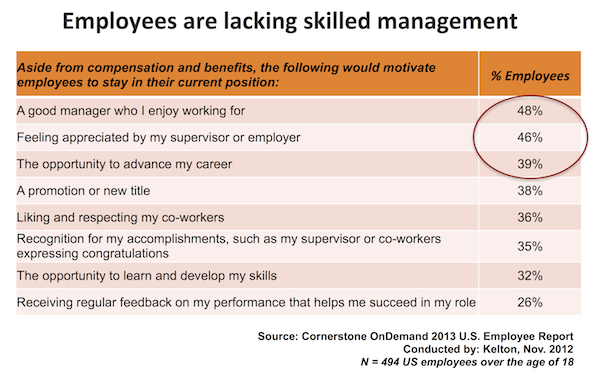
As if by magic, I was presented with a new survey carried out by Kelton Research, on behalf of talent management SaaS provider, Cornerstone OnDemand, which canvassed views of 494 employed Americans over the age of 18. It’s clear that the very attitude and approach towards talent management has shifted radically in recent years.
What stands out for me are five main aspects:
1) Managers are not being developed or trained property to nurture and develop our talent;
2) Over half of employees today are taking a short-term view of their current employment;
3) HR has become a forgotten function in the business when it comes to aligning employee performance with objectives;
4) Corporate leaders are losing interest in developing their own talent, and looking for “silver bullet” hires;
5) This short-term attitude towards talent management is surely increasing the value proposition of partnering with sourcing providers. If they can fill your talent gaps quickly and inexpensively, then why bother developing your own?
So let’s take a closer look…
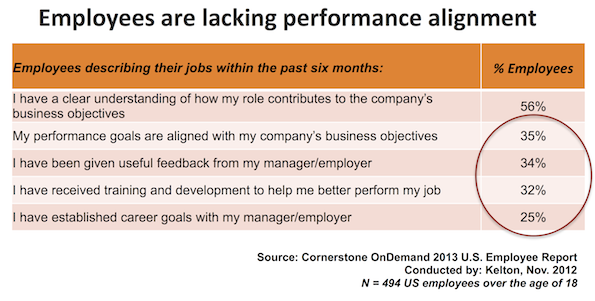
While employees still, by and large, know how their jobs contribute to the business objectives (56%), barely a third feel their performance goals are aligned with their organizations’ objectives, or are managed or trained adequately.
Question: Are managers simply too busy to devote time to their staff, and are many not being trained in the art of developing their employees’ careers? And – even more importantly – do many corporate leaders even care?
While more than half the respondents do not view their future with their current employer for longer than a three-year period, it’s clear the main reason for this is a lack of skilled managerial talent which can motivate and mentor their staff. Almost half of today’s employees would take a longer view of their current organizational career track, if their manager showed them sufficient development, attention and appreciation.
Question: Employees want to be managed well, so why are so many asking for it? Have companies forgotten the art of good staff management? Or have many simply have lost interest in developing their staff?
The Bottom-line: The “career employee” culture is clearly on the wane, opening the door for deeper sourcing relationships
While we can bemoan the poor progress in talent development, for which an alarming portion of the US corporate sector is now responsible, I believe there is a deeper message in all of this: not all firms are “dropping the ball”, they simply do not have a vested interest in the future development of many staff, and their management layer doesn’t have the time to train junior staff. Many have taken the attitude that they can replace poor performers with high-performers, if need be. Moreover, many are also viewing their sourcing relationships as opportunities to downsize their current workforces (such as the recent Citigroup announcement).
The data also signifies that many organizations are probably already too ill-equipped to become superlative talent development environments, especially in functions that do not create a great deal of competitive advantage for the business… so maybe it’s time for them to look at new ways to manage business functions. While we haven’t witnessed a rapid burst of outsourcing activity since 2008, it doesn’t mean business aren’t re-aligning their resources and readying for it in the future. This data suggests they may well be.
And just when you’d forgotten we hadn’t published the final installment of our interview with Genpact’s CEO NV “Tiger” Tyagarajan… here’s the final installment of our interview with Genpact’s CEO NV “Tiger” Tyagarajan.
The more you understand your processes, the better you can redesign them. Better processes produce better data. Better data gives better insights. The better your insights, the smarter you run the company and the smarter the decisions you make. It becomes a virtuous cycle.
NV “Tiger” Tyagarajan, President and CEO of Genpact, 2012
Phil Fersht (CEO, HfS Research): Tiger, there’s been a lot of talk lately of changing the image and even the terminology of BPO. Do you think it matters who we are perceived as and what we call ourselves?
NV “Tiger” Tyagarajan is President and CEO, Genpact (click for bio)
NV “Tiger” Tyagarajan (CEO, Genpact): I think it matters a lot. Five years back we created the terminology business process management. In all our corporate communications we have never used the word BPO. We have always used the terminology business process management and technology services company to describe ourselves. It was tough to get everyone else in the industry—other providers, the press, analysts, advisors, employees—to use terminology other than BPO.
Now, finally, driven by the economy, the whole industry is jumping there. We always believed the business we are in is really two businesses:
I am going to help you run your company better. It will be more efficient and effective. It will produce better output. I will take you on that journey. First, we fix your processes and then we bring in technology.
They make decisions every point along the way. Do I invest here or there? Do I accept this customer or that one? Do I price like this or that? Should I take that risk or not? Our job is to help companies make better, smarter decisions. We do that using two aspects:
Data. There’s so much data coming out you can use it to build insights to make smarter decisions. Make it more predictive so companies can make those decisions before it’s needed.
Processes. How do you redesign your processes to make smarter decisions around how the process should run?
The more you understand your processes, the better you can redesign them. Better processes produce better data. Better data gives better insights. The better your insights, the smarter you run the company and the smarter the decisions you make. It becomes a virtuous cycle.
We have seen that happen with long-term relationships. We think this is what our industry should be known for.
Clients have to have that vision. If they don’t, they are stuck in transactional, easy stuff. They also have no expectation other than dollars per hour.
The second reason this is important is: How do you attract the best talent? If people think this industry is nothing but drudgery work, you are not going to attract the best and brightest in the world. Clearly, talent is going to be a big question mark in the long run. So, how do you become the best attractor of talent? You have to make your company an exciting place to work. That’s how you drive intellectual capital. We have to create role models people can follow.
Phil: Tiger – it’s been great catching up again – I am sure the HfS community, have really appreciated reading your insights.
NV “Tiger” Tyagarajan (pictured) is Chief Executive Officer for Genpact. You can view his full bio by clicking here
For all of you waiting on tenterhooks for our 2013 predictions, I am afraid we have some bad news: today, we took the unprecedented step of canceling them. But why? Can’t analysts see into the future anymore?
We predict… there'll be a lot of rubbish predictions
1) Analysts who claim to see the future, without any real data to support their theories, are very, very likely to be talking gibberish. They are either:
a) Talking out of their behinds;
b) In love with their own verbocity and have lost their grip on reality; or
c) Both of the above.
This time, HfS will base its outlook on the data gleaned from our 2013 State of Outsourcing study, which will include the views, experiences, dynamics and intentions of hundreds of enterprise buyers, providers and consultants.
2) Predictions from “experts” are nearly always wrong and many are just ill-informed rubbish. Not only that, nothing is more off-putting than reading someone’s predictions that are just plain wacky, for example, Jason Krieser of law firm K&L Gates views a bright future for the service integrator model. What? We were talking about this a decade ago. Moreover, the article is claiming the fact that the State of Texas is “one of the first IT organizations to give it a go”. When did the State of Texas become a barometer for the future of IT Outsourcing and innovation? And while we’re having a laugh at predictions based on very shaky evidence, Steve Martin of outsourcing consultancy Pace Harmon, claims we’re in for a major “backsourcing splash” next year simply because Randy Mott fancies stirring things up at GM (which is easy to do when your boss is Barack Obama). How can you base an industry trend on the actions of an auto manufacturer which only recently survived on bail out money from the government?
3) Our economy is teetering over a precipice in 12 days’ time… won’t that have some impact on proceedings? In case any of you have been in a coma all year, if Congress can’t figure out a way to even start paying off its $16 trillion debt over the next few days, we could be heading into a sharp recession. Most likely, they’ll come up with come temporary band-aid measure, but our economy is in serious debt and we haven’t even come up with an initial plan to save it and reverse our horrible addiction to debt. Now, the outcome of the end of year Fiscal Cliff deadline could create an incredible burning platform for outsourcing deals to be signed… or it could prolong the painful do nothing, change nothing holding-pattern much of industry has been persisting with since 2008. It all depends on what kind of deal (if any) Congress can concoct.
So we, at HfS, predict absolutely nothing, except that we’ll all get probably get extremely drunk next Tuesday, Wednesday and maybe Thursday…
Here’s some sourcing cheese we don’t need more of in 2013:
1) “Big Data”. Puh-lease. Who came up with this in the first place?
2) “BPM”. Nasscom took it upon itself to rename the BPO industry “BPM” (Business Process Management). It made a press release… but has anyone heard the new term since mentioned even once?
3) “Innovation”. Overused and rarely achieved in sourcing. Let’s put this one back in the locker until we actually see some. The temporary term to be used is “Shminnovation”.
4) “End-to-end process”. I’m sorry, but what is an “end-to-end” process? A process with a middle bit, a front bit and and end bit? Does this mean companies only look at parts of processes?
5) “Cloud”. This is about as relevant as “e-business” became with any piece of software that became web-enabled. Time to put this one to rest?
6) “Data Scientists”. Can we kill this one before it starts, please? Makes me think of geeks in white coats…
7) “Global In-house Centers”. Try telling your Mom and Dad you work for a Global In-house Center… oh my.
8′) “Users”. Please, please, please can people stop referring to customers as users. Until IBM starts slinging cocaine, I think we’re good to drop this one…
9) “Buyers”. And please, please, please, please can people stop referring to customers as buyers. Why not just call them “shoppers”? Are you a sourcing shopper?
10) “Outsourcing”. Ha. Only kidding… let’s not go there….
If you’ve spent a lot of time with service provider leadership, you’ll know they spend an inordinate amount of time preparing stories for equity analysts to regurgitate.
I'm telling you… shipping back office work to India is going to be HUGE
HfS Research Fellow, Deb Kops, has been on both sides of the fence – as CMO for a service provider tasked with painting pretty pictures for Wall Street, to being entrenched with many enterprises who actually consume these services. And after many years dealing with – and observing – these beings, she finally begs the question:
Mars, Venus or Saturn… which planet are equity analysts from?
As a child, I had a very fertile imagination. When I came up with a story that had no semblance of reality, my father would ask “Which planet are you from?”
Ever read an equity analyst’s report on the outsourcing market or a particular provider, and wonder whether you are located in the same solar system? When they put an outperform on a provider that everyone else in the industry thinks is a weak sister, or talk up a stock, missing the fact that revenue growth is mainly coming from a savvy hedging strategy. When they classify the provider as a business process outsourcer while the market knows that said provider is an app dev company with a whiff of business process outsourcing revenue. Why don’t equity analysts following the outsourcing industry start asking the questions that really matter when putting out their recommendations?
Even though I don’t consider myself naïve, it always surprises me how limited analysts’ knowledge of outsourcing company operations sometimes is. I know that the job of good investor relations teams is to tell a favorable story to the analysts—in fact, I’d be the first one to admit I gamed the messaging in a previous life. But when I read the analysts’ reports, I am often flummoxed by the recommendations, and amazed by the commentary. Don’t some of these guys have the time…or the inclination… to get under the covers? Or are they creatures of habit, only getting under the covers when there’s a marked quarterly change in performance trends? Sometimes I wonder whether the sole basis for rating stocks is handicapping the odds–will said company meet annual guidance?
It’s time to move beyond calculating 90 day rolling averages, or looking at the impact of increased float as a result of a sale of a block of shares as a basis for a buy recommendation. Analysts, let’s forget about the oh so-last decade hype around the strong long-term growth in markets like India, and acknowledge that clients are looking for contextual prowess that many offshore providers just don’t have. Let’s admit that that pricing is now commoditized for most processes, and profitable deals are fewer on the ground… Let’s go beyond the term “compelling value proposition” to understand that clients are thirsting for value beyond wage arbitrage. And when it comes to the onshoring trend, perhaps it’s time to stop blaming the pressures on politics, and start looking at the fact that increasingly customers are unhappy with the quality of service coming from offshore delivery centers, and are now looking for alternatives onshore.
The risks analysts note encompass so much more than in-house alternatives, currency fluctuations, and geo-political concerns about a war between India and Pakistan. Competitors are already aggressive in an increasingly undifferentiated market, often buying logos when the deal is a “must win,” so competition is not a special risk worth calling out, but an everyday occurrence.
Would investors evaluate the industry differently if equity analysts dug deeper, perhaps developing models that associate the real impact of double digit wage increases with rising attrition? Or if they quantified the growing trend toward the implementation of hybrid shared services models as opposed to the adoption pure outsourcing models? Perhaps analysts ought to look at the reality of provider dominance in certain verticals so when a new entrant declares they are going to achieve substantial growth in pharmaceuticals or publishing or whatever; their aspirations can be appropriately discounted.
Now if I was an analyst, what are the questions I would ask?
Quality of the sales force. Ask questions about experience, longevity, and who’s making their quotas. Find out how many sales guys failed to make a sale last year, and the year before that. Ask if the sales function is a revolving door, and how the top rainmakers are incentivized to stick around. Determine whether the front end folks have deep backgrounds in the industries they are focused on, and if they have experience actually selling, say BPO, or whether they are IT retreads. In fact, look at the cost of sales to revenue—if 98 percent of provider revenues are from existing clients, while SG&A is in the 95th percentile, it would be fair game to ask what the dickens the sales force is doing with their time.
Channel dependency. It’s great for the provider to build good traction with advisors, or obtain the majority of leads off the Internet, but when one channel becomes dominant, there’s a major pipeline risk. The source of leads should be balanced; influencer (read advisor)-led, direct calls/relationships, and marketing channels should all feature in the mix. For example, if the provider’s influencer relations leader leaves, and he/she is any good, the channel will likely dry up. Cut dollars for digital marketing, and that channel goes fallow. Ask what the source of deals actually is.
Effective shop window. Marketing is no longer a nice-to-have; it’s a have to have in order to differentiate a provider in a market where sameness is becoming the norm. Clients now buy brand. Open the provider’s front door and take a real look at their branding and marketing. Is it differentiated? How much do they spend annually? Look at their messaging—can you tell the difference between Providers x and y and z? Perhaps you don’t think it’s a problem now based upon historic performance, but trust me, clients will increasingly buy brand.
Logo frenzy. While collecting nine new logos in a year is music to the ears of analysts, it can be a red flag for financial performance, at least in the near term. First year deal performance will hit margins hard, even without the risk of poor execution, while too many new logos could suggest that the provider is out buying deals. Look under the covers of new client announcements to understand what is causing the velocity of deals—pricing, new markets opening up, or even a differentiated offering—in order to determine whether it’s luck, aggression or a seminal trend that creates shareholder value.
Source of organic growth. Growth is so much more granular than the simple categorization “organic” and “inorganic” that analysts focus on; it’s down to the percentages that come from hunting and farming. If absolute inorganic growth coming from farming the existing stable of clients is much less than 40-50 percent, it says something about focus and the quality of account management, suggesting that there’s a weak spot in the provider’s talent base, the company isn’t as tight with its clients as advertised, or perhaps the provider is taking their existing customers for granted. That means there’s trouble down the line.
Domain depth. One or two clients does not a vertical make, yet some industry analysts are bamboozled by a lonely name brand around which a provider declares they are building a fast-growing vertical. Ascertain whether there’s room for another entry into an industry, and how what the current sourcing saturation really is to see whether Provider X can really grab enough market share to create a viable business. After all, when a provider announces that they are entering a new vertical, chances are that a number of competitors are already pretty well ensconced.
Real attrition numbers. Creativity has found a home in the calculation of provider attrition; figuring out how the numbers are actually put together is critical. But attrition is much more than the number of staff going through a revolving door; it’s one indicator of the strength of management. Delve down into service and geographical attrition to find out if there is a root cause—poor management in a region, or lack of training. Ask where staff is going; if they are leaving the provider to go into industry, it suggests a market trend; if substantial numbers are going to other providers, it may mean adverse working conditions, difficult cultures, poor hiring practices or sub-market compensation. Ask who is leaving—women versus men, associates as opposed to supervisors and managers. And don’t just focus on attrition in the offshore delivery centers; pay particular attention to onshore attrition as a harbinger of sales and account management challenges.
Number of toys in the toy box. In other industries, equity analysts’ mantra is ‘few things well,” or “focus, focus, focus,” yet in the outsourcing industry, there seems to be a premium placed on having the widest array of offerings and verticals to avoid economic ups and downs. As a result, many of our providers are trying to be all things to all people, often in an effort to show diversity in vertical, offering and geography. Very few providers cover all the function/process/industry bases with equal depth. Count the toys, and judge whether management is making the appropriate investment based on market potential.
Training dollars. Training is always one of the first areas to be cut when providers are under margin pressure, yet, in a business that depends upon the quality of talent, cutting investments in people is a fool’s errand .Ask how much is spent on training per capita after year one. Find out whether training is “train the trainer,” often known in the industry as the “blind leading the blind,” or true, process- and industry-intensive training. Ask how often the courseware and curricula are refreshed. And delve into the training methodology in place to train supervisors; after all, they are the lifeblood of provider delivery success.
Management layers. Leadership layers are a bit of a problem in the ranks of outsourcing providers; since talent is relatively cheap, the fix for poor delivery is often to add additional layers of management, rather than to up-skill the base talent. Clients often complain about the number of levels they have to navigate in order to determine who’s actually responsible for a problem…and its fix. If the provider’s management layers start looking like the tiers on a wedding cake, performance issues may be endemic.
Educational levels. While the number of university graduates available in offshore locations is certainly seductive, with in market economic growth, top university talent offshore is now shying away from outsourcing careers. At the same time, as providers move operations to lower cost Tier 2 and 3 cities, the number of available…and talented… graduates declines. Track educational levels year-on-year to get the real talent story.
Globalization of management. Origin matters. If the majority of the management is either located in one country, or is transplants, it suggests that the company is not fully global in its outlook and approach. Ultimately providers, especially those with offshore legacies, must evolve into global companies with substantial diversity in their top leadership and management teams. Ascertain where strategic and operating decisions are actually made, and by whom. Look at the roster of leaders to see how many represent different cultures. Ask whether talent is seconded—not just from India to the US, but from client-proximate locations offshore. Depending on visas does not grow a business onshore.
Deborah Kops, Research Fellow at HfS (click for bio)
Effectiveness of acquisitions (after two years). So many of our industry’s acquisitions fail to move the dial for the acquirer. Yet a few years later, amnesia sets in and analysts stop asking the right questions relative to their success. Notice whether the last time you heard of the acquisition was at announcement. Find out whether the acquired team’s management stayed beyond the payout, or left after a short transition period. Ask whether the acquisition changed the game through platform expansion or new business growth.
Bottom-line: It’s time for these guys to get under the covers and quit the puffery
Now, if equity analysts started to look under the covers and actually asked these questions, what might they really find? And would their ‘buy’ and ‘sell’ recommendations vary greatly? Would we all be on the same planet when it comes to understanding what drives outsourcing provider value? One can only live in hope…
Here’s some free advice, amigos, so make of with it what you want…
Go to the nearest gym during your lunchbreak, lob $50 into the reception area, turn around and go back to the office. You can do this every day for two weeks, and it’s still cheaper than a membership… plus think of all that calorie-burn walking to and from the gym.
Wouldya believe “Horses for Sources” is going to be six years old? So… here’s six years of soundbites, silliness, sensationalism and scrutiny. Oh – and crank up the volume 🙂
Your week not quite the same without seven dudes rabbiting on about best practices and being over-polite with each other? Well, your addiction can be cured by listening to the replay:
2013: A new dawn for a maturing outsourcing industry
Make no bones about it: 2012 was a pretty dire year for the industry known as “outsourcing”.
However, brand new data from our State of Outsourcing 2013 Study conducted with the support of KPMG, the largest-ever research survey focused on IT and business function outsourcing, clearly shows that the majority of enterprises are not only aggressively focused on increasing their outsourcing portfoilios, but many are now taking a more mature and realistic approach.
So, as always, let’s examine the facts…
How outsourcing got battered, bruised and vilified in 2012
A media desperate to jump on the fact that IT outsourcing must be in its death throes if GM’s Randy Mott was creating a few jobs on US soil;
Pundits, consultants and “analysts” claiming outsourcing is yesterday’s strategy for our enterprises, without really being able to explain why, but eager to bury it under the negativity. Meanwhile, the fact that the great American innovator they love to laud, Apple, has been using Chinese children to manufacturer its wares, seems to escape practically unnoticed…
The outsourcing industry itself calling for a re-brand to escape the negativity.
Why outsourcing is more embedded than ever in corporate operations strategy
1355 stakeholders across enterprise buyers, service providers and consultant/influencer organizations shared their views, observations and intentions for 2013 and beyond, when it comes to outsourcing IT and business processes. We are going to delve deep to share these dynamics with you in the coming weeks, but let’s start with the key dynamics – how fast is the industry growing, and what is driving the decisions:
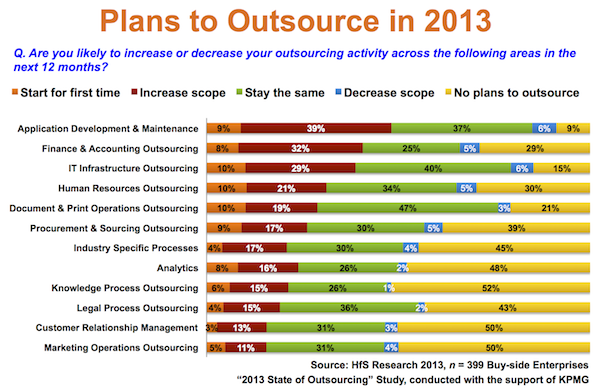
399 major buy-side enterprises have spoken about their 2013 outsourcing plans, and barely a twentieth of them are looking to reduce their outsourcing scope across any IT or business function in 2013. Moreover, half of them are looking to increase their outsourcing of application services, four out-of-ten their finance and accounting, and a third their HR. In addition, there is a notable pick up in newer sourcing areas, such as analytics and legal.
The classical values of outsourcing are stronger than ever: cost, standardization and global delivery
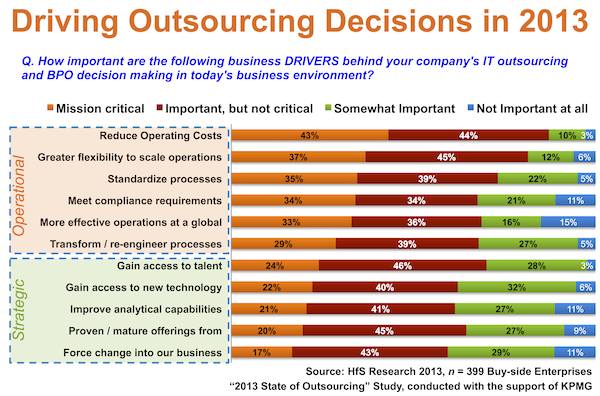
When it comes to the decision drivers, it’s almost refreshing to see enterprises focusing on the basics: cost, global delivery and standardized process:
While, on the surface, this data isn’t exactly surprising, what it’s telling us is the vast majority of enterprises are eagerly looking to industry standard offerings as a priority. We’ve been lauding the old “ADP payroll analogy” for several years now, where there is little discernible business reason to run your payrolls yourself these days, and this is ringing true for the rest of the operational functions: being competitive with business operations is achieved by standardizing onto best-in-class processes. And to achieve that standardization is, really, quite straightforward – move these processes onto proven technology platforms and have them operated in a cost-efficient manner. For most organizations today, they’ve failed to do this effectively inhouse (through many years of pain and wasted investments) and shifting them over to a third-party has forced the issue and got them from A to C.
The Bottom-line: The tenets of outsourcing haven’t changed – it’s the simple fact that operations leaders have run out of excuses not to do it
The outsourcing debate used to be centered on the ability of enterprises and providers to do it right, to make the required cost savings with the appropriate amount of risk mitigation. This data finally, finally, renders that debate moot: the basic ingredients of outsourcing today are maturing and proven to work when executed effectively… the focus now shifts to the how enterprises can evolve into a globally sourced environment, not simply the should. Our next piece of analysis will zone into the core challenge of enterprise operations in 2013: how enterprises can alter their internal mindsets, attitudes and operational issues holding them back. Stay tuned…









 Here’s some free advice, amigos, so make of with it what you want…