You may recall we’ve been a tad harsh on the municipality of Orlando over the years here on HfS, once even going as far as equating being middle-seated en route to the Floridian enclave as being stuck in purgatory all the way to the gates of hell. After many lost nights’ sleep trying to seek out that elusive morsel of innovation, it has finally dawned on us: where better to look than the Magic Kingdom? So after writing a personal letter of apology to both Jeb Bush and Mickey Mouse (was an easy copy/paste) we are delighted to announce that HfS is making an Orlando tribute tour to SSON’s magical 16th Annual Shared Services & Outsourcing Week:
We’d love to meet you at the Hilton, Orlando, March 7th-9th, where you’ll get the usual deluge of panels, G6 big-thinking debate, session break outs and every single possible angle you can ever attribute to shared services and outsourcing. We’re also excited to feature on the analyst discussion with our good pal Stephanie Moore of Forrester Research (read her HfS interview here) and to have an on-stage interview with Microsoft’s Chief Procurement Officer, Tim McBride (read his interview and HfS case discussion here). And yes… you may even discover a morsel of innovation before resorting to scourcing the bottom of your wine glass.
And… of course… our friends at SSON are extending a special discount to our loyal cynical HfS readers, who have been so cruelly brainwashed against the magical delights of Orlando and its sourcing magic…
Just click here and type in the code ‘SSOW12_HFS’ to take advantage of our special “Orlando we are ready to try again” 15% discount
In Part I of Poole’s patter, we heard from BPO veteran David Poole sharing some of his thoughts on where BPO is eventually heading- and he began the conversation by discussing the fact that “outsourcing” will gradually been replaced by “venturing”, where providers will do as much due diligence on their clients as clients do on them to analyse and dig out the true joint opportunity.
Essentially, David argues that a new breed of providers are seriously trying to figure out the added value they can provide so they can share it to create a true win-win with their future engagements. He also points out that providers paid by results or so called business outcomes is little more than jargon, and frankly the evidence of this in practice is pretty slim.
So in reality, we know where the industry is heading, we just haven’t reached the point where these new developments are really happening in practice. However, one core trend that is clearly going to kick-start the process of venturing versus actual outsourcing, is the fact that most providers today no longer need to “lift and shift” client staff into their organization to effect the knowledge transfer – they can now use their existing delivery staff. Hence, the actual process of “outsourcing” operations is fast becoming moot – this transfer of labor, technology and domain acumen is no longer needed in many of these business process engagements, because the provider already brings these qualities to the table. So let’s zone-in on the patter-tastic protagonist himself, David Poole…
Virtualized Delivery – The “O” is not a prerequisite
Providers really are getting extremely good at providing services better, faster, cheaper and with greater value added than even the biggest companies, with the most experienced shared services organizations, can achieve. It stands to reason because providing back office services IS their business. They invest in best practice process models, they have far greater scale, they invest in technology, work management, risk management, provide unparalleled career opportunities. I predict however that there will be a huge blurring of the boundary between provider and client.
Still today there are many situations where outsourcing is a bad word, where legal or regulatory constraints exist or frankly where political and / or Political boundaries prevent an outsourcing decision. The fact is that providers don’t just provide cheap people these days. That other stuff, the technology, process knowledge, analytics, work management, methodology and leadership capability is highly value adding. I predict that we will see deals emerging where these are provided and applied to the clients own staff. In the new World of Business Process Venturing the O is not a prerequisite. The provider can manage services using client staff and still share in the value added outcome. There are some notable examples of niche providers today that operate this model extensively and extremely profitably. Accretive Health from Michael Cline’s stable is a great example.
I think the future mainstream of our industry will see deals that are hybrids of traditional onshore, nearshore, offshore and increasingly client staff will be in the mix. Another twist to this point is the growing potential, aided by technology, of utilizing home workers, often self-employed to deliver processes.
David Poole ponders
This area is growing very fast in the customer service arena but why not in a host of other process areas. It’s politically extremely attractive, provides access to a highly educated and motivated sector of the work force and work management tools, methods and technology now available to manage home workers in truly impressive.
David Poole is a distinguished veteran of the BPO industry having previously led Capgemini’s Americas BPO service line. He was also a founding member of PwC’s global BPO business prior to IBM acquiring their operations. He can be emailed here.
"Please mind the innovation gap"… click here to find out what Business Platforms are and they represent the future of outsourcing
You may recall we first started introduced the concept of the “Business Platform” a few years ago, when we discussed a “Business Services Cloud” where SaaS-providers could start building a BPO capability to deliver their solutions to clients and ensure they were making maximum use of the application.
We also made the point that if BPO providers were merely selling commodity processes on commodity packaged software, they were going to get sucked into a race to the bottom, where the focus was all about low-cost and delivery-scale.
Hence, those providers wanting a competitive offering, need to provide distinctive services that can help their clients transition effectively to new processes that really work with their businesses. Simply selling packaged software through various channels, with minimal business transformation support, is not going to help clients take full advantage of what they have – and often leaves them only using a fraction of the functionality of the software. However, the very concept of leading with BPO capability is simply too alien for many software providers to grasp – they still live by the stack ’em high and sell ’em cheap concept of pushing out license sales as aggressively as they can through whatever channel partner that will sell for them.
However, one software provider which has gone against the grain is Sales Performance Management provider Synygy, which quickly realized developing its own BPO delivery competency would create a major competitive advantage over its competitors, and also help it develop deep, sticky relationships with its clients. We recently investigated how three clients organizations are improving business outcomes using this Business Platform solution for their sales compensation management, which has direct impact on their top-line. The paper entitled Drive Revenues and Lower Costs by Outsourcing Sales Performance Management outlines the business benefits and return on investment (ROI) achieved by three multinational companies that have outsourced the end-to-end management of their sales compensation programs—inclusive of technology, people, and processes—to Synygy.
We caught up Mark Stiffler the founder and CEO of Synygy recently to get his take on what Business Platforms mean to his company and ask him about some of the shifts that are occurring in the market.…
HfS: Good morning Mark – can you please give us some back ground on how your company got started?
Mark Stiffler is CEO of SPM Business Platform provider, Synygy
Mark Stiffler (CEO, Synygy): I started Synygy 21 years ago, which was after a stint at management consulting and graduating with an MBA from the Sloan School of Management at the Massachusetts Institute of Technology (MIT).
I actually began Synygy as a services company, more management consulting, focused initially on analytical work and then compensation design, which in turn led to the creation of software, and eventually a transition to being much more of a software company.
More recently we have balanced ourselves back along the lines of what HfS presents as a Business Platform: software, implementation, expertise, and continuous improvement—all offered as a singular managed service.
HfS: Moving from a software provider to a services provider business model has proven incredibly difficult. Can you share with us some of your views on this?
Mark: Software and services are very different types of businesses. For us, software has been a relatively transactional relationship versus a BPO service that is a daily relationship with the client.
Synygy today for the most part has two distinct types of clients: software and BPO clients (with some in the middle). Software-oriented clients want to run their sales operations and processes on their own while at the other end of the spectrum—BPO—it’s Synygy that’s running the sales operations department of the client.
What is different between our software clients and BPO clients is the degree to which they benefit from Synygy’s expertise in complex business processes like sales compensation management. As was seen in the case studies you conducted, real value is being derived from the expert services that are being provided on top of the software.
But it is interesting to see that costs savings were also a considerable benefit for those same clients. That is not a value driver that we typically lead with!
HfS: You don’t pitch cost savings? Why is this?
Mark: All of our clients are recurring services relationships, which is the basis of BPO. Until recently we treated software clients with the same level of services as our BPO clients and, frankly, we gave them too much support on how to make best use of the software. We now have moved many to a Managed Support contract (think of it as half way to outsourcing) where they pay to receive more services than from their software relationship. When we stopped giving-away expertise and advice for free to software clients, many realized that there was real value associated with the provision of that and decided to buy the managed support.
HfS: So what market are you really going after: Software, Services or Business Platforms?
Mark: All of our competitors have driven towards SaaS and cut their implementation services teams to drive a higher ratio of subscription revenue to total revenue. We want to drive a more balanced approach along the lines of Business Platforms, i.e., SaaS, software hosting services, best practices in process design and continuous improvement so that the processes remain relevant. We call this ‘Sales Performance Management. Above the Cloud.’
HfS: When you look at your company’s evolution do you see any changes as to why organizations are outsourcing SPM?
Mark: What has changed is that companies like Salesforce.com have shown how SaaS can be used to deliver software from the cloud and this has allowed us to have a conversation about managed support and outsourcing services on top of SaaS. Software in the cloud is still just software and if you want to take advantage of expertise to optimize your business processes you need to think about more than software. Outsourcing is a good solution for a very complex problem like sales performance management.
HfS: Are you very rigid in terms of moving client onto your processes?
Mark: That has shifted as well. For many years it was a blank slate approach in which we would redesign the client’s processes from scratch. Now we strike a balance between standards and flexibility, combining industry-wide commonalities with client-specific requirements. We are also changing the way we perform implementations. While we still do them as a fixed fee based on an estimation of work effort, we are significantly changing the way we work with a client through the implementation. We are using a far more interactive process, with continuous feedback from the client as we implement the solution on a daily basis.
HfS: What do you think of your competitors that develop the software and create partnerships with service providers to provide the services? What is lost in a partnership that Synygy can provide as a singular managed service?
Mark: This is the key differentiator for Synygy. Does a client want to pick a piece of software, do a detailed vendor comparison, and then do the same for an implementation services firm? There is a lot of cost and risk for sourcing from two providers and then what? You are left to manage it on your own?
We provide the software, datacenter services for hosting the software, implementation services, and then the managed support or outsourcing services to get the most out of the investment. The cloud makes software more of a commodity as value is shifted to the services. Services are the key differentiator against the software companies and Synygy’s outsourcing services are its key differentiator against the services implementers.
The Business Platform concept encapsulates this, which is exciting since it dovetails with Synygy’s move to a more balanced SPM offering. The ‘above the cloud’ approach to sales performance management has caught on within the company and we are looking forward to the reception in the market.
HfS: Would you do anything different if we were to start up again?
Mark: We feel that we are almost like a start-up. We have seen three iterations of market development and collapse through acquisitions of competition and competitors going out of business. This market iteration is coming together nicely with SaaS, implementation services, and outsourcing services enabling Business Platforms.
HfS: If you were given $1 billion, would you switch careers?
Mark: I don’t know about that (laughter), but I am fascinated about changing old things into new things and that is why we have our worldwide HQ in a former power plant. Pursuing historical projects like that would be of interest.
HfS: What advice would you give to your peers that are seeing increasing commoditization?
Mark: I would rather not give advice. We have the formula and we will keep that a secret.
HfS: Lol! That was a great answer. Thanks so much for your time today, Mark – we are excited to share your story with our readers.
Click here to download your complimentary copy of “Drive Revenues and Lower Costs by Outsourcing Sales Performance Management”
Our recent State of Outsourcing study, conducted with the Outsourcing Unit at the London School of Economics, has revealed that nine out of every ten enterprises will be increasing or maintaining their reliance on either, or both, outsourcing and shared services over the next three years. The key is to identify, at the industry level, what factors are influencing these increasingly aggressive approaches to global sourcing strategy.
The study has uncovered many home-truths about why some organizations are more motivated to externalize their support operations to third-parties, while others prefer to focus on their own shared services investments. We can also evaluate organizations within specific industries that are seeking to assign equal significance to both outsourcing and shared services as they pursue a holistic governance framework across both models.
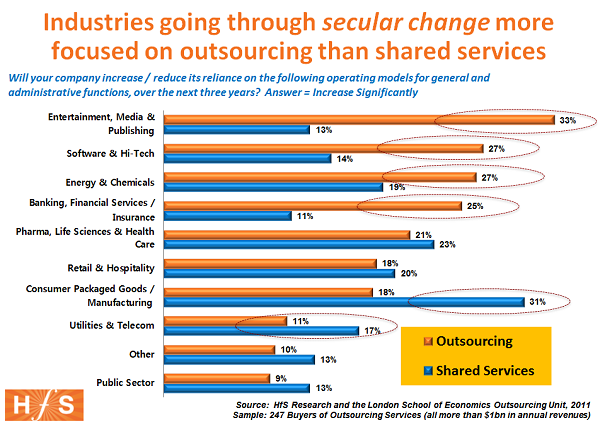
So we’ve taken a closer look at how 250 large organizations, with annual revenues greater that $1 Billion, are intending to make significant planned investments in either, or both outsourcing and shared services models over the next three years:
It’s plain to see that it’s organizations within those industry verticals experiencing fundamental shifts to their economics, which are more prepared than ever to admit they need to look outside of their current organizational boundaries to keep their business operations competitive. Simply-put, secular changes to industry environments are crystallizing options for businesses and driving more radical and actionable behaviors from executives under pressure to deliver continual productivity improvements. The radical impact outsourcing can potentially have on business performance is clearly becoming more attractive to those businesses in the throes of tackling fundamental challenges and opportunities to their business environments.
Buyers are getting savvier at focusing their outsourcing plans to improve their competitive advantage
Increasingly, we are seeing a realization that retaining some processes internally isn’t – in any shape of form – bringing organizations a competitive edge, and these sourcing decisions are no longer only about cost – they represent a fundamental change in the way business leaders now view outsourcing as an integral function of their operations.
For example, many of today’s leading banks do not lead their markets because they process mortgage applications better than their competitors. Their management teams typically prefer to find a services partner to process them at lower cost, using industry-standard process flows and technology, while it focuses its internal competencies on business functions that can help the bank gain marketshare, such as smarter customer targeting, or upselling new product through customer support channels etc.
Similarly, most of today’s leading insurance providers have already embarked on long-term engagements to have their claims processes managed, processed and adjudicated by third-parties, allowing their internal talent to focus on market-leading initiatives, such as competitive advertising strategy and new service development that can help them gain an edge over the competition. Customers do not care about how their claims are processed – they care about how much their policies cost, the additional benefits they can receive as customer and the brand and reputation of the insurance carrier.
In addition, does a retailer really need to maintain its entire application portfolio inhouse, when it can devote its internal talent and IT resources to improving its customers’ online shopping experience, where it can actually grow its business?
Today’s buyers are getting a lot smarter at figuring out how they can improve their organizations by using the resources and knowledge available through third-party relationships.
The five most bullish industries planning significant increases with outsourcing, are not only basing their planning on achieving ongoing cost-reduction outcomes (read here for more on this topic), but also because the fundamentals of their industries have dramatically shifted in the recent past, for example:
» Entertainment, media and publishing: The crash of newspapers and network news; The Web 2.0 impact; Radical new distribution and business models.
» Software and Hi-Tech: Rapid commoditization of packaged software models; Impact of Cloud computing on licensing and pricing dynamics; Dominance of India, China and other low-cost nations to drive out the cost of development; Willingness to “Eat their own dog-food” as providers of outsourced services themselves.
» Energy & Chemicals: High price volatility for oil products; high capital costs of oil exploration projects; Shortages of talent; Aging infrastructure and constantly-changing compliance requirements.
» Insurance: New compliance measures (Solvency II, ObamaCare) causing unprecedented administrative cost and workload; Shortage of risk analysts and actuaries to take on the higher level work.
There are just a few examples of major industries, being shaken to their very foundations, where we can discuss secular shifts driving unprecedented demands on organizations to remain competitive. HfS believes it is no coincidence that it is these industries that are today the most aggressive with embracing third-parties to redefine their global operations? Secular changes drive bolder, more radical behaviors, and it is already clear that a more aggressive approach to outsourcing is high on these organizations’ agendas.
Industries that have already experienced much of their secular changes in the past are more focused on investing in shared services frameworks
These businesses are typically reactive to market conditions and often radical long-termism doesn’t fit as well with their mentality, especially when faced with uncertain times ahead. In addition, many of them have already shaved their operating costs to the bone, hence digging out new productivity benefits via outsourcing is often challenging – and mistakes can prove fatal in a low-margin business.
» Industries such as retail and manufacturing, one can argue, have already been through their secular shifts over the last three decades or more. While they have had to experience much fundamental change, for example mass globalization of markets and volatile changes to consumer spending behaviors, the very essence of these industries is still the same – their organizations are focused on inventory management and supply chain optimization, maintaining operating margins and accurately predicting demand. To them, outsourcing has always been an option, and has been readily explored over the years to find more pennies to save. So while economic conditions may have been vicious, focus on short-term cash-flow has clearly been the priority for many in these sectors, and radical overhaul of operational infrastructure clearly not an attractive option.
» Utilities are also proving to be more conservative with outsourcing, with a strong shared services focus. While many of the large utilities organizations have been among the earlier adopters of hybrid outsourcing and shared services models, many of them have not felt such secular change as many of those industries that were more dramatically impacted by the 2008 crash and many of the fundamental shift mentioned above.
» While there are many active outsourcing engagements – both existing and new – in telecom and wireless, HfS sees more these engagements as relative small in scope as these firms opt for more incremental, conservative ventures into outsourcing. For example, several major telecom firms are evaluating smaller BPO initiatives in areas such as sourcing and transactional accounting, and still prefer to engage in several smaller multi-vendor engagements in the ITO space.
Hence, it’s no surprise that these organizations are more conservative with their long-term operational planning. Moreover, many have proven to be heavy outsourcing adopters in the past, and we expect these sectors to remain focused on maintaining their outsourcing initiatives, but with a large proportion opting for a more reserved approach, with increased focus on improving, and in some cases expanding, their internal shared services competencies.
The Public Sector: Facing up to unprecedented challenges
One industry which is going through more secular change than any today is the Public Sector. Quite simply, national and local government bodies are under unprecedented pressures to drive austerity measures and make long-term plans to drive new productivity programs. This explains why 55% of public sector bodies actually foresee some moderate increase in outsourcing activity over the long-haul. Huge political bodies, such as the US Navy, NASA, the UK Inland Revenue and National Health Service – and even the FBI – all outsource elements of their operational support functions to varying degrees. With increased onshore delivery resources becoming available from several providers, this could well turn out to be a surprisingly large growth sector for outsourcing.
The Bottom-line: New fundamentals are creating new rules to manage one holistic and comprehensive outsourcing and shared services strategy
Outsourcing is entering a new era – one where organizations can no longer afford to ignore its benefits. As these radical and secular changes to many of our core industries take hold, business leaders simply cannot overlook the competitive advantage outsourcing offers: enabling them to focus on developing competitive advantage. These secular shifts are threatening the survival of many businesses, but at the same time are opening up major opportunities to build smarter, more globalized and leaner organizations. Business leaders can no longer afford to cling to many of the methods of yesteryear to steer their organizations, and this data points to a more bold, radical approach to embrace the benefits of global sourcing.
However, most smart organizations are no longer evaluating shared services and outsourcing strategies in silos; while these initiatives are singularly successful at providing benefits to that individual function, our research has shown that these initiatives have failed, in many situations, to improve comprehensively the broader corporate strategic objectives of these organizations.
Jui Narendran is Research Director, Business Services, HfS Research (Click for bio)
We’re really excited to announce that respected business services analyst, Jui Narendran, has joined the fulltime HfS team as Research Director, based out of Pune, India. Jui’s been a good friend of HfS for a couple of year’s now, having worked on several research projects with us… but that still didn’t discourage her from joining our rumbustious rabble of research reprobates.
Prior to joining HfS, Jui headed the outsourcing research team at ValueNotes, a boutique research firm in India, leading several custom engagements and also worked on creating thought leadership research in the BPO and KPO domains. Jui has also worked for advisory organization TPI, where she led the offshore research team, which supported the consulting team with real time research and insights into the client industry and business issues. Additionally, she has worked for service providers Accenture and TCS. Jui brings a deep knowledge of the business services domain and will be focusing on several specific areas of BPO, namely the retail industry, KPO and legal services outsourcing. And when she’s not cranking out content for HfS, she is spending much of her spare time honing her new found talent for oil painting… but before we start airing her fledgling masterpieces, let’s hear about her recent analysis of the legal services outsourcing market.
Legal Services Outsourcing: India’s next growth market?
We’ve been doing some funky math over at the HfS data factory, and we’ve estimated that corporates splurge at least $1 trillion a year on legal services, which includes their internal General Counsels and their lawfirm partners. We’ve been keeping tabs on this space for a few years now and we believe the time is ripe for this market to really start kicking into gear.
Traditionally, the law firms engaged with Legal Process Outsourcing (LPO) providers for specific services, such as document review and other litigation support. However, over the last three years, large corporations have been signing comprehensive deals with LPO service providers. The following are some examples:
» In 2009, Microsoft engaged with Integreon, one of the larger pure play LPO services providers to provide exclusive e-discovery and document review services. The contract was subsequently extended to include contract review services.
» Also in 2009, Rio Tinto signed up with CPA Global, another large legal services provider, to provide contract review and drafting, legal research, and document review services. The engagement is also geared to expand to additional services.
» Pinsent Masons, a leading UK based law firm, signed up with South Africa based LPO firm, Exigent in 2009 to provide initial data review and e-disclosure services.
» Clifford Chance, a UK based law firm and member of the “Magic Circle”, procures legal support work from its shared services center in Gurgaon, India.
» Nixon Peabody, a Global 100 law firm outsourced its e-discovery review work to Pangea3, an LPO and a part of Thomson Reuters.
To learn more about why we believe Legal Services Outsourcing is poised for significant growth you can click here to access Jui’s new RapidInsight “The Exciting Evolution of LPO” at the BPO Resource Center (for a limited time only).
Jui Narendran (pictured above) is Research Director, Business Process and KPO Services, HfS Research. You can access her bio here and email her at jui @ hfsresearch dot com.
The world of sourcing advisory has gone through unprecedented change over the last couple of years.
The days of enterprise buyers dropping millions to view their favored (and less favored) providers strut the catwalk and have their contracts hammered out by some baseball-bat wielding former ITO salesman are rapidly fading into the past. That ship has, thankfully, sailed.
However, a new ship is now dropping anchor in the sourcing harbor, promising riches beyond your wildest dreams to re-vamp your shared service centers, re-craft your entire governance framework and ensure those outsourcing engagements fit seamlessly into the overall mix. But are these new-found riches all they appear to be, or another crafty way for consultants to sneak that MBA bus back into the visitor’s car park? Who better than Deb Kops to investigate further…
Source to stay
The aggressive push of the big name management consultancies and the Big Whatever into sourcing advisory is in many respects a good thing. These organizations bring a wealth of resource—from an acute understanding of corporate strategy, incredibly deep domain knowledge, regulatory requirements, organizational design and development, and all shades of expertise in between…plus strong ties to the c-suite (the power of which should never be underestimated when hiring a consultant). After all, the sourcing decision encompasses so much more than a market study, a location analysis, writing a good RFP and implementing a rigorous selection process.
But to any shared services and outsourcing conference these days and you’ll hear many of these white shoe guys express a decided preference for shared services as a model. And the traditional sourcing transaction firms are now following close behind, echoing the same refrain.
The guidance from the podium sounds something like this—“Be safe and smart. Alternative delivery models are tricky no matter what. Consider outsourcing but only after you’ve fixed, consolidated into captive centers, and operated until stable. Then think about outsourcing that transactional stuff to a provider to tap into transaction pricing/gain flexibility/leverage investment/free up management bandwidth.”
What’s the implicit message? “Outsourcing is risky. Outsourcing is not the first step on the journey. If you want to fix the mess, do it yourself (with our help). Outsourcing is not transformational. Outsourcing is a commodity—pursue it only after you ring out every penny of cost, then throw it over the transom to a specialist factory.”
Now, shared services very well may be the right answer for many of current crop of organizations investigating or evolving alternative delivery models. First, despite what the pundits say, Western companies are reacting to pressure (or at least thinking twice) to keep jobs onshore and in-house—ergo a captive. Second, what value outsourcing or a simple shared services implementation is capable of delivering at this point in time is pretty well understood. And some organizations are now getting comfortable revisiting their strategies with the view that the trick is no longer fixing the factory, but getting closer to the business—perceiving shared services as the better ticket. But these trends alone cannot account for the noise from the consultancy bully pulpit, and the number of firms renaming outsourcing advisory “shared services” or “global business” or “enterprise advisory”, putting the “O” word in awfully fine print.
Why the push for shared services rather than outsourcing from some of the biggest consulting names in the industry? It might be driven by the fact that, post the 2008 recession, major corporations invited in consultants by the tens of thousands, asking them to broadly transform their enterprises post a 2008 near death experience. And these good folk, rather than the more deal-oriented outsourcing advisors, had a superb opening to evaluate sourcing as one out of many in a transformation bags of tricks, building up legions of consultants on engagements.
But, as a former consultant, I can’t help wondering whether this trend also results from the need to grow consulting revenue, making it engagements sticky as possible. Is it merely a coincidence that shared services is actually tout the right model for the majority of organizations given their maturity at this point in time–or could it be a manifestation of enlightened self interest on the part of consultants–what I glibly am calling “source to stay.” After all, if full-on outsourcing becomes the model of choice at the beginning of the sourcing journey, chances are pretty high that consultants will be cut out of the equation early unless the buyer has resource or expertise issues, or is looking to for an insurance policy in the event something goes wrong. With providers now equipped with cookbooks full of methodologies, choosing the outsourcing route usually reduces sourcing consultants’ fee earning potential. That means a material difference in fee magnitude—a hundred thousand or two as opposed to engagements closer to the million mark and more.
Deborah Kops, Research Fellow, HfS Research (click for bio)
I’m not saying that consultants push shared services rather than outsourcing merely because they are concerned about growing wallet share and feeding their legions of junior associates. A good consultant—and we are gifted with many in this industry—understands what the client needs to achieve through a sourcing strategy, and helps him understand the benefits and challenges associated with each option accordingly. But when the consultants are falling over each other to differentiate themselves as business services globalizers and enterprises extenders, while the traditional outsourcing advisors are actively rebranding themselves as shared services advisors, it suggests that the “O” word may be falling off the table.
The Bottom-line: Buyers must identify the right model for their particular organizations, and not fall prey to source to stay
Be honest about speed to implementation. If you want to move fast and have the skills to outsource, you can move the dial more rapidly. Shared services implementation often moves at a tortoise’s pace as compared to tapping into the existing infrastructure and network of a provider. But if time is on your side, perhaps a first foray into shared services is optimal given other considerations.
Evaluate how your organization will best take on the change culturally. If the organization will not take kindly to, or have much trust in, third party delivery of any stripe, outsourcing might be better staged later in model evolution.
Gauge the value of a commercial relationship in moving the dial. Some organizations are better off moving right to outsourcing because the formality of a contract gives them the discipline they need to make any sort of change.
Be honest about what the rub is in outsourcing. Assuming you select the right provider, getting to better for the business is rarely the problem. Given the evolution of providers, it’s not the quality of the delivery, it’s the business’s ability to adopt new ways of working and get over their loss of control. Recalcitrant business lines don’t discriminate—they’ll resist both outsourcing and shared services.
Think about whether your organization is more comfortable as builder or buyer. My research indicates that buyer companies are better managing providers as part of a supply chain, while builder companies like to make change internally, seizing any opportunity to innovate by inventing and implementing new models.
At the outset of any sourcing advisory engagement, it’s important to be very clear about what you want out of it—a true design exercise, air cover to underwrite the decision, handholding through the process, or deep expertise (and arms and legs) from strategy through implementation. Pushing a one size “fix-it-first-internally-than-flip-it-over-the-transom-to-a-provider-when-there-are-a-few-more-pennies-to-wring-out” approach is like prescribing heart surgery without first assessing the patient’s history and symptoms. Consulting expertise can be critical to making the right decision, but the best consultants never source to stay.
Thanks to Robert McNeill (HfS), Shawn Riegsecker (Centro Media), Paul Roehrig (Cognizant) and Bob Law (HP) for an excellent discussion today on Cloud, BPO and Business Platforms. Here’s the re-run:
And if you really want more, click here for the slide deck.
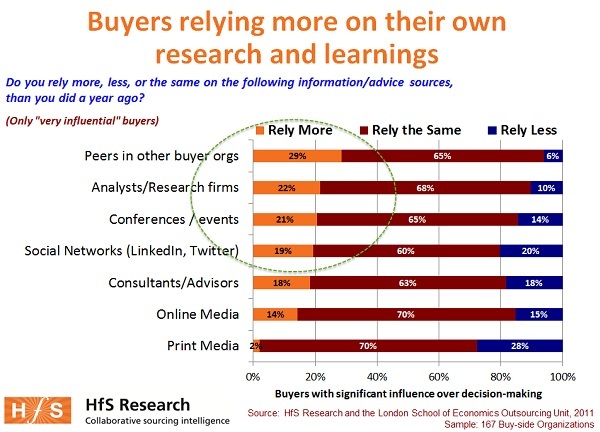
As our research has emphatically revealed, peer networking is the preferred medium of choice for today’s outsourcing decision makers. So when executives are putting considerable time, cost and effort into spending multiple days at these gatherings, they hope to get some serious value out of the networking and education.
So who better to send to the International Association of Outsourcing Professionals (IAOP) annual summit in Orlando than HfS’ research head, Tony Filippone, who has attended this event for several years running in his previous role heading up BPO for healthcare payor giant WellPoint. Here’s his report on the proceedings…
Lack of Thought Leadership Leads to a Rerun Performance
After attending the 2011 and 2012 World Summits hosted by the International Association of Outsourcing Professionals (IAOP), we were left with a feeling that event organizers were ignoring the opportunity to assemble top-notch thought leadership to drive community discussion. While keynotes were remarkably better than 2011, the educational sessions seemed similar to discussions had at every other event and last year’s 2011 World Summit. Presenters share a background on their company, their journey to success, challenges overcome, and lessons learned. Service providers stand beside their clients as their clients endorse the service provider’s services. Panelists who are CEOs for different service providers argue for the viability of regions, niche categories of services, and the need for better contract terms.
Time to change that channel?
The formula for events has become rote. Lectures and panel discussions are the dominant format, which drives little communication among attendees. Sessions rarely focus on the need for our industry to change and instead focus on repeating what has already happened or promoting sponsor interests. In lieu of tools and templates, presenters provide business cards and collateral. There is an exhibition hall full of booths staffed by marketing leaders handing out tchotchkes. Sales people meet between sessions to assemble lists of leads.
IAOP events, in particular, create the impression that the event is formulaic. Awards are given to individuals and companies. Many of the same people moderate or lead IAOP sessions each year. New lists of top service providers and advisors are announced. In fact, for the second year in a row, these “top” lists exclude the likes of industry leaders Cognizant, IBM and Xerox.
It leaves us wondering whether the IAOP really intends to be a voice of the industry, or just another event company bent on rehashing the same themes. With a hefty $1,900 dollar price tag for the 2013 World Summit, we asked ourselves, “If I attended the 2012 IAOP World Summit, would I learn anything new in 2013?”
Billed as “The Largest of its Kind”
Over 780 “delegates” attended the IAOP 2012 World Summit held in Orlando, Florida. Roughly one third of delegates were customers or buyers, one third of delegates were service providers, and the last third were a mix of advisors, regional governmental representatives, academics, and press. The event spanned roughly two and half days, which were divided into the following types of content.
» Main session presentations where keynote presentations were given to all delegates. These made up roughly eight hours of the World Summit. Three of those hours were held at the same time as other content.
» Seven “educational” tracks where companies presented theory and experiences. These tracks focused on customer experience, outsourcing tools, “management science”, transition and governance, the “human side” of outsourcing, globalization, and the future of outsourcing. There were six 50-minute presentations in each track, which totaled nearly six hours of content.
» Networking events where customers were sometimes separated from service providers and advisors. Besides structured “speed dating” networking where participants moved from table to table discussing different topics (about two hours), there were evening mixers sponsored by service providers who gave away prizes to participants.
» Practicums were held on the morning of the last day where buyers and service providers were separated. Three hours of presentations were given to each group. Buyers heard ITSqc promote its CMI-like capability maturity model and presentations from P&G and McGraw-Hill on metrics. Service providers heard the findings from Duke’s 2011 outsourcing study, ITSqc’s promotion of its capability maturity model, and a sales effectiveness presentation from Pretium Partners.
In addition, several service providers sponsored dinners or drinks in the evenings. There was also a large hall filled with service providers’ marketing booths.
The IAOP also rolled-out the “Summit Hub”, an online portal for attendees to read detailed session descriptions, plan their schedule, and proactively network with other attendees. In fact, the IAOP allowed all participants to update personal profiles and “request” meetings with other participants online.
Benefits of Attending an IAOP World Summit
For the most part, IAOP puts on well-organized events with high attendance of a broad cross-section of industry stakeholders. Expect crowds full of buyers, sales people, and industry influencers. If you are a newcomer to outsourcing, a World Summit is an ideal event because it hosts sessions on nearly every conceivable topic, from contract metrics to outsourcing in China and from contracting for cloud technology to health care services. World Summits are a smorgasbord of outsourcing discussion. You’ll have an opportunity to listen to topics on subjects you may have never otherwise have considered. However, discussion is rarely more than a high-level summary. You’ll need to follow-up with presenters after the event to get the detailed information you need to execute.
Because of the breadth of discussion, there are great networking opportunities. You’ll meet a large number of new people if you introduce yourself to your neighbors in each session, during meals, and take advantage of the structured networking activities. Most attendees find this the biggest benefit of the event. Yet, the busy schedule and predominately lecture-style formats of sessions limit your ability to interact with attendees. See our suggestions below for advice on how to improve your networking activities.
The awards given at the World Summit communicates clearly that the industry is a community and that some industry participants are great examples of outsourcing relationships and skills. To those who are new or have suboptimal relationships, the awards can serve as an aspiration. To those with experience, the awards can remind them that they haven’t yet achieved all that they could. To those who win, awards are a wonderful recognition of hard work and industry contribution. More importantly, the community that assembles is full of people who achieved the same results, but cannot seek out recognition because their organizations do not want public recognition of their outsourcing prowness.
No Event is Perfect – How the IAOP and Sponsors Could Improve the Event
The problem with events as an information source is that event companies don’t vet the content that is presented for quality. Despite “calls for paper” requests and committees that are supposed to vet the proposed content, speakers are selected based on marketing spend instead of quality of content. As shown in Exhibit 1, those influential buyers with significant influence over outsourcing decisions know the game and they find event content far less compelling than other sources.
Exhibit 1: Where Buyers Get Their Information
This is the gist of the main criticism of the IAOP World Summit: The World Summit focuses too much on marketing and connecting sales people with buyers, and less on creating meaningful forward-looking momentum for the industry. World Summits are trade shows, not thought leadership venues. And they lack enough networking opportunities to build strong communities.
In this vein of thinking, here are several key ways the IAOP World Summit could be improved:
» Break with the old, bring in the new. Don’t rehash the same discussions with the same presenters and moderators in 2013. Require speakers to up the ante and bring fresh content. Vet the content for quality so that panel discussions and sessions presenters don’t come-off as marketing shills. Encourage sessions that drive participants to interact, so they come away with new ideas and better relationships.
» Use a venue of the right size or limit attendee numbers. The organizers of the World Summit chose rooms that were too small on several occasions with major negative consequences. For example, the Tuesday lunch had insufficient seating capacity forcing people who paid $1,000 or more to attend the event to go to the cafeteria to eat and miss the keynote given at the same time. The breakout session rooms were almost always too small (or we attended the most popular discussions!). At times there wasn’t even room to stand in the back. Organizers need to do a better job of picking the right size venues or allowing people to pre-register for breakout sessions.
» Shameless freebie giveaways devalue the perception of the event. At a number of sponsored sessions, service providers heavily promoted giveaways of wine, Kindles, portable projectors, and other gifts. While swag is great, its gives off an appearance of street hawkers trying to promote their services, not contribute to the industry’s knowledge. Organizations don’t select service providers or advisors based on the quality or quantity of wine they handout.
» Let people network and stop threatening them when they do. During the Wednesday lunch and afternoon networking session, one speaker took to the microphone and ordered the entire audience to stop talking amongst themselves and instead listen to the droll introduction of chapters (he should have considered the poor quality of content, which was why the crowd ignored him). On at least three occasions, the same speaker threatened to embarrass people who weren’t silently listening to the hard to hear discussion. The speaker, a CEO of an advisory firm, accomplished only one thing: lessening the likelihood of people hiring him. The event organizers could have done a better job allowing time for people to network on their own or providing compelling content.
» Increase the quality of content. Buyers sharing experiences and best practices gave only one third of the presentations. This is always the top area of interest to buyers, and more space in the agenda should be allocated to this. However, improving the quantity of high interest is not enough. Event organizers need to improve the quality of breakout session presentations. Some sessions were outstanding, but some sessions were lead by presenters who were not as well prepared and whose slides were too high level to address the level of interest and insight participants seek. Kudos should go to Accenture who used a graphics artist that drew pictures as presenters spoke. It was a fun way of keeping the audience’s attention and stood out among the throng of text heavy PowerPoint presentations that dominated the event.
» Increase interaction among attendees. While the Summit Hub was an interesting social media experiment, it wasn’t actively used during the event. Evening mixers were sparsely attended. Presentations were generally given in lecture format. More can be done to generate interaction and create new relationships among attendees.
» Consider smaller focused events because big events lose focus. Just as buffet-style restaurants lose quality by trying to be everything to everyone, a World Summit can seem overwhelming in the sheer diversity of discussions. Most buyers and service providers have great interest in niches of services and there will undoubtedly be a session or two that meets attendee’s interest. However, the lack of event focus limits the number of sessions that will appeal to attendees. Smaller, themed events can improve the focus and allow attendees of similar interests to network better.
Six Ways to Get the Most Out of Your Attendance
Given the variety of topics and the sheer quantity of presentations, most of which occur concurrently, participants at an IAOP World Summit need a strategy to get the most out of the event. Here are five strategies you can use to improve your experience:
» Network in advance. The problem with an event like this is that everyone you’d likely want to meet is busy scheduling time with people with whom they’d like to talk. Given the sheer size of the event, participants find it hard to serendipitously run into individuals they want to speak with. IAOP’s Summit Hub makes it even harder to find these people because participants felt inundated with requests from individuals they had never heard of – especially individuals who gave their marketing teams access and used the Summit Hub as a lead generation tool. If you want to talk to someone of interest, reach out to presenters and participants in advance of the summit and ask to speak with them. Use the Summit Hub, but also reach out to them using LinkedIn or through colleagues. A particular challenge will be to find time to meet given the busy event schedule. You simply wont have a lot of available time for a meaningful conversation. So, use your meal times as opportunities to meet and greet, as well as offer to meet at mixers or other organized social events.
» Give yourself time for unexpected connections. You will meet a variety of people you hadn’t anticipated to meet. Don’t book yourself solid with event presentations and offline networking discussions. Leave yourself time to meet people and start or continue new conversations. Don’t be shy about meeting people – everyone is there to meet others. Most importantly, don’t spend the time you have with others telling them about you. Instead, ask questions and build a relationship that will allow for a follow-up discussion after the event ends.
» Avoid repeat presentations and veiled sales pitches. If you have previously attended a World Summit, skip the sessions given by the same presenters. There were several presenters who repeated highly similar content presented at the 2011 World Summit. A few sessions were nothing more than thinly veiled sales presentations focused on a portion of a service providers’ capabilities. These discussions do not provide meaningful content that you’ll easily be able to take back to your company. You’re better off to call these companies directly and schedule time to meet with them outside of the conference. Buyers and researchers lead the best presentations, as they generate discussion full of useful information.
» Select panel discussions carefully. One of the great things about the World Summit are panel discussions where three or more experts are supposed to be selected to discuss a particular topic. It theoretically offers an excellent opportunity to hear multiple perspectives on the same topic. However, panel discussions are notoriously poorly prepared and low on content. Panelists usually meet once beforehand to review questions and “coordinate” responses. Attendees hear little more than opinionated soundbytes with little tangible content. Attending a panel discussion should be left for newcomers to the content where the variety of small sound bytes provide introductory content. More interestingly, fellow attendees often have greater expertise than the panelists and are a great source of the same information. So, arrive early and introduce yourself to your neighbors. Alternatively, bring a perplexing issue to the moderator’s attention and request the opportunity to ask the panelists their opinions.
» Manage your business cards. You’ll have a stack of business cards at the end of the event, but you’ll have a hard time matching faces with names. Be sure to write down action items on the back of every card you receive so you don’t forget. When you get back to your office the following week, block out two hours to follow-up with every person you met. This process will make sure you leverage the event for long term networking relationships, not just the content presented in the sessions.
» Meet new talent you can hire. All organizations can improve their talent, and events offer excellent opportunities to network with practitioners at other companies. Use networking opportunities to identify talent your organization can use.
The Bottom-line: Heavy marketing and overt sponsorship may be a sign of the times, but limits serious dialogue on industry challenges
Events are important opportunities to improve attendee general knowledge of industry trends and build broader peer networks. IAOP World Summits achieve that objective and are ideal events for industry newcomers looking to improve their knowledge and networks. World Summits are also ideal opportunities for experienced industry veterans to take a break amidst their busy global responsibility to reflect on their achievements and opportunities to improve. If you prepare properly and apply some basic principles, these well-organized events are goldmines of opportunity.
However, the repetitive format of the event, the too-common lecture-style format of sessions, and repeat topics can lead many attendees to feel a bit like a character in Groundhog Day if they attend year after year. The lack of event focus on any one theme assures attendees that they’ll hear a little about everything and not enough about their specific areas of focus. Heavy marketing and overt sponsorship may be a sign of the times, but limits serious dialogue on industry challenges. In fact, the combination of a jam-packed agenda and lecture-style sessions limits networking opportunities to brief windows between sessions. Because the repetitive nature of events, event goers are probably better off broadening their industry knowledge by alternating between IAOP and SSON events, or even seek out more focused process or industry events, like ProcureCon, SIG, and AHIP or regional events held in Latin America, Europe, or Asia.
Tony Filippone is Executive Vice President of Research for HfS Research. You can read his full bio here
Nothing makes HfS’ own Esteban Herrera happier than helping save our clients obscene amounts of moolah when it comes to negotiating a service contract, especially when all that was needed was a prod in the right direction, and a couple of days of smart discussions…
Don't hang your advisor just yet…
I’ve been reflecting on the last three outsourcing contracts where we were asked to coach the clients (a partial answer for those of you who keep asking: how does HfS Research make money?)
As the resident complainer about stagnation and lack of creativity in our industry, I am immediately encouraged, but at the same time also dismayed, by what I’ve recently witnessed. Encouraged because I see clearly where we add value and I’ve been around long enough to see some things change for the better, dismayed because I see so many things still staying the same.
Without further ado, here is the good, bad, and ugly of recent deals where we’ve coached clients, with some critical names and dates obscured to protect the, er… guilty.
The Good
We have job security. The average savings on TCV for the last three deals we helped negotiate was 29%, as measured by total price of the winning bid on day 1 of negotiations and total price of the same bid upon completion of negotiations. This doesn’t even take into account improvement in positions like SLA risk pools and service credits, limitation of liability, indemnification, key personnel commitments, and the other myriad terms that matter to providers and buyers alike. All kidding aside, this shows that a competent advisor armed with data and a sound negotiating approach can still make a huge impact on an outsourcing deal. As a buyer, if your deal size is $50 million on November 15th and $35 million one week later, the money you probably paid the advisor who worked that deal will seem like peanuts.
Even better, each of these deals has been negotiated in about a week, meaning we’ve saved clients money (attorney and consulting fees) while we save them even more money (provider fees). And even the providers are not that upset with us because at the end of the day they close their deal much quicker and save oodles of time and costs on protracted discussions, allowing their deal teams to focus on winning other business. Of course, this speed is predicated on following a certain process that we’ve used over years and years, but if an advisor tells you its going to take a ten weeks or more to negotiate your deal (as many still do), please, please call us!
At the end of the day, our clients are happy because they saved money, but just as importantly, all the finalist providers feel we treated them fairly and gave them every opportunity to put their best foot forward and win. In an industry where win-win is always talked about and rarely achieved, I get to go home with the knowledge that my company did right by everybody.
The Bad
Reflecting on this last batch of deals, I still see lots of room for improvement. To begin with, why the $%^& do some providers still lob in bids that are 30% higher than what they will ultimately take to do the work? Do they still naively hope clients are that dumb? Why do we spend so much time negotiating benchmarking when less than a quarter of the deals in the industry ever get benchmarked, and more importantly, when zero-termination fees has become the norm? Why is the contract still thousands of pages when the paper from one deal to the next resembles each other so much? And why are providers still insisting on shirking data privacy and protection accountability?
Buyers aren’t immune to irrational behavior—like double dipping on transaction-based pricing (where they pay only for successful transactions) and still expect SLA credits for failed transactions, or requesting levels of insurance that would have saved Enron. Or requesting exuberant and unnecessary SLAs. The industry could have fairly standard paper (in fact, it already does) if buyers did not insist on bespoke clauses and contracts for things that are at this point de facto standards.
Inevitably, someone will get emotional. While this makes for great happy hour conversations it’s a clear indication that an opportunity to take a valuable break was missed. Emotion always, always compromises leverage, so it’s not even a good business move—some people think that getting angry is intimidating to the other party. It is the job of the advisor (or a designated even-keeled colleague) to diffuse the situation with humor, mediation, and/or a break in the action.
The Ugly
While “the bad” is passable and even to be expected, the ugly is a case-by-case example of incompetence. In the last few deals, I’ve seen the following:
Provider’s lawyer refused to get on a plane to meet with the client and their attorneys, insisting on a conference call instead. When client insisted that he attend, provider answered that their attorneys “never” travel to negotiation sites. The advisor had sat in another client’s boardroom with that very same attorney eight weeks earlier.
Provider insists that their delegation (an entire two people) is fully empowered to make all decisions, but negotiations drag on twice as long as with the other provider because almost every position has be “run up the flagpole”
The lead provider executive had never met the client executive. He doomed his chances by addressing the (male) CIO the whole time when the decision-maker was clearly the (female) head of infrastructure
Provider: “We cannot accept that position as a matter of corporate policy—we just don’t do that”
Advisor: “How long has that policy been in place?”
Provider: (possibly remembering another deal with the same advisor in which the position had been accepted) “Um, well, I don’t know—our policies fluctuate from deal to deal”
Provider attempts to “educate” client and advisor on the IT outsourcing business when both have been in it for longer than he has. Even if he’s right, it’s an arrogant, offensive position
Again, clients aren’t immune from negotiating mistakes:
After a tough two hour discussion in which the attorney and advisor secured an important concession, the client sympathetically gives it back.
Client invites a provider to the negotiating table that has no chance of winning but doesn’t tell anybody that until negotiations are over. Or a similar one which hasn’t happened recently but happens all too often—after a grueling selection process the client executive’s boss overturns the decision to favor a fraternity brother/relative/neighbor/golfing buddy.
Decision-maker pops in and out of room forcing the team to rehash and occasionally re-open closed (often hard-fought) positions
These are just some of the more recent “WTF” moments in over a decade of advising clients on outsourcing deals. There are many more, and some I won’t tell until we’ve had a couple of drinks. The good news is that there is still value in my profession for buyers and providers. The bad news is that a lot of advisors out there are taking advantage of both.
The Bottom-line: It’s time to speed up deals and build some mutual trust into the experience
"Go ahead… just one more bid 30% over the street price… make my day"
Outsourcing deals are still complex beasts, and savvy buyers can clients can capture tons of value by engaging experienced advisors and attorneys, but that advice need not have a six or seven figure price tag. Providers still make far too many mistakes at the negotiating table—things that cause their prospects to lose trust, which is the single most important buying criterion to begin with. There’s a lot to be done to simplify deals, but even if we don’t get there, as an industry, quickly, there are key behaviors and positions on either side of the transaction that can speed up the deal while building trust and creating a more strategic relationship.
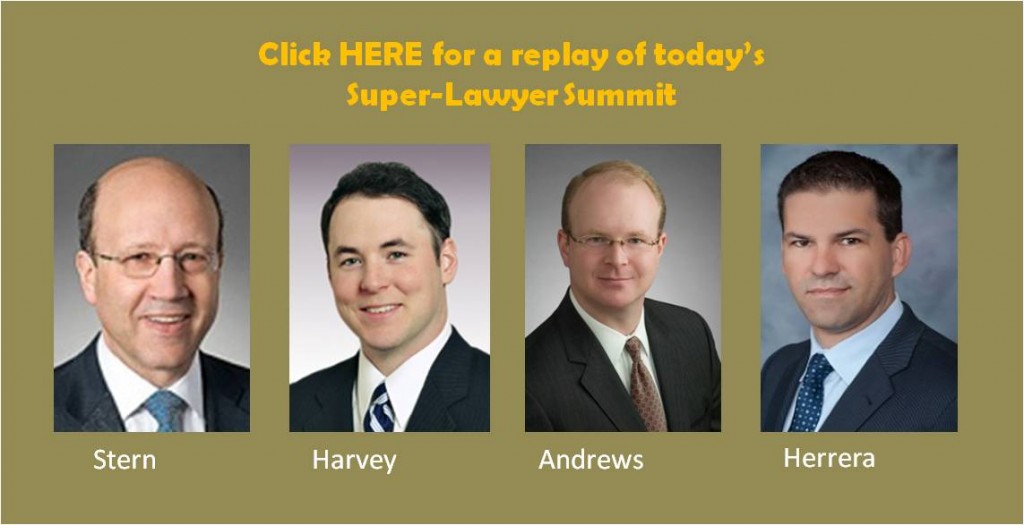
Esteban Herrera (pictured here) is COO for HfS Research and leads the firm’s buy-side deal coaching. You can hear him this coming Thursday at 11.00am ET at our Outsourcing Super Lawyer Web-Summit (click here for more details).
This week’s webinar included the ‘A’ Team of experienced, handsome and fun-loving outsourcing attorneys. In fact, these guys are so handsome, we chose an audio format to have the ladies focus on their brains, and not their brawn. Oh dear…how low are we stooping for a cheap laugh these days?
Anyway, a special thanks to Esteban Herrera (HfS), Akiba Stern (Loeb & Loeb), Jeff Harvey (Hunton & Williams) and Jeff Andrews (Thompson & Knight) for one helluva lively discussion in the state of today’s outsourcing contracts.
Missed out on the legal ear-candy? Click below for the re-play.
And if you want to enjoy a fully interactive experience of having the slide deck to accompany their dulcet tones, click here.


 In
In 




 The world of sourcing advisory has gone through unprecedented change over the last couple of years.