Thanks to all of you who participated in December's survey "Seeking The New Normal in Outsourcing Delivery".
In total, 1051 companies gave their opinions, with a strong mix of buyers, intermediaries and providers participating to give us an unprecedented pulse on the outsourcing industry. About time we had less prophesying and some actual hard facts on what's really going on out there…
In anticipation of releasing the results of the study later next week, I'd like to recap some recent thoughts on where the industry is headed, to help make sense of what is really happening in the industry. And a special thanks to our friends at Global Services Media and the Shared Services & Outsourcing Network, who graciously invited their member communities to complete the survey (thank you, Ed and Sarah). And curses to those of you who pilfered our phrase "New Normal"… you know who you are 🙂
The "new normal" in the outsourcing delivery business
This truly has been a pivotal quarter for the outsourcing business. As we've discussed several times here, many services contract decisions have been delayed during the economic crisis while organizations worked out the best course of action to get through the downturn.
In Q3 we've started to see definitive action, with many service providers meeting, and some even beating, Wall St. expectations. But while some providers are clearly delivering, others are struggling to compete in this "new normal".
So what is this "new normal"?
Operational service provision is commoditizing and leveling the playing field. Coming out of the recession, there is a backlog of engagements which are largely labor arbitrage-focused and it's often a question of price balanced with the promise of delivery performance for most clients. There isn't a lot of secret sauce these days for what many clients are currently demanding, where in the past, incumbent service providers could play the "capability game". With many of these skills becoming mainstream, the competitive playing field has leveled out.
A not-so-secret sauce is undermining the business models of the old-guard. When selecting a provider in commodity services areas such as ERP software development and maintenance, or transactional accounting processing, it's getting harder and harder for the traditional branded service providers to command higher price-tags against the new breed of offshore service provider. Essentially, everyone's competing for the same pool of talent in commodity areas these days, and for some providers used to commanding higher multiples in the old days, they simply cannot compete effectively anymore. This is especially the case where clients simply want technical support, without significant business transformation.
The recent round of financial results from the service providers is confirming this new reality - and it's happening at a fast-pace in this environment, which is alarming the old-guard. The crux of the matter, coming out of the economic crisis, is that most clients are not yet readyfor real business transformation (even though many need it) - that will come further down the road. Their current requirements are to take advantage of operational arbitrage opportunities, and this market is a long way from becoming saturated. For example, 75% of ERP services are still being delivered onshore – hmmm… that's a lot of room for future labor arbitrage.
The winners in the arbitrage game have a future seat at the table for higher end services, but need to reinvest to deliver. Those providers proving operationally-efficient and cost-competitive to win the less sexy work today, will find themselves in a strong positiong to push higher-end business transformational services in the future, because they will already be present within clients delivering operational work. They need to demonstrate they are capable of learning their clients' businesses, in order to move up the value chain to take on more consultative work.
However (and it's a big "however"), in order to move up the services value chain, the winning providers of today need to invest in their talent, their IP, their global delivery platform and their industry acumen to prove they can deliver more innovative services down the road. They need to develop, either through organic investment, or through smart acquisition, this capability to help their clients find the next phase of efficiency gains for themselves and new sources of revenue. Hence, while clients demand cost-arbitrage today, the next wave of efficiency gains can't continue to be found from swapping out higher cost for lower cost (which we discuss here). They're going to come from doing things differently and re-wiring their operations.
The struggle for differentiation. With several providers that can deliver essentially the same service within a narrow price-band, it's getting very tough for some to break out of the pack to prove they warrant being the long-term partner of choice for a client. Simply put, a client needs the following: a provider which is financially sound and is re-investing in its global delivery platform, and has a stellar track record in delivering results for its clients.
Trust trumps brand. Customer references are critical in this business. A consistent voice from multiple customers is now the tell-tale sign as to whether a provider can deliver. In most cases, where a clients have unique requirements, they have to take a leap of faith in whomever they select. It's no longer all about brand and executive relationships for smart customers today; it's about having a unique culture that encourages clients to trust their provider to deliver results and to explore constantly new avenues to make them successful.
All-in-all, as we discussed recently, those business that persist in the old way of doing things will go by the wayside, and the service provider landscape is certainly no different. There's a changing of the old-guard happening, and at a speed which is making it increasingly worried.
We've had a huge amount of debate concerning the future direction of outsourcing advisory services, and today, we can exclusively reveal a sea-change in the advisor industry landscape with Alsbridge's acquisition of TAG, the leading life-cycle expense management advisor for network services.
Essentially, this is the first genuine coming-together of IT and network-connectivity sourcing services within an advisory model. While most traditional outsourcing advisors are firmly-rooted trying to maximize cost-efficiencies for their clients through lower-cost labor offerings in IT and BPO, they often overlook the additional savings on the table they can generate for CIOs through smarter sourcing and management of all telecom and wireless connectivity expenditure.
Hence, this merger is a win-win for both parties – Alsbridge can introduce TAG's benchmarking, sourcing/procurement and network expertise to its clients, while TAG's clients can benefit from Alsbridge's broader outsourcing and pricing expertise across both IT and BPO domains. Moreover, TAG adds another 30 experienced networking practitioners to the merged entity, significantly enhancing Alsbridge's firepower as we move into an aggressive 2010 marketplace.
I interrupted TAG's President Dieter Thompson during a deep-sea fishing expedition earlier today, and he added, "We're in the right place at the right time, in a challenging environment, to help execute our clients' business plans which many set in motion in 2009." In addition, Alsbridge CEO, Ben Trowbridge, dragged himself away from the Cowboy's ongoing playoff celebrations to add, "While ITO and BPO purchasing is relatively straightforward these days, network services are complex. Acquiring data-rich consulting capability across IT, BPO and networking domains is providing the meat to the sourcing strategy."
Pictured above (left-to-right): Dieter Thompson and Ben Trowbridge sealing the deal over the weekend
My earliest memory of outsourcing was ringing to complain about a utility bill and getting a polite, but calmly authoritative, Scottish girl at the end of the line. I knew immediately that I wasn't going to get a ton of mileage with my quest for justice that day…
We've spent a lot of time discussing outsourcing locations here, and one we've overlooked is Scotland. And it's not because I'm a Brit and the Jocks don't like us very much - it's simply the fact that they don't make a great deal of noise about what a stellar location they have. They quietly go about taking on BPO services for the likes of Morgan Stanley and Shell and let their reputation take care of itself.
So, with this year's European Shared Services Week conferencebeing staged in Edinburgh (where I once narrowly dodged the cheese police, but I'll save that story for another time), I asked Danny Cusick to give us his best Scottish sales pitch that puts those "Invest in Wales" ads (we get force-fed on BA flights), into the shade. And for those of you who don't know Danny, he's President of the Americas for Scottish Development International. Over to you Sire!
Scotland: A Hub for Business Process Outsourcing (BPO) Centers
It’s clear that the context of the global business process outsourcing (BPO) sector is changing rapidly. No longer simply the answer to the question of cutting costs, customer contact and shared service centers are now often – and rightly – seen as integral parts of a business. The ingredients of a successful BPO hub are changing too. For world-class businesses, cost is part of the equation, but alongside many other factors. Scotland has a long and proud tradition of excellence in the financial and business services sector.
Today, with companies tapping our unbeatable combination of high-quality skills and competitive costs, the nation has become the ideal location and home to some of the largest contact centers in Europe. At the heart of Europe, within a short journey from the City of London, Scotland is able to serve a wide range of markets throughout the continent and from Central and South America to Asia Pacific, with the support of academic institutions, stable infrastructure, and advanced facilities. Its impressive record of success in the field has made Scotland an internationally recognized BPO location.
But we are not resting on our laurels. In Scotland we’re taking a lead in ensuring what we have to offer meets the needs of the new business landscape.
First, we continue to invest in one of the most impressive and skilled contact center workforces in the world. With a world-renowned educational system and a ratio of greater than 20 percent of working-age graduates working in the shared services sector, there are more than 86,000 people employed within 400 contact centers in Scotland, meaning that one in every 30 employees works in a contact center. Due to the wealth of multilingual capability available in Scotland, the BPO contact centers feature a mix of 26 different languages in a wide variety of operations in a diverse range of sectors including financial services, telecoms, utilities, retail, technical support, travel, and media.
Second, this quality workforce is allied to an extremely cost-competitive environment. Labor market regulations in the UK, including working hours, are among the most flexible in Europe, and staffing costs are highly competitive. Scottish salary costs, including indirect social wage costs such as employer national insurance, are among the most competitive in Europe. And companies will find that high quality workspaces at very competitive rates are aplenty in Scotland. Within minutes of large population centers in Edinburgh and Glasgow, investments have been made to make world-class contact center space available at a fraction of the costs of similar space in other capitals throughout Europe.
Finally, for call center personnel, Scotland has a well embedded training infrastructure developed by the public and private sector. Established in 1996, Customer Contact Association (CCA) is the professional body for the Call Center, Contact Center, and Customer Service Industry in the UK. Headquartered in Glasgow, Scotland, the CCA endorses training courses at three levels with a strict quality checking process at each level.
Furthermore, most colleges in Scotland have particular strengths in developing flexible preemployment training courses geared to meet the specific needs of contact centers. A broad range of courses have been developed in conjunction with companies, colleges and local enterprise companies in Scotland. More than 42 colleges and 21 private training providers offer a variety of customer care courses, with five colleges offering specific Customer Contact Centre courses. In Dundee for example, the local college delivers courses which last up to 8 weeks, with a focus on customer care, telephone technique and IT skills all of which delivered within a call center environment within the college grounds.
Demonstrated by the number of corporations who have already taken advantage of the nation’s innovative and highly educated workforce and wealth of expertise in this field, Scotland’s dynamic business environment is proving to be the ideal shared service center location. Due to its advanced and cost-effective IT and telecoms infrastructure, competitive property market and highly- qualified workforce, Scotland has been chosen by companies including IBM, Morgan Stanley, Dell, O2, Iron Mountain, Eaton, Shell and NCR, as the hub for their service center activities.
In the current global economic climate, leading global companies are looking for a BPO partner that can deliver high quality service and cost-competitiveness. In Scotland, we’ve taken that challenge to heart, providing world-class contact center options to world-class firms.
Danny Cusick (pictured here) is the President of the Americas for Scottish Development International the international division of Scottish Enterprise and joint venture with the Scottish Government. Danny is responsible for all of SDI international business activities in the Americas.
So it’s time to drip-feed the intentions and experiences of 1055 buyers, intermediaries and vendors into the global sourcing industry.
We’ll be discussing the results from our “Seeking the New Normal in Outsourcing Delivery” in full at the Global Services Conference on 28th January, but the nuances behind why – and how – companies are exploring sourcing delivery models, as we come out of a painful recession into an uncertain climate, need to be aired and discussed.
There’s been a lot of talk about a “New Normal”, or a “Reset Economy”, that things will never be quite the same as before, however, we really need to zone-in on reality to grasp what these new dynamics really entail, in order to understand how we can address them.
To cut to the chase, most industries are in a state of profound change, where businesses are having to accomplish new levels productivity and sources of revenue simply to survive, let alone grow, in this climate. Whether you’re making cars, pharmaceutical products, providing consulting services, and so forth, the chances are there’s someone else in your industry vying to deliver what you do at lower cost, and potentially better quality. (Unless you’re in banking, where it’s business as usual…).
The big difference today is there aren’t really any major developments on the near-term horizon to fuel a fresh wave of new economic growth, such as those provided by the Internet, computing and telecoms revolutions of the last 20 years. This time, the name-of-the-game is to optimize the tools we have, and be smarter than our competitors. Eventually, we’ll see real progress being made in areas such as medical research, Cloud computing and Green tech that should fuel a new growth era, but it’s not going to be upon us quite just yet.
In today’s global economy, the options available to provide products and services leveraging global talent and new technologies, are almost suffocating for most firms. There’s never been a time more crucial than now to find the right partners who can help you source global talent effectively.
When 209 enterprise buyers of outsourcing services were asked what were the most important reasons driving them to evaluate outsourcing in 2010, we received the following results across small (under $750m revenues), mid-sized ($750m-$3bn) and large ($3bn+) customers:
Figure 1: Customers are looking to drive change into their operations to become more effective globally
You can clearly see the contrasting motivations here between small, medium and large-scale enterprises when in comes to their motivations behind outsourcing. Let’s drill a bit deeper here…
Cost-reduction dominates, but only where there is significant scale to exploit labor arbitrage opportunities. While the mid-large customers (90%) overwhelmingly look at cost-reduction as their prime driver, smaller firms do not have the same scale to enjoy such immediate cost take-out potential, with only 60% citing reducing costs as a primary driver. They actually regard accessing new process acumen, technical skills and having support to operate more effectively at a global level, as similarly powerful motives.
Empowering global operations and re-engineering processes are coming to the fore. When we ran a similar study six months’ ago, it was already becoming clear that customers, when looking at outsourcing, are anticipating more business benefits than merely driving our some initial cost. As we emerge from the recession, their desire to leverage global sourcing to help them operate more effectively as a global organization and re-wire their operations to support that process, is becoming even more apparent, with over half of all customers citing the need to globalize and transform processes as prime outsourcing motives. And this is across all size-classes of customer. The need to globalize is impacting all companies, and outsourcing is providing one vehicle firms are looking at to help them achieve it.
The mid-market increasingly views outsourcing as a vehicle to force change into their business operations. As we’ve discussed exhaustively during the downturn, many businesses are struggling to break out of the old way of running operations, and outsourcing is increasingly being viewed as a major change-agent, with close to two-thirds of mid-sized customers citing this as a very important driver for outsourcing this year. While mid-market customers clearly feel the need to combat fatigue from old business support models, large firms are less inclined to view outsourcing this way, as they are more used to using customized sourcing approaches and captive / shared services models, that are harder to “change” solely with outsourcing engagements. Small firms tend to use outsourcing moreto augment the value it brings from an added resource, talent and global standpoint, but because of the lack of scale will struggle to force real change into the business models with limited labor arbitrage opportunity.
There’s much more to follow from this study in the coming days, but we can already conclude that this unique view across the real drivers behind outsourcing clearly compliments the profound and fundamental changes we are going through across most industry sectors. Global business is rapidly changing, and outsourcing provides a vehicle for many business to change with it. Love to hear your thoughts / comments. You can also email me at phil dot fersht at horsesforsources dot com.
Whether it's cash management in Casablanca, or payroll in Patagonia, there's one guy who'll have a Harvey Ball polished and ready for you. Enter Everest Group's rock-loving, paint-balling enthusiast, Anand Ramesh, who lives and breathes global sourcing locations.
However, before you read the excellent guest article he's submitted for us, please spend a few minutes assisting Anand with his new study to understand how companies are leveraging offshore locations – particularly for high-value services – and how the landscape is likely to evolve. Just click here to access his study, and he'll send you a summary of the "Market Vista" report in return for your efforts. Over to you Anand…
Global Sourcing Destinations: Perspective 2010
The ripple effects of the global economic slowdown made 2009 an interesting year for outsourcing and offshoring. Rapid growth in offshoring slowed in 2009, despite the fact that the trend of high wage inflation in offshoring markets diminished significantly.
Although India and Philippines witnessed significant slowing down of hiring and consequently slower growth, these countries will continue to be the hubs of activity in 2010. In the last 12 months, India and the Philippines accounted for nearly 40 percent of new delivery centers set up globally. A combination of low-cost, large-scale, highly skilled talent pools and a high degree of offshoring maturity will contribute to both countries retaining their dominant position in the market. By Q3 2010, we expect the conversations around India and Philippines to center back to where they were two years ago – inflation, attrition, pressures of rapid growth!
In recent months, several other countries saw increases in activity. Most notable are Brazil, Argentina, Central American countries, and parts of Africa. Buyers and suppliers expanded to these geographies by setting up new delivery centers. Several offshore-centric suppliers such as Polaris Software, TCS, Patni, Genpact, and Cognizant announced large plans for Latin America. The hot location pick for 2010 will be Peru – with more activity than before, new local suppliers entering the market, expect at least one major global supplier to set up a delivery center in the country.
Delivery centers in Latin America and Eastern Europe are increasingly focused on more niche services. For example, centers in Eastern Europe support language-specific requirements and high-end R&D or engineering services. Similarly, Singapore is increasingly emerging as a logistics and knowledge-services hub.
These factors point towards an increasing focus on specific services in these locations in smaller scale, in contrast to a broader suite of services supported from India and the Philippines at large scale.
As buyers’ focus shifts to cost reduction, low concentration risks, and improved productivity levels in the future, they will tend to seek greater flexibility in service delivery models. This is already manifesting itself in multi-geography, hub-and-spoke models. In 2010, we expect to see an increasing number of buyers push towards globally integrated networks where locations both complement and supplement each other.
The result will be a mix of domestic, near-shore and offshore delivery /shared-service centers – often in a “hub and spoke” model. Suppliers will continue to explore the new terrain and tap specialized skills and language capabilities to address the outsourcing needs of local and regional economies.
In summary, as the offshoring industry recovers, the location landscape will see substantial changes in 2010. Buyers will increasingly focus on developing the right portfolio of locations and suppliers will continue to push the envelope into new countries. The key challenge for all participants will be to think beyond selecting single locations to develop a portfolio view of locations.
Anand Ramesh (pictured) is a Research Director at Everest Group’s Global Sourcing practice. He tracks global sourcing market trends across buyers, suppliers, captives and locations and plays a leadership role for the company's quarterly Market Vista research.
The Industry Speaks, Part II: When the labor arbitrage deals dry-up (and they will), customers will select vendors that can deliver business-value beyond basic low-cost services
Fed up with short, punchy news titles such as “Outsourcing is Dead”, or “My Delivery Manager Ate my Hamster“, designed purely to capture your attention with minimal substance?
Well, salvation can be found right here, as long-winded rambling ones are going to be all the rage this year, so here’s one to send you into a tail-spin: “Infosys will buy Capgemini, then IBM will acquire the newly-merged entity before spinning it out as part of a joint-venture with Deloitte, GE and Macdonalds”. Actually, before you hurry out to purchase some stock in the Golden Arches, I just made that up…
Instead, let’s talk about outsourcing vendors, and what on earth they are going to do when these tasty labor-arbitrage deals start to fizzle-out. As we discussed at length back in November, operational service provision is commoditizing and leveling the playing field. Customers did their planning during the recession, and, now armageddon has (apparently) been averted, it’s time to execute on that planning. And part of many customers’ planning right now, is to take advantage of moving operational support offshore and driving out some cost.
This is bonanza-time for the offshore-specialists that can deliver basic IT and BPO services at competitive prices. Contract-signings that were delayed during the painful recession months are now in full-swing, service vendors are reporting healthy results and even the sourcing advisors have stopped moaning about their lack of deals, and are making money again.
However – let’s not get too carried away. While the outsourcing market has rebounded, and it’s likely to remain strong for most of 2010 (read Part III when I get around to the next piece shortly), these labor-arbitrage deals are not infinite. Once customers have moved out as much of the easy work to service providers as they can, their focus will move to finding that next tranche of productivity, and it’s not going to be as simple as documenting standard processes and training an offshore team to replicate them. Customers may be delighted today that they trimmed 30% on this, and 50% on that, but next year those costs are eradicated and they won’t keep harking back to that successful outsourcing initiative they did back in ’09. They’ll be looking at what initiatives they can take advantage of next.
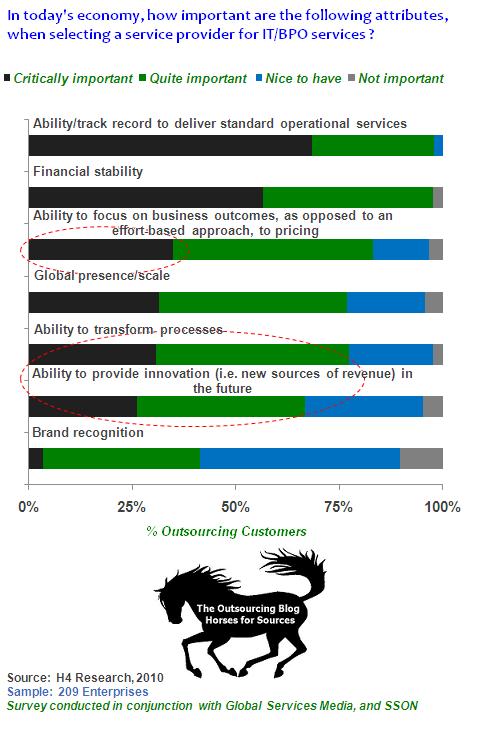
So when we spoke to 1055 customers, intermediaries and vendors across the global sourcing industry earlier this month, we drilled into the criteria behind vendor selection decisions, with an eye on how these decisions will be made in the future:
Figure 1: When evaluating vendors, financial stability and operational excellence are the table-stakes. Business transformation capabilities are the differentiators
Vendors need a proven delivery record and financial stability just to get to the table. The vast majority of buyers now see these as table-stakes just to start a discussion. The Satyam fiasco has left some sore memories with customers, who do not want to experience a repeat of their vendor going belly-up, like Satyam almost did. Would you sign up with an electricity provider who might go out of business? The same applies to whomever is processing your business transactions and managing your IT.
Moreover, with the industry for commodity work (i.e. technical support, application development, transactional accounting etc.) now quickly maturing, there’s little room for companies without proven customer successes and experience within the customer’s industry.
Once at the table, customers are asking “what else can you give me?” Quite simply, there are several vendors today pushing services within a similar price-band and sufficient track record of successful delivery. Furthermore, most large enterprises have already experienced offshoring and outsourcing varying degrees of their operations for several years’ now, and are smart enough to realize outsourcing provides an opportunity to deliver more than simply cost-savings (see Part I). Consequently, the ability to provide outcome-based pricing is now a critical component among a third of customers, and an important consideration for most of the rest.
Global presence and scale are less of an issue these days. Merely a couple of years’ ago, this would have been among the most critical selection criteria, however, today’s customers are less concerned with these issues, as most of today’s vendors are already expected to have a multi-shore strategy and sufficient ability to add resources when required. Moreover, most of today’s deals have an onshore / onsite component complemented with offshore support from India, Philippines or some other location. Everyone has that in spades. It’s like asking whether your electricity provider has enough generators…
Innovation / transformation now becoming major decision-swayers.While on the surface, it may appear that transformation and innovation are only secondary considerations (i.e. not a “deal-breaker” for three-quarters of customers), when you take into account that most vendors are offering similar solutions at similar prices, it is these categories that are fast-becoming the decision-swayers.
Brand not nearly as much of a consideration. I do view this skeptically, as people rarely admit they are swayed by brand, however, the fact that it is the least important selection criteria does tell you that service delivery these days is much more about the realities of delivery excellence, than the label they under which they are delivered. Engaging with a second-tier offshore brand is now seen as acceptable as a household Western brand. Moreover, executives these days can get fired for using a big brand and messing up. The sheer number of customers that have engaged the new breed of offshore service providers, in recent years, has significantly leveled the playing field when it comes to brand.
The bottom-line: those that fail to invest in the future delivery model will likely get cast aside. To conclude, it’s clear this business has reached a critical juncture where providers are being judged on their ability to go beyond standard services and deliver real business value for their clients. Decisions are made on which vendors have invested in creative staff with industry domain skills, backed up by the table-stakes of delivering bread-and-butter services at competitive prices.
Everyone’s talking a big game right now, and it may get them to the table… it may even win them new business, but their real challenge is whether they can truly move clients up the value chain and help them find new avenues for productivity and growth. While a lot of basic services contracts are being divvied out in this post-recessionary era, if today’s winners fail to invest in upping the value of their service provision, they may find these clients seeking alternative service partners before long. Some vendors will always be happy delivering low-end services, however, if they see their business going to competitors with higher-value propositions, they will desperately seek out ways to remain competitive. The question is whether they have the appetite and culture to invest to find that next level of performance for their customers.
Industry analysts are often accused of hyping the market they cover, creating hockey-stick growth projections to get everyone excited and avoiding ever reporting a worrying decline in growth. I just heard you gasp in shock and horror at this revelation…
So what do you do when you’re actually in a position to dust-off the old hockey-stick, last seen used adorning a forecast for online vacuum-cleaner parts from ’99, and slap it under a title such as “Outsourcing spending to reach $250 Gazillion by 2016”?
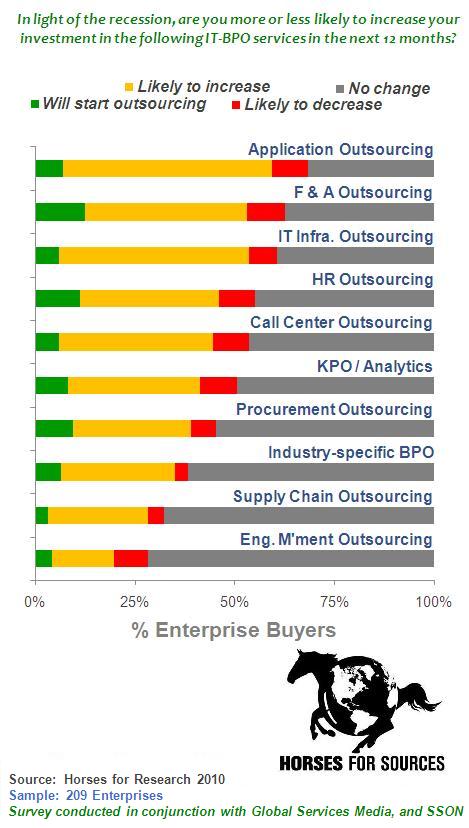
Which brings us to the topic du jour: what are customers intending to do this year with their outsourcing strategies? When we spoke to 1055 customers, intermediaries and vendors across the global sourcing industry earlier this month, they gave us the real picture:
Figure 1: How 2010 will play out (from the customers’ perspective)… IT Outsourcing reaching its peak and a banner-year for BPO likely
This chart is revealing the dynamics of enterprises now looking to execute on plans to reduce costs and drive change into their business operations after hunkering down during the recession.
The green represents where customers are intending to initiate outsourcing for the first time, the amber where they are intending to increase scope of existing outsourced processes, the red where they intend to pull-back scope, and the gray where they haven’t made any plans, or just intend to maintain their status quo. Let’s take a closer look…
Applications and infrastructure: most larger firms have already been using IT services vendors to deliver work in outsourced contracts for some time now, hence the relative small percentage of customers starting ITO for the first time. The notable trend here is the sheer magnitude – over 50% – of firms intending to increase the scope of their existing IT outsourcing engagements. We’re already seeing significant revenue growth from several of the ITO vendors over the last couple fo quarters, as they layer on work for customers. As we’ve discussed at length, there’s still a lot of room for labor-arbitrage deals in the short-medium term, with 75% of ERP still being maintained and supported onshore. Hence 2010 will constitute something of a land-grab for the arbitrage work from the leading services vendors. The big question will be who wins the higher-value transformative work when the obvious arbitrage opportunities eventually dry up.
Our take – IT outsourcing to peak this year.The delivery models for standard ITO services are mature and scalable enough to cope with the demand. 2010 will be a peak year for the ITO business as the services vendors rapidly mop-up the labor-arbitrage deals. The gauntlet really gets laid down towards the end of this year, as customers want to find new ways to drive productivity after the arbitrage is exploited, for example virtualization and cloud-based services.
BPO: simply put, many BPO functions are a lot less developed, less scalable and less “productized” than those of IT outsourcing, so expect a lag-effect between the resurgence in ITO and a bounce-back in BPO engagements being signed. We’ll delve deeper into the BPO dynamics, in the coming days, to discuss the development path of the process areas and their blend with IT delivery. However, similar to ITO, it’s clear a lot of pent-up demand from business case evaluation in the recession months, will come into play in 2010.
Transactional finance and accounting (F&A) outsourcing (i.e. payables and receivables) has become well-resourced and supported by a number of vendors, with over 70,000 delivery staff working for services vendors across the globe. One-in-six customers expect to venture into an F&A BPO engagement for the first time this year, but more significantly, 40% of them will be layering on additional F&A processes to existing engagements, with only a small fraction actually pulling back work. Much of this demand is coming from mid-market firms, so expect a multitude of smaller transactions in the $5m-$20m range being signed this year.
In a similar vein, some HR outsourcing functions will be outsourced, with 11% expecting to outsource for the first time, and a third of customers adding additional scope. Unlike the multi-process HRO business of yesteryear, most of the new HRO engagements will be single-process in areas such as payroll, staffing (recruitment process outsourcing) and benefits administration, where vendors have established and more scalable delivery models, underpinned by technology platforms and a blend of onshore, nearshore and offshore delivery.
Other areas of note, that will be discussed in further detail down the road, involve an uptake in call center work, to be expected during a period of some economic recovery, and a lot of firms exploring analytics / knowledge process outsourcing, especially among mid-market customers. Most interestingly, we’re seeing a real interest from customers to explore industry-specific BPO models, most notably in the financial services and life sciences sectors.
Our take – BPO to re-emerge, but demand will outstrip supply. Simply put, many firms that laid-off heavily during the recession are opting for more flexible support models as we move into an uncertain period of economic recovery. Outsourcing fits the bill in many cases, as it provides a more flexible, lower-cost option that can support uncertain business volumes. Moreover, outsourcing can provide a unique change opportunity for firms, as they look for better payroll systems, flexible recruitment support, a streamlined global accounts payable process flow etc. However, BPO areas usually necessitate more intricate business re-engineering and change management than those in IT support areas, and the cost-savings can be a lot less attractive in many instances. In addition, a lot of the fresh demand is coming from the mid-market, where the numbers of process staff involved are fewer, and the labor arbitrage savings less attractive than those of larger companies with greater scale. Not to mention the pressure on vendors to maintain their profit margins, which is going to make it tough for them to be as cost-competitive with mid-market deals as they are with higher-end pursuits.
The bottom-line: outsourcing is back on the table, but the industry will only be able to respond initially to demand in commodity areas. It’s encouraging for the outsourcing industry that customers are seriously looking at outsourcing to solve many of their performance issues, however, trying not to insert too much of a damp squib into this positive data, many services vendors are not geared to give them the cost-savings they hope for, in many instances. Not many customers will turn away opportunities to drive out 30%+ cost-savings and the chance to improve their support operations, hence the resurgence in demand after such a long period of careful planning. However, the industry has been geared to solving low-hanging fruit outsourcing opportunities, such as application support and standard transactional business processes, where the common denominator has been cost-reduction via high-scale labor arbitrage.
While there is clearly a lot of new business to be taken on in this environment, the real issues are arising in the mid-market, where lesser-scale necessitates a vendor partner which can deliver more than low-cost staff in a scalable delivery model. The transformation many mid-market customers need to move into an outsourced environment, often requires new technology implementation that incorporate elements of SaaS and Cloud computing, deep domain-specific consultative support and a skilled change management program. While several services vendors have these capabilities today, they are scarce and come at a price. As a consequence, many of these customers will be disappointed at the level of immediate cost-savings on the table and will be challenged to create outsourcing business-case justifications to their leadership, in order to proceed.
The challenge is on for services vendors to craft creative solutions for clients that provide more than merely standard delivery underpinned by labor-arbitrage. The winners will be those that can step up and craft creative, innovative offerings and convince their shareholders they are doing the right thing.
An "Awful Award" goes out to Technobabble 2.0 legend Jonny Bentwood for this truly hilarious parody of the Magic Quadrant. I was going to warn readers of some naughty language, but realized that would only encourage you further…
For once I am stumped for a catchy title, and am opting for some good ol’ jargon-laden gruyère to tee-up Part IV in the series discussing our New Normal in Outsourcing Deliverysurvey. At least I’ve avoided the ‘T’ word lately, to grant myself a morsel of poetic license to indulge in a little schmolz…
But we all love the term “Cloud” (c’mon, you know you do…). It gives us a nice fluffy visual of ripping out all that complex, clunky computing chaos from our organization, and having some nice services vendor deliver us everything we need for our business… leaving us with simply a screen, a keyboard and lots off additional space in the office to set up that Fussball table… or a Twister mat in the corner…
Why Cloud Computing is the future of outsourcing delivery
While I am probably the first cynic to de-odorize the latest cheese fumes that infuse our industry, I have to admit I am rather taken with the whole philosophy of Cloud Computing. Cloud signifies the coming-together of business process and IT delivery in a fully outsourced model (see earlier post). Cloud’s not simply about outsourcing the heavy-duty computing grunt – it’s about the delivery of real business services, enabled by the applications needed to support them, powered by the requisite computing and network infrastructure to host and deliver them.
If Cloud was only about gutting the clunky, expensive and environmentally-unfriendly infrastructure, and having Amazon and co. deliver the computing power, then it’s really just an infrastructure utility offering. However, if you’re going to have your data and applications hosted externally in the Cloud, do you really need to manage them yourself anymore? It all depends whether you need to customize the applications yourself because it gives you some sort of competitive advantage. For example, do you really gain a competitive edge with the way you run your benefits administration, or process your insurance claims, or isn’t it time to find a services vendor that will host the app, the associated infrastructure and even process the transactions for you? If you feel your edge is customer service, or great internal employee care, then you can keep inhouse staff to take care of that, but what’s the point in managing all the related IT and back-office processing if someone can do it for you?
To refer back to the fundamental principle of outsourcing, if a third-party services vendor can perform a task for you at lower cost, and to an equal or higher standard, and the costs and risks of transitioning into the outsourced environment are outweighed by the business benefits, then there’s little sense in doing it yourself. And if that vendor can add genuine consultative value to improve that task and add to your overall business performance, then we’re talking about real business effectiveness, and not simply a cost-arbitrage scenario.
Cloud’s value will only be reached when vendors and customers are honest with themselves
The challenge posed to the outsourcing industry to find new performance thresholds, is shared equally by both customers and services vendors:
1) Customers: do you know how to take business performance to the next level, and are you having the right conversations with the right services vendors who have the process depth and delivery model to help you determine what that next level is? Do you have full confidence in the solutions being touted by the vendors with whom you are talking, or are you afraid you’re simply being heavily “sold”? Have you seen real evidence of their capabilities to deliver real business effectiveness?
2) Services vendors: have you determined where you’re truly distinctive in the market and can bring real business performance improvement to your clients beyond simple cost-efficiencies? Or are you simply following the crowd and adding a thin veneer of industry jargon over your standard capabilities? And if you choose to ignore the hype and focus on standard service delivery, will you get squeezed out of the market in the future by smarter competitors with deeper process and delivery capability?
The question is how long it takes for our customers and our services vendors to dig deep and find honest answers to these questions. We knew back in 1995 that e-commerce was the future of retail, but it really took a decade for it to become widely-adopted. Cloud will likely take 3-5 years to become fully-formed as a business utility offering, but we can be sure its seeds have been sewn and its roots already taking shape, as our new study essentially reveals:
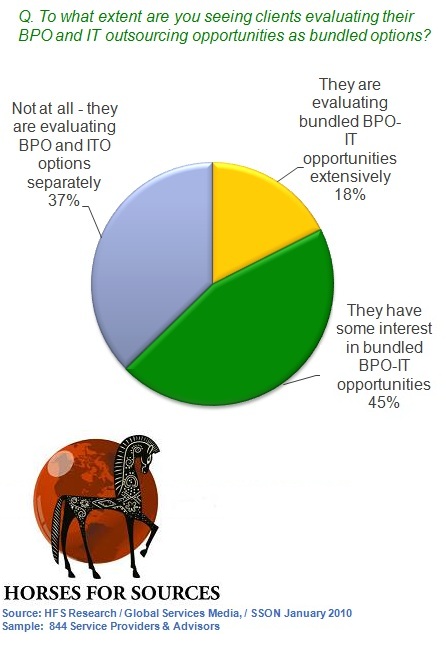
Figure 1: The roots of Cloud in an outsourced environment: Two-thirds of customers now evaluate ITO/BPO solutions as bundled options
The roots of Cloud services can be found in today’s blended ITO/BPO engagements
Just a couple of years’ ago, it would have been unthinkable that so many customers would be entertaining the concept of “hybrid” BPO/ITO solutions, where they would seek to outsource business processes alongside the IT componentry that supports them. Only a handful of customers had “bundled” both their BPO and supporting apps management with a single provider. And these tended to be in cases where large customers had opted to “lift and shift” entire shared services operations over to their service provider and it was simply easier (and contractually more attractive) to lump everything over to one vendor to take care of everything. Today, as Figure 1 illustrates, close to two-thirds of customers are evaluating their outsourcing options looking at both both ITO and BPO in a more blended model and nearly one in five are doing it extensively (that’s a lot of engagements).
In many engagements today, we are seeing both ITO and BPO feed off each other, where services vendors are getting much more proficient at cobbling together hybrid teams of systems architects and business process analysts to develop broader engagements that tackle end-to-end business process flows. Many of the more recent BPO engagements we are seeing have been extensions of existing ITO relationships, where the incumbent IT services vendor has brought in BPO teams to layer on business services.
Being predominantly a BPO person myself, I am getting increasing calls from infrastructure guys trying to find out how “BPO fits in with their Cloud strategies”. Simply put, BPO provides that layer of flexible personalization to a Cloud/SaaS offering that can make it workable for a business. I may be somewhat biased towards BPO offerings, but I am going to put a stake in the ground and declare that those service vendors which successfully develop Cloud offerings, that are supported by deep BPO expertise, are going to win out in the long-term. While today, these “bundled” offerings may not be anything nearly as sophisticated as fully-integrated Cloud solutions, pulling together the business process and supporting IT apps and infrastructure, within an outsourced model, is the first step on road to achieving integrated Cloud services.
The bottom-line: Cloud will separate the real business services providers from the body-shoppers
As companies increasingly look to take advantage of standardized business processes, the fusion of IT delivery supported by business process services will accelerate. The ultimate challenge is for IT architects to understand how BPO delivery works, and business delivery analysts and operators to understand how to standardize their services on standard applications and infrastructure.
Moreover, services vendors need to decide whether to provide the data center and networking capability themselves, or manage it via partnerships. Customers care about where their confidential information is housed, and many will prefer it to be within the confines of a trusted service vendor. Don’t be surprised to see some partnerships and mergers between strong infrastructure services and BPO vendors in the coming months as the move to Cloud services picks up more steam.
To cut to the chase, Cloud Computing presents the biggest opportunity for today’s services vendors to deliver blended IT/BPO services, where they can not only drive down costs through labor arbitrage and the removal of IT hardware with its associated energy costs (that surmount to 60% of the costs of maintenance), but also to improve business performance through holistic, integrated business solutions. The ability to demonstrate real industry business process depth to compliment a robust Cloud infrastructure is the only way to do it, and the time to develop that acumen is upon us. 2010 will see separate the men separated from the boys in this market. Vendors pushing standard labor arbitrage services under a thin veneer of “Cloud marketing” will quickly get cast aside as the table-stakes get a lot tougher.
I took a rather embarrassed peek at the very first post I wrote on the Horses and, having been revived from the camembert fumes of consultant-speak from yesteryear (did we really write like that?), I realized that we were actually onto something back then.
The only major difference today is that this is no longer a game for the glitzy F100, when clients could demand their vendors take their existing processes, and simply run them at lower cost, with very little change to the actual way they did things. And if the resulting savings weren’t quite as good as originally promised, and the books weren’t getting closed promptly, the vendor always bore the full brunt of the blame.
The big difference today, is that more clients are tending (though not always) to take more responsibility for the success of their BPO engagement. If clients take flawed processes and run them offshore, it’s only going to expose how flawed they were in the first place. Plus, if you’re put in charge of managing a BPO engagement today, you’re charged with making it work, not coming up with reasons for failure. If you can prove you can do this successfully in one firm, many other firms will want to hire you to do it for them too. I’m trying to convince a good friend of mine to guest here and talk about how he’s managed to oversee two major F&A BPO transitions for two companies, because it’s truly becoming a lucrative – and scarce – expertise for customers today.
Like anything else, we have to learn through trial and error, and F&A BPO is certainly no exception. Once clients realized they weren’t making anything near the savings they initially thought, it forced them back to the table to work with their vendors to understand why it was the case. In nearly every instance, it wasn’t the fault of the vendor for supplying inadequate personnel, but more the inability of the client to use the BPO as an opportunity to iron out those flaws, examine some better process flows for getting things done more effectively, and to work more collaboratively with their vendor to implement them. In the case of F&A BPO, most the work today is relatively transactional, so the argument not to look at more standard ways of doing things doesn’t wash anymore. How many ways can you “transform” an accounts payable workflow?
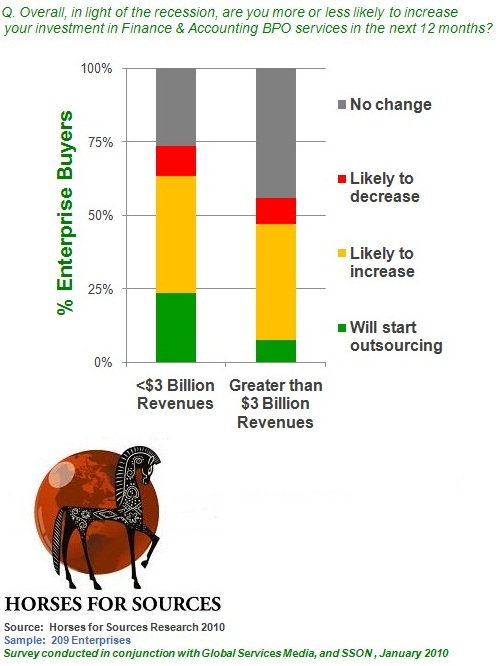
As we discussed in Part I of this series, many customers, especially in the mid-market ($750m-$3000m revs), now view outsourcing an a change agent to go beyond simply driving out cost. They want to exploit the opportunity to globalize processes and become more effective in the way they do things. And as the supplier based has matured and started to move into smaller-scale engagements, the impact on customer demand, emerging from the economic crisis, is eye-opening:
Figure 1: Mid-sized customers are ready to exploit Finance and Accounting BPO
So, what does this mean for the BPO industry?
No turning back for the large customers. Our study clearly signifies that many large-scale customers have now outsourced some elements of the F&A, with only 7% moving in for the first time in 2010 (see Figure 1). However, 40% of current F&A BPO customers are going to increase their engagement scope this year. This is a strong endorsement that once customers take the plunge, they are seeking to enhance their engagements. And when you drill deeper into the numbers, it’s clear that customers are seeking to add more capability to support management reporting and analytics.
Once you’re using a BPO to do our work for you, why hire new staff? Another reason why so many customers are looking to increase scope is the simple fact it’s easier, cheaper and more flexible to have your vendor provide the staff, as opposed to hiring it yourself. Moreover, the process many firms have to go through these days to have staff requisitions approved is often so prohibitive, that it’s a lot less hassle to contact your outsourcing PMO to ramp up a few FTEs on an engagement.
As the high-end saturates, attention turns to the mid-market. When you consider that close to a quarter of mid-market customers will seek their first forays into F&A BPO this year, you know where this industry is headed. Vendors have got much more organized with how they push more standard processes at the mid-tier, and they are becoming more adept at taking on smaller-scale employee transitions and still turning a healthy profit. While just a couple of years ago, most the top tier service providers would only look at engagements with a minimum of 50 FTEs involved, most will now dabble in must smaller affairs, especially where there is strong future upside to increase scope and cross-sell other services. Moreover, some customers are bundling F&A BPO with IT systems development work (see Part IV of this series), which allows for vendors to take on smaller-scale BPO engagements as part of a larger contract.
The Bottom-line: F&A BPO has opened up to the broader market, but the tough transitions for clients really start
With the industry-at-large widely looking at F&A BPO, it’s clear that the main difference today is customers being more prepared to change their existing processes to move onto a more standard delivery model. Those services vendors that adopt the old “lift and shift” mentality when taking on smaller engagement in this space will quickly fall-short – there simply isn’t the same wiggle-room in the mid-market to throw bodies at the problem.
The core to success with smaller-scale engagements stems from encouraging customers to standardize much of their workflows onto process maps vendors can understand, and have the vendor staff-up quickly to service them. The transition for clients will often be painful, but at least the realization is there that they have to do things differently and take more responsibility for their own outcomes.


 Thanks to all of you who participated in December's survey "Seeking The New Normal in Outsourcing Delivery".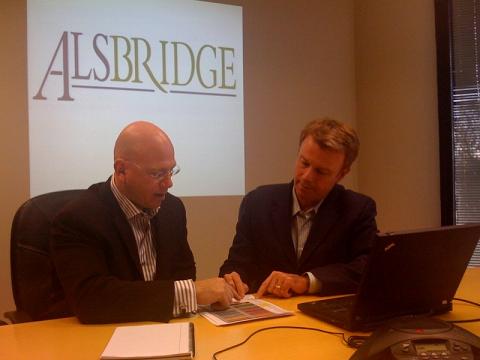

 Danny Cusick (pictured here) is the President of the Americas for
  So it’s time to drip-feed the intentions and experiences of 1055 buyers, intermediaries and vendors into the global sourcing industry.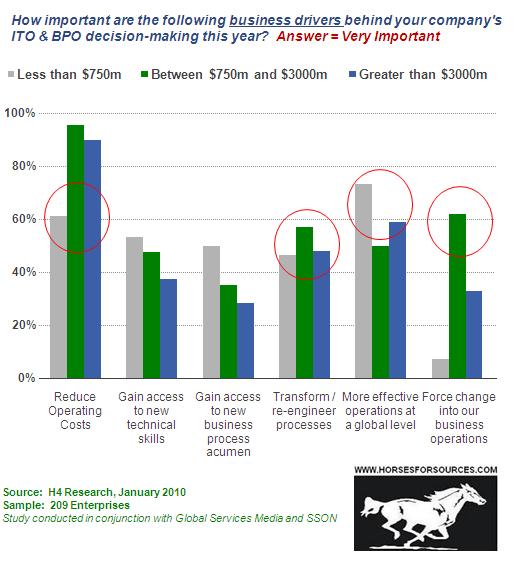


 This chart is revealing the dynamics of enterprises now looking to execute on plans to reduce costs and drive change into their business operations after hunkering down during the recession.
 For once I am stumped for a catchy title, and am opting for some good ol’ jargon-laden gruyère to tee-up Part IV in the series discussing our