The client problem, today, is fundamentally different. The clients are not saying, “I know this process and I know the organization, I know the technology, help me do it better faster cheaper”. They’re saying “I’m not sure what the process is. I’m not sure about the right organizational model. And I’m not sure about the right technical architecture. Help me through that process of discovery and ideation and innovation, and bring that to me”. So it’s really a different market we’re recognizing – not only do clients need to run better, but they need to run different.
— Malcolm Frank, Cognizant, August 2013
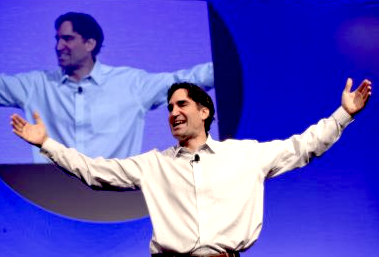
Malcolm Frank is EVP, Strategy and Marketing for Cognizant
This guy needs little introduction to the tech and business services industry. As I have often said of Cognizant’s strat head, Malcolm Frank, “This guy would make a phenomenal analyst”. However, am sure he makes a far bigger paycheck, helping steer the direction of the largest tech services growth story of the past decade: Cognizant.
We’re delighted Malcolm found some time to talk to us all about how he and his firm got to where they are – and what we can expect in the future. So without further ado…
Phil Fersht, CEO HfS Research: Good morning Malcolm. Thank you very much for taking the time out to talk with us and our readers today. Now you’ve been one of the key brains behind the impressive hyper-growth of Cognizant over the last few years. It would be great to get a bit of an understanding of your background and how fell into the tech services industry…
Malcolm Frank, EVP Strategy & Marketing, Cognizant: First of all thank for having us on this. I guess I’ve been at Cognizant now 8 years and it’s been a terrific run. When I joined the company we were about 12,000 associates, and now we’re about 160,000, so it’s been a terrific run over those 8 years and it’s been fun to be a part of it. I’ve been part of the industry for about 23-24 years now. And when you say ‘fell into it’, that’s exactly what I did. After college I used to trade commodities on Wall Street. But had a friend who was working for a startup IT services from Boston which was called Cambridge Technology Partners. I joined them at about 50 people and was fortunate enough to be part of that company. And we were about 6000 people and had a very successful IPO in the 90’s. And then I started two companies that evolved before joining Cognizant 8 years’ ago. So it’s been a fun.
Phil: Malcolm, can you talk to us a bit about the Cognizant experience going from one to six billion in the last three to four years? I mean how have you managed such an impressive period of growth. Is there any other secret sauce you can share with us now?
Malcolm: Yeah I don’t know if there’s necessarily a secret sauce. But for me it’s always about alignment – and it’s alignment outside in, and then inside out. And we care passionately about making sure that there’s only that true alignment. And what I mean is outside in recognizing what is the client need and what is the context of what clients are looking for, and then specifically what they are looking for, and ‘are we best tuned to deliver that’. And we are constantly paranoid, we’re constantly honest with ourselves. And we’re constantly challenging ourselves to say “Just because there was a formula that may have worked in 2007, it may not be the right formula for 2008 or 2009″. And so it’s a constant process of ensuring that we have that from the client view.
The same is true inside any company, to ensure that we can take all of our capabilities, and put them together in the right way to address that client need and to continually evolve as fast as the market is evolving. And one of the things that I was deeply impressed with, when I was getting to know Cognizant, you know some 10-12 years ago, when I was actually on the advisory board, is the culture of the firm – and a central piece of that is the sense of entrepreneurialism. And that is something that we’ve tried very hard to protect. And I think it still exists today, even though the firm is 160,000 employees. And the reason is so important, as you know Phil, that these markets are changing so quickly and we need to change with the market. So it’s one of those where that evolution is one that we just make sure is a fundamental capability of the firm.
And I know it’s tough. Sometimes that feels, in our industry, counterproductive. Meaning, you want to build a practice around certain problems that have methods and processes and people and so forth, that are really if you are hard-rooted to that problem. But you have to have a sense of malleability to change with the marketplace. And so, if there’s something that we’ve tried to really protect, I think that’s it. Because when you look at all of our competitors, we all see what’s going on in the marketplace. We all can sense and recognize the changes that are going on. But I think the firms that can respond to those appropriately, are the firms that are rewarded in the market place.
Phil: And you think having this more entrepreneurial culture in the business is what makes you quicker to respond and work with the clients, is that right?
Malcolm: I think that’s at the foundation of it, but it’s more than just culture and intent. You have to have a structure that allows you to do something about it. And I think, you know, several years ago we moved to what we call, in our vernacular a “Three Horizon Business Model Architecture”. So Horizon One will be a more traditional services portfolio. Horizon Two are newer services that are getting to scale. Then Horizon Three are true newco’s where we’re taking new approaches for new technologies in the market place. And it’s this architecture that helps us break through the innovators dilemma, since our industry is as hard as any other industry. And so it’s a) Having a culture, but then b) Having a business architecture, where we can navigate through this change.
Phil: And when you look back just five years ago where a lot of this hyper growth story started, what do you think is different today? And how has the company adapted to take advantage of that?
Malcolm: Yeah, I start with the clients. The client need is very different relative to what I see as the ‘big break’ around Bear Stearns time. And during this time we had these two hurricane force winds hit the clients. One is that they started going through structural business change. So banking, investment banking, healthcare, insurance, retail et al., all of these industries are going through significant structural business change. At the same time we have this technical shift around the SMAC stack. Consumer technology is really coming into the enterprise in a meaningful way. So the client problem changed. If you look at the offshore outsourcing business surface 2006, 2007. Remember this was the time of the ‘world is flat’ and all the rest, and it really was about taking an existing client capability and running a ‘better faster cheaper’ on a global platform.
The client problem, today, is fundamentally different. The clients are not saying, “I know this process and I know the organization, I know the technology, help me do it better faster cheaper”. They’re saying “I’m not sure what the process is. I’m not sure about the right organizational model. And I’m not sure about the right technical architecture. Help me through that process of discovery and ideation and innovation, and bring to that me”. So it’s really a different market we’re recognizing – not only do clients need to run better, but they need to run different.
Stay Tuned for Part 2, where we discuss the future role for the CIO, get deeper into the SMAC stack, and look out 10 years into the future…
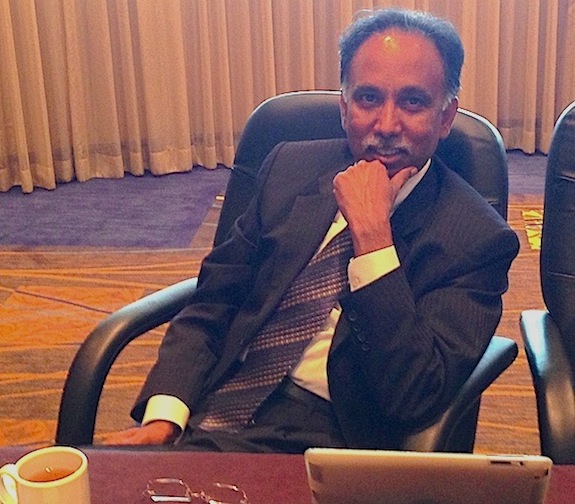
S D Sibalal a.k.a. 'Shibu', Co-Founder and CEO, Infosys
A lot has changed in the outsourcing world since seven engineers started Infosys with $250 in 1981. Or has it? We got a few minutes with S D Sibalal, Co-Founder and CEO of Infosys, who goes by ‘Shibu’, during Infosys’ recent analyst day in Boston, to find out what’s going on under the Infosys hood these days....
Phil Fersht, HfS Research: Shibu, in the next three years what do you see as the driving force behind this new look and spirit of Infosys we’re seeing?
S D Sibalal (‘Shibu’), Co-Founder and CEO, Infosys: I don’t think the fundamental platforms have changed. However, I would like to be more diversified in Mexico, China and other parts of the world. One of the key aspects of our vision is to be global. Today 94 percent of our workforce is in India. That needs to shift. We will become a more local player, especially in the non-English speaking markets like Germany and France. We will expand our business in Europe and the rest of the world.
Phil: The type of skills you need are quickly changing as you evolve the business. Now it’s not just the technology skills that were the classic underpinnings of the company. Today you need people who understand processes and marketing.
Shibu: Today everyone must be an expert. It’s all about business knowledge. We must have employees who are business process experts in specific areas like retailing or risk management. We are in the process of adding those kinds of people. Right now they comprise just 10 percent of our employees if you take out BPO. But that percentage is constantly increasing, especially in the non-English speaking markets. Eventually the balance will be 70/30, with just 70 percent of our people having a high tech background.
Phil: Does that mean you are going to enter the consulting space more aggressively?
Shibu: We are not trying to become a consulting company like Deloitte or McKinsey. Our model is our strength. We don’t want to become anybody. But from a capability standpoint consulting will enhance our offerings.
Phil: When you look at the next wave of innovation over the next five years, where do you think the business will go?
Shibu: When I began this career, I started in electronic data processing. Then we worked in the connected world. Now there is a huge shift in the industry toward prediction. We are going from data to information to intelligence. It’s all about creating intelligence and insights. I see that as a huge part of our job.
Phil: Is this kind of innovation a new opportunity for Infosys?
Shibu: This opens up a lot of opportunities. There is no doubt. There’s a lot of innovation there: statistic modeling, heuristic learning, speech recognition, and so on. They are all opportunities. However, we will need to develop a lot of new skills to do this.
Phil: And how about the “old” IT capabilities?
Shibu: I still believe we will be doing Cobol programming and mainframe work. Outsourcing is a continuum. We still have people working on mainframe while the evolution is happening at the same time.
Phil: How important is intellectual property in the long game?
Shibu: I believe it will be important to have patents and intellectual property. In the last four years we have filed 548 patents. That is the journey we are taking. An intellectual-property-based business will be big a part of our model in the next four years. And I think this journey to this new model will be accelerated. It took 15 years to get here but probably only four to get there.
Phil: Are you happy with your acquisition of Lodestone Holdings? The press release says you added 200 clients.
Shibu: Actually about 70 percent are new clients. Some of their clients were small clients which isn’t our market. More importantly, we got 1,000 people in continental Europe, local talent in Germany, France and Switzerland.
Phil: How is the integration going?
Shibu: An integration like this is very difficult to do. This delayed the integration process by a quarter, but now it’s all behind us. Clients are able to see the benefits.
Phil: Do you see other strategic IT acquisitions on the horizon?
Shibu: There is no need for acquisitions in IT operations. Historically we have grown organically in IT. We will only do partnerships. I think we will wait with systems integration and consulting. We have a strong model in the US and now we have a strong presence in Europe. I don’t see a reason to do anything else.
Phil: How do you keep the “stove pipes” from taking business away from each other when the primary go-to-market strategy is around the vertical industry? How do you maintain collaboration across the enterprise?
Shibu: In our model the industry verticals can’t take business away from each other because they are completely isolated. This problem doesn’t exist because we have no overlap. But the challenge is: how do you make sure the offerings are standardized across the different go-to-market segments? That is where analytics comes into the picture.
Phil: What about best practices across the industry verticals?
Shibu: This is a challenge because the verticals really have nothing in common. For example, retail has nothing to do with manufacturing. Creating a best practice across them is the challenge. It’s a little more challenging than I actually expected.
Phil: So….has Infosys got its mojo back?
Shibu: I don’t think we have lost anything in one or two quarters. Last year we had some challenges, both internal and external. And we still have some, to be honest. But now most of them are behind us. Things are going well. But I am still cautious. I want to see a couple of good quarters before I declare victory.
Phil: And finally, we’ve talked a lot about about ‘change’ today. What won’t change?
Shibu: Our value system. We base our company on honesty, transparency, no hierarchy and fairness. Those values are the guiding radiant. Whatever we work on, at the end of the day, the only things that are important are client centricity, execution excellence, leadership by example, a spirit of innovation and our value system. Our strength is that we are a learning organization.
Phil: And that’s why the smart people aren’t writing off Infosys 🙂 Thanks for your time talking to our readers, Shibu.
When vendors, particularly hardware and software vendors, were running around and talking about ‘Cloud this and Cloud that’, and ‘Big Data this and Big Data that’, we felt they were missing the point, because they weren’t driving conversion. Whereas the SMAC Stack, when it is integrated, does start to drive business solutions.
– Malcolm Frank, Cognizant, August 2013
Now to the real meat of our discussion with Cognizant’s strategy lead, Malcolm Frank, where we discuss the future of the CIO’s role and the IT function, the SMAC Stack and those Things of Internet, or is it the Internet of Things…
Malcolm Frank is EVP, Strategy and Marketing for Cognizant
Phil Fersht, CEO HfS Research: Malcolm, we’re hearing a lot about CIO turnover – in the last year, in particular. I think many companies emerge from recession and the needs and demands on the CIO clearly shift. What do you see as the attributes that make a successful CIO today?
Malcolm Frank, EVP Strategy & Marketing, Cognizant: Yeah, it is really two primary items. The first is what I just described that, if you look at the prior market through a CIO lens, there were these austerity programs between the Internet bubble to Bear Stearns – that eight year window. Make sure you have the IT backbone secure, rock solid stable and cheap. I mean you look at what’s occurring today and we’re getting to a world where a CIO is being asked through the SMAC Stack to fundamentally innovate, not just provide the backbone of the company, but to innovate into the product itself or the service itself of the company. So you see this in many different realms. It could be in automotive where all the auto manufacturers are saying if “We want to transform what the car really is. Our consumers are saying a $300 iPhone is so smart but my $30,000 car is so dumb”. So the CEOs turn around to the CIO and say, “You are the technology person. We presume you should do that.” And IT turns around and says, “We don’t have that skill yet”. And so that gap needs to be closed. And I think in closing that gap, you’re seeing new demands on the CIO office and in many cases it is driving CIO turnover.
Phil: And one of the things which you guys coined at Cognizant, is this term the ‘SMAC Stack’, the Social Mobile Analytics and Cloud platform. But what do you really mean by that when you talk to a CIO or even a COO / CFO today? How should you think about those four elements as you evolve your technology strategy?
Malcolm: We’re trying to convey a few important issues when we talk SMAC Stack. The first is it is integrated. So that’s the stack portion of it. And there is a multiplier effect when you can have a mobile solution in the cloud that’s driving tons of customer analytics. And so it’s important for clients to conceptualize these as an integrated stack. When vendors, particularly hardware and software vendors, were running around and talking about ‘Cloud this and Cloud that’, and ‘Big Data this and Big Data that’, we felt they were missing the point, because they weren’t driving conversion. Whereas the SMAC Stack, when it is integrated, does start to drive business solutions.
A second important point is that enterprise IT has gone through multiple phases. And each phase is cumulative – they build upon one another. For example we had mainframes leading to minicomputers, then to client/server leading to the Internet. We think that the SMAC Stack represents that fifth wave but it needs to be integrated and sitting on top of the prior waves. So we’re not going to see legacy environments go away. The issue is how do you take the SMAC Stack to then tap into your ERP backbone or your CRM infrastructure to leverage those in ways that you haven’t before. So that’s we were pushing into the market place and it has resonated reasonably well.
Phil: So when you look at enterprises 10 years down the road, Malcolm, trying to look out a long way out here, what do you think they are going to look like?
Malcolm: It’s a great question, Phil. 10 years is a long, long way particularly these days! But I’ll give a try. A couple of things, Phil, that we do know, if you look at technology. I think the Internet of Things is a very big deal, and we have underestimated that to date. In some pockets, I think people really do get it, but the overall market has to yet to fully digest what that means when we have, today, about 10 billion computers that are IT addressable and online. And ten years from now that’s going to go up by an order of magnitude. In order to make this massive shift where today, most data that’s created is created by human beings. But we are going to cross the line where most data which is generated is by machines. So it can be machine-to-machine communication or machine-to-human communication, and vice versa.
So that shift is going to,I think, redefine what is the role of IT and also redefine what is the value of a product. And we’re already starting to see instances of this. For example, look at General Electric. And their whole marketing, now, is around brilliant machines, where they are saying ‘it’s not the value of a jet engine per se, but it’s that halo of information that’s around it from this smart machine’. And with their locomotives and generators and the rest. You’re seeing it with Nike and FuelBand, or from Disney in creating their Magic Band. And so I think we’re making the shift where our customers, Fortune 500 firms, are recognizing if they can actually generate more value or economic value from the information around people and products as opposed to the actual asset themselves.
And some of the eBusinesses think that way already. Google, Netflix, Apple, Pandora, they already think that way. But I think we’re going to have a sea change where a lot of traditional sectors start to conceptualize their businesses that way and want IT to support it that way. And I think that’s where we’re going, when you look at a lot of these trends.
Phil: You’ve had a very successful career in the technology industry, Malcolm, but if you could go back 20 years and start it all over again, is there anything you do differently?
Malcolm: It’s one of those things one does in life, if you look at the mistakes you’ve made and obsess over them and think “Wow, how could I have avoided those mistakes?” But the more time that goes by I am actually feeling fortunate of having made those mistakes, because it opens your eyes to how you avoid them in the future. And I think some of the contributions I’ve made in the Cognizant context is the direct result of recognizing what goes wrong when you don’t pay attention to some of these issues. So, I think from that view, Phil, of course, you look back at some product innovations, such as Youtube today or Facebook today and think, “Why didn’t I come up with that?”. But one has to be realistic. So the short answer is ‘No’. It’s been a great journey. I think all of us in this business have to remember just how quickly the market moves and you really have to pay attention to that. And if you don’t then companies can get punished and it’s a great lesson. So it’s always an exhilarating ride in our business. It means you’re going to have some really exciting highs but it also means you’re going to have lows that come with it. I think it’s nature of the beast.
So given that context, I don’t think there’s not much that I would have changed.
Phil: Well, thank you very much for spending some time with us today. We look forward to sharing this discussion with all our readers, Malcolm.
Malcolm: Okay, great, appreciate it and would welcome any ideas or questions from them.
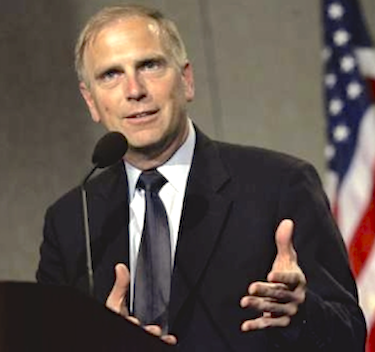
Malcolm Frank (pictured) is EVP, Strategy and Marketing for Cognizant. You can read his full bio by clicking here.
“Massolution”, the first-ever crowdsourcing & crowdfunding conference, focused on the Fortune 1000 enterprise, is just about a month out, and we jumped at the opportunity to get some discounted tickets to HfS subscribers. We’ve also been talking to crowdsourcing kingpin and Massolution CEO, Carl Esposti (and founder of the Crowdsourcing.org community platform) about the approaching conference, which we will publish shortly.
Join senior executives from Fortune 1000 enterprises, government agencies, and leading crowdsourcing platforms to learn how crowdsourcing and crowdfunding are changing the ways companies compete and reduce costs. Also learn how today’s innovative outsourcers are looking to embrace crowdsourcing models to break away form the flagging FTE approach to business services. Doors open on September 18th in midtown Manhattan.
Enter the promo code HFS when you register to save an additional 10% by clicking here.
For those of you who think they’ve escaped being outed as a public irritant, it’s time we put you back in your place… Here are the latest irritations plaguing our world today:
People who buy iPads and never use them.
People who not only bought an iPad, but ensured they bought the 64 gigabyte, retina display model for about $850… just to check their gmail occasionally and read people magazine.
People who spend inordinate amounts of time scheduling a 30 minute conference call… then reschedule at the last minute.
People who spend inordinate amounts of time scheduling a 30 minute conference call… then don’t show up for it.
Germany shutting down for the entire month of August.
People who insist on using their webcam on skype… at 8.00 AM.
People who send out emails when they are clearly three sheets to the wind.
People who use Foursquare to announce they just checked in at JFK… on Facebook…
People who constantly complain they are always just soooo busy.
People who get paid wads of money and seemingly don’t do anything.
American news channels.
People who get paid scandalously low wages and seemingly do everything.
France shutting down for the entire month of August.
People who get paid well, but constantly complain they are underpaid.
People who are really well organized and get boatloads of work done between 9 and 5, and never work evenings or weekends…
People who are just really, really lazy and complain how tough they have it.
People who just lie, lie, lie and lie until they believe it themselves (ugh!).
People who just talk, talk, talk, talk…. and never listen.
British public holidays.
People who clearly spend 95% of their productive time stalking people on Facebook.
And back to the exploits of “Dr Charlie”, alias the Last King of Sourcing, Charlie Aird, who completes his diaries from his recent sabbatical to East Africa, where he got some time to visit Uganda. Over to you Charlie…
Country Spotlight: Uganda
Uganda attained independence from British colonial rule in 1962, and after a decade of stability, had political and economic challenges from the 1970s through the mid 1980s. In the late 1980s, Uganda was one of the first Sub-Saharan African countries to liberalize their economy and initiate pro-market policies and has a stable macroeconomic environment today. GDP growth has averaged over 7% per year during the 2000s, and is above the Sub-Saharan Africa average.
Uganda has an agrarian economy, and is still working on providing basic needs to its population, for example, a 2009/2010 national survey showed that only 12% of households used electricity for lighting. Development differs widely across different regions of the country. Education development results have been mixed, for example, reading and mathematics are lower in Uganda than in Kenya or Tanzania, but gender equality is near parity in net primary or secondary enrollment rates.
The Ugandan government identified Information Technology Enabled Services – Business Process Outsourcing as one of the key sectors to enhance economic growth and reduce youth unemployment in the country. They have established a BPO incubator named the National Information Technology Authority – Uganda (NITA-U) which focuses on delivery of public BPO services. NITA-U is expected to:
Co-ordinate, supervize and monitor the utilization of IT in the public and private sectors
Identify and advise Government on all matters of IT development, utilization and deployment
Set, monitor, and regulate standards for IT planning, acquisition, implementation, delivery, support, organization, sustenance, disposal, risks management, data protection, security and contingency planning
Regulate and enforce standards for IT hardware and software equipment procurement in all Government ministries, departments and agencies
Provide first-level technical support and advice for critical Government IT Systems
NITA-U has worked with Makerere University to train 500 youths in MPO skills, and plans are underway to train 3,000 in the next year to ensure a critical mass of BPO trained skills in Uganda. To ensure this volume of specially educated youths continues, NITA-U is working with the Ministry of Education, Universities and other institutions to incorporate BPO training in their curriculums.
To develop the shared services skills in the country, NITA-U has created a 250 seat BPO call center in Kampala and is in process of facilitating setting up more, including Lake Victoria Information Communication Technology & Bio Tech Park.
MNCs who are interested in developing their presence in East Africa and are willing to invest in the area can find employees with BPO training and high level English skills. Unemployment is still a problem even among the educated youths in Kampala, and there are many opportunities to fill positions by educated workers with excellent English skills
At this time, Uganda is not attractive for investment from global outsourcers, due to the lack of tax incentives and limited infrastructure. The government is aware of the current state gap, and to create an enabling environment for the BPO sector in Uganda, NITA-U is currently undertaking the following:
Developing guidelines for the provision of Government incentives to BPO operators
Developing the required BPO standards and accreditations
Finalized the national BPO strategy and roadmap for Uganda
Developing IT infrastructure to support BPO operations in Uganda, by:
Commercializing the NBI (National Backbone Infrastructure) to deliver subsidized internet bandwidth
Developing and connecting alternative link via Mutukula to NBI to avoid single link via Kenya
Developing the last mile connections of NBI to districts
As the NITA-U makes progress in their goals, Uganda may become a great opportunity for investment. This opportunity may be a few years out
Critical success factors for continued growth in East Africa
When India or Costa Rica decided to try to attract foreign direct investment in the BPO industry, the governments offered incentives to outsourcers to invest in their countries, for example, an eight year tax holiday where profits were not taxed, removed duties on anything imported to the country and excise taxes on energy and telecommunications, and only required a minimum level of investment to receive these benefits. When Costa Rica set up a tax free zone, companies like P&G and Chiquita invested heavily in shared services delivery centers.
For Uganda to kick-start the growth in shared services and outsourcing, the government needs to set tax incentives that are similar to those set up for manufacturing and agro-processing industries, and include specific incentives for BPO, including the creation of Free Trade Zones and subsidies for operational costs and staff training. These incentives will attract the large outsourcers, whose investment will also encourage shared services centers. In addition, Uganda needs to invest heavily in education and training. A model to consider is India’s NIIT, a for-profit organization that has trained people for the past 20 years in computing in urban and very rural locations. NIIT helped establish a base of trained workers, from which India’s outsourcing industry grew.
For Kenya to continue their growth, they need to continue to invest in training and infrastructure to help current operations attract higher level processes and achieve higher level of profitability. Public schools require significant investment to be a springboard for a career in BPO. Costa Rica’s commitment to high quality, free public education has provided them with a base of very educated youth from which to build their shared services and outsourcing success. Costa Rica devotes at least 6% of its GDP on education and training, and targets 8.5% in future years. Greater investment by entrepreneurs or the Kenyan government on education and training could reap significant rewards in providing a pool of skilled workers. The government must to continue to support the outsourcers who have established a foothold in the industry and consider developing more robust incentives to attract larger outsourcing service providers and MNCs.
With increased government incentives for MNCs and education and training for the local population, the shared services and outsourcing industry could be a great opportunity for East Africa and for MNC investment in the near future.
This article is authored by Dr. Charles L. Aird, and assisted by Meagan O’Brien.
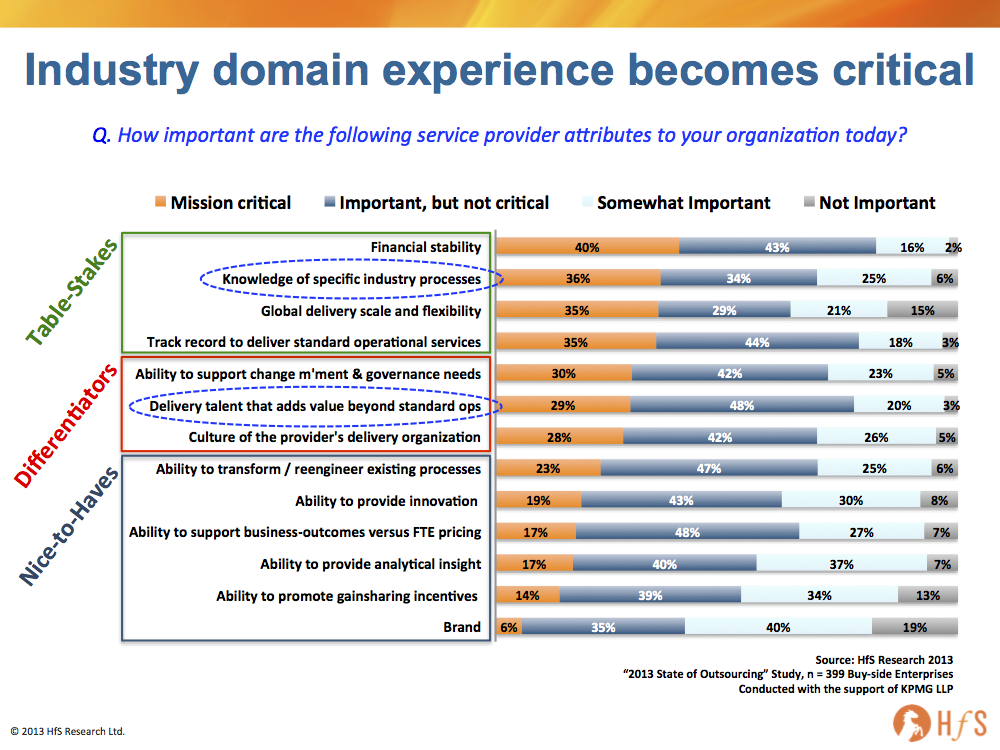
Well, we have some shocking news for you all… these things are only making the “nice to haves” category when it comes to provider selection, as buyers look at more immediate, tangible benefits from providers.
Our seminal State of Outsourcing Study, conducted with the support of KPMG, where we delved into the views and dynamics of 399 enterprises, has revealed that today’s wizening outsourcing buyer is looking at industry experience and the provision of talent that can do more than just the basics, when it comes to choosing between their providers:
Click to Enlarge
The answer’s simple – most providers are tooled up to deliver what was contracted, not what the client really needs. Most large outsourcing deals today were (and many still are) initially negotiated and brokered by different teams, on both the provider and buyer sides, than the teams which ended up running the engagements. Too many enterprise outsourcing relationships, today, were (and many still are) brokered to solve yesterday’s challenges – namely, driving out labor costs, mitigating risks, and achieving a basic level of operational performance.
These are now “table-stakes” – or should be – for any serious enterprise buyer or provider. However, if your talent pool was hired and developed only to perform against those objectives, and you contracted with a provider to deliver precisely what was agreed five years’ ago, then how, exactly, do you expect to rise to an improved level of performance? Until enterprise buyers make these attributes critical during negotiation and selection, providers will continue to push their table-stakes capabilities, and throw in all the “nice to haves” as marketing frosting – because they know they can never likely to be held accountable to them. How many times have you heard the cry “we were promised innovation, better analytics and all these wonderful new capabilities, but haven’t seen anything“? Well, that’s because they didn’t actually buy those things…
Then why are we so obsessed with the act of sourcing, as opposed to the management and success of a long term relationship?
The problem we have – as an industry – is that we’re obsessed by the act of sourcing, as opposed to the practice of managing it effectively over the long haul. However, as the data insinuates, as buyers become more experienced, and governance executives get more involved in future decisions, the approach from many providers has to change. We’re already seeing this with several contracts coming up for renewal, where the buyers are inviting others to the party, seriously looking to see if they can get more value from another provider (and many forlornly wishing it wasn’t so damned hard to kick out their incumbent).
Their problem has, simply, been that they opted to go with a provider to achieve the basic table stakes, and they now feel that said provider cannot deliver anything much beyond the current performance, due the constraints of their current contract – and, in several cases, because their provider simply does not have the acumen or talent availability to help them attain improved new levels of performance.
Until governance executives, with real working experience of outsourcing in their organization, get involved in the brokering of contracts and provider selection discussions, we’re going to be plagued with many outsourcing engagements where the provider is never really delivering much value beyond cost.
Most enterprises are looking for help getting from “mediocre” to “better-than-average” – they’re not yet ready for “world-class”
The other issue we are dealing with here, is that providers are obsessed with positioning themselves as having solutions that are, simply, far beyond the immediate realities of their clients – many are simply looking for better mileage form their Chevy before considering a Cadillac. Achieving incredible “business outcomes” is a journey both a provider and buyer can work on over the years of getting to know each other. It is not something that can be bought and sold on day one. Moreover, the same can be said for reaping great value from analytics, or developing a realistic innovation roadmap – these are delights that take years to achieve – and competent providers will provide the right teams to create the environments in which their clients can progress along their journeys.
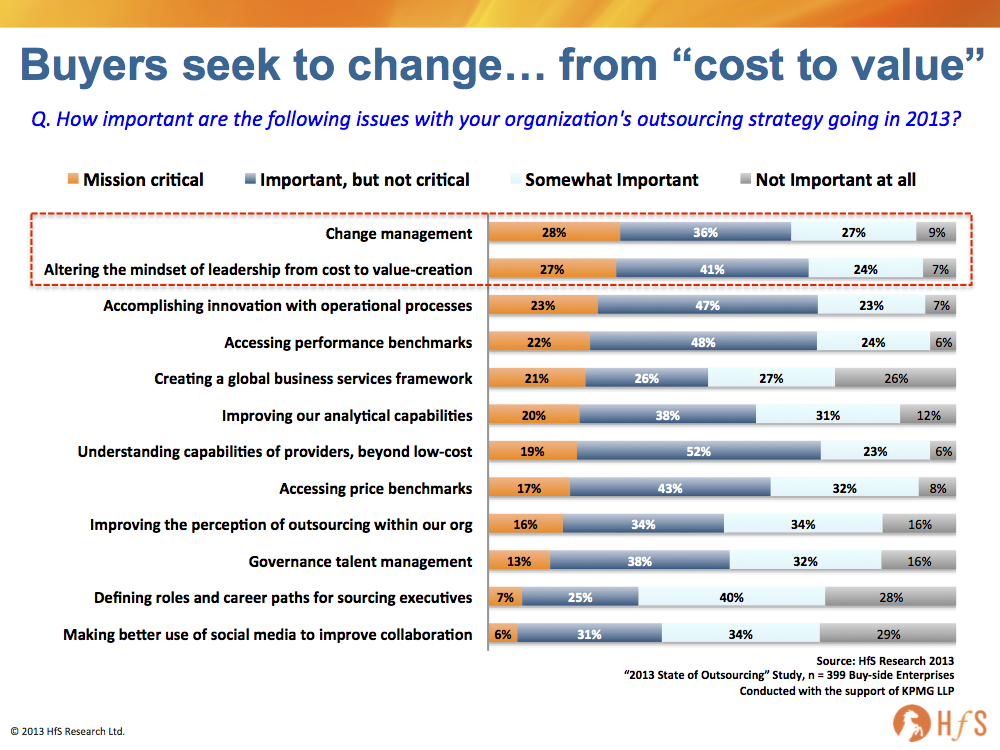
It’s clear, when you examine the key topics on the minds of enterprise executives, that it’s baby steps for most of them, as they look for more value from outsourcing:
Click to Enlarge
Two items dominate: how to change, and how to move leadership away from the legacy “cost reduction” mindset. It’s clear that enterprises need to tackle these two areas before they can really get stuck into the longer term benefits that can be achieved.
The Bottom-line: Providers are being judged by clients expecting more… and many need to up their game
You don’t need to spend hours cutting up survey data to fully realize what is happening in outsourcing today – you just need to talk to a few clients to get the fuller picture: essentially, many are trying to fight their way out of the corners in which they unwittingly found themselves, where they were signed up to receive low-cost, adequate operations.. and expected to be “content” with that. At the same time, it’s nigh-on impossible to attain better performance and efficiencies from your operations if you have the provider’s C-team delivering your processes from some far-flung location.
And there lies the Catch-22; Your firm bought “cheap and adequate” and if you can’t turn around in 3 years and show where that next 10-20% of productivity is coming from, your job may well be next on the line. There’s a scary attrition rate of buyers who got pushed out of their firms after a couple of years of grappling with the mediocrity, where settling for the status quo clearly wasn’t an option.
The only solution is for the majority of enterprises to change their whole approach to selecting – and working with – providers, and most of them are only now in the process of asking some very tough questions… and trying to figure out how to change their whole approach to managing engagements.
Click here to view our full array of blogs that discuss our “State of Outsourcing” study findings, conducted in partnership with KPMG LLP
Rich Lechner is tasked with defining IBM's sourcing strategy (click to access his new research paper)
When you have over $100 billion in software, services and systems revenues and 440,000 staff worldwide, what can be simpler than running sourcing engagements for clients? Meet the man tasked with formulating a sourcing strategy for the firm: Rich Lechner, another one of these tech guys who should probably have become an industry analyst after 10 years of writing code, but somehow found himself piecing together the many facets of the world largest computing company to help devise this roadmap. We were fortunate enough to drag Rich away from his electric powered Tesla to spend a few minutes sharing his experiences with us from over three decades with Big Blue…
Phil Fersht, CEO HfS Research: Rich, great to have you talk to our readers today. You’ve been in IBM for over 30 years – did you ever expect to stay at one company for so long.. and how have you winded up doing what you’re doing today?
Rich Lechner, Vice Business & IT Services Marketing, IBM: First of all thanks for having me. It’s hard to believe it’s been that long. I will say that I feel like I’ve worked in many different parts of the industry but had the luxury of working for one great company. In the sense that I started out as a microprogrammer working on ATM’s and check processing machines and then went into a range of software development, strategy and sales roles for mainframes, OS/2, distributed systems management, Linux and eBusiness. I then moved to the hardware part of our business where I had the privilege of leading sales and marketing for mainframes for several years globally as well as working in our storage business. I then had responsibility for IBM’s broad portfolio of sustainability capabilities including green datacenters, water management, supply chain optimization, smarter traffic or smart buildings. And then finally coming to services. The common theme has been leveraging technology and innovation to address real world challenges and bringing differentiated value to clients.
Phil: In your recent research study “Why Partnering Strategies Matter” (HfS readers can download their copy here), where you surveyed 1350 participants, you talk about sourcing motivations and how they’ve shifted and why sourcing strategies need to shift with them. Can you expand on this some more?
Rich: As a leader in business and IT services, IBM works with many clients around the world and increasingly we were encountering customers who were looking not just to shed cost or to outsource some component of their environment, whether it be infrastructure, process or application, but rather increasingly they were also looking to acquire capabilities to address some need that they have. In many cases these needs were driven by the desire to harness important forces like social, mobile or big data in order to fuel growth and drive market expansion. And so in seeing that in our own engagements, we commissioned an extensive piece of research with a third party to assess partner strategies. The survey involved clients who had experience in outsourcing some element of their environment and there was broad participation across geographies, industries, and customer size. What we found was that clients were, in fact, increasingly looking to acquire capabilities that mattered most and not just to outsource a non-critical piece of their business for cost or efficiency benefits. And that those organizations who were being successful at doing that were seeing significant financial benefits of their business. They were also behaving significantly different in terms of the objectives they were setting for the partnership, the capabilities they were looking for in their partners, and the way they were executing the relationships.
Phil: You talk a lot about optimizers and innovators as contrasting partnering strategies. What do you mean by these terminologies and why are they different?
Rich: The study focused on clients who had experience outsourcing some element of their environment – in fact they could identify over 80 discrete elements of their infrastructure or set of applications and processes. One dimension of measured how broadly they’re outsourcing or leveraging partners. The second dimension was what was their primary motivation: was it primarily for cost take out and operational efficiency? Those who cited that as their primary reason we characterized it as “optimizers”. “Innovators” were those clients who said that their primary objective in developing a sourcing partnership was to achieve a business outcome; to gain access to innovation; for assistance in harnessing some new technology like social or mobile; were looking to expand globally; , or who were looking for a partner could infuse a culture of innovation into their organization. It is important to note that across all segments cost takeout and efficiency were important. But the relative priority varied between the innovators and optimizers and what the innovators did with the cost savings was significantly different in that they chose to not just throw those savings to the bottom line, but they were consciously leveraging efficiency to fund innovation in growth in other parts of infrastructure.
Perhaps most interesting was that the research showed that those clients who were broadly partnering for innovation had substantially better financial performance relative to those who were partnering in a very narrow fashion with a primary focus on cost optimization. The ‘ienterprise innovators’ saw 2x the revenue growth and 5x the profit growth compared to the ‘focused optimizers’
Phil: Rich, in terms of enterprises achieving measurable business outcomes from sourcing, I was reading about how metrics have been tied more effectively to outcomes in your paper. Did you learn more about how sourcing can improve a company’s access to critical data that they didn’t have before?
Rich: Phil, we found markedly different behaviors between the optimizers and the innovators. The innovators were looking for business outcomes beyond operational efficiency and they were far more likely to to define metrics that were directly tied to business outcomes. So for a retailer it might be the revenue per store or inventory turns. It might be subscriber retention rate for a telco or bed utilization for a hospital. So, the metrics for the partnership were very outcome based and by doing that, these innovators were also finding that to achieve those kinds of outcomes, they had to look more holistically. They needed data, or operational data, and they had to be able to link the financial drivers to the specific key process indicators and metrics, business metrics, and then needed to be able to aligning the relevant elements of their business and IT environments, the infrastructure components, the applications, the processes across those businesses that affected those outcomes. And then to develop a partnering strategy that allowed them to affect those in an integrated way.
Phil: You also talk a lot about integrated governance. I would love to hear a bit more about your thoughts here – we’re obviously looking a lot at evolving global business services frameworks at HfS. Do you think there is something unique evolving here, or is this more lipstick on the same old pig?
Rich: I think there is significant evolution with the governance model required to meet the expectations of the innovators. If you think about traditional focus on operational governance, you’re really focused on service quality and continuous improvement. Of course that’s foundational and will always matter. As does the tactical and functional governance focused on some of the business relationship and fulfillment against contracting services. But – as you begin to move into the space of business outcomes and partnerships premised upon outcomes then there is an additional need for strategic government that’s really focused on the alignment of the business strategy in the transformation of a client’s business. This to me is incremental to the governance model that most clients are putting into place as they form a relationship with their partners or their outsourcing vendors.
Phil: Rich, not many people have been as close to the technology and service model shifts as you have really over three decades. What’s really different today? I mean, are we seeing similar inflection points than the ones we saw in the 80’s and the 90’s… or do you think things have really moved on in the last few years?
Linking inputs, execution, cost of ownership and outcomes… Rich Lechner's automotive strategy
Rich: I think, in some regards, we’re seeing many of the same trends continue, but the emergence of several key forces: big data, the instrumentation of everything, the ability to analyze in real time all aspects of your interaction with your clients or of some of your business. The expectations of end consumers, based on the emergence of things like social and mobile. And Cloud as not only an important technology, but acting as an accelerator to the adoption of services. If you think back to client server computing two decades ago, it changed the way that IT capabilities were acquired by organizations. Prior to the emergence of client server, computing capability was sort of the exclusive domain of the IT organization, but now departments were able to acquire servers and storage and pc’s to perform critical business functions independently and it fundamentally changed the way that IT was acquired and applied inside business. Cloud is having the same sort of transformative affect. Because it’s allowing any individual or organization to acquire capability as a service, whether it be a process, an application or a bit of infrastructure as a service. Those forces coming together are creating this opportunity for significant transformation, but increasingly clients realize that they don’t have all the capabilities they need to address these issues or the opportunities that these forces present. And so what’s really changed is the acceleration of some of these traditional trends with these new forces.
Phil: Ok, so try and look out ten years from now… What do you think the world of sourcing is going to look like when we peer that far into the future based on everything you have lived through over the last few years?
Rich: I noticed that said “sourcing” which is great, because I think the idea of taking the “out” out of outsourcing will occur very rapidly and in fact it is already occurring. What I mean by that is that it will become much more prevalent for companies looking to acquire or source a key capability that they lack as opposed to shedding something that is noncore. And we are seeing that occur already and that will happen very rapidly. Secondly, I would say I think if you look ten years out, increasingly today we talk about infrastructure as a service or software as a service I think that you will see everything as a service. The idea of any capability, whether it be marketing insights or compute capacity or real time analytics of consumer behavior or what have you as a service will be the norm. Everything as a service will be what people will be sourcing. Again whether it be infrastructure, or application or processes, or industry insights, or marketplace insights, or technology.
Phil: Rich, it’s has been very refreshing to hear from somebody like you who has been so close to the industry for so long, so I do thank you for your time, and I look forward to sharing your thoughts very much with our readers.
Rich: Thank You, Phil – a pleasure to share some thoughts and I hope your readers find the time to reads our new research paper.
Rich Lechner (picture above) is Vice President for IBM’s Business and IT Services Sourcing.
With the intense proliferation of customer communications channels, there’s a huge strain on CMOs, like never before, to keep up and stay ahead of the competition.
Management of an omni-channel environment that is effective across all customer touch-points is a brutal, but necessary, reality for competitive success in today’s business world. Leveraging service providers which can deliver the customer-centric marketing savvy, the business processes, global scale and technology capabilities to support these secular changes to the customer environment is critical to the success of so many organization’s today.
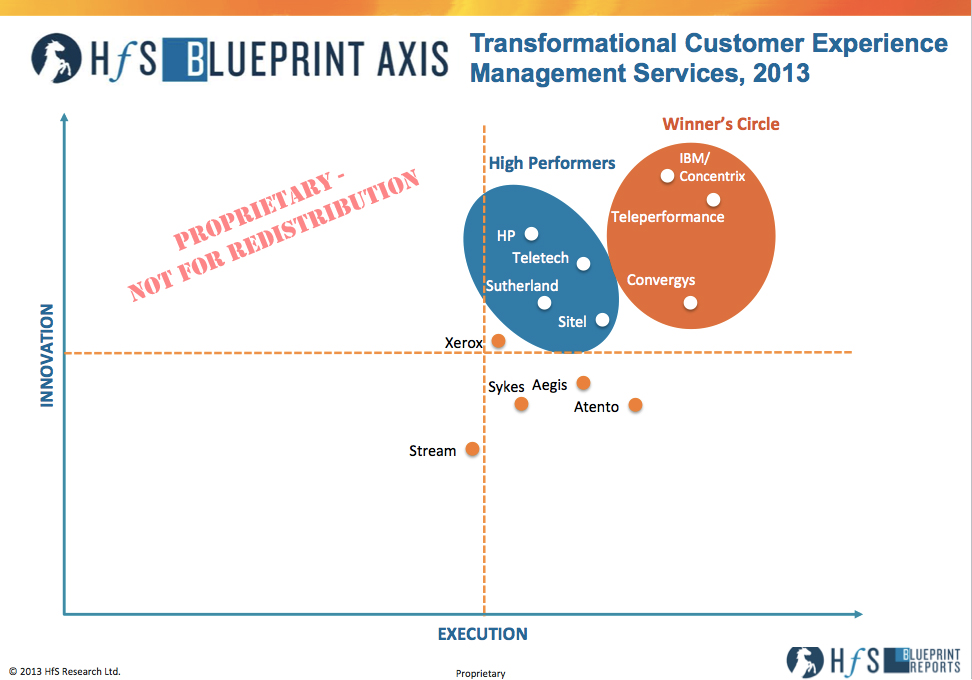
We are proud to reveal our first Blueprint report that has gone deep into the innovation and execution capabilities of today’s leading service providers in the customer experience management industry – and many congratulations to Teleperformance, IBM/Concentrix and Convergys for making the inaugural Winner’s Circle:
Here are the top 3 factors necessary to create a valuable customer experience in the future:
*Capabilities to Monitor, Understand and Proactively Serve the Expectations of Customers are the Crucial Ingredients. The elements that touch the customer are increasingly originating from the digital realm. Organizations will need to adapt to this change and develop competencies to understand the expectations of customers and align each touch point with brand expectations. This is critical now, and becoming even more so in the future.
*Understanding the Customer is becoming More Complex, but Creates Competitive Opportunities for Ambitious CMOs. Although more channels need to be developed (social and mobile) if an organization utilizes monitoring technology and builds models around the flow of customer data, more complete pictures of the customer will become available that were not previously available. This can enable organizations to align marketing activities better to customers through more specific segmentation, as well as to understand, and proactively address, customer sentiment and customer trends.
*Customer Experience Alignment Across All Customer Channels is Imperative for many Brands. Aligning expectations to an organization’s brand image across all channels is a make or break proposition. For example, many organizations are fighting to align traditional brick-and-mortar stores with online and mobile experiences. There are increasingly more channels to contend with, including SMS usage in emerging economies such as Africa.
Getting customer experience management right will matter to all organizations, especially larger organizations that have sizable product portfolios across multiple geographies. Organizations will need to monitor, understand, and align their brand to the right customers, at the right time. The three service providers that we found best placed currently to service organizations with customer experience management services are Teleperformance, IBM (whose call center assets have been recently acquired by the Concentrix division of Synnex), and Convergys.
The CEM Blueprint utilizes our Blueprint Methodology (click here to read in detail), which measures both execution and innovation against a set of crowdsourced criteria derived from the State of the Outsourcing Survey 2013. We assessed data from over 130 live multi-process CEM BPO engagements to ascertain provider market shares, depth of client base, breath of execution and geographic scope of delivery. We examined the CEM value chain (consulting, product design, marketing and sales, and service and support) and interlaced what we know will be important to CEM buyers in the radically evolving CEM sector with the capabilities and vision of the service providers in our assessment.
Report Author, Adam Luciano, Principal Analyst, HfS Research (Click for bio)
Our analyst team conducted exhaustive interviews with multiple buyers and market advisors to help score providers against each other across all the sub-categories of the Blueprint using ExpertChoice, an advanced statistical analytics platform. We also received a tremendous amount of cooperation from (almost) all of the providers above, as we went through this exhaustive process to understand their concrete plans for the future, get really deep with their current client relationships, their overall vision and their appetite to evolve and invest into higher-value areas of CEM BPO.