Trying to analyze why one Indian service provider had a better quarter vis-à-vis another is becoming pretty moot.
Yes, there are various nuances clearly helping or hindering some of the W-I-T-C-H firms with certain deals, such as TCS’ flexibility to win selective large complex deals, Cognizant’s savvy US leadership team, HCL’s price aggressiveness to pillage legacy EDS contracts, and the fact that Wipro and Infosys somehow “lost their mojoes” in the kerfuffle. However, the bottom-line is clear: The Indian services business is hurtling toward commodotization, and there needs to be a much more radical play from their ambitious leaders to alter the game.
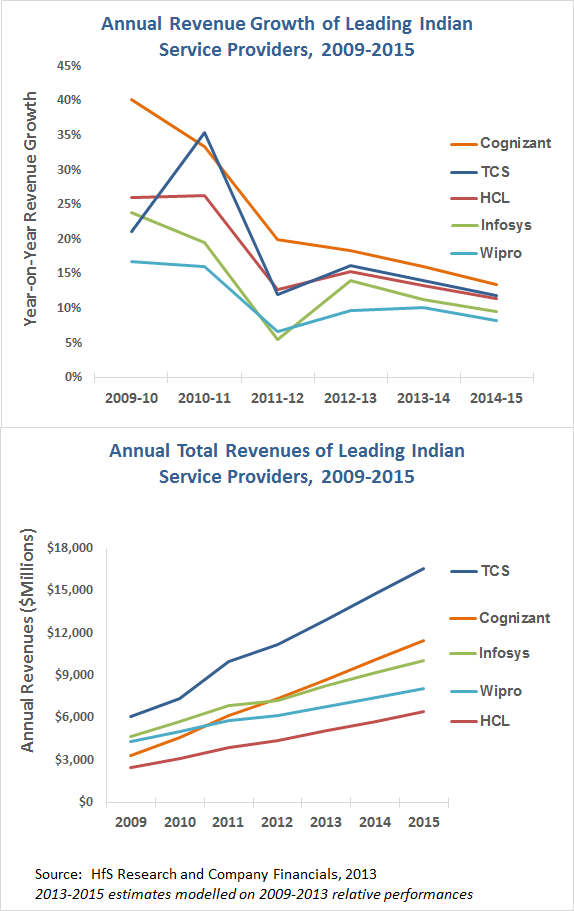
In order to highlight this dynamic, we took quarterly revenue and growth performances over the last 4 years and created a predictive revenue forecast for each of the W-I-T-C-H providers, based on the past four-year historical variances:
What this data tells us, is that the growth trajectory is now declining at such a clip that none of these providers may make the HfS IT Services Top Ten if they continue with their current growth strategies.
Why the WITCH providers can either fight for the old dollars, or revamp for the new
Essentially, what these five great firms have achieved is to create huge factories of (predominantly) young talent that can service operational technology and business process work that can be standardized, externalized and run from their Indian centers. The simple fact that their margins have remained largely unaffected, despite increasing price pressures, is two-fold:
A weak Rupee which has kept the Indian firms hyper-competitive throughout the Recession years;
Industry-leading innovations in training and developing hundreds of thousands of employees from the Indian colleges.
Only Accenture and IBM, and more recently Capgemini, have really been able to compete aggressively for the operational work, because they invested heavily in developing their own Indian (and other global) delivery centers in recent years in order to catch-up.
However, as this data plainly dictates, we’re now on a fast-track to lower growth that will likely be dipping below the 10% mark by the end of next year, for some of these firms. So… this leaves two stark choices for the WITCH firms:
1) Accept the industry is commodotizing and be prepared for slower growth and reducing margins.Hell, we’ll still be massively wealthy and our owners and long-term executives are so rich, who cares?
2) Aggressively acquire the capabilities to find new sources of growth.Relying on the same tried and trusted formula of hiring kids, keeping prices low and selling ever-harder is clearly going to see us sink into the middle-of the-pack – we have to make radical changes if we are going to buck the trend.
The Bottom-line: It’s a clear decision for today’s leading Indians – prepare for commodotization, or invest for new growth
The WITCH providers will forever go down in the folklore of business globalization in the way they quietly infiltrated the major global financial institutions, moving from 10 to 50 to 250 to 1000+ FTEs in many of them, before their Western incumbent competitors realized they’d just had their lunch eaten (and for some it was too late to come back). Other major industries followed, from manufacturing to retail, life sciences to insurance, hi-tech to energy.
However which way you may want to criticize the low-cost model, they disrupted the industry and their competitors struggled to respond. But – like any market disruption – once it’s been disrupted a new landscape emerges and the next wave of winners will be those who continue to satisfy the customers’ needs profitably.
While wage arbitrage will continue to provide a lever for new investments, the next wave of customer demands is shifting into new areas where no clear leader has yet emerged. It’s no longer going to be all about ABAP programmers, help-desk jockeys and accounts payable clerks. The next round of winners will be those who can re-invent their clients’ business process to work around SaaS platforms such as Workday and NetSuite; who can recreate an organization’s entire approach to managing and analyzing its data; who can become genuine partners to both their clients’ front and back offices; who can consult, think, act and create for their clients. Tomorrow’s businesses want to get smaller, smarter and leaner, not fatter, more bloated and too sluggish to adjust to today’s global environment.
I do not believe today’s WITCH providers can get from today’s commodity needs to tomorrow’s emerging needs by making the occasional niche purchase to fill a few competency gaps – it’s just too slow and painful a process. The only genuine strategy is to go for the “big bang buy”, the game changer that will force the shift to Sourcing 2.0. We’ll take a look at some good potential candidates shortly… stay tuned.
Vicki Phelan has run 6 marathons… in between pharma projects at KPMG
Next time your mom gives you a hard time, ask her if she does triathlons and brokers mega-outsourcing deals for big pharma giants. Oh, and that’s while putting two girls through college, one of whom is a Varsity pole-vaulter. And apparently, she has dinner on the table every night too…
OK, I made up that last part, but meet Vicki Phelan, one of the sourcing industry’s leading advisors in the pharmaceutical and life sciences industry. These days, Vicki plies her trade with KPMG’s Shared Services and Outsourcing Advisory group, having come across with the 2011 EquaTerra acquisition, having earned her stripes in the pharmaceutical, chemicals and life sciences industry with IBM during her earlier career.
So, let’s hear more about what’s happening in the sector…
Phil Fersht (HfS Research): Hi Vicki, we’d love to learn more about your background and how you’ve come around to doing what you are doing today
Vicki Phelan (KPMG): Hi Phil – I feel as if I was born and raised in, and certainly live and breathe, the life sciences and pharma industry. I started my career on the service provider side, working in IBM’s pharmaceutical and chemicals practice. After many years there, I went to a start-up focused on ITO advisory services, primarily for healthcare organizations. I joined sourcing advisory firm EquaTerra pretty much at its inception to establish and grow its pharma and life sciences practice. When KPMG’s shared services and outsourcing advisory group acquired EquaTerra, I was named its life sciences practice leader. In that role, I focus on everything life sciences, with the exception of the provider and payor segments. I am also married to a pharmaceutical company executive, so I’m surrounded by pharma all day, everyday, and that helps me gain different perspectives of the marketplace.
Phil: One of the most fascinating things about pharma is that it was one of the industries, decades ago, to outsource major elements of its core business (contract bio-tech, clinical trials, research, etc.), but has also been one of the laggards to move administrative functions to shared services / outsourcing. Why do you think that has been the case and do you see this shifting now?
Vicki: From an evolutionary standpoint, per a study we conducted a few years ago on which firms outsourced what and when, the path was pretty clear – it started with IT, and then expanded into different aspects of the SG&A processes, driven by the need to address patent expirations, M&A, cost reductions, downsizing, and rightsizing issues. All of those events have increased the outsourcing footprint.
There are different flavors of how to achieve business goals, and many pharma companies are now starting with financial shared services. If that works, then they are willing to expand to a larger scope of multi-functional activities.
One of the most progressive pharma companies started outsourcing aggressively, and it was also one of the first firms in the space to establish a shared services organization. After a change of leadership and company strategy 10 years ago, it disbanded its shared services organization, but it’s now looking to build it up again. It’s aggressively trying to optimize and gain efficiencies across its functions. What’s interesting is that it’s looking beyond SG&A to marketing, legal, data analytics, and some R&D.
Phil: In your view, Vicki, what makes sense for pharma companies to keep in house vs. externalize – and how should they base those decisions moving forward?
Vicki: The sacred cows that should never be outsourced remain strategy and aspects of the R&D function relating to drug development. But over the past five or six years, the thinking has changed, and pharma companies are increasingly interested in outsourcing clinical data management, pharmacovigilance, and some of the regulatory affairs-related activities. And they’re not only looking at outsourcing domestically, but also to emerging markets such as China, India, and Poland. Their outsourcing appetite has increased, and their willingness to mitigate and manage their risk is becoming far more aggressive than it has been in the past.
Vicki’s youngest daughter Lauren takes a leap of faith by joining KPMG this summer
When it comes to building a shared services organization, I’ve determined pharma companies are looking for seven common things: alignment of their operating model for efficiency/effectiveness, optimization of their global footprint, a redefinition of the business model for greater integration, improved collaboration across teams, active mining of data to drive greater insight, a drive for growth in emerging markets, and protection of their brand through delivery of a common customer experience.
Phil: When we look at shared services vs. outsourcing, or even a hybrid of both for these businesses, what do you see becoming more dominant in the future? How far do you see pharma looking to go, in regard to outsourcing, and what role do you see shared services playing in the future as pharma companies look at their different options?
Vicki: Traditionally, pharma companies have viewed outsourcing as the be-all end-all, and shared services was off to the side. But I see outsourcing as an execution method for shared services, and pharma firms need to strategically design and structure their shared services to address the sticking points I mentioned earlier. The issues boil down to what type of model can be employed to get the most productivity and cost savings, while optimizing the scope and delivering the best customer solution experience. I believe shared services can be a good way to balance the different objectives that pharma is pursuing.
There are obviously many ways to approach this, including: outsource part of a function and keep the other parts as a shared service, utilize a provider to implement the shared service, utilize a provider to run the shared service in its own footprint, region, etc.
For example, one global pharma firm utilizes a hybrid model in which IT is 70 percent externalized (outsourced or via staff augmentation). It uses shared services for some components of finance, IT and HR. And it is in constant evaluation mode to determine the right combination to optimize the user experience. Another had a multitude of outsourced functional relationships in IT, HR, finance and procurement, brought all of the transactional activity into shared services, retained many of its outsourced relationships, but kept the higher value activities in the functions.
There is no one-size-fits-all approach…the “best” or most suitable hybrid solution depends on multiple company-specific variables.
Phil: If you could peer into a crystal ball and envisage what the perfect future pharma organization would look like, what functions do you see sitting in-house at pharma companies vs. those being managed by providers?
Vicki: In the back office, I think that most of IT will be outsourced, as that’s typically the most cost effective way to deliver IT. I can see parts of finance and accounting being outsourced, but depending on how a company designs its hybrid model, that could instead land in shared services. A lot of HR has gone out, but that’s been a very tentative play, as companies need to discover the right stay/go balance.
In the front office, I think a large portion of sales forces will be contracted out, yet some will be retained given the need in certain situations for face-to-face interaction. An increasing amount of sales will be done via social media and the cloud, meaning that companies won’t need the same level of headcount as in the past.
Some organizations have stated they would like to retain some of their regulatory functions, but things like regulatory affairs are being outsourced including much of document management and medical writing. I also think there is a good opportunity for a big piece of legal to be outsourced.
The bottom line is that outsourcing is a powerful method of execution, and a shared services umbrella can cover what is not in outsourcing scope.
Phil: We have seen the blockbuster drug model slowing down in recent years, and the increased use of generics; is this something you see continuing or do you think we are going to see a comeback with some new blockbuster drugs coming out – and what impact does that ultimately have on sourcing strategy?
Vicki: I hope that new blockbusters are found. They are critical to the health of the world’s population, but they are increasingly hard to come by. The regulatory approvals are far more difficult than they used to be. Part of the challenge is that there are multiple regulatory agencies globally, and all of them have their finger in the pie to some extent, which makes the process lengthier and more cumbersome. My crystal ball theory is that there will be a lot more collaboration, more emphasis on partnering between big and small pharma companies, mergers to buy pipeline, and acquisition of start-ups that have developed some really great molecules.
Phil: I think the wondrous thing about pharma is its global nature, you’ve got manufacturing and biotech work going on in places such as Singapore, China, India and Australia and we are seeing a lot of manufacturing in Africa now as well. How should pharma best govern global operations with such a complex and diverse array of opportunities and partners – and how do you advise your clients in that respect?
Vicki: Pharma companies must take into account a wide range of concerns and considerations, including political and geopolitical stability, safety, leadership, tax, and IP, when picking a manufacturing location. And it doesn’t matter whether they are outsourcing manufacturing or doing it themselves, as they are ultimately responsible for the outcome. So there are most certainly many places where the savings does not outweigh the risk or the hassle of relocating.
Many pharma companies that are engaged in multi-continent location selection activities actually have internal oversight organizations that focus not only on the service delivery that comes out of potential locations, but also regularly monitor what is going on from labor pool, monetary, political, leadership and other standpoints. And KPMG has a software product offering that provides clients with weekly updates on multiple factors that may impact proper manufacturing and success.
When it comes to outsourcing, we have always said companies must consider governance from the moment they think about going the third-party route. And this includes both internal governance for their own organization, as well as for their external providers, to make sure there is end-to-end performance measurement.
Phil: You’re 18 again – you can start all over again and do things differently… what would you be doing today?
Vicki: It’s a great question, because you ultimately come to realize that a combination of luck, skill and being in the right place at the right time comes into play in leading you to the job you love.
My major in college was environmental science, I have a master’s degree in environmental management and environmental law, and I was recruited to IBM because they loved my analytical skills. At the same time, if you told me when I was 18 years old that I would be doing what I am doing today, I would have told you to go jump off a bridge.
Vicki Phelan, Life Sciences Advisory at KPMG’s Shared Services & Advisory Group
But I’ve been very fortunate. The pharmaceutical marketplace has always been very interesting to me. I had the benefit of working for a huge corporation where I got fantastic training, of working for two terrific start-ups where I learned a whole different aspect of the business, and the opportunity to then roll all of that into the KPMG system. And I met my husband through being in the pharma space.
Truthfully, I wouldn’t change a thing.
Phil: Vicki, it’s been a pleasure getting to spend time with you today – am sure our readers will enjoy hearing your views.
Vicki Phelan (pictured right) is Director for Life Sciences Advisory at KPMG’s Shared Services and Outsourcing Advisory group.
After years of coaxing and nagging from so many of you, we’ve finally got our act together to get an all-singing and dancing governance training and certification program off the ground. And not only that, we’ve acquired the Selah Group to help us do this, with Mr Governance Training Maestro himself, Mike Beals, as our lead instructor.
What on earth has HfS gone and done now?
With the acquisition, we’ve officially launched the HfS Governance Academy; an advanced series of instructor-led online and classroom-based training services designed to help HfS Research’s global enterprise clients across the Americas, Europe and Asia/Pacific regions govern their outsourcing and shared services environments more effectively. As we have bleated on about here for god-knows how long, the only genuine path to achieving more value from outsourcing and shared services initiatives is through the development of more progressive and collaborative enterprise buyer/service provider relationships.
Why are we doing this?
Over the past four years, the HfS Sourcing Executive Council members have bitterly bemoaned the absence of a relevant, up-to-date and sophisticated governance training and certification program in the sourcing industry.
What form will the training take?
The HfS Governance Academy is uniquely primed to address this need with eight phases of instructor-led and online training based on the following modules:
Relationship Management Modules
Understanding the Value of Business-to-Business Relationships
Provider Selection and Relationship Establishment
Realignment and Remediation
Achieving Innovation by Collaborative Partnering
Governance Training Modules
Governance Functionality and Design
Contractual Levers to Improve Performance
Multi-provider Portfolio Management
Sourcing Governance Effectiveness across the vendor management office and shared service centers
Is there a certification involved?
Yes. Participants in the training will be awarded the HfS Governance Academy Certification for Advanced Services Governance, upon successful completion of the eight modules.
What do HfS Sourcing Exec Council members also get?
In addition to the HfS Governance Academy courses, members of the HfS Sourcing Council also receive ongoing access to published HfS Research and analyst experts, HfS’ PriceIndicator benchmarking tool for services pricing across application management and BPO, and access to HfS’ flagship “Blueprint Sessions” events. Onsite training and facilitated workshops are also available for HfS clients.
And why is Mike Beals such a dude?
Mike Beals is Managing Director, Governance Training Services at HfS (click for bio)
As part of the merger, Mike Beals, who founded and previously led governance training for the Selah Group, joins HfS as Managing Director for Governance Training Services. Beals brings to HfS 20 years of ITO, BPO, relationship management, and outsourcing governance experience and is widely-recognized across the services industry as a leading innovator and corporate instructor for outsourcing and shared services governance. His full bio can be viewed by clicking here.
And where can you lean more?
Simply email us here and we’ll probably get back to you…. if we don’t, send another one with “xxxxxxxg respond please” in the subject line…
Charlie Aird contemplates process transformation outside of Mukono, Uganda
There’s been so much talk the past couple of years about which levers need to be pulled next to squeeze more value and efficiency from BPO services, with many firms fearing they’ve hit a wall beyond shifting as much labor arbitrage as they can to India, Philippines, Mexico and Eastern Europe.
Yes, you can standardize and automate more processes to reduce your reliance on manual labor inputs, and even re-invent your processes to eliminate unnecessary tasks. And yes, you can replace legacy on-premise software with modern SaaS solutions that negate the need for so many IT and process administrators to keep your workflows ticking along.
But how about exploring an entirely new continent for talent availability that can pull an entirely new lever of efficiency and potential value for your business: East Africa. And who better than a veteran global services luminary, in his fifth decade of experiencing global sourcing, to take a sabbatical from advisory work to get up close and personal with the potential of this region? Without further ado, over to you, Charlie Aird…
East Africa – BPO Diamond in the Rough
“Dr. Charlie”, PwC’s Global Leader of Shared Services and Outsourcing was recently awarded a 5 week sabbatical by his firm. He volunteered to do mission work in Uganda. He and his wife are sponsors of Debbi Hobbs, his sister-in-law, with the International Justice Mission. Charlie was providing services to a not for profit, micro-financing organization that is focused on IT startups. Since he was not busy enough, Charlie provided pro bono consulting services through PwC in Uganda and Kenya. Charlie leveraged his experiences from living in India and working in Asia, Eastern Europe, and Latin America to provide services to Kenya and Uganda.
Introduction to East Africa
When people think about Africa, they often think of the vast Sahara desert, the metropolis of Johannesburg or the game parks across the region, but often forget the vast continent in between. East Africa has many unique and positive facets that make it a great opportunity for further BPO expansion. The population speaks English and has a neutral accent that is very easy to understand for either British or American based multinational companies (MNC). Unemployment is high, even among the young and educated, providing a large supply of workers that can translate their current skills to a BPO atmosphere. Salaries are still at a low level, especially for the language skills provided. Some levels of infrastructure are much higher than one might expect, for example, cellular and wireless services are widespread, even in remote areas, though sometimes electricity is not. In many ways East Africa resembles India 20 years ago or even Costa Rica of the recent past – largely agrarian economies that have a demographic bulge of young, educated workers that are looking for opportunity and employment at the next level. With the right levels of investment from MNC and government, East Africa can be the next sourcing designation for BPO.
Country Spotlight – Kenya
Kenya attained independence from Britain in 1963 and is the most stable democratic nation in East Africa. The country just had a presidential election, viewed by the western press as a difficult political process but internally as a transition. Although inflation has been high at points in the 2000s, both inflation and the currency are currently stable. Kenya’s economy has grown at 7% a year since the global recession began, largely attributable to the telecommunication industry and innovation in IT services. In order to attract investment, Kenya has implemented the following tax exemptions:
Corporate tax for 10 years
Stamp duty
Import duty
Value Added Tax
Although it shows an understanding of the positive effect of tax breaks, these exemptions are only for demarcated Export Processing Zones (EPZ), which are not suitable for outsourcing organizations as they only apply to international work and are only available in limited locations.
English is the official language of Kenya and is the primary language in schools. Kenya has the highest expatriate population in Africa at 50,000 and there are 100,000 Kenyans living in the US, both as residents and students. The cultural affinity with the US is strong, with most Kenyans having access to and watching US networks and using western internet sites. Transportation infrastructure is strong, with international airports, excellent roads and railways to landlocked neighbors. Many IT companies have their African regional offices in Kenya, including Google, IBM and Microsoft. Many Telecoms companies also have a footprint in Kenya, including Vodafone, Orange, and Bharti Airtel. Kenya has very strong software piracy laws and data protection is similar to US and European standards. Criminal charges can be filed against employees who breach data privacy.
800,000 Kenyans enter the labor force every year, and the Kenyan government is very interested in providing expanded employment opportunities in BPO. Kenya already has several MNCs currently developing their shared service center capabilities in Kenya, including Coca-Cola and several government agencies.
A Horizon contact center in Nairobi, Kenya
Although the biggest names in global outsourcing have not yet invested in Kenya, smaller providers have been on the scene for years. Horizon was established in 2009 as the first multi channel international contact center and BPO in East Africa.
The provider has 350 employees and 3 contact center sites across Nairobi, with facilities scalable up to 600 seats. Today, the operation supports 13 major brands and provides language support in English, Swahili, Arabic and French across 6 countries. 20% of their volume is outside of the domestic market, supporting MNCs in Africa, US and Europe. The operation supports MNCs across many industries, including pharmaceuticals, consumer electronics, telecoms, fast-food, government, insurance and manufacturing. They support a wide range of services, including Retention (e.g., customer services, sales support, and incident management), Data Support (e.g., database cleansing, help desk, data entry), and Acquisition & Marketing (e.g., market surveys, lead generation, and in/outbound sales). Horizon has been successful in establishing a strong presence in Kenya as an outsourcer, have secured multiyear exclusivity contracts with some of the largest household brands and will continue to expand while playing a pioneering role within the BPO space in Kenya.
Join us shortly for Part 2 of Charlie Aird’s East African experience, where he talks about the potential of Uganda and the Critical success factors for continued growth in East Africa. This article is authored by Dr. Charles L. Aird, and assisted by Meagan O’Brien.
The hype over social media is over. While most of us – as individuals – have found the right uses for social media in our personal and professional lives, its potential has, for now, been pretty much realized.
We can network like never before, communicating electronically with girlfriends we haven’t seen since our teens, with people with whom we once worked, forgot about, and probably will never see again, and with people we were subjected to at college and never really liked, whose Facebook pics of their kids seem mildly more than interesting than the presentation we are supposed to be reviewing.
Not only that, we are being deluged with crap from people we really don’t need – or want – to hear from, and will never acknowledge or respond to. How important is it that someone I barely know just updated her LinkedIn profile, or someone I once fired just endorsed me for my management skills (seriously)? How critical is it that my competitors are tweeting their own yawn-inducing PR at a faster rate than my firm… to no-one in particular?
If your life is anything like mine, you simply cannot cope with the velocity of electronic bullish*t surrounding your day. Let’s face facts here, folks… social media has become a distraction – and, (I hate to admit it), probably a big fat waste of time. It has also dragged me into having ridiculously superficial relationships with people I probably do not need to invest my time with, being ridiculously superficial.
While social has played a great purpose in expanding my electronic database and reconnecting me with all these people my life didn’t really need back in it, it’s now reached a point where I am trying to figure out how to de-social myself from some of this rubbish.
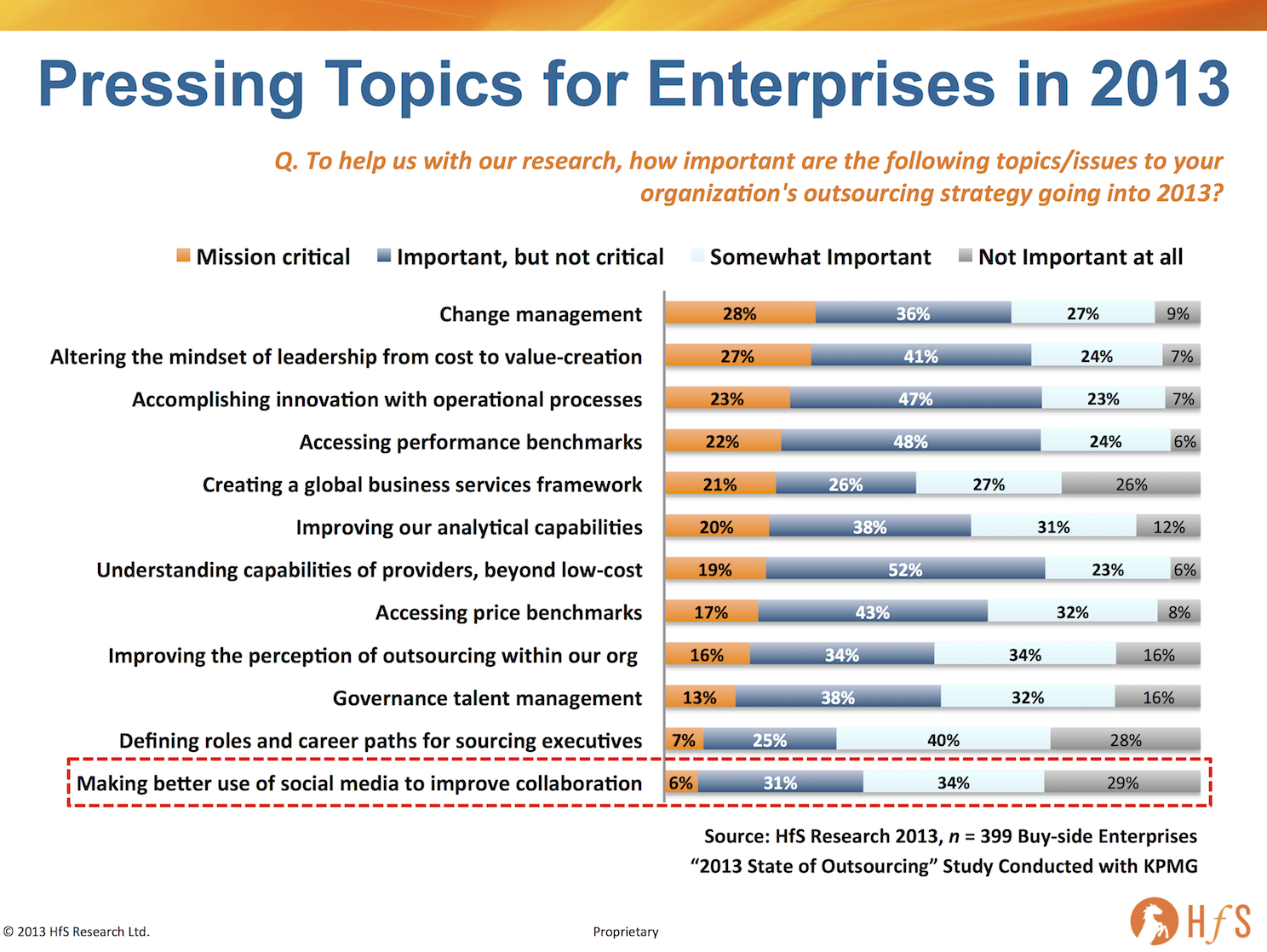
And to prove that “social” really doesn’t count for much when it comes to enterprise strategy, this is where it ranked as an enterprise priority, in our recent state of industry study conducted with KPMG:
Click to Enlarge
While people will argue that it’s still “early days” for social media, it’s already been years since the whole world (seemingly) started using it. It’s here and it matters, but is it really enabling new business innovations and dominating corporate thinking? I don’t think so – and neither do most of the 400 enterprises we spoke to. I would argue that it’s actually time to “de-social” our behavior to regain the effectiveness and quality of our interactions and relationships.
So here are some top-of-mind ideas on how to improve the quality of our real social lives:
1) Kill the PowerPoint in conference calls. PPT gives everyone, bar the presenter, the opportunity to zone out and do mindless tasks – and you can only guess how many of the folks on the call are checking their Facebook updates or tweeting some mindless crap to noone in-particular. Surprise your conference call comrades by engaging them in a (gasp) conversation. They will actually have to listen and respond.
2) Remove the Twitter/LI/FB apps from your mobile device. These apps will find a way to give you a notification update every 5 minutes, which I guarantee will have a meaningless impact on your life. Go in and check your updates once or twice a day manually – you’ll save those hours of wasted time and energy nervously checking your phone like a reflex action that you just can’t control…
3) Start calling people up just to “chat”. This may freak people out, but what happened to the days when you could call people and just talk about stuff? It seems we spend more time trying to create a freaking appointment to talk for 30 mins in three weeks’ time, when you could have just called each other up there and then.
4) Make efforts to have more in-person meetings. My word, the quality of interaction in a face-to-face meeting, versus a conference call or web-session, is eons higher. You talk, you listen, you exchange ideas…
5) Go to more conferences. Everyone’s just so “busy” these days, but what happened to those days when we went to conferences, met people, had a few beers with them etc? Haven’t you noticed how “sanitized” some of your relationships have become? It’s because you’re restricting your interactions to freaking LI messages, “likes” in facebook chats and re-bloody-tweets. Take it from me – nothing beats a pint of beer, a glass of wine or a decent single malt to have a real conversation with someone.
To prove my point, I will buy anyone a drink who shows up at my office over the next two weeks… but hurry while stocks last 🙂
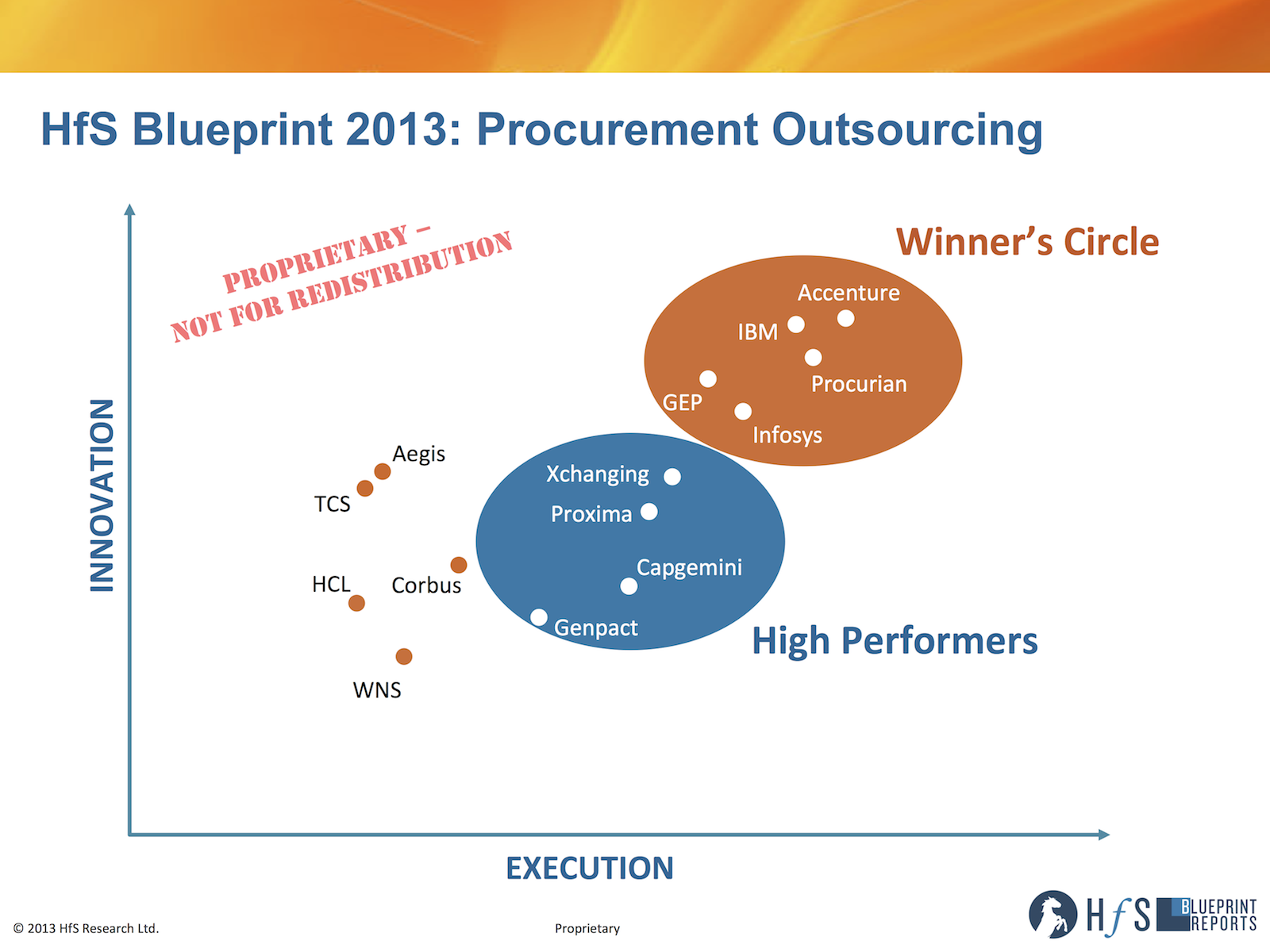
Ever wondered which providers are driving the world of procurement outsourcing? Well, the wait is finally over, with the first ever Blueprint in this space… and a big congrats to Accenture, IBM, Procurian, Infosys and GEP for making the Winners Circle:
Click to Enlarge
So what’s the skinny on this market…
What’s hot about procurement BPO right now – why are firms suddenly jumping into the space?
The Procurement Outsourcing (PO) market has quickly become one of the fastest growing BPO segments in the market, growing at an annual rate of 12% over the next 5 years, and expected to reach $3.4 Billion in expenditure this year. Our research has shown this is the result of procurement deals piggybacking on a maturing and established Finance and Accounting BPO market, with the close linkages between F&A and procure-to-pay. While many CFOs have become more accustomed to the BPO model, they are increasingly confident in taking advantage of provider skill-sets in procurement where category expertise, spend management and technology provide the core value, as opposed to merely lower cost labor.
So what processes are people looking at? Is it still mainly P2P, or are there higher value processes being evaluated?
As growth continues, the scope of PO services has grown from the more transactional P2P elements of the value chain, to one where more strategic processes are being outsourced, such as strategic sourcing, vendor governance and spend analytics, which is redefining the market differentiators among providers. Vertical expertise as well as geographic market sourcing presence have also aided the leading procurement market providers to offer distinguishable characteristics compared to the more “generalist” BPO body shops.
What differentiated the Winners Circle providers from the others?
Accenture, IBM, Procurian, GEP and Infosys have been selected this year as part of HfS’ “Winner’s Circle” for their ability to provide a strong encompassing Procurement value chain offering, both for the transactional and strategic processes. These providers offer strategic support communities for procurement professionals and can align to many vertical industries requiring unique sourcing expertise, such for Retail and CPG, or cater to niche category sourcing such as marketing, consulting, and other professional services. These providers have also gone above and beyond others with the incorporation of consultative procurement capabilities, such as helping enterprises discover value through redefining and transforming their procurement organizations, and incorporating global compliance standardization. In short, they are servicing customers more as strategic partners than mere outsourcing providers.
And, for all you HfS subscribers, you can download your copy of the…
Unlike other quadrants and matrices, the HfS Blueprint identifies the relevant differentials between service provider performance and capability across a number of facets actually meaningful to the delivery of services: how all the providers are genuinely innovating and how effectively they are executing. Moreover, HfS Blueprint Report criteria are dependent on a broad range of stakeholders with specific weightings, based on 1,355 crowd-sourced responses from our 2013 State of Outsourcing study, conducted with the support of KPMG. You can download a detailed methodology of the Blueprint concept and process here.
Momentum 2013 is the inaugural industry event dedicated to one of the most politically-charged and compelling issues in the services business today – domestic sourcing of IT and BPO services in America.
And – as you would suspect – HfS will be there stirring things up! Phil Fersht will be leading the plenary buyers’ panel, while HfS’ Mike Beals, who leads training programs for the HfS Governance Academy, will also be there. Oh – and you can download our report on the topic here for some advanced reading so you can turn up sounding clever…
This two-day event includes discussions and debates from industry leaders on topics such as:
Domestic IT and BPO Sourcing Can Generate Good American Jobs: The Role for Policy
After years of Offshoring, Why is Domestic Sourcing Now Viable?
Trends in Domestic Sourcing
Global Sourcing 101: A Primer for EDAs and Government Agencies
Operations Best Practices: Recruitment & Training Strategies for Domestic Sourcing
How State Governments and Local Agencies Can Attract IT/BPO Service Providers and Shared Services Centers
Building the Business Case for Domestic Sourcing
The Domestic Sourcing Model: Key Considerations in Location Assessment
A Compelling Argument: The Cost Analysis of Domestic Sourcing
Domestic Sourcing: A Key Component of a Global Service Delivery Strategy
And for all you savings-savvy sourcing sentinels, we have secured a 20% discount for HfS readers: Enter the promo code HfS421 when you registerhere.
This October, the Affordable Care Act is poised to disrupt the healthcare industry in seismic fashion, whereupon the entire world of the healthcare payers will be turned on its head:
*The traditional B2B model is switching to a B2C model: Payers now now have to cater for millions of individuals, in addition to thousands of companies with “cookie-cutter” solutions. In effect, they now have to sell to, market to and manage consumers, in addition to their traditional corporate clients.
*Health plans must now being priced very, very differently differently: The only variable inputs will be age, geography, family size, and tobacco use, while past history will and pre-existing conditions will no longer be taken into account. Millions of new people will be entering the health insurance market, with vastly increased regulation on how payers ‘ revenues can be allocated.
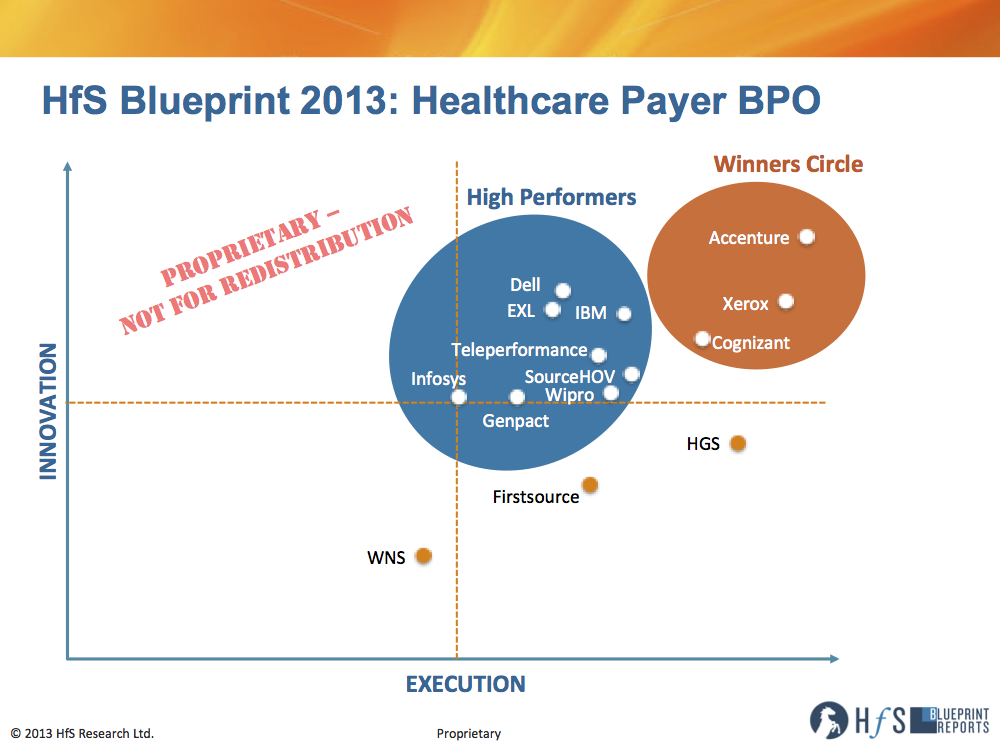
This will matter for everyone – service providers, buyers, and pretty much anyone living in the United States. These reforms will affect the healthcare payers the most, as they seek to cope with the monumental challenges needed to improve product operations, engage with the customer differently, optimize processes, and contain not only administrative costs, but medical costs too. The three service providers that we found best placed currently to service the healthcare payers are Accenture, Xerox, and Cognizant:
Click to Enlarge
The Healthcare Payer Blueprint utilizes our Blueprint Methodology, which measures both execution and innovation against a set of crowdsourced criteria derived from the State of the Outsourcing Survey 2013. We assessed data from over 155 live multi-process healthcare payor BPO engagements to ascertain provider market shares, depth of client base, breath of execution and geographic scope of delivery. We examined the healthcare payer value chain (claims, service, marketing and sales, medical management, etc.) and interlaced what we know will be important to Healthcare Payers in the dramatically evolving healthcare industry with the capabilities and vision of the service providers in our assessment.
Our analyst team conducted exhaustive interviews with multiple buyers and market advisors to help score providers against each other across all the sub-categories of the Blueprint using ExpertChoice, an advanced statistical analytics platform. We also received a tremendous amount of cooperation from (almost) all of the providers above, as we went through this exhaustive process to understand their concrete plans for the future, get really deep with their current client relationships, their overall vision and their appetite to evolve and invest into higher-value areas of Healthcare Payer BPO.
Christa Degnan Manning is Research Vice President, HfS (Click for bio)
If there’s one thing we’ve learned in recent years – and about a thousand blog posts – it’s that most organizations are not looking to increase their permanent workforces.
Most organizations, today, have armies of extended staff working for outsourcing providers, staffing agencies, or are independent contractors. The role of the maturing governance organization needs to oversee the delivery of business outcomes regardless of how/where/why workers are situated, managed and paid. If it were only as simple as having nice powwows and boxed lunches with your providers’ account management team…
To this end, we’ve hired workforce optimization expert Christa Degnan Manning to drive our focus on workforce optimization and the extended enterprise, who debuts her return the the analyst fold, after five years with American Express, with a unique view as to whether we can genuinely trust our workforces in today’s extended enterprise environment:
WTF? Does your firm have the Workforce Trust Factor?
The U.S. Department of Defense (DoD) is the largest employer in the world with 3.2 million workers, according to a 2012 report by the BBC. It is unclear whether or not that number includes the 420,000 “contractors” Reuters reported have top-secret security clearance such as Edward Snowden, the high-school drop-out, $122,000 USD annual salary computer systems administrator for the National Security Agency, hired by government services provider Booz Allen Hamilton.
Regardless, the news that Mr. Snowden allegedly stole and shared confidential government information with rival superpower nations should have every single senior executive and corporate board member asking himself or herself: do we know who works for us, where, and why? But more importantly: can we trust them?
Year after year, multiple studies have been conducted on the state of the workforce, yet few of these surveys ever drill down into practical solutions to improve employee contributions, in the context of the modern business world.
So… HfS is asking YOU – the individual worker – what it will take to empower and energize YOU in your business. Your candid, unbiased insights are extremely important to this unique research study, whether you work in sales, marketing, finance, IT… or any other business function.
Please note that all answers can be anonymous, and will only be used in aggregate and are treated with the strictest of confidence. Optional email contact info can be provided at the end to receive a copy of the research report and enter you into the prize draw for a Samsung S4 smartphone.
This should take no more than 15 minutes to complete. Make your voice heard and become part of a revolutionary research study.






 After years of coaxing and nagging from so many of you, we’ve finally got our act together to get an all-singing and dancing governance training and certification program off the ground. And not only that, we’ve acquired the