As per usual, election year brings up the age-old argument about how to combat the “threat” of outsourcing. However, let’s not forget this is nothing new..I recall in 2004 when an HR Outsourcing conference was subjected to a vociferous demonstration by anti-outsourcing protesters (I mean – seriously – HRO? Most of it is onshore in any case).
Today’s angry hoards of protesters are (and quite rightly so) expressing anger at the obscene wealth generated by Wall St, and barely even notice the fact that real “American” companies, such as Apple, employs 500,000 people in Chinese factories and that lovely “American” Hanes underwear brand employs thousands of people in Vietnamese sweatshops.
Yes, the argument is boring, flawed and jaded, and while politicians need to be seen to be against it, they do little to prevent it. However, one major stride of progress that Obama emphasized during his recent State of the Union speech has been how the US automotive industry has been brought back from the brink:
“This blueprint begins with American manufacturing. On the day I took office, our auto industry was on the verge of collapse. Some even said we should let it die. With a million jobs at stake, I refused to let that happen. In exchange for help, we demanded responsibility. We got workers and automakers to settle their differences. We got the industry to retool and restructure. Today, General Motors is back on top as the world’s number one automaker. Chrysler has grown faster in the U.S. than any major car company. Ford is investing billions in U.S. plants and factories. And together, the entire industry added nearly 160,000 jobs.
“We bet on American workers. We bet on American ingenuity. And tonight, the American auto industry is back.
“What’s happening in Detroit can happen in other industries. It can happen in Cleveland and Pittsburgh and Raleigh. We can’t bring back every job that’s left our shores. But right now, it’s getting more expensive to do business in places like China. Meanwhile, America is more productive.”
Why is the experience of the resurgent US automotive industry significant to resurrecting its flagging IT industry?
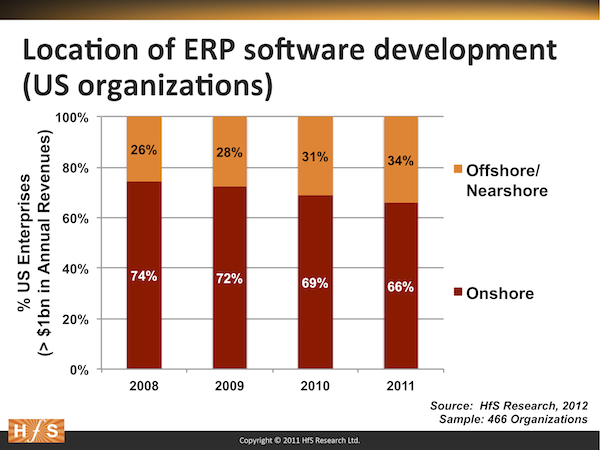
Let’s not beat around the bush here. The US onshore IT industry has ceded much of its dominance to India in recent years. While three-quarters of ERP development work was performed onshore in 2008, the proportion has today decreased to 65%:
I’m not going to get into the tedium of this latest wave of toothless “protection” acts aimed at creating tax incentives / disincentives, and other various penalties and inconveniences for US organizations which dare to employ foreign labor outside of the country to service their business operations and manufacture their wares. Simply put, there are already US IT services firms, such as Systems in Motion, pushing services at US enterprises with wage rates comparable, and often even cheaper, than those of Bangalore – especially those which leverage resources in low-cost onshore locations such as Michigan. And while some niche onshore providers are finding pockets of business and growth for themselves, you can’t ignore the bigger picture that the US onshore IT industry is on the decline. At HfS, we’ve even seen enterprises actually declining to use onshore US IT services firms which underbid their Indian competition, because many of these buyers of services are so invested in the Indian IT brand. Today, many senior IT executives within US organizations actually prefer to invest in their Indian IT relationships than their US ones!
The Bottom-line: It’s time for government to help re-brand US IT services
While the US IT services industry is nowhere near the state of distress that the US auto industry found itself during the last Recession, isn’t it now clear that the only way for the government to stimulate the success of its onshore industries is to invest in them, to aggressively help them, to encourage them to hire locally with real investment? By investing so heavily in their automotive industry, they also re-branded the entire American automotive business. Nothing’s worse than a business in financial decline, and by giving automotive a helping hand, they also improved the perception and credibility of the entire US automotive industry.
The Chinese and Indian governments, as examples, constantly invest in their local business to help them grow and be successful – so why can’t the US government do the same for its flagging IT industry, that it did for automotive?
I, for one, would be happy to see my tax dollars being re-invested in stimulating local industries and job creation in growth industries like IT services and Cloud computing, BPO, social media and medical research, so why not follow the example of how the US automotive industry was salvaged and do the same for IT? Invest in some local companies… hire train and their local workforces to support our organizations’ IT systems. Small measures never work, waste everyone’s time and allow our more aggressive foreign counterparts to advance further ahead in industries such as global IT services. Isn’t now the time, in an election year, to stop the rhetoric and actually make commitments to growing local industries that have a direct impact?
We’re very excited to announce that we’ve partnered with ACCA (the Association of Chartered Certified Accountants) to conduct the largest-ever global study of finance professionals to understand adoption trends, experiences and dynamics of shared services and outsourcing for the finance function.
Are you achieving sourcing success for your finance function? Click to take part in our survey
Members of the ACCA global membership and HfS Research’s own network of finance and sourcing professionals are being surveyed over the next couple of weeks across organizations of all sizes, industries and regions.
We will gain an unprecendented global picture of finance and accounting sourcing from well over 1000 organizations:
What CFOs and senior finance executives really think about shared services and outsourcing;
How organizations’ adoption patterns of finance and accounting sourcing are differing across industry sectors and countries;
What are the experiences of finance professionals to date and how they rate their sourcing performance in terms of both cost control and productivity improvements;
Whether today’s finance functions are realizing finance transformation improvements with the right level of finance talent and technology they need;
Whether finance leadership’s business objectives are being met by a shared service or outsourced finance delivery model – and have these business objectives changed since they started on their transformation journey;
How finance leaders are measuring sourcing success.
Does your organisation use finance shared services or outsourcing? If so, we would like to hear from you.
Your feedback will be aggregated with that of others and will be a key input into our series of research and insights looking at finance transformation by both ACCA and HfS. At the end of this survey we welcome you to register for a copy of the report findings from this survey and enter a free prize draw for an iPad 2 as a thank you for time and feedback.
The Phoenicians were the greatest entrepreneurs of their time, dominating the trade of the ancient world and founding colonies throughout the Mediterranean. We will never see the likes of them in the modern business world, where a nation of business hungry folk could possibly develop their own real estate within today’s Global 2000 organizations through savvy barter of their own wares. Or will we? Deborah Kops investigates…
India’s Sourcing Leaders — the New Phoenicians
"Maximo innovation at unbeatable prices… hurry while stocks last"
At a sourcing conference cocktail party in Singapore, I was chatting pleasantly to a gentleman who– Indian by nationality, Kenyan by upbringing—was leading a global sourcing strategy team in Dubai for one of the largest of multinationals. As he politely tried not to blow smoke in my face, I had one of those eureka moments— I was speaking to a Phoenician!
(Be patient with me, readers…I’m drawing an analogy in order to make a point. Perhaps a little history lesson might be a diversion from treatises on governance or the consolidation of the outsourcing industry. I’ll try not to be too much of a bluestocking.)
For those of you who are not familiar with Phoenicians, it’s not a dirty word. Phoenicians —the “red people”—that dominated the regions proximate to the Mediterranean from the ninth to the six centuries BC, were a significant cultural and political force. They grew rich trading the commodities of the time—olive oil, wine, timber and precious metals, and were unmatched city builders, developers and stonemasons, hydraulic engineers and superb mariners.
But their greatest contribution was as globalizers of the only region that mattered in the ancient world. As developers of the modern alphabet (yes, without Phoenicians who knows how you’d be reading this), and acting as cultural middlemen, the Phoenicians disseminated ideas, myths, and knowledge. As a result, the Mediterranean arguably became the first example of a world economy.
So much for togas, olive oil and wooden ships. When I talk to the likes of an Anirvan Sen of GE, a Jay Desai of Northern Trust, a Vinoo Mehra of Colt, or any number of executives from the likes of Genpact, Accenture, Infosys or EXL, I am chatting with the progenitors of those ancient globalizers. Born in India, perhaps degreed in the US or Europe, climbing the career ladder in a range of industries, holding a breathtaking number of increasingly challenging positions in multi-national corporations, these folks are the true evangelizers of process globalization, whether they are on the buy or sell side, or even advising and warning as consultants. Builders of outsourcing companies and shared services platforms, masters of process excellence, spokespersons for global delivery—they do it all. And today they are found in Indian-legacy outsourcers, global outsourcers, consultancies and a myriad of corporations.
The Bottom-line: our Indian industry colleagues play the role of globalizer so well
—Common ways of working. Although often castigated as being too “Indian” in approach, their shared, monolithic code of conduct actually supports implementation of globalization. Whether located in Manhattan, Manchester or Mumbai, our Indian colleagues know the handshakes and the rules when they work together, and have the ability to cut through the chase to get things done. In effect, the sourcing industry benefits from a common way of working.
Take this a step further, dear reader. Contrast the results when an American, a Brit, a German or a Swede (or all of the above) work with an Indian to source processes. First, they have to study Culture 101, spending sufficient time to understand that when a German says no, he means that the case for change has not been made, or that to a Brit, a meeting is not where decisions are taken. Overlay an Indian on the other side of the table, and you get a cultural stew of nuance, decision-making style, sense of timing, and hierarchy. But with a number of savvy Indian leaders in the room, with shared experiences, it is generally possible to develop a commonality of understanding, bridge the cultural divide and keep moving on.
–-World citizenship. As a group, the Indian members of our industry have substantially more experience working globally than our country compatriots. Perhaps they left at 18 to study in the US, the UK or Switzerland, quickly absorbing local ways of working and living, knowing that Yankees and Red Sox are the ultimate in sports rivalries, that May is the time to eat spargel in Germany, or that passing out red envelopes to children is the done thing at the Chinese New Year. Cultural understanding and experience are underrated attribute in the sourcing world; the ability to straddle and translate two or more cultures is golden to the implementation and operation of a global operating model.
–Strong networks. Global operating networks are even more successful when they are underpinned by effective professional networks. Our Indian colleagues went to college and university together, and have many shared experiences; their ability to collapse the proverbial game of “seven degrees of separation” into two or three is awesome. Seemingly, everyone knows who has what expertise, who is looking for new talent, where the latest innovations are occurring, and who is developing leading-edge applications. Now you might think that this is a bit of an over-the-top characterization, but in an increasingly more complex world, networks matter; often, they are the best way to get things done quickly and efficiently.
Deborah Kops, Research Fellow, Sourcing Change Management, HfS Research (click for bio)
–Understanding how destination economies really work. Despite many trips to places such as India and The Philippines, most of us never develop a deep understanding of their inner workings—specifically cultural values, acceptable mores, and how to get things done. Because they do not evaluate a situation through a wholly western lens, our Indian colleagues are able to bring a level of local understanding which is so critical to global sourcing success.
Some say that we’re entering the age where it’s very cool to be a non-Indian in the outsourcing industry, or in the words of one of my sourcing industry headhunter friends, “ American companies want Americans. Indian companies want Americans. Everybody wants Americans.” And to my mind that’s a good thing; after all, successful globalization involves leaders from all cultures and geographies, not to mention that every decision can’t be made by dialing +91. But I’ll place my bets that our Indian friends cum/Phoenicians will continue to play an outsized leadership role the sourcing world.
Thank God services providers don’t like buying each other very much. There are scores of IT services and Business Services providers today competing for every help desk, invoice processing, app dev, clinical data management (etc.) deal.
For smart services buyers, they are spoiled for choice to keep their providers on their toes to get as much attention, talent, technology and inspiration that they can squeeze out of them. And if they only care about low-cost, there are plenty of providers who’ll kill themselves to do their work as cheaply as is humanly possible.
When I watch Oracle and SAP rapidly clean up whatever application is left on the market worth buying, my heart sinks for the future of the enterprise software business. For Oracle and SAP, it’s all about maintaining the status quo and growing their considerable license revenue streams. They know they have to be seen to embrace the Cloud, but all they really care about is protecting their customer bases and preventing upstart vendors sneaking in to disrupt their revenue model. And can you really blame them? It’s economics 101…
Microsoft won the office apps game well over a decade ago and today largely focuses on milking its massive customer base. I mean, have you seen anything radically different with Word, Excel and PowerPoint over said period? No competition means limited innovation, and that is my fear for the enterprise software business, which is rapidly running out of worthy independent applications that can help business managers run their functions better, have access to more relevant data to help them make decisions, and be provided on a more affordable pricing model that allows them to pay for what they need, when they need it.
Companies buy software because they want standard process that can be automated with as little human intervention as possible. For process flows such as recruitment, if Taleo can provide you with the steps you need to automate an end-to-end recruitment process effectively, then the only way to find more value (or dare I say “innovation”) from recruitment is in those areas that cannot be automated – such as assessing the cultural fit of a candidate, or making a judgement call that the candidate has potential which his or her former employers had previously failed to unleash.
Unless Oracle and SAP decide to enter the services game, they are not going to provide enterprises with that kind of innovation – they are merely pedlers of automation. Once they own all the apps on the market, they will own all the automation, and my huge concern is whether there is really any more room for innovation spurred by this automation. Essentially, have these enterprise apps pretty much reached the peaks of their capabilities now they are owned by the 1600-pound ERP gorillas? I mean, seriously, how much further can you improve a companies’ recruiting processes by making some tweaks to the software code? Yes, I hear all the techie purists voice their fury because all software products can have their architectures improved, but at the end of the day, most of these software apps support pretty standard business processes today.
We’ve arrived at a juncture where the next wave of value that enterprises can derive from their business processes isn’t going to be purely from upgrading to whatever software platform is next available on the market. It’s actually going to be having real help in improving the quality of those process elements that cannot be automated, require real context and judgement, and real analytics. These are requirements you can’t download via an email from your SAP rep – they are where you need real consultative support from experts who’ve gotten to understand your business.
The Bottom-line: Packaged software alone is no longer providing innovation for buyers
SAP and Oracle don’t need to try to hard to differentiate from each other these days – there are only two of them and they pretty much own the enterprise packaged software markets between them. The consolidation of the software apps business is firmly placing the onus of innovation and process improvement in the hands of today’s service providers. Those business services outsourcing providers that can coach their clients on an ongoing basis as part of a managed services relationship, will be able to differentiate themselves in the market. We are already starting to observe service providers handpick industries where they really think they have an edge and are eager to demonstrate it at every opportunity. Our new research on Business Platforms already shows that today’s leading service providers have already leveraged over 15o packaged and custom-built applications to underpin their services. The apps provide a process framework that can help improve an enterprise’s current state, but the actual innovation will only come from the introduction of new and creative methods that can’t be embedded in a piece of code.
When it comes to nearshore, anyone in the know knows Kirk Laughlin and his nearshore news site Nearshore Americas… and we’re excited to let you know that HfS is being beamed up to lead the key session at Kirk’s annual nearshore sourcing shindig, aptly named Nearshore Nexus:
The conference will feature over 20 speakers, including top CIOs, sourcing advisors and also welcomes delegates from more than 15 countries in the region. Special features include:
Keynote presentation by Mr. Alvaro Uribe, Former President of the Republic of Colombia (2002-2010).
A “Buyers’ Super Session”, featuring deep analysis of costs, contracts and benchmarks, led by our own Esteban Herrera, COO at HfS Research.
Panel sessions on Vendor Management in a multi-provider, multi-geographic environments; selecting sites for new operations in Latin America and overall drivers and risk around doing business in Latin America.
Dedicated sessions on Sourcing to Mexico and Sourcing to Brazil.
Nexus “After Dark” featuring live entertainment at the conclusion of the conference.
Kirk Laughlin is beaming up the nearshore superstars in New York on April 19th… click to register
The Venue:
April 19, 2012 at the Crowne Plaza, Times Square, New York City
Outsourcing clients and decision makers can obtain an all-access conference pass at no charge! In order to register, click here to go to this web page and type in code: MDUX10
We’re gearing up for our HfS 50 Sourcing Blueprint Sessions, taking place April 24-25 in New York City for a two day spectacle of sourcing-savvy soliloquies:
One year on and the HfS 50 just got bigger and badder than ever
Over the last year, our elite peer group of sourcing buyers has doubled in size – making this our biggest, baddest and most discussion-rich meeting to date. And in response to the high-demand, we have managed to extend an extra ten invitations to the event – so if you are a client of BPO or IT services, a shared services or governance leader, or a senior service provider executive and would like to get involved with the HfS 50, please contact Tom Ivory for more information.
This exclusive event will include the development of a 2015 Blueprint for the sourcing industry, culminating in a tempestuous vendor/buyer face-off that will include leaders hand-picked from several of the top tier service providers.
Key discussions will include the following titillating topics:
What do we want – and what should we expect – from the vendor account manager?
Outsourcing higher value processes – what’s feasible and how options should be evaluated
Re-energizing the governance function
Blending shared services and outsourcing into a productive, manageable governance framework
Vendor management and performance management strategies
Forward-thinking and productive pricing strategies that can actually work
Globalization’s impact on today’s sourcing strategies
David Poole, Process Protagonist and Prognosticator
Many of you will remember one of the legends of BPO, Deputy David Poole, who’s spent much of his career fighting BPO crime on the streets of Chicago for Capgemini (where he actually rolled up with the job title “Deputy”).
He was also a founding member of PwC’s global BPO business prior to IBM acquiring their operations, having made a significant contribution to the development of the global BPO industry, crafting several major global engagements since the early ‘90s.
David’s thought to have skipped town, after a shootout at the Outcome-based Corral and is rumored to be trawling the streets of London seeking out errant processes in dire need of transformation. In the meantime, we managed to track him down somewhere in the ethernet to share some of his thoughts on where the BPO market is heading.
So without further ado, here’s Part I, where he discusses future of BPO having less to do with outsourcing and much more to do with venturing – a blurring of the lines between the client and the provider…
Venturing – Sharing of risks and rewards between clients and providers
Imagine a World where providers actually put their money where their mouths are. I don’t mean just putting their margins at risk (tied up with so much legal jargon there actually isn’t any risk). I mean really working out the added value they can provide and taking a share of that to create a true win – win. This will be a world where providers will do as much due diligence on their clients as clients do on them to analyse and dig out the true joint opportunity. Sound familiar? Well certainly not in the BPO World we know today, but much more like the venture capital world. In fact, perhaps Business Process Venturing has a nice ring to it?
So far, providers paid by results or so called business outcomes is little more than jargon, and frankly the evidence of this in practice is pretty slim, perhaps with the exception of more knowledge-based and directly financially measurable processes like in collections or procurement. The lucrative BPO market of the past few years has been extremely cosy and risk averse but this is all about to change.
I predict a new breed of deal and provider will emerge in the coming years, sending shivers through the current providers risk management processes but forcing the type of change and commitment to process excellence that the buyers always thought they were getting but in fact were not. I don’t think it’s a bad thing for the providers either because it creates the opportunity for the best ones to truly monetise the return from the investments they have made in processes, analytics, technology and facilities. This is because the overall influence providers will have over the delivery in this much more collaborative environment will be far greater and less bounded by the restrictive contracts we as an industry have over time developed to protect clients from the big bad providers.
Stay tuned for more of Poole’s patter, which pinpoints the potential of virtualized delivery, utility delivery models and the end of consulting as we know it (gasp)…
Buying Team becomes "Proxima", ICG Commerce,"Procurian"
Did anyone see this day coming? Yes indeedy, the day procurement gets a makeover has finally arrived, with brand-spanking new liveries and catchy brand names for both the Buying Team and ICG Commerce who’ve renamed themselves Proxima and Procurian respectively.
No – they aren’t venturing into wonder drugs or high-end restaurant chains – they are simply sexing-up their procurement with more P’s and less Zzzzz’s… so why now, and – in fact – why at all? Let’s leave it up to a man who once counted paper clip purchasing by the million-load, HfS research’s Tony Filippone himself. Over to you, Tony…
Pure-play procurement outsourcing heats up, triggering two name changes among procurement-focused service providers
You’d think that down-to-earth procurement guys (and gals) would avoid the expense of renaming a firm, but within the span of less than five days two procurement outsourcing service providers did exactly that. Yet, the rationales behind their name changes are quite different.
Proxima (formerly Buying Team) based its new name on the need for procurement to leave behind its cost savings heritage that has always marginalized its value in the eyes of its internal customers. In the place of cost savings, Proxima wants to focus on developing procurement’s “proximity” and “intimacy” with the broader objectives of its business unit. Proxima hopes to position itself as a company that will elevate the position of procurement within an organization through “management control and visibility of costs.” In effect, Proxima team is leaving behind the heritage of “buying”, which connotes boring “P2P” in the eyes of procurement executives, to become closely aligned sourcing organization. “During the last two years we have repositioned our business as an end-to-end procurement services business, with a clear vision and a strategy to achieve our ambitious goals,” explained Guy Strafford, Proxima’s Chief Client Officer. “Having done this, the next logical step was to refresh our brand, which included challenging the appropriateness of the buyingTeam name.” Frankly, based on their capabilities and services provided to their clients, which is heavily focused on strategic sourcing, this name change makes tremendous sense.
Procurian (formerly ICG Commerce) based its new name on the need for procurement to exert sourcing and category management excellence. Based on our research in the procurement space, category management is a differentiator, but clearly its old name didn’t describe the business Procurian is in. As, Shannon Parish, Procurian’s Marketing Leader, explained, “We realized that we needed our name to bring additional meaning to who we are and what we do. By combining ‘Procur’ with the suffix ‘-ian’, that denotes a specialist or doer, we are able to better project our specialized focus and long-standing commitment to procurement.”
Snazzy new names really reflect the changing focus the procurement outsourcing market
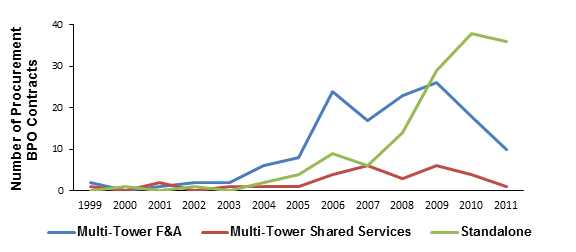
The Latinate marketing explanations for renaming these two firms belie what is really triggering two procurement organizations to rebrand. The real driver is that these two niche firms are challenging the two stalwarts of the procurement outsourcing industry, IBM and Accenture, because the nature of the procurement outsourcing market has rapidly changed. As shown in exhibit 1, procurement outsourcing used to be driven by multi-tower shared services and finance and accounting outsourcing initiatives. In the last three year, the procurement outsourcing market has become a market where buyers strongly prefer standalone procurement outsourcing contacts. Of the $2.5B procurement outsourcing market, standalone outsourcing contracts represent 56 percent of the entire market – and this number is clearly growing.
Standalone Procurement Outsourcing Captures the Attention of Procurement Executives
Source: HfS Research, 2012; n = 430 procurement outsourcing contracts
For example, while all of Proxima and Procurian’s contracts are 100% focused on procurement and 80-90 percent of Accenture’s procurement outsourcing services (fueled by its Ariba Services acquisition) are standand alone, only 30-40 percent of IBM’s procurement outsourcing client base contracts for standalone procurement outsourcing services. Proxima and Procurian have positioned themselves squarely in the headlights of chief procurement officers looking for procurement expertise. And, if they are going to challenge the category titans, they need to ramp-up their marketing exposure with procurement executives.
In fact, at the 2012 ProcureCon Indirect East event held last week (which had a solid showing with over 30 CPOs and well over 200 procurement experts, excluding service provider marketing and sales teams), only one procurement outsourcing service provider was actively marketing. We expect that to change dramatically in the coming year, as event attendance at both ProcureCon and SIG events has been on the rise.
But what makes marketing most important is the message. While the rest of the outsourcing industry deals with FTE-based lift and shift, procurement executives are really interested in gaining expertise. That’s the message these firms need to impart to their audience. Nearly 75 percent of the discussions at ProcureCon’s novel all-day “practitioner-only” day (no sales people allowed – the procurement executives were thrilled!) focused on talent management: the difficulty of finding category experts and procurement leadership. As we explain in more detail in our RapidInsight, “Broadening the CPO Mandate Through Procurement BPO” (download it here), procurement outsourcing has to be positioned as initiative geared towards improving spend management by leveraging service providers’ deep, experienced benches.
And that is exactly what both Proxima and Procurian are doing.
The Bottom Line: Differentiated, specialty services matter to CPOs
At ProcureCon, one CPO for a major manufacturing company took the main stage and said, “We want to keep it internal.” This speaks to the uphill battle that procurement outsourcing faces. CPOs simply don’t know that procurement outsourcing is different than other forms of outsourcing. They are used to the labor arbitrage comparison, and simply are unfamiliar with the ability to leverage outside expertise apart from expensive strategic sourcing consultants (see our report discussing the models here: “The CPO in 2011: The Toughest Job in the Global 1000”). Service providers have to educate CPOs on why procurement outsourcing is different to open a procurement executive’s mind.
Tony Filippone is EVP for Research, HfS Research (click for bio)
Moreover, the CPO may be the one executive who is immune from service provider marketing rubbish. While relationships may (force) open a door, CPOs are most likely to turn any friendly discussion into a competitive bid exercise. If a service provider is going to win mindshare in a procurement executive’s objective RFP process, it will be on the basis of “why can you save me more than your competitors” and “how can you help me execute better”. Cool logos and fancy names aren’t going to convince prudent buyers of capability and CPOs know how to sniff out P2P players that are masquerading as strategic sourcing experts. Highly specialized procurement services catered to the CPO is what the market demands, especially those that can help the CPO rapidly mature his or her delivery. Proxima and Procurian have the mettle and are sharpening their message.