Like an ’86 Margaux, some things just mature with age, and one of those is the good ol’ newsletter.
Read the Finish Line, edited by HfS analyst Bruce McCracken
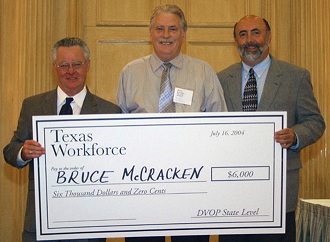
So we asked another fine vintage, HfS senior analyst, Bruce McCracken, (whose claim-to-fame is once receiving a fat check from the State of Texas), to pull one together for us.
This month we’ve featured industry dignitaries such as Vinnie Mirchandani, Naomi Bloom, Ben Trowbridge and Mark Trepanier airing their views about Mahindra Satyam’s re-emergence and AON’s takeover of Hewitt.
And don’t miss a superb interview with EquaTerra’s Stan Lepeak, discussing the latest Industry Pulse and its new findings on Cloud Computing adoption.
Bruce McCracken (pictured center) is senior analyst at HfS Research, and editor of the Finish Line.You can read his bio here.
You can submit news and views that you deem appropriate for inclusion in future Finish Lines by emailing Bruce at bruce dot mccracken at horsesforsources dot com.
When Mark Hurd took up the reins as HP’s boss back in 2005, the company badly needed him to stabilize the business, drive up the stock price, while instilling discipline and cost-control into many of its global operations.
Whatever the reason for his demise (and quite frankly, he’s not Tiger Woods, so who cares?), he’s done what HP needed him to do – and this is a good time to put someone else at the helm who can start closing the gap with IBM and others. In fact, he should have gone sooner, because there’s a lot of ground to be made up right across the board.
One of those is a flagging BPO business that had outperformed anyone’s expectations before the EDS merger threw it into a confused shambles. The addition of EDS should have been the cherry on the icing-on-the-cake to drive the emergence of a major BPO powerhouse to challenge the likes of Accenture and IBM.
In pre-EDS days, HP was giving everyone a run for their money winning several mega F&A engagements, such as Nestle, P&G, Clorox and Molson-Coors, and were doing a great job bundling IT and ERP-enablement services around their BPO. The firm was also discretely picking off payroll-centric HRO engagements and building an impressive competency for running multi-country SAP-based payroll services. HP also boasts one of the world’s largest supply chains it could have leveraged to drive its source-to-pay offerings.
But Hurd rarely mentioned BPO in his speeches or strategy discussions – the business relied firmly on the determined leadership of some great individuals (you know who you are) who drove that business in spite of lacking much senior leadership support. Consequently, since the EDS merger, more of the BPO leadership exited the business, the ExcellerateHRO business was sold to rivals Xerox(ACS) and the firm is rarely seen in major pursuits. Instead, most of its BPO focus is polarized on the healthcare sector, which is smart, but not when the rest of the BPO areas are neglected.
Bottom-line, Hurd is one of those IT operations guys who didn’t quite understand the value and stickiness BPO engagements can bring to a IT-BPO services provider – he’s a dollar- and-cents guy, not a business transformation one. Accenture and IBM have multi-billion dollar BPO businesses. Infosys, TCS and Wipro are tenaciously growing BPO business that are threatening to surpass HP’s. Capgemini has also moved in front of HP in the pecking order in most deal pursuits – particularly in Europe. And even in the verticals, such as healthcare, up-and-comers like Cognizant are edging in front.
HP is a great company and has a solid base of BPO from which to build. But it’s “lost years” in BPO need addressing quickly by whomever next takes the hot-seat. And this time, there isn’t much time, in a polarizing industry with twice as many competitors. An acquisition or two will likely be needed to turnaround its stuggling BPO service lines… and we’ll be hinting on where this should come from very soon.
Leadership: a very fine line between love and nausea…
I got a few of emails today from people who claim you can’t only blame Hurd for HP’s current malaise, moreover it’s the whole HP leadership that should be held accountable.
I say it’s all about the leader and the team he or she molds that drives the vision and instills passion down through their organization.
Today’s winning services firms are being shaped by their leaders:
Accenture’s Bill has charisma, is pragmatic, and has had the guts to bring in new blood and thinking to constantly break new ground; Cognizant’s Frank’s incredible energy, youthful thinking and intellect defines his firm; Genpact’s Pramod relentlessly drives his firm on with a consistent vision; Infosys’ Kris has a determination to shape the industry; while Wipro’s Suresh has stuck to his guns to deliver his own brand of global sourcing to clients. These are just some examples of today’s services leaders who define agendas for their firms and are prepared to adapt to change. And one other thing – if a large deal was on the line, they would be personally involved.
Several other providers have forgotten their personalities, are lumbering along trying to meet certain metrics, but seem to be following trends, as opposed to leading and defining them.
Now, none of these providers are perfect – they all have their warts (hell, we all have warts), but what they do have are leaders with a vision and an understanding of how to position their firms in unique times like these, where there is no “set” way of doing things. Today, there is no rule book. Instead there is passion and energy, creativity and innovation. Moreover, services companies need to forge an identity to survive.
Hurd’s challenge was that HP was too big and too focused on hardware. He needed 5% annual growth, which was about $6-7B a year. He would much rather sell a hardware device to a business or a retailer with a service contract attached, than sell a more strategic and “sticky” business process contract.
HP doesn’t have time to make a poor, or even an average, decision. The firm needs a vision, it needs to detail specifically how it intends to service its customers, and how it intends to help them find new thresholds of performance. It needs a leader who can step in to re-energize the firm, set out its agenda, nurture the cash-cows, while investing in the growth opportunities. The industry is watching which direction HP takes – and this one’s crucial.
we'll be happy to deliver that to your door for an additional $20…
Today’s outsourcing industry is balanced on a knife-edge as costs continue to level-out across service providers for operational work. Business leaders are demanding more innovation and productivity from their outsourcing endeavors, but their delivery teams tend to be more concerned with the work culture of their provider.
So how can leading service providers deliver all the goodies CFOs and CIOs want, in addition to being really flexible and easy to work with? Quite an ask, but those who can deliver both will win out. So how did we arrive at this impasse?
During the early years of this Millennium, the onslaught of the Indian-headquartered outsourcing providers was centered on low-cost service provision, and a willingness to do whatever clients wanted to win the business. This strategy has proved especially effective for the less-complex IT application development and maintenance work, and several operational business processes, such as invoice or claims processing.
In today’s market, the Western providers have been forced to bring their costs in line to be competitive for the “lower-end” work, by expanding and optimizing their offshore/nearshore operations. Once their prices are within 10-15% of the offshore-centric providers, the provider selection decision veers away from price, and towards one of with whom do we actually want to work?
Two different services cultures have defined today’s outsourcing business
We’ve witnessed an incredible dichotomy of styles in the outsourcing business over the last decade – one of top-down dictation from our traditional incumbents, in stark contract to the bottom-up tenacity from our growth machines from the sub-continent. To put it quite simply, the Western incumbent providers show up at the CIO’s or CFO’s office and tell her/him how they can change their world to do things their way, while the Indian-headquartered providers have typically operated a rung or two down, offering to do whatever their clients need to get the job done – and make them look good in the process.
One set of providers has grown considerably over the recession years, and continues to outperform the industry, while the other is maintaining a status quo, with far more modest growth. And, as we’ve mentioned, it’s not all about price anymore – several hundred thousand Indian and Philippines citizens are proudly showing up to work in an Accenture, Capgemini , Deloitte or IBM polo-shirt. Both the traditional providers and the newer Indian breed can offer low-cost services to take on new business. So if it’s not really about cost anymore, and the Indian-headquartered providers continue to gain marketshare in this environment… the secret sauce must really be about work culture. Let’s examine further…
C-levels don’t get so involved in service provider selection. Most IT or discreet business project decisions are overseen by the direct report to a C-level (or even lower than that). If you’re a VP / director level executive, why would you want some flash MBA-infused team of hotshots telling you what to do, while constantly trying reach over your head to your boss to let him (subtly) know you could run your department a lot smarter, and more cost-efficiently? In this post-recession environment, people are incredibly nervous about their job security, and the last thing the VPs and directors want is a provider that is going to threaten their cosy world.
Conversely, a team of humble, dedicated and determined service provider staff, who see you as king of their world, and are prepared to do anything for your business – and promise you outcomes you probably realize are unrealistic (but who cares, right?), are far more appealing providers for your custom.
Peer pressure up the chain trumps a round of golf. In the old days, when CIOs were wined-and-dined at offsites in Monte Carlo, they made the provider selections. They could afford the occasional $100m project-wastage and no one really cared (hey – it’s just IT, right – it’s just a black hole of lost cash, right?)
Today, most CIOs are tied to their desks staring at a spreadsheet trying to keep within budget, while trying to prove they can deliver value to their board – they are in a pressure-cooker environment, with ever-decreasing tenures. They are completely reliant on their teams to bring them results. When their two, three, or four direct reports come to you with a suggestion to “use this provider”, it’s very hard to challenge a consensus from your own team – you’re the boss and you need you team to like you, or you’re in serious schtuck. You don’t have time to mess up, and you may be out of a job soon anyway, so short-term success works better for you anyway. If you recommend your consulting partner buddy (who just three-putted to let your win on the 18th) propose work for your managers down the ranks, the chances are they’ll find every excuse not to use them. If your team isn’t happy and you’re making multi-million dollar investments, you can’t afford mistakes, or a lot of dissention from the ranks beneath you. Might be easier just to keep everyone happy as long as you’re staying on budget.
So what can the CIO do? Risk upsetting your team, or keep the costs low and find a way to keep the machine ticking over and meet the operational goals?
The next wave or productivity requires a new approach from the industry. Quite simply, most of the managers, a rung down from the CIO, have squeezed as much as they can out of the easy work. The app support, the testing, the simple coding is running about as cheap as you can – you even bring in sourcing advisors to keep the contracts running as low as you can manage. There’s no more room for maneuver. That nice Indian head-quartered provider – who still loves you as much as the first day they showed up at your office – can’t find anymore wiggle room to keep making you look good. Besides, today they’re a multi-billion dollar eneterprise with a lot more overhead, and have sales heads forcing them to start raising prices.
At the same time, some of the old Western providers you abandoned a couple of years ago, can now match the prices you’ve just been quoted from the “low-cost” provider. They want you back and are begging for that second chance, promising delights that you forgot that failed to deliver in the old days…. WHAT DO YOU DO?
Bottom-line: the Indian providers are trying to be more like the Western providers, and the smart Western providers have studied the Indians who’ve been eating their lunch, and are working out a game plan to win back lost business. The cultures are moving closer together.
Does that mean we may actually see one of the Indian biggies merge with a Western one? I’ll put a stake in the ground and say we will. In the next year it has to happen – a blending of the two cultures to form a mega-provider which can do it all.
Chuck (center) and his selfless buddies strategizing how to stimulate the US economy
Senator Charles E. Schumer, not content with ludicrous attempts to tax the US consumer for taking an offshore call, has continued his personal tirade against the use of offshore services, by pushing through legislation to add a further $2,000 tax for an H-1B visa application, and $2,250 more for an L-1 visa application. This CIO Magazine article by journalist Stephanie Overby does an excellent job discussing the situation.
You have to wonder about the motives of a US senator, who describes Infosys as a “chop shop” and pushes through legislation that is deigned to antagonize service providers, as opposed to what he should be doing: helping to make US service providers become more competitive, and US IT / BPO workers more attractive to be hired than those offshore.
In terms of creating more US IT jobs, this is a further backward step in trying to re-energize the US IT industry for the following reasons:
1) Indian IT services providers will attempt to conduct more IT work offshore / outside of the US, whereas in the past they would have conducted the work locally with either a US employee, or an Indian visa holder in the US. Impact: more work moves offshore as opposed to onshore work being created
2) Indian IT service providers have been investing heavily in hiring onshore staff, and have been creating local employment. However, the new visa taxes will only help to accelerate the movement of more complex IT work offshore. The Indian providers have a proven successful strategy of taking on complex IT projects and “learning on the job” with their offshore personnel. This new fee will only encourage them to take bolder steps to take more work offshore. Impact: more work moves offshore as opposed to onshore work being created
3) When Obama was elected and voiced potential moves to slowdown offshoring, several Indian IT providers made investments in locations such as Canada (especially Ontatio) and Latin America. They will now look to leverage these investments more aggressively. This is great news for the developing nearshore IT services markets. Impact: more work moves offshore and nearshore, as opposed to onshore work being created
4) With the global IT services industry poised for consolidation, this may encourage several of the leading Indian IT giants to acquire onshore US firms, now they have more financial incentive to do so – which would likely have further negative ramifications for the US IT job market. When Indian firms acquire US IT services firms, they will seek to rationalize the existing onshore staff to support their offshore operations, while keeping salary costs at a minimum. Impact: more work moves offshore as opposed to onshore work being created
5) The US IT and hi-tech industries grew up on bringing talent into the country that added new skills and ability – and was often more affordable. By further discouraging bring the talent to the states, Schumer and co are driving the next wave of IT development out of the country. Impact: innovation moves offshore, and more vacant office-lots in Silicon Valley.
President Obama has set out to be a transformative president, who can elevate US competitiveness in a global economy and create jobs by intelligent fiscal stimulus. He needs to drive policies that will stimulate employment, and stimulate innovation. The economic wonder that became America, was centered on an immigrant society, and attracting talent to these shores. My fear is that policies like Schumer’s are moving the US further away from the very principals with made its economy what it once was. The imperative word here is “was”…
I received a ton of email and blog comments this week from various people airing their views on Senator Schumer’s visa-fee hike. They tended to be in the form of one of the following:
“Right on – this guy is all about protectionism and has little idea how to create jobs”
“The policy is so toothless, it’s barely worth talking about”
“It’s only targeting firms who excessively use H1B staff, so what’s wrong with that?”
“We have to protect American jobs”
“I never knew you were a Republican”
All fair comments – except the last one. Firstly, my politics have always been left-of-center – I am merely a global realist and believe in intelligent, informed debate on these tough issues. Secondly, it never ceases to amaze me how polarized people in the US are when it comes to politics. You’re either Democrat or Republican – there’s now common ground on anything. And thirdly, I’m not American anyway, so it’s a moot point.
The other major point that needs to be made, is that this policy does nothing to create American jobs – it’s merely political grandstanding from the protectionist lobby. As we pointed out, the visa-hike will only encourage further offshoring, and the inflated fee is not enough to have any meaningful impact on altering current dynamics. Moreover, it’s pretty hard to couch these political actions as anything but protecti0nist politics when the Senator in the driving seat brands one of the leading Indian IT services firms a “chop shop” (detracted, or whatever – he said it).
What options, then, could the US government consider, if it wants to “stop” Indian IT services firms bringing temporary IT staff over to the US, and create an environment for fostering onshore technology employment and innovation?
1) Give Indian services firms tax-incentives that would sufficiently motivate them to hire and train US IT employees. Many of these firms provide a great training ground for new IT talent – now let’s ensure they are motivated to train and develop talent in the US and not just offshore staff. Many leading Indian firms have proved extremely good at training, developing and motivating young IT talent, so why not get us a piece of the action?
2) Give US enterprises tax-incentives for creating new onshore IT jobs. This won’t be any harder to administer that call center tariff etc.
3) Establish an oversight committee that will devise an immigration strategy to encourage top talent into the country and ensure it stays here. Ensure immigration policies are focused on developing the talent pool in the country and not open to abuse;
4) Establish more dynamic partnerships between academic institutions and businesses. We don’t see enough involvement from the academic sectors in the global sourcing industry today – a few firms, such as Systems In Motion, are pushing the agenda, but these firms need a lot more investment to get anything like the scale and execution capability to be effective in the global market place.
We live in global economy and we need to focus on being competitive for a larger piece of the pie, not trying to protect limply the dwindling one we have left. The Chinese economy is the new powerhouse – we need to ensure we have the innovators, thinkers and operators to compete effectively. Countries with developing talent, such as India, can help us be competitive, as long as we create smart entrepreneurial environments to work with them.
We’ve seen a significant shift in in the competitive landscape for BPO providers in the last two years – some of the leading Indian service providers have taken advantage of the Recession to steal a march on several of their incumbent competitors, pushing their own tenacious brand of offshore service delivery. The change has been dramatic, with some of the traditional providers of recent years being knocked off their perch. When HfS produces its new competitive landscape later this year, this market shift away from some of the “traditional” BPO engagements and momentum towards new approaches for pricing, engagement scope and IT-synergy will be apparent.
Abid Ali Z Neemuchwala, Global Head for BPO Services and Process Excellence, Tata Consultancy Services
One of those providers which has evolved significantly into a major BPO provider, in its own right, is Tata Consultancy Services (TCS). Like a couple of the other major Indian IT services providers, TCS has quietly, but aggressively, developed a global operation of scale at a rapid clip, with its 2008 acquisition of Citigroup’s banking captive adding significant offshore BPO scale and financial services competency to its $1.2 billion mammoth multi-tower IT-BPO-KPO engagement with Nielsen in 2007. Quite simply, it’s eye-opening how quickly the likes of Infosys, TCS and Wipro have muscled in on the business process game, as they branch out from their massive IT services businesses.
To discuss this dynamic at length, we managed to grab some time with TCS’s head BPO honcho, Abid Ali Neemuchwala – (more simply known in the business as “Abid”) to talk about TCS’s development, and his views for the future nature and development of global BPO service delivery.
Abid has developed a 17 year tenure with TCS where he expanded the firm’s operations in Mumbai, Pune and Gujarat (in India), the Midwest of the US and Japan, before moving his family over to sunny Dallas to lead the firm’s global BPO surge. Abid kindly relented from one of his evening city strolls to spend some time with us…
Phil Fersht: Good morning Abid. Let’s start with where TCS is today, how things have changed in the last six months, where you see the majority of demand coming from and how the business is shaping up.
Abid Ali: Phil, we ended our financial year on March 31 with about $720 million in pure BPO revenues. TCS overall is $6.7 billion, so our BPO revenue is now more than 11 percent of the TCS revenue pie. Last year was very successful and rewarding for us, which means our strategy has been playing out well throughout the downturn and the recent upturn.
From a market perspective, I continue to see very good uptake in transaction processing in the verticals. We’re especially seeing a lot of activity in banking and financial services, accelerated by our Citigroup acquisition, which gave us some unparalleled capability. We also see a lot of activity in the insurance vertical. For that sector, we embarked on licensing on three key aspects of transaction processing in the U.S….collections, mortgage origination and third party administration licenses. This is quite complex because all the licenses for each of these streams are administered at an individual state level. So acquiring these licenses positions us as a committed and serious insurance industry player. We also continue to see traction in the pharma space, both vertical and horizontal.
Most of our new client acquisitions have happened based on the IT-BPO synergy proposition. And if you look at all the deals we have won in the last 12 or 18 months, about 70 percent of those have come from cross-selling to existing IT customers. That works very well for an organization like TCS because we have strong C-suite relationships and so are able to position ourselves very well. If you look at TCS’s growth over the past 20-25 years, account mining has been our strength. This many times makes our cost of sale lower, makes it easier for us to penetrate, sometimes makes deal closure much faster. Especially in the recession when a formal bidding process was taking anywhere between nine to 12 months, we saw certain deal closures in three to four months simply because we were cross selling into existing accounts.
Over the last six months, we have seen many relatively small deals coming up. We have not seen too many big bang $300-500 million deals, but the smaller deals — $50-%70 million – plays well to our strategy of penetration, establishing track record and then growing within the account once we prove our capabilities and are able to cross sell and up sell our offerings.
Phil Fersht: You mentioned 70 percent of your business in the last year has come through cross selling into IT clients. Does that signify that more BPO discussions are arising around industry-specific processes at this point, or are you seeing more horizontal BPO business opportunities?
Abid Ali: We are definitely seeing much more vertical process interest in the market. Many of the cross-sold deals have been in core domain areas. And more than 50 percent of those deals are cases where we either developed the IT application or we were supporting the customer’s application enabling that particular vertical process that we took over in the BPO area. So our domain knowledge and understanding of the customer’s process is playing to our advantage in those deals. We are also seeing a fair amount of horizontal deals, but more of them are still coming in through the traditional bidding process. The vertical processes are the ones coming more as cross-sell opportunities from IT into BPO.
Phil Fersht: Our recent discussions with the buy-side on vertical focused processes, have shown common concensus that the next wave of optimization comes through IT-enabling the process within the outsourced environment. So when you talk about cross selling into the IT customer base, I immediately think about ‘vertical processes’. You mentioned taking on customer applications and delivering the process around them in vertical areas. Would you say most of your vertical business is taking on the customer’s existing IT platform, or are you actually pushing your own application IP into the client base?
Abid Ali: In verticals, we have developed some of our own very focused platforms, most of the vertical processes we deliver are on our customer platforms. And in most of those cases, we support it from an IT standpoint. We have a platform for U.K. Life and Pensions companies which originally germinated from our Diligenta/Pearl Group deal, and we now have a couple of additional customers on that platform. Another of our platforms, which we call Aspire, is for reconciliations. We started that about three years back with our Deutsche Bank deal, and have about four other customers on that. Our third platform, which includes solutions from our acquisitions of TKS in Switzerland and FNS in Australia, is our BaNCS products for the banking industry.
On the horizontal side, we are seeing a lot more traction on going in with our own modular technology platforms, whether it is F&A, supply chain, HR or analytics.
Phil Fersht: One thing we are seeing this year is more sole-sourced activity and less involvement with the competitive sourcing advisory process, particularly with the vertical deals. Is that something you are seeing as well?
Abid Ali: Yes, especially when I look at the vertical business and deals we are able to cross sell. We are able to proactively go to our client and say, “You have this process. This is what your process matrix looks like. This is what our best in class industry process is, this is what we think the process matrix should look like based on our knowledge of the industry, and we see an opportunity for improvement.” That’s how a C-level conversation gets started, and then we get into due diligence which helps us create a business case for the customer. And after that we pretty much see a sole source engagement happening. In some verticals like manufacturing and retail where there is a strong sourcing organization, they still undergo an accelerated sourcing process. But most of the contours of the deals are shaped during demand creation, rather than during the vendor evaluation process.
Phil Fersht: So what’s changed since the Recession has faded, and how is the new, less conservative mindset impacting your business?
Abid Ali: Let me answer this from two perspectives. On the buyer side I am seeing much more certainty. A year back, survival was the big thing, so the decisions being made could have been more tactical than strategic. Today, we are seeing customers coming out of the Recession already thinking about how they will cater, not only to the growth that is going to happen in the next two or three years, but also how to be better prepared if they were to undergo a similar Recession three years from now. And obviously, since organizations like TCS were such a strong part of the solution to the challenges clients had, they are now engaging with us on a more strategic basis. This also means we are getting to try newer things we would not have been given a shot at earlier, and all of the vertical transaction processing, vertical BPO, platform transformation etc. is part of that.
We’re also seeing smaller deal sizes. We’re also seeing more pilots that start with a model where their own in-house staff is the “champion” and we are the “challenger”, do part of the processing and then they have a roadmap over the next year or 18 months to scale it up. Risk becomes an important criterion on the buyer’s side as we do that. They understand there’s a huge component of learning custom processes, but they are very focused on whether we have the right risk and control mechanisms in place. And a process-centric organization like TCS does have a significant advantage with the risk and controls, quality, tools and ecosystems, which enable better process capability and delivery.
On the supplier side, we are making more investments in our global delivery network. We have delivery centers in the US, the UK, India, Mexico, Chile, Uruguay, Brazil, Ecuador, Budapest, the Philippines and China. Some of our more recently added sites – such as the Philippines and Michigan – were a direct outcome of everything we learned through the Recession and the political dynamics that come into focused play during an economic hardship.
Phil Fersht: As you build out globally, is it in response to the way companies are morphing their shared services? Two or three years ago, people were talking about the death of shared services, but clearly that hasn’t happened. What’s your view on the future development of shared services and how it ties into BPO?
Abid Ali:Client organizations are still investing in shared services. On one end of the spectrum, there are companies that have done shared services earlier, and are looking at the next wave of value, and that is where BPO is becoming more compelling to them. There has been mixed success of process standardization and process transformation in internal shared services, where, for example, four separate P&L managers are hiring four different teams in those shared services, and they may be able to put in some common recuiriting processes, for example, but all these services are being directly controlled by the end-user. They have delivered consolidation and a certain amount of labor cost arbitrage, but they have not necessarily delivered IT-led transformation.
So the next wave we are seeing, is where the customers are coming to us saying, “We have put the shared services together, now either can you take it over, or partner with us to deliver IT-led transformation and the next wave of business effectiveness and process efficiency to it.” So that is one side of the spectrum. The other side today, is where some customers are embarking on a two-stage process, where the first stage of doing vertical BPO is actually creating their own shared services and consolidating processes in their shared services.
So I don’t think shared services is over. In many cases today, we actually see shared services as an enabler for an eventual BPO. I would partner early on with the client and encourage the movement to shared services, because a lot of times doing direct BPO from a current state, may not necessarily be manageable by a third party provider because of the amount of change that needs to be driven within the client organization. I see this as a continuum with shared services and BPO on two different ends and many stages in between.
We continue the discussion in Part 2, where we talk about gain-sharing, the Cloud and developing consultative BPO partnerships
Abid Ali Z Neemuchwala (pictured), is Global Head for BPO Services and Process Excellence for Tata Consultancy Services. In his 17-year TCS career, Abid has been executive sponsor for a number of key clients of TCS. He is a director on the board of TCS eServe Limited. Earlier, he managed TCS’ operations as Regional Manager for the Midwest US and in Japan. He currently lives in Dallas with his wife and 7-year old daughter.
If you happened to be listening to National Public Radio yesterday afternoon, you would have heard an interesting discussion on the rise of homeshoring on their All Things Considered afternoon show.
“So what’s new, then”, I hear you mutter over your espresso and boiled kippers…
In a bid to sound a bit clever, my good friend Philip Peters over at Zagada (which does some excellent analytics on the global sourcing space), pulled some data to discover that at least 110,000 home-based call center jobs have been created in the US in the last three years by companies such as Alpine Access, Working Solutions,LiveOps, Arise NA and West!@home. Now that’s more onshore jobs than the entire size of Cognizant’s global workforce!
Now while it’s clear that homeshoring is not primed to replace offshore work anytime soon, it clearly is a viable option for front-line customer-facing services at competitive prices. The removal of the bricks and mortar, telecom costs and use of Cloud-based applications to record/monitor calls is enabling the homeworking environment on a serious scale. Other areas, such as medical coding, already rely heavily on homeshoring staff to work on administrative tasks with contextual needs.
Running a business myself, which is entirely “in the Cloud” with folks working largely from their homes, you do start to wonder how quickly the homeshoring model with proliferate, especially with the amount of workers available to switch on their PCs from their houses and start work. This is one dynamic emerging from the Recession that you can see gaining traction, as more and more people opt to work remotely (or have little choice but to). Procurement/sourcing, accounting, medical writing, financial research… the number of possibilities for using homeshoring as adjunct delivery options in other BPO areas is clearly apparent.
Reetika Joshi is a research analyst at ValueNotes Sourcing Practice
We recently debated how the nature of global service delivery is going to change in this climate of leveling prices, increasing buyer expectations and post-recession lethargy. This is clearly a pivotal time for the industry.
We decided to get a flavor from India, where their BPO providers are eagerly ramping up for taking on new business, and asked our friends based in the beautiful university city of Pune, ValueNotes, to share some insights with us. One of their lead analysts, Reetika Joshi, who can boast the Accenture prize for best student on her Marketing Management Masters course at Aston University (UK), has shared her insights with us. Not sure what that prize actually was, so let’s hear her views on the Indian BPO provider dynamics instead:
The hunters and the hunted: Indian BPOs readying for a rebound
As the world recovers from recession, the major Indian BPO providers eagerly await a return to the BPO boom, which has paused in the past 18 months as companies have sought to cope with riding out the tough-times.
As HfS Research recently revealed with a new study of enterprise BPO demand, many enterprises are seriously looking at outsourcing to solve many of their performance issues, however, it’s clear many are taking their time before jumping into large contracts. In fact, we’re actually seeing more piecemeal engagements from companies making more tentative moves into BPO. While the bounce-back has hardly been resurgent, BPO is clearly firmly on the corporate agenda and many of the leading Indian service providers are expanding staff, acquiring competitors, and making new marketing plans to widen market share and penetrate new sectors, such as the mid-market.
Even amid the doom and gloom, the Dataquest Top 20 annual industry survey reported that the Top 20 Indian BPO firms increased their combined export revenues by 15 percent in fiscal 2009-2010, with revenues of $6.1 billion, slightly down from the growth of 17 percent achieved in fiscal 2008-2009. After a year of relatively sluggish growth, Indian service providers are now expecting business to grow. Financial and managerial pressures are easing up across major markets, with a collective agenda to optimize costs and efficiencies. Recent research has suggested that in the next two years, companies plan to offshore more, to countries such as Mexico, China, Philippines and of course, India. Accordingly, Q12010 (Apr-Jun) results have already shown volume growth beyond expectations for the major Indian BPO providers such as TCS at 8.1%, Infosys at 6.9%, and Wipro at 4.7%.
So although things are looking bright for India in the next few years, the next logical question is – are Indian vendors prepared for a rebound? As they await the uptick this financial year, this much is clear; the industry is not sitting still. In fact, Indian BPOs are attempting a makeover to emerge stronger than ever, by gearing up in two ways:
Increasing organic capacity: Most service providers are extremely aggressive about scaling. TCS and Infosys have hiked their annual hiring targets, to 40,000 and 36,000, respectively. There is an outright ‘war for talent’ emerging, and service providers are doing everything they can to retain employees, amid the current rise in attrition. But there is only so much they can do, organically.
Strategic acquisitions: To achieve their ambitious expansion targets, BPO service providers have been busy with several strategic acquisitions that play to their unique strengths. Although consolidation is inevitable as the industry matures, the pace of these acquisitions suggests that only the strongest (and biggest) will survive the melee.
Here are the top five drivers for these service providers to execute strategic acquisitions. It is actually more than likely that a combination of these competitive advantages is motivating providers towards inorganic growth, as the examples below illustrate.
1.Expanding reach – eyeing the mighty global delivery model
Whether it’s the tier 1 providers like TCS, Infosys or Wipro, or relatively smaller contenders, global reach for outsourcing providers is becoming not only the norm but a long-term competitive necessity. Multinational companies such as IBM and EDS had an early lead. But as the rest of the industry caught up, the importance of tapping diverse locations became apparent. The preference has been delivery centers in low-cost offshore (e.g., India, China) and nearshore (e.g., Mexico, Poland) destinations, coupled with R&D, marketing and sales activities in onsite locations (e.g., US, UK). Therefore, some of the larger BPO players in India have been expanding in Eastern Europe and Latin America. The bolder ones have also moved to emerging outsourcing destinations such as Sri Lanka and Mauritius to setup their offshore centers. Increasing capacity this year will likely be higher in these emerging destinations.
Recent acquisitions to expand global reach:
DiacriTech – LaurelTech Integrated Publishing Solutions (2009), giving the Chennai based firm great client market presence in the US.
EXL Service – Schneider Logistics (2009), bringing EXL delivery capability in Eastern Europe (Czech Republic).
2. Acquiring specialist skills – When synthesis isn’t enough
Whether you’re a top notch BPO focused on insurance, or the largest outsourcer to healthcare providers, there are always more products and services that could enhance your portfolio. Specialized skills often stem from those small firms that are almost off the radar, save for their highly innovative offering(s). BPOs are always on the lookout to make their value proposition stronger by incorporating the best that the industry has to offer. Whether it’s a single feature on a platform BPO product, or a niche analytics skill-set, BPOs are making more acquisitions that align with and enhance their core business areas.
Recent acquisitions to gain specialist skills:
Genpact – Symphony Marketing Solutions (2010), allowing Genpact to offer a broader range of services, ranging from core finance and accounting, procurement and supply chain to data management and advanced analytics solutions.
Infosys BPO – McCamish Systems LLC. (2009), where Infosys BPO gained from McCamish’s domain expertise in platform BPO services.
3. Reducing risk by entering new vertical markets
The recession underscored a central truth of business: you’re only as stable as your clients. For BPOs, this is all the more important because there are many so-called vertical specialists. For example, more than half of EXL Service’s business comes from the insurance sector. The annual reports of most of these vertically focused BPOs state very clearly that they face huge risks in catering to a niche clientele. It then makes business sense to enter additional verticals through acquisitions that deliver a strong client list to build on, thereby reducing risk. In Q1, there was broadbased growth, with media, retail and communications segments matching pace with financial services. All the large BPOs have expressed interest in entering new verticals, eyeing segments such as healthcare and utilities, so we can expect to see more activity in the coming year.
Recent acquisitions to enter new verticals:
Sutherland Global Services – Adventity Global Services (2010), to tap new verticals, including BFSI, airline and travel.
4. Scaling up – there is only one way to go from here–up
BPOs are very often evaluated by their clients on their ability to scale, which is fair? One of the major reasons for outsourcing is labor arbitrage, especially if the labor in question is in significant numbers. Companies looking to expand in certain geographies find that acquiring another company in the region is the easiest way to build human capital. Acquisitions of this kind make most sense products and services have synergies. With strong pipelines and insufficient resources, Indian service providers are likely to build capacity addition through acquisitions this financial year, because organic growth isn’t going to be enough.
Recent acquisitions to scale-up:
Aon – Hewitt Associates (2010), resulting in ‘Aon Hewitt’ revenues $4.3 billion, with 29,000 associates globally, and over 3000 Hewitt clients.
On the flipside, Infosys just closed its BPO in Bangkok due to its inability to scale up. Though they intended this from the start, the reason they bought the center from Philips in the first place is explained in my last point below
5. Extending business relations –capturing captives
Like other firms BPOs are keen to extend business relationships with their clients. One of the biggest ongoing trends in the industry is the buying captive units or shared service centers (SSCs) from client organizations that aren’t able/willing to sustain them. This leaves BPOs with deliciously long contracts and an army of specialized employees to go after other clients in the same vertical.
Recent acquisitions to extend business relations:
EXL Service – American Express Travel Services captive (2009), where EXL gained a $160 million outsourcing contract spread over eight years, along with 800 employees.
Intelenet – FirstInfo SSC of FirstGroup UK (2010), where Intelenet will continue to handle customer management, correspondence, ticketing and other back office processes for FirstGroup’s rail customers, and FirstGroup gets to focus on its core transport business.
Cognizant – UBS SSC (2009), allowing Cognizant to offer BPO, KPO, IT and remote infrastructure management services to UBS divisions globally.
Patni Computer Systems – CHCS services Inc, fully owned subsidiary of Universal American (2010), where Patni will enter third party administration business as extension to its insurance services portfolio, significantly enhancing its existing BPO capabilities to deliver end-to-end platform based solutions.
These mergers and acquisitions don’t necessarily indicate a singular trend, but rather a wave of consolidation. BPOs are racing to match pace with global demand, and inorganic growth seems to be one of the ways to ensure long-term growth. The plan may be to go global, enter niches, acquire skills for nonlinear growth, or extend business relationships. There was no single driver for inorganic growth in the last year. Instead, outsourcing companies used acquisitions to fortify themselves and build up momentum, while they played the waiting game.
In 2010, we can expect these BPOs to reap some of the benefits from their bold expansion moves. As business picks up, and client organizations warm up to offshoring once again, BPOs are definitely better positioned to take on the immense challenges set before them. Improvements in scale, reach, and range have been largely addressed due to the many completed and scheduled strategic acquisitions (along with organic capacity addition). It then looks to be an eventful, and I daresay, extremely successful year ahead for BPO!
Reetika Joshi (pictured) is a research analyst at ValueNotes Sourcing Practice. She has undertaken several research assignments across the outsourcing spectrum, including BPO, medical transcription, research & analytics, and e-learning. She can be contacted at reetika at valuenotes dot com.
In order to understand better the business potential of Cloud-esque environments to drive innovation, you could do a lot worse than have a look at the scientists who’ve been using their own version of Cloud for years: Grid Computing. When you get into areas such as particle physics, these folks need all the computing grunt and pooled brain-power they can muster to succeed.
At HfS, we’ve partnered with the Outsourcing Unit at the London School of Economics (LSE) to determine the future potential of Cloud Business Services by studying the needs, concerns, intentions and views of business-line executives, and not solely the IT department.
There’s been so much noise focused on the technology implications of Cloud, and not enough attention placed on how business executives intend to apply Cloud services within their own business environments. At the end of the day, some firms will succeed in driving down IT infrastructure costs using Cloud models, but the real momentum will come from the business processes that can be delivered to organizations that have all the associated application workflow and infrastructure already provisioned in the Cloud.
We’ll be launching a study very shortly with the LSE and will appreciate all of you taking part, but first we wanted to talk about the LSE’s experiences with the Worldwide LHC Computing Grid (WLCG); a global collaboration phenomenon that links grid infrastructures and computer centres worldwide. Its purpose is to distribute, store and analyse the immense amounts of data generated by a gigantic scientific instrument on the Franco-Swiss border, called a Large Hadron Collider (LHC) at The European Organization for Nuclear Research (CERN), which is used by physicists to study the smallest known atomic particles. This LHC is the largest scientific instrument on the planet, producing 15 Petabytes (15 million Gigabytes) of data annually, which thousands of scientists around the world access and analyse.
The idea is to provision a data storage and analysis infrastructure for the entire high-energy physics community – not too dissimilar from a Private Cloud environment where users can plug in to the shared environment and access the applications they need, without stacks of IT hardware in the basement to house the data, or IT personnel on site needed to maintain and support the infrastructure. Today, the WLCG combines the computing resources of more than 100,000 processors from over 130 sites in 34 countries, producing a massive distributed computing infrastructure that provides more than 8,000 physicists around the world with near real-time access to LHC data, and the power to process it.
OK – that’s a lot of numbers, so we managed to grab the LSE’s Dr Will Venters as he was venturing off the squash-court to his local pub, to explain more to us business philistines why this project is to relevant to Cloud services and outsourcing…
Dr. Will Venters, the London School of Economics
Phil Fersht: Will, you’re involved in a fascinating research study that focuses on how thousands of particle physicists around the world are collaboratively using the grid – a microcosm of the cloud – to capture, process and analyze huge volumes of data being produced by CERN, Europe’s particle physics laboratory in Geneva. For readers who aren’t well-versed in particle physics, would you please give us a brief overview so we can understand the importance of using the grid for the data the physicists are working with?
Dr. Will Venters: Sure Phil. Particle physicists recreate the conditions just after the “big bang” and analyze particle collisions to discover the mechanisms by which the universe, and therefore the atoms and molecules that form all matter came into being. They reproduce these collisions in CERN’s Large Hadron Collider, or LHC, which produces vast numbers of three-dimensional pictures of particle collisions for the physicists to analyze for “new physics” events. One of the most interesting examples is to discover the Higgs Boson, the so-called “god particle,” which could provide an explanation for “mass” in the universe, hence linking gravity into the standard physics model. But finding one Higgs is like finding a needle in 20 million haystacks, so the physicists must analyze a massive number of pictures – which equates to 12 to 14 million gigabytes of data per year – if they are going to find enough evidence to prove it actually exists. So the LHC Computing Grid, which consists of many distributed computers, CPUs and disk servers at over 170 computer centers around the world, was created to give 8,000 physicists in 34 countries the ability to draw on very large amounts of computing power to collaboratively review and analyze all the particle collisions created in the LHC.
As a lecturer in information systems at the London School of Economics, I was fascinated by how they coordinate themselves and go about developing and managing this widely distributed resource. I therefore got a research grant and employed a team to follow the particle physics community in the UK and CERN as developed its grid for the LHC..
Phil Fersht: So what have you observed during your research?
Dr. Will Venters: The particle physics community has a long history of developing quite advanced prototype computer systems. It’s also a community with a long history of collaborative work practice. And they collectively understood the only way they were going to be able to realize the data from the LHC was to get the grid to work. One very interesting thing we observed is they didn’t go about it way normal project managers would do it. They approached it as scientists and as a scientific endeavor, rather than as developing a large-scale computer system the way a big systems integrator might. They have very informal organizational structures. There is a strong hierarchy in that somebody is the leader, but they don’t have the power or muscle to drive things. They just use more charisma and soft leadership type techniques in order to drive the project forward. But it’s a project being collectively driven by a very committed group of people. Interestingly, they use pretty un-advanced collaboration tools. They use blogs, wikis and very simple video conferencing – but they use them an awful lot. They’ve developed a way of working with these relatively simple web tools that not only helps pull the project together but also helps hold the sense of community together in a much different way than the formal control type management you might see elsewhere.
Phil Fersht: The dynamics within this collaborative community sound fascinating. Can you talk a bit more about more about the scientists go about organizing discussions, learning from each other, sharing findings etc.?
Dr. Will Venters: We developed a distinctive description of the physicists work practices based on the idea of paradox and tensions… the only way we can effectively describe what this community is doing is the idea of paradox. While they’re individually being quite fluid and flexible, they were also quite tightly focused on developing their grid and getting it to work so they could produce data. But there was tension coupled with anxious confidence due to the community’s long history of previous creative and successful work. One of the things we observed was the idea of learned improvisation – that you don’t improvise just because you can. You actually learn how to do it in the same way you learn play to jazz, and even though jazz is highly improvisational, there are actually themes running through it. Similarly, this community had themes running through it, and the members improvised based on many things they’d done and learned in the past. Another thing we observed was the tension between wanting to organize, control and have strong collaborative structures, versus the need to say, “We’re all clever individuals and work really hard, and so we should all be allowed to have individuality and the ability to work on our own.” When you visit CERN, you see the kind of rocket science side of things, this massive, great experiment. But parts of CERN are like a 1950’s university campus with drab offices and basements filled with old bits of rusting technology. I think that well describes how they are collectively comfortable with accepting bits of imperfection as long as the important parts are working.
Phil Fersht: When you look at the project in its entirety and where it is today – what has been achieved that wouldn’t have been without the grid?
Dr. Will Venters: They wouldn’t be able to do the extremely high level of precision analysis required without access to the grid. The huge volume of data produced by the LHC needs something in the form of grid technology to allow the physicists to keep track of it and to do the analysis. They couldn’t do it with clusters of computers or individual computers – they would just get lost in a jumble of data.
This project has also driven forward the science agenda in other sciences. In some sense, they’ve shown leadership in how to develop grid computing which has led to new developments in other areas of science.
Phil Fersht: What’s next for this project? Do you think this grid will move into more of a Cloud-based environment, or do you think it’s going to build upon its own infrastructure?
Dr. Will Venters: There is a move to see if the National Grid Service (electrical power) in the U.K. should become more of a Cloud type of resource for supercomputing. They are looking at whether they should be using cloud for peak demand and when the demand outstrips the capacity of even their grid. They are also looking at whether they should be providing a cloud resource to other areas. But once they can do the data analysis out of the LHC, their interest in the development of the grid will start to wane as working with 12 to 14 million gigabytes of information will become a trivial challenge in the long term. Their experience on previous experiments, and their hope, suggests that 10 years down the line they could buy a commodity piece of hardware, sit it in a machine room and it will probably be able to do the analysis on the LHC data on its own. Then the next experiment will come along demanding something new and different, and they’ll start developing something new themselves.
Phil Fersht: In terms of the business world and what we see going on commercially with the development of Cloud, etc., what do you think are going to be the key opportunities and challenges for businesses trying to move into these types of collaborative networks?
Dr. Will Venters:I think a huge benefit they have in working in distributed collaborative ways is a sense of working and collaborating together, being open rather than closed. But the challenge is learning how to coordinate a group of individuals who have individual aspirations and motivations to a higher goal or bigger aim. Another challenge is supporting an unstructured network – what we call a knowledge infrastructure – not only their website, the wikis, the blogs and the communication infrastructure but also their sense of history and their sense of organizing themselves, who they communicate with and how they organize themselves into clusters of competence around particular areas. But the benefit comes from understanding they don’t need to be constrained by how they organize what they’ve done in the past, and how they manage that history and culture alongside these things so they can capitalize on what they know, and develop new knowledge, new techniques and new technologies. I think that the knowledge infrastructure around their work is the key part of it, and perhaps something the businesses would benefit from learning. But I also think doing so would require a large amount of cultural change to achieve what the particle physicists have. There are dramatic differences in culture and history of collaboration.
Phil Fersht: In many organizations, it can get a bit political when we dare to question the stranglehold that many IT departments have over managing these networks and their infrastructure. Do you think we’re still many years away from these types of Cloud networks becoming a mainstream business reality, or do you think it is closer than we envision, given the speed in which the LHC grid was developed?
Dr. Will Venters: I think at some level it’s a big challenge for business. To put it into perspective, a person I know recently told me a story about when he was shown an amazing usage-based piece of computer software at CERN which was written by a post-doctorate. My friend asked, “What happens if the post-doc falls under a bus?” The physics professor didn’t even blink, and said, “Well, we would find another post-doc straight away and get him or her to do something different.” The particle physics community is accepting of the incredibly challenging and experimental nature of their work – they readily accept a good enough, kind of messy around the edges but ultimately very innovative, very new thing. The concern I have about the debate around cloud for business is that we get too bogged down around the safety, the belief that we must massively mitigate risks. The conservativeness you sometimes see in businesses, and particularly in IT departments, will cause impediments to speedy cloud adoption. But I think we’re seeing stuff with the cloud happening in innovative parts of businesses; they’re just not necessarily being led from the more conservative IT departments. There is a serious risk that competitors and innovators will collaborate using cloud resources – this risk of competition is something we should consider in our cloud models alongside risks of security, cost, lock-in etc.
Phil Fersht. Will – thanks for your time with us – we’re excitied to be working on this upcoming study with you and the team!
Dr Will Venters (pictured) is a Lecturer for the Information Systems and Innovation Group at the London School Economics. His research is centered on the development and use of IT technologies to support collaborative working. He is currently researching the development and use of Grid computing technology among experimental particle physicists for the LHC experiments at CERN. More details on his publications can be accessed here.










 In order to understand better the business potential of Cloud-esque environments to drive innovation, you could do a lot worse than have a look at the scientists who’ve been using their own version of Cloud for years: Grid Computing. When you get into areas such as particle physics, these folks need all the computing grunt and pooled brain-power they can muster to succeed.