It’s hard to remember that the Generative Era is barely more than a year into its fledgling life since LLMs were cast upon us, and the tremendous excitement that GPT-4 started delivering with all the dramatic improvements helping us create new content and data.
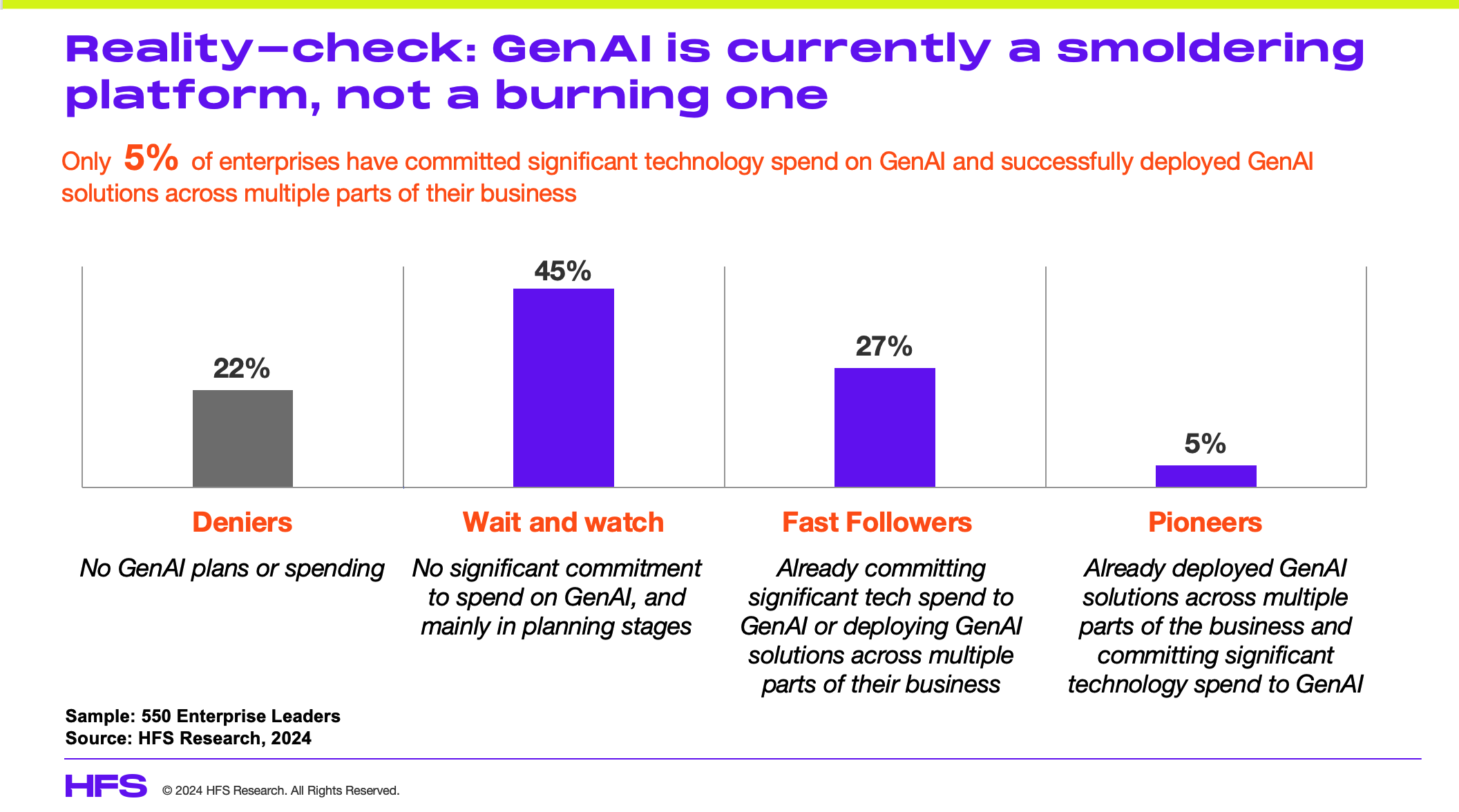
However, our new research* covering a quarter of the Global 2000 shows things have not moved as fast as many of us were expecting, with only 5% of enterprises committing significant technology spend on GenAI and successfully deploying GenAI solutions across multiple parts of their business, and two-thirds doing practically nothing:
So, what will spark enterprises to move faster with GenAI and keep it from the graveyard of so many previous technology “innovations”?
The big problem with any type of new tech, since John Mauchly initiated modern computer programming in 1949 with Short Code, is that business folks dump it into the tech people to figure out and implement for them. While they get excited at the tech’s potential impact on their businesses to be slicker, smarter, and more competitive, they do not believe they need to get pulled deep into the technology to understand exactly how it can do it and what the business needs to do to exploit it.
This is why so many businesses got sold down the river with cloud migration during the pandemic and RPA just prior. They bought into the vision the technology firms were selling but gave it to technologists to implement that vision without changing how they ran their businesses to drive that change.
As Microsoft CEO Satya Nadella recently bemoaned, the uptake of AI “hinges on other companies doing ‘the hard work’ of changing their cultures.” Easier said than done, Satya, but perhaps Microsoft needs to invest in fast-track change management services to help your clients buy more CoPilot licenses?
Enter GPT-4o… another iteration of GenAI that just took things to a much more human level
The one thing that has been consistent since ChatCPT 3.5 was launched in November 2022 has been the continual proliferation of LLMs and the capabilities of the technology. However, it is the latest iteration of GPT that makes the biggest advancement yet and will surely wake up the majority of enterprise leaders as we pointed out when GPT-4 hit the streets last year.
Multimodal makes everything much more human. The thing I am loving about GPT-4o, apart from being twice as fast as GPT-4 is the “omni” or multimodal capability to bring text, vision and speech into the same neural network. With GPT-4, these were processed separately, with voice being transcribed into plain text, which erases the nuanced information from the LLM; so all the tone and emotion captured in an audio format are now reduced to plain boring text. Net-net GPT-4o can process images, audio, video, and text simultaneously. GPT-4 could only process text and images. In effect, old GPT was like texting a friend, GPT-4o is like calling a friend.
Real-time human-2-machine conversation is now possible. In short, we are able to converse naturally without first converting words to text, with real energy, emotion, and expressiveness. We’ll also be able to interrupt it, have it change its tone of voice, and respond with emotion. The whole nature of collaboration with machines has gone to a new level.
Enhanced multilingual support and capabilities. GPT-4o has greatly improved the quality and speed of ChatGPT’s international language capabilities compared to previous models. It can communicate fluently in dozens of languages, making it accessible to more users globally. The model demonstrates more robust performance in non-English languages and translation tasks. Combined with its human-like chat and collaboration, surely the excuses to invest in generative customer engagement are moot?
It really does have human eyes now. GPT-4o can read the expressions on people’s faces and judge their emotions by simply pointing your iPhone camera. This thing really does have eyes that process what we see beyond transactional images. While GPT-4 had optical potential, GPT-4o is making AI optical capability much more real.
It’s being incorporated into Apple’s iPhone and Google’s Android operating systems. The earlier version of ChatGPT Voice available in the iPhone and Android app allowed you to converse with the AI in a relatively natural way — but it wasn’t listening to what you were saying; rather, it converted it to text and analyzed that instead. Hence, Siri and Google Assistant should soon be becoming much more human than their current transactional forms, which most of us turn off because they’re just so useless.
Summaries are concise and relevant. GPT-4o provides summaries of conversations and searches that are very accurate in both tone and length, while GPT-4 often produces inaccurate language and tone which require a lot of supervision to get right. Is this finally the end of legacy Google search and bad call transcripts? Surely disruption of legacy text strings is now in full play?
Visual interpretation and data tables are much more usable and accurate, ready to support business needs. It accurately converts image data into a clean table format without misinterpretations. It is precise in converting text and data, while previous versions made a lot of inaccuracies. Research capabilities are more detailed, provide more accurate breakdowns of data and analysts, and provide real practical examples. Do we really need to keep relying on clunky old data and analytics tools that require so much manual manipulation to get what we need?
Image generation capabilities are just so much sharper. GPT-4o is more visually appealing and produces conceptually accurate images. It is much more usable for enterprise projects needing high-quality visuals than what we have experienced using the current versions of Dall-E (for example). GPT-4 gave us a taste but now we surely we now are seeing the potential to create content ourselves without the need for expensive agencies and outdated complicated software packages?
The cost of accessing its APIs is 50% cheaper. OpenAI has clearly realized its costs are holding back wary enterprises and is now pushing 50% less cost for many of its core APIs, such as Chat Completions API, Assistants API, and Batch API. Are we finally going to be freed from decades of legacy software, abhorrent license fees and meaningless code bases?
Coding is vastly improved. So far, many developers are lauding the improvements in GTP40’s ability to solve many coding projects, such as multiple thousand lines of code in under 10 minutes, which previously took prompt engineering processes many hours. It can also create multiple apps in Python that the previous version struggled with. According to one developer, “4o not only solved it and provided clear concise dissection of the solution. 4 can be easily tricked into going down a death spiral it does not know how to backtrack correctly. OpenAI did incredible improvements to 4o. I can see Model 5 gonna start to get rid of human programmers for good.” We recently discussed how GenAI is already making radical improvements to human-heavy legacy code development, and these new advancements are reinforcing the end to legacy coding as we know it.
The Bottom-line: Just as we were giving up the ghost on GenAI, it becomes more human than ever
I am one of the biggest cynics when it comes to tech innovation and business change because of one reason—there needs to be a bloody great burning platform to force businesses to adopt. With GPT-4o, many of the reasons for murdering the technology in this death spiral of a thousand pilots have been the inability to adapt it to so many business scenarios. Ambitious C-suites will clamor louder than ever to see this AI tech immersed into their organizations and will seek leaders to defrost their frozen middle ranks to make this happen for them. Your job may not be replaced directly by AI, but you will more likely be replaced by someone who knows how to use AI if you don’t wake up and get with the GenAI program.
To conclude, I will go back to the main excitement behind GenAI… it is disruptive because it helps us create new data and new content. But it needs to become an extension of our humanness to do that, not merely another technology tool that can add some value in bits and pieces. Having multimodal capability that brings speech, text, video, and content together in one neural network that we can communicate with in real-time and immerse into our day-to-day activities is the game changer we have been unwittingly waiting for. Now it is here, and we can only imagine how quickly this will keep evolving as OpenAI, Google, Anthropic, Apple, Microsoft, NVidia, and co keep pumping all their investments into this emerging tech.
* The survey was conducted in collaboration with Genpact. We will be releasing the full study on 5/22
Cognizant’s bold $1.3B acquisition of Belcan isn’t just a headline grabber; it’s a game-changer in an IT services market that’s hitting a plateau:
Growth Catalyst: Engineering services, where Belcan excels, is the rocket fuel Cognizant needs. While IT services see modest gains or losses between -5% and +5%, engineering services are soaring with growth rates over 10%.
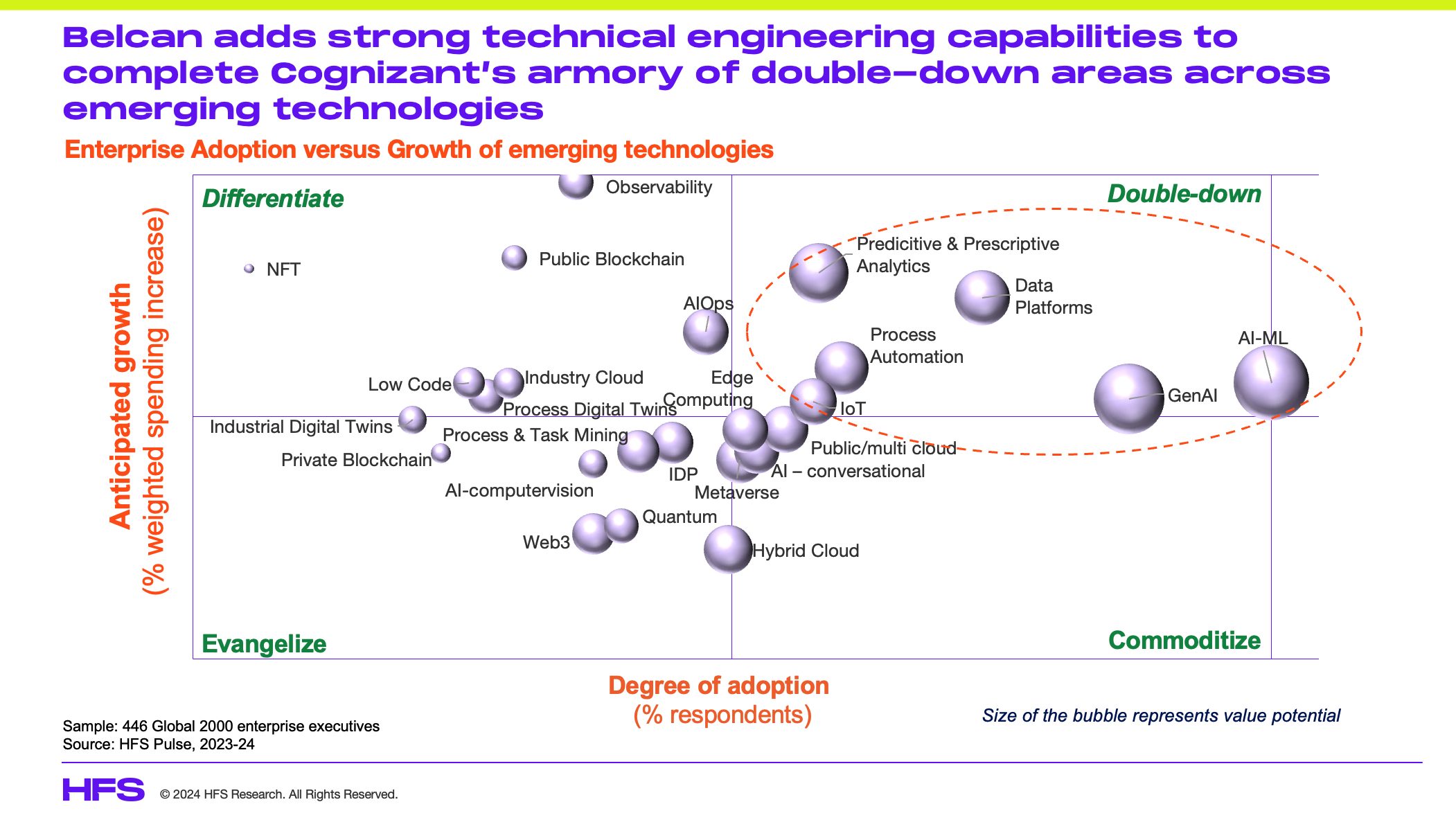
Tech Arsenal Upgrade: Belcan’s technical engineering services prowess adds serious firepower to Cognizant’s already robust suite of emerging technologies and digital engineering capabilities. With formidable AI, automation, and analytics capabilities, Cognizant now stands tall across all high-growth, high-adoption technologies:
Diverse offerings and domain expertise: Belcan brings expertise in both engineering and traditional IT development, testing, and integration capabilities across Aerospace and Defence, Automotive and Industrials. This strategic expansion and capability addition in global locations complements Cognizant’s existing technology expertise.
Niche Industry skills: Belcan brings deep technical expertise in high-precision sectors of Aerospace and Defence, Automotive and Industrial – industries where subject matter expertise is crucial to delivering complex projects. These industries are investing in digital threads, MBSE, integration of operations and enterprise technologies, building sustainable solutions and supply chain resilience which is Belcan’s sweet spot.
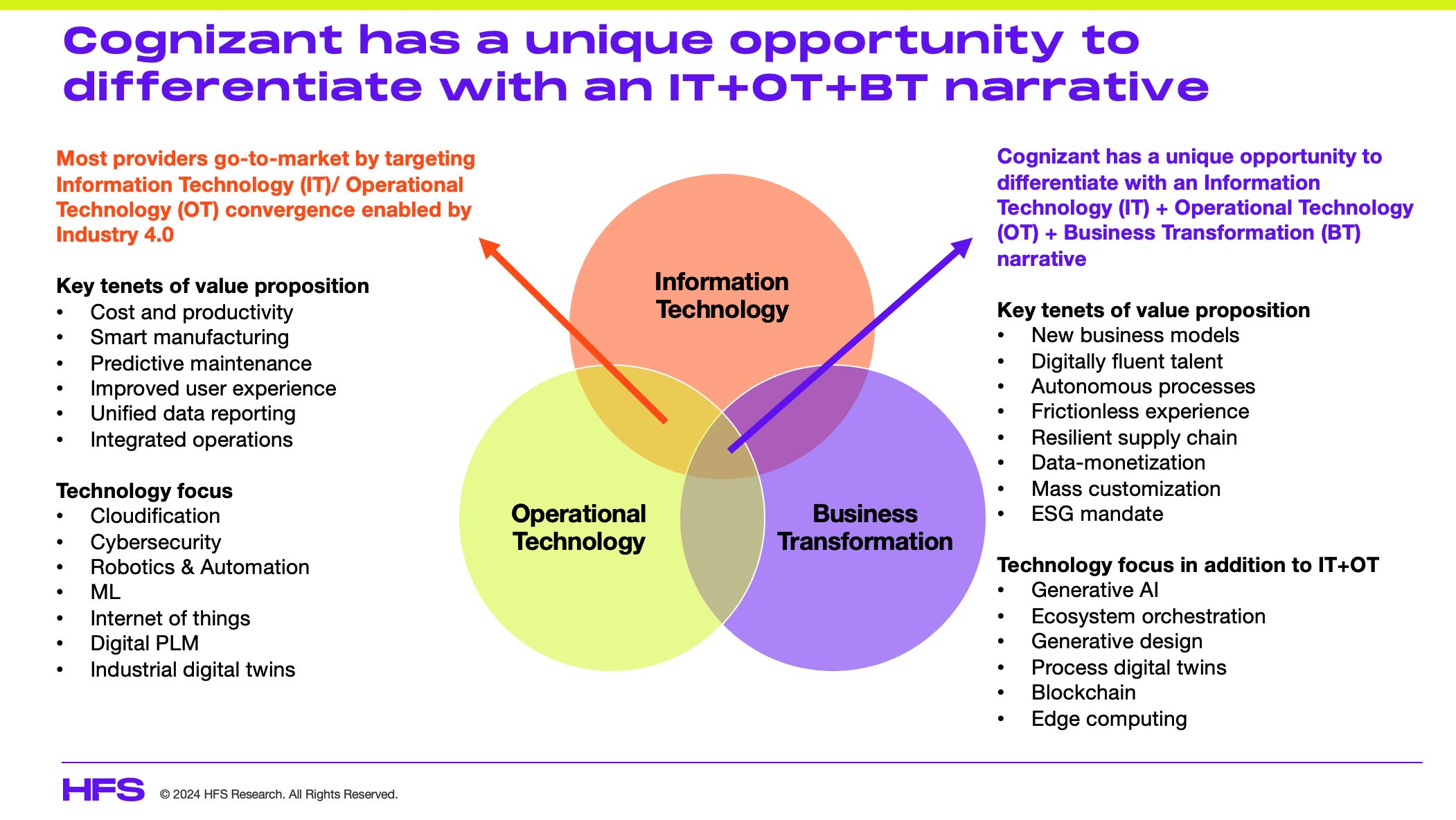
Strategic Differentiation: In these asset-heavy industries, Belcan’s expertise gives Cognizant a unique edge in large-scale transformational deals. This expands Cognizant’s digital transformation capabilities into aerospace and defense industries that are currently in a growth trajectory and are undergoing technology disruptions, compelling them to think of new product development, efficiency in operations, and business model transformation. This acquisition positions Cognizant as one of the few major players capable of seamlessly integrating IT (Information Technology), OT (Operational Technology via Belcan), and BT (Business Transformation) (See below). Only a few service providers, like Accenture, HCLTech, Infosys and Capgemini, can boast a similar trifecta:
Historically, Indian heritage service providers have struggled with large mergers. But if Cognizant can bridge these gaps, this acquisition could redefine the competitive landscape. However, all this hinges on seamless integration—no small feat given both firms are very different:
Geographical Divide. Belcan’s workforce is predominantly North American, while Cognizant’s strength lies in its substantial Indian presence. Although the value proposition is different, this integration should be similar to Capgemini’s integration of iGate, where European consulting norms were merged with an Indian IT culture.
Budgeting Clash. R&D budgets, Belcan’s domain, operate under different dynamics compared to IT budgets, which are Cognizant’s forte.
Reduce dependency on financial services and healthcare. Cognizant has a high revenue dependency on the financial services and healthcare sector—almost 60% of its revenue comes from these two highly regulated sectors. This deal will help Cognizant diversify its revenue mix. Additionally, the aerospace and defense sector is riding tailwinds due to the demand for travel and geopolitical conflicts.
Major opportunities this acquisition creates for Cognizant
The investment price is reasonable and the investment is almost 100% additive in revenues. The $1.29B acquisition price is very competitive, adding an estimated $800m in incremental revenues to Cognizant, of which 40% is in product engineering and 35% in embedded software. This broadens Cognizant’s offerings far beyond its mainstays of healthcare, life sciences and financial services, which are struggling for future growth in traditional IT services markets.
The post-investment merger is set up to drive synergies and continuity. Cognizant will now boast a $1.8B global engineering services practice under the leadership of renowned Lance Kwasniewski, which includes the acquisition of embedded software firm Mobica early last year. In a similar vein to Jason Wojahn becoming leader of Cognizant’s ServiceNow practice with the Thirdera acquisition, HFS sees this as the smart strategy for Ravi Kumar to expand his team by retaining key leadership talent to continue driving the businesses they built. This helps blend the cultures, retain key talent and ensure continuity.
The aerospace and defence market opportunity is spectacular. The aerospace and defense market is booming in terms of commercial, private, and government spending, which HFS estimates at surpassing $800B this year and $1T in two years’ time. There is also a strong demand in MRO services in the industry and because of Belcan’s OEM experience with clients like Boeing, Airbus, and Lockheed Martin. Belcan is able to service this demand effectively. Being in a position to deliver AI, technology, embedded software, and technical engineering services is a real additive area for Cognizant to exploit in this high-growth sector full of both large enterprises and hundreds of mid-sized subcontractors.
Seizing opportunities in automotive, E&U and industrials sectors, which are going through technology shifts. These industries are investing in new product development and optimizing their manufacturing process and their supply chain, which need industry domain and technical expertise as it is complex high-precision engineering. For example, to seize product engineering opportunities a provider must have capabilities in aircraft design, avionics, propulsion systems and defence technologies in the A&D industry. Similarly, capabilities in vehicle design, powertrain development, and autonomous systems are needed to grab opportunities in the growing SDV and electric vehicles market. The acquisition builds an industry-focused differentiator and is an opportunity to build next-gen technology solutions for Cognizant.
The offshore opportunity is still fledgling and positions Cognizant very strongly. Boeing, Airbus, Collins Aerospace, Pratt and Whitney, Lockheed Martin, and Thales in the A&D sector, and similarly, ZF, Hella, BorgWarner, Volvo, Hyundai, Stellantis, and Ford in the automotive sector have set up GCCs in India. There is also a significant focus on the expansion of engineering-centric GCC centers in India right across manufacturing and other verticals. The market is ripe for expansion, with Cognizant in a very strong position to take on these services.
The opportunity to take engineering and embedded software capabilities into other industries is clear. Huge industries such as medical devices, household electronics, and automotive technologies are rife with demand for embedded software, product engineering, and supply chains. With Cognizant’s focus on bringing Engineering, OT, IT, and BT together, there is a clear roadmap for growth, provided the firm can bring together the differing skills, cultures, and client needs effectively as a holistic and integrated capability.
Bottomline: Cognizant now has a seat at the engineer’s top table, but now needs to ensure it stays there
The deal strengthens Cognizant’s already existing technical expertise and deepens client relationships, creating major new market opportunities. This also puts Cognizant on the industry map for large-scale transformations with strong emerging technologies capabilities, making the firm a formidable player in the engineering services industry with domain and technical expertise. All Cognizant now needs is to cross the integration milestone seamlessly to build on this considerable momentum.
In response to disruptive global events such as geopolitical tensions and continuously changing shipping guidelines, enterprises are increasingly prioritizing making their supply chains resilient and agile. There is a significant emphasis on digitalization, integrating AI, IoT, and analytics technologies to improve network transparency, efficiency, and security. Sustainability has also become crucial, as businesses aim to minimize environmental impact and uphold ethical practices in their supply chains. These changes not only address regulatory pressures but also align with consumer expectations for responsible business practices. Overall, these shifts are transforming supply chains into more dynamic, interconnected, and accountable systems capable of meeting the complex demands of the modern global market.
There’s a growing trend toward creating collaborative ecosystems that include suppliers, partners, and even competitors. This approach leverages shared technology platforms and data insights to collectively drive efficiencies and innovate supply chain solutions.
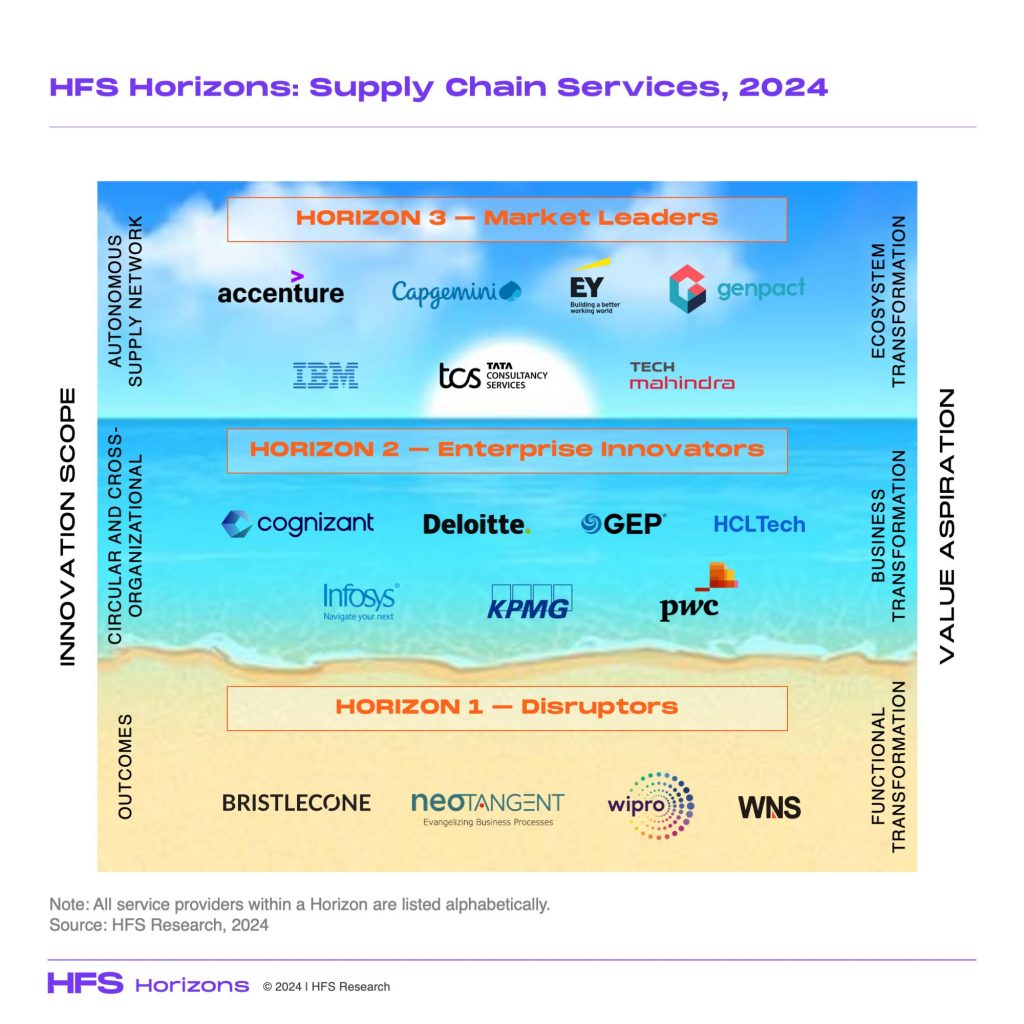
In the HFS Horizons: Supply Chain Services 2024 study, 18 supply chain services providers are analyzed and profiled. Seven of these providers are identified as leaders in Horizon 3, focusing on ecosystem collaboration. Seven are identified as innovators in Horizon 2, excelling in cross-functional alignment, and four are identified as disruptors, primarily working on function-level transformation.
Exhibit 1: 68% of upcoming supply chain investments in the next 2 years will be in Horizon 3
New service offerings coming into the fray
Generative AI integration: There’s a significant push toward integrating GenAI across various facets of supply chain management, from planning and logistics to customer interaction and compliance. This technology is expected to enhance automation, improve decision-making, and create more dynamic and responsive supply chain systems.
Sustainability services: Providers are increasingly offering services to achieve sustainability goals, such as carbon footprint reduction, lifecycle assessments, and sustainable sourcing strategies. These services are crucial for companies aiming to meet regulatory requirements and consumer demands.
Digital twins and advanced analytics: The use of digital twin technologies and advanced analytics is being expanded to offer more detailed insights into operations, enabling predictive maintenance, and optimizing supply chain resilience.
New buying patterns are surfacing
Shift toward subscription and as-a-service models: There’s a noticeable trend toward subscription-based and as-a-service purchasing models. These models provide flexibility, reduce upfront costs, and align with the increasing preference for OpEx vs. CapEx expenditures in corporate budgeting.
Increased demand for customized solutions: Enterprises are looking for solutions they can tailor to their specific needs, reflecting a move away from one-size-fits-all offerings. This customization is particularly prevalent in areas such as AI implementations and data analytics services.
New scope of work on the table
Global expansion: Organizations are increasingly designing supply chain solutions to support global operations, with a focus on integrating cross-border supply chains and managing international compliance and logistics challenges.
Focus on resilience and agility: Services are being developed to enhance the resilience and agility of supply chains, enabling enterprises to respond more swiftly to market changes and disruptions. This includes tools for better risk management and dynamic rerouting of logistics in response to external shocks.
New operating models being adopted
Collaboration across sectors: There’s an increasing emphasis on collaboration across different sectors and industries to optimize supply chain operations. This involves partnerships with tech companies, logistics firms, and even competitors to pool resources and capabilities.
Leveraging big data and IoT: The scale of supply chain operations is expanding with the integration of IoT and big data. These technologies enable teams to handle vast amounts of data across extensive networks, improving real-time decision-making and operational efficiency.
The Bottom Line: The shift toward deeper digital integration and an evolved operating model is transforming human-dependent supply chains into low-touch collaborative supply networks.
There has been much progress with life expectancies, health outcomes, and access to care across the globe—although it is inconsistent. Therefore, it should be unsurprising that the triple aim of care (cost, experience, and health outcomes) remains elusive in the US and worldwide. Still, the post-pandemic years have seen significant progress in applying technologies smartly and an attitudinal shift to experiment in a regulated industry.
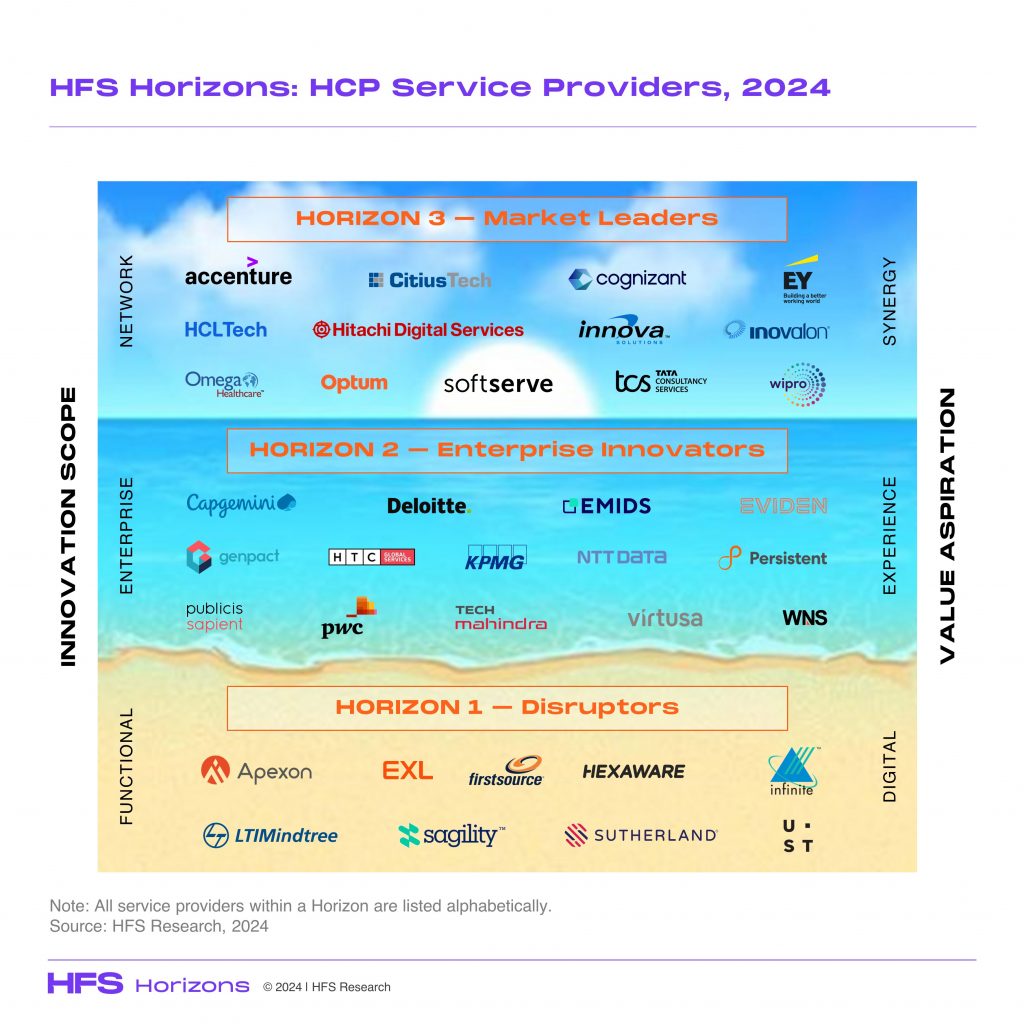
Exhibit 1: The increasing number of service providers capable of addressing the triple aim of care is reflected in the large cohort of Horizon 3 placements
Financial pressures take center stage for health systems and hospitals
The end of the pandemic-driven stimulus has returned healthcare providers to a new reality with even greater pressure to remain above water financially. Given the deteriorating health outcomes in the US and other large population centers, demand for care is increasing. This is why providers must discover a way to meet the demand in a cost-optimum manner.
The desire to improve the point-of-care experience and drive connectivity in a post-care scenario is growing to drive retention and value-based care (VBC) outcomes. Providers are becoming more open to technology-enabled innovation to improve productivity, health outcomes, and financial woes.
Lastly, there has been a material increase in outsourcing and offshoring for services and technology enablement, an acceleration over the past few years driven by the need of the hour and the supplier landscape.
Service provider capabilities and attitudes shift toward the possibilities
Service providers have improved their ability to address complex clinical and financial challenges by attracting talent from the industry, investing in key technologies, and becoming bolder in their market approach. Many service providers have significantly expanded their delivery footprint across the globe, addressing new markets and solving distinctly local problems.
The sophistication of capabilities leveraging technology to predict a pneumothorax, prevent diabetes, or facilitate food as a prescription adds an incredible new lever in the marketplace to help health systems and hospitals fight diseases.
Despite progress, opportunities continue to be missed to address the triple aim of care
While many service providers have the capabilities to address all attributes of the triple aim of care and have ample evidence to showcase results, health systems and hospitals remain entrenched in the legacy paradigm of addressing episodic symptoms rather than holistic health.
The bias toward acute care has translated into ignoring and underserving primary care, post-acute care, and rehab (physical therapy, substance abuse treatment). Technology adoption in the non-acute care space for electronic health records and revenue cycle management is below 50%, indicating a huge opportunity to remediate and support basic healthcare.
The Bottom Line: Those who help save lives need help keeping their businesses alive so they can positively and consistently impact the triple aim of care.
As the US and world population ages rapidly, climate change’s implications for health become acute, and clinician shortages are exacerbated, implementing creative ecosystems and improving how we address health and deliver care equitably has never been more urgent. The contemporary paradigm is a legacy sick-care construct ill-suited to the 21st century. We all need to lean in to reimagine and do it fast to move the triple-aim needle.
Manufacturers are striving to achieve better visibility into their daily operations, from sourcing and design to factory operations and the various departments involved. They are taking steps to modernize their operations with infusion technologies such as digital twin, the internet of things (IoT), 6G, 5G, cognitive robotics, artificial intelligence (AI), machine learning (ML), and digital thread and standardization of enterprise resource planning (ERP) and manufacturing execution systems (MES) to achieve operational clarity. At the same time, manufacturers are working to make the supply chain more resilient and adopt sustainability practices with evolving regulatory and compliance requirements to create a well-rounded, sustainable manufacturing value chain. Manufacturers are looking to drive digital transformation with a consistent focus on efficiency and building resilience across the value chain.
HFS’s newly published Manufacturing Intelligent Operations Services reportexplores the capabilities of the industry-leading service providers, enabling manufacturers to achieve their goal of autonomous manufacturing and sustainable practices, making operations efficient and resilient.
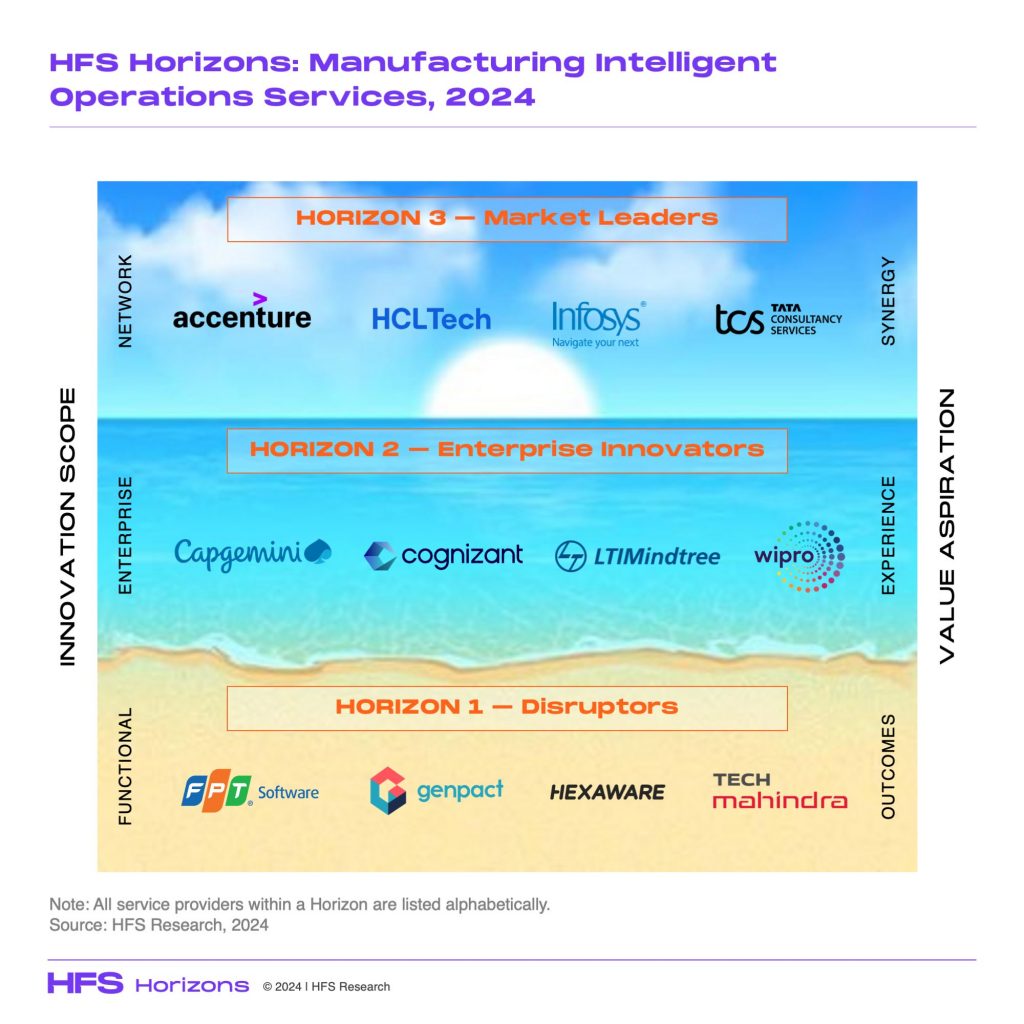
Exhibit 1: Manufacturing Intelligent Operations Services Report, 2024, evaluates the capabilities of the 12 service providers across the horizons
Strengtheningthe foundation for intelligent manufacturing with data and technology collaboration
To achieve the goal of integrated manufacturing processes, establishing a data-driven business model is essential. Manufacturers must put data at the heart of their operations, going beyond simply regular reporting. Manufacturers need to integrate data from across functions, breaking the silos to optimize shop-floor operations and drive innovation and real-time decision-making. Thus, the convergence of information technology (IT) and operational technology (OT) has become crucial in gaining access to comprehensive real-time data for better decision-making and assessment of processes on the shop floor.
Real-time data from the convergence of IT and OT also enables the seamless implementation of digital twin and digital thread, creating a connected ecosystem. Digital twin enables all involved stakeholders to visualize a digital replica of an operational asset or manufacturing facility. It creates a unified environment that helps to eliminate silos while enabling data centralization from multiple sources, such as sensors, machinery, and enterprise systems. And digital thread helps to establish traceability and connect data throughout the manufacturing lifecycle. Together they break down communication silos and establish a continuous loop across the manufacturing value chain.
It is crucial to bridge the IT and OT divide to create a data-driven culture, support technology transformation, and enable real-time visibility into end-to-end shop floor operations. Service providers are supporting manufacturers in driving collaboration between IT and OT data by integrating unified digital platforms to increase operational efficiency.
Building partnerecosystem to enhance capabilities and drive innovation
Service providers are building robust partnerships and strategic alliances to builda strong delivery ecosystemthat supportsevolving customer requirements and constantly changing market dynamics. Service providers are building alliances with niche players, hyperscalers, startups, industry bodies, and academia to drive innovation, foster digital capabilities, and deliver value to clients. This not only enables them to build innovative solutions around emerging technologies but also to leveragea vast pool of talent in driving digital transformation. This establishes that service providers are continuously aiming to evolve with the rapidly changing industry and customer demands and requirements and tap into new growth opportunities.
Resilient supply chains and sustainabilityare becomingkey priorities
With supply chain challenges causing recent disruptions, manufacturers are increasing investments to gain supply-chain visibility. Simultaneously, increasing regulatory pressure is driving manufacturers to adopt circular economy and decarbonization practices, including:
Service providers are building connected and intelligent supply chain capabilities by analyzing operational requirements and integrating technologies such as predictive analytics, AI, and digital twins to optimize and gain real-time visibility into processes.
Service providers have also geared up to help manufacturers mitigate risks related to carbon footprints, waste reduction, energy management, pollution management, and green supply chains.
The Bottom Line: Service providers will need tocontinue to orchestrate smart manufacturing strategies to drive end-to-end digital transformation across the manufacturing operations value chain, striving for efficiency
We’ve finally reached the point in our careers when we need to learn new and more ingenious ways of doing things. No more papering over the cracks, no more passing the problems onto someone else to fix. WE are the problem that now needs fixing.
For decades, we’ve been throwing trillions at our enterprise operations, namely ERP systems, data warehouses, RPA, software engineers, process architects, etc. But to what end? To eke out some more efficiency here, rinse out some cost there? Move some data around a bit faster? Are these solutions still relevant by the time you’re done? Or is there always a new, shinier option capturing everyone’s attention?
It’s time to reinvent our whole mindset toward enterprise operations to save ourselves from drowning in our legacy pools of technology, process, data, skills, and culture.
Yes, we’ve been predicting the extinction of the corporate dinosaur for a while now, but we’re truly arriving at the time when tired old businesses will be displaced if they persist on limping along under the sheer weight of valueless technology and transactional people, determined to cling on to the “way we’ve always done things.” Your firm will sink under its ability to change anything, it’ll become increasingly uncompetitive, and you will go down with it groping for air, wondering why you suddenly lost your corporate relevance.
GenAI is the closest we’ve come to bridging the business/IT chasm
Eighteen months into the most significant technology rush since the ERP heydays, GenAI has the potential to change the game entirely because this is the first time business leaders can think like application developers to create new content, to access critical data, to command better ways to get things done, and so on.
Its ability to analyze unstructured data, create content, and qualitatively analyze and make recommendations is striking. The pace of model evolution and compute power is quickly advancing the technology to the point we are beginning to believe that GenAI-enabled middleware and frontend solutions may replace existing business process applications.
The big question now is whether business owners who clearly own innovation can reinvent how their companies operate or whether they are too burdened by three decades of technology, process, data, and culture debts.
Generative AI is your secret weapon. It tears down barriers, fuels innovation, and keeps you ahead of the curve. Adapt or perish – the choice is yours.
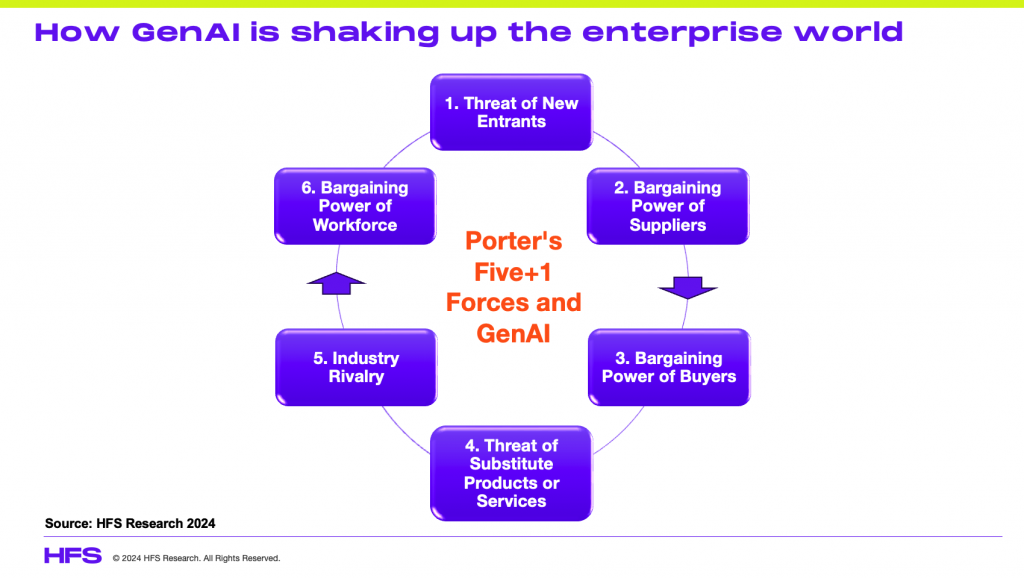
Using Michael Porter’s Five Forces (+1) framework, let’s break down how generative AI (GenAI) is shaking up the enterprise world:
Threat of New Entrants: Smashing Entry Barriers. GenAI lowers technical and operational barriers for new entrants. OpenAI’s APIs, for example, enable startups to integrate powerful AI without heavy R&D costs, allowing them to compete with established giants. Brace yourself for an influx of AI-driven competitors, like how Grammarly leverages advanced AI to disrupt traditional proofreading and writing tools.
Bargaining Power of Suppliers: Breaking Supply Chains. AI’s predictive and analytical powers disrupts traditional supply chains by eliminating middlemen. Farmers Business Network (FBN) uses AI to provide farmers with data-driven insights, price transparency, and predictive analytics, enabling direct and cost-effective purchasing from suppliers. This leads to significant cost savings, increased efficiency, and greater empowerment for farmers.
Bargaining Power of Buyers. Mass Personalization of Customer Experience. Mars drives mass personalization in its pet food business using generative AI by analyzing data on pet health, preferences, and behaviors to create tailored nutrition plans. Through platforms like Kinship, Mars offers customized pet food recommendations, enhancing customer satisfaction and loyalty.
Threat of Substitute Products or Services. This is where disruptive innovation comes into play. Adobe’s AI-powered tools, like Adobe Sensei, allow users to create stunning visuals and designs effortlessly, outpacing traditional design methods.
Industry Rivalry: Productivity on steroids. With AI-driven automation, efficiency skyrockets. Amazon’s use of robots and AI in warehouses has revolutionized logistics, intensifying industry rivalry. GenAI provides killer insights; retailers like Zara use AI to analyze market trends and consumer behavior, enabling them to react swiftly to fashion changes and outmaneuver competitors.
Bargaining Power of Workforce (our Bonus Force). New Workforce will not accept Old. The next generation of employees won’t settle for outdated systems and processes. GenAI is to work what calculators are to math – indispensable. Companies like Google and new startups attract top talent not only with higher pay but also by avoiding cumbersome processes and systems that make work dull and boring.
It’s time to effect real change and write off our painful legacies if we want real innovation
Do you believe your current IT department, whose massive budget is 80% allocated to keeping the lights on, is your firm’s best investment toward achieving your goals?
Do you believe that outsourcing your F&A team has solved your business problems? Do you think your 7-year global ERP suite implementation has kept pace with the changing needs of your business over this time? Considering breakthrough GenAI capabilities, it’s time you reflect on this – it’s not too late to make radical changes to keep yourself relevant and reshape your business function as we stumble face-first into the Generative Era.
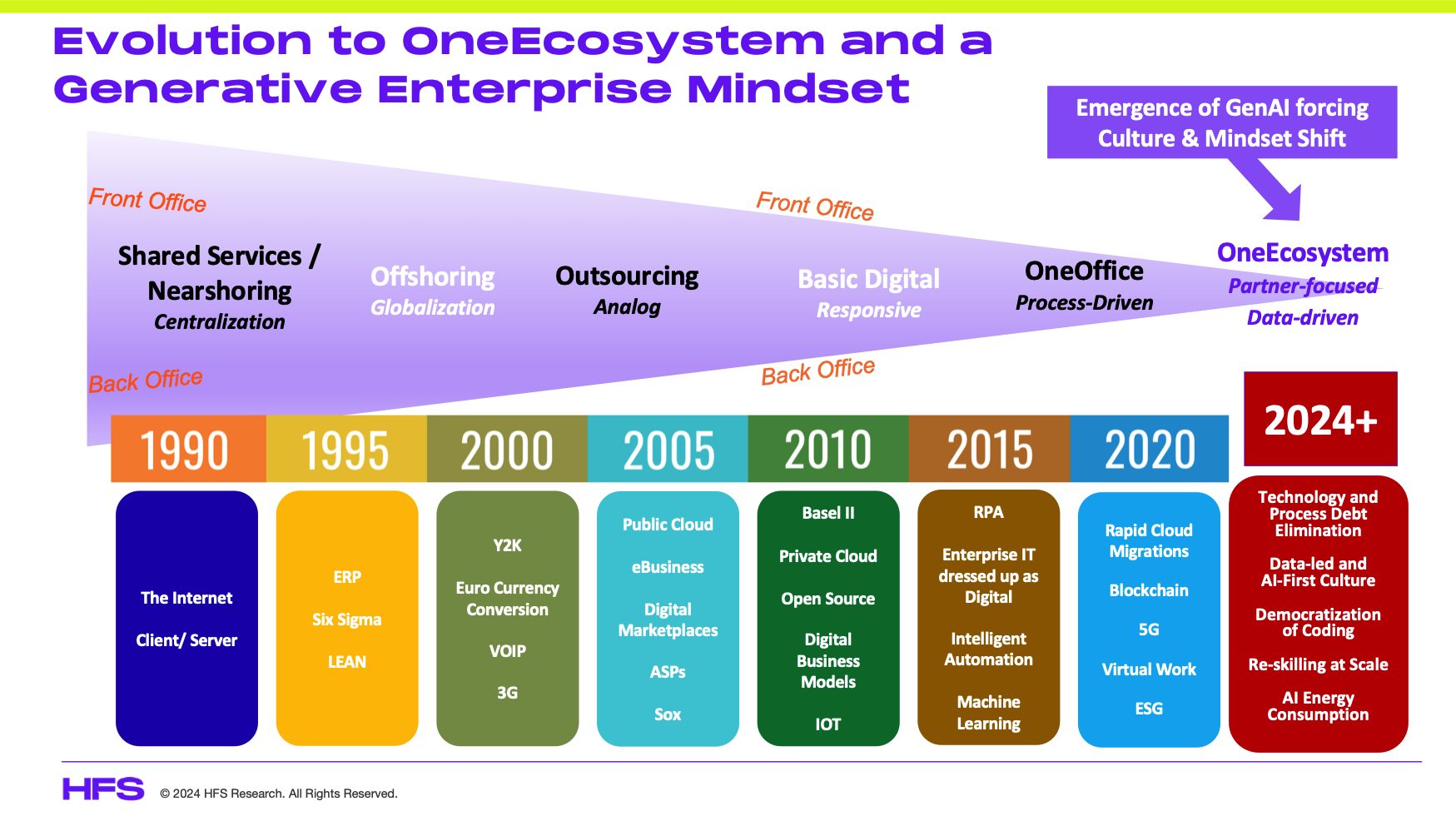
Over the last three decades, enterprises have implemented organizational models and technologies that perpetuate existing processes based on operating models dating back to the 1990s – and some even as far back as the Second World War.
We have to quit funneling most of our tech funds into maintaining legacy business processes
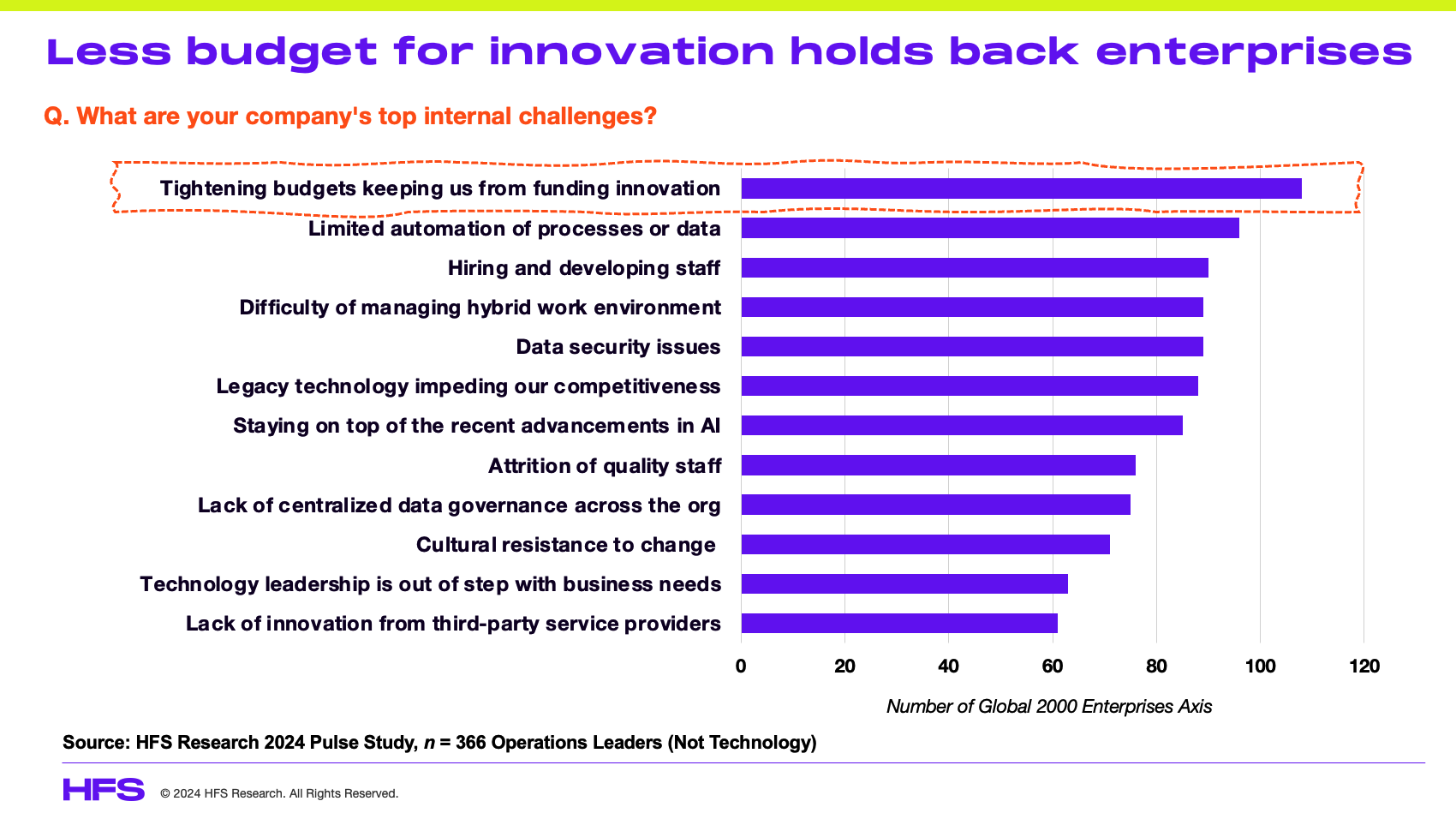
Despite trillions of dollars spent over the decades, process automation and data remain a stark problem. Our latest data on this topic, in which 366 operations leaders (not technology leaders) identified their companies’ top changes, clearly indicates this while also citing that they don’t have the budget to fund the innovations they require.
Business applications become saviors of the business
If all we’re going to do is outsource work, strap RPA robots into the pilot seats, and replace old technology with new technology that processes widgets in similar ways, consider for a moment if these incremental approaches funded by loose pocket change will ever be enough. Even among the large-scale technology programs that take years to complete (do they ever really end?), are the solutions still relevant by the time you’re done? Or is there already a new, shinier option capturing everyone’s attention?
Decidedly, business leaders are voting with their wallets as they flock to specialty applications full of features ERP vendors can’t produce and relatively minor implementation costs. Business leaders are leaving behind big SAP and Oracle ERP worlds that increasingly are little more than glorified “systems of record.” ERPs are no longer strategic assets, despite their eye-watering 9-digit implementation and proportionately large maintenance costs weighing down companies’ financials like boat anchors. Undoubtedly, every CFO has felt the “replace it with Workday” push, but they are hesitant because the future has shifted elsewhere.
ERP systems have largely become the dull data layer beneath a raft of specialty functional applications orchestrated by Salesforce, Pega, ServiceNow, Zip, or Outsystems. It doesn’t matter what SAP and Oracle implement from a functionality or GenAI perspective – their clients are looking at true business applications for innovation. However, these once-affordable platforms’ sales teams are pushing hefty price hikes onto clients who now hold increasingly less love for them as a result. This has led to a new group of technology providers, like Unqork, who are marketing, “Why pay the big ticket, ever-escalating prices of specialty application pricing when you can build it yourself to your exact specifications in our low code systems?”
Yet, the dark secret of many business applications is that they simply replicate the old processes in a SaaS environment. Consider for a moment if your company changed its approach to sales because it implemented Salesforce, changed its performance management program when it implemented Workday, or changed its T&E process when it implemented Concur. All the old work methods were replicated into easier-to-use, flexible, lower-cost systems now owned by the business, not IT.
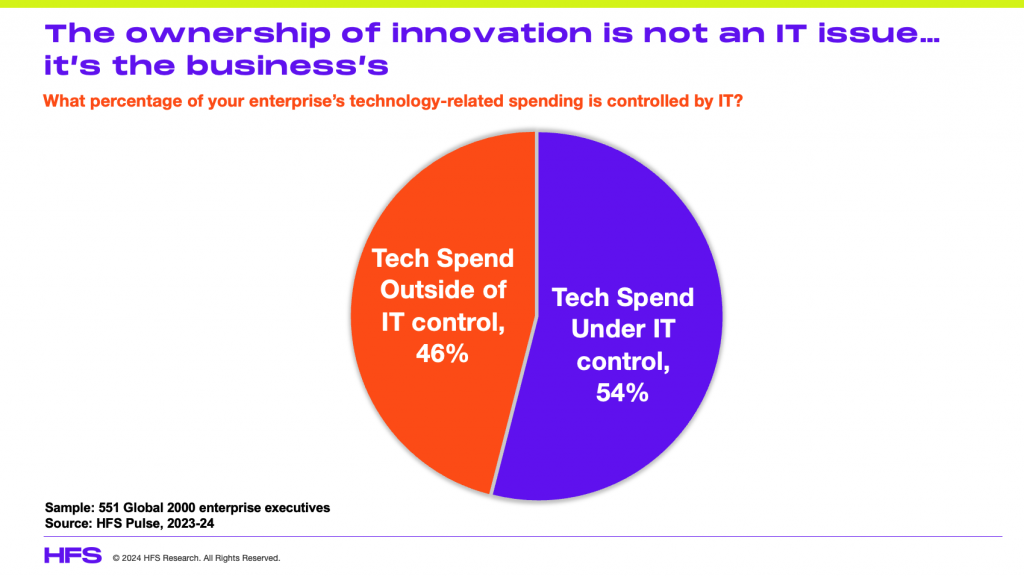
However, this is no longer IT’s fault. It’s clear who is in the driver’s seat. Whereas CIOs used to rule the roost with large ERP applications and complex data warehouse projects, business leaders now control the purse strings. Our latest data from a study of 605 organizations shows clearly that a company’s IT department controls less than half of the corporate IT spending in 46% of organizations. So, the ownership of innovation is not an IT issue; it’s the business’s.
GenAI Comes to the Forefront: Embrace it with your eyes wide open
Lest you think that GenAI is just another RPA-like hype, think for a moment about how it has already changed entire industries:
Until recently, the creative industry relied on legacy photographers and videographers to create and then enhance images and videos using digital tools, often pixel by pixel. Now, led by Adobe’s fast adoption of GenAI, an entire wave of GenAI illustration and editing tools can change whole images and videos in seconds. Still, as powerful as this is, GenAI’s ability to create hyper-realistic images and videos catered to narrowly specified requirements threatens the entire workforce, forcing workers to scramble to recreate themselves and spawning new developments in intellectual property law and deep fake detection.
In the world of education, long reliant on the legacy of dusty libraries, lengthy essays, and math drills, professors and teachers realize that GenAI is a threat to homework and how people learn. Professors and teachers now rely on GenAI to build courses, lesson plans, and assignments once sold online and part of the textbook industry. But what good is any of that if anyone who wants to learn anything can, with a handful of prompts and access to the world’s entire knowledgebase, do the same, and then learn anything and even obtain feedback on their work? What is the point of the university and training industry if learners can generate more effective, tailored learning models than teachers can?
The social media influencer industry is being turned on its head by GenAI. While the industry is impacted similarly to the creative industry, more and more social media accounts are being created and run by ChatGPT hustlers that use GenAI capabilities to analyze audiences and competitors, and then generate social media designed to drive engagement. An untrained influencer can create blogs, email campaigns, images, and advertising copy in seconds, empowering teams to create faceless virtual influencer accounts. While these clout chasers may only have fringe impacts, realize the same revolution is occurring in the legacy advertising industry amid upheavals affecting the same topics, which we know as copywriting, audience data analysis, market research, and search engine optimization. The people-centric professional services industry is undergoing radical change.
It is important to note that these real-world impacts are on white-collar workers long entrenched in antiquated work practices. Innovative business leaders are leveraging GenAI’s power to completely change how their industries operate
These same impacts are being felt directly in the software industry. Look at every technology provider’s rush to demonstrate GenAI capabilities in every solution they have. Behind the scenes, they are struggling with their own technology and business process debts that are built into the foundations of the data models, application rule engines, and workflow capabilities built to allow clients to do the same old work with a bit more efficiency and reporting capability. How many demos have you seen showing the latest AI-powered widget in your software? Behind the scenes, they fear the dawn of a new generation of applications will have no legacy debt and be fully capable of changing the way we operate – if clients will let them.
And this is the big question. Will business owners who clearly own innovation reinvent how their companies operate? Or are they too burdened by two decades of technology, process, data, and culture debts and repeated examples of technology implementation that essentially digitally replicated exactly what once existed on paper and in file cabinets? For every dozen legacy leaders taking a “wait and see” approach to GenAI, one is changing the game, blazing new approaches to delivering customer service, financial operations, security management, strategic sourcing, and legal services.
The Bottom-line: This is Your Moment… Embrace GenAI or Die
Maybe we’re overreaching a bit. You clearly won’t die if you don’t implement GenAI to re-engineer your operations completely (though in the healthcare world, you could save lives!). But your company will fall behind your competitors. New debtless digital-first competitors will arrive. Your company’s results will start to lag and, we assure you, some other smart and creative person with some prompt training will certainly take your job.
The time for complacency has ended. GenAI represents a seismic technological shift, offering unparalleled capabilities to transform business operations. Decades-old methods of using systems to digitize old workflows provide only incremental improvements, which are no longer sufficient. Companies must embrace GenAI or risk being outpaced by more agile, innovative competitors. The era of maintaining outdated processes and technologies is over. Now, it is about revolutionizing how we work, leveraging GenAI to unlock new efficiencies, insights, and opportunities. This is OUR moment. Seize it with GenAI or face the inevitable decline. The choice is clear: innovate or…
Last Friday’s cluster &^%$ of IT outages plaguing companies globally will likely result in several billion dollars of economic impact. However, for CIOs, the problem wasn’t a security issue. Instead, this was an IT services management (ITSM) issue that caused massive disruption with companies relying on Microsoft’s Windows platform.
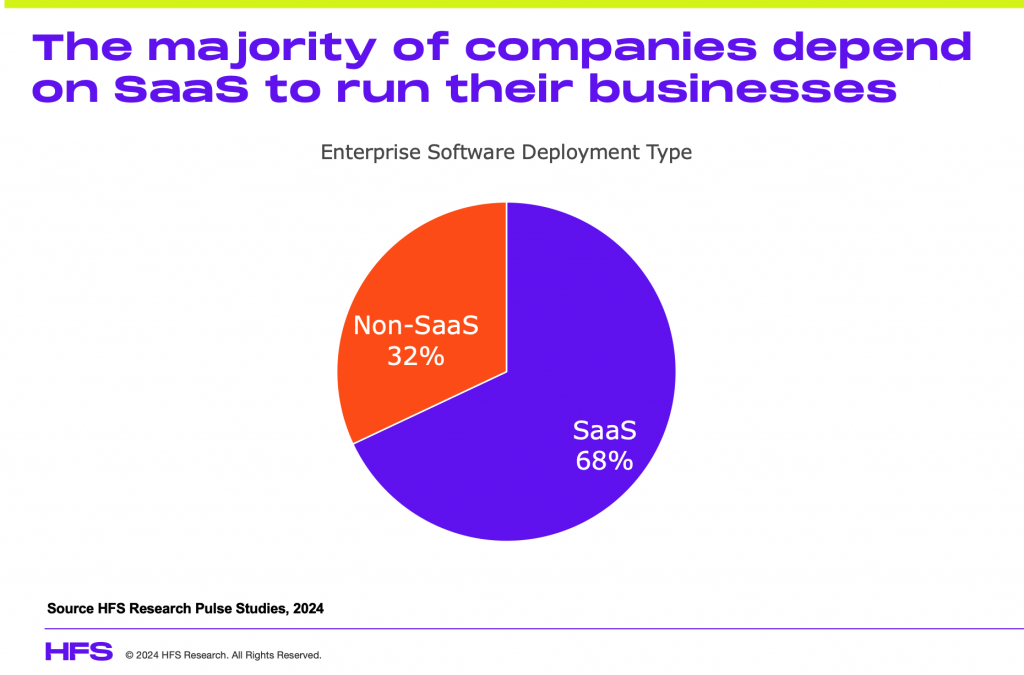
Software-as-a-service (SaaS) has become mainstream, with our research showing 68% of enterprise software is being delivered using this model today. As SaaS allows the software vendor to maintain, upgrade, and improve their solutions via their cloud delivery, updates are regularly issued as par for the course. However, as the CrowdStrike outages illustrate, many IT departments are getting too complacent, allowing their SaaS vendors to have full control of application management, updates, and automated delivery, especially when it comes to security updates. In addition, tech giants like Microsoft must be more diligent with their SaaS ecosystem partners.
This event happened as corporate IT has blindly trusted SaaS providers to patch their own solutions and assumed adequate testing and risk assessment
Friday, July 19th, wasn’t the first time there have been significant IT outages. For example, Rogers, the second largest telecom services provider in Canada, significantly impacted its customers in July 2022 with a router update from Cisco. And in 2020, SolarWind, another cybersecurity firm, dealt its customer a similar as their systems failed after an update. In the case of SolarWinds, this event has been traced back to a bad actor implanting malicious code in an update.
While companies depend on security patches to safeguard their systems, applications, and data, blindly trusting a loose federation of software companies to be mutually compliant is increasingly risky. Any IT leader worth their salt must have a process that not only governs software but also ensures that new software and patches have a modicum of testing to ensure compliance and stability. One only needs to crack open that dusty volume on the ITIL (Information Technology Infrastructure Library) framework to recant the importance of having a standardized process for quality assurance, testing, and deployment.
What caused the CrowdStrike mayhem was the release of a virus definition. Because the update is automated and is accepted automatically by its antivirus software, Flacon, when it was enabled, it caused the ‘blue screen of death’.
These automatic updates from SaaS vendors are common. However, EDR and antivirus firms push out a significant number of virus definition updates per week, sometimes even per day, depending on the severity of a virus they’ve discovered. This is all done to meet device-level security requirements required by standards like Soc2. However, when CrowdStrike released its version early Friday, July 19, it resulted in a global Windows meltdown for nearly every firm running CrowdStrike’s Falcon product.
CrowdStrike is a fault due to negligence processes
The ONLY explanation for this is CrowdStrike’s fundamental failure to follow basic ITSM or ITIL practices. ITIL is an industry recognized five step framework outlining a set of best practices and guidelines for managing and delivering IT software and services. ITIL offers software development teams with a systematic approach to IT service management (ITSM) with a focus on aligning their services with the needs of the business and ensuring the quality of the products they deliver.
In the case of CrowdStrike, its development team likely glossed over Step 3, Service Transition. While it likely focused on its standard operating procedure for writing the update the virus definition code, it appears they dropped the ball here for some unknown reason or hubris. As a reminder, in service transition, standard ITIL practices dictate the developer ensure the software (package, feature, or update) undergo a validation and test step. Surely, CrowdStrike has a stage gate for this, don’t they?
This step would have put the update through a quick battery of code testing, integration testing with Window’s OS, and finally system testing between the antivirus, Windows, and any additional services that might be called. Given the failure happened after the update hit the CrowdStrike Falcon software causing Windows clients globally to fail, it is pretty clear there was a lack of quality or system testing prior to release.
Therefore, one can only assume that CrowdStrike’s developers make the poor decision to skip testing and trust that their update would just work. This is a black mark on CS’s quality control, assuming it has one, and should lead to many CIO asking their CrowdStrike rep, “WTF, don’t you test these?!”
As an aside, this isn’t first time this has happened under the watch of the CEO of CrowdStrike, so this is likely to be an endemic issue with Crowdstrike’s internal processes.
This fiasco not Microsoft’s direct fault, but it does highlight weaknesses in its SaaS ecosystem
This outage has nothing to do with Microsoft, per se, even though Microsoft has had similar issues with the malformed Microsoft Defender antivirus updates that have disabled users’ computers in the past.
Yet, while not a Microsoft-caused issue, Microsoft must revisit how SaaS developers are allowed to release software in their ecosystem. Given the brand damage and potential legal and regulatory suits that will emerge from this, it is likely, but should never be assumed, that Microsoft will need to review its partner program.
In this review, Microsoft’s partner program must revise how its ecosystem will be regulated and held accountable for any damage-causing economic events of varying magnitude. The highest, and arguably the one that CrowdStrike reached this past week, may result in its partnership being revoked. While adding additional stage gates may slow down delivery, innovation, and services, the vendor may have to implement stringent guidelines as not doing so makes it culpable for not ensuring its partners are accountable for their products having a detrimental impact on its customers.
So what is next for the world of SaaS and cyber?
The global outages caused by a CrowdStrike update could have been mitigated had it followed ITIL. Basic ITIL procedures dating back over several decades implore responsible testing prior to a release.
While CrowdStrike took down global operations for millions of firms with a malformed virus definition as part of an automated update to its ESR clients, it is still culpable for not testing. This negligence should be the focus of many companies and lawyers.
And while this (hopefully) will be a one-time event for the vendor, the damage done was nearly catastrophic. The result is a significant erosion of trust between CrowdStrike and its customers. But we can’t just blame CrowdStrike, we signed agreements that have allowed this to happen.
Nonetheless, we are fools if we don’t learn from this event. As such, every CIO must revisit the policies and procedures for accepting updates from their SaaS and applications vendors. This will be an extensive list that will stretch from Microsoft’s Windows updates to SAP. Through this exercise, the CIO must come to an understanding of which vendors may have a material impact on their firm’s ability to function.
While HFS isn’t advocating that the CIO adopt a manual review of any patches or updates, for that would be a fool’s errand. Rather, we recommend that a firm’s IT leadership, and if they have one of their managed services providers, take stock of the enterprise user license agreements (EULA), who owns the risk, and what terms of service may require updating given the risk or impact any similar outage may cause in the future.
As many are likely to discover, it is unlikely the CIO, CEO, or chief legal officer will have much ground to stand on with CrowdStrike after this event. But to remain complacent towards future events is negligent. After all, what responsible firm will trust its supply chain (tech or non-tech) to make changes to solutions that may render your systems inoperable? There must be a ‘trust but verify’ program that ensures that activities originating outside their IT organization must have followed some process for approval/staging/release gate prior to widespread deployment inside of the organization.
Expect another week of upcoming chaos and fallout.
The extent of this outage puts a lot of pressure on corporate IT and their services partners to reset computers and implement the fixes. With computers supporting systems, it’s likely that many, but unfortunate not all, end-point devices can be fixed remotely. This will require teams of experts to manually apply updates, reboot, and test systems.
The Bottom Line: The CrowdStrike event is the latest call to arms for your CIO to assign a team responsible for re-architecting your software and SaaS policies.
These new policies must prioritize operational resiliency and follow basic ITSM/ITIL best practices. We will be assessing the productivity, economic, and supplier impacts resulting from this CloudStrike event and how tech giants like Microsoft hold their SaaS ecosystems more accountable in future for this level of abject failure.
Remember all the excitement about the Rabbit R1, and how this was supposed to signal the demise of the appstore and the onset of Large Action Models? Where we were no longer going to be held hostage by app providers refusing to open up their APIs or be forced to work through the dysfunction and poor integration of many painful subscriptions?
Remember the promises that all we had to do was talk to this little orange thing and it would execute pretty much anything we wanted? And all we had to do was drop $199 on the device to experience an AI-driven change to our lives where these effortless experiences would change everything for the better…
Rabbit.tech caused such a stir at the 2024 CES event, with Founder Jesse Lyu claiming his firm Rabbit could totally disrupt the app store in a similar fashion to how ChatGPT is disrupting web search. Even Microsoft CEO Satya Nadella has described the Rabbit’s launch of its R1 hardware as the most impressive since Jobs’ historic iPhone launch in 2007.
Source: YouTube, 2024
Well, after making us wait almost six months, the little red devices have finally arrived for a $199 price tag.
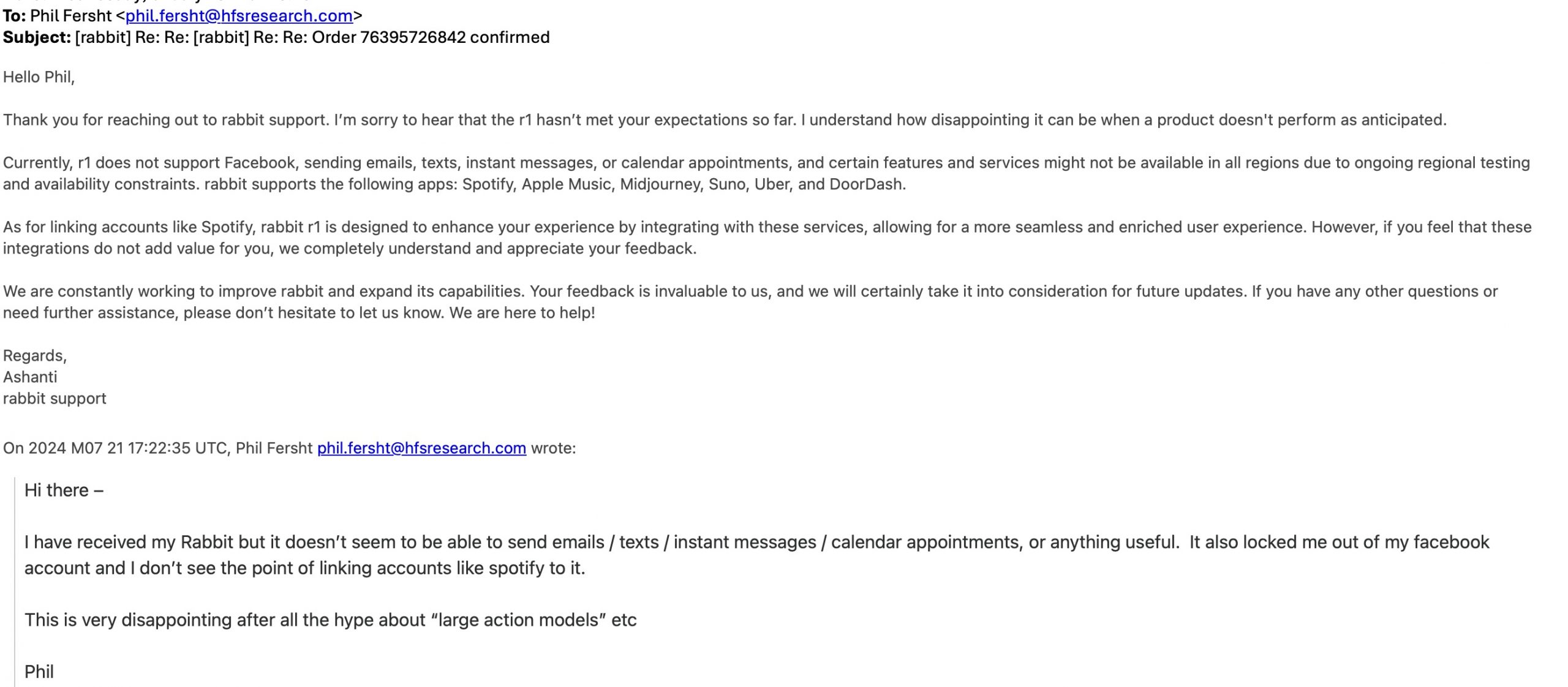
The reality is the device only supports only supports Spotify, Apple Music, Midjourney, Suno, Uber, and DoorDash. Do I really need to listen to music on this orange thing and order a pizza with it? What about sending emails, texts, whatsapps, calendar invites, or anything remotely useful? This is the response I received from Rabbit customer support:
The Bottom-line: Beware of AI snake oil, as some of it is very slippery indeed. Rabbit promised us freedom from app lock-in and all we got was more lock-out
I am sure there are may reasons why I now have a useless orange device taking up space on my desk and $200 missing from my bank account, but the delta between the device Jesse was selling and what I ended up with is scandalous. I can warn you about salesmen selling you AI dreams that appear too good to be true, but I know you are already probably very very wary!
In the endless march toward cost savings and efficiency, enterprises have increasingly turned to generative AI (GenAI) to optimize every facet of their operations. In theory, this should lead to unprecedented productivity levels, freeing up time and resources for innovation and growth.
However, the reality of GenAI integration into the workplace reveals a paradox: while the initial productivity gains are evident, they often come with hidden costs that can offset the benefits by creating new challenges. The highest cost that must be addressed is when people become over-reliant on GenAI to develop solutions and suffer a decline in their learning capabilities.
GenAI could erode human creativity as people become dependent on the technology for basic cognitive tasks
Multiple research studies over the past couple of years clearly indicate that GenAI can automate many tasks, significantly boosting productivity in the short term; for example, 35% of leading executives across driving GenAI initiatives have already witnessed productivity and efficiency increases. However, reliance on these AI tools might inadvertently devalue or erode human creativity and heuristic skills as people become too comfortable relying on them, rather than developing their own solutions.
When individuals rely on AI to perform cognitive tasks such as data analysis, writing, or decision-making, they may sacrifice the opportunity to develop and hone these critical skills. For instance, a study from the University of Pennsylvania in a high school context found that GPT-4 improved short-term student performance in math (48% for GPT Base and 127% for GPT Tutor). However, reliance on it led to worse outcomes when access was removed, with a 17% performance drop compared to those who never had access. This dependency can erode the workforce’s intrinsic problem-solving abilities and creative thinking, which are vital for driving long-term innovation and competitive advantage.
GenAI will improve you if you use it to focus on smarter ways of achieving positive outcomes
On the flip side, one can argue that GenAI tools simply help us do things smarter, so we just become worse at the old way of doing things. The results from this University of Pennsylvania study could indicate that GenAI only diminishes our cognitive skills somewhat if we don’t refocus our brains on using our freed-up time and creativity effectively. For example, there is evidence that shows people become fitter using e-bikes than regular bikes, as they enjoy the experience more and end up cycling for longer, ultimately burning more calories and becoming physically fitter. Or in some cases people who never used to cycle now engage in the activity as it’s so much more enjoyable and efficient.
AI’s potential impact on creativity is profound
AI’s ability to generate content and ideas could also discourage individuals from producing original work, leading to a loss of creative skills. In creative fields such as art, writing, and design, the overuse of AI-generated outputs can result in a decline in the unique human touch that characterizes these disciplines. As people become more dependent on AI for creative tasks, the skill sets required for these activities may diminish, stunting the richness and diversity of human creativity.
In a worst-case scenario, over-reliance could make enterprises vulnerable to disruptions or threats; if employees are accustomed to handling complex tasks, a failure or limitation in the AI system could leave them ill-equipped to manage these challenges independently. The initial productivity gains from AI could thus be offset by a decline in human capability, leading to a net negative impact on the organization’s long-term innovation and adaptability.
Employee experience also takes a hit when organizations hyper-focus on productivity outcomes
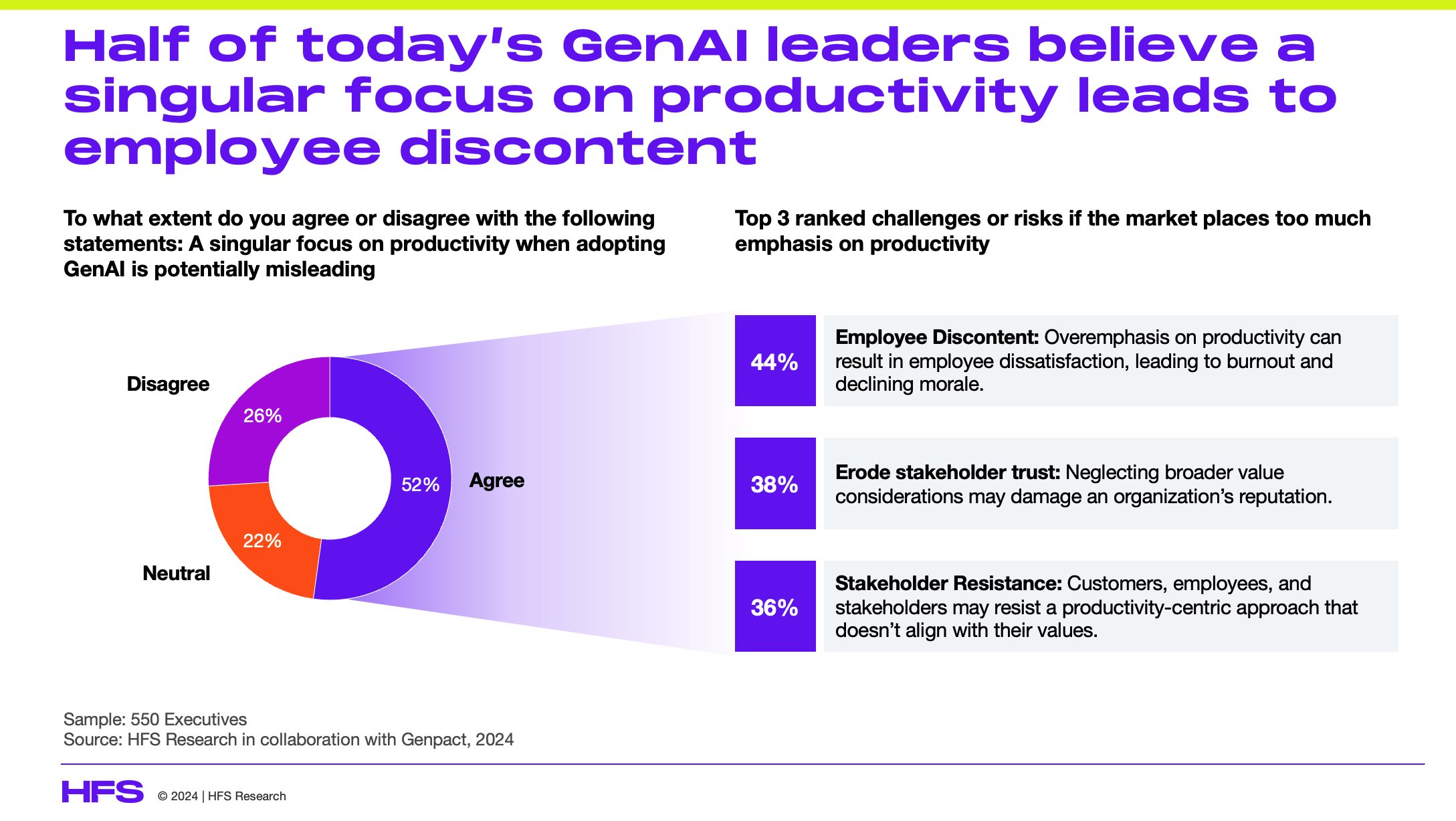
An HFS study found that more than half of the 550 executives sampled (52%) recognize an obsession with productivity as problematic. When asked about the potential risks of this hyper-focus on productivity, 44% indicated that the overemphasis leads to employee dissatisfaction, burnout, and declining morale:
This obsession with productivity can create a high-pressure environment where employees feel constantly monitored and evaluated, leading to increased stress and a sense of being undervalued. In the long term, such an environment can result in higher turnover rates, as employees seek workplaces that prioritize their well-being and provide a more balanced approach to productivity and innovation.
Organizations must strive toward a balanced human-AI symbiosis to mitigate the productivity paradox
In the late ’60s, Douglas Engelbart, in his work “Augmenting Human Intellect: A Conceptual Framework,” introduced the idea of human-AI symbiosis, where AI systems enhance human capabilities rather than replace them. This concept is critical to understanding the productivity paradox in GenAI adoption. While GenAI technologies promise significant productivity gains by automating complex tasks, the true potential of these technologies is realized when they are used to augment human intellect and creativity. In practice, enterprises should focus on integrating GenAI to complement and enhance human skills rather than create a dependency that could undermine long-term innovation and adaptability.
Ultimately, the productivity paradox arises when organizations fail to achieve this symbiosis. Instead of merely automating tasks for efficiency, enterprises should leverage GenAI to empower employees, providing them with tools that extend their capabilities and foster a more innovative and agile workforce. This approach helps mitigate the risks of skill degradation and dependency, ensuring the workforce remains resilient.
Recommendations to drive human-AI symbiosis and mitigate the productivity paradox:
Training and development: More than one-off training will be required to ensure that AI tools complement rather than replace human skills. Invest in continuous training programs to help employees develop and maintain critical cognitive and creative skills alongside AI.
Conduct “show and tell” GenAI training workshops: Nothing is more effective than having your staff demonstrate their active use and enjoyment of GenAI in collaborative group settings. This encourages more uptake, smarter use of the tools, and real-time sharing of best practices.
Human-AI collaboration: Encourage a collaborative approach where AI handles repetitive tasks, and humans focus on complex problem-solving and creative work.
Encourage experimentation: Create an environment that values experimentation and risk-taking, allowing employees to explore new ideas without fear of being judged solely on productivity metrics.
Reward creativity: Implement recognition and reward systems that celebrate creative solutions and innovative thinking.
Work-life balance: Promote policies that support work-life balance to reduce stress and burnout. Flexible working hours and remote work options can help achieve this.
Employee feedback: Regularly solicit feedback on employees’ experience with AI tools and use their input to make adjustments that improve their work environment and job satisfaction.
Invest in continuous upskilling: Prioritize ongoing training and development to mitigate the skills gap created by the rapid adoption of GenAI. This ensures employees are adept at using AI tools and capable of critical thinking and problem-solving with these tools.
The Bottom Line: By fostering a symbiotic relationship between humans and AI, enterprises can achieve sustainable productivity gains that drive long-term growth and innovation
In essence, the productivity paradox is the realization that if the drive for efficiency sidelines the human workforce and what is required to nurture them to use AI effectively, the pursuit of productivity and efficiency gains will be compromised.
Organizations can mitigate these risks by promoting balanced AI integration, fostering a culture of innovation, and focusing on employee well-being. Ensuring AI tools complement human skills, encouraging experimentation and creativity, and supporting work-life balance can help maintain GenAI’s long-term benefits without compromising human capabilities and employee satisfaction.
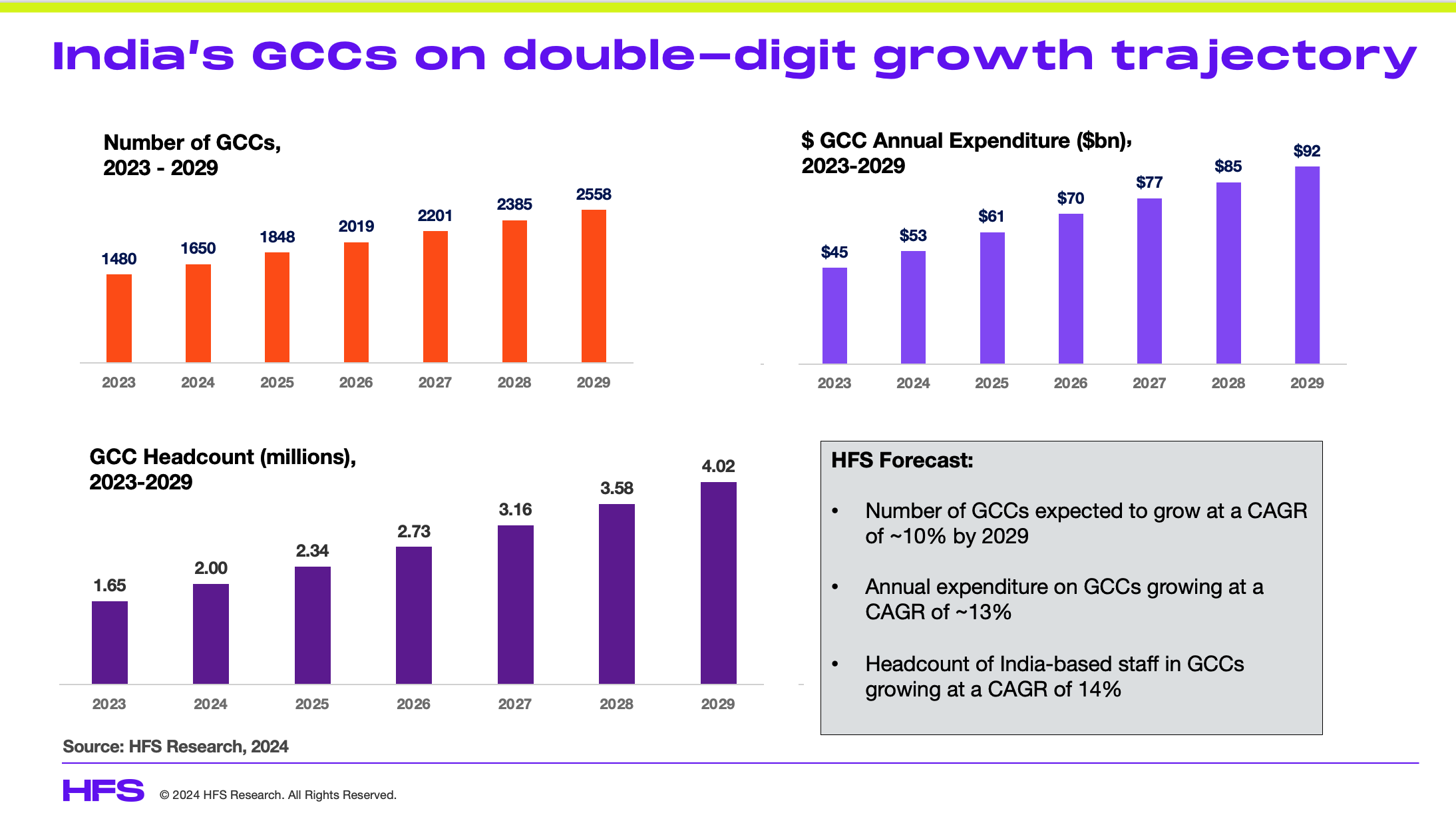
Global Capability Centers (GCCs) have emerged as the trailblazers of the Indian IT landscape, displaying extraordinary double-digit growth and transformation and carving out a distinct and powerful niche. While tech and BPO service providers have grappled with flagging enterprise demand and other market pressures, GCCs have thrived, with HFS estimating 2000 expected to be in full operation in 2025. So, are these GCCs genuinely the new face of Indian IT?
Let’s discuss:
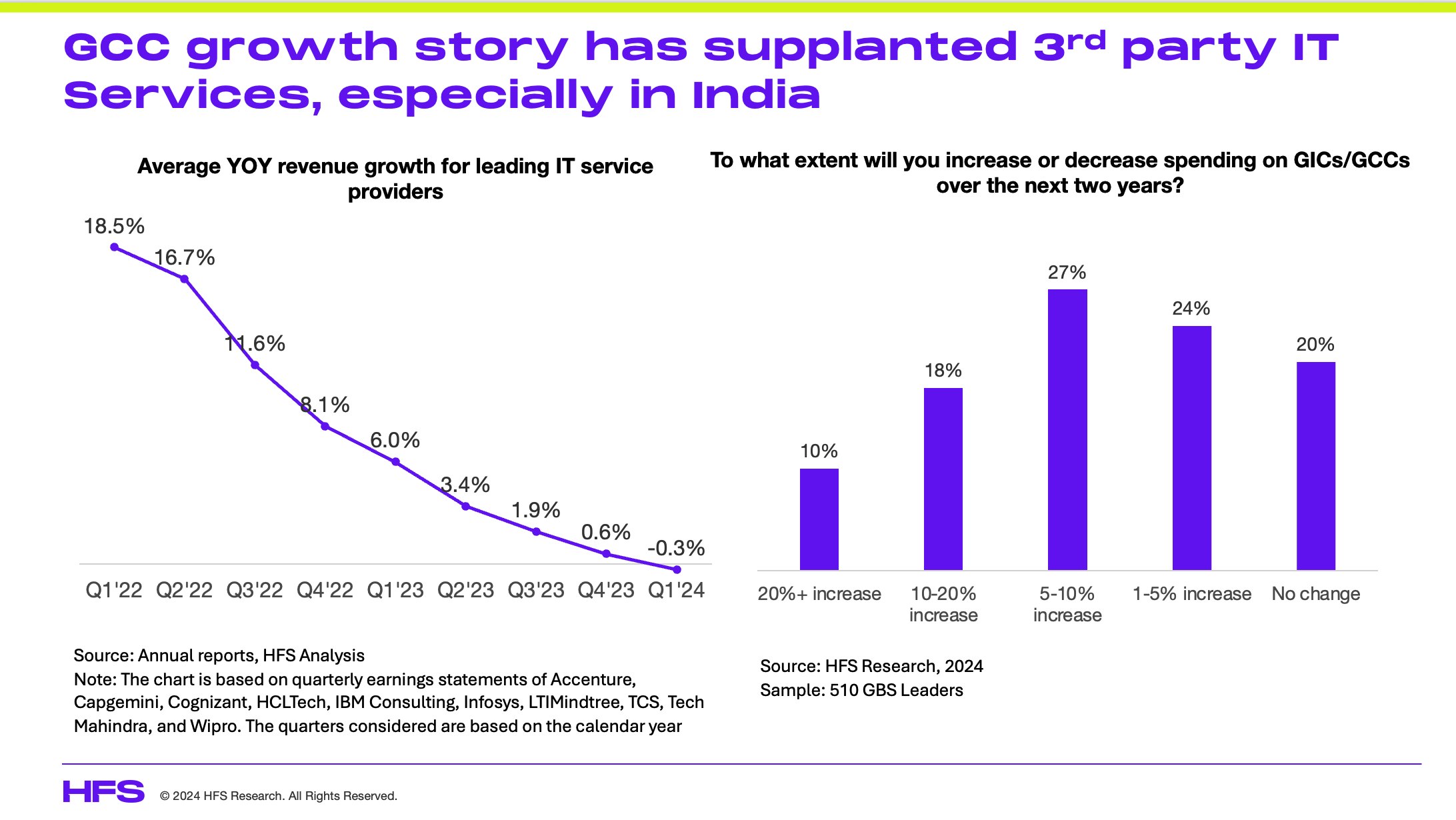
GCCs thrive while third-party providers struggle
The rise of GCCs has been nothing short of meteoric. As third-party tech and BPO service providers navigate turbulent waters, GCCs are scaling new heights. The numbers speak volumes: HFS estimates show 1,650 GCCs established in India (growing at 11% this year), employing around 1.6 million people, with 120 new GCCs launched just in the first half of 2024 alone. HFS estimates over 2.7 million people will occupy India’s GCCs by the end of 2026, which could top 4 million staff by 2029. In addition, annual spending in GCCs will move past $50 billion this year and could almost double over the next five years.
Net-net, this explosive growth has redefined India’s tech industry and is being driven by rampant expansion across India’s leading tier 1 and tier 2 cities for talent:
The secret? Effective GCCs are much more closely integrated with their parent organizations, aligning with corporate goals, which ensures optimal resource allocation, effective project management, and a profound understanding of their parent company’s culture and objectives. In short, many global decision-makers within the Global 2000 feel much more in control over their operations in a market of rampant technological development and economic uncertainty:
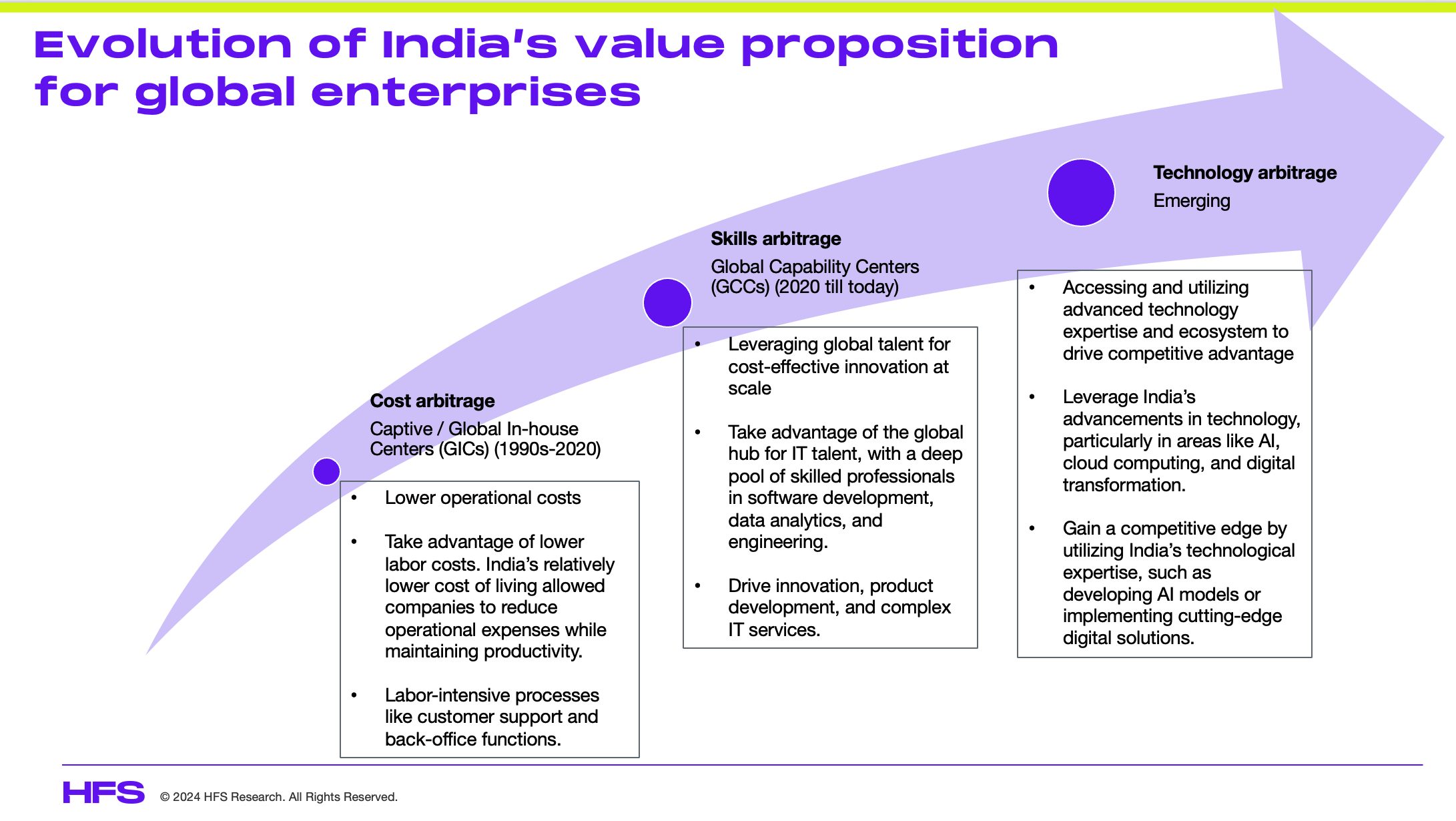
GCCs are shifting the “Why India” question from Cost Arbitrage to Skills Arbitrage
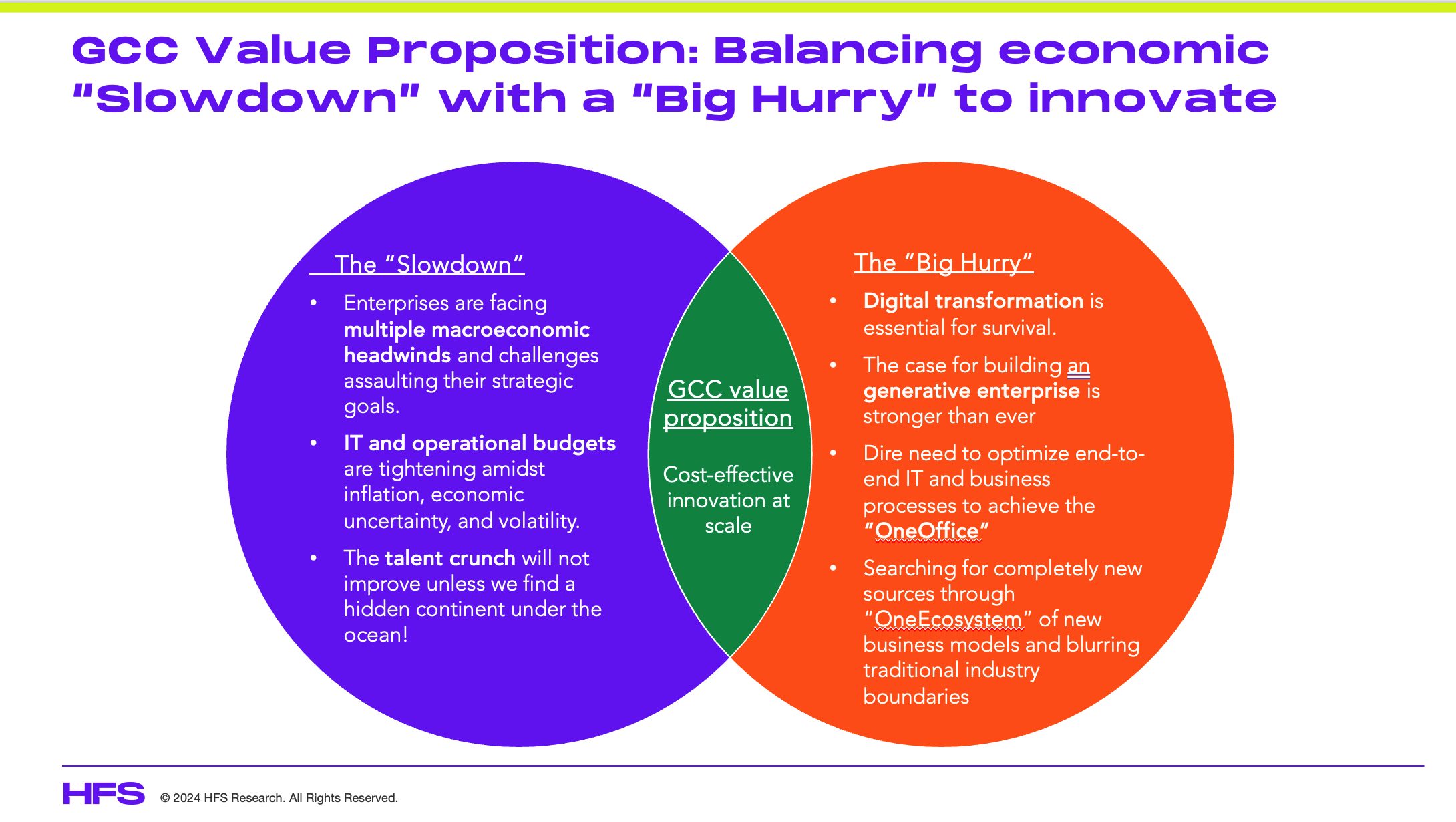
The GCC model is not new (remember “captives” and Global In-house Centers/GICs), but its value proposition has been evolving significantly in recent times. Initially seen as cost-saving centers, GCCs have transitioned to a focus on skills arbitrage. India’s deep reservoir of skilled IT professionals now promises something far more valuable: cost-effective innovation at scale. This pivot has rebranded the “Why India” narrative from a mere cost-saving exercise to a strategy of substantial value creation—a vital advantage for enterprises caught in the “digital dichotomy,” struggling to balance macroeconomic challenges with the need for relentless innovation:
GCCs are making IT services sexy again for Top-Tier Indian Talent
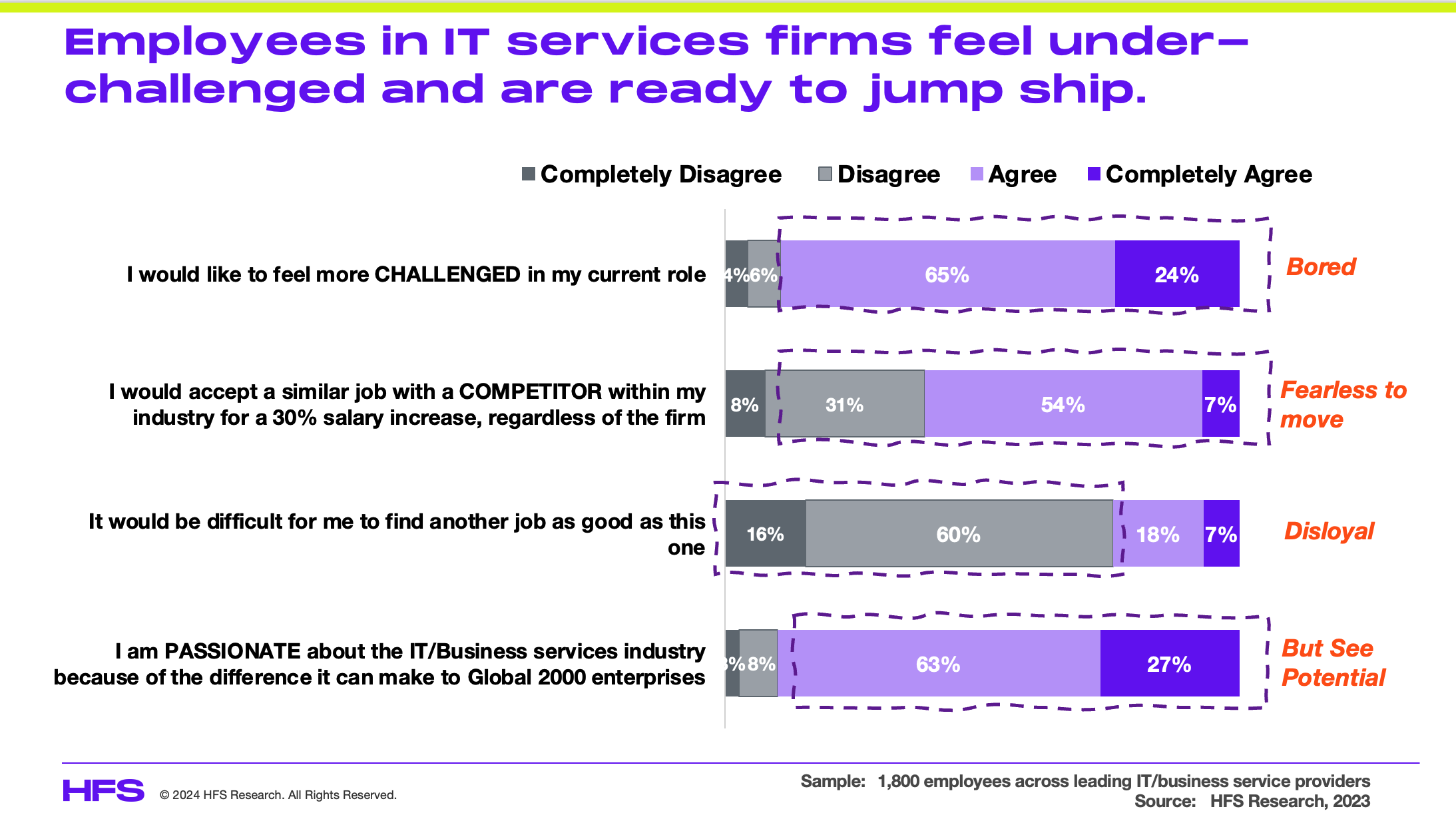
The Indian IT services industry has long faced challenges in attracting top-tier talent, with the best and brightest often gravitating toward startups or global technology providers. Our study of 1,800 IT services employees last year revealed widespread dissatisfaction, with many feeling under-challenged and ready to jump ship (See exhibit below). The problem with the services industry is that when companies provide outsourced services for enterprise customers, it’s most often the monotonous tasks the customer can offload at scale, such as application testing, infrastructure monitoring, accounts payables or receivables.
Even sexier-sounding work, such as content moderation for social media sites or product support services, is usually very tedious after a while, especially when the services worker is just instructed to follow a standard operating procedure without any incentives to use judgment, creativity, analytical skill, or common sense. It’s no wonder staff have been quitting in droves in search of something more challenging when there is so much demand for workers to perform higher-impact work elsewhere. Now that their next job may turn out no more challenging than their current gig if there’s 30% more money for doing it, why not?
In short, employees do not like their current employers because of their lack of career growth opportunities, bureaucratic company cultures, difficulties finding the right work-life balance, and disillusionment with the company’s purpose and vision:
As you can see, close to 9 out of 10 staff want to feel more challenged (and are bored), 61% will jump to a competitor for a pay hike, and 75% believe they can easily find a job as good as the one they currently have. The only saving grace for the IT and Business services industry is that 90% of employees are passionate about the impact they can have on enterprise clients. The simple fact that GCCs offer the chance for Indian talent to get closer to global enterprises and have a more direct impact on their clients (true OneOffice) is making the GCC career option far more attractive than many of these “back office” service provider roles.
GCCs are reversing this trend. Offering up to 30% higher salaries, often more challenging roles, and opportunities to work with cutting-edge technologies and prestigious institutions, GCCs are making IT services desirable once again. This resurgence in interest is not only enhancing GCC capabilities but also elevating the entire Indian IT industry, especially during these challenging times for its traditional outsourcing market.
HFS Recommendations for Long-Term Success with the GCC Model
GCCs have rightly earned the spotlight, but to sustain their momentum, they must continue to innovate. The future is promising, but complacency is the enemy. Here’s what they need to do:
1. Embrace India’s blossoming AI talent to drive Technology Arbitrage
GCCs are accelerating India’s value proposition from cost to skills arbitrage. Now, they must embrace AI to unlock the potential of technology arbitrage, positioning themselves not just as cost-effective hubs but as epicenters of technological innovation (See below). No region in the world comes close to India to develop talent at scale, which can learn the latest GenAI and machine learning tool. The booming startup ecosystem and ambitious numbers of college graduates place India in an ideal position to dominate the future of AI development, with GCCs at the core.
If this shift is managed effectively, it will transform many GCCs from support centers to strategic drivers of global business value, supporting companies to optimize processes, predict market trends, and respond to changing consumer needs to create new revenue streams. This shift would not only enhance the competitive edge of their parent organizations but also establish many GCCs as leaders in the global technology landscape. The challenge is centered on transitioning from a people-centric model to a technology-driven one, but the rewards are immense if you can adopt the right mindset for change and innovation.
2. Benefit from a Hybrid Model of in-house capabilities AND third-party services
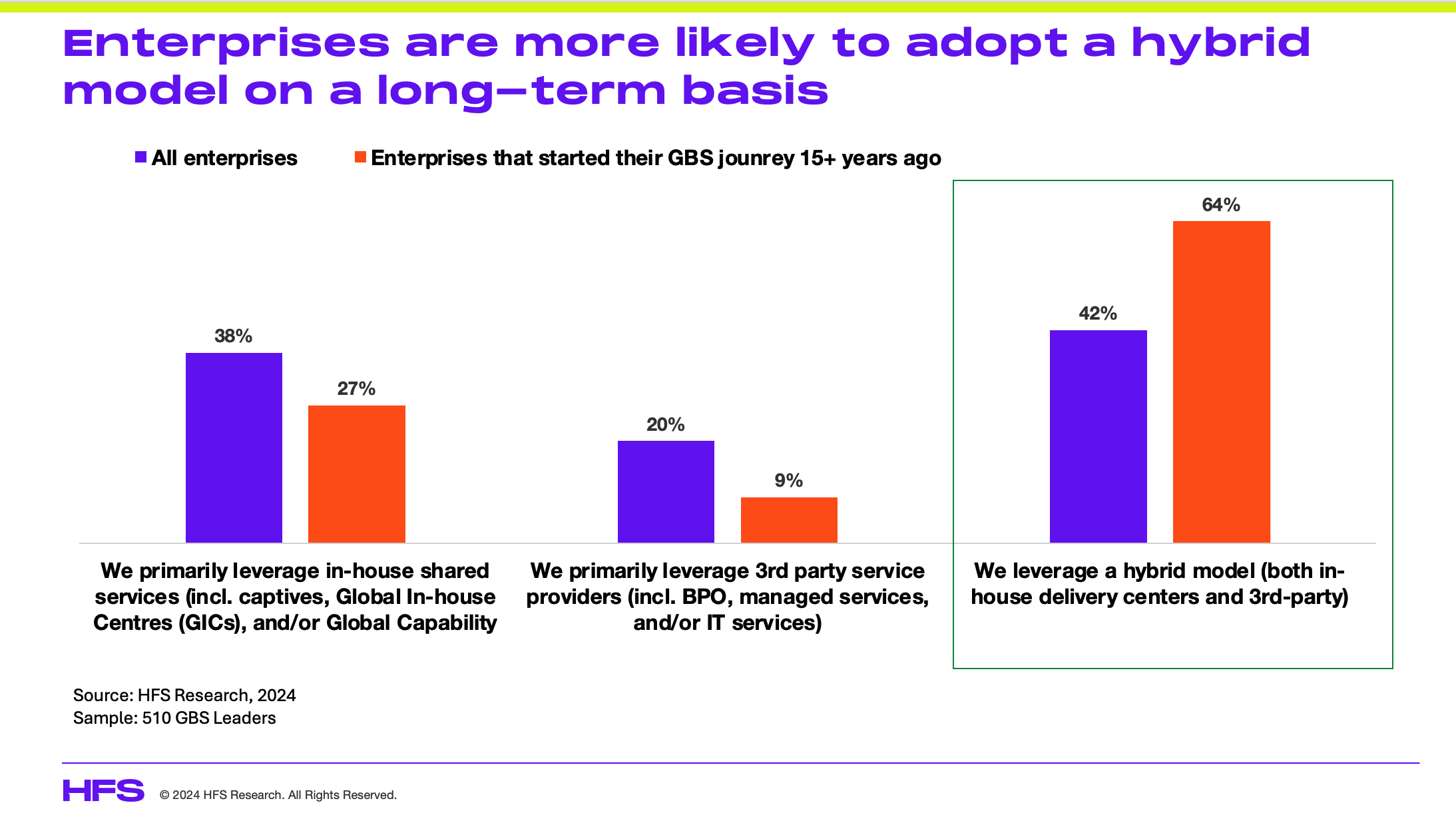
The future is hybrid. While 40% of Global 2000 enterprises use a hybrid model, this figure jumps to nearly 65% for those with over 15 years in the game (See below). On a long-term basis, companies are more likely to adopt a hybrid model, due to their need for greater flexibility and the ability to balance cost-efficiency with specialized expertise. A hybrid model that combines in-house capability centers with third-party services can offer the best of both worlds. This approach allows for flexibility, scalability, and access to a broader range of expertise and resources, enhancing overall service delivery and innovation capacity. The conversation should not be “In-house OR 3rd parties” but “In-house AND 3rd parties.” The hybrid model offers the flexibility and scalability that today’s dynamic business environment demands. It’s not a choice between in-house and third-party services—it’s about integrating both to create a more robust, versatile operation.
3. Make GCCs a vital part of the Corporate Innovation Agenda
GCCs are often perceived as execution engines rather than innovation leaders, including instances where GCCs are primarily tasked with implementing strategies and projects designed by the parent company rather than driving the ideation and development of those strategies. For example, a GCC might be responsible for scaling a software development project globally, but the core innovation and design decisions are made at the headquarters.
GCCs should aim higher than executing the corporate innovation agenda set by their parent companies. They should aspire to create this agenda, leading the way in identifying new opportunities, technologies, and market trends. By taking a proactive role in innovation, GCCs can become indispensable partners to their parent organizations, driving strategic initiatives and long-term growth.
The key challenge here is to establish stronger lines of collaboration between GCC leaders and the enterprise leaders in corporate. This is usually a result of legacy-minded corporations who traditionally treat Indian resources as “back office” as opposed to being part of the broader corporate mission. Smart enterprise operation leaders need to establish clear skills development programs and career paths to encourage more Indian staff to establish themselves as strategic workers forming part of global teams. This is where enterprises, in general, need to invest in a global talent model and ensure the GCC is fully integrated with the rest of the enterprise and not sectioned off as a support center.
Bottom line: It’s time to elevate GCCs from execution engines to innovation leaders
Global Capability Centers (GCCs) have become a pivotal force in the Indian IT industry, driving operational excellence and innovation at scale. However, to sustain their success and continue leading the charge in global technology services, GCCs must evolve significantly beyond their current roles.
Embracing AI and shifting towards a technology-driven model will position GCCs as epicenters of innovation rather than mere execution engines. Moreover, adopting a hybrid model that integrates in-house capabilities with third-party services will provide the flexibility and scalability needed in a dynamic business environment. Finally, GCCs should not simply implement the corporate innovation agenda but also aspire to help create it, thereby becoming indispensable partners in shaping the future of their parent organizations. The time is ripe for GCCs to transition from cost and skills arbitrage to full-fledged technology arbitrage, ensuring long-term growth and global leadership.
At HFS, we are diving deeper into this exciting GCC space. Watch out for our upcoming videocast series with GCC leaders, our GCC executive roundtable in Bengaluru, and our HFS Summit in India next February.