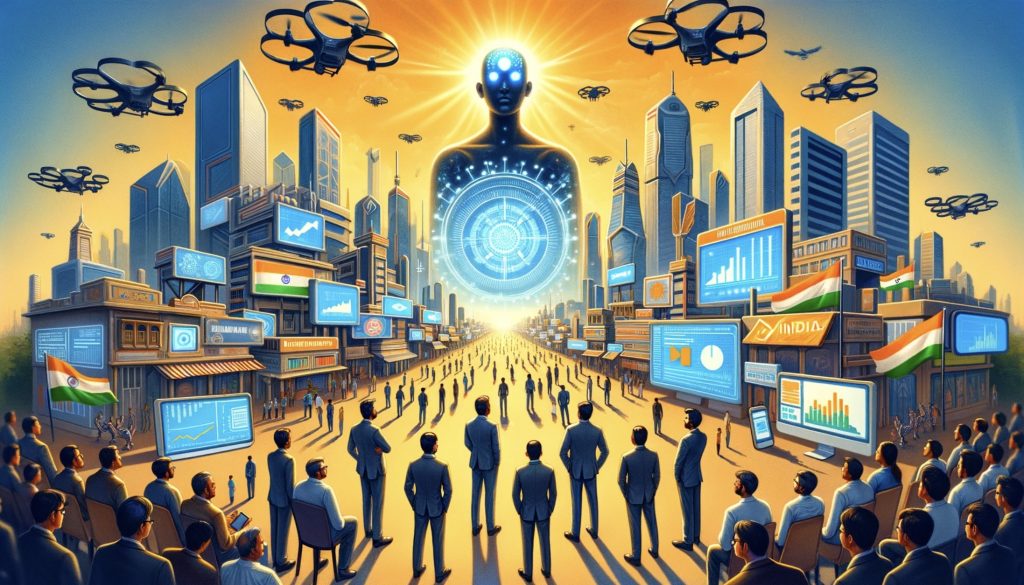
The noise surrounding GenAI has reached insufferable proportions – literally, everyone has to voice their opinion on it, regardless of who they work for or what their role is. Take a trip out to India, and similar rhetoric is yet again following these noises from America, jumping on the hype bandwagon as it did with internet enablement, digitization of business foundations, and, more recently, the directionless corporate lunge into the cloud.
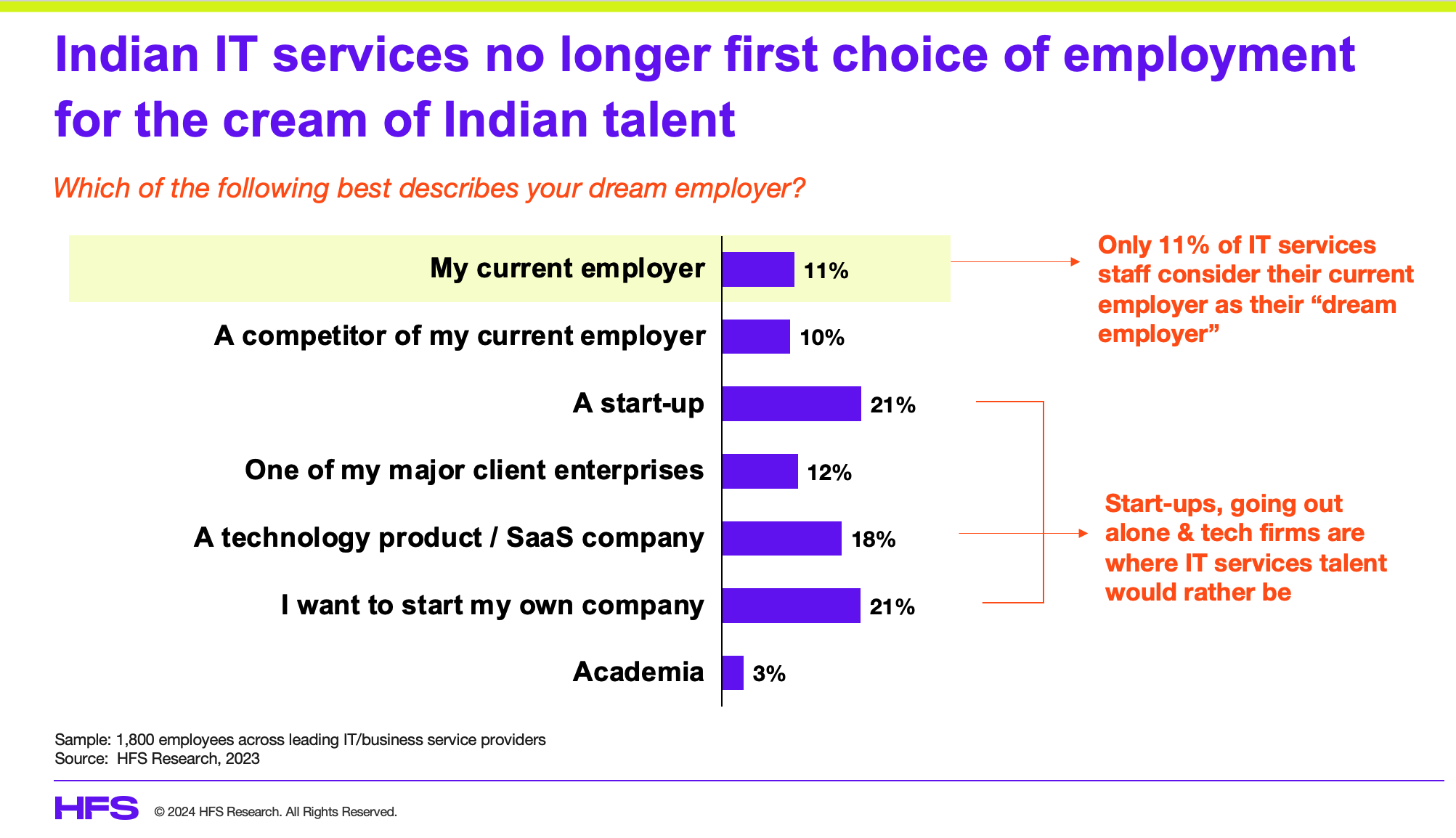
Indian talent is steering clear of their IT services firms
The big dichotomy our India analyst team has pinpointed is the disconnect between the buzzing startup economy, which is sprouting literally hundreds of innovative firms such as DeltaCube, Xylem.ai, E42, Chaos Genius, A21.ai, Lami.fit, Perkant Tech, CoRover, Bhashini.ai, Machine Hack, Rephase.ai, Mockey, etc., while the lethargic IT services firms just can’t seem to break out of their paralyzed mindset. Plus, why have Microsoft, Google, et al., been hiring the cream of young Indian talent aggressively while the IT services shops obsess about forcing their staff back into the office, attempting to relive their glory years pre-Covid?
Our study of 1800 service provider staff tells us that the days of becoming a programmer to buy your first car are pretty much over… smart young talent today wants to make impact in their careers:
What happened to the entrepreneurial spirit and determination to win the hearts of their clients that drove incredible growth over the last couple of decades? Have they really become bloated, tired old shops that simply want to keep selling rollouts of “the next tech product”?
For 25 years, Indian IT services have profited from each of these technological shifts as enterprises groped for bread-and-butter IT support to fix bad code, test portfolios of legacy apps, maintain creaking infrastructures, and generally keep the IT wheels on global 2000 corporations hell-bent on sustaining archaic business operating models that have barely changed since World War II. In fact, at HFS we estimate that India now employs close to 7 million people in service providers and global capability centers (GCCs) to service these corporations with IT and business process support.
In den-ail? India’s IT services economy has a great opportunity with GenAI but will blow it if they cannot change their stuffy ways of operating
EY’s latest white paper, “The AIdea of India“, declared that Generative AI can add a cumulative $1.2 – $1.5 trillion to India’s GDP by 2030. So surely this means India’s leading service providers and GCCs are paving the way in rethinking how they train their people, how they recruit from Indian universities, and how they price their capabilities and services with their enterprise clients to infuse GenAI into the core of everything they do? The answer, sadly, is NO, as several leaders pointed out in public and private settings.
Having just spent a lovely week in India leading an HFS special event in Mumbai, followed by speaking at the Nasscom Technology Leadership Forum, I was overwhelmed with concern that so many leaders in India’s services industry really have no concept of what is going to hit them. Some Indian leaders declare GenAI as a massive game changer, while others just write it off as another tech tool they will learn to manage in the future. Whether or not they see the GenAI impact coming, the sad reality is that very few have a plan to change how they operate to exploit this impeding tremendous growth the likes of EY are proclaiming.
We have arrived in a dangerous period where many enterprise customer leaders are reaching the full realization that they need partners who understand their institutional issues and are willing to invest time to figure out a GenAI roadmap that will sharpen their competitive edge. The big challenge with GenAI is to clean up enterprises’ messy data so they can benefit from the tools. Otherwise, GenAI becomes lipstick looking for a pig. Enterprise leaders want no-nonsense partners who can understand the business context behind their data needs. Those partners who fail to step up will be quickly cast aside or relegated to low-value service contracts, which will continue to decline in value.
Indian support services could lose a million positions over the next couple of years as LLMs rapidly change how routine IT testing and coding work are delivered
“When will business pick up, Phil?” was the common question I was asked last week as if their global enterprise customers will suddenly magically find thousands of new IT roles to displace to Indian IT service partners. There just seems to be an expectation that the old model of swapping out people will continue along its previous linear growth trajectory as US and European enterprises maintain their insatiable need to keep spending more and more money on Indian-based services. It’s frightening to think how much the Indian services industry is likely to be impacted as the country comes to terms with the fact that the economic fundamentals of how IT services are delivered are changing forever.
For example, one enterprise has just concluded it can remove 15% of its IT staff from application testing by running an LLM against its testing processes. And this is just the start. When you consider that 20-30% of revenues for Indian-heritage IT services providers involve testing and quality assurance, it’s clear that there is growing pressure to weave GenAI into bread-and-butter IT areas like testing, routine maintenance and development. It doesn’t take a rocket scientist to conclude that a million of the 7 million Indian employees supporting routine-based testing and coding work could be eliminated in the next couple of years. There will also be similar ramifications felt in the Philippines and LLMs cut deep into customer support operations and other global regions such as Eastern Europe, which profit so well from technical engineering and coding services that are being impacted in a similar vein by GenAI.
And if Jensen Huang, CEO of NVidia, is to be wholly believed, our need for programmers is going to be completely eradicated in the future, and we should address what our kids study in college as a consequence:
Bottom-line: Many enterprise clients are crying out for help, but their partners are struggling to win their hearts. It’s now time for India’s leaders to rethink how their firms operate and address GenAI
The winners will be the partners who can quickly understand what needs to be done to fix and scale the data without charging the earth, with the ability to work fast and smart. When you look at the deep institutional relationships the likes of Cognizant, HCL, Infosys, TCS et al. have with their clients, many of whom are into 4th or even 5th-generation contracts, surely these firms have a tremendous opportunity to convince enterprise leaders to take a risk with them to make the painful changes necessary to capitalize on GenAI tech? Isn’t this a wonderful opportunity to upsell them new work, new ideas, and new ways to excite their staff? When the trust is already there, what is stopping IT and business services from moving up the value chain and helping enterprise customers desperately need more support from smart talent who understands their challenges?
India’s leaders must stop viewing GenAI as merely the next shiny tech tool, as opposed to what it really is – a truly disruptive technological evolution that will fundamentally change business models and radically change how we invest in technology solutions and services. All they need to do is look at the flourishing ecosystem of startups covering all angles of AI and industry solutions and embrace some of the entrepreneurial culture that once made them successful.
Quite simply, the conversation regarding what constitutes value needs to change – enterprises need to be convinced to pay for value than mere effort… is it really that hard? It seems to me that many service providers lack the leadership talent to have that conversation… and need to address that ASAP.
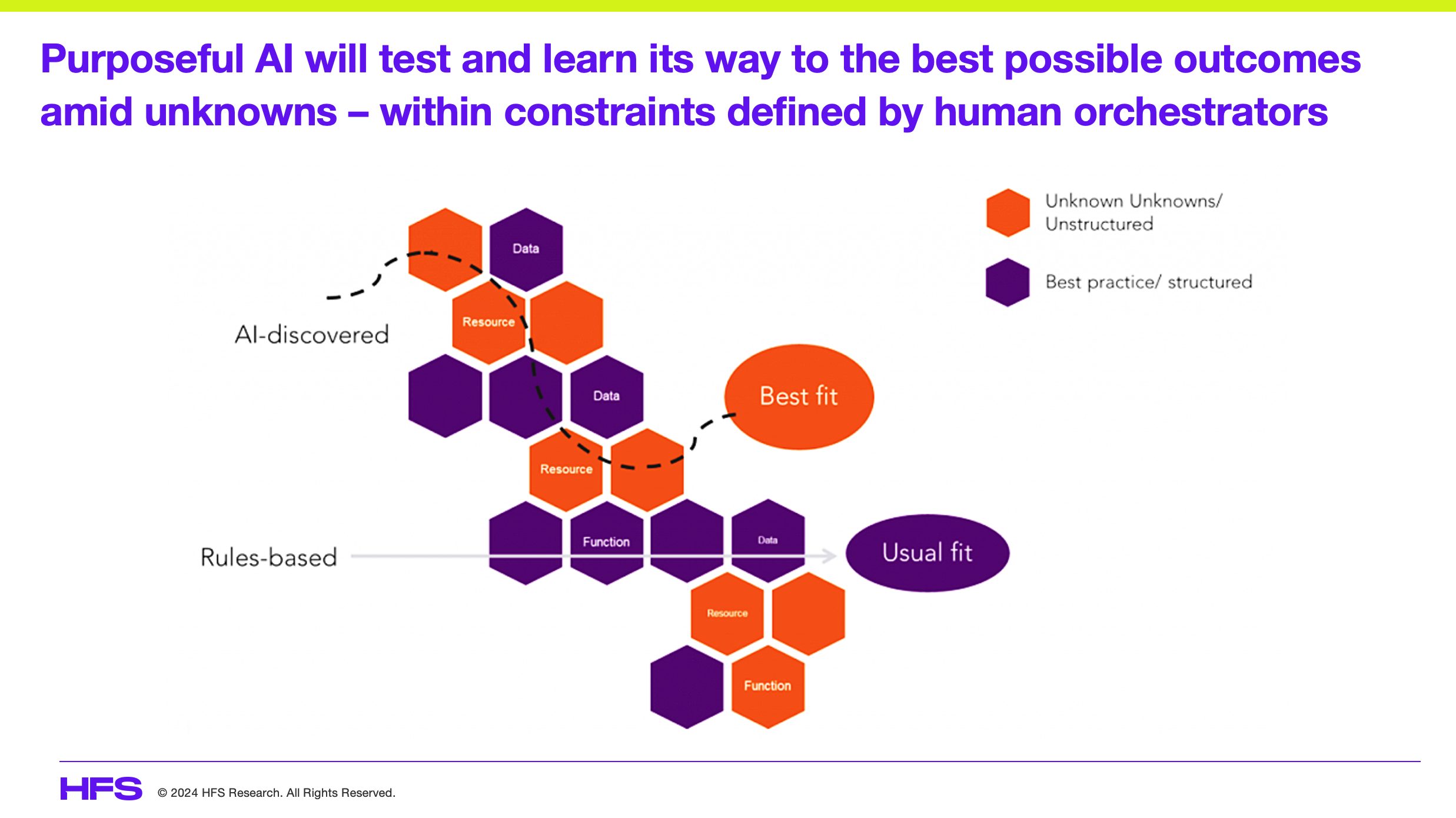
Prepare to hand over the day-to-day running of your business to a new phase of AI that is driven by purpose. You create the purpose and your AI will deliver for you within the boundaries you create.
It will find you the best suppliers that sense and respond to your firm’s needs. It will address customer service needs – empowered to offer and deliver anything from apologies to recompense and implement ongoing improvements. It may even provide health diagnoses, issue prescriptions, and identify when and where a human doctor needs to intervene. And it will do all this without checking with a human while your enterprise leaders are free to focus on choosing and delivering their strategic goals.
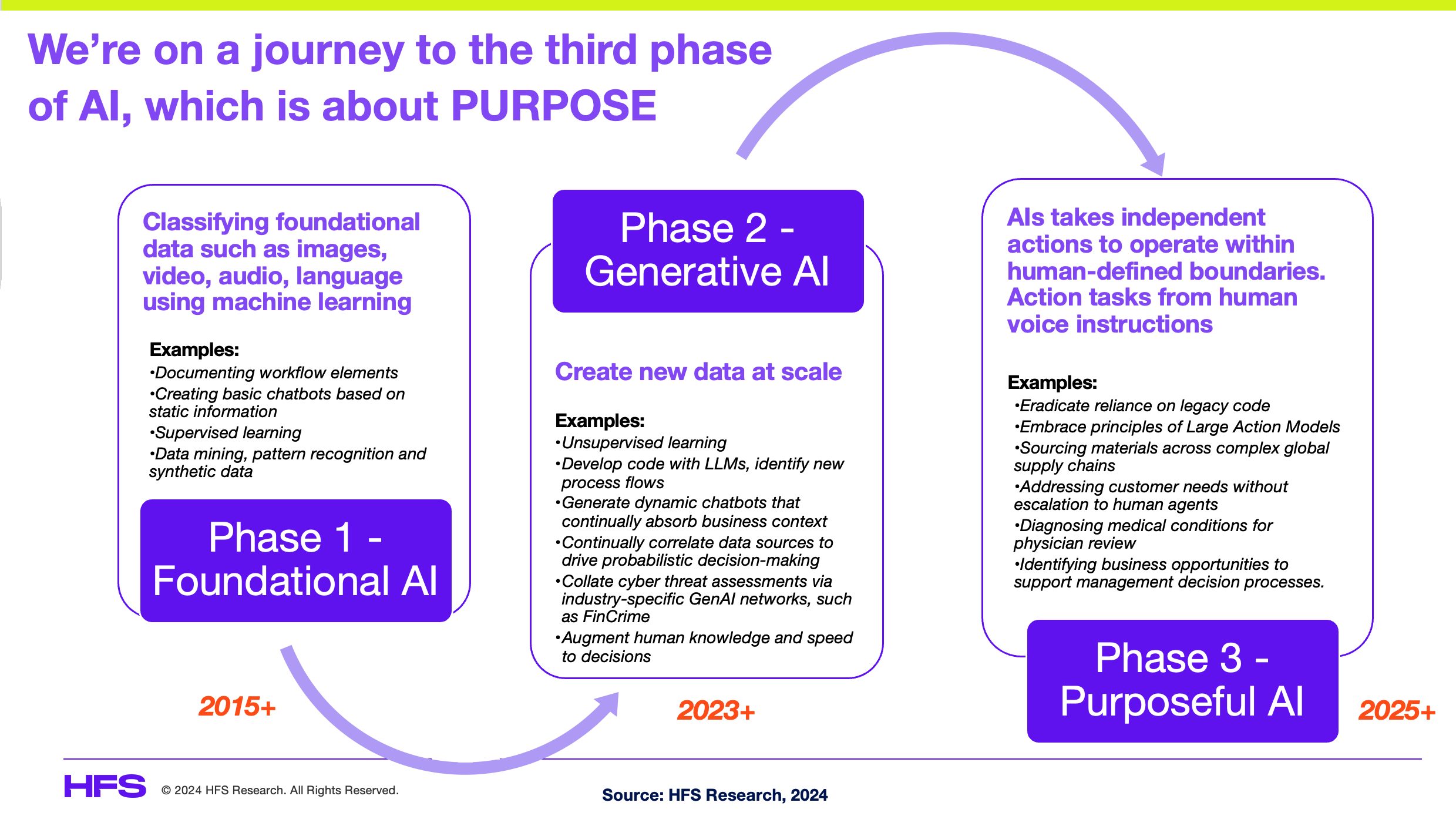
This ‘Third Phase of AI’ follows from Foundational AI and Generative AI and is designed to make independent decisions – acting with autonomy within human-defined boundaries. Purposeful AI goes beyond a one-time-only assembly of rules of engagement. It will learn from its interactions and from prompts provided by humans to constantly improve its capabilities to action their desired outcomes in real-time:
Phase 1: Foundational AI is the bedrock on which to build generative and purposeful solutions
Each of the phases of AI illustrated above has a value proposition, and while Phase 1 represents the basic technology, it is an essential first step for extracting greater value from AI. It is in Phase 1 where we’ve learned how to organize and use data in a way that can learn and become useful for workflows and interactions. For example, Foundational AI has been in use for many years within the content moderation function of enterprises, particularly when dealing with online user-generated content. Its remit is to categorize and flag images or text that meets specific criteria (typically false, unethical or offensive content); red-flagging this content allows the humans-in-the-loop to decide whether the content needs to be removed, and in turn helps keep online communities safe. Another Foundational AI example that’s been used for years in sales, marketing, and customer service is in next-best-action strategies, where the AI analyzes customer interactions such as web visits, clicks, past purchases, etc. in order to recommend the best offer to make or content to push to the customer at the right time. This stepping stone makes it easier to see that potential of Generative AI is not not just to offer up predetermined next steps but actually to generate the content for even further personalization and speed.
Phase 2: Generative AI scales AI’s application of data to generate rapid outcomes
Phase 2 is more about how you can use AI at scale; applying Generative AI to vast amounts of information and asking it to create rapid content. Since the widespread launch of GPT 4 last year, we have been gifted with software providing an incredible ability to generate human-like text, understand and respond to queries, perform simple tasks, and even hold a conversation.
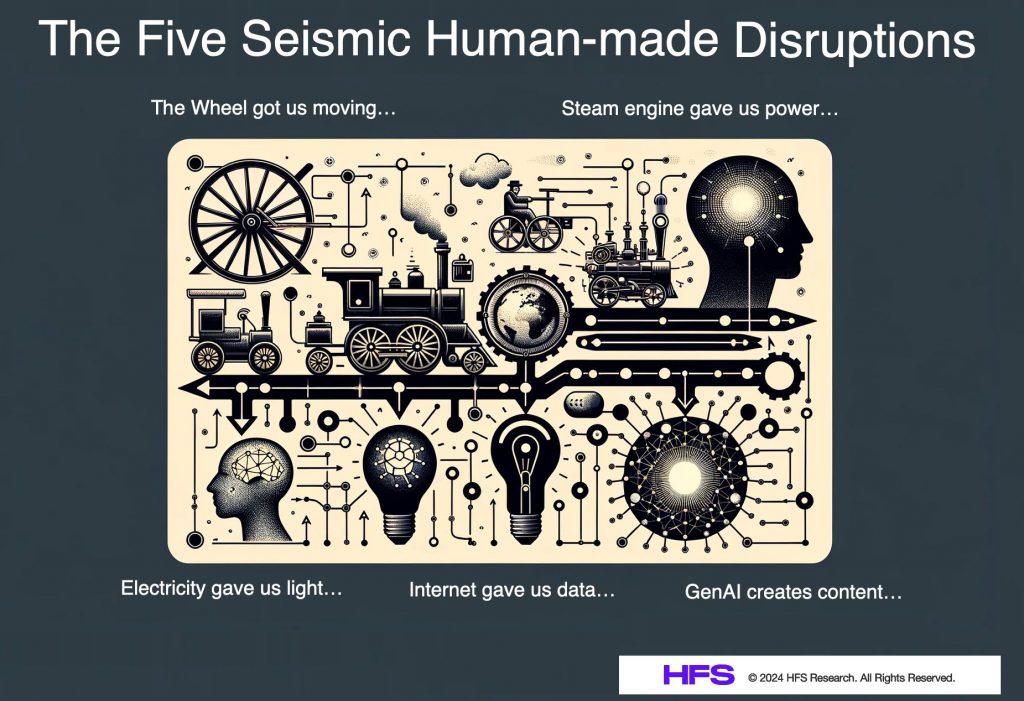
Code-writing is vastly improved, there is a natural ability to respond to emotions expressed in text, you can accurately generate and interpret text in various dialects and languages, solve complex mathematical and scientific problems – and you can even develop optical capabilities that supercede the Metaverse. The significance of GenAI to enterprises is hugely disruptive when we look at the evolution of new technologies and their ability to change industries radically:
In one use case we heard during our Generative AI Horizon report, a ChatGPT solution was implemented for media monitoring, extracting metadata from large volumes of media articles across many channels and countries to categorize, summarize, and provide sentiment analysis. This ultimately negated the heavy lifting from media analysts, allowing them to leverage the AI-generated summaries and instead focus on the output of the marketing reports. HFS Research also has Phase 2 in production on our website, where rather than use a basic web search, research clients can ask our LLM a question and receive a natural language response generated from all the research on our website.
In terms of rapid improvements with code development, one major enterprise, for example, has just concluded it can remove 15% of its IT staff from application testing by running an LLM against its testing processes (an emerging practice we are terming generative quality assurance). And this is just the start as we learn of many similar projects where LLMs erradicate significant amounts of time and labor investments dedicated to routine code development and application testing. When you consider that 20-30% of revenues for Indian-heritage IT services providers involve testing and quality assurance, it’s clear there is growing pressure to weave GenAI into bread-and-butter IT areas like testing, routine maintenance and development, and we predict this will be in full effect across IT services in the next few months.
Purposeful AI is empowered AI that performs actions requested by humans
Phase 3 takes the principles of 1 and 2 to the next level but leverages multiple technologies and an ecosystem to get the human out of the loop. The humans set the goals and the boundaries, and your AI is empowered to deliver on the actions. We opined on the enterprise potential for Purposeful AI in the enterprise (fueled by LAMs) in our recent blog post on emerging LAM tools such as the Rabbit R1. While nascent in the enterprise outside of advanced robotics (see more below), the potential use cases are compelling, if Purposeful AI is able to navigate the complex apps ecosystem that is today’s enterprise. Imagine asking your digital assistant to onboard an employee which automatically executes tasks such as device procurement, enrolling their benefits, setting up training etc? Or demand planning, forecasting, and then optimizing a supply chain network at the click of a button? Or your marketing AI companion setting up a podcast session for you, making suggestions of who to invite and how to promote over your social networks etc? Or a Soc-2 security audit that automatically delivers the governance plans and requests actions from your employees? These examples are likely not be far off…
Enterprises must also prepare for their customers to use similar technology. According to Deep Mind’s Mustafa Suleyman, the technology may be catching up. All of this strongly suggests a revolution in marketing, sales, go-to-market, and procurement that brands and organizations must start developing strategies in response to, plans that place the digital customer- as an Independent AI – at their heart.
Humans will be out of the loop, but orchestrating the loop
To deliver these benefits, humans must stop micro-managing bots’ in the loop’. Humans will be ‘out of the loop, but orchestrating the loop’. Human orchestration will mean business leaders maintain strategic control and remain accountable – by defining the boundaries they set for these bots. As natural language and voice capabilities improve, leaders will be able to issue voice commands to offer strategic direction to their independent bots and the change in guidance will be enacted immediately. Bot independence means we can release the bots to make high-speed decisions in line with the strategic goals we set directly – and all day, every day.
Their job will be to create end-to-end processes across ecosystems, making live connections between the best possible capabilities to serve the best possible outcomes – as defined by human orchestrators:
Purposeful AI is alive and kicking in advanced robotics
Purposeful AI is already a thing in advanced physical robotics. No human is in the loop when a Boston Dynamics robot moves around an unknown environment. It is making live decisions and acting on those within constraints set by a human. According to the company, the next generation of robots will be “smarter, more agile, more dexterous, and more like people”. The intent is for them to be able to take on human tasks in high-risk environments or provide care where human carers are in short supply, for example. It seems the human workforce faces a pincer movement– robotics replacing physical labor while independent bots threaten knowledge work.
The Bottom Line: Purposeful AI will disrupt how work gets done and how companies interact with their customers, suppliers and employees
Add the rise of Purposeful AI to your risk register now. It is hard to imagine a department or function of any enterprise that won’t be impacted – from sales to production, marketing to procurement. The most prepared enterprises for what-comes-next will be those which are already making advances in the AI revolution towards managing their purpose orchestrating AI’s actions. There is little chance you will be ready to move to Phase 3 if you do not first journey through phases 1 and 2.
Look out for HFS advice on assessing your AI maturity – coming soon…
Has there ever been a time when we’ve challenged the ever-increasing stranglehold enterprise applications and their codebase have been inflicting on us for decades? Where each version upgrade requires more and more code to be rewritten just to keep everything working; where we’re subjected to aging developers holding us to ransom for their dated programming languages. Because they can.
Where it just takes bloody ages to get anything done because our enterprise technology just sucks and these cloud migrations are a big mess. And where both our personal and professional lives are beset by the constant inability of applications to talk to each other, to validate who the hell we are every day, to keep upping their subscription fees… Because they can.
Well maybe they won’t for much longer as the sheer energy behind this move to generative solutions takes hold, and the desire to drive actions to bypass bad antiquated technology overwhelms the old ways of doing things. So who better to speak his mind after a lifetime grappling with technological stranglehold than our new Chief Technology Evangelist, Francis Carden…
Our future is all about visible actions and invisible technology
After a remarkable journey through the era of computerization and its remarkable contributions, we stand at a pivotal moment of innovation. It’s time to bid farewell to a core element that has been instrumental in its success: We must undertake a comprehensive reevaluation of our enterprise application suites and the ecosystem of coding that has been central to their development and support.
Our reliance on codifying applications suffocates innovation
Something hit me in the face when I recently heard that we were going to start using AI to write code. My first thought was that this is BS. Writing code was never really the problem at the creation stage of each software application! Because even if the business and IT requirements were always in total alignment to codify great applications, it was really the next 10,20, or even 30 years of supporting this “software” through coding hacks that created the slow strangulation towards legacy debt and accelerating cost of ownership. These mammoth costs and constraints stalled so many enterprise innovations and dare I say, will continue to stifle our ability to embrace the new transformative shift in technology with AI if we stay on this course. We must stop thinking about coding the old way.
The new focus is on ACTIONS, not applications
Enter the new world of Large Action Libraries (LALs) where ACTIONS are the true makeup of all future business processes and application needs. Easily understandable and digestible, ACTIONS can be consolidated into Large Action Models (LAMs) that become consistent and flexible interconnected assets to meet any current or future business, or IT need rapidly. ACTIONS are key and can still be built by programmers in code, but more and more likely, by citizen developments using lowcode and nocode. Software will now be constructed, not coded.
This concept of ACTIONS, LALs and LAMs is not new because we’ve dreamed of being able to do this since the first program became a callable “subroutine”! But until more recently, we have never had the technology to do this properly. The dream of modular, reusable code through ACTIONS, LALs, and LAMs, once constrained by hardware limitations, is now achievable and transformative due to the exponential growth in computing power and cloud infrastructure, mirroring the AI revolution’s leap from theoretical to practical, game-changing applications.
A world without code frees us to innovate with technology at a speed we’ve never experienced
Picture reducing the ongoing costs of supporting apps written with code for our users, consumers, and partners to a mere fraction of what we’ve accepted as normal since the start of the computing era. Envision being able to near instantaneously create, modify or improve any process or task for governance, competitive advantage, or even just aesthetic purposes. These goals can now be achieved without adding another gazillion lines of code to each “app”, which only serves to spaghettify our already complex business logic nestled within. Instead, we can adopt a revolutionary approach that simplifies our software implementations, permanently.
I can now foresee where service providers will provide prebuilt actions of public or private LAL’s and even host and execute LAM’s themselves as well (think Microservices around the most common business rulesets across all common horizontals and verticals. I mean, why are there 10,000 different codified versions of a US driving license validation when one would suffice across all enterprises? This license validation process may thus be created as a LAM, available to some or all, and each consisting of ACTIONS chosen from the LAL’s. Your enterprise was never better because it has the best driving license validation, it’s just more expensive to run! This quagmire of coded software is duplicated within and across millions of tasks and processes today. Each unnecessarily exists in isolation, duplicated many times over, in each and every enterprise!
The world of enterprise applications we have built no longer makes sense in the GenAI era.
To be clear, most enterprise applications still in use today were written logically (often illogically) to make data calls (transactions and APIs), describe the business logic (rules, coding, subroutines, functions), along with the conditions and branches to determine the correct order to run. Combine all that with the multi-denominations of user interfaces, squirrely logic at each layer, most likely too, encased with many modified duplicates of all the same coded capabilities, from the back end to the front end and everything in between. And there we have it, the birth (and hostage) of the legacy systems. This huge but impossible-to-measure TCO (Total Cost of Ownership) keeps being piled on just to “keep the lights on” with no end in sight except more risk, more downtime, and stifling the business needs to innovate and lead. This is our “enterprise apps”, with old school code.
A little side history lesson: Before “apps,” users would simply log in to access a “system” or “run a program.” But when we started building richer UIs, we suddenly felt the urge to lump it all together and coined the phrase “apps,” a term that has stayed ever since.
Is there a NoAPP for that?
In reality today, primarily outside of the enterprise, we have turned full circle as consumers may only just consider apps, an “app”, when they download something first (often from an app store!). Is the browser itself an app or a browser? Is Facebook running in a browser an app or is it only an app when it’s running ON a phone? There’s an app for everything – but is there really? With ACTIONS, LAMS and LALs, perhaps nothing is really an application until it’s consumed and presented with a UI. The introduction of NoAPPS software? Food for thought.
Successful LAMs will pave a sustainable path for the future of technology
LAMs could even be construed to represent the renewable energy revolution within the software development industry. Just as the shift to renewables offers a path away from the harmful emissions that threaten our planet, LAMS (NoAPPS) promises to move us beyond these ‘Legacy Gases’; the outdated, inefficient duplicated practices that suffocate innovation and progress within our field. This approach not only mitigates the risk of internal stagnation but also revitalizes our industry by reducing the dependency on cumbersome and polluting legacy systems. By embracing ACTIONS, LALs and LAMs, in a NoAPP era, we are choosing a sustainable future, one where software “development” is cleaner, more efficient, and infinitely more adaptable—ushering in a time where our industry’s growth is no longer at odds with the health of its ecosystem. See what we did there? Green NoAPPS? But it’s important, because our current legacy systems are beyond recyclable, though our future ones don’t have to be!
Why have we not really achieved this before? For sure we tried! 3GL’s, 4GLS, lowcode/nocode, Rapid Application Development tools and model application development. And even, dare I say it, object-oriented programming to drive reuse! But to be fair, all of these great concepts were often long before their time, constrained by memory limits, CPU power, storage and networking bandwidths to name a few. Our coding became atrocious, through no fault on any individual, but by the desire to not get left behind. so we are out of excuses for the new future of software. This is why we need to rebrand software development that can easily adapt to any current or future desired outcome. Hooray for NoApps and LAMS consuming ACTIONS from libraries to create the sustainable autonomous enterprise and the dream of the OneOffice.
Setting standards for the NoApps revolution
The first part of this new paradigm is to capture any process and task detail in some form, into an agreed standard, albeit a new open standard or unique to you (thought I don’t encourage the latter). You also need to capture the variations and the rules (separately). No programming or tech speak necessary unless you want it (because you will always want it easily explainable!). Once captured, in whatever form we desire, with all of the variations and business rules, they will be consuming, ready for translation into ANY desired execution format, even code. Remember, these ACTIONS, that go into the Library (LALs) can be small (the execution of the simplest of tasks), or grouped into LAMs for more complex needs. These actions and the models they are consumed by, will always be the core of what you need for your business to run and evolve, albeit for true end to end execution or an app. Apps are born of the NOAPPS description, only if required, not the other way around.
In this methodology, you actually do not even need to know how ACTION descriptions will be consumed. Will they be used by an application? An API? An AI call? It doesn’t matter yet because these things don’t change based on the use, that’s where we went with legacy coding. Each action would 100% describe what needs to be done, and can even run and be tested standalone in many cases. And cleverly, when something that already exists, is detected (by AI), it will be reported and attempt to force the reuse (or logically split into multiple inheritable actions)! The goal must be to never have two copies of the action, model or rule but rather, now it should be added to the broader library for the business to consume, and now, with AI, automatically. Actions will tracked as to where they reside and run (think always on mining here). When a change is made to a now encapsulated ACTION or LAM, process, or task, it can transition easily upstream to live, post-testing.
What about the database and what about the UX I hear you ask. They are irrelevant for the implementation of NoAPPS going forward. ACTIONS and ACTION MODELS should no longer be tied or locked into either. You will regret it. We are not living in the 80’s where indexing and storage sacrifices were mandatory before software design! Standard for the consumption and runtime executables will be encryption, roll-forward, roll-back, transaction reliance, smart locking, reporting et al. Just as with the cloud, so many upstream guardrails become automatically inherited and trusted.
Bottom-line: Technology’s future is about driving actions that you define. You are the outcome, and the tech must be invisible
Some in IT, or even business, might argue that they need their own unique version of these ACTIONS, but I submit that they don’t.
They may need variations in rules and flows but to hard code them will become sacrilege. Most enterprises already use the same cloud vendor as their competitors, the same security and encryption as their competitors, and the same browser or mobile access device. Do you care which insurance company you use to cover your home and car? Probably not, you just need an action (when you need it) at a reasonable price. It’s becoming the same with technology… it is a means to an action, not the action itself.
The days of which one you choose giving you the competitive edge are dead. It’s irrelevant for most. And if this last holy grail of software and application development is where your business wants to hang its hat, then even if someone notices and applauds you for it, it might just very well be your most costly downfall.
In most of today’s Global 2000 enterprises, stodgy shared services are failing to deliver value beyond back-office support, provide exciting career tracks for ambitious professionals, and rarely provide anything to support the growth and innovation their companies so desperately crave.
The GBS model has had its time and is no longer relevant for ambitious enterprises
For more than two decades, Global Business Services (GBS), the centralized service delivery model leveraging a mix of internal shared services and/or 3rd party outsourcing, has been a tried-and-tested modus operandi for large enterprises to save costs, drive process discipline and improve compliance.
However, with the rapid advent of real generative AI capability, the current GBS model is dated, fails to deliver much (if any) value beyond cost and efficiency and has struggled to create viable career opportunities for ambitious talent. Let’s face it, GBS is still stuck squarely in the back office and fails to provide a career track for the best and brightest to pivot their firms into the generative AI era.
The GenAI era is finally driving much-needed change in business operations
After persisting with this tired old business operations model for so long, GenAI is forcing a major shift for ambitious enterprises striving to attract the talent they need to remain competitive and innovative. Many enterprises firmly glued to the old GBS model are in real peril of being left behind, lacking the culture, mindset and direction to remain relevant, viable businesses.
The ability for generative business services, where advancing AI technologies such as Large Language Models and autonomously-capable apps are driving the speed and predictive capability of enterprises to function with so much more agility, creativity, and intelligence.
Simply put, the time to make the move from back office to OneOffice is finally upon us (we introduced OneOffice seven years ago) and GenAI is the catalyst to force this change.
However, at HFS, we see two massive problems the current GBS proposition must overcome:
Problem #1. Cost and efficiency are now hygiene. Enterprises are on a mission to find new sources of value
How often does your CFO tell you, “We loved that 30% you took off the bottom line last decade; just relax and enjoy life”. With the advent and maturity of ERP platforms and outsourcing/offshoring, the role of shared services and GBS has been largely centered on the centralization of processes to drive efficiencies and partnering with outsourcing service providers to exploit lower-cost labor to reduce costs.
However, with most GBS organizations having maximized the cost and efficiency levers in recent years, the onus is now firmly shifting to genuine business transformation to provide faster, smarter data to drive rapid decisioning. That is the new lever that must be pulled by GBS to keep driving new thresholds of performance out of the business and support the growth agenda.
Cost savings are important but no longer sufficient to keep most operations leaders in their jobs. Minimizing costs to a desired level is one ceiling of achievement, but ambitious enterprise C-Suites have to keep striving for new sources of value to stay competitive in today’s era of rapid AI deployment.
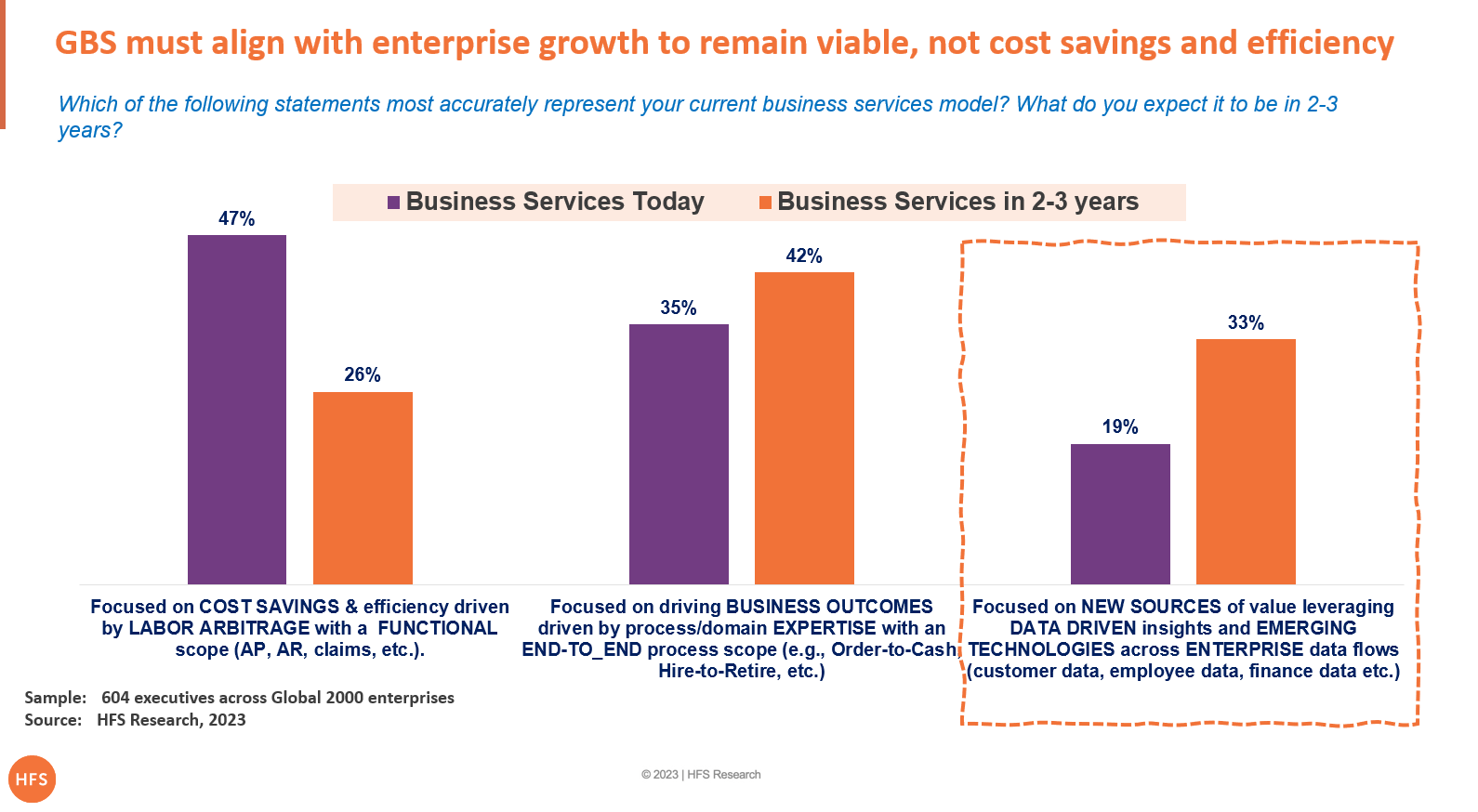
Our research of over 600 business services decision makers across the Global 2000 reveals nearly 50% GBSes are happily focused on cost savings today. However, it is expected to halve in the next 2-3 years (See exhibit below). GBS services of the future must align with the enterprise growth agenda, not just better, faster, and cheaper operations.
GBS has a critical role in helping organizations balance the current digital dichotomy that nearly every enterprise faces: balance the macroeconomic “Slowdown” with the “Big Hurry” to innovate.
Problem #2. Young people don’t see GBS as an attractive career. It’s just not sexy
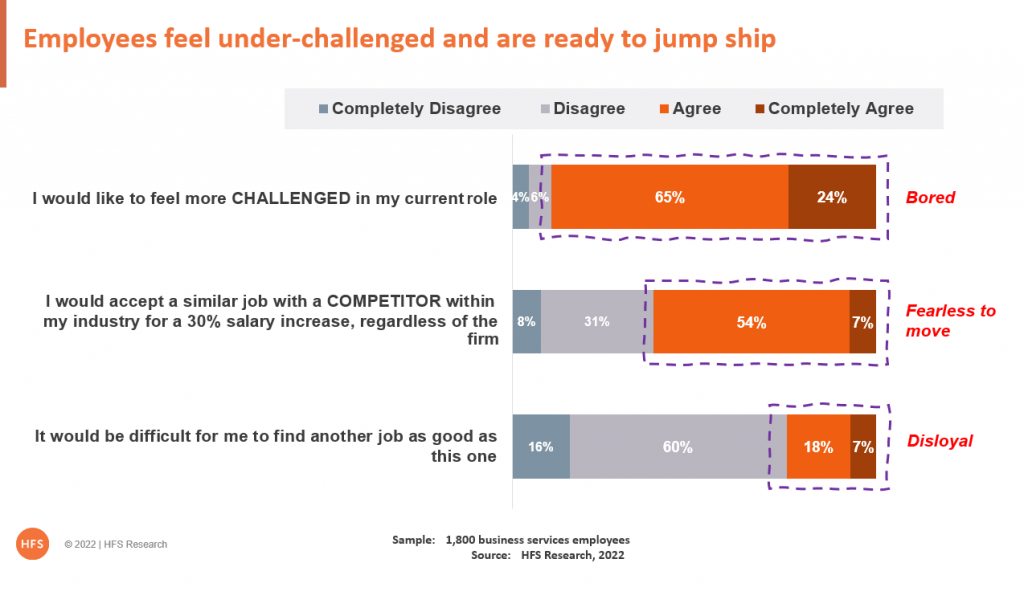
Research we conducted on employee experiences of 1800 business services staff shows close to 9 out of 10 want to feel more challenged (and are bored), 61% will jump to a competitor for a pay hike, and 75% believe they can easily find a job as good as the one they currently have:
It’s no wonder business services staff are quitting in droves in search of something more challenging when there is so much demand for workers to perform elsewhere. Now that next job may turn out no more challenging than their current gig, but if there’s 30% more money for doing it, why not?
Now we can moan and groan about the attitude and self-entitlement of some Gen-Zs and Millennials who have no loyalty, don’t care about longevity on their CVs, etc., but put yourself in their position: you’re ambitious, and other companies are offering you more challenging work, more money, and are simply more exciting places to work.
Why would you want to suffer a life of soul-crushing work for a company that still operates the same way it did 30 years ago? And can you blame staff for preferring to work from home than suffer from the monotony of a stuffy cube kingdom where most of the management isn’t even there? Let’s be blunt: it’s often the management who have become self-entitled, not the staff. The problem ultimately lies with bad leadership, not bad working attitudes, which is the reason why GBS has failed to provide real career options for our best and brightest.
The dawn of GenAI creates a once-in-a-lifetime opportunity for GBS to pivot
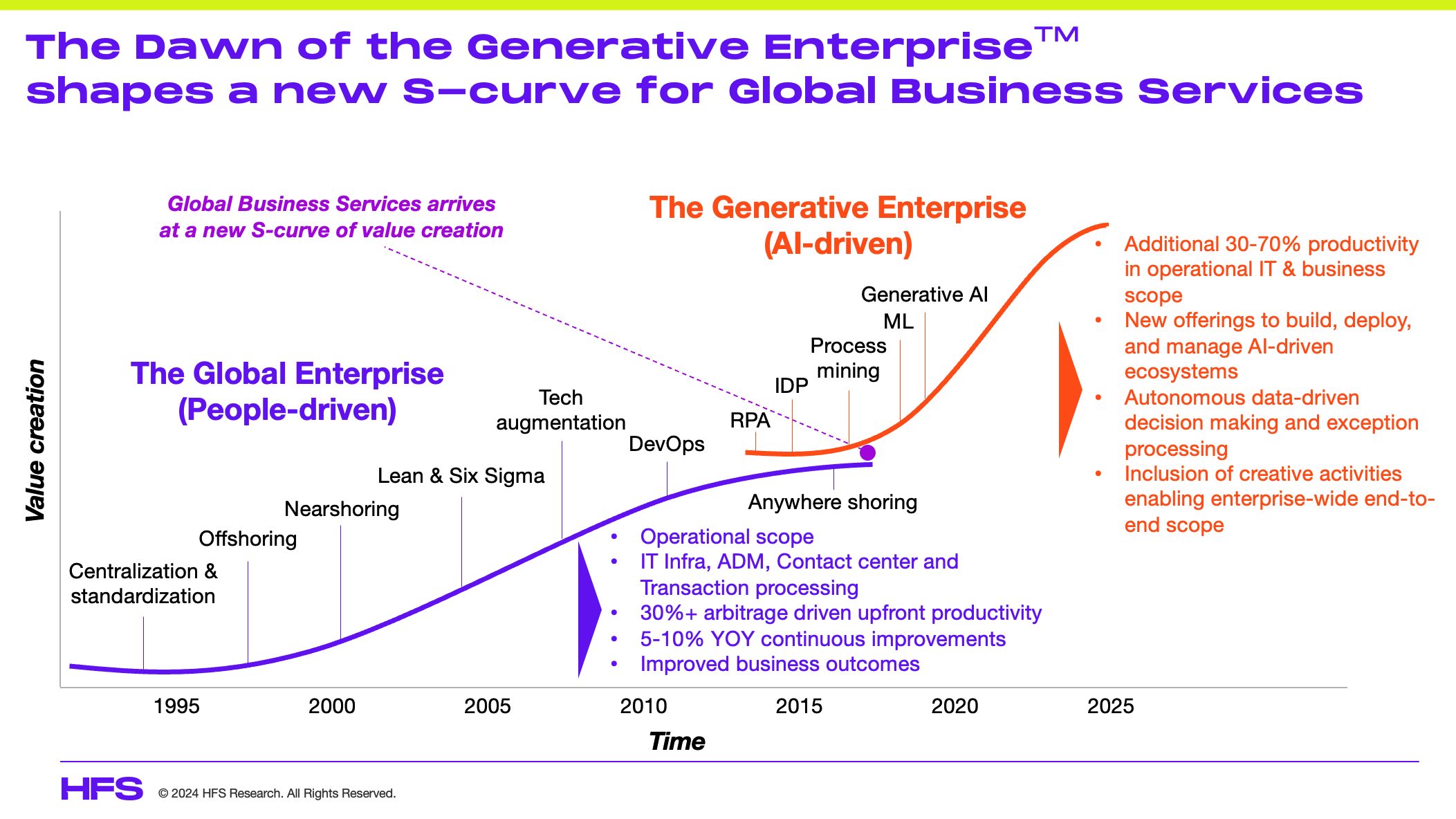
Global talent is what created the GBS model. Centralization, standardization, lean/six sigma, offshoring, nearshoring, technology augmentation and, more recently, anywhere shoring have been the pillars to drive down costs and improve productivity. The core business case for GBS revolves around 30%+ upfront arbitrage-driven cost savings and 5-10% YOY productivity with a veneer of better stakeholder experience and improved business outcomes. For enterprises that have been at it for decades, start realizing there is a limit to how much juice you can squeeze from a lemon and start witnessing diminishing returns. As we mentioned already, your C-Suite has long since stopped celebrating the costs you trimmed in the past, they will soon be demanding new thresholds of value that aligns with their innovation agenda (if they are not already).
GenAI is driving a whole new innovation agenda and GBS leaders must be part of the conversation
GBS leaders searching for the next big thing after “offshoring” may have their prayers answered with the dawn of GenAI. It promises a significant productivity improvement (not just incremental) on voice-based work, coding, testing, and transactional processing – the core of any GBS operation. What’s even more interesting is the ability of AI-driven operations to support autonomous decision-making, exception processing and the capability to handle a more creative scope of work (think art, writing, design) beyond mundane and boring activities.
The dawn of GenAI has created an inflection point for GBS to jump to a new S-curve of value creation:
The S-Curve we once knew as linear now has a huge kink in it: where we could save 20% here or 30% there with the use of smart automation, chatbots, and simply using better software and cheaper labor aligned to better processes is now up having a major shake-up – and this will happen quickly.
For example, one onshore call center operation has hooked up a GPT-4 bot to its Salesforce system and can already see how 50% of its staff can be reduced within months. There are many, many other cases quickly emerging – they are emerging almost daily as we all tinker with the disruptive potential this is going to have.
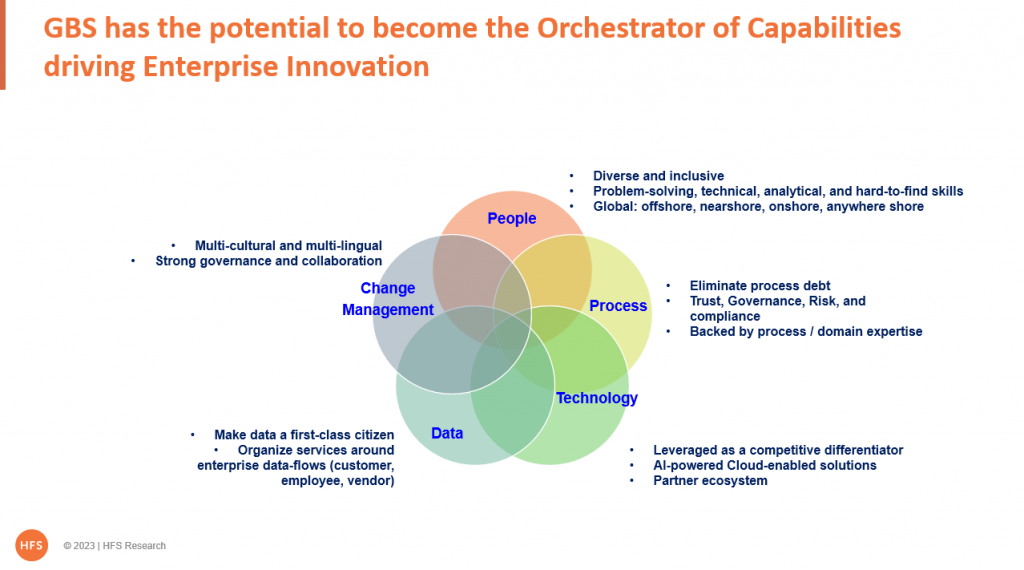
It’s time to stop underselling GBS as a large-scale operational entity. GBS has the potential to be an innovation capability orchestrator
The common perception within most enterprise stakeholders of GBS is associated with large-scale and process efficiency. GBS leaders must market their capabilities better. GBS can become the orchestrator of capabilities required for enterprise innovation if it stops underselling itself around running transactional processes for the enterprise:
The winning mantra for GBS is EX+PX = CX. In our obsession to deliver the best CX, we ignored EX for far too long. Thankfully, the “Great Resignation” of 2022 created the burning platform to at least try to resolve our talent equation. However, we are still missing an important stakeholder – the PX (Partner Experience). No-one-can-be-everything-to-anyone and more organizations are now realizing that they need an ecosystem strategy to be at the forefront, along with customers and employees (See HFS’ POV on OneEcosystem).
The bottom-line. Focusing on the old way of doing things is no longer the way forward for GBS
Successful GBS of the future needs to be training grounds for talent, data, and AI business models. GBS needs to be generative… by driving and promoting new ideas and ways of thinking and operating. The back office perpetuated by tired old GBS models has held back enterprises for far, far too long. The tools, know-how, and competitive realization are forcing the move to a generative mindset for those companies desperate to propel themselves forward into the GenAI-era. Don’t get left behind…
In March 2021, Wipro closed the largest acquisition in its history, Capco, a BFSI-focused consulting firm, for $1.45B. HFS wrote glowingly about the transaction, with our positive assessment fueled by a confluence of circumstances including a new, unlikely pick for CEO (Thierry Delaporte) who brought a strong pedigree in integrations of significant acquisitions, driven by his experience of the successful merger of IGATE into Capgemini and his respected leadership within the financial services industry.
In addition, the IT services industry was enjoying a massive pandemic-fueled spike in digital and modernization spending, and there was some optimism that this acquisition would finally anoint Wipro as a true end-to-end transformation partner.
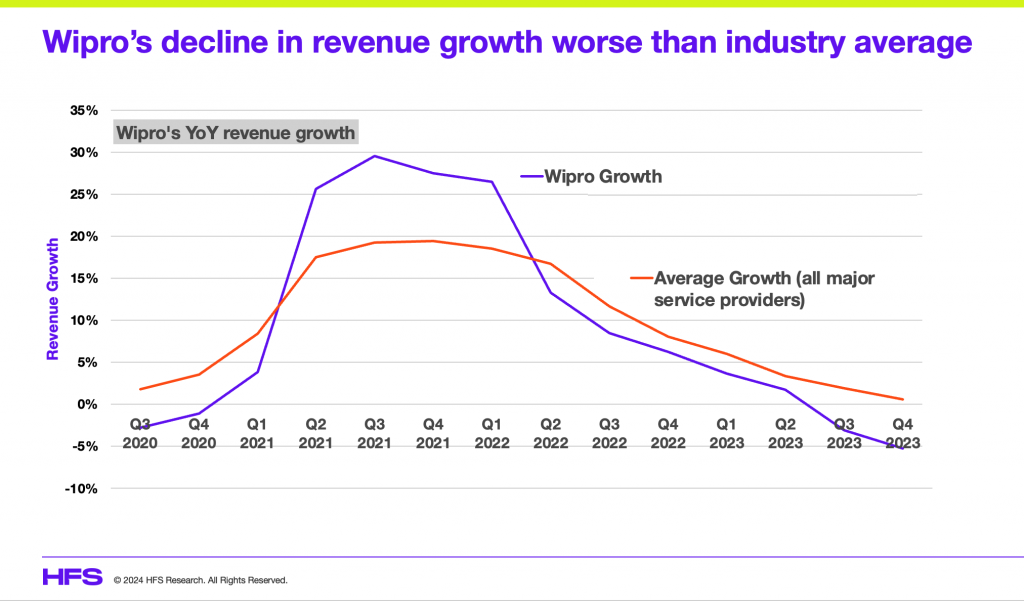
As we examine what Wipro has achieved in the three years since the acquisition, we regretfully opine that things have not gone well, as clearly outlined here:
What went wrong – market headwinds, culture clashes, and lack of integration
The potential to be a great acquisition was there. “Strategy-led execution” was what the combination of Capco and Wipro could yield. Capco brought deep BFSI consulting capabilities and strong C-Suite relationships outside the CIO’s office, which so many of Wipro’s competitors lack. Wipro brought extensive delivery and execution capabilities in IT services. This limited overlap was viewed as a benefit, with the game plan being to integrate the elements to drive end-to-end services capabilities “from think to design to build to operate”. The integration plans were executed – lots of great and well-intentioned account-specific plans were drawn up. However, Wipro grossly underestimated the cultural differences between their firms, namely Capco’s Western-heritage consulting versus Wipro’s India-heritage delivery mindset. This cultural mismatch was further exacerbated by keeping the brands separate.
Wipro additionally could not have planned for the inflation and associated market headwinds that torched many a bank in 2023. The combined result has been a massively detrimental slide in BFSI revenues which, as its largest reported industry vertical contributing about a third of revenue, has most definitely left a mark.
At HFS, we acknowledge Wipro’s revenue challenges are bigger than the Capco conundrum, however this was Thierry’s big bet and it’s clearly struggling. All services firms are battling continued market headwinds and even Accenture sent alarm bells across the industry with its bleak demand forecast for the year.
But the fact remains that Wipro made its largest-ever acquisition and has little to show for it other than the somewhat nominal addition of Capco revenues to its topline.
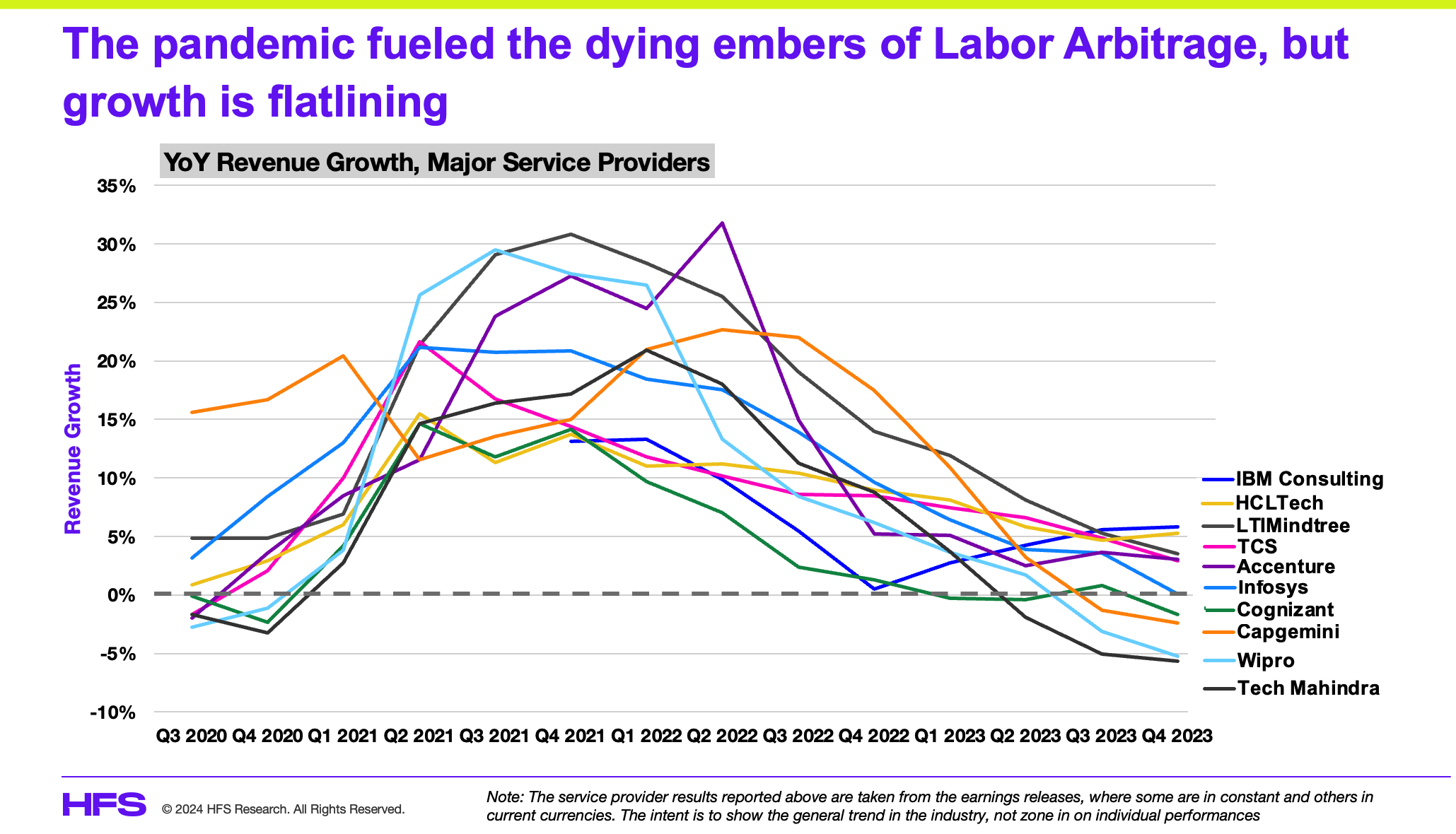
Despite adding a supposedly margin-rich consulting business, its operating margins are in fact lower than they were pre-pandemic. The following graphic puts a fine point on the state of Wipro vis-à-vis its competitors. Those that are staying above water are doing so due to heavy prioritization of technology arbitrage.
Why large consulting firms and offshore-centric outsourcing providers struggle to blend
There was a cheesy relationship self-help book from the 90s called “Men Are from Mars, and Women Are from Venus – a Guide to Understanding the Opposite Sex.” Apparently, BFSI strategy consultants and IT delivery and execution resources are also creatures from different planets. At least at Capco and Wipro, but the cold reality is there have been few successful large mergers between large onshore consulting firms and India-heritage service providers. The one exception is Capgemini and IGATE, where there was very limited client overlap, and Capgemini already had deep consulting capability. Plus Capgemini had learned from several past acquisitions which hadn’t fared as well.
There is a fundamental underlying reality: strategy consultants are in the business of paid ideation and hand off to execution resources to build and implement their recommendations. Basically, consultants sell the dreams, and service providers provide reality, which is sadly where this Capco/Wipro merger has found itself.
IT delivery and execution resources are paid to build, implement and manage business as usual operations. These should be complementary capabilities, as was the plan for Capco and Wipro, but the breakdown comes from a mismatch of enterprise buyers, Capco’s view of Wipro’s capabilities as commoditized delivery, and Wipro’s view of Capco’s consulting as pre-sales.
1+1 = 1.5
The idea of Capco as the tip of the spear for Wipro’s capabilities fell apart as Capco’s relationships with non-CIO leaders did not translate well to downstream Wipro engagements. HFS heard numerous reports of Capco consultants disparaging Wipro delivery resources as the “C-team”. Wipro in turn has its own cultural challenges – best described as a bad habit of treating consulting as cost of sales investments to land large build and run deals. Neither of these orientations lend themselves well to end-to-end transformation deals.
The Capco and Wipro teams were culturally opposed and never found a great working groove. The most damning evidence of this is the various conversations HFS has had with clients of each Capco and Wipro, where we inquired about the impact of the integration. Capco clients generally indicated they are interested in the build and run “bodyshopping” resources of Wipro, but have not been impressed with the caliber of their people. Wipro clients have generally indicated they often work with Capco in other parts of their firms, but have not had the need to bring them in for their IT build and run engagements.
The net-net is Capco and Wipro sell and run separate engagements, usually with different levels of executives on the client-side. Sure, Capco’s revenue accrues to Wipro, but there has been limited exponential impact from combining the two entities. Strategy-led execution deals have not materialized.
Sub-brands are the antithesis of integration
So Wipro basically has a strategy sub-brand. Capco continues to operate as Capco, now branded as a Wipro company. They have lost some of their talent, most recently Lance Levy, the longtime CEO of Capco who will now serve as a “strategic advisor”. But retention bonuses paid early on have helped keep some of their key operators. Although, as with Levy, the three year mark is often when golden handcuffs are released. What is ultimately keeping Wipro from realizing the value of its acquisition of Capco has been the lack of integration.
We truly thought Wipro’s CEO, Thierry Delaporte, understood the criticality of integrating acquisitions. After all he was the maestro behind Capgemini’s successful integration of IGATE, an eerily similar combination of consulting plus Indian IT services capabilities. However it was the reverse order of operations – a consulting company acquiring an execution firm. We’re not sure it matters though. As Capgemini has more recently demonstrated with its 2019 acquisition and integration of Altran, the name of the acquired entity must be put to rest otherwise the master brand loses equity. Altran has been known as Capgemini Engineering since early 2021. Why Delaporte and his team lacked the confidence to roll its newfound consulting skills under its own brand effectively undermines the value of Wipro. And with the announcement of new CEO Annie Rowland as Lance Levy’s replacement you’d have thought this an ideal time to fuse the brands together with the old guard finally leaving the building.
Other proof points include the highly acquisitive Accenture – arguably the master of acquisition integration – nearly 300 of them since it split from Arthur Andersen – with most acquired entities folded in and accruing to the master brand. Although even Accenture struggled with some earlier acquisitions as it was building out its brand as a digital and advertising business.
NTT DATA has finally seen the light after years of fragmented operations and the awkward co-existence of multiple brands. It recently announced the consolidation of all operations outside of Japan. The result is a $30B powerhouse slightly bigger than TCS.
The Bottom Line. The writing is on the wall. The Capco brand needs to be retired if Wipro has any hope of truly integrating and realizing the vision of strategy-led execution
HFS refers to 2023 as the year of the digital dichotomy, where enterprises across all industries struggled to balance market headwinds with the palpable need to drive progress and impact with innovation. No sector was harder hit than banking and financial services. A gigantic entity like Credit Suisse went down. The 2008 financial crisis was a long time ago, but banking is an old industry and everyone still remembers like it was yesterday.
So there was zero confidence in banking investment last year. Every service provider, most of which have BFSI as their largest reported industry group, are feeling the pain of massively elongated sales cycles, teeny contracts, and cut-throat competition. For Wipro, the firm needs to reign in its sub-brands (let us not forget DesignIT and TopCoder) and get down to the business of offering, delivering, and finally realizing its potential of providing end-to-end transformation services. The cost-to-income ratio of banks has been stagnant for twenty years. The need for change is there, and there,is no better time than now to make a bit bet on itself.
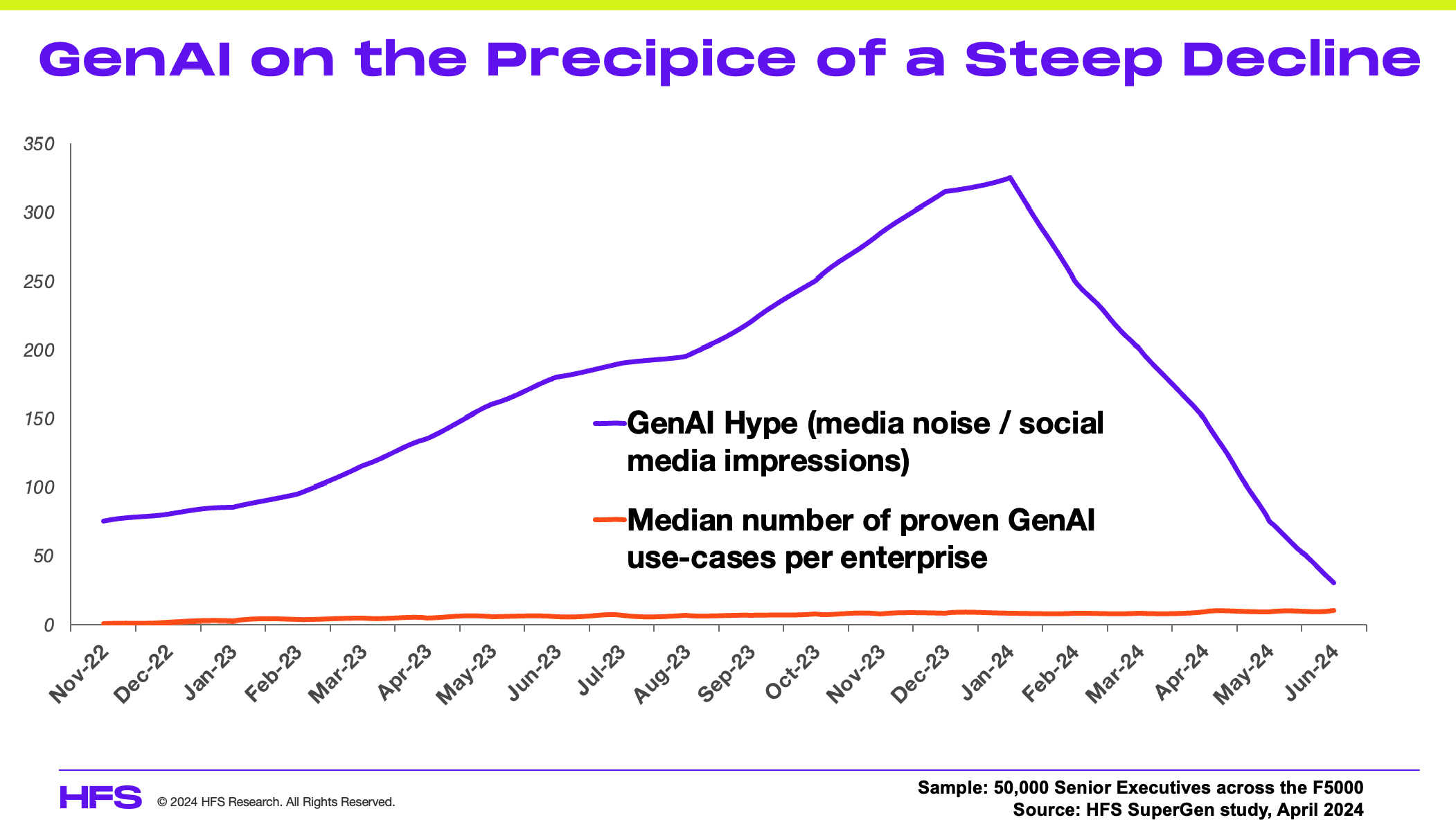
We’re sad to inform you all that the GenAI we have grown to love with such intensity will shortly crash and burn. We’ve been here before, folks, when we called the death of RPA five years ago… and we are today calling the death of GenAI:
GenAI has simply become the new Digital. The many billions every tech and services firm has claimed to be investing in GenAI has now evaporated in a puff of press releases, turgid conferences, and soul-crushing webcasts. They’re now claiming everything they once painted as digital is now getting a second coat of paint called GenAI.
Suddenly, every single executive from every single organization is talking as incessantly about GenAI as they used to about Digital. And they are keeping a straight face while they do it.
But “What is the problem with this, Phil? AI is changing everything about our world.” I hear you all collectively cry… so without further ado, let’s analyze brand-new data from our SuperGen study of 50,000 senior executives in big companies in the F5000.
HFS’ SuperGen study finally reveals the real truths behind the last 16 months of AI hysteria
Not content to simply jump on this hysterical AI bandwagon, HFS’s stubborn analyst team took it upon itself to launch the largest-ever study of GenAI adoption known to humankind. Here are some key highlights from the data findings we can exclusively reveal today:
98% of executives claim to be rolling out GenAI initiatives.
76% believe their GenAI initiatives are game-changing but won’t disclose what they are.
91% of senior executives do not have a paid ChatGPT account.
84% of senior executives with a paid ChatGPT account haven’t actually used it yet.
85% of senior executives have only performed one prompt, which is to find out what ChatGPT says about them.
97% of senior executives can’t actually define GenAI.
63% believe Elon Musk and Jensen Huang are developing GenAI to control people’s minds with embedded Nvidia chips.
34% believe Donald Trump will soon launch his own GenAI tool branded MagaGPT.
88% believe President Biden would benefit from a GenAI chip implant.
Bottom-line: With GenAI hitting the skids, what’s next?
We decided to consult the experts on what will replace GenAI and these many billions of dollars we’ve seen expended into the ether.
Jensen Huang and Jesse Lyu weigh in on the demise of GenAI
Firstly, we spoke to the new Steve Jobs… Rabbit’s Jesse Lyu has sent a thunderbolt of excitement into the industry with his revolutionary handheld product, RI. “LLMs asked the questions, but LAMs will provide the real actions. Fortunately, we’ve only just shipped out the first batch of Rabbits, so it’ll take a while for you all to realize the thing just adds yet another useless layer of application management. But it’s a cute bunny, and I got you all excited and very rich at the same time, so what the hell.”
We then managed to get Nvidia CEO Jensen Huang himself to talk to us, and he was pretty candid, “We’ve made so many billions from GenAI that I realized it may evaporate once I ditched this leather jacket I’ve been wearing continuously the past few years. So I’ve decided to invest in a super cool new bomber jacket to prepare for the next big thing… stay tuned, folks!”
Well, there we have it, everyone. With GenAI about to die, we can only ask why….
So, the worst rumor in the industry finally came to fruition: Thierry Delaporte finally fell on his sword at struggling Wipro to be replaced by an internal Wipro-ite and 32-year veteran, Srini Pallia. This is Wipro’s first internal candidate to take the helm since T K Kurien’s appointment in 2011.
Delaporte came into Wipro as the pandemic was kicking in and used his remote advantage to pull the company together, speaking with a multitude of clients and giving the firm some strategic direction during that difficult time, especially with the bold acquisition of financial services consulting powerhouse Capco. In addition, Wipro enjoyed a strong 2021 as dollars flowed into cloud modernization, and many of Wipro’s large clients, such as AT&T, Citibank, ABN Amro, Levi’s, Metro AG, Dell, and Este, all kept faith in the firm. However, when the momentum was there to kick on and compete for some of the choice deals, Thierry took his eye off the ball.
Sadly for Wipro, the post-pandemic period has been one of the worst times in the company’s history:
Delaporte rarely left his Paris base, while his CEO counterparts have been regularly rallying the troops across India and the US. You can’t run an Indian-heritage business during tough economic times when you’re not physically present to boost morale and represent the firm. Being seen at Davos and not rallying the leadership while the revenues are tanking is not a good look.
He brought in many executives from outside of Wipro and neglected the loyal Wipro-ites who had built the company. This has resulted in many A players leaving the firm such as Rajan Kohli (CitiusTech) and most notably losing its well-respected CFO, Jatin Dalal to Cognizant.
His large deals team, spearheaded by Stephanie Trautman, struggled with the internal fiefdoms Thierry failed to address, and was shut down at the end of last year with Trautman, a popular figure with clients, leaving the firm.
The Capco acquisition has been a major struggle to bear fruit, which was Delaporte’s big bet, as we discussed recently.
The morale has been sapped out of Wipro for a year now, and this change in leadership is at least six months overdue.
So what’s the deal with Srini, and can he bring Wipro’s mojo back?
While several external candidates were mooted, Rishad has opted for a popular internal candidate based in New Jersey the heartland of IT services decision making. Srini has the respect of the guys who built the firm (those who are still there) and well-liked by key partners Microsoft and SAP. He knows the company, he knows many of the key clients, especially ones like Este and Tapestry he personally let for Wipro.
What are the big things he needs to do quickly?
Restore morale. Simply put, the firm is bleeding talent, and morale has never been lower. He needs to nail down his plans quickly, give the firm renewed direction, and convince key stakeholders he is the right choice during perhaps the darkest period in Wipro’s history.
Retain key leaders. Significant talent, such as Suhba Tatavarti, Suzanne Dann, Nagendra Bandaru, Anis Chenchah, Harish Dwarkanhalli, and Jo Debecker, remains in the firm. He needs to pull together and ensure they stay.
Breakdown the fiefdoms. This is where Thierry struggled, and Srini can succeed by ensuring they go after new clients as one Wipro team, not a broken group of silos. Srini is at the coalface of many deal pursuits and should be in prime position to fix these issues.
Fix Capco. As we recently discussed it makes no sense to keep these entities so separate with separate brands. It’s not too late to reverse this and get this moving in the right direction, especially with financial services over the worst of its difficult times.
The Bottom-line: Better late than never, but this is no easy task for Pallia as Wipro turns back time
After the failed experiment to make Wipro like a Big 4/Accenture-like firm, Wipro is going back to its Indian-centric 80-year heritage to deliver cost-efficiency, but with capabilities to support transformations, Cloud and GenAI (Wipro is performing well with several GenAI pilots and rollouts, for example). However, the firm has to play catch-up during the toughest time facing Indian-heritage outsourcing, and Pallia needs to weather more challenging quarters, impatient shareholders, and unrealistic expectations. Thierry hasn’t left a great legacy to build on…
Operations leaders face unprecedented challenges. They have to manage the new complexity of becoming cloud native and anticipate the implications of GenAI. If that’s not enough, they also have to find answers to the Digital Dichotomy, balancing the macroeconomic “slowdown” with the “big hurry” to innovate to keep up with innovation pacesetters. Yet, it is not a question of doing one or the other—they must address all those challenges simultaneously.
Against this background, quality assurance (QA), or simply “testing,” as it was called in the old days, can no longer be a reactive afterthought coupled with an unwillingness to invest in quality. Instead, it must become an integral part of the software development lifecycle (SDLC) and take on a much more holistic responsibility for assuring transformational outcomes.
This is the context for HFS’s seminal study on assuring the Generative Enterprise™ (HFS Horizons: Assuring the Generative Enterprise™, 2024). We sought to understand better where organizations are with their QA efforts and how they are trying to ensure transformational outcomes. We also explored how they assure change agents such as automation, AI, and blockchain. Finally, we looked at the adoption of GenAI through the lens of QA. In the following, we share the insights gleaned from our study.
Lofty aspirations for quality assurance
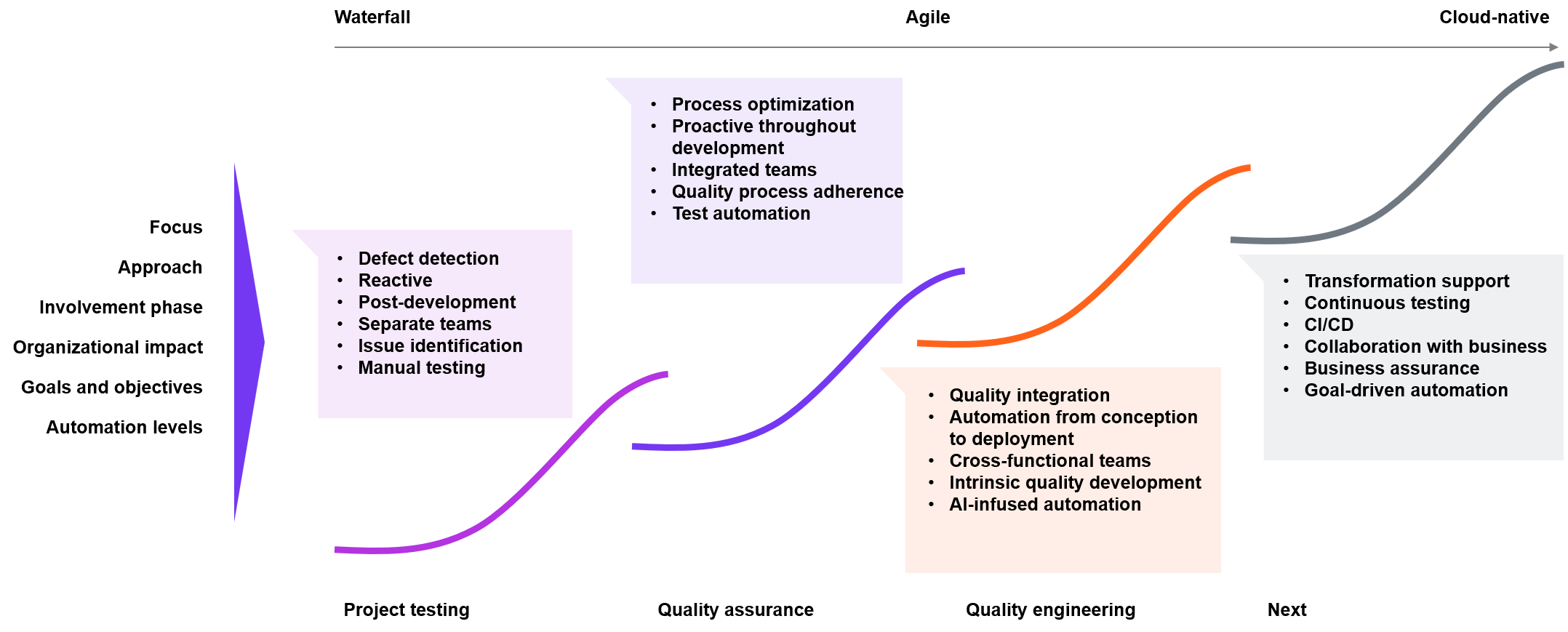
Finding your bearings on all things QA is difficult because there is a massive gap between the aspirations (and lip service) for QA and QA functions’ maturity and enterprises’ willingness to invest in them. While the mature end of the market is pivoting toward quality engineering (QE) with a focus on achieving continuous testing, data-driven decision-making, and cross-functional collaboration, two-thirds of the market is stuck at a lower maturity level, often still working with a Waterfall methodology, as Exhibit 1 depicts. Simply put, most organizations are on the left-hand side of this infographic.
Exhibit 1: Pivoting to quality engineering is about aligning quality assurance to customer journeys
Source: HFS Research, 2024
Yet, we might finally see organizations embracing the transformation of their quality assurance functions. According to our study’s reference clients, 95% described the primary value delivered by their service provider today as the ability to drive functional optimizations with selective quality assurance capabilities. Simply put, they expect services on the left-hand side of Exhibit 1. However, in two years, most of these organizations expect a transformation of their quality assurance functions, intending to drive experience-led outcomes and stakeholder experiences while creating new sources of value through ecosystem synergy.
“Shift right” is starting to augment “shift left”
Discussing these issues with QA leaders, technology partners, and service providers could crystalize more nuanced market dynamics. Most organizations have embraced “shift left” principles emphasizing the early and proactive involvement of quality assurance activities in software development. We are seeing mature QA functions augment this with “shift right” principles advocating quality activities also at the later stages of the SDLC.
Regarding organizations’ QA priorities, four clusters jump out for us: First, carving out a budget for QE architecture modernization and transformation. This goes back to the discussion of the Digital Dichotomy and the need to self-fund innovation. Second, solving the conflict of production quality versus speed to market. Not least, with innovation cycles dramatically compressed with the ascent to GenAI, this is a hard nut to crack. Third, overcoming a new complexity to provide integrated assurance for apps, infrastructure, and platforms or progressing toward the OneOffice™, as HFS would put it. And fourth, driving change management to foster transformation. Yet, large chunks of the QA community are stuck in a tools and technology mindset.
There is much noise but little assurance on GenAI
Let’s zoom in on the topic that comes up in every discussion we have, regardless of the context. While many providers hype use cases around domain knowledge and code creation, grown-up discussions about how to assure GenAI are sparse. As such, Cognizant’s Artificial Intelligent Lifecycle Assurance (AILA) and Infosys’ AI Assurance Platform are more exceptions than rules. This provides indicators for the enterprise adoption of GenAI. We are still at the very beginning of enterprise adoption. The core value proposition of GenAI use cases in QA is having a higher accuracy with less data. Thus, providers can drive new levels of automation to generate test scenarios and test cases.
While we had many discussions on the infusion of QA with GenAI, deliberations on governance on GenAI are still nascent. Where we had honest discussions, providers reflected that large language models (LLMs) are largely unfamiliar entities. One executive framed this aptly: In the context of GenAI, we must show humility to the unknown. Thus, the predominant way to engage is through experimentation. However, there is no beating around the bush that we were a tad underwhelmed by the discussions of assuring GenAI outcomes; outside of the service providers, we had some stimulating conversations. For instance, MunichRe provides insurance for AI, while German start-up QuantiPi blends quality assurance with governance for GenAI.
North Star (autonomous) persona-based testing
Beyond the broader pivot to QE, what have we learned about the evolution of quality requirements? Like cloud-native operations are shifting toward persona-based solutions, QE is shifting toward persona-based testing, requiring capabilities to support better specific stakeholders such as product teams, site reliability engineering (SRE), DevOps engineers, and beyond. But to be clear, this is the North Star, and only a few organizations have it on their roadmap. Looking at these requirements in the context of GenAI, the key is blending prompt engineering with specific persona scenarios. Using prompts to generate automation scripts such as Selenium can significantly enhance the scale of automation. Lastly, using the input from one prompt to generate another prompt can leverage GenAI to industrialize offerings.
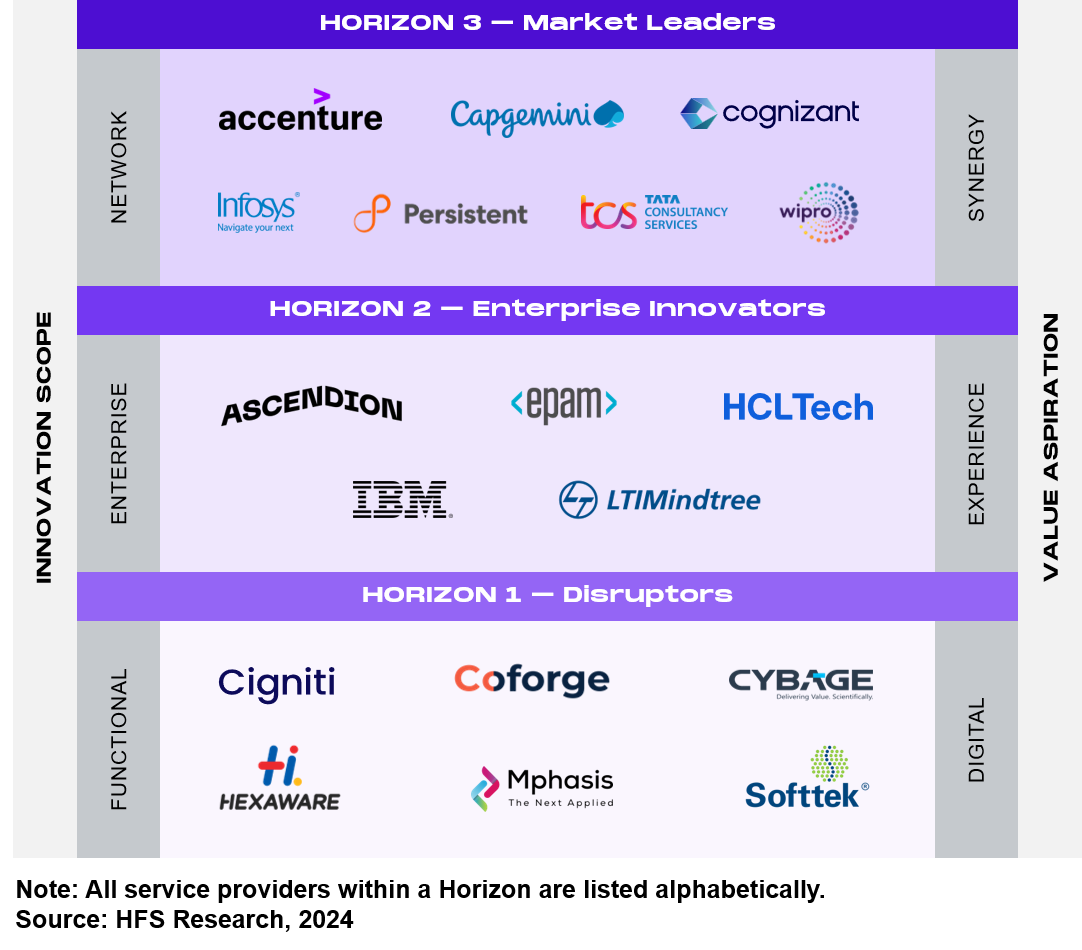
Horizon 3 market leaders blend a compelling vision of transformation QA with nuanced approaches to assure change agents such as GenAI
Last but by no means least, congratulations to the Horizon 3 market leaders. These leaders’ shared characteristics include blending a compelling vision of transformational QA with nuanced approaches to assure change agents such as GenAI. The wheat separates from the chaff when providers ensure transformation outcomes are enabled rather than depicting functional testing and an overreliance on tools and technology. The leaders are pushing the envelope on transformation with new themes such as cross-functional testing, zero-touch testing, black-box testing, and beyond. Exhibit 2 outlines the detailed rankings of our research.
Exhibit 2: The vanguard of the quality assurance services ecosystem
Accenture and Wipro stand out, clearly outlining the evolution to QE. They shift the focus of their narratives by depicting transformational journeys and outcomes rather than getting stuck in tools and technology. Infosys supports clients’ pivots to product-centric delivery and intelligent ecosystems, while TCS infuses emerging technologies into QE and embeds them at the core of transformation. Capgemini surprised us with a nuanced and thoughtful narrative on adopting GenAI. Cognizant was demonstrating test automation chops and strongly emphasized customer experience assurance. Perhaps surprisingly to some, Persistent is going deep on cloud-native transformation by investing ahead of the market in digital engineering and GenAI capabilities.
The Bottom Line: The QA community needs to emancipate itself
The innovation delivered by the QA community continues to be stupendous. Yet, the community does a modest job articulating the goals and outcomes those change agents achieve. Without snapping out of this tool- and solution-centric view of QA, it is difficult to articulate a more value-driven approach, where QA executives get the limelight they crave to discuss and decide the significant sourcing issues. Stepping up to QE transformation and putting QE at the heart of transformation and software development is an opportunity for the community to emancipate itself from being boxed in a technology and tools mindset. Discussions with the market leaders in Horizon 3 gave us some hope that we are getting closer to this.
HFS subscribers can download the report and find many more details here.
The IT and business services world has entered a crucial phase where the winners and losers will become clear in the next few months. Many are already getting left behind in the legacy services world of shopping low-cost labor, while the smarter ones are vying to become strategic partners to their enterprise clients, helping them write off decades of people, process, data, and technology debt to forge the path to the brave new AI world.
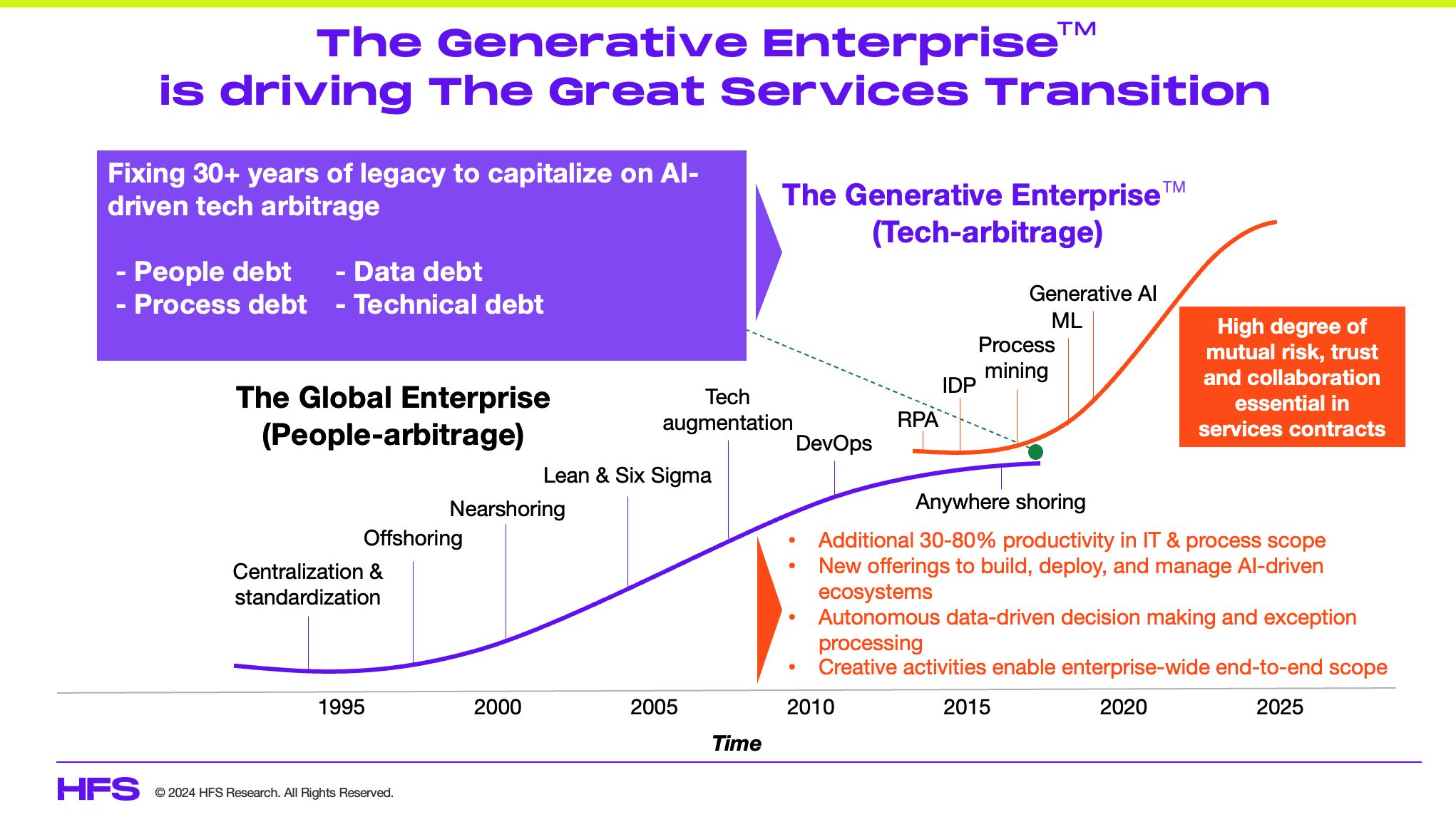
We are firmly along this S-Curve evolution from people to technology arbitrage that the Generative Enterprise demands. Welcome to this Great Services Transition, where the entire financial construct of services relationships is being reinvented to capitalize on the complex ecosystem of AI platform players, hyperscalers, data integration products, automation tools, LLM builders, and so on.
For example, services powerhouses like TCS and Wipro are digging deep into their tried and trusted past glories to (at least) restore some of the old energy and verve into their teams, but they won’t be able to rest on their laurels by simply placing popular leaders at the helm. They have to embrace the complex shift from people-based arbitrage to technology-based arbitrage if they are truly going to make it through to the other side – which we are calling this Great Services Transition.
Can today’s services firms really make the painful changes to reinvent their business models, or have their owners made so much money off the old model they simply aren’t motivated to grapple with painful change?
All these major providers, from Accenture, IBM, and Capgemini to the plethora of Indian heritage services firms and technology consultants such as Deloitte, EY, and KPMG, have to change their financial construct with their clients to one of shared risk, shared learning, and ultimately shared reward; otherwise, they face a race to the bottom.
This means changing the habits of a lifetime. You only need to look at the likes of Kodak, Nokia, Yahoo, Xerox, and even JC Penney, which simply failed to innovate with the times and were too late to play catch-up once they had woken up to the new reality. One could argue that many of the services firms in today’s spotlight are already too embedded in their legacies to turn things around. The continued cycle of providing people-based services will yield a modicum of modest growth as enterprises seek continued cost savings and invest in AI build-out initiatives. But as the model transitions to AI-led technology arbitrage, those left with hundreds of thousands of resources requiring decent utilization rates will see margins further degrade. The people-based arbitrage model is plateauing.
When your leadership is fat and happy, and the stock still holds up, why go through the aggravation of painful change when you can quietly ride off into the sunset with your cash pile? When your board and stockholders only care about your quarterly numbers, and you don’t have the time or trust to drive a long-term plan, what can you really do beyond chasing ever-decreasing deals and focusing on cutting costs to the bone? Sadly, it’s not always the fact that leaders fail to see the change coming; it’s more the casino that is Corporate America’s stock market that dictates which companies will survive or add themselves to the list of innovation failures.
However, as analysts who’ve covered this market for nearly 30 years, we steadfastly refuse to give up because many of today’s IT service leaders are too greedy, too risk-averse, or just too ignorant to find a path for survival and renewed prosperity. So let’s break down this Great Services Transition into four simple problems to solve:
To survive The Great Services Transition, there are Four Problems to Solve:
Solving problem 1). Enterprises and service partners must be aligned on the change mandate
What service partner has a culture you want to work with that will blend well with yours? Ambitious enterprises and their service partners are both striving to be effective in the emerging world of AI-driven business models and operations. This means this transition only works when there are two parties ready to tango and change together. To this end, service providers must become partners of change for their clients to help them understand the sheer noise of technology change going on around them. Clients need internal alignment to ensure that its time to make the move.
Solving problem 2). Services must provide access to affordable talent with real expertise
The shift from labor to technology doesn’t take away the need for people; it actually necessitates experts who can shepherd their clients along to help them change. They must provide continuous education on how to manage organizations’ fast-moving technology ecosystems and work with them to create business roadmaps based on emerging tech to make them slicker, smarter, more efficient, and less bloated.
Solving problem 3). Determine the people, process, data, and technology debt to address
In the Great Services Transition, enterprises are buying services solutions that improve performance, drive speed to market, reduce cost, and create new content and data.
You must address your debt in these four areas which your firm has likely collected over the last 30+ years:
1. Fixing your skills debt: Develop new skill sets that can support the transition to embracing emerging technology and AI-driven business models.
2. Fixing your process-debt: Recreate new processes process to determine what should be added, eliminated, or simplified across your workflows to support your slicker AI-led operating model.
3. Fixing your data debt: You must align your data needs to deliver on your AI-centric business strategy. This is where you clarify your vision and purpose. Do you know what your customers’ needs are? Is your supply chain effective in sensing and responding to these needs? Can your cash flow support immediate critical investments? Do you have a handle on your staff attrition?
4. Fixing your technology debt: IT spending just keeps increasing and only keeps swelling with each new platform and coding change. Stop buying tech for the sake of tech—this has been the failure of so many previous investments, such as the two-thirds of enterprises left struggling with their cloud migration journeys signed during the pandemic. The Great Services Transition is where you proceed through steps one to three before making bold decisions on your technology investments of the future.
Solving problem 4). Restructuring your services engagements to shift from labor arbitrage to technology arbitrage
Enterprise leadership has always been – and still is – obsessed with cost reduction. This is what they understand more than anything, and they view innovations such as GenAI as another lever to justify investments based on yet more cost take-out. The best approach is to reduce overall delivery costs by 20-30%, apportioned over 3-5 years. This is offset by the increased value and reduced labor costs driven through effective investments in change, processes, data, and technology. Clients MUST sign up for process reinvention and data transformation as part of it. Clients need to TRUST their partners to get them there. Providers need the TALENT to work with their customers, or the whole thing simply erodes to the bottom.
The Bottom Line: Change the habits of a lifetime, or crawl away, as this S-Curve is the biggest people and technology challenge we’ve ever faced
As human beings we’ve already grown comfortable with what is familiar to us and avoided doing things differently until we have literally no choice. This is the case with the services industry, which has ballooned in growth and home comforts for three decades. The stark reality today is that enterprises do not need to keep spending on low-cost people-based services – they have what they need, and there is so much supply they can look at many providers to get it. What enterprises desperately need are partners to work with them who share similar desires to learn new methods, unlearn old habits, and to teach them to exploit new technologies and new data methodologies and work with them to attack new markets with these capabilities.
This is how to survive the Great Services Transition. The big question now is whether enterprises and their services partners have the appetite to fix their skills, processes, data, and technical debt? Can they really learn new ways of operating, change their cultures, and embrace emerging technologies? Everyone needs to dig deep and decide whether they want to be a footnote or the future
The biggest issue I see within enterprises today is how smart executives can find common ground with their bosses to make great decisions.
I really enjoyed this simple, but magnificent advice from HBR’s Amy Gallo where she describes some simple steps on how best to achieve the right results at work without creating all sorts of bad energy:
There are some pearls of Gallo wisdom I took down:
Do a risk assessment – weigh the consequences of disagreeing
Chances are you won’t get fired or make an enemy for speaking your mind
What do you stand to lose… what could happen later if you don’t raise this issue now?
When and where you meet matters to have the conversation
Time can really help, perhaps you can find colleagues on the same page as you and their support and ideas may bolster your case
A private meeting may be a lot less threatening
Make it a chess game, not a boxing match
What to say and how to say it
Maintain a strategic focus… keep everyone’s integrity intact
Ask permission to disagree… allows your superior to opt in without feeling threatened
Explain, “I’d like to lay out my reasoning. Would that be OK?”
Connect your idea to a shared goal…. something you both care about such as company morale, quarterly earnings, etc
How to present your argument
Project confidence and neutrality…. anxious body language can harm your message
Breathe deeply
Stay humble and curious enough to hear critiques
Share only facts, not judgments
Always add, “I know you make the final call here”
The Bottom-line: Amy will be speaking at the HFS Summit next week!
And, of course, how could we resist not enticing Amy to come and keynote at the HFS summit next week with the topic… “Is it Me? Or Is it Them? How to Collaborate with Difficult People”. We’ll also be sharing a few copies of her book, “Getting Along: How to Work with Anyone (Even Difficult People)”.