Sandeep Dadlani, Executive VP and Chief Digital and Technology Officer at UnitedHealth Group (UHG), the world’s largest healthcare enterprise with diversified businesses, has a long and deep technology experience across multiple industries on both the supply and demand side. His early days at UHG coincided with the explosion of GenAI on the global stage and has been shaping some of the thinking and doing for him.
In speaking with Sandeep, it is clear about the methodical and structured approach he is driving at UHG could define how healthcare leverages the latest technology miracle.
Our most recent candid interview – as part of our GenAI Leaders Series – is to learn how Sandeep fashions GenAI’s use and ways to realize its potential in healthcare and potentially beyond.
Pragmatic, excited, and responsible: the steps to get it done
While UHG is the world’s largest commercial healthcare enterprise with ~$360B (Sep 30, 2023) in revenues, it is also amongst the largest enterprises by workforce of some 440,000 clinicians, technologists, and market-facing professionals. An enterprise of this size with even greater implications for the health and well-being of over 150 million people must be deliberate when exploring new technologies. That is precisely the approach that is being considered while the world is abuzz with GenAI.
A pragmatic approach is to find the problem(s) to solve as the first critical step in being able to address it with any new technology. At UHG there is a bottom-up effort at identifying use cases that have led to piloting some 500 use cases while the top-down identified some 14 use cases. The approach to identifying the top-down use cases was an enterprise celebratory event called Tech-Tank involving tens of thousands of employees. While ideation and spitballing are part of the effort, UHG took a hard look at the business case and the ability to scale those use cases in their selection. Given the size of UHG, scaling means very different, and early indications are very encouraging.
The use cases are generally in the administrative realm of the value chain, which historically has accumulated suboptimal processes and is a rich target for technology transformation. These low-hanging fruits include processes used by thousands of call center agents to summarize their interactions with United’s members.
“…call summarization is a simple thing but has eluded the industry for a while but really eases the work for our call center advocates and has them focus on caring for the person who is calling” – Sandeep Dadlani
Never mind the cape GenAI wears, just focus on its superpowers
“…great synthesis and data extraction from structured and unstructured fantastically well, content generation very well and automates code writing…” Sandeep Dadlani
UHG’s selection of use cases keeps clinicians in the loop to ensure that they can practice at the top of their license and not replace them. This extends to all processes that may or may not include clinicians, that a human is always in the loop to help improve the outcomes and it is done responsibly.
And so, the notion of responsible AI does not have a stronger motivator than the use of GenAI in healthcare. In the context of life and death implications, be it for diagnosis, choice of therapies, or care delivery, responsible AI must become table stakes in action vs. narrative. There must be added urgency to ensuring fairness, eliminating bias, and clear explanations of results.
GenAI’s iPhone moment is more impactful than the Kodak moment
IT services are experiencing a flat revenue trajectory in 2023 after a quarter of a century of sequential growth. As a result, most of them are investing in GenAI to fuel the next era of growth. However, the philosophy of investments in healthcare could have long-term implications. There are two schools of GenAI investments in the context of the triple aim of care (reducing the cost of care, improving health outcomes, and enhancing the experience of care);
Positively improving the tripleaim of care by empowering clinicians to practice at the top of their license, incorporating ambient tech to be virtual caregivers, or accelerating drug discovery. This philosophy will take longer to pay off but will be sustainable and result in strong growth.
Maintaining the status quo by following legacy paradigms, including labor arbitrage, could see an immediate improvement but is unlikely to be sustainable.
The potential of GenAI is like the launch of iPhones in 2007 and the realization that it could not only replace the 36 pictures of a Kodak film role, but one could store thousands of pictures on the device. The notion of experimentation became common because one did not need to be precise in the shooting of a picture, photography expanded to everyone with a smartphone, and functionality expanded beyond pictures. In a similar vein, expect GenAI to deliver more technology faster with better outcomes.
Yet before IT service providers run the idea to the banks, it is important to address the improved productivity and how that will be shared. Early indicators suggest that we should expect 30-70% productivity gains, and enterprises expect that the productivity gains will be shared with them by service providers. Providers who figure out how they realize productivity gains and find an equitable way to share them with their employees and clients will likely prosper.
The Bottom-Line: A future of elevating work beyond the mundane, learning continuously and faster, while GenAI becomes a copilot aiding in better decision-making and improving outcomes many times over.
GenAI opens the door to interrogating data differently and smartly, leading to using data (structured, unstructured, images, audio, etc.) in ways perhaps only imagined. In a future where we are going to experience an acute shortage of clinicians, GenAI, being an able aid to a clinician, will help with speed and accuracy of diagnosis, reduce administrative burden, ensure gaps in care are addressed by engaging with health consumers, and the list goes on. The sky is the limit with GenAI, and that has some extraordinary possibilities in healthcare…assuming we make the right choices and deploy GenAI against the right problems.
As we collect our thoughts for the year and prepare for the next, one area I never want to compromise on is my desire to speak the truth and never be muted by corporate propaganda and pay-to-play bribery. Let’s just call it what it is, folks.
When I founded HFS 14 years ago, all we had was our honesty and reputation for calling a spade a spade. The more we kept true to this reputation, the more valuable our brand became, and the more money companies were prepared to pay for our insight and expertise. This was a terrific way to do business and feel proud of our work.
HFS does not do business with a handful of software and services businesses, which “canceled” us because we put out research that did not make them look as amazing as they were trying to portray themselves or we just called them out for poor practices. We also turn away business from several suppliers as we do not want money purely for puffing up brands with no proven research and customer evidence to back up the claims. These firms choose to work with other firms that are clearly more flexible to bend to their dollar bills. Like has anyone ever received an “award” in this industry they didn’t have to pay for? Like ever?
I won’t embarrass some of these firms here, as I do not want to play that game, but they know who they are…
In 2024, I will push my team even harder to be brave and speak the truth in this world of bullish*t marketing, relentless hype, blatant lies, and swirl of nonsense. We have more than doubled HFS since 2019, so there is one lesson to take away from this: Truth sells!
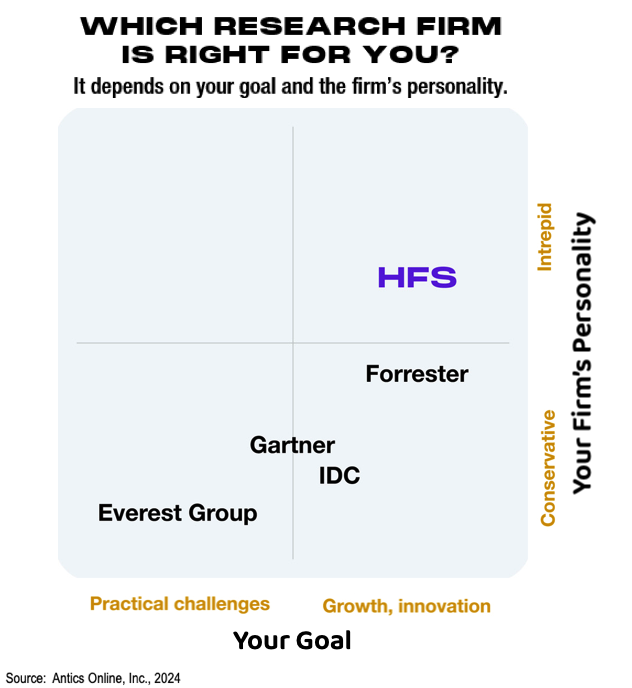
Am very flattered by how leading creative marketing strategy firm Antics Marketing Solutions has positioned HFS Research. Our simple goal is to empower your organization to be the disruptor in your industry 💪
Generative AI (GenAI) has been top of mind for leading executives globally since ChatGPT first stole headlines in November 2022, but enterprises have yet to realize anything close to its true value. Organizations must understand that GenAI and large language models (LLMs) cannot act alone; they are only as good as the data built and designed to power them.
Celonis Co-Founder and Co-CEO Alex Rinke believes that process intelligence tools could hold the key to unlocking faster and better innovation with GenAI, and every enterprise should be keen to learn why.
In a recent Fireside Chat, I connected with Alex Rinke to understand his perspectives on GenAI and how Celonis will shape the future of the technology.
For GenAI to reach its full potential, it needs complete insight into your business—and that’s no easy task
While UHG is the world’s largest commercial healthcare enterprise with ~$360B (Sep 30, 2023) in revenues, it is also amongst the largest enterprises by workforce of some 440,000 clinicians, technologists, and market-facing professionals. An enterprise of this size with even greater implications for the health and well-being of over 150 million people must be deliberate when exploring new technologies. That is precisely the approach that is being considered while the world is abuzz with GenAI.
The ease of using ChatGPT has driven the rapid excitement of GenAI for enterprises—something Alex admitted has taken him by surprise. Despite this, many enterprises don’t yet understand how to deploy it effectively in their organization. The technology needs complete insight into a business to deliver accurate, efficient, and reliable results. Traditionally, this means tackling siloed and unstructured data to create a mature data foundation—a time- and cost-consuming task. For example, developing HFS’ first-of-its-kind large language model (LLM) is the result of a six-month process that required a complete restructure of data and a fresh approach to how we work.
That’s exactly where Alex believes tools like Celonis can help, accelerating the speed of innovation by unleashing the synergy of GenAI and process intelligence.
Enterprises should put process intelligence at the heart of their operations, serving as an engagement layer for LLMs
Technology is best leveraged in combination with other technologies. Throughout the conversation, Alex highlighted how he believes Celonis and other process intelligence tools will be key enablers for GenAI, helping address adoption challenges and delivering more intelligence-data-driven insights and rich process context.
He explained that process intelligence tools provide a unified view of a business, pulling together all the pieces of fragmented systems and providing a single view for AI models. He called this the engagement layer. This unified view drastically reduces the need for extensive infrastructure changes, accelerating innovation. It’s important to note that this doesn’t eliminate the importance of maintaining a high data quality; ultimately, the garbage in, garbage out adage still applies!
To bring this concept to life, a large bank is working with Celonis to build an LLM-fueled customer service chatbot. To deliver it effectively, the model needs access to internal business processes, the ability to collect data from multiple sources, and an understanding of everything. Celonis had already been deployed across the business, which allowed data to be pulled directly from Celonis with deeper process context, such as where an order is and when it will arrive. This allowed the bank to implement the chatbot faster and deliver more intelligent responses, improving customer experience.
The Bottom-Line: Enterprises should consider process intelligence’s role in better connecting their data with GenAI.
If GenAI is set to be as impactful as the Internet, as Alex believes, organizations must ensure they are using it to its full potential, or they might just give their competitors an edge. To fulfill its potential, an LLM must have a deep understanding of the business and its data to deliver intelligent answers.
When enterprises define their GenAI adoption roadmap, they must consider the value process intelligence can deliver if they want the technology to reach its full potential. Celonis understands the power of ecosystems, and Alex teased the idea of partnerships between Celonis and the likes of LLaMA and Hugging Face, so it might be about to get even easier to infuse process intelligence with your Generative AI plans.
We have to stop using “ethics” as an excuse to avoid investing in AI. Ethical standards are something enterprise leaders must lay out for their enterprises regardless of technology investments.
For example, what DEI standards are acceptable, and what biases does a company want to set in stone? This dictates how AI can ultimately be governed and also which partners in the ecosystem a company should work with, as most enterprise leaders want to be aligned with other like-minded enterprises. For example, if a company deems it important to create a genuine gender balance within its management ranks, it will likely prefer to work with partners who share and practice those values.
Ethical fear-mongering threatens to kill off the commercial gains of GenAI at birth in three-quarters of global enterprises
Three in four CEOs believe those with the best GenAI will obtain a competitive advantage. Yet the data – presented at an IBM event in London covering GenAI and HR – also shows three in four CEOs are willing to forego the commercial benefits of GenAI over ethical concerns.
These ethical concerns are regularly cited as the cause of delays in the implementation of AI and GenAI projects. We hear this often from service providers. Many report an uptick in the volume and value of GenAI projects in Q4 of 2023 – but they also lament how many enterprises are dragging their feet over governance concerns.
Lumping ethics in the same governance bucket as accuracy and transparency has confused enterprise buyers
But many tech firms and service providers have done themselves no favors by lumping ethics in the same ‘AI governance’ bucket as accuracy and transparency. In doing so, they have muddied the waters. Ethics, accuracy, transparency, and openness are fundamentally different.
Ethics are a reason for governing—the why. Ethics are standards by which an enterprise chooses to be held accountable.
Transparency is what is required to understand how well those standards are met.
Accuracy is a measure of AI performance.
Yet we throw these three together and then wonder why the enterprise stands back, confused.
AI can’t be intrinsically ethical or empathetic
Transparency and accuracy are intrinsically machine capabilities.AI can be accurate. AI can be transparent (this is more an ambition than a reality currently). AI can’t be intrinsically ethical like a car, a washing machine, or a gun can’t be ethical. AI can be no more ethical than it can be empathetic (automatically firing out soothing phrases because you have been trained to do so is NOT the same as being empathetic.)
Only humans are capable of devising and living by ethics.
Ethics are not set in stone either. They are highly context–dependent. Context is another reason whyleaders should separate ethics from things that can be built into the machine (such as accuracy and transparency). Today’s ethics are not the same as those of 50 years ago, and no doubt not the same as those of 50 years in the future. Hard-coding ethics into AI could prove an extraordinarily arrogant and risky thing for any human to attempt today.
Ethics remains the C-suite human concern it always was – don’t use it as an excuse to delay a tech project
As discussed in a LinkedIn article in 2018: “The challenge when trying to set rules for behavior is the huge cultural weight shaping our view of wrong and right. That view varies from culture to culture and through time.”
Ethics are not for sale. They should not be sold as part of AI governance. The enterprise owns them.
Separating the two reveals ethics is much less an AI concern and much more the C-suite human challenge it always was. Leaders should certainly NOT use ethics as a reason to delay benefiting from the 10-20% boost to business performance our report GenAI will re-shape business economics, identifies.
The Bottom-Line: Separate ethics from legal and regulatory compliance to fast-track your GenAI route to better business performance.
Enterprise leaders should own ethics. They should not leave goal setting and targets for this to third parties – machine or supplier. Leaders should assess the outcomes of using AI against enterprise-owned targets. But AI can only ever be ethical by rote, meaning ethics is one loop humans must continue to own.
Legal and regulatory obligations aren’t ethical concerns; they are compliance issues. Service providers can and should help with these – building in accuracy to measure compliance and transparency to show how compliance is met.
Enterprise leaders should separate ethics from legal and regulatory compliance to fast-track their GenAI route for better business performance.
Large Action Models (LAM) are the most exciting development in AI evolution since ChatGPT was launched. Having an AI assistant not dependent on islands of apps that do not integrate with each other is everything we’ve been crying out for… But the future potential of LAMs is a lot bigger than addressing this burning problem plaguing our smartphone lives – it also has significant implications for the future of enterprise tech. It’s just incredible that while Google, Meta, Microsoft, et al. are all working on the evolution of LLMs toward actions and problem-solving, a startup like Rabbit is allegedly ahead of them.
Welcome rabbit.tech and step forward Jesse Lyu, who could well be the new Chinese Steve Jobs.
Source: YouTube, 2024
His introduction of a proprietary LAM makes it possible for AI systems to see and act on apps in the same way humans do. They learn through demonstration – watching what a person using an interface does to replicate the process – even if the interface changes. LAMs learn the interfaces from any software. They solve the problem of islands of apps that would not otherwise integrate.
The most impressive launch since Steve Jobs revealed the iPhone in 2007
Models for controlling computer actions are significantly less mature than language models, which is likely why Rabbit.tech caused such a stir at the recent 2024 CES event. What Lyu is developing with his firm Rabbit could totally disrupt the app store in a similar fashion to how ChatGPT is disrupting web search. This is super impressive in our view (except for Lyu’s love of Pizza Hut and Rick Astley). Even Microsoft CEO Satya Nadella has described the Rabbit’s launch of its R1 hardware as the most impressive since Jobs’ historic iPhone launch in 2007.
Real innovations are driven by consumer needs to begin with – which eventually find their way into the enterprise. The web and the smartphone are just two clear examples. Both have created the world in which we now live – a world of wanting instant gratification from our tech. And this next wave of AI is all about… making things work here and now.
LLMs understand what you say, LAMs get things done
We like the premise that “ChatGPT is great at understanding your intentions but can be better at triggering actions.” LLMs understand what you say… LAMs get things done. We have yet to produce an AI agent as good as one in which users simply click the buttons. We must go beyond a piece of complex software. In the case of Rabbit and its R1, a large language model (LLM) understands what you say, and the LAM actions your request. This model understands and enacts human intentions on computers and any user can teach it new skills.
Rabbit has applied this to the many applications sitting on your smartphone. The R1 device attaches to your phone and uses a camera and GPS to provide context for its decision-making and actions. You can use voice to ask questions and get voice and text responses. With the support of the LAM, you can ask ‘for a ride home,’ and Rabbit will use your preferred smartphone app to make the booking – understanding where you start the journey from.
Source: HFS and DALL-E 2024
Rabbit delivers outcomes through dialogue – in an ‘out-loud’ conversation, the likes of Siri and Alexa cannot match. However, the real breakthrough happens when you need a range of apps to solve your challenge – such as booking a vacation. Rabbit can respond to and fulfill complex requests such as ‘Book me a vacation in London for two adults and a child and find us a great hotel in a central location.’
And you can enter into a dialogue with it. At this point, you are effectively in conversation with it, having a conversation to hone – for example – your vacation itinerary. This implies a level of sustained memory more akin to that found in ChatGPT than in voice interfaces to date – including Alexa and Siri.
Once that vacation itinerary is honed to your liking and reported back, it takes just one human click-to-confirm to trigger the tech to complete all the bookings required – and pay for them.
The R1 ideal could sound the death knell for today’s smartphone, app stores, and even RPA… anything with needless complexity that prevents getting things actioned at the click of a button or simple voice action.
R1 wants to be everything to the user across IoS, Android, and desktop. The issue is that all these apps have a user interface. Its LAM can learn interfaces from any software. Though LAMs are not designed to replace your phone – they will eventually make it obsolete in its current form. R1 is aiming to kick off a whole new generation of native AI-powered devices and is just getting started; for example, this year, we can also expect the Humane AI Pin and the Tab AI Pendant.
LAMs effectively make it simpler to get stuff done, cutting through the needless complexity legacy applications have saddled us with. Robotic Process Automation (RPA) may allow us to stitch software together to form a process to complete an outcome, but RPA breaks the moment you change one app or interface in that process. With a LAM, the idea is you can just teach the new process through demonstration, and you get to continue getting stuff done.
Can it really be that simple? A note of caution before we pop the champagne
Should we really be ready to celebrate so soon? HFS’s Tom Reuner sounds a note of caution. “The big claim for LAMs is that they can action things. My suspicion is that LAMs require a high level of standardization for their actions. Therefore, we remain some distance away from objective-driven AI and automation that future large models may yet bring.”
In addition, while we believe that LAMs will eventually be a game-changer, specific to R1, we have a healthy dose of skepticism about whether another device is required for this functionality and whether or not consumers will appreciate carrying another device in their pockets just to save a couple of taps on their phones. The mobile revolution has been about device convergence all along. And what will prevent Google Assistant and other established assistants from improving their NLP and getting plugs for apps for similar functionality so we can just use our existing devices?
The Bottom-Line: Even if this bunny turns out to be a turkey – you need to prepare for the impact of Large Action Models
Like other AI there are risks to consider – will it comply with data and privacy rules and concerns? How many eggs do you want to put (to mix our metaphors) in the Rabbit basket? Is the device even going to show up and work (if not, there’s a bunch of HFS analysts who will be wanting their $199 bucks back). The answers for Rabbit will only come when the first consumers start getting their hands on the device. That’s expected to be early April (or, as Rabbit quips, ‘in time for Easter’).
And, let’s face it, enterprises are decades behind waking up to the need for actions so that AI can then actually do a better job, such as documenting a process, mapping a process (mining) automatically, reusing assets, securing them, and ultimately, solving the API/RPA conundrums. But when we start experiencing the end of application dysfunction in our consumer lives, surely this mindset will eventually trickle into the enterprise as we embrace all the wonders and anxiety of today’s emerging AI technologies.
But even if the device is a failure, the LAM genie is out of the bottle. Rabbit’s iPhone moment will inspire more investment to drive forward the maturity of models for controlling computers at an ever-increasing rate. And if the arrival of the R1 device does define the moment the great leap forward happens, then it will have ramifications for how work gets done in every app, in every process, in every enterprise. Either way, this is not a moment you can afford to ignore.
Nothing has disrupted the cozy status quo of big enterprise technology transformations more than GenAI. It has been a true leveler across the industry where suddenly everyone is operating on a level playing field, trying to convince the world they have a better GenAI story than their competitors.
Up until November 30th, 2022, the Big 4 consultants dined on the ineptitude of large enterprises to move bad processes into the cloud, while the Indian heritage outsourcers fed on the tasty scraps of supplying armies of low-wage talent at scale to keep these hulking institutions somehow functioning.
The legacy software companies sold their licenses through these services firms to maintain the flow of insane amounts of money and maintain the veneer of competence as these clunking enterprises kept up with the latest versions of SAP, Oracle, Workday, and Salesforce, with smatterings of UiPath bots to knit together broken workflows and poorly integrated systems.
And to cap it off, the hyperscalers profited from everyone as they sought to force a cloud narrative for CIOs to desperately follow to sound credible. In short, everyone has been on the enterprise technology gravy train, and it’s taken a genuinely credible new technology that business leaders can understand to redirect the train.
As Henry Hill famously said in the classic movie Goodfellas: “We ran everything. We paid off cops. We paid off lawyers. We paid off judges. Everybody had their hands out. Everything was for the taking. And now it’s all over.”
Our industry has been equalized, and a new set of winners are going to emerge
A senior partner in a Big 4 consulting org literally declared to a major enterprise leader this past week: “GenAI is just another technology tool and nothing more”. Many of these (previously) highly respected and handsomely paid consultants have been caught flatfooted and are dismissing GenAI because they don’t understand it and can’t divert extra millions of dollars out of their clients’ budgets to “help” them. The harsh reality is smart clients can smell the bullshit and aren’t going to get burned like they have so many times in the past with consultants wielding shiny new tech. And you only need to look at the sheer scale of layoffs in these firms to comprehend that the gravy train is screeching to a halt.
Net-net enterprise perceptions are changing fast, and our latest pulse survey of 425 global 2000 enterprises shows the Big 4 did no better than other IT and business service providers when rated as strategic partners for emerging technology capabilities.
Why the legacy Big 4 approach and mentality will fail with GenAI
Services partners need to win their clients’ hearts before they can attack their wallets. No one budgeted for GenAI, and two-thirds of major enterprises are still recovering from overspending on bad cloud migrations. However, most ambitious C-Suite leaders are infatuated with the potential of GenAI to make their companies more competitive and improve their own capabilities to be smarter and slicker at their jobs. Partners who understand their clients’ institutional issues and are willing to invest time at no cost to figure out a GenAI roadmap will reap a lot of fruit next year.
Enterprises want to explore solutions that are fast and uncomplex. The big challenge with GenAI is to clean up enterprises’ messy data so they can benefit from the tools. Otherwise, GenAI becomes lipstick looking for a pig. Enterprise leaders want no-nonsense partners which can understand the business context behind their data needs, as opposed to teams of highly expensive technical and domain consultants who’ll charge $2 million just to show up and document the problems.
The winners will be the partners which can quickly understand what needs to be done to fix and scale the data without charging the earth, with the ability to work fast and smart. When you look at the deep institutional relationships the likes of Cognizant, HCL, Infosys, TCS et al. have with their clients, many of whom are into 4th or even 5th-generation contracts, surely these firms have a huge opportunity to convince enterprise leaders to take a risk with them to make the painful changes necessary to capitalize on GenAI tech?
Tech spend is rebounding in 2024, with AI as the main driver. The battle is on to partner with ambitious enterprises
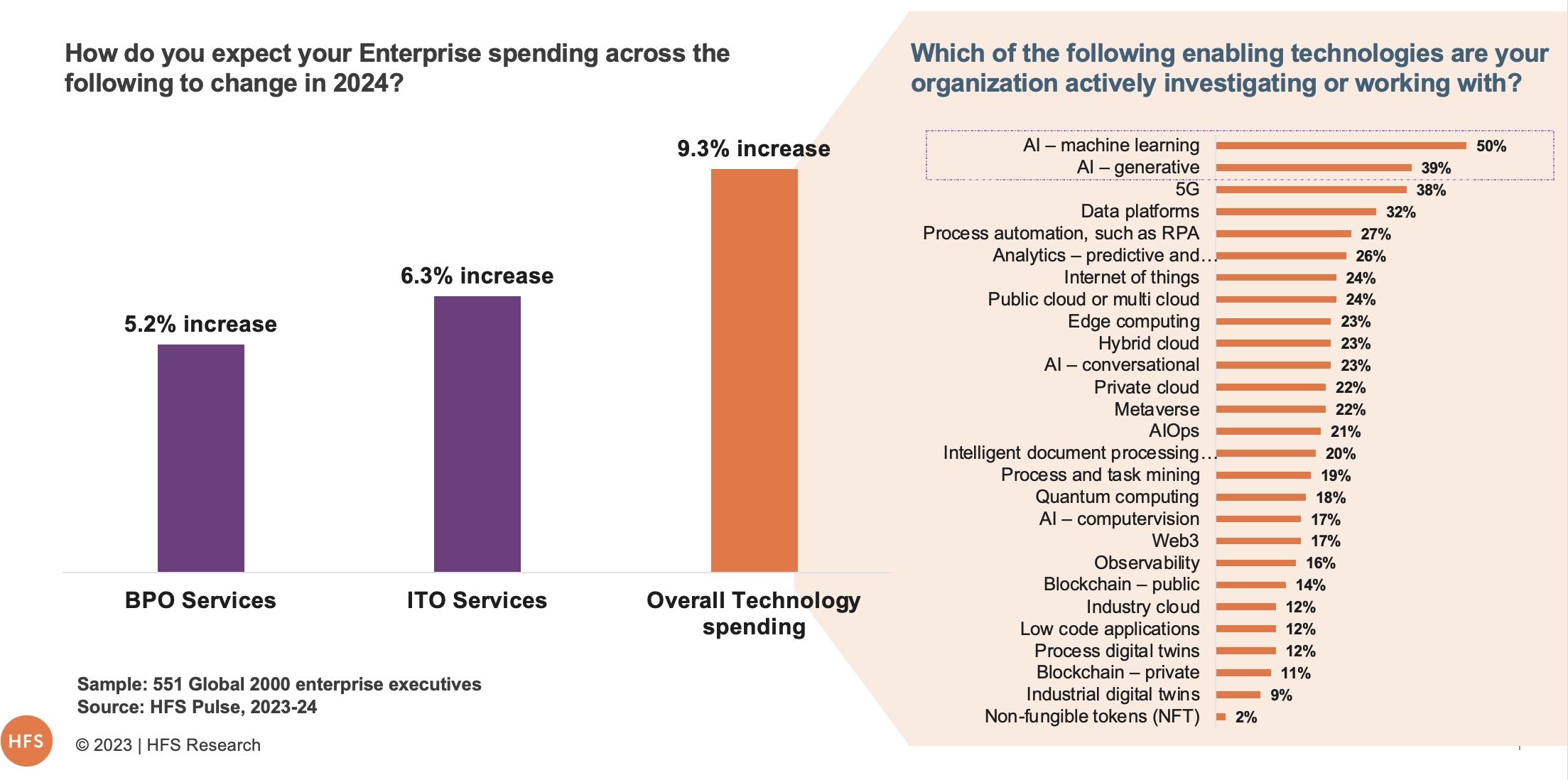
As the HFS Pulse study showed this year, tech spending plummeted from 11% growth in 2022 to barely 2% in 2023. While a lot of the pullback has been a result of difficult economic conditions earlier this year, there has also been a backlash as our research has shown only 32% of enterprises consider they have achieved their strategic priorities with their Cloud investments. Net-net, enterprises are being careful shelling out more millions on new technologies after such heavy disappointment with Cloud.
However, the good news is that our latest Pulse data of 600 Global 2000 enterprises reveals 2024 tech budgets are rebounding and the core driver is AI (both Machine Learning and GenAI). So the big question now is which services firms enterprises will choose to partner with to embed GenAI into their data and processes:
AI-driven technology spending is expected to increase by 10% in 2024
The Bottom-line: The old way Big 4 operated is over, and the smart ones are focused on re-winning their clients’ hearts
The Big 4 need to practice what they preach to get back their competitive edge. We have three recommendations for them:
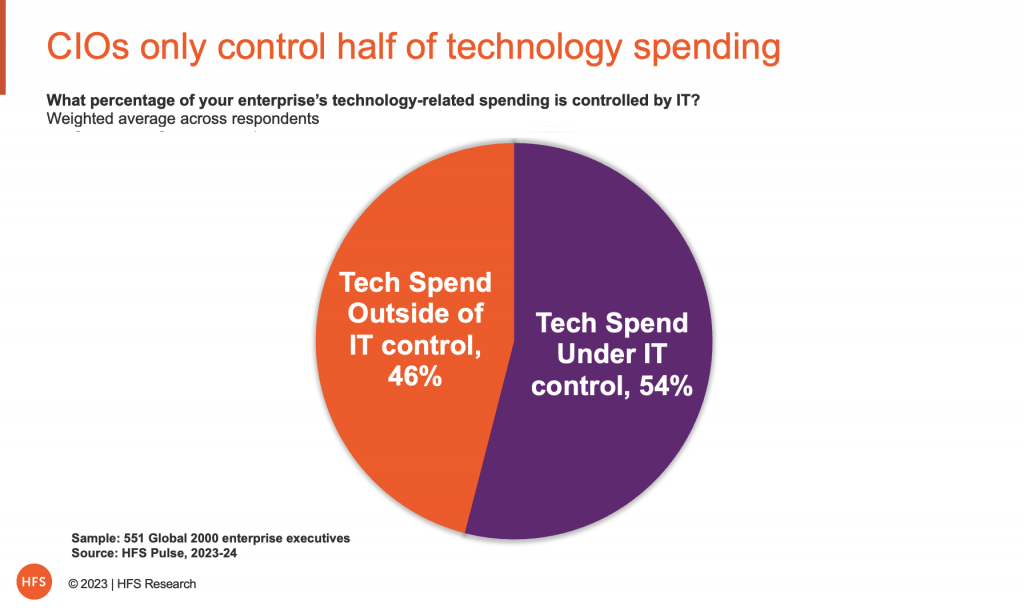
1. Double-down on the business narrative for technologies. The Big 4 have stronger relationships with the business compared to their IT services counterparts (with the exception of Accenture), who continue to struggle beyond the CIO / CTO. Our latest pulse survey indicates that IT controls just about half of the tech-related spending (see graphic below). The other half of the tech spending is with the business – that is where the Big 4 can win with their relationships if they can create a compelling business narrative for emerging technologies. They need to simplify technology, not complicate it. Make it solve business problems and make it easy to use and adopt!
2. Align advisory with managed services to create real value. The days of charging top dollar for slick PowerPoint decks are gone. The Big 4 need to get their hands dirty and be a part of the solution. In fact, managed services can protect the advisory business. Firms with operational relationships with clients can make the case for end-to-end services relationships. Managed services and ongoing operational relationships offer client stickiness and prevent client defections. The Big 4 should structure services around some elements of risk, trust, and compliance. This can also include LLM model evaluation and monitoring for Gen AI. Establish trust as a core value and marketing principle for managed services. This approach aligns with their branding and is presently not fully exploited by the competition.
3. Move beyond hourly consulting fees to performance and purpose-driven pricing. We don’t see clients paying $500-an-hour rate for advice at scale for long. The continued problem with consulting is the lack of skin in the game. But this is possibly the hardest challenge facing the Big 4 with a partner-led model where each partner thinks of their book of business, and while there is a lot of money for scoring the goal, there is no incentive for passing the ball. Managed services provide a foundation to shift away from a time-and-materials model, but this requires a fundamental transformation of the Big 4 operating model. EY tried to change things with Project Everest (splitting its audit and consulting business), but its legacy audit partners voted it down… too afraid to change their traditional model.
The Carden clan. Duffy the Westie, Gavin, Francis, Denise, Grant
and Alexis (Daughter-in-law)
It’s with real pleasure I can unveil the inimitable Francis Carden as HFS’ first Chief Technology Evangelist. Francis brings four decades of invaluable experience in the realm of software automation, having co-founded successful companies such as Pixel Innovations and OpenSpan. In 2016, Pega acquired OpenSpan to launch its RPA capabilities, and Francis led Pega’s digital automation and robotics business. Having worked with Francis for over 10 years, I am thrilled to welcome him to our team.
We have frequently debated critical industry topics (often publicly) and I’ve personally learned a lot from his wealth of hands-on experience and his courage to voice uncomfortable truths. So let’s find out a bit more about what we can expect from the British implant split between Peachtree Corners City (Atlanta, Georgia) and Panama City Beach, Florida…
What’s defined your career so far, Francis? What have been your greatest achievements… and how did you achieve them?
Wow, lets start with the small questions first Phil. OK, let’s try to summarize. My accidental landing into the tech world started when I was 17 by landing a job in the training room of a hardware and software company. For the next 7 years, working my way up, building applications and introducing new operating systems and hardware. Through many late nights of trialing, optimizing, and benchmarking, I became the central point of contact for making all of these internal and customer “things” better and faster. Back then, we needed to squeeze everything we could out of machines with extremely limited memory and performance. This continued through my co-founding of two successful software companies (in 1988 and then again in 2005), optimizing user software through any means possible – including the UI that became known as RPA! Building, running and ultimately selling these two software companies, as you can imagine, taught me just about every aspect of our industry. I feel proud to have worked with and become friends with some of the most fantastic people all over the globe. That has to be one of my greatest achievements.
What do you do first when you get up in the morning?
Grab a cup of hot tea with milk, no sugar! I drink a lot of tea Phil. And then, as usual, I check my phone for anything urgent, catch up on the overnight news, and plan out my day. Oh, and feed my dog (Duffy is a Westie) and take him for a walk.
So, what have you learned most to date about working in the technology industry that you can share?
That the most successful tech companies are ones that place bets on innovation and don’t get bogged down with the as-is. Enterprise leaders seem reluctant, for whatever reason, to place multiple bets on the art-of-the-possible and then wonder why competitors overtake them. It’s frustrating but real – and I hope to help drive this change. Enterprises lack a start-up mentality, yet this is where innovation comes in – and it doesn’t have to cost the earth or create any risks.
What would you change most about enterprise technology behavior… if you had one wish?
The need to stop with the fear of what stands before us. With so many choices in tech, there’s a constant fear from many executives that being too innovative and/or taking risks isn’t worth it. So they end up just sticking with what they know. Don’t get me wrong, most will happily engage vendors and see a world of opportunity to improve their organization in many ways. But when it comes to turning people into committed buyers or having them put their stamp firmly on key (not piecemeal) projects, the procrastination can become stifling. We are now standing on the precipice of the next digital revolution, so what needs to change is the leadership, from the board on down, who need to get closer to their teams to encourage the move from fear of change to being proud executors of change.
So you’ve been absorbed in the world of code, scaling, automation, process improvement, and now AI all your career… what do you think happens next in our world? Are we really changing old habits to move to a codeless (or even app-less) future?
I would go further now and say these old habits need quite literally to be buried deep underground forever. We need to get past the BS that is out there that gets in the way of the possibilities we have for real game-changing innovation. Most legacy software is already well past its sell-by date, but we keep putting band-aids on it. Integration and unification of systems and processes is no longer hard just because we keep saying it is. This BS must stop as the future of all software development, and all it touches does not and must not use historic computing techniques that were fine in their day. Thanks to the cloud and near-unlimited computing power, we have achieved this already with the hardware. This is the era where we rewrite history on how the enterprise manages software versus how software manages the business.
As a brand new analyst with HFS, what do you hope to achieve with us?
I feel that at this stage of my already long career, I can bring a compelling set of perspectives to generate constructive and lively debate around what matters most across the rapid spectrum of technology. I have worked with 10’s 1000 people across the entire ecosystem in just about every industry: systems integrators, consulting firms, analysts, software and hardware vendors, developers, sales and marketing, buyers, sellers, board members, C-suite, Venture Capital firms, and so forth. I have strong opinions but am always open to being swayed. If you have a strong counter argument, I will listen. I believe two or more strong differing opinions ALWAYS flush out the best position. Convince me, and you will have the best seller you could wish for. So, I hope to achieve doing what I love and having fun doing it.
What would you like to change most about the analyst industry?
I have worked on the vendor side for decades and made a lot of analyst friends (and maybe one or two enemies), but this has given me insights into what’s right and wrong in the analyst world. I hate bias in the form of analysts who don’t want to listen to a vendor/provider or even just shut them down (it’s happened to me). It’s not about fighting to force a change of mind, but rather, I want to see the analyst industry have compassion and understand that there is always more than one point of view – and sometimes, we are all wrong! Selective hearing is what I want to change. Eliminate selective hearing!
Well, it’s terrific to have you on the analyst side of the fence, Francis! Welcome to HFS
It’s time for asset and wealth management (AWM) firms to get serious about transformation. The buy-side has been flush with profit and largely loyal customers for decades, propping up poor digital hygiene. Serial merger and acquisition activity has been passed off as modernization for far too long. Changing customer needs, new business models, and expanding offerings in the quest for alpha require modernization investments to enable the future of this sector. AWM firms will get there with the help of their service provider partners.
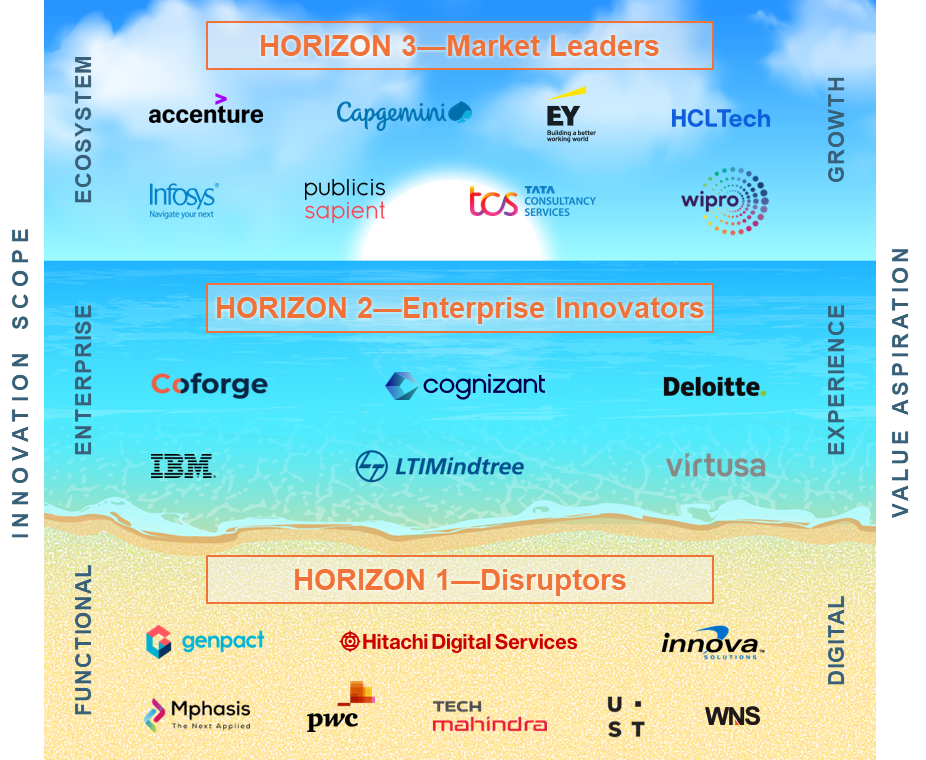
The HFS Horizons: The Best Service Providers for Asset and Wealth Management, 2024 report evaluates the capabilities of 22 service providers across the HFS asset and wealth management value chain based on a range of dimensions to understand the why, what, how, and so what of their service offerings. It assesses how well service providers are helping their asset and wealth management clients worldwide embrace innovation and realize value across three distinct Horizons: Horizon 1, optimization through functional digital change; Horizon 2, experience through end-to-end enterprise transformation; and Horizon 3, growth through ecosystem transformation.
Exhibit 1: AWM enterprises leverage the HFS Horizon model to pick their optimal service provider partners based on needed outcomes
Note: All service providers within a Horizon are listed alphabetically.
Source: HFS Research, 2024
The AWM market is amid massive change across client, business model, and offering facets; end-to-end enterprise transformation is required for progress
The enterprises and service providers interviewed for this study painted a clear picture of a market in transition. HFS notes three big buckets of change:
Client change: Who clients are and what they want is in massive flux, impacted by a huge generational transfer of wealth and the democratization of investing for retail and mass affluent clients and underpinned by changing demographics and a growing expectation for digital interactions, regardless of whether the client is an individual or institutional investor.
Business model change. A decade of M&A in the AWM domain has blurred once-accepted front-, middle-, and back-office roles and market participants. Who offers what to whom is changing day by day. New market participants complement market consolidation, and fee pressure drives the potential for new models.
Offering change. There is a massive push to expand asset class and new fund offerings in the quest for alpha. This push is yielding new offerings in the ESG and sustainability domain, and an embrace of alternative assets like real estate, private equity, and digital assets is on the rise. Investors want a much more robust mix of investments to drive improved returns. Performance matters.
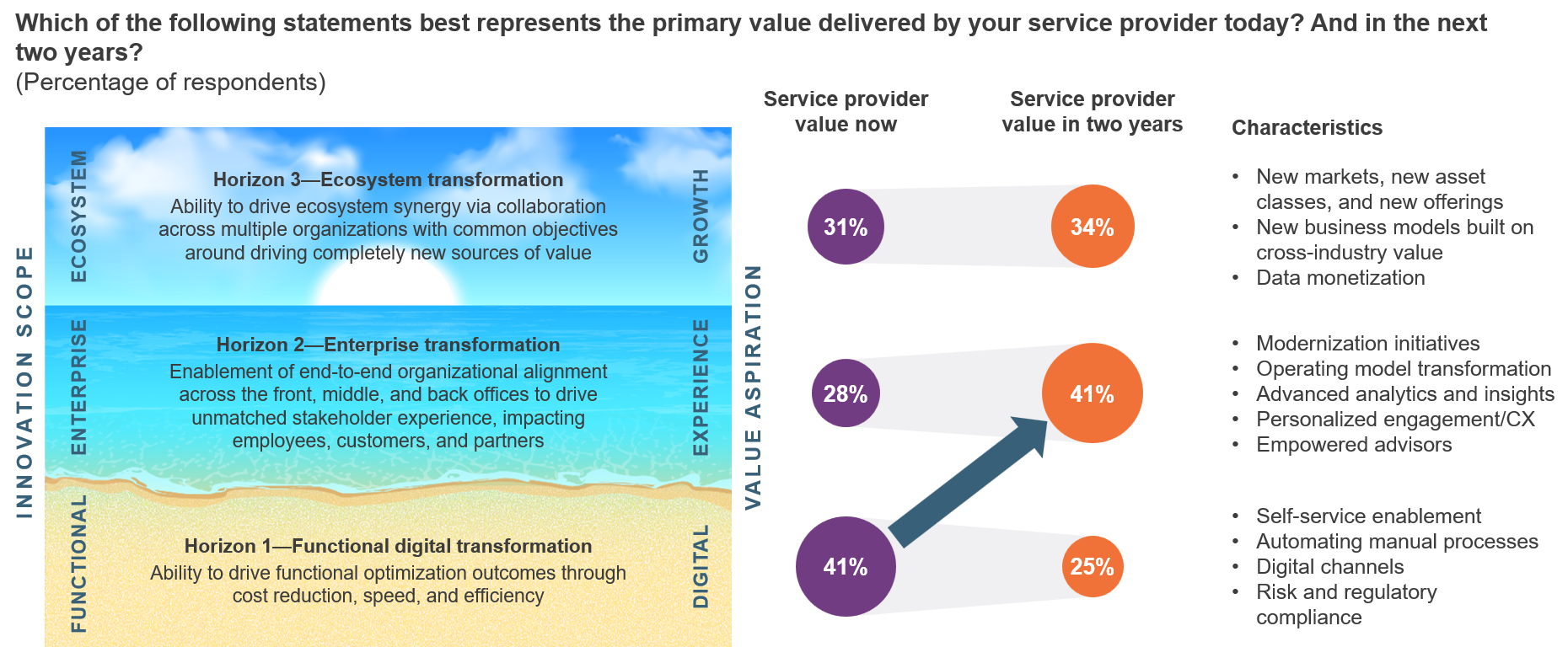
The HFS Horizons model aligns closely with enterprise maturity. We asked the AWM leaders we interviewed as references for this study to comment on the primary value their IT and business service provider partners deliver today and are expected to deliver in two years. Respondents indicated that the value realized today is largely Horizon 1—functional digital transformation focused on digital and optimization outcomes (41%). Two years from now, the story changes, with an enhanced focus on using service providers to help achieve enterprise transformation (41%) and a heavy emphasis on driving growth and new value creation through ecosystem transformation (34%). AWM firms should select their partners based on the value they seek. Incumbents may be the easy choice, but ensure they deliver updated and relevant value.
Exhibit 2:AWM firms seek enterprise transformation enablement from their service provider partners in the coming years
Service providers are decently well aligned to AWM enterprise transformation needs
As AWM firms evolve and mature across the Horizons, service providers are on point to support these ever-changing needs. In our study, we found strong alignment between AWM firms’ push to Horizon 2—enterprise transformation—and the fastest-growing service offerings from providers. Providers are prioritizing modernization and transformation enabled by the latest digital technologies. Modernization is a necessary pathway to meet changing customer needs, develop new business models, and create alpha-generating returns. CX elevation is ongoing and increasingly enabled by modernization, especially data initiatives. Risk and regulatory compliance are perpetual, and there is still work to do to optimize these functions.
The AWM domain is where ESG has moved from a compliance and reporting focus to a growth driver through enabling green investing. IT services leads for spending, underpinning the need for tech-enabled transformation. The jury is still out on whether tech can deliver better returns for investors.
The Bottom Line: AWM enterprises need to get serious about end-to-end transformation to capitalize on the massive changes afoot in clients, business models, and offerings. They’ll get there with the help of their service provider partners.
Post-pandemic, amid a balancing act of challenging macroeconomic factors and exciting innovation potential, asset and wealth management (AWM) firms are looking beyond building capability via M&A to securing growth through a trifecta approach of developing new assets and offerings, enhancing the experiences of customers and advisors, and monetizing data with the help of analytics and applied AI to drive real-time insights, modeling, and decisioning.
The imperative for success is no longer just offerings and services across asset classes; it is increasingly digital differentiation enabled by extensible technology offering front-to-back integration. Service providers have a critical role in enabling the future of the AWM market. AWM firms should select their partners based on the value they seek. Incumbents may be the easy choice, but ensure they deliver updated and relevant value.
We fear many companies today are failing because they no longer have a handle on their workforce environments.
Big 4 consulting firms and banks have already slowed hiring college grads en masse… because everyone wants “plug-and-play” workers who need minimal training and can deliver the work allocated. On top of that, we are seeing so many enterprises mandate staff to return to the office (RTO) as management blames the remote working environment for corporate underperformance.
This is what we are terming as the transactional workforce environment unfolding. It’s quasi-remote, it’s terrible for training college grads, while many people are far more focused on their lifestyles. Long gone are the pre-pandemic days when the workplace was like an extension of your family, you went for drinks together after work, and most of your colleagues were on your Facebook.
Let’s be honest, folks, this brings into question, “What is the purpose of work these days?”…
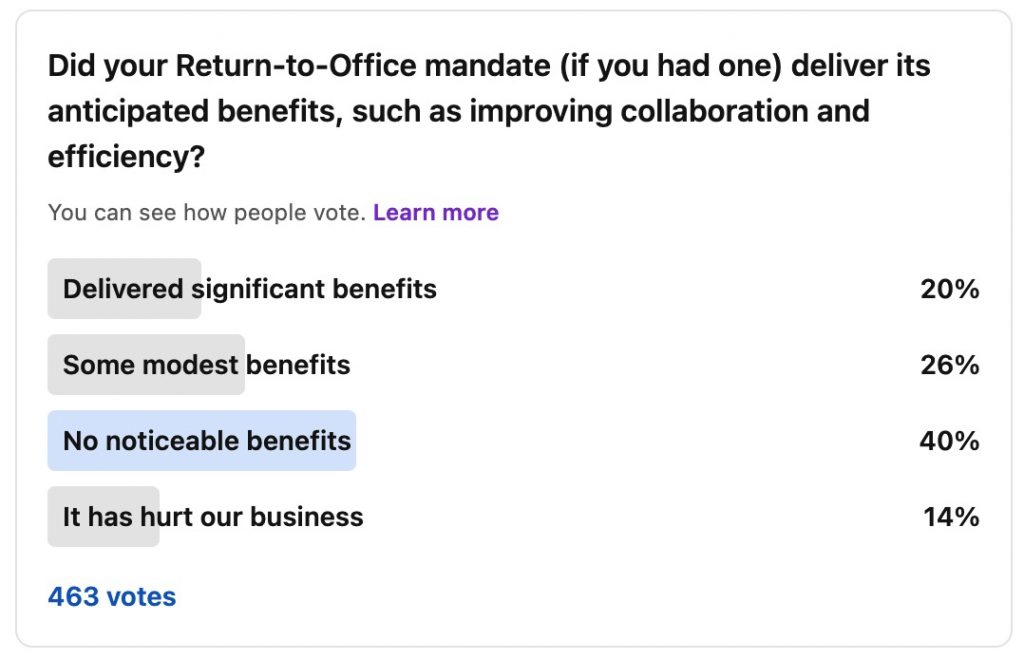
80% of workers see minimal to no benefit in returning to the office
This transactional work environment stems from the fact that many employers are blaming their poor performance on working from home, but the benefits experienced by 463 employees mandated back to the office are pretty meh:
Source: LinkedIn February 2024
What is the point in full-time employment these days?
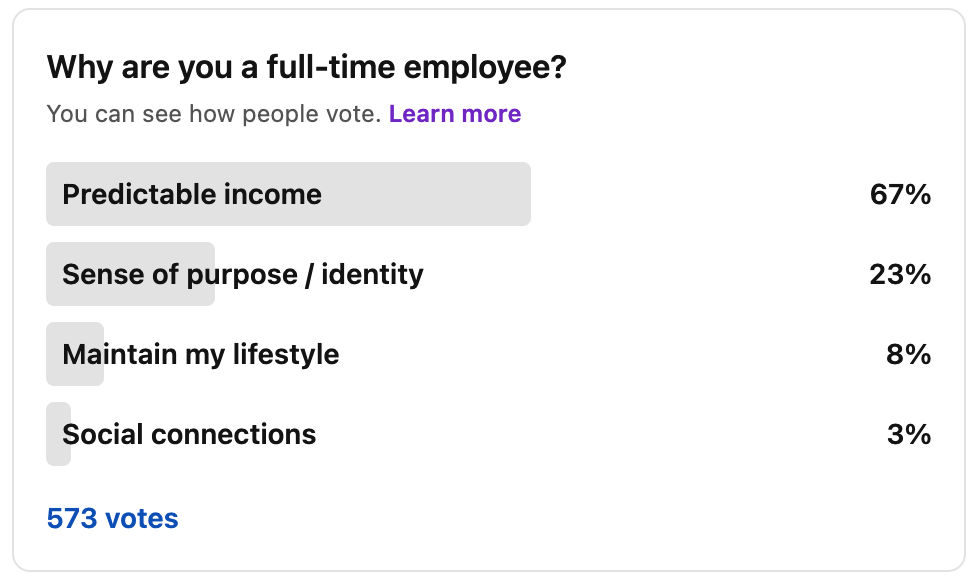
So when staff see minimal benefit in returning to the office, what is the point in having a full-time remote job? Let’s dig a bit deeper:
Source: Linkedin February 2024
So what is the point of “working” for a firm as a full-time employee when so many of you only care about the predictable income? Isn’t the working relationship becoming transactional and lacking in purpose? Does no one care about the social elements of colleagues and collaboration?
Both office and remote environments can work, but you need to MAKE them work
So why do so many employers feel shortchanged on performance and blame the remote work environment? If their firms are failing and the remote environment is not improving performance, it really sounds like both leadership is failing to lead, and many employees are not performing either.
We believe success in this “remote” market will come from firms with the most collaborative and energizing cultures. When you think we can spend our days engaging with so many people right across the world, this is incredible. HFS has exploited the remote working world to hire talent from all over the world and move fast to excite our clients, but it takes a lot of discipline and work to keep moving a business forward in this environment.
An effective remote work environment means fostering a culture where we turn on videos and actually talk and challenge each other. Not just everyone sitting in silence trying to complete whatever tasks were assigned to us. That also means we need all our colleagues to share that desire; otherwise, it just becomes top-down lip service.
We think the crux here is how full-time employees in their work-from-home nirvana can delight their employers while meeting their lifestyle goals.
Bottom-line: Leaders and Staff must stop pointing fingers and come together
Our conclusion is it takes two to tango. Leaders need to trust their people and do all they can to get their staff to engage and collaborate, but staff also need to recognize this and motivate themselves to step it up and be engaging workers. In several cases, RTO is a desperate measure to address this mismatch.
However, it’s very easy for staff to criticize their terrible management for wanting them in an office and not respecting their chosen lifestyle… but it doesn’t necessarily mean their management is terrible. Management may be just frustrated and desperate to recreate an energized work culture.
So, if you’re going to mandate RTO, make sure there is a real point in wheeling everyone back in. Make sure leadership is there to drive conversation and create a sense of purpose for having a physical workplace. If leadership is not there and staff feel like they are just wasting their time commuting to sit in a cube all day, then make the remote environment work. Otherwise, you will experience an erosion of morale and performance from leaders and employees, and your whole raison d’être under serious threat.