As we digest the incredible dialog from the HfS Cambridge University blueprint summit this week, the overwhelming mood from enterprises is one of frustration to get beyond this tactical status quo of legacy operations, in which so many find themselves wedged.
And most services providers aren’t going to come to the table with the technology and talent until their customers clearly dictate and demand what they need to cross this chasm. And those providers which simply do not have the Digital capabilities their clients demand to address these gaps, run the risk of being relegated to the class of legacy staff augmentation provider that performs only the low-value grunt work, or ditched from many client provider rosters altogether. And this is already happening with some ambitious determined clients.
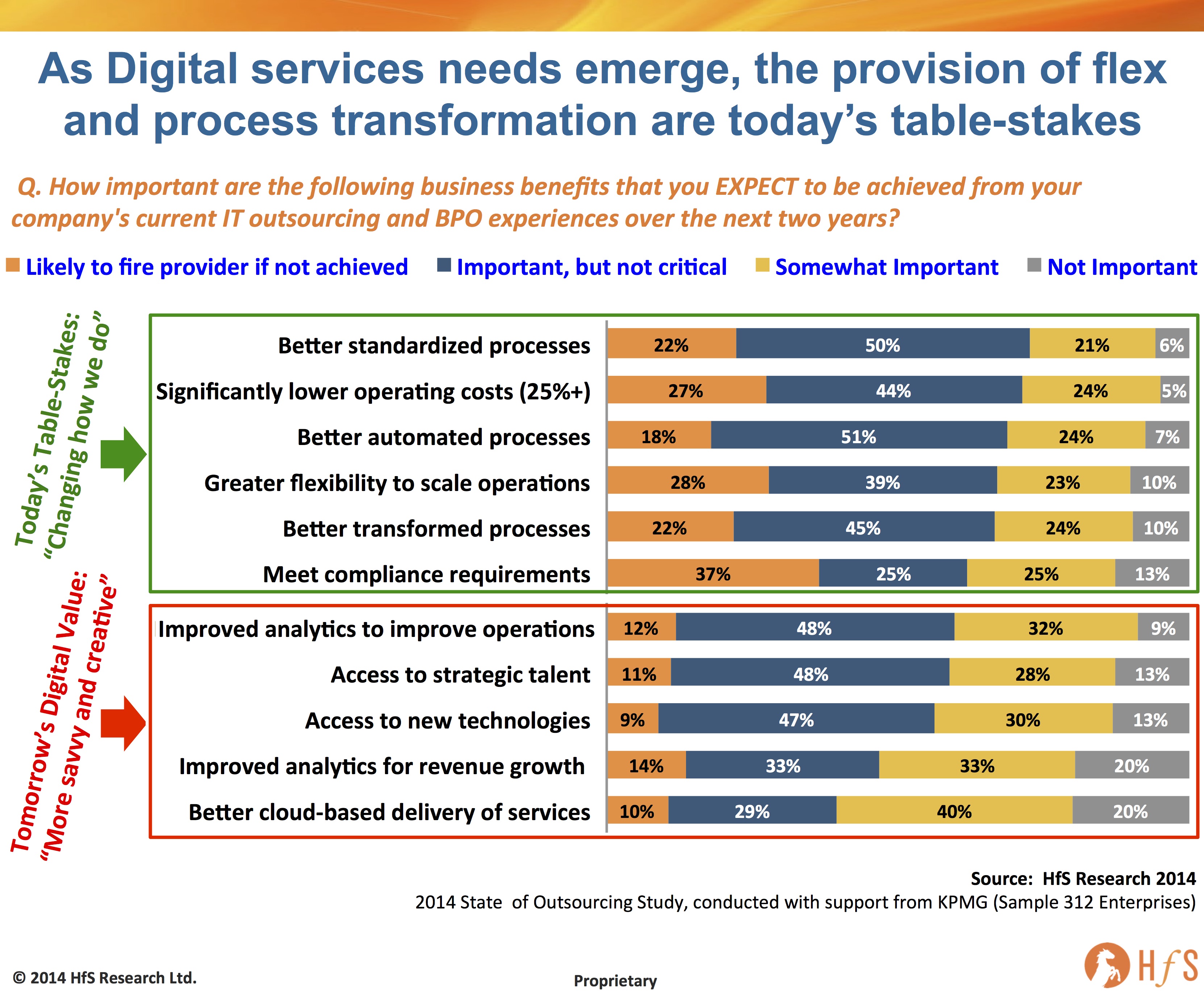
When we surveyed 312 enterprise buyers on their two-year expectations from their current outsourcing relationships, it becomes abundantly clear that those desired business outcomes from yesterday’s outsourcing era have quickly become today’s table-stakes:
Click to Enlarge
Clients are rapidly losing patience with services providers that aren’t working proactively with them to provide more value than the basic terms of the original contract. I feel like we’ve had this conversation before, but this time many clients are doing a lot more than having a quiet moan that they aren’t really getting value beyond very basic service provision. This time, many are actively looking to fire their provider if they cannot get past operational teething issues and actively begin the process of transforming the way they do things. In so many instances, clients are beginning to doubt their current provider actually has the skills or acumen that they were promised during the early courting days prior to contract signing. In today’s climate, close to a quarter of clients will actively seek to eject their current provider if they have not effectively helped them standardize, automate and transform their processes within the next two years. This is no longer about achieving significant cost reduction targets and getting basic tactical operations functional – it is about moving clients into a future state that is much more effective than the current one.
The focus on Digital outcomes has dramatically emerged, with many clients increasingly no longer viewing tactical success as their end-game. Whereas, in years gone by, the focus was slowly shifting from cost reduction to better global scale (see our 2010 study), the onus on clients to move the conversation to one of better analytical capability, more savvy and creative support talent, access to better tools and tech, has leapt onto the table: these are the new stakes. While most providers will not get fired today for Digital failure in the short-term, it is already very clear that an increasing majority of enterprise clients expect their providers to bring these skills to the table. 60% already see operational analytics as very important as an outsourcing outcome, and a similar majority are already expecting their providers to pony up savvy talent and better tech within two years.
The Bottom-line: Innovation is now defined and most clients know what they need. Providers have to step up if they want permission to play in the next phase of this industry
Remember all those fantastical debates about “What is innovation and how can I get some?” Well, the answers are now unraveling and it’s becoming clear how both buyers and providers can be successful in the future – and how they can also maintain the status quo and risk being relegated to the detritus of legacy operations. Clients no longer yearn for transformation of processes, reduced costs and flexibility of global scale – because that’s what most have already bought and paid-for. Hence, those not getting these outcomes today are not yearning, they are feeling duped and let down – and know they are failing and going down on their provider’s sinking ship.
The table-stakes of 2014 are now a must-have for clients which have their eyes firmly planted on what they need to achieve in the medium and long term. They want providers who know how to engage with them to help them get to the next level. However, too many of today’s providers have lost interest in their clients once they have reached an operational steady-state – and are constantly laser-focused on winning that next deal, as opposed to fixing their existing ones.
Until our industry takes the painful steps to fix the current legacy it has created, many will likely fail in creating a new era of Digital services. This means both clients and providers need to invest in the skills and tools they need – and recognize that failure to do so will likely result in their ultimate failure to drag themselves out of operational low-value purgatory. In addition, intermediaries and advisors need to stop forcing these deals to get done in three-week RFPs so they can walk away with their fees paid with little care for what that client and its provider really achieve down the road. We all need to focus on planning and investing in the long-term future and not solely on the quick wins staring us in the face near term.
Outsourcing: Making the same mistakes over and over and expecting people to stop moaning
One of the the core issues we discussed at last week’s Blueprint Sessions was the frustrating and seemingly never-ending issue of providers over-promising delights to clients to win engagements and then failing to deliver on them. However, the group of 45 industry stakeholders all agreed that all of the entities are at fault in setting up too many of these engagements to fail:
Buyers: Thinking that they are going to get wads of free transformational consulting that will miraculously appear from the provider – even thought they haven’t actually paid for any;
Providers: Promising wads of free transformation consulting to augment their operational obligations, even though they probably will not really give the client any (but who cares, as it’ll be too late for the client to back out in two years’ time and they aren’t contractually obliged to provide it);
Advisors: Strong-arming providers to respond to RFPs in three weeks and allowing very little (if any) interaction time for providers to interact with their clients in advance to develop the right solution and get a stronger balance between delivery capability and desired outcomes.
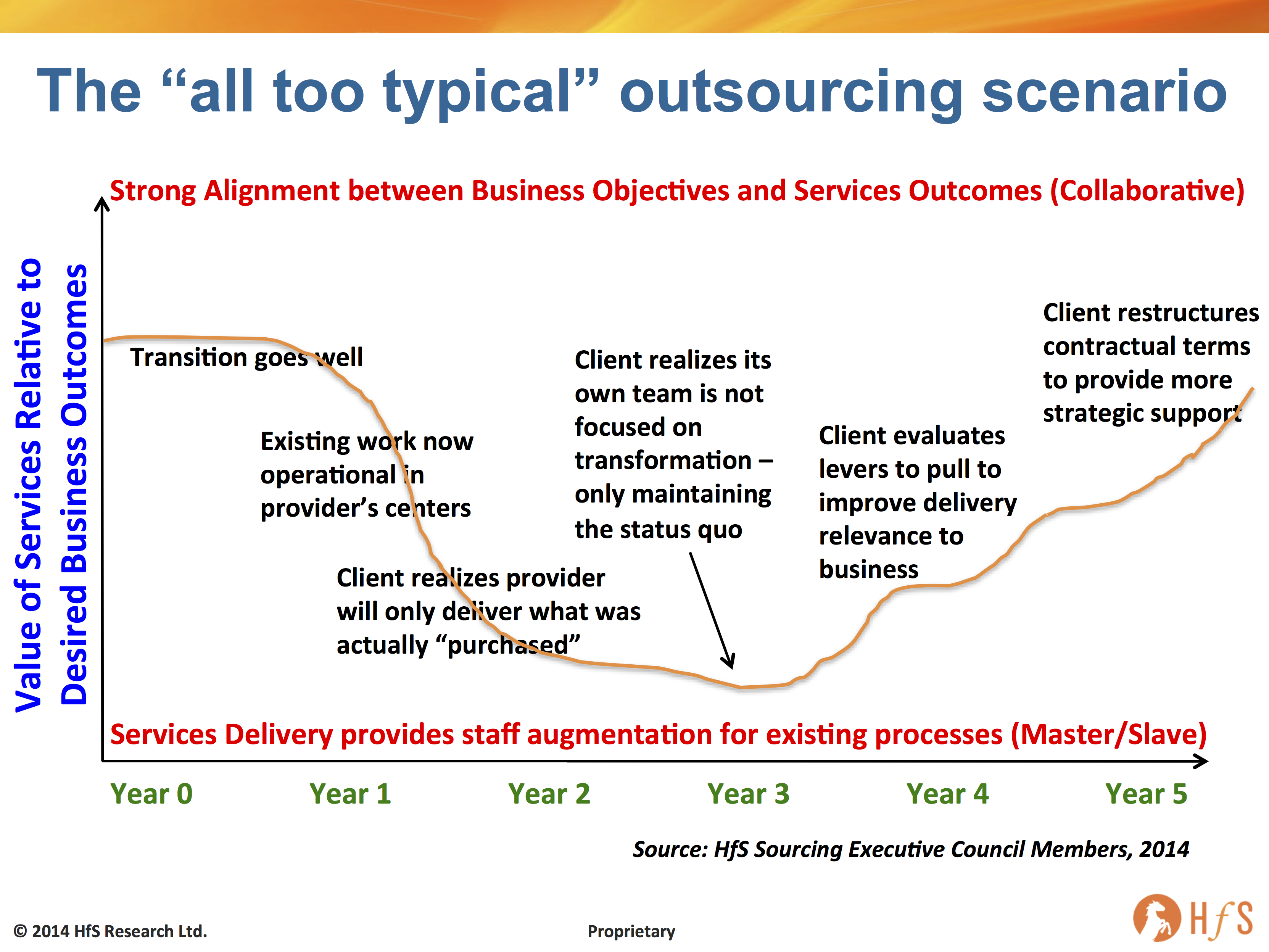
So what happens when you look at a culmination of many buyers’ first five years’ experiences after signing a contract? Let’s take a look at some collective journeys:
Click to Enlarge
Four steps this industry needs to take to avoid engagement failure in the future
1) Less focus on the deal, more on the relationship. Providers are all-too-frequently being forced in the position of saying what they need to win the deal, as opposed to having a structure to propose a realistic partnership that works for both sides, with specific milestones and balanced delivery expectations.
Possible Solutions: Advisors need to create a more collaborative RFP process that allows for more interaction between the buyer and interested providers. Advisors also need to set better expectations for their clients and potentially get their governance consultants involved earlier in the down-selection process. In addition, providers need to take a stronger look at how to develop their existing clients – and view them as future growth opportunities, as opposed to always chasing that next deal simply because there’s more immediate money on the table, which means more consultative account managers and less out-and-out salespeople.
2) Buyers need to get real proof-points on provider culture, performance and capability. Buyers need access to pragmatic experts who talk to a multitude of peers in other organizations in order to get a stronger view of the post-transaction performance of providers. Simply relying on the rose-tinted references ponied up to the advisor, or reading inaccurate analyst reports (usually premised on rose-tinted client references) isn’t going to give them the accurate expectation of what they are likely to experience down the road with each provider.
Possible Solutions: Buyers need to do their own research and exploration and use the expertise of advisors and analysts to validate their strategy. Talk to other buyers, go to conferences, seek them out on social media groups. Ask advisors and analysts to make introductions to other buyers, and if they can’t do that for are probably wasting their money on them. Buyers should also try to hire at least one inhouse expert to work with the internal and external parties to add a dose of realism and experience to the whole process – there are plenty of experience experts in advisors/providers shops who are interested in getting off the road to get some buyside experience.
3) Early exit provisions should be implemented as an insurance from “value disappointment”. There needs to be smarter forethought in the whole process where the buyer and provider prepare in advance for failure to meet expectations. Outsourcing relationships need to be marriages with pre-nups. Providers really do not want miserable clients and buyers need providers prepared to invest in them, or give up trying to outsource, as they clearly aren’t cut out for doing it properly.
Possible Solution: If providers are being shoe-horned into responding to a price-squeezing, innovation-sapping relationship, there should be an early exit provision for both sides (for example after 36 months). If the relationship isn’t working – it probably makes sense for both sides to exit quickly, cost-effectively and painlessly.
4) Buyers need to recognize the profession of services and sourcing governance. After seven HfS summits, we can declare officially that most corporate staff have little knowledge of understanding of what services and sourcing governance people do and why they matter (or even exist). In fact, we estimate that 90% of employees are ignorant of the role and value a services governance profession provides – or should provide. Until services and sourcing governance is recognized as a crucial professional discipline, we are going to continue to be an industry struggling for an identity littered with flawed relationships and ignorant perceptions of what we all do.
Possible Solution: Appoint a Chief Services Officer (CSO). Many CPOs are proving ill-equipped to manage services governance, so surely its time for smart organizations to create the CSO function, with a direct reporting line to the top of the company? It’s hard to convince top talent to work for buyer governance teams when they are submerged 4 layers down the organization form any decision-making authority. With the concerted move to increase investments in offshoring, shared services and outsourcing, not having an empowered senior corporate officer responsible for transforming operations is lunacy for so many of today’s organizations.
The Bottom-line: If we are to survive as an industry, we need to stop making the same old mistakes
Didn’t Albert Einstein* once say: “The definition of insanity is to do the same thing over and over and expect different results”. Then, surely, it’s time for the industry formerly known and “outsourcing” and now known as many different things (including outsourcing), started to change the way it operates. Providers need to get focused on making their existing business really shine, buyers just need to take control and dictate what they expect and then figure out how to realistically get it, and advisors need to focus on more than forcing nice-priced deals frosted with bullshit.
*Most people will attribute this quote to Albert Einstein but there is no evidence to suggest that he made this statement. Current consensus is that it came from the author Rita Mae Brown in her book Sudden Death, but we needed to find a cheesy way to tie Albert to outsourcing, so there you have it…
One of the trends we’ve been seeing with the proliferation of independent analysts, bloggers, consultants, journalists and other pundits, is for many of these characters to launch their own “firms”, when the product is, really, just them. Or them and a few freelancers they could tack on to their website to make them look like an actual company of people.
Now, if an individual was actually planning to grow a company over time – and genuinely adding real staff which does more than organize their mailshots, calendar or spell-check their reports, they can be forgiven, however, there are far too many people out there masquerading as company CEOs when they really don’t have a “company” to run. It’s just them. And some freelance admin person.
When I saw my old friend, Chris Lewis, announcing an exciting conference “The Great Telco Event” he is running in London this November, I was amazed at the sheer number of “companies” I have never heard of from a pretty impressive collection of individual speakers (many of whom are telecom analysts who found themselves going independent after that market commodotized and their firms couldn’t make enough profit out of them). Now, I have heard of most these experts as individuals, but these weird company names? I mean, why bother? Aren’t they just confusing their clients and prospects?
Aren’t we in a new generation of individuals promoting themselves? Isn’t the real brand equity in their personal brands as opposed to some obscure name they trumped up? And credit to Chris – one of the great all time telecom analysts, who has recently branched out as “Chris Lewis Insight“. Now… when prospective clients want to hire Chris, they want him and his services – and his handsome face. So why not brand his venture under his own brand?
“But didn’t you do the same thing Phil?” I hear you ask…
Kind of – I wanted to use a successful blog as the initial platform to grow a research firm, and that is exactly what we achieved, and it quickly culminated with us abbreviating the blog name to HfS to sound more corporate (try getting meetings with CFOs when your firm is called “Horses for Sources”). My friend Ray Wang had a vision of assembling a “constellation” of star analysts, and that is what he has achieved with some great additions like Holger Mueller and Peter Kim at Constellation Research. Now, if myself of Ray had never actually bothered to build genuine companies of experts, we should just call ourselves “Fersht Inc.”, or “Wang and Assocs LLC” (or whatever). And if the whole of HfS decides to quit on me tomorrow and I decide I can’t be bothered to replace them, I’ll probably do just that!
The Bottom-Line: We’re in the era of creating our individual personas – it’s time for people to exploit that
When you go on LinkedIn these days, it reminds me of those market scenes in historical movies and paintings, where people are selling their services and wares openly to all the town (B2C) and the other merchants (B2B). People are marketing their skills and competencies before their corporate identity. In fact, I find I have to click on someone’s actual profile and scroll down a couple of screens to find out who employs them these days. Who cares if you are an SVP at Blah Blah Bank… I want to know what you’re good at! And on twitter, many people do not even bother to add their company name in their profile at all.
I believe careers are now going in that direction – corporates want to reduce their core and contract for expertise as and when they need it. At the same time, an increasing number of individuals are shunning the corporate treadmill to enjoy the fruits of being self-employed – either as themselves or their pretend company. And those individuals are picking up new skills – often without realizing it – that makes them more valuable professionals – they learn how to market themselves well, how to hustle for clients, how to think outside of the box, how to differentiate their ideas and personas…
We can lament the shortage of Digital talent within corporations, but maybe that’s because the next wave of “Digital” skill and creativity is coming from outside of the creaking corporate firewall.
When we look at the future potential of BPO, one of the markets with the most untapped potential is that of supply chain services, which could be as large as $300 Billion in annual expenditure when today’s emerging offerings really begin to mature, and an increasing number of buyers have to tap into third party technology and services specialization.
When you think about the scope of this space, we’re talking about the management of orders, inventory, manufacturing and transport to get products to market, and then the whole additional services tied to after market needs, master data management and sustainability management:
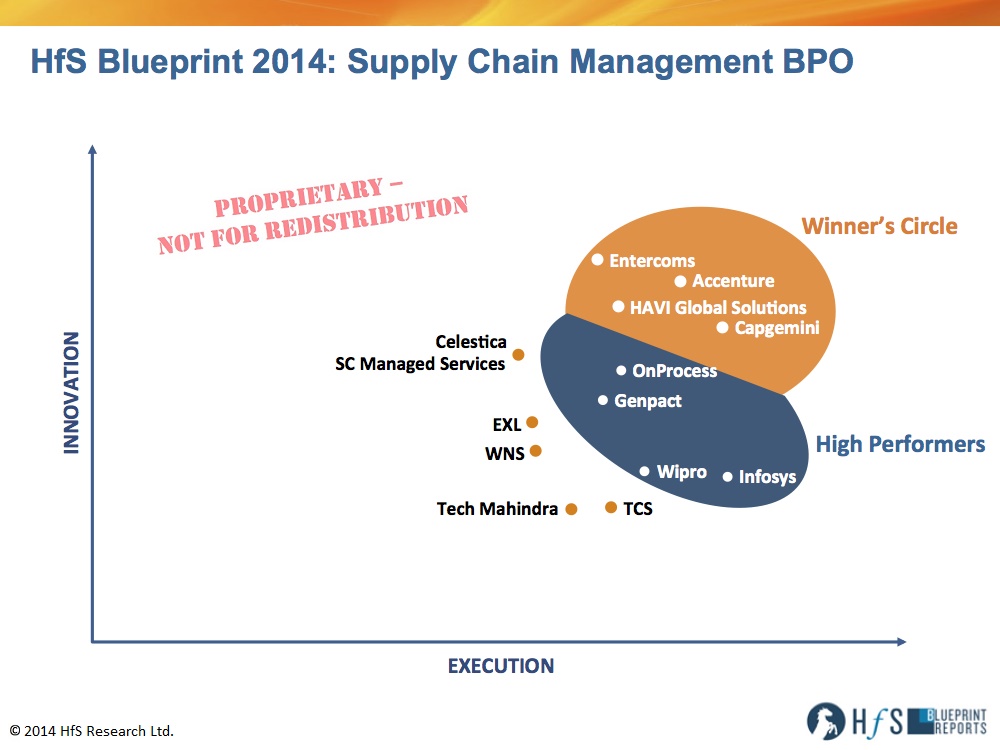
The need for supply chain process, domain and analytics expertise, supported by the necessary technology tools platforms – at a global scale and depth – has never been as intense it today’s buoyant and globalized market place, where decisions needs to made faster than ever to keep many companies in business. So HfS analysts Pareekh Jain and Charles Sutherland set about the analyst industry’s first-ever attempt to flesh out the leading providers in this market with the 2014 Blueprint Report in Supply Chain Management BPO Services:
Click to Enlarge
So, Charles and Pareekh, what is driving buyer interest in Supply Chain Management BPO today?
For most enterprises the costs of goods sold is the vast majority of their income statement and the with SG&A having in many cases being squeezed extensively over the last decade they are looking for new ways to both reduce COGS but also to improve performance of their supply chains as well. As the world continues to globalize and both suppliers and customers become more distributed and more demanding it is strategically critical that enterprises rethink how they are managing these supply chains.
It’s taken quite awhile for the message to get out to the broader market that there are a variety of different SCM BPO service providers today who all have valuable offerings to help with the enterprise supply chain but we see that market knowledge and understanding is taking hold. There are so many pain points for both multinational corporations and domestic SMBs in their supply chains including the lack of end to end visibility, lack of standardization in processes, rampant inefficiency in transactional processing, shortcoming in the scale of operations as well as the lack of resilience in their globally dispersed supply chain that when SCM BPO comes along and offers solutions to many or all of these it certainly helps create the level of increasing buyer interest that we are seeing today.
How would you categorize the current state of this market?
We would say that the SCM BPO market has two is defined by two key and in some ways conflicting traits. On one hand it is a very nascent market where the potential for impact in the enterprise and for revenue for Service Providers has barely been scratched. On the other hand, SCM BPO is one of the most advanced of all the BPO offerings in the market as it can combine business outcomes based contracting, deep analytics in delivery, collaborative partnership based solutions, large scale process transformation and the use of significant technology components as well. In fact we see SCM BPO as one of the best examples in practice of what we have been calling “progressive operations”. It really can be leading edge service delivery but as we said it’s still a small market, with relatively few RFPs and minimal involvement of sourcing advisors. Once it gets better known and the case studies from clients get more attention we believe that this is a market which will really take off in the next few years.
And how did the Winners Circle shake out?
There are four service providers in our SCM BPO Winner’s Circle: Accenture, Capgemini, Entercoms & HAVI Global Solutions. We found four things in common across these service providers:
– Strong consulting and analytics capabilities;
– The deployment of visibility or Control Tower platforms;
– Great account management capabilities as validated by clients; and
– Deep reference examples of clients who have been through a journey of SCM transformation together with these service providers that they couldn’t have done on their own.
So what are your key takeaways from this study?
We think there are four key take aways from this Blueprint study on SCM BPO. First, is the uniqueness of SCM BPO by comparison to other horizontal BPOs. Second, it is about the market potential and relevance across industries of SCM BPO. Third, is the current heterogeneity of capabilities and strategies across the SCM BPO service providers profiled. Finally, it is about the capabilities required to be successful in the SCM BPO market today.
Lets discuss each of them separately:
1) The SCM BPO market is unique as it impacts COGS (Cost of Goods Sold) while the other horizontal BPOs primarily impact SG&A. In SCM BPO, there is competition not only from the other SCM BPO service providers but also from diverse set of providers such as IT Firms, software firms, consulting companies, 3rd party logistic (3PL) firms, firms with integrated supply chains, reverse logistics and/or firms willing to carry inventory costs and infrastructure. In this mixed environment, it is the role of the SCM BPO providers to better defined the client problems and possible outcomes and then bring together an ecosystem of all these various components to create the solution. As a result, partnerships and partner management is of greater importance in this area of BPO than pretty much anywhere else we have looked. What also makes SCM BPO unique is that having a distributed geographic delivery footprint is not just about cost savings or follow the sun processing but a key part of delivering what in many cases are still very physical and localized processes.
2) Since SCM BPO directly impacts COGS it means that the potential addressable size of this market is even at conservative estimates huge, on the order of about $3 Trillion with a related process cost of say $300 Billion annually. Based on our current estimates of the market, BPO Service Providers are delivering perhaps $1.5 Billion in services so around 0.5% of total potential just in BPO and 0.05% of enterprise related cost.
3) Amongst the service providers we have profiled we see four different segment which creates this heterogeneity in approaches to the market. We see there being: consulting solution based service providers, specialist service providers, pure play BPO service providers and large IT services companies. Even within these segments we see significantly different areas of focus by service provider and strategies which at this nascent state of the market are unique to each. Therefore as a potential buyer of SCM BPO services, it is incumbent on you to look at all these different approaches and talk to the service providers to understand their vision for the processes and capabilities as this isn’t a market where you will see near identical bids across a range of service providers in response to any RFIs/RFPs you release.
4) If we have to pick one essential capability required to be successful in the SCM BPO market today it will be the availability of analytic based consulting capabilities on top of transactional service offerings. All of the service providers in our Winner’s Circle have these capabilities. It is because of the collaborative, analytic based business outcomes oriented model for SCM BPO that we really see this as one of the clearest expressions of what we have termed at HfS as “progressive operations”. SCM BPO really can be one of the offerings that sets the path for the other parts of the BPO marketplace to follow.
What are some trends you are seeing in SCM BPO offerings and what should we be watching for in next few years?
The biggest trend is SCM BPO service providers acting as collectors and commentators on the vast variety and volume of supply chain related data that is being created. BPO Service Providers are using this data in two different ways today. First, they are using the data in near real-time to identify weak links or problem areas in the supply chain by implementing visibility platforms, dashboards and Control Towers and wrapping those with insightful analytical teams. Second, they are using the data with consulting and process excellence teams on a project basis to drive better decision making outside of the real-time interactions.
Going forward we should be watching for even more rapid growth in the volume and variety of this data as it gets fed by even larger and more detailed streams from telematics, machine to machine interactions (M2M) the internet of things(IoT) and by social media commentary from users of the products in the supply chain. SCM BPO can be a capability to not just analyze the data and drive better discrete decision making in the process but as it integrates with product development, it can be at the intersection of value creation as we bring together the product development cycle with insight from product performance in the field, reliability data and insight from the operation of after market services processes. This is one dynamic area and we want to show how this is evolving by also looking at the inter-related engineering services market later in 2014.
Over the next few years, we believe that SCM BPO will be one of the fastest growing and ultimately largest markets in BPO and as that happens and more service providers develop their offerings in this space we should expect to see a lot more M&A activity as the race to scale and differentiated capabilities takes root.
Thanks for taking the time to learn more about SCM BPO and we look forward to more of our continued coverage on this evolving market in the coming months.
HfS report authors Charles Sutherland (left) and Pareekh Jain (Click to view bios)
HfS subscribers can click here to download their copy of the 2014 Supply Chain Management BPO Services Blueprint Report
Ned May, SVP Enterprise Mobility and Digital Services Research, HfS
Remember the days when standard corporate issue to enterprise staff was the monster-sized Dell laptop that only seemed to be made for the mass-market corporate crowd and needed a huge ugly Targus case to lug it around… and a low-end Blackberry, where the only redeeming feature was brickbreaker that could keep your brain amused for hours on those middle seats at the back of coach?
In fact, it was for these very reasons that executives slowly came around to realizing that the only cool technology they could get access to would come from their own personal investments, which is how Apple crept into the executive suite. Apple was just so anti-enterprise; YOU were in control and YOU could develop you whole digital persona using your iPad and iPhone.
There have been some insightful pieces penned on the landmark IBM/Apple alliance signed this week – notably from Larry Dignan and Peter Allen that go into the far-reaching potential consequences of this deal, notably the potential of providing iOS apps and embedded analytics tools to enterprises and disrupting traditional services models, potentially not too different from Workday’s impact on HR.
However, I wanted to draw your attention to HfS’ enterprise mobility analyst, Ned May, who focused on the simple fact that this alliance finally gets Apple into the enterprise through the front door…
“Apple has never understood the enterprise very well. While it has attempted to become ‘more friendly’ over the years and extended a few fig leafs in the terms of iOS updates that address enterprise grade concerns like security, Apple’s success in the enterprise has mostly been driven by its success as a consumer device. It has largely entered the enterprise through the front door in an executive’s purse or pocket not via a box on the loading dock that was backed up to IT. Further, Apple has been notoriously difficult to work with often to the frustration of a CIO. In short, while Apple’s support might be “legendary” it has not been the type of story that ends with someone riding off into the sunset. Which brings us back to the impetus behind this deal. At its core, it is about Apple realizing it will never understand the enterprise and that there is no better partner to get them over that challenge than IBM.
“In exchange, IBM gets to offer a message of safety to anxious IT departments who nervously watched iOS devices sweep into their formerly locked down playgrounds and ultimately opened them up to the chaos known as BYOD. As we pointed out in our Enterprise Mobility Services Blueprint (see link), the market is now reaching a stage of maturity where IT departments are being asked to rationalize the disparate mobile activities underway around the enterprise. As they do, many are looking to apply their traditional approaches to managing the challenges these new environments brings.”
Click here to access the full complimentary POV “The Day Apple’s Enterprise Strategy Came in from the Cold”
It’s time to wake up and smell the roses, people. The services industry is going through its most seismic challenge as increasingly sophisticated enterprise clients are looking to reduce their reliance on labor-based services and clunking archaic on-premise technology. While some services and consulting firms have their heads buried in the sand, clearly in denial that the services model has already entered into a fundamental shift, others are recognizing that they need to get ahead of this – and fast.
The services industry is going through a secular change and it will never be like it was, where trillions of dollars were spent maintaining dysfunctional systems and funding huge armies of staff to fumble their way through managing non-standard and often obsolete processes. Those days are fading fast and that pie is shrinking for providers and consultants still feeding off the legacy enterprise operations beast.
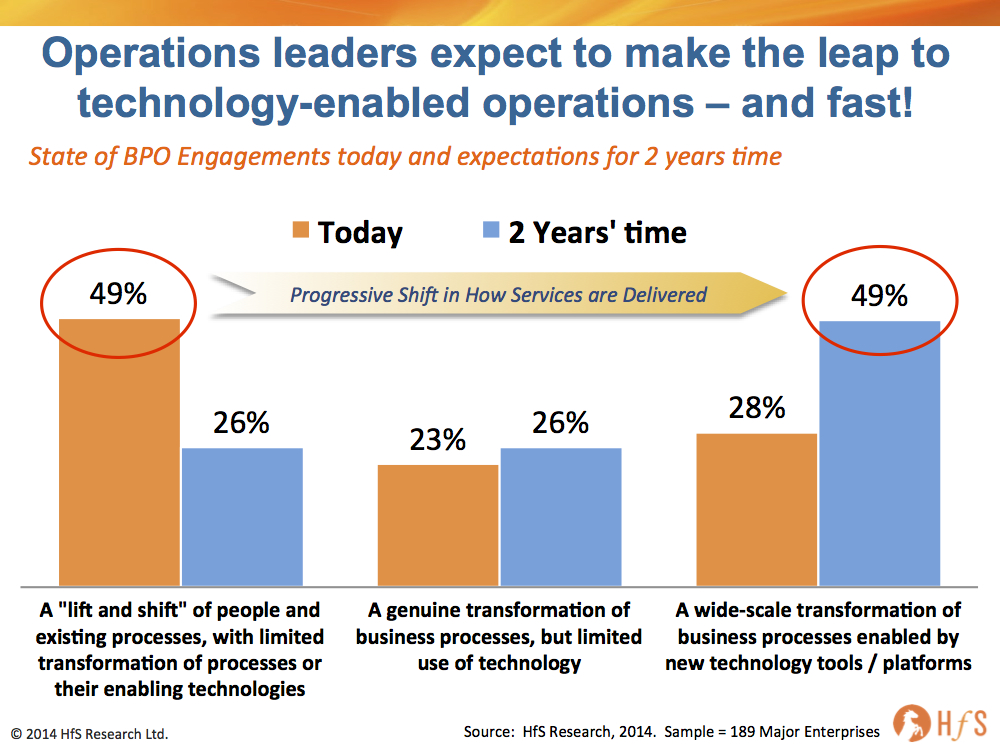
We ran a study earlier this year that explored the role of technology when enterprises outsource their business operations, and the findings from almost 200 major enterprises couldn’t be clearer: half of today’s enterprises are expecting to take the leap to enable their business operations with new technology tools and platforms in barely a two-year time-frame.
Click to Enlarge
Operations leaders don’t have the luxury of ten-year improvement programs anymore – corporate leadership expects to see tangible results in much shorter timeframes. You only have to look at the growing number of unemployed CIOs to understand what happens when functions become overly-operational and limited value and innovation is achieved.
It’s the same for CFOs, CPOs, supply chain heads and other function leaders – most are under a renewed pressure to continue driving out costs, while delivering ongoing improvements to data quality and having greater alignment with front-office activities. The old “we need to fix our ERP first” excuse just isn’t cutting it as much these days.
This is why 49% of today’s enterprise buyers expect to move to a “wide-scale transformation of business processes enabled by new technology tools/platforms” in just two years. Yes, this may be a pipe-dream for some enterprises, but what’s clear is that many of those operations leaders failing to steer their enterprise away from legacy delivery models will get cast aside quickly in today’s tolerance-diminishing business environment.
Why the merger of Operations, Infrastructure and Cloud services helps address the fundamental shift to technology-driven services
One recent provider re-organization that quietly took place was the merger (see link) of Accenture’s Operations with its its infrastructure and cloud services division to create a ~$5.7 Billion (HfS estimate) business unit. This follows on from the firm’s recent renaming of “BPO” to “Operations”, where the intent was always to extend the service suite. Now this is significant.
Firstly, these are two very large divisions, so it will likely take some time for them to figure out how to work most effectively together, but the immediate benefits are already powerful:
Creating hybrid teams of cloud and process experts creates an “As-a-Service” culture
When you talk to buyers today, most will tell you that having to deal with the technology and operations/BPO divisions of providers is akin to dealing with two separate companies. There is often very little synergy – and very different working cultures – between those people which deliver business processes and those who design, develop and maintain technology solutions. It’s been a major impediment to the progression of the BPO industry, and one of the key reasons why 49% of enterprises today (see above) still find themselves trapped in a “lift and shift” purgatory. Having IT infrastructure and operational talent together should help to break down these barriers and create a culture of enabling technology-driven services, moving processes into an “As-a-Service” model and creating the skills and acumen that providers need to make the delivery of “As-a-Service” effective. Simply put, BPaaS (Business-Process-as-a-Service) delivery is not as dependent on transactional processing scale, as most these processes are now full automated in the cloud; instead the successful providers will develop their BPaaS businesses around providing teams of analytical, creative and digitally-centric talent – areas where most enterprises already recognize they have real talent shortages.
The “Cloud Conversation” can be quickly brought to the table with operational clients
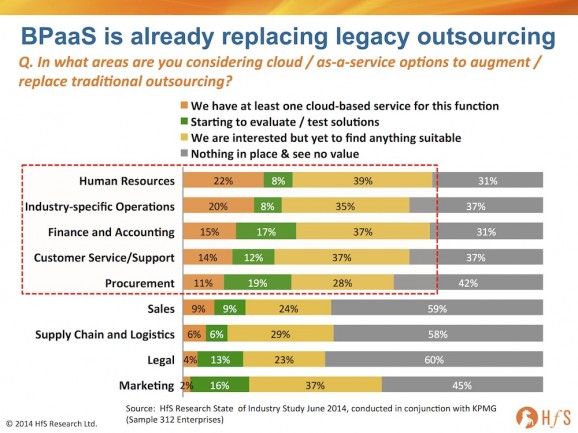
Ambitious and sophisticated clients are now seeing the huge benefits of shifting from on-premise to cloud delivery and need to talk to combinations of infrastructure and operational experts to understand what is possible, and to craft solutions that can work for them. And this isn’t something that is occurring in a few years, it’s alreadyhappening where our latest research shows close to one-in-three enterprises already using (or about to use) BPaaS / cloud as an alternative to legacy outsourcing in areas such as HR, industry-specific operations, finance and accounting and procurement:
Click to Enlarge
For example, many enterprises have already taken the leap to Workday, but some failed to invest in the right services expertise, not only to implement the product, but to go through the requisite change management and organizational redesign needed to get the maximum benefit from the cloud solution. It’s already clear from the Workday example alone that outsourcing and cloud need to be delivered as one seamlessly-accessible service, where outsourcing is technology. Most enterprises adopting cloud products and expecting simply to “figure out” how to enable the operations around them are going to go through a lot more pain and long-term frustration that they ever anticipated.
To this end, having a provider which understands and can implement a cloud platform, support the transformation and provide the necessary services that add real value to the front-office is the Holy Grail for many buyers. For Accenture, having both these breeds of experts working even more closely together will surely help drive forward these types of conversations even faster, but with an eye on both the cloud benefits and the services acumen to implement and services cloud solutions effectively. This should be of particular benefit to areas where Accenture has been making discreet software investments that support major service areas, such as Accenture Credit Services’ mortgage origination platform and its Octagon clinical services management platform.
Creates more opportunities to make investments and future alliances in the As-a-Service delivery model
Mike Salvino is Group Chief Executive, Accenture Operations
Rolling out a comprehensive As-a-Service delivery model across the sheer breadth of vertical and horizontal areas in which a global provider such as Accenture operates, is going to take major investments in future software platforms (whether developed in-house or acquired), strategic alliances with software firms and niche specialists, and ongoing investments in training and reorientation of its own services talent to provide higher value services for clients.
When providers section-off process delivery and operations from technology, it nearly always makes it challenging to get the right access to funds, align all the stakeholders that matter, and make meaningful, credible business cases. Quite simply, operations people talk a different language to technology people. Having operations and infrastructure in the same unit creates more opportunity for transformational thinking at the solution-architect level in operations, by increasing awareness of – and exposure to – emerging technologies. In addition, having a group head in Mike Salvino (pictured), who comes from a business operations mindset with a focus on business solutions, should help focus the new division on service delivery aligned to solving business needs, as opposed to merely technology products.
The Bottom-line: The winning providers will be those with one foot in the present and one in the future
Providers which leave their current clients trapped in a status quo of averageness, will be the losers in this new era of services. The table-stakes of services have shifted rapidly in just a few short years, where ambitious clients are now expecting providers to come to the table with the ability to transform their operations and add real capability in areas that are much more “front-office” focused. There are also a large number of clients (at least half, according to our research mentioned earlier) who are still at a phase where they haven’t yet really changed anything – they still run the same old processes the same old way and are clearly challenged to incorporate the benefits of cloud delivery and digital into their operations. If these clients’ providers cannot bring the new world of As-a-Service process delivery to the table, many will walk from their incumbents – and there have already been some notable defections this year from clients, clearly fed up with the paralysis of their current provider to deliver anything more than the same old processing and very little capability (or impetus) to improve them. Simply-put, it’s not in some providers’ interests to help their clients change the status quo – often there isn’t enough money in it for them, or they just don’t have the caliber resources to help them.
Providers prepared to be bold and get ahead of the curve – and make the necessary investments do to so – will survive. It’s still early days, and providers like Accenture can’t yet declare victory, simply because it recognizes the seeds of change and is actually doing something about it. And several other savvy providers clearly sense what the future has in store, and are making their own beds in preparation. However, the shift to the As-a-Service era has already begun and there are going to be many painful experiences as cash-rich legacy engagements are ejected and several providers disappear into the tier of insignificance, or are broken up and submerged into other entities altogether. The winners are those which can bring together higher-value service capability that inspires creative and analytical thinking, and twin them with real cloud delivery – either through their own platforms, or those of their partners.
The services world has already started to change – and those who are only just realizing may already be too late…
2014 has shaped up to be the year Digital Transformation took root as a unifying theme for IT and business services. What’s been exciting about Digital is much of the technology is already available, and it’s the digitization of business processes to enable plug-and-play services, more meaningful data and more seamless business models designed for mobile and cloud business environments.
Digital is not really about digitizing the way we’ve always done things, it’s about digitizing the way things need to be done to be more competitive and effective in the future. Digital is also about progressing our talent to operate with digital mindsets, by adopting analytical, creative approaches to help their enterprises progress from creaking, legacy business practices.
Nearly every major IT and business services provider is now using the term Digital in its go-to-market messaging today. But that level of activity and interest means the phrase has taken on an extraordinary breadth of meaning. So much so, perhaps, that one might argue it is becoming increasingly meaningless as a descriptor of activity.
HfS’ Ned May recently set out to clarify our definition of Digital Transformation and to explore the positioning of the leading IT and business services providers in the today. Rather than narrowly define and coral the topic, he cast a wide net with the goal of highlighting the full range of activity currently underway. His rationale for this approach being that Digital Transformation does not merely represent a new external market opportunity for service providers, but it is also a major catalyst to reconfigure the very markets in which they are operating.
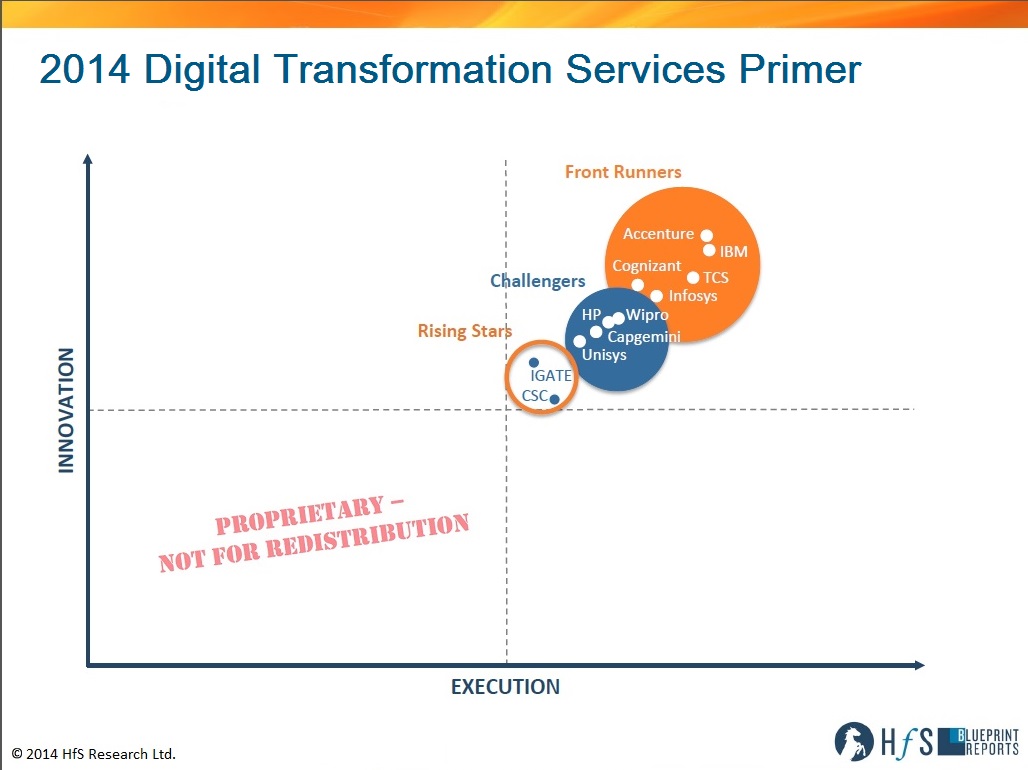
To this end, we have published what we are calling a Blueprint Primer Report that evaluates this emerging Digital Transformation services landscape, the significant participants and their early positioning and achievements as they vie to take many of their clients into this digital dimension of service delivery and capability. So how did the early front runners shake out?
Click to Enlarge
Ned, let’s start with what you mean by Digital Transformation. Can you elaborate?
Thanks, Phil. As you are aware, it can mean many things but in its purest sense we see Digital Transformation as the changes that must occur when a business moves away from a physical task. For example, the shifts that occur in underlying processes and infrastructure when one sells goods online rather than in physical store. As such, you could argue that Digital Transformation is as old as information technology itself.
So… why, suddenly, is “Digital” as a moniker beginning to stick again?
Ah, good point and to quote Yogi Berra, its Deja vu all over again. But there’s good reason. We are entering another period of accelerated development and economic advancement that is being driven by technology. The last wave was also fueled by Digital technology, but driven by the web and the broader internet the gains this created were primarily centered on improving existing operations. Information became cheaper, moved faster and became available to nearly everyone – whether an employee, customer or partner. That transparency drove out waste. Today, we are seeing another wave of Digital, however this time it is different. It is fueled by a cross pollinating collision of three things: the proliferation of mobile devices, the development of sophisticated analytics, and the emergence and maturing of cloud delivery. In short, computing is now spreading out to the edges of every activity we undertake and in conjunction we are now able to glean meaningful and actionable insight from this activities at reasonable cost. None of this is new. It’s been the subject of visionaries for years. What is transformative today is that it is increasingly economically feasible. As such, leading enterprises are adopting these technologies to drive business gains, and laggards are realizing they must either keep up or they may be forever left behind.
You mention in your research that Digital Transformation is already here today. Where do you see this activity?
Yes, and I can not say it enough. The future is not waiting for tomorrow. It is here today and we have been documenting it over the past year in our research and for those hoping to reference some definitive turning point, you are waiting in vain.
So… what then does Digital Transformation actually look like?
Digital Transformation is as much about the impact on providers themselves as it is about the needs of the markets they serve. Specifically, it brings five key changes to the provider market – changes we highlight in our ongoing research. The five traits are:
New business models emerge. As IT service providers look to push a message of transformation, they are being asked (or afforded) the opportunity to embrace this themselves. As a result, we are seeing a rise in revenue gainsharing models where a provider delivers a set of underlying services in exchange for a share of profits pegged to a specific business outcome.
Bottom line: Digital Transformation will rewrite the underlying economics for services firms.
Sacred operating models get shattered. When a new market emerges it does so via a set of new definitions that establishes its uniqueness and allows it to take shape. These “rules” often take on significance of their own but as the market evolves into a mainstream opportunity, these rigid definitional distinctions ultimately become obstacles not advantages. Such is the case today with Cloud, Analytics, and Mobility. The core concepts matter but greater value is obtained by taking a broad and open approach to the enabling technologies and what they can bring.
Bottom line: Digital Transformation will become embedded in every conversation
A focus on infrastructure readiness prevails. As providers push their messaging around the positive outcomes that digital transformation can bring, they are being asked to rationalize disparate legacy apps to enable this change. This raises the focus on solving the challenge of infrastructure readiness and who can best weave it all together.
Bottom line: Digital Transformation requires us to fix many of our old problems before we can realize its promise.
Old technologies become new friends. As new markets emerge, they often revolve around shiny new features that ultimately cloud our ability to extrapolate where they are truly headed overall. True progress comes when we move beyond this feature focus to embrace the whole. Take for instance the mobile market where early on we saw smartphone Apps become the end rather than the means. Today leading services providers are thinking well beyond this and presenting Digital Transformation offerings that leverage the full capabilities of these phones and integrate them into how a business is run not just how some information is accessed or displayed.
Bottom line: Digital Transformation requires us to look beyond the obvious in what new technologies offer.
Old friends become new technologies. In a similar fashion, Digital Transformation creates opportunities for new forms of information and insight to be gleaned from the traditional ways we already conduct business today. For example, email trails are being mined via sophisticated analytics to determine patterns of communication that may indicate future problems among partners. Sensors are now being deployed on physical objects to allow them to become part of information context that was impossible before.
Bottom line: Digital transformation requires us to look for new insight among existing processes and tools.
Despite the current activity being well underway, it is important to point out we remain in the earliest of stages for this market and the battle for dominance continues to play out – both across the underlying enabling technologies as well as the providers themselves.
After all, the iPhone – arguably one of the single greatest drivers of this opportunity – is only seven years old. These markets are moving fast and there is a tremendous amount at stake for every participant – be they hardware, software, services or some combination of all three. Expect the activity to intensify.
So with that, how do the providers stack up?
Digital Transformation represents a diverse set of activities – everything from modernizing a back office legacy application to designing a new customer engagement model to be delivered via a mobile app with many disparate services in between. As such, conducting an apples-to-apples comparison across providers requires a high level view that compares outcomes rather than individual underlying technologies.
In the realm of Digital Transformation, HfS groups IT Services providers in one of three circles as determined by the maturity of their offerings and capabilities within this emerging market.
Front Runners. Accenture, IBM, TCS, Cognizant and Infosys occupy the select group of “Front Runners” as each has demonstrated having the industry expertise and technological innovation to craft leading edge solutions across a variety of clients. These providers make a great fit for those looking to aggressively embrace change – understanding the level of challenges and opportunities that breaking this new ground will entail.
Challengers. Wipro, HP, Capgemini, and Unisys are this year’s “Challengers” with each in the hunt for the top positions though they could all benefit from greater coordination and centralization around their entire portfolio of Digital skills. These providers make a great fit for an enterprise that brings a clear but more measured vision of adoption.
Rising Stars. IGATE and CSC round out this year’s “Rising Stars” with each providing strong examples of Digital Transformation though now needing to do so on much broader scale. Providers in this wave make an excellent choice for those looking to experiment and want a strong partner to co-develop a solution.
In your view, how should a business or technology executive should approach Digital today?
First and foremost, there is the need to assess your organizational appetite for change. As the most significant new selling opportunity of a decade if not more, Digital Transformation is generating tremendous buzz across the IT Services landscape. Nearly every major provider is aggressively marketing themselves as a leader in the field today.
So what is a buyer to do? Enterprises are advised to assess their internal appetite for change. If you are still at the experimental phase and only looking to test the waters of Digital, a skilled partner from the lower left might be willing to invest more energy getting you where you want to go in return for becoming a reference account. However, if you are in a market or industry that needs to quickly go all in, you may be better off with a front runner today.
Also understand that some firms excel at execution while others excel at innovation and these relative strengths can differ within an individual provider’s own big MAC. We include a diagram highlighting these distinctions for every provider in the report. For example, one portrays a firm that is strongest in mobile innovation and brings balanced strengths in Analytics but lags a bit around innovation in Cloud. Enterprise buyers should use these diagrams to match a provider’s strengths with the skills they need.
And finally, where do you see Digital Transformation headed in the second half of 2014 and beyond?
Ned May, SVP Enterprise Mobility and Digital Services Research, HfS (Click for Bio)
While the upside around Digital Transformation is significant, and providers should and are addressing it now, it still remains in dollar terms fairly nascent today. The same is true for many of the technology deployments. So while new business models are visible and new revenue streams being realized, they remain far from the norm.
However, the market is moving fast. Given the amount of focus and energy invested around Digital Transformation in the first half of 2014, we expect rapid development in the second half of 2014 and even more so in 2015. Buyers could even expect a bidding war among providers as the hunt for reference able wins gets frothy short term
While a flurry of buzz words will continue to flow around this space in 2014 and beyond with the likes of Systems of Engagement and the Internet of Things both gaining ground, the bulk of activity for services providers will continue to center around three activities.
Developing their own proprietary platforms
Refining and honing their skills at Services Integration
Adding a few major reference transformation projects.
As this occurs, deep industry expertise as well as analytics skills will become increasingly in demand. So too will be the need to form actionable partnerships with other services providers and to organize oneself to market and sell in more efficient ways as multiyear infrastructure and process deals get squeezed out by ongoing collaborations measured by business results.
Ned, thanks for taking the time to describe the Digital Transformation Services market… we look forward to more continued coverage on this evolving market in the coming months.
HfS subscribers click here to access our new report, ‘2014 Digital Transformation Services: an HfS Blueprint Primer’
We have heard a lot about Apple’s manufacturing outsourcing, where the firm has ~500,000 people subcontracted via Foxconn in China to crank out its iPhones, but very little about its IT outsourcing habits.
So… does Apple also leverage large scale IT outsourcing? If answer is yes, then what kind of IT outsourcing is done by Apple, and how it has been changing with time?
With these questions in mind, our ever-curious India-based analyst (note: also keen novelist now seemingly developing a penchant for investigative journalism), Pareekh Jain, started studying Apple’s IT outsourcing initiatives, and the results surprised us: Apple doesn’t outsource its core software technologies that go into its products, but it does outsource Enterprise Applications, Business Intelligence, ADM and other software initiatives to a combination of TCS, Infosys, Wipro, TechMahindra and Exilant (which we know of). Quite simply, as Apple is growing, so is the scope of its Indian-centric IT outsourcing to support it’s ever-increasing needs.
Another related aspect that cropped up during Pareekh’s research, is the increasing use of global engineering talent by Apple. According to our estimates, Apple leverages Indian engineering talent heavily as indicated from its sizable H1B and GreenCard applications.
We shared our research findings with Times Of India (The World’s largest English daily newspaper), which went as far as a story on this interesting little topic on today’s front page.
We’ll be sharing our research report on Apple’s outsourcing strategy with our readers shortly….
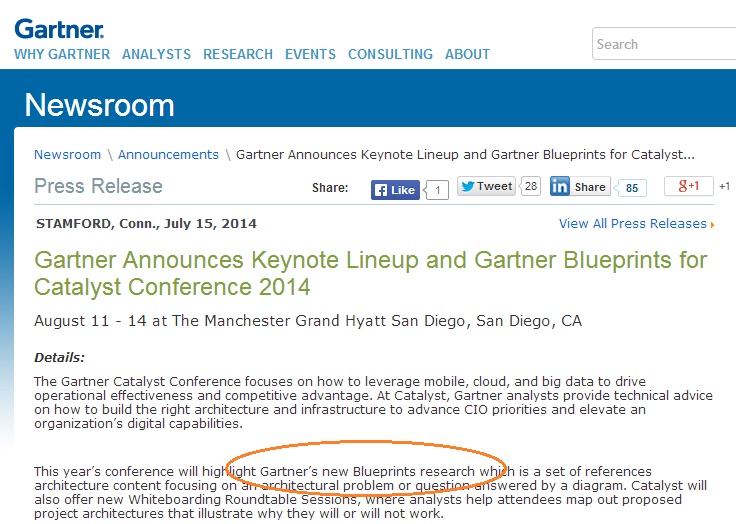
We woke up this morning to a wonderful endorsement from the mighty Gartner for all the hard work the HfS team has been putting into developing our HfS Blueprints over the last couple of years, when we proudly launched our revolutionary HfS Blueprint crowdsourced methodology for evaluating business and IT service providers. Yes indeed folks – Gartner has announced it is doing its own “Blueprints research”!
Click to Enlarge
Since we released the first Blueprint Report almost 18 months’ ago, the HfS Blueprint has become one of the industry’s best known and most popular methodologies for assessing provider capability and competitive market landscapes, with fourteen Blueprint reports now published (you can view all the HfS Blueprint highlights here). Enterprise buyers have used the Blueprint Reports exhaustively as an assessment guide for their provider portfolio management, and many advisors rely on it to sanitize their own provider selection processes with their clients.
So does this mean Gartner will take onboard the key tenets of the HfS methodology, in addition to leveraging the broad community data we gather from 1000’s of industry constituents, when it develops its own “Blueprints”? Let’s recap how we develop and execute on the HfS Blueprint methodology – and you can make up your own mind whether you think Gartner will deviate away from its Magic Quadrant process for assessing tech suppliers:
The Tenets and Objectives of the HfS Blueprint:
To assess services providers without being reliant on the arbitrary viewpoint of a single analyst;
Provide a credible methodology (see here) to gauge the performance of service providers against “real” innovation and execution capabilities;
Deliver a performance assessment of providers that apportions importance weightings of each innovation and execution category based on data from our annual State of Outsourcing Survey, conducted with the support of KPMG, covering 1200 enterprise buyers, influencers, advisors and provider executives each year;
Evaluate performance assessments of providers where exhaustive inputs from buyers and influencers shape the scoring (not solely a handful of rose-tinted client references that the providers served up themselves);
Enable a customizable assessment tool where enterprise buyers re-calibrate the weightings to assess their provider-fit based on their own unique needs.
Good luck Gartner – we can’t wait to see these new Blueprints of yours’ hit the market!