

Posted in : Absolutely Meaningless Comedy
Innovation discovered… on the London Underground
Outsourcing Executives: What’s your career narrative?
If ever I am lost for words to introduce an article, then I am now lost for words. So without further ado, here is Deadly Deborah… and definitely with the handbrake off…
Outsourcing Executives: What’s your career narrative?
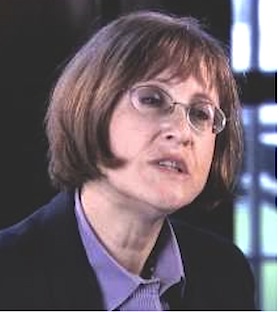
Deborah Kops is, always was, and always will be, Deborah Kops (click for bio)
I’m obsessed by careers. I spend time trying to make sense of the various and sundry twists and turns that the life’s work of those in our industry seem to take. And I look closely for patterns. Will leaving a secure position in a global firm for a start-up end in happily ever after? Does a stint in a Tier 3 provider indelibly affect a career path? After all, if Ecclesiastes 1:9 is right, there’s nothing new under the sun, or as the saying goes, history always repeats itself. So colleagues, do any of these career narratives resonate? Or is this article just the fanciful creation of someone who is absolutely at the end of her career rope?
Having recently decided that there are four major career narratives for our shared services executive cousins, I’ve turned my attention to outsourcing (read: sell side) executive career trajectories. In a segment of the global services industry with much more nuance (and opportunity), It seems to me that in every outsourcing executive’s career, there is an event, or a decision, or some other such driver that will profoundly impact his or her career narrative.
So read the 12 narratives I’ve observed in outsourcing executives. And have a good laugh if they don’t cut too close to home:
1. The mid-life crisis career narrative: Around the age of 40, some well-established outsourcing executives become frustrated with a), corporate bureaucracy; b), a stalled salary band; or c), the fact that they have years of experience on the man or woman they report to. And if their peers (especially their batch mates) are making money hand over foot starting their own companies, the itch to throw security to the winds and join a start up is compelling. So the itch takes over, and the leader leaves a good job to join the ranks of the challengers, crossing fingers that he’ll make enough money to pay off the mortgage and put the kiddies through school.
2. The yo-yo career narrative: Yo-yo career narratives characterize those executives who start out in ITO, hone their sales or management skills, are tapped to run a BPO gig because their skills are thought to be transferable, then high tail it back to ITO when a), the realization dawns on said leader that not all outsourcing pursuits are created equal; or b); their management realize that BPO is a foreign language to their hire. So after a period of time, and a very cordial leaving, the leader goes back to an often bigger post in ITO, sadder, wiser and richer for the experience.
3. The find the greater fool career narrative: The entire market knows that Mr or Ms X is a great interview, taking credit for every deal since Eve persuaded Adam to take a bite of the apple. And providers, desperate for leadership in a market with very little talent, bite hard on the marvelous resume. But eventually—about 9 months in– when the honeymoon is over and nary the hope of a deal has materialized, the dial hasn’t moved on operations, or the solutions team develops a severe allergy to a different way of working, said executive starts looking again…and again…and again.
4. The grass is always greener career narrative: A second cousin to the find the greater fool career, executives with greener grass career narratives are our industry’s true seekers. They are always looking for the perfect home: money, flexibility, respect, influence…and move around frequently, often as much as once a year, to find job nirvana. Sometimes they are allowed to come back to home base, a bit sheepish but glad to be back in the bosom of a family; otherwise they keep moving on, often into the sunset and out of the outsourcing industry.
5. The Book of Ruth career narrative: No, I am not trying to get all biblical on you, readers, but if you apply what the Old Testament’s Ruth said to Naomi “”whither thou goest, I will go, ” you’ll see some couples of the professional kind that always seem to move jobs together. These joined-at-the-hip folks show up together in outsourcing companies big and small, with the senior of the two either moving first, then yanking out his faithful follower, or as a package deal. Employers sunder their ties at their own peril: the two of them just can’t function effectively without the other.
6. The fox in the henhouse career narrative: We all know the type: he or she is itching to move from the dark to the light side, and perpetrate every crime against nature on the provider community. The former provider executive is dying to show the client side how a deal should actually done—or governed– and if a little pain is inflicted on either his former employer, or his employer’s biggest competition, so be it. After all, what better position to be in than have the CEO who never knew your name suddenly have you on speed dial when you move to the buy side.
7. The I’ve been captured career narrative: Although this career narrative is rare given the number of commercialized captive operations, there are a few of these blokes in the industry. Executive is a corporate creature, having started a captive for a multi-national. The captive is then sold to an eager provider, and the executive suddenly has to become a commercial operator. After getting over the initial shock of having to be accountable, the former captive leader wholeheartedly drinks the Kool-Aid, and becomes a pillar of his outsourcing practice…or quickly walks out the door into any career that does not involve SLAs.
8. The gentle decline career narrative: There’s a growing trend I kindly refer to as the “gentle decline.” Look around and you’ll see players who started their careers at the powerhouses of our industry—Accenture, IBM, even the late great EDS—then, over time, softly switch to companies with less and less prestige in the outsourcing provider pecking order. Said gentle decliners are absolutely convinced that their skill and acumen will be the silver bullet that elevates their new employers into the top tier. The paradox? The jobs get bigger but the employers get smaller.
9. The “any advisory firm would die to have me” career narrative: The executive is tired of 2 am conference calls to India, or wherever, and being grilled when the numbers run shy of quarterly expectations. Jumping the fence to an advisory practice, particularly if it’s at the partner level with the trappings of business class airfare and a liberal expense account, seems very attractive, despite having to don a tie to visit a client. But if these former deal or operating titans are able to make the shift, they find that selling, operating and consulting are indeed different, and yearn for the days when filling in a timesheet did not take up an hour each day.
10. The time to be an entrepreneur career narrative: The executive is a deal maven extraordinaire. He or she can sell snow to indigenous peoples living above the Arctic Circle, and is always brimming with innovative ideas. Often a lone ranger, the wannabe entrepreneur carefully calculates when his commission payouts hit, and starts looking for backing from friends and family. When the time is right, he jumps ship, spending a good year burning cash either to develop a slightly better mousetrap—a riff on some kind of KPO or accounting offering, or applies what he knows to another area entirely—perhaps selling timeshares in Florida or Cyprus.
11. The phoenix rising from the ashes career narrative: There are a few executives that flame out spectacularly by their own hands, supposedly committing some crime that’s considered to be so egregious (flaunting policy, losing a foundation client, or worse) that it results in an instant exit from a lofty position. But like the careers of many politicians and corporate moguls, memories are short and all is forgiven after an enforced period of wandering in the wilderness complete with penance and daily golf. And eventually the phoenix rises from the ashes, accepting megabucks and a CEO title from some global or private equity player.
12. The end of the line career narrative: Readers, that’s me…and several others I will refrain from naming. Having tried absolutely every outsourcing role with either a modicum of success, or a spectacular failure, we’re completely unemployable and now relegated to the sidelines of punditry. It’s a lonely job, but someone’s got to do it.
Deborah Kops (pictured above) leads many lives, including her own boutique firm, SourcingChange, a Research Fellow for HfS and The Conference Board. You can email her here.
Posted in : Absolutely Meaningless Comedy, Business Process Outsourcing (BPO), HfSResearch.com Homepage, IT Outsourcing / IT Services, Outsourcing Advisors
The dreamSource countdown… Meet Mads
Picture the scene – it’s day three of the HfS 50 event in Boston last October… three days of perpetual debate, fueled by a seemingly endless supply of red wine and caffeine. Yes, just the perfect time to have an hour’s education on next-gen performance management strategy.
Step-up Madelein “Mads” Smit, head of both IT and F&A outsourcing for CEVA Logistics, who – sensing the moment, took it upon herself to play the Gangnam video at full blast. Now, if you’ve ever witnessed a room full of hungover middle-aged governance professionals attempting to get-down Gangnam style…
Warning – the following clip may cause serious psychological damage:
Needless to say, Mads just had to be asked back for a second round of performance-enhancing antics, this time at the forthcoming dreamSource extravaganza…. so without further ado, let’s find out more about what Mads is all about, besides her undoubted skills singing and dancing…
Phil Fersht (HfS): Good morning Madelein, would you please give our readers some background on yourself, your career and why you are doing what you are doing today?
Madelein Smit (CEVA Logistics): Hi Phil! I got started in outsourcing as a youngster. I was originally an accountant at PwC, and traded in that job when someone said, “There’s this thing called outsourcing coming up…would you like to be on the project for a little while?” Since then, my career has taken all sorts of turns and changes. I have been on the buy-side, the sell-side and the consulting side, so I have seen this industry from many angles. Right now, I am in a role where I am turning around an IT outsourcing contract; it’s quite large scale and looking at the benefits we can harness from integrating F&A and IT in our process. It’s now 16 years since I started working in the outsourcing industry, and I am still passionate about it.
Phil: You are still passionate about outsourcing after all these years. Why oh why?
Madelein: I think that it’s a great leveler. A lot of people talk about globalization, but not many have the advantage or the privilege to see that up close. I have visited India on average two or three times each year for the last eleven years, and have seen first hand the transformation in its economy and the real difference it has made on the ground to the lives of millions of people there. I think it is really a transformational activity in the way that an NGO or a government can’t begin to change the social standing of people, and similar cases are also being played out in the Philippines and even parts of Africa. It’s contributing to education, it’s contributing to rights for women, it’s contributing to the workforce being valued in a different way, and I think it’s the best thing we can do for world peace because it’s process understanding between cultures and people living in different parts of the world working toward the same goal.
I do look at it in a bit of a romanticized way from a social development perspective. But I am also passionate about things like process improvement, and I have seen the amount of waste that could be taken out of functions and how waste builds up in functions over time. And it is just so refreshing to see other people coming out, looking at this problem with fresh eyes and transforming it into something that is far more effective. That has to be good for capitalism as well.
Phil: You said you have been traveling to India for over ten years now. What would you say has fundamentally changed there over the last decade in terms of how they engage and deliver these services?

Madelein Smit is VP Outsourcing at CEVA Logistics
Madelein: Well, they have become the market leaders in terms of developing and delivering BPO. Many years ago, you still had to explain to people what BPO was, what outsourcing was. But it is a complete concept in India. You can get a doctorate degree in outsourcing now, so it has become a professionalized function that people really look up to and aspire to. That has definitely changed. We are also seeing wage arbitration, which was taken for granted from Day One. I think in 2013 we will see a real transformation in that if India does not find other value-add in this process, it will start to lose ground. We’re now reaching a point due to high unemployment that you can hire a graduate onshore in certain pockets of Europe for about the same money as in India.
Phil: That’s a very interesting point, and we ourselves – at HfS – hire local MBA graduates. We have noticed the narrowing gap in wage costs for mid-level skill sets. When we were in India at NASSCOM last year, there was a lot of debate around the fact that, in BPO, they haven’t quite developed the factory of talent coming out of the universities that they had achieved in IT. And, they needed to get their act together in terms of training youngsters and talent in colleges and linking them to the providers’ training programs. Is that something you are seeing improving, or do you think it is still a major issue for them?
Madelein: I still think it’s a major challenge. I also think there is, to some degree, a general divide in this. Accounting is usually seen in India as more of a female, or slightly softer, occupation, and IT is seen as a largely male occupation. So, there is a good stream of graduates being fed out of the big schools in the IT space, but the same is not true in accounting. So, I definitely buy into that about ITO versus BPO. Also on the diversity front, there is a real struggle to develop and pay women. They have made great strides in the industry, but still the graduate output of the top schools is about 40 percent women and 60 percent men. That remains a gap to be filled, and I think that is more valuable in the BPO space. Unfortunately the recent events in Delhi – the high profile rape case – has also led to a social reaction with a lot of clients putting women out of work when it entails them traveling home at night time, which has all just put a big dent in development and retention in the last two months.
Phil: Very good insights, thank you. At CEVA, you oversee both IT and F&A sourcing. What do you see as the key differences in terms of talent issues and delivery between the two functions from a sourcing perspective?
Madelein: I think the IT space is definitely much more commoditized. Managed services are much easier to apply in a sizable amount – managing so many servers, keeping them patched, fed and running. But accounting is a far more subjective art. I think that adds to the complexity, which sometimes causes providers to struggle to estimate the amount of work needed, struggle to estimate the skill level needed and so on. So I do think that setting up an engagement is slightly more complex in the accounting space than in the IT space.
Stay tuned for the second part of this interview, where we talk about onshoring of BPO and the diversity issue in the sourcing industry…
Posted in : Absolutely Meaningless Comedy, Business Process Outsourcing (BPO), Captives and Shared Services Strategies, Finance and Accounting, Global Business Services, HfSResearch.com Homepage, IT Outsourcing / IT Services, Outsourcing Heros, Sourcing Best Practises, Talent in Sourcing
The dreamSource countdown continues… Meet Mads (Part II)

Madelein Smit is ready for dreamSource… are YOU? (Click to learn more)
If you have recovered from the mental impairment caused by the really awful governance dancing, it’s time to get back to the serious discussion about the narrowing onshore/offshore cost gap, and the diversity issues in sourcing…. so let’s visit the final part of our recent interview with Madelein Smit, outsourcing head at the global logistics giant, CEVA Logistics…
Phil Fersht (HfS): Madelein, in our previous discussion, you talked about a watershed period for sourcing arriving in 2013, with the narrowing cost differential between onshore and offshore talent. Do you think that is going to have a noticeable impact on how a company like yours is sourcing its BPO?
Madelein Smit (CEVA Logistics): We are in a very cost-driven environment, so we will keep sourcing in a way that suits our need. One thing that has happened over the last three years in the accounting space, five years now in the IT space, is that we have built up valuable partnerships with our partners. And I do think we are at the point where we have moved beyond labor arbitration in both of our agreements, and are driving much higher value-add. I don’t think wage arbitration will impact this year in existing engagements in which there is active engagement by both provider-side and buyer-side management. But I do think that for people considering doing in-house shared services or moving to an outsourced solution for what still remains onshore, the business case will become harder and harder to fill, and the value-add will prove harder and harder for an outsourced solution.
Phil: So do you see that the buy-side will evaluate offshoring against just getting cheaper talent in-house? And do you think providers will broaden their customer options to deliver more services from onshore and nearshore locations. How do see the dynamics evolving here?
Madelein: I think both, and this is exactly my point. If the providers don’t come up with those alternative solutions, I think it will be major pickings in the pipelines for new deals. They definitely have to change the way in which they sell, and work with sourcing managers to help them understand what that value-add might be. With F&A, if you put a pure cost layer on the table, I think it’s 50/50.
Phil: You’ve also been quite vocal on the topic of diversity. Would you please talk a bit about some of the conversations you have been having on the role of women in sourcing and some of the issues going on there?
Madelein: Absolutely…I find it fascinating. Having grown up in Africa myself, in a very male chauvinist-dominated culture, I find it very interesting to see India going through a journey similar to what Europe went through maybe 40 years ago and what Africa went through 10 years ago, or is still in the process of making. There are still basic social inequalities among people. I know this sounds a bit overly dramatic, but I do believe in equal rights for all people, and I think that we have the opportunity to do something good in the world through our work. So, this is one of the areas that I demand of my providers. I demand that they have a diversity program in place, and I regularly discuss with them what they do retain, motivate and stimulate women in places like India. I also discuss with them issues like gender or sexual preference in places like Eastern Europe, where that is perhaps a more relevant topic today.
It is very interesting to see what these large companies are doing. The leadership of NASSCOM, which is made up of all of the big providers in India, so among them they employ close to a million people or more…all of these providers recently signed an agreement that they will ask all of their suppliers what they are doing about diversity in India. Think about the security companies, the facility companies, the catering companies. The trickle-down effect of this is enormous, and has an enormous impact on the transformation of the culture and the rights of people and the development of people.
Phil: Do you think part of the problem is we live in an industry that is obsessed with cost and delivery, and it seems to override all other issues including diversity?

Madelein Smit is VP Outsourcing at CEVA Logistics
Madelein: Yes, but I think it’s like all business. You know, capitalism can be a force for evil or a force for good, as we have seen with the recent demise of some high profile banks, and with the work some of the big players like Unilever are doing in the world for the Green agenda, the Corporate Social Responsibility agenda. I think there is a huge opportunity for good. And I think that we take our old purses to work every day, and if there’s something in our power to do good, I believe we should.
Phil: That was a great answer. Thank you so much for sharing some of these views and ideas and feelings with us today. And we are all eagerly anticipating your next performance at dreamSource. Maybe the Harlem Shake?
Madelein: We’ll just have to wait in anticipation 🙂 See you in New York!
Madelein Smit (pictured) is VP Outsourcing at CEVA Logistics and will be leading the session entitled “The Science of Performance Management” at the forthcoming dreamSource summit in Westchester New York April 30th-May 2nd. Click here for more details.
Posted in : Business Process Outsourcing (BPO), Captives and Shared Services Strategies, Cloud Computing, Finance and Accounting, Global Business Services, HfSResearch.com Homepage, Outsourcing Events, Outsourcing Heros, Sourcing Best Practises, Talent in Sourcing
Why American firms are more progressive with outsourcing than the Europeans and Asians
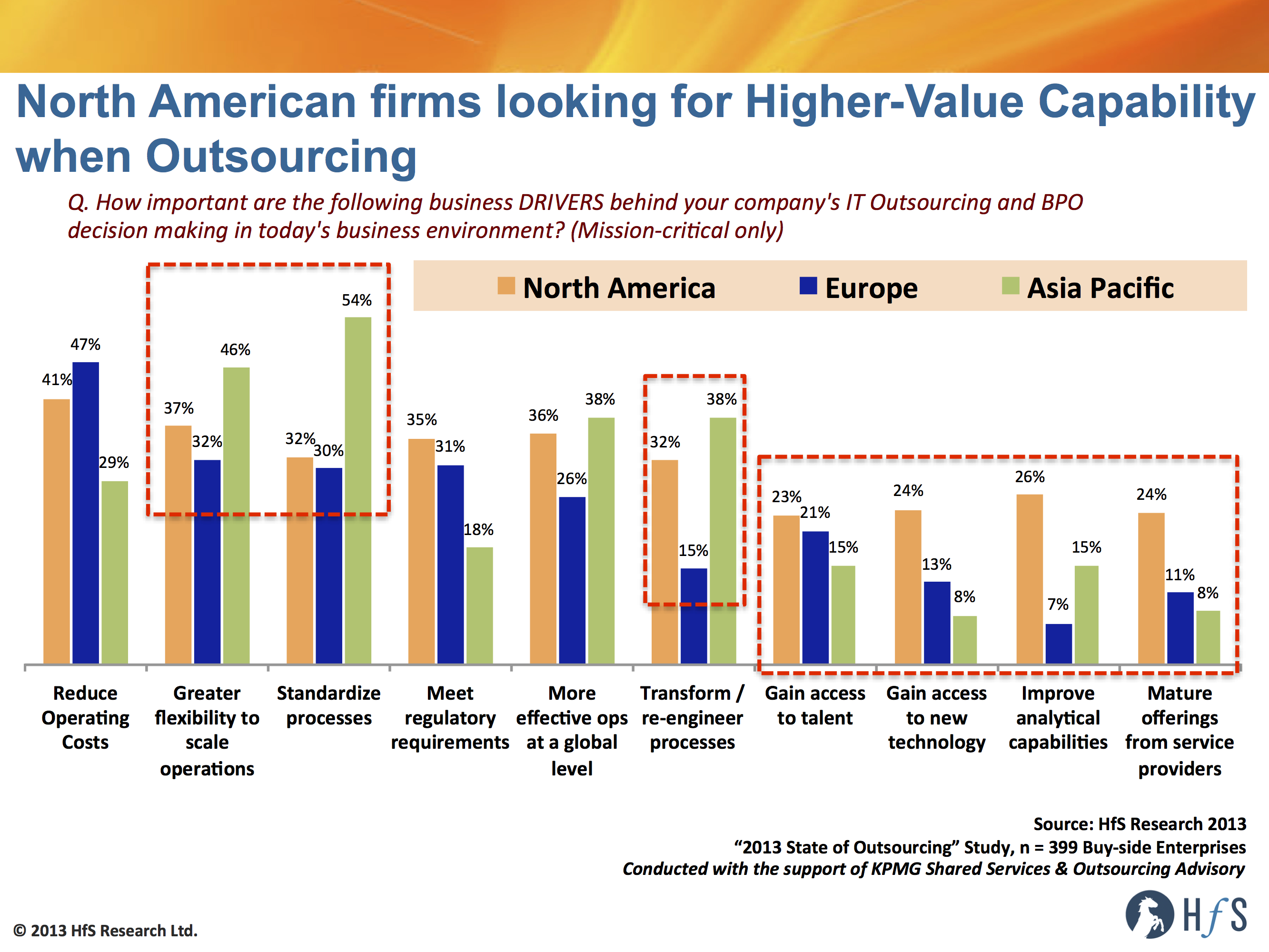
Why is it always the Americans at the head of the queue when it comes to increasing quarterly profit margins? But, even more intriguingly, why are they also leading the way when it comes to attempting to improve their capabilities when they outsource? Our recent State of Outsourcing Study 2013, conducted with the support of KPMG, clearly shows the differing mission-critical business motivations across the main three global regions, when it comes to ITO/BPO:
Click to Enlarge
So, in our true style of insulting everyone from every continent with sweeping generalizations, let’s take a closer look:
North American Enterprises:
Simply put, these firms are a lot more experienced with outsourcing IT and business processes, and a good proportion of them are today showing a good deal of maturity as a result. Much of this is because outsourcing has traditionally been a game for the large corporates to play… and most of the large corporates are based Stateside. Moreover, the biggest “lever” of attractiveness over the last 10+ years has been wage arbitrage to India, hence it is those English-speaking enterprises with the most to save, who are the prime candidates to benefit financially in the short-medium term. This also explains why the UK, then Australia are the second and third most mature countries, respectively, for ITO/BPO.
What’s most interesting here, is the fact that cost-reduction is no longer the main dominant factor behind outsourcing for American firms – effectiveness measures, such as process standardization and re-engineering, are nearly as important, but, most encouragingly, high-value capabilities, such as improving analytics, accessing new technology and talent – and proven provider offerings, are mentioned as mission critical business drivers by a quarter of North American firms.
Simply put, many organizational leaders are waking up to the realization they are running out of wiggle-room in terms of finding massive cost savings simply from labor arbitrage, and the only long-term measures to find new thresholds of productivity is through smarter process redesign (and standardization in areas where there is limited competitive advantage to be had), a more analytical workforce that can help the firm make faster and smarter decisions, and a more flexible operations infrastructure that can scale to the needs of the business. What’s more, our research shows many of the larger enterprises viewing outsourcing a part of a broader framework for achieving business objectives, alongside internal business functions, shared services and offshore captives. It’s being viewed less and less as a siloed strategy for cost reduction, and more as one lever of many for achieving better productivity, tighter operational control and access to external resources and acumen.
Moreover, an encouraging economic period traditionally drives North American firms to evaluate more radical opportunities, and outsourcing frequently rises to the surface as a genuine change-agent during times of economic stability.
European Enterprises:
Cost-reduction and standard delivery requirements still dominate most European firms, with the exception of a handful of enterprises in the UK. Simply put, many of the large-scale European enterprises are far less experienced when it comes to outsourcing and offshoring as their North American counterparts, and many offer a less mature, “just get it done” attitude. The majority do not really want to change, and do not feel the need to transform processes or improve their analytical capabilities – or even if they did, they certainly do not view an outsourcing relationship as an opportunity to do a lot more than drive down some costs, standardize some processes and get some better flex into their operating model.
Interestingly, there does seem to be a notable increase of Euro firms viewing outsourcing as an opportunity to access some quality talent (21% state this as a mission critical driver), which is surely a result of the shortfall of affordable quality IT talent available on the European continent and the proven success of the ITO model for many global organizations today.
Couple all of this with a horribly nervous European economic outlook and you quickly get the picture why outsourcing just isn’t everyone’s cup of tea these days. Why rock the boat even more, when everyone’s already seasick?
Asia/Pac Enterprises:
It’s difficult not to sweepingly-generalize when you have the likes of Japan lumped in with Malaysia, India, China and New Zealand, but the underlying trend here, is that many firms view outsourcing as a real chance to improve their processes, and globalize their operations. They are less enticed by cost-reduction – and this is often because low cost labor is already available locally, in addition to the fact many AP firms are scattered across the region without massive repositories of centralized staff do to a cost-slashing “lift and shift”.
It’s clear many AP firms see outsourcing as a quick route to get from “A to C” with some areas of the business that could really benefit from a more standard solution, such as payroll, procure-to-pay or ERP maintenance. However, what’s also clear is these organizations are miles away from recognizing real strategic value from outsourcing, with only one-in-every-seven organizations viewing outsourcing as a key driver for improving access to new talent and analytical capabilities.
So these immature adopters are viewing the tactical benefits first and foremost. Perhaps that will change in a few short years as uptake of global sourcing models picks up… but it’s still very early days for this region.
The Bottom-line: Tactical measures continue to dominate, but ambitious North American buyers are starting to lead the way with a more progressive approach to outsourcing
We can bemoan the old “outsourcing is all about cost and meeting green lights” adage, but there are some genuine positive signs that our weary operational warriors are beginning to take a more progressive approach to outsourcing these days.
The fact a quarter of North American buyers now view analytics, talent, improved technology and provider maturity as mission critical shows that a portion of this industry is finally beginning to move the needle to achieving more than the basics. Smart governance leads realize they need to build careers from managing outsourcing engagements, and if they simply sit back and check boxes on spreadsheets, their own employability with soon come into question.
What’s more, shared services has struggled similarly to achieve higher level value – and over a longer period than outsourcing – and there is a genuine coming-together of operational governance models, with the likes of Global Business Services being tested as the future operating model. Are we at an inflection point? Yes, I believe so… albeit very “gradual” one!
Disclaimer: before you non-Americans go piling in, the author of this article, Phil Fersht, is actually a British subject currently living Stateside
Posted in : Business Process Outsourcing (BPO), Captives and Shared Services Strategies, HfS Surveys: State of the Outsourcing 2013, HfSResearch.com Homepage, IT Outsourcing / IT Services, Sourcing Best Practises, Sourcing Locations, Talent in Sourcing, the-industry-speaks
Is the day of the rock star analyst officially over?
 There’s been a lot of backchannel lately regarding high profile analyst departures to vendor organizations, with Thomas Otter, Gartner’s hugely popular VP for Human Capital Management, hopping to SAP’s recent acquisition, SuccessFactors.
Naturally, SAP’s competitors are all freaking out because they’ve invested so much time and attention in Thomas, while Gartner can’t be happy as its clients shouldn’t care whether they’re buying Bill or Ben… they should be buying Gartner.
What’s worrying, is the recent succession of high-profile analyst stars making vendor moves, for example, Jim Holincheck’s switch from Gartner to Workday, Stephanie Moore from Forrester to Ameritas Technologies, Mickey North Rizza from Gartner to BravoSolution, and even one of HfS’ early stalwarts, Euan Davis, to Cognizant, as the latest examples.
Having worked in the big ticket analyst world myself with IDC and AMR (leading up to the Gartner acquisition), I can vividly recall the changing attitude of analyst firms towards their high profile analysts, who commanded top-dollar for their clients to have them on the end of the phone. When I joined IDC as a mere child, the rock stars analysts were what made the firm – and the fledgling analysts looked to emulate them as they gained experience. Plus, the analyst firms tolerated them because they brought in the clients and created a lot of attention from media. The stars were their real differentiators.
It wasn’t until the last few years, with the advent of analyst blogs and the easy capability for smart analysts to nurture their digital infamy, that the big-ticket analyst firms turned against the rock-star model. They wanted their clients to pay to spend time with whatever analysts they chose to put in front of them – and if there was an analyst departure, they could quickly (and quietly) slot some other individual into that role to fill their place. No-one should care, it’s all about the analyst firm brand, not the individual analyst, isn’t it?

Big Data… Cloud… Mobility…. will transform the enterprise
It’s my personal concern that the exodus of great individual analysts from the great analyst firms is symbolic of a slow death of the romance and intrigue of the industry analyst industry, as we once knew it. The tech analyst industry grew up on great personalites and thought leaders, who thrived on innovation and the exciting changes technology was bringing to the world. Today, the succession of turgid reports, many of which read like they are written by automated robo-analyst applications with the words Big Data, Cloud, Analytics, Mobility and Transformation being spewed out at periodic moments, is killing research as we know it.
Here’s why the demise of the rock star analyst is depressing for the analyst industry:
1) Clients value relationships with individual analysts more than written research. People don’t have time to read more than a few paragraphs of research these days, and prefer to have the key insights presented as a few bullet points to accompany a live discussion with the analyst. The watchword of the research sales pros these days is always “research sells, but relationships renew”.
2) People want to trust with whom they share their confidential information. The best analysts are those who regularly talk to the customers of the vendors and can deliver real insights and opinions of their products and services. The more a good analyst becomes intimate with the vendors, the more valuable the advice and validation that analyst can deliver to the vendor. Moreover, the more a good analyst knows the vendors, the better they can inform the customers of software and services offerings. That means clients need to have individual analysts they want to get to know and trust.
3) Analyst firms are caught in a Catch-22 between their corporate brands and their individual analyst brands. The paradox is that the handful of analysts who reach the status of being “good” quickly become rockstars and get whisked away to the rich vendors. For example, it’s far more valuable for the likes of SAP to “own” Thomas Otter than to share him with their competitors. So the crux of the matter is, simply, that if the likes of Gartner et al. can’t (or simply do not want to) create an environment where their rockstar analysts can prosper and be happy for the bulk of their careers, then they may as well let them all leave and milk the robo-analyst model that is more scalable and easier to control. However, if that means they will ultimately lose business because their clients aren’t satisfied with robo-analyst, they have a problem…
4) Rogue analysts of varying quality are setting up their own “boutiques”. There are a host of individuals who have hung out their own shingles in recent years, and some are forging a living, based on the relationships they developed when they were in the big analyst shops. While this creates some excitement, especially when a genuinely decent analyst starts putting out some good research and insight, there is also a host of average-to-mediocre “analysts” exploiting social media and vendor ignorance to publish shabby (and often incorrect) research that confuses the market place. We live in an unregulated world where anyone can suddenly don an analyst cap and pose as some form of “expert”…
The Bottom-line: The information and research industry is experiencing a fundamental shift… surely the analyst firms will have to change their ways soon
However which way we look at it, the sizzle and anticipation when a new analyst report comes out is becoming a shadow of what it once was, and the levels of cynicism and negativity towards analysts are reaching an all time high. What’s more, the overall desire from companies to read and digest many analyst research reports has dropped significantly in today’s information-crazy world.
So much data and insight is proliferating the Internet, the LinkedIn groups and other digital communities, that the value of many once-acclaimed analyst reports is simply not what it once was. Sadly, as long as the big-ticket analyst firms are milking their clients and making money, they are unlikely to change. However, research is a discretionary expenditure, and ultimately if the value is diminishing, so will the investment. If clients want to invest in relationships, they will ultimately take their money to those firms who can provide them…. or directly to those individual rockstars themselves, if they are still around.
Posted in : CRM and Marketing, HfSResearch.com Homepage, HR Strategy, kpo-analytics, Outsourcing Advisors, Talent in Sourcing
Achieving new-world innovation: promote your innermost qualities to the world unashamedly
[embedplusvideo height=”390″ width=”640″ standard=”http://www.youtube.com/v/3qfBiz64Axs?fs=1″ vars=”ytid=3qfBiz64Axs&width=640&height=390&start=&stop=&rs=w&hd=0&autoplay=0&react=1&chapters=¬es=” id=”ep6183″ /]
Posted in : Absolutely Meaningless Comedy, Sourcing Best Practises
Hear Phil Fersht talk to Bill Kutik about analysts, HR and outsourcing…

Hear Phil Fersht talking to HR Technology’s godfather, Bill Kutik

Click to listen to the recorded interview on iTunes
You may recall our announcement to the world, over three years ago, revealing the launch of outsourcing analyst firm HfS Research… and we first mentioned this on Bill Kutik’s irreverent radio show.
Tune in to listen to our latest conversation and you’ll hear more about:
- The current state of the research business and why recent entrants, such as HfS, are playing with the traditional analysts;
- What’s happing in HR Outsourcing, and why it’s becoming more of a niche-process industry today;
- Why HR is fast-becoming one of the most dependent business functi0ns of technology to be effective;
- Why firms are more likely to do outsourcing in a good economy than a bad one;
- HfS’ new Blueprint methodology for assessing vendor performance – and why it’s such a game-changer.
Click here to listen to Phil and Bill
Produced by Knowledge Infusion, an Appirio company, and hosted by independent industry analyst Bill Kutik, selected last year as one of the world’s “Most Powerful HR Technology Experts,” the bi-weekly interview show provides leading HR business content and insight into up-to-the-minute trends.
Posted in : Business Process Outsourcing (BPO), Cloud Computing, HfSResearch.com Homepage, HR Outsourcing, HR Strategy, SaaS, PaaS, IaaS and BPaaS
So if the rockstars have gone, what’s left in the analyst industry?

SVP and Research Fellow, Customer Satisfaction
As we revealed last week, most of the big analyst personalities have seemingly fled the analyst industry… many for the riches on offer from their vendor clients, clearly seeing more ROI from employing them, as opposed to purchasing their firm’s services. However, this hasn’t prevented the remaining legacy purveyors of analyst services from making a living.
So what’s left in these firms after the rock stars have left the building? Let’s examine the cast of characters that many of us frequently have the good fortune to meet in briefings, conferences, airport lounges, hotel bars, psych wards etc.
Mick Jagger Analysts:
Not all the rock stars fled… some stayed well past their sell-by-dates, clearly not mentally prepared for a foray into the real world. They still drift around analyst firms, making occasional appearances in executive briefing sessions (or sometimes just walking out of them halfway through). Their research productivity is usually about one thought-piece a year, which is usually miles from reality, but everyone tells them their piece was amazingly thought-provoking, having read the first paragraph.
They still show up at the odd vendor analyst conference, where they tend to knock back too much scotch on the first night and spend the next morning sleeping it off in their hotel room before making a token appearance at the one-on-one briefing in the afternoon.
The High Performer Analyst:
A “High Performer” these days is pretty much an analyst who does what he/she is paid to do and actually has some reasonable research to share with the world. They spend a good deal of time conversing with both buyers and vendors and actually cobbling together some genuine research for all to read. Sadly, their wares are normally wedged miles behind some firewall somewhere where noone can find it, even when they’ve paid for it. What’s more, the months it takes to get their research past their internal red tape and editorial teams drives them crazy, and their firms are unlikely going to let them blog (and they get no credits towards their bonus for blogging, in any case, so why do it?). Motivation quickly slips away and their CVs normally slip onto the market after a couple of years.
The Egomaniac Analyst:
Analysts who got their egos stroked and loved it so much, they realized they needed them stroked… every minute of every day. Writing one good piece a quarter wasn’t enough to slake their thirst for praise, so they attempt to hop on every hot area they can and put our some fluffy piece of prose to get attention. Their focus on quality quickly wanes, as having their name in lights, in as many places as possible, trumps all else. After trampling on all their colleagues’ areas and sucking up all their manager’s time in the process, they eventually get booted out and apply for any analyst job they can, as they do not have the real confidence to go it alone. Usually, some analyst firm will pick them up and go through the whole egomaniacal process with them… all over again.
The Spin Doctor Analyst:
Analysts who feel doing actual research is either beneath them, they simply feel no compulsion to do any, or they may not actually know what “doing research” is. Instead, they get their hands on a few reports from others and cobble together their own version of the trends. Good spin doctor analysts can do this very effectively, and very convincingly, leaving the world to believe they grafted long and hard to create this vision, when all they did was spin the ideas and views of others. They frequently offer to “collaborate” with other analysts on reports to create the impression they do some actual research, but in reality just want to slap their name on the report for showing up at a couple of meetings.
Sadly, the average spin doctor doesn’t get away with it for too long (there have been several embarrassing examples of analysts plagiarizing over the years), but many of the good ones build a nice career doing it. Usually they get promoted into practice lead areas, so others can actually do the real work, while the spin doctor can spin their stuff all day long…
The “Annoying and complex Questions” Analyst:
Yes, every conference is never complete without the analyst who just has to chime in with some annoying questions. Frequently, some will start asking a question, but forget the original intent of why they are asking the question, proceeding to drone on for a couple of minutes spouting their views on something that sounds complex and undecipherable to the rest of the audience. Others will launch into some direct questions to probe at the weaknesses of the presenter’s content, which they really should do in private, instead of trying to embarrass the presenter.
These analysts tend to attend every single conference and vendor event imaginable, with the hope that, one day, they will become enlightened and not have to ask a really annoyong question in front of the whole room.
The “Plodder” Analyst:
Sadly, this analyst comprises the good proportion of most analyst houses. Simply put, the plodder isn’t very good, doesn’t rock the boat and drifts along checking the boxes and meeting their firm’s metrics (sound familiar?). He or she smiles politely when spoken to, produce average-to-mediocre research and isn’t going anywhere anytime soon – they simply aren’t very good. They get left largely alone to plod along and keep the machine cranking along.
The “Why on earth are they still Employed” Analyst:
Yes, there’s always a few lurking around. Analysts who are so bad everyone keeps out of their way. They tend to cover boring areas noone cares about and get wheeled out for the occasional client meeting when their area need a “face” tied to it. Their goal in life is to be as invisible as possible and eke out a cosy living until the eventual day they get that call from HR…
The “Drive-by Consultant” Analyst:
Analysts who come from the buy-side and proceed to spend every day talking about “what is was like when they were a CIO” etc. They do not see the need to do any actual research, but will put out a few flashy pieces on the good ol’ days and the incredible best practices they initiated. Typically, the “Drive-by Consultant” Analyst can pull off this game for about three years, whereupon everyone has become tired of the same anecdotes being rolled out. These analysts tend to sneak back to the buy-side at this point, chalking up their three wonderful years of being an “analyst” before re-entering the real world again.
The “Vendor Marketing” Analyst”
Analysts who come from the vendor side, with intimate knowledge how vendor marketers work. They get obsessed with showing up at vendor briefings and writing up little blogs and briefs on what they thought of the occasion. They do all the things to press the buttons of the vendors… little tweets of praise from their events and announcements, blogs (if allowed) of the vendor’s next groundbreaking industry maneuver, and profiles of their favorites. These analysts typically go through a one-to-two year honeymoon of vendor-schmoozing, but quickly get bored of the same dog-and-pony show and start interviewing for their next salary-doubling move… back to the dark side.
The “Screw this, I can do this better Myself” Analyst
Analysts who are typically some hybrid of many of the above, who decide they can walk off into the sunset and set up their own little shop. Some just declare they are a one analyst show, while others put up a facade that they actually have an analyst team. A few do actually have analyst teams, but still can’t resist writing the odd cheeky blog about the analyst industry 🙂
Posted in : Absolutely Meaningless Comedy, Confusing Outsourcing Information, HfSResearch.com Homepage, HR Strategy, Sourcing Best Practises
If there’s something strange with your processes, who ya gonna call? Ghoshbusters…

Afraid of no processes: Genpact's solution head Shantanu Ghosh
Anyone close to business services over the last decade would have crossed paths with one little guy with a huge brain: Genpact’s Shantanu Ghosh. While everyone is familiar with Genpact’s current CEO NV “Tiger” Tyagarajan, and retired former CEO, Pramod Bhasin, Shantanu has frequently been the guy cobbling together the internal teams and the solutions to make it all happen.
I have had many conversations with Shantanu over the years and each time I have come away inspired by someone who is so intimately involved with so many clients and issues in the process delivery industry – he really lives and breathes this stuff.
So when we had the chance to hear his inner-most thoughts on the future drection of the services business, we couldn’t resist sharing them with you…
Phil Fersht (HfS): Shantanu, you’ve been one of the brains behind Genpact’s rise to the pinnacle of the BPO industry in the last few years. Please tell us a little about your background and how you got into this business. Did you always want to be a process guy?
Shantanu Ghosh (Genpact): Thank you very much for saying that Genpact has reached some stage in the BPO business. My background is that of a functional finance expert. I spent my early years in accounting at Pricewaterhouse, then a decade with Unilever in various functional finance roles. Then I spent five years with GE, first at the business level and then at the corporate country level as the CFO. I had reached a stage in my career where I had done the whole functional side of the game, and I wanted really to drive a business. Genpact at that time was just contemplating becoming an independent commercial BPO organization, and moving to the company has provided a huge opportunity for me to come and grow the finance and accounting service line as a general manager. My belief was that in early 2005 the BPO industry was at the cusp of a breakthrough and I wanted to be part of the action. Also Genpact provided an unique opportunity for paid entrepreneur ism.
Phil: You talk a lot about performance enhancement at the enterprise process level, and it sounds very impressive. But what do you really mean, and is it something realistic to which many of today’s businesses can aspire?
Shantanu: Phil, our fundamental belief is that that all enterprises are basically a conglomeration of different value creation processes. Source to pay, record to report and order to cash, the supply chain processes, customer acquisition, the claims process in insurance, etc.
I think the way businesses compete are on the strength of their products and the strength of their operating performance. And operating performance is a direct function of how well those end-to-end processes run. There is a lot of empirical proof on that area. I do think performance enhancement at the enterprise process level is something realistic to which businesses can aspire to. If you look at moves toward global business services for back-room processes, if you look at what people have done with manufacturing processes…clearly there is an increasing awareness, understanding and intent to drive process performance to a level where it becomes a competitive differentiator.
Phil: The operational challenge behind finding these new thresholds of performance, about shifting the corporate mindset from one of cost to one of value, is something a lot companies claim is their biggest challenge today. How do you think clients can learn from past experiences and start to offer best practices to others?
Shantanu: The performance of different enterprises in this area varies significantly. It’s obviously far easier to focus on cost, and much tougher to focus on the other dimension of performance which is value or effectiveness.
In terms of best practices, a value-driven model needs three primary things. First, the tone must be set at the top. Value is often driven between different functional silos across the value chain, and it’s very hard to achieve that with a bottom-up traditonal budgeting approach. Second, you need to create an empowered organization that can look at driving value across end-to-end enterprise processes … As evident by the increasing trend of Global Business service groups. Many organisations have tried to do this in their existing federated, siloed organizational model, and that obviously produces muted or mixed results. Third, value creation is not one shot process, it is a long-term, multi-year journey that includes being able to understand where one’s performance is, being able to objectively compare it and benchmark it against others, being able to create a roadmap consistent with organisational constraints of money and leadership bandwidth and change appetite, and then having the tenacity to walk on that roadmap.
Phil: Can you give us some examples of failures?
Shantanu: Many of the failures are when there has been a one-dimensional view of how can I get the most efficient, both in terms of cost as well as maybe cycle time and all, without actually being clear on the desired business value or business impact.
A classic simple example on this is in the collections or order to cash area. If you only optimize on the dimension of cost, you will try to maximum the number of accounts one particular agent can call in a given time frame and the minimise the time needed on each call. Whereas, if you optimize on the option of value, then suddenly you will think about what kind of analytics and technology you can use to try and figure out who to call, when to call, how you take the analytics upstream to ensure you are not on-boarding customers with credit limits issues, or fixing the billing process to eliminate the need for a lot of calls etc. It completely changes the game of how much outstanding debt you have, or how much you have to write off in bad debts and those benefits are order of magnitude higher than just cost. The second most common reason for failure is to underestimate the change management issues… Organisational habits are tough to break and all standardisation and optimisation initially looks like an impediment to flexibility and reduced control for frontline and operating people in the businesses.
Phil: Our research shows that change management is topping enterprises’ agenda in 2013. Why do you think this is? Why do you think so many want to change, but they struggling to put together programs to help themselves? What works or doesn’t work for clients, when we get into these change issues?
Shantanu: I’ll tackle these very interesting questions at two levels, First, why change management tops companies’ agendas today is that they are more looking to drive value rather than only plain vanilla cost reduction. And driving value means cutting through traditional company hierarchies, cutting though traditional organizational models of functional silos. That’s a big change. That’s not the way people are used to working. So the first fundamental barrier to making change happen is the fact that it goes against how people have worked for many years, many decades. The second piece is that driving change requires a burning platform. Many failures we’ve seen are due to the fact that the organization and the leadership team have not been able to either acknowledge or articulate a burning platform for the troops to rally around. Change is always painful. Change means you have to learn new things, you have to do things differently, you have to let go of people, you have to change your ways of working…none of it is easy. And for people to go through that process, you need to believe in something bigger, something better; you need to have a vision that fires you up.
Phil: So… what’s next for Genpact? You’ve made the Winners Circle now – you are one of the big, glitzy, top-tier providers in this space. Are you ready to declare victory and rest on your laurels, or are we going to witness a whole new impetus and focus on where your firm wants to go next?
Shantanu: Phil, we believe that we are just at the start of our journey. We are a small company, just about $2 billion in revenue. We’ve been in the commercial space for less than a decade. We’re in a market and in an industry that is hugely under-penetrated. We have a fundamental belief that this industry will double, triple, quadruple in size over the next few years. We feel very privileged to have had some role in defining the way the industry works, and that we can continue to drive that definition.
Demonstrating flawless execution
There are two aspects we feel very deeply about. One is helping our clients succeed by competing through smarter processes. So, everything we do is focused on how our customers create competitive advantage through the power of their operating model in the marketplace. The second thing we believe is that the market and the industry have really started shifting fundamentally from a pure cost equation to a cost plus value equation. It would be naive to think that the shift has happened significantly. But there is enough evidence for us to be very encouraged that the shift is happening and it’s really one way…it’s not going to change. And we believe we are uniquely positioned to both drive and benefit from that particular shift.
Phil: So the final question… you are awarded $10 million. What will you be doing in six months time?
Shantanu: Well, I’ve had a fabulous eight years in Genpact, but it’s been very busy, so if you give me $10 million, I’ll possibly be on a very expensive long holiday. But seriously…if I had $10 million to invest, there are so many areas of competency that we could invest in to benefit our business and customers. Whether it’s in the Analytics space, or in the regulatory compliance space, given the changes that are happening or twenty other such interesting areas; if I had $10m to experiment with, I would put that into our new products innovation funding in a couple of those areas.
Phil: Hmmmm…. good answer 🙂 Thanks for your time today with our readers, Shantanu. It’s been quite a journey for both you and Genpact and we’ll love to hear more from you further down the road.
Shantanu Ghost (pictured) is Senior Vice President and Global Head, Enterprise Services, Solutions, Transitions and Lean Six Sigma. You can view his full bio here.
Posted in : Business Process Outsourcing (BPO), Finance and Accounting, Global Business Services, HfSResearch.com Homepage, HR Strategy, Outsourcing Heros, Sourcing Best Practises, sourcing-change, Talent in Sourcing
