Visa and Mastercard just escalated the war for the future of commerce—not with another app, but with autonomous AI agents that buy on your behalf.
These aren’t lab experiments. Visa’s Intelligent Commerce and Mastercard’s Agent Pay are foundational shifts designed to embed payments into AI platforms that consumers already trust.
The implications for enterprise marketing are nothing short of seismic, and the following class of applications is under threat:
Ecommerce platforms like Adobe Commerce, Shopify, and Salesforce as AI agents bypass frontends entirely by making decisions and completing purchases autonomously.
SaaS tools for behavioral analytics and personalized product recommendations (e.g., Dynamic Yield, Monetate, Nosto)
Commerce Is Becoming Agentic—and SaaS Is Losing Its Grip
Visa integrates tokenized payments into agents OpenAI, Microsoft, and Anthropic developed. Mastercard is launching Agent Pay to handle secure transactions via AI, using a system of agentic tokens to verify trust and authorization. These aren’t front-end bells and whistles—they are backend rails designed to replace the shopping cart, the e-wallet, and potentially the SaaS commerce stack itself.
Forget clicking, browsing, or tapping. Tomorrow’s consumers can offload their entire shopping experience to trusted AI agents: searching, choosing, transacting.
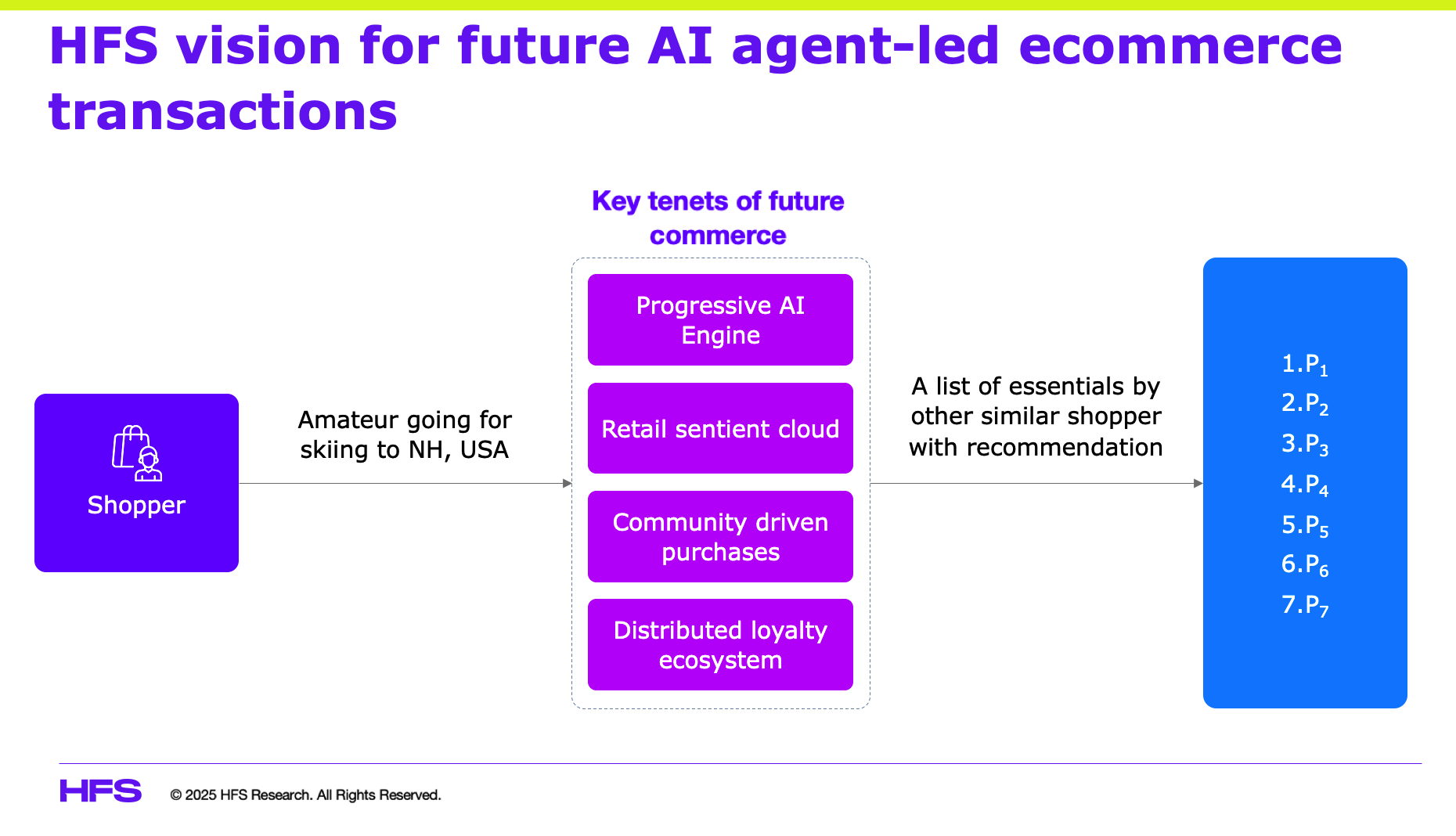
Six months ago, we at HFS outlined precisely this vision (see our previous POV, “Reimagining e-commerce with AI: the dawn of interactive commerce“), emphasizing AI-driven personalization, real-time recommendations, and autonomous purchasing as the future of digital commerce (see below). These recent moves by Visa and Mastercard directly support that bold prediction.
We’ve Been Here Before—But This Time, the Tech Can Deliver
Skepticism is warranted. We’ve seen overhyped commerce experiments flop before. Voice commerce flatlined. Chatbots collapsed under their own UX failures. Even Amazon’s Dash Buttons died quietly, abandoned by customers who preferred frictionless app-based buying.
But generative AI isn’t Alexa. Today’s GPT-class agents don’t just react—they reason, personalize, and adapt to individual behaviors in real-time. Visa and Mastercard are embedding commerce into agents consumers trust—Microsoft Copilot, OpenAI’s ChatGPT—and are not trying to build new destinations. The Apple Pay strategy is reborn but with an intelligence layer on top.
Trust Is the New Commerce Interface
Here’s the rub: none of this works if enterprises don’t aggressively confront the trust equation. Consumers will not adopt agentic commerce if transactions feel opaque or risky. Visa and Mastercard offer spending limits, granular controls, and advanced fraud protection—but enterprise leaders can’t outsource this responsibility.
Enterprise leaders must now ask:
How do we expose our catalog, pricing, and inventory to AI agents?
How will we audit and verify agent-led purchases?
What is our liability if an agent misfires?
Failing to answer these questions risks marginalization. In a world where AI agents filter and finalize purchases, invisibility equals irrelevance.
Enterprise Leaders Must Act Now to Stay in the Game
Don’t wait for agentic commerce to go mainstream. The fundamental shift in how platforms manage transactions and data flows is underway. The new power brokers—Visa, Mastercard, OpenAI, Microsoft—are building commerce ecosystems where SaaS apps and digital storefronts may no longer be the primary interface.
Enterprise leaders must:
Pilot AI-agent exposure: Experiment with exposing products to agent ecosystems (e.g., integrating with GPT plugins or Microsoft Copilot).
Design for machine-first buying: Rethink UX, metadata, and taxonomy to serve AI agents—not humans.
Double down on trust infrastructure: Build transparency, consent, and explainability into every touchpoint—because the agent is now the user.
Bottom Line:AI agents are not another channel—they are a new species of consumer. Enterprise commerce leaders must prepare for a world where decisions are outsourced to autonomous systems, not influenced by UX or loyalty programs.
Enterprises must build trust into every AI-agent interaction because, without transparency and control, agent-led commerce dies before it scales. The winners will be those who operationalize agentic commerce today—exposing product data, managing liability, and building trust before Visa and Mastercard become the invisible middlemen behind every transaction. Waiting means disappearing from the decision-making process entirely…
Cyber conflict is no longer a niche concern for defense departments, it’s a pervasive, persistent threat reshaping the security posture of every enterprise. As global tensions escalate—from Ukraine and Israel to rising flashpoints in South Asia—cyberwarfare has emerged as the new frontline. It targets not just military infrastructure, but also cloud platforms, supply chains, tech ecosystems, social media feeds, and the smartphones of your employees.
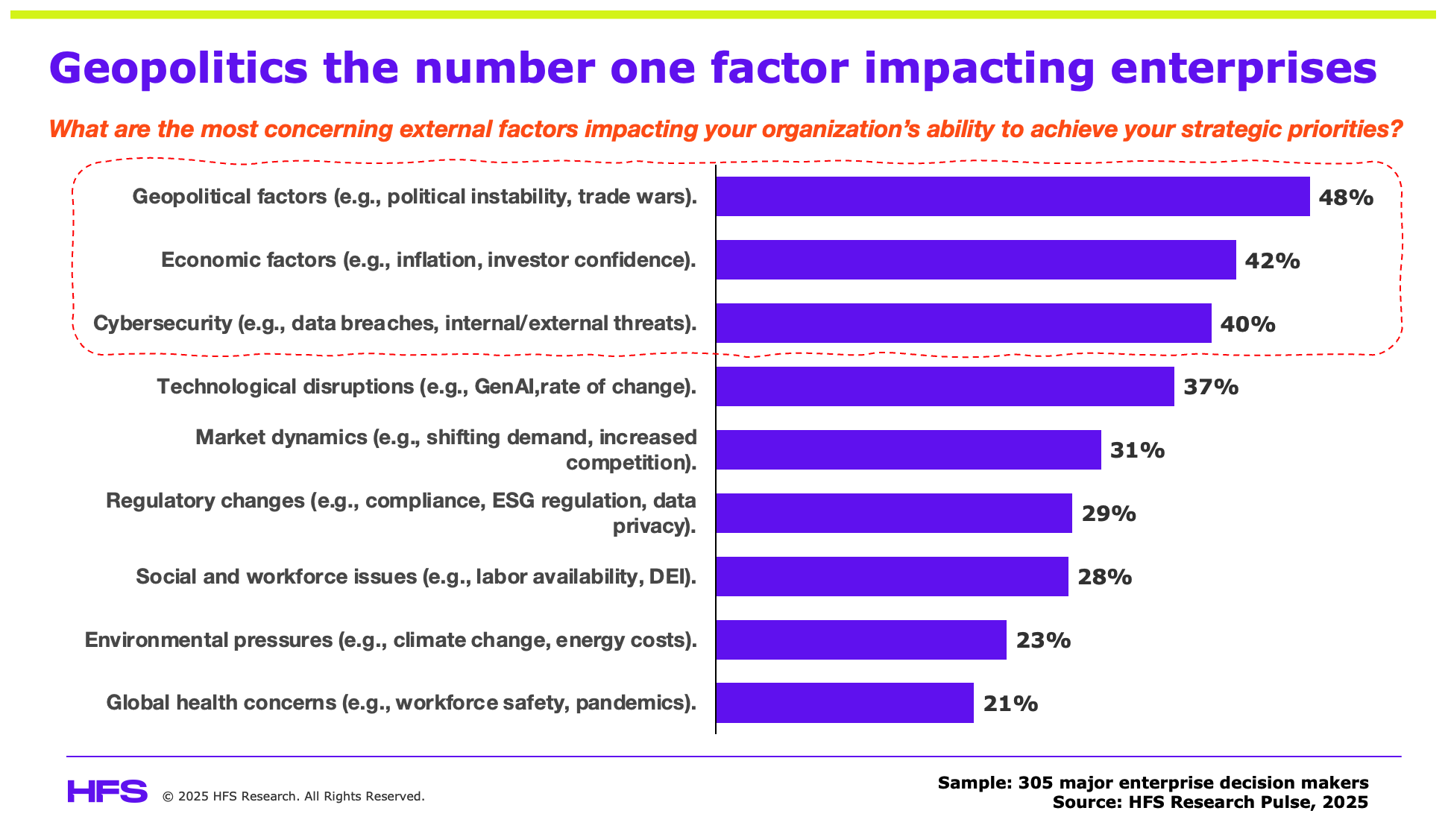
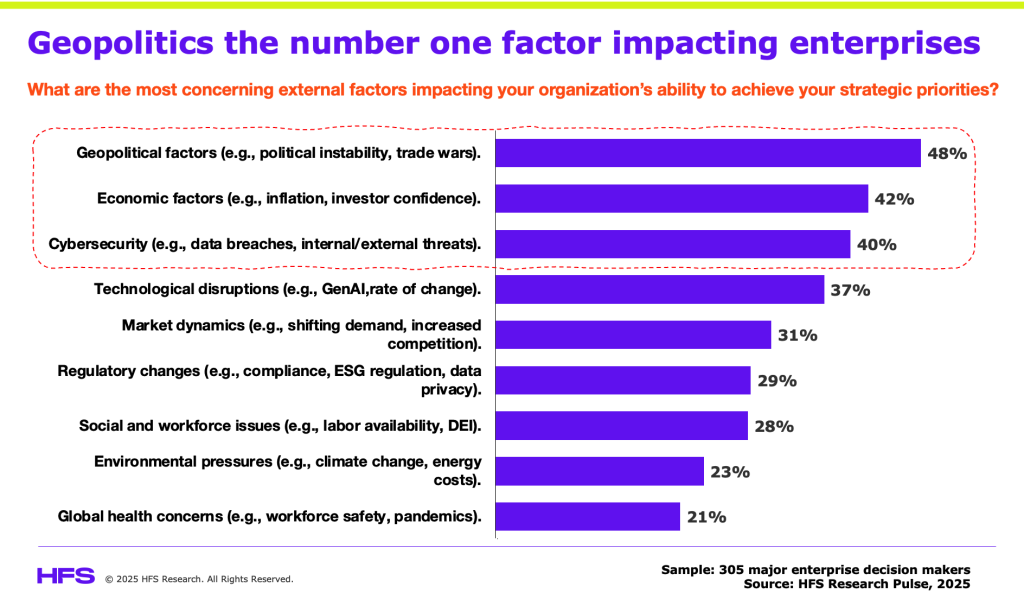
It is little wonder our latest research shows the combo of geopolitics, economics, and cybersecurity as the dominant external factors on the minds of G2K enterprise leaders:
This is not just about ransomware or phishing; it’s an emphatic focus for the CIO
Cyber conflict today includes information warfare, infrastructure sabotage, and financial system disruption, all designed to paralyze confidence and destabilize economies.
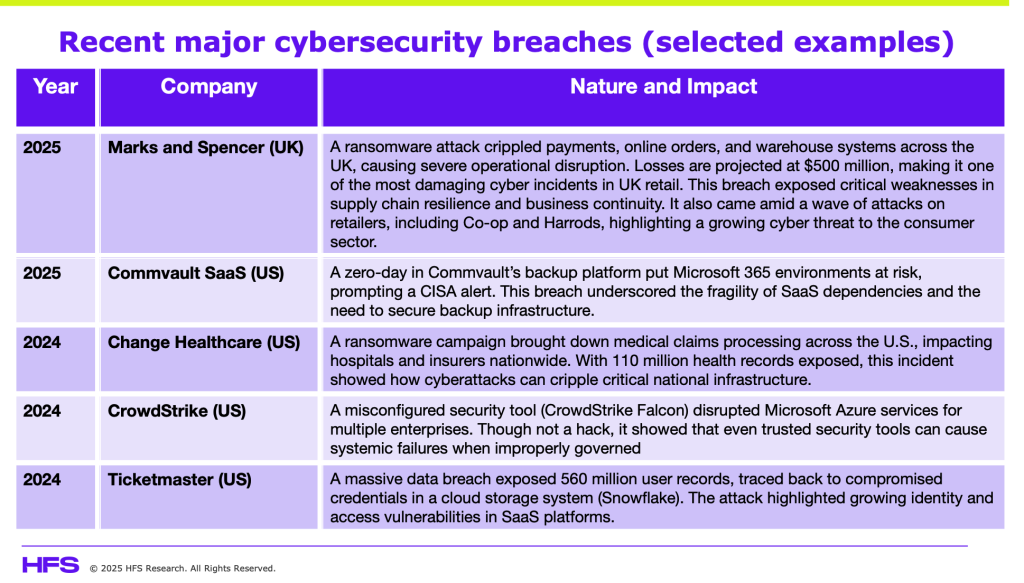
The pressure point has become the CIO, who not only has to manage significant pressures from their boards and leadership peers to deliver an AI agenda, but they also have to balance this with a proactive, holistic cybersecurity approach that business leaders can comprehend. Mess up your cybersecurity, and you’re not only fired, but your entire firm may just sink with you. And for every cyber-attack that goes public, we estimate another six are kept under wraps to avoid negative publicity, remaining unreported or even undetected:
Enterprise leaders must treat cybersecurity as a strategic boardroom issue, not merely an IT function
This is why we do not believe a CISO should report to the CEO, as the CEO really needs to understand the risks and how to proactively get ahead of them. CISOs tend to be too technical, whereas the CIO is evolving as the hybrid executive who can translate technical issues in plain business terms. In addition, with all the pressure to deliver on AI, the CIO is best placed to bring the cyber strategy into the conversation, as there simply won’t be successful AI without an effective cyber strategy.
This paper unpacks the modern cyberwarfare playbook, outlines its enterprise implications, and provides a security readiness agenda that organizations must prioritize in an era of digital warfare.
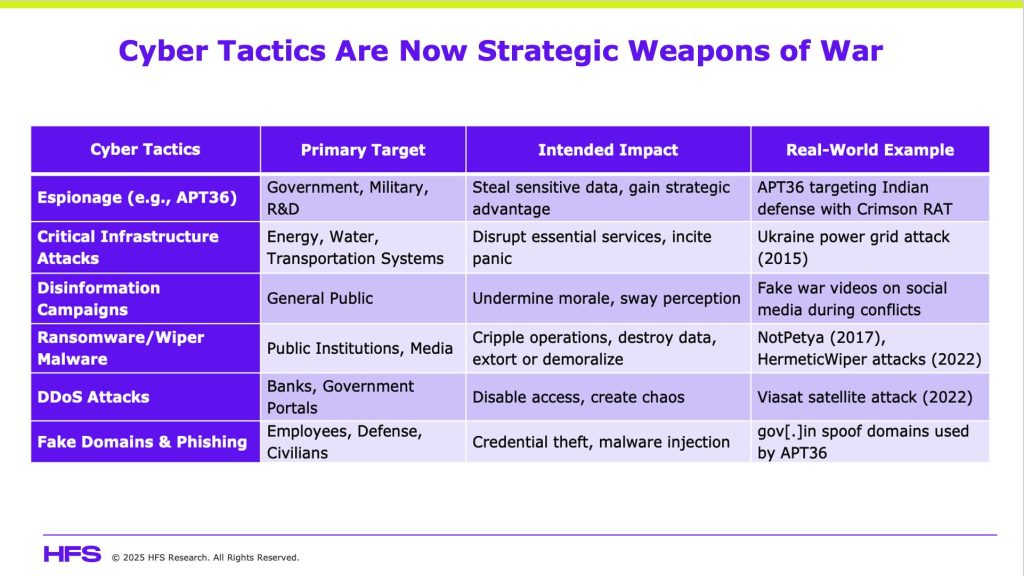
Cyber tactics are now strategic weapons of war
Before diving into each tactic in depth, the table below summarizes the most common cyberwarfare methods, their typical targets, intended impacts, and real-world examples observed in recent conflicts.
Let’s now examine these threats in greater detail:
Cyber Espionage Is a Silent Strategic Weapon
Cyber espionage is among the most insidious tactics in modern cyberwarfare. It involves stealthy infiltration into government networks, defense systems, and critical infrastructure to extract sensitive information—military strategies, diplomatic communications, or classified research. These campaigns are often the work of state-sponsored Advanced Persistent Threats (APTs). The long dwell times and covert nature of these breaches make them especially dangerous, and they can unfold undetected for months, quietly eroding national security.
Sabotage of Critical Infrastructure
Attacks on critical infrastructure are no longer speculative, they are documented weapons of war. Power grids, water supply systems, transportation hubs, telecom, and financial institutions are prime targets due to their symbolic and systemic value. Disabling such services can incite public panic, disrupt military logistics, and hobble a nation’s economy.
Denial-of-Service (DoS/DDoS) Attacks
Distributed Denial-of-Service (DDoS) attacks involve flooding a target’s servers or websites with overwhelming traffic, making them inaccessible. These attacks often aim to paralyze essential services like banking, government portals, or emergency response systems during times of peak demand. In recent conflicts, banks have established “war rooms” to monitor and neutralize such attacks on financial infrastructure, recognizing that even temporary outages can cause economic damage.
Disinformation and Psychological Warfare
Modern cyberwarfare also weaponizes information. State-sponsored troll farms, fake social media profiles, and AI-generated content flood platforms with misinformation designed to erode public trust or manipulate opinion. During active conflicts, fake videos, doctored images, and viral rumours often circulate faster than facts. The goal is not just confusion—it’s psychological destabilization.
Ransomware and Wiper Malware
Ransomware typically locks critical files and demands payment for their release, while wiper malware is designed purely to destroy data. In war zones, these tools can disrupt media outlets, hospitals, transportation, and public sector databases.
Fake Domain Attacks and Social Engineering
Threat actors often register lookalike domains, like “gov[.]in” clones or fake military emails to deceive targets. These are used in phishing attacks to steal credentials or implant malware. These tactics, as seen with actors like APT36, exploit human trust as much as technology. This reinforces that cyberwarfare doesn’t always involve zero-days or advanced code—human deception remains one of the most effective vectors.
Cyber risk now reaches every node—from the boardroom to the smartphone
The broad reach of cyberwarfare means that no one is immune—not just governments and militaries, but also hospitals, utilities, media, private enterprises, and ordinary citizens.
Governments and National Security
Defense ministries, intelligence agencies, and critical infrastructure operators are prime targets. The need for robust cyber defense postures, including threat intelligence sharing, rapid incident response, and sovereign cloud strategies, has never been more urgent. Enterprises must integrate with national threat intelligence initiatives and not operate in silos—public-private cyber cooperation is now survival, not strategy.
Financial Institutions and Corporations
Banks, payment processors, and fintech firms are increasingly in the crosshairs of both nation-state actors and criminal proxies. Disruption of financial services not only causes direct economic loss but also undermines national morale and investor confidence. CISOs and CFOs must jointly model the impact of multi-day outages—not just from a tech standpoint, but investor confidence and liquidity.
Citizens and Civil Society
Ordinary users are not exempt. Malware-laced videos, phishing messages on messaging apps, and spyware hidden in mobile content put smartphones and personal data at risk. These devices can also be hijacked into botnets or used as entry points into corporate systems.
Security can no longer be just a defense—it must be a digital war doctrine
The shifting cyber risk landscape demands more than patchwork defenses—it requires holistic, governance-driven frameworks across all levels of society.
For Individuals:
Individuals are no longer bystanders in digital conflict. Practicing basic cyber hygiene—strong passwords, MFA, regular updates, and healthy skepticism on social media—must become habitual. Each personal device is part of a nation’s cyber terrain.
For Organizations:
Operationalize war-room readiness: Crisis simulations and red-teaming must become part of quarterly risk oversight.
Elevate employee awareness: Training must go beyond phishing modules—employees must understand geopolitical vectors and supply chain infiltration.
Audit digital supply chains continuously: Most vulnerabilities now enter through cloud vendors and third-party platforms.
Backups are not optional: They must be segregated, immutable, and tested frequently.
For Boardrooms and Policy Leaders:
Leadership must stop asking if cyberwar will affect them—and start preparing for when it does. Key questions every board must ask today:
Do we have strategic visibility into our cloud, SaaS, and geopolitical risk exposure?
Can we maintain operations during a symbolic, high-profile cyberattack?
How will we defend brand trust if misinformation targeting our leadership goes viral?
Global cyber instability demands enterprise engagement in rulemaking
In the absence of attribution standards, the private sector is often left to interpret silence as safety. Enterprises must advocate for clearer norms and participate in attribution consortia and not wait for government-led rules to trickle down. Enterprises cannot wait for digital Geneva Conventions. Industry coalitions must take the lead in defining cyber accountability protocols, especially in cross-border supply chains and critical services.
These costs are cascading to enterprises through compliance mandates, insurance premiums, and operational disruptions. Leadership must start quantifying cyber conflict readiness as a financial exposure in annual reports and audits.
Bottom Line: Cyber conflict is now a business continuity threat, a brand risk, and a geopolitical wildcard.
Cyber conflict is now a business continuity threat, a brand risk, and a geopolitical wildcard. Enterprise leaders must treat it with the same urgency and discipline as they do financial risk or regulatory exposure. It’s time to move beyond firewalls and frameworks to establish a living cyber doctrine—one that includes red-teaming, board-level risk modeling, threat-sharing participation, and scenario-based preparedness.
The question is no longer if you’ll be targeted. It’s whether you’re prepared to respond at the speed of a nation-state actor.
Act now: appoint a cyber conflict readiness officer, fund cyber resilience as an innovation stream, and demand geopolitical threat briefings at the board level. Because resilience in the age of cyberwar isn’t just technical—it’s cultural, strategic, and existential.
We’ve spent the last decade-plus romanticizing automation and AI, and now the hangover’s (finally) kicking in. Most of us are avoiding CoPilot like the new Clippy, while GenAI and Agentic get tossed into PowerPoint decks like fairy dust. And meanwhile, our businesses still run on Excel macros, spaghetti code, and tribal knowledge.
Bad data is killing businesses
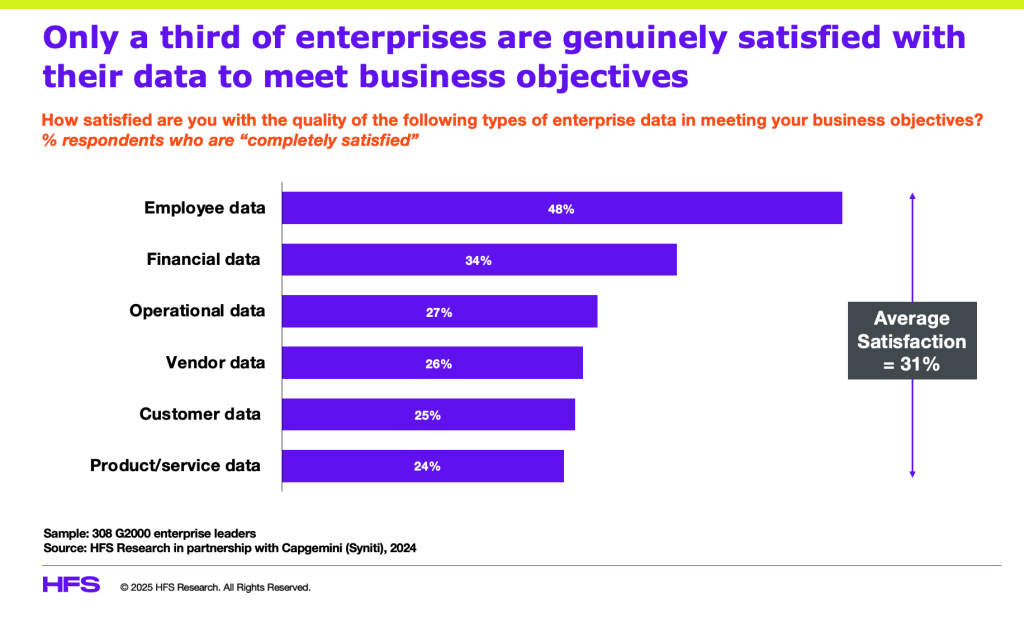
The truth? Enterprises that win are the ones who treat data as their strategy, not just some exhaust from the grind of their broken workflows and systems that no one trusts to base decisions on. A major study we conducted across global 2000 organizations reveals just how poor our data is right across the enterprise:
The HFS OneOffice model initially laid the groundwork in 2016 to define how businesses need to operate. We just didn’t realize back then it would take another decade via a pandemic, rampant inflation, several geopolitical conflicts, and daily economic uncertainty to create the burning platform where enterprises have to be autonomous, less border-sensitive and much more cost-conscious, with capable talent and partners to help them function in these emerging business ecosystems and across convoluted supply chains.
OneOffice inspired a new enterprise mindset in 2016
“HFS in 2016: The onset of digital and emerging automation solutions, coupled with the dire need to access meaningful data in real-time, is forcing the back and middle offices to support the customer experience needs of the front. Consequently, we’re evolving to an era where there is only “OneOffice” that matters anymore, creating the digital customer experience and an intelligent, single office to enable and support it
Today’s college graduates are simply not coming out of school willing to perform mundane routine work: operations staff proactively need to support the fast-shifting needs of the front office. So the focus needs to shift towards creating a work culture where individuals are encouraged to spend more time interpreting data, understanding the needs of the front end of the business, and ensuring the support functions keep pace with the front office.”
Fast-forward to today, and we finally have an injection of rocket fuel from Generative and Agentic AI to create intelligent agents that can sense, decide, and act with autonomy… as long as we have our data strategy right. To be a truly autonomous organization, the principles of OneOffice hold truer than ever: workflows executed in real-time between customers and employees that engage partners right across our business ecosystems.
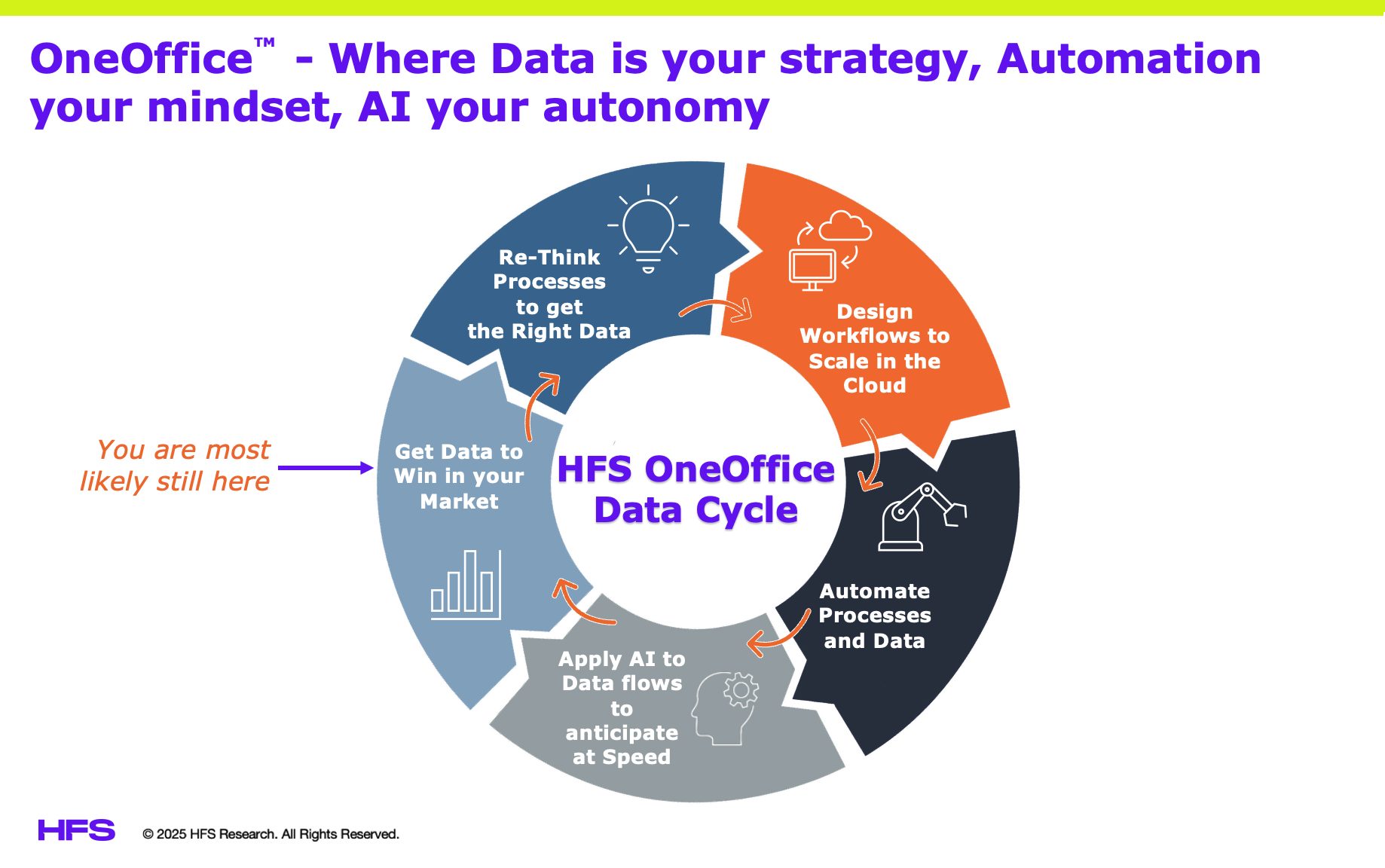
The OneOffice Data Cycle in 2025 places data at the core of enterprise effectiveness
OneOffice is HFS Research’s enterprise model that breaks down traditional silos between front, middle, and back offices to create a single, digital, customer-centric enterprise. It’s where automation, AI, and data converge to create real-time workflows between customers, employees, and partners—without handoffs or latency. A OneOffice model creates one intelligent enterprise that operates in real-time, adapts to change, and delivers seamless customer experiences. Data is the lifeblood of OneOffice: it fuels decision-making, powers AI models, and ensures every function is aligned with customer and business outcomes.
Let’s walk through this OneOffice Data Cycle, powered by the actual technologies and companies that are making it real.
We need to understand how the data cycle works to get us ahead of our markets. Here are five steps we must take with examples from enterprise clients, service providers and technology firms:
1. Get data to win in your market.
This is where you must align your data needs to deliver on business strategy. You can’t manage what you can’t measure. This is about aligning data capture with business priorities: customer behavior, operational bottlenecks, talent churn, and cash velocity.
Examples where AI is being effectively applied:
Unilever uses Microsoft Azure OpenAI to analyze internal and external datasets, including consumer sentiment, to adjust brand strategies in near real-time.
Anthropic’s Claude is being embedded by data-rich enterprises to run secure, real-time analysis agents that summarize, flag anomalies, and interact with humans when decision thresholds are crossed.
Stitch Fix leverages OpenAI GPT to extract signals from customer feedback and style preferences, improving product recommendations and inventory decisions.
Siemens uses Braincube’s agentic AI platform to monitor industrial IoT data, detect deviations in production, and adjust machine behavior—without waiting for human commands.
Infosys Topaz integrates GenAI with real-time analytics to help clients personalize digital banking experiences based on behavioral data.
LTIMindtree applies autonomous agents to enable real-time tracking and predictive inventory management for retail clients, eliminating stock-outs.
Publicis Sapient uses GenAI to analyze large-scale customer journey data, surfacing real-time behavior patterns to inform digital product strategy.
Movate integrates agentic AI into CX analytics platforms to proactively detect churn signals and initiate retention playbooks autonomously.
Firstsource integrates GenAI-powered document understanding to extract structured data from scanned medical records and billing forms—feeding analytics for healthcare payer and provider decision-making.
Net-net: If your data signals aren’t tied directly to how you win revenue, you’re running blind.
2. Re-think processes to get the right data
If your processes don’t capture useful data, they’re not processes—they’re liabilities. You must re-think what should be added, eliminated, or simplified across your workflows to source this critical data. Do your processes get you the data you need from your customers, employers, and partners?
Examples where AI is being effectively applied:
Chubb Insurance applies Amazon Bedrock to re-engineer underwriting and claims documentation workflows—turning dense PDFs and call transcripts into structured, searchable insights.
Capgemini has embedded Google Gemini into supply chain operations to automate root cause analysis and recommend corrective actions across vendor networks.
Publicis Sapient reimagines customer experience and marketing processes using custom-built GenAI copilots that generate real-time campaign responses based on audience behavior.
UnitedHealth Group is developing a concierge bot developed with both GenAI and agentic technologies to support medical patients dealing with the complexities (and huge inefficiencies) of the US healthcare system.
UiPath Autopilot now combines GenAI with autonomous agents to observe process execution and propose optimizations—cutting down rework loops by over 30% in pilot enterprise clients.
Wipro’s ai360 platform deploys agents to continuously optimize procurement and finance workflows by identifying anomalies and recommending improvements.
NVIDIA partners with major automotive and manufacturing firms to deploy AI agents on its DGX Cloud infrastructure—allowing real-time model training, simulation, and inference at the edge.
Cognizant’s Neuro agent-based modules continuously scan workflow telemetry to self-heal and recommend business rule updates.
Coforge is leveraging agent-based automation to dynamically adjust airline booking flows based on real-time seat availability and fare rule compliance.
Net-net: If the process doesn’t give you valuable data, kill it or fix it. Preferably both.
3. Design workflows to scale in the cloud.
Moving legacy sludge to the cloud without rethinking the model just means faster dysfunction. We’ve seen billions of dollars wasted on botched cloud migrations in recent years because underlying data infrastructures were not addressed effectively, and bad processes became even less effective or completely dysfunctional.
Examples where AI is being effectively applied:
Ford Motor Company deploys agentic AI agents built on OpenAI, Anthropic, and Nvidia GPUs to convert 2D sketches into 3D models and run rapid stress analyses—shortening simulation from 15 hours to 10 seconds
ServiceNow’s GenAI Workflow Studio lets ops teams redesign service flows using natural language—automating ticket routing, approvals, and data handoffs in cloud-native apps.
Workday AI uses GenAI to automate job description creation, compensation modeling, and hiring workflows—all in cloud-native HR suites.
Tech Mahindra uses Google Cloud’s Gemini to enable telecom clients to deploy conversational agents across cloud-native CRM and support systems.
FedEx is using DataRobot agents to orchestrate cloud services across route planning, weather modeling, and fleet management—autonomously shifting strategies on the fly.
Accenture SynOps embeds agentic capabilities to autonomously orchestrate and optimize cloud-based workflows in finance and customer operations.
Anthropic Claude is embedded in some cloud-first healthcare platforms to provide HIPAA-safe, autonomous intake triage for patient engagement.
Publicis Sapient enables retail clients to run full-funnel autonomous campaign workflows across cloud stacks, where agentic bots optimize audience targeting and message testing.
Uber built a near-real-time data infrastructure processing PBs of user and driver data—supporting instantaneous pricing, fraud detection, and dispatch decisions across its platform
Birlasoft has deployed cloud-native agent frameworks that autonomously monitor SAP-based operations for global manufacturers—streamlining issue detection and resolution across procurement and logistics.
Genpact leverages cloud-based GenAI models to power finance-as-a-service workflows, dynamically updating reporting logic and dashboard content based on real-time operational data.
Net-net: If the cloud is your warehouse, AI is your forklift driver. But you still need to design the blueprint.
4. Automate processes and data.
Automation is not your strategy. It is the necessary discipline to ensure your processes provide the data – at speed – to achieve your business outcomes. This is where we separate real automation from Franken-bots duct-taped to bad data.
Examples where AI is being effectively applied:
Morgan Stanley has deployed OpenAI-powered advisors internally via GPT-4, enabling wealth managers to get instant access to decades of investment research—automated, summarized, and contextualized in seconds.
SAP Joule helps automate business insights from ERP data across finance and supply chain, using GenAI to generate insights that would’ve taken analysts days.
Cognizant’s Neuro Agent Framework is being used by Fortune 500 firms to automate backend processes across billing, collections, and claims management—learning and adapting with each data cycle.
Sonata Software integrates GenAI into its Harmoni.AI platform to automate customer service and backend documentation in manufacturing.
TCS Digitate’s Ingio platform uses agentic AI to resolve IT incidents automatically by sensing anomalies, identifying root causes, and executing fixes autonomously.
Capgemini’s Perform AI framework deploys agents to dynamically rebalance workloads and scale automation across insurance and telecom.
Microsoft uses AI builders in Power Automate at Eletrobras Furnas to detect electric grid anomalies and trigger alerts—minimizing regulatory risk.
WNS deploys an agentic-based solution called Travel Buddy to supports it clients’ needs for corporate travel bookings without the need for constant human oversight.
Net-net: Automation that doesn’t learn is just glorified scripting. Intelligent automation enables intelligent outcomes.
5. Apply AI to data flows to anticipate at speed.
This is where the magic happens—predictive, adaptive AI running on clean, automated, cloud-native data. Welcome to the self-optimizing enterprise. AI is how we engage with our data to refine ourselves as digital organizations, where we only want a single office to operate with agility to do things faster, cheaper, and more streamlined than we ever thought possible. AI helps us predict and anticipate how to beat our competitors and delight our customers, reaching both outside and inside of our organizations to pull the data we need to make critical decisions at speed. In short, automation and AI go hand in hand… AI is what enables a well-automated set of processes to function autonomously with little need for constant human oversight and intervention.
Examples where AI is being effectively applied:
Pfizer uses IBM Watsonx to accelerate clinical trial discovery by analyzing academic papers, medical literature, and trial results, surfacing new therapeutic targets in record time.
JPMorgan Chase is applying GenAI to risk models—feeding real-time data from markets, news, and internal portfolios to simulate potential exposures and make split-second adjustments.
Accenture leverages agentic AI for proactive customer churn prevention—automatically adjusting engagement models based on behavioral and transaction patterns.
Telefonica has deployed Aisera’s agentic AI to manage internal IT and employee service requests—handling over 80% of Tier 1 tickets autonomously.
Shell uses agent-based digital twins to simulate field operations and adapt to variables like pricing, weather, and inventory—helping them model and tweak operations in real time.
Inflection AI’s Pi assistant is being explored for continuous learning across enterprise L&D platforms to nudge workforce behavior in real-time.
Genpact applies AI-powered forecasting to proactively adjust finance and accounting workflows for large clients, predicting anomalies in receivables and dynamically adjusting credit risk scores across markets.
Anthropic Claude is embedded in financial services platforms to act as a proactive co-pilot for risk monitoring, triggering alerts and recommendations autonomously.
Coforge is piloting predictive agent-based maintenance for airport ground services using IoT sensor data and historical patterns.
Bridgewater Associates launched a multi-agent system (“AIA Labs”) that breaks investment queries into sequential agent tasks—an early-stage agentic AI demonstration
Net-net: AI isn’t the cherry on top—it’s the engine room. And it only runs on connected, clean, automated data.
Bottom-line: GenAI is the Brain, Agentic AI is the Muscle. As long as you have good data.
Let’s be clear: GenAI generates. Agentic AI executes. Together, they transform OneOffice from a strategy into an operating model. However, if your processes can’t capture good data, you’ll automate the wrong things. If your cloud isn’t built for agility, you’ll scale chaos. And if your talent isn’t empowered with intelligent tools, they’ll become blockers, not drivers. Your employees are now your most important customers. Treat them like it—or watch your best data (and people) walk out the door…
Aren’t you just sick and tired of people waxing on about AI job destruction but clearly assume they are just going to be fine because they are just so damn important and irreplaceable? Oh, wait, you’re not also guilty of this, too, are you?
The harsh reality is that we all have a price on our heads to be replaced. As long as we are employed by someone else, we’re running the risk of pricing ourselves out of our jobs, because we’re just not worth the cost to our employers anymore.
We’ve always been walking costs to our employers. AI has just exposed us more than ever
Let’s cut through the noise and face our brutal truth head-on: we’re all vulnerable to AI, not just “them,” but you, me, everyone drawing a paycheck. It’s time we stopped comfortably pontificating about AI’s impact on other industries and professions, while conveniently ignoring our own glaring susceptibility. The harsh reality? Fail to evolve our work habits and embrace AI, and we’re setting ourselves up for irrelevance—fast-tracked straight onto the scrapheap of once-talented dinosaurs.
Here’s a simple litmus test: we can spot an executive bluffing about their AI knowledge in under two minutes. The buzzwords flow freely, but practical application? Hmmm… And guess what? Most people in your organization are quickly becoming adept at identifying the AI fakers. Authentic understanding—real competence—is becoming the gold standard that separates valuable assets from costly liabilities.
Leaders have avoided getting their hands dirty for decades, until now
For decades, people have survived on weaving their wonderful bullsh*t without getting their hands dirty. I remember once interviewing the RPA practice leaders across all the leading services firms and asking them to share their insights into the product functionality of the leading software tools. All of them failed to demonstrate any actual understanding of what these automation products actually did, beyond the usual rhetoric about “automating the enterprise”, infusing terms like “hyper” and “intelligent”. And they undoubtedly were dealing with clients who possessed equally scant knowledge of what these products did. In both cases, the leaders were dumping the real work down into the trenches of their organizations, where it inevitably faded into a series of insignificant pilot projects.
Let’s tackle the elephant in the room: the delicate balance between your cost, your value, and your replaceability
Here’s the cold, hard truth about employment today—we’re judged by one ruthless metric: how much we cost versus how much value we deliver. With AI reshaping expectations, the tipping point where our value fails to justify our price tag is frighteningly closer than most of us will admit.
The future of labor isn’t complicated—it’s about raw economics. For example, if you’re earning $200K+ annually, you’d better deliver exponentially greater value than someone at $75K with better AI chops. AI isn’t just another workplace tool—it’s an economic reset button that’s forcing every one of us to justify our salaries like never before. Young professionals, take note: this is your golden opportunity. If you can deliver equivalent or greater value at a fraction of the cost through adept AI integration, the future is yours to claim.
The Bottom-line: Don’t be part of the corporate hedgerow
Costs are like hedgerows – if you don’t keep trimming them, they keep growing back. But this time, many of these legacy hedgerows aren’t ever going to be replaced as enterprise leadership seems to eradicate legacy costs once and for all with their AI investments.
In this unforgiving AI economy, your salary isn’t just compensation—it’s a number continuously scrutinized, weighed, and measured against the value you’re delivering. But this really shouldn’t be about fear; it must be about clarity and being self-aware of our value. Justifying our price point has never been harder, but making ourselves irreplaceable AI warriors has never been more rewarding.
The insurance industry has spent the last decade digitizing its core in the form of claims, policy servicing, and back-office operations. But in 2025, modernizing won’t cut it. The real challenge is shifting from functional transformation to enterprise orchestration and ecosystem-led growth.
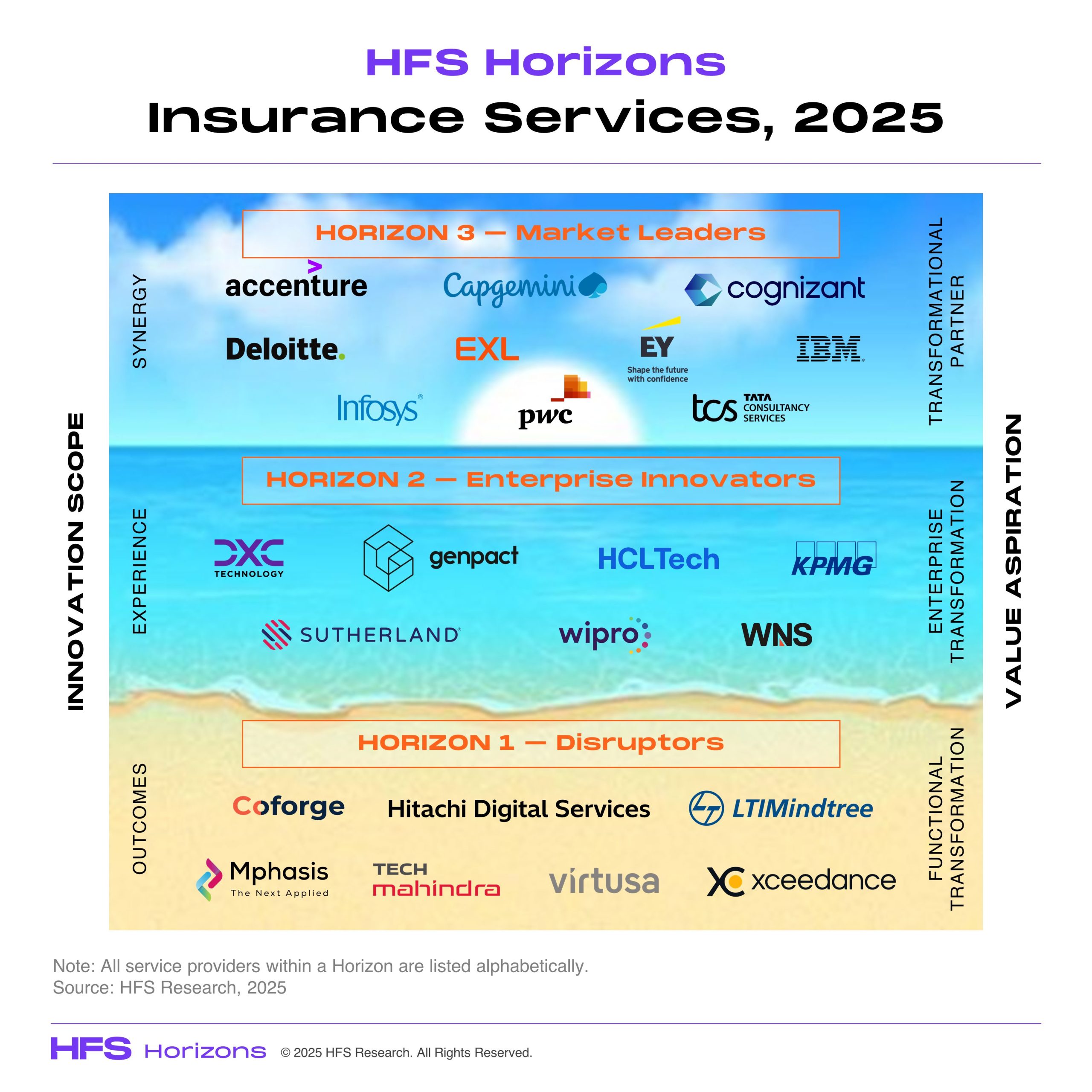
Our HFS Horizons: Insurance Services 2025 study evaluates 24 leading service providers across the insurance value chain. The verdict is that winners aren’t just automating; they’re unlocking new forms of value through GenAI, smarter underwriting, personalized CX, and ecosystem co-creation.
Exhibit 1: The Insurance Horizons framework captures the transformative shift from operational efficiency to ecosystem-driven, experience-led enterprises
Key study findings:
Functional transformation is the foundation and not the future: Many service providers have been successful in reducing expense ratios, streamlining workflows, and bringing regulatory clarity to complex insurance operations. Providers in Horizon 1 are driving measurable outcomes in speed, cost, and compliance, especially across claims, policy servicing, and legacy modernization.
But while functional execution earns providers a seat at the table, it doesn’t guarantee long-term relevance. Insurers are now expecting more flexible APIs, GenAI-powered insights, predictive risk engines, and cloud-native ecosystems that don’t just fix problems but prevent them from occurring.
Ecosystem orchestration is moving from slideware to real revenue: The most forward-looking providers (recognized as Horizon 3 Market Leaders) are co-creating with insurers, InsurTechs, data providers, and cloud platforms to reimagine entire insurance journeys. These firms are embedding intelligent agents in underwriting, activating ESG-linked product design, and orchestrating API-first platforms that connect distribution, policy, and claims into a single flow.
What separates these players isn’t just innovation but their ability to operationalize it at scale. They’re building modular offerings with clear business cases and aligning their delivery to customer, broker, and employee experience KPIs.
Underwriting is emerging as the next transformation battleground: Underwriting is the new frontier. Buyers want AI-driven triage, real-time risk scoring, and faster quote-to-bind cycles. Yet many providers still treat underwriting as off-limits. Leaders such as EY and EXL are deploying modular, data-rich solutions. Insurers should prioritize partners that bring speed, intelligence, and transparency to the front-end, not just clean up the back office.
The GenAI gap between hype and impact: Most GenAI pilots in insurance (chatbots, claims summaries, FNOL) haven’t scaled yet as they are bolted on and not embedded. Domain-specific tuning, deep API integration, and governance maturity are still lacking. Until GenAI is wired into core delivery without being stitched around it, enterprise leaders will see potential, not value.
Experience integration is the next mandate: Enterprises seek connected experiences, not point improvements. Whether it’s agents, policyholders, or employees, users are tired of jumping across portals, systems, and processes. Service providers that can’t deliver seamless journeys across underwriting, claims, and service will lose out to those that can.
The Bottom Line: Enterprises today have no shortage of service providers, but their true transformation lies in enabling a future-ready business model. Service providers that can’t make that shift will be replaced by those that can.
Insurance providers have modernized, but now they need to orchestrate. Leaders in this space aren’t just fixing workflows; they’re building modular, intelligent, and experience-aligned ecosystems that insurers can monetize. The ask has shifted from automation to alignment, tech showcases to scalable orchestration, and functional delivery to growth-anchored impact.
GenAI won’t matter unless it’s embedded. Underwriting won’t scale unless it’s intelligent. And journeys won’t stick unless they’re connected. To stay relevant in Horizon 3, insurers must move beyond just transforming operations by reinventing their business models.
My analyst colleague Saurabh Gupta has shared our viewpoint about what’s going on with Accenture in 2025 and it’s big re-org around Reinvention Services under the leadership of Manish Sharma.
Saurabh lays down the challenges ahead for our 800,000 services King Kong, namely several recent leadership changes, its sheer size, its huge plethora of acquisitions, its client culture, and the simple fact that AI is levelling the playing field. He also calls out the company’s huge breadth of capabilities to reinvent its clients with the subtle nuance that it now needs to prevail with its largest reinvention challenge: itself.
I am personally excited for my good friend Manish Sharma taking on the challenge of bringing together Accenture’s crown jewels of Strategy, Consulting, Song, Technology, and Operations to spearhead its Reinvention Services capability. Manish has been one of the bastions of global services ever since I can remember (which is a long time), and I can’t think of too many people who generally “get” the need to simply offer services to enterprises and bring together business needs scaled by technology. And in today’s era of AI fluff, the need to bring together front and back offices to exploit the blurring of lines between software and services, between people and machines, has never been more prominent.
Accenture’s been a step ahead reinventing the services market for many years
This is a significant rejigging of the services world from the global leader, which has clearly reached its own reinvention moment. The firm invented the term digital with its practice launch in 2013 and proceeded to acquire ~50 media/ad firms to become the global powerhouse in martech and digital advertising. The following year, it brought its BPO and managed IT services together under the Accenture Operations banner to transform “multi-tower” outsourcing. It then went full throttle Cloud First as we hit the pandemic, as the enterprise world desperately groped around to become genuinely virtual, organized, and scaled in the cloud. And as GenAI hit the big streets in late 2022, Accenture made sure it was at the forefront of building a billion-dollar pipeline. Then, when GCCs started competing directly with service providers for the offshore outsourcing work, Accenture smartly acquired a major stake in the GCC consulting leader ANSR to ensure it could balance its consulting and outsourcing portfolios to stay ahead of the disruption to global services. At the heart of this acquisition was Manish Sharma, the king of services reinvention himself, who sits on the ANSR board.
But can it keep reinventing with reinvented services in this volatile climate?
One of the secrets of growing, growing, and growing is having well-designed business units that can compete aggressively in the market, feeding off a common brand and pool of resources. However, with the unbelievable speed of development of agentic AI, generative AI, and machine learning, we have reached a greater need than ever to fix the same quagmire of issues plaguing enterprises for decades: processes, people, data, and tech.
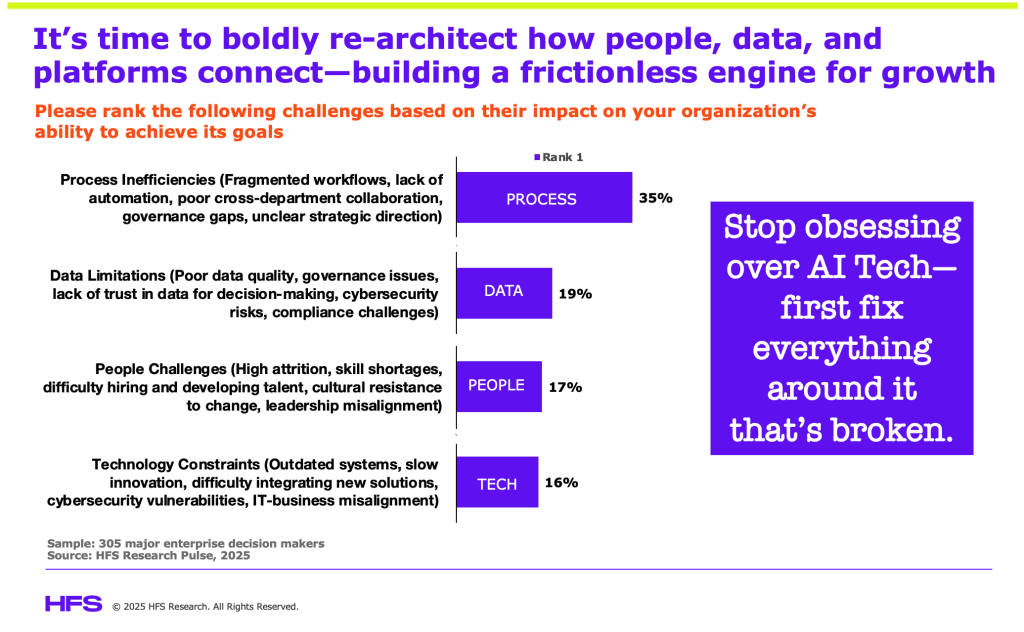
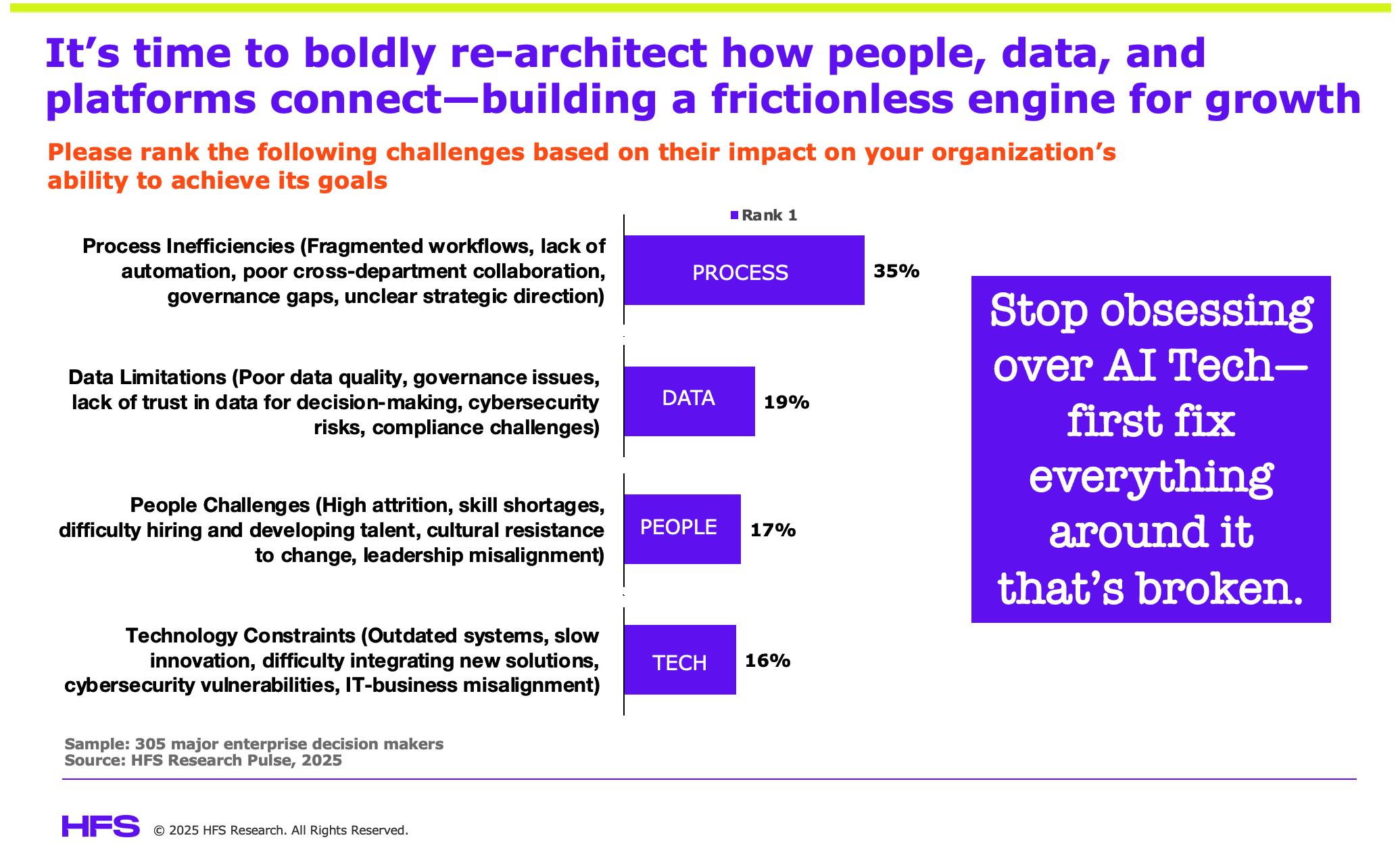
However, what people don’t often realize is that the tech isn’t really the problem with AI. It’s fixing all the process mess, bad data, and skills deficiencies that are holding back enterprises. As our Pulse data across the Global 2000 dramatically illustrates, processes are the biggest, hairiest mess, and we need open-heart surgery to even consider sampling the forbidden fruits of AI:
Coupled with our legacy debts, we also need to get ahead of all the instability posed by geopolitics, economics, and cybersecurity, as these dominate the minds of troubled ambitious enterprise leaders looking to invest in the core infrastructure of the businesses to insulate themselves from macro-instability and exposure to debilitating cyberattacks:
Net-net, the need for businesses to reinvent themselves to define such an array of problems and somehow fashion a way forward in this world has never been so poignant.
Bottom Line: Accenture has always stayed ahead of the game, but this time presents their biggest challenge
As we’ve discussed, Accenture has done a brilliant job over the last two decades reinventing itself and forcing the rest of the industry to follow its lead. However, they were able to do this with several business lines working fairly independently of each other. Their corporate branding, their deep relationships across the C-Suite (and not just IT) have enabled the firm to grow with a lot of smart acquisitions, incredible marketing, and an aggressive culture of “high performance” that was very distinct to the Accenture brand and culture.
However, today’s services playbook is changing radically and all the leading providers have no choice but to practice what they preach and take themselves through painful bottom-up change, where they need to focus on repaying their legacy debts of the last two decades to reinvent their own cultures, break down their silos and create distinct value for their clients. Being a true services-as-software provider necessitates a completely integrated company operating under one mission, one culture, one brand and one united leadership team energized by working together. But if anyone can pull this off, Manish can…
The traditional lines between CPG brands and retailers are blurring, with brands engaging consumers directly and retailers elevating private-label products to international rivals. The global supply chain instability is pushing them toward diversification for greater resilience. These firms are battling multiple fronts—margin pressure, shifting consumer preferences, operational complexity, and a relentless technology drumbeat. While the noise around GenAI, automation, and omnichannel disruption is deafening, executives are shooting sharper questions: What investments actually matter? Where should we double down now? What’s worth betting on for the future?
The lion’s share of tech budgets remains anchored in traditional strongholds: cloud computing (26%) and analytics (21%), which collectively command nearly half of all enterprise tech spending. But the real surprise lies in the swelling appetite for new-age AI: GenAI (10%) and agentic AI (7%), which now outpace traditional AI (6%) and underscore a dramatic pivot in enterprise AI adoption narratives. RPA and intelligent automation are still much alive (9%). Meanwhile, emerging tools such as blockchain and digital twins hover at the margins, but their moment may be approaching.
90% of IT and business services outsourcing spend maps to the eight domains of the HFS retail and CPG value chain. Over 56% is concentrated in just four areas: Data-driven product innovation, omnichannel CX, resilient operations, and immersive marketing and customer engagement.
Investments that clearly demonstrated business value and are now ready to scale include:
Personalization, driven by AI recommendation engines and GenAI content creation, is delivering a double-digit revenue uplift per user. Retailers using tools such as Salesforce Einstein or Adobe Target are driving higher conversion rates and increased loyalty.
Omni-fulfillment strategies—including BOPIS (buy online, pick up in store), curbside pickup, and ship-from-store—are now foundational, supported by cloud-based inventory management and AI-driven demand forecasting. Enterprises mastering this coordination enjoy 30% higher customer lifetime value.
Micro-fulfillment centers are helping to meet the growing demand for same-day delivery in urban markets, while bonded warehouses are improving global cash flow and customs agility.
Data-fueled product innovations, such as private-label SKUs based on trending ingredients or unmet category demands, is cutting time-to-market and improving launch success rates.
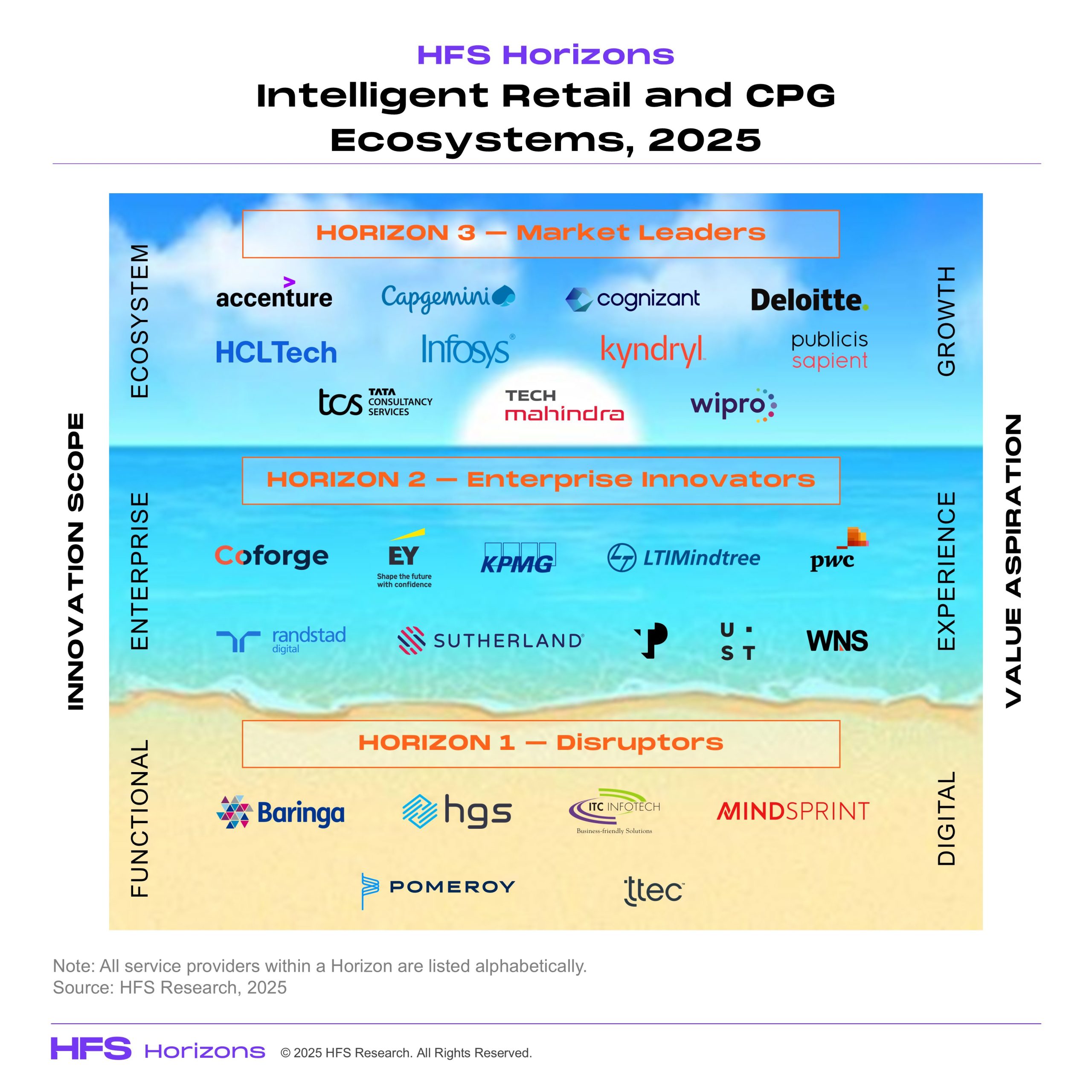
The report evaluates 27 retail and CPG service providers. Of these, 11 are classified as Horizon 3 Leaders, 10 as Horizon 2 Innovators, and 6 as Horizon 1 Disruptors. The evaluation included inputs from 44 enterprise reference clients and 36 reference technology vendors.
Horizon 1 represents Disruptors laying the foundation for digital efficiency by leveraging technology to drive cost reduction, speed, and operational efficiency in specific functions across the value chain.
Horizon 2 represents Innovators delivering end-to-end experience transformation i.e., Horizon 1 + elevating the entire value chain by creating integrated, customer-centric experiences through data unification and seamless interaction across touchpoints.
Horizon 3 represents Leaders showcasing ecosystem synergy and new value creation i.e., Horizon 2 + building ecosystems that unlock new business models, foster co-innovation, and create entirely new revenue streams, with an emphasis on sustainability and collaboration.
The Bottom Line: Retail and CPG leaders should prioritize investments in data-driven product innovation and omnichannel CX with cloud as the enabler, analytics as the propeller, and AI as the value generator.
Service providers that are rising beyond traditional services and capturing value through futuristic value-capturing models such as services-as-software are best suited to cater to the business expansion demand of the retail and CPG ecosystem.
Today’s analysts and advisors love talking about how the speed of AI advancements is turning every industry on its head, but most conveniently ignore the fact that their own industry is getting rewired faster than they can say “disrupted.”
The analyst and advisor industries, reliant on IP and research to market their products, are in serious trouble, and many firms will cease to exist in a couple of years. I mean, whatever happened to the likes of Omdia or 451? They already seem to have melted away into insignificance under some analyst firm roll-up scheme, smashing together mediocre events, marketing, and “research”.
I’ve been fortunate to be part of the analyst and advisory industry for three decades. I can only say it’s been a privilege to be paid to learn, to engage with so many smart people, and to build many, many relationships over the years based on trust, mutual respect, and friendship.
However, there have been warning signs for a long while that the comfortable status quo is already getting very rocky (as already witnessed by Forrester’s dramatic decline). And what’s really worrying is the recent speed of development with AI platforms, agentic software, and LLMs, which is, quite frankly, making the use of analysts and advisors increasingly irrelevant.
The issues are staring us in the face:
Generative AI platforms are fast replacing the need for analyst support. Routine research tasks, such as reports summarizing trends, market sizing, vendor comparisons, or basic scenario analysis, are increasingly being automated by generative AI.
Analysts are just too slow to deliver insight. The sheer speed of GenAI is challenging analysts to justify their premium pricing and timelines. Why pay for information that sometimes takes weeks to access, or even set up a call with an analyst? We are operating in a world of immediate decision-making, and many analysts are simply not adapting.
Cost Pressures will focus many firms to prioritize their GenAI platforms: GenAI significantly lowers barriers to basic insight, and many clients are already pushing analyst firms harder to justify their obscene subscription costs. In addition, the cost of enterprise tokens for GenAI platforms is pushing many CFOs to look at offsetting against legacy research costs. If you’re spending $500K+ a year on your enterprise OpenAI access, you’ll want to offset this against existing information costs, which will likely include analyst subscriptions.
Analysts are losing authenticity. So much analyst output today has become so jargonized that many research consumers are simply switching off. Who wants to hear the constant regurgitation of meaningless words like “orchestration” and “transformation”. Analysts using GenAI to craft their narrative immediately lose touch with a human audience who wants to hear something real, not more recycled nonsense.
Many analyst/advisor relations professionals are killing the analyst industry. Most tech and services firms persist in relying on prehistoric analyst relations professionals who have forgotten what “value” analysts provide to their firms. They live in a world of checking boxes for administering their executives’ briefings and justifying their large salaries by claiming they somehow drive influence and new business for their employers. I personally can’t remember the last time analyst/advisor relations professionals proactively called up analysts to understand their research agendas and craft an engagement model to get the most out of the relationship. These roles will likely get phased out in the next couple of years as the whole concept of analyst value deviates away from these transactional relationships that are becoming worthless in this age of LLMs.
In short, the whole concept of the value an analyst provides is changing very fast…
How the analyst industry can save itself
Stop cheating with ChatGPT. Now. As MIT scientists have discovered, do not use ChatGPT for your writing if you want to avoid accumulating Cognitive Debt. So if you are genuinely using ChatGPT to write your research for you, stop now. One, it will rot your brain, and many smart people can tell they are not reading the work of a human. Too many bullet points, obvious capitalization of titles, overuse of em dashes, articles that start with “in today’s challenging world…In today’s fast-paced environment” or some variation of it, overuse of short lists with bold titles. I’ve also started seeing ChatGPT-generated charts and diagrams, which don’t really make sense. Plus, some of these analyst articles sound like some corny American journalists in some blah magazine.
Dig deeper – don’t just skim the surface. Too much analysis feels like it’s been written after a quick skim of a press release and a glance at LinkedIn – too much seems generated. If you want to say anything of interest, you must get beyond the obvious. Ask the difficult questions. What’s really going on behind the trends? What are the implications people aren’t talking about? The best analysts cut through the fluff and reveal the real story – not just what happened, but why it matters and what to do about it. Bring insight, not just information. That’s how you earn trust and deliver value.
Be authentic. The one thing good analysts bring to the table is a human voice that should rise above the AI-manufactured cacophony of bullshit. They need to talk plain English to their subscribers. People are turned off by AI-generated content and the same old buzzword bingo, so rise above it, folks! Pretend you are explaining agentic AI to your Mom or the immigration officer who asks what you do for a living…
Lose the attitude. I hate to say it, but people don’t like assholes anymore. They want to like the voice they are hearing, to identify with the analyst, to learn from them, to empathize with them. They don’t want to be lectured and preached to constantly. If they identify with the analyst, they may actually pay to engage with them and get support and ideas from them. Why would you pay for a human being you don’t care about when you get your information from ChatGPT?
Just get to the bloody point. No one has time to read paragraphs of preamble these days. They need to know immediately what you are writing. The days of the waffling intellectual analyst are over. You have a tiny piece of attention-time to make your mark these days, and you need to scream to your audience why you are declaring something profound for their insight pleasure.
Invest in personal relationships – and not just with vendors. The most effective analysts today are those who have invested in their networks and relationships across their ecosystem. I can attest to the fact that you can gain from a lifetime’s knowledge from a person in an hour. Great analysts get to know the people buying technology and services, not just the ones who are marketing themselves to the buyer. You will be such a better analyst for being able to convey real buyer experiences than one who is merely parroting vendor marketing jargon. Great analysts tend to be great people with great personalities and relationships.
Use AI as an ally, not a competitor. The old saying that you won’t lose your job to AI, but to someone who can use AI better than you is VERY true with analysts. Use AI as a research assistant and sounding board, but NOT as your brain.
The Bottom-line: Be honest with yourself if you really want to stay relevant
Analysts need to accomplish three things if they want to avoid being replaced by agents and LLMs:
Influence people. You need to convince people that your experience and views matter, and that they actually follow you.
Advise people. You need to convince people that your research and wisdom matter, and they actually listen to you.
Connect people. You need to prove to people you have a great network of stakeholders across your value ecosystem, so they actually want to know you and spend time with you.
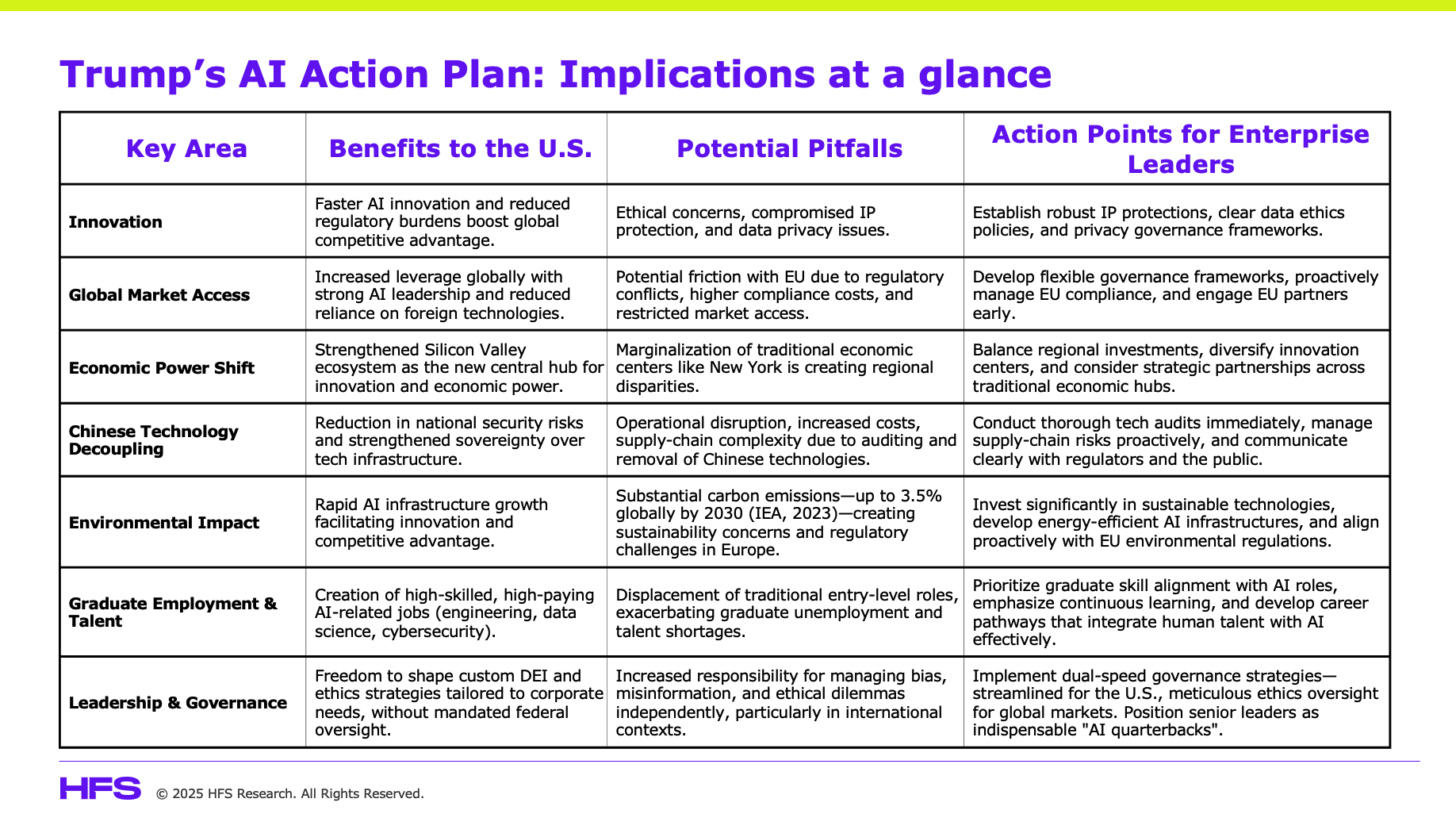
Love him or loathe him, let’s be clear… President Trump’s new AI Action Plan isn’t just political theatre, it’s a strategic sledgehammer aimed at reshaping the global AI landscape in America’s favor. This is your wake-up call, whether you’re leading a tech firm or steering an enterprise. Align with the American AI stack, or prepare for a long ride in the slow tech lane.
Accelerating innovation and removing regulatory shackles
America is taking its foot off the regulatory brakes, although this could amplify ethical risks, reduce content protection, and potentially compromise data privacy as it seeks to become the undisputed AI leader. Trump’s vision is simple: remove barriers, build massive infrastructure, and force global alignment with US-controlled AI tech stacks and data centers. Forget subtlety, this is an aggressive, competitive manoeuvre driven by Trump’s showman antics!
Silicon Valley becoming America’s power center
With copyright protections sidelined and regulations slashed, the Valley is primed to dominate this AI-fuelled gold rush. However, this raises critical concerns, namely uncontrolled content exploitation by AI bots that could severely damage intellectual property rights, trigger extensive copyright litigation, and create significant ethical dilemmas related to data privacy and fairness. Additionally, this push reinforces a significant power shift toward Silicon Valley and away from traditional economic hubs like New York, further consolidating influence around tech giants at the expense of traditional finance and media sectors.
America’s free-for-all approach is in stark contrast to Europe’s regulatory quagmire
Europe’s AI Act emphasizes caution, human oversight, and sustainability, which could prove to be deadly slow in the AI arms race. Trump’s strategy couldn’t be more opposite by promoting innovation, accelerating infrastructure, and accepting (or just ignoring) inherent risks. For ambitious enterprises seeking to drive AI-first business and talent strategies, the choice is stark… bet on the fast-moving, albeit riskier, American stack or struggle through Europe’s costly and stodgy compliance maze.
This AI Action Plan could also create challenges for American firms dealing with European firms, in terms of meeting their compliance requirements, potentially increasing operational complexity and legal risks. Also, with Europe tightening controls and potentially imposing import taxes on tech services from countries not complying with its regulations, American enterprises might face higher costs, restricted market access, or increased scrutiny when serving European customers.
To mitigate these issues, American enterprises should proactively develop flexible, robust governance frameworks capable of adapting to both markets, clearly communicate compliance and ethical strategies, and engage directly with European partners to address potential concerns early.
Audit your tech stack immediately for Chinese influence
With Trump’s renewed emphasis on national security, enterprises must urgently audit their tech stacks. Firmware, data sources, and LLMs originating from China, such as DeepSeek, ERNIE Bot, Manus Tongyi Qianwen, 360 Zhinao, SenseFace, and Tencent, will be considered toxic. Be ready to answer regulators’ tough questions or face uncomfortable public scrutiny. Keep in mind, however, that auditing and removing Chinese technology can present significant operational challenges, including service disruptions, increased costs, and potential supply-chain complexities.
Take charge of your DEI and ethics strategy independently
The Trump administration is explicitly stripping DEI and ethics mandates from federal frameworks. This gives enterprises both freedom and responsibility, where US firms must now manage their own bias and misinformation risks, especially when operating internationally. Prepare for a dual-speed governance approach that tackles streamlined security for the US market with meticulous ethics and compliance for Europe.
Address the environmental cost of rapid AI expansion
The global environmental impact of AI infrastructure growth is immense. AI data centers alone could account for up to 3.5% of global carbon emissions by 2030 (source: International Energy Agency, 2023), which is even more than the emissions from the global aviation industry today. Enterprises racing to expand their AI capabilities must grapple with sustainability concerns as energy consumption and environmental footprints skyrocket.
American firms relying heavily on carbon-intensive AI infrastructure could struggle to comply with EU sustainability requirements. This scenario could raise operational costs significantly, making American solutions less competitive or less attractive to European partners who prioritize sustainability compliance.
Lean into both your developing human talent and AI ambitions to create a unique company culture and identity
The AI Action Plan presents significant implications for graduate employment and entry-level jobs in particular. On the positive side, increased investment and rapid innovation in AI technology will likely create new categories of high-skilled, high-paying jobs, particularly in AI engineering, data science, and cybersecurity. Graduates who acquire specialized AI-related skills will have considerable advantages in the job market.
However, there’s also a downside. Automation and AI could displace entry-level positions traditionally filled by recent graduates, potentially exacerbating graduate unemployment rates and creating a gap in career pathways. Enterprise leaders should proactively invest in young talent by aligning graduate recruitment with evolving skill requirements, emphasizing continuous learning, and developing pathways that enable graduates to work creatively and effectively with AI tools. Lean into both by creating roles that complement AI—focusing human effort on critical thinking, creativity, ethics oversight, process and systems governance, and innovation management.
The US has several robust training initiatives underway to support AI workforce development. These include NSF-funded National AI Research Institutes focused on sector-specific skills, the Department of Labor’s AI Apprenticeship Program emphasizing practical AI training, the Department of Commerce’s AI Centers of Excellence facilitating industry partnerships, and Workforce Innovation Grants aimed at boosting AI education in community colleges and regional institutions.
Become an AI quarterback and an indispensable leader
Business leaders must proactively position themselves as indispensable AI quarterbacks within their organizations. This involves developing a deep understanding of AI capabilities, limitations, and strategic implications for your business. Act as a bridge between technical AI teams and broader organizational strategy, effectively translating complex technical details into clear business insights.
Leaders should prioritize AI literacy, invest in executive education, and champion AI-driven initiatives across all departments. Foster a culture of curiosity and agility, encouraging your teams to experiment and iterate quickly. Your ability to lead AI transformations, manage risks, create smart governance frameworks, and leverage technology strategically will make you essential to your organization’s future success.
Bottom line: Invest hard, move fast, and exploit this AI freedom
Trump’s AI Action Plan signals permission to innovate aggressively. Push the limits, break the mold, and stop waiting for global consensus. This is your moment to place your big bets on AI with Uncle Sam’s backing, which means speed and boldness trump caution and inertia. Hesitate now, and you risk irrelevance.
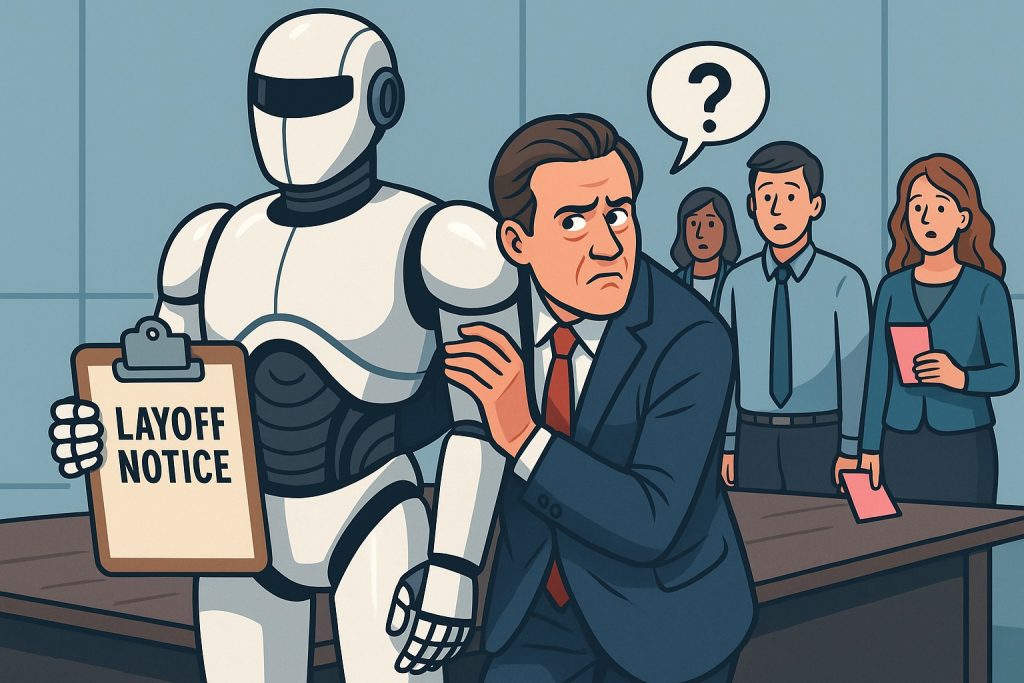
Layoffs are accelerating again, but this time AI is becoming the cover story, offering a convenient narrative to justify long-delayed changes under the guise of technological progress.
Microsoft, Amazon, Citigroup, UPS, Google, McKinsey, Deloitte, PwC, and many others have all recently laid off staff under the AI smokescreen. The headlines say it is about automation and AI readiness, but that is not the whole story… not even close.
What we are seeing is not just automation-led efficiency, it is a structural shakeout triggered by board pressures to cut costs, eliminate underperforming middle layers, and move away from legacy talent strategies. The corporate world has also experienced high-wage fatigue, where many staff have had significant wage growth, especially since the inflationary pandemic years, and it’s simply very expensive to maintain staff on these high salaries and other benefits.
Many of these firms have been waiting for an excuse for years to trim their fat, and now they have it. We will, however, give some credit to TCS’s CEO Krithi, who positioned their recent “restructuring initiative as being aimed at transforming the company into a future-ready organization.” At least there is some admission here that many staff at mid-senior levels were no longer delivering value in a challenging market environment, and it was time to trim the fat. Not one mention of AI…
You can run from your past, but it will catch up with you if you can’t change your habits
Companies are making moves they have postponed for years. Cuts labeled as future-proofing are often strategic resets that should have happened long before AI showed up. Yes, some AI deployments are proving valuable. But not at the scale required to displace tens of thousands of roles overnight.
In fact, we were having exactly the same conversations when RPA was hyping markets a decade ago, but the technologies couldn’t scale up and deliver like what we are witnessing with GenAI and agentic. It is easier to blame emerging tech than to admit to dysfunctional processes, poor-quality data, bloated hierarchies, poor skills development, or misaligned workforce structures.
Recent research (below) clearly shows that the issues plaguing major enterprises in achieving their goals are not technology constraints but all the non-technical areas that are blocking the ability to exploit AI:
Leaders need to stop pretending all of this is an AI transformation. This is not an overdue cleanup… it is a premature dismantling of work structures without the foundations for what comes next. What is clear is that you will fail with AI if you do not focus on your processes, data, and people first.
Cutting early-career talent creates long-term fragility and trashes your culture
Some of the clearest signals are coming from the firms that once defined the pyramid talent model: the big four. Deloitte, EY, PwC, and KPMG have sharply reduced graduate recruitment, with cuts as high as 44 percent compared to last year. At the same time, mid-level roles are being protected, senior compensation is climbing, and administrative tasks are being offshored to lower-cost hubs.
The rationale? AI can automate a lot of entry-level work. But AI is not ready to own this work at scale, and many of these roles were not just about task execution, they were about long-term capability building. Cutting them removes a foundational layer of growth, learning, and leadership development. It weakens succession pipelines, institutional knowledge transfer, and creates brittle organizations with no buffer to absorb future shifts.
This pattern is not limited to the big four. The US government is accelerating generative AI pilots while significantly cutting civil service positions. Media organizations like Business Insider are adopting AI-first strategies while laying off large portions of their newsrooms. B2B companies are reducing headcount in marketing and sales functions in anticipation of productivity gains that have yet to fully materialize.
Yet few of these decisions are supported by robust evidence of AI delivering sustainable value at scale. Instead, many are driven by cost-cutting mandates, simplification goals, and boardroom pressure. AI is being positioned as a convenient explanation for broader organizational shakeouts.
Crucially, early-career roles are not collateral damage, they are a deliberate target. Firms are pulling back on graduate and entry-level hiring, assuming that AI will render those jobs unnecessary. But AI can only automate fragments of work, not own entire workflows. These junior positions were never just task execution lanes—they were foundational to future leadership development, capability building, and institutional continuity. Eliminating them puts long-term organizational stability at risk. We are not just trimming headcount, we are erasing the scaffolding of future expertise.
Smart enterprise leaders are leaning into both young talent and emerging AI opportunities together
Enterprise leaders should proactively invest in young talent by aligning graduate recruitment with evolving skill requirements, emphasizing continuous learning, and developing pathways that enable graduates to work creatively and effectively with AI tools. Lean into both by creating roles that complement AI—focusing human effort on critical thinking, creativity, ethics oversight, process and systems governance, and innovation management.
The US, for example, has several robust training initiatives underway to support AI workforce development. These include NSF-funded National AI Research Institutes focused on sector-specific skills, the Department of Labor’s AI Apprenticeship Program emphasizing practical AI training, the Department of Commerce’s AI Centers of Excellence facilitating industry partnerships, and Workforce Innovation Grants aimed at boosting AI education in community colleges and regional institutions.
The work has not been redesigned, only reduced
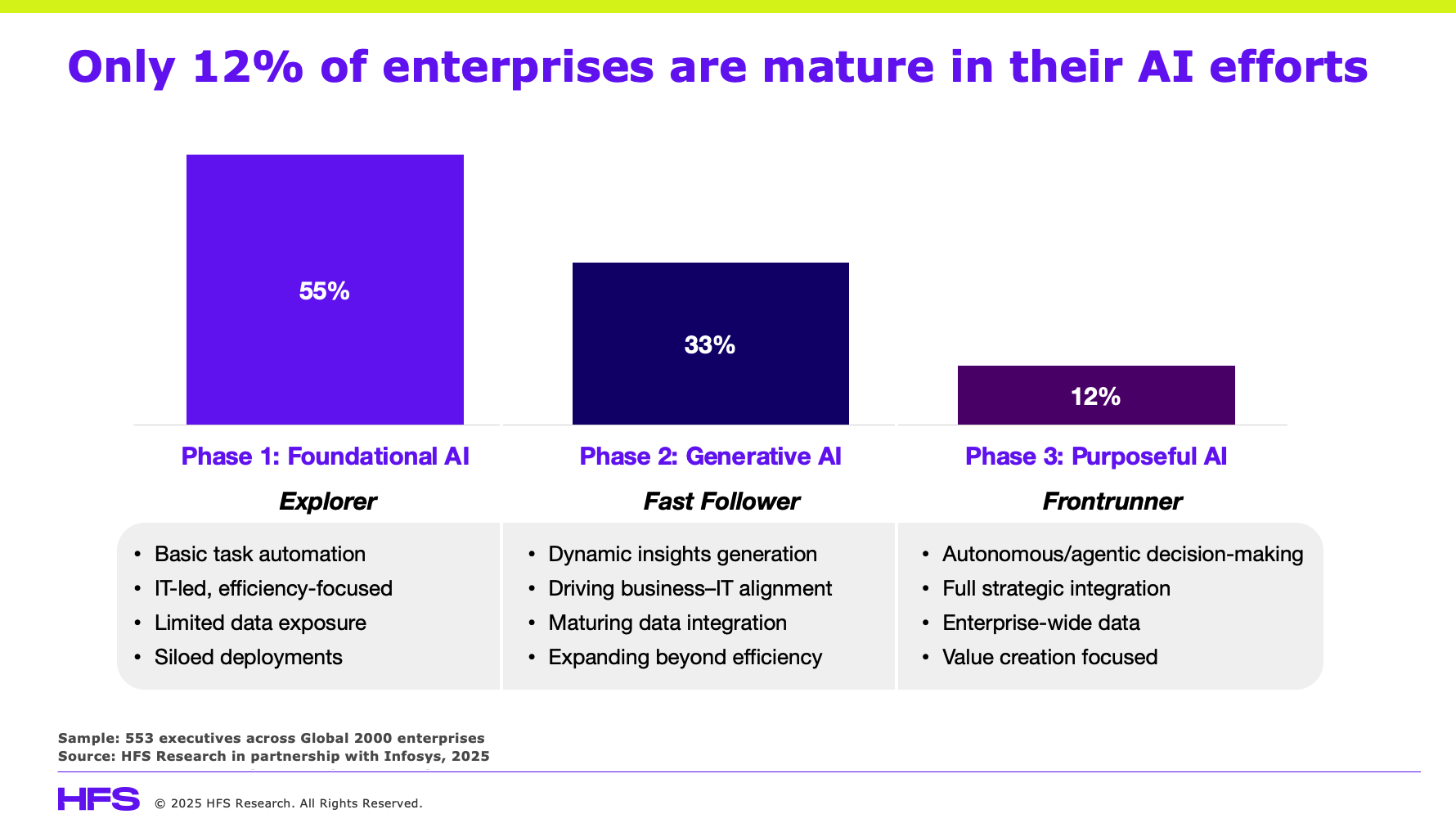
Here is the real risk. Enterprises are shrinking their workforce without reshaping the work. The assumption is that AI will simply fill in the gaps. However, only 12 percent of organizations report a somewhat mature level of AI readiness, and most of them acknowledge that they have a long way to go (see exhibit below). That makes the scale of workforce cuts hard to justify on the basis of actual deployment.
Most of the AI used today still relies on human orchestration, supervision, and refinement. Few enterprises have established clear handoffs between agents and people, and even fewer have rearchitected workflows to reflect new levels of autonomy or human-AI collaboration:
We are clearing out talent faster than we are designing the next delivery model, and that creates exposure, inconsistent outcomes, and over-reliance on immature systems. Fragile operating models are held together by duct tape, not by design.
This is not the AI revolution most leaders say they are preparing for. It is a pause on hiring disguised as foresight. A reversion to old cost takeout habits, rather than a step toward adaptive work models.
Where enterprise leaders now need to focus
If you are an enterprise leader watching this unfold, it is time to move beyond reactive cycles. Here is where to focus instead:
Map the work, not just the roles. Understand what outcomes your teams are responsible for and where AI can assist rather than own it. Decompose the work before deciding who or what should do it.
Stop hollowing out your future talent. Reducing early-career roles may create short-term savings but also destroy long-term agility. Invest in hybrid learning environments where new talent can collaborate with AI systems and senior mentors.
Redesign for orchestration. Do not just implement AI tools. Build systems around them that define how work is triggered, handed off, evaluated, and evolved. Think beyond productivity into reliability and resilience.
Ground your decisions in data, not buzz. Track what AI is actually delivering, where it saves time, reduces errors, or enhances quality. Make staffing decisions based on this evidence, not aspiration.
Challenge your narrative. If you are using AI as the justification for layoffs, be honest about what is really driving the shift. Employees, customers, and shareholders are watching and expecting more than spin.
This is not about being anti-AI. It is about building enterprise systems and workforces that are designed for what is coming, not just shedding what is familiar. AI may be the accelerant, but the redesign is still up to us.
Bottom line: Stop optimizing for a future you have not yet built
Enterprises are rushing to cut headcount for AI efficiency without having done the work to understand what good looks like. Most have not redesigned roles, workflows, or orchestration layers. They are simply hoping that fewer people plus more tech will equal progress. That is not a strategy; it is a gamble.