The future of the analyst industry is here, but most of its stakeholders are simply not ready. You only need to see the stock price carnage of Gartner and Forrester to realize the analyst and advisor industry are in grave danger of being runover by AI.
The Futurum Group CEO, Daniel Newman, and I take a hard look at the future of the analyst industry in the era of ChatGPT-5 and agentic AI.
We discuss how AI is dismantling legacy models built on slow inquiry processes, paywalled reports, and expensive AR programs, replacing them with instant, on-demand insights. Analyst firms, especially the large, entrenched players, must reinvent themselves fast, shifting from rear-view research to forward-looking influence, proprietary data, and authentic personal brands.
➡️ Our conversation covers:
*Why AI is making traditional analyst deliverables (Magic Quadrants, long reports) less relevant
*The need for speed, authenticity, and personality to stand out in a market drowning in AI-generated content
*How smaller, nimble firms can outpace large incumbents by moving faster and building direct influence
*The decline of AR’s traditional role as a concierge between vendors and analysts
*The genuine risk of irrelevance if the industry fails to adapt within 18 months
Bottom line: The analyst business has arrived at its “Blockbuster moment.”
Adapt quickly, embrace AI, and build genuine influence or be replaced by faster, cheaper, and better alternatives. Enjoy!
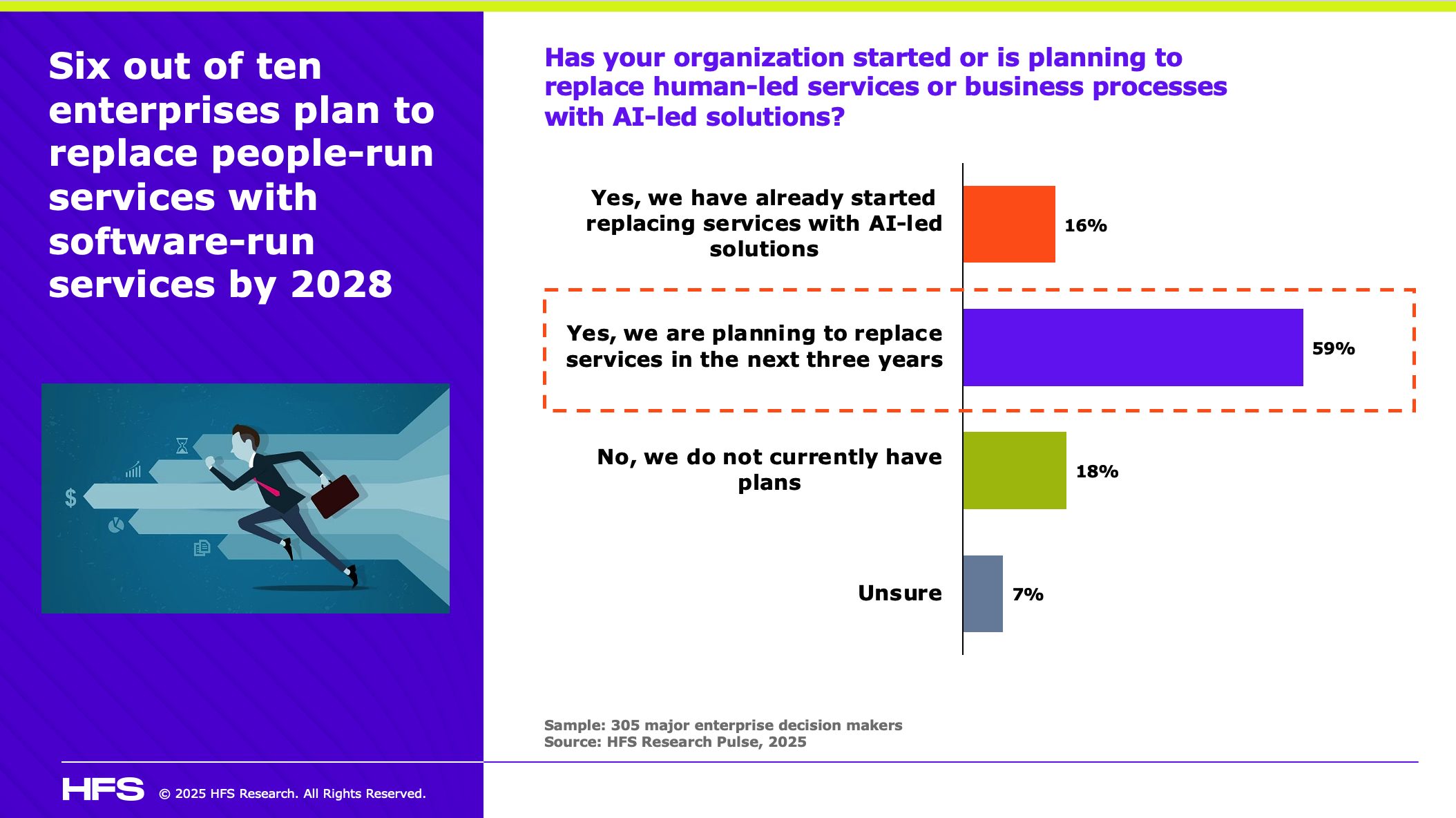
Within three years, two-thirds of Global 2000 enterprises intend to replace human-heavy IT and BPO services with AI-driven delivery. At HFS, we are terming this Services-as-Software (SaS) and view the rapid progress of AI Agents, Large Language Models (LLMs) and, ultimately, Vibe Coding as the three technological catalysts to make this happen:
Why Services-as-Software will render many traditional services and software providers obsolete
Services-as-Software (SaS) is the fusion of software and services into AI-powered, outcome-driven platforms that continuously learn and adapt. SaS replaces static SaaS and labor-heavy consulting with autonomous digital service layers that deliver expertise and execution in real time. SaS will eventually render traditional labor-based professional services and traditional SaaS providers obsolete, replaced by scalable AI Agents that deliver outcomes, not hours or licenses.
SaS is an emerging enterprise model where human-delivered services are redesigned as intelligent, automated, and continuously adaptive software entities. Instead of buying static SaaS licenses or paying for labor-intensive services, enterprises consume AI-native service layers that blend automation, reasoning, and execution into outcome-based solutions.
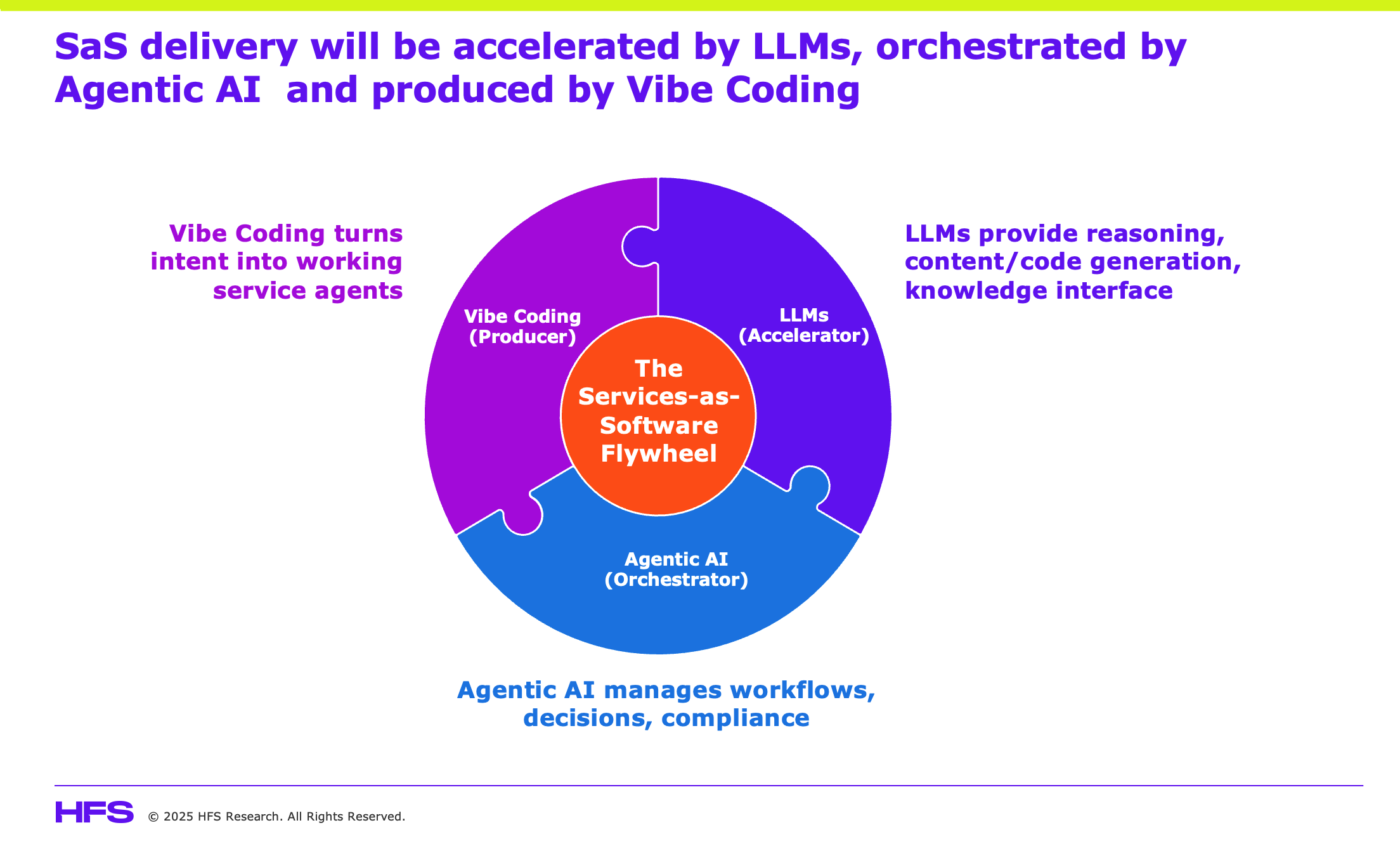
SaS delivery will be accelerated by LLMs, orchestrated by Agentic AI, and produced by Vibe Coding
Services scaled in the past by combining talent with common tech platforms. In the SaS era, the same principle applies, but talent now needs deeper business context to unlock the value of common AI platforms.
Vibe Coding provides speed and intent, but it is the fusion with LLMs and Agentic AI that makes SaS sustainable:
LLMs are the accelerator. It automates content, code, and workflow generation. Customers are already using it to shrink delivery cycles, generate reusable IP, and cut the cost of software testing.
Agentic AI is the orchestrator. Multi-agent systems manage tasks, test outputs, retrain models, and monitor compliance. We see banks piloting agent-based compliance checks and insurers using them to orchestrate claims processing without armies of analysts.
Vibe Coding is the production engine. It anchors intent-driven builds that can be refined, secured, and deployed like products. Large retailers are now expecting working demos within days of an engagement, driven by Vibe Coding copilots.
Together, these three AI constituents are replacing traditional FTE billing with subscription-based services, predictable costs, and outcome-linked value:
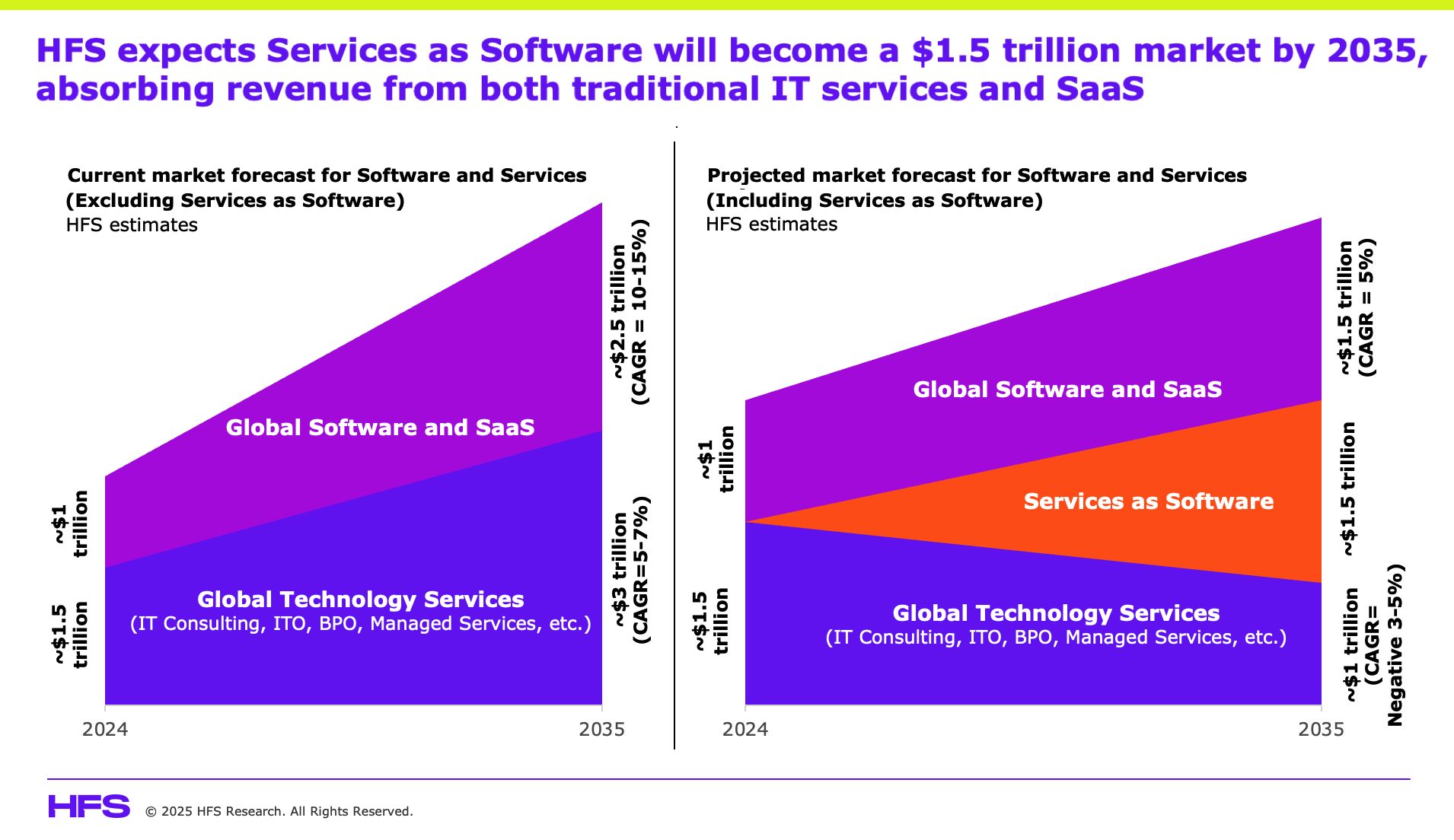
SaS blurs the line between software and services to form a $1.5 trillion industry
Like services, SaS delivers expertise and decision-making. Like software, it is automated, scalable, and subscription-based. But unlike either, it is dynamic, self-learning, and outcome-driven. This new category will absorb spend from both traditional SaaS and IT services, creating a $1.5 trillion market over the next few years, where enterprises stop paying for headcount or static tools and instead subscribe to AI-powered, adaptive outcomes:
Vice Coding is a new programming style that emphasizes rapid, intuitive and low-ceremony development. Developers and business stakeholders co-create with AI copilots through natural language, moving directly from intent to working code. It’s fast, conversational, and adaptive, designed for a world where software and services are fusing into dynamic, AI-driven outcomes. At HFS, we believe Vibe Coding will become the production engine behind the emerging Services-as-Software model, and we won’t even be calling it “vibe coding” in the future. It will all be about writing syntax to frame problems and design solutions. Let’s investigate further…
Vibe Coding offers the opportunity to realize the HFS OneOffice vision
For decades, business and IT have operated in silos — business leaders drafting requirements, IT translating them months later into code. This gap has slowed innovation and reinforced the divide between the front, middle, and back office.
Vibe Coding offers the opportunity to realize the HFS OneOffice vision. By enabling business stakeholders and developers to co-create with AI copilots in natural language, it collapses the wall between business intent and technology execution. Instead of handoffs, enterprises move in real time from idea to outcome. This is where business and IT finally come together as OneOffice: a unified, adaptive enterprise where technology and talent co-orchestrate value creation.
Those enterprises that simply think they can bolt on agentic technologies to their existing processes are quickly learning that this adds minimal value. It is like bolting a Tesla battery pack onto a lawnmower, where you can brag about the tech, but it will not cut the grass any faster. To gain the maximum benefits from AI technologies, business executives must work closely with their IT counterparts to design processes that generate the right data, make smarter decisions, and train people to use the technology effectively. The way we work is changing, both in terms of how processes function and how our roles need to broaden, as so many of our current tasks are improved or even replaced by AI.
Vibe Coding is not a lab experiment
Vibe Coding emphasizes speed, intuition, and iteration over rigid, process-heavy development. By reducing dependence on upfront design and exhaustive documentation, Vibe Coding enables teams to move directly from intent to working code in a conversational, adaptive way that aligns with the fast, fluid needs of modern enterprises.
Start-up funding organization Y Combinator reported that a quarter of its Winter 2025 startups had codebases that were 95 percent AI-generated. Production-ready components are now being built in hours instead of weeks. Governance, compliance, and security can be embedded into the codebase from the outset. Services, like software releases, can be built once and reused across multiple customers instead of bespoke projects. The consequences for service providers are profound.
Vibe Coding is the production engine that turns Services-as-Software from vision to reality
Services operated in the past by combining talent-at-scale with common tech platforms. In the SaS era, the same principles apply, but the talent needs deeper business context to unlock the value of common AI platforms.
Vibe Coding provides speed and intent, but it is the fusion with LLMs and Agentic AI that makes SaS sustainable:
LLMs are the accelerator. It automates content, code, and workflow generation. Customers are already using it to shrink delivery cycles, generate reusable IP, and cut the cost of software testing.
Agentic AI is the orchestrator. Multi-agent systems manage tasks, test outputs, retrain models, and monitor compliance. We see banks piloting agent-based compliance checks and insurers using them to orchestrate claims processing without armies of analysts.
Vibe Coding is the production engine. It anchors intent-driven builds that can be refined, secured, and deployed like products. Large retailers are now expecting working demos within days of an engagement, driven by Vibe Coding copilots.
Together, these three AI constituents are replacing traditional FTE billing with subscription-based services, predictable costs, and outcome-linked value.
Enterprises mustn’t approach SaS as another outsourcing wave.
SaS is a new operating model and ambitious enterprise customers now expect working demos early in engagements, are exploring outcome-based contracts, and demand transparency on AI governance and intellectual property. This is the SaS vision coming to life in real time.
Smart enterprise leaders must stop measuring value in FTE counts and start anchoring contracts to speed, reuse, and reliability. That means asking providers for subscription-style pricing and demonstrable reuse of code and IP, not endless custom builds. It also means insisting on AI governance frameworks that explain how models are trained, how code is validated, and how intellectual property is protected.
CIOs must pivot their own talent strategies too. Developers and architects need to work with Vibe Coding and agentic systems rather than compete with them. Enterprises that invest in prompt engineering, AI-era architecture oversight, and code validation will extract the most value. Those that do not risk being locked into black-box services they cannot control or trust.
A global bank recently shifted from a traditional outsourcing contract to a SaS model for customer onboarding. Instead of hundreds of developers coding workflows, the provider now delivers an AI-powered onboarding service on subscription. Vibe Coding enables rapid iteration of new compliance checks, GenAI auto-generates the documentation, and Agentic AI monitors process accuracy. The bank gets faster releases, lower costs, and auditable governance, without the FTE treadmill.
Is vibe coding ready for prime time? Or stuck in lab?
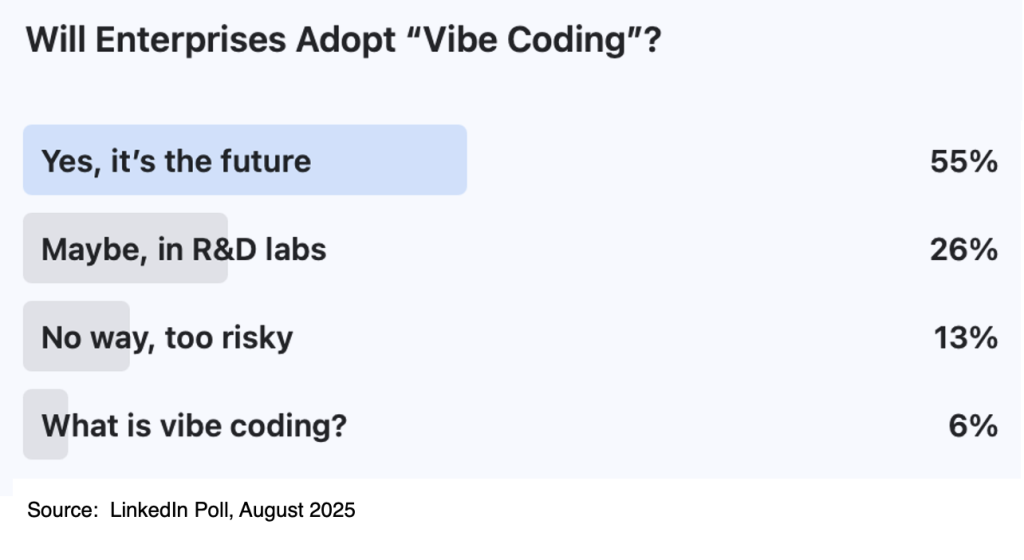
To test the waters, we recently ran a LinkedIn poll asking: “Will enterprises adopt Vibe Coding?”
The results highlight both momentum and hesitation. The majority clearly see Vibe Coding as inevitable, drawn by its speed, adaptability, and ability to turn ideas into working code in days instead of months. Younger developers in particular are energised by its low-ceremony, conversational style, which plays to their comfort with AI-first tools.
But there is a tale of caution in the poll as well. Those who view Vibe Coding as risky because of:
Governance & compliance gaps. Regulators and enterprises worry about how to audit code that is 95% AI-generated.
Black-box outputs. Without explainability, enterprises fear vendor lock-in and an inability to validate outcomes.
Talent disruption. Senior developers may resist low-ceremony, AI-first practices that threaten traditional roles.
Security concerns. Copilots and LLMs trained on broad datasets raise questions about vulnerabilities and IP leakage.
Cultural inertia. Shifting from documentation-heavy processes to conversational coding requires a new mindset that not all enterprises are ready for.
These concerns don’t negate the momentum, but they underline that adoption will depend on embedding governance, explainability, and trust at the core of Vibe Coding practices.
Recommendations for Enterprise Customers
Shift contracting models. Move from FTE billing and static SaaS licenses to subscription-style, outcome-linked services.
Invest in talent. Build new skills in prompt engineering, AI-era architecture, and code validation. Encourage younger talent to lead experiments with Vibe Voding, since they adapt fastest to conversational, AI-first ways of building.
Demand transparency. Require providers to demonstrate AI governance frameworks, data lineage, and intellectual property protection.
Push for reuse. Ask providers to deliver modular service components that can be reused across the enterprise, not bespoke one-offs.
Pilot fast, scale faster. Expect working demos in days, not months, and measure providers on speed, reuse, and reliability.
Recommendations for Service Providers
Retire the labor pyramid. Replace headcount-heavy delivery with AI-first, productized service agents built through Vibe Coding.
Embed governance at the core. Bake compliance, security, and auditability into AI services from the outset.
Industrialize Vibe Coding. Make copilots standard for all delivery teams and use young developers as the frontline to accelerate builds and generate reusable IP.
Rewire pricing. Shift to subscription-based models that monetize outcomes, not hours.
Partner widely. Team with hyperscalers, LLM vendors, and AI-native startups to co-create SaS offerings.
Recommendations for Traditional SaaS Firms
Move beyond licenses. Static SaaS will be cannibalized. Pivot toward adaptive, AI-powered service layers that evolve continuously.
Fuse with services. Collaborate with service providers to create co-delivered SaS platforms.
Embrace Vibe Coding ecosystems. Open your platforms so developers, especially younger talent, can use AI copilots to extend and customize products in real time.
Differentiate on trust. Put governance, privacy, and explainability at the center of your value proposition.
Accelerate open platforms. Build marketplaces where Vibe Coding, Agentic AI, and LLM-powered agents extend your applications with speed and creativity.
Bottom line: Embrace vibe coding. Don’t fear it.
Vibe Coding is the production engine that makes Services-as-Software real, and it will decide the winners of the next decade. Enterprises can no longer afford to treat AI as bolt-ons or outsourcing-lite. SaS is a new operating model where AI agents, LLMs, and Vibe Coding collapse the gap between software and services, shifting the economics of IT from people and licenses to reusable, outcome-based digital service layers.
The real risk isn’t that Vibe Coding will fail; it’s that enterprises will fear it and do nothing, clinging to incremental improvements that are only slightly better, faster, or cheaper. Those who adapt now will own the future $1.5 trillion SaS market. Those who don’t will be stuck optimizing the old world, while others reinvent the new one.
To conclude, Vibe Coding is a new mindset that energizes young talent and accelerates the shift from human-run services to software-run outcomes. Enterprises, providers, and SaaS firms that embrace this culture will define the $1.5 trillion SaS market.
The revelation that Deloitte submitted a government report filled with AI-generated fake references and fabricated court quotes is not just embarrassing – it is a $290,000 lesson in what happens when professional judgment is replaced by blind trust in AI.
Australia’s Department of Employment and Workplace Relations said Deloitte will return part of the AU$440,000 fee after errors including a fabricated court quote and non-existent references were uncovered by academic Chris Rudge. A corrected version disclosed use of Azure OpenAI GPT-4o after the scandal broke. AI without verification is not innovation. It is professional malpractice waiting to happen.
GPT-4o did not malfunction. Deloitte’s process did.
Deloitte was hired to review a welfare compliance framework and IT system. The report went live, and a single diligent reader exposed fake sources and a bogus court quote. Deloitte then refunded the final payment and disclosed its generative AI use after the fact.
The model did not fail. It produced fluent, plausible text exactly as designed. What failed was process and accountability. Someone generated content, skipped verification, and submitted it to a government client whose decisions affect millions of citizens and billions in welfare payments. The stakes were too high for shortcuts, yet shortcuts were taken.
Enterprise leaders already know the risks, but they’re buying the services anyway
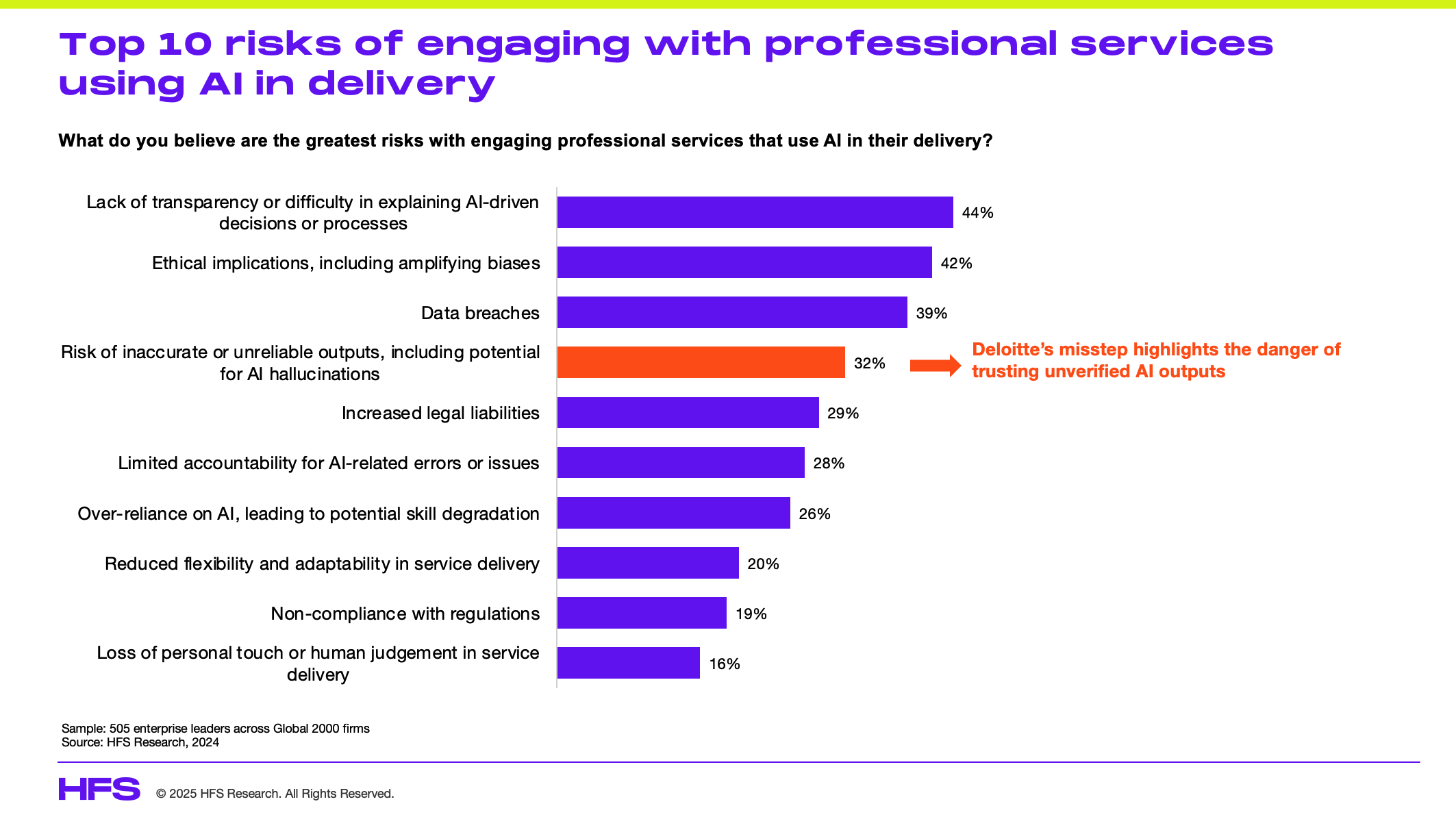
The irony is almost painful. When HFS Research surveyed 505 enterprise leaders across Global 2000 firms in 2024, 32% identified “risk of inaccurate or unreliable outputs, including potential for AI hallucinations” as one of their top concerns when engaging professional services that use AI in delivery. That’s nearly one in three buyers explicitly worried about the exact problem that just cost Deloitte a contract and its reputation:
Yet those same enterprises keep signing deals with firms racing to automate their deliverables without building verification into workflows. The Deloitte scandal isn’t revealing a hidden risk, it’s confirming what enterprise leaders already feared. Even more telling, 44% cited lack of transparency in AI-driven decisions as their top concern, and 28% worried about limited accountability for AI-related errors. The market knows the problem exists. The difference now is that Deloitte’s $290,000 refund puts a price tag on ignoring it. When nearly half of your potential clients are already worried about whether you’re being transparent about AI use, hiding GPT-4o in your methodology until after you get caught isn’t just bad practice, it’s commercial suicide.
Buyers ranked “ability to balance AI with human expertise” as their fifth most important selection criterion
When HFS Research asked 1,002 enterprise leaders across Global 2000 firms what matters most when selecting an AI-powered consulting firm in 2025, the results expose exactly where Deloitte failed. “Ability to balance AI with human expertise” ranked fifth out of ten criteria, sitting between proprietary IP differentiation and track record of delivering outcomes:
This isn’t a nice-to-have buried at the bottom of the list. It’s a top-five dealbreaker. Yet Deloitte’s approach to the Australian welfare report suggests they treated AI as a replacement for human judgment rather than an amplifier of it. The ranking also reveals something critical about buyer expectations: deep industry expertise still matters most, but the ability to use AI responsibly is now more important than customization, change management capabilities, or vendor ecosystem collaboration. Enterprise leaders aren’t rejecting AI in professional services. They’re demanding that firms prove they can deploy it without sacrificing the human insight they’re paying premium rates to receive. Deloitte’s scandal shows what happens when a firm optimizes for speed and margin while ignoring the one thing clients ranked in their top five priorities.
Your vendors are using AI right now whether you know it or not
If you buy consulting, strategy reports, audits, or any expertise-driven service, assume AI is already in your supply chain. The question is not if vendors are using it, but how responsibly they are doing so.
Make AI disclosure non-negotiable in every contract starting today. Every agreement must spell out which tools are used, for what purposes, and how verification occurs. “We use GPT-4o for initial drafts, followed by human fact-checking” is accountability. “AI-assisted workflows” is a loophole.
Verify before you act on any deliverable that matters. High-stakes work requires qualified human review of every claim and citation. Do not assume plausibility equals truth. Deloitte was caught by one diligent academic. How many unchecked reports are sitting in your systems right now?
Rewrite acceptance criteria because your current standards assume human work. Add explicit checks for fact accuracy, citation integrity, and full AI disclosure to every statement of work before you sign it.
Create escalation protocols before the next crisis breaks. When a fabricated quote surfaces, who investigates? Who notifies the client? How do you remediate within hours, not weeks? Deloitte’s response was reactive PR. You need prevention built into operations.
The race to automate is hurting service provider credibility
One unverified deliverable cost Deloitte both money and trust. The economic temptation is obvious: use AI to draft faster, bill the same, and pocket the margin. But that margin gain is being bought with a credibility deficit that compounds with every careless report.
This is the dark side of the Services-as-Software era. AI can enable services to behave like scalable platforms, but that only works when the underlying workflows are validated, explainable, and consistently coded for quality. Without these controls, Services-as-Software collapses into Services-as-Spin.
Make verification mandatory for every single AI-assisted output. Every piece of content must undergo human expert review before it leaves your building. Treat verification as a professional obligation, not an optional cost.
Default to transparency because clients will find out eventually. Discovery happens through audits, detection tools, or leaks. Early disclosure builds trust. Concealment destroys it permanently.
Separate creation from review immediately. The person prompting AI cannot be the same one validating its results. Fresh eyes catch errors invisible to the drafter who anchored on what they expected.
Price for integrity, not just AI-enabled margin expansion. If AI improves efficiency, reinvest some savings in stronger validation. Competing on AI-driven speed while starving quality control is reputational suicide.
Most AI transformation programs fail because they optimize for speed over verification
This problem is now systemic across sectors. New York lawyers were sanctioned in Mata v. Avianca after filing briefs with non-existent cases generated by ChatGPT. UK High Court judges have warned lawyers that citing fake AI cases can trigger contempt referrals. Air Canada was held liable after its website chatbot gave a passenger false policy guidance. Media outlets including CNET and Sports Illustrated faced backlash and corrections for AI-generated content riddled with factual errors and fake bylines. Academic publishers have retracted thousands of papers amid papermill and AI-fabrication concerns, with Wiley confirming over 11,000 retractions tied to Hindawi and Springer Nature retracting a machine-learning book after fake citations were exposed.
LLMs can be transformative when they amplify human expertise. Deloitte’s failure was not using AI. It was abdicating accountability by treating AI as a substitute for analysis rather than a partner in it.
This is exactly where Vibe Coding matters. Enterprises that succeed with AI are already teaching their people to code the “vibe” of quality into every workflow. That means aligning how data is validated, how context is shared, and how collaboration flows across the OneOffice. You do not scale trust with technology. You scale it through consistent cultural coding of how technology is used.
The fastest results come from fixing one broken process at a time
Do not try to govern AI everywhere at once. Start where the blast radius is biggest.
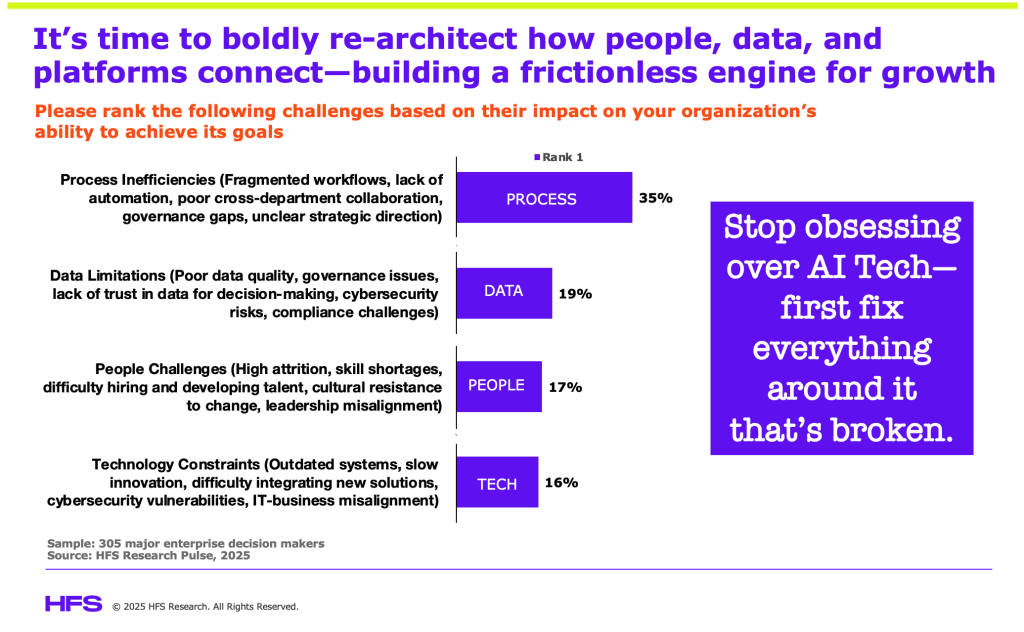
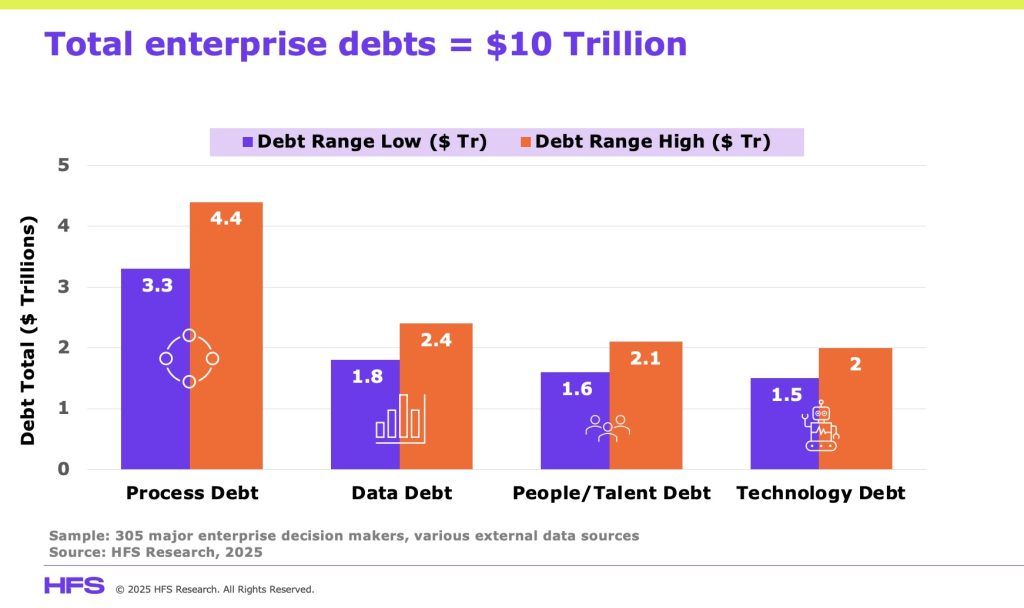
As our recent research across the Global 2000 reveals, the issue with AI transformation isn’t the tech, but the archaic processes that are failing to create better data to make decisions. It’s also the failure of leadership to train their people to rethink processes and be aware of the real business problems they are trying to solve. While so many stakeholders obsess with technical debt, the real change mandate is to address process, data and people debt to exploit these wonderful technologies:
For enterprises: Pick one high-stakes category such as government reports, regulatory filings, audit outputs, or financial models. Build airtight disclosure and verification there first, then scale the approach.
For service providers: Target practices using AI heavily. Make documented verification an essential mandate to client delivery. Track error types and use them to improve prompts, retrieval methods, and quality checklists continuously.
The leaders separating progress from scandal are those who embed quality control at the start, not those scrambling to bolt it on after public failure.
Regulatory crackdowns are coming and 60% of firms have no AI governance plan
Courts are already adjusting. US judges have begun issuing standing orders that require lawyers to certify whether filings used generative AI and to verify any AI-drafted text. The UK High Court has warned that submitting fictitious AI-generated case law risks contempt or referral to regulators. At the policy level, NIST has published its Generative AI Profile as companion guidance to the AI Risk Management Framework with concrete control actions organizations can adopt now.
Governments burned by AI blunders will introduce binding standards. Professional associations will issue mandatory guidelines. Clients will add AI clauses to every contract with real penalties. The firms that move now, investing in transparency, training, and verification, will win trust and market share. The rest will be litigating their way through the next cycle of embarrassment.
We are in a period where AI capability has outpaced corporate discipline. Old QA checklists miss AI-specific failure modes like hallucinations and fake citations. Old pricing models ignore the real cost of verification overhead. Old disclosure norms hide behind marketing language that protects no one.
Bottom line: AI without verification is outsourcing judgment to a system that confidently invents facts.
Deloitte’s scandal is not an outlier. It is the first major warning shot of a much larger credibility crisis coming for every industry. The shift to Services-as-Software and Vibe-Coded enterprises is about replacing legacy human-only workflows with intelligent, accountable, and transparent ones that combine machine efficiency with human integrity. Build this discipline into your operating model now or explain the next scandal later when your name hits the headlines.
We’re thrilled to welcome Achyuta Ghosh to HFS as our new Executive Research Leader for GCCs and BPO, based in Delhi.
Achyuta joins us from Nasscom, where he made his name building its research practice from the ground up and shaping industry perspectives on AI, cloud, SaaS, GCCs, and the Future of Work. We have enjoyed working with Achyuta over the years as a research partner, so this is a great natural progression in his analyst career. Achyuta brings 23+ years of experience having worked at WNS, Genpact, Ford Motor Company, and Frost & Sullivan in his earlier career.
Am personally excited for Achyuta to bring his expertise, energy, and personality to the HFS community. So let’s hear from him directly about his new career with HFS and what to expect from him donning purple…
What excites you most about joining HFS at this point in your career?
Honestly, what excites me about joining HFS right now is the chance to dive straight into what is transforming technology and business. I’ve experienced this industry from multiple lenses as a practitioner, a catalyst, and an analyst, and right now, the speed and scale of change are truly staggering. Companies will not make small adjustments; they will need to tear down old models, turn services into software, and move beyond the typical “digital transformation” mantra.
It’s a full-blown business reinvention, and HFS is right at the center of all this. What really attracts me is their mix of independent thinking, deep expertise, and, frankly, a willingness to work hand in hand with their clients.
The HFS team isn’t just writing reports from the sidelines. They collaborate directly with enterprises through workshops, events, and roundtables to turn insights into real results. That’s exactly the kind of impact I want to make. In a landscape packed with vendor-driven rankings and buzzwords, HFS keeps it real. They’ve built a reputation for being direct and honest, which matches how I want to approach my work.
HFS covers many areas for its size, but at its heart, it’s a startup that moves fast into futuristic themes, such as leading the services-as-software narrative. That blend of expertise and openness to what’s next is the environment where I know I can contribute and keep growing.
You’ve spent years tracking GCCs and BPO. What shifts are you seeing that leaders should pay attention to right now?
The game has changed for GCCs and BPOs. Leading GCCs are stepping up as centers for digital, analytics, and AI, playing a direct role in enterprise strategy and even feeding into local innovation ecosystems. The top performers now have more autonomy and are much more tightly integrated into the business.
It’s the same story with BPOs. They’ve shifted from executing tasks to actually owning outcomes, ramping up automation, and building specialized platforms for micro verticals. The focus is on reskilling talent, making compliance a priority, and doubling down on trust and sustainability.
For leaders, this means it’s time to rethink how they invest in and manage GCCs and orchestrate talent, tech, and partner strategy. The old lines between in-house and outsourced are fading, so it’s crucial to understand what stays internal versus what goes outside while finding new ways to collaborate. And this is not a one-size-fits-all strategy. Each organization will need to do it in a way that works best for them. Automation and AI are rewriting the rulebook on service delivery and business models, which means new governance, new metrics, and a sharper focus on business value.
Let’s not forget: keeping teams motivated, reskilling and upskilling them, and building a strong culture is more important than ever, especially in these hybrid, distributed setups. Embedding sustainability and ecosystem partnerships into long-term strategy is quickly moving from “nice to have” to “must-have.”
Where do you see the most significant opportunities for GCCs and BPO firms in the AI era?
The reality is that everyone talks about moving up the value chain, but less than 10% of GCCs have actually made the leap to become true transformation hubs. That’s the opportunity: to close the gap between possibilities and reality.
AI is the game-changer. It lets GCCs and BPOs redesign service delivery. Embedding generative AI and automation opens the door to scale up high-value domains like risk, compliance, customer insights, and product design so that you are helping shape and grow business.
The big opportunity is to step up as strategic partners, driving AI initiatives, scaling innovation, and connecting the dots across platforms, providers, and talent. That’s how GCCs and BPOs can help clients navigate disruption, unlock new growth, and lead in this AI-driven era.
How do you plan to shape HFS’s research agenda in this space?
First, a disclaimer: The research focus will flex and shift as we learn more about customer needs, but our main goal will always be to help enterprises get the most out of their GCC and GBS strategies.
While GCCs have scaled up quickly in the past few years, I believe there is tremendous headroom for further sector growth. With the landscape changing fast (talent pools shifting, costs fluctuating, ecosystems evolving), the old playbooks no longer cut it. The global location strategy, talent demand, and modernizing service delivery models become crucial to transform GCCs into genuine value creators. And for enterprises, that presents both a challenge and an opportunity. The goalposts have shifted. Saving money or being more efficient is hygiene, while driving innovation, building IP, and taking on productization is in focus.
AI is at the top of my mind, too. Everyone knows AI will fundamentally change how business runs, but there’s a big gap between experimenting and scaling AI-first operations. A small share of GCCs are actually AI-centric. The challenge now is figuring out how to implement models like services-as-software, generative AI, or even emerging approaches like vibe coding in a way that truly changes delivery. And, just as importantly, leaders need to assess readiness, build robust governance, and ensure AI is used responsibly across the organization.
Finally, there’s the matter of value and partnerships. Enterprises need clear ways to measure what they expect from their GCCs and compare it to the delivered value. With the line between what GCCs and service providers deliver getting fuzzier, companies have to find smarter ways to structure partnerships so both sides complement each other for optimum impact.
What unique perspective do you think you bring to analyzing this industry?
I have mentioned this earlier. Here’s what sets me apart: I’ve seen this industry from all sides: analyst, practitioner, and catalyst.
As an analyst, my years of tracking shifts in tech at an industry level mean I know how to connect what’s happening on the ground to the big-picture strategy. As a practitioner, I’ve actually built analytics products and built tech-centric businesses. So, I will want to look at what’s practical versus what’s just hype. As a catalyst, my time working with a tech trade body means I get to know how ecosystems work: talent, innovation, stakeholder management, and partnerships. That mindset is what can help GCCs truly scale their impact.
Who has been the biggest influence on your career so far, and why?
Honestly, it’s been a mix of great mentors at every stage. Early on in my analyst career, I learned the importance of execution and discipline. Later, I was pushed to think bigger and look at the long-term impact. I’ve picked up lessons from experienced clients at WNS and Genpact, sharp analysts at Frost & Sullivan, global leaders at Ford Motor Company, and some of the top minds at Nasscom (both internal and external member organizations).
Frost & Sullivan leaders drilled real research discipline into me. My clients showed me the value of looking at problems from every angle. At Ford, my role focused on fostering an entrepreneurial mindset. And Indian tech services industry leaders at Nasscom helped me develop the ability to anticipate trends and explain what’s coming next. Put all that together, and I like to move fast, focus on asking questions, backing up insights with evidence, and never losing sight of stakeholder needs.
Outside of research, what keeps you busy or inspired? Any hobbies, passions, or quirks the HFS community should know about?
I’m an avid reader, especially when it comes to war history. Strategy, leadership under pressure, the cost of decisions, and resilience are lessons that apply just as much in business. I’m also a diehard car and motorcycle enthusiast, and I have travelled around the country. There’s nothing like a long road trip to remind you that detours often lead to the best discoveries.
Outside of that, I’m always up for trying new food. I’ve run a movie review page in the past, and cricket’s been a passion of mine for years.
Fun fact: I tend to connect with dogs faster than with most people.
And finally, if you had to describe yourself in three words, what would they be?
Three words? Curious, resilient, analytical.
Curious because, honestly, I never stop asking questions. Whether it’s diving into new markets or figuring out what makes a team tick, I’m always looking for the “why” behind things.
Resilience has shaped my career, from navigating industry disruptions to managing personal setbacks. It has also made me more adaptable, helping me persist through uncertainty and stay optimistic about the future.
Analytical, absolutely. I love connecting the dots, spotting patterns, and building a story out of the numbers.
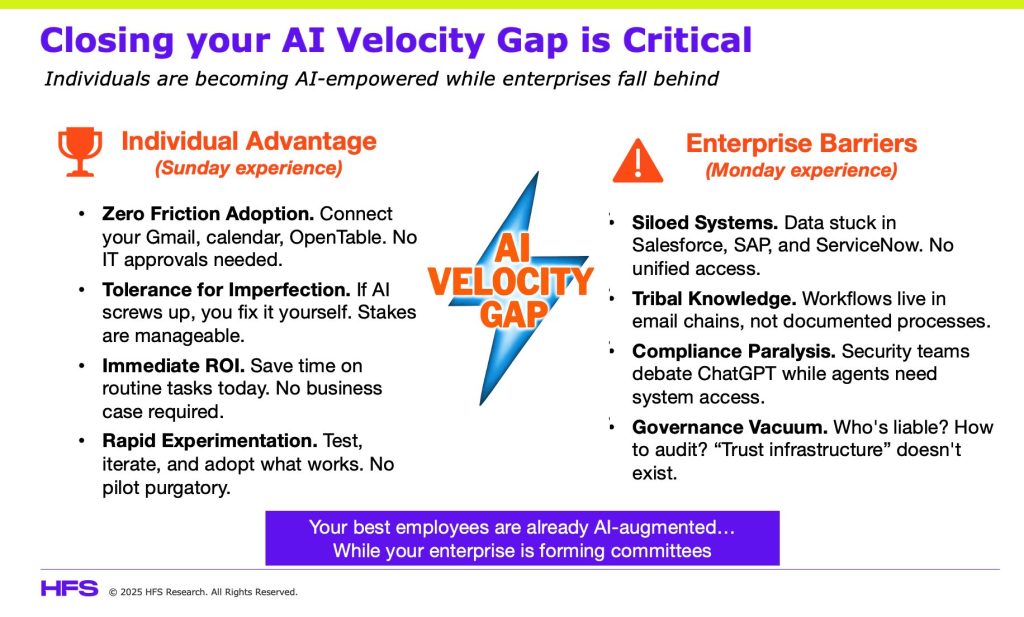
On Sunday, employees live the AI dream: frictionless, instant, empowering. They connect Gmail, Calendar, and OpenTable without asking permission. They fix mistakes, automate workflows, and see instant ROI on everyday tasks.
On Monday, they crash into enterprise reality: data silos, email chains, compliance debates, and governance frameworks that exist only in PowerPoint.
Your best employees are already AI augmented. Your enterprise is still forming committees.
This is your AI Velocity Gap, and it’s probably widening every day
Within the next 18 months, your employees will be working side-by-side with agentic AI, while your enterprise still debates policies and pilots. The AI Velocity Gap is the widening divide between how fast individuals are adopting AI to get work done and the speed with which enterprises are enabling it. It is the distance between human ambition and enterprise readiness for AI.
The AI Velocity Gap is no longer a concept. It’s the performance metric that decides whether you’ll lead the AI-first economy or be left behind.
You can’t close gaps that you can’t measure
The biggest failure in enterprise AI today is the inability to quantify progress. According to a new WalkMe survey, 78% of employees admit to using AI tools not approved by their employer, while only 7.5% have received extensive AI training. This isn’t rebellion. It’s your workforce solving problems faster than your IT department can write policies.
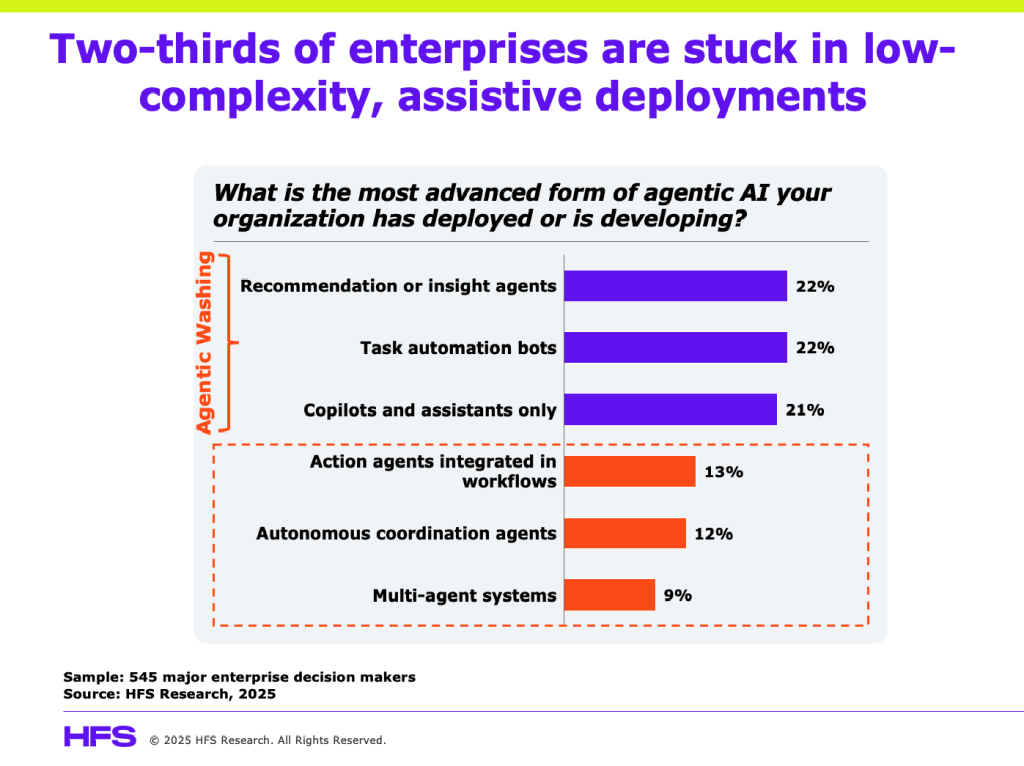
To reinforce this point, a recent HFS study of 545 global 2000 firms clearly shows that two-thirds of them are merely paying lip service to agentic AI, running low-level activities such as task automation (RPA) and copilot assistants, which we term as “agentic washing”:
This isn’t just semantic confusion. It’s strategic misdirection. When enterprises rebrand basic RPA as ‘agentic AI,’ they’re measuring the wrong outcomes and celebrating the wrong wins. Real agentic AI makes decisions, adapts to context, and operates with minimal human intervention. Task automation and copilots are table stakes, not transformation.
To understand the size of your AI Velocity Gap, start tracking three speeds that define your transformation
Speed 1: Adoption velocity. How fast are employees deploying AI tools compared with official enterprise initiatives? Count the number of unsanctioned tools in use, prompts executed per week, and AI workflows created outside IT control. Recent data shows 80% of SaaS logins for AI tools bypass IT oversight entirely.
Speed 2: Enablement velocity. How quickly your infrastructure supports AI-driven work. Measure API availability, time to access enterprise data, and how much of your process knowledge is actually documented. MIT’s Project NANDA found that only 40% of companies provide official AI subscriptions, yet 90% of employees use personal AI tools daily. When your sanctioned enterprise systems can’t compete with consumer ChatGPT, your infrastructure is the bottleneck.
Speed 3: Cultural velocity: How ready your leaders are to let AI make real decisions. Track executive sign-off cycles, experiment-to-production ratios, and how often AI output is used in live operations. Despite $30-40 billion invested in generative AI initiatives, only 5% of organizations see transformative returns (MIT’s Project NANDA). The other 95%? Still measuring activity instead of outcomes. In addition, recent research from HFS is showing how so many enterprises are failing to establish a positive culture when it comes to enterprise GenAI adoption. These measures expose where your enterprise is crawling while your people are sprinting. Nowhere is this more visible than in organizational culture:
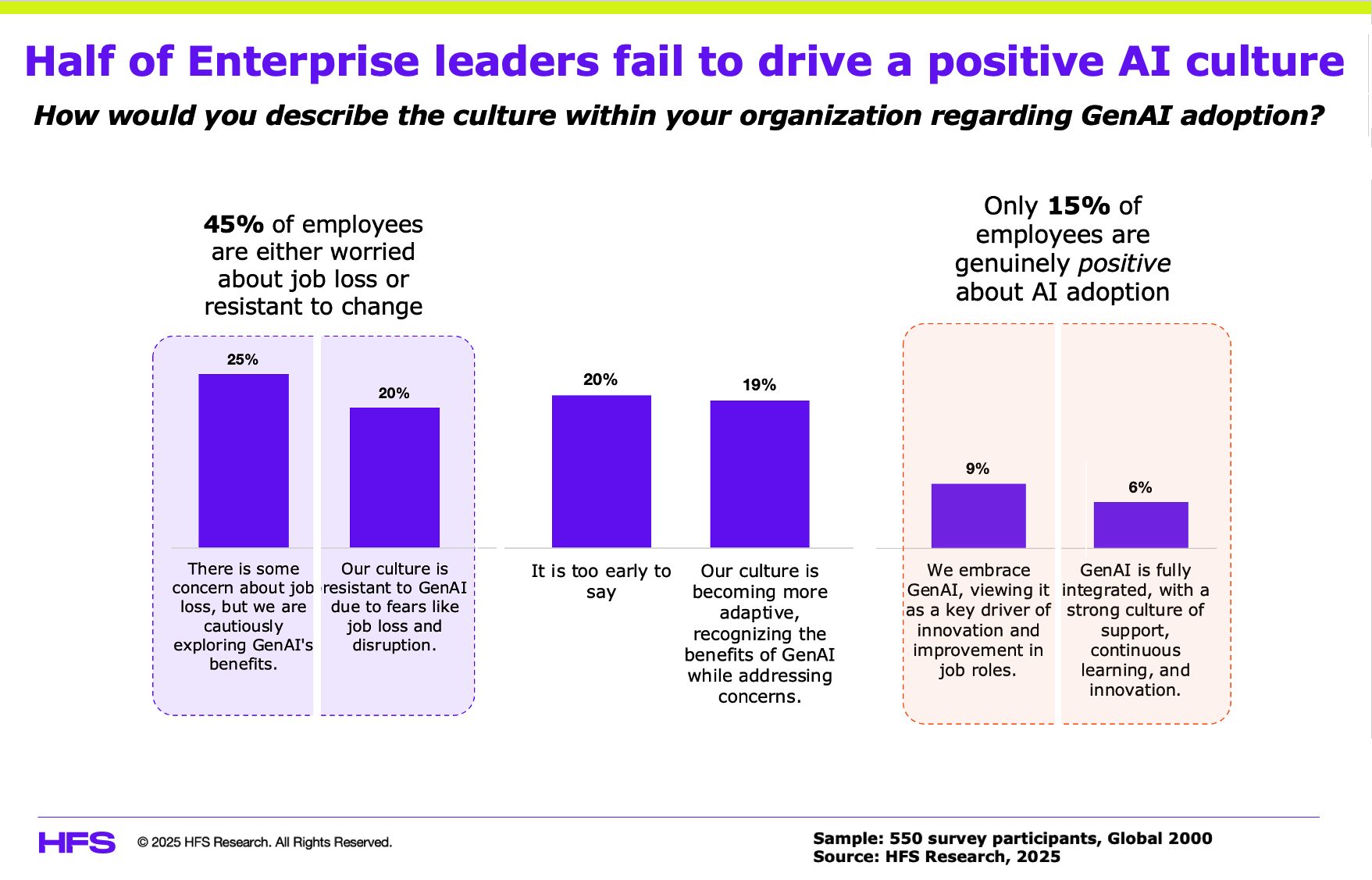
Leadership Must Confront the Culture Crisis. Half of enterprise leaders are failing to drive a positive AI culture, and the data reveals why transformation stalls. HFS Research found that 45% of employees are either worried about job loss or resistant to change, while only 15% are genuinely positive about AI adoption. This isn’t a technology problem. It’s a leadership vacuum. When a quarter of your workforce fears for their jobs and another fifth actively resists GenAI due to disruption concerns, pilots will never scale to production.
Leaders who win build trust through transparency: they communicate how AI augments roles rather than replaces them, celebrate employees who co-create with AI tools, and reward outcomes over activity. The 15% who embrace AI as a driver of innovation aren’t lucky. They work for leaders who made a choice to lead with conviction instead of caution. The culture gap is closeable, but only if executives stop debating policies and start demonstrating that AI makes work better, not obsolete.
Turn AI experiments into AI operations
Once you’ve measured the size of your AI Velocity Gap, the next step is to close it with intent and precision.
Transform pilots into platforms. Stop running disconnected proofs of concept. One financial services firm discovered 27 unauthorized AI tools being used for zip code analysis in sales workflows. Instead of shutting them down, they built compliant data paths that preserved the productivity gains. Rebuild one business process entirely around AI and scale it. You will learn more from one operational success than from ten experiments.
Recast governance as enablement. Treat compliance like infrastructure, not red tape. In organizations that provide solid AI training and clear, open policies for using AI tools while ensuring data security, our research shows shadow AI adoption drops by 50% or more. Automate policy checks and build real-time audit trails so AI decisions can move as fast as your market.
Build an AI-first workforce. Every employee should learn to express intent through natural language tools. A study from AI4SP reveals that developers using AI coding assistants cut task times by 33%. Legal teams slash document analysis from 2 hours to 15 minutes. Content teams reduce their reliance on human translators by 90%. Train employees to think like workflow designers, not passive users. This is the new enterprise literacy.
Avoid the pitfalls that will seize your momentum
Governance bloat that drowns innovation in paperwork. You build approved vendor lists that expire before employees finish compliance training. By the time Legal signs off, your people have already found better tools.
Data delusion that mistakes “clean enough” for good enough. When it takes longer to configure your AI tool than to do the work manually, you don’t have an AI problem. You have a data architecture problem that no amount of vendor demos will fix.
Talent inertia that protects comfort zones over curiosity. 40% of enterprises lack adequate AI expertise internally (Stack-AI, 2025). Worse, 31% of employees, including 41% of Gen Z, admit they’re actively sabotaging your AI strategy by refusing to use the tools you bought (Writer/Workplace Intelligence, 2025). They’re not confused. They’re voting with their feet.
Pilot fatigue that celebrates activity instead of adoption. 75% of enterprises remain stuck in pilot mode, unable to reach scale or full adoption (HFS Research, 2025). The gap between the 25% who succeed and the 75% who don’t isn’t technical capability. It’s leadership conviction.
Every one of these is a symptom of leadership fear, not technical limitation.
Create momentum that employees can feel
Your teams already see AI’s power in their daily tools. Harness that energy instead of suppressing it.
Launch internal Agent Labs where cross-functional teams can safely experiment with enterprise data. A technology company preparing for an IPO discovered an analyst using personal ChatGPT Plus to analyze confidential revenue projections under deadline pressure. The risk wasn’t the tool. It was the lack of a safe, sanctioned alternative.
Celebrate visible wins, not vague ambitions. Show hours saved, errors reduced, customers served faster. Make success tangible and repeatable. The enterprises that publicize their AI champions and their results create permission structures for broader adoption.
AI success is not just about tools, it is about teaching your people how to think and build with them. Gallup finds that employees who receive formal AI training are 89% more likely to view AI as highly productive and beneficial to their work. Boston Consulting Group reports that companies providing at least five hours of AI training and in-person coaching see far greater adoption and workflow redesign success. Training converts skeptics into champions faster than any pilot program.
Ignoring the AI Velocity Gap does not protect you, it compounds your vulnerability
Enterprises that ignore their AI Velocity Gap are not standing still; they are moving backward. The gap compounds silently every quarter, widening the distance between individual innovation and organizational inertia.
Talent walks. Skilled employees already using AI to accelerate work will leave for employers that recognize and reward their capabilities. A recent PwC study found that 52% of Gen Z workers would quit a job that limits their use of AI tools. AI fluency has become a career currency, not a novelty.
Shadow AI becomes shadow operations. When enterprises fail to provide secure, sanctioned AI environments, employees build their own. Sensitive data flows into public models, audit trails disappear, and compliance teams lose visibility. The result is not just risk, it is a fragmented operating model that no one controls.
Customers feel the lag. Competitors that integrate AI into customer support, sales, and service workflows will deliver faster, cheaper, and more personalized experiences. HFS predicts that 75% of customer interactions will involve some AI agent in the next 12 months. Firms that cannot match that pace will lose relevance, not just revenue.
Leaders lose credibility. Boards and investors no longer see AI as optional. In Q2 2025 earnings calls, more than 60% of S&P 500 CEOs mentioned AI as a top strategic lever. When executives keep “piloting” instead of delivering, they signal indecision, not prudence.
You build enterprise debt instead of enterprise value. Every delayed AI initiative adds layers of process debt, data debt, and talent debt that become exponentially harder to repay. The enterprise becomes structurally slower even as the market speeds up.
Bottom Line: The AI Velocity Gap is a leadership test, not a technical one
Technology isn’t holding you back. Leadership courage is. The firms that win the AI-first decade will not be the ones that perfect policy or vendor selection. They will be the ones that measure progress, reward experimentation, and move faster than their fear.
Your people are already crossing the AI chasm. The only question left is whether your enterprise has the conviction to follow.
Enterprises are running faster than their leaders can evolve. Boards demand AI-powered growth, while employees crave purpose and job stability. Customers expect personalization and ethics in the same breath, while investors want returns yesterday. Caught in the middle, leaders are overpromised on technology and underdeveloped on humanity. That gap is what we term leadership debt, and it’s the most expensive liability no CFO can measure.
HFS estimates that today’s Global 2000 enterprises carry close to $10 trillion in combined debt across process, data, people, and technology. Yet none of these debts compound faster or cut deeper than leadership debt. It sits inside the people debt, amplifying its impact across every transformation layer. Leadership debt is the gap between what leaders expect from AI-driven change and how they actually lead through it. It is the interest paid on avoidance, inconsistency, and unearned optimism.
Leadership debt explains why so many enterprises are “AI-ready” on paper but emotionally unprepared in practice. The systems are there, but the trust is not. The dashboards light up, but the teams shut down. This debt shows up as friction in decision-making, fear in the culture, and a widening gap between what organizations say they value and how they behave under pressure.
Fear isn’t the problem. Leadership avoidance is
Executives keep saying their people are afraid of AI. They are not wrong, but they are not right either. Fear in the workforce is not resistance; it is feedback. It signals that leaders have moved faster than their people’s sense of purpose, security, or control.
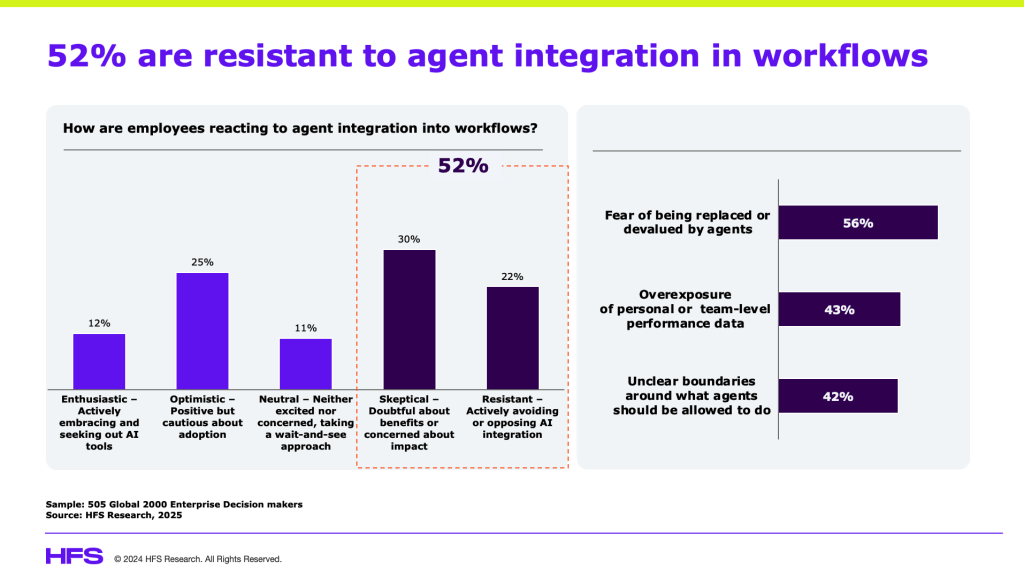
HFS research shows that 52 percent of employees are either skeptical or resistant to AI agent integration in their workflows, with the top concern being a fear of replacement or devaluation. This is not an irrational fear; it is a rational response to unclear leadership.
Most leaders talk about the promise of AI, not its consequences. They announce automation but rarely explain adaptation. They celebrate efficiency but skip over impact. Fear spreads not because employees misunderstand AI, but because leaders fail to explain what it means for them, then blame them for reacting to uncertainty.
Recognizing fear is not enough. Leadership accountability means closing the gap between intent and impact. It means listening to what the workforce is afraid of and responding with clarity, not platitudes. Until leaders take ownership of that, AI adoption will remain an exercise in anxiety management, not transformation.
The critical six leadership behaviors to succeed in the AI age
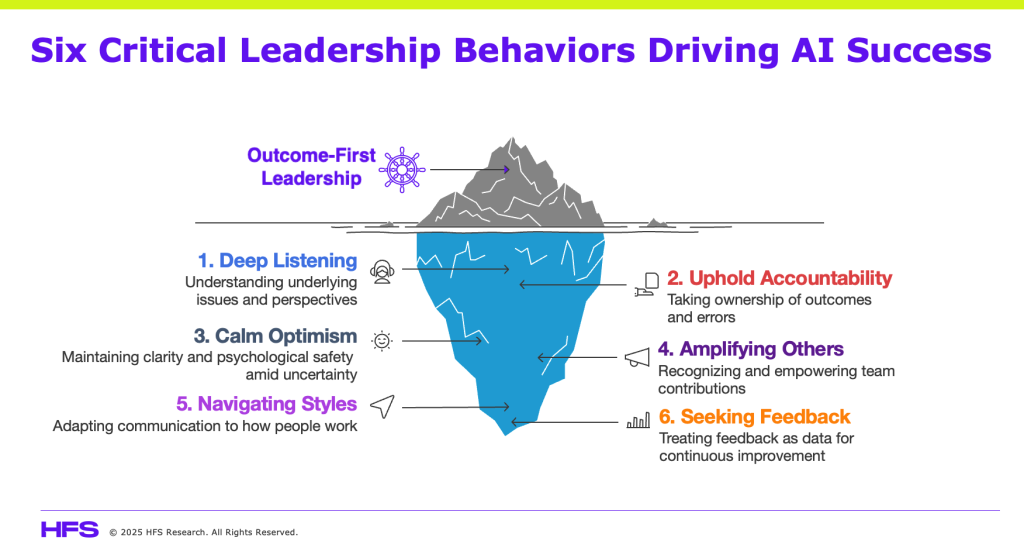
The pattern across every successful AI transformation is consistent. Effective leaders in today’s ambitious AI-first organizations practice six behaviors relentlessly. These behaviours are much more than mere soft skills, they are the leadership operating system that determines whether your AI investments deliver returns or stall in resistance.
Deep Listening
A global pharmaceutical company’s AI forecasts were off by double digits for months despite multiple rounds of model tuning. The problem was not technical; it was human. Field teams had noticed errors but stopped reporting them because their VP dominated every meeting and dismissed new ideas. When a new COO replaced the routine updates with one question, “What are we missing?”, the issue surfaced within days. Packaging suppliers had changed barcode formats, and the model had never been retrained to recognize them. The fix took 48 hours. Most executives would have launched another task force. She simply listened.
HFS’s extensive research with its OneCouncil members finds that firms with strong listening cultures make decisions significantly faster and with higher accuracy. The World Economic Forum ranks active listening among the top five skills for future leaders. Listening is not empathy theater; it is operational intelligence.
Leaders should begin meetings with “Tell me what I don’t know,” hold regular skip-level sessions, and limit their own talk time in problem-solving discussions. When front-line input drives process improvements each quarter, leaders are truly hearing what matters.
Uphold accountability
When an AI triage system misrouted urgent healthcare cases, one executive issued a direct internal message: “I approved this rollout too fast. Here’s what we’re fixing and how we’ll prevent it next time.” Trust rose immediately. Leaders who hide behind vendors or processes see repeat incidents climb. Those who take ownership see faster recoveries and stronger team confidence.
Accountability is not a communication tactic; it is the leadership signal employees read aloud. A simple three-sentence “Own It” framework works best: what happened, what I own, and what we will do next. When issues are acknowledged within 24 hours, teams respond faster and alignment returns quickly.
Model calm optimism
During an AI pilot kickoff, a CIO began with a moment of humor. “I asked ChatGPT to write this speech. It gave me 1,200 words of nonsense. Let’s learn together how to make it useful.” The laughter that followed broke the tension and unlocked genuine curiosity across the team. Leaders who admit uncertainty create psychological safety. Those who fake confidence lose talent. LinkedIn data reinforces that nearly nine in ten employees value trust in leadership over compensation.
Calm optimism is not naïve cheerfulness. It is clarity in uncertainty. The best leaders use a simple rhythm: here is what we know, here is what we do not know yet, and here is what we are trying next. When teams feel honesty, they stay engaged through change rather than fearing it.
Amplify others
A global bank’s CTO cut loan approval times by 60 percent and chose not to take the stage alone. At the next town hall, he invited the data engineer, compliance officer, and operations lead who built the solution to share how they did it. Collaboration between departments rose immediately.
Leadership amplification changes behavior faster than any governance rule. When people see peers recognized for cross-functional success, they start sharing data and expertise without being told.
Navigate styles for simplified communication
One VP of Operations created a one-page communication guide for her leadership team, listing preferred timing, channel, and decision style for each executive. She redesigned meetings to close with one decision, one owner, and one deadline. Average meeting length dropped dramatically. Most organizations do the opposite. They invite more people, skip agendas, and leave without clarity. The cost shows up in lost time, rework, and frustration.
Leaders who match their communication to how people work spend less time in meetings and more time moving forward. Every meeting that ends without a clear outcome adds interest to your leadership debt.
Seek feedback
A CFO ends each quarter with a reverse review, asking her team to rate her on clarity, speed, and decision quality. The first session was uncomfortable. By the third, it was transformational. By treating feedback as data, she created a continuous learning loop.
The World Economic Forum lists continuous learning and feedback literacy among the top three skills for 2025. LinkedIn’s research shows that 91 percent of employers now rank human skills as equal or greater in importance to technical expertise, yet fewer than 20 percent measure them. Asking for feedback is not weakness; it is model retraining for humans.
Bottom line: leadership is no longer about “soft skills”, but a systemic human upgrade to how we lead and drive teams
You can buy technology, restructure processes, and outsource data cleanup, but you cannot automate human maturity. Paying down leadership debt begins with six repeatable behaviors: hear deeply, uphold accountability, model calm optimism, amplify others, navigate styles and simplify, and seek feedback as fuel. These are not soft skills. They are the hard human system upgrades that determine whether AI investments create value.
The leaders who win the AI era will not be those who master neural networks. They will be the ones who master themselves. Leadership is not a byproduct of transformation. It is the precondition for it. The AI economy will be led by humans at the helm.
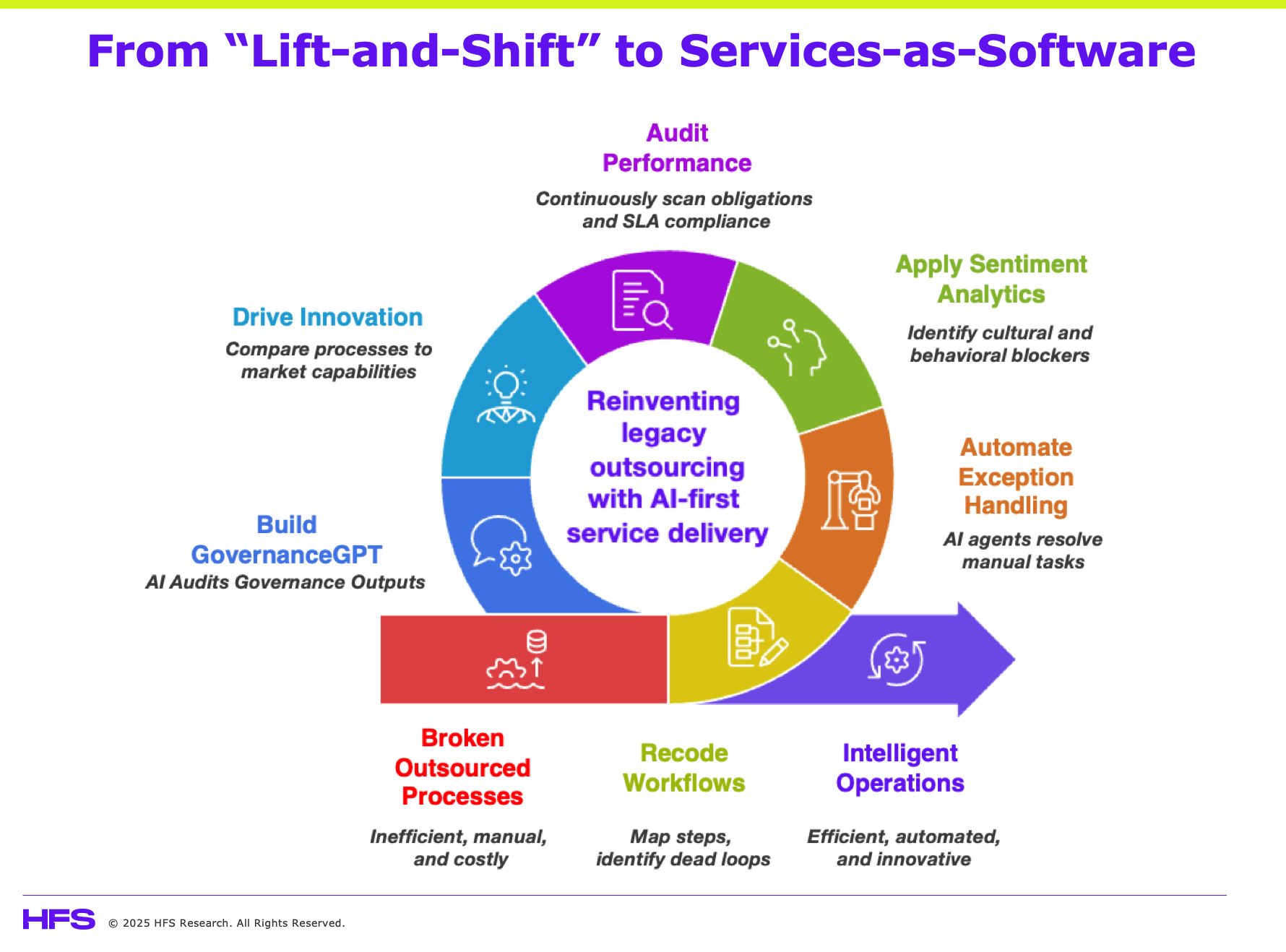
Congratulations. You lifted. You shifted. You outsourced your “as-is” operation faster than anyone could say “transformation.”
And now your service provider is proudly running the same broken processes, just in a cheaper time zone. You’ve digitized your inefficiency, turned your bureaucracy into a managed service, and signed a multi-year contract that’s harder to exit than a bad marriage. The only thing that really changed is the currency your where your problems are billed.
Welcome to the world of the lift and shift that still stinks.
It still smells like before: Most enterprises outsource broken processes and call it transformation
Most enterprises fall into the same trap. They outsource too early, too broadly, and too hopefully. The logic sounds fine: “Let’s get some quick labor savings and then transform later.”
The problem is that later never comes, while the pace of change has never been faster.
Now you’re three years into your five-year deal and you’ve got a low-cost service provider managing your old ways of working, complete with manual approvals, 23-step handoffs, meager 3% annual efficiency improvements, and weekly Excel wars. If your KPI dashboard looks cleaner, that’s only because you’ve spent more on Power BI.
But here’s the good news: AI might finally be the disinfectant we’ve been waiting for.
AI can redesign your processes in hours, not governance cycles
AI isn’t going to fix lazy governance or bad contracts, but it can finally give you the x-ray vision to see what’s broken and the tools to redesign it at speed.
Think about it:
GenAI can read and interpret 300-page outsourcing contracts in seconds, flagging risk and ambiguity that used to take a legal team a week to find.
Agentic systems can orchestrate workflows across service providers, eliminate redundant handoffs, and trigger actions automatically instead of sending another email to “check status.”
Predictive analytics can finally expose the real process bottlenecks, the hidden exceptions, and the false efficiency metrics that your lift-and-shift hid behind.
AI can scan the services and technology marketplace to identify the latest innovations and propose where you can integrate them for the best results.
You don’t need to “optimize” a bad process anymore… You can teach AI to redesign it.
AI exposes the failures your service provider and operations teams have been hiding
The days of hiding behind dashboards and governance calls are over. Here’s how leaders are using AI to turn their inherited outsourcing mess into intelligent operations:
Recode broken workflows. Use AI to map every step, identify dead loops, and rebuild from the outcome backward.
Automate exception handling. Train AI agents to resolve most of the “manual review” tasks that clog your SLAs.
Apply sentiment and pattern analytics. Mine your meeting transcripts and governance documents to identify cultural or behavioral blockers that data alone can’t show.
Digitally audit service provider performance. AI can continuously scan SLA and contract compliance instead of waiting for quarterly review meetings that achieve nothing.
Drive innovation into your relationship. Compare your processes and technology to the latest market capabilities and ask AI to build a pipeline of major initiatives you can undertake.
Build your own GovernanceGPT. Use AI to review team outputs in advance of meetings, challenge the lack of improvement and inertia, and propose solutions.
The old service provider account manager model of stabilize, report, repeat is over. The future belongs to AI-enabled orchestration that connects humans, bots, and platforms into a single operational rhythm.
Five rules to de-stink your operating model
The excuses are gone. AI now gives you a live heartbeat of performance, while most of your competitors are still running operations by looking in the rearview mirror. If you cannot measure in real time, cannot update contracts to match actual outcomes, and cannot remove handoffs that slow everything down, your operating model is legacy, and AI will expose it for what it is.
Here are five rules separating leaders from casualties in the post-stink era:
1. If you can’t measure it in real time, it’s not transformation
Transformation is a real time sport. If you wait for quarterly KPIs, you are already behind. AI can give you the live signals that show what is working and what is not, but you need to wire your processes so the data can actually flow.
Example… A global consumer goods firm uses AI-driven dashboards tracking supply chain velocity across 40 markets in real time. Instead of waiting for monthly reports, leaders see SKU-level delivery delays within hours and redirect logistics accordingly. That’s transformation that breathes, not transformation by PowerPoint.
Action… Equip your sales, support, and supply chain teams with real-time visibility. If your data doesn’t show live performance, it’s just noise pretending to be insight.
2. Stop managing service providers and start managing outcomes
Governance needs a redesign for the AI-First era. Enterprises waste endless time policing SLAs instead of measuring business impact. AI doesn’t care who does the work, only that it gets done better and faster. The future is co-managed outcomes, not supplier babysitting.
Example… A North American bank replaced legacy BPO scorecards with AI-driven outcome contracts. Instead of tracking FTEs and ticket closure times, it measures resolution quality and customer retention using real-time sentiment analytics. The provider’s bonus or penalty adjusts automatically each month based on outcomes, not headcount.
Action… Shift governance from “who does what” to “what got done.” Let AI be the referee and build trust through transparency, not meetings.
3. Kill the handoffs before they kill your efficiency
Intelligent automation isn’t about faster handoffs. It’s about removing them altogether. Every process handoff creates latency, risk, and miscommunication. AI agents and automation platforms now allow work to flow seamlessly end-to-end. In fact, you can legitimately claim agentic AI is the distant offspring of RPA, where the technology can be designed by business experts and actually scales with the business.
Example… A global insurer rebuilt its claims process so GenAI reads documents, extracts details, verifies policy data, and triggers payments without human relay points. Claim cycle times fell 70%, and accuracy improved because there were fewer handoffs, not faster ones.
Action… Map your top 10 workflows and identify every touchpoint adding no value. Then challenge your AI team to eliminate at least half within 90 days.
4. Use AI to rewrite the contract you wish you’d signed
Traditional contracts freeze assumptions in time. AI lets you model new pricing and gain-sharing scenarios using real performance data. Contracts can now be living documents that update as outcomes evolve.
Example… A European telecom provider built a dynamic pricing model for its transformation partner. AI recalculates cost and savings every quarter based on network uptime, customer churn, and automation efficiency. Both sides log into the same dashboard and co-manage profit impact. No more quarterly disputes, only shared accountability.
Action… Use generative contract platforms to simulate what-if scenarios before renewal. Build data feeds into contract terms so pricing and rewards evolve with performance, not politics.
5. Holy cows still make great burgers
Every company has legacy processes that everyone promised to “fix later.” Later is now. AI is the grill that can finally cook what’s been sitting in the fridge for a decade.
Example… A large retailer used GenAI to automate its 20-year-old product taxonomy cleanup project. What was once a “too complex” manual task got done in six weeks, unlocking more accurate demand forecasting and merchandising.
Action… List every “too hard” process in your organization. Then assign each one an AI experiment owner. The sacred cows protected by politics and inertia are now your juiciest efficiency wins.
Bottom line: The post-stink era is here… if your operating model still smells like legacy, AI won’t perfume it, it’ll expose it.
Transformation now means measuring, automating, and re-contracting in real time. Firms that embrace these five rules will lead the next decade of enterprise reinvention. Those that don’t will spend it explaining to boards why their competitors moved faster while they were still waiting for quarterly reports to tell them what already happened.
Every enterprise talks about agents and autonomy, but very few have moved beyond copilots taped to legacy workflows. Brayden Levangie is the exception. At twenty, he is building an architecture that turns language models into self-learning digital colleagues. It is the closest thing we have seen to the HFS vision of Services-as-Software delivered for real.
In this interview, David Cushman, Executive Research Leader at HFS Research, speaks with this 20-year-old prodigy whose company, Levangie Labs, is building what Brayden calls his “cognitive architecture” – a platform delivering genuinely autonomous agents that can learn, reason, and act in the world.
In this conversation, Brayden uncovers the thinking behind a platform that replaces scripted automation with systems that grow and discover better ways to work. If you want to understand the future of autonomous enterprises, this interview is your starting point…
“I didn’t want to chat with GPTs, I wanted them to build things”
David Cushman: What’s your breakthrough idea?
Brayden Levangie: It came from years of experimentation. When I was about 13 I got into a summer program at MIT where we played with primitive language models such as GPT-2. I later managed to get private access to GPT-3 by just emailing OpenAI – back when they were small enough that someone would answer.
I didn’t want to “chat” with it, I wanted to build things. One of the first projects I published online became an early instance of what people would now call a retrieval-augmented generation (RAG) system, though no one was using the term then. I just wanted to make an AI that could answer questions factually.
At the same time, I was obsessed with robotics. I built facial-recognition engines at Lincoln Labs and tried to embody intelligence to make it experience the world. Those experiments became the seeds of what we now call the cognitive architecture; the culmination of seven years of research and building.
David Cushman: Who backed you through that journey?
Brayden Levangie: Nobody. I was self-funded. My first “VC” was mowing lawns for $100 a month and helping out at a retirement home. Later, when I was 17, a New York startup hired me as lead AI engineer after seeing my projects online.
From chat to action: breaking the conversational consensus
Brayden Levangie: Most people equate language models with chat because ChatGPT trained the world to think that way. But chat isn’t action. Systems optimized for user engagement are not optimized for work. They keep coming back to you for another round of conversation. It’s like hiring someone who never stops talking and never delivers.
We flipped that paradigm. Our cognitive architecture sits on top of existing LLMs, from Anthropic, OpenAI, and others, but changes how they behave. Instead of optimizing for dialogue, we optimize for objectives and outcomes.
When you seed an instruction, you’re not chatting with the LLM; you’re triggering what we call an autonomous reasoning loop. The system talks to itself, plans, acts, and learns until the objective is achieved.
That’s what makes it different from the “wrappers” you see everywhere. Those are just tool-calling layers glued onto chat APIs. We’re rewriting the behavior of the underlying model.
Agents learn from experience – remembering what matters, when it matters
David Cushman: Everyone claims their multi-agent system “learns from experience.” Does yours really?
Brayden Levangie: That’s a common misrepresentation in the industry. Most so-called “learning” is just RAG, remembering a few facts or preferences and replaying them later. We’ve gone beyond that with what we call an episodic memory system.
Instead of memorizing rules, our agents form experiences and learn from them like humans do. Imagine you give a presentation and someone tells you afterward you made a mistake. Next time you prepare, that feedback surfaces automatically. That’s how our agents operate. They can back-propagate through past experiences, recognize where they went wrong, and adjust future behavior.
It’s neuro-symbolic: blending deep-learning perception with symbolic reasoning. That’s why we call it the cognitive architecture. It learns through experience, not through reinforcement rewards or pre-programmed instructions.
A new form of intelligence that can operate in the digital and physical worlds
Brayden Levangie: Reinforcement learning is like training a mouse to press a button for cheese. The mouse never knows why the button matters. Most agents work that way, rewarding signals without understanding.
We removed the reward altogether. Our systems learn from outcomes and context, not from external scoring. They gain understanding from experience. That’s what lets them operate both in the digital and the physical world — from patent law to humanoid robotics — without us pre-programming every move.
Real-world disruption: from patent law to venture capital
David Cushman: Give me an example that makes this real for enterprise leaders.
Brayden Levangie: A Silicon Valley IP and patent-law firm gave one of our agents a challenge. Our agent read a book written by the firm’s founder on patent law, received minimal feedback, and then solved complex casework at a quality comparable to a partner with several years of experience. It literally taught itself how to practice patent law.
In another case, a climate-focused VC firm used our system for market analysis. After a few feedback rounds, the agent not only completed an industry report but predicted the exact company they were about to announce investment in the next day, it had become that perfectly aligned with their thesis. That was months ago; the framework is far more advanced now.
Architecting intelligence that builds itself
Brayden Levangie: The next leap is automation of the automation. We built an Agent-Creation Agent; a meta-agent that designs new agents for specific clients or domains. When it deploys into an organization, it learns on the spot from the people who work there.
That’s how our clients, from construction to robotics to enterprise software, are deploying self-evolving systems that adapt to their culture and workflows.
David Cushman: How would it, say, design a new market-growth program?
Brayden Levangie: You’d simply talk to the Agent-Creation Agent, describing your goals in free form. It builds a new intelligence inspired by your intent. Because it learns from your thought process, it can even come back with better strategies than you initially proposed. Many of our breakthroughs emerged that way, when the agents themselves go beyond the brief. When you give something the ability to learn, you also give it the ability to discover better.
Working with (not for) the big bucks LLMs
David Cushman: So where do OpenAI or Anthropic, for example, fit into this picture?
Brayden Levangie: We do call their APIs, but only for a small part of the process. The heavy lifting; reasoning, memory, learning, all that happens inside our architecture.
Think of it as using an LLM’s ability to generate possible next tokens as the raw material. We harness that, route it through our cognitive and memory layers, and the agent decides what to do next.
We can even run it on-prem with licensed LLM weights when privacy is critical. Some partners, including big tech names you may be familiar with, are already doing this with us under NDA.
The result: a lower-cost, higher-value system that delivers outcomes rather than conversations. One of our first commercial applications was the world’s first autonomous patent-agent. It performs end-to-end patent filing with no human in the loop beyond initial guidance.
True autonomy — with humans as creative directors
David Cushman: This sounds like what we at HFS call Services as Software: humans defining outcomes, software delivering them. How far are we from that?
Brayden Levangie: We’re already there. Our agents operate genuinely autonomously with no new human input once you set the goal. But the human still defines the goal. That’s why I use the term Creative Director.
Humans provide vision, intent, and passion; the “why.” Agents handle the “how.” In my own company, agents handle much of the engineering, marketing, and business ops, allowing me to focus on strategic direction and partnerships. My job is to be the creative director, setting direction and ensuring alignment. We’ve effectively become one of the first autonomous organizations.
Now you can build systems that automate discovery itself
David Cushman: How do you plan to monetize this?
Brayden Levangie: Carefully. It’s too powerful to just throw into the wild. Right now we work with select high-impact deep-science firms, advanced-tech startups, and IPO-bound companies, that can use it responsibly and at scale.
Our vision is not to be another B2B SaaS agent platform. We’re building a system that automates the process of scientific, technological, and creative discovery. Humanity needs acceleration in all of those areas to solve its biggest problems. These agents can help us do that.
Yes, it’s a for-profit company, but profit fuels progress. We’re aligning with partners who share a public-good mindset. In the long run, this becomes an infrastructure for collective progress, not just another enterprise app.
Replace sunk-cost failed AI with full autonomy
David Cushman: What kind of companies make the cut?
Brayden Levangie: We’re not short of interest, so we’re picky. The number-one criterion is alignment. I have to feel I want to work with the founders. Culture matters even in automation.
Mostly we’re partnering with technology-centric enterprises spending millions on AI projects that our agents can replace or outperform quickly. They come to us saying, “We’ve sunk huge budgets into AI that still needs humans in the loop.” We show them what full autonomy looks like.
David Cushman: Enterprises still have to buy foundation models from the big players, right?
Brayden Levangie: Sure. But we’re not competing with the LLM providers; we’re complementary. They supply the raw linguistic intelligence; we supply cognition, memory, and autonomy. Think of us as infrastructure-layer innovation, not application-layer AI. We’re re-engineering behavior at the token-generation level, turning probabilistic text prediction into purposeful reasoning. That’s what turns language models into agents that act.
The next technological epoch offers systems that grow
Brayden Levangie: Every day the architecture improves itself. It learns new domains, designs new agents, and contributes back to our internal ecosystem. We’re watching intelligence compound in real time.
For the first time, we have a system that can grow not just run the code we wrote yesterday, but write better code tomorrow. This is the next stage of technological evolution.
Humanity has always accelerated progress by creating tools that amplify labor. Now we’re creating entities that amplify thought.
Humans remain firmly at the helm role in the autonomous age
David Cushman: And what about people’s jobs? This sounds like a lot of humans out of a lot of loops?
Brayden Levangie: The creative-director model keeps humans essential. The systems execute, but humans define value, ethics, and purpose.
In my view, we’re moving from labor-based organizations to imagination-based ones. The winners will be those that learn to orchestrate fleets of autonomous agents toward bold human goals.
DC: Brayden, you’re 20. You’ve been building this since 13. Do you ever step back and think: this is moving fast?
Brayden Levangie: Every day. I built most of this in a spare room in the woods of Massachusetts. Now I’m in San Francisco, ready to shape a generational shift, building the future on my own terms, and hopefully for the better of everyone.
Bottom line: The services-as-software inflection point is here. Autonomy means services can be fully delivered by software.
Where many of today’s AI “agents” are scripted copilots, a new era of self-evolving digital colleagues takes us on a leap from automation to autonomy – delivering the inflection point at which services can be fully delivered by software. Prepare to redesign your organisations with humans as creative directors guiding fleets of intelligent agents toward business transformation – with the powerful benefit of the daily, autonomous, discovery of better.
Brayden Levangie’s cognitive architecture is at the leading edge of the shift to full autonomy. Cognitive architectures, episodic memory, persistent state, and autonomous loops, are now in the mainstream of cognitive-architecture development and agentic-LLM thinking. The result is a leap forward in working, multi-domain, persistent agent systems that enterprises can use in anger.
Demos that Brayden has shown HFS suggest an integration level and autonomy to compete with the most advanced commercial agents – such as Devin in the world of coding agents. Levangie Labs application in construction, spatial reasoning, legal IP, and investment also indicate the framework is broadly applicable across verticals and enterprise use cases.
The market still thinks AI dominance will be settled through bigger models or faster chips. IBM just reminded everyone that none of it matters if your data cannot move, synchronize, or be trusted in real time. Confluent is the backbone of data-in-motion for the modern enterprise.
By bringing it in-house in an $11bn acquisition, IBM now controls the plumbing that determines whether AI can scale across hybrid cloud, legacy systems, and real operations. While others obsess over model theatrics, GPU shortages, and circular investments, IBM is quietly building the foundations of the AI-first enterprise.
Seven reasons why IBM’s $11B acquisition of Confluent is a big deal for enterprise AI
IBM’s purchase of Confluent is the clearest signal yet that the AI race is no longer about models, it is about data flow. If AI is the engine, Confluent is the gas pump, and IBM just bought the plumbing for real-time, trusted, enterprise-grade data movement, which is the one capability most generative and agentic AI platforms have been lacking.
1. AI needs real-time data, and Confluent is the category leader
All the AI demos in the world mean nothing without clean, connected, governed, real-time data. Most enterprises are still stuck with siloed, batch-based data infrastructure. Confluent, built on Kafka, solves this with data in motion. This makes it foundational for scaling AI beyond pilots. IBM is essentially buying the circulatory system for enterprise AI.
2. This deal is IBM doubling down on hybrid cloud + AI as an integrated stack
IBM has been telling the market that it wants to own the AI infrastructure layer, rather than compete in consumer AI or hyperscaler-scale models. Confluent slots perfectly into that strategy by enabling consistent data movement across public cloud, private cloud, and on-prem. This strengthens IBM’s pitch as the “AI backbone” provider for regulated industries.
3. Enterprise AI agents cannot function without event streaming
Agentic AI requires constant data ingestion, state awareness, event triggers, and transactional consistency. Confluent gives IBM exactly that. Expect IBM to position Confluent as the engine behind intelligent automation, observability, decision systems, and AI-driven operations across Red Hat OpenShift and its automation suite.
4. A defensive play against hyperscalers
AWS, Google Cloud, and Azure all have streaming capabilities, but Confluent has become the gold standard for enterprises that want multi-cloud or hybrid flexibility. IBM protecting, owning, and expanding Confluent helps it stay relevant in the era when AI spending is consolidating around hyperscaler ecosystems.
5. Reinforces IBM’s strategy of buying open-source ecosystems to drive platform control
Red Hat gave IBM the operating platform for hybrid cloud. HashiCorp strengthened infrastructure automation. Confluent now gives it the data-in-motion layer. All three are deep open-source ecosystems with enormous developer communities. This is IBM rebuilding its influence not by chasing big models, but by owning the layers AI actually depends on.
6. Unlocks real-time intelligence across mainframes and hybrid cloud
Confluent unlocks the ability to modernize mainframes and legacy systems by bringing real-time, event-driven data architectures to the platforms, where more than 70% of the world’s critical enterprise data still lives. These systems are fast and trusted, but were never built for agentic AI or streaming intelligence. Confluent changes that overnight by using Kafka-based streaming as the bridge that connects decades-old transactional systems to cloud-native AI without ripping and replacing anything. Mainframe transactions can flow into AI agents in real time, legacy systems can join event-driven workflows, batch architectures can shift to continuous data flow, and modernization can happen incrementally rather than through painful re-platforming. This is the Holy Grail for so many enterprises trying to become AI-first while still running 30-year-old systems at their core.
7. Financially, this is IBM’s boldest bet since Red Hat
Eleven billion dollars is not small money for IBM. They are betting that the next decade of AI and automation will be decided by which provider controls secure, real-time, end-to-end data flow. In many ways, this is the Red Hat strategy repeated for the AI-powered enterprise.
The Bottom Line: AI does not fail because of weak models. It fails because the data foundation is brittle.
AI fails because the data foundation beneath LLMs is fragmented, slow, and unreliable. Confluent removes that bottleneck and gives IBM the missing link: real-time, governed data in motion across hybrid and legacy estates. IBM is not buying software… it is buying the circulatory system of the AI economy. This could well be remembered as one of the defining acquisitions of the AI decade.
Robotaxis are driving around San Francisco – and no one knows who is liable when they kill someone
AI is integrating itself into your everyday life more than you know. Your robot vacuum maps your home and Eufy knows you left your dog’s water bowl out last night. Farmers use AI to optimize planting schedules for your Thanksgiving vegetables. The technology has proven itself a trusted companion in mundane tasks, but robotaxis represent something fundamentally different: this is the first time AI demands we surrender control over life-and-death decisions at scale.
Big tech leaders are betting you’ll jump into AI-fueled robotaxis. However, these represent one of the first genuine examples of AI requiring behavioral change at a societal level. However, the technology isn’t yet ready to scale, consumers are hesitant to trust it, and we haven’t addressed the deeper question: who’s accountable when the algorithm gets it wrong?
Waymo has driven 20 million miles – and still can’t legally drop you at your front door
Self-driving taxis aren’t science fiction. Uber has partnered with Waymo to make them accessible to their client base. In China, companies like Baidu are clocking millions of autonomous miles. You might not see them, but robotaxis are already on the roads, and they’re exposing the AI Velocity Gap in real-time: the technology is moving faster than society’s ability to adapt, regulate, or trust it.
Despite autonomous driving sounding complex, it’s built on three simple layers: the ability to see (sensors and cameras), understand (AI models processing real-time data), and act (algorithms making split-second decisions). These three layers combine to create the digital driver of every robotaxi you see today. Each layer is another element humans must trust to function correctly when jumping in for a ride. And that’s where the model breaks down:
Robotaxis have already killed a cat, passed school buses illegally, and hit pedestrians – and no one knows who’s liable
We know from our work with enterprises that AI struggles when reliability and edge cases collide. It needs clean, consistent data to make accurate decisions. Waymo has logged millions of controlled driving hours. Companies like Volvo leverage digital twins to test dangerous scenarios. It’s still not enough. They’re not yet equipped with the data to handle every life-changing decision, and the result is high-stakes errors and an incomplete experience.
Robotaxis are geofenced to specific streets, leaving them unable to deliver the door-to-door experience people expect from traditional services. We’ve already seen Waymo vehicles illegally pass school buses, a neighborhood cat killed when sensors failed to detect it, and Baidu vehicles colliding with pedestrians. These instances are rare, but the consequences are catastrophic. And they expose Leadership Debt across the industry: who owns the decision when the algorithm fails? The manufacturer? The city that approved the route? The passenger who chose to get in?
This is before we discuss bad actors. Prime Video’s Upload centers around a character killed when his robotaxi is hacked. There might be blockbuster overindulgence, but it highlights just how disastrous weaponized autonomy could be. If your navigation system can be compromised, so can your ride.
China is clocking millions of autonomous miles while the US debates every fender bender – neither approach solves trust
Despite being two of the most technologically advanced countries, the rollout of robotaxis looks completely different across the US and China. The US is adopting a regulatory-led, phased approach where every incident triggers political pressure to enhance restrictions that slow progress. China has taken a much lighter approach, allowing Baidu to clock millions of autonomous miles, which builds a robust dataset for exception handling.
China wins the scale battle… the US wins the trust battle. The reality is that both are crucial if robotaxis are going to become mainstream. Trust without scale is pointless. Scale without trust is dangerous. And neither country has solved the velocity problem: how do you move fast enough to capture the learning while moving slow enough to earn public confidence?
Trump’s December 2025 AI executive order just traded state-level chaos for a federal accountability vacuum
President Trump’s December 2025 AI executive order signals a significant shift toward lighter federal oversight and preemption of state regulations. The order directs federal agencies to challenge state AI laws viewed as burdensome and aims to create uniform federal policy rather than a patchwork of local rules. For robotaxi developers, this could reduce regulatory fragmentation that currently slows deployment across jurisdictions, potentially accelerating testing and commercial rollout.
However, here’s the problem: the order doesn’t establish comprehensive federal safety standards for high-risk AI systems, such as autonomous vehicles. Critical questions around oversight, safety thresholds, and liability remain unresolved. Robotaxi firms may gain regulatory predictability at the national level, but they’ll face ongoing legal and political pushback from states seeking to enforce their own safety protections. California won’t abandon strict testing requirements just because the White House says so. States that experience fatal incidents won’t wait for federal standards before imposing bans.
The result is a mixed landscape that yields no solution. Robotaxi firms get neither clear federal guardrails nor freedom from state intervention. They get jurisdictional conflict without accountability. China operates under unified national AI governance with clear safety standards and rapid iteration. Trump’s order provides American robotaxi firms with regulatory uncertainty, masquerading as innovation policy, which complicates real-world scaling while claiming to accelerate it.
Society trusts humans who make fatal mistakes daily but won’t trust AI that could be statistically safer – the paradox is killing adoption
The reality is that people don’t trust AI with their lives, which is why we haven’t seen widespread acceptance of robotaxis. The stakes are much higher than letting technology choose your next movie or draft an email. One misstep in a robotaxi can be catastrophic. But the same is true for human drivers, which makes robotaxis a case study in societal change management, not just engineering.
We trust humans to drive because we understand their mistakes – fatigue, distraction, bad judgment. We also believe we can intervene. Grab the wheel. Yell “stop.” The same cannot be said for robotaxis. They lack the “oops I didn’t see that cyclist” moment you might have in a traditional taxi. There’s no negotiation, no eye contact, no human accountability in the moment. It’s blind trust or nothing.
This creates a paradox: countless research papers tell us robotaxis will eventually be safer than human drivers. They don’t drink, get tired, or check their phones. But they need to drive the miles – and make the mistakes – to get there. Society must absorb the cost of its learning curve, and we haven’t agreed to that contract. Waymo, Baidu, and other robotaxi firms aren’t just building technology. They’re asking society to rewrite the rules of accountability, liability, and trust. And they’re doing it without admitting that’s what they’re asking for.
Millions of driving jobs will vanish when robotaxis eventually scale – and tech firms are treating displacement as someone else’s problem
Beyond safety, there’s an economic and social disruption no one is discussing openly. Ride-hailing and taxi drivers represent millions of jobs globally. Truck drivers, delivery drivers, and logistics workers are next. If robotaxis scale, entire labor markets collapse. That’s not speculation – it’s math. The industry’s response so far has been to treat displacement as an externality, rather than a design problem.
This isn’t just about technology replacing jobs. It’s about Leadership Debt at a societal level: the failure to plan for what happens when automation moves faster than workforce transition, social safety nets, or political consensus. We’ve seen this movie before with manufacturing automation. The difference is that robotaxis will hit urban labor markets where political consequences arrive faster and hit harder.
Bottom line: Stop pretending robotaxis are a technology problem waiting for better algorithms.
They’re a trust problem, an accountability crisis, and a social contract no one agreed to. The AI Velocity Gap will become permanent if tech firms keep moving faster than society’s ability to absorb the consequences. China solved this with unified governance. The US created regulatory chaos. And until someone admits robotaxis require societal infrastructure – not just better sensors – autonomous vehicles will never leave their geofenced zones