HFS Research has gone where no one has been before as we take a serious look at benefits outsourcing and expose how many of today’s providers still operate in the dark ages.
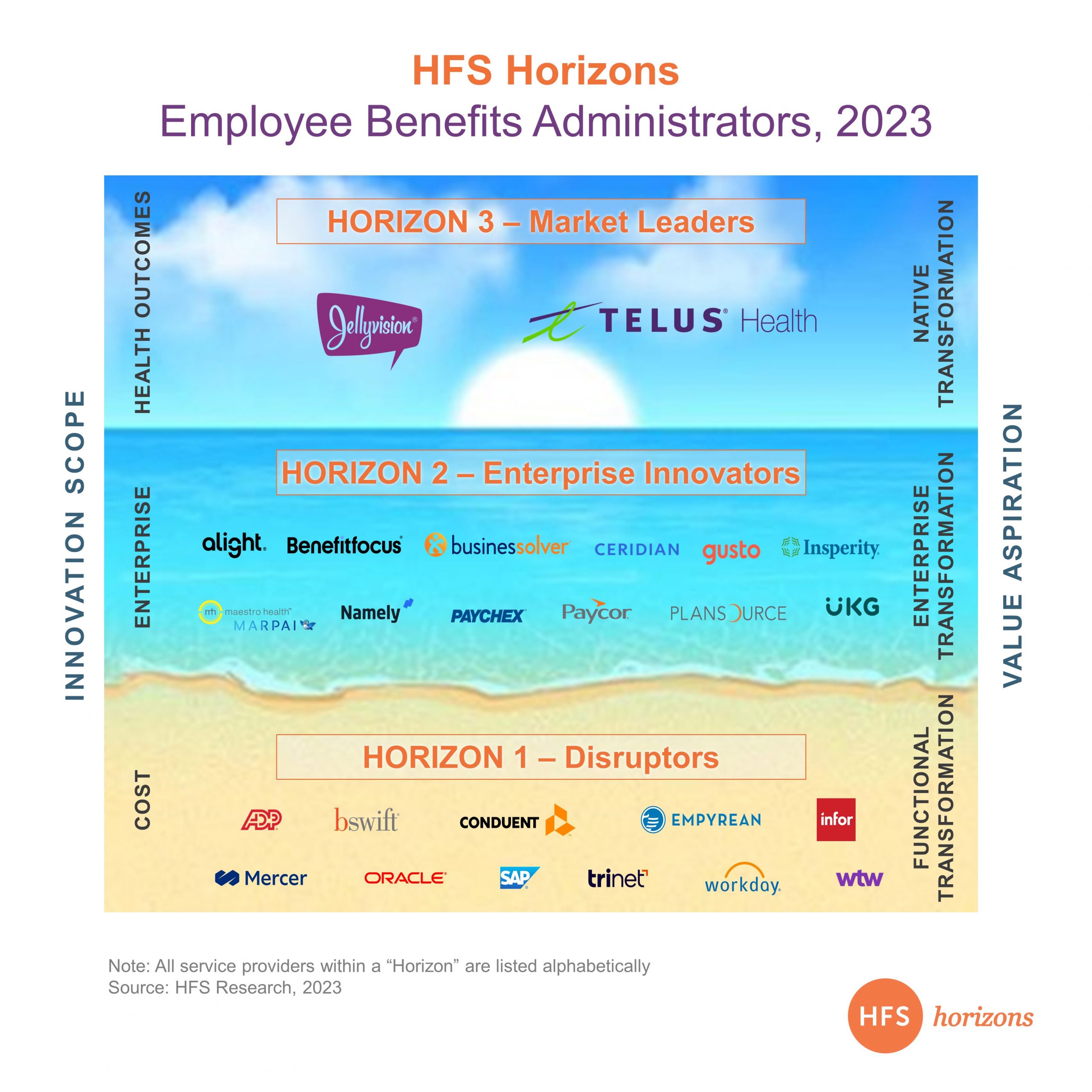
For our groundbreaking HFS Horizons: Employee Benefits Administrators, 2023 report, we evaluated 25 benefits administrators and service providers (see Exhibit 1) and interacted with 125 enterprises that contract with them. It’s the most extensive slate and comprehensive study on this industry yet. US healthcare is shifting: Employer medical underwriting surpassed commercial insurers, the aspirations of a post-pandemic multi-generational workforce continue to evolve, and the proliferation of technology is accelerating—yet benefits administration appears stuck in a legacy paradigm.
We evaluated the 25 benefits administrators for their ability to address the cost (Horizon 1), experience (Horizon 2), and health outcomes (Horizon 3) for employees globally.
Exhibit 1: Only two of the 25 benefits administrators and service providers addressed the triple aim of care: reducing costs, enhancing experience, and impacting health outcomes
Note: Service providers in each Horizon are listed alphabetically.
The multi-generational global workforce has constantly evolving expectations
Five generations coexist in the current workforce; they have distinct world views, varied aspirations, and different pandemic recovery strategies. Yet, when it comes to benefits—whether health (wellness and healthcare), wealth (financial planning and retirement), or professional (career and training)—there is an extraordinary bias toward a one-size-fits-all model. Employers and benefits administrators are guilty of not sufficiently investing in understanding their employees’ evolving needs and not reimagining how they address their health, wealth, and professional needs beyond traditional solutions.
Same old, same old
Many benefits administrators are satisfied with delivering the same set of services through the same modalities, year after year. The intrinsic apathy is befuddling, given that generational needs continue to evolve and remain unmet. According to the US Centers for Disease Control and Prevention (CDC), the US population’s life expectancy has regressed to 1996 levels—in 2019 it was 79 and now it is 76.1—and 60% of the population has a chronic condition such as diabetes, obesity, or hypertension. The Employee Benefit Research Institute (EBRI) indicated that in 2023, Americans’ confidence in retiring comfortably has declined. Given these deteriorating statistics, benefits administrators and employers must do more to address the deterioration in their sphere of influence and reimagine a paradigm to keep improvements sustainable.
A new generation of providers is leveraging technology to make a difference
Still, there is hope. A new generation of providers is leveraging technology to make a difference. Technology enablement is driven by a slow paradigm shift that engages employees, converts feedback into solutions, and measures outcomes beyond the tactical. These benefits administrators utilize data smartly and effectively to improve benefits utilization rates, track efficacy, and improve access. The proliferating mobile apps are becoming table stakes, while many firms are making usability a foundational capability to address experience gaps. The extensive use of technology impacts costs, though the underlying cost of benefits is slowing the progression of reducing costs materially.
The Bottom Line: The needs of today’s multi-generational global workforce require a new paradigm—a challenge benefits administrators must address immediately or be disrupted.
The HFS Horizons: Employee Benefits Administrators, 2023 report includes detailed profiles of each benefits administrator and service provider, outlining capabilities, strengths, provider facts, and development opportunities.
Danske Bank, a Danish multinational banking and financial services corporation founded in 1871, recently announced a new strategy to drive its cost-to-income ratio down to 45% from ~60% by 2026. A few weeks later, it announced the deal with Infosys for “digital and technology transformation,” including the sales of Danske IT, the Bangalore-based captive of Danske Bank that provides IT development and operations.
However, when you venture into regions like the Nordics, the whole premise of cost-to-value differs from deals in the US or UK, as it’s very expensive to displace people. So rather than basing the deal’s value on tangible cost takeout from onshore–offshore employee displacement, firms like Danske have to look to other metrics to justify the cost. Those metrics are tied firmly to the technology and talent (aka “digital”) capabilities Infosys can bring to the table to make Danske a more innovative, efficient, competitive—and ultimately profitable bank.
Danske Bank pivots with new “Forward ‘28” strategy and financial targets
Any enterprise that engages in a “big” outsourcing engagement, defined as $100 million+, does so for specific reasons. In other recent big banking, financial services, and insurance (BFSI) deals we’ve written about, such as Vanguard, State Farm, or Core Logic, the “why” is almost always a palpable need to modernize or risk irrelevancy—or at least minimize disintermediation. For Danske Bank, the “why” is less of a digital catch-up and more of a next-chapter strategy after settling its money laundering fraud debacle and implementing a massive overhaul of its risk and regulatory compliance protocols. 2023 is a new chapter, and Danske Bank is ready to move on with its new Forward ‘28 strategy and financial targets for 2026.
It has reaffirmed its focus as a Nordic bank with specific commercial, retail, and private banking propositions for Denmark, Norway, Sweden, and Finland. It has also unveiled revised financial targets, including a target 45% cost-to-income ratio and the resumption of dividend payments. The bank will execute its strategy by upping investments in digital platforms, advisory services, and sustainability from DKK 3 billion to DKK 4 billion (about $437 million to $584 million). This includes plans to further develop its customer-facing digital solutions and modernize its technology infrastructure to enable better customer experiences and drive operational efficiency. Infosys is a key piece of the execution strategy.
What is this “digital transformation” that improves cost-to-income ratios?
What does “digital transformation” actually mean to banks? There are thousands of answers, but one of the most succinct measures of digital impact is improved cost-to-income ratios.
This ratio simply shows cost as a percentage of income—literally, “How much does it cost to run the bank versus how much revenue is generated?” Digital transformation could impact both sides of this equation—driving new revenue and lower operating costs. The World Bank pegs the average cost-to-income ratio for all banks across 40 developed countries at about 60%. This stat has been remarkably consistent for about a decade.
In reality, there are three value levers to pull in a digital transformation engagement to create shareholder value, and Infosys will use them all:
1.) Better technology foundation. Modernizing core systems, automating broken processes, and moving activities into the cloud can significantly impact cost; less time is needed to oversee processes, legacy applications can be retired and consolidated, and leadership has better data upon which to base decisions. However, companies need to invest in consulting work and new technology to reap the longer-term rewards. Often a provider such as Infosys will apportion these costs over the duration of the contract so there is immediate “value” from the client end.
2.) Access to deep talent expertise at scale. When partnering with a firm like Infosys, by far, the largest lever to pull is the availability of tech and business support talent at much lower labor rates. However, the client would need to be able to offload onshore staff to offset with offshore, which can be problematic and costly, depending on the locations involved. For example, staff in the Nordics and Germany can only be removed at significant expense, but transitioning 1,400 India-based staff over to Infosys to manage and upskill should reap longer-term benefits for Danske.
Firstly, Infosys is vastly experienced at training staff on new technologies and domains, which should make the Danske dedicated “re-badged” staff more effective at their jobs. Secondly, Infosys will supplement Nordic talent with other staff worldwide to plug critical gaps in areas such as cybersecurity, cloud, and AI. Danske Bank emphasizes there are no planned redundancies as part of this deal.
3.) Ability to focus on the core. Danske can now pivot its whole approach to reinventing its banking operations to exploit the capabilities Infosys brings to the table; for example, the Infosys Topaz AI suite and the Infosys Cobalt cloud service set. Instead of being beset by old ways of doing things just to keep the IT wheels on and the regulators at bay, Danske can now focus heavily on achieving business outcomes through better technology deployment. This is where the “income” part of the equation is most impacted.
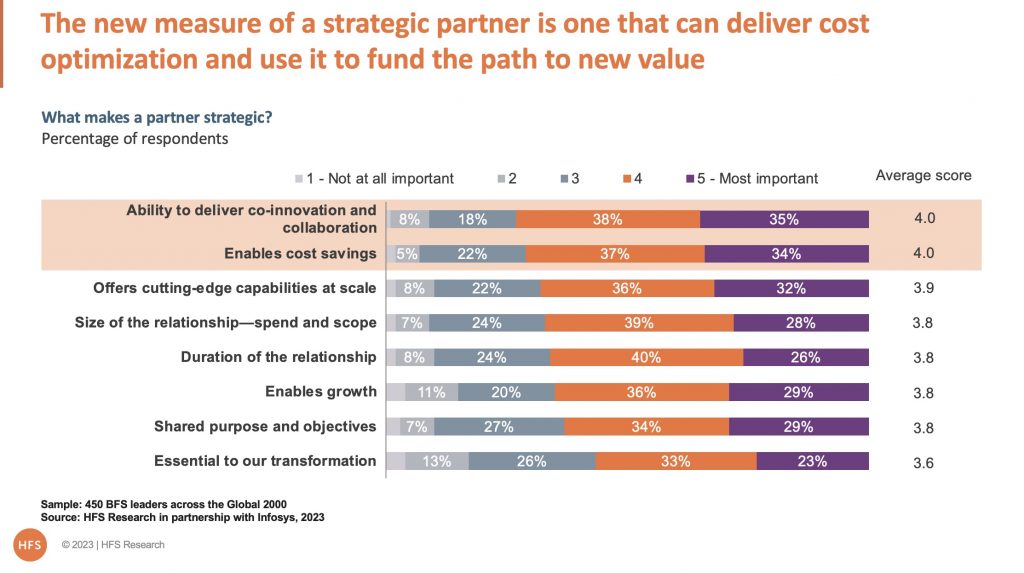
As illustrated below, the role of strategic IT and business process services firms continues to morph from cost takeout to an ambitious “and” proposition of cost and innovation to work to improve the cost-to-income ratios. It’s the combo pack that drives value.
The Bottom Line: Big transformation outsourcing deals could impact cost-to-income ratios by doing more than banging on the cost-take-out lever.
Congratulations to Danske Bank and Infosys on their new strategic partnership. Danske Bank has done a vital job defining its roadmap and key metrics for measuring its results. These same measures need to be considered in Infosys’ performance. While only the bank can control and drive cultural change, it must work closely with Infosys to drive cost efficiencies and applied innovation to impact cost-to-income ratios. This simple metric should have been dramatically reduced in all banks over the past decade, given the caliber and extent of digital investment. It has not, bearing out the fact that cost reduction alone is not enough.
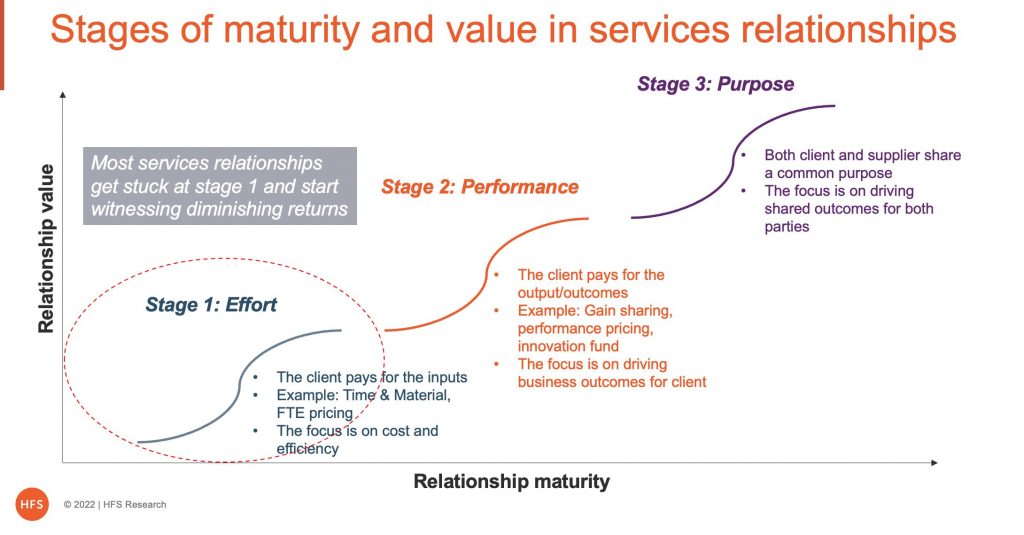
To conclude, clients and suppliers need to jump to a new S-curve of value creation where the client pays for the performance, not just the effort (See Exhibit below). Performance should be measured based on some attribute of business value, not just cost and efficiency, in this case a cost-to-income ratio.
Most services relationships get stuck at Stage 1 and start witnessing diminishing returns because you just cannot keep squeezing the lemon for more juice. In a performance-driven relationship, the supplier and client share the risk and reward while providing services at the lowest cost possible starts to become a given.
Time will tell whether Danske and Infosys can truly make the leap into a successful Stage 2 relationship, but we laud the way this engagement has come to fruition, with the necessary C-suite attention and focus from both sides.
You’ve probably completely forgotten that London was the world’s vibrant financial center in 2016… oh how times have changed.
Despite some glimmers of positive economic news in recent months, the UK economy really is now teetering on the brink of a recession, with even a nervous Rishi Sunak warning of its inevitability, at a time when his slim re-election hopes will surely be left in tatters if it cannot be avoided. However, this fall from grace cuts much deeper than a cyclical economic recession: Britain has lost its luster as a place major economies want to invest, where the world’s best talent wants to work, where the world’s business leaders even want to visit anymore.
Britain needs to convince the world it should take big bets again in its potential, as today, “Brand Britain” is circling the drain. Only a unified and focused government, real structural economic reforms, and smart investments can save this once-great economic powerhouse from decades of purgatory from which it may never recover its former glory.
UK is mired in deep-rooted economic, social, and political challenges
With the UK’s latest hike in interest rates squeezing whatever life was left in 2 million homeowners, rampant double-digit inflation that is barely flattening, some of Europe’s most costly energy costs, wave after wave of strikes impacting every corner of society, and a desperate shortage of low-income labor to keep the wheels of the economy and health service barely functioning. Britain has completely lost its economic mojo, with its economy 7% smaller than pre-COVID levels and a confused public wondering what happened to all the heady “benefits” of leaving the EU.
And while the latest reversal by the IMF indicates that the UK will no longer stand alone as the only advanced economy shrinking this year, its projected growth rate of 0.4% still raises concerns—much as the EU found out recently, it’s not impossible to slip into a technical recession, even with rose-tinted predictions.
The erratic nature of economic predictions has become a defining feature of the volatile early 2020s, taking over from the Great Stagnation that preceded it. In short, we’ve become used to chaos, and the ongoing assault on everything that used to seem stable is now the norm… from pandemics to rioting, from nuclear war to energy crises, and even the national water supplier about to go bust. In short, the UK faces deep-rooted economic, social, and political challenges.
The UK economy post-Brexit: Death by a thousand cuts
Several systemic challenges that foreshadow long-term economic troubles lie at the core of the UK’s problems. The most significant remains the persistently uncertain relationship with Europe after Brexit. Nine years have passed since the referendum, yet the UK government remains ill-prepared and arguably unfocused on the mounting political, logistical, financial, and economic obstacles that lie ahead.
For instance, some of the world’s largest car manufacturers recently warned the British government that they may need to renegotiate the Brexit deal to avoid factory closures and job losses. They highlighted the practical impact of the “rules of origin” outlined in the Trade and Cooperation Agreement (TCA) signed between London and Brussels in 2020. These rules entail imposing 10% tariffs on cars not meeting the specified percentage of components manufactured in the UK or EU. Leading automakers argue that this provision would render manufacturing electric vehicles in the UK economically unviable.
Vauxhall manufacturer, Stellantis expressed concerns about its ability to honor its commitment to producing electric vehicles in Britain without changes to the agreement. Ford referred to the rules as a “pointless cost,” while Jaguar Land Rover, the largest automotive employer in the UK, labeled the timing of the new regulations as “unrealistic.” (Despite this, JLR plans to launch a new battery factory in the UK, choosing somerset over Spain).
Such complaints from manufacturers are not new to the political landscape; in 2016, industry leaders warned that a poorly executed departure from the EU would result in a “death by a thousand cuts,” with the UK drowning in red tape and facing increased costs. Despite these prescient warnings and almost a decade to find solutions, the UK government has made relatively little progress.
Major capital investments from traditional economic and political partners are going elsewhere
The repercussions of the UK’s economic challenges extend beyond the automotive sector. Capital earmarked for the UK is now finding more welcoming homes elsewhere. Germany recorded its highest level of foreign direct investment last year, amounting to €25.3 billion—a staggering 261% increase from the €7 billion seen during the pandemic-hit 2021. The bulk of this investment comes from the US, as American companies seek to establish a presence in Europe while looking beyond the UK.
Apart from Brexit-related issues, a depleted financial arsenal has hampered the UK’s ability to compete with its economic counterparts. As a diminished economic power, it is ill-prepared to rival the generous cash incentives the US and EU offer. A telling example is the recent surge in support for domestic semiconductor industries, which have become a battleground between the US and China. The US and EU have dedicated war chests of $52 billion and $46 billion, respectively, to bolster and expand their domestic industries. In contrast, the UK has cobbled together a measly $1.2 billion.
But even this relatively modest sum, if properly allocated to areas where the UK possesses a competitive advantage (such as semiconductor design, intellectual property, compound semiconductors, and research and innovation), could be beneficial in helping the UK maintain a robust economic position. However, it highlights the diminished stature of the UK outside the EU and the limited leverage it possesses to compete with the generosity of other economic powers.
The power of the US and EU leaves an isolated Britain floundering
Indeed, the Inflation Reduction Act in the US is already turning heads in the UK. And the EU’s similarly compelling state aid rules are dialing up the pressure from the other side of the English Channel. According to a hydrogen- and battery-powered truck manufacturer, they can pocket an extra $113,000 more in subsidies for each truck they build in the EU, compared to the UK.
Similarly, the UK lithium industry is pushing the UK government to take action to strengthen the country’s supply chains in response to the US Inflation Reduction Act and the EU’s Critical Raw Materials Act (CRMA) and Net Zero Industries Act (NVIA). According to industry insiders, many battery producers plan to ditch the UK in favor of the US or EU unless they do something to make the current domestic environment more attractive. But it’s difficult to see how the UK can rustle up the funds to compete with the aid packages across the Atlantic or the Channel.
Securing more funding will come at a cost, given increasing interest rates. And with a debt-to-GDP ratio approaching 100%, there isn’t much room for maneuver. Indeed, the likely-soon-to-be-in-power Labour Party has already started to shrink its flagship £28bn green plan for fears of seeming out of touch with the economic realities of modern Britain.
Access to capital is becoming a broader issue, and UK capital markets have also taken a hit. One notable example is the snub by microchip giant Arm, which chose New York over London markets. Arm cited reputational damage from “Brexit Idiocy” and a shallower capital pool as reasons for bypassing the London Stock Exchange. This decision has dealt a significant blow to a country that once stood as a financial powerhouse, leaving the UK stock market trailing behind its French counterpart by $250 billion—a hit to pride as much as finance.
“Brand UK” as a place to work has taken a battering with employment levels below pre-pandemic levels
There’s also the small matter of a spiraling talent shortage. According to the ONS, there are currently 1.134 million unfilled vacancies across the UK economy, hampering productivity and ramping up pressure on wages—currently at the highest rates in the private sector outside of the pandemic. Employment group Manpower said the number of employers reporting skills shortages had increased six-fold over the last decade – and more than doubled since pre-Brexit and the pandemic.
The current government’s strategy—focused on unleashing untapped talent—is barely touching the sides, with the UK stuck as the only country in the developed world with employment still below its pre-pandemic level at the start of 2023. Years of creating a “hostile environment” for illegal immigrants and its umbrella message to those who want to arrive legally, combined with continued uncertainty for European workers following Brexit, will do little to woo workers back to the UK.
The Bottom-line: Turning the UK ship around is possible, but only with a precision three-point turn
However, despite the grim outlook, there is still hope for the UK to regain its footing in the global economy. To achieve this, the government must address three critical systemic challenges:
Firstly, UK political leaders must end internal discord and infighting, which have plagued the government since the Brexit referendum. Strong leadership, sound decision-making, and a commitment beyond political point-scoring are needed to unify and steer the country forward. “Brand Britain” has taken a battering, especially since the pandemic, and the world’s business leaders tend to avoid visiting the country anymore. Simply having a unified government and strong leadership will go a long way to fixing that.
Secondly, the UK must make bold and targeted investments. Instead of attempting to compete with larger economic rivals using inadequate funding, the UK must focus on sectors where the UK already has a competitive edge, and strategically deploy resources to secure a distinct advantage. Its leaders need to take big bold bets and encourage investors and workers alike that they are worth the risk and still have what it takes to come out on top.
Thirdly, the UK government must break free from Brexit’s lingering uncertainties. Empty promises and promotional marketing materials touting “Brexit benefits” will not solve the genuine concerns of businesses. The government should provide clarity, guidance, and structural support to address these concerns effectively. Over a decade has passed since the referendum, and it is high time for tangible structural changes that can restore stability and make the UK an attractive investment destination.
There appears to be a strong whiff of Zeitgeist in IBM’s intention to acquire Apptio. Macro headwinds are putting brakes on budgets. Cloud costs are rising – so where better to drive value to enterprises than help them manage their technology investments?
HFS strongly believes these mega-software compilations can only fulfill their potential when combining transformation services with the software. The days of selling expensive software to CIOs without a real business plan to integrate them effectively across the enterprise and then develop and manage them are fast fading. And there is no greater example of this than IBM’s acquisition of Apptio. It looks great on paper, but this investment will come nowhere near achieving its objectives if the platform is not developed to deliver a holistic view of IT spending, with a services alignment to help them achieve this quickly for needy enterprise clients.
Apptio addresses the first half of the Digital Dichotomy – reducing costs. Now it needs to help enterprises innovate at speed
2021 and 2022 have been dubbed by many as the “Big Hurry” years, where so many enterprises were desperate to transition to their desired cloud states and worried less about some of the cost and transition work it entailed to get there. 2023 has turned into a “Digital Dichotomy” where cost pressures have become massive for so many enterprise businesses, but they still need to move at real speed to benefit from the cloud outcomes that will keep them competitive.
This is where the core value is for the future of an IBM-led Apptio solution… to manage costs while supporting innovation investments at speed. Operational leaders have to accept that cloud transformation is not a cost-reduction exercise. The benefits lie in cultural change leading to the capture of new sources of value. With that, the value proposition of any spend management tool has to be expanded to enable transformational change. In our this view, this is the context for the Apptio acquisition.
Additionally, IBM’s growth rates are slowing, and Apptio has reached another plateau in its corporate development as it has struggled to expand its sales reach. By paying a substantial $4.6bn, IBM is looking to create a new software category that, in the words of Rob Thomas, SVP Software and Chief Commercial Officer, “will give customers a virtual command center to understand their technology spend, their cloud spend, and their labor spend.” An elevator pitch that should echo the thoughts of many leaders in these challenging times. But it has to be filled with proof points, not only compelling narratives.
Apptio’s progression from IT cost management to FinOps
Let’s rewind. Apptio, founded in 2007, created a new software category Technology Business Management (TBM). The goal was to run IT like a business where you manage cost. Basically, by providing CIOs and senior IT operations executives with the necessary tools and insights to optimize IT costs, align IT with business objectives, measure performance, and drive value for the organization as a whole. Core IP is based on a “standardized” cost attribution model for shared platforms across infra/apps/services, which could be used to run a chargeback model for all IT Services delivered to a line of business entity. At the same time, innovative Apptio did hit a plateau. Its initial focus was on-prem, but a series of acquisitions (e.g., Cloudability) led to extending this approach to cloud-native platforms, predominantly the hyperscalers. Yet, Apptio could never progress beyond financial management and strategic planning. For many, Apptio has become a leader in FinOps; nonetheless, it is easy to forget its roots.
Spend data meets telemetry data which ultimately becomes aligned with AI
Fast forward to what both companies had to say in the announcement. The intent is more significant than either TBM or FinOps, much bigger. IBM intends to bring automation and FinOps together. Put another way; the ambition is to link spend management data with broader operational telemetry data. Not only this, but the acquisition will be a conduit for enabling actions and, ultimately automations, for a multitude of inputs from AIOps, Observability, and beyond.
This is about expanding the integration of Watson capabilities into the various Cloud Paks. From a product point of view, the plan is to blend Apptio with the capabilities from the newly-launched Watsonx platform and acquisitions like Turbonomic, Instana, and MyInvenio. AI is meant to be the glue and the catalyst for an expansive suite of IBM-owned assets. As so often, the proof will be in the pudding.
IBM describes Watsonx as full technology stack” for training, tuning, and deploying AI models, including foundation and large language models, while ensuring tight data governance controls. With that, Apptio conceivably will be heavily aligned with GenAI. Additionally, the data from IBM’s multiple acquisitions provides a large set of telemetry data to bolster the spend data provided by Apptio.
Take Turbonomic, which helps customers overcome silos in IT Operations as it brought together applications resource management and network performance management. To progress toward cloud-native operations, organizations must develop the ability to convert insights from logs, metrics, traces, and dependency maps into actions across the enterprise. For most organizations, the progress has stopped at insights. And those insights are often confined within siloes rather than providing an enterprise-wide view. The North Star is the ambition to run operations across the boundaries of IT and business. Apptio never progressed beyond providing insights, while IBM needs to demonstrate the proof points for integrating its disparate capabilities as well as progress from insight to action and, ultimately, automation.
IBM Software must work with IBM Consulting transformation more effectively
So how can the worlds of telemetry and spend data come together? IBM’s AI assets are meant to improve Apptio’s already decent ability to ingest and classify data, detect anomalies in data or operations, and create recommendations. It is here where the integration of those disparate data assets is meant to happen. In essence, if successful, the ability to act on – and ultimately automate – all those insights is pretty much the operational Holy Grail.
Just for transparency getting expansive spend management and FinOps capabilities in itself will be a solid asset for IBM. However, any new and bolder proposition aiming at the bigger transformation price must move beyond technology and include stakeholders and change management. The ambition could be a broader business assurance where spend data, operational insights, and governance get tied to business objectives. In our view, this provides a significant alignment opportunity with IBM Consulting as it seeks to differentiate itself from the likes of Accenture Operations and Genpact. Having a deep services alignment with Watsonx and Apptio will bridge together the ability to manage the cost and value of both cloud transformation and AI investments – provided it gets it right with its global talent base of technical and process domain specialists.
Apptio must prove to be more than just FinOps
Foremost the value proposition must be broader than the narrow cost focus of FinOps. As Kareem Yusuf, SVP Product Management and Growth at IBM Software, explained: “FinOps is just one use case of the overall proposition. We probably might need a new terminology to capture the value proposition”. In our view, this should not just be about a new terminology but a new way to manage transformations enabled by cloud. As clients progress toward becoming cloud-native, IT and business operations must move together. Clients want end-to-end process insights and the efficiency to react to any incidents. Whether we need to create a new moniker to capture those capabilities is debatable. What IBM is proposing is as bold as it is complex. We look forward to seeing the first proof points…
Bottom line: The contours of a new value proposition for managing transformation are bold, but as always, the proof will be in the pudding
Net-net, it is a good deal for both IBM and Apptio. IBM didn’t have much spend data; therefore, there is little overlap in terms of products. The ambition is bold. But the Holy Grail of operations is having an operational single pane of glass that includes automation and AI. If IBM can integrate all those acquisitions and get all that telemetry data out of its often highly specific domains, it can achieve strong differentiation in the market. Conversely, Apptio had hit a sales plateau as it struggled to scale its sales reach. Getting $4.6bn for hitting a plateau is too good an opportunity to turn down.
The rationale behind the deal is built on aspirations. It must be because $4.6bn is no peanuts. We have heard the sales pitch, but now we need to see concrete outcomes. But we have heard many claims from IBM over the years. Top of my mind is the claim that IBM is winning big AMS deals because they allegedly had linked RPA with AIOps. However, we still must see the proof points. IBM’s Apptio bet is to drive a new value proposition of an end-to-end operational single pane of glass linking technology performance and spend data. If successful, such a proposition will create high demand in today’s challenging macro headwinds.
While we’ve been very busy weaving lots of GenAI into our research model, we haven’t ignored our primary strategy of hiring great human talent. As we evaluate people with diverse backgrounds and personalities, we’ve landed on a very smart analyst in Toronto who’s into pottery, sculpture, drawing, photography, and roller skating. Yes, this is exactly what we needed when looking for someone to help drive our Employee Experience research with deep technology chops.
With a background in Anthropology and IT, Dana Daher brings a unique human-centered perspective to the world of technology. In her new role, she will collaborate on key research areas impacting clients across Employee Experiences, including HR technology, EX services, automation, generative AI, DEI, and sustainability.
So let’s learn a bit more about Dana Daher and what she brings to the table after her experiences with the likes of Unisys and Info-Tech Research, and of course, roller skating…
Welcome to HFS, Dana! So, what gets you up in the morning besides a good roller skate?
My mini cockapoo Junie! Her morning routine is always the same, and it never fails to make me smile. As I open her crate door, her tail starts wagging with infectious enthusiasm. Her joyful trotting echoes through my apartment as she jumps to the couch, waiting to greet me for morning cuddles. Her morning rituals shape mine, and with a warm cup of coffee, I am ready to start my day.
What keeps me inspired throughout my day is my passion for understanding the technical and human aspects of the digital world! With a background in anthropology and a career in IT research, I am fascinated by how technology shapes and is shaped by human behaviour, beliefs and practices. Where possible, I find opportunities to instill anthropological inquiry and practices, striving to contribute to a more human-centered and socially responsible approach to technological innovation.
Your diverse background is fascinating! How has the combination of your experiences influenced your career journey so far?
Because of my diverse background, my career path has never been straightforward. From consulting in vendor management, data analysis and validation, leading research and advisory in digital transformation, to driving a research practice in a technology organization, I have acquired and practiced numerous approaches to pinpoint systemic trends and client opportunities.
I always thought of my skillsets as a formidable trio on a battleground – each complementing the other seamlessly. My training in anthropology enables me to closely observe and interpret behaviours, patterns and cultural nuances – granting me insights into strategies and decision-making patterns. My expertise in data analytics allows me to analyze vast datasets to discern patterns and predict moves. Last, with a passion for all things digital, I explore the exponential stretches of technological innovations to navigate their trajectory. My wide range of passions and skill sets allow me to help clients wield data-driven intelligence and technological advances to conquer the challenges of operating in an ever-changing landscape. Throughout this process, my focus remains on prioritizing the needs of people at every step of the way.
And why choose HFS? What will you be writing about? What is it you care about?
I’ve been fortunate to work with HFS folks from a vendor-client perspective and in prior roles. I’ve found that, undoubtedly, HFS boasts a team of brilliant individuals who bring their unique perspectives and expertise to the table. One thing I’ve admired – and is certainly a key differentiator amongst analyst firms – is the no BS/nonsense approach to research and writing. It’s an approach that cultivates an environment of transparency and honesty which I find refreshing.
In my new role, I will be leading research in Employee Experience. I will explore how employees engage with their work environment – capturing the tools, culture, and physical environment. I will explore best practices, emerging technologies and their impacts on shaping an employee’s journey through an organization. To kick off this role, I will be building out the Employee Experience Horizon – diving into the needs of enterprises when it comes to EX and how providers are addressing them.
Dana was recently in Edinburgh, trying not to look like an American tourist…
So, finally, Dana, what do you think we’ll be talking about in a year?
Looking ahead, the discussion will continue to center on how organizations are coping with economic volatility and the increasing need to do more with less. One prominent solution in the tech world that continues to dominate today’s discourse is AI and generative AI. I’m keen to expand on the Generative Enterprise concept from HFS as it relates to EX – exploring how AI can elevate employee experiences, augment work, enable worker autonomy and generate new efficiencies. I will explore the impacts of AI on employees through an ethical and human-centric lens that sustains a level of empathy.
Beyond this, whenever I think about what I will be talking about in one- or five-years’ time, I start with mega-trends. These are trends that happen on a large scale, are linked to our past and unfold over an extended period. Several megatrends around us will impact everything we know today, including climate change, demographic shifts, increased connectivity, and blurred digital and physical realms. Each of these megatrends poses questions about their impact on the workforce. They lead to questions like: How will climate change influence an organization’s operational costs (e.g., energy consumption, resource management)– and how will that impact its workforce? Will there be changes in work demands or job responsibilities due to wider ESG measures? How will digital-native generations influence the organization’s technological capabilities and digital transformation efforts? What are the skills required for the future digital workforce? and much more.
As populations grow and the world begins to feel much smaller, the modern enterprise must adapt and ensure it meets the evolving needs of its workforce to thrive. There are many topics to discuss within these mega-trends; you’ll have to wait to see what we focus on!
Well welcome to HFS, Dana – we can’t wait to read your insights!
Thanks, Phil! I’m looking forward to this new journey!
New TCS CEO K Krithivasan (left) taking the reins from Rajesh Gopinathan
So new(ish) TCS CEO MD K Krithivasan (or just “Krithi” to those who know him) has made his first move in his new role – to re-jig the familiar cast of TCS characters and move back to the more industry-centric structure that made TCS so successful in the past, including Krithi himself as their financial services leader. As expected, no one new is brought in, and it feels very much like a TCS re-org… focusing on the familiar tenured gentlemen and focusing on what worked in the past.
Is this new structure really going to propel the company forward in the AI-driven era where scarce skills in areas such as GenAI are at a premium and intra-company collaboration and training are more critical than ever? Does having an all-male leadership team send the right message to clients and employees, where diversity is so important to its culture and enticing the best young talent?
Krithi is doubling down on an industry-led go-to-market
TCS announced a new operating structure for the company that organizes its 40+ Industry Solution Units (ISUs) into seven verticalized business groups – BFSI US, BFSI RoW, CMI, Life Sciences & Healthcare, Manufacturing, Retail, and Technology and Services. With this change, Krithi has pretty much wiped away Rajesh Gopinath’s (his predecessor) 2022 re-org, which was structured mainly by client size categories and has returned TCS to a tried-and-tested model.
Going back to familiarity can paper over the cracks
For TCS, the recent structure has caused a lot of internal politics and issues with access to scarce resources, so going back more to what they are familiar with should help calm the waters as they target more client wins and expansions.
The pros are increased specialist skills in certain industry verticals where TCS is well-resourced to win smaller deals as opposed to accessing a generic talent pool – assuming each vertical has an adequate scale of talent.
Going back to industries spells a re-emergence of old-world fiefdoms, which can stifle collaboration and neglect emerging business opportunities
The cons of this structure are that specific industry units get preferential access to talent, making it harder for emerging industries to have the investment needed to be competitive. In addition, industry segmentation like this can lead to fiefdoms and poor collaboration, which ultimately could stunt the growth of TCS. Moreover, reverting to the old “vertical fiefdom” approach doesn’t bode well for TCS investing in smaller-scale opportunities with emerging clients, which could deliver longer-term growth potential, and places the emphasis on the same old slow-moving juggernaut clients which suck up resources and often do not want to move beyond the butts-on-seats Walmart model.
While it’s understandable Krithi wants to revert to a structure that made him very successful, this signals a sideways move in contrast to the likes of Accenture, which focuses its structure heavily on geographic localization of resources that has spurred huge growth for the firm over the past couple of years.
This latest re-org doubles down on execution focus versus innovation focus.
The industry focus allows them to be close to their clients, understand their context, and ensure delivery is flawless. But to drive innovation, you need a OneOfficeTM model – where they need to seamlessly integrate their IT, business, engineering, and consulting services in an easy-to-understand and simple-to-consume way. Accenture is driving this with “One Accenture for shared success,” and Wipro’s latest re-org is trying to achieve this OneOffice mindset.
For TCS, creating the OneOffice will be difficult to achieve in its new (or back to the old) industry-led model where the biggest verticals get the brightest resources and drive innovation in silos. It is also complicated for clients to navigate.
We’ve interviewed nearly 50 TCS clients over the last 2-3 years for our Horizon studies. Their clients’ average scores is a strong 8.7/10 for execution but drops to 8.0 for innovation. We doubt if that will change significantly with this new model.
With Generative AI promising to change how services are consumed and delivered, we were expecting a bit more forward-thinking from TCS versus going to back to a decades-old tried and tested model.
The re-org does nothing to drive forward TCS’ gender diversity while promoting long-time company servants
Executives like Abhinav Kumar, Ashok Pai, and Harrick Vin are very strong leaders in their own right and will surely do well in the new regime. However, it’s very disappointing to see the lack of gender diversity in the appointments, and Rajashree has performed very well as CMO, with some smart branding, especially the extensive sponsorships of marathons which has gained real visibility and alignment with health and wellness across the world.
With Rajashree’s demotion, TCS now has an “all-Indian male” leadership team. This does not augur well for a company that is considered by many as the bellwether for the IT services industry.
Bottom line: This structure is designed to embrace the tried and tested ways that have yielded success for TCS in the past. However, it is likely to create vertical stove pipes and stifle innovation required for changing the status quo
Will the TCS factory model continue to roll on? Most likely. But is it going to be an exciting journey? No way! The dawn of GenAI has created a unique opportunity for the IT and business services industry to jump to a new S-curve of value creation for enterprises. We wished TCS looked at this as an unmissable opportunity to create a forward-looking org structure versus a conservative back-to-the-past re-org.
When every tech firm is pounding out an identical narrative to seize their pound of GenAI marketing flesh, who better to turn to than Don Draper to unearth that golden nugget that makes them special in the mind of the buyer?
The greatest marketing opportunity since the invention of cereal…
Tech providers… when it comes to differentiating your capabilities, you need to resonate with the audience you’re targeting, not simply scream more noise into the ethernet. Do you really think anyone wants to hear about your new suite of GenAI tools that just appeared from nowhere and sound suspiciously like your usual crop of offerings with “GenAI” simply glommed on top?
The answer is no – people are excited by the potential impact of GenAI on their lives – both their work and their personal experiences. They want to know how they can be better than they are – and how to make others around them better. They want to know how to keep enriching their experiences because of the promise of GenAI… not simply how they may become so programmable they will lose their job or the huge productivity gains that will make their corporate money people happy.
In short, we must stop making the same old mistakes of viewing anything new and shiny as the next productivity tool… this is what killed RPA (remember that?). The beauty of GenAI is the simple reality that it brings human-like intellect into our technological lives… it’s about extending the brilliance and creativity of ourselves, not about replicating and subsequently eliminating our minds.
The key is for tech providers to convince you to take a bet on them
You must avoid creating panic and desperation to sound as credible as everyone else or make out you’re spending more money than everyone else. Ultimately, you want your clients and your competitors’ clients to find you compelling enough to talk to you about this and view you as a partner worth taking a big bet on… and they’ve all got some very big decisions to take and some very big risky bets to make.
We all know by this point that GenAI promises the first seismic business-tech inflection point since the advent of the Internet in the mid-90s. GPT-4 is real; it is a whole new way to interact with the Internet, to learn, to collaborate, to program, to design, to re-invent, to make us happy. It’s not just disruptive; it’s positively destructive. It’s really, really personal.
GenAI is powerful because it is personal… it can make smart people happy
So the whole tech industry needs to get away from this press release disease of copying each other’s fluff and actually change the whole conversation to make it meaningful – and make it personal. Unlike most technologies, GPT is being driven by consumers, not corporations pushing out the next productivity tool, which can help penny-pinching CFOs cut staff and shift work to cheaper locations.
People are bringing ChatGPT into their enterprise in a similar fashion to the way Apple Macs were submerged into enterprise environments… employees demand superior technology when it raises the quality of their work and their personal experiences. And savvy corporate leaders will support tech investments when they see how the improved experiences stimulate employee morale, and their improved happiness and passion result in better competitive performance.
Bottom-Line: Most people are turning off GenAI and will only pay attention when someone can make it all about THEM
Back in the 60’s, you had six tobacco giants trying to convince the world that cigarettes were not bad for your health, as more and more evidence gradually unfolded linking smoking to cancer. Fast forward to today, and it must be similar to convince people about the threat of climate change and actually doing something about it while various politicians and big businesses attempt to sow doubt into people’s minds (even though only the most ignorant are still in denial).
If only we had Don to spur us into climate change action with another brilliant campaign idea. If we made climate change about how it impacts you personally, then perhaps more people will actually do something about it, rather than confuse us with Net Zero targets and thrusting intellectual elite snobs on us, jet-setting to their latest fancy conference, to make us feel very stupid and unworthy.
It’s also the same with GenAI… the tech world must convince people how amazing the experience is to them, genuinely demonstrating how they can immerse themselves in a new technology that everyone can immerse into their daily lives. GenAI may not be toasted, but it can make you happy…
The last decade-plus has seen the ascendancy of platform businesses like Uber, Netflix, Amazon, Facebook, Google, and Spotify… and today, six of the top 10 global businesses by market capitalization are platform businesses.
These businesses have changed how consumers and producers interact, companies compete (customer acquisition becoming more important than profits), and value is created in the economy. These platform companies with new rules of engagement, reimagined value chains, and non-conventional business models constitute the platform economy.
These companies rule the roost in market share and technological advancements. For the past few years, many leading platform companies, including Amazon.com and Meta, have been working on and incorporating recently introduced technologies such as LLM and Generative AI.
The opportunities for service provider partners continue to proliferate
The platform companies, especially start-ups and next-generation platform businesses, are constantly looking for providers that can respond to their platform’s network effects, understand the multi-sided nature of clients (providers and consumers), play the role of an orchestrator in ecosystem building, show preparedness to handle rapid scaling, and help in geographic expansion. Correspondingly, the platform economy has become an irresistible customer segment for IT and business process services (BPS) providers. However, few providers have been able to crack the code required to work with platform businesses.
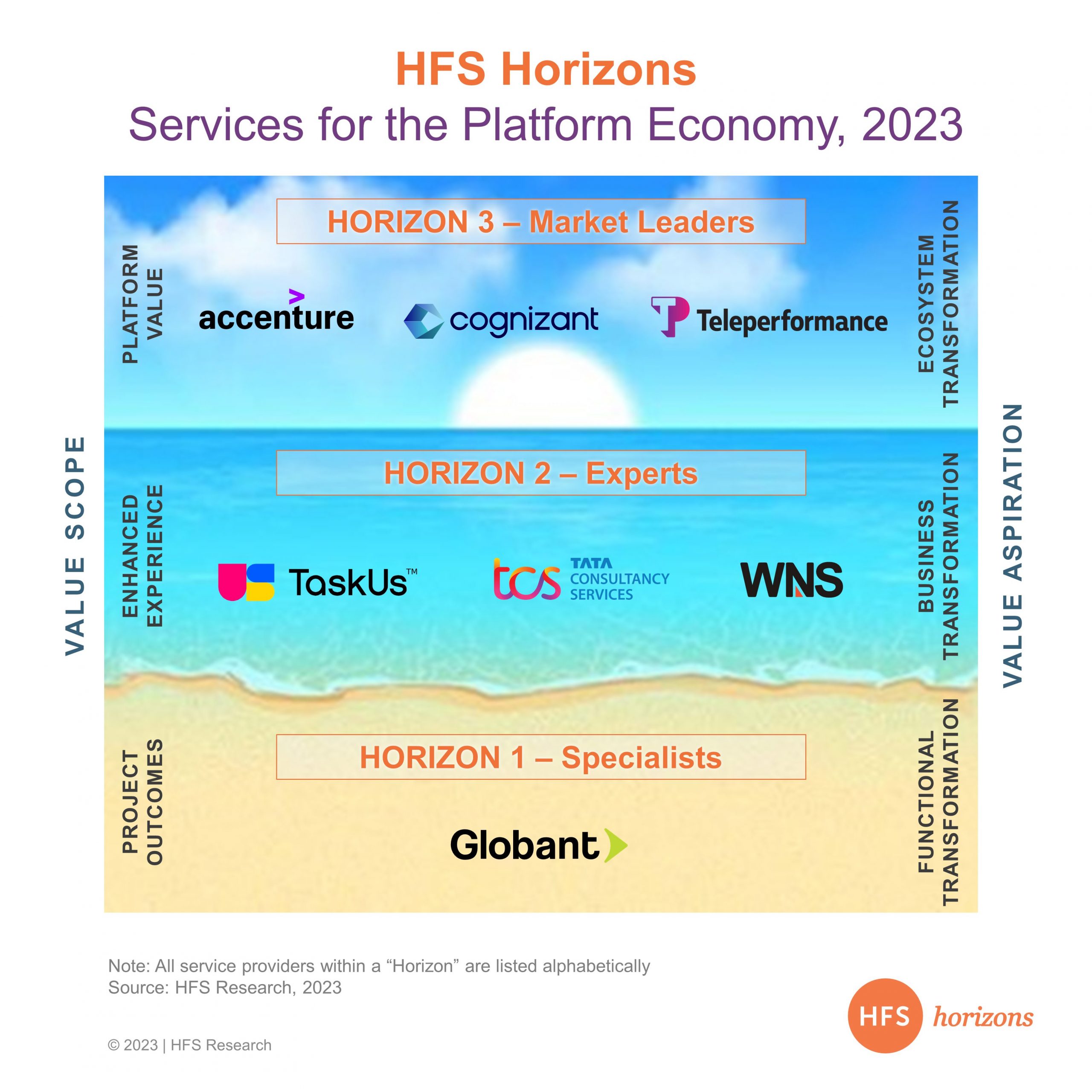
The Services for the Platform Economy, 2023 Horizons report covers seven notable providers helping their platform clients efficiently run operations, expand business, and realize value. Horizon 1 constitutes niche and specialized services catering to specific aspects of a platform business, such as digital engineering or digital marketing. Horizon 2 retains the values of Horizon 1 plus looks at a diverse portfolio of services and core competence in working with platform clients with varying business models. At the pinnacle is Horizon 3, encapsulating all values of the previous Horizons plus a focus on an innovative portfolio of tailored services and instances of co-innovation, driving completely new sources of value with the HFS OneEcosystem™ approach.
Exhibit 1 summarizes the Horizons philosophy and key underlying dynamics, showcasing the providers across the three Horizons.
Exhibit 1: Accenture, Cognizant, and Teleperformance are driving value with the HFS OneEcosystem™ approach
Note: All the service providers within a Horizon are listed alphabetically.
According to the report’s lead author, Ashish Chaturvedi, “The ascendancy of the platform economy ushers in a transformative era in the enterprise world—six of the world’s top 10 companies by market capitalization are now platform businesses. This dynamic shift redefines traditional business boundaries, compelling the market to embrace eco-system-driven opportunities, multi-sided customer lifecycles, and manage hypergrowth phases. Service providers are pivotal in fostering this growth and innovation by sharing and managing their platform clients’ critical business and IT activities.”Read More
HFS launches its first-ever cards and payments Horizons report. Payments demonstrate the fastest innovation cycles in BFS and are in a constant state of disruption as digital models decimate the cost and data intelligence capabilities of legacy systems.
Payments were once perceived by the world as largely tangential to the banking and financial service industry (BFS), but today they have morphed into a melting pot of innovation and one of the most compelling areas of activity and investment in new capabilities within financial services.
The effects of developments in payments are far-reaching, with a broad impact across consumers and businesses. Payments-industry shifts are forcing incumbents to work harder to capture growth, pick up the pace of digitization, gain economies of scale, and manage risk—all while contributing to innovation. These demands can be overwhelming, but the potential for growth and innovation in the payments space is real. Therefore, attracting new players in great numbers, crowding the market, and raising the competitive stakes.
The payments ecosystem is more dynamic than ever with multiple forces at play, and smart service providers are seizing the opportunities
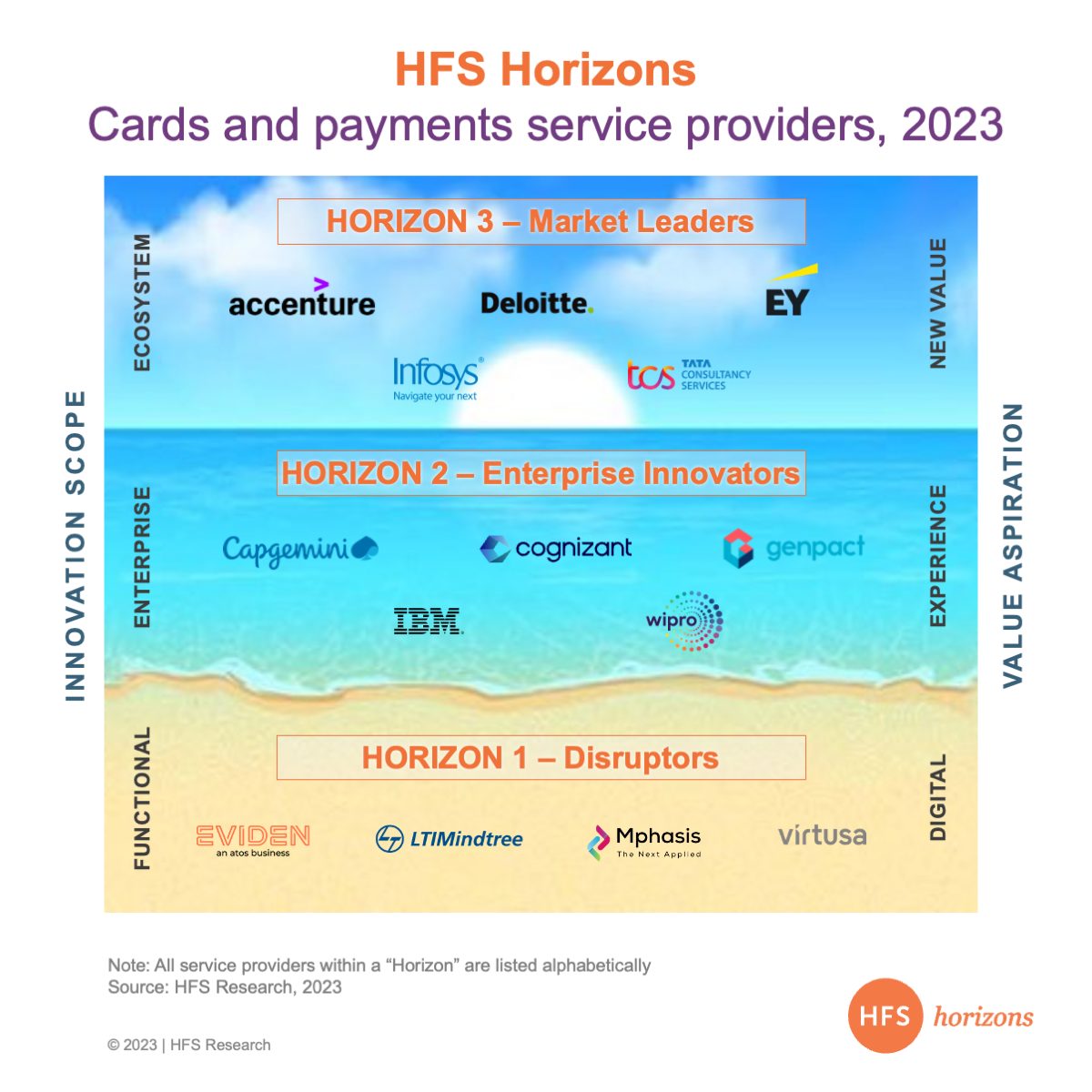
We took an all-hands-on-deck approach to understanding the changing landscape and role of service providersfor our2023 Horizons report oncards and payments, where we evaluated14 service providers (Exhibit 1) and interacted with 40 enterprises that contract with them. Here are the top payment marketplace takeaways.
Exhibit 1: Seeing the opportunities emerging from payment evolution is not the same as being able to seize them, need the help of service provider partners to seize the opportunity
Note: Service providers within each Horizon are listed alphabetically.
The many manifestations of digital payments
Digital payments take many forms; high-profile payment vehicles include digital wallets, real-time payments, buy-now-pay-later, blockchain, super apps, and crypto payments. The most recent incarnation is mobility payments. Here, one size doesn’t fit all; different markets and regions have had success developing payment business models for specific demographics with strategies embodying the elements defining them. Common elements of a winning model include a connected infrastructure, a forward-looking regulatory view, customer intuitiveness, leveraging emerging technology, and a compelling value proposition rather than just cool technology. All digital payments have exhibited a promising future; however, players that can monetize services and data are poised to capture a larger share of revenue pools.
The promise of multiple monetizable opportunities
Nontraditional players are jostling with banks and payment service providers to become issuers, providers, processors, or partners of choice, causing a proliferation of payment providers. The promise of monetizing across various touchpoints of consumer and commercial customer journeys has everyone excited. And we can’t leave out the payments-adjacent revenue pools, such as unlocking data to capture personalization and marketing opportunities, the ancillary prospects of open banking and embedded finance, and software, platforms, and services surrounding the payment. The payments space is becoming crowded, so market participants must work hard to create differentiated value positions to win in the marketplace.
Modernize or risk disintermediation by customers
It’s time to retire legacy monolithic payments architecture in favor of more flexible systems to accommodate digital payments, integrated services, and related new payment technologies. The archetypes of modern payments architecture include cloud or hybrid models using a modern microservice-based framework, scalable data platforms to access data through standardized APIs, a nimble and adaptive ecosystem, and decoupling legacy workflows and augmenting them with new workflows powered by emerging technologies while supporting seamless integrations with external software and platforms.
The Bottom Line: There is no silver bullet that solves all payment challenges; however, there are clear action steps that participants can take to improve their positions and gain or maintain competitive advantage
TheHFS Horizons: Cards and payments service providers, 2023report includes detailed profiles of each service provider supporting the cards and payments ecosystem, outlining the service provider’scapabilities, strengths, provider facts, and development opportunities.
Barely ten months after its birth changed the world of technology, OpenAI unleashes ChatGPT Enterprise, where enterprises now have “Enterprise-grade security and privacy, unlimited higher-speed GPT-4 access, longer context windows for processing longer inputs, advanced data analysis capabilities, customization options, and much more.”
Assuming the 20 enterprises that road-tested ChatGPT Enterprise experienced these benefits in double-quick time, you have to take a serious look at scaling up GenAI tools or risk getting left behind with the most hyped technology since the Internet came to be…
The market is awash with BS about GenAI – and you already know it
As Kurzweil’s 2029 prophecy that AI will pass a valid Turing Test and draw level with human intelligenceappears less improbable, it’s vital we take a reality check to balance fantasy with reality.
Firstly, you gotta love the discussions of the displacements of jobs from AI. It feels like the whole narrative on equating automation and job losses just got reloaded with a GenAI sugar frosting.
Yet, at the same time, the build-out of capabilities on the service provider side is equally mindboggling as everyone claims deep capabilities of talent and solutions in barely a few months. To this end, HFS is currently engaging with the leading service providers to learn about their strategic objectives and capabilities to release our inaugural Generative Enterprise Horizon study on the topic.
Simply put, the whole enterprise world is absorbing GenAI information overload, and we need to take a deep breath and crystalize some issues that will drive enterprise adoption:
Take a long-term view on technology adoption: Technology and capabilities are continuing to evolve at an astounding rate, and their hype phases are shortening – we’ve only just come through the excitement of IoT, blockchain, RPA, Cloud, etc., and adoption of these technologies is still relatively immature and only just realizing their potential. ChatGPT was only released to the public last November 30th, and the GPT 4 series of foundation models later in March of this year, which already demonstrated a 10-fold increase in synthesis power among a host of other significant improvements and potential. However, enterprises are still struggling to adopt cloud! And we should remember that progress with GenAI is only possible when you fix your data infrastructure and integrate cloud and your other AI tools. With that, you have to digest all those surveys with data on adoption rates with a big pinch of salt as consultants and tech firms vie to lead the GenAI narrative. For example, many traditional NLP projects are getting relabeled as GenAI to make them sound more appealing among many other initiatives using older AI tech.
It is about the enterprise, stupid! GenAI has not infiltrated the enterprise in the traditional “vendor push” manner as most technologies – it’s being brought into everyone’s daily lives by users, especially the younger generation, for education purposes. Most GenAI examples are not enterprise-centric, and only a handful of projects have reached production. We must acknowledge that enterprise environments are not a smartphone. Enterprises are not closed systems but systems that have to deal with complexity and scale as well as the old foe that is legacy.
There will be big winners and losers in the AI arms race, and there is nowhere to hide. Whether you sell, advise, buy or use technology, there is an arms race to build out foundational GenAI models with these fresh dollops of crazy capital influx. If and when the hype bubble bursts (which they always do), the technology will be blamed. And, of course, it is the typical analyst question: Who are the winners and losers? Luckily we are not financial analysts. Our job is to guide on enterprise adoption not financial gain, but ultimately there will be winners and losers in the GenAI era, and you can’t hide from it.
Beware of the hyperscalers ringfencing their oligopoly: In our view, more – not less power is getting concentrated with hyperscalers, such as Amazon Bedrock, Microsoft Copilot, and Google Cloud generative AI. Just like cloud GenAI will be foundational. Yet, enterprises are already frustrated with the oligopoly. Both in terms of vendor lock-in as well as spend. Only with clear objectives can enterprises justify the costs.
Engage with the cool kids on the block like Nvidia, Databricks, and Hugging Face: Brand new ecosystems, including Nvidia, Databricks, and start-ups, are emerging. Enterprises don’t know how to navigate this. Everybody is trying to be the new best friend of Hugging Face, who could become the new RedHat. At the same time, who is getting hold of Nvidia’s GPUs as the key building blocks for GenAI have become a scarce resource? But
Your governance and explainability focus is critical. Most data privacy laws are trying to take a black-box approach with limited explanation or visibility, where something goes inside a black box, and something comes out and no one understands what happened inside the box. Yet, most Machine Learning is a black box with no explainabilty, but this largely went unquestioned until the recent explosion of focus around LLMs. To protect civil liberties, bias and other issues you need explainable AI. To this end, major legislation is looming: US AI Bill of Rights, and the EU AI liability directive as examples. And we are already seeing AI litigation is starting to kick-in. For instance, the FTC has opened an investigation into ChatGPT maker OpenAI over the potential harm it could cause and the company’s security practices. Lastly, responsible AI legislations around the world are not yet aligned on a common reporting format, thus, it is adding to confusion and delaying the initiation of responsible AI compliance by companies.
Get on top of enterprise data management. Anything touching our customer or employee data is more scrutinized than ever, and GenAI opens up a whole new can of worms when it comes to immersive it into the enterprise. Most Generative AI use cases use public data today. Getting enterprises to share private data will be challenging, if not impossible. We hear about approaches for data anonymization and for data impact assessments. But as we could see with GDPR, in the end, the courts will be the arbiters of the effectiveness of those approaches. Equally, how can enterprises deal with model drift and eliminate the randomness from these models’ outputs? Their responses evolve due to updates from new data. It is about the integration into complex enterprise ecosystems.
Scaling your GenAI is expensive – start building the business case now: Forget ChatGPT 3.5. For enterprises, GenAI is not free. On the contrary, to attract talent for data management, the rare breed of prompt engineers, or even to run your foundational model, requires deep pockets. And that is before the debate around Carbon Footprint of AI is getting started. In addition, getting access to the IT infrastructure to build and develop these language models gets expensive, and building business cases and longer-term viable cost models is going to dominate sourcing discussions in the coming months.
You must avoid a myopic view on productivity: The singular focus on productivity is misleading – remember how replacing people with techdestroyed the RPA phenomenon. We are hearing from service providers that they intend to shrink their talent pyramid by leveraging GenAI. Yet, what we need to focus much more on is the value creation. We are hearing about fantastic breakthroughs in science, but we have yet to hear about compelling examples of value creation in the enterprise.
Understand what GenAI is… and what it isn’t: GenAI is Machine Learning, and it is being trained on information that disparate sources have provided. So don’t expect a “42” thrown at you as the answer to life, the universe, and everything. And the last time we checked, it wasn’t sentient either. The next frontier for AI is becoming objective and goal-driven. Yet, we are early in terms of foundational research. It will be intriguing to watch the progress of Google with its Gemini project, which aims to add planning and problem-solving to the capabilities of LLMs.
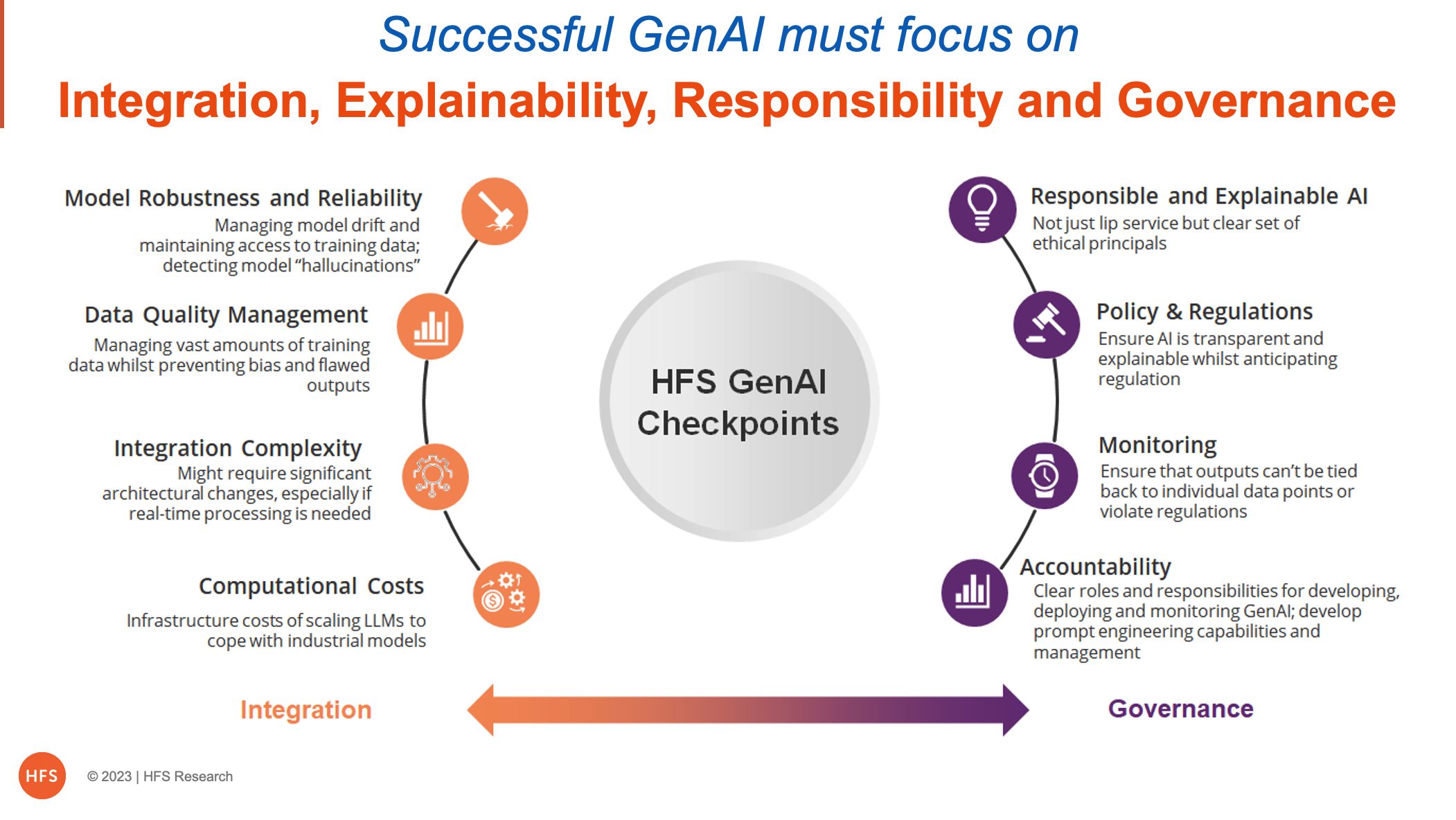
From an enterprise point of view, what all of this boils down to is integration and governance. In the exhibit below, we have highlighted the critical elements. It is about building on and expanding all the hard work at the intersection of cloud, data, and AI. GenAI is not supplanting all this. All the noise about the democratization of AI is misleading, as we still need the infrastructure and the talent to run all these models. Talent that understands GenAI is not growing on trees. Thus, it will not only be an arms race for AI capabilities but for talent. And we should remind ourselves of the learning of cloud adoption. Cloud-native talent remains scarce, and many cloud transformations fail. It is all about the learning from those experiences. Therefore, we have to learn so much more about GenAI and beyond. Cutting through the market noise is an essential early step on that journey.
The Bottom Line: Enterprise adoption of GenAI is all about integration and governance; therefore, operations leaders need to take a long-term view focused on value creation
The development of GenAI is demonstrating an unparalleled compression of innovation cycles we’ve never before seen. Yet, all those headline-grabbing reports on enterprise adoption are focused on capabilities (and sales ambitions) rather than the critical issues of integration and governance. Therefore, we urgently need to learn more about the real experiences from the early deployments to drive more nuanced and relevant discussions. As far as we can tell, the Singularity is not yet nigh. But stay tuned for our inaugural Horizon!



 You’ve probably completely forgotten that London was the world’s vibrant financial center in 2016… oh how times have changed.