Do you work for a firm selling a successful product that just requires staff to push rocks and turn widgets, where you’re unaffected by technology disruption and innovative competition? Where all you need to do is to turn up for work when your boss is looking, and you’ll get your annual payrise and bonus? Where can you just take off on holiday / go to whatever conferences… and all you need to do is slap on your “out of office,” and no one will bother you or dare stress you out with any work demands.
My guess is you don’t… although it was probably like that during the recent pandemic years and recent return to quasi-normality when most people took full advantage of the Great Resignation to put lifestyle very much first in their lives.
Over my career experience, a company is all about its people. If your colleagues aren’t passionate about your brand, barely enjoy working with each other, are struggling to delight your customers, or grow your partnerships, this post-pandemic business climate could well see your business fall away as more adventurous, disruptive, and passionate businesses steal your mindshare and usurp your competitive position.
Today’s business climate is not for the faint-hearted, and settling for a cushy lifestyle job is something you need to think very hard about as we all venture into a business environment demanding passion and focus.
Even Zoom is losing faith in the remote work ethic it helped create
The sad reality is that nearly half of companies are struggling to get their work ethic back to pre-pandemic levels – and when you consider that even Zoom is mandating staff back to the office, we clearly have a work motivation that is getting worse… not better. Zoom and most of the G2K are calling staff into the office 2-3 days a week (at a minimum) because they have lost the trust they are motivated, are putting the needed time into their jobs and have lost interest in collaborating with their colleagues.
Net-net, many companies’ leaders are struggling to motivate a dispassionate workforce and want to bring their teams back together physically to retrofit some form of the work culture they can remember from pre-pandemic times. Their problem is you can’t force people to be passionate and focused; you must show them the way and inspire them with great ideas and your vision for taking your company into a leadership position in your market. If you can’t do that, then you’re either working for a company living on past glories or you’re struggling to motivate yourself as a leader. Or both…
As our talent survey of service provider employees revealed last year, close to 9 out of 10 staff want to feel more challenged (and are bored), the only saving grace being that 90% of employees are passionate about the impact they can have on enterprise clients. So corporate leaders have to make sure their staff has that chance to challenge themselves if they want to avoid their firm slipping into the abyss of commodity work and demotivated staff.
Whether we like it or not, the vast majority of today’s companies rely massively on a motivated workforce to stay ahead of their markets during a time of genuine technological disruption and significant cost pressures from years of inflation and a tough economy.
Only a quarter of firms are going in the right direction with their people… make sure you work for one of them if you can’t fix where you are
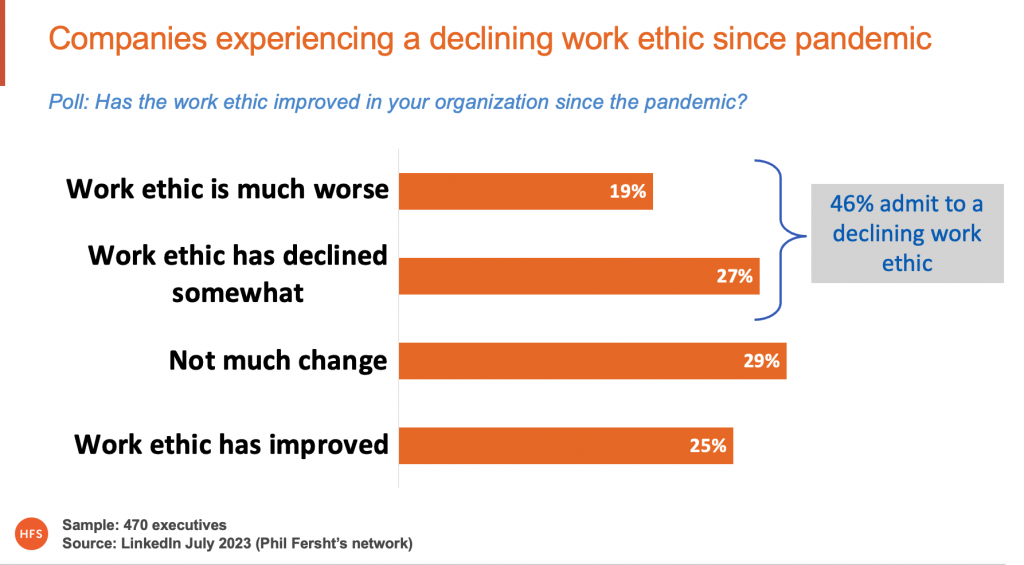
Most people in my network are associated with the tech industry – either selling/advising on technology services and products or implementing and managing them as part of their tech/operations leader role. So I thought I’d poll my network to gauge whether their companies’ worth ethics were improving or in decline:
When you consider most people on LinkedIn tend to give a more rose-tinted view of their business world, the fact only 25% see an improvement in work ethic is a pretty damning verdict of where we are. On top of that, close to half (46%) actually admit their company’s work ethic is bad or very bad.
This data does not bode well, with people getting laid off almost everywhere as the Great Resignation becomes the Great Freakout, and many companies are desperately seeking to offload the deadwood. So make sure you are not seen as deadwood…
Bottom line: Are YOU motivated to be part of a successful business, or do you just care about your lifestyle where a “job is a job”?
In short, you need to evaluate your own career trajectory and decide whether you have the appetite to be on the winning side in this emerging AI economy or if you prefer to meander around today’s strugglers where the work ethic dissipated away somewhere in 2020 and are still clinging to the memories of pre-pandemic days when their brands had real meaning and direction.
Only YOU can honestly answer that question for yourself. But don’t dwell too long deciding what trajectory you are on, as you may get left behind on the scrap heap of lethargic legacy brands that aren’t going to make it much past the next couple of years in this new economy.
Please stay true to your inner work mojo that got you here in the first place…
Unlike most other technological breakthroughs in our history, Generative AI has caused a tidal wave of excitement and fear in our personal and business lives. In many ways, it feels like it’s 1998 all over again when the early days of the Internet dominated the lion’s share of both business and tech conversations and became embedded into the fabric of society.
While AI has been a fundamental part of our technological landscape for over a decade, GenAI represents a substantial leap forward, revolutionizing the way that we work, learn, and interact with technology and one another – especially the major enhancements between the ChatGPT 3.5 version that was launched last November and the recent upgrades to GPT4.
We caught up with someone who’s been a bastion of AI for well over a decade now, Paul Daugherty, the Chief Technology and Innovation Officer at Accenture, on the potential impacts of GenAI on enterprises and the workforce. Paul has been CTO of Accenture for over a decade and became Chief Executive of the $60bn firm’s technology business in 2020..here are some key insights from our discussion!
GenAI isn’t just eating software, it’s dining on the future of work
In this evolving landscape of technology – a new paradigm is dawning, one where GenAI is not just impacting how we use technology; it’s fundamentally changing the nature of work. As Paul aptly put it, “We used to talk about how software is eating the world, and now the new analogy is that generative AI is eating software, which means that we have much more powerful ways of interacting with technology than we had before, which stands to benefit the way we work.”
In this reality, it’s not just an incremental improvement on existing AI capability but a leap that has the potential to fundamentally alter our approach to work. While previous technological advancements optimized and streamlined processes, GenAI seeks to redefine the very nature of what organizations do and how they do it. “Whether it’s reimagining content creation in media companies or streamlining regulatory filings in financial and life sciences institutions, GenAI is about reshaping enterprises’ core processes and workflows.” It empowers organizations to rethink how they function – making it a game-changer in the tech landscape.
We’re entering an era of ‘no-collar’ jobs—where AI and humans collaborate to create new jobs
As we step into this transformative era, the concept of “no-collar jobs” takes center stage. Paul introduced this idea in his book “Human + Machine,” where new roles are expected to emerge that don’t fit into the traditional white-collar or blue-collar jobs; instead, it’s giving rise to what he called ‘no-collar jobs.’ These roles defy conventional categories, relying increasingly on digital technologies, AI, and automation to enhance human capabilities. In this emergence of new roles, the only threat is to those “who don’t learn to use the new tools, approaches and technologies in their work.”
While this new future involves a transformation of tasks and roles, it does not necessitate jobs disappearing. To Paul, AI isn’t replacing us; it’s giving us superpowers in our own domains. While technology can streamline the workforce, history has shown it often enables people to work more efficiently. According to an Accenture study, approximately 40% of working hours across industries will be impacted in some way by GenAI, but “that doesn’t mean that 40% of jobs go away because, in most cases, GenAI is impacting a part of a task somebody does. It’s making their overall job more effective, and often more fulfilling by removing some of the detailed work they needed to do – that can now be done by AI.”
In this reality, reskilling is a critical mandate. Paul emphasized the need to develop both AI development and AI usage skills are critical. He encourages companies to set up dedicated training academies and learning processes to help reskill their employees.
Paul’s predictions point to the next epoch of enterprise evolution
When asked to peer two years into the future, Paul made four predictions about GenAIthat signal a seismic shift in the evolution of the enterprise – alongside some cautions:
Accelerated Experimentation and Scaling: In a year, companies will shift from experimenting to scaling AI solutions, with more focus on specific use cases for widespread deployment. Traditional enterprise software companies will increasingly incorporate generative AI into their products, making it a standard part of operations.
Integration into Enterprise Software: Just as AI has become an integral part of enterprise software today, GenAI will follow suit. In the coming year, we can expect to see established software companies integrating GenAI capabilities into their products. “It will become more common for companies to use generative AI capabilities like Microsoft Dynamics Copilot, Einstein GPT from Salesforce or, GenAI capabilities from ServiceNow or other capabilities that will become natural in how they do things.”
Intelligence as core to enterprise architecture: Paul believes “embedding intelligence as a core component of the enterprise architecture” isone of the most significant changes businesses will experience since the internet. Accenture now calls this the “modern digital core, which businesses must develop so that they can integrate new capabilities like GenAI, operate more effectively and set the stage for new growth..”
The Inevitable Backlash: With great innovation comes a (healthy) dose of skepticism and backlash. GenAI will face its share of challenges, including managing expectations. Over the next year, some may be disappointed when they “realize that generative AI doesn’t solve every problem as easily as they thought.” Paul cautions that careful consideration of the business case, costs, and scalability will be essential for a successful transition – “We’re encouraging companies to start even at the experimentation stage with a business case-driven view.”
We’re at the tipping point of one of the most significant enterprise shifts ever, and there is much more to come (that perhaps we are yet to fathom). As Paul put it, “I believe we haven’t seen some of the significant innovations yet from an enterprise tech perspective where it’s entrancing to watch AI ecosystem players that are innovating in the models themselves.”
Responsible AI isn’t just a push from the Tech community anymore, it’s a market-driven requirement.
As organizations gear up to integrate GenAI into their operations, Responsible AI has moved from a push from the tech community to a market-driven requirement. In our discussion, Paul noted that while the foundations of fairness and ethical AI have remained consistent over the last few years – the approach has shifted. In the past, efforts were focused on pushing to educate people about these concerns; however, today, “what’s different now is that there’s a pull to find information on responsible AI because they understand the importance…and heightened risks of GenAI”.
With the escalating risks concerning intellectual property and the emerging concerns related to misinformation at scale (including the potential creation of GenAI-generated deep fakes) – a set of unique challenges has arisen with GenAI. These challenges have been instrumental in driving the demand for Responsible AI. Paul stressed the urgency for organizations to promptly establish a systemic foundation for responsible AI practices.
Bottom line: We’re at the tipping point of one of the most significant enterprise tech shifts ever. The first movers are the ones that will have an advantage…
No one is immune from the impacts of GenAI, and conversely, everyone has an opportunity. “What will make a difference is that the first movers will have an advantage. Those who now understand the technology and models, and look critically at their data estate, will establish a solid digital foundation and will have a sustainable competitive advantage.”
There you have it, folks. It’s a brave new world; are you ready to seize it?
You know what we’re sick and tired of at HFS? Ridiculous empty-promise press releases touting GenAI capabilities with no in-production use cases or substantiated benefits.
You know, the ones boasting “widget ABC now with generative AI”. A close second on the naughty list is press releases purporting to showcase generative AI capabilities but are really promoting the same non-generative AI capabilities they already had. Then there are all the promises of billions of dollars of “investment in GenAI” without any sort of accountability they’ll ever be held to it.
Let’s be honest, the entire marketplace is exhausted by genAI-washing, where everyone can pretty much claim whatever they want and never be held to account. This is such a shame because the potential is massive as we explore the seemingly limitless possibilities of GPT4 technologies.
So when we do manage to find actual GenAI use cases that are in production with real live customers and delivering benefits, we move like the BS-busting analyst cheetahs that we are, and we cover them! This was the case when Genpact briefed us on its newly developed anti-financial crime (fincrime) regulatory risk and compliance GenAI capabilities (see news release here). We approached with an appropriate level of “show me the outcomes” cynicism and were pleasantly surprised to find that despite its shiny newness, its capabilities were developed with not one but two actual clients (gasp), and they were showcasing in-production use cases.
Anti-fincrime regulatory compliance – super important, super manual
Despite financial services firms being the early adopters and now long-time poster children of applied automation and AI, these capabilities have not been adopted consistently across all business functions. Areas like shared services, risk modelling, and customer service have benefited substantially from intelligent automation beating down the manual processes caused by compounded legacy tech debt. But many processes within anti-fincrime functions like fraud, know your customer (KYC), and anti-money laundering (AML) have proven to buck the trend by being non-standard, requiring humans to make final decisions, and/or not being sufficiently explainable to satisfy regulators. The current state reality of many fincrime groups within financial institutions is loads of humans generating content to enable or justify decisions. This is intense, detail-oriented work in a specialized domain with a high burn-out rate.
Genpact, some edgy riskCanvas clients, and AWS came together to make fincrime compliance less soul-crushing
Genpact acquired riskCanvas, a software suite of AML solutions and a related consulting practice, from Booz Allen in 2019 to help enhance its fledging risk and compliance practice. A couple of Genpact’s riskCanvas clients, including Apex Fintech Solutions, were excited about the potential of GenAI and agreed to a discovery session turned hack-a-thon with Genpact and its partner AWS to road test AWS’ Bedrock foundational AI model capabilities. Genpact and its clients leveraged their respective private and secure data from riskCanvas, chronicling years of AML events, to feed various foundational GenAI models. The initial results were so encouraging they transitioned to a full-on hack-a-thon at the Amazon2 headquarters. From the event, two use cases rose to the top as offering the greatest immediate impact:
Automated sanctions screening alert decisioning – potential sanctions match data is automatically analyzed and compared against thousands of previous alerts, resulting in a detailed explanation of findings and suggested decisions. Human analysts make the final decisions. The benefits impact is 70% reduced handle time.
Suspicious activity report (SAR) narrative writing – automating the time-consuming summarization of SARs, including filing details, subject information, transaction patterns, and activity analysis, all based on an institution’s established standards and languages. Human analysts provide final review. The benefits impact is 60% reduced handle time.
It is critical to note that the generative capabilities of GenAI are also used to produce explainability statements. The hack-a-thons took place in July 2023. These production use cases were hardened and put into production quickly because the necessary data was available and already hosted securely on riskCanvas in the AWS cloud. Also critical to note – these are publicly available models used privately in a static format to ensure privacy.
Other use cases have also been identified – all loosely in the ilk of fincrime functions with loads of content documentation that needs to be produced and is currently heavily manual – like customer due diligence review and summation, case review and summation, fraud alert decisioning with detailed explanation, transaction monitoring alert decisioning with detailed explanation. You get the picture.
The bottom line. Genpact makes a bold step forward to make GenAI real and impactful in fighting financial crime. Banks tired of analyst burn-out take notice!
Nothing happens if you don’t try. Failing fast is a great mantra, but it requires effort. Kudos to Genpact, its intrepid clients, and AWS for experimenting and succeeding in building in-production GenAI models that can legitimately help better fight financial crime and improve the harried lives of fincrime analysts. The regulatory burden of documented proof of decisioning is a heavy lift for firms of all sizes. But it is a problem screaming for GenAI solutions – literally, the power of generative content trained on private data from past reports – is an ideal fit.
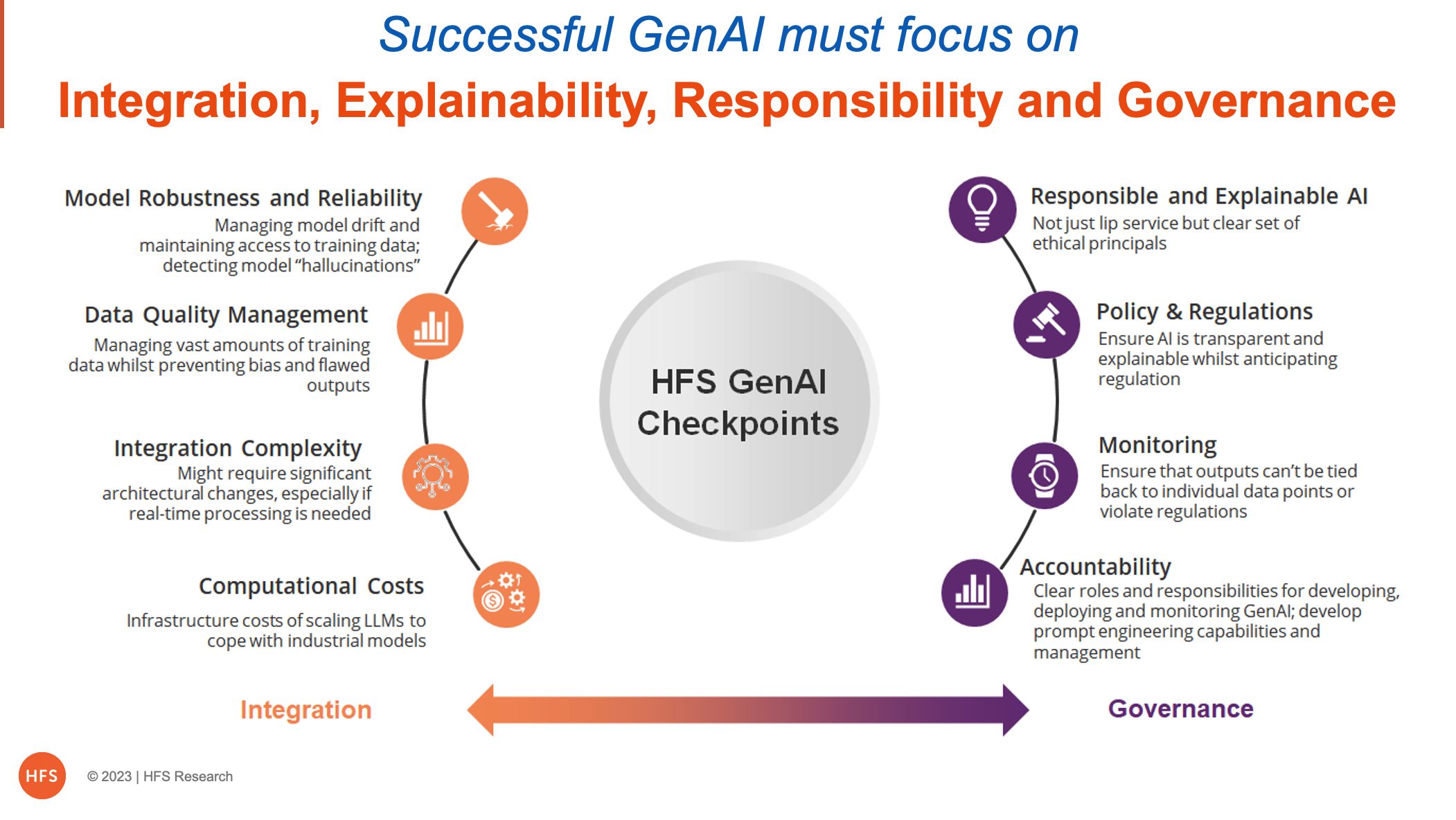
The rub for fincrime compliance typically is unhappy regulators. The critical nuance here is GenAI enables the humans, with humans taking all final decisions with full explainability documented. Here are our critical focal points for successful GenAI:
While this is a real and decent step forward, as with so much of applied automation and AI – it is focused on making existing rule-based processes less manual – rather than changing the processes. While the industry works towards a future of less rules-based fincrime compliance processes, Genpact’s riskCanvas GenAI is a much-needed step in the right direction.
Did you know that the average time a US employee spends reading up on their company health insurance coverage is 15 minutes… and costs their employer $20K a year?
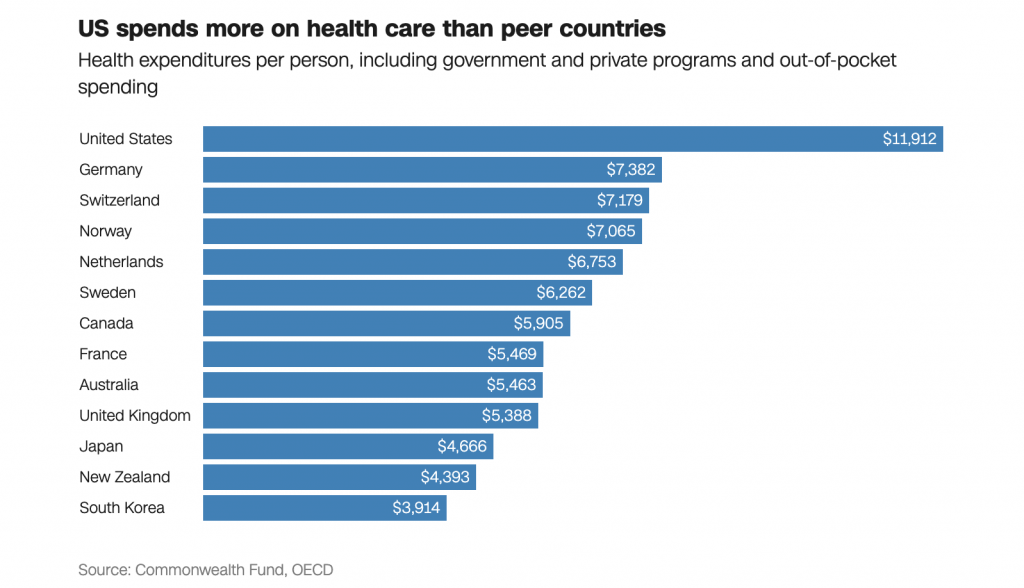
So you can imagine most US employers don’t spend much more time considering these policies either (I know I certainly don’t!). The issue is we all take the healthcare insurance system for granted; we pay these exorbitant rates to these mega-corps and just assume this is a cost of living and doing business. OECD data shows that in 2021 alone, the US spent nearly twice as much as the average OECD country on health care – and three times higher than even Japan and South Korea:
However, our incredible healthcare program leader, Rohan Kulkarni, has moved heaven and earth to force people (including me) to think about this supreme waste of hard-earned income and point us to the whopping 40% savings on offer, in the region of $350 billion a year, if we move from these exorbitantly expensive group plans to a self-insured model where we take a bit more risk for a huge amount of savings.
And when the “risk” is essentially the health of our workers, that’s a pretty good place to focus on as an employer in today’s high-stress work environment, where the cost of living is skyrocketing, and we’re struggling with creating more sane work models that do not involve ten communications mediums open at any one time…
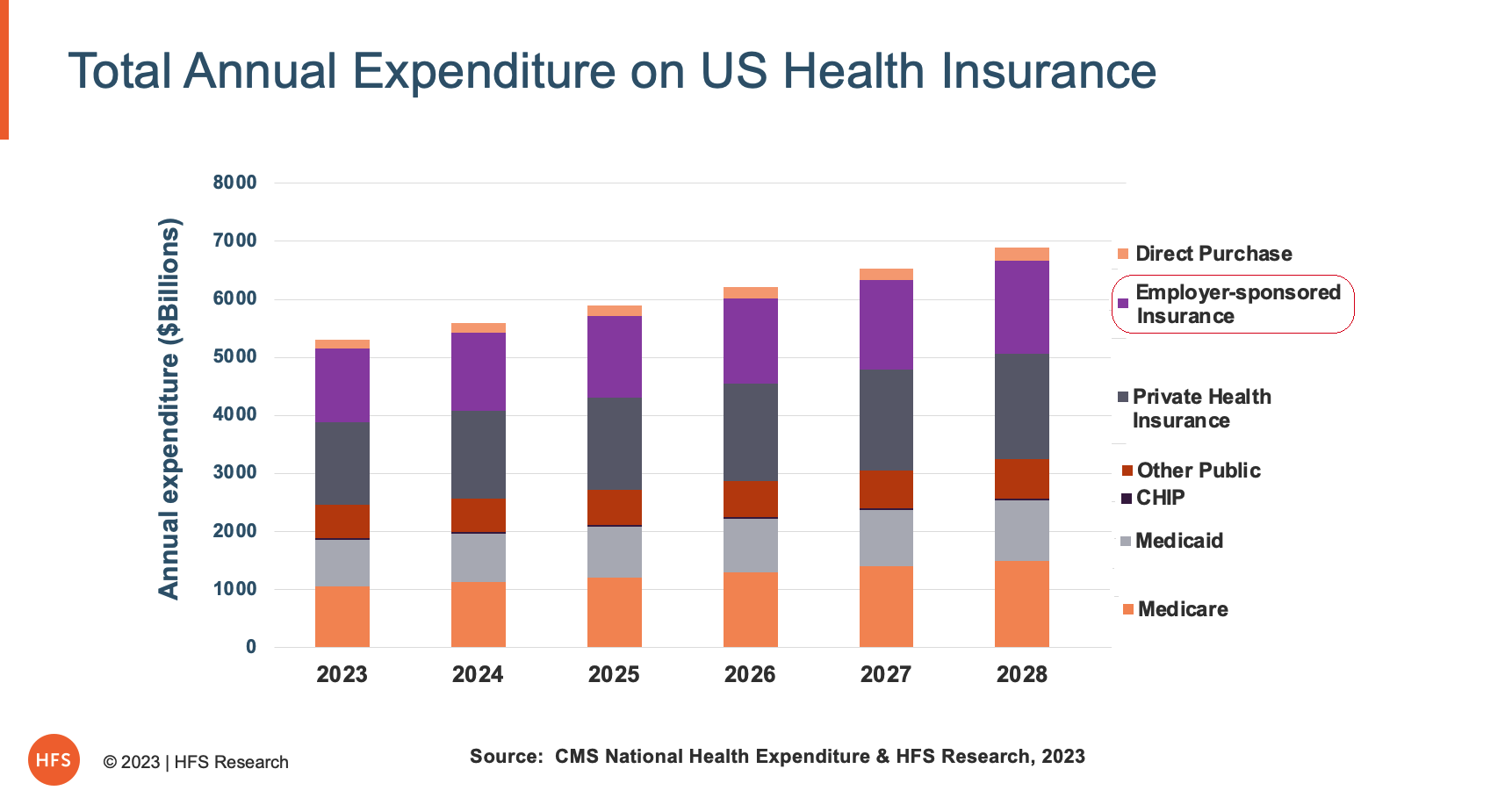
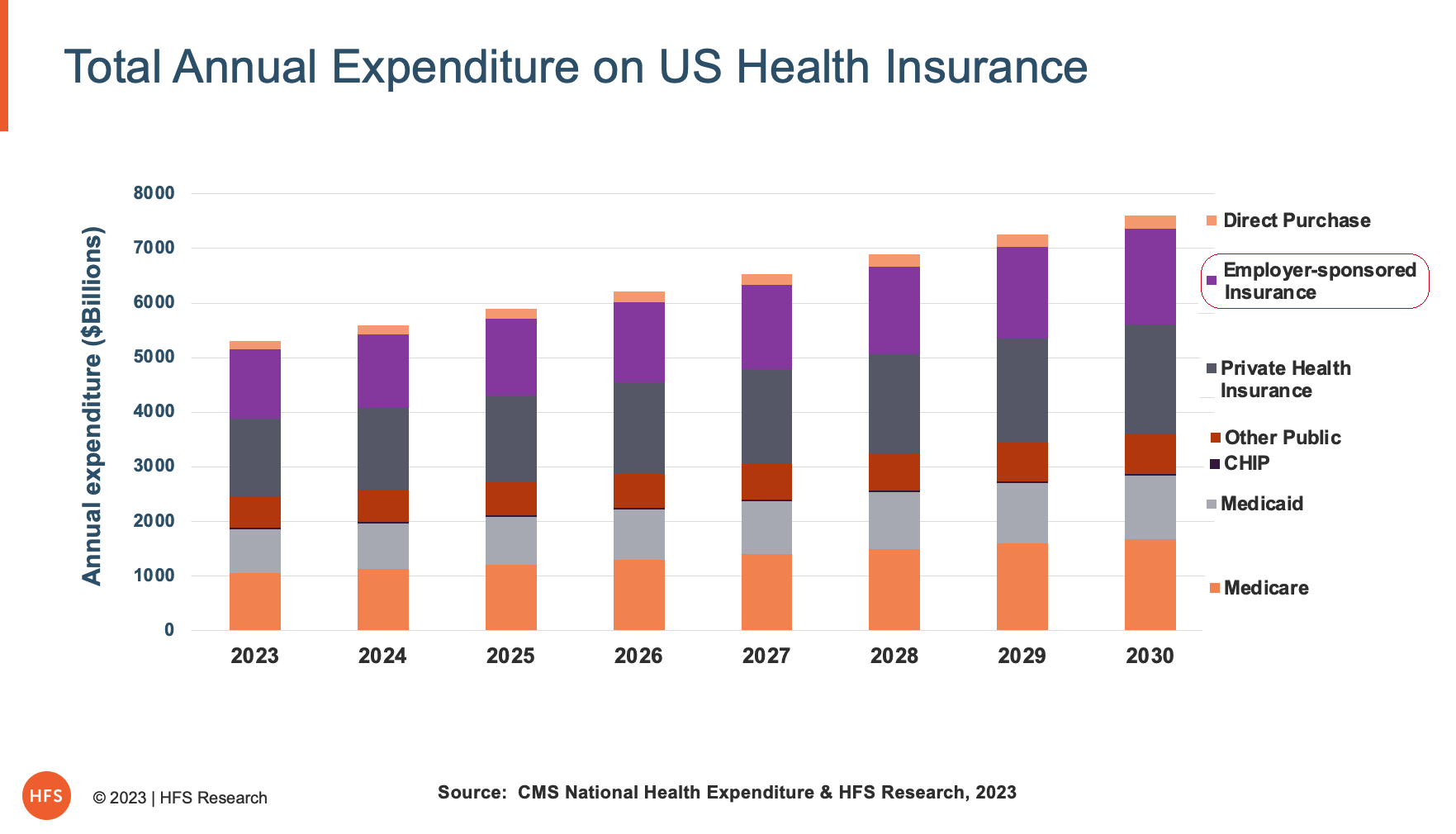
Net-net, few of us realize US health insurance is a $4 trillion dollar annual market this year and is likely to surpass $7 trillion in the next five years. Folks… let’s face it, we’ve been subjected to a mammoth insurance con job for decades, and now we have the opportunity to do something about it:
So let’s hear more from Rohan on how this all works and why we need to take this shift to Employee-sponsored insurance very seriously…
Why the evolution to employer-sponsored healthcare is so prominent
In the US, our healthcare is covered through four primary funding vehicles;
Medicare, if you are a senior,
Medicaid, if you are amongst our most vulnerable,
Group Plans (commercial insurance) if you work for an employer who buys insurance for you or, increasingly,
Self-insured employers who are underwriting the medical risks of their own employees.
In 2020, enrollment in self-insured employer plans passed group plans, becoming the largest segment of the market (see Exhibit 3) with the potential to alter how we buy, deliver, and consume healthcare.Read More
HFS is back with its analysis of the finance and accounting (F&A) service providers, but now in the Horizons framework!
With the rush to remain relevant in the new AI era, there should be no more important function than finance as the repository for all the data that is needed to support rapid and smart business decisions. Yes, it’s pivotal in helping organizations transform to respond to changing market forces. Traditional finance remains the backbone, but strategic finance is gaining importance. Key F&A service providers are moving beyond the usual F&A functions and trying to act as strategic advisors to finance organizations.
Data is driving this change, and most enterprises seek help from F&A service providers due to the lack of in-house advanced knowledge and capabilities specific to data requirements. Real-time insights and future-proof actionability are the needs of the hour, and enterprises unable to quickly make that shift will be left behind. This is where we see rising interest in the financial planning and analysis (FP&A) and finance transformation levers of finance.
The F&A basics remain important, but newer areas are catching up
Cost efficiency, speed, and industry expertise remain the most important selection criteria for service providers in F&A, but innovation, emerging tech, and environmental, social, and governance (ESG) prioritization are catching up. F&A service providers are integrating generative artificial intelligence (GenAI) modules into their service portfolio to minimize business risk and bring more efficiency and accuracy into the processes. At the same time, ESG KPI reporting is also making headway in bringing visibility into the ESG agenda, with accountability moving toward the finance function.
Data-driven finance combined with agility, predictive analytics, and tech-savvy talent is needed to push the boundaries toward making an impact spanning enterprises, partners, and clients.
Opportunities abound for service providers, with F&A taking on a pivotal role for enterprises at large
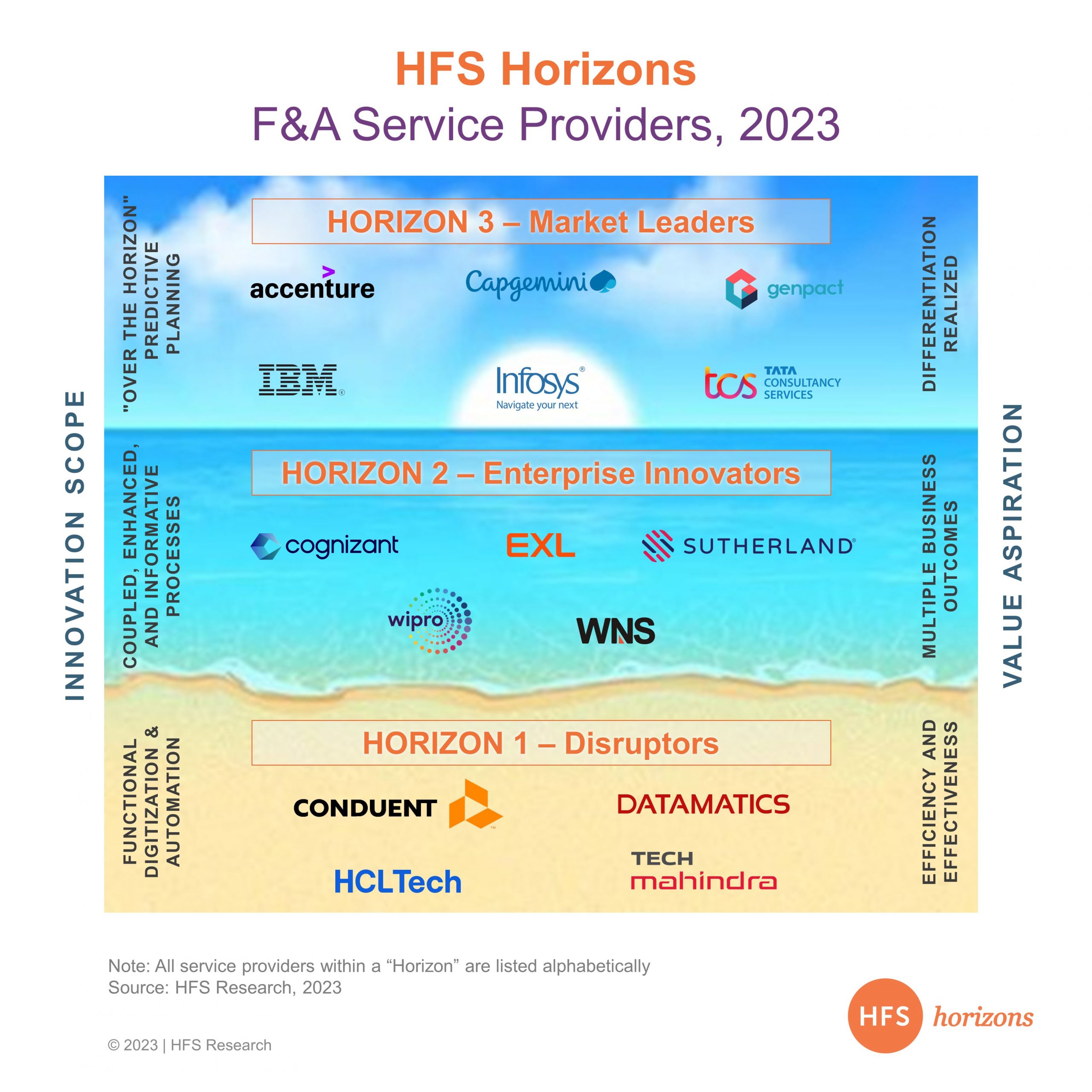
We conducted an exhaustive research exerciseinto15 of the key service providers (Exhibit 1) in the latest Horizons report,HFS Horizons: F&A Service Providers, 2023,by divingdeep into the capabilities of each and how they have contributed tothe changing F&A landscape over the last year.
Exhibit 1: We see more and more enterprises willing to outsource finance functions to service providers for a more holistic F&A transformation
Note: Service providers within each Horizon are listed alphabetically.
A few glimmers of Horizon 3 are making its impact felt, courtesy of the market leaders
Market leaders like Accenture, Capgemini, Genpact, IBM, Infosys, and TCS are doing the right things, creating an ecosystem of differentiation and client impact—but it is still very early days. These service providers use data, analytics, AI, emerging tech, and strategic partnering to deliver beyond the usual F&A services. They lead the way, bringing a wind of change to how we look at F&A and where we expect F&A to go over the next couple of years. ESG is another area where some service providers are working to bring about socially responsible accounting practices.
Horizon 2 providers are well on the way to achieving multi-level outcomes
Cognizant, EXL, Sutherland, Wipro, and WNS have taken the enterprise innovator Horizon in the 2023 edit. Some of these F&A players are moving into consulting, some focus largely on enabling data-driven finance to become a reality, and others focus on strengthening digital IP and partner ecosystems to push the boundaries further and continue to drive outcomes that span enterprises.
Horizon 1 disruptors focuson getting the basics right andfinding solutions that drivemultiple business outcomes
The disruptors—Conduent, Datamatics, HCLTech, and TechMahindra—are doing a great job either catering to the mid-market with agility and efficiency and winning multi-tower tech and operational improvements or building internal IP to support F&A advancements. While this is great for clients still at the nascent stage of their F&A transformation journeys, we would love to see them move beyond Horizon 1 outcomes to deliver more synergistic outcomes.
The Bottom Line: Finance is no longer a boring,back-office function, and the CFO role is evolving as a strategic partner across the organization. Each service provider is doing something differentto drive new sources of value beyond the usual.
TheHFS Horizons: F&A Service Providers, 2023reportincludes detailed profiles of each service provider supporting the F&A ecosystem, outlining the service provider’scapabilities, strengths, provider facts, and development opportunities. Each service provider has a unique approach to enabling organizations to become more predictive with data and insights.
Generative AI is already making real impacts in the enterprise, but bad processes may create a false ceiling to hold back progress. That’s how Exponential View founder and esteemed independent AI researcher Azeem Azhar reads recently emerging research, where processes and data structures designed for GenAI can reap exponential rewards.
In a fireside conversation with HFS Research CEO and Chief Analyst Phil Fersht, Azeem offered evidence that LLMs were already helping people do their work quicker, at higher performance levels – and with greater employee satisfaction. So without further ado, here are Azeem’s keen insights….
LLMs boost performance among the majority of skilled workers
Azeem Azhar: “Phil, thank you so much for the opportunity to talk to you and the audience here. There was a Brynjolfsson study that looked at call center workers using LLMs before GPT-3.5 or 4, and they identified that these call center workers were 14% more productive, and after two months of using an LLM, a new worker was as well skilled as long-term employees who had not used an LLM.”
He explained that even uncodified knowledge and know-how not in the document was transmitted to these new workers over six months. In another survey by Noy and Zhang from MIT, higher-paid white-collar workers were provided with ChatGPT.
Azeem Azhar: “These were grant writers, or in HR, or marcomms, with an average salary over $100,000 yearly. They had a 40% improvement in the time taken and – I think – 15 to 20% improvement in the quality of the work.”
Poor processes constrain top performers and will limit the benefits GenAIcan bring
Recently, Azeem’s colleague Karim Lakhani at HBS and friend François Candelon at BCG looked at 800 Boston Consulting Group strategy consultants supported in their work using a GPT-4 application. Tasks got completed to a higher standard faster, and below-median employees improved the most.Azeem says these three studies show LLMs can be productivity enhancers across the board. But improvement at the top level is constrained.
Azeem Azhar: “I think, Phil, this falls right in the realm of the kind of strategic transformation work you have done with clients for years and years. The fact that the bottom three quartiles of the employees improve the most speaks to the limitations of the existing process flow.”
He says LLMs reveal the limitations that poor processes place on top performers.
Azeem Azhar: “It’s as if we have a high jump, and the bar never goes above 1.7m, and for me, that’s a stretch; for you,that’seasy, you could jump 1.9m, but we never raised it to 1.9m. And that’s the kind of thing that HFS helps firms think about. LLMs have shown that you must rethink your internal dynamics to get more performance.”
We must get to grips with a new‘jagged frontier’where performance can go either way
Azeem Azhar: “Where you (Phil) identify we may hit limits, that is what the AI researchers call the jagged frontier. On one side of the frontier, the LLM does better; on the other, it worsens things. The problem is we don’t know what that frontier looks like. It’s also a shifting frontier. It varies from task to task.”
Azeem thinks the arrival of LLMs triggers a moment to rethink how work is down.
Azeem Azhar: “You must be alert to where your existing systems or processes are so constrained they don’t allow you to perform at a GPA of 4.0 because you’ve never thought it was possible, and also how you manage for those tasks where working with an LLM might give you a worse result.”
Don’t blame the LLMs – it’s the shareholders and finance directors who are likely to be swinging the job cuts axe
Phil Fersht: So, do you feel white-collar jobs are under threat, Azeem? Or do you think this is another evolution, a new technology, and new jobs will be created…
Azeem Azhar: I think we can be reasonably expectant that new jobs will get created. I don’t believe the threat necessarily comes from LLMs. It probably comes from shareholders and finance directors, more than anything else, because there will be a lot of pressure for cost savings and, you know, “Can we deliver the same experience to our customers at a lower cost? And if we can, let’s do that.”
“There will undoubtedly be many processes that will be as efficient with fewer people. What a firm chooses to do at that point will depend a lot on its relationship with its workers, territory, and employee rights, the kind of direction, mission, and depth of capacity of the firm. Some big IT consulting firms managed to upskill and retrain hundreds of thousands of people in the face of automation. But they’ve done that against the backdrop of growing businesses.
Jobs created out of technical debt will be among the first to go
Phil Fersht:Yeah. Yes, very well put. And, you know, it’s interesting, the conversation I had yesterday with the academic was very much, “We need to keep reminding ourselves that AI is about ultimately improving human intelligence.” So…
Azeem Azhar: Yeah. But I think wehave to bear in mind that there was an assumption, when tasks were designed and processes were created, about who would do that job. Many jobs were framed so that they didn’t need to be done by humans; humans did them because it was a bit too complicated to get a computer to do them. Data entry is one. The whole of RPA exists because of poorly architected, monolithic computing frameworks, which meant we couldn’t move the ledger entry from the mainframe system into the minicomputer system, the client service system, or into the web–based system, so we had to do screen scraping and things like that. Now, that person has a job, but that job exists only because of technology debt.
They can’t reason, they can’t plan – but LLMs overcome limitations
Phil Fersht:Yeah. So, final question. You said it’s not all going to end here with LLMs. If you could look back in three years’ time, what do you think the world of enterprise tech will look like then, based on how fast things are moving now?
Azeem Azhar: LLMs are good at a bunch of things. But they can’t reason, reliably plan complex actions, and are not great at learning representations of the world. And this is really about how they’re designed, so it does appear like new science may be needed.However, these limitations that we see – for example, hallucinations– may get tackled through continual improvement in the LLMs themselves; GPT-4 is much less hallucinatory than GPT-3.5, but also by how they get productized by other tools, like vector databases, or RAG, retrieval-augmented generation, which is meant to anchor an LLM’s output to verifiable certified facts that it might find elsewhere. Because you’re starting to see technologies like that, and techniques like that, wrapped around the science, I think you’ll see many companies building SaaS and enterprise software with such solutions as an underlying model.
The Bottom-Line: Prepare to be surprised – just as you were surprised by ChatGPT
Azeem Azhar: I would expect the use of more and more open source, more sparse, more efficient models that are tuned to specific sub-verticals within industries. But at the same time, there will still be a constraint because if you are a customer of Salesforce, and you have the Salesforce GenAI chatbot helping you with this or that, there will still be things that it can’t see in your worldview, and you will then start to think about, “How do I bring that in, with my internal system?”
It’s an exciting time. We should be prepared to be surprised in the same way that we were surprised by ChatGPT. But I think there’s quite a lot of momentum in building these systems based around LLMs as a core orchestrator and reasoning engine, even though it doesn’t do any of that stuff particularly well. Still, it does it well enough, which looks like a framing for the next few years.
Phil Fersht:Very well put, Azeem, and thank you very much for your time today – always good to hear from you.
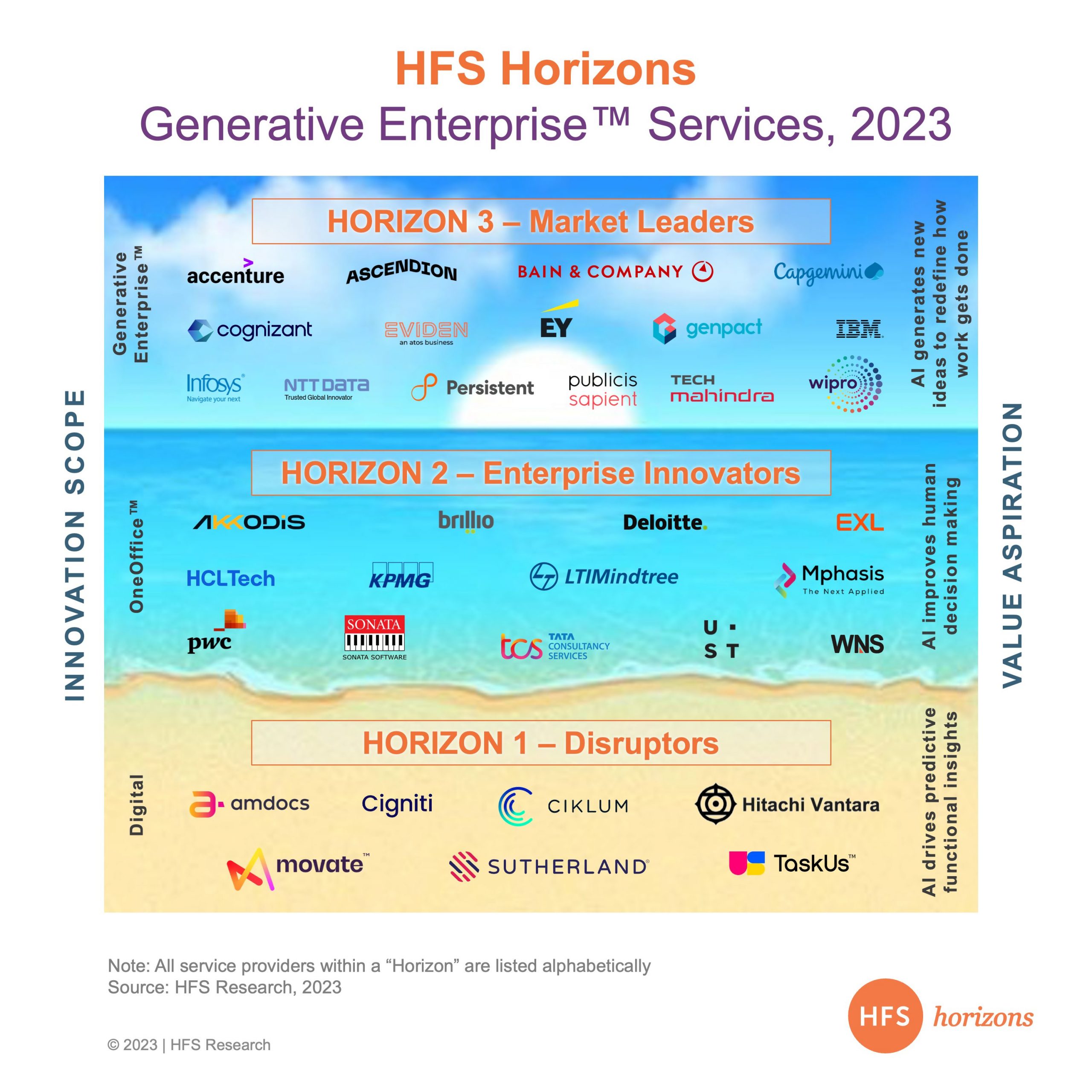
HFS has just launched the industry’s first-ever Generative Enterprise™ Services Horizons report, covering the 35 leading service providers and advisors vying for what they expect to be an enterprise investment bonanza.
So we finally have real “low-code” technology for business people, and every company leader wants to make sure they aren’t caught flat-footed again like they were barely a year after that famous ChatGPT launch. What is clear is they all desperately need partners to help them, but which of today’s leading service providers have the real chops to provide GenAI value at scale? Who’s actively backing up their big rhetoric with real know-how and capability?
Well… after an exhausting process of researching the 35 market leaders, their customers, and partners, we can provide the industry’s first real view of how the GenAI services landscape is shaking out.
The next LLM update will create new business cases and just as easily destroy others
Generative AI (GenAI) seemed to land like an alien-bestowed gift at the start of the year, promising productivity step changes and transformed ways of working. It triggered a rush of announcements from service providers as they committed billions in investments, raced to train hundreds of thousands of staff in the new technology, and buddied up with the hyperscaler owners of so much of the critical technology. Enterprise leaders felt pressure from above and below to “do something” with this shiny new object.
This nascent market is very much subject to rapid change. Updates to the various versions of large language models (LLMs) on offer may reveal unexpected opportunities for new use cases at every turn—and they are just as likely to destroy other business cases. There’s never been a better time to be agile and to keep your options open.
Fix your data and cloud challenges now, or risk missing the GenAIrevolution
And yet, there is a growing realization that scaling the possibilities of GenAI will ONLY be possible with solid data designed to support GenAI tools and cloud maturity foundations. This realizationwill create a moment for a sharp collective intake of breath among those enterprise leaders who are still working to get their data and cloud capabilities up to scratch. Catching up won’t be cheap,but to join the GenAI revolution it’s going to be unavoidable.
Simply put, if we just layer GenAI onto what we already have, we’ll reach a ceiling very quickly with what we can achieve. If, however, we optimize how we collect data to be synthesized by GenAI tools, the opportunities are exponentially greater. We will have to change our habits and how we do things if we truly want to move to a new S-Curve of value.
This is where the smart service providers see the real gold – transforming enterprises to get them GenAI-ready, as opposed to their old habits of implementing software and hoping their clients actually use it effectively. Hence GenAI is a transform-first, then-implement scenario…
Our Generative Enterprise™ Services Horizonsreport covers the 35 leading service providers
Our report examines and assesses 35 service providers. It evaluates providers’ capabilities to understand the Why, What, How, and So What of their Generative Enterprise services offerings:
Note: Service providers within each Horizon are listed alphabetically.
HFS has called out the rise of the Generative Enterprise—the articulation of the pursuit of AI technologies based on LLMs like ChatGPT and GPT-4 to reap substantial business benefits for organizations in terms of continuously generating new ideas, redefining how work gets done, and disrupting business models steeped in decades of antiquated process and technology.
The report offers detailed profiles of each provider and places each in one of our three Horizons:
Horizon 1–Disruptors: Those best placed to help enterprises drive digital transformation by leveraging AI to drive predictive functional insights.
Horizon 2–Enterprise innovators: Those enabling the HFS OneOffice™ by leveraging AI to improve decision-making and driving unmatched stakeholder experience.
Horizon 3–Market leaders: Those enabling the Generative Enterprise by leveraging AI to generate new ideas to redefine how work gets done.
Five key dynamics this report reveals about the evolving Generative Enterprise services market
The GenAI gold rush is pursuing a $7 trillion prize We’ve never seen a technology adopted so fast. GenAI’s poster child, ChatGPT, reached 100 million users in two months. RPA took more than a decade to reach 15 million. Every boardroom is asking every CEO, “What are you doing with GenAI?” This bottom-up and top-down demand and promise of a $7 trillion prize has prompted a gold rush among service providers as they hurry to organize and claim a piece of the action. In months, leading systems integrators and consultancies have conjured new practices, divisions, platforms, and partnerships. They are scaling up, investing billions, training thousands of people, and recruiting thousands more—and this journey is only just beginning.
Point solutions dominate, but this is not where we will end up We are already witnessing a rapid diversion of AI budgets to GenAI projects. On average, this stands at 41% across the enterprises surveyed for this report. We expect that proportion to grow as enterprises move beyond their initial point solutions in proofs of concept (POCs) and pilots. Most are solving specific tasks. As the next budgeting cycle begins, we expect budgets to scale up to take GenAI deeper into end-to-end processes, shaping new ways of working. The next step will be more challenging but more rewarding. And if it doesn’t happen, there will be a lot of red faces among service provider leaders, many of whom have gone all-in on GenAI.
The disruption is coming first and fastest to CX, EX, and sales and marketing As part of our research for this report, we asked enterprise leaders about the functions they prioritize for applying GenAI. Customer experience (CX), employee experience (EX), and sales and marketing lead the way. This chimes with the case studies service providers shared. Transforming code has been touted as a leading use case by many service providers, and it features prominently in their internal use and service offerings. But in our research, it only shows up in around 10% of the case studies we’ve seen. One key thing to note regarding case studies to date is that few are coming with an ROI. At this stage, most enterprises are happy to see softer measures such as time-to-serve, CSAT, or time-to-market.
Knowing the tech is one thing, but helping to transform with it is quite another Enterprise customers see a gap between how well their service providers deliver on tech implementation and their ability to transform business. It’s an important gap as enterprises seek help on their journey to the Generative Enterprise beyond the initial point solutions. Knowing the tech is one thing; helping transform ways of working because of the tech is another altogether. We think this gap will close because many service providers are going all-in on GenAI, focusing on proving the effectiveness of applying it to their ways of working first. The lessons they learn through self-transformation will give them the credibility to help enterprises shape their journeys.
This revolution is personal, and you need to get down and dirty with it Using GenAI tools is where your personal experience and understanding begin. Using the tech yourself is your due diligence. The journey to the HFS Research Generative Enterprise is not easy, but it starts with your understanding. Leaders need to develop their GenAI muscle memory to begin seeing the future through today’s technology rather than persisting with a view constructed on their experience and knowledge of the technology of the past.
The Bottom Line: GenAI will start and finish with POCs if you haven’t already cracked your OneOffice digital transformation.
Much of the investment to date in GenAI has been in POCs and pilots. It’s likely to start and finish there for those organizations that lag behind the leaders in digital transformation. Those best placed to scaletheir capabilities in GenAI are already digitally savvy and have the cloud and data infrastructure to support GenAI’sdata-centric and cloud-computerequirements. We are headed for a critical decision point for leaders:Get very serious about yourOneOffice digital transformation, or watch your GenAI-augmented rivals leap beyond your grasp.
The biggest problem plaguing the world of business technology – ever since businesses started using technology – is the simple fact that most enterprises blow vast fortunes on expensive tech solutions and expect them to perform wonders for their businesses without redesigning and structuring their processes and data to achieve maximum value from the technology. It was the case back in the 1960s with MRP, then decades later with ERP, and these issues are even more exacerbated with the Cloud.
Most customers of Cloud just want “easy”… that is the problem.
At least ERP gave companies a standard set of processes to force themselves to follow, but moving your existing mess into the Cloud is an expensive disaster if you avoid changing how you operate, modernizing your hodgepodge of systems and applications, and redesigning your workflows so data can flow freely around your global organization, up and down your supply chain, and across your business ecosystem of customers and partners.
The Cloud is a whole new environment within which to operate your business, and you can’t shoehorn your legacy way of operating into this environment without addressing these (often painful) changes. “Clients just want easy; that is the real problem,” stated the leader of a major transformation practice. This is why our recent research of over 500 Cloud decision-makers from major enterprises (Global 2000) reveals that Two-thirds of organizations don’t fully achieve their strategic objectives for transformation enabled by the cloud (see Exhibit 1 below). Sadly many of those transformations clearly fail miserably if your Cloud transformation will fail if it is not grounded in business objectives. Yet, to keep the cloud bandwagon and spending going, hyperscalers and service providers are now peddling “Industry Cloud.” So let’s probe deeper into what “Industry Cloud” really means…Read More
“Gen AI is a catalyst for a new level of reinvention over the next decade” – Julie Sweet
As part of our GenAI Leaders Series, we got time with Accenture CEO Julie Sweet to talk about how the $64 Billion dollar corporation is approaching GenAI. With the services industry experiencing feverish excitement over AI and anxiety surrounding the demise of legacy labor arbitrage models and reduced technology expenditure, who better to listen to than the provider leading growth from the front and reinventing itself ahead of the market, with its formation of Accenture Digital in 2013, then Cloud First in 2020… and now its aggressive pivot to drive GenAI at scale.
Accenture’s Total Reinvention… can enterprises embrace change?
Just when you thought you couldn’t bear to hear the phrase “digital transformation” one more time, a fresh view of changing business dynamics is being ushered in by Accenture CEO Julie Sweet under the moniker “Total Enterprise Reinvention.”
Accenture claims this reinvention is fueled by technology, data, and AI and is already impacting how people work. While highlighting the responsibilities leaders must take to be successful during the next decade. As Sweet says, “Accenture clients are embracing change more than ever, and GenAI is the catalyst for embracing that change at a more rapid pace than we’ve ever seen.”
While enterprises are under pressure to innovate and cut costs at the same time, many service firms have been caught flat-footed when it comes to understanding the potentially revolutionary capabilities of LLMs and generative AI tools. And while others are defining their vision, Accenture is putting its money where its mouth is by declaring a $3bn investment in AI. Their goal is to embrace the workforce changes enabled by GenAI and proactively train thousands of staff, develop assets, and build solutions to help their enterprise clients adopt GenAI faster. Their big bet promises a big payoff for the $64bn services juggernaut, which announced in June it had secured $100m in GenAI projects, a number that’s surely climbing further since, claiming 40 of its enterprise clients are now experiencing GenAI at scale.
In our latest interview with Accenture’s top brass (see last month’s summary of Paul Daugherty’s insights here), Sweet describes the transformative potential of GenAI on the enterprise and the future of work. Here’s what we learned, and HFS’s take:
Spending constraints must not slow down innovation in the digital dichotomy of 2023. The economic climate this year is forcing companies to hunker down and cut costs, focusing on efficiencies, and making them do more with less. But at the same time, they are being tasked with increasing their innovation efforts critical to differentiation and growth. Accenture’s “total enterprise re-invention” is aimed at helping clients figure out where and when to invest. As Sweet says, “There’s going to be a significant amount of enterprise spend that’s unavoidable, and Accenture aims to help clients do that in the smartest way possible.” As enterprises add in the opportunities and risks inherent with GenAI, Accenture is bullish on helping clients embrace GenAI to drive the next decade of change.
GenAI is playing a role in the re-invention of the workforce and society at large. GenAI is leading to fundamental changes in how organizations operate and impacting how every part of the organization will have to work differently to compete and succeed. Mainstream discussions have mainly circled around whose jobs are in jeopardy and whether or not education is being stunted by the use of GenAI to “cheat.” (Sweet points out her teens have taught her that’s not happening – too many tools out there to detect when GenAI’s been used to cut corners!) For now, it seems the workforce is being augmented, and students are becoming savvy with GenAI to learn faster and, to improve the learning process rather than avoid it.
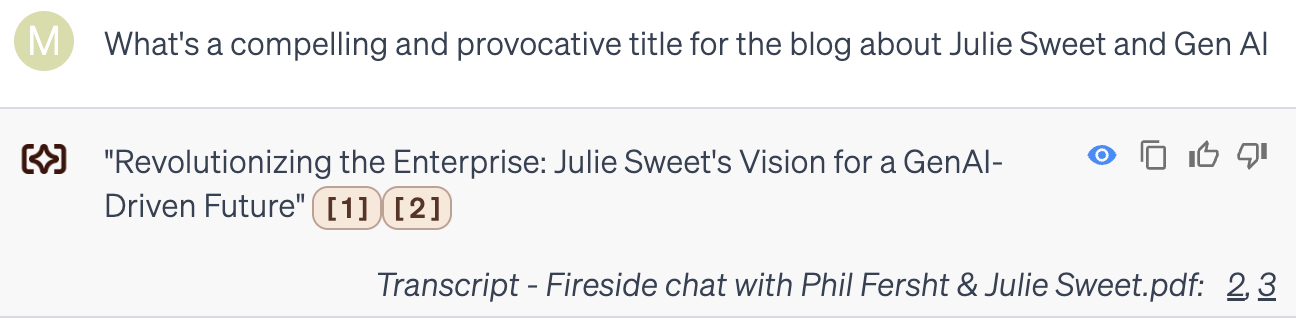
Knowledge workers will be affected most by GenAI-fueled re-invention. All knowledge workers will be using some form of GenAI to do their jobs better within the next five years. Just look at HFS Research’s own use of LLMs to transform our web search tool and allow greater access to research for our clients. In fact, we used GenAI tools on this blog itself to transcribe and summarize this interview and organize some of the key points. As knowledge workers, we must embrace the opportunity to use these tools to help us work more effectively. What remains to be seen is what parts of knowledge work jobs will be displaced versus those that will be augmented – there will be both in our future. It’s clear that (for now) the creative and provocative idea-focused tasks are still firmly in the human realm (though the return on the request below wasn’t terrible).
For Accenture, the evolution of GenAI in their workforce is underway as they are educating their workforce on prompt engineering, AI-centric risk assessment, and ongoing training for their global workforce. Under Sweet, Accenture is taking a stand that GenAI isn’t the enemy of knowledge workers; rather, it’s an infusion of capabilities as GenAI assists in how people get their job done more efficiently.
Responsible AI isn’t just a priority; it must be part of the foundation of your firm’s GenAI journey. You will put your company at risk by not thinking through the pitfalls of AI; companies must promptly establish a systemic foundation for responsible AI practices.Accenture is establishing a first-of-its-kind formal compliance program for responsible AI, including a framework providing guidelines for its teams and their customers on implementing AI projects. As it has been building AI solutions for over a decade, Accenture provides diagnostic tools to aid in the evaluation of risk levels related to implementing AI-based projects. This tool helps categorize AI applications into different levels of risk, allowing organizations to understand where they might be using high-risk AI. HFS agrees with Accenture that it is critical that while investment is going into GenAI, matters of bias, fairness, privacy, and security be addressed and protected from the start.
Adopting GenAI to augment how we work, its impact on people, processes, and tech will mean every part of the enterprise will work differently. As companies and employees apply data and AI into their everyday lives every part of how they work is going to change. If you only combine this seismic shift with what we know now, you’ll miss great opportunities during this change. For instance, people aren’t talking about how GenAI, combined with advancements in quantum computing will bring significant changes in fields like material sciences, security, and biotech. With this in mind, it is critical for organizations to adapt and work differently and do this with further change just on the horizon.
The Bottom-Line: GenAI’s potential is positive, but proceed with caution, education, and responsibility
We are at the tipping point of one of the most significant enterprise technology shifts ever. GenAI is maturing quickly, and whether it’s within two years or five years, our workforce and business environment will be completely different, and the services industry will be re-invented.
It is still early days, but it is clear that it is critical to invest in GenAI now to create future value; services firms must go all in on understanding and finding examples of effective use cases for GenAI. By doing so their enterprise clients will seek them out for guidance and collaboration as these investments in GenAI shape their generative enterprise aspirations. “When you embrace the shift, you win,” says Sweet, about each of the technology shifts she’s seen Accenture embrace in its past. GenAI promises to be a seismic shift, but moving forward carefully is necessary to avoid risk while maximizing value creation.
Ravi Kumar, CEO of Cognizant and one of the leading voices in the global IT and business services industry for the last couple of decades has spent this year reshaping Cognizant as the firm surpasses the $20 billion services revenue milestone.
Talking with Ravi and hearing his developing thoughts, he has a deeper-than-ever focus on reversing the alarming commoditization trend of tech services by developing a talent strategy with a mindset grounded in creating new value through technology arbitrage value, not simply labor arbitrage.
Our most recent candid interview – as part of our GenAI Leaders Series – is to learn how Ravi is shaping things up at Cognizant in light of the opportunities and potential threats posed by GenAI…
Enterprises must do more with less and innovate in tandem
So, what are Cognizant clients doing to navigate the new business climate steeped in cost-cutting concerns alongside excitement and uncertainty about GenAI potential? Ravi described an accelerated pace of change that is occurring within the enterprise landscape, with technology as the foundation; all companies are now aspiring to become tech businesses and AI is becoming deeply embedded in business. Cognizant customers are looking to drive out costs and innovate in a hurry with equal determination. They are also focusing on the foundational elements of an AI-powered organization, including data readiness, privacy, security, and responsible AI.
This means firms like Cognizant must pivot their value proposition; getting stuck in Horizon 1 of cost-cutting and process optimization means continuing to live in the legacy world of commodity cost-savings-focused engagements. Cost savings are important, but ambitious providers have to keep striving for the co-creation of new sources of value to stay competitive in today’s era of rapid AI deployment. Many service providers have maximized the cost and efficiency levers in recent years, and now the focus is firmly shifting to genuine business transformation to provide faster, smarter data to drive rapid decision-making. That is the new lever that must be pulled in these engagements to deliver new thresholds of performance out of the business and support the growth agenda. Providers must support their clients to optimize and innovate at an equal pace in order to keep up with the competition and do the same themselves.
Gen AI creates a whole new workflow paradigm: enter, the jagged frontier
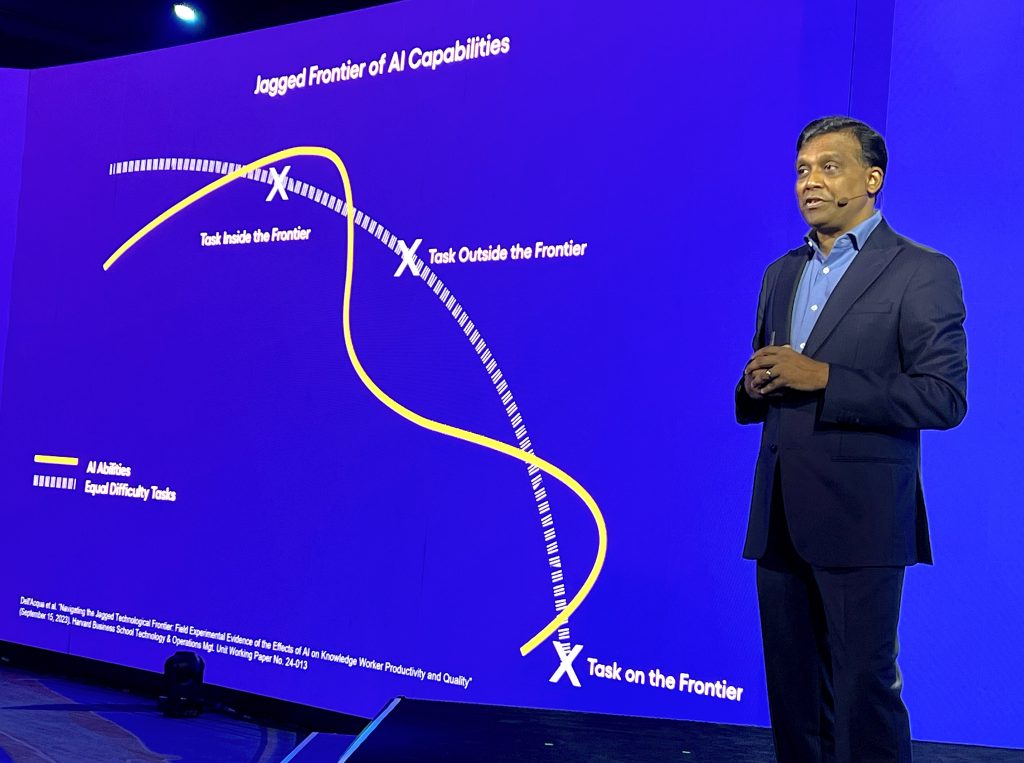
Ravi describes his view of the evolution of GenAI as a “jagged technological frontier.” This jagged frontier implies an uneven edge, where task allocation is irregular and the output quality is very disparate. Some operational tasks are easily done by AI, while other tasks of a seemingly similar difficulty are outside the current capability of AI. For a workflow designer, this means GenAI-capable tasks can fluctuate over the course of an employee’s workflow, with some tasks falling inside and others outside the frontier. You always need a human in the loop, at least with the AI we have today. The jagged edge GenAI creates for workflows is driving a whole new workforce dynamic that is both exciting and daunting. Let’s dive in on how this jagged frontier is playing out within Cognizant and for its clients….
GenAI is poised to amplify human production; the bottom half of workers will benefit most, but will overall improve productivity
There are two core areas where Ravi sees GenAI as having the most impact: the amplification of productivity within the delivery of services, particularly for developers and customer service staff, and augmenting customer ecosystems.
When we wrote about the new S-curve of value creation for GBS, we noted the rapid maturation of GenAI promises a significant productivity improvement (not just incremental) in voice-based work, coding, testing, and transactional processing. There’s also the promise of AI-driven operations to support autonomous decision-making, exception processing, and the capability to handle a more creative scope of work beyond mundane and boring activities.
This aligns with Cognizant’s view of the evolving GenAI capabilities, where human talent is both augmented and accelerated. Ravi sees a particularly significant impact on developers for equalizing performance; he cites a report that concluded that the bottom low-performing developers benefit much more from GenAI than high-performers when evaluated on the quality of output performance. This levels the playing field for talent across proficiency levels and offers a big opportunity to improve the developer productivity lifecycle.
“Every job can be upwardly mobile if you can use the power of technology, the power of AI, and make people do more value-added jobs and more prosperous jobs so that they see the value in embracing technology. So, while technology related to AI is going to eliminate jobs, it’s going to create upwardly mobile jobs.” –Ravi Kumar
The future workforce is driven by capability equalization and net new, different jobs
While Ravi also reminds us that any big disruptive opportunity is also a threat and cautious enthusiasm is the right tone to strike, Ravi firmly believes that the evolution of GenAI will create new jobs and impact the future workforce in a positive way. The shifting of agency to the end user brings a new opportunity for tech to be used to empower ourselves and our employees in their jobs. Generative AI still requires a human in the loop, and as a result, we will re-invent our workforce, and the types of jobs we need in the services industry will change. As Ravi puts it, “We will need more problem finders versus problem solvers; it will require more heuristic and creative skills, which will make this industry much more diverse.” That diversity of thought and people is something that services firms must embrace to refresh and reinvigorate the industry.
Moreover, in terms of the overall volume of jobs, Ravi is bullish on the GenAI shift as a catalyst for job growth in the services industry rather than the commoditization that has been threatened for decades every time a shiny new tech is introduced. “Looking back, technology actually created more jobs of the future than it’s taken away jobs of the past – so I’m very optimistic that it is going to create significantly more jobs for the future.”
AI first, machine + people is the future of work; services firms are the arbiters of change
Tech services firms are going through a transition fueled by these technology advancements and labor shifts. While the enterprise landscape is being completely reshaped by GenAI, and resistance to change is high, leading services firms will help connect their clients’ organizations to the broader GenAI ecosystem, and their partners must be in lockstep with them to navigate the changes.
Looking ahead, Kumar predicts that the world will become an AI-first, machine-plus-people endeavor. AI will lead to more tech intensity, more budget allocation due to higher productivity, and a greater need for creative and heuristic skills. This is an opportunity for the services industry to develop top talent for new and exciting tasks that shun the mundane and repetitive roles of the future and create fun, human things for people to do.
As technology becomes more central to enterprise landscapes, the traditional labor arbitrage value proposition will fade into the distance as technology arbitrage becomes the central role of the service provider.
“Technology arbitrage is the future of the services industry” – Ravi Kumar
The Bottom Line: Capability equalization of the jagged edge frontier will lead to the human amplification that the services industry desperately needs to deliver value.
There is still much work to do to bring the promise of GenAI to its potential in the services industry, and constant tech advancements and risks mean we cannot afford to take our eye off the ball for one minute. What is certain is that as enterprise operations and services leaders, we must be prepared for challenges, not least of which is a dearth of technology and business professionals prepared to ride the wave that an AI-powered enterprise requires, which is adopting a probabilistic mindset and an emboldened attitude to learn new methods and ways of doing things.
Bridging this divide we currently see ahead of us means better service partnerships, greater productivity as well as prosperity for workers, and greater job satisfaction leading to better outcomes across this new generative ecosystem.