To paraphrase Freddie Mercury, “Another bank bites the dust.” This time it’s First Republic Bank – the latest financial institution that was unable to sufficiently rebound from the liquidity crisis borne out of rising interest rates. J.P. Morgan scooped them up on May 1, with its Chairman and CEO Jamie Dimon widely quoted in the press insisting that this is not a global financial crisis repeat.
HFS tends to agree with him. Central banks and the financial services community have too much at stake to let that happen. It was a long road back from 2008. Trust in banks is still dicey at best. We expect we’ll see continued regulatory oversight, financial support and rescue buy-outs if needed to keep the global banking system functional.
While there is an undeniable crisis of confidence at play fueled by various macroeconomic factors and exacerbated by the spate of bank failures, crisis begets opportunity for the bold. Here are three recommended actions that growth-minded banks should take immediately to ensure survival at a minimum and potential leadership if done well.
Continue investment in critical modernization initiatives.
Digitize your commercial banking offerings
Create actual offerings for small and medium enterprise clients, inclusive of start-ups and scale-ups
Let’s break these down…
1. Continue investment in critical modernization initiatives
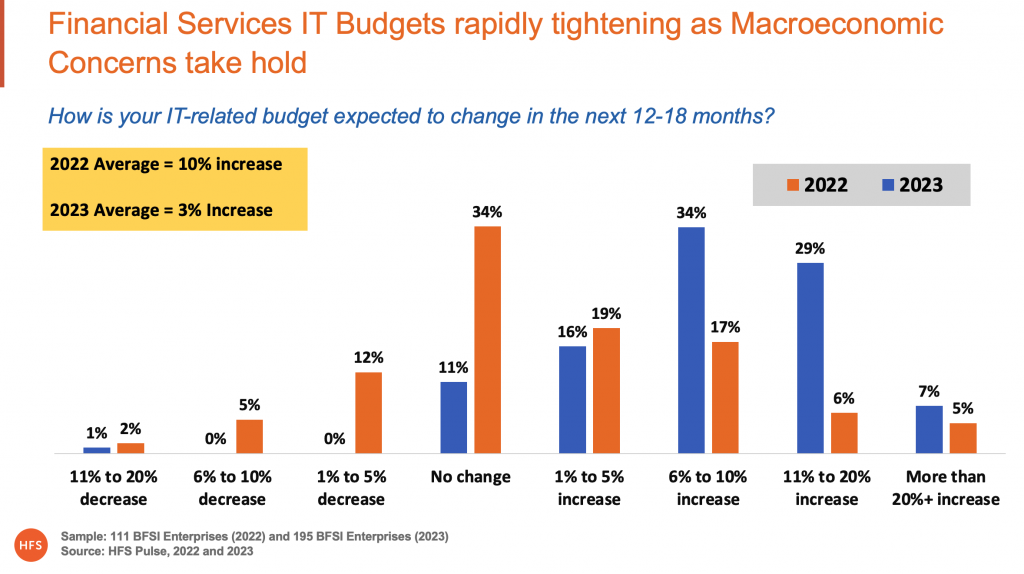
Before Silicon Valley Bank went belly up, global IT spending was already in a death spiral from the strain of ongoing macroeconomic conditions. With the pandemic largely at bay, everyone was forced to now pay attention to all the other contributors to macroeconomic malaise – global conflict, inflation, recession, talent challenges, and heightening cybersecurity risk. HFS saw this crisis of confidence reveal itself through a massive year-on-year slowdown in projected IT spending. As the below chart showcases, BFSI spending went from 10% projected growth in 2022 to just 3% in 2023, with the greatest portion of spending now sitting in the “no change” bucket.
This will further slow enterprise spending and related deal closures for services firms. This will persist for at least a quarter with the potential for stabilization and turnaround when banks fail and interest rate hikes quiet down, possibly in Q3 or Q4 2023.
As banks navigate the current mess, we beseech you – do not fall prey to the cost reduction path to perpetual mediocrity. While digital native competitors may be loads smaller than established banks, their technology nimbleness is real, enabling their ability to swiftly spin up new personalized offerings, use data to not just have a 360 views of customers but also to do something useful with the data immediately, and they can and are driving interesting new business models built on open banking and embedded finance. Smart banks need to have a firm understanding of which modernization initiatives are essential to enable growth. Core banking modernization and data migration to the cloud are two likely candidates that are well worth staying the investment course.
2. Digitize your commercial banking offerings
The four fallen banks of 2023 thus far – Silicon Valley Bank (SVB), Signature Bank, Credit Suisse, and First Republic Bank all had varied portfolios and customers. Still, they all offered a significant commercial banking proposition. These failures have already sounded the alarm for updated regulatory standards pertaining to interest rate risk. But they should also serve to raise awareness about the shoddy state of commercial banking – built for large enterprises and starved of digital investment. Smart banks should turn this so-called crisis into an opportunity to finally modernize their aging commercial banking capabilities. The impact will be better quality of service for existing clients and realization of the growth potential in SMEs.
A recent HFS survey of 150 commercial banking leaders revealed investment in offering expansion is heavily focused on enhancing existing capabilities not spinning up sexy new offerings:
The same but better. The top three areas for commercial banking offering expansion are lending and lines of credit, deposit accounts, and commercial cards. Treasury services rolled in at number four. The emphasis is less on new offerings and more on better versions of existing offerings.
Customer onboarding time takes too long. Respondents indicated the average time to onboard a commercial customer is 32 days. The leading factor slowing onboarding is implementation or integration requirements.
Host-to-host connectivity still rules customer access. 65% of respondents indicated that host-to-host connectivity is still the primary standard for accessing products and services. Commercial banking leaders expect strong growth in API connectivity in the next two years.
Current investments favor operations automation. Commercial banks indicated their current top area of investment is in intelligent automation of transaction and operations management. The top areas of investment in two years’ time shift from process optimization to international enablement with trade finance and embedded finance opportunities.
As banks consider their paths forward in the low-confidence economy, there is a clear need and growth potential in commercial banking that can be unlocked with appropriate investment.
3. Create actual offerings for small and medium enterprise clients, inclusive of start-ups and scale-ups
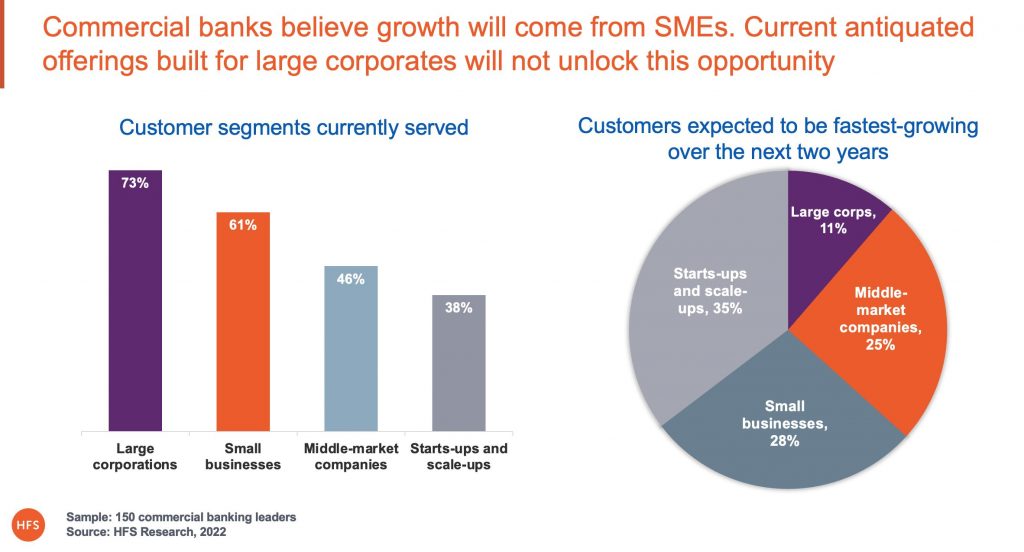
Commercial banking has largely been built for large corporates. The definitions of “large” tend to change based on the size of bank, but the customer baseline is very consistent – with large corporations making up the lion’s share of commercial customers served (see below). SMEs, start-ups, and scale-ups are represented, but often these segments are clubbed with and supported by retail banking businesses rather than being treated as commercial clients – or as their own unique customer segments. This is a missed opportunity to support and enable the growth of SMEs.
As Exhibit 2 also shows, commercial banks realize future growth will come from SMEs. The conundrum, though, is how to truly cater to these segments. The gaps left in the market by SVB, Signature, and now First Republic – all firms that were notable backers and supporters of SMEs – raise issues of bank choice, who is willing to support SMEs and innovative start-ups, and how to do so. As we suggested earlier in this piece, banks supporting commercial customers must invest in digitizing their offerings to deliver better services to existing clients. But it is also a critical ingredient to customer expansion. SMEs want the digital capabilities they’ve been enjoying on the retail side of the house with the benefit of traditional commercial services like various treasury services, lending and lines of credit, and merchant services – but done digitally. SMEs and start-ups, and scale-ups need to be treated as a distinct business segment.
The Bottom Line. Despite the crisis of confidence, there is a glaring opportunity in the face of the banking mess – better commercial banking
Banks should clearly shore up their balance sheets in the face of the liquidity crisis. Those not on Moody’s or other watchlists should consider seizing smart opportunities The need for better commercial banking is not new. But the recent bank failures have put a spotlight on banking choices and the options available to SMEs and innovative start-ups and scale-ups. There is a clear need and opportunity for digitization in commercial banking. As part of this investment, banks need to consider the needs of the SME community – typically representing over 99% of business in most country markets. These are your future growth customers, and they want offerings designed for them.
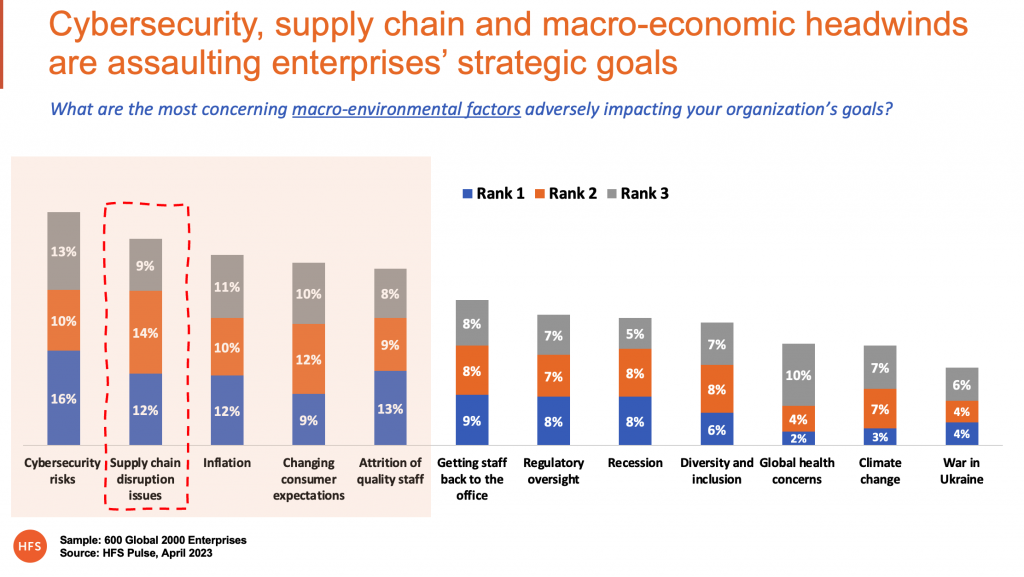
The health of most enterprises depends on the robustness of their supply chains, and our latest Pulse study of 600 G2K orgs shows supply chain disruption is posing the second-greatest challenge to enterprise leaders after cybersecurity:
Today’s enterprises grapple with unprecedented challenges, including disrupted supply from hubs like China, heightened sustainability expectations, a lack of resources, and increasing raw material and fulfillment costs. Service providers help enterprises improve inventory allocation through artificial intelligence (AI) and machine learning (ML) algorithms, optimize supplier management through dynamic supplier management systems, improve visibility by building advanced control tower solutions, and reduce people dependency by introducing automation across processes. The objective is that enterprises should be able to detect and react to “change” quickly, transforming from linear to circular to eventually autonomous supply chain networks.
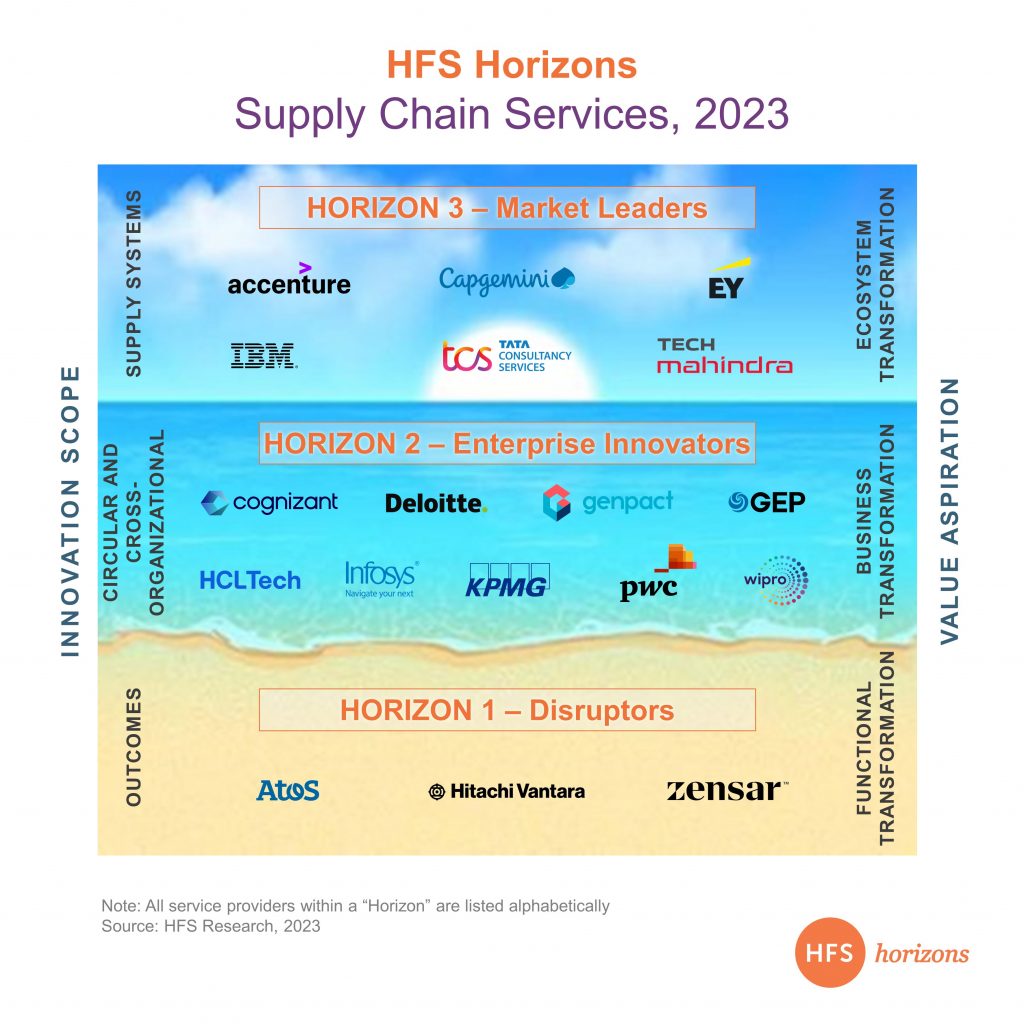
The HFS Horizons report on supply chain services features 18 providers across three Horizons manifesting incremental business value for enterprise clients. Horizon 1 focuses on a linear supply chain driving functional optimization, followed by Horizon 2, which retains the values of Horizon 1 plus drives circular supply chains with end-to-end transformation capabilities, creating unmatched stakeholder experience with a “OneOffice” mindset. At the pinnacle is Horizon 3, which encapsulates all values of previous Horizons plus encompasses a networked and autonomous vision of the supply chain, driving completely new sources of value with a “OneEcosystem” approach.
The chart below summarizes the Horizons philosophy and key underlying dynamics, showcasing the providers across the three Horizons.
Note: All providers within a Horizon are listed alphabetically
According to the report’s lead author, Ashish Chaturvedi, “The pandemic coerced enterprises to prioritize resilience in their supply chain management and modernization programs. They are achieving this by increasing supply chain visibility, limiting human intervention, and creating multiple fallback options at a process level, such as source-to-pay (S2P). This newfound focus transcends the traditional linear, albeit constrained, supply chain management approach. Gradually, the industry is inching toward a connected, autonomous, sustainable, and collaborative supply chain paradigm.”
Report highlights include
Supply chain resilience has become the central theme of contemporary supply chain engagements. Service providers are helping move enterprises from just-in-time to inventory overstock and single-supplier–single-country sourcing to multi-supplier–multi-country sourcing, demanding more dynamic control tower solutions and a higher degree of automation in demand planning, warehousing, and fulfillment. The objective is to have more control and visibility of the supply chain to navigate unforeseen disruptions.
Sustainability offerings have evolved but not baked into engagements. More than two-thirds of the providers participating in the study have formulated offerings around sustainable sourcing, circular economy, green logistics, and decarbonization metrics. Interestingly, most of the cases discussed were standalone sustainability engagements with a supply chain angle rather than the other way around. It came to light that enterprises are also putting a half-hearted effort into baking sustainability across the supply chain.
HFS assessed 18 leading supply chain service providers. Of these 18 providers, six are positioned in Horizon 3 as leaders, nine in Horizon 2 as innovators, and three in Horizon 1 as disruptors. The services firms that lead the market and ecosystem-level change in Horizon 3 are Accenture, Capgemini, EY, IBM, TCS, and Tech Mahindra. The services firms innovating across organizations and supply chains in Horizon 2 are Cognizant, Deloitte, Genpact, GEP, HCLTech, Infosys, KPMG, PWC, and Wipro. The services firms disrupting and transforming business processes and functions in Horizon 1 are Atos, Hitachi Vantara, and Zensar.
The report includes detailed profiles of each service provider, outlining their capabilities, strengths, provider facts, and development opportunities.
A decade on from the trials and tribulations of IBM Watson, IBM unveiled its multi-model and multi-cloud Watsonx to drive AI-first enterprises – what we are calling “The Generative Enterprise” at HFS.
IBM is describing the platform as a “full technology stack” for training, tuning, and deploying AI models, including foundation and large language models, while ensuring tight data governance controls. Watsonx.data focuses on the data scientist; Watsonx.ai the application developer; and Watsonx.governance is then used to deploy the model using a data model factory to ensure that AI is used ethically and responsibly.
In our view, Watsonx is the first enterprise-grade offering to address the Generative Enterprise holistically. Here’s our interpretation of Watsonx:
Watsonx.data helps you create the data model. It focused on the data scientist leveraging Red Hat Open Shift to prepare, tokenize, train, and validate internal and external data.
Watson.ai helps you ask the relevant questions (design prompts). ChatGPT, for example, never gives exactly the same response twice. Learn how to prompt your LLM more intelligently with both short and long prompts to compare quality and accuracy. One of the key benefits of GPT4.0 is the ability to absorb very long prompts (as large as 1000s of words) at rapid speed.
Watson.ai also helps to iterate. Try asking the same question in different ways, exploring multiple responses to the same prompt, and then comparing the results, detecting bias, and being aware of it.
Watsonx.governance evaluates responses which is as critical as much of what we have experienced so far as how ChatGPT gets it wrong. Asking questions in different ways, discovering contradictions, and asking to self-assess, is a key aspect of GPT4 that has improved significantly since the prior version.
Watsonx.governance helps eradicate bias by constantly expanding our understanding of bias in LLMs. ChatGPT, for example, is biased based on the underlying approach used to build the LLM and the data used to train it.
Watsonx overall fosters the generation of new ideas (Generative Thinking). The big challenge now confronting us as we pursue becoming a true Generative Enterprise is to constantly seek new ideas beyond the constraints of our current LLM. You should ask ChatGPT to summarize, synthesize and find the contradictions in the result it creates. Invest time in learning how conceptual blending approaches are evolving.
The Bottom-line: IBM could have been at the center of the AI revolution but was left out as a bystander. Watsonx has the potential to put IBM front and center of the Generative Enterprise
Watsonx seems very well thought through for AI-powered enterprise use cases, especially for horizontal call centers, HR, and F&A. IBM seems to have learned from its original Watson launch by deploying it internally first, launching an apps development platform to demystify the technology. However, the IBM narrative for Watsonx continues to be more technology-centric versus business-centric, which they need to address with their Watsonx narrative.
IBM still woos the CIO budget, but that’s only a third of the total enterprise tech spend. We believe IBM runs the risk of missing out on the broader CXO budgets but polarizing itself around the CIO.
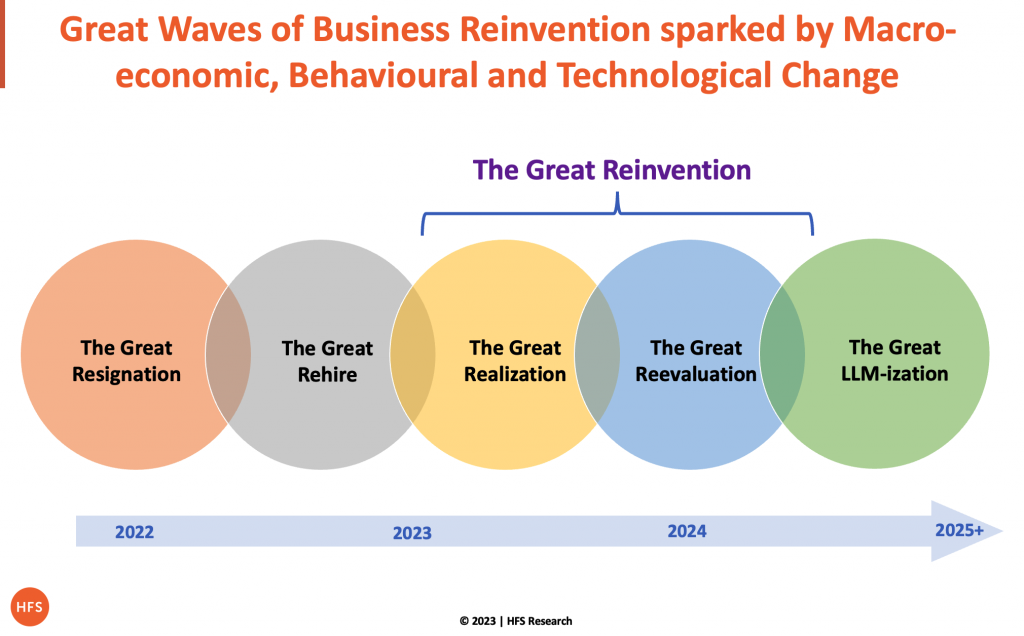
The Pandemic will forever go down as a seismic game changer in our lifetimes – and our careers. The whole 2+ year experience took a lot of us, cost so many people loved ones and changed the work/life perspectives for so many. Now we face a new world where new rules are still being set (and those rules are likely to be no actual rules at all), but we are faced with no choice but to reinvent ourselves if we want to remain relevant in the business ecosystem of the future.
Or we could choose to ignore the change and pray we aren’t assigned to the dinosaur mausoleum anytime soon… it’s critical to prepare ourselves for the Great LLM-ization as AI becomes the interface to the Internet – and to physical business. LLMs will blow a hole in predictable high-cost operations like call center services and back office business process services, where their entire business models will eventually become defunct in the wake of technological and behavioral change.
Nothing is quite like it was before, and many of us struggle to adapt to these new uncertain surroundings.
Scratch that; most of us are struggling to re-adapt because there are no hard and fast business rules or norms these days. People guard their time religiously, especially when it comes to leaving the house for meetings, events, or office visits. Meanwhile, many corporates are wracked with politics and toxicity, as many workers panic about upcoming layoffs, driving peculiar behaviors from many. There are so many people existing at home for weeks on end, praying not to get the sack in the next round of layoffs because they know they lack energy and focus. This stress of uncertainty and unfamiliarity with the emerging work environment is having a major negative effect on our mental stamina. A lot of folks can barely make it through a full day of meetings these days.
We are living through a time of realization and reevaluation
While I am not going to advocate people to force themselves into an office (those days are pretty much over), I strongly advocate everyone refocus on adapting to the emerging work environment in order to re-energize themselves. The current environment demands you meet regularly with colleagues and clients, suppliers and ecosystem partners if you want to be visible and relevant in your market.
So bloody well do something about it! You need to find your mental stamina to hustle again, learn new ways of thinking, and prepare for the AI-dominant future.
Seven golden recommendations to reinvent ourselves and survive the onslaught of change
1. Accept the way business works has changed… and will keep changing. Accept the way things are emerging are not necessarily a mirror of the past… how we interact, invest our time, communicate, influence, focus, relax, etc. Get used to change and embrace it.
2. Prioritize meeting in person with clients and colleagues more than ever. Don’t fade away in your cave… the sheer scale of change AI and automation are bringing demands us to lock heads and learn together. There’s nothing wrong with working from home, but nothing is better than locking heads with our colleagues and other people to come up with inspired ideas.
3. Adopt an autonomous mindset. Make a real effort to stop yourself and others wasting time on tasks, interactions, and processes that can be automated. Focus your time on making smart decisions based on the data your systems and teams create for you. And developments in LLM models are adding a whole new dimension to the quality of data and insight at our disposal.
4. Change your narrative from ‘effort’ to ‘performance’. The only way to do more with less is to focus on measuring the outcomes we need and the smartest way to achieve them. Work with people who share that mentality. We need to focus on speed to data, not some trudging, painful set of activities.
5. Invest time in understanding AI tools and capabilities, or get left well behind. Don’t be a dinosaur and get with the program, as AI becomes our interface to the internet. AI is changing business as we know it… and at pace, both electronically and physically. Large Language Models are quick and easy to learn and don’t need a Ph.D. in mathematics or computer science. These tools are low/no code environments to develop new workflows or processes that threaten the old guard of programming, where technical staff loved building brick walls to prevent any meaningful business/IT collaboration. Now those walls are crashing down with the onset of these tools that can find patterns in large bodies of text which can predict the next word to write, create sentences and assemble paragraphs of coherent content.
6. Humans are ‘back in the loop’ as we have toprompt AI to get ahead of the LLM explosion. Prompt engineers are the fastest-emerging class of digitally fluent business/tech designers. We already using a conversational interface to ask questions and generate text with an LLM in 2023, and we will be unable to avoid it by 2024. Learning how to do this effectively will become a standard skill that all of us are expected to have. You must understand the mental maps to direct what your team does, as LLMs dictate how we interface with the Internet and run our businesses.
This skillset needed to build effective conversational interfaces is not steeped in NLP or deep learning, instead these LLM orchestration skills demand constant self-improvement in the following:
Asking questions(design prompts). ChatGPT, for example, never gives exactly the same response twice. Learn how to prompt your LLM more intelligently with both short and long prompts to compare quality and accuracy. One of the key benefits of GPT4.0 is the ability to absorb very long prompts (as large as 1000s of words) at rapid speed.
How to iterate. Try asking the same question in different ways, exploring multiple responses to the same prompt, and then comparing the results, detecting bias, and being aware of it.
Evaluating responses is critical as much of what we have experienced so far is how ChatGPT gets it wrong. By asking questions in different ways, discovering contradictions, and asking to self-assess is a key aspect of GPT4 that has improved significantly since the prior version.
Eradicating bias by constantly expanding our understanding of bias in LLMs. ChatGPT, for example, is biased based on the underlying approach used to build the LLM and the data used to train it.
How to generate new ideas(Generative Thinking). The big challenge now confronting us as we approach the Great LLM-ization is to constantly seek new ideas beyond the constraints of our current LLM. You should ask ChatGPT to summarize, synthesize and find the contradictions in the result it creates. Invest time in learning how conceptual blending approaches are evolving.
7. Understand the significance of the technical improvements of GPT-4… it’s the beginning of the Generative Enterprise.
HFS’ Generative Enterprise articulates the pursuit of AI technologies based on Large Language Models (LLMs) and ChatGPT to reap huge business benefits to organizations in terms of continuously generating new ideas, redefining how work gets done, and disrupting business models steeped in decades of antiquated process and technology.
We are learning the new version of GPT is ten times more powerful, cites sources, understands dialects, and even has eyes… just click here to learn more.
While everyone a year ago thought that nuclear war could threaten humanity’s future yet again, 61% of Americans now say that AI threatens Humanity, according to a new IPSOS/Reuters poll of Americans. 70% of Trump voters believe this, compared with 60% of Biden’s. Not quite sure why we shared that last stat, but it seems to convey how ridiculously this new fad of “AI-washing” is taking us over.
AI means both Everything and Nothing
On the back of the generative AI hype, “AI” has quickly become the new catch-all phrase in modern IT, despite being around for 50 years. People have never been so aware of fake news, internet scams, security breaches, etc., as the public trust in technology reaches a new low.
Massive public misidentifications are making the AI term both a scapegoat for unpopular job layoffs and a magic hype-wand for vendor marketing, as literally every firm touching technology is launching their “GenAI” suite of offerings on a daily basis. The pressure is on executives, investors, public decision-makers, and influencers to skill-up fast and learn how to approach the AI craze with cunning instead of credulity.
We must learn to question what is meant by “AI” and stop it everywhere we lack an agenda or a justification. While the same lack of meaning can be said for the term “Digital,” at least “Digital” tends to be used in a positive context to describe “modern technology,” whereas “AI” is currently being used to describe pretty much anything. AI’s use has become so vague it essentially means “modern computing” in many cases.
However, AI is bloody everywhere
Since the public release of ChatGPT in November, “AI” has been snowballing in usage and popularity. Take a simple Google trend search, and you’ll see the meteoric rise of the term, with “AI” quadrupling since November. In this timespan, most people everywhere have encountered it.
Whether you are a business leader looking for the next innovation to drive profit or cut costs or a parent to a school child getting ready for exams, AI has been doing the rounds at dinner tables and coffee meetings as well as getting a high share of attention on mainstream TV news, from journalists and politicians across the globe. Even many people’s grandparents ask about it as if it’s some sudden new thing.
AI becomes a fashionable excuse to sack people
Back in the days when jobs were being cut because of “outsourcing,” there was always political uproar, and evil corporates were vilified for destroying livelihoods to save a few dirty dollars. I’ve even had protesters demonstrating outside of conferences with the “O” word plastered over them. Suddenly these same corporates (most of whom have already outsourced staff to the bone) are victims of the evil realities of technology where they have no choice but then whack thousands more “because of AI”. Puh-lease… is AI now some dreaded disease inflicted on our corporations where we have no choice but to fire people to survive? Talk about AI-washing our way to Disneyland of Delusion…
For example, in a recent article, BBC explained how Telecom giant BT was planning to cut 55.000 jobs during this decade, with more than 10000 of these coming “from using new tech including AI.” However, the largest bulk of the 55,000 layoffs is projected to stem from BT finishing the rollout of fiber technology, a massive long-term strategic project involving thousands of workers. In turn, the success of this project would further reduce maintenance needs due to fiber’s higher durability.
The story was thus, in essence, about technology efficiency gains, reduced waste, and the success of a strategic project – 15,000 layoffs would come from finalizing the project, and 10,000 from reduced maintenance. What was the headline of this article?: “BT to cut 55,000 jobs with up to a fifth replaced by AI”. While most BT cuts have nothing to do with AI, AI is still in the headline. A more accurate headline for the BBC article could have been: “BT to cut 25,000 jobs due to fiber technology” – it could even get a positive spin: “BT to reduce waste and cut cost due to low-maintenance fiber technology.”
We are yet to see any materialized mass layoffs directly related to AI
We are likely to see increases in these supposedly AI-induced layoffs that are not entirely related to AI, and these will, in turn, most probably also increase the scaremongering across ardent AI reactionaries. However, the reality is that we are yet to see any materialized mass layoffs directly related to AI. Although there will surely be layoffs (like IBM envisioning 7.800 fewer workers in 5 years related to AI), there is no indications that the layoffs will not be offset by massive collective investments made into AI technology (OpenAI already worth $30bn) or other jobs. Goldman Sachs anticipates 300m full-time jobs exposed to automation, and this message took headline in a recent Forbes article in a similar vein to the BT news mentioned above, with AI also here the culprit at center stage. But in GS’ actual report, the prediction is quickly followed up with: “Worker displacement from automation has historically been offset by the creation of new jobs.” As so often before, could it be that we will see more of a restructuring of the workforce than a complete collapse? Very possibly so.
Two primary perspectives, then, are tangible and reasonable: AI will impact our jobs, and AI will spur the reinvention of and investment into other, new jobs. Our first POV on ChatGPT in December highlighted precisely this – that we will see impacts on our jobs and enhancements of our productivity but no actual job removal yet – it is simply not visible nor historically justified. The “misleading impression of greatness” that ChatGPT has stirred (quote by Sam Altman) has also created, in one sweeping move, a misleading impression of AI dystopia. Remember when Gartner said your next boss would be a bot during the RPA craze?
The Bottom Line: let’s learn from this example and keep focused on the task at hand – improving and enhancing the way we work – and stick to concrete use cases instead of idealistic meta-narratives.
As an industry, we will do wise to start spreading the simple word that not all algorithms are AI –and that the generative AI we are currently enthusiastic about is still very much an algorithm. We can be sure the spread of AI as a term and as a technology is not slowing down or losing any steam, but we cannot be sure that the term and the tech will remain focused on the same thing. The tangible and productive AI we have today is getting unhinged from public discourse, and public discourse is power in modern democracies, markets, and minds. After all, we are anticipating a new economy, not no economy.
Many people have viewed Cognizant as losing its mojo over the past few years, with staff attrition among the worst in the services industry last year, a demoralized Indian organization, and a general lack of raison d’être. What had been the poster child for modern offshore-centric outsourcing for a decade and a half has struggled since activist investor Elliot Management squeezed the life out of the firm in 2017.
“Why Cognizant”. Can the poster child for spectacular offshore-centric services growth find a new raison d’être?
Fast-forward to 2023 and the firm has a charismatic new CEO at the helm, Ravi Kumar S, who is looking to reinvigorate the firm’s culture while also setting out a new course for growth in the era of The Generative EnterpriseTM. A noticeable uptick in bookings this year is already indicating that the Cognizant mojo is starting to reemerge.
Back in the good old days, the firm could do little wrong by challenging Accenture’s strategy – driving a hard-digital bargain and offering a simplified approach that many clients wanted: easy to partner with and able to deliver what they wanted at much more competitive rates. In short, many clients wanted to work with Cognizant because they loved the energy and simplicity of the firm, which was in stark contrast to the consulting-led arrogance of the transitional IT services model. Simply put, client-centricity was always the table stakes for the firm during its rampant growth days.
Cognizant had achieved what most of the industry still fails at today: Everyone understood the “Why Cognizant”, versus just the “what” and the “how”.
Sure, Cognizant, at $20bn, still has an array of outstanding capabilities, but without a clear message to the market, it has become difficult for enterprises to understand what makes the firm a desirable transformational partner that can deliver both cost and innovation impact. Winning by embracing heritage means reinforcing the three strong strengths in its roots – a confluence of industry and technology, flexibility and client centricity and entrepreneurial spirit
The firm needs a new identity, renewed direction, and a reenergized culture to reclaim its former glory. However, the precise ingredients that provided the magic formula in the past may not be the right ones in the medium-long term as the services industry faces the vast dichotomy of transforming clients at speed and pre-inflationary prices.
Enter new CEO Ravi Kumar S, former Infosys rainmaker, ready to right the ship. The HFS team descended on Cognizant’s 2023 US Analyst and Advisor Summit – the first significant analyst event since Ravi took the helm – ready to hear the master plan.
Victimized by its past success, Cognizant became encumbered with low-value work while lacking a spark to attract new business.
Cognizant is the firm that made digital real for various industries over the past two decades. Its digital focus purveyed a powerful value proposition for clients and investors, yielding substantial dividends, revenues, and profits. But as digital became Horizon One table stakes, Cognizant became encumbered with supporting technologies, processes, and agreements associated with yesterday’s tech – not theRead More
In the land of the blind, the one-eyed lawyer will not be king for much longer. In my view, ChatGPT is exposing lazy people compared to smart, diligent ones, and lawyers are no exception to the rule – everyone is being held to account by their ability to use LLMs properly and professionally.
And this goes to anyone in knowledge professions, such as technology, marketing, research, science, consulting, accounting, etc. You are only as smart at what you know and how intelligently you interact with the Internet to enhance your knowledge. But let’s focus on this ChatGPT disruption of lawyers because who doesn’t love to pick on lawyers?
I’ve been riveted to the cases of lawyers and ChatGPT recently, where lazy lawyers are getting smashed in the media using bad ChatGPT information. Let’s get to the point, with the current version of ChatGPT, a lot of bad information is recycled, and some people are not smart enough, or too lazy, to check it properly. It’s the same with people researching for exams or corporate presentations – if you know what you’re looking for, ChatGPT can save you a bunch of time and make you far more productive – and even appear more knowledgeable.
The technological shift from ChatGPT-3.5 to ChatGPT-4 will have a seismic impact on the legal profession
Moreover, the impending upgrade from the current version of ChatGPT-3.5 to ChatGPT-4 is seeing a ten-fold increase in information synthesis power, a much greater ability to cite facts correctly, find nuances and mistakes in information and keep refining its capabilities. In fact, one team of GPT-4 experts has claimed that while ChatGPT-3.5 came in the bottom 10% of the Uniform Bar Exam, GPT-4 passed with flying colors approaching the 90th percentile. And this is from a team of legal experts at Stanford Law School.
Lawyers: the lazy versus the skilled will be exposed
In the case of these current legal blunders, lazy lawyers are being exposed because they are – let’s face it – too apathetic to keep current in their jobs and always looking for shortcuts to bill their clients insane amounts of money.
“Strategy” is needed in cases where the law is open to interpretation and the outcome is not cut and dried. Many lawyers can be immensely valuable – and I have been in awe of one lawyer who showed more skill, emotional intelligence, and insight than I have probably witnessed in my entire career. There are also many others who are clearly diligent and smart, who I would use again.
However, I have also worked with many (and observed many) who are simply a huge waste of money. Having lived through many contractual negotiations, there is rarely any “strategy” from some lawyers. They are highly-paid billable administrators following processes and delegating most of the work to juniors to rack up the billings.
It’s these lawyers who should be very scared of GPT4, especially in areas like outsourcing where most of these contracts are cut and dried, and there is very little room for “innovation” for anything beyond keeping on the green lights.
The Bottom-line: In the land of the blind, the one-eyed lawyer will not be king for much longer
When you’re in a situation where lawyers and procurement are sparring over the useless minutiae of standard contracts, you are simply wasting hundreds of thousands (or millions) of dollars. Seriously, what is the point of paying $1m+ to draw up a valueless, standard outsourcing contract when you can find a smart lawyer who can do it for a fraction of the price using sophisticated LLMs?
The smart clients are those who know how to manage lawyers, hold them to set budgets, and know where they are useful beyond being glorified – and very expensive – process followers. And those lawyers who know how to use ChatGPT to be more productive – and continually increase their knowledge – will quickly rise to the forefront.
For example, would you go to a dentist who hasn’t read a dental journal in 20 years or uses the latest software and equipment? Or course you wouldn’t! If my lawyer was super in-tune with their practice area, I would want them to be 20%+ smarter and more productive because they know how to use ChatGPT properly. I want more for less, and GPT-4 will deliver that to those who learn how to use it effectively.
Operations leaders face some seriously unprecedented challenges. They have to balance the macroeconomic Slowdown with the Big Hurry to innovate and keep up with pacesetters. Yet, it is not a question of doing one or the other—they have to address both challenges simultaneously. Thus, a digital foundation is essential for survival.
Let’s hear what HFS Executing Research Leader, Tom Reuner, has to share about his exhausting learnings from the 2023 Horizon report on ServiceNow services…
A disruptive ServiceNow ecosystem is operationalizing the journey toward the Generative Enterprise™
The pacesetters are taking the road to autonomous operations, but generative AI detours them – in fact, it’s providing the whole industry with a massive detour! The goal is autonomous, data-driven decision-making and exception processing. Machines aren’t taking over the world, but executives need an autonomous mindset. The focus is on making smart decisions based on the data the systems teams create. This is where the vibrant ServiceNow ecosystem cuts in.
ServiceNow can become the digital foundation of the Generative Enterprise™. The vanguard of service providers in that ecosystem is in a pole position to operationalize that journey, as HFS’ seminal study on the ServiceNow provider landscape highlights.
ServiceNow’s rapidly expanding capabilities are driving operational change
The pace of change and maturation across the ServiceNow ecosystem is astounding. This is less about headline-grabbing announcements, such as releasing one of the large language models (LLM) for code generation ahead of ServiceNow’s big conference in Las Vegas. Rather the ecosystem is pivoting from a focus on implementation to a focus on transformation. ServiceNow is no longer an IT-centric capability discussion but about enabling transformation outcomes ranging from industry solutions to GBS to ESG and beyond.
Operations leaders benefit from ServiceNow’s rapidly expanding capabilities and the partner ecosystem’s innovative solutions and approaches, leading to a bifurcation in that ecosystem. Our report focuses on the vanguard of that ecosystem enabling broader transformation, while many other service providers (outside of our report) remain focused on implementation only.
The ServiceNow ecosystem is pivoting to transformation
The transformational outcomes go far beyond ServiceNow’s heritage in IT workflows. If anything, the broader market has not yet woken up to the fact that half of ServiceNow’s new revenues come from business workflows. Sometimes you scratch your head listening to providers talking about the transformation journey they are enabling because you wouldn’t have thought they were talking about ServiceNow as the underlying platform. For example, take TCS’ supply chain transformation for a leading manufacturer in APAC. It integrated existing ERPs into one system to streamline workflows and data collection and supplanted core ERP capabilities with ServiceNow functionalities. Suffice it to say those engagements are highly disruptive.
Emerging themes and capabilities take ServiceNow into new buying centers
With this pivot to transformation, we see themes emerging that many wouldn’t associate with ServiceNow. Enabling GBS journeys is a red-hot topic, yet only very mature organizations take their workflows cross-domain or even cross-function. At the same time, Accenture is pushing capabilities deep into BPO—beyond having its SynOps platform built on ServiceNow. As with ERP modernization and application management services (AMS), all these transformation journeys take ServiceNow into new buying centers. Its traditional non-IT buying centers are in customer and employee services.
Ecosystem engagement models are emerging
The other development that surprised us was the emergence of ecosystem engagements. Especially for emerging themes such as ERP modernization, AMS, and cloud operations partners such as Celonis, Dynatrace, and AppDynamics are coming to the fore. Dynatrace and AppDynamics are broadening ServiceNow’s AIOps and observability capabilities, and providers like Atos offer automated remediation. At the same time, Celonis is re-entering the ServiceNow scene. In 2021, ServiceNow and Celonis announced a partnership, and we expected them to end up with the nuptials. It went quiet, but Celonis is re-emerging with a broad set of use cases.
Pure plays are scaling out
Yet, the ServiceNow ecosystem is not just about the big GSIs. Pure plays like Thirdera and NewRocket are leveraging M&A to scale out. Plat4mation is the poster child for industry solutions in manufacturing, while Cask is deeply entrenched in the public sector. GlideFast’s sweet spot is taking over projects that have run into challenges, referencing the deep technical knowledge of the platform. The leading pure plays are scaling up and have surpassed the revenues and capabilities of many GSIs. They drive scaled transformations and build out industry-led solutions. They are strong provider choices just outside Horizon 3.
Horizon 3 market leaders are demonstrating transformational outcomes
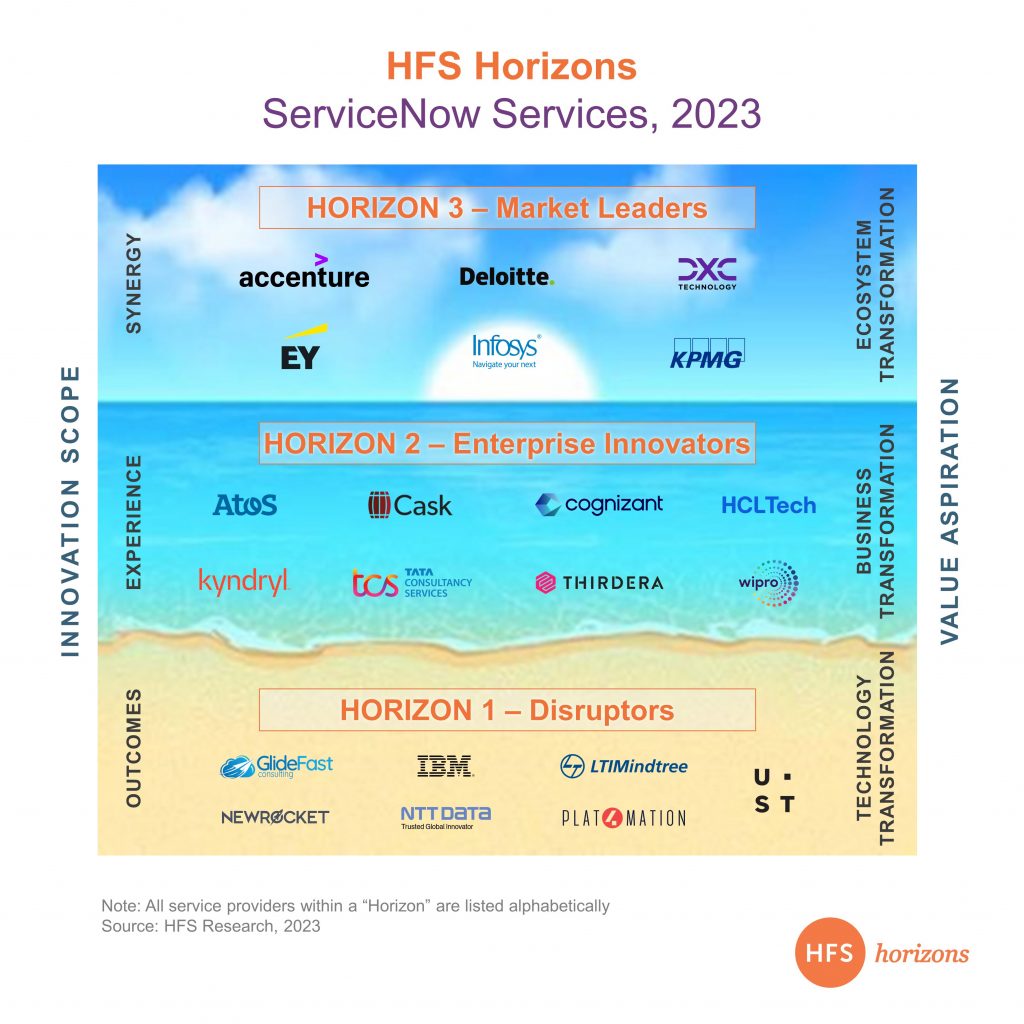
Last but by no means least, congratulations to the Horizon 3 market leaders. These leaders’ shared characteristics include blending a compelling vision of digital transformation with deep ServiceNow capabilities. The wheat gets separated from the chaff when providers demonstrate transformational outcomes enabled by ServiceNow rather than depicting ServiceNow roadmap thinking.
Accenture pushes the innovation envelope by covering eight industries with specific deep solutions. Perhaps the most telling aspect of its approach is that ServiceNow capabilities are no longer the centerpiece of the narrative. The narratives have shifted to transformation, and the transformational outcome has moved to center stage. Deloitte has been the launch partner for FSI (financial services and insurance) industry-led solutions and is scaling out GBS (global business services) engagements, while DXC, after a transition period, is getting its mojo back with differentiation in operationalizing cloud transformations.
EY is kicking the tires on all things advisory and risk while scaling out GBS. KPMG has a similar approach but also spearheads an ESG (environmental, social, and governance) solution in partnership with Celonis. Lastly, Infosys blends the service management process and domain consulting expertise using investments in the ESM Café platform as differentiation to enable a productized delivery approach. Exhibit 1 outlines the detailed rankings of our research.
Exhibit 1: The vanguard of the ServiceNow services ecosystem
The Bottom Line: The ServiceNow ecosystem is pivoting toward transformation, with the Generative Enterprise as the next frontier.
ServiceNow is no longer a capability discussion. Yet, there is a lack of clarity on the new IT operating model. There is agreement on the experience outcomes enabled by workflows designed in the cloud. The more organizations accelerate transformation initiatives, the more service providers need to provide guidance on designing a cloud target operating model. It is abundantly clear the next frontier is the hugely disruptive context of organizations having to deal with the impact of generative AI. HFS plans to lead the way in this seismic shift.
We know these are the early days of Gen-AI, but the speed of adoption is breathtaking, and we need to understand how well-prepared services experts are advising enterprises on how best to roadmap their generative journeys. For example, since its launch, ChatGPT has rocketed to 100m users in 60 days and already boasts 13m daily users – it is most probably the greatest AI invention… ever.
Overnight, your firm has been gifted with software providing an incredible ability to generate human-like text, understand and respond to queries, perform simple tasks, and even hold a conversation… are you really up to the task of winning in the era of the Generative Enterprise?
HFS is launching the industry’s first competitive analysis of professional services firms and the value they are creating with enterprise clients with the adoption and experimentation of generative AI tech
HFS’ Generative Enterprise ‘articulates the pursuit of AI technologies based on Large Language Models (LLMs) like ChatGPT and GPT-4 to reap huge business benefits to organizations in terms of continuously generating new ideas, redefining how work gets done and disrupting business models steeped in decades of antiquated process and technology’.
HFS will determine the Generative Enterprise Services Market Leaders, Enterprise Innovators, and Disruptors across leading and emerging services firms
HFS CEO Phil Fersht will be leading the research, supported by Executive Research Leader David Cushman, and key HFS other research leaders Saurabh Gupta, Melissa O’Brien, Tom Reuner, and Niti Jhunjhunwala.
The study will kick off in July 2023 and be released in September/October 2023 with a hugely anticipated impact across the global HFS networks
If you work for a services firm providing early-stage generative AI services or you’re an enterprise leader seeking to share your experiences and vision with us,please drop us a note here.
Most people hell-bent on criticizing ChatGPT don’t realize the current version is merely a prerequisite for a much more powerful version of the technology: GPT-4. Since its launch, ChatGPT has rocketed to 100m users in 60 days and already boasts 13m daily users – it is most probably the greatest AI invention ever.
Overnight, you have been gifted with software providing an incredible ability to generate human-like text, understand and respond to queries, perform simple tasks, and even hold a conversation. When you fully immerse yourself in GPT-4, you’ll quickly see how rapidly the errors of the previous version have been ironed out with some significant performance improvements:
Ten tectonic shifts from GPT-3.5 to GPT-4
1. Scale, speed, and power – up to 10x for information synthesis and language patterns. GPT-3.5 had a max request value of 3,000 words. GPT-4 has two variants, one with 6,000 words and another with 24,000.
2. Code-writing significantly improved. Its ability to generate code snippets or debug existing code can reduce workloads of several weeks down to mere hours:
“Write code to train A with dataset B.”
“I’m getting this error. Fix it.”
3. Greater ability to respond to emotions expressed in the text. GPT-4 can recognize and respond sensitively to a user expressing sadness or frustration, making the interaction feel more personal and genuine.
4. Handle more complex natural language processing tasks – such as natural language understanding, automatic text generation, and dialogue systems.
5. Can accurately generate and interpret text in various dialects and languages – such as semantics in regional or cultural differences to meet the needs of global users.
6. GPT-4 can properly cite sources when generating text. Critical to help individuals, enterprises, and academia govern risks of plagiarism and inaccuracy. GPT-4 performs exceptionally well in various standardized tests, including the BAR, LSAT, GRE, etc.
7. GPT-4 solves complex mathematical and scientific problems like astronomy, physics, chemistry, and biology.
8. Much more creative and collaborative. It generates stories, poems, essays and even jokes with improved coherence and creativity. Can edit and collaborate with users to generate creative and technical writing tasks, marketing copy, process design, and even song compositions while learning a user’s writing style.
9. GPT-4 has eyes. GPT-4 has the ability to analyze images. Users can ask ChatGPT to describe a photo, analyze a chart, or even explain a meme.
10. GPT-4 is the spark that ignites the AGI bomb. GPT-5 will take us even closer to this AGI (Average General Intelligence) milestone of software possessing video modality, deep sensory perception, creativity and fine motorskills. The way in which everything is experienced is in play.
The Bottom-line: The GPT-4 impact creates a whole new way you must think about business operations
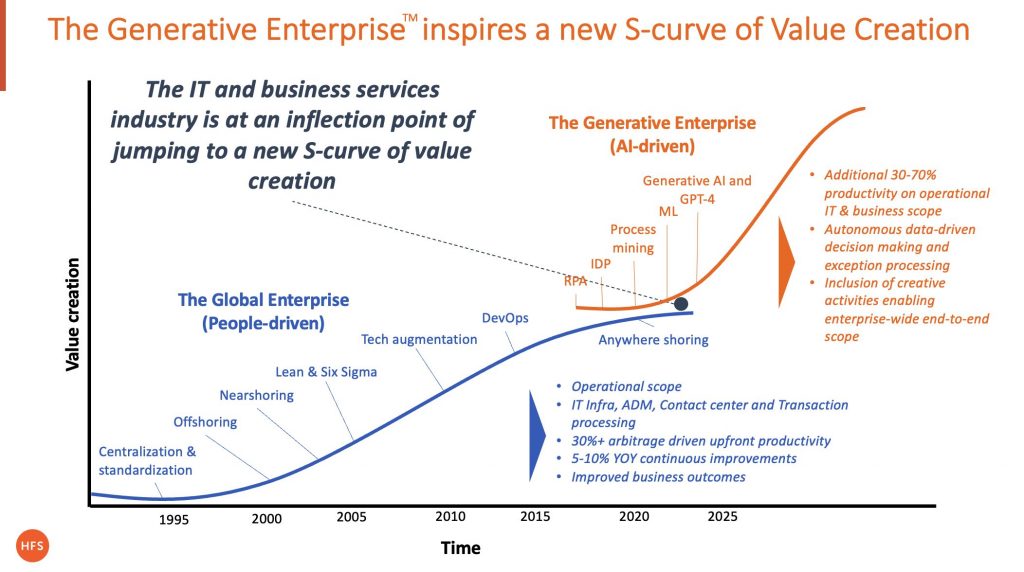
GPT-4 is poised to have a dramatic impact on business cases, and the S-Curve we once knew as linear now has a huge kink in it: where we could save 20% here or 30% there with the use of smart automation, chatbots and simply using better software and cheaper labor aligned to better processes, is now up having a major shake-up – and this will happen quickly.
For example, one onshore call center operation has hooked up a GPT-4 bot to its Salesforce system and can already see how 50% of its staff can be reduced within months. There are many, many other cases quickly emerging – they are emerging almost daily as we all tinker with the disruptive potential this is going to have:
The difference with the old S-Curve is that simple tasks can be learned, honed, and replicated, and even the prompt engineers will be automated once the process is running smoothly.
At the moment, GPT4 has a cap of 25 messages every three hours, but when this is opened up, the floodgates will be open, and I can only leave you with three things to take away from this:
We need to comprehend how AI works and its impact on the world;
We need to understand how AI will affect the real world;
We need to learn how to make money with AI.
Access to AI has now been democratized, and learning to ask the right questions is still being learned by the masses. You must all adapt quickly and use AI to your advantage. Your only limit is your ability to ask the right questions.


 A decade on from the trials and tribulations of IBM Watson, IBM unveiled its multi-model and multi-cloud Watsonx to drive AI-first enterprises – what we are calling “The Generative Enterprise” at HFS.