In just a few days, Silicon Valley Bank (SVB) fell from grace so swiftly that it still holds onto ‘buy’ ratings from most analyst firms. A month ago, stock pundit Jim Cramer urged investors to buy the stock—a clear warning sign to anyone familiar with inverse-Cramer investments. Tomorrow, an estimated 1000 tech start-ups will be unable to make payroll, and a further 2000 will be clinging on to liquidity for dear life. The future of America’s innovation – and the world’s innovation – is hanging by a thread.
So what actually happened with SVB?
Simply put, SVB piled loads of customers’ cash into long-term illiquid assets that, at the time, were safe but tanked as interest rates increased. That meant they couldn’t lay their hands on enough cash quickly enough to meet withdrawal demands. Word got out; more withdrawal requests came in. Eventually, the whole thing collapsed—a classic run on a bank.
Most of us have seen a run on a bank before. But for those new to the rapid demise of a financial institution, here’s a deeper analogy. Let’s say you’re kicking off a tech startup. SVB’s wooed you with their compelling investment offer for £1m in funding and all the goodies that come with it. Part of that deal involves putting your cash in SVB. They are your bank of choice. SVB, for its part, bought a lot of bonds, dishing out 1.5%. It’s not a bad deal on the face of it, given historically low-interest rates. But then, interest rates started rising. 3, 4, 5%. So those bonds paying out 1.5% suddenly look less attractive than newer bonds getting 4.5%.
Understandably, people aren’t keen on buying them anymore or want a much lower price. These factors combined (SVB pulling below-market yields on its bond portfolio, and the corresponding reduction in the value of bonds) pushed SVB to cash out on billions of bonds at a loss. Then, apparently to reassure the market, they chose to raise new funds from VC firm General Atlantic, alongside a public-facing bond. Rather than reassuring the market, panic set in. Their customers started pulling cash out.
So now, depending on where you are in the queue, getting your cash out of the bank becomes pretty hard. If you’re close to the back of the queue, it becomes impossible.
Some of it’s insured, and some SVB promises to pay back. But, for now, billions of dollars sit in an uncomfortable limbo. Leaving the CFOs of SVB clients to work all weekend as they develop a fiscal survival plan.
Multiply that $1m example a few thousand times, and you have the true scale of the challenge. And that’s assuming it’s just SVB. Global stocks took a kicking at the end of last week, with bank stocks leading the charge. The market is betting that the contagion will spread beyond SVB’s four walls. Most likely due to wary depositors racing to redeem their cash.
Another dent in the tech industry: The ecosystem effect will ripple far beyond tech startups
Now that may be a bit of a simplistic explanation—and economists and equity analysts will no doubt offer countless superior answers—but it gives a flavor of the crisis at hand. Now let’s zoom in on the impact of the SVB crisis on our industry.
Let’s start with the obvious: SVB clients. Firms with cash tied up in SVB face a tough few weeks or months as regulators figure out how to compensate clients and distribute SVBs remaining assets. Already, there are countless stories of tech firms of varying sizes warning that they’ll struggle to make payroll next week.
Few big names have announced any issues, but given its prevalence in the sector, it’s almost certain we’ll see some major enterprise software and services firms touched by the crisis. And, dependent on the direct exposure, we’ll see a ripple effect across the industry.
That’s because SVB’s clients in the enterprise space don’t sit in isolation. Take cloud observability company, Datadog, which is a known client (at least regarding SVB’s published case studies). Amongst their partner ecosystem, Datadog boasts IT Services giants Accenture, Fujitsu, and IBM. If Datadog encounters business continuity challenges—and there’s nothing to suggest they are—, then the ripple effect can swiftly spread across marquee outsourcers and into client engagements.
Of course, larger cornerstone companies (think the big SaaS giants now deeply embedded in most major businesses) will cause significantly larger problems for the industry, particularly as many are already grappling with rightsizing initiatives to drive down unsustainable costs. We could see some significant operational challenges if even a portion of their cash is locked away.
A bigger dent to innovation: A new funding winter
The immediate impact aside, we can expect a more damaging aftershock – a hit to innovation. SVB, as a financial institution, is a crucial source of funding for many high-potential tech firms—many in the consumer space but also a large cohort targeting real-world business challenges. Many will likely struggle to fight through the next few months without access to capital.
These firms may be small and nameless today but could be tomorrow’s enterprise tech giants. We may never know.
The impact is global. For example, TechCrunch reckons 60 YC-backed Indian Startups are struggling to redeem cash stuck in the failed bank. Encapsulating the issue, a founder told the India Express, “It is 4 am now and we have been on hold at the toll-free number given by the FDIC for over half an hour. We have around $2 million in our SVB account and need that to create payroll.” Meanwhile, in the UK, the Chancellor is working on a rapid intervention to provide cash to companies impacted by the crisis and give them some fiscal breathing space.
Smaller companies, or those earlier in their journey, will be the hardest hit. For instance, they’ll find it harder to lean on clients for early payments to help cashflow. And are far less likely to have followed risk best practices by spreading funds across multiple banks. They are also, on average, the source of the greatest industry innovation (today’s SaaS giants, for example, all started somewhere, very few are homegrown in already giant companies).
Bottom Line: The collapse of SVB isn’t just a banking crisis; it’s an innovation crisis
While many look to the collapse of SVB as an inevitable outcome of Silicon Valley excess, perhaps there’s some truth to the characterization. But below the surface, what we have here is the start of a potentially painful period for a tech sector already struggling to make sense of a world alien to their upbringing oriented around cheap cash. But worse, this could be the final nail in the coffin of innovation-focused funding for some time.
While the last decade of easy money deserves a degree of criticism, the inability of traditional investments to offer any meaningful return saw capital flow into startups and innovators. Now, why risk it? When the risks seem much higher, and the comparative returns much lower? And while there are already efforts underway to save SVB, it’s possible the damage to the tech sector is already done.
We thought the Y2K IT spending trigger was one-time bonanza… until we experienced the pandemic trigger, which saw IT investing bulge beyond our wildest dreams. Not only were we blowing cash on any collab app that seemed viable, any overpriced webcam on Amazon that would (surely) make you look amazing, but enterprise heads were also convinced they had to go on an insane rush into the cloud, even though their legacy systems and siloed 1960s processes were nowhere near ready.
Sadly, all good things come to an end as the majority of enterprises tighten their belts
Firstly, appreciate 2021 and 2022… we won’t see the likes of growth like it in IT services again. Or not until another trigger gets pulled, and we don’t know what that will look like – or when it will be. However, 2023 is going to be choppy, uncertain, and complex as we grapple with rampant global inflation and a recession everywhere except the US, which only decides to be in recession when Fox or CNN decides it’s time to be in one, based on whatever numbers can be spun to suit their agenda. Or when the government decides not to keep bailing out inept unregulated banks.
As soon as CFOs hear the “R” word, their hair-trigger response is to freeze all spending and gradually unfreeze items that are “critical” once they realize they were overreacting. Everything gets caught up in their web of austerity (except maybe some nice dinners with the auditors), and the humungous sums being lavished on all these expensive cloud migrations are under intense scrutiny as projects are either scaled back, accelerated to fruition, down-sized or even scrapped altogether.
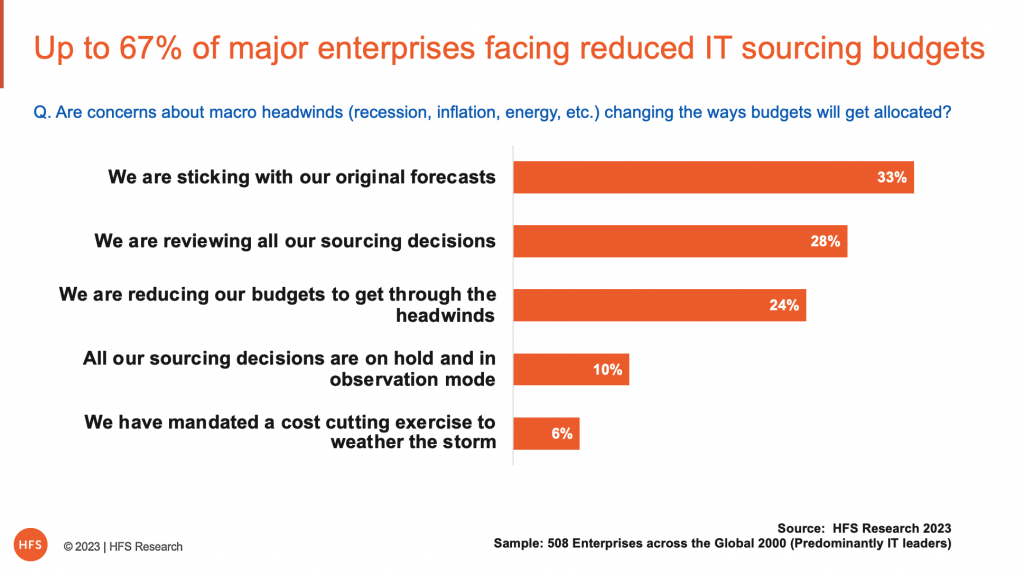
Brand new data from over 500 IT leaders across the global 2000 tells an ugly story of how quickly the cloud bingeing is grinding to a halt, with only a third of enterprises currently staying the course with their current IT sourcing investments:
As startling as these factors are, market indices such as the S&P500 and the FTSE100 continue to trade at record highs. None of the leading service providers or bellwether ISVs like SAP, Salesforce, and ServiceNow have talked about a fundamental change in the market conditions.
Against this backdrop, the data from the survey tells us that discretionary spend is disappearing fast. This is neither the time for fancy innovation projects nor lavish client entertainment. However, spend for managing the core operations of organizations is holding up. We haven’t come across indicators that would suggest a softening in sourcing activities beyond service providers privately complaining deal cycles are lengthening and harder to close. So let’s examine these conflicting views…
We have seen a rapid shift in focus from top-line to bottom-line
One way to read into these data points is that we are seeing a reversal of buying trends triggered by the pandemic, where lengthy project lifecycles with opaque objectives have been billed to enterprises like there is no tomorrow. What has rapidly changed is tech and operations leaders expect a commitment from their service providers to deliver tangible outcomes in clearly defined timeframes. We are seeing an increase in many projects shifting to quarterly budgeting – and being placed under considerable scrutiny to reach their desired conclusions on time and on budget.
The macro headwinds that we did describe will force service providers to deliver outcomes that drive efficiency and automation. They also have to demonstrate an understanding of their clients’ data requirements and processes to ensure workloads can be migrated to the cloud effectively; otherwise, these projects will be expensive, long and painful.
At the same time, those headwinds could spell trouble for innovative startups that require PoCs to show the proof-points of their capabilities. Enterprise leaders want certainty at predictable costs and to minimize their exposure to project failure.
How should both CIOs and cloud providers address this dramatic change in enterprise focus and spending in 2023 and beyond? Can they find new fizz by approaching the cloud differently?
SaaS providers must show more flexibility in their contractual agreements and go beyond standardized seat-based pricing to support broader transformation initiatives.
Service providers must align technology with business objectives to (finally) capture business value for their clients
CIOs must change their mindset from cost to business value. Thus, FinOps must be expanded to governance and, ultimately, business assurance.
CIOs and Ops leaders much work together to map out their underlying data infrastructure to ensure it is cloud-ready
The cloud discussion has to shift to business value.
As we famously declared in 2019, standalone RPA is dead, and the only way to derive real value from process automation and data is to adopt an integrated approach that breaks down silos and produces the data executives need to make rapid decisions. Our autonomous enterprise principles clearly outline the steps needed to define the data needed, the transformation to collect and access it, and the governance capabilities to arrive at the decision points along the way.
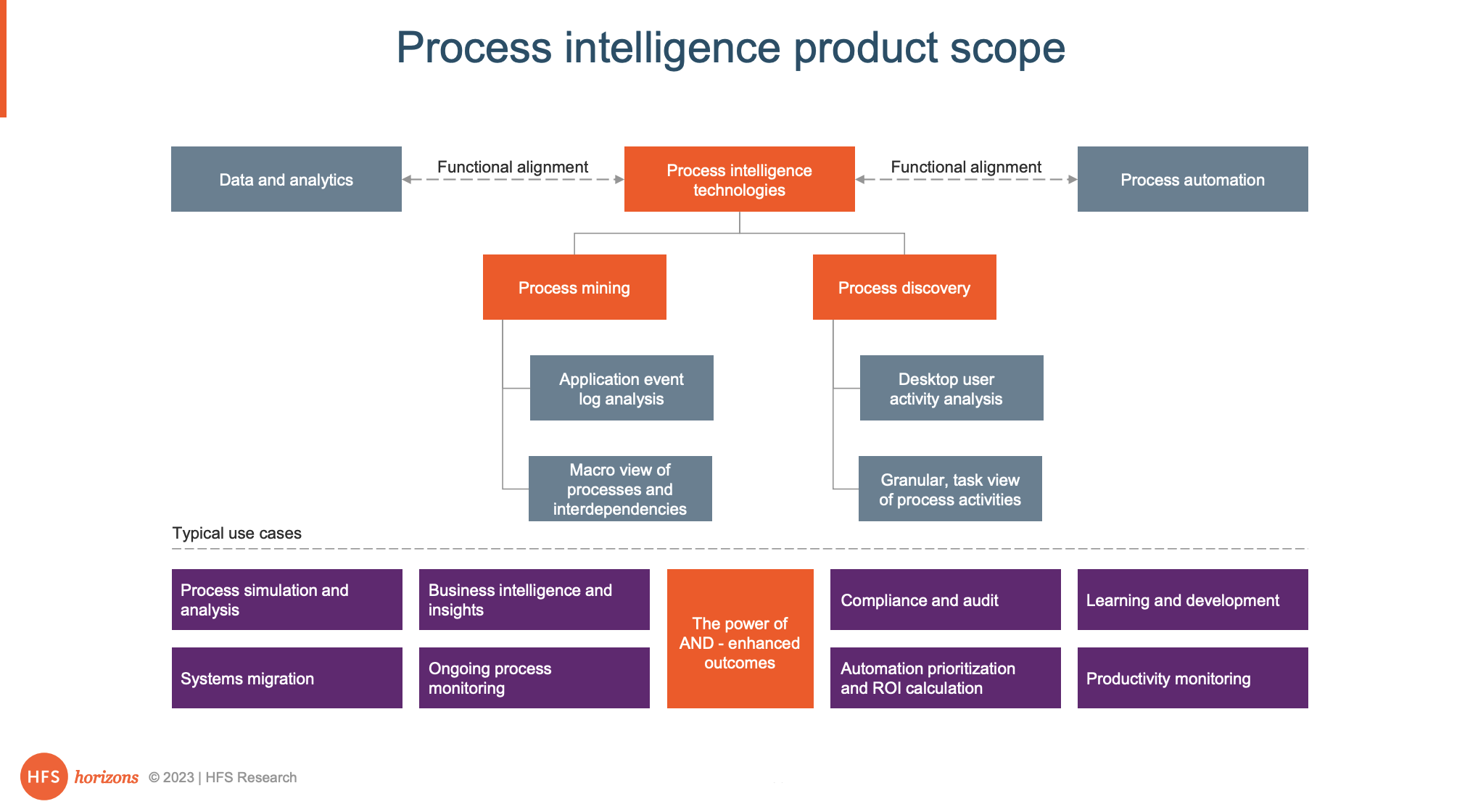
Enterprises can either use a multitude of specific software tools to support their needs or opt for a single platform approach that encompasses the functionality they need. We categorize software platforms that support this integrated approach as “Process Intelligence”:
To this end, HFS published its latest HFS Horizons report delving into the world of Process Intelligence Products. Rather than being a ranked Top 10 list, the assessment methodology provides a Horizon view comprising a full market landscape of vendors bringing different sets of technologies and focus to help enterprises understand how their work gets done.
Much like our previous assessments, we grouped process and task-mining vendors in this analysis for several reasons:
HFS focuses on the use cases and business values being derived from this set of technologies rather than the specifics of data capture and analysis techniques. In fact, our research proves that enterprise clients are applying a combination of process and task-mining tools toward similar and distinct use cases.
There’s a significant amount of convergence in this space. The market is full of acquisitions, investments, partnerships, and inhouse development to offer integrated solutions to combine both process and task data to deliver combined value – and it’s a trend we expect to see grow in the coming years.
The process intelligence market continues to grow exponentially and transform equally as fast.
Organizations are battling decades of technical and process debt, and as we immerse ourselves further into the digital economy, it will be enterprises with efficient operations that will succeed. To that end, we expect to see the impressive growth of process intelligence to continue – and the data in this HFS Horizons report confirms it, as we report that the majority of enterprises are predicting a ‘significant increase’ in spend on the technology over the next 12-18 months.
On the vendor side, we’ve witnessed the process intelligence market transform radically in recent years. A handful of vendors have been acquired by large enterprise technology platforms, automation, and workflow vendors. Meanwhile, new entrants are coming to the market armed with fresh approaches to gathering information and analyzing how people work. For enterprises, this makes it even more difficult than ever to select their preferred process intelligence partner – but they are also spoiled for choice.
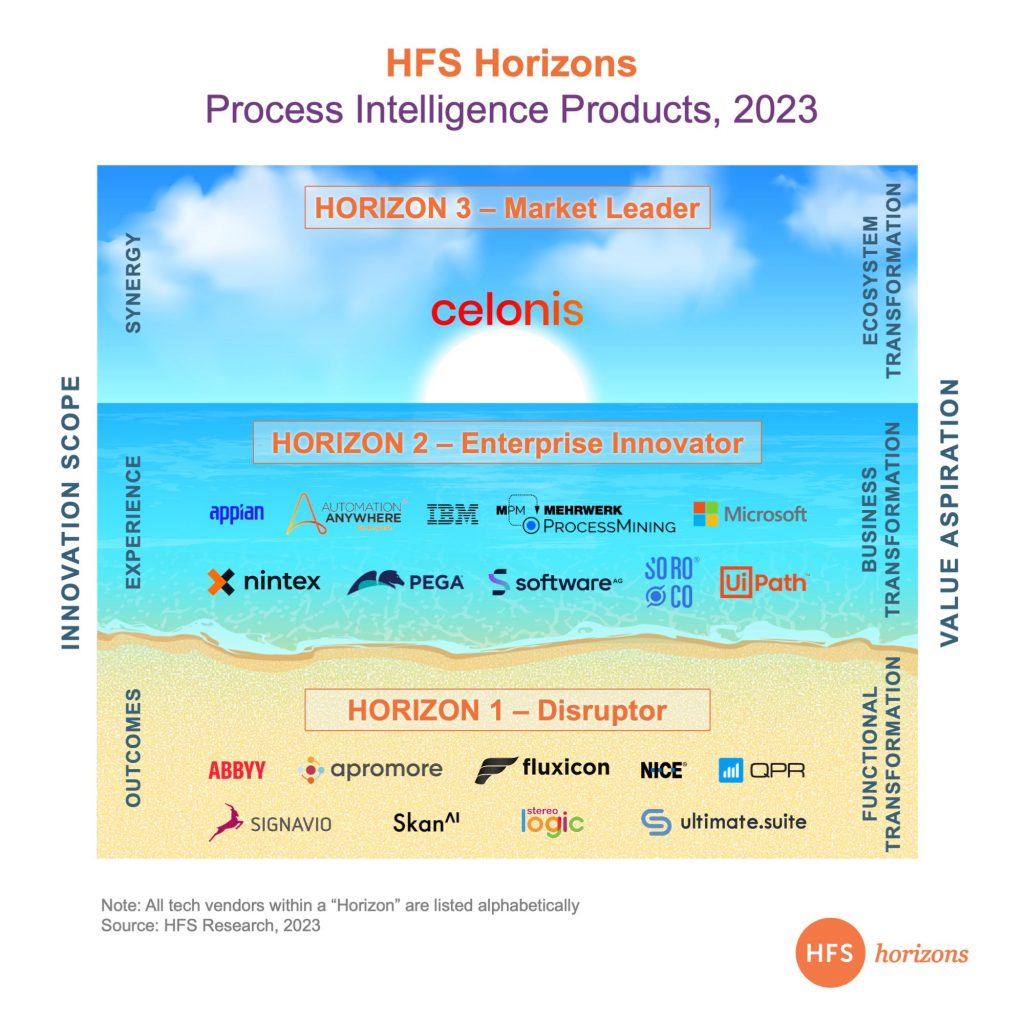
HFS evaluated 20 technology vendors
We assessed 20 technology vendors across four key dimensions: Why, What, How, and So What, allowing us to categorize vendors into three horizons: delivering cost and efficiency transformation (Horizon 1), driving enterprise business transformation at scale (Horizon 2), and creating new sources of value and creating an ecosystem impact (Horizon 3).
Note: All service providers within a “Horizon” are listed alphabetically
We identified one clear Horizon 3 market leader – Celonis
Celonis emerged as the only clear Horizon 3 market leader thanks to its ability to deliver ecosystem-based, data-driven transformation today. Horizon 2 hosts 10 fast-growing vendors whose clients are seeking enterprise-wide, data-driven initiatives – and it includes a combination of pureplay and acquired process intelligence vendors.
Horizon 2 plays host to 10 innovative vendors who are driving real business outcomes and improved stakeholder experiences. These vendors are putting an increasing amount of pressure on the likes of Celonis and are beginning to assemble a compelling end-to-end proposition, which we expect to see come to fruition in the next 1-2 years.
In Horizon 1, we identified 9 disruptive vendors helping enterprises make focused investments in the space. In particular, Horizon 1 disruptors excel when helping organizations with limited process intelligence experience and those focused on project-based functional transformation.
This report included detailed profiles of each service provider, outlining their placement, provider facts, as well as detailed strengths and opportunities.
HFS subscribers can download the report here (available free for a limited time).
2022 was the year where many peoples’ lifestyles trumped their commitment to their jobs; however, that attitude today might just get you the sack.
Just when it seemed that a hybrid work model, which is primarily home-based, had settled in as the status quo, the global economy enjoyed its post-pandemic bounce, and people were coasting along in their cozy hybrid habitats; 2023 hit us with a thumping jolt.
Massive tech layoffs, back-to-office mandates, a highly-uncertain economic and political climate, and an epidemic of banks almost collapsing dominate the headlines, and suddenly the workplace power dynamic has shifted squarely from the jaded employee-fuelled Great Resignation to something resembling a great workplace freakout.
In the current challenging economy, many employers are pointing fingers at remote workers as a reason for underperformance
There are many high-profile organizations now mandating in-office policy that is more “office-first” than “remote-first”. For example, Disney has mandated four days a week in-office and General Motors and Starbucks three days a week at their main headquarters and regional centers. Social media firm TikTok has mandated two days per week and threatened employees with termination if they do not comply. Many more enterprises are following suit, with three-day-a-week in-office mandates becoming commonplace. Moreover, the proportion of remote jobs being advertised on LinkedIn has decreased from a high of 20% a year ago to just 13% today.
Net-net, work-from-home entitlement is out the window, and uncertainty is high across the board. Our recent study (with the support of Unisys) of 2,000 employers and employees across the U.S., U.K, Germany, and Australia laid bare all discrepancies between staff and managers’ perspectives of hybrid work and also pointed to some ways to bridge the gaps and avoid the pitfalls that this freakout is threatening.
Hybrid work is breaking down, but finding that right balance is like walking a tightrope
While the power pendulum has swung back from employee to employer, enterprises struggle with keeping their employees happy while demanding the motivation, presence, and productivity that business performance requires. Our study showed employees are much more confident in hybrid work, with over half indicating they work in a ‘very effective’ hybrid environment, compared to only 1/3 of employers.
Employees reported enjoying the work/life balance that hybrid affords, but managers struggle to know whether the staff is engaged and productive. Employers are also struggling to justify real estate investments, high-security risks for remote work, and a lack of collaborative culture. Enterprises want to retain top talent, but not at the expense of financial results. Case in point, to kick off Meta’s “year of efficiency,” leadership used poor employee evaluations to try and weed out the low performers before announcing its 10,000 staff layoff last week.
Poor IT experiences and security setbacks are threatening staff efficiency and morale
While the pendulum may be swinging back toward in-office protocols, the reality is that hybrid, in some shape or form, is here to stay for the foreseeable future. Our study found some very specific pain points that employers must address to improve hybrid functionality. One mammoth issue we found is that 49% of employees lose between one and five hours of productivity per week dealing with IT issues. Not even half of employers are not measuring productivity loss due to IT support issues, meaning many are woefully unaware that their staff are losing this much time in the week. And cybersecurity, while the top enterprise concern for 2023, poses another major issue impacting worker productivity. 1/3 of employees report their ability to work effectively being negatively impacted by security policies regularly. The survey showed that positive IT experiences are a main factor in employees’ choice to leave or remain with a company; employers must provide a smooth experience or risk losing staff.
These issues are not insurmountable. Making investments in systems and technology that can proactively identify and quantify IT issues before they impact users can go a long way to improve workplace efficiency (about half of the employers surveyed currently have these in place). And 92% of employees report that they are willing to share more data (such as app/device/network usage and performance) if they can receive more proactive IT support in exchange. This statistic points to a win-win scenario if employers have the foresight to invest in systems that will measure and predict these issues.
Investing in EX: empowerment, recognition, and flexibility trump the old motivators
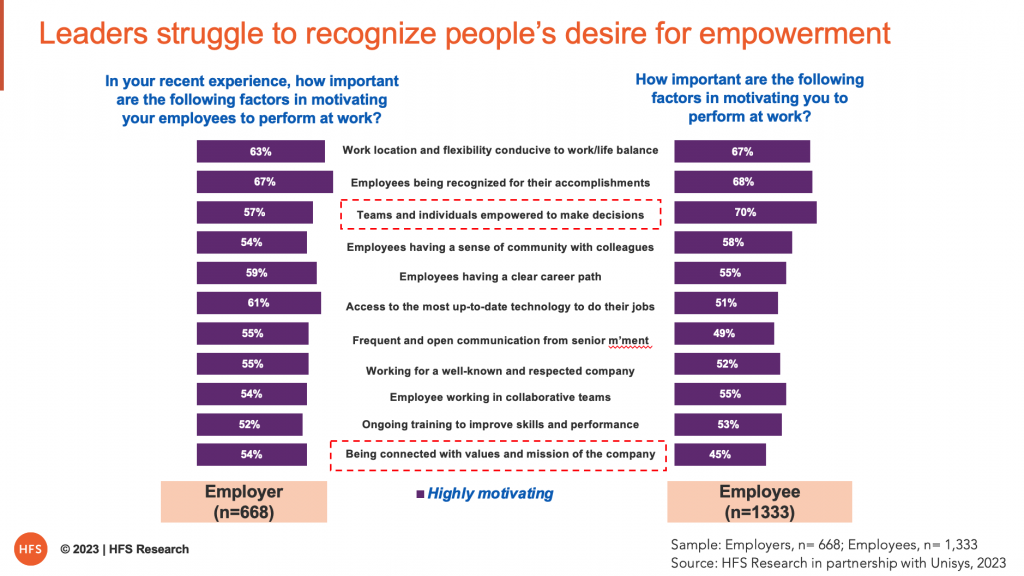
We covered some of the tactical issues impacting experience, but culture and engagement have a huge impact on how employees perform and are motivated at work. Any decent leader knows that EX is important, but do they know what their employees need and how to deliver on that? What motivates employees vs. what their managers think motivates them is quite a chasm across several key areas, particularly with employers not recognizing the importance of empowering employees to make an impact:
Employees are much more focused on their ability to have an impact and be recognized than the corporate brand
Employee motivations have changed, and employers need to pivot to enable better EX. The whole in-office culture was much more about belonging to the big corporate brand where you got a window cube when you got promoted. Now it’s less about the big company prestige and more about autonomy to make decisions, the recognition of doing your job well, and the flexibility to manage work/life balance. The big company rhetoric about mission and value is actually at the bottom of the motivational factors. Clearly, enterprise leadership is struggling to resonate with staff, many of whom must be losing their pride and identity with mothership as they lose touch with in-person interaction with their colleagues and managers.
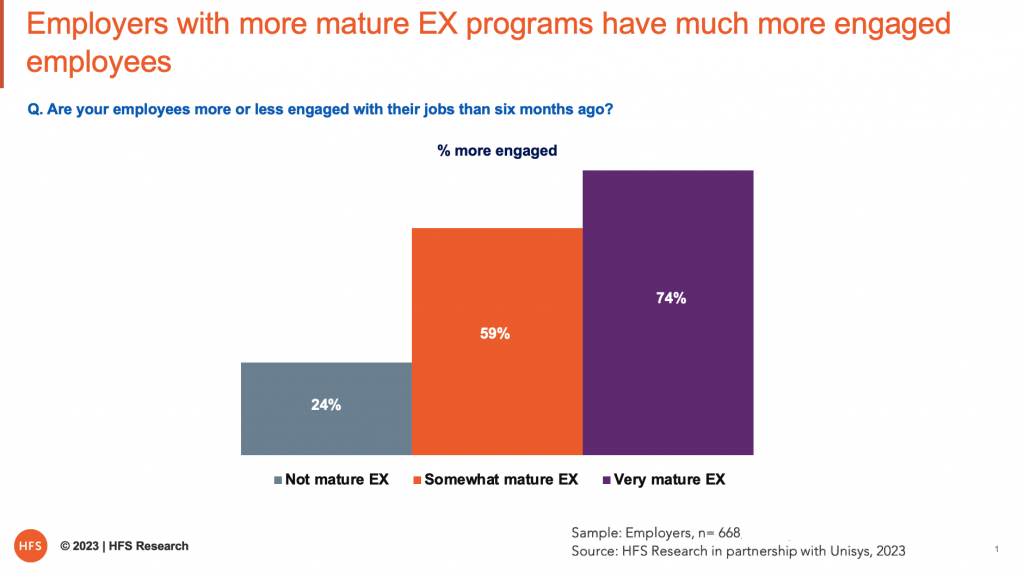
So how are companies investing in ways to better understand staff and deliver on their needs? Enter the EX program: including specific methods and metrics to measure EX, a centralized function that measures and informs EX policy, ways to solicit and incorporate feedback and manage against business outcomes, to name a few initiatives. Companies with very mature EX programs find their employees more engaged at a rate of 74%, compared to those with somewhat mature EX programs (59%) and immature EX programs (24%) (Exhibit 2). What’s more, employers and employees agree that EX programs also have a strong impact on business outcomes, including productivity, customer experience, and even financial performance.
The Bottom Line: Invest in creating the right conditions to shift from employee engagement to employee empowerment. You must understand employee frustrations and motivations to make hybrid work effective in this next era of the digital workplace.
The Great Resignation is in the rearview mirror, but we could have a messy freakout ahead if leaders don’t prepare accordingly. Many employees are increasingly citing an “edgy” culture is unsettling their enterprise, where most staff have no idea if layoffs are imminent and which staff will be targeted. We are not far from a Great Freakout engulfing enterprises as banks struggle to cope with increased interest rates, tech firms are radically addressing their cost structures, staff wages are not aligned with the current inflation rates due to a tough economy, and firms grapple the unprecedented situation of a shortage of low-income workers.
Last year there was a mistaken belief that by getting people the ability to work from home, we have achieved hybrid work, but our study shows we have not really figured out hybrid work. The good news is that there are enough synergies between employer perceptions and what employees want to create much better experiences; it is a matter of informed planning and execution to capitalize on the positives. The data is clear that investing in EX leads to better employee engagement. Tying this engagement to business outcomes is the next frontier and a critical one to brace for the uncertain days ahead in 2023.
In addition, companies have to address the cultures they want to create – and fast. They need to instill more urgency into their workforce and ensure their workers, whether remote or in the office, are accountable and still take their jobs seriously – and an effective EX strategy will go a long way to creating and maintaining that culture and settling employees’ nerves, providing your leadership takes it seriously and you have an empowered executive to drive it.
The days of hiding in our caves are over… it’s time to get out and face the world and fix our businesses. What worked in 2019 may no longer work in 2023, but if we don’t pull our teams together, we may find that out too late… and then it will be time to freakout!
HFS has successfully road-tested the capability with several research customers, who universally declared their whole research experience had been transformed. “It was like the research had come alive, and I was actually living it,” stated one customer. “I asked about the Metaverse and finally understood that it won’t be anything until Web3 is incorporated”.
To help customers navigate the HFS Web, HFS has developed an Avatar called Hillary, based on the firm’s popular Horse logo:
“With GPT, if you win, you win. If you lose, you still win”, stated HFS CTO Jake LaMotta. “When we tested Hillary with our customer focus group, we discovered our customers wanted to ‘Holler for Hillary’, so we have opted for a non-binary horse to guide everyone. We think this is going to be very popular.”
Another HFS customer, Tony Montana, was not quite so convinced. “Why do I need a damn horse to tell me about UiPath’s long-awaited admission that RPA is dead. Everyday above ground is a good day.”
HFS CEO Phil Fersht, commenting on the launch, added, “We disrupted with free research and loads of brash views on the market. Now we’re disrupting with a hollering horse. It’s what I dreamed of as a young entrepreneur. GPT-6 is the future, and it’s part of us now.”
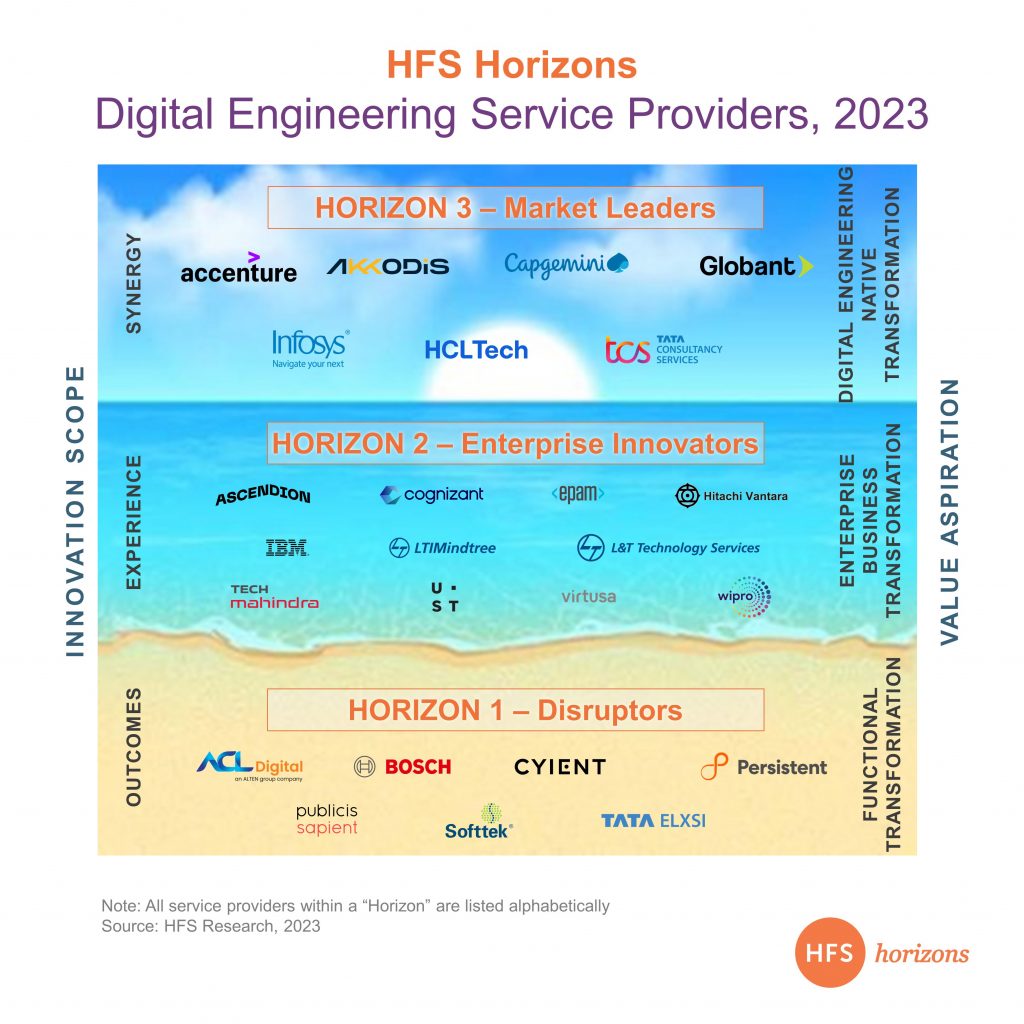
The new HFS Digital Engineering Services (DES) Horizons report provides a snapshot of leading digital engineering service providers’ capabilities in a rapidly changing market as more companies adopt digital technologies in product development and engineering processes.
Ultimately, the goal is to bring together siloed digital initiatives and look at a holistic picture of the business
Advanced technologies like artificial intelligence (AI), machine learning (ML), the internet of things (IoT), 5G, robotics, cloud, automation, data and analytics, blockchain, and alternate reality and virtual reality (AR/VR) are revolutionizing product design and development. As these new technologies emerge, there is a need for skilled talent, particularly in areas such as AI, ML, and data analytics.
Additionally, the rise of new business models such as product servitization (traditional episodic encounters being replaced by continuous personalized interactions) and platformization (making platforms data ready to drive commerce and interactions between buyers, sellers, and suppliers) has further fueled the need for providers to offer expertise in business design, marketing, customer and supplier engagement to stay relevant. This trend is driven by enterprises’ needs to optimize data use, digitally enable processes, accelerate growth, achieve customer intimacy, and become true ecosystem participants.
Disruptors, Enterprise Innovators, and Market Leaders
The HFS Horizons: Digital Engineering Service Providers, 2023 report examines service providers’ roles in digital engineering. The HFS Horizons model aims to align enterprise objectives with service provider value. We assessed 25 service providers across their value propositions (the why), execution and innovation capabilities (the what), go-to-market strategy (the how), and market impact criteria (the so what) to best understand and plot the value they offer to their digital engineering clients.
Here are the results.
Note: All service providers within a Horizon are listed alphabetically
The new Horizons landscape demonstrates the providers’ positions within the three Horizons:
Horizon 1 (Disruptors) refers to those providers who have been able to drive functional transformation with ecosystem partners and co-innovate solutions.
Horizon 2 (Enterprise Innovators) includes those creating end-to-end organizational alignment to drive unmatched stakeholder experiences.
Horizon 3 (Market Leaders) includes all providers with OneEcosystem™ synergy via collaboration to create completely new sources of value.
The Rise of Smaller Players in the Booming Digital Engineering Services Industry
The digital engineering services industry is a dynamic and rapidly evolving field, with many players offering a diverse range of technology and services. These players tend to be smaller, focusing on specialized niches within the industry. Despite their smaller scale, these service providers are experiencing impressive growth, with an average growth rate of 25%. Much of this growth can be attributed to North America’s booming market for digital engineering services. As this industry expands and develops, it will be interesting to see how these smaller players adapt and differentiate themselves from their competitors to remain competitive and relevant.
Strategic Partnerships and M&A
The digital engineering services industry is competitive, and service providers consolidate through mergers and acquisitions to expand their capabilities, enter new markets, and gain a larger market share. They also partner with startups and other players in the ecosystem to develop new capabilities and technologies to better serve their customers. This reflects the evolving nature of the industry and the need for service providers to continuously seek new partnerships and growth opportunities to remain competitive and meet the evolving needs of their customers.
Innovation Is the Key to Success in Digital Engineering Services
In the digital engineering services industry, service providers need to invest in innovation and R&D to remain competitive as new technologies emerge. Technologies like the metaverse and blockchain are garnering interest for enabling new business models and revenue streams. Service providers must adapt to changing client demands and explore co-innovation and value-creation partnerships to develop comprehensive and integrated solutions. Joint ventures, strategic alliances, and co-innovation programs allow service providers to leverage their expertise for growth and value creation.
The HFS Horizons: Digital Engineering Service Providers, 2023 report highlights the value-based positioning for 25 service providers: Accenture, ACL Digital, Akkodis, Ascendion, Bosch, Capgemini, Cognizant, Cyient, EPAM, Globant, HCL, Hitachi Vantara, IBM, Infosys, LTIMindtree, LTTS, Persistent, Publicis Sapient, Softtek, TATA Elxsi, TCS, TechM, UST, Virtusa, and Wipro. It also includes a detailed profile of each service provider.
Every couple of years, we’re due a large-scale call center acquisition play, and the latest is Concentrix’s announcement to acquire Webhelp. With combined revenues of $8.3bn, Concentrix is now nipping at the heels of Teleperformance for position as the largest contact center business globally. Yes, it’s time for even more big traditional analog call center – and lots of it!
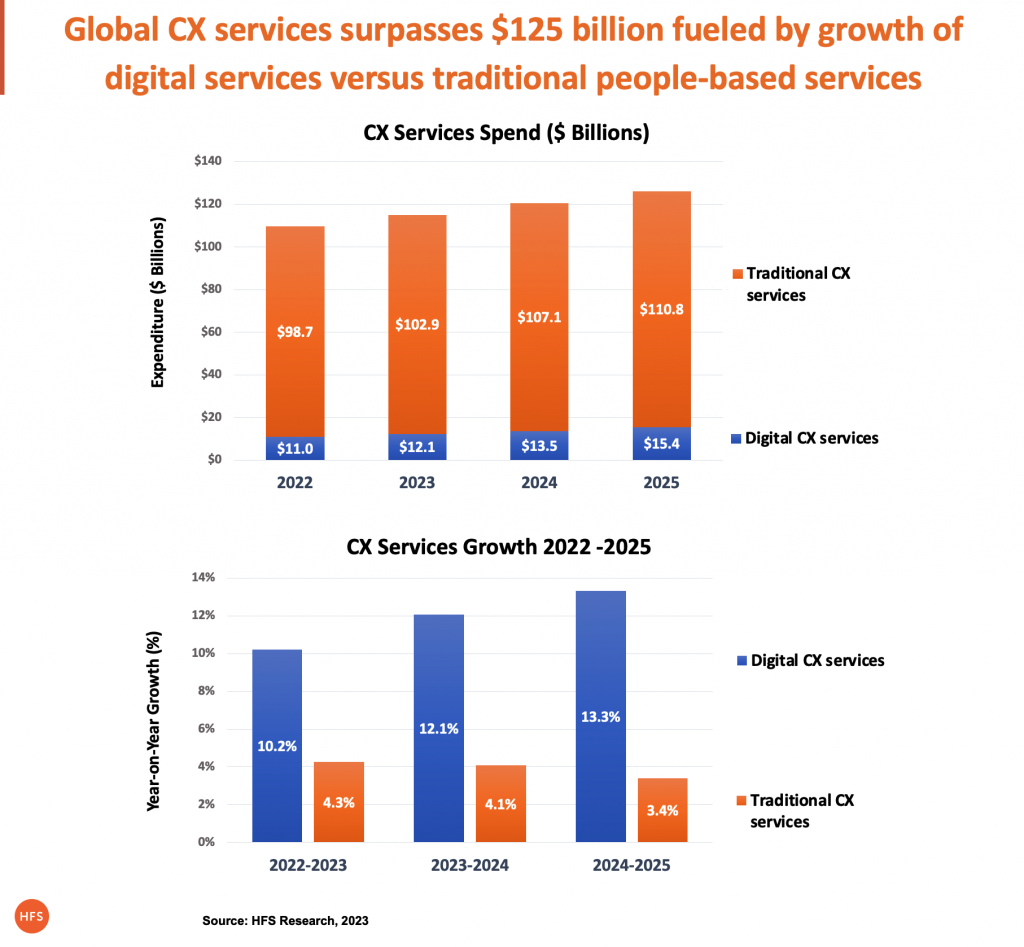
So has the $125 billion world of call centers really become so dull that the only thing left to talk about is who’s the biggest? This reminds us of the days when ADP swallowed up every payroll firm imaginable to ensure it controlled the global payroll market, making it an extremely unattractive market for others to enter. This speaks volumes for a service provider seeking to protect its legacy business and maintain the legacy way of pricing deals where scale means more butts on seats… and more revenue.
At first glance, it seems that Concentrix, Teleperformance and Foundever have locked down the CX services market… but they are actually creating a whole new one that will hurt them in the longer-term
However, there is one major difference here – traditional call center services are extremely ripe for disruption, with huge costs to be saved with the smart deployment of autonomous technologies. There are ample opportunities for tech-capable service providers to attack the CX space with digital offerings that are not dependent on voice-based butts-on-seats.
We are living through this Third Trigger of Change, where enterprises are seeking to slash costs, avoid wage inflation and enjoy the benefits of autonomization at the same time. Removing humans from loops where they are no longer needed is the game, but this seems to be counter to the business models of several traditional call center providers, still depending on selling more butts to keep growing their revenues. However, while traditional call center services are stagnating at a lower-than-inflation 4%, digital CX is growing at three times the clip (12%):
Just look at the growth services providers such as Tech Mahindra, Wipro, Genpact, and WNS are already enjoying adding CX-related services based on non-voice delivery to their client engagements. For example, Tech Mahinda has doubled its BPS business in three years (to over a billion dollars), wheeling in CX-related work in sectors like telco without this huge dependency on Manila. We fully expect other tech service providers with deep relationships in the CX domain to enter this market soon, such as IBM, Cognizant, and Accenture, all pushing business services with strong CX automation and AI elements.
For many industries, the need to house armies of increasingly-expensive customer service agents, either onshore or in locations like the Philippines, is decreasing as more and more customers simply do not have the time or inclination to talk to a rep, and enterprises want to cut out the costs of paying for them.
Concentrix hopes bigger is more beautiful for Webhelp’s customers
While service providers in other services, such as IT and F&A have been openly against scale-based acquisitions for several years, it seems that the leading call centers are opting for greater scale, more global presence, and more people to get ahead in their markets.
Recent consolidation of the largest providers in this market included Sitel/ SYKES (now Foundever) in 2021 and Concentrix/ Convergys in 2018. While this appears to be largely a scale play, Webhelp brings some unique features to the table. For example, its recent Sellbytel acquisition bolstered its ML/AI capacity. Its NEST offering is a business unit dedicated completely to helping startups scale their CX businesses, something we’ve not seen formalized in any major competitors (and probably will not until that market eventually recovers). Plus, the firm brings a strong ESG game, particularly with regard to its impact sourcing credibility.
Bolstering its geographic presence is clearly one of the advantages Webhelp brings to Concentrix, and its addition of 25 countries is appealing at a time when CX clients are very keen to pursue new locations that offer services and lower costs. Webhelp’s European, nearshore and South African presence will be particularly useful to complete Concentrix’s global jigsaw.
Whether Webhelp’s customers will be happy being serviced by a much larger beast is in question – will they get the same attention as before? Will Concentrix hike up prices safe in the knowledge the switching options have become fewer?
Concentrix is refocusing on traditional call center growth, despite earlier acquisitions of Tigerspike and PK
Much of the appeal of large-scale call center services acquisitions is to drive down pricing with fewer players, consolidate accounts and real estate, but it sometimes seems at the cost of innovation. This was the reason BPO giants like IBM exited the market several years ago (it actually sold its CX business to Concentrix a decade ago) and Capgemini deemphasized the CX space. They saw this market as a race to the bottom that was becoming harder an harder to maintain margins.
Webhelp signifies the direction Concentrix is going as a company, which is to edge out its other giant call center competitors with added scale and resources. When Concentrix acquired Tigerspike in 2017 to add digital design capabilities, it seemed that the firm wanted to broaden beyond CX into higher value areas to impact customer experiences. And its sizeable acquisition of PK Consulting early last year seemed like an attempt to make a more concerted effort into digital design after Tigerspike failed to impact Concentrix clients at scale.
However, the problem is simply that call center services and digital marketing services are acquired by different people within enterprises, and the client leads in services firms cannot sell to marketing leads as well as call center leads. You can’t blend the two skillsets the way most enterprises have developed over the years.
For example, the Sitel acquisition of Sykes saw a massive clearout of staff to remove redundancies, and strategic investments like its Symphony automation play have long bitten the dust. While the vision is lofty, the reality of the mega-mergers often seems focused on lower costs and higher margins while squeezing out cheaper smaller players. Overall we see a lot more call centers, and bigger call centers, than any significant technological advancements.
The Bottom-line: The future of CX is shifting to autonomous digital delivery, driving the need for call centers and IT integration providers to merge
Bigger isn’t always better, but other large providers are growing at faster rates, with both Teleperformance and TELUS both growing in the double digits. Both of these firms have made significant investments in technology capabilities and digitalizing their solutions, such as TELUS International grabbing up IT services firm Xavient and, more recently, digital engineering firm WillowTree.
Offshore-heavy IT-centric providers actively vying to move more into CX, having the tech capabilities to connect integration points, adding security around data repositories, and implement AI-bots to cater to autonomous customer contact. It seems that finding the right balance between technology and front-office capabilities will be the recipe for future CX success.
So why doesn’t Concentrix look to acquire an IT services firm to equip itself for the autonomous enterprise? Surely balancing the physical delights of the call center with digital integration capabilities to balance cost and speed will answer this digital dichotomy facing enterprises…
One of the most talked about sessions at the HFS Super Summit in New York was my on-stage 1-1 with one of the IT and business services industry’s most revered voices, Ravi Kumar. When he’s not getting invitations to the White House to advise on expanding IT talent development in the US, he’s often spotted on stage at the Milken Institute or Davos – all the while working many major customer engagements – and some of the largest in the history of services. Not many people have been as steeped in the development of global IT services over the last couple of decades as Ravi
So getting Ravi to talk candidly to a senior audience of IT and operations leaders at the recent HFS Summit was a terrific opportunity to get his perspective on the current crisis engulfing tech services to attract the best and brightest – and reverse this depressing drift towards becoming a commodity business.
Phil Fersht: Well, Ravi, do tell the audience a bit about yourself. Because you’ve kind of grown up with this industry, you’re still fairly young, as well, so you have a good affiliation with younger staff, as well as senior management, being one yourself. So maybe you could share a little bit about how what used to be sexy about this industry and maybe where it’s lost its sheen a bit.
Ravi Kumar: Phil, thank you so much for the opportunity to talk to you and the audience here.
When I joined this Industry two+ decades ago, I would say the tech services industry, in general, hired from tier 1 schools. Twenty years hence, I think this industry hires from lower-tier schools. So it’s a significant shift. I think the classical economics of when demand outstrips supply, you think the billing rates are going to go up. That’s not happened. And because the rates have not gone up… I think somebody in the audience mentioned that their son didn’t join one of the tech services companies because it’s not an innovation industry. I think, historically, the industry has been a fast follower in that way. So you fast follow tech cycles, tech waves, and you monetize on it.
And I would also say, Phil, that for the last 30 years, Global 2000 firms used system integrators for enabling technology in the non-core; building HR systems, building CRM systems, building financial systems, etc. So when tech is non-core – and for the last 30 years, the Global 2000 went global, and they used technology to make their operations efficient – it wasn’t so critical, honestly. It was critical to scale, technology was the enabler, but it wasn’t like technology was core.
So every time there was commoditization, it actually hit the tech services industry the most, and the tech services industry held up the margin, and to hold up to the margin, they actually went down the chain to lower-cost schools and hired talent in addition to building productivity improvement cycles. And that actually is the reason why it went from being a sexy business to where it is today.
Phil: Ravi, so how do we reverse this depressing cycle down the service value chain?
Ravi: Phil, we have this unique opportunity to change that. Tech has gone from non-core to core. The Global 2000 today want to use technology not just to build HR and CRM systems; they want to use technology to get extended reach to their consumers through digital platforms. Now, they actually want to embed technology into their products and services. So tech is going to go core. Every Industry today is in the technology and software business. When tech is core for a company, the kind of talent you need is going to be extraordinary, and the rates you are going to get are going to be elastic. And therefore, we have this unique opportunity to repivot. And I would say that the ones who will really make it are the ones who can pivot from enabling technology from the non-core to the core.
There is a new segment of customers that is showing up, which is digitally native companies. Digitally native companies did not outsource for the last 20 years or so. They had a free runway on EBITA, capital was freely available, and they hired talent at an abnormally high cost, which is why they are attractive as employers. Now, the cost of capital is high, and there is accountability to EBITA. So these same set of companies are outsourcing, but they were born digital, so they are outsourcing for core work, and therefore they’re willing to pay more money for high-quality talent. So we could repivot if we want to. So that’s the second shift. Tech is core, and we have a new segment of clients.
And the third is the universe for tech services companies was 2 to 7% of the revenue ofRead More
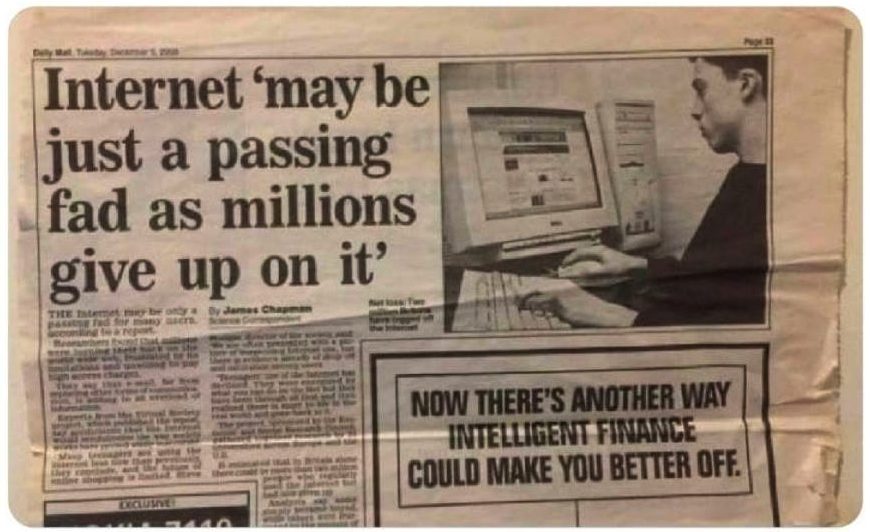
Recent headlines such as those in the WSJ (The Metaverse is Quickly Turning Into the Meh-taverse), and similar in the FT, remind us of such classics as ‘Internet may be just a passing fad as millions give up on it’ from the year 2000 edition of the UK’s treasure trove of fact, The Daily Mail. Such black-and-white premature pronouncements are typical of headline hunters. As leaders planning their investments and ensuring we extract the advantages we need from technologies as they emerge, we must take a more measured approach and a longer view. The Metaverse is so much more than Zuckerburg’s stumbling business model; it’s the complete immersion of augmented experiences enabled by AI and, ultimately, by Web3.
Anyone who thinks Disney has given up on the Metaverse has lost the plot
The headlines are being made by what are largely corrections in investment in the consumer Metaverse. For example, Disney is reported to have shut down the division, which (among other things) handled Metaverse strategies.
But these layoffs are part of a broader effort to reduce corporate spending and boost free cash flow. Disney is cutting $3 billion in content spend. No one is saying that’s the end of Disney content.
Let’s be real here. The idea that Disney has entirely shelved its Metaverse ambitions just does not ring true. Their ambitions “for storytelling without boundaries in our Disney Metaverse” have not gone away.
Meta’s rollback is no surprise and is likely to encourage investment from others
Mark Zuckerberg may be playing bait and switch with AI on his most recent earnings call rather than with the Metaverse, but then again, who isn’t? ChatGPT is investors’ latest drug of choice; why wouldn’t he play up Meta’s capabilities in it? Frankly, Meta distancing itself from the Metaverse landgrab will be welcome in a community that prefers decentralization and cooperative collaboration to the Zuckerberg monopoly any day of the week. We expect the Meta roll-back to encourage investment from elsewhere.
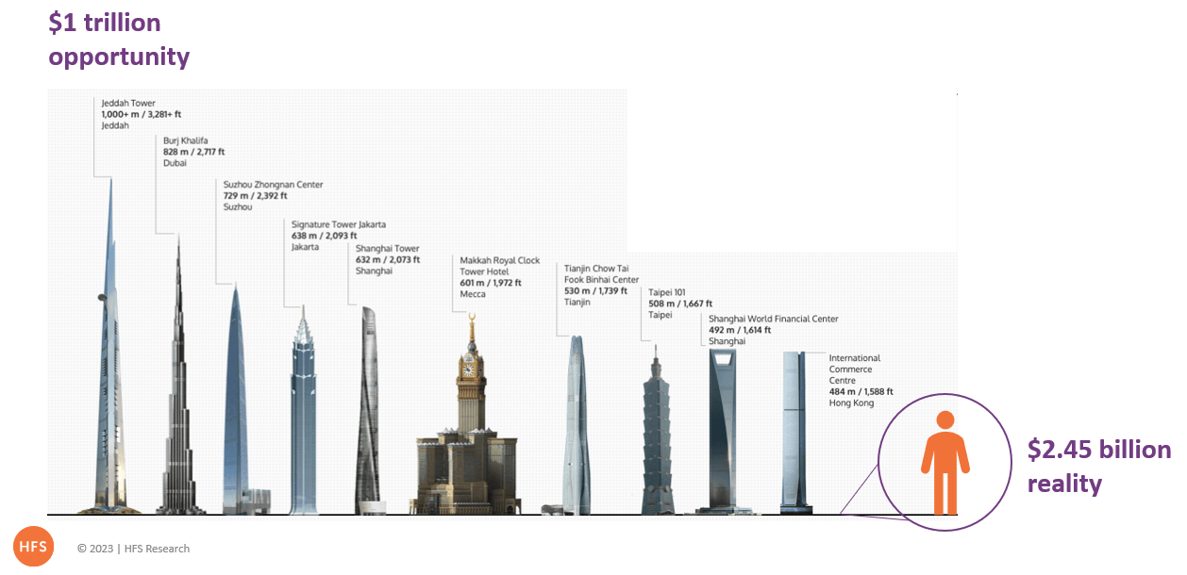
So what is really going on? A figure of $1 trillion for the Metaverse economy was reported at Davos just a few short months ago. Where did that come from? The answer: a global survey of CEOs who were asked roughly what percentage of their revenues they expected to come from Metaverse-related activities by the end of 2025. For context, this represents less than 1% of global GDP (which is predicted to deliver $118 trillion in 2025 – source, Statista).
The predicted opportunity equates to the size of a 1000m high skyscraper in comparison to the current reality – which at the same scale would appear just 2.45m tall
Source: HFS Research 2023
The $1 trillion opportunity is one Accenture takes seriously and CEO Julia Sweet has referenced it in public. Accenture is investing heavily in the Metaverse and believes it is one of five pillars of success for the enterprise over the next decade.
18 Metaverse services providers expect, on average, to see 15% growth this year
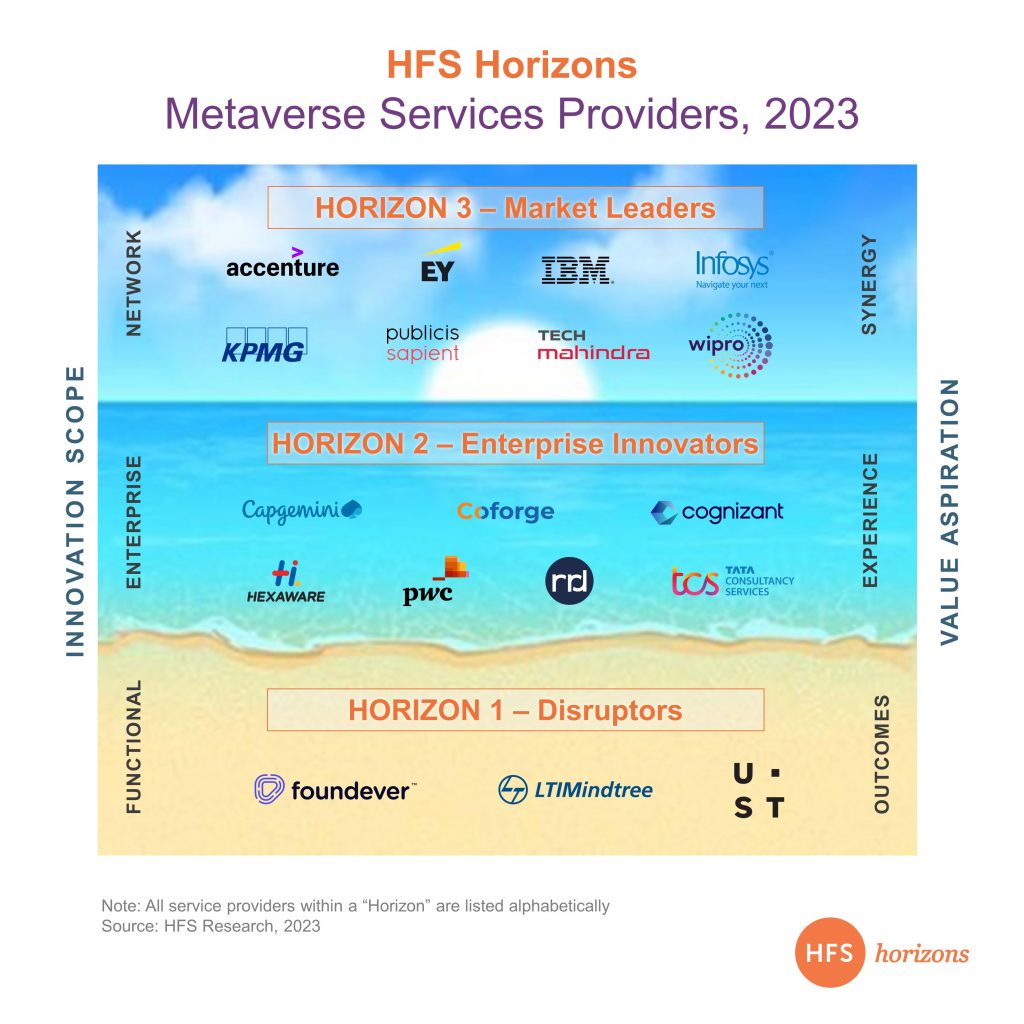
Accenture is far from alone in believing there is a very real and present opportunity in the Metaverse. Our recently published – and inaugural – HFS Horizons Metaverse Services report 2023, includes profiles of 18 leading services and consulting businesses who are designing and delivering Metaverse services and products right now. HFS estimates they are collectively generating $2.45 billion from these services – and across the board that is expected to grow by 15% this year.
Exhibit 1: 18 leading service providers and consultancies feature across three value horizons in our inaugural Metavese Service report
These include (exhibit 1) Accenture, Capgemini, Coforge, Cognizant, EY, Foundever, Hexaware, IBM, Infosys, KPMG, LTI Mindtree, Publicis Sapient, PWC, RRD, TCS, Tech Mahindra, UST, and Wipro.
Enterprises are continuing to increase Metaverse investments
We also found that Metaverse spending, along with low–code investment, were the only two areas in which enterprise investment in emerging tech is not being cut. Metaverse investments showed the greatest increase in investment, with 87% of enterprises committing between 5% and 20% more spend in 2023. The important caveat to this is that most are starting from very low bases.
The Bottom Line: Investment, services, practices, and products prove the Metaverse is not going away. Join investors now or scramble to catch-up later
Enterprise leaders should not allow knee-jerk headlines to distract them. The Metaverse is not going away, as proven by the investments continuing to be made and the practices, products, and services being established by leading service providers and consultancies. Your rivals are increasing their investment in the Metaverse. Your choice is between joining them now or scrambling to catch up later.
Anyone tracking HFS will have noticed some terrific new brains join us over the past couple of years from all over the world, but one area we have been really keen to bolter is engineering services. And we’ve been lucky enough to hire a smiling insomniac in Nandini Tare, who’s helped us grow our practice and coverage significantly, especially with her recent flagship Horizons report on Digital Engineering Service Providers.
So let’s hear from her directly what makes her tick and her views in the industry…
Hi Nandini – you’ve been causing quite the excitement for HFS over in India in the year you’ve been with us. Can you tell us a little bit about yourself? What gets you up in the morning?
On the professional front, Phil, I have been in research and consulting for almost 15 years. I started my research career in the automotive sector and now have about 3 areas of expertise under my wing. It has been an exciting journey so far, engaging with business leaders and talking about changing technology landscapes. The world is moving at such a fast pace, and everyone is trying to play catch up. I can’t help but quote Leena Nair the global CEO of CHANEL, ‘Don’t wait for the storms to pass, learn to dance in the rain.’
On a personal front, travel is my weakness. I find traveling an opportunity to engage in experiences that bring me inspiration and keep me motivated. I recently started on a fitness journey that has me up and running in the mornings. The endorphins keep me going. I am hoping to get certified as a coach in the future hopefully! And when I manage to get some free time, I ride my Royal Enfield Classic 500.
So why an analyst? Is this something you always wanted to do as a profession, or did you just fall into it by circumstance?
I believe I had the skills but didn’t tap into them early, but I forayed into industries accidentally. By no means am I an engineer, but I know how engineering impacts businesses. After experimenting with various roles from pre-sales to operations to consulting in my early career, I later chose to play by my strengths. It was a wholesome transition. The early experiments in my career gave me first-hand experience and widen my thought process. This experience has helped me analyze a subject or a topic from all angles and then conclude my opinion.
So what makes a good analyst, in your opinion?
An independent voice and an ability to be unbiased. I feel these two qualities can set an analyst apart from the regular crowd. Believing in the research and methodology one has created and proudly owns it. One can develop skills to be an SME, but providing an unbiased opinion is a conscious effort.
You’ve clearly demonstrated an aptitude for covering engineering markets… what’s so exciting about them, Nandini?
The whole ecosystem is getting connected. Businesses now have access to the latest and greatest technologies to reduce costs and make themselves profitable. The influx of IoT, AI, Robotics, 3D printing, 5G, Cloud, and emerging technologies like Blockchain, Metaverse, Digital Twin, etc. are impacting the consumption side and changing the way traditional business functions. Businesses are now spending on R&D to identify early-stage use cases and commercialize them to bring themselves to the forefront of the industry. All these changes must be a steady progression. ER&D is set to expand as it further gains acceptance in outsourcing and digital engineering. While all of this has me excited, I have intentionally kept generative AI out of this conversation as we would never stop discussing it and arrive at a conclusion on its influence on the ways of working.
And what do you think we’ll be talking about in 2 years time in this space?
Digital engineering services, as most of us would agree, have largely been known for building new products and solutions, Phil. The current set of available technologies has improved business efficiencies, augmented the speed at which a product is brought to the market, and aided product as a service. There is a small portion of the industry that is already talking about how digital engineering is advancing digital transformation strategy to business transformation. One would see a reduction in the lift and shift process and an increase in well-thought-through utilization of technologies to bring true value to the business. It would be interesting to see how service providers and enterprises develop a purpose-led ecosystem and outcome-based pricing. One would also see businesses engaging with niche players to build capabilities to provide enhanced customer experience. Overall, I see this space growing in the next few years.
Thanks for your time today, and looking forward to the next big insights, Nandini!







 One of the most talked about sessions at the HFS Super Summit in New York was my on-stage 1-1 with one of the IT and business services industry’s most revered voices,