The modern digital world is awesome in so many ways. But sometimes I get sent a piece of data, and I just wonder why? Not to be an advert, but I recently started to use a grammar / spelling plug-in called Grammarly (it just corrected the spelling of itself as I’d forgotten to capitalise). I find it helpful as it does things like contextual spelling – so it’s a bit better at spotting some of the common mistakes I make – for example, I am always typing deliverying instead of delivering which Word seems not to find.
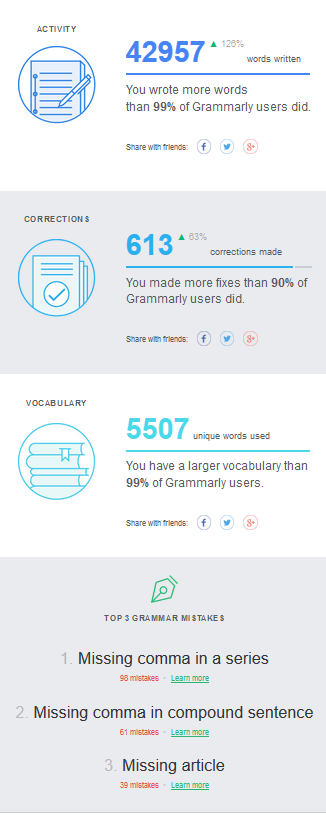
Anyway, I get an email from them every week giving me a run-down on how I used it that week – I have displayed one of my latest stats in the picture.
When I first received this, I thought that this was great – look at me I’m 99% more active than everyone else. Then the following week my number of words went down 30%, and it worried me – thinking I’d been just as busy. As the weeks rolled on, I have made the same number of mistakes and my stats fluctuate – but they just don’t help me. It went from “That’s interesting”, “Wow” to “So what?” in about two weeks. It may just be that I am not learning from my mistakes….
Coincidentally, I wrote about the importance of learning from mistakes in one of my last blogs (Why the slogan “Fail Fast” is bullsh*t if you want to succeed with OneOfficeTM) and I think this is where much of the data explosion is failing. We’re provided with all this useless data, but without much guidance on what to do about it, how to act on it – how to improve for the future. I think that is the issue with all the data – we just don’t know what to bloody do with it!
Bottom line: To avoid #bloodyuselessdata you need a data chicken, not just a data egg
HfS Research is calling time on bloody useless data. Pure data collection and naïve analysis are table stakes in the digital world. The only way to create business value is to provide a feedback loop. The data needs to be used to inform the person in a positive way and iterate the process. Just hoarding data with no purpose is pointless (and potentially expensive) and next level of statistical reports which generate little action are almost as bad. For data to have any power it needs to inform the process and it needs to be actionable. From now on HfS will be looking for examples of useless data and calling it out. If you have any examples, please contact me via twitter @thewizeone #bloodyuselessdata or [email protected].
HfS analysts recently attended Wipro Digital’s first analyst and advisor day event in the U.S., and our collective first impressions could summed up into, “Ok, they get digital, and what it means for enterprises, but are they articulating exactly how they’re going to market on it – and will clients understand?”
The mantra that this group articulated is to think it – design it – build it – run it. Wipro has traditionally been associated with the last two of those battle cries, and is making investments and efforts to climb up the ladder on the first two. With its acquisition of design firm Designit, it has a new set of capabilities, organizational practices and culture that it has started to draw from. As importantly, it is hoping to leverage the agency’s design positioning and brand identity for Wipro Digital – and perhaps Wipro as a whole.
Moving outside of IT, and into the business, is perhaps Wipro’s greatest challenge
A significant challenge for Wipro Digital is its current footprint and connections within enterprises. The service provider mentioned at the event that its starting point for new deals was most often the IT organization, where it is best known and experienced. “Design tech” work is increasingly originating outside the CIO’s office, and while marquee/strategic clients might take Wipro Digital to the table with stakeholders for new initiatives, the service provider has to take new approaches for the larger market where IT and operations are starting to take more joint ownership of digital projects. We see promise and challenge as Wipro, like a lot of its competitors, gears itself up to service old customers in new ways , as well as reinvent itself for new breeds of customers.
Examples of how Wipro Digital is bringing this to life, shared at the event, include:
“Digital pods”: 13 design studios that are office spaces for creative work for Wipro
Digital and Designit’s teams. Wipro stresses that the more clients visit these spaces and
see this way of working, the more its brand perception will be changed.
A $100m fund to invest in digital startups that it can bring into large projects.
Scaling up resources that work exclusively in methodologies that prioritize agility, rapid
prototyping and flexibility in IT design and implementation, including agile practices and DevOps.
Wipro brings “digital” to life with clients in banking
Of the examples of projects Wipro shared the last two years with these new capabilities and methodologies, three examples in banking represent different use cases and Wipro capabilities:
A transformation with a major British retail and commercial bank: The engagement spans across consulting, design and technology. Wipro is taking a different approach with this client – partnering on governance, jointly engineering prototypes, and bringing access to its ecosystem of partners/startups and academy for the client’s IT organization. In the next few years, this is going to be the engagement to watch, to see how Wipro Digital pulls off coordination and collaboration across its internal groups, Designit and the client’s IT organization to execute on the bank’s strategic digital initiative.
From the ground up with Designit: A project with Israel’s second largest bank, Leumi, to create a new digital, mobile-only, bank as a startup within the enterprise. Christened Pepper, the teams used agile design thinking methodologies that included intensive collaboration between team members from product, design and technology, and constant user-based feedback and prototyping.
The journey with a multinational BFS firm as they rollout an implementation of the Wipro Holmes E-KYC solution: The bank wants to streamline how its KYC is being run to free up valuable analyst time, focusing not on cost savings but innovation with the help of automation and machine learning technologies. He described his vision for this project as, “wanting to redefine the way we work to make KYC competitive in the banking industry.” The bank is working with Wipro to define outcomes, ROIs and commercial models as the implementation advances.
Service providers need to determine their early “sweet spots” and really hone digital and business capability –and story—with their clients
These examples demonstrate how opportunistic and diverse the digital market is, making it challenging for service providers to pinpoint their approach/experience. Wipro Digital laid out its goal at the event, with Avinash commenting, “We want to move from a cost and efficiency play as a system integrator, to revenue generation and outcomes as digital executors.” That reads like HfS’ thinking on the bifurcation coming down the line, with service providers wanting to be OneOffice Enablers. Wipro has started to share how clients are starting to leverage it – with both new and existing capabilities being brought to bear. What was missing from the messaging was specificity in the execution – how many clients is it working with today, what are the sales team’s approaches, and what is the progress it has made on scaling its talent, and presence in different geographies, especially client markets.
HfS cautions that much like the heady days of IT services, where the biggest players went with ‘being everything to everyone’, Digital practices like this one run the same risks of diluting their message, and as a result, their specializations. Even with the banking examples shared above, the solutions being developed are highly tailored to the clients’ needs – as they should be – but don’t paint a picture of what Wipro Digital envisions as its approach for the banking industry’s needs and opportunities. It will take some big success stories – told by its clients – that will help Wipro Digital in further formulating its range of new capabilities and the brand association behind it.
With the realization firmly sinking that the new normal in Oil & Gas is “lower for longer,” it is hard to find service providers investing heavily to build out their Oil & Gas Practice. That is, until Cognizant announced plans to acquire Frontica’s IT outsourcing and BPO business for $128 million, a service provider born in the Oil & Gas industry.
Frontica hails from one of the largest hydrocarbon rich areas in Europe—Norway—and specializes in ITO and BPO services for Oil & Gas. Frontica has been on a transformative journey the last couple of years, reorienting itself from the internally focused shared services unit of oilfield service company Aker Solutions until 2014. At that time it started operating as a separate ITO and BPO service provider in Oil & Gas. It has a healthy portfolio of contracts such as the 5 year deal signed in February 2016 with former parent Aker Solutions, which is valued at between $ 116 million and $ 145 million annually.
Frontica’s ITO services are focused on SAP consulting, application maintenance and development, IT infrastructure, implementation services, IT support for mergers and demergers (good business in Oil & Gas). BPO services focus on HR and payroll, F&A, operational procurement, category management and sourcing.
Cognizant, a High Performer in our 2016 HfS Energy Operations Blueprint, already has a strong Oil & Gas practice. We commended Cognizant for its vision for Energy Operations and its depth of industry specific capabilities. We felt Cognizant lacked industry specific acquisitions that would build out its capability and credibility in Oil & Gas, especially compared to some of its competitors, such as Infosys (acquired Noah Consulting in 2016) and Accenture (acquired Schlumberger Business Services in 2015).
Some smaller Cognizant clients in Europe mentioned they would appreciate more engagement, especially when navigating challenges around outdated legacy applications. This acquisition brings in local knowledge and delivery power, which can provide clients with increased interaction and closer engagement.
Although HfS sees this $128 million deal as a significant investment in the Oil & Gas practice, it’s not a game changer for domain specific processes, as Frontica’s expertise lies more in the process-enabling sphere. Nevertheless, the merits of this acquisition include:
Support for SAP customers who continue to struggle with a move into the world dominated by cloud and digital.
Delivery capability in BPO, a market currently dominated by Accenture and IBM. This acquisition gives service buyers a credible alternative, especially in Northern Europe.
A client base and network in a market very much in flux. Turmoil in the Oil & Gas market not only impacted service buyers, but also service providers’ ability to invest in their Oil & Gas domain expertise, capabilities and innovation.
Frontica, which has global aspirations, is better off as part of Cognizant’s Oil & Gas practice and wider ecosystem than it is trying to build its presence alone.
Bottom Line
With this acquisition, Cognizant bolsters the profile of its Oil & Gas practice, and shows a seriousness supporting clients in this vertical, with the addition of industry specific talent and capabilities. In the process, Cognizant also shores up its geographic presence in one of Europe’s largest Oil and Gas markets. The challenge is to integrate Frontica into the O&G practice quickly and leverage Frontica’s knowledge of the market and position in Europe, particularly in the Nordics.
The manufacturing industry has reused components for a long time. A high level of reuse not only reduces waste but also lowers the cost of production and reduces time-to-market. Now this concept is being adopted by engineering service providers for part of the software product development process. Software code reuse helps clients save resources, which provides cost advantages and also enables engineering service providers to reduce redundancy and time. In many cases, engineering service providers claim to be using software code reuse components for client engagements, but often software product engineering buyers don’t have visibility into software code reuse by service providers and are not sure whether they are getting the benefit of it.
In our Software Product Engineering Blueprint, we asked software product engineering customers to rate service providers on different major capabilities. The capabilities were broadly divided into six categories and the response is depicted as below.
As the Exhibit shows, the code reuse capability of engineering service providers is rated as the lowest capability. Software product engineering buyers don’t know whether service providers are performing any software code reuse and also have no visibility in case the software code reuse is implemented.
Currently, software code reuse is seen as an industry best practice for IT service providers but often there are no metrics/KPIs identified to measure it. Therefore, there is a need to measure software code reuse capability and performance because what is measured is what gets done.
We have developed a PoV focused on the metrics-based approach that software product engineering buyers can use to drive software code reuse in their engineering engagements with service providers. Software product engineering service providers should also use software code reuse metrics proactively to demonstrate their capabilities even if customers are not asking for it.
Some service providers are hesitant to highlight their software code reuse as if customers know about software code reuse then they might ask for discounts in pricing. This in our opinion is a short-term thinking. The customers will anyway know about the software code reuse from analysts, advisors and competitors and then service providers will risk losing their credibility and contract. It is better to disrupt the engagements with software code reuse yourself than leave the room for competitors to disrupt it. Also, with code reuse KPIs, engineering service providers might have a better business case of outsourcing in comparison to the customer’s internal software product development in their in-house R&D centers.
HfS subscribers can click here to download the full POV for developing a plan for metrics based software code reuse in software product engineering .
When I set out to do a spinoff Blueprint on the future of contact center services, I thought of this concept that only seemed logical to explain as “digitally-enabled contact center.” Initially, I think this inspired more confusion and uncertainty than it did to define the future of contact center services. I confused the service providers, who were convinced they had already provided their best digital story, and the buyer references, who had way more examples of traditional call center work than true digital enablement. I’m admitting this, hoping that we can learn from the lesson that sometimes it takes a lot of battling through confusion/hype/ attempted brainwashing to figure out what’s really going on in the markets we cover.
The most important question this exercise inspired is: how can the contact center break free from legacy butts in seats engagements that force customers into bad conversations they don’t want to be having– and create a customer experience that serves the digital customer, and inspires greater satisfaction and loyalty?
What is a digitally enabled contact center?
At the most basic level, embracing “digital” channels: social media, web self-service including mobile apps and visual IVR, video kiosks and chat is the start of digitally-enabled contact center. Also important is seeking to use automation to create efficiencies; and the really smart contact center operators are trying to figure out how to involve increasingly intelligent automation into the mix.
It’s more than just implementing these channels, though, it’s the design of how each channel fits into the overall customer journey, and the understanding of how talent fits into the equation– talent that not only can handle communication on varied channels that demand different styles (yet consistency!) but can also take contextual information from multiple sources and use that in a way that benefits the customer. From an analytics perspective, it’s all about using the data to better understand customers, enable personalization and be more predictive.
A digitally enabled contact center is way more than the technology—humans are actually at the heart of a digitally enabled contact center.
Ultimately, a digitally enabled contact center is one that supports Intelligent OneOffice. It’s not just about supporting the digital channels themselves, it’s the design and strategy about how digital impacts the way enterprises handle customer service in a “customer first” organization. Ask anyone who has worked in a call center and they will tell you it’s hard and it can be tedious. I can attest to this as someone who’s toured dozens, and worked in them myself. But, there are moments when it can be very rewarding; moments of human connection and real customer satisfaction, and even loyalty—those moments are what we need to focus on in order to understand what’s at the heart of this rapidly changing industry—and requires a digital strategy to support.
Digital enablement is happening in spurts
A contact center strategy that addresses all the above capabilities is largely aspirational. Digitally enabled contact center is happening in pockets – little bits here and there. Some of the highlights include:
Channel Mix: Digital channels have been supported for many years, and service providers continue to implement services well around “newer” channels which are now mainstream, such as chat and social media support. A “self-assist first” strategy is one that’s emerging among the savviest contact center service providers; the idea of guiding customers with self-service first and then incorporating the agent role to intervene when needed. Voice is still the dominant channel, while others have increased as a percentage of overall interactions; the issue is not so much about voice declining as it is about understanding the shift in channel mix, and the underlying dynamics and preferences driving the shift.
Channel deflection/ issue prevention: Intuitive knowledge bases which pre-empt and solve customer inquiries before requiring agent assistance is driving self-service as a solution to decrease customer effort. Improving self-service is frequently put forward as a cost savings mechanism, but often has the most immediate impact on service quality and consistency. Automation on the front end of customer service in many cases is not developed enough to address these drivers.
Digital Customer Experience: Demand for adoption of true end-to-end customer care offerings is still low compared to actual adoption, but we’ve seen pilots with large clients looking to really connect the underlying back and middle offices to support customer experience. The next year or so will be telling with how and whether these pilots come to fruition. The competitive landscape is about to change. Some large multinationals and tech-focused service providers have more horsepower to be real “OneOffice Enablers”—connecting the front, middle and back office to support the digital customer experience holistically. Many traditional contact center service providers will end up focused on scale, geographic footprint and labor arbitrage (“DumbOffice” category)—for which there is still a large market but getting more and more difficult to compete and stay profitable in.
How to thrive and not just survive—Contact center services need to cross the chasm by:
Changing the perception (and reality!) of contact center and contact center service provider relationships. I recently spoke with a buyer who said that after implementing a web self-service strategy, his company automated about 50% of their phone calls over the course of only several months. This caused a re-evaluation of the company’s contact center service provider and whether it was really worth outsourcing the decreasing amount of phone calls. This begs the question, what can this provider do to keep the relationship alive? Are there other channels they can help implement to deflect calls? What analytics can the provider bring to create more value and bring insight to their client?
Sharpening a strong partner ecosystem. Digital trends increase the importance of a strong, smart partner ecosystem. Most contact center services providers aren’t really “tech shops” so don’t do core development, and need to focus on partnerships with established firms and startups. Considering the technology needed to service customers using channels like video, mobile, and chat, as well as connecting to other systems such CRM, having access to platforms that are agile and connect easily with other systems is critical. Strategic technology partnerships are especially important for the pure play service providers that are not technology providers.
Shifting the metrics. Engagements focused on average handle time will fall flat or cease to exist in 5 years. For example, SLA s for response times involving an email might be 48 hours, whereas response time SLAs for social media are often four hours or less (Amtrak may want to look into implementing some kind of standard there).
Future-proofing the contact center services business
There’s lots of talk about cannibalization of legacy engagements. Contact center service providers’ mitigation strategy must be multi fold—they must provide something in conjunction with traditional operations that addresses automation and self-service, built in with exception support (with a great talent strategy) to address the changing contact center model to derive more value out of clients’ investments.
One of the wild cards with the potential biggest impact is artificial intelligence – as we discuss in the Blueprint, many of the traditional contact center service providers are not looking at artificial intelligence in any meaningful way. Whether they invest in a partnership strategy or at the least develop a team to study its potential impact, action needs to be taken– but most providers are content to bury their heads in the sand. Eventually artificial intelligence will have a material impact on contact centers, and it won’t be pretty for the providers who are dependent on butts in seats. Understanding how to blend the best of human and artificial intelligence, and a greater sense of urgency to understand how this will impact the industry is sorely needed right now.
And I’ve waited this long to get to the dreaded “omnichannel” phrase, but let’s face it: in the future, anything can be a “channel”—it could be a car, or a watch, or a refrigerator. What this demands more than anything is an agility that is very rarely found- and often antithetical- to traditional contact center services.
The Bottom Line: The entire future of contact center (and OneOffice) hinges on creating different kinds of relationships
This seems to beg for a design thinking first strategy. One executive quote from a recent analyst event that stood out was: “We’re teaching clients how to work differently, and they’re teaching us. We’re learning together.” These are the kind of relationships that will ultimately generate a customer experience that keeps contact centers a critical part of the CX strategy. I’ll be really excited to take another look at this digitally enabled contact center in a year or two. With so much of the discussion being around pilots and big picture thinking, I’ll be eager to see how some of this stuff comes to fruition.
For an evaluation of the digitally enabled contact center market themes and service provider analysis, click here.
When you see major advances in disruptive robotics, such as the soon-to-be-unveiled Hadrian X, which claims to build a house in two days, moving four times faster than human construction workers, you realize that making invoice process workflows more automated is small-time, when it comes to achieving real robotic efficiencies:
The robot, named Hadrian after the Roman emperor who built defence walls in England, is being primed to work day and night, lay 1,000 bricks per hour, and could potentially build 150 homes in a single year. That’s a lot of construction workers who may just not be needed anymore… and where you get genuine hard cost savings because you’re removing actual labor, not merely automating some annoying manual steps in a process chain.
Although we expect to see more and more core IT moving to the cloud in the coming months and years, largely this is preceded by successful use of public cloud for new application development and deployment. This continued uptake in the use of public cloud eases the pressure on large organizations, with the availability of on-demand flexible computational power that scales rapidly to cater for changing business and customer needs.
For example, the rapid deployment of more customer applications as part of a digital strategy, or trying to collect more data from IoT devices, or making better use of SaaS applications are typical drivers of the thirst for on-demand scalable computing power. The issues for enterprise enterprise functions and their IT departments with cloud remain: managing cloud alongside existing infrastructures, making sure the solution complies with security and other enterprise risk concerns, ensuring they have the skills and resources to manage it effectively, performs to the right standards, is genuinely scalable, and, of course, is cost effective.
One solution to this problem, for many enterprises, is moving to a more holistic software defined datacentre model – or a hybrid cloud platform – which gathers together cloud instances and, in some cases, legacy IT into a manageable framework. This is what Accenture, and many of the other infrastructure outsourcing service providers, are doing as a way to continue to be relevant and add value in the cloud world.
In this vein, Accenture has formed another cloud-centric alliance as part of the firm’s Cloud First strategy, by teaming with Google. While this encompasses pure cloud computing from Google, it also includes other Google-specific technologies, namely Android, Google apps, analytics, augmented reality, big data, IoT and machine learning. Accenture has integrated the Google Cloud Platform into its own multi-cloud platform, the originally named Accenture Cloud Platform (ACP) – ACP existing partners include AWS, Microsoft Azure, and NTT. ACP helps manage enterprise IT and cloud resources across multiple public and private cloud instances – helping to manage and automate infrastructure requirements.
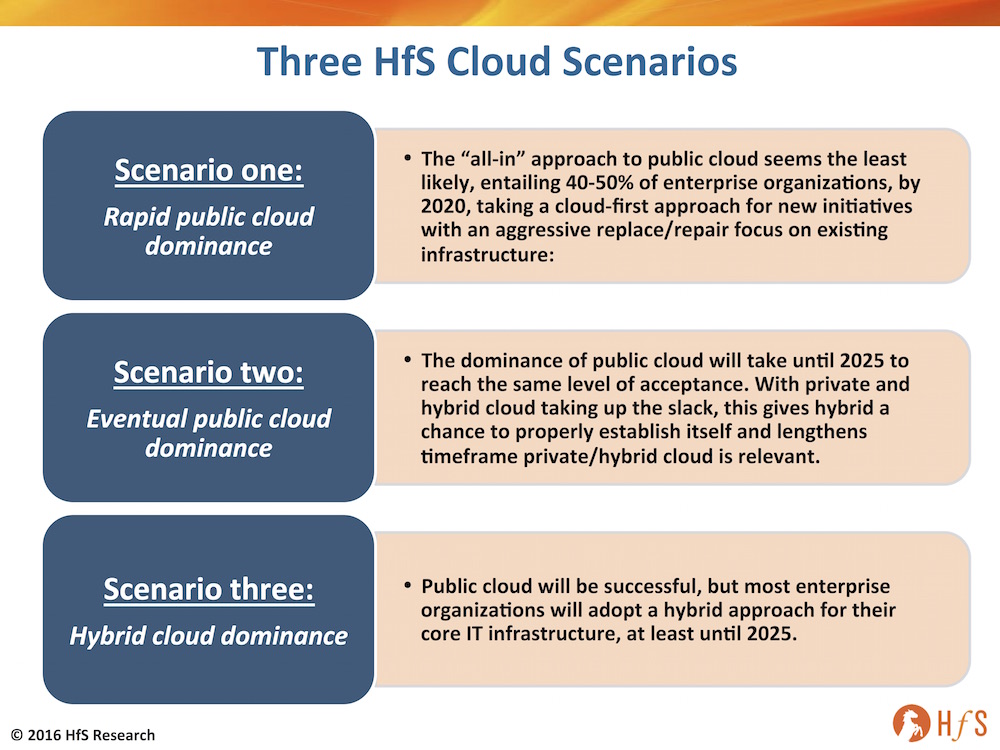
The likely success or failure of such a move depends on your position on cloud platforms and their long-term future in infrastructure management. As you can see in the diagram, HfS took a position on this last year posting our view of the three most likely scenarios for enterprise cloud adoption over the next five years.
HfS stands by this schema and is increasingly of the opinion that the eventual outcome will be two or even three – with the timeframes for two perhaps stretching beyond 2025 – largely because this is the nature of prediction. Everything takes longer than people think or you desire, when it comes to replacing legacy IT. However, the big deciding factor will be the success or failure of orchestration platform layers and cloud ecosystems. However, even if scenario 2 is the ultimate winner, it still provider us with a healthy runway for cloud platforms – and these platforms are likely to be retained for enterprise environments if only to make sure the client receives the best price and cloud operators continue to innovate and provide good value.
So it seems that, at least for the time being, these platforms will be part of the on-going story for infrastructure management, particularly in complex and risk-averse enterprise environments, for several years to come. Before AWS cries fowl and says our customers tell us that they’re going 100% cloud without a platform. Or that a hybrid platform creates a lowest common denominator of cloud services. I need to explain that this is a generalisation aimed largely at the enterprise space and there will be many organizations that will choose to use AWS, Azure or Google as the window into Cloud. But there are still significant numbers that don’t want to be locked into a single provider, the investment in legacy is too much to abandon and that have complicated requirements that one solution won’t work.
OK so now the question is who will win the battle of the cloud platforms? In the old legacy IT outsourcing world there were many “winners” with providers winning deals based on complex sets of criteria and there was scope for differentiation outside of pure technology skills or efficacy – largely because the engagements were all heavily customized and deciding which provider would deliver the best service was based very much on whether an enterprise was important enough to the provider to warrant its best resources and get the “A Team”. A provider’s ability to deliver value over and above the technology in IT infrastructure management engagements will persist somewhat but will be diluted by benefits that flow from the platform itself. The big changes we’ll see with selecting a hybrid cloud platform will be: The big change with selecting a cloud infrastructure platform will be:
A large part of the success of the platform will be the richness of the ecosystem – both regarding quality of partner and number of services/partners in the ecosystem.
The actual functionality of the platform will also be crucial to its success. So functions like plug and play analytics, brokerage, and automation.
Finally, the way the platform deals with commercial aspects of cloud management will also be key to its success. Platforms that allow flexible methods of payment and structuring of engagement will be key. We can envisage the most flexible platforms being able to offer a full range of pricing options at a fixed monthly price managed service approach to fully pay per use cloud model.
The Bottom Line: Accenture has a firm handle on the most diverse and complex cloud capabilities to support its long-term roadmap
A key aspect of the deal between Accenture and Google is it helps to make sure the Accenture’s cloud ecosystem is a rich and diverse as possible. One of the most important, if not the most important criteria for any hybrid platform will be its ecosystem. This is likely to mean there will be competition for the “best” ecosystem, and perhaps the most important gauge, for the time being, will be who has the richest set of partners. So it makes sense that Accenture adds Google to its list of partners, not just to give another compute option, but also to leverage Google’s investments in other technology like AI, analytics, and automation. This a great opportunity for Google to tap more directly into the enterprise space with Accenture’s credentials – similar to the benefits AWS is hoping to enjoy from its arrangement with Accenture.
More widely we expect to see more partnerships looking to build out cloud ecosystems. We expect this to happen at the infrastructure layer and also the DevOps layer. So more partnerships between PaaS platform operators and service partners – as although PaaS environments success is around broad capabilities/functionality, access to ready pools of skilled developers who use the platform is essential.
Focus everyone on the shared outcome: The healthcare consumer experience
“We are, frankly, still at a stage in which healthcare technology often hinders, rather than helps, physicians trying to provide better care,” says Andy Slavitt, Acting Director of Centers for Medicare and Medicaid. The examples he shared at HIMSS16 still resonate with me: feedback from physicians who have told him, “To order aspirin takes 8 clicks on the computer. To order full strength aspirin takes 18.” Another said, “I can’t track my patient’s referral; I sent them to the hospital and can’t track them.”
Despite the increased, even prolific, use of IT in healthcare with member and patient portals, electronic records, and online billing and payments, the clinician or healthcare consumer experience has yet to change fundamentally for the better. To truly become digital, healthcare organizations have to rethink their use of IT. In many cases, where they have software vendors and service providers involved, they also need to revisit their engagement strategy, especially as the industry shifts to value-based care and payment based on results.
A single-minded focus on the customer—patient, member, employee, clinician, etc.—can break down the barriers in and across organizations to drive meaningful processes and use of IT
Digital healthcare, in its purest form, is all about transforming the healthcare business to create, support and sustain the healthcare customer experience – customers being, at times: plan members, patients, physicians, caregivers, etc. The “end user” can be the same person in different roles, or working with people in other roles, creating a complex network of constituents with varying wants, needs, and motivations. So, creating a healthcare experience is not a job for a solo artist, either – it takes the whole orchestra playing together to create a musical masterpiece and not just a cacophony of sound.
Simply stated, a pivotal factor for being truly effective in delivering the vision of better health and care at a more reasonable cost for the industry is a coordinated, interactive, and interoperable approach in operations, what we at HfS call the Intelligent OneOffice. OneOffice is all about how people use data and digital technology to bring together the front, middle and back office to enable a user experience that matters, thereby having an impact on health, care, and the viability of healthcare organizations and businesses.
Everyone in the industry has a role to play in supporting this person-centered approach. In some cases, the impact is more obvious and intuitive, such as the front line staff of doctors, nurses, and pharmacists directly discussing a patient’s care plan, therapy and medications. However, roles that are more removed from these direct touch points also have an impact on health, medical, and administrative outcomes. For example, operations support staff processing claims are analyzing data to identify care gaps and opportunities for new interventions, making sure patients are informed through the design and input into systems that automate outreach and reminders through phone, email, or text, for example. So much of how the touch points in healthcare can be more effective depends on the data, digital technology, and relationships that extend from “hidden” roles in “the back office.”
People who can identify and articulate problems and coordinate across internal and external organizations to focus on the end-consumer, are key to bringing together IT and operations
Generating the kind of synchronistic flow from less customer-facing processes to support the healthcare customer experience is no easy task. What will help drive change is finding and/ or cultivating “brokers of capability”—people who can articulate a business problem or opportunity, the desired outcomes, and then coordinate and facilitate across internal and external entities to reach those results. In healthcare, we see brokering going on to create networks such as for ACOs and hospital systems leading to data stores and insight-driven interactions to better manage a patient’s health and care, end to end, covering socio economic/financial and medical needs.
Who are your brokers of capability? People you identify in your organization with critical thinking and networking skills, people who put people first. Taking this approach also creates a more attractive workplace and can play on a naturally altruistic synergy as many people enter the healthcare profession to “help others.” No matter what role they play, as a nurse, doctor or physician, or a claim processor or medical coder, there is an opportunity for everyone to impact the customer experience and gain a greater level of satisfaction and engagement.
Note to readers: Our study on achieving Intelligent Operations, with input from Cognizant’s Center for the Future of Work and Business Process Services practice, canvassed 371 major buy-side enterprises and had 45 healthcare executive participants. Link to The Journey to Intelligent Operations in Healthcare and download for free after registering on the site.
Notwithstanding having my 13th HR Technology Conference participation cut short by needing to return home to Florida to deal with a hurricane, one major observation stood out for me. It was also a fairly pleasant surprise, something that doesn’t come easy after attending so many of these events—as enriching as they usually are.
In fact, the hurricane actually contributed to the observation. How? Well, in having to unfortunately cancel briefings with major HR Tech vendors to leave early on Thursday, I had to rely more on quick-hitting discovery sessions in the exhibit hall, generally with lesser known vendors. They are typically not as schedule-constrained at the conference.
So, here it is: I found it just as easy to see meaningful HR Tech innovations in the booths of “little guys” and emerging players as I did in their much larger and more established counterparts. I’ll define ”meaningful product innovations” as practical, obviously value-creating (vs. largely “wow factor”) advances where the system’s intelligence is leveraged without a lot of heavy lifting or major change adoption needed by the customer organization … dependencies often under-estimated by vendors and customers.
This phenomenon of smaller players excelling so much in the innovation department is arguably a function of basic math: There’s only a small group of market-leading solution vendors but roughly 400 HR Technology companies exhibited at the event. And no matter how large and well capitalized a solution provider is, it is just impossible to make every functionality area or module in their product portfolio a priority every release cycle, or even every second or third release or enhancement cycle.
Added to that is the more subtle notion that a large customer and product footprint can also be a double-edged sword. While they logically lead to more robust revenue channels, they also cause a correspondingly larger list of potential enhancements and R+D investments needed to maintain a leadership position across the portfolio, prevent customers from defecting, attack new markets, etc. This allows smaller players, for varying periods of time, to lead the way with innovative solutions that solve fairly specific, often vexing HCM-related business problems.
Below are four examples I encountered on the exhibit hall floor, and these particular upstart vendors were all borne out of HCM-related consulting practices having pockets of expertise not typically found in classic HCM software companies. This is perhaps another contributing factor to why (and how) smaller players are driving so much product innovation.
TalentQuest leverages validated assessments and related behavioral information to help managers give employees the most meaningful feedback and coaching, but in ways that will resonate the most — a great example of personalization (more on this theme in my next post). TalentQuest’s technology also guides employees in pursuing roles in which they will excel and find the most satisfaction.
TalentGuard, with a heritage in career development and robust competency models, uses well designed behavioral frameworks to meaningfully tie together performance tuning and coaching with ideal, personalized development options and career pathing guidance. The result is fully engaged employees who perceive a fair and transparent process that has their best interests in mind.
eeStrategy’s flagship product, eeCompensation, serves up recommended compensation decisions based on the system knowing which data points are the most relevant for each employee, and therefore should be considered the most in a compensation decision. Data points might include skillsets becoming more important but also scarce internally/externally, or key employee retention risks. Coming from someone who used to manage year-end bonus processes in global investment banks, basically eliminating all the data and spreadsheet manipulations is a beautiful thing.
TheChemistry Group, one of 8 startups recognized by conference organizers as offering the most promising HR technology solutions, also has its origins on the consulting side – specifically, assessments that predict star performers for different roles and organizational contexts. These folks, whom I met while sharing a table at the recognition luncheon, are actually moving from using structured to unstructured data (e.g., social media and other publicly available data) as the basis for predicting great hiring outcomes.
These lesser known solution vendors, and many others I didn’t have time to connect with or who weren’t at the conference, are clearly doing their part to drive increased demand (and therefore funding) for HR services and solutions from HR’s internal customers.
I’ll get to other examples of lesser known players offering compelling HR Tech product innovations in a follow-on Conference post being published shortly. It will focus on an obviously huge industry trend: Finding and engaging with the right passive candidates at the right time, using personalization and other advanced forms of system intelligence.
And if you’re an HCM/HR Tech solution provider that wants to schedule a briefing with me, kindly use this form.
If there’s one character, on the client side, who’s really take on the mantel of “Chief of the Robo-Buyers” it’s Lee Coulter, the year’s Chairman for the HfS Sourcing Executive Council.
He probably won’t appreciate the moniker, as his standards group has already dropped the term “Robo”, but we’ll call him that anyway… So without further ado, let’s hear more from Lee as he gathers his thoughts after the recent HfS Cognition Summit:
Server: “Hi there, my name is HAL, and I will be your server. Can I get you started with something to drink? Sparkling water or something else perhaps?”
Watson: “I’d like a Hadoop martini, Drilled not Dremeled.”
Holmes: “That’ll be fine for me, too, but with some Flume and a touch of Pig”
HAL: “Sure. And have you had a chance to look at the menu? Do you know what you’d like?”
Watson: “I’d like the Presto with Storm please. Can I get a side of Sqoop as well?”
Holmes: “I’d love some Oozie with the Mongo preparation and Thrift as a starter.”
Server: “Very good. I am putting myself to the fullest possible use, which is all I think that any conscious entity can ever hope to do.”
A few weeks ago, at Phil’s event in White Plains, I got to hang out with some of industry’s best and brightest. Of course, as we have been doing at HfS for years, we looked to the future for trends, disruption, and new capabilities that will influence what the SSO industry will be facing. I also had the privilege to hang out with Gerd Leonhard for a couple hours over a drink. That was a real treat.
Not surprisingly, there was a lot of talk about automation, machine learning, AI, cloud, aaS, and so forth. I remarked to Phil that gone are the days when we were wrestling with how to do transitions well, how to contract for BPO, location strategies, and even the years-long discussion about why we aren’t getting innovation from our service providers. In the last three years, the conversation has totally changed. Whether you are a Utopian or a dystopian, the irrefutable reality of rapidly increasing Intelligent Automation is a fact. Leading futurists like Kurzweil, Leonhard, and Diamandis disagree on a few things like timing and the impact to society and future of work; they all agree that the world will fundamentally change by 2030.
During the event, and on the plane home, I was thinking a lot about what’s next. How do we get from where we are now, to a position in which our organizations can take advantage of this really cool stuff?
The pace of the pace of advancement is such that I am calling this era Living Logarithmic. There are so many technologies in an exponential rate of advancement that in combination, the total acceleration is logarithmic. Weirdly, the human brain is inherently incapable of comprehension of change at this pace without deliberate effort. I have been feebly trying to do exactly that, and wanted to share some thoughts.
My organization is an an early adopter of automation, and I am generally a geek that follows technological advancement fervently. We have a five-year roadmap taking us into a new world of d-BPO or digital BPO (will reserve for another discussion). We have a well-established CoE implementing unattended batched automation and assisted in-line automation, and are looking deeply at NLP, UCaaS, and Machine Learning (ML). We are in active dialog with Amelia, Cognitive Scale, Watson, and Holmes. These are technologies that all make use of ML. I am very careful with my choice of words here as things like autonomic, cognitive, and AI are not defined. As an aside, I should mention that I am Chair of the IEEE Computational Intelligence Society (CIS) Working Group on Standards in Intelligent Process Automation – the first output of that work will be a Guide to Concepts, Nomenclature, and Terms. We expect to be opening that for public input sometime in December. So for now, I lump these more sophisticated technologies into the bucket of ML.
All of that is well and good. However, over the last year or so, we have made a surprising, and somewhat dismaying, discovery about this next wave of capability. Simply stated, you need DATA; lots and lots and lots of data. It is absolutely essential for this next round of advancement, and it is not the data you think you already have. It is no surprise that Google and Facebook (among a few others) are already in the business of ML and perhaps even some narrow AI. Their worlds are, by design, entirely digital. Every single thing that happens in their universe creates digital exhaust that is captured in truly staggeringly huge data repositories. It is estimated that Google has somewhere around 1.8 million servers today and approximately 15 EXAbytes (that is 15 million TB) of data. For comparison, that is about 3% of all of the data stored by mankind. Facebook collects 500 TB of data daily. The beauty of their worlds is that they designed it so that every part of it would be digital. All interactions between man and machine are digitized. Transactions and the software that enables them are built for AIDC and KeyValue storage. They planned it so they would have the data to feed their future.
In the enterprise, we are not so fortunate. In fact, businesses today are data malnourished. What does that mean? I created that term to describe the current reality where enterprises have a digital record of remarkably little of what they do. Where they do have data, it is woefully insufficient and anything but a balanced meal when you consider the appetite for ML and AI.
To give a bit more context, enterprise software systems of today are designed to discard almost every digital breadcrumb except the final transactional output. Because of limitations of computing and storage that existed at the time these systems were developed, programmers built the system to intentionally discard transitional data and contextual information. While most businesses have some sort of Business Intelligence (BI) program and a data warehouse and think things are rosy, they are not. Keeping with the food analogy, think of it this way: after business is done serving up a whole Thanksgiving dinner, the only digital record is a single byte of information regarding the color (but not even the exact shade) from one dot of icing on one cookie. That simply won’t do. That is data poverty and data malnutrition.
The Bottom-line: Move over automation, the real task at hand is saving our data souls
The next big thing is going to be all about data: data forms, data formats, data structures, data strategies, data storage, data management (a field unto itself), human-machine interaction digitization strategies, data user, data context, data content, data fabric (a new term), data seeding, data landing, ACID testing, semantic data mapping, ontological structure imposition, Automatic Identification and Capture (AIDC), data governance, data cleanliness, and a whole host of new things known today only by experts. A new set of words and tools will likewise enter our business vocabulary: Hive, Mahout, Presto, Sqoop, Flume, Thrift, Hama, Oozie, Impala, Docker, Hbase, micro-service, Avro, Box, Kafka, Chukwa, Mongo, Dremel and Drill and Sawzall (not hand tools!), Pig, Cassandra, and Storm.
I realize that all sounds like a crap load of confabulation, but that too is a term we will get to know and hate. Confabulation: The act of making an intuition-based decision appear to be data-based.
So folks, grab your Dockers with both hands, the Storm is coming, and there’s no Presto button to catch this greased Pig. If you didn’t find a little humor in that, it probably means you are suffering from the data scientist scarcity like most of the global industry. Current estimates say we are short by 200,000 data scientists in 2017. These folks currently make an average of $113k in suburban areas and command $200k in dense metro areas.
Move over automation. We need to save our data malnourished companies… and quickly!
Lee Coulter (pictured right) is currently senior vice president at Ascension and the chief executive of Ascension’s Shared Services Subsidiary. Lee is the 2016-2017 Chairman, HfS Sourcing Executive Council (SEC); Co Chair, World BPO/ITO Forum; Global Steering Committee member Shared Services and Outsourcing Network (SSON); and Chair, IEEE CIS Working Group on Standards in Intelligent Process Automation. In his 30 years in the SSO industry, he has worked in senior leadership roles for GE, Kraft, Aon, and Ascension.









 If there’s one character, on the client side, who’s really take on the mantel of “Chief of the Robo-Buyers” it’s
  Lee Coulter