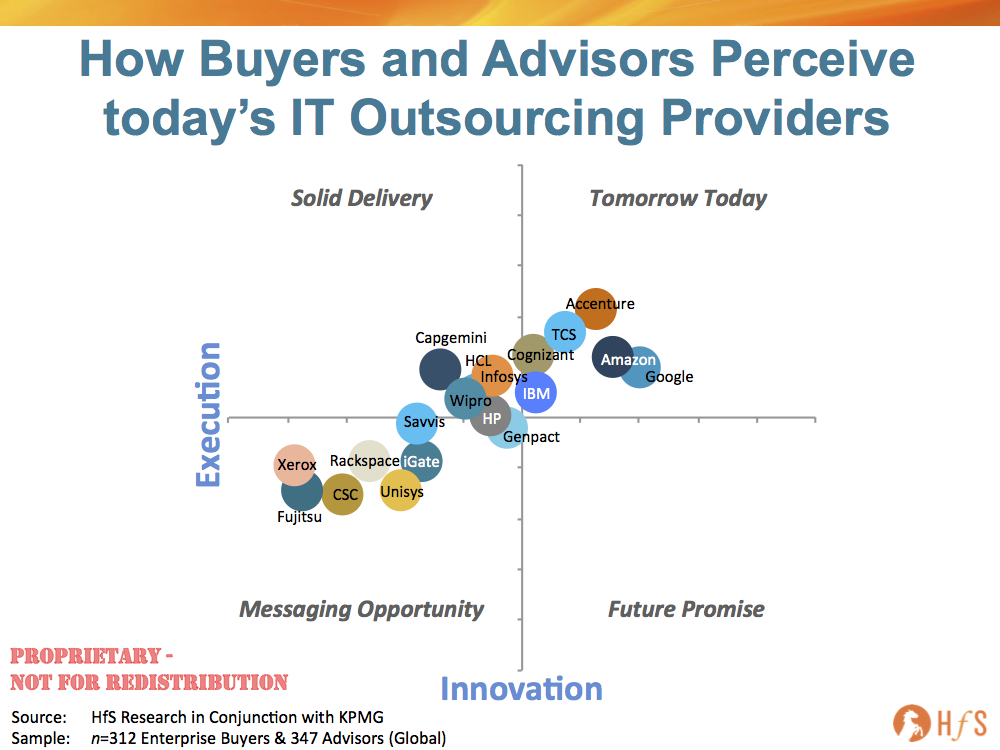
During the recent 2014 State of Outsourcing mega-study, conducted with the support of KPMG, we polled 312 enterprise outsourcing buyers and 347 outsourcing advisors on how they perceived each of the major 19 IT outsourcing services providers across our Execution and Innovation categories (click here for the full definitions). And the ultimate results might not be quite what you expect:
Click to Enlarge
HfS’ Charles Sutherland, takes a deeper dive into these results, to understand better the reasons why these IT Outsourcers are being perceived this way:
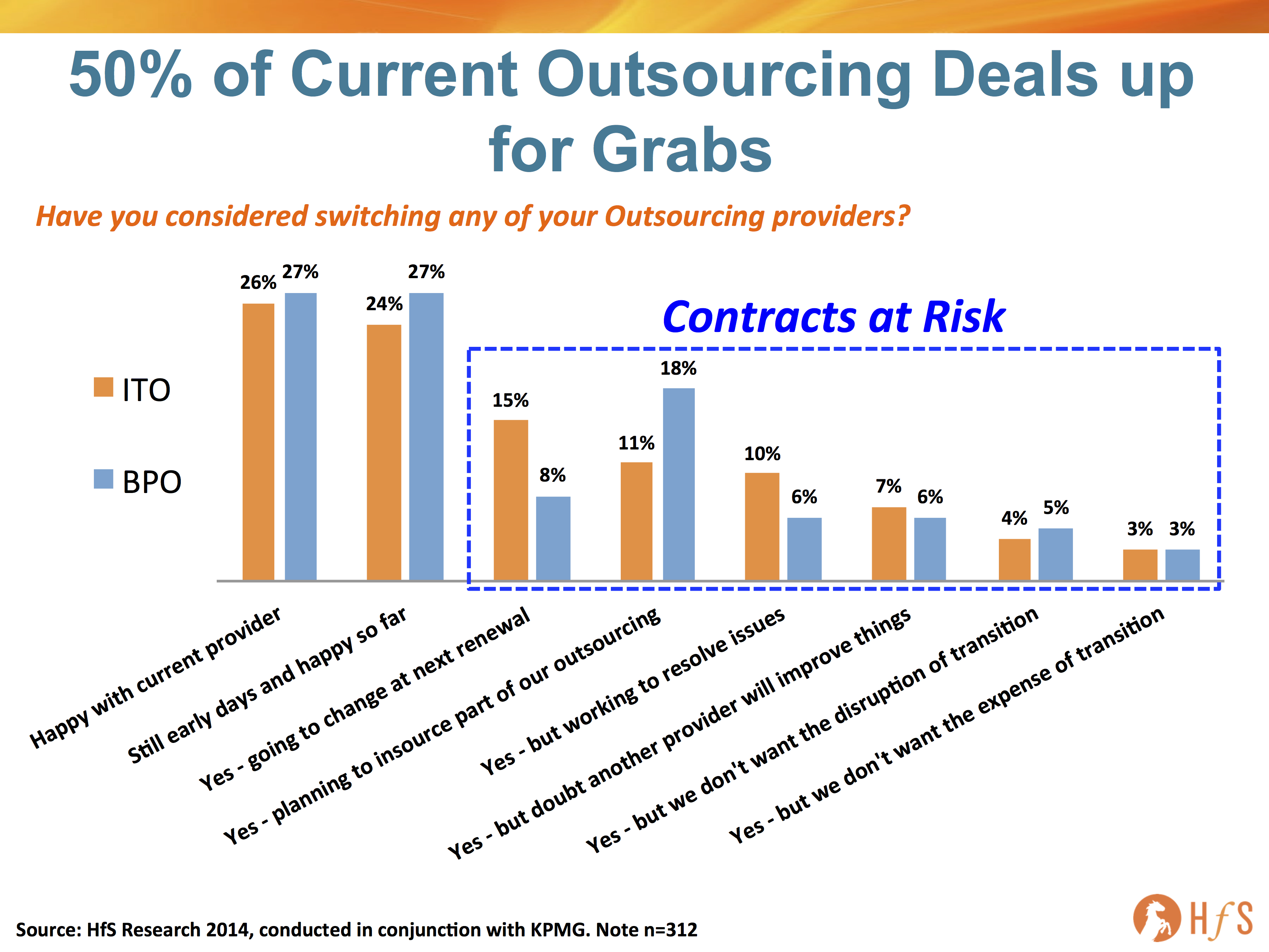
With 50% of IT outsourcing deals at risk, how are IT Outsourcing providers being perceived?
The fact that Amazon and Google were the highest perceived ITO service providers on Innovation doesn’t come as a huge surprise, after all they are continually lauded for innovation in the press and don’t carry the breadth of “legacy” service offerings that the other ITO service providers do. However, they were also perceived as being at the top for Execution; in fact just 4 of the other 18 ITO service providers were perceived as well or better than they were for Execution capabilities.
What we also see, when we look at these results, is that the best Executors of IT Outsourcing services are generally also perceived as the most Innovative. It suggests to us that as 50% of enterprise IT Outsourcing buyers seek to churn their current IT service provider in the near future, many are also likely to seek out those positioned to the upper-right which can fulfill their higher-value needs, beyond the bread-and butter executional service delivery.
It also suggests that in the wake of greater market differentiation in IT services, both in capabilities and commercial performance, those providers lingering in the lower-left face some very significant commercial challenges over the next several years to remain competitively viable.
We broke the perception map out into 4 quadrants that have some common characteristics:
Messaging Opportunity. These are the ITO service providers which scored lower on the perception of execution and innovation relative to their peers. For these ITO service providers, the task ahead is to increase awareness of their capabilities and, in particular, to highlight investments in innovation for ITO service offerings and perhaps to break away from potential linkages in buyer minds to legacy ITO offerings, especially given the levels of potential market churn that the survey identified.
Solid Delivery.These ITO service providers were perceived as strong execution partners for buyers, but still being perceived as lower than the leaders on innovation, although they were seen as more innovative than the service providers in the first quadrant. This does not mean they are necessarily candidates for churn, although if their areas of execution become less significant going forward, that could spell future trouble.
Future Promise. Currently an empty quadrant, this area where perceptions of innovation out-strip those of execution, can be the resting space of up-and-coming ITO challengers, whether new or coming up from Messaging Opportunity, where they start rolling out leading edge services before they are necessarily fully time-tested.
Tomorrow Today. ITO service providers in this final quadrant are leading the way in terms of buyer perceptions, both on innovation and execution, relative to their peers. An interesting group of asset heavy (Amazon, IBM, Google) as well as asset lite (Accenture, Cognizant, TCS), they have as many or more differences between themselves in terms of offerings and market strategies, as they have anything in common, other than being the service providers best positioned today to take advantage of the high level of potential market churn.
The Bottom-line: The traditional IT outsourcing market as we know it is being disrupted, and the next year will likely flesh out the thrivers, the survivors and the also-rans
Report author, Charles Sutherland, is EVP Research at HfS (Click for bio)
The intention from an enterprise to churn a current service provider, may be much less complex than actually completing the process of switching out to another provider, and we will be looking at the market dynamics over the next 12 months to see just how many significant contracts in ITO are moved. In particular, we will be observing closely how many hosting and IT management deals make their way over to the disruptive presence of Amazon and Google from incumbent service providers. In addition, how the ITO service providers at the lower left and upper right hand portions of our perception study fare, will provide a good input on the understanding as to how the ITO market is changing and what measures incumbent service providers need to be taking, not merely to survive, but also thrive in this fast-evolving marketplace.
HfS subscribers can click here to download the full POV “With 50% of IT outsourcing deals at risk, how are IT Outsourcing providers being perceived?”
We’ve been calling it for seven years now, and finally the chickens are coming home to roost for the outsourcing business: clients are genuinely walking away from outsourcing relationships which provide mediocre value.
And, while some savvy providers are sensing the defections with a few notable re-bid wins of late, many still have their heads in the sand and hoping that once they win a new client, they’ll never leave them… oh how wrong they could be, as revealed by 312 enterprise buyers during our new State of Outsourcing study with KPMG:
Click to Enlarge
So, why are so many outsourcing relationships hitting the skids?
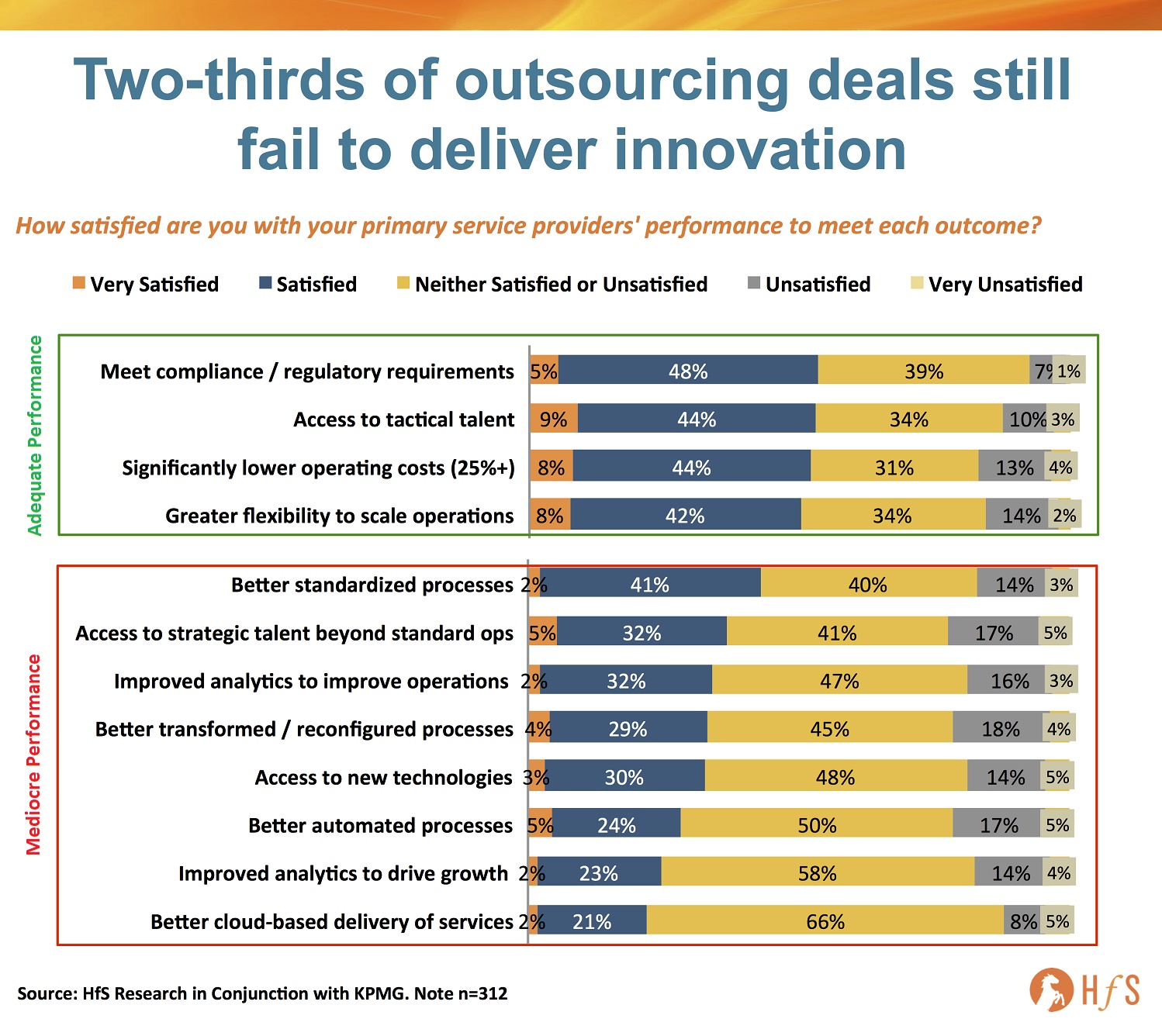
While we’re at pains to point out that relationships fail to deliver innovation where buyers lack the skills and capabilities, it’s also blindingly obvious that many providers are not coming to the table with the goods either:
Click to Enlarge
As you can see, it’s the same old story – in fact, buyer satisfaction has actually got worse over the last three years (see our 2011 State of Outsourcing results). At least, back then, the large majority of enterprise clients enjoyed some degree of value from their relationship, while today, barely a third of buyers are seeing positive impact in terms of having improved strategic talent, better operational analytics support, better technologies, process transformation, automation… the list goes on.
The three main issues driving this churn problem – and how providers can address them more effectively
1) Buyers’ expectations – and impatience levels – have markedly increased. The world of business operations has evolved at an almost alarming clip over the last five years – it’s as if the recovery from the worst recession in living memory has driven an impatience from business leaders to advance their capabilities and cost efficiencies much faster than the snail’s pace of yesteryear, when ERP rollouts were calculated by the decade and outsourcing evaluations took three years just to get a meeting together. Suddenly, buyers want to talk about where they expect to be in a couple of years, they’re asking questions about robotic automation and developing meaningful analytics capabilities, they’re asking how their provider can help them improve the way they do things – not merely manage their legacy processes at cheaper rates.
How providers need to respond: Prepare more diligently to manage your clients over the longer-term. You know many are going to start asking for the “what’s next?” quicker than you expected, so be prepared with a plan to deliver it. Otherwise, they may no longer be your client when the re-bid process kicks in….
2) Most providers are still obsessing with the next deal, as opposed to cementing their existing relationships. The real “tangible” money on the table for providers today, is when they win a brand new deal that adds to their win-rate, their Wall Street scripts and feeds their PR machine. However, the cost of losing a client is far, far worse – the lost income, the ignominy, the negative perception from the industry. As more deals begin to churn, the focus will shift to protecting the base, and not just pursing the new.
How providers need to respond: Start replacing the old-school sales guys with the fat expense accounts and standard issue BMWs or Jags (you know the type) with operationally-savvy account managers who understand how operations need to be run. While they may be less fun on the golf course, they’ll be much better-placed to develop your clients down the road.
3) Buyers still think that innovation should be free, despite the fact they bought labor arbitrage. If you didn’t pay for it, why should you get any? The perennial problem with outsourcing is the fact that low-cost still wins the day, with most sourcing advisors strong-arming providers to respond to RFPs in three weeks and allowing very little (if any) interaction time for providers to interact with their clients in advance to develop the right solution and get a stronger balance between delivery capability and desired outcomes. In most these cases, the buyer and provider teams brokering the deal hand them off to the operations teams on both sides to manage, with little room for investment on either side to do anything more than basic delivery with low-end resources.
How providers need to respond: Invest in more direct communications and sales cycles with clients, and be less reliant on the advisor channel for your future business. You need to develop relationships where you can spend more time with your clients to get this right, not second guess their needs and rely on some fudged math to get a deal done.
This man founded WNS, built up IBM's Middle East and African Practice and today leads KPMG's European shared services and outsourcing advisory. He also cycles a lot…
Did you hear the one about the Mamil (middle aged man in lycra), who got off his bike, donned a suit and tie and joined a Big 4 consulting firm to wax lyrical about sourcing strategy? And not only that, he is called Shamus Rae, the shameless sourcing strategist from Islington…
Shamus has been in the sourcing business since 1993, where he started off working with British Airways and overseeing a lot of outsourcing of IT services to India. This is when he came up with the idea to build a company to act as an offshore BPO for the airline industry, which became WNS. In addition, Shamus built IBM’s BPO Service from zero to 17,000 people in MEA (Middle East and Africa). In total, he’s had 21 years in the industry working for suppliers, including 13 years working with clients on multi-functioned shared services and outsourcing around the world. And all this in addition to his 120 km a week cycling addiction.
So let’s hear from KPMG’s European Partner for Operational Transformation and Advisory Leadership, Shamus Rae.
Phil Fersht, CEO, HfS Research: Good afternoon, Shamus, and thank you very much for taking the time with us today. Let’s cut to the chase – are US enterprises ahead of the British/Europeans with sourcing?
Shamus Rae, Partner at KPMG, London: Categorizing “Europe” as one homogeneous region is too generic. The United Kingdom, plus Switzerland, are as sophisticated as the United States, and sometimes more cutting edge. However, other European countries are in catch-up mode. We’ve been doing some work recently for a large French bank helping them build a global sourcing strategy for their finance function. I asked the CFO whether he wanted to simply do a strategy or whether he was actually going to execute. We get many requests for sourcing strategies for organisations, of which a high number are never executed, but take up a significant amount of time for my team. To be fair to this client, he said that this time the bank is going ahead, and in fairness to him, he’s now built an offshore center of excellence on a global basis. In a nutshell, Europe is in catch-up mode but they’re positioned to leapfrog the United States.
Phil: At our recent UK Blueprint event at HfS, attendees were more open with their issues than many of the Americans that we regularly deal with…
Shamus: The fashionable trend is talking about robots in shared services. The way these concepts are branded is a bit too much sometimes. If you talk about operational efficiency and the future of robotics with French and German colleagues or clients, it can be too American. The best approach is to engage different countries in the right way for them and ensure there are relevant discussions on all of these topics and trends that are emerging
Phil: Is the industry vastly different from five years ago when we were going into the recession? Has there been a lot of shift, or is it more noise?
Shamus: There’s been a massive shift. I’ve been through a few recessions but none quite as significant as 2008. Previously companies were mostly focusing on straightforward labor arbitrage and people were trying to find quick cost savings. This recession was different, in terms of the way it drove the sourcing industry. People wanted cost savings for sure, but they wanted to put in the right governance, and handle more complex work within the sourcing environment. They wanted to think about the next step beyond offshoring.
There’s a lot more of a drive towards process standardization—what’s going to happen within a retained organisation to ensure that the business benefits are delivered? Therefore, it’s a more interesting time. The impact has also seen dramatic growth in multi-function shared services organizations within clients as well. The global business services piece has really taken hold. It’s a dramatically different environment. Some of the outsource players are not seeing as much work as they would expect because people are being more sophisticated about the way they’re building the “above outsourcing” functions and the way they’re approaching simplification and standardization.
Phil: The joint research that HfS Research has done with KPMG (see link) has pointed to a sharp increase in the amount of investment that clients are making in their offshore shared services (captives) but a little bit of a slow-down, and more of a moderation, in their investment in outsourcing. Is this because they’re moving more high-level services to shared services and want to keep them in-house first, or do you think there’s a general swing to a shared services model and leveraging outsourcing as a kind of “flex-tool”? What’s your view?
Shamus: I think you hit the nail on the head when you said they don’t want to outsource more complex work; companies are looking at the skills continuum. It’s fine to outsource AP and AR, and so on, offshore, but clients are building centers of excellence in order to handle more complex work. Like treasury, some of the big deals we’re seeing are to automate more transactional work and aligning some of the complex work to come back in-house. A large FMCG company that had a big HR contract made a lot of fanfare about renewing its big contract, but in reality the more complex work all went back in-house, to help create more critical mass for the complex work. There’s more talk about BOTs as a way to transition to more complex work.
Phil: I want to talk with you about the change process that some of the companies need to go through. Clients are fairly willing to admit that they’re not very happy with their own talent. Only a third of them feel that their existing Operations talent can balance their existing capability analytics or add creative thinking or ideas. It sounds like we’re at an impasse where providers can’t deliver everything the clients want, but at the same time clients seem to be struggling to develop their own talent base. Do you agree, and what do clients need to do to develop their own talent?
Shamus: Most people are unhappy with their own support functions. People always have great expectations about what those should deliver. Professionalising your support functions, with the global business services trend, is helping to meet the growing expectations of the Board and the end user. However, transforming the support functions with people who really care about the services provided to the end business, changing the culture of the support function to be customer orientated, and minimising the amount of transactional work that takes place through automation has made a big impact. In reality, there are lots of people who are automating or outsourcing transactional work and expecting the staff to suddenly become great at customer service and business partnering. That takes a lot of time to do.
Analytics is a really interesting “crunch point.” We’re all bored of hearing about big data but it’s a massive trend, both for KPMG and for our clients. The number of people who can work in that space, relative to demand, is dramatically out of kilter. Does that talent, wherever it is in the world, want to be working for a client organisation or for an outsource organisation? There are great pure-play analytics that are attached to consulting businesses. For example, Prophet in the United States is a great brand consultancy organisation and they’re building great analytics capabilities underneath it. At KPMG, we have a great brand and organisation and have deep capability in analytics.
Phil: What about young talent—the Millennials? Is it important to embed more young talent into the sourcing model?
Shamus: Back in 1993, especially in India, it was full of young talent. It’s an industry that was built on grabbing people from universities to satisfy the demand for labour arbitrage and starting new organisations. It would’ve been nicer to have a better culture within the companies, which is appropriate for the new generation coming through. In reality, the work is getting more sophisticated. You need people with more experience to start work here. Relating this back to culture, it’s a major deal. Everyone is trying to find a way to get the young, current graduate way of thinking. We have one client, a US FMCG, that is trying to move completely towards a project-based, rather than a standard, hierarchical organisation, so that they can tap into creative ideas and revolutionary thinking which comes with the current generation of people who use mobile apps. It’s a major bet on a new way of working, coming from 25-year-olds today.
Phil: We’re seeing more development in, oddly enough, the IT space where there’s a lot of pressure around digital and plug-and-play capabilities—people who can understand cloud and programming and analytics. The Indian majors have a really good Millennial model stemming from building out the ITO delivery three or four years ago and it’s now bearing fruit. On the BPO model, it’s hard to find people who want to build their careers around finance and accounting. It’s a professional issue, not a skills issue.
Shamus: I think that’s right. If you look at what KPMG’s up to, we’re rapidly building our Customer Advisory piece, with great teams in the United States and United Kingdom, and lots of great people in Analytics from lots of acquisitions (Link Analytics, Cynergy, etc.). We’re reshaping the business to be the front office as well as the back office. It’s a great, crazy environment, not like any KPMG office you go to normally. There’s a massive shift going on. A lot of the previous pieces will be automated away.
All the Big Four are building cloud-based advisory proposition and mobile app teams, not because they’re trying to compete on price with mobile apps, but because they’re trying to help clients go through the digitalization journey. All the companies that built big ERP centers will find these dramatically reduce down in the next 10 years.
Phil: It’s almost like the Global 2000 will be trying to get smaller. They’re getting focused on the products, on middle- to front-office activities. We’ll have a larger SME sector.
Shamus Rae is Partner at KPMG and Heads Operational Transformation in Europe
Shamus: This is a reality when you look at the 10- to 15-year window. There’s a lot of great talent because jobs get digitized away. KPMG is trying to find models in which they can create the atmosphere of working in a smaller organisation. KPMG in the US recently acquired Cynergy US, a mobile apps company, and we will build a new customer and digital office here in London leveraging this asset. The firm has always been good at allowing entrepreneurial spirit yet getting the economies from acting at scale.
Phil: Final question: if you could change the industry in one way, what would it be?
Shamus: I want to make this industry global rather than Indian, getting more sophisticated with analytics or mobile apps. I’m not saying it shouldn’t happen in India because I believe it should—I’ve been a 20-year fan of India. However, the brand that’s associated in legacy BPO is actually holding back organizations’ ability to play in new IT and KPO; the brand needs to move from legacy BPO and labor arbitration.
Phil: Shamus – it’s been refreshing! We’ll definitely have to have you back soon 🙂
Yes folks, we’ve unveiled our agenda for the Eighth Blueprint Summit this November, which includes C-Suite executives from all the major service providers and sourcing advisory firms, in addition to a host of speakers from leading buy-side enterprises. So let’s take a peak at the providers putting themselves in the firing line…
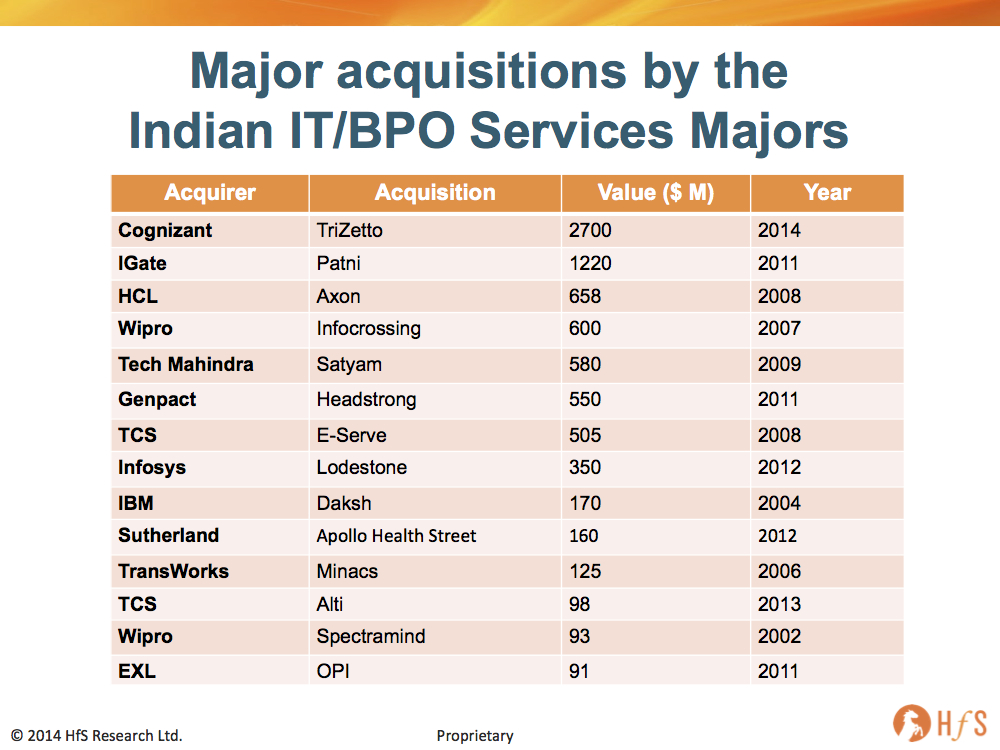
What ever happened to the days of the tiddly little sub-$10m “tuck-in” acquisitions that Indian providers used to make (and we all forgot about pretty quickly afterwards)? Well, the game has changed forever as Cognizant shelled out a whopping $2.7 Billion on healthcare technology firm TriZetto (read our research POV here).
This wasn’t only Cog’s largest acquisition – it’s the largest one – by a country mile – from any Indian IT/BPO services major. Ever:
Click to Enlarge
Four reasons why this changes the game for services:
1. Cognizant becomes a true BPaaS, software and services firm. Most of the pureplay services firms buy little technology tucks-in to improve their services, and have technology tools and platforms that differentiate them with proprietary workflow and IP. However, services firms have always sold services first and foremost, with software as the value differentiator that creates client stickiness and allows greater scalability of skills and standard processes. By acquiring a platform the size and scale of TriZetto, suddenly Cognizant is adapting to selling software, and not just service provision. In my opinion, the only way true BPaaS will ultimately be successful is when the services firms elect to sell the software first and then figure out with the client how to implement it, redesign the processes, do the change management etc. I call this the “Workday effect”. Essentially, have the client fall in love with the software, slam it in, then figure out the rest afterwards. It’s like buying Google – they just force you to figure it all out after you’ve been bought into using their platform.
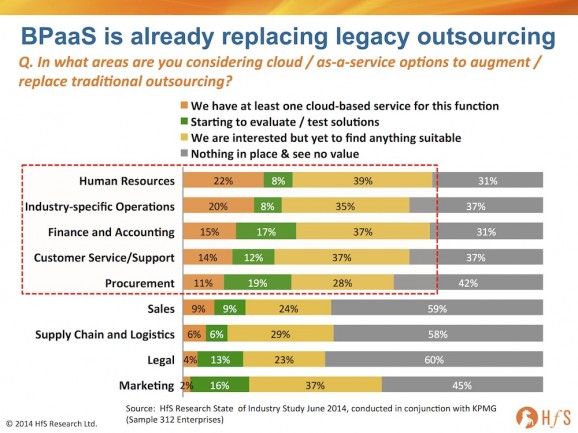
2. BPaaS will replace legacy outsourcing – it’s just a matter if time. As our new State of Outsourcing data illustrates, close to one-in-three enterprises are already using (or about to use) BPaaS / cloud as an alternative to legacy outsourcing in areas such as HR, industry-specific operations (such as TriZetto), finance and accounting and procurement:
Click to Enlarge
Having a provider which understands – and can implement – a cloud platform, support the transformation and provide the necessary services that add real value to the front-office is the Holy Grail for many buyers. With half of today’s outsourcing contracts potentially up for grabs, those providers with genuine platform plays are in pole position to pick off legacy outsourcing contracts that have hit the wall, in terms of finding future value.
3. Healthcare becomes the new “financial services” for IT/BPO. In the past, most of the big bucks in industry-specific IT/BPO was in sorting out the quagmire of complexity, dysfunction and legacy in the banking and financial services space. Now, with the ACA hitting us in full-force, it’s plainly apparent that there’s a ton of opportunity taking healthcare payers and providers into BPaaS and sophisticated outsourcing models. Watch this space for further acquisitive moves in this sector, where tech-centric healthcare suppliers, such as Emdeon and McKesson, are becoming increasingly attractive targets.
4. The BPaaS gauntlet in thrown down to Accenture, TCS, Infosys and Wipro to respond. Cognizant’s main competitors are rocked by this one – and they need to figure out how to raise the ante with their own BPaaS plays. Infosys is enjoying a return of its mojo, with a software innovator Vishal Sikka now at the helm and figuring out its EdgeVerve strategy, Accenture has brought together Operations (including BPO) and Cloud Infrastructure to form a super group of BPaaS potential, Wipro has enjoyed a solid rebirth under TK Kurien and has been doing some cool things with Base))) and its mortgage platform play, while TCS has long been a pioneer of “PlatformBPO” with a series of developing offerings, notably in the insurance and banking space. Oh – and let’s not forget dear old IBM, who’s off trying to cure cancer with Watson…
The Bottom-line: Cognizant has upped the ante… Now it’s time for the ambitious providers to open their war-chests
You can just feel it in the air, can’t you? The global economy’s buzzing again, ambitious enterprises are willing to spend again. Meanwhile, the ITO labor arbitrage game is finally showing signs of drying up – and Cognizant, a major bell-weather for the health of offshore services, has responded with a massive, massive bet on the future of the industry – and few would dare to fault this move.
Now the winners need to place their bets on the solutions and industries where they can find new growth opportunities – they all have serious funds available, and can likely get access to even more capital if they need to. There are clear yawning gaps in the market for (more) winning BPaaS offerings in areas such as finance and accounting, supply chain, retail and manufacturing… not to mention healthcare, life sciences and financial services. The future path for BPaaS is really starting to unravel and we’ll likely know in the next 18 months who’s willing to make the investments and business model changes needed to evolve with it.
After SAP lashed out $8.3 billion on Concur, it’s making Cognizant’s flagship acquisition of TriZetto look like the bargain of the decade. So we grabbed a few minutes with Cognizant’s CEO, Frank D’Souza, to talk about why the US-headquartered company made this move and what we can expect to see unravel as a result…
Phil Fersht, HfS: Frank, in a nutshell, why did you make this investment?
Frank D’Souza, Cognizant: Hi Phil – the acquisition of TriZetto is in response to some powerful trends that are fundamentally changing the U.S. healthcare industry today—including the Affordable Care Act, shifting responsibilities between payers and providers, and the desire for employers to contain risk and reduce cost. By combining technology and operations, we have a phenomenal opportunity to build ‘the winning business model of tomorrow’ and play a key role in keeping people healthy and well.
Today, approximately half of the U.S. insured population have their health benefits managed by TriZetto software, and we see tremendous synergy opportunities to join that with our $2.5 billion healthcare and life science practice. By marrying TriZetto’s world class products with Cognizant’s consulting, IT and business process services, we are confident that we can capitalize on opportunities that neither company could access individually.
This move is also consistent with our overall three-horizon strategy, and brings new markets, new technologies and new delivery models to our portfolio. It moves us very significantly in the direction of adding non-linear, IP based revenue.
Phil, HfS: How will this change Cognizant? Doesn’t this turn you into a software firm, in addition to services? How will this impact your culture and they way you work with clients? Will you need to bring in new skillsets of sales/marketing/engineers, etc.?
Frank, Cognizant: We are committed to offering services across a range of products and technologies. We also believe that there is a growing demand for fully-integrated technology and operations using newer delivery models made possible by Cloud and digital technologies. These so called BPaaS or utility models are very powerful and this is what TriZetto represents for us in healthcare.
Our approach has always been to start with the market and focus on how best to satisfy our clients’ needs. This acquisition is driven by that client-focused strategy. Our clients are looking to us to provide integrated, end-to-end solutions that drive differentiated results for their own customers. And, of course, everyone wants to lower costs.
A few weeks ago we announced the signing of a Letter of Intent for a seven-year, $2.7 billion engagement with Health Net, a top 10 managed care organization in the US. The business model resulting from this deal is expected to be a benchmark for the industry, enabling Health Net to improve its quality of service, reduce G&A spending, and increase its agility in launching new products and participating in new markets. We think there are significant opportunities in the marketplace for deals such as Health Net and the combined capabilities of TriZetto and Health Net accelerate our ability to win such similar deals.
On your question of culture, an important factor in our decision to acquire TriZetto is that it’s a company we have known and done business with for many years. Currently, we are supporting TriZetto platforms for more than 30 clients. We are very familiar with the company, its people and its culture, and are excited to have their team join Cognizant.
Because TriZetto brings in very differentiated capabilities, we think it is important to maintain TriZetto as a separate business within our Healthcare business segment. In doing so, we will continue to leverage the Trizetto brand and look forward to benefitting and learning from TriZetto’s strong, product-oriented culture.
Phil, HfS: Is healthcare becoming the “new financial services” in your view, with the amount of secular change, regulatory impact and disruption going on?
Frank, Cognizant: There are two major forces impacting healthcare today:
The first is technology-based, as clients are looking for industry-focused, as-a-service solutions that leverage the latest technologies (such as SMAC and digital), enhanced by the insights that come with managing large pools of data.
The second force is the massive transition underway in the U.S. healthcare industry driven by the Affordable Care Act, demographics of an aging population, the desire of employers to shift risk and contain costs, and shifting responsibilities between payers and providers. At about $2.7 trillion of total spend, the industry is equivalent to nearly one-fifth of U.S. GDP. The combination of these two factors is driving fundamental changes to every constituency in the value chain.
At the same time, payers and providers in particular need to focus on making their operations as efficient as possible, while at the same time investing to drive growth and innovation in an increasingly competitive environment. We call this the ‘dual mandate’ and it’s what makes the combination of Cognizant healthcare with TriZetto so strategically compelling for our healthcare clients.
We see clients like Health Net as indicative of the broad need in healthcare for end-to-end solutions that respond to the dual mandate, and we believe our combination with TriZetto will provide a unique market alternative for healthcare clients looking not only to survive, but to thrive in the new healthcare context.
Phil, HfS: Do you see major ramifications from the services industry at large from this move? Do you expect to see your competitors making similar investments or will their heads remain in the sand in denial that the fundamentals of the services industry are rapidly shifting?
Frank, Cognizant: We and our peers in the services sector have talked for a long time about adding non-linear, IP-based revenue. For us, this acquisition is an important step in that direction. And we are taking this step with one of our strongest verticals.
TriZetto’s current revenue base of $711 million (for twelve months ending June 2014) is highly predictable and non-linear. About two-thirds of TriZetto’s revenue is recurring. Also of note is that 40 percent of Trizetto’s revenue comes from payer software and 20 percent from provider software-as-a service model. This has led to a comprehensive portfolio of offerings to approximately 350 payers and approximately 245,000 providers.
Like Cognizant, TriZetto is successful because it marries highly refined processes with deep domain expertise. This is why we are truly excited about what TriZetto brings to our business and customers. Jointly we can help our healthcare clients to meaningfully lower healthcare costs, improve quality of care, and make a positive difference to millions of lives.
Phil, HfS: Thanks for taking time out of your insane schedule to talk to us – we appreciate it, Frank!
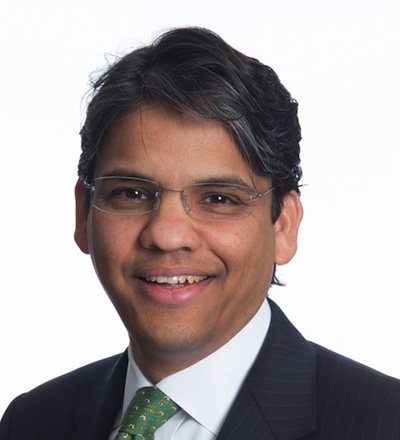
Francisco (Frank) D’Souza (pictured) is Chief Executive Officer of US-Headquartered service and technology provider Cognizant
Authors: Phil Fersht and Ray Wang: Industry Analysts who still give a sh*t
(This is a collaboration and represents our individual points of view and not necessarily our employers. Oh wait, that’s us…. moving on…)
Is the analyst business stuck in its own trough of disillusionment?
We called it three years’ ago and we can now officially proclaim that the industry once known as “research” is close to meeting its maker.
Okay, the reality is it’s rare these days for analysts to comb for obscure facts, ask the hard questions, reach out to customers, dig deep with the system integrators, and circumvent corporate communication teams by going direct to employees for the inside scoop.
In fact, the alarming observation of analysts, especially in the large firms, is that most of them are spending all their time on evaluation matrices (e.g. MQs, Waves, Marketscapes, etc.). There seems to be precious little (or any) research coming out of these places anymore. Where are the big ideas? Where’s the insight? Where’s the thought leadership? What do these people stand for anymore?
When we sat down to talk to our client base, our analysts, and our clients, we determined that there were eight common reasons, namely:
1. Legacy business models are built on scare-to-play. The only way the legacy firms are making money is through selling reprints of vendor positionings. Sales folks tell vendors that if they don’t pay for briefing hours and advisory time, analysts will ignore them.
2. Tele analyst approach reinforces an ivory tower image. Today’s legacy analysts have no other means of getting data. Sadly, most rarely ever talk to buyers of services or users of technology. The situation is so bad, that many vendors are forced to provide 15 to 50 customer references because the analyst has no means to reach out to real customers.
3. Stone soup research model reflects the laziness of analyst firm methodologies. They are essentially having the vendors do their “research” for them. Another way to look at this, legacy analyst firms are strong-arming vendors into providing references as their primary method of reaching out to customers. Some analysts today are demanding three hour briefings with vendors to educate them – they are essentially making vendors pay to give them the knowledge they need to appear smart.
4. Egotistical narcissism drives power trips in evaluations. Legacy analysts love the attention of vendors pandering to their demands. In one case, a legacy analyst asked for 35 client references for a scatterplot chart. Vendors humored him just to play along.
5. Information often confused as insight. Many legacy analysts have precious little fresh insight of their own. Often legacy analysts operate on limited data and base “facts” from old surveys run at the corporate level. The result – dated insight not grounded with the reality of the buyer’s point of view. In fact, many have become so enslaved to the vendor evaluation model and have forgotten that they really are an analyst who’s supposed to provide insight to the world – not simply regurgitate vendor-fed marketing hype.
6. Limited practical experience hampered by siloed’ coverage areas. The legacy analysts firms create specialists blinded by the big picture and intensely focused on the hyper specific. Clients often express frustration in having to schedule conversations with multiple analysts who often can not match experience with context.
7. Lowered expectations reinforce lowered standards. Let’s face it, the legacy analyst firms have lost touch with their clients when it comes to research. Clients aren’t expecting insight anymore, and most the analysts just aren’t producing it.
8. Failure of research firms to bring in visionary leaders. Most of the traditional analyst firms prefer to have 20 year veterans as their lead visionaries to the market, many of whom have never worked in the real world and refrain from hiring dynamic analysts who can outshine them. Many refrain from talking to clients, speaking at conferences as they have lost touch with their customers – and are not incentivized to inspire – simply keep their money machine cranking along. They have become slaves to their internal politics and P&Ls, as opposed to shaping new ideas and insights to delight their markets.
The Digital Chasm Among Analyst Firms Is Growing
Buyers must seriously ask if legacy analyst firms are still analyst firms or are they merely advertising agencies for vendors smart enough to play their game? With the dearth of enterprise journalists and media, has the analyst become the new media for the enterprise market?
Gartner’s model is smart. It continues to create more categories to include more vendors with the goal of monopolizing a vendor’s resources and time. Many vendors now have multiple FTE’s dedicated to just Gartner’s evaluations. This model crowds out other independent voices and puts pressure on the other legacy analyst firms. Those dedicated to the analyst relations function have little time to see a different point of view.
We believe that should this continue, there may not be a research industry left in 2 years’ time. We believe that this model of racking and stacking vendors will no longer be sustainable.
The Bottom line: The only way to resurrect research is to bring back talent – and motivate it
Rebels without causes? Two fresh-faced analysts from back in the day…
We can talk about new business models for hours, but the one missing ingredient in today’s fading research business is the lack of passionate people who want to know everything about their area, who are talking to the people who buy and sell technology and services… who care about what they represent and articulating what they think and do.
Where are those people? Are they hiding, did they retire, or did they just give up? Or did they just figure out how to check the boxes as analysts and give up caring about their careers?
Without passionate talent, we’re doomed and research can – and will soon – be put to bed as a distant memory that once was. Maybe a couple of smart individuals will save this industry, but it needs some serious saving…
Last week, HfS attended and presented at NASSCOM’s buzzing BPM Strategy Summit 2014 in Bangalore.
We asked our EVP of Research, Charles Sutherland, to share the team’s thoughts on the event and what were the key themes that came out during the various sessions and how those relate to NASSCOM’s ambition to grow Business Process Management (BPM) exports from $20 Billion in 2014 to $50 Billion by 2020. The simple fact that Charles actually shaved for this conference tells you in was quite the big deal…
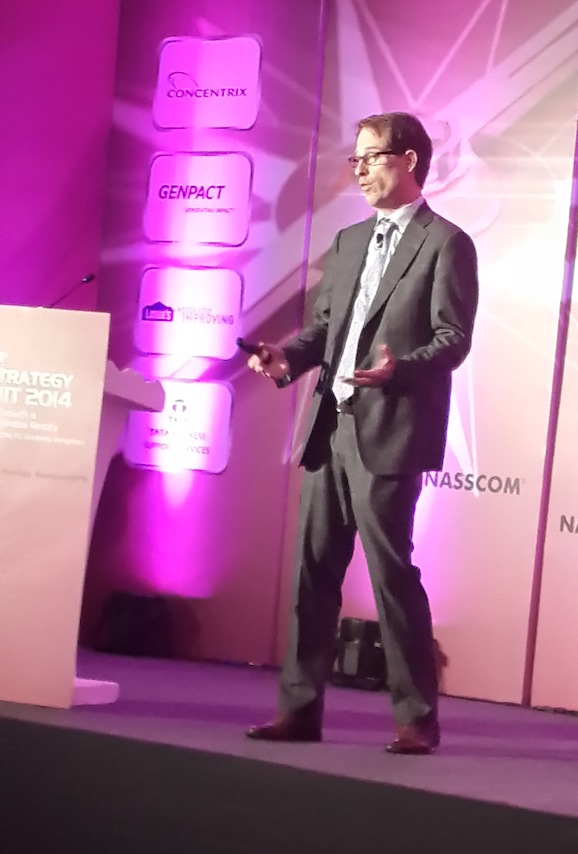
Charles Sutherland closes out this year's Nasscom BPM Summit in Bangalore
Phil, let me begin by first acknowledging strong attendance (~500 people) for this year’s Summit and the high level of engagement from across the NASSCOM membership during the day and a half of sessions. The theme of the Summit was what NASSCOM member’s could be doing to drive hyper-growth to bring the exports of BPM services from India to $50 Billion by 2020 a CAGR of ~16.5% which really is hyper-growth by anyone’s calculations especially for an industry with 25+ years of history in India.
To borrow a metaphor provided before to HfS by Anantha Radhakrishnan, SVP and Global Head of Enterprise Services at Infosys BPO, we liken the final goal that NASSCOM wants to create with this $50 Billion to the equivalent of an especially tasty meal of an Indian Biryani (a mixed rice dish comprised of many different ingredients that also has many different regional variants across India) made up of various existing ingredients that the BPM industry has at its disposal today, plus a few that are just now emerging. Based on the panel discussions and all of the hallway conversations during the Summit, we identified the following as being the key ingredients that most NASSCOM members believe will comprise the final dish.
The existing base ingredients in this Bangalore Biryani:
» Analytics. Perhaps the most recurring topic through the Summit was whether analytics could be the driver for BPM growth through 2020 that Y2K was for the Indian IT industry in the late 90’s. We sat in on discussions around pricing models and operating models in analytics along with whether clients would be most interested in offerings based on descriptive or predictive analytics solutions. Some panelists stated that analytics could be the second biggest area in Indian BPM export mix by 2020 bypassing F&A, which implies that analytics could be $11 billion-plus sector from the current levels of only $825 million.
» Omni-Channel Contact Center. The Customer Interaction Services (CIS) is the largest component in the Indian BPM export mix and the consensus during the Summit was that it will remain so by 2020. There were discussions around the evolution of CIS to multi-channel or omni-channel contact centers, and how consumers, who now interact with companies through numerous channels, expect superior services and a seamless experience across all the channels. These companies then in turn expect the same from their BPM service providers which will be the challenge for NASSCOM members as they seek to have this sector drive a significant portion of the overall growth ambition.
» Finance & Accounting (F&A). The second largest component of the Indian BPM export mix today and from discussions at the summit it was clear that the service providers think that F&A will continue to be a high growth offering through the rest of this decade fueled by untapped customer demand and the depth of capabilities available from service providers across the NASSCOM membership.
» Healthcare. There was also great interest in healthcare primarily driven by the fast approaching second operational year of the Affordable Care Act. The announcement of Cognizant’s acquisition of Trizetto just before the Summit further validated the healthcare opportunity and signaled how service providers are willing to make big bets in this vertical.
The emerging base ingredients in this Bangalore Biryani:
» Partnerships. Partnerships are a cornerstone of the growth strategy for BPM service providers who don’t have capabilities in all the possible delivery technologies and process domains. In the past we saw that BPM service providers were occasionally naïve in their approach to technology and service partnerships but that is changing quite dramatically. In our side-bar discussions and in the panels, we saw many, many examples of new and extensive partnership strategies emerging to drive growth especially from traditionally “pure play: BPM players which don’t have an extensive library of proprietary platform plays today.
» Platform Plays or Business Process as a Service (BPaaS). While not a large source of export revenue today, the discussions around the Summit were that business platforms need to be a central component of BPM solutions across vertical and horizontal offerings going forward. During individual service provider discussions, the specific business platforms they have or will be bringing to market were always near the top of the agenda with our HfS team.
» Robotics Process Automation (RPA). I presented a closing keynote session at the Summit that introduced the concept of a Maturity Model for RPA which in turn generated significant discussions as to whether this was an enabler or an impediment to the $50 Billion growth target. HfS believes that RPA will for many service providers act as an enabler of growth breaking the current near linear linkage between FTE growth and overall revenue growth in the BPM industry. That said, for those NASSCOM BPM members whose core service offerings are based upon data entry or other process steps which are easily replaced by RPA the future will not be anywhere as rosy and in fact RPA will likely be a very significant threat to even the current business.
The flavorful ingredient on the top of this Bangalore Biryani is:
Yes, we just had to add a Biryani pic
» Acquisitions. Perhaps fueled by the size of Cognizant’s Trizetto acquisition, the Summit was buzzing with discussions as to whether ramping up acquisitions in the BPM industry especially of software and business platforms could to really solidify the hyper-growth or to keep with our Biryani metaphor – to add the final flavor which makes the dish totally enticing. Sadly, we didn’t hear any juicy new rumors to share with you here but it’s clear that the industry is willing to step up from broadly having a strategy of small “tuck-in” acquisitions to targets which are much bolder and potentially harder to digest.
So overall, we clearly saw during the Summit what this $50 Billion Bangalore Biryani is likely to be comprised of, and we will be eagerly watching all the chefs congregate in the NASSCOM kitchen to deliver this tasty treat by 2020. We will check in again next year and see how all of this is coming together and what else the industry might yet add to create the final dish.
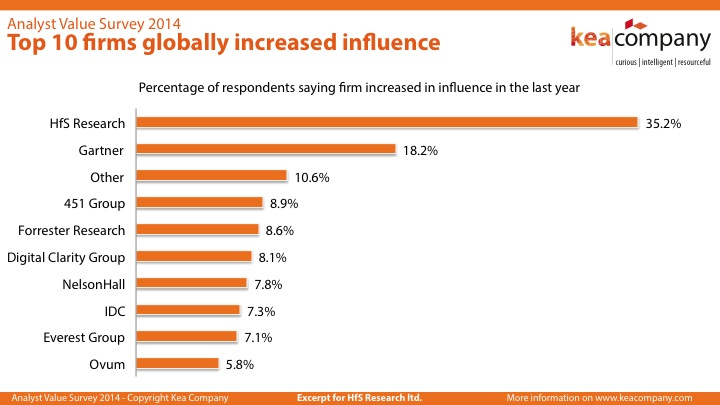
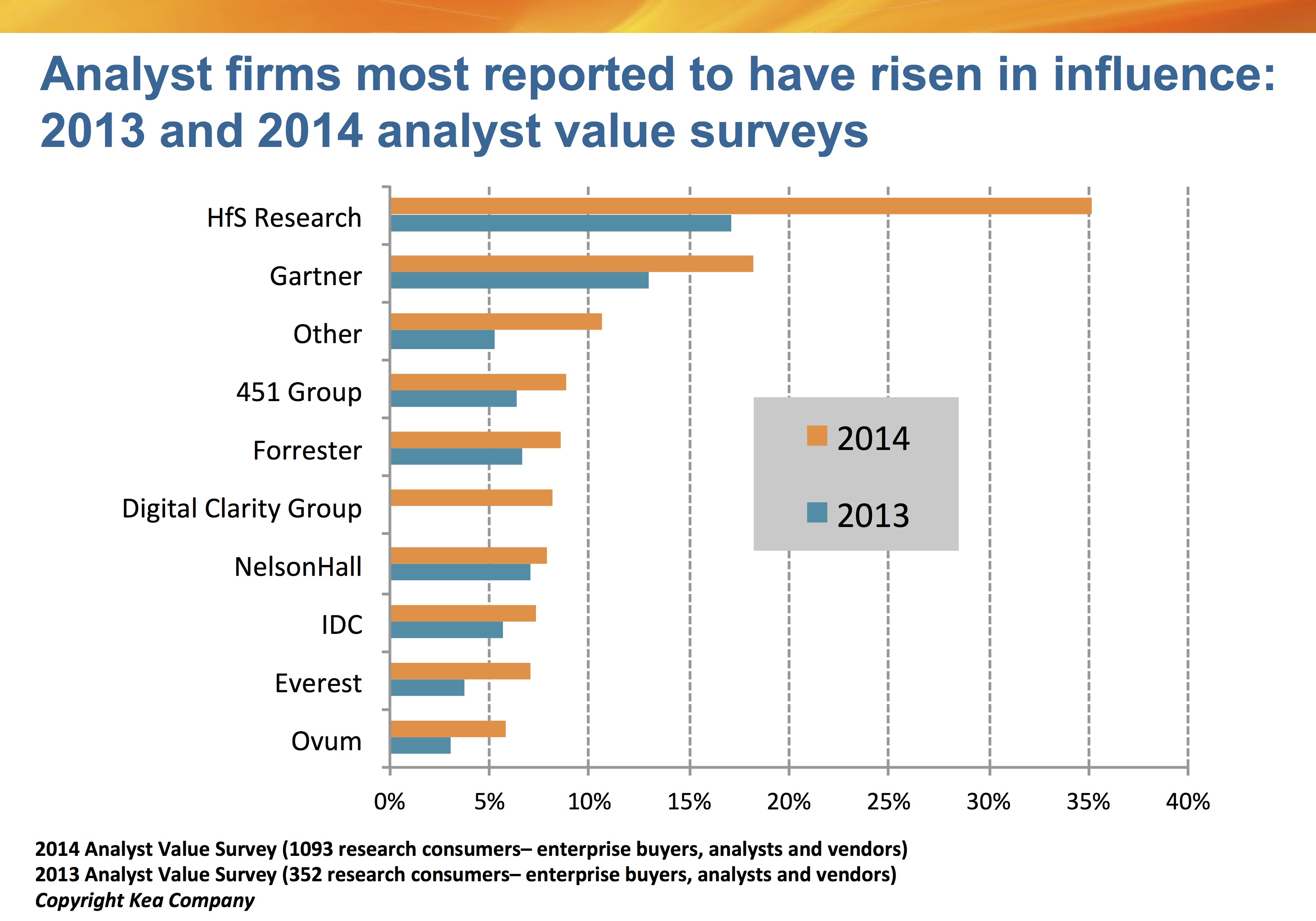
And finally, the results of the Analyst Value Survey, which canvassed the views of 1093 enterprises, analysts and vendor consumers of research, have been released. This is – by some margin – the largest study ever conducted to gauge the influence and value of the industry technology analyst firms, and even the most optimistic followers of HfS couldn’t have expected this result:
Click to Enlarge
And not only did we enjoy a huge uplift in influence of the last 12 months, this also also builds on our influence increase over buyers and providers the previous year (see last year’s results):
Click to Enlarge
I really don’t want to bore you with a sales pitch as to how we have been achieving this recognition (hopefully you have your own ideas, and if you were one of the nice people who voted for us, I thank you personally – and owe you a drink).
All I will say is “thank you” to the HfS team for working their socks off and making this all possible. And also a thank you to YOU for reading our stuff, saying great things about us and believing in our approach and determination to change the face of the analyst industry forever.
I would also like to thank the hard-working people at Kea Company, which today has adopted the mantle of “analyst of the analysts” for pulling off such a terrific and comprehensive study.
If you would like to purchase a full copy of the results, you can access them here. If you are a provider marketer who needs some conclusive data and a decent steer where to invest your analyst relationship time, you could to a lot worse than spend some time with these guys.
I don’t know about you, but I’ve been getting really tired of people lamenting that jobs are being robotized, our operations talent is too transactional and we’re all, basically, screwed.
I’ve also been guilty, in the past, of preaching the doom and gloom scenario for the workforce, as our enterprises find new ways and means to improve efficiencies and effectiveness, however, as business models evolve, so do our labor needs – and this often translates into an even greater need for talent. I also have an increasing amount of faith in the capability of most workers to evolve and adapt, and our new research supports this theory.
In short, industry has been striving to minimize the reliance on manual labor to support processes for centuries, since the invention of the water wheel, the steam engine, the spinning jenny, the motor vehicle and – of course – the computer. All this means, is that skills which become redundant need to evolve to ones that are in need – and in today’s digital era, the need for creative minds, for talent which can use analytics tools and other apps, for knowledge workers which can use their judgement, for customer service reps which can delight customers, HR reps which can delight their managers, accountants which can improve cash flow and support tough decisions, healthcare administrators which can work the changing systems and regulations etc. has never been higher.
Complexity and change drives the need for expertise – and the need for talent has never been as intense as it is today. Society, education and businesses simply need to ensure today’s workers have the environment to adapt to the new methods. In fact, the electronic revolution is only driving the thirst for new skills to an even higher intensity. People adapt – they always have and they always will. Just go on LinkedIn to see all the fancy new job titles and career resumes being aligned with the evolving needs or today’s employers. Human nature is to adapt and survive, and today’s “digital” environment is creating challenges for some, but great opportunities for the majority, to further their careers and perform more intellectually challenging and rewarding jobs.
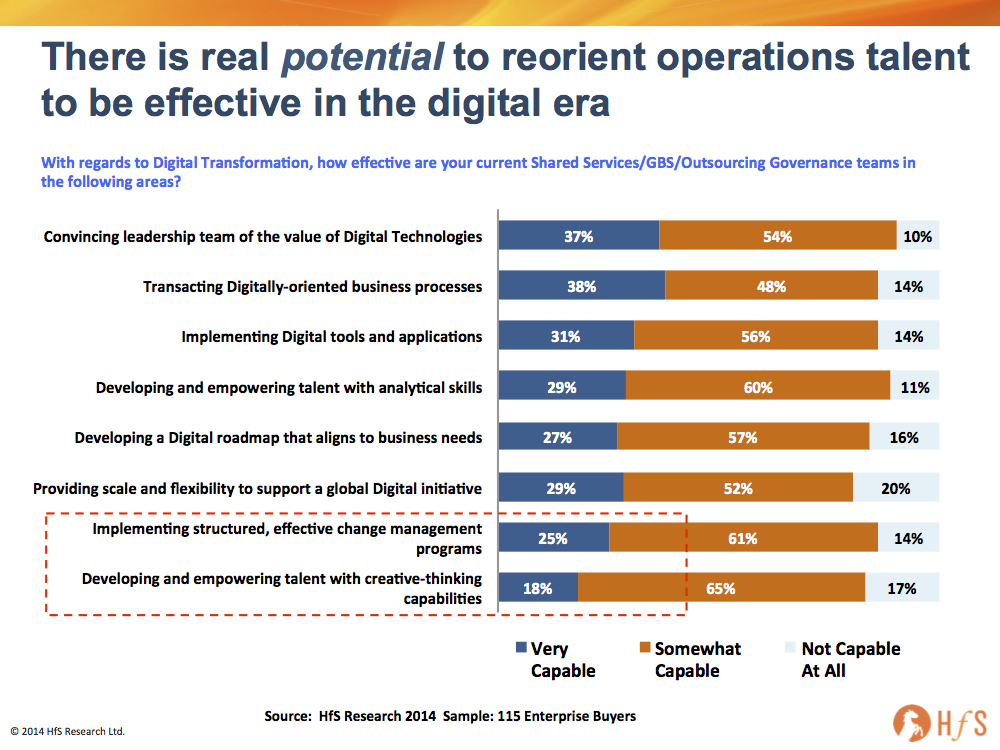
When we recently asked 115 major enterprises about the capability of their operations governance staff with the impact of digital transformation, we were pleasantly surprised by the confidence most enterprises have with their operations workers’ abilities to reorient themselves to be effective in a digital business environment:
Click to Enlarge
In nearly all digital scenarios, the vast majority of enterprises feel they have talent with some capability to be effective – and, in many cases, very capable. Only 11% bemoan their lack of analytical talent and 90% are convincing their leadership that a digital roadmap is adding real value to their operations. Where there is a worrying death of capability is in the area of creating-thinking and the ability to drive effective change management programs, but, even in these areas, there is a clear capability to improve. It’s a largely positive picture with regards to how today’s enterprises can cope with the shifts and get ahead of them in time.
The Bottom-line: the digital era is not only changing the way we work, it’s improving it
Accountants who used to spend their days pumping reports out of SAP can now spend more time exploring data correlations and global markets to prepare reports for their Board. With today’s massive advances in technology and automation, HR reps who used to spend all day filing benefits and payroll information can now spend more time hunting social networks for new talent… procurement staff can develop valuable relationships with suppliers than simply beat them up over a cost spreadsheet all day… healthcare administrators can spend more time prepping doctors with critical patient information, than wrestling with archaic scheduling and insurance systems…. IT staff can focus on creating an environment of usable digital tools and apps for their organization, than maintaining help desk tickets and writing lines of horrible code. The world of work’s just so much more interesting and rewarding today that it was even five years’ ago.
So let’s stop bemoaning the fact we may one day get replaced by a piece of software or an actual robot… or will simply become an unemployable lump of wasted humanity. The future needs us to adapt and flourish with challenging roles we never dreamed of just a few short years ago.