Now there's some significant innovation potential…
When it comes to achieving innovation when outsourcing, buyers need to identify where real innovation is possible, and where they only really need operational efficiency.
Innovation is about deploying creative and unique methods to drive new productivity or top line growth into the company. In reality, some processes have that potential, while others, quite frankly, only offer a means to an end.
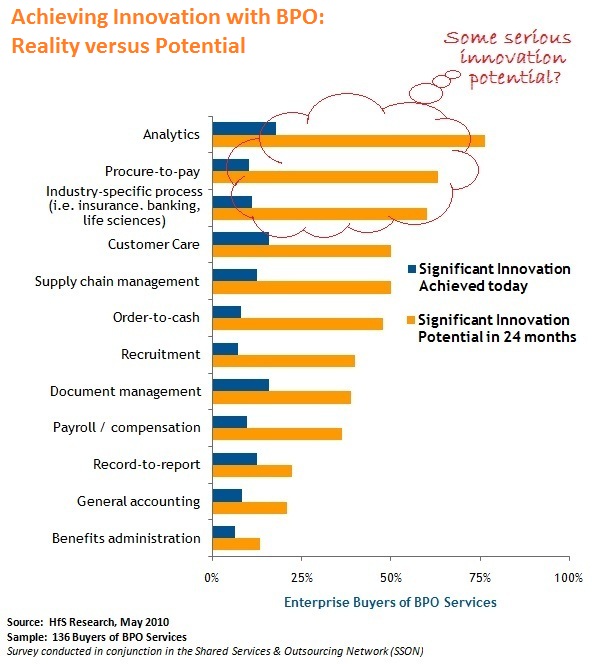
Our new innovation study, conducted in conjunction with our BPO networking partner, the Shared Services & Outsourcing Network, reveals some staggering results from 136 senior BPO buyers, when we asked them where they were achieving significant innovation today, and where they saw the potential to achieving significant innovation within a two-year time frame:
Determine the ceiling of innovation value
This data reveals an awful lot about outsourcing today. Essentially, most business processes can be improved to a certain extent when they are outsourced, whether it be through better workflows, application of new technology, and domain knowledge from experts. And most buyers today still feel most – or all – of their outsourced processes can benefit from further innovation.
However, some processes clearly have a ceiling of innovation value that can be attained, which is where the move towards standardization comes into play. For example, once you’ve got a benefits or payroll solution that delivers the required functionality, is delivered via a hosted / SaaS model, and the provider has the costs and service quality performing to an acceptable level, is there really a whole lot more value your business can gain from them, to increase productivity further and drive new top-line growth? Cloud Computing and SaaS can further help drive down the operating costs and optimization of delivery, but once you’re happy with the processes and the service, that may be the limit of future innovative value that you can expect to attain.
Pinpoint where future growth and productivity can be attained with a BPO provider
Where there is significant opportunity to achieve innovation, is where there is significant room to improve process flows, add domain knowledge, creativity and technology into the mix to achieve impactful business outcomes. This is especially prevalent with those processes that are often a long way from standardization, and can benefit from consultative business partners to develop a specific innovation agenda (see Part II). Analytics innovation clearly represents a major opportunity for providers and buyers to work together to make better use of information to drive results, in a cost-efficient manner. It also encompasses a much greater need for consultative support from the provider. And it’s the same story as you go through those processes where the innovation opportunity is significant, for example, P2P (massive productivity and cash flow); supply chain (driving product to market quicker); customer–care (driving new income), recruiting (reducing time-to-hire and improving talent selection), and so on. Each innovation gap tells a story of where the future value lies.
The HfS Viewpoint: The key lies in determining and achieving the right balance between operational efficiency and innovative value. Both are crucial.
That means, when selecting BPO partners to drive new business value, buyers need to focus on identifying which ones can genuinely help them innovate, versus those who can keep the machine cranking. In most cases today, buyers are increasingly finding they can source to multiple BPO and consulting partners – those to help them innovate in processes that have real value-potential, and those which can keep the costs down and the operations functioning. Many buyers today with some BPO experience, are now seriously considering adding more competitiveness to their provider mix to get more creative value.
On the flip-side, providers need to determine where they add the most value. For example, ADP has the lion’s share of the managed payroll business – so does it need to broaden beyond that into adjacent processes, for example P2P, that requires greater innovative and consultative support? Cognizant has a strong portfolio of industry-specific offerings in verticals such as life sciences and banking – does it need to broaden more aggressively into more horizontal processes, such as F&A or procurement? Accenture and IBM have strong offerings across many of these processes, so where should they choose to invest more of their resources in a tightening market?
Buyers and providers need to work out a game-plan whereupon they determine what innovation is possible, and how it needs to be achieved. Some buyers feel they don’t need a hell of a lot of innovation, and some providers are happy delivering standard services with little innovation impetus, beyond a few basic requirements. In the future, we’ll be drawing up illustrations of the innovators and the operational players. There is room for both – the key is to determine how much focus to put into each area.
All-in-all: Both buyers and providers need to be honest with themselves to determine whether they are truly prepared to invest in either achieving or delivering innovation. If not, stick to being operationally efficient and stop talking about an innovation game-plan that will never happen.
Thanks for so many of the comments, calls and emails we received after our recent post discussing “Why Senator Schumer’s proposed call center tax is detrimental and unproductive for the US economy”. The majority of the viewpoints convey concern and confusion regarding the implications of the proposals – I’ll let you read on for yourselves. However, one opinion did standout, coming from a gentleman called Skip Womack, who heads up the US onshore IT outsourcing provider, Advantage Outsourcing, based in Wichita, in the Midwest.
Now, you really wouldn’t blame guys like Skip for supporting Chuck’s anti-offshoring measures, but it’s refreshing to learn that many of them (and it’s not only Skip), believe the US onshore outsourcing industry – and not only call center – can prosper without such punitive attempts at firms leveraging offshore services:
“This post has captured some great insight into what I strongly believe is a no-win approach for tapping the strength of the US based outsourcing industry. America’s onshore service providers can succeed and prosper without Senator Schumer’s proposed tax legislation and regulations targeted to offshore firms. As noted in this post, many of the best-in-class call centers are located in low cost, high productivity centers in more rural sections of the US. There is no doubt that the US based worker can effectively compete for business and deliver service excellence. Moreover, I see a recent significant shift in the broader, IT Services market as well.
“There is a growing interest among CIOs and business leaders for a new type of outsourcing partner who can tap the strengths of the technology savvy American workforce based in locations where the work ethic and culture foster service excellence in a cost effective manner.
“To meet with this new demand I formed Advantage Outsourcing with Marc Sumner, and based it in Wichita. Being in the heart of the mid-western community, where we believe a handshake still means something, was paramount to our company’s vision. It is our goal to gain community support and create jobs in our market with a highly specialized network of business technology professionals who share our passion for client service, saving our client’s time, money and effort.
“While Senator Schumer may think he is trying to help the American workforce be competitive, I think he underestimates the talent, technology and work ethic that makes the US onshore solution the one to beat.”
When you’re looking at the future development of the global sourcing industry, you need to look hard at the diversity of the Asia/Pacific countries to understand from where much of the future demand – and supply – of technology and BPO services will arise.
With much of the US and Europe’s economic leaders coming to terms with paying for their years of spending excesses, their financial bail-outs and tethering themselves to basket-case economies, the next decade represents a real shift in the balance of economic power. No longer can enterprise leaders afford to view Asia/Pacific myopically as a single region, requiring a single go-to-market strategy for a “region” that houses 60% of the world’s population.
When we were developing our research agenda at HfS, we made the concerted decision to focus resources and attention firmly on Asia/Pac, so we can help our clients better understand how to organize themselves for growth across the region though their sourcing strategies. Our newest analyst at HfS, Andrew Milroy, discusses further some of the incredible diversity across that region. You can also listen to Andrew discussing key outsourcing dynamics in the Asia/Pacific region with our networking partner, SSON, by clicking here. Over to you, Mr Milroy:
Notes from a Large Region
I recently attended a briefing detailing APJ results for a major US-based cloud services provider. By the way, APJ is an abbreviation for Asia Pacific, Japan which means Asia Pacific plus Japan. To many, Asia Pacific includes Japan anyway and the letter J does not need to be specified. But sometimes, the letter J is used to signify the importance of Japan which until recently accounted for more than half of the aggregate GDP of Asia.
I was presented with APJ revenue numbers and revenue growth numbers, and was informed that these growth figures are higher than for anywhere else in the world. I then attempted to interpret this information and came to the conclusion that it was meaningless. Telling me that APJ growth is x%, and that this is the highest in the world, is like telling me that there is a storm in the Pacific Ocean. I want to know about specific parts of the APJ region. In fact, like many, I am particularly interested in what is going on in China. I believe that the vendor in question, like many US services companies, does very little business in China and will struggle to penetrate the Chinese market. Talking about APJ disguises this fact and may lead some to assume that business is strong in China. Right now, the Chinese government is probably creating several Chinese versions of this company. Of course, when I asked if the vendor in question could share its revenue numbers for specific parts of APJ, I was told that this was not possible.
The notion of placing many, very diverse countries into one region has always seemed very strange to me and not very rational. It seems as though large corporations split the world up in a way that satisfies their own, internal and often myopic view of the world.
Asia Pacific is a huge area and is made up of an incredibly diverse set of countries.
From an outsourcing/IT services perspective, it is important to understand the diversity of the region.
Australia and New Zealand are mature IT markets and the propensity to outsource is high. From an outsourcing perspective, these countries share more characteristics with the UK than with any country in the Asia Pacific region. The combined ANZ economy is becoming smaller relative to other Asia Pacific economies and hence is receiving less focus. Nevertheless, many US-based services companies continue to generate the bulk of their Asia Pacific revenues from ANZ.
Japan and Korea are also mature IT markets but the propensity to outsource to third parties is relatively low. Japanese and Korean organizations are much more likely to operate captive facilities than to engage a third party to manage business or IT processes.
India is an enormous offshore destination with a rapidly emerging domestic outsourcing market. Economically and politically, India behaves more like a Western economy than other large economies in Asia Pacific, like China and Japan. Large Indian companies and government organizations have a comparatively high propensity to purchase outsourcing services from third parties.
The Philippines is the second largest offshore destination in the region but has a disproportionately small domestic market. Most ASEAN countries, including The Philippines, face challenges in maintaining economic and political stability. Furthermore, some ASEAN countries such as Cambodia are among the poorest nations on earth while Singapore is one of the richest on a GDP per capita basis.
Of course, China is the market that attracts the most interest given its phenomenal economic growth and the size of the economy. In recent years, China has emerged as a nearshore destination for Japanese and Korean captives. However, the government is investing heavily in encouraging foreign and Chinese companies to establish themselves as providers of offshore outsourcing services within China aimed at US and European companies. The establishment of this infrastructure is not driven by current demand but instead by anticipated future demand for services delivered from China. Perhaps of more interest is the domestic market in China. This could potentially be huge. But, it will take time for a sizeable domestic market to emerge for many reasons. One of the main reasons for this is cultural. China is not yet a services-oriented economy and by and large, China simply does not do services well today. There is a sense that you buy products that should work and if they don’t, then you should be able to fix them using your own resources. It is hard to find high quality services in China should you be unable to address a problem with products using your own resources. The other issue that holds back domestic outsourcing is the same as in many other parts of Asia Pacific and that is the relatively low cost of labour.
So, Asia Pacific has massive variety. It houses two of the world’s three largest economies as well as some of the world’s poorest. It has countries where the propensity to outsource is among the highest in the world and where it is among the lowest. It has the most centrally planned economies in the world as well as some of the most market-oriented economies. In other words, it doesn’t make much sense for these economies to be included in the same category.
As parts of the region become more influential globally, managers within the region are changing the geographic categories that these use. Powerful country offices within the region are beginning to refuse to report into regional headquarters and insisting that they should report into global headquarters. If you are running the Chinese operation for a large US-based corporation, you are probably operating a critical part of the business for future growth. So, you will most likely want to report directly into global headquarters rather than regional headquarters in Singapore.
Andy Milroy, HfS Research's voice from Asia/Pac
In a few years time, the way some large corporations segment the globe will change, Asia Pacific will no longer be a useful geographic category. It is likely to break up into several areas. India and its immediate neighbours will make up one area, Greater China another, ASEAN another and Japan and Korea will be the other. As mentioned earlier, ANZ will continue to become proportionately a smaller part of Asia Pacific so will probably be thrown in uncomfortably with ASEAN.
Andy Milroy, pictured here, is Expert Contributor for Horses for Sources Research. You can access his bio here. He likes to be tweeted at @andy1994
I feel like we’ve been here before. Oh wait – we have! Remember the heady old days of HR BPO, when a couple of hundred enterprises shifted multiple HR functions over to service providers, with the hope of saving money and – perhaps – find a few smidgens of improvement with their HR strategy?
While a couple of service providers failed to get their delivery model right and ended up losing money, HR executives screamed from the rooftops to ensure every single negative view of HR BPO was expounded in all the HR media, and anyone else who would listen. They got their wish, as firms such as Convergys and Hewitt got crucified by Wall St, and most of the providers made a hasty retreat from the business. In fact, it proved such a grueling experience for Convergys, it recently jettisoned one the industry’s largest HRO businesses for loose change.
Now enter the latest threat to HR: Recruitment Process Outsourcing. And this time, our HR friends will have to try a lot harder to throw this one under the bus.
Firstly, most of the providers in this space have been dealing with recruiting for years, and, secondly, the newer providers have been getting their feet wet with a host of successful pilots and early client engagements, which our forthcoming HfS Research report will discuss at greater length. And thirdly, these providers are fulfilling a badly-needed service for many enterprises today: helping them source new pools talent, get a handle on managing the talent pipeline, access new recruiting technology and social networks, while helping drive out cost by running various back office recruiting tasks offshore.
HfS Research’s latest study, conducted in conjunction with Human Resources Executive Online, gleaned the views and dynamics of 238 HR executives towards RPO, of which 34 percent were senior VPs or VPs of HR. And the first factor that was apparent, was that RPO was low down the list of recruiting services HR executives are going to take a look at this year. Let’s examine this further…
HR’s major recruiting concerns
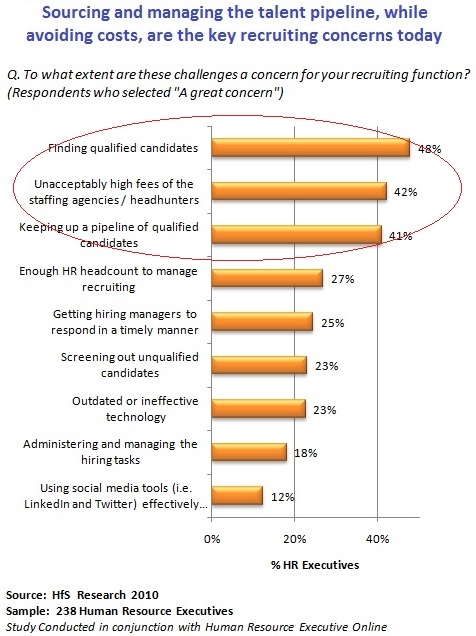
Quite simply, HR executives are struggling to cope with the demands of developing and nurturing their organization’s talent pipeline, while trying to avoid the exorbitant fees of headhunters and staffing agencies. Our new study illustrates these elements of recruiting new talent are proving to be a “great concern” to organizations:
HR executives need help and should consider transferring part of its recruitment function to an external service provider. The more leg-work they can offload, and the more help they can receive to develop the talent pipeline, and the more time they can actually devote to strategic functions, such as spending more time understanding the needs of their internal hiring managers and facilitating ongoing staff development initiatives.
HR executives are highly resistant towards outsourcing any of their recruiting processes
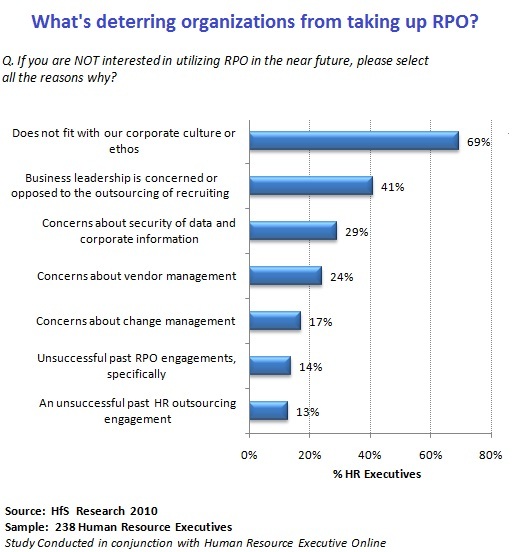
Seven-out-of-ten HR executives claim they won’t looking into RPO because it “does not fit” with their corporate culture or ethos, which is consistent across all sizes of organization. And if you examine that datapoint further, you’ll find that attitude running at 80% for the SVPs /VPs of HR:
Recruiting smartly is about engaging outside help that can infiltrate marketplaces effectively to get the best results – not too far removed from a PR agency which can engage markets with added expertise, technology and canny use of social media. HR trying to perform all of its recruiting inhouse is like marketing doing all their PR work internally. No CMO worth his/her salt would really contemplate running all of its PR internally these days, unless it was a very small activity that didn’t warrant outside help. So why should the SVP of HR be any different, when it comes to running recruiting?
Other business functions have all resisted outsourcing in the past: IT, finance, procurement, claims processing, clinical data analysis etc. However, once staff and managers got used to working with outside help and expertise, and realized it was a vital part of their team, most have accepted that it is a way of life for today’s organization. So why is HR so different that it has to try and run everything itself?
The HfS Viewpoint: If HR continues to resist RPO, key decisions over talent management will like be made for them in the future
Emerging from the Recession, the focus on developing new talent has never been so intense – especially in increasingly globalized markets where it’s getting harder and harder to manage the recruiting pipeline on tightening budgets. If HR leadership fails to seek the help it needs soon, it may find decisions being made in corporate meetings, where the SVP of HR isn’t even invited. The challenge for RPO providers is clearly to find avenues of communication with operational leaders outside of the HR department.
This little outsourcing saga has a few cycles yet to run, and is likely to have a major impact on the way companies approach their talent management in the future.
HfS Research’s coverage of RPO will be featured for research clients in an upcoming new market landscape report, in addition to a forthcoming featured article in Human Resource Executive magazine
Preaching Process with Pramod, Part III: What if you can build a true back-office-in-the-box, based on the Cloud and ERP platforms, which costs a fraction of what it used to?
At long last, we come to the final part of our interview with Genpact’s President and CEO, Pramod Bhasin.
In Part II, Pramod talked about “integrating IT and BPO and not getting blown up into small pieces“, where we discussed the convergence of SaaS, BPO and Cloud Computing. In our final chapter, we discuss the future of process consulting, where labor arbitrage is heading, more about the Cloud (of course), and a little piece of advice for today’s budding sourcing masochists, er, I mean executives.
Phil Fersht (PF): There’s no doubting Genpact as a great business process expertise company, but when we get into the mid-market and these more “leveraged” solutions, there’s clearly a lot more need for consultative support. How’s Genpact, moving forward, going to build out its consultative capabilities? Are you going to develop a consultative arm, or are you going to bed more consultative expertise into your managed services offerings – how are you going to tackle this?
Pramod Bhasin (PB): We have a very strong re-engineering focus, so I try to stay away from calling myself a consultant, because people see us differently, and I worry about that being a label that attaches to us, when clients don’t recognize us as that. We have a very strong re-engineering team with all of the black belts and Six Sigma people, and we are adding, in terms of domain expertise, as well as relationship managers, We are hiring people with much better consultative skills. That is a clear roadmap that we have put into place. Our relationship managers need to be significantly upgraded in many cases, so they are part of the consulting skills-setting. That is an ongoing process that we have put into place and it will take some time. We probably have300 master black belts at this time and we will go above that. We need to change the DNA in many of our cases, though. We have very strong operating backgrounds, but now we need to find people who can provide solutions. The re-engineering folks are fantastic, the black belts are fantastic, but I still think that we need to add another layer of skill to our people, particularly focused on industries, such as healthcare, pharma, or whatever it may be.
PF: We’re seeing several providers almost using BPO as a loss leading tool to sell consulting and IT services, and this seems to be accelerating. Especially when you get them pushing all their resources into their IT services and not BPO, because of the way they are structured. Do you see these guys waking up and realizing they need to invest more in their BPO capabilities? Where do you see this going?
PB: When I look at the big guys like the Accentures and IBMs of the world, they lead with it separately. It is not a loss leader, it is a stand alone business. They do business with it. They use it to get into business and to cross-sell. But, I agree with you. I think that people are saying, “Let me get in here and gain an entry point. Let me show you skills, let me show you experience.” But honestly, it’s working. These guys are doing work pretty well for customers. And to that extent, they are able to build up businesses and get more customers. Some of that will happen. One, because the world is big enough, so I don’t think we always have to worry about competing against each other as the marketplace is big enough for plenty of us.
At the end of the day, Phil, I think that we believe that one thing will be clear: we as organization think about business processes from top to toe. It makes a difference. I, single-handedly, designed smart enterprise processes, the entire framework, from start to finish. Why? Because, this is what I do for a living. At some point in time, this stuff starts playing itself out. You must have a core competency, and there are very few companies in the world that have been able to have demonstrated that they can do three or four different things really well. I think that at some point in time that will also come back to us. I also think that as Cloud Computing takes over, applications become more generic, and application development becomes more widespread, so that people are building applications to go onto the Cloud that you use and can subscribe to more easily, and leverage for your customers. I think that this will play out better and better. Because you can’t put business processes on the Cloud, not today anyway. You can’t not know Sarbanes Oxley and its rules, and US GAAP, unless you have been in the finance profession. You can’t say, because you are a technology company supporting these processes, that you really know this. Therefore, that focus will really play out to our benefit.
PF: Isn’t Cloud making ITO more nimble and proctizeable, and creating so many more intersection points for the industry?
PB: Cloud is making everything more nimble, more productive. It is almost a safety net. I don’t know what it is going to do for application work. There are many more points of intersection and we have to be alive to that. I do think that the quality of applications that come out will be so good that the guys who do that the best may not be the current IT services companies. I am not so sure the next generation will be born inside a TCS or an Accenture. I don’t know which of those would be the winner, but it’s not going to both, I don’t think.
The world has changed so dramatically, that all our people need to be much savvier. Our focus on business processes is constant because I’ve got a lot of bankers, financial services people, and people like that, who understand processes and operations very well. Equally now, we need people now who understand technology and the convergence at the points that they connect. So I think that there is a lot that we will also need to retool. I think that the NetSuites of the world are radically different animals from the IT services companies of the world. That is where the rubber will meet the road in terms of how adaptable/inflexible are these new applications and how can we wrap what we do around them, which is more customized. And why will IT services also be able to do that, if applications really become so prolific?
PF: It’s not really the products and services that are changing, though, it’s the speed and ability they can be delivered to market…
PB: They are saying, “If you made bank branches more efficient, come on and tell us how. Here is an open deck. If you can make hospitals run better at a base experience, come on in and tell us how. I don’t want to buy a big ERP system, for me, I’m not interested. Teach me how to fish. Teach me how to manage my processes better. Don’t just say that you will “come in and fix them”, but teach me how to do it.” There is an increasing realization around how important managing your processes as a single minded science, can be a huge competitive advantage, or a disadvantage, as the case may be. We have got to spend the next 12 months makes sure that we do this properly. We have our unique place and we need to make sure that we stay there and increase our lead and increase our position. Again, that is where our single minded focus will help, but I guess we will find out in 12 months.
PF: What advice would you give to young executives today on both the practitioner-side and the service provider side?
PB: I think more and more, Phil, the thing that we are missing in broad parts, amazingly, is what I call “operating skills”. I don’t want to get too grundy on this or too detailed, but for a 25 year old, I’m saying, get a domain expertise, understand an industry whether it is pharma, banking, something else. Build up your own research, understand how it works, understand the problems it faces. Use the Internet for information, use virtual exchange, use networks of experts that we can tap into to solve problems for customers. Really get into the guts of the industry that you work with. And understand operations as a science. This is not flying by the seat of your pants. This is not “wake up in the morning and decide what you are going to do today”. It is a science: invest in it, think about it, think about how you can make it more efficient. But behind that, is that domain expertise of saying, “I know this industry really well and I undstand its ins and outs”. I understand how it works in China and I understand how it works in the US – and this is how I can help. Build that up, it will take years, but that is what the world is built on.
PF: The speed of this industry is relentless, Pramod – is this the place to be right now?
PB: I am now finding this whole debate on Cloud and what it may do, the flexibility it may provide, and how applications may be developed, absolutely fascinating. And to that extent, there is no industry moving at a faster speed than this one. It is frightening, and you are somewhat scared. You hope that you get it right. You hope that you don’t make mistakes. You don’t know where you can go wrong and you won’t find out for years. But at the same time, it is fantastic with the opportunity. What if you can build a true back-office-in-the-box based on the Cloud and ERP platforms, which costs a fraction of what they used to in the past, and really start doing this across the board. It could be a huge winner. Things like that are fantastic in fact and that is part of the joy of our business.
PF: Pramod, thanks so much for all your time, this evening – I know our readers will really appreciate your vision for the industry.
Pramod Bhasin (pictured above) is President & CEO, Genpact. Pramod established Genpact (formerly GE Capital International Services) in 1997. Pramod was earlier an Officer of General Electric (GE). His career with GE and RCA spanned 25 years across the US, Europe and Asia. He was most recently the head of GE Capital in India and in Asia, having earlier worked with GE Capital’s Corporate and Finance Group in Stamford, Connecticut, USA. You can read his full bio here.
Capgemini has emphasized its global delivery acumen, by showcasing its expanding European delivery center in Krakow, Poland, to industry analysts and advisors.
This dovetails with Capgemini’s strategy of positioning its delivery centers in Latin America (see earlier post), Guangzhou (China) and India, to present a compelling global delivery capability, based on a network of proven locations, where educated, multilingual talent is readily available to support its clients’ global General and Administrative (G&A) processes. However, while the firm is clearly focused on investing in quality nearshore/offshore delivery resources, does this enable it to compete aggressively with low-cost offshore-centric providers for BPO/ITO engagements?
Capgemini is one of the largest and most well-known European IT/BPO service providers and consulting firms, with revenues of $10.3 billion, but has struggled in the past become a household name in the US. However, its recent aggression in the BPO market, resulting in notable client wins such as Bunge and Coca-Cola Enterprises, has helped elevate Capgemini as a serious contender for global enterprise BPO engagements.
Capgemini has been providing BPO services, primarily Finance and Accounting (F&A) and Procurement, for more than 6 years, and boasts one of the few integrated global delivery networks, from which the firm supports enterprise its customers, which include the likes of Coca-Cola Enterprises, International Paper, Zurich Financial, and Hydro One. This support is provided by a global network of delivery centers in Guangzhou, Bangalore, Chennai, Guatemala City, Sao Paulo, and Dallas.
The Polish cities of Krakow, and nearby Katowice, are the centers for the majority of its Pan-European operations. Similarly to its Latin center in Guatemala City, Krakow is marked by a youthful energetic staff, and acts as a control center for the entire European support operations, similar to the function of Guatemala for Latin America.
The center, which opened 5 years ago, has grown to 3,500 employees, of which 2,100 provide dedicated support for Capgemini’s BPO operations. This growth has provided compelling career opportunities and contributed to the enthusiasm and energy that is apparent within the centers. Much of the staff have studied in universities across Europe, which allows this center to provide voice support in all European languages, as well as having the necessary understanding of local accounting and procurement practices, to support the F&A and procurement activities of its customers.
Capgemini is working hard to provide differentiation for its offerings. In Krakow, it emphasized its “Global Command Center”, which is a concept based on a set of procedures and tracking programs, that allows global customers to be managed as a single entity. Capgemini can share work between centers to balance loads, or use its global distributed work force to solve problems in a timelier, synergistic manner. This command center concept, combined with its multi-lingual ability, is its greatest point of differentiation for delivering pan-European BPO operations for its clients.
Moreover, Capgemini has also have developed approaches to try and get more customers to move to solutions whereby it can share resources and knowledge across customers, rather than setting up the “virtual captives” that have become the de facto solutions for most BPO providers. It’s philosophies for a “Global Process model” and the release of its governance dashboard solution, BPOpen 2.0, are strong value enhancements for enterprises seeking global process improvements.
Capgemini has also recently purchased IBX, a procurement services and SaaS provider, to provide a unique enhancement to its overall procurement BPO capabilities. This gives Capgemini a standardized technology platform to SaaS-enable procurement clients and the ability to provide the technology cost in a variety of ways, competing directly with the likes of Ariba, but also providing an alternative to other BPO/Procurement partnerships, for example IBM/Hubwoo and Genpact/ICG Commerce. Moreover, Capgemini can genuinely offer a one-stop procurement-as-a-service competency, whereby in the past it had to rely on subcontracting to other procurement software and services providers.
The HfS Viewpoint: Capgemini has global delivery quality in spades, but has to continue to develop cross-client synergies and processes to be competitive
Capgemini’s Krakow center provides the type of operation that will make a client feel comfortable in using it for its G&A activities. What remains to be proven, is whether Capgemini can develop common offerings for G&A process that will be accepted by clients, which is the common challenge facing all of today’s leading BPO providers. While Capgemini leverages offshore support from locations, such as India, to drive down the cost of its global delivery services, it has made investments in high-quality locations, such as Poland and Guatemala, which are costlier than those of several of Capgemini’s competitors, which focus more heavily on lower-cost locations to be more price competitive.
Developing more common processes will enable Capgemini to provide greater value in delivering process excellence and competitive pricing through efficienctly-leveraged staff, technology and processes. This will be necessary as Poland becomes a fully-fledged member of the EU and labor costs across Europe become equalized.
All-in-all, while the French- headquartered service provider is clearly investing in high-quality, but also costlier, locations, HfS believes these investments should bear fruit in the future when labor-based engagements further commodotize, and cost efficiencies increasingly come more from IT/BPO synergies, common delivery platforms and Cloud Computing delivery, as opposed to primarily low-cost labor.
This post was co-written by HfS analysts Mike Atwood and Phil Fersht. You can upload a full copy of the HfS Rapid Insight by clicking here.
There are a lot of secrets in the BPO business (oh, if only you knew), however, one best-kept secret that is worth revealing, is the Xchanging story. The UK-headquartered firm is the largest pureplay BPO today, with revenues over $1.1bn.
BPO purists will recall some significant developments, back in the late ’90s, when private equity investor General Atlantic pump-primed two BPO providers to enter enterprise markets: Exult and Xchanging. While the former went after the big “lift and shift” enterprise engagements, the latter quietly went about developing BPO services focused on partnering with enterprises, co-developing technology and processes, and developing industry-specific process skills that could be blended with horizontal administrative processes.
Wall Street investors, industry analysts and business media loved the Exult model – it was focused on big-bang deals, exposed the shortcomings of enterprise HR operations, and brought the BPO business to the attention of the media and the industry. Meanwhile, Xchanging, led by the pragmatic David Andrews, quietly went under the radar building a business that focused on servicing industry vertical processes, namely insurance and banking, and two fulcrum bridging processes: payroll and accounts payable processing, in addition to other administrative functions.
In today’s market, the message couldn’t be clearer: the old “lift and shift” model only works when there is tremendous discipline applied to process standardization tied to common technology workflows, while the partner-orientated approach, where buyer and provider work together towards common outcomes, is proving to be the model where both parties are vested in making the engagement successful – and within budget.
As part of our CEO series of interviews, we thought it about time to drag David away from one of his hazardous Dartmoor runs (the invisible cliff edges keep his shareholders constantly on edge) to share his story with us.
Phil Fersht: Good afternoon, David. When you look back at Xchanging over the its first decade, how would you say it’s developed from when you started out. How different is the vision from when you began, to where the company is today?
David Andrews: Phil, if you look at the original business case, we’re pretty much bang on track. We set up in 10 years of operation, 10000 people and a billion turn over dollars. And 100 million dollar profit. And that’s where we are now. Got our first contract in 2001. Financially, it’s gratifying, we’re on target. We’ve weathered the financial crisis pretty well, despite having a pretty heavy reliance on financial services. I’m delighted that the enterprise partnership model has become accepted in the business community. When you start a business you’re never quite sure whether it’s your own stupid idea that no one else will think is any good, or whether it has legs, so it’s really been proven that it has legs. Certainly as we now globalized, which is crucial. I don’t see how you can do national BPO for corporations. As we’re globalizing, we’re finding it has a lot of support in Asia as well as the states.
Phil Fersht: For those of our readers who are not all that familiar with Xchanging, tell us about your enterprise partnership model and how it works.
David Andrews: In my view there are three generic third-party delivery models in the marketplace today. One is an M&A-type model where you buy a piece of processing and then seek to develop it. The second, sitting at the other end of the spectrum, is outsourcing, so lift and shift either on a time and materials or on an output price basis. What we’vedone is put something in the middle which has some characteristics of M&A – which is your seeking to do a capital upside – and some characteristics of outsourcing – which is your seeking to create a discontinuity and a mindset by moving the process. The enterprise partnership is actually a jointly-owned business which not only serves the client customer, but can also serve other customers. Some of our enterprise partners are Deutsche Bank, BAE Systems and Lloyd’s.
The enterprise partnership model is highly attractive when you are dealing with complex things you can’t absolutely define on Day One. If you are doing an M&A or an outsourcing transaction you’ve got to put very tight boundaries around what you’re dealing with because you are either offering a price or a discount on Day One. If you’re dealing with very large, complex back offices, it can be very difficult to put the boundaries with sufficient accuracy. There will be lots of interconnections with other systems. There won’t necessarily be ready-made SLAs and measures as you would find in ITO. So you need different mechanisms for handling complexity and uncertainty. To do so, the enterprise partnership model says let’s go open book, let’s define some outcomes and let’s create a commercial arrangement around the outcomes rather than the inputs. So it seeks to put some commercial certainty around the uncertainty of the complex back office. It enables you to do stuff you couldn’t otherwise M&A or outsource.
Philip Fersht: So what you are talking about, is really what a lot of the leaders and your competitors are now talking about. We’ve gotten to the point, particularly with many of the big horizontal BPO deals and things like F&A, where the price points are pretty similar and the presented differentiator now, is one vendor offering better gain-sharing than another. Do you think this is a reality or a lot of smoke-blowing to try and close the business? We’veseen a couple of recent deals with some pretty innovative gain-share approaches, but you guys have been doing this for a very long time, and it seems only now that your larger competitors have begun trying it as well.
David Andrews: Hopefully, a few more will. I welcome the competition as I think it creates a bigger market. The only thing I would say is that it is quite difficult to do gain share as just an add-on to what you already do. I think there is quite a fundamental mind shift you have to bring about. Without talking ill of my previous company Accenture, I found it very challenging to get them into a gain share mindset. They understood time and materials really well, and we all understand that an input cost-based time and materials model has been brilliantly exploited by the Indian companies. But what we’re talking about here is…”I’m not going to make any money at all unless I create a gain. So I am at risk. I’m not just creating a company but creating an outsourced arrangement where unless I do really well, unless I get the costs down, unless I get the productivity gains up and unless I attract third-party revenues, I am not doing anything.” And that’s a really different and very important mindset because it does take you beyond what you otherwise do. You’ve got to have that absolute determination to bring about the benefits otherwise you don’t make any money. So I am a bit worried about gain-share being a “sweetener”.
Philip Fersht: I completely agree with you here. I think we’ve seen some deals recently where the vendor has done it because they felt they needed to in order to win the business, and now they’re going to be forced to actually try and deliver what they promised or they’ll be punished for it. And I’ve seen some rather cleverly worded gain-share initiatives where the provider might be able to get away with not delivering on some of what they’ve promised, however, I do think some of them are almost deliberately sticking their neck out so they can try and prove they can do this. But as you’ve said, it is very difficult when it is more positioned as a “sweetener” than as something they genuinely feel they can deliver.
David Andrews: Yes, people often rationalize this in their own way and I’ve seen this in large corporations. You are seeking to create a different set of motivations for both the provider and the customer, so you move away from an adversarial relationship by putting in some sweeteners to win this and then hope it will go back to normal. And the provider who is going to squeeze the maximum out of the supplier by way of promises upfront – that’s a misalignment. I think in the future we’re going to see a different set of motivations where the provider and customer agree that if they cooperate and align as partners they’ll get more out of it. Now that’s a very different mindset than what has historically existed in outsourcing. And it isn’t a soft mindset…actually cooperating as partners is tough stuff because you have to be very transparent. There is a lot more relationship to it, and there are breakdowns to get breakthroughs if you stick together. The tremendous advantage I’ve seen with your big partnerships is that you can actually be braver to accomplish some big stuff because you know your partners are aligned with you.
Philip Fersht: What do you see as the main opportunities for Xchanging, and where you are going to make your future investments?
David Andrews: We put a certain level of investment in to make the transformation in all our enterprise partnerships. Part of our model is that we put money upfront. We are at risk with that money and that further focuses our minds on getting the return we share with our partner. So that won’t stop as it’s an underlying cultural underpinning of the company. What has happened in the last two or three years, and is accelerating, is us taking development risk on renewing technology…reinventing it really. I didn’t foresee that. I thought it would be more of a partitioning of the industry, where you’d still have the systems integrators and the outsourcers and we’d subcontract to them, but we’re finding that we’re investing for our own account in large-scale technology. So, for example, in the U.K., I thought we’d be able to subcontract data center processing but we found we couldn’t get the quality to financial services standards of delivery. We’d get it to maybe a telco standard billing reliability, but not to something beyond Six Sigma that you need for payment systems in financial services. So we have found ourselves investing in things we thought we could buy in, which is causing us to be a much more integrated technology and BPO company. And that is half the reason we did the deal with Cambridge. We knew we had to have strength and depth in advanced systems development, web-based development, and fast transaction-based, real-time systems development for payment systems/exchange systems for us to move into a world where we could genuinely offer that standard of service. I think that would mark out what has changed over the last ten years in BPO. You’ve seen technology companies dabble a bit in BPO. You’ve seen BPO companies dabble a bit in technology. But I think that dabbling at each end of this is out. You’ve got to be really seriously into both of those.
In Part II, we’ll focus in on the market dynamics, where buyers are achieving some innovation and the convergence of IT and BPO within industry processes…
David Andrews (pictured above) is CEO Xchanging plc, founding the company in 1999. Previously, David built up Accenture’s outsourcing business and had responsibility for managing major technology replacement programmes in Europe. Before joining Accenture, he managed a major programme of hospital refurbishment and health care infrastructure renewal in Congo.
And now that it’s the worst-kept secret, let’s finish our discussion on “the interesting arm wrestle” with Xchanging CEO, David Andrews…
Phil Fersht: David, you asserted that providers today need to be really strong in both BPO and technology, rather than dabbling in one or the other. I’ve looked very closely at a lot of the Indian ITOs. They like BPO because it has a huge IT tail on it and they’ll even bid on small BPO deals because they see the IT opportunity. But the mindset required to lead a BPO engagement is very different than what is needed to lead an ITO engagement. Do you think we’re going to see a consolidation in the industry between the BPO and ITO sides? Or do you think it’s going to meander for a little while longer while everyone figures this thing out?
David Andrews: I think you’ll see a lot of meandering around, and denial, from either angle because we’re all prisoners of our heritage. But I think you’re going to see one or two get it. And those are the ones that realize BPO has got to be technology powered.
Phil Fersht: Do you still see this as a very industry-centric business, or do you think we’re getting to a stage now where industry spin “sells”, but it is really about operations and delivery?
David Andrews: I’ve always been industry agnostic. When I was at Accenture, functionally I was an expert in systems building, but knew nothing about stock exchanges when I went to build the London Stock Exchange system. You’ve got to be able to operate in an industry, but if you focus on only a couple of industry perspectives you are often bound by tradition and what people historically have found possible. And I think that really applies to BPO. BPO is all about being a great operator of processes, and those processes can be standardized across industries as well as within a company. So, for example, Cayman’s processing and the sorts of things you need to do there can be similar in insurance and financial services and telco customer billing, as it’s all transfer of money. It’s really all about reinvention, and I don’t think you get reinvention by being an industry expert. By knowing a tremendous amount about a particular industry you are almost a prisoner of it. That’s not to say it’s not important knowledge, but if you’re going to cause reinvention you have to come in with some new ideas. So in 4G cloud computing – a new idea – you don’t have to be an industry expert but you have to be an expert in how to apply it to an industry.
Phil Fersht: One of the things I am grappling with, is who is going to be leading BPO deals from the vendor-side. In the early model, Accenture and PwC started off with BPO services that formed a platform for their consulting businesses. Now we have companies like Genpact which are trying to incorporate transformational support as a standard practice within BPO. But when we get into more of these synergized technology-driven BPO engagements – how are these going to come together from a delivery perspective? I spent a lot of time recently with the SaaS companies and software thought leaders and many of them still have the attitude that they can come and slam in a SaaS application, and the customer should just be able to figure it all out and run it itself. But BPO guys like you and me know companies need a lot more help and support in getting there. So who is going to be leading these deals down the road? Is it going to be the BPOs or do you think it is going to be the technology-led companies that develop more comprehensive BPO skill sets?
David Andrews: I think it is going to be the companies that understand how to build market infrastructures that take advantage of economies of scale which enable them to invest in reinventing – I think that’s the combination. That is why I am so excited about Xchanging’s future because I think we’ve mastered the art of – or we’ve understood – the power of market infrastructures and put them into a commercial context, and realized you’ve got to power that with technology. You can do the process optimization, you can do your arbitrage and all that stuff, but you’ve also got to be really creative in the ways in which you apply technology, and be prepared and courageous enough to cannibalize what you have in order to move to that brave new world. I don’t think there are very many of us out there doing that, but there is the opportunity over the next five to 10 years to build the next IBM or Accenture. In my view, some companies will master this and become very big corporations. I think you could well argue that Xchanging has got what it takes to become a lot bigger. I also think you could say Genpact has characteristics along those lines. You’ll find one or two of the big shared services boys will spin out. Then there will be a couple of surprises none of us have thought about. But I think there will be five or 10 out there. The advantage I think Xchanging and Genpact have today over pretty much everyone else is that we are pure play and genuinely global. So if you go into our centers you will see us exchanging work flows within a business day. So it’s not just a question of lift and shift – it’s lift and shift, lift and shift, lift and shift –shifting backwards and forwards all the time between our centers. And for that you must have a very strongly engineered standard environment.
Phil Fersht: You made a very good point that some of these vendors are really going to get it, while some, simply, won’t. At HfS, we’ve started to look at two camps – the “innovators” and the “operators”. While some vendors have high-growth, multi-billion dollar businesses, most of their client relationships are with the director of applications…they operate two or three layers down from the business decision-making. You know they are really struggling to get to the higher layers. Are these guys always going to be good “operators” because they are pretty much happy where they are, and make enough money doing what they are doing – and do you think they should start to be honest that that is what they do, versus “innovators” who generally are trying to operate at the higher levels of the organization, and drive more gain-share outcome initatives with their clients? We are starting to see some vendors step it up and try to become innovators, whereas you’ve got these operational companies who clearly aren’t investing heavily in the talent they need to do this. Do you think this dynamic is going to continue in this vein for a while?
David Andrews: Interesting arm wrestle, isn’t it? Innovators will say that operators are boring. Operators will say that innovators are nut-cases. I think each of those is necessary but insufficient. I think the new sufficiency is that you need both. You need to be an innovative operator.
Phil Fersht: We’re starting to hear from several experienced buy side BPO leaders that they’re beginning to invite more and more vendors into their mix in order to move away from the “single throat-to-choke” model, where they feel beholden to one vendor which hasn’t really stepped up to the task. They’re starting to look at bringing in some innovative type players to add more value. Do you think this is a sign of BPO maturation where buyers are now getting smarter and wanting to increase the competitive mix from their suppliers, or do you think we’ll stay with a one supplier model for quite a lot longer?
David Andrews: I think to embrace multiple providers into the mix you need to be very organized with a really good framework for operating. So my guess is those companies that are talking in the way you suggest have already figured out how to operate a standard framework into which they can plug best in class, and they might decide they can’t invest enough to do best in class themselves. That’s certainly where we are going because we realize you can’t be good at everything. And therefore we have to bring it in to get the quality. This make versus buy decision…it’s a constant decision within our organization. Ideally you prefer to buy it from best in class. The areas in which it’s really happening at the moment are where you’re putting together quite innovative sets of processing and you probably have to add three or four products you’ve put together in order to deliver the outcome. So there’s quite a lot of assembly going on today, certainly in our organization. Maybe three or four years ago we were doing development, but we’re now assembling best in class. And of course there are a few companies you have to have a strategic relationship with because they dominate their particular environment.
Phil Fersht: David – this conversation has been most interesting – and could go on for a while yet! Thanks for much for your time today – HfS readers will enjoy reading your thoughts.
David Andrews: Thanks, Phil. Glad to spend time with your readership.
David Andrews (pictured above) is CEO Xchanging plc, founding the company in 1999. Previously, David built up Accenture’s outsourcing business and had responsibility for managing major technology replacement programmes in Europe. Before joining Accenture, he managed a major programme of hospital refurbishment and health care infrastructure renewal in Congo.
When we recently spoke with close to 600 shared services and outsourcing executives across both the buy and sell side of BPO, the tough news for much of the industry is that most enterprises are unwilling to collaborate with other firms in their industry to foster innovation with their outsourced business processes.
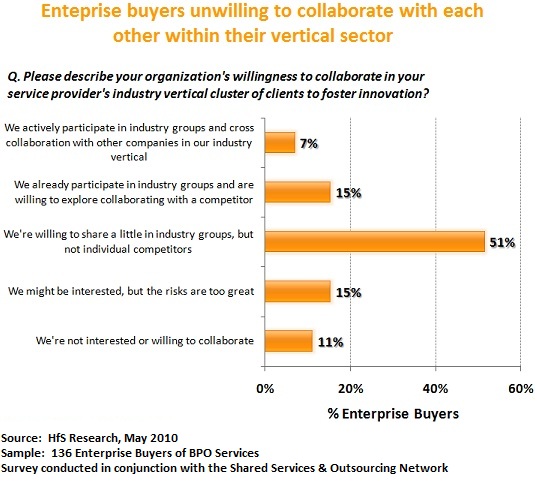
Our new research reveals clients’ desire to collaborate with non-competitive firms in other industries is much more powerful. Simply-put, new service delivery models must emerge between collaborating partners that will help them innovate, share their ideas and experiences. For example, over half of enterprise buyers are not prepared to collaborate with industry competitors:
I hear you gasp with shock and horror at this revelation. But why, then, do so many service providers still persist in stove-piping their business into vertical groupings, when their clients don’t want to talk to each other about their business processes? While it’s clear that clients like to be “sold to” by executives who clearly understand their business issues, once the engagement is “live”, the vast majority of governance and process management issues are generic across all firms who outsource.
To win more business, outsourcing service providers must innovate by creating and unleashing a multi-client collaborative model that isn’t restricting their clients to their industry vertical silos. Our distinguished analyst (I love that title, but he is very distinguished…) for shared services and outsourcing governance, Lee Coulter, investigates further. You can also read on this issue indepth in Lee’s new report, available as a freemium pick on our research page for a limited time.
Innovation? With THEM?!
I am almost afraid to write yet another article lamenting the lack of innovation in the BPO industry, but this time, I have some thoughts on how to change the game and I am spreading the blame around a little more evenly. There is plenty of blame to spread around on this one. It’s not entirely your BPO provider’s fault. Innovation is a delicate thing. It is really hard to coax into life, and remarkably easy to kill. That means it takes everyone doing the right things to create it, and anyone doing the wrong thing can stop it.
I am constantly asked about innovation in shared services and BPO from enterprise clients. I have a special place in my heart for innovation because in today’s world, innovation often isn’t about getting ahead; it’s a case of running to stand still. Business consultant James Morse said it best, “The only sustainable competitive advantage comes from out-innovating the competition”.
In the world of BPO, I tell folks innovation is absolutely possible. It just takes four things:
Organize for it
Contract for it
Fund it
Govern it
Sounds pretty easy, but there are a few nuances. First is, that both client and provider need to organize for innovation. Most people don’t have a clear idea of what that really means. It is the most foundational part of the equation, and the one that is often overlooked. I’ll come back to this in a moment.
Contracting for innovation is not actually that difficult. It does mean however that both parties should be expecting to describe it in words, fund it with real money, and resource it with the right people. There is some weird amnesia that afflicts clients the moment they contract for BPO services. They forget that when they ran their own shop that they had specific people and budgets committed to projects and innovation. Somehow once a BPO provider is involved, there is supposed to be some miraculous automatic innovation machine that churns out valuable innovation without any effort or cost.
Funding it is pretty straightforward, however it means everyone needs to clearly identify the funding for it and be clear about what benefits it should generate, and most importantly, don’t strip it out of the deal during price negotiations. It should be a separate part of the contract and pricing so that it doesn’t muddy the waters when evaluating the cost of service delivery.
Governing it isn’t that hard as long as everyone realizes that the people that are dealing with crisis-of-the-day are not the right people to be managing innovation. Different people and different outcomes mean it should be governed separately.
So really it comes down to organizing for it and this is where there is a fundamental breakdown, as our new research data emphasizes. By and large, BPO providers are organized around industry verticals. What is an industry vertical? Simply put, companies that aim to solve the same or similar problems in the marketplace. These companies are typically competitive, due to the overlapping focuses of the products and services that are provided to their customers.
Hmmm, let’s put six or eight or ten competitors in a group together, and then tell each of them that because they are all customers of the same provider, that they will enjoy rich benefits of innovation. I am not sure that strategy was thought all the way through.
Not gonna happen; for a whole lot of reasons. Most notably because each of the clients in an industry vertical group would really like to find a way to smash their competitors in the marketplace! About the last thing they are really excited to do is go share their best practices with a competitor!
There is a better way… introducing a new model I call the Ecosystem of Collaborating Industries and Processes (ECIP) is based on organizing clients in non-competitive groups that share similar business practices along with clients that are affiliated by process. By combining clients that operate businesses with similar processes in non-competitive spaces, the model accelerates the leverage of assets and creates new channels of cross collaboration while preserving, and in fact enhancing, the provider’s credibility in a given industry space.
Lee Coulter is Research Fellow, HfS Research
Lee Coulter’s new report, entitled Service Providers siloed by Vertical Industry are Stifling Innovation with Clients is available, for a limited time as a freemium report over at our published research page. Go check it out…
Lee Coulter (pictured here) is Research Fellow and Distinguished Analyst for HfS Research, having previously led global shared services for Kraft. Prior to that, he had senior roles with General Electric and AON – you can read his full bio here.