Salesforce’s AgentForce 2.0 signals a new era of digital labor, redefining how enterprises manage productivity, outsourcing, and internal workforce models. By integrating AI-driven Digital Workforce Equivalents (DWEs) into its platform, Salesforce positions itself as a cornerstone of the agentic AI revolution, challenging traditional IT and outsourcing paradigms. We believe this release signals a clear path toward the services industry’s shift toward Services-as-Software:
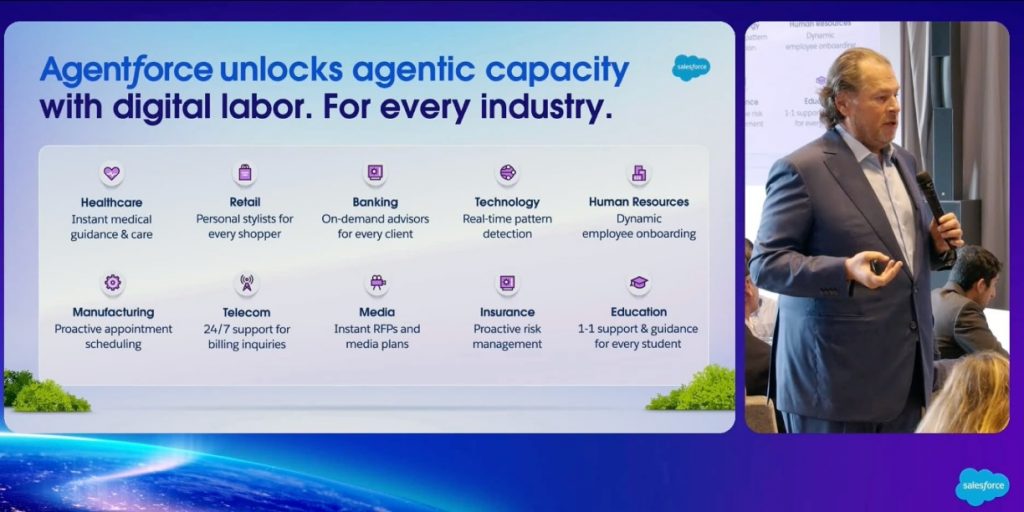
Digital Workers at Scale: What’s New in AgentForce 2.0?
The AgentForce 2.0 release promises:
An End-to-End, “Skilled” Digital Workforce: Simplified agent creation using the Agent Builder that automatically generates “digital workers” from natural language descriptions, allowing businesses to scale their digital workforce with minimal technical expertise. This includes MuleSoft’s connections to 40+ platforms like AWS, SAP, Workday, Adobe, and Oracle, streamlining data and task orchestration across ecosystems. Enterprises can add “skills” to the digital workforce, which are pre-built or customizable capabilities, allowing for easy deployment of agents for common sales, HR, customer service, IT, and industry-specific actions with minimal configuration.
Digital Workforce Deployment to Slack: Agents can operate directly in Slack, enabling enterprise-wide search, workflow execution, and contextual task management. Collaboration and communication are reimagined as agents seamlessly interact with human teams in channels and DMs. This is a direct attack on Microsoft 365’s CoPilot capability but it also creates a built-in ecosystem expanding the promise of Slack’s collaboration capabilities with an expanding digital workforce.
Enhanced Atlas Reasoning Engine: Atlas upgrades by differentiating between faster simple queries and slower complex reasoning. Improvements in metadata chunking, query reformulation, and future inline citations will improve the quality of the digital workforce’s responses and ensure transparency and trust. Atlas includes enhanced governance and security through improved policies, as governance ensures compliance, secure data access, and trustworthy operations.
Outsourcing in Crisis: DWEs Reshape Enterprise Labor Models
DWEs Can Replace FTEs: As HFS has already forecasted, Services as Software is the future of the service industry. Salesforce’s new capabilities provide for a more capable agentic AI solution to replace outsourced and in-house FTEs with a digital workforce. If workers are not completely replaced, fractional DWES will soon reduce manual workloads and support the remaining FTEs. Net result: fewer FTEs on payrolls, and more DWEs on Salesforce’s invoices.
The New Default for AI and Automation: Agentforce 2.0 positions Salesforce as a go-to platform for scaling AI across enterprises. By consolidating AI tools into one existing solution, Salesforce reduces the complexity of managing multiple service providers. Traditional development and outsourcing firms specializing in repetitive business processes, ITSM, and application maintenance will face declining demand as enterprises turn to digital labor – Marc Benioff, Salesforce’s Founder, and CEO, has pledged not to hire new development staff but instead rely on its Salesforce capabilities.
Salesforce Becomes a Vital New Ecosystem Provider: IT services already have relationships with Salesforce, and those will become more important. However, business process outsourcing vendors, especially call centers, sales teams, order entry teams, and digital marketing teams, will need to build formal partnership relationships with Salesforce to enhance their Salesforce offerings instead of building their own solutions that have a fraction of the R&D funding that Salesforce is pumping into their solution.
Salesforce Challenges Tech Giants with Integrated AI Workforce
The AgentForce 2.0 release challenges existing norms in the technology sector, creating ripple effects across software vendors, service providers, and IT ecosystems.
A Redefinition of Enterprise Platforms: Salesforce is no longer just a CRM enterprise SaaS provider—it is positioning itself as an operating system for the digital workforce. This shift forces other vendors, including AWS, Microsoft, and Google Cloud, to rethink their strategies. For example, SAP’s Joule, while included in some of its cloud offerings, is not included in its customers’ proprietary SAP HANA S/4 environments, requiring custom installation for all of its clients. If a client has Salesforce and SAP, Salesforce may be the more capable and easier implementation, relegating SAP to being a system of truth but not processing.
Platform Stickiness: By deeply embedding AgentForce 2.0 in the Salesforce ecosystem, the company strengthens customer loyalty and makes it harder for enterprises to switch to other platforms.
Shift Toward Unified Platforms: Salesforce’s ability to integrate its ecosystem (Customer 360, Data Cloud, MuleSoft, Tableau, Slack) into a single, cohesive solution sets a new standard for enterprise platforms. Competing providers with fragmented specialty tools must offer deeper integrations and more comprehensive solutions.
Pre-Built Capabilities Reduce Time to Value: With a GenAI-driven Agentbuilder and a growing list of pre-built skills, enterprises can implement AgentForce without the need for extensive coding or consulting services. While the implementation does mean new revenue sources, the ease of implementation requires fewer billable hours. It is imperative that Salesforce “global system integrators” build accelerators that Salesforce currently does not have, like industry-specific action, legacy system actions leveraging MuleSoft, and Data Cloud integrations.
Why AgentForce 2.0 Still Faces Major Hurdles
Everyone is a Microsoft Client, but Not Everyone Uses Salesforce: Salesforce has faced heavy pressure from CRM ecosystem competitors. This foray into providing enterprise-wide agentic AI drives into the heart of Microsoft, Google Cloud, and AWS’s strategies, as nearly every company has one, if not more than one, of these solutions. The hyperscalers, while leaders in cloud services and AI models, rely heavily on enterprises to build their own solutions. Salesforce’s pre-built, low-code approach drastically lowers the barrier to entry for companies, presenting a direct competitive threat – and will not go unanswered, either through direct response or through SAP and Oracle ecosystems.
Cost Model Evolution: With pricing at $2 per conversation (list price), Salesforce makes AI-driven digital labor accessible. However, questions remain about how costs will scale as usage increases across autonomous, non-conversational use cases (back office agents). Furthermore, calculating the number of transactions per DWE requires significant business governance investment.
Ecosystem Lock-In: Of course, with unparalleled convenience and integration, enterprises that adopt AgentForce heavily will become deeply entrenched in its ecosystem, raising switching costs over time. Salesforce customers are quite vocal about their escalating licensing costs.
Industry-Specific Solutions Still Lag: Salesforce still remains a largely generic set of horizontal solutions with limited industry-specific “skills.” Salesforce must continue to develop in-house capabilities to suit the needs of healthcare, insurance, banking, pharma, and many other industries, or they must develop an ecosystem of “plugins” that bring industry-specific understanding to Agentforce 2.0. In the meantime, this becomes an excellent place for service providers to invest, as they have the industry acumen Salesforce lacks.
The Bottom Line: Agentforce is Accelerating the Future of Services-as-Software
As Salesforce brings AI-driven digital workers to market, enterprises must evaluate their workforce models and outsourcing strategies. Leaders should assess how DWEs can augment their operations, drive productivity, and reduce costs—or risk being left behind in the digital labor force revolution. Furthermore, AgentForce 2.0 is not just about scaling digital labor; it’s about reshaping the technology landscape. Salesforce is positioning itself as the backbone of the AI-driven enterprise, combining ease of use, deep integration, and scalability to drive adoption – a landscape long held by hyperscalers and ERP providers. Regardless of where you sit in the ecosystem, the enterprises and the entire services industry has been served notice: service as software is coming faster than most predict. . AgentForce 2.0 is a blueprint for the future of services as software —and Salesforce is leading the charge.
Two very different worlds, one based on humans and the other on technology, are becoming one blended, scalable solution we are calling Services-as-Software. In short, the line between services and software is blurring and eventually vanishing, and this progression has become more crucial than ever.
Sixty percent of enterprises are already looking to procure services as technology offerings
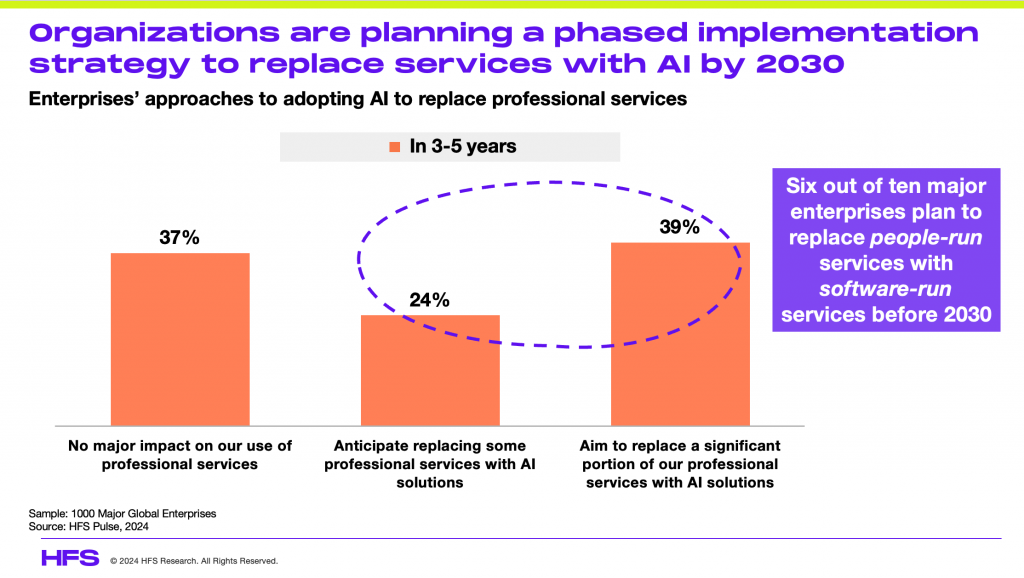
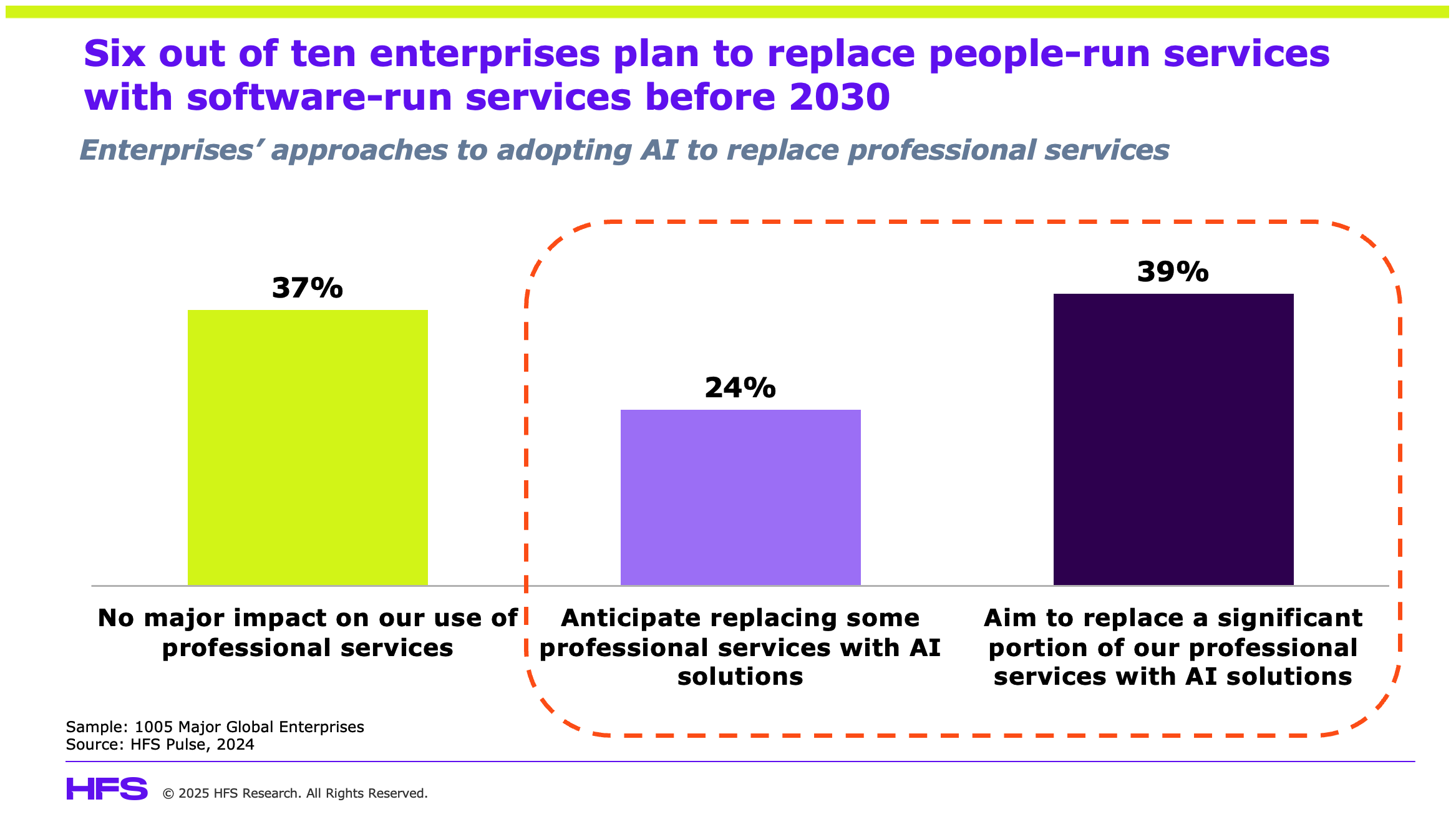
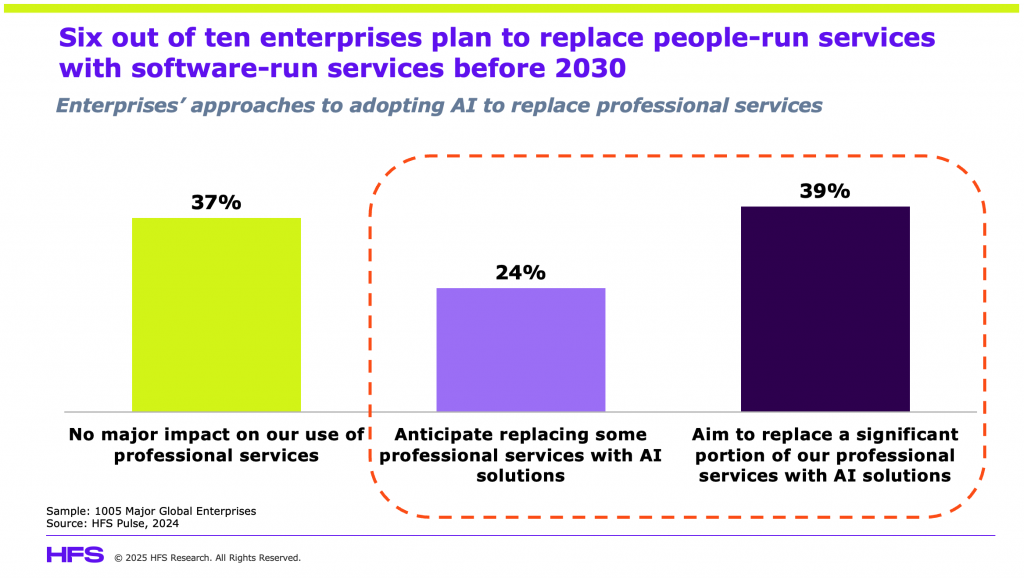
A recent HFS study of 1000 major global enterprises reveals what is happening with stark brutality: Six out of ten enterprise leaders plan to replace some or all of their professional services with some form of AI within the next 3-5 years.
Services will continue to reduce their reliance on labor as automation creates more efficiency and productivity
The reality is that most people-based services, once they become predictable and routine, eventually become automated. This increasing sophistication of AI tools is enhancing the whole service efficiency and personalization experience. Once implemented effectively, these Services-as-Software solutions become faster to manage, cheaper to maintain, and more scalable to cope with volumes of demand.
For example, fully automated passport gates at airports now allow for higher volumes of passengers to clear immigration much quicker than previously and for more airlines to land their planes at the airport. This leads to more profitability for the airport, more business for the airlines and people to enter the country more expediently. Similarly, self-checkouts at grocery and convenience stores are enabling many more customers to have their purchases processed simultaneously, securely, and faster, which creates the ability to handle volume spikes without layering on unnecessary staffing costs to cater to demand.
Software-driven services can also improve the customer and employee experience
Now the airport can redeploy its people to manage issues at the passport gate when needed, to help shepherd them into the right lines, and also to provide assistance to elderly or disabled people. The whole experience is improved. Similarly, the convenience store can redeploy its staff to help customers find the products they need, to ensure inventory is better managed, to help manage in-store promotions, and to ensure the store is kept clean and presentable. Again, the customer and employee experience should be vastly improved, and the automation of the rote work allows more focus on improving the speed and quality of the whole business proposition.
While fairly simplistic, these are current real-world examples of how software embedded in enabled machines can not only replace the dependence on people to meet outcomes, but also enable organizations to scale their services without adding linear cost. The only differences with the emerging Services-as-Software model are the improvements in botifying routine white-collar work that was previously too challenging to automate due to limited technologies such as RPA and the absence of our ability to mimic and predict human behavior with the increasing sophistication of GenAI and Agentic software.
Services and software are equally exposed to full automation and AI
Enter the world of IT and business process services, and similar trends are in play as routine IT maintenance, HR, procurement, accounting, and customer service work are becoming much easier to replicate in advancing GenAI and Agentic software, supported by public and private cloud capabilities to secure and scale transaction volumes.
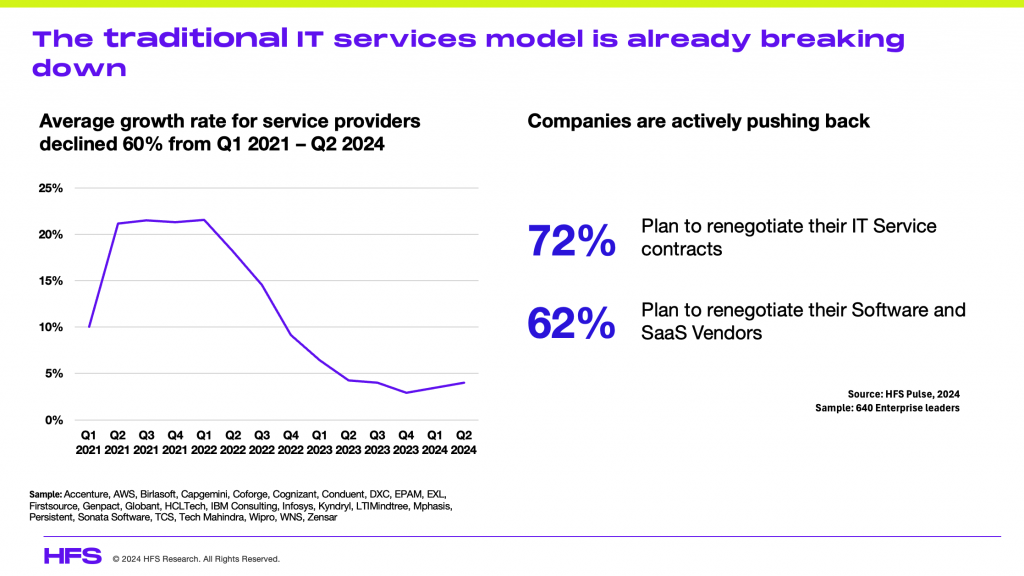
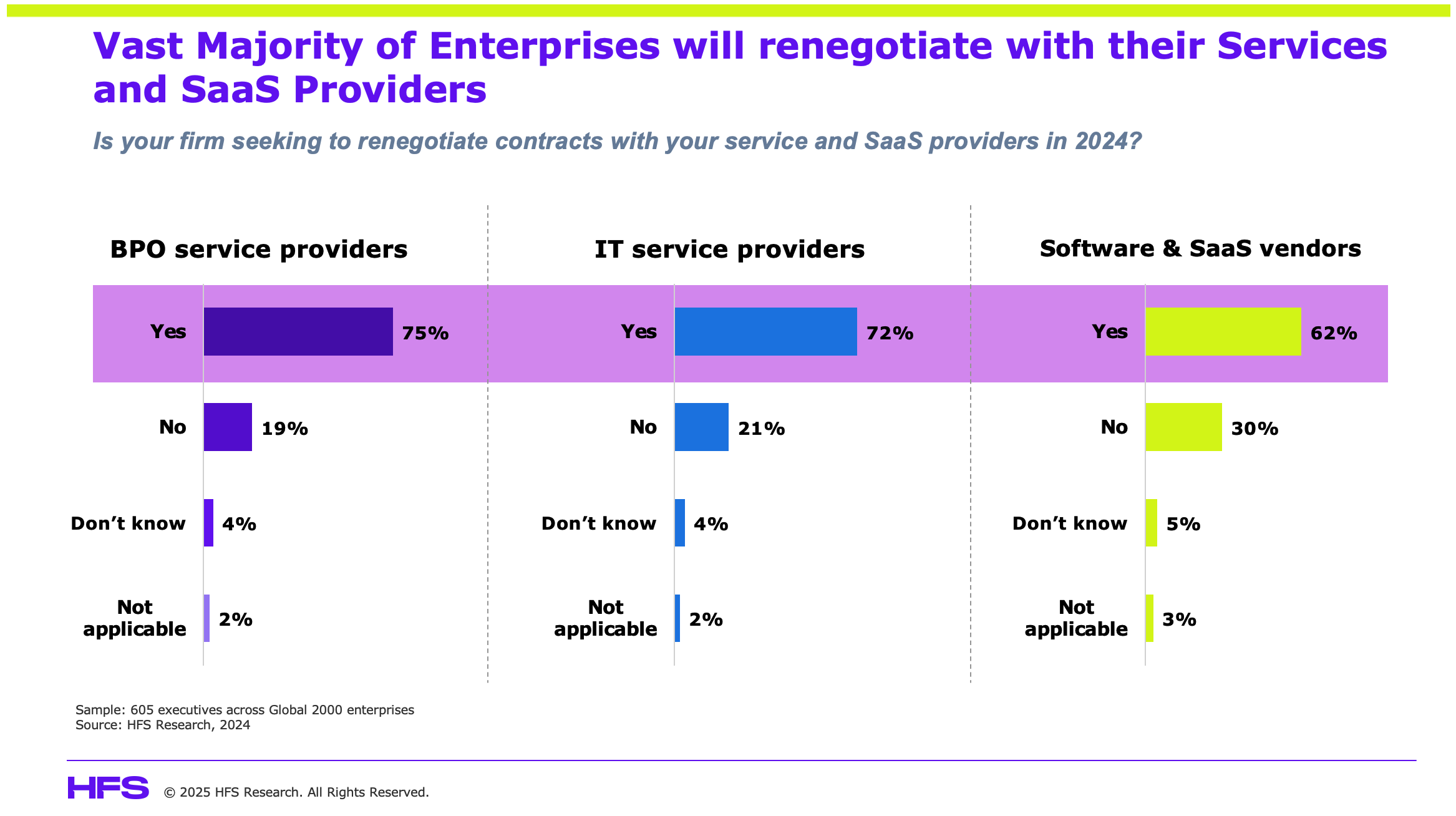
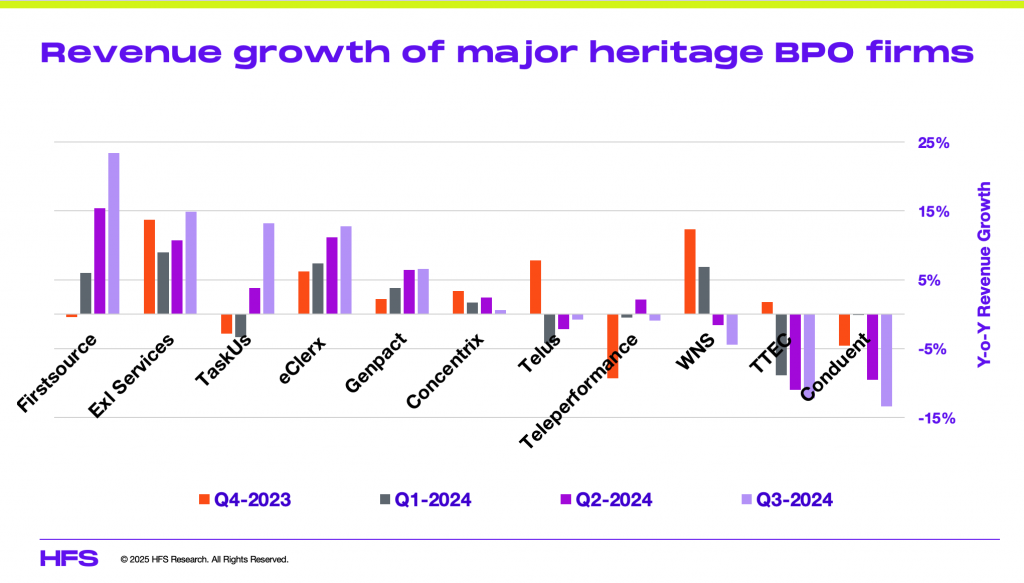
You only need to observe the rapid decline of growth in the labor-intensive services sector and the determination of enterprise customers to renegotiate both their services and software contracts to understand this dynamic is now in full swing:
Organizations face mounting pressure to deliver results faster, at scale, and with limited resources—all while managing increasingly complex technology ecosystems. The convergence of services and software meets that demand by transforming traditional consulting and outsourcing into scalable, automated solutions.
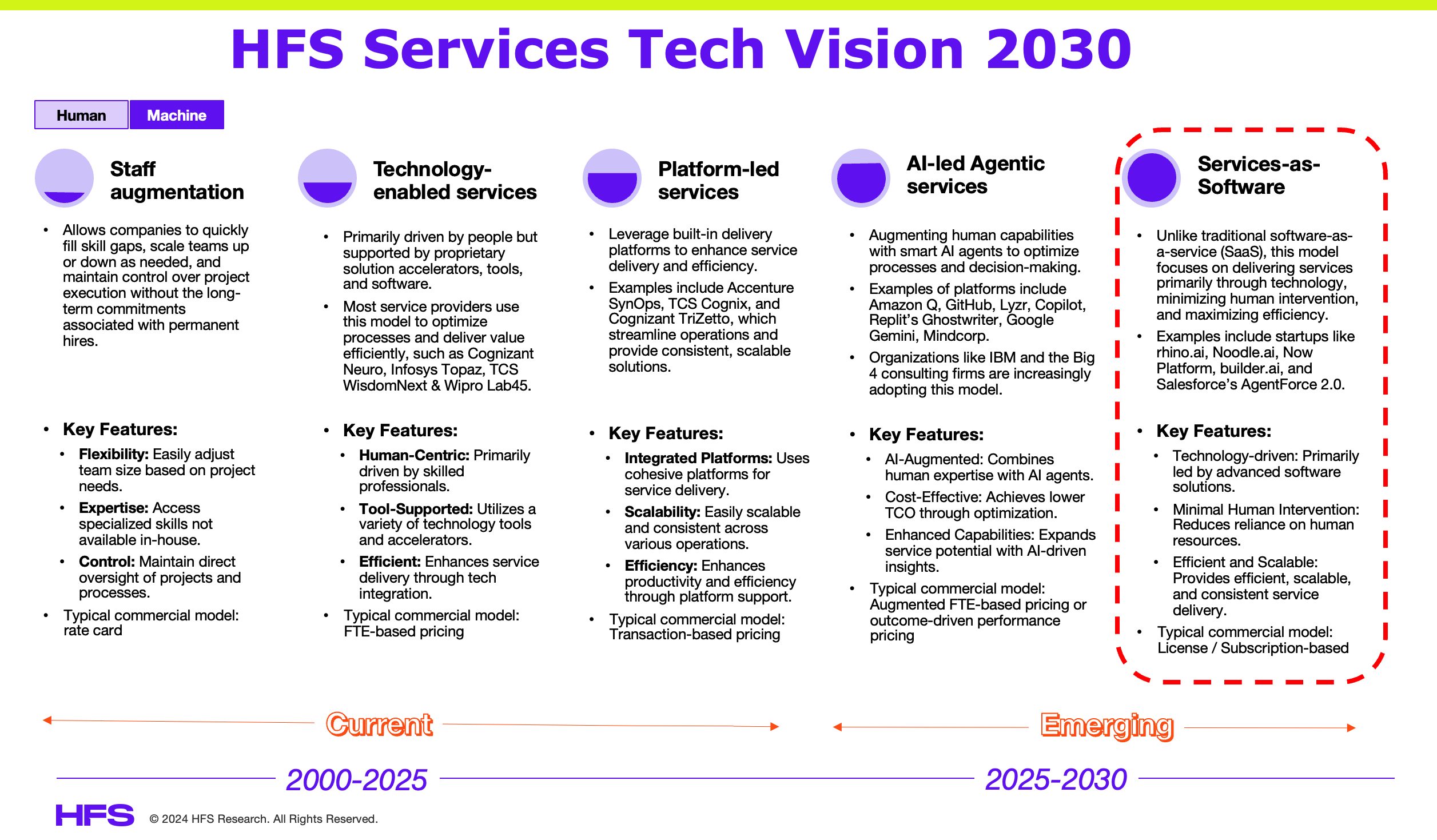
The 2030 destination is Services-as-Software, where the focus is on service provision performed by AI, not people
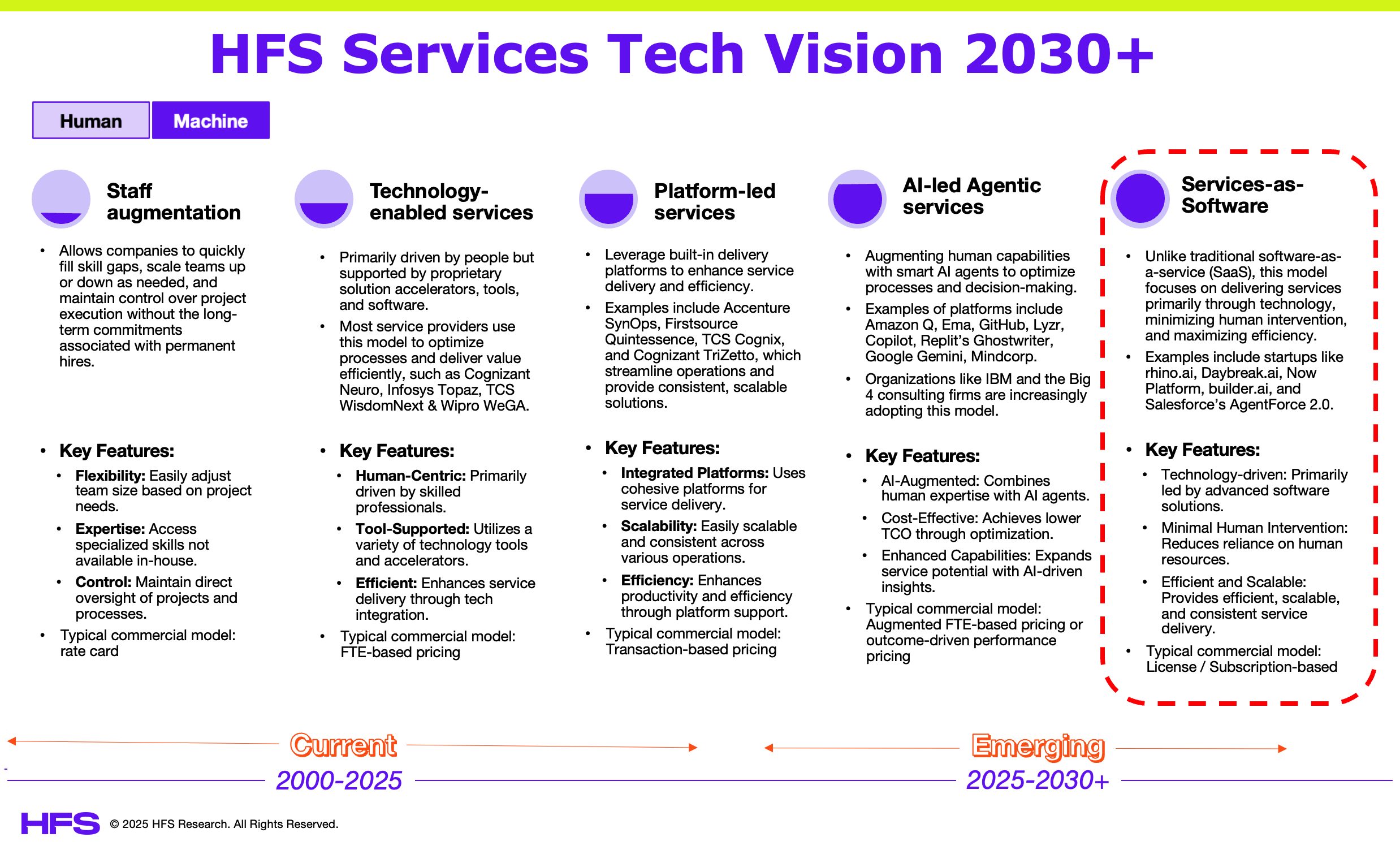
With the application of software platforms, Agentic solutions, and, ultimately, autonomous services mimicked by software, we believe we are on a fast track to reach an autonomous, human-lite nirvana of scalable, profitable, and affordable services by 2030:
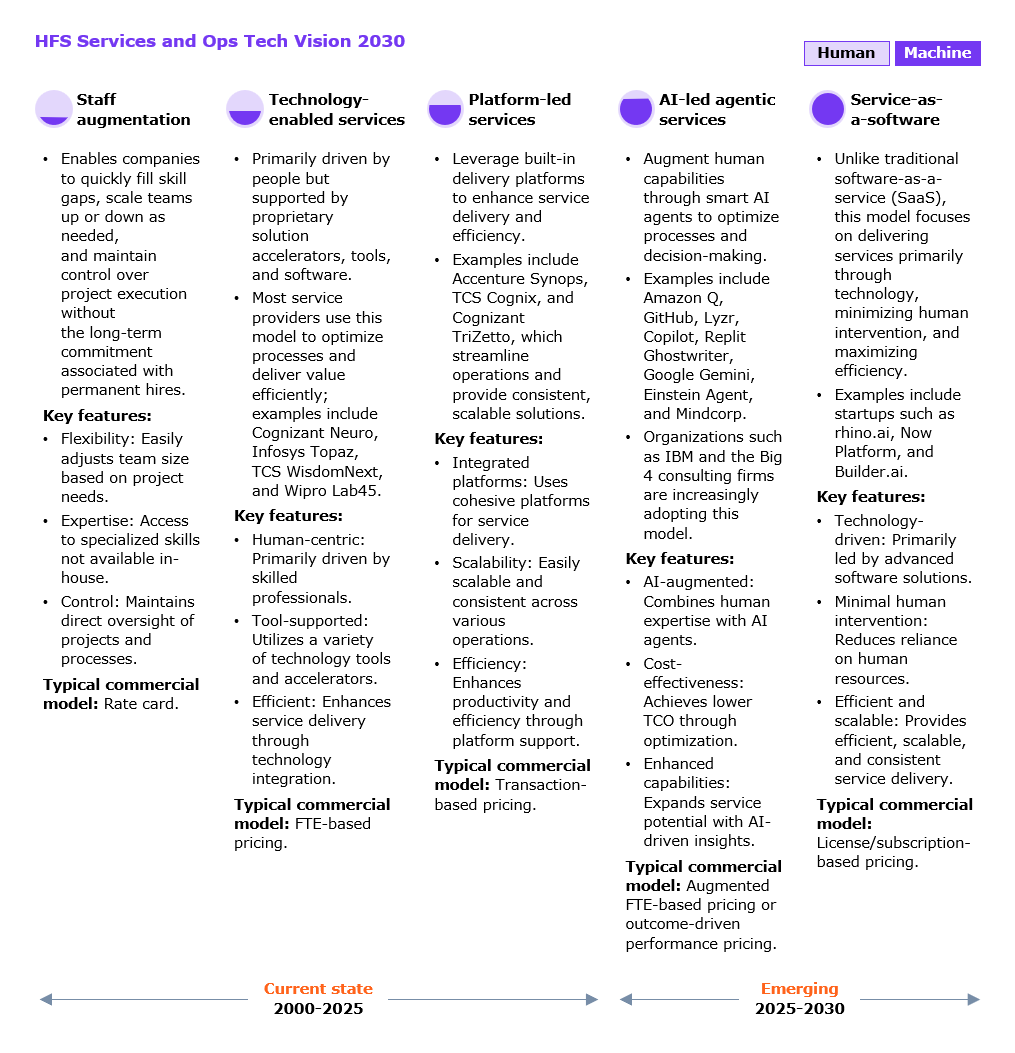
These five phases of services tell the complete story of the industry’s evolution from adding people to perform work to scaling these same people with the smart use of platforms, AI-driven Agentic tools, and ultimately fully autonomous technology-led services where work is effectively replicated at scale with embedded intelligence.
In short, we are getting more of the same work without having to spend more on that same work. Instead, we can invest that money in value-added areas that cannot be mimicked by AI. Enterprises must adapt quickly to this shift as Agentic AI can autonomously handle complex decision-making tasks. This will impact both workforce roles and the enterprise software landscape, reducing the need for repetitive, decision-heavy positions and consolidating software functions under AI-driven platforms.
How the lines between services and software are blurring
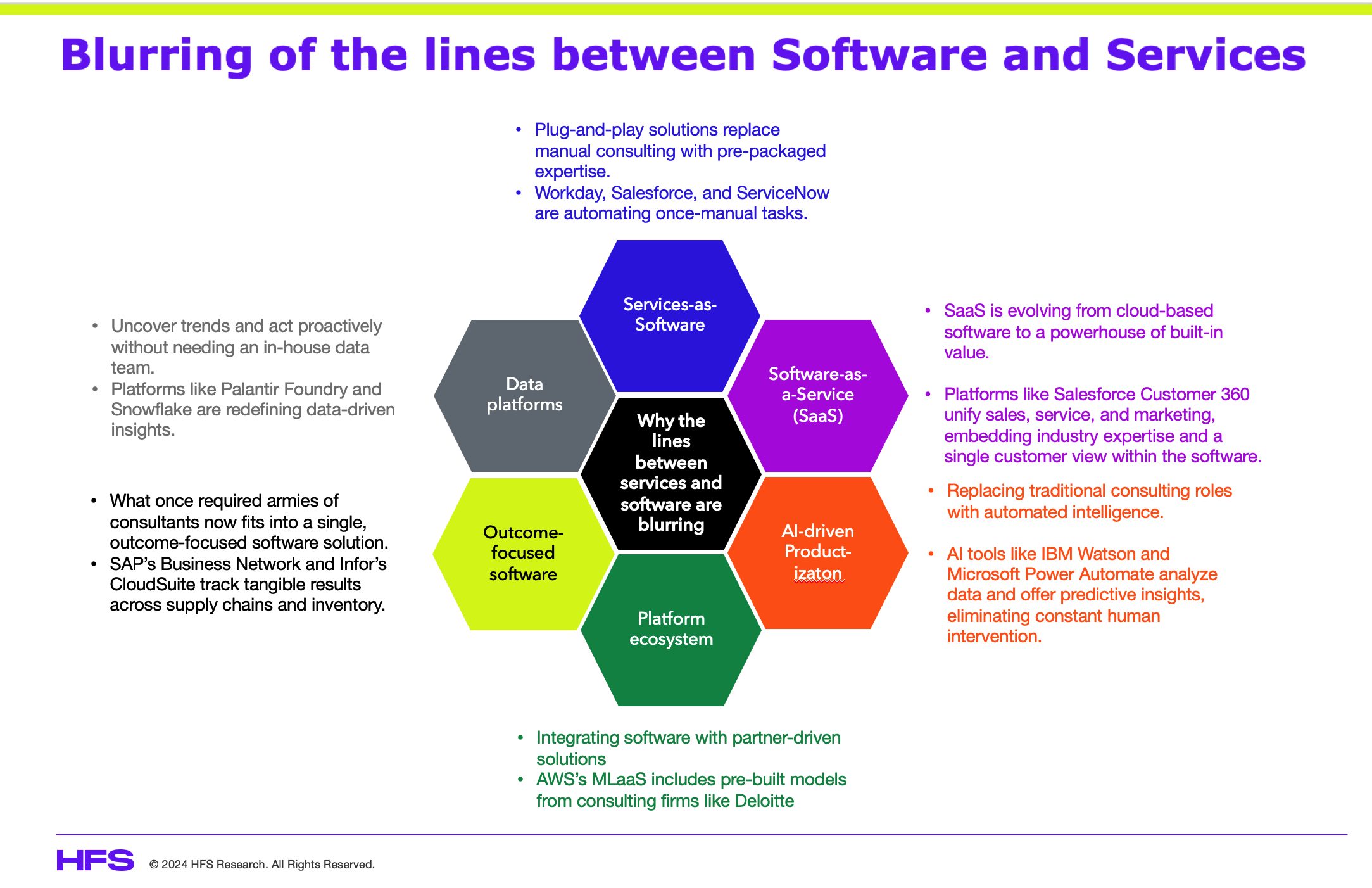
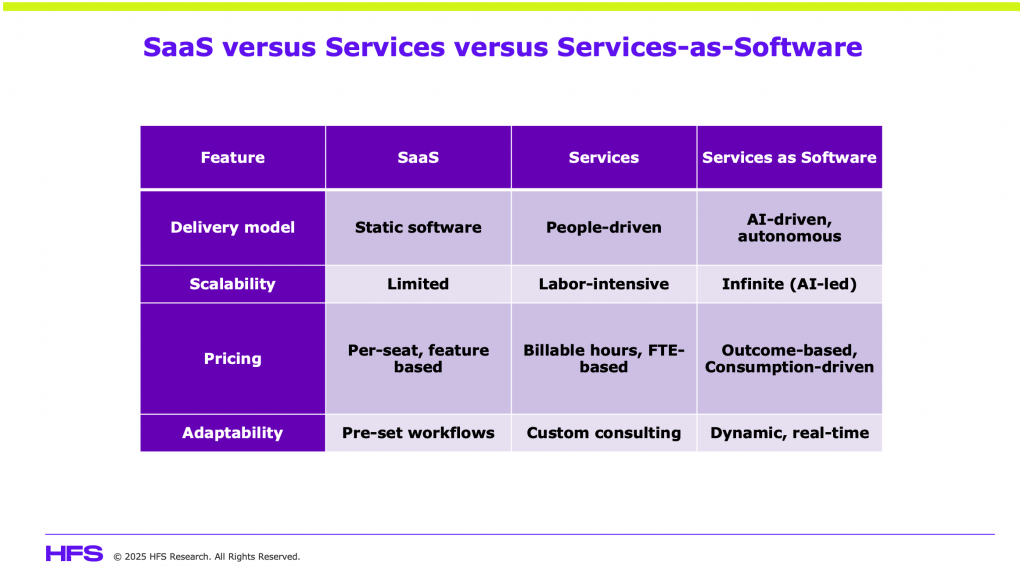
This new model (see exhibit below) allows businesses to access continuous insights, predictive analytics, and outcome-driven solutions that adapt in real-time. It’s not just about streamlining operations; it’s about fueling growth and resilience, accelerating companies ahead in a world where speed and adaptability are critical to success. Let’s explore how this is already happening at speed:
Services-as-Software (SaaS 2.0): Providers like Workday and ServiceNow are shifting from traditional consulting models to plug-and-play solutions that automate once-manual tasks. Workday’s People Analytics and ServiceNow’s ITSM are prime examples—what once required hours of consulting is now pre-packaged expertise delivering instant results.
SaaS as the New Backbone: SaaS is evolving from cloud-based software to a powerhouse of built-in value. Platforms like Salesforce’s Customer 360 bundle sales, service, and marketing insights into one, reducing the need for external CRM optimization by embedding industry-specific expertise and a single customer view across the lifecycle right within the software.
AI-Driven Productization: AI tools like IBM Watson and Microsoft Power Automate are replacing traditional consulting roles with automated intelligence. IBM Watson isn’t just a chatbot but a full-scale AI ecosystem that analyzes data and offers predictive insights, eliminating constant human intervention.
Platform Playgrounds: Ecosystems like AWS and Google Cloud go beyond tech infrastructure by integrating software and partner-driven solutions. AWS’s MLaaS, for instance, includes pre-built models from consulting firms like Deloitte, allowing its enterprise clients to tap into sophisticated AI solutions without custom builds. KPMG has invested significantly in the GenAI platform Rhino.ai to modernize legacy applications, while, and IBM has been developing out its watsonx platforms to replicate many routine business services in a one-to-many scalable delivery model.
Outcome Obsession: Companies like SAP and Infor focus on outcome-driven solutions, with SAP’s Business Network and Infor’s CloudSuite tracking tangible results across supply chains and inventory. What once required armies of consultants now fits into a single, outcome-focused software solution.
Data as a Weapon: Platforms like Palantir Foundry and Snowflake are redefining data-driven insights. Palantir Foundry continuously analyzes business data for actionable intelligence, while Snowflake’s Data Cloud empowers companies to uncover trends and act proactively without needing an in-house data team.
The Bottom-line: In this new service-as-software era, the distinction between service and software is practically erasing.
Businesses now access pre-built solutions, automated workflows, and data-powered insights, creating a seamless and scalable experience that puts the power of technology and expertise directly at their fingertips. Services firms will increasingly look to their software partners and investments to streamline and provide greater value to entrprise clients, as this GenAI ecosystem unfolds. This model doesn’t just support business goals—it accelerates them, transforming how companies achieve impact in a world where speed and adaptability are the ultimate competitive advantage.
The challenge we all face – whether we buy, sell, advise or analyze this merging of markets is changing how we articulate, commercialize and deliver outcomes. Services and software people come from different worlds and speak different languages, but now these need to come together in a way we can all understand and develop. We can’t simply buy shiny new S-a-S solutions and plug them in like we did with an ERP solution. This is where we need to define real business value, which can be delivered by AI technology and price according to that value and the desired outcomes we expect. There is a huge opportunity for service providers to guide their clients to a state where they are ready for S-a-S solutions. There is also the potential for services and software firms to merge together as this new market emerges – there are already multiple discussions and partnerships taking place that are readying for 2025 and beyond.
Welcome to the era of uncertain change, everyone… where uncertainty will breed opportunity!
Have you taken a step back to reflect on the impact of social media, AI, and the pandemic on today’s employee mindset? A work environment where isolation, loneliness, and self-entitlement have become the norm… an environment that is losing its connectedness and is becoming increasingly dehumanized.
What’s it like being in a “ME” work culture?
We live in a world that’s all about ME. We want to be loved, appreciated, adulated, respected, and credited for literally everything we do.
We want to earn lots of money, work when we want to, do what we want to, and not have a boss watching over our shoulders every day. We want ME in charge.
We want to have an opinion on pretty much everything and choose where we get our knowledge. ME has an opinion, and that’s all that matters.
We need these constant little endorphin hits when someone gives us attention, whether it’s a social media post or a call out at work. It’s all about ME… and as much as possible!
We communicate most of our time over text and talk to people less and less because we hide in our little ME cocoons. Talking to people requires effort and our full attention, and it’s not all about ME.
We have become super-sensitive to criticism. The slightest accusation or hint of negativity toward us makes us get very defensive. How dare you accuse me of not being perfect!
We repeatedly tell people all the amazing things we do so we can constantly get credit. Why wait for praise when we can just praise ME?
We invest our time in people who can advance our ME agendas.
We avoid people who have little to offer ME.
We spend less social time with our colleagues because team bonding is not very important to ME.
We spend time learning new things that interest ME, not things we need to learn about to further our work skills and knowledge.
We rarely work evenings or weekends anymore. ME doesn’t need to go over and above unless it benefits ME.
We “like” things on social media to further our ME network and never bother to read the articles. The authors should be genuinely grateful for our endorsements because they are from ME.
It’s really all just about ME, ME, ME!
“ME” is the world we live in, but we need to focus more on “US” to improve work culture
Can you really blame employees for feeling dehumanized when their bosses keep pontificating about bots and agents replacing and augmenting their work activities? Can you blame them for feeling lonely and isolated at home, performing mundane activities with little outlet to enjoy themselves? Can you blame them for needing recognition and appreciation for being human in an environment where there is so much focus on meeting metrics, reducing costs, and sucking the very humanity out of the workplace with constant technology upgrades and new deployments?
People don’t suddenly decide to become selfish. This is a product of these dehumanizing dynamics in the work environment, which results in people crying out for affirmation and a sense of connectedness that is missing from our work lives.
Bottom-line: We must reverse this culture, but it will take a lot of refocusing
I would love to provide a definitive guide to employers and employees on how to make our work environments more connected, but this is a blog, not a detailed guide to HR, so I’ll leave you with three simple activities to get back on the right track:
Let’s get to know each other better. Get off the Team, Zoom, Slack, whatever text system we use for company communication and call each other up. Get to know each other as HUMANS again and not as mere work colleagues who provide a means to an end. We don’t even need to like each other but just behaving like humans and not text-generating cyborgs is a huge step to improving our connectedness and work culture.
Focus on work as a positive, not a negative experience. It’s so easy to be negative; we all go there, and it’s not a great place to be. When you feel negativity coming knocking, take a step away and rethink why you are feeling this way. Staring at a screen 10 hours a day is just bad for your brain, your eyes, and your health and saps your energy and enthusiasm. So take more breaks in the day, go for a walk, hit the gym, or just call someone up to talk.
Spend less time on social media. I am not the patron saint of this, but so many people are wasting an inordinate amount of time seeking their little endorphin hits and not getting any actual real value from this. Unless you have something profound to share with the world, why spend half your day just trawling through digital junk when you can spend more time improving your own work or client relationships just by talking to them? Social media can be a great thing for developing your network etc., but there is a line between some networking and just wasting hours a day on this mind-numbing activity.
HFS research has found that the average time for a bank to onboard a new commercial customer is 32 days. Not hours. DAYS. The rapid and often real-time digital interactions and journeys enjoyed in the retail banking domain have not permeated the commercial banking realm – despite the fact that commercial clients are typically banks’ highest-value clients.
As commercial banks strive to meet the broad B2B needs of small and medium enterprises, commercial clients, and corporates, they need to seriously up their digital game. This means something totally different and far more complex in the B2B arena. A sexy app does not win the day in commercial banking. Commercial banks must balance foundational modernization initiatives between practical platform solutions and custom builds—all in the name of enabling 360 visibility of working capital and real-time everything. Service provider partners have a critical role to play in enabling this future reality.
Who are the best service providers for commercial banks?
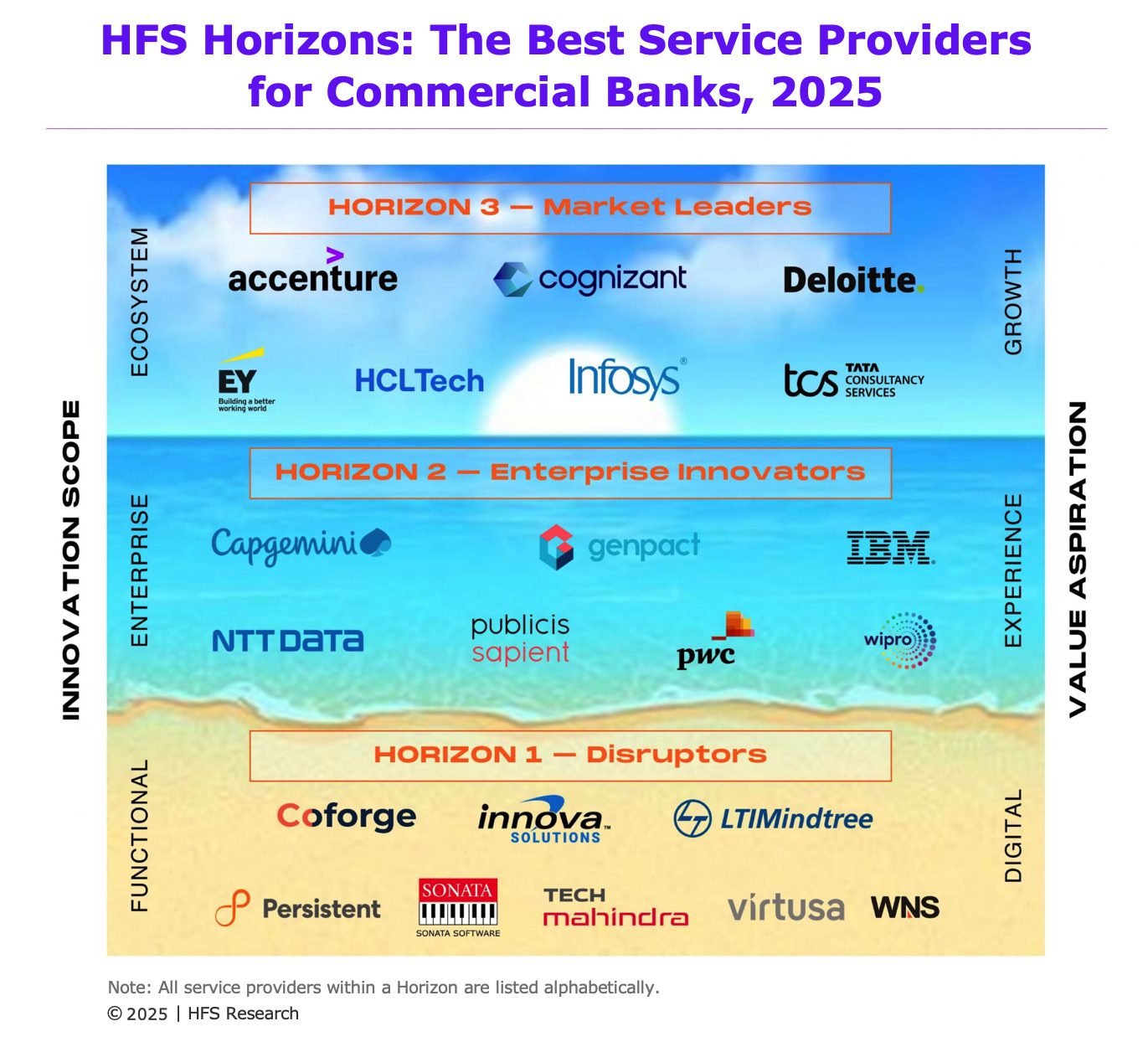
HFS conducted a deep-dive Horizons Study into the needs of commercial banks and the best IT and business process service providers to support them.: HFS Horizons: The Best Service Providers for Commercial Banks, 2025. This report evaluates the capabilities of 22 service providers across the HFS commercial banking value chain based on a range of dimensions to understand the why, what, how, and so what of their service offerings. It assesses how well service providers are helping their commercial banking clients worldwide embrace innovation and realize value across three distinct Horizons: Horizon 1, optimization through functional digital change; Horizon 2, experience through end-to-end enterprise transformation; and Horizon 3, growth through ecosystem transformation (Exhibit 1).
Exhibit 1: The HFS Horizons model helps commercial banks pick their service providers based on desired outcomes
We assessed these 22 service providers across their value propositions (the why), execution and innovation capabilities (the what), go-to-market strategy (the how), and market impact criteria (the so what). The seven (7) Horizon 3 market leaders are Accenture, Cognizant, Deloitte, EY, HCLTech, Infosys, and TCS in alphabetical order. These service providers have demonstrated their ability to support commercial banks across the journey—from functional digital transformation through enterprise-wide modernization to creating new value through ecosystems. Their shared characteristics include deep industry expertise across the commercial banking value chain, a full-service approach across consulting, IT, and operations, a strong focus on innovation internally and externally with partners, co-innovation with clients and partners, and proven impact and outcomes with commercial banking clients around the world. While these seven firms prevailed as Horizon 3 market leaders, we underscore the fact that there is value to be had at each horizon based on the needs and desired outcomes of commercial banking clients.
Key trends in commercial banking – change is hard and expensive
The enterprises and service providers interviewed for this study painted a clear picture of a market in need of modernization but mired in extenuating circumstances that impact budgets and solution extensibility. HFS notes three major trend themes:
Macroeconomic mixed bag. Inflation and high interest rates have yielded good news/bad news scenarios in commercial banking. The good news has been that there was money to be made in the first rising interest rate economy in the past 15+ years. However, volumes were down as the cost of loans was high. Combine this with the steep competition for deposits, which forced commercial banks to offer attractive interest rates, thinning their net interest margins.
CX in commercial banking is unique. Retail banking CX is flashy B2C. In commercial banking, it’s a B2B paradigm that requires 365x24x7 capital clarity. Commercial clients want simplified, connected access and straight-through transactions. Banks are meeting this need by balancing digitalization with personalized service—using digital tools to enhance in-person interactions, enable self-service, and deliver best-in-class onboarding among others. The 2025 wish list includes 360 liquidity across banks and real-time everything.
Build AND buy to modernize. No commercial bank wants to build a custom or highly customized lending platform for treasury or trade finance among other functions. Witness the rise of COTS (commercial off-the-shelf) in commercial banking. However, for modernization needs—where there is no easy platform upgrade—commercial banks are building various digital, API-enabled solutions to extend the functionality of legacy systems that are not ready to be retired.
What commercial banks want from service providers
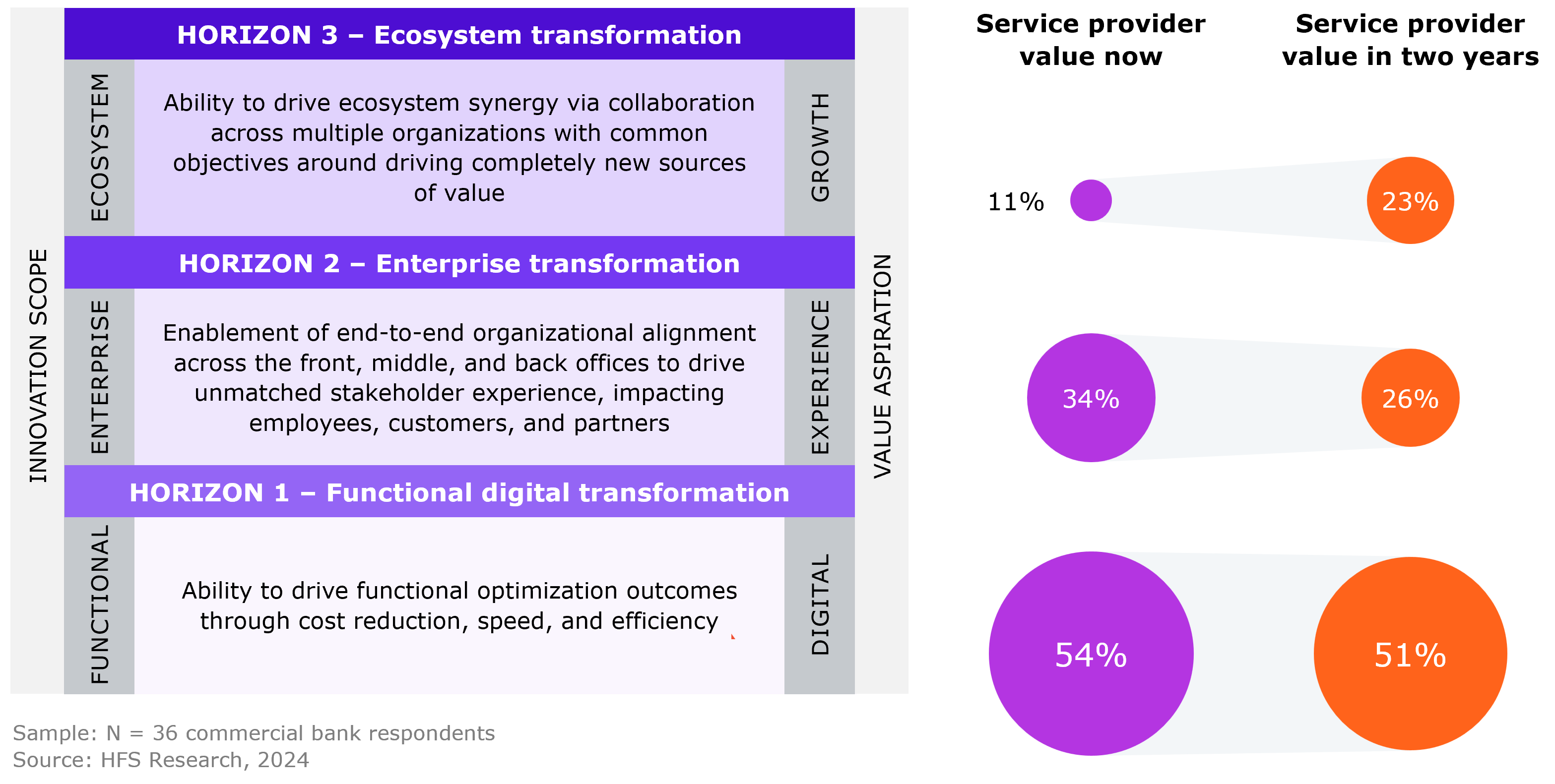
The HFS Horizons model aligns closely with enterprise maturity. We asked commercial banking leaders interviewed as references for this study to comment on the primary value their IT and business service provider partners deliver today and are expected to deliver in two years. Respondents indicated that the primary value realized today is largely Horizon 1—functional digital transformation focused on digital and optimization outcomes (54%). In two years, the focus will continue on digital and optimization outcomes (51%), as the industry strengthens its digital hygiene to better serve large customers while also expanding to effectively cater to small and medium enterprise (SME) clients (Exhibit 2).
About a third of commercial banks are currently tapping their service providers to support enterprise transformation (34%). While modernization needs abound, this focus will be downplayed in 2025. The biggest value shift in the next two years is to Horizon 3 initiatives. Commercial banks want to leverage their modernization initiatives to help them expand their footprint and increase their relevance to commercial customers with broader liquidity offerings, non-banking services, and other ecosystem plays. Commercial banks must choose their partners based on the value they seek; incumbents may be the convenient choice, but they must demonstrate updated and relevant value.
Exhibit 2: Commercial banks prioritize improving digital hygiene to reduce costs, improve operations, and elevate customer experience
How service providers are meeting the needs of commercial banks
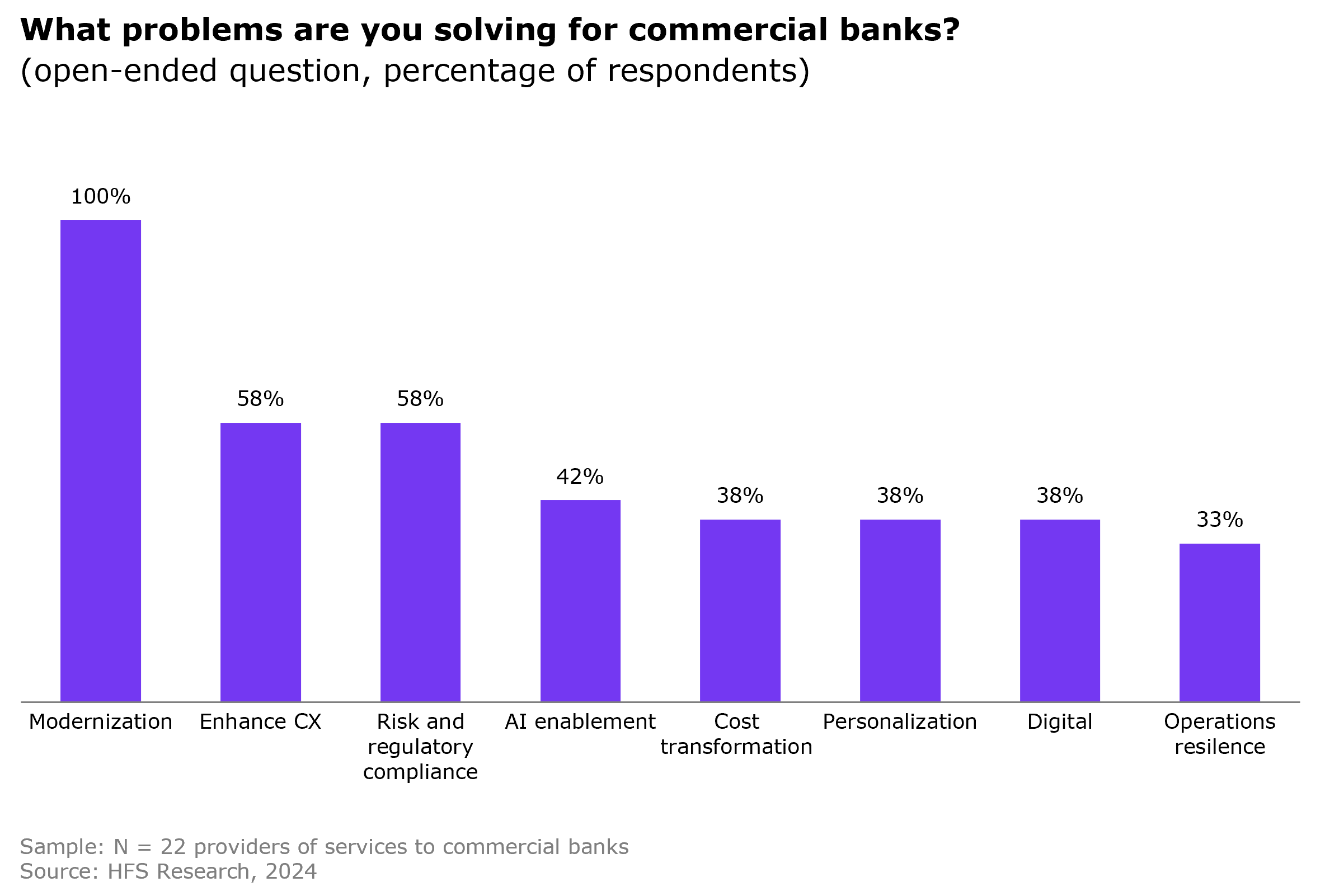
As commercial banks evolve and mature across the Horizons, service providers are on point to support these ever-changing needs. In our study, we found strong alignment between commercial banks’ digital and modernization initiatives (Horizons 1 and 2, respectively) and the fastest-growing service offerings from providers. Modernization, CX, and risk and regulatory compliance ranked as the top solutions meeting the needs of commercial banks (Exhibit 3). Modernization initiatives take many forms, but there is a strong focus on platform implementations for functions such as commercial lending and trade finance. CX in commercial banking is a B2B focus and requires more than great interactions—it includes elements such as faster customer onboarding, real-time payments, better cash management to enable real-time liquidity views, and faster credit decisions for lending. Enhanced customer onboarding was a top case study, as were nCino implementations for lending modernization. Risk and regulatory compliance is perpetual, and there’s still work to be done on optimizing these functions, particularly with AI. We’ll see what the incoming American federal government administration has in store for regulations in 2025.
Exhibit 3. Service providers’ top commercial banking offerings
The Bottom Line: Modernization is essential for commercial banking success in 2025
Commercial banking customers want digital experience: Commercial banks own the high-value relationships within their firms, but they must play catch-up with their retail banking siblings, shifting from manual processes and a people-led engagement running on legacy tech to seriously up their digital CX game. The competition is intense, with commercial clients diversifying their relationships across banking institutions and non-bank lenders and nimble fintechs gaining ground. Congruent priorities around customer experience, new business models, and enablement of better business transactions necessitate modernization to secure each bank’s future—goals that commercial banks can achieve with the help of their service provider partners.
Have you been taking your FOBO pills? Because without a healthy Fear Of Becoming Obsolete, you will likely end up in a dark place, desperately searching for someone to buy what you’re selling.
Cutting to the chase, if you think enterprise software and services will look anything like they do today in the future, you’re delusional.
SaaS is a bloated, overpriced mess that forces companies to pay for features they don’t need.
IT Services and Consulting are a glorified human labor business masquerading as innovation.
CIOs are still spending billions on static tools and labor-heavy services when AI-first solutions can do far more for a lot less.
Talk to any C-Suite leader worth their salt, and they will tell you they are sick of spending more and more every single year on the same old software licenses and hiring more and more services people to make them work. This world cannot continue spending on low-value technology in perpetuity.
Why and how Services-as-Software will rewrite the enterprise tech playbook
Traditionally, software vendors have dominated the strategic sale of outcomes, while service providers have sold the tactical rollout of the software to reach these outcomes. The big challenge is for software firms to focus more on the tactical “how to” and services firms to be more relevant with the strategic “why.” This is an unprecedented time in technology history where outcomes, dreams, and tactical delivery are becoming one, and we don’t yet know who the clear winner will be.
Enter Services-as-Software—an AI-first, automated service layer that’s coming to obliterate everything in its path. No more billable hours. No more clunky SaaS.
That’s the HFS 2030 Vision—where we first coined the term Services-as-Software. A world where enterprises stop buying static technology and people-intensive services and instead consume AI-powered, outcome-driven solutions that continuously evolve and adapt to changing business requirements.
This isn’t a subtle shift. It’s a full-scale re-invention of enterprise technology as we know it. We’re already experiencing a secular change in how we buy, deploy, and consume technology, both in our professional and personal lives. The key is to stop clinging hold of the way we used to engage with tech and embrace the new before we become obsolete in the workplace. The old world of bloated spending on bad SaaS and bloated labor-based support deals is firmly in the past.
To reiterate this trend, HFS’s pulse survey of over 600 enterprise decision-makers reveals more than two-thirds of enterprises are frustrated with both their software and services investments and are primed to renegotiate their current contracts as they search for alternatives:
Enterprise software promised efficiency but delivered clutter for decades. Packed with unnecessary features, it overwhelms users instead of empowering them. Pre-configured workflows assume businesses operate in predictable, linear ways, yet real-world challenges demand adaptability and agility. And despite the never-ending hype of automation, most software still relies on expensive consultants to stitch it together—turning “plug-and-play” into “pay-and-pray.”
Services are a scam—overpriced, slow, and labor-heavy
Consulting firms claim to sell expertise, but too often, they peddle generic templates disguised as bespoke solutions. The game is simple: create complexity, then charge clients to navigate it. Efficiency isn’t in their business model—hours billed are the real product. Organizations don’t pay for results; they pay for human effort, endless PowerPoints, and the illusion of transformation. In short, complexity has kept consultants and C-suite executives in jobs for decades as they tacked decade-long ERP rollouts, cloud migrations, and data transformation initiatives.
In a world that demands agility, both software and services are holding businesses back. It’s time for something better.
A brand new category of “Services-as-Software” is emerging
Services-as-Software eliminates this current BS—blending automation, AI-driven decision-making, and outcome-based pricing to finally deliver what enterprises need.
Like services, it delivers expertise and decision-making.
Like software, it is automated, scalable, and subscription-based.
But unlike traditional SaaS and Services, it is adaptive, continuously learning from data to optimize processes in real time.
No wonder 6 out of 10 enterprises expect to replace at least some of their professional services with AI-driven solutions:
Forget configuring software. Forget hiring a bunch of consultants. Services-as-Software is the new model. It’s AI-first, service-led, and autonomous:
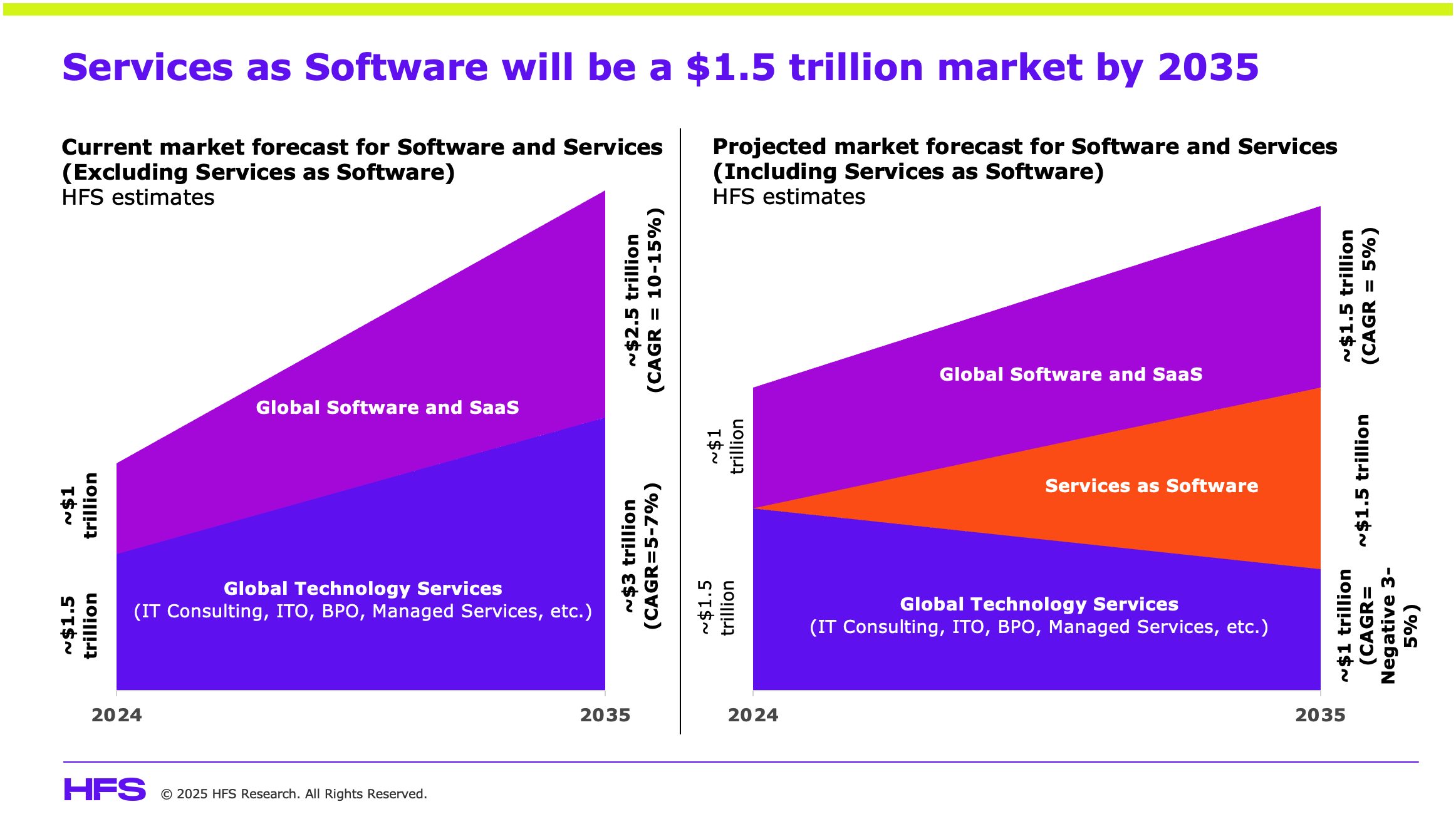
Services-as-Software will become a $1.5 trillion market by 2035, absorbing revenue from both traditional IT services and SaaS
By 2035, HFS projects Services-as-Software to grow into a $1.5 trillion market, absorbing revenue from both traditional IT services (which will shrink) and Software & SaaS (which will evolve and grow but at a slower rate):
These are our high-level projections based on several critical assumptions about enterprise technology adoption, AI progress, and industry transformation:
Services-as-Software will erode traditional IT services revenue. IT services revenue (around $1.5T in 2024) will decline as AI-driven services replace traditional labor-intensive work in areas like IT outsourcing, BPO, and consulting. Many traditional services will become productized and subscription-based, leading to fewer billable hours and lower revenue from human-led services.
SaaS growth will continue but at a much slower pace. SaaS growth (from around $1T in 2024 to $1.5T in 2035) will not just be from traditional SaaS licensing but from AI-powered, adaptive services. Software vendors will increasingly monetize AI-powered service layers instead of static software licenses.
Services-as-Software will become a $1.5T category. New spending will not be incremental but will come at the expense of traditional services and software markets. Enterprises will stop hiring as many IT consultants and will move away from feature-based SaaS toward outcome-based AI solutions.
AI innovation will drive down costs, increasing adoption. The cost of AI will continue to decline, making AI-driven services cheaper and more accessible for enterprises of all sizes. Open-source AI models will accelerate adoption of Services-as-Software by reducing development and implementation costs.
Agentic AI and “DeepSeek” inspired AI innovations will accelerate the shift to Services-as-Software
Agentic AI is emerging as the backbone of Services-as-Software. AI systems that autonomously take action make decisions, and continuously learn will drive the transformation of software and services into intelligent, self-operating solutions. Unlike traditional SaaS, which relies on pre-defined workflows and manual configurations, agentic AI learns, optimizes, and executes in real-time, eliminating the need for enterprise software licenses. Businesses will no longer need to buy and configure ERP, CRM, or other SaaS platforms; instead, AI agents will autonomously manage processes, analyze data, and take proactive actions (at least the easy ones) without human intervention.
The same shift will disrupt traditional service models like IT consulting, BPO, and professional services. Rather than hiring consultants to analyze data or outsourcing tasks to human workers, agentic AI will monitor operations, self-optimize workflows, and make business decisions in real-time—reducing dependency on billable hours and manual labor. The future of enterprise technology isn’t about AI-assisted work; it’s about AI-led execution. A future is emerging where businesses won’t need to buy software or hire service providers for everything—they will consume fully autonomous AI-driven solutions.
If you leave aside the geopolitics and the “AI cold war” between the US and China, DeepSeek’s recent AI advancements will also accelerate the movement toward Services-as-Software. DeepSeek’s underlying engineering innovations promise to make AI-powered solutions cheaper, more efficient, and widely accessible, accelerating the shift toward Services-as-Software. AI at lower costs enables cutting-edge capabilities at a fraction of traditional development expenses. Open-source AI is also democratizing access, allowing enterprises of all sizes to integrate powerful AI-driven solutions without prohibitive costs. Meanwhile, real-time expert reasoning is revolutionizing decision-making as AI increasingly replicates the expertise of human consultants, reducing the need for traditional advisory services. This shift levels the playing field, enabling even small businesses to harness AI-driven intelligence, accelerating adoption, and driving industry-wide disruption.
CIOs: It’s time to completely rethink your IT budget
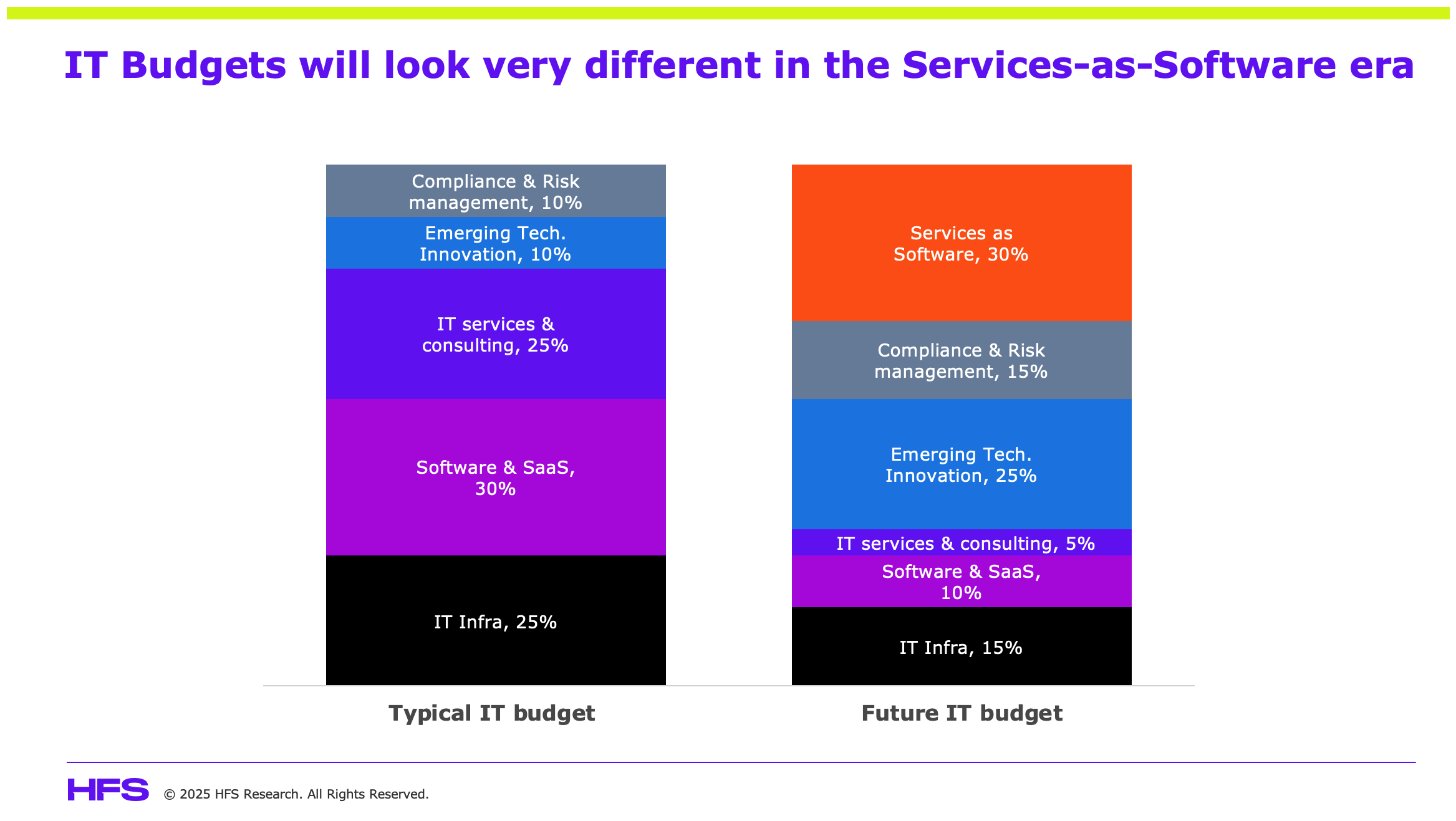
A large enterprise typically allocates its technology budget across multiple categories, including IT infrastructure, software, services, innovation, and compliance. However, with the rise of Services-as-Software, this spending will shift from fixed investments in software licenses and human-driven services to AI-powered, outcome-based models (See Exhibit 4). AI-driven services will replace traditional workflows, dynamically adapting to business needs and optimizing processes in real-time:
Services-as-Software becomes a major IT spend. Nearly a third of IT budgets will shift toward AI-powered service layers that replace static workflows with real-time intelligence. Spending on AI-as-a-Service will grow, covering automated advisory, compliance, and decision-making. Investments in AI-native process automation will replace traditional SaaS workflows, with outcome-based pricing models replacing per-seat software licensing.
Increased investment in security, compliance, and governance. AI-enabled cybersecurity and automated compliance will become critical budget priorities. Regulatory technology (RegTech) spending will surge as businesses strengthen AI governance to meet evolving compliance requirements.
Growing budget for emerging technology & innovation, Enterprises will increase spending on cutting-edge technologies beyond AI, including quantum computing, edge computing, blockchain, IoT, digital twins, and who knows what else! The focus will be on integrating these technologies into AI-powered platforms to drive competitive advantage.
Key Areas of IT Budget Decline:
Shrinking IT services & outsourcing spend. AI-driven automation will significantly reduce reliance on traditional IT support, consulting, and application development. The demand for outsourcing contracts will decline as no-code/low-code AI solutions take over maintenance and customization.
Declining enterprise SaaS spending. Businesses will move away from large, rigid SaaS contracts (e.g., Salesforce, SAP, Oracle) in favor of AI-driven, flexible, outcome-based platforms that continuously adapt to business needs.
Infrastructure costs shift to AI-optimized cloud consumption. Traditional cloud spending will give way to AI-optimized compute environments, allowing enterprises to dynamically adjust workloads for greater efficiency and cost savings.
As AI and other emerging technologies reshape the enterprise landscape, IT budgets will prioritize intelligence over infrastructure, automation over manual processes, and outcomes over effort—accelerating the shift toward a fully AI-powered and innovation-driven operating model.
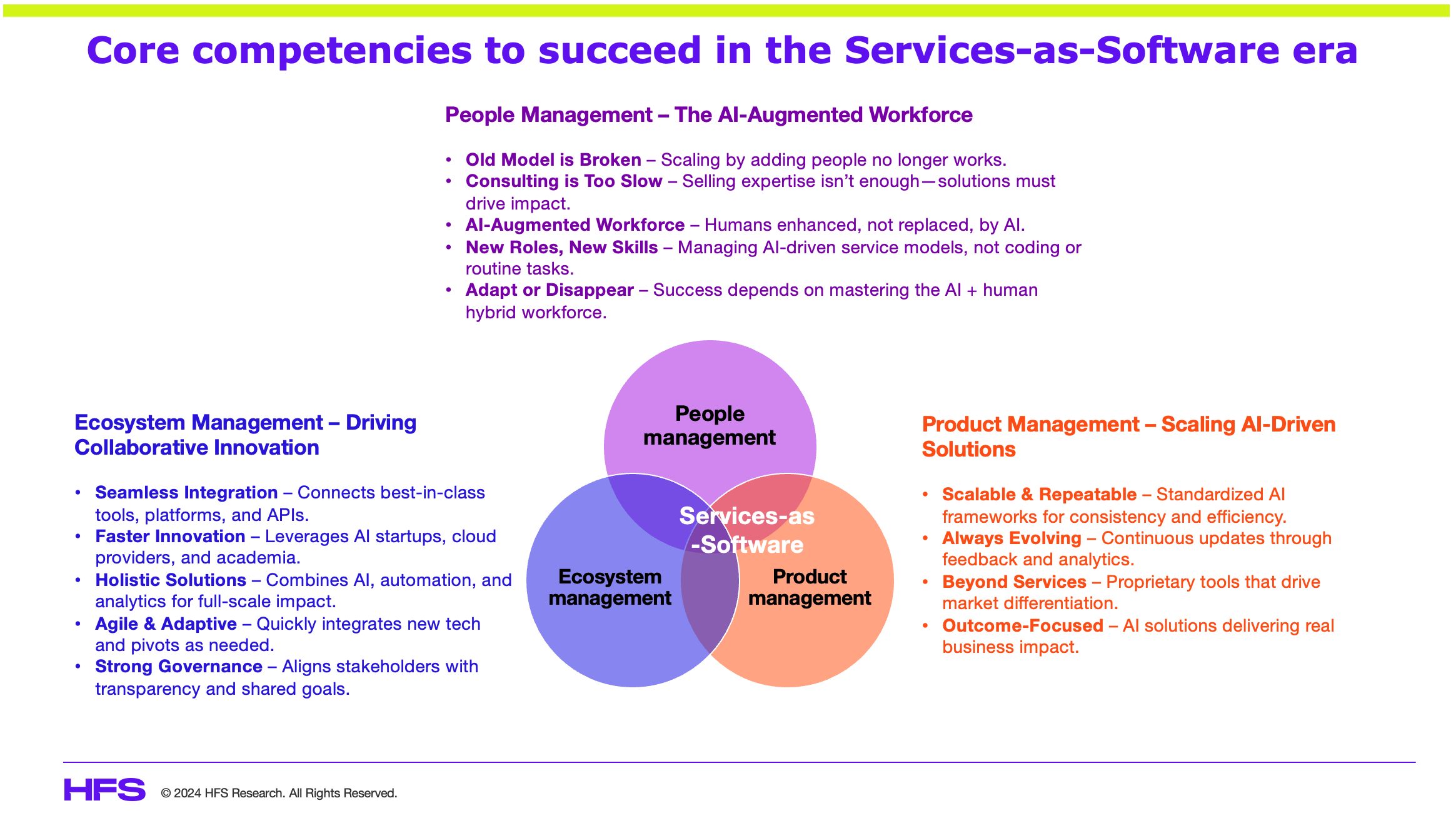
Who will win? The Providers who can master People, Products, and Ecosystems
Traditional IT services firms don’t know how to build scalable products. Traditional SaaS vendors don’t know how to deliver real-world services. Ecosystem building is not considered a core competency by either. The winners in the Services-as-Software era will be those who master all three core competencies:
The Bottom line: Services-as-Software is not a death knell for service providers and software vendors. It’s the $1.5 trillion opportunity of our lifetime
As the lines between software and services blur, traditional tech providers can finally crack open the $1.5 trillion services market, while service firms can escape the FTE trap and regain hockey-stick growth. But the winners won’t be those who cling to outdated models—they’ll be the ones who fuse AI, automation, and expertise into scalable, outcome-based solutions.
This isn’t the end. It’s the biggest revenue shift in enterprise technology history. A brand new category is on the horizon. The big question is—who will seize it? That is yet to be seen…
Prepare for a breakthrough year in the Generative Enterprise—powered by the potential of agentic AI to deliver end-to-end, self-improving, cross-silo processes to achieve business outcomes, the promise of deregulation, and greater access to the infrastructure of the Stargate program, and a new wave of LLM innovation exemplified by China’s DeepSeek.
There has never been more urgency to find the right services partner to match your firm’s ambitions. Our Generative Enterprise Services Horizons report 2025 identified several trends: how service providers are meeting enterprise needs, effectively training people, what enterprises need more of from their service partners, and what customers and partners have to say about their service experiences.
Who are the best Generative Enterprise service providers?
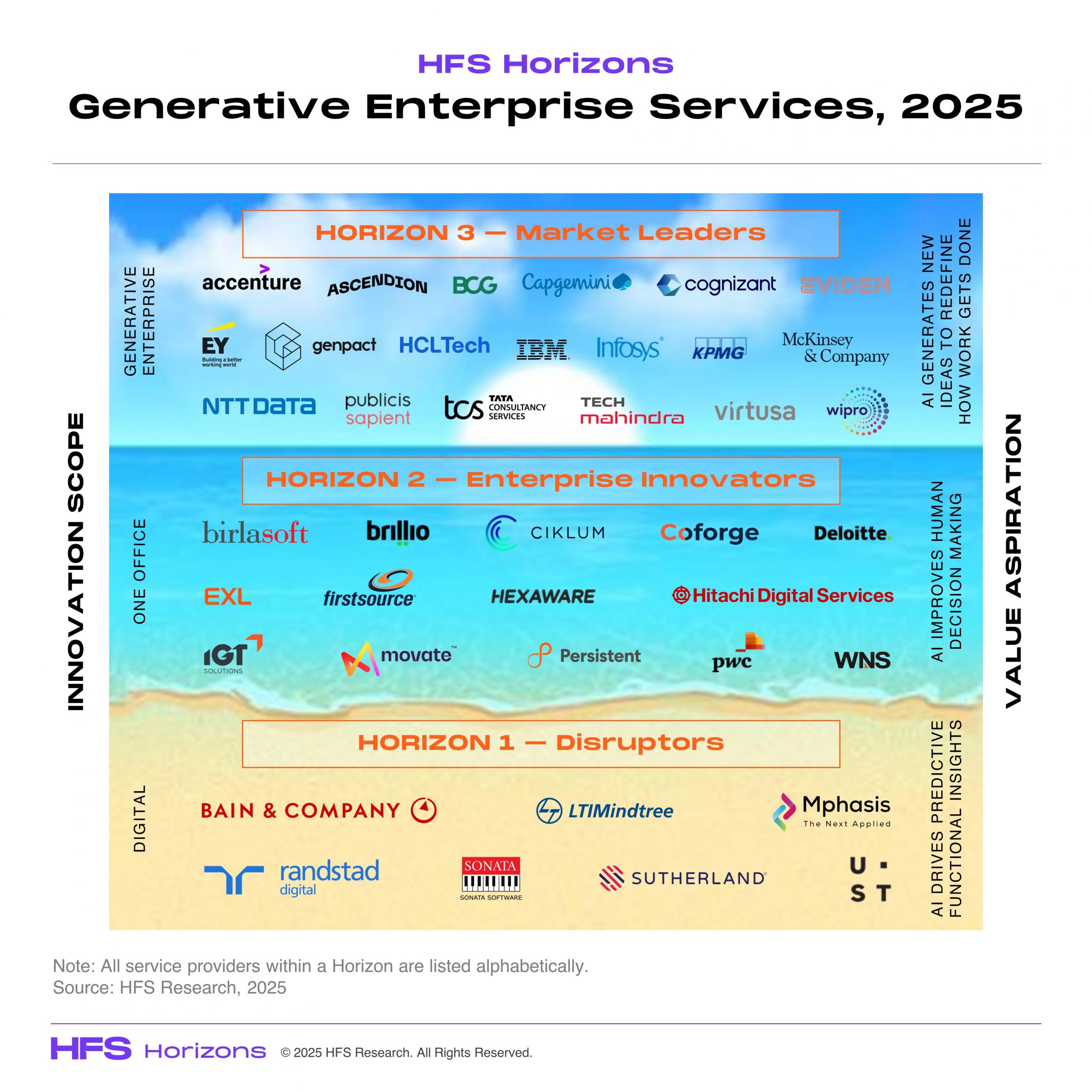
This report evaluates the capabilities of 40 service providers across the HFS Generative Enterprise value chain based on a range of dimensions to understand the why, what, how, and so what of their service offerings. It assesses how well service providers are helping their clients worldwide embrace innovation and realize value across three distinct Horizons: Horizon 1, optimization through functional digital change; Horizon 2, experience through end-to-end enterprise transformation; and Horizon 3, growth through ecosystem transformation (Exhibit 1).
Exhibit 1: The HFS Horizons model helps enterprises pick their service providers based on desired outcomes
We assessed these 40 service providers across their value propositions (the why), execution and innovation capabilities (the what), go-to-market strategy (the how), and market impact criteria (the so what). The Horizon 3 leaders (in alphabetical order) are Accenture, Ascendion, BCG, Capgemini, Cognizant, EY, Eviden, Genpact, HCLTech, IBM, Infosys, KPMG, McKinsey, NTT DATA, Publicis Sapient, TCS, Tech Mahindra, Virtusa, and Wipro. These service providers have demonstrated their ability to support various enterprises across the journey—from functional digital transformation through enterprise-wide modernization to creating new value through ecosystems. These leaders’ shared characteristics include deep expertise across the Generative Enterprise value chain; a full-service approach across consulting, IT, and operations; a strong focus on innovation, internally and externally with partners; co-innovation with clients and partners; and proven impact and outcomes with clients around the world.
A year is a (very) long time in the Generative Enterprise
When we published our 2023 Horizons report on Generative Enterprise Services (Q4, 2023), the gaps in capabilities and commitment across service providers were clearer. As we publish our 2025 Horizons report (Q1, 2025), those gaps have been compressed as demand for POCs and pilots has rocketed, and learning has been shared far and wide across the industry.
A year is a long time in the emergence of the Generative Enterprise. A year ago, agentic wasn’t even getting a name check. The LLM-capability arms race has continued with OpenAI, Meta, and Google all releasing multiple updates and new capabilities in text, image, and audio processing and taken a new twist with the arrival of DeepSeek. And now we have Trump’s Stargate for a boost to infrastructure, too.
Enterprises now demand business outcomes over experiments
Customers have shifted from initial experimentation to focusing GenAI’s capabilities on value outcomes. And that has led to the formalization of innovation pipelines in the enterprise – and integrated and repeatable offerings from service providers. But for all the formalization and standardization, there is no doubt we remain very early in this journey.
And while spending on GenAI is rising (HFS data suggests enterprise investment is rising by more than 25% on average into 2025), we start from a low base. We estimate enterprise spending on GenAI in 2024 accounted for less than 1% of global IT services spending. This is just one illustration of how far we still have to go.
Service providers are adding resources, expanding their ecosystems, and replacing labor with software
To help enterprises achieve the results they need with GenAI, services firms have continued to scale up their capabilities (by 250%) and extend their ecosystems.
Services firms are forming an increasing number of strategic alliances with large tech, cloud, and data companies such as NVIDIA, IBM, and Databricks to co-develop platforms, frameworks, and foundational capabilities; academic partners such as MIT and Stanford to further research the impact of GenAI; and niche AI players such as Hugging Face, Anthropic, Kore.ai, and Mistral AI to gain access to specialized AI capabilities such as fine-tuning.
As services firms cozy up to tech providers, they become a little more like their tech partners—developing software solutions to replace work previously done by consultants. Examples such as SASVA from Persistent and Consulting Advantage from IBM illustrate the shift to the right HFS has been predicting in our Services-as-Software Vision 2030 (see Exhibit 2).
Exhibit 2: The lines between services and software are already blurring
Source: HFS Research, 2025
Enterprise-scale AI comes with new cost and control challenges
However, the examples of scaled success with GenAI remain scarce. Firms are stuck in a chicken-and-egg situation. Leaders must see ROI to take the leap and scale up their GenAI initiatives. Yet it is nearly impossible to prove value with just one or two POCs or pilots—such is the investment required to overcome data, privacy, and security concerns—let alone tackle the mountainous technical, skills, process, culture, and data debts accrued over decades.
The firms taking the leap to deliver at scale with GenAI soon hit cost and control issues—echoing the debates over the cloud. Many are learning that there is no single LLM solution to their enterprise needs—hence the rise of small language models (SLM) and models to support selection vs. accuracy, performance, and cost control, such as TCS’s WisdomNext platform.
DeepSeek is setting new expectations regarding training and related costs, and we expect market leaders to respond.
Data and technology debts restrict many firms to point solutions
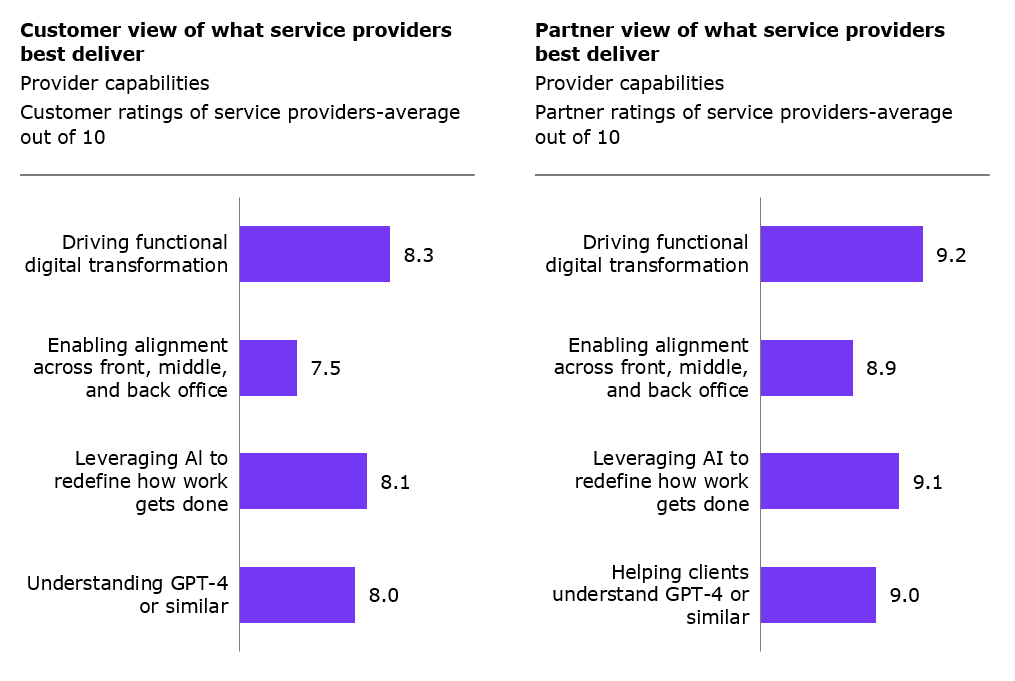
Enterprise customers and service providers’ partners rate service providers strongest when driving functional digital transformations (see Exhibit 3). These transformations are mostly point solutions that help clients achieve greater efficiency or improved CX or EX. However, these point solutions rarely deliver new sources of value or redefine how work gets done, making it difficult to meet ROI requirements.
Data and technology gaps must be filled to enable the disruptive potential of GenAI to extend end-to-end across processes. Currently, service providers are rated less effective at delivering the alignment across front, middle, and back offices that cross-silo processes demand (see Exhibit 3). Enterprises must be prepared to tackle their data silos.
Exhibit 3: Service providers are rated weakest on enablingcross-silo alignment
Sample: 75 GenAI partners and 71 customer references as part of the survey for the report. Source: HFS Research, 2025
Talent supply is impacting the outcomes service providers can deliver for enterprises
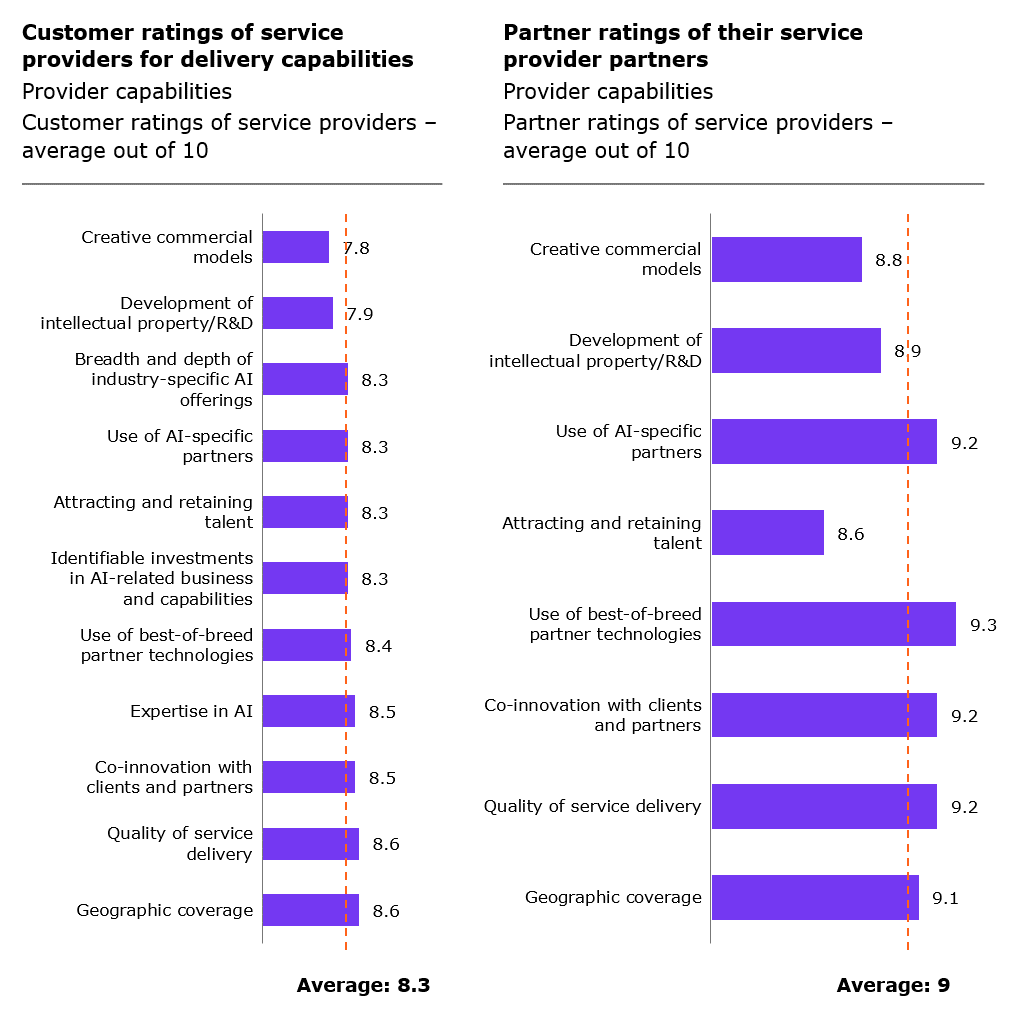
Service providers have made huge investments in training employees on AI /GenAI; however, as seen in Exhibit 4, partners, in particular, have called out talent issues. The supply of AI / ML–experienced employees remains stretched, and a talent war is ongoing. Furthermore, customers and partners have indicated a greater need for creativity in commercial models and more GenAI-focused development of IP / R&D, including industry-specific AI offerings.
Exhibit 4: Service providers’ ability to attract the best AI talent is a concern for their partners and customers
Sample: 75 GenAI partners and 71 customer references as part of the survey for the report. Source: HFS Research, 2025
Agentic will be as essential as staff augmentation within 18 months
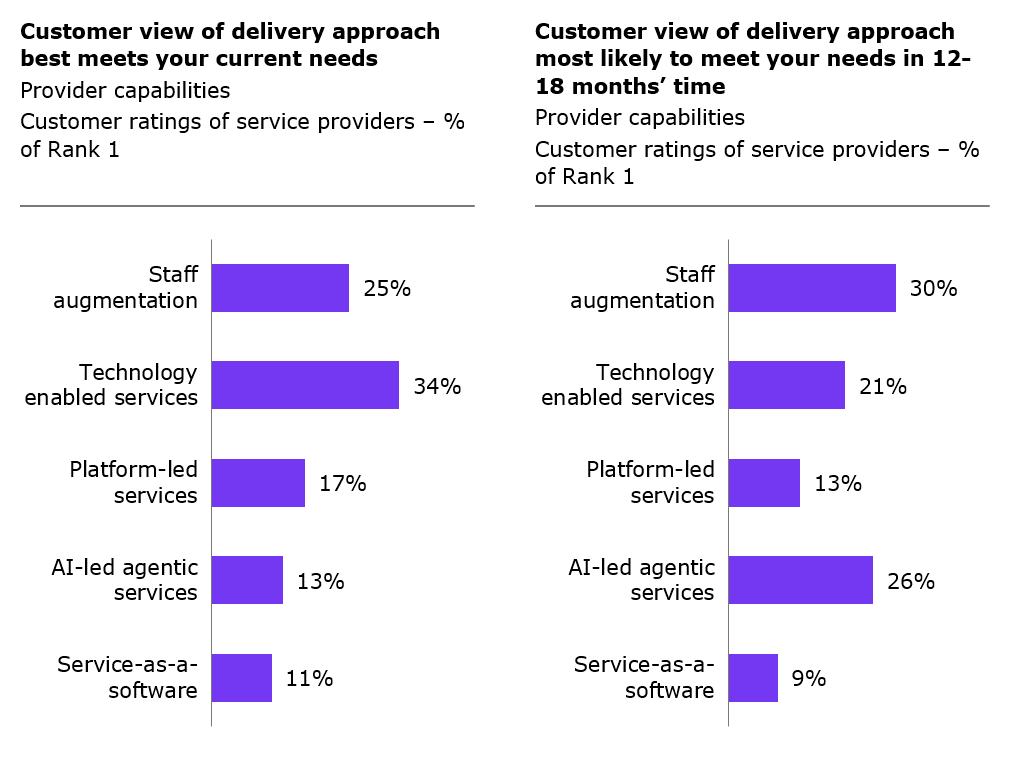
Currently, technology-enabled services and staff augmentation approaches are most in demand by customers. Within 18 months, customers’ service delivery preferences will shift, and autonomous AI-led agentic services handling complex decision-making tasks will be almost as important as staff augmentation (see Exhibit 5).
Services and software people come from different worlds and speak different languages, but they will need to come together—quickly—to align technology with business outcomes.
Exhibit 5: Customers expect agentic to play almost as large a part as staff augmentation within 18 months
Sample: 71 customer references as part of the survey for the report. Source: HFS Research, 2025
The Bottom Line: Choose a service provider that understands where your enterprise is on its Generative Enterprise journey—and is best positioned to meet you where you are.
It’s easy to be overwhelmed by possibility, excited by grand visions, and lose your way in pursuit of goals that are not within the current grasp of your organization.
When choosing your service provider partners, look for those who understand the business problems you face now. If your current problem is how to take the leap to scaling the impact of generative AI across the business, choose partners capable of supporting such ambition. But if you face more discrete and burning issues, be open to partners matching less ambitious outcomes. Solving the smaller problems is the route to preparing for the coming AI transformation.
Read our full Generative Enterprise Services Horizons Report 2025 – here to learn which service provider is best aligned with the results you want to achieve.
We’ve been talking about the impending disruption facing BPO for well over a decade now, as maturing AI and automation technologies promise to replace the masses of humanity hired to deal with customer queries, move data from one screen to another, process reams of invoices, claims, and many other office tasks. However, are we finally on the cusp of genuine secular change in the industry commonly known as “BPO”?
Will UnBPO succeed where Robotistan failed?
In fact, we went as far as introducing Robotistan as the new BPO location back in 2012 as RPA solutions launched themselves upon the industry. Somehow, labor-centric BPO has managed to weather the storm as enterprises struggled to scale the technology to do anything beyond piecemeal task automation, hence our declaration of RPA death in 2019. However, as enterprises have gradually run out of excess onshore labor to be replicated offshore, the BPO industry has slowed down considerably, and the only room for further value in the model is to shift away from moving work from humans to lower-wage humans by moving that same work to software.
The industry has been ripe for this transition for many years, but it’s the rapid rise of agentic technology to mimic human work that is about to make the pivotal assault that finally forces the industry to change. The technology is finally here, and there is nowhere left to hide. In short, the rise of GenAI, automation, and digital-native competitors is making legacy BPO look like a relic, and the old model—offshoring, labor arbitrage, FTE pricing—is on life support. Firstsource is betting its future on a radical alternative: “UnBPO.”
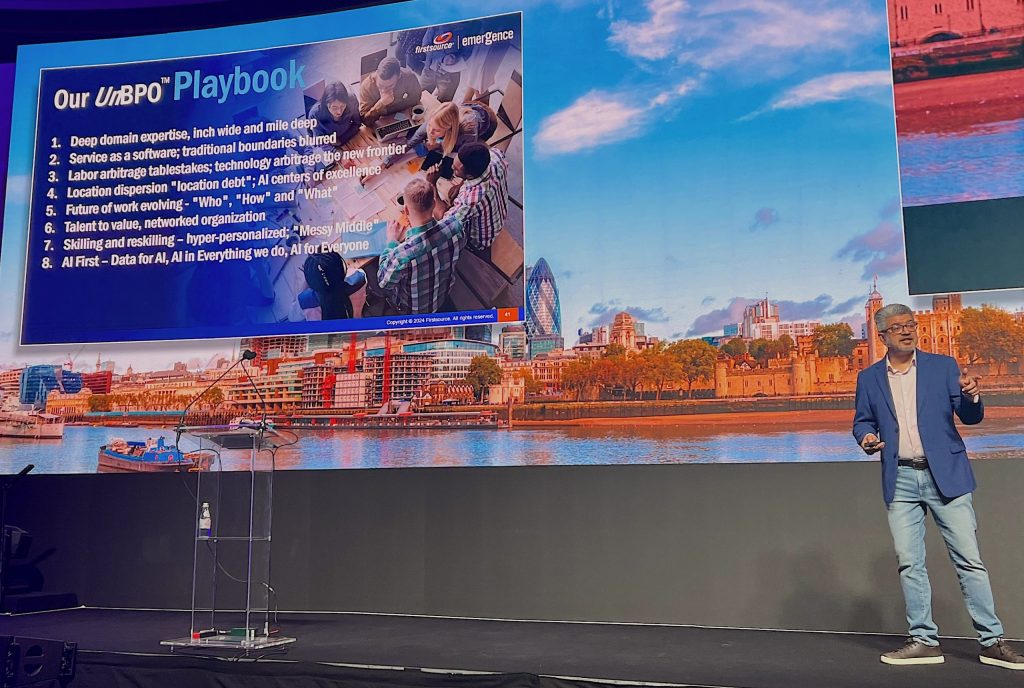
CEO Ritesh Idnani, a BPO veteran who has lived and breathed every flavor of BPO for the last two+ decades, unveiled this bold vision at the Emergence customer event, making it clear that this isn’t just another incremental shift, it’s a demolition job on the traditional BPO model. The ambition is for AI-first, networked, outcome-driven operations that render legacy paradigms obsolete. The tenets laid out in the UnBPO playbook are well aligned with the guidance HFS has been giving the industry, and the seeds of real change are being planted with some of the shifts Firstsource is making to its organization and client engagements. But execution is everything. Can Firstsource and the industry make the leap, or is this just another rebranding exercise?
Firstsource CEO Ritesh Idnani unveils Firstsource as the UnBPO Company
The future workforce has to unlearn — there’s no patience for legacy thinking
Forget offshore, nearshore, or onshore. Work has no borders anymore. Firstsource is throwing out the outdated “location strategy” playbook, embracing a truly global workforce where AI, automation, and human expertise operate in sync. The new model isn’t cheap labor, it’s technology arbitrage.
The company’s AI-first mantra—”data for AI, AI in everything, AI for everyone”—signals a pivot from cost-cutting to value creation. This is about augmentation, not elimination. One radical example is how Firstsource now uses AI bots to conduct all first-round hiring interviews. That’s not just automation, it’s rewriting how companies think about talent acquisition.
But talent strategy isn’t just about who does the work, it’s about how they learn, and traditional training models are facing potential extinction. Firstsource is betting on hyper-personalized skilling and real-time learning as a talent game-changer. They are forgoing static training programs in favor of guided decision-making, dynamic prompts, and AI-driven agent support in the moment. Firstsource’s workforce will need to unlearn outdated processes and mindsets quickly to keep up. As Idnani put it, “The only metric we want employees to think about is what value did you add to your customer today?” That’s the kind of metric that forces transformation—or exposes the cracks.
AI translation is smashing the global talent market. Location no longer matters.
One of the most disruptive forces in the contact center industry today is the rise of AI-driven language translation capabilities. If companies can use AI to remove language barriers, they can literally hire anywhere. Firstsource is already deploying live agent voice translation, meaning an agent in Bogotá can seamlessly serve a customer in Tokyo. This flattens the global talent market, unlocking labor pools previously off-limits due to language constraints.
This has profound implications for the BPO industry. For Firstsource, this is a competitive advantage—if it scales. But it also introduces risk. AI-driven translation depends on data quality, compliance, and regulatory alignment. Firstsource’s mission will be scaling AI translation without introducing compliance nightmares or degrading customer experience.
Firstsource aims to kill headcount-based pricing, focusing the customer on value, not “effort”
Perhaps the most aggressive part of Firstsource’s UnBPO model is its rejection of traditional BPO pricing. Firstsource is pushing for risk-sharing and outcome-based pricing—aligning revenue to value delivered, not hours worked. Firstsource is riding a wave of aggressive growth in 2024, outpacing struggling mid-tier competitors by doubling down on AI, automation, and digital CX (see chart below). Its strategic acquisitions—Ascensos, Quintessence, and AccunAI—signal a clear intent to lead, not follow. In our current market discussions, an increasing number of enterprises are far more open to an AI-first mindset to procuring services, with 6-out-of-10 declaring they are ready to move a large amount of their services into a services-as-software model by 2030. We are also seeing many enterprises start to value the services platform they are buying as opposed to the number of bodies required to execute for them. This is where the game finally changes for services as the customer focus shifts from effort to value.
This is surely the calm before the storm when enterprise customers are ready to UnBPO themselves
Furthermore, Firstsource’s rising headcount is a direct response to its business expansion, fueled by new client wins, strategic acquisitions, and an increasing demand for AI-augmented services. Unlike traditional BPOs that add headcount primarily for labor-intensive contracts, Firstsource’s growth strategy is tied to scaling its AI-first, automation-driven service model. But hypergrowth comes with high stakes. Scaling headcount while shifting to outcome-based pricing is a balancing act—one that introduces revenue unpredictability just as Firstsource is making massive bets on AI and workforce transformation. Clients love the concept, an many have declared they are ready to commit at scale. This is surely the calm before the storm when enterprise customers are ready to UnBPO themselves.
Firstsource’s UnBPO vision hits all the right notes, but the transformation is only just beginning. The growth tear that was 2024 indicates a good start. However, heavy AI investments, workforce restructuring, and non-linear revenue models create unpredictability. Investors and clients will be watching closely. The real test will be whether Firstsource can consistently deliver measurable outcomes enough to make this model viable in the long term.
The Bottom Line: AI is flattening the global workforce and upending BPO. UnBPO is a whole new way of thinking, working and partnering. Only the strong – and courageous – will survive.
Firstsource just put BPO on notice. It’s not just talking about transformation—it’s daring the entire industry to burn the old playbook.
AI is flattening the global workforce, killing off legacy BPO, and redefining what service delivery means. The challenge is execution. Firstsource’s vision is compelling, but it requires massive change to survive the brutal realities of enterprise adoption, financial sustainability, and workforce resistance. One thing is certain: BPO firms that cling to outdated models will be left in the dust. Firstsource has thrown down the gauntlet. Now the industry has to decide—evolve or be erased.
There has never been a time during the last three decades that the world has seemed less flat…
Thirty years of the Internet and the rapid development of ubiquitous data, coupled with the emergence of developing nations hungry to support bloated greedy corporations, had led us to a place where employment has seamlessly moved to low-cost locations to support these corporations at much lower cost and scale than employing people locally.
Until recently, these corporations primarily favored contracting with third-party outsourcers to deliver this lower-cost work, but we have seen a marked swing toward many of them opting to hire offshore people directly into their own labor forces as part of what they are marketing as “Global Capability Centers.”
However which way we look at this, the basic premise has been the same: moving work to low-cost locations that can rapidly scale up to deliver that work. Whether it is more beneficial to employ people directly in low-cost locations or contract to have them deliver work through third parties isn’t really that important. The big question now is whether these corporations are going to have tariffs imposed for exporting corporate operations outside of the country that could be managed at home.
Suddenly, we find ourselves in a world where moving work around the world carries a lot more risk… and cost
In the past, when economies got tight, and corporates panicked, there was always the constant of sending more IT and process work to India, more manufacturing to China, or more customer support to the Philippines to keep operating costs down and CFOs at bay. However, there is now increasing concern from industry leaders that all their exports of work outside the US will come under the spotlight as the tariff programs get rolled out. The impact would ultimately result in big hikes in costs, which could be as high as the 25% level, considering the current tariffs that are being set. Why stop at Mexico, Canada, China, and the EU?
In our view at HFS, this will further drive the focus on AI-first services where increasing amounts of service provision are programmed into software platforms using agentic technology, generative AI, and other AI technologies. As we discussed recently, six out of ten enterprises are already serious about adopting an AI-first approach to professional services, so doesn’t this throw the whole location question out the window as the line between services and software increasingly blurs? If we are going to be buying supercharged agentic humans before long, so will the focus from people scale to outcomes:
We have already projected Services-as-Software presents a $1.5 trillion opportunity for both software and services firms, where enterprises stop buying static technology and people-intensive services and instead consume AI-powered, outcome-driven solutions that continuously evolve and adapt to changing business requirements. What we hadn’t projected were the locations that would benefit from this expenditure.
Why the US services option is becoming increasingly attractive
Already, Apple has announced $500 billion of investments in the US over the next four years as the firm seeks to get ahead of the political move away from globalization and the onset of these prohibitive tariffs. As we have seen with the succession of US-led enterprises renouncing their DEI strategies, surely we are poised for a wave of these corporations promising to move more of their jobs back to the US as they seek to curry favor with the Trump administration and also derisk their services supply chains exposed to global delivery strategies. Manufacturing, logistics, and retail sectors are already either slowing down hiring or shifting workforce priorities due to higher costs of imported goods. It is only a matter of time before other industries heavily reliant on global talent, such as financial services and hi-tech, seriously evaluate the penalties and risks of their globalized business operations.
Another factor to consider is the state of employment in the US, where a recent study from the Federal Reserve Bank of New York reported the widest unemployment gap between new graduates and experienced degree holders since the 1990s. In terms of MBA graduates, Harvard Business School has reported 23% of the 2024 MBA class remained jobless three months after graduation, a significant increase from 10% in 2022, while Wharton, Stanford, MIT, and Kellogg all report double-digit unemployment, well above previous years.
Bottom line: It’s time to brace ourselves as the future of global services may be about to go through some radical changes
Even if currently offshored services increase by ~20%, many will still be significantly cheaper than re-employing onshore as the wage costs are usually 30-70% higher. The short-term impact should be small, but we cannot ignore the longer-term effect, especially for areas requiring skilled workers that can be highly effective when boosted by AI tech. When services that may have required, for example, 100 people in India, can be run with 20 skilled workers onshore, there are both significant geo-political and straight-up business cases to consider. The changing nature of the US workforce supports the possibility of services coming to the US as anxious businesses look to get ahead of global risk and uncertainty. Only a fool would ignore the magnitude of what is happening in our geopolitical landscape.
Trade wars used to be fought with ships and embargoes. Today, they’re waged with tariffs, regulatory chokeholds, and digital sovereignty laws. The US and China have been throwing economic punches for years. Europe has fortified its own walled garden with GDPR and AI regulations, and the new US administration has intensified trade tensions with Canada and Mexico. However, amid the geopolitical chaos, ambitious CEOs and CIOs see a huge opportunity to rise above the noise and exploit the rapid advances in AI and automation technology (Services-as-Software) to ensure their organizations remain competitive, with agents supercharging their workforces.
Protectionism is reinventing how services will be delivered to your organization
As a CIO, you must prepare for the impact: rising costs for offshore/nearshore talent, imminent price hikes on technology hardware and software, delayed hardware shipments, and service providers suddenly subjected to new regulatory constraints. But protectionism isn’t just disrupting your current vendor relationships—it’s fundamentally transforming how services will be delivered to your organization.
The more governments try to lock down supply chains, labor markets, and data flows, service providers are left with no choice but to accelerate their shift toward Services-as-Software (SaS). By automating and digitizing service delivery, they’re reducing their reliance on people, physical goods, and traditional offshoring models, and this will change how you consume and integrate professional services across your organization. Savvy service providers will shift the delivery of software-based services to the US (or whatever location avoids financial penalties) to give their clients services unencumbered by government interference.
Isolationist policies force businesses to radically rethink their access to talent, technology and resilience
Governments pushing protectionist policies are stuck in a pre-World War II old-world paradigm, where economic strength comes from manufacturing dominance and self-sufficiency. But the world doesn’t work that way anymore. The Internet has woven supply chains and commerce so tightly together that there’s no undoing interdependence. Yet, leaders are doubling down on restrictions that force businesses to rethink how they access talent, technology, and supply chains.
Higher tariffs don’t just raise costs—they force automation. Companies aren’t waiting around for trade deals to stabilize. If importing materials, talent, or services becomes too expensive, they don’t just “buy local”—they digitize, automate, or move to neutral zones where protectionist policies don’t apply.
Global supply chains are too complex to rewind. Cutting off trade doesn’t make them simpler—it makes them unpredictable. Businesses are already restructuring operations around AI, automation, and nearshoring, not because they want to but because they can’t afford to be caught in the next tariff war.
Regulatory barriers don’t protect industries—they push them toward digital models. Businesses don’t wait for favorable policies; they engineer workarounds. The more fragmented the regulatory landscape becomes, the more companies rely on software-driven services that make national borders irrelevant.
The loudest advocates for economic independence are still deeply dependent on global markets. China pushes self-reliance but still relies on foreign semiconductors and global exports. The U.S. is doubling down on tariffs for key imports—steel, aluminum, electric vehicles—while still needing foreign critical minerals, pharmaceuticals, and offshore manufacturing.
Protectionism isn’t making industries stronger—it’s forcing them to become leaner, faster, and more reliant on technology instead of people. And that’s where Services-as-Software comes in.
Protectionism creates a compelling opportunity for CIOs with SaS
When governments raise trade barriers, service providers don’t wait for a diplomatic resolution—they adapt. Increasingly, the adaptation strategy is Services-as-Software—the shift from human-dependent services to fully automated, software-driven solutions:
We’ve seen this playbook before. The first industrial revolution mechanized labor, the second optimized mass production, and the third digitized processes. Now, we’re in the next phase—the automation of services, where routine work that once required people, physical goods, and often cross-border transactions is being rewritten as code. Professional IT and business services companies such as Infosys, IBM, Genpact, Cognizant, KPMG, and Accenture are already repositioning their strategies to align with this vision.
But this SaS shift isn’t just about avoiding tariffs or dodging supply chain constraints—it’s transforming how value is created and delivered. All these protectionist policies are doing is accelerating the development of SaS because of the following:
Weakening dependence on offshore labor: AI-powered services eliminate the need for massive offshore teams, cutting exposure to labor costs and visa restrictions. In many instances, scaled-down onshore teams supporting a SaS model can perform the same work at similar or even less cost and arguably increase analytical value.
Automated compliance at scale: Software-driven services embed compliance into the code instead of navigating country-by-country regulations.
Resilient, tariff-proof supply chains: Businesses that once relied on imports can now deliver services via cloud-based automation, skipping geopolitical bottlenecks entirely.
The old playbook—offshoring to low-cost regions—is likely being replaced with software-first service delivery. The big question is whether the human element of services remains offshore or if the cost benefits encourage services to move onshore or be eliminated. CIOs must rethink their vendor relationships because how they buy and integrate services are fundamentally changing. They need partners aligned with their needs to support their transformation path to SaS.
CIOs must adapt as services shift from people to code
When electric and hybrid vehicles entered mainstream consumer markets, dealerships needed to retrain their staff to understand how to sell and maintain them in addition to traditional gas vehicles. The same is happening with SaS models entering the enterprise equation. CIOs should adapt their knowledge and skills to program work types into software applications, work with their C-Suite counterparts to drive the process, and support the significant change management aspects involved. It’s one thing to move work from onshore people to offshore people. It’s an entirely different proposition to move work from people to computers.
CIOs must understand the implications for their operations, technology strategies, and vendor relationships:
Changing commercial models: Traditional FTE-based pricing structures are giving way to subscription and consumption-based models, which may require different budgeting, procurement, and governance approaches.
Shifting partnership dynamics: Relationships with consultants, systems integrators, and managed service providers are becoming more like SaaS vendor relationships, with significant implications for security, compliance, and integration.
New implementation challenges: As services become more automated, bridging business requirements and service outcomes requires different skills when platforms replace human intermediaries.
Integration considerations: Organizations need integration strategies for automated service platforms with embedded workflows rather than adapting offshore teams to existing processes.
New governance frameworks: When software—not people—delivers services, governance must shift from vendor relationship management to overseeing APIs, data flows, and automation.
Preparing for the SaS Future
CIOs should take proactive steps to get ahead of the shift:
Assess service automation potential: Identify which functions, processes, and services are primed for automation based on labor costs, regulatory exposure, and technology maturity.
Evolve procurement strategies: Redefine vendor selection and contracting models for SaS, shifting from FTE models to AI-driven service consumption.
Implement governance frameworks: Establish new oversight models focused on compliance, automation monitoring, and outcome-based service evaluation.
Develop integration capabilities: To prepare for a code-based service delivery model, build expertise in agentic AI, workflow orchestration, and automation-first architectures.
Align business expectations: Educate stakeholders on how service consumption patterns will evolve, ensuring that business units adapt to automation-driven service delivery.
Manage the AI fear and cultural impact:Recent HFS research shows that 45% of enterprise executives fear AI will take away their jobs and negatively impact company culture. CIOs must take charge by running AI boot camps to educate teams, showcase AI’s potential, and inspire a mindset shift toward AI-enabled roles.
SaS isn’t an island—enterprises still need ecosystems
Let’s be clear: while Services-as-Software may provide an escape hatch from protectionism, it doesn’t eliminate the need for interconnected ecosystems or people. AI and automation might replace some people, physical assets, and manual workflows, but they can’t substitute collaboration, shared data, and platform interoperability. No company operates in a vacuum, and no tech stack functions without dependencies.
The Bottom Line: CIOs must prepare for a world where many services are delivered through software, not people—protectionism is merely speeding up the inevitable
CIOs can’t afford to treat protectionism as just a policy shift—it’s fundamentally reshaping how services are delivered and consumed. The move toward Services-as-Software is accelerating, forcing enterprises to rethink vendor relationships, integration strategies, and governance models.
Google has struggled for years to sink real teeth into the enterprise, but it may have just found its path to take on Microsoft and AWS as an AI cyber giant and gain real relevance as an enterprise cloud AI platform. This massive acquisition of Wiz also firmly positions Google directly against cyber vendors, namely Palo Alto Networks and CrowdStrike.
Google’s $32 billion valuation represents an exceptional premium, about 90x Wiz’s reported $350 million ARR. The significant valuation increase from Google’s $23 billion offer underscores both competitive urgency and strategic foresight, driven by Wiz’s rapid growth trajectory and market adoption and the Trump administration’s friendlier stance towards big M&A.
It is also worth noting that the US Administration deprioritizing its cyber focus on foreign actors means companies will need to be extra vigilant in protecting their data and assets. This acquisition could prove very timely for team Google, especially with the huge client list of Wiz clients it can try to tempt over to Google Cloud. If it plays this well, Google could end up closing this gap to both AWS and Microsoft in the enterprise AI platform market as cloud, cyber, and AI become completely intertwined. However, with AWS dominating a third of the global cloud market and Google barely having more than 10%, Google will have to tread carefully to avoid alienating the vast portfolio of Wiz customers. It has to prove to its new Wiz cyber clients it can be cloud-agnostic to optimize this massive investment.
Why are we bullish on this move?
Google’s biggest opportunity with this acquisition can be establishing itself as a leading multi-cloud security provider (leveraging Wiz’s advanced AI-driven technology and Security Graph, which identifies complex risk patterns across cloud environments). This will further support Google’s strategy to diversify revenue streams beyond advertising. Google has strategically focused on cybersecurity since 2022 (because of the acquisitions of two cyber firms). Google can deliver built-in security solutions without relying on third-party integrations, unlike its competitors (AWS and Microsoft Azure).
What are Google’s main challenges with Wiz?
On the tech side, one integration challenge will be migrating Wiz’s backend onto GCP. Wiz, as a startup, is hosted across many different clouds. Post-acquisition, it would make sense for many customers to run Wiz’s services on GCP for cost and synergy. However, if the migration is not handled carefully, it will disrupt existing customers. In addition, many Wiz customers will not want to move onto GCP, so Google needs to carefully manage its new portfolio of Wiz customers to allow them to use whatever clouds they want without risking alienating them.
The company’s previous largest acquisition, Motorola Mobility, for $12.5 billion in 2012, ultimately resulted in Google selling most of Motorola’s assets to Lenovo for $2.91 billion just two years later. This raised a question about Google’s integration capabilities. Google has allocated up to $1 billion in retention bonuses to retain Wiz’s critical talent, recognizing the importance of preserving the startup’s entrepreneurial culture and innovation velocity within Google’s more structured corporate environment.
Wiz’s strategic appointment of Anil Bhasin as India head underscores significant growth opportunities in India’s rapidly expanding cloud security market. Wiz’s proactive approach includes extensive local hiring and collaboration with regional enterprises and government initiatives, strengthening its position as a significant regional cybersecurity partner.
And the strategic rationale behind this mega acquisition…
Google’s strategic imperative centers around enhancing cloud security capabilities. This is driven by increased enterprise investment in cybersecurity, especially following significant incidents like the 2024 CrowdStrike outage, which heightened industry awareness of cloud vulnerabilities. Wiz’s Cloud-Native Application Protection Platform (CNAPP) significantly enhances Google’s offerings by integrating advanced AI-powered tools to identify and remediate complex vulnerabilities across multi-cloud environments, aligning with Google’s AI-centric approach.
This acquisition further supports Google’s strategy to diversify revenue streams beyond advertising, subtly positioning it against competitors such as Microsoft, whose cybersecurity business alone generates over $20 billion annually. Notably, Google’s strategic focus on cybersecurity was previously reinforced by acquisitions of Siemplify and Mandiant in 2022 for approximately $500 million and $5.4 billion, respectively.
The core technical and product integration challenges
Wiz’s unique Security Graph architecture is central to its differentiation. It comprehensively maps cloud infrastructures to identify and address toxic risk combinations and vulnerabilities that traditional security tools often overlook. As a Cloud-Native Application Protection Platform (CNAPP), Wiz effectively integrates Cloud Security Posture Management (CSPM), vulnerability detection, and identity risk analysis into one unified solution.
Wiz’s overarching platform is cloud-agnostic, developer-friendly, and deployable in minutes via simple API-based integration. This ease of deployment is critical for rapid adoption and effective management across diverse environments. Wiz’s multi-cloud posture management capabilities, comprehensive risk graph, and innovative AI-driven security services address significant gaps within existing offerings.
Integrating into Google’s ecosystem involves addressing multiple technical challenges, such as migrating Wiz’s backend onto Google Cloud infrastructure for cost efficiencies and operational synergies without disrupting existing services. Aligning Wiz’s advanced Security Graph and data models with Google Cloud’s existing asset inventory systems and services like the Security Command Center (SCC) will be complex. Google may rationalize overlapping functionalities within its current security offerings to ensure seamless user experiences, including unified login, authentication, and consolidated billing.
How does this impact the cybersecurity competitive landscape?
The acquisition significantly reshapes competitive dynamics. Google’s enhanced security capabilities put considerable pressure on AWS and Microsoft Azure. AWS, traditionally reliant on internal security solutions and third-party integrations, may need to accelerate improvements in its native security tools or pursue strategic acquisitions of similar agentless, multi-cloud security platforms. Microsoft Azure, with its extensive but traditionally more siloed security ecosystem, also faces intensified pressure to innovate rapidly, particularly in comprehensive risk analytics and AI-driven vulnerability management.
Cybersecurity vendors like Palo Alto Networks and CrowdStrike confront heightened competitive pressures. Google’s acquisition may prompt further market consolidation or drive independent cybersecurity firms to form strategic alliances with other cloud service providers or major technology firms to remain competitive. In the short term, we can expect a significant valuation jump for many of the cloud-native security vendors such as Eclypses, Crypto4A (creating quantum-safe keys that are NIST and Quantum approved), Wallarm (API security), Crowdstrike (even with their fumble, they are one to beat), Sysdig (microservices/container security) and a host of others.
The bottom line: All the major tech players need to up their cyber game and join this acquisition frenzy
Google’s acquisition of Wiz significantly enhances its competitive position in cloud security, providing advanced, AI-enhanced capabilities across multiple clouds. Successfully navigating technical integration challenges and regulatory scrutiny will be essential. Ultimately, the success of this acquisition will largely depend on the effectiveness of execution, potentially reshaping competitive dynamics across cloud computing and cybersecurity industries and emphasizing the critical role of innovative security solutions in enterprise technology ecosystems.
Cyber is very complex and AWS, Google, MSFT, Oracle, and IBM will likely all need to go on the acquisition hunt for solutions that can be embedded into their offerings. Apple, HPE, Dell Technologies, and Lenovo will all likely join the hunt as well.