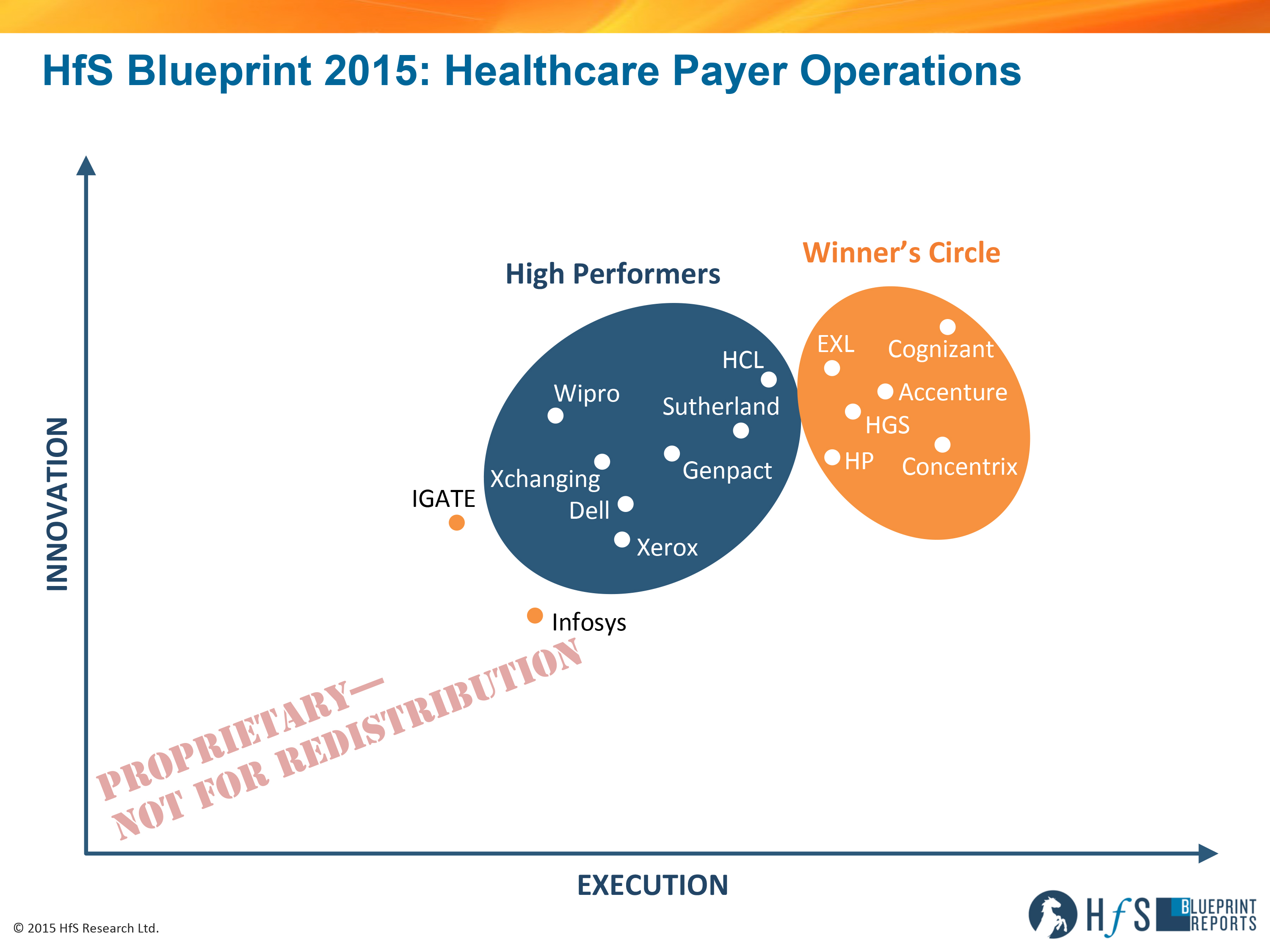
We made the conscious decision to invest in researching the healthcare and life sciences industries when we founded HfS, and one of those investments was to hire Barbra McGann to define the space, really sift through the core processes, issues and political dynamics to form a concise picture of who is genuinely innovating, who is effectively executing and aligning their capabilities to solving (and finding) problems for stressed healthcare clients.
The Blueprint goes in-depth as the market transitions to As-a-Service, with a focus on the consumer/member/patient, and more flexible solutions. Barbra looks at the increasing use and integration of automation, analytics, and other digital technologies into offerings; examines the changes in demand for talent; and investigates the increasing need for more collaborative and value-based engagements.
So, we thought, who better than Barbra to tell us about it?
Click to Enlarge
Barbra, with all the market perspective published on healthcare today, what is unique about the HfS Healthcare Payer Operations Blueprint?
Phil, the only place that seems to be cutting back on reading material is the waiting room at the doctor’s office. (Am I the only one who misses Highlights?) Of course, that is just one change in the midst of many for waiting rooms, really, as technology and regulation are both expanding the opportunity for mobile health care. All that aside, healthcare organizations, service buyers and providers who are looking for a different perspective on trends and opportunities for increasing the value of sourcing in Health Care, here it is.
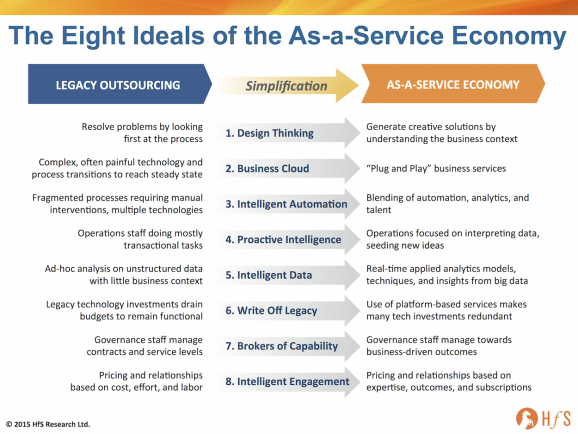
Many of the larger healthcare organizations have achieved the maximum potential benefits from legacy BPO by this point. In our recent “Ideals of the As-a-Service Economy” research, just about three out of four participants (72%) from this industry indicated that there was “no value left” in the current BPO sourcing model. At least one out of three are ready for more “intelligent engagement” managed by “brokers of capability.” Simply put, organizations increasingly realize the need to shake up their operations and engagements, and are looking for the people and the partners to help them put together a solution with the best capabilities to drive results.
What is increasing the value of sourcing in the healthcare industry?
Barbra McGann, HfS EVP, Business Operations Research (click for bio).
The healthcare industry is being “shaken, not stirred,” by new ways and means of defining, delivering, and managing health and care. It is being impacted by regulation, consumerism, digital technologies, and maturing sourcing models. Healthcare is also an industry that is traditionally slow to embrace change. However, change is exactly what is needed in order to deliver on the “triple aim” of better health, better care, and lower administrative and medical costs.
Payers, providers and other healthcare organizations are all part of the same value chain in the effort to deliver on this triple aim of healthcare. The common factor is the focus on the consumer, who is also seen as a patient, a member, or a customer, depending on the lens. It’s time to line up the lenses.
There are many elements of the operations—processes and technology—that underlie healthcare that are common and repeatable. What we see is an increasing need to continue—and continue to improve—managing the processes for example, the steps for enrolling a new member or patient into a plan, ensuring they have the right coverage that is funded appropriately, enabling access to high quality care in the right place when needed, and processing referrals, claims and payments, etc. At the same time, health plans and healthcare providers also need to create better and higher quality experience in the healthcare system so that people will continue to subscribe and use their services and do it in a way that will keep them healthy or address their health and care issues expediently.
With years of BPO and ITO experience in healthcare, clinicians and other healthcare professionals on staff, best practices that many can tap into from other industries that have gone through similarly regulated and high profile change, and pilots and platforms with newer technologies, many service providers are in a position to partner in new and more collaborative ways. Newer entrants in the market will increasingly challenge the established players, driving new innovation, as well.
How did this shake out in the Healthcare Payer Operations grid?
In this report, we use the term “Healthcare Payer Operations” to refer to:
A broader set of buyers: healthcare providers, pharmaceutical companies, and new risk-bearing organizations, such as Accountable Care Organizations (ACOs) and Provider-Sponsored Health Plans (PSHPs) among many that are using what was traditionally the back office of payers, e.g, claims, member management
The increasing use of enabling technologies to deliver business process services, to “operate”
New contracting and engagement models
The scope of: claims management, member management, provider data management, and health and care management, along with analytics and enabling technology platforms
Direction of business process outsourcing services and transition to As-a-Service.
In this Blueprint, we take a look at how the chain of service buyers and service providers are stepping up to the ball to help drive change in the healthcare industry. There are a few service providers that are making bold moves to rethink how and when to partner and look beyond process to rethink targeted results and then put together solutions. Cognizant, Genpact, and HCL all come to mind. While the Cognizant / Health Net story is still unfolding, it is an example of a healthcare organization and a service provider making a collaborative leap to challenge the status quo for sourcing. Each link in the chain needs to get more efficient, deliberate, thoughtful and innovative in re-imagining and streamlining its services to the other connected links.
Some service providers are investing in acquisitions to refresh and build capability to fill gaps that are opening because of new industry regulations and the increasing imperative to engage and empower consumers to lead healthier lives—because impact in both the front and back office in the long run can reduce the expense of healthcare. HGS, Dell, and Xerox have been leading the way here. Interestingly, the latter two are the only ones that are also expanding their telehealth operations to broaden the reach of healthcare into retail.
How is technology starting to play out in what has been a very labor arbitrage driven industry?
Automation is par for the course, and the industry is at the beginning stages of experimenting with cognitive computing and artificial intelligence. There is a reduction in effort, an increase in accuracy and throughput recognized at every service provider with the use of automation. In commodity areas of sourcing – claims and provider data/network management in particular – automation is the innovation right now; it is helping to streamline and speed up processing. Increasingly, service providers are also introducing platform-based services that typically target a specific area like EXL in population health and care management, risk management analytics from Accenture, IGATE for managing lines of insurance, or customer service and engagement with Cognizant. Xchanging is operating on all cylinders with clients on SaaS, BPaaS, and Digital “wraparounds” for legacy systems.
The limitations are in how broadly a service provider decides to leverage automation (that might cannibalize revenues and change the roles of their people) and other technologies that require on-going investment and maintenance. What also matters is whether clients will allow automation and platform-based services to interface with their healthcare administrative system or replace their current the end to end process.
Service buyers told me more than once in interviews that it is often their own organizational limitations that get in the way of being more innovative. Approaches like Design Thinking which is increasingly ingrained in Sutherland Global Services’s approach to work, observing as well as listening and doing, can facilitate new ways to partner that take into consideration the relevance and environment for innovation. This requires buyers to let service providers further “inside” and more familiar and interactive with the business and even the consumers than many have in the past.
Where is the healthcare sourcing industry heading?
Talent + Technology = The Great Game Changer. Enabling technologies help drive change, but not without people who make it drive toward the business outcomes needed in the right context. BPO roles in defining, managing, and delivering services are changing, and there is an increasing demand in the market for people who are embracing and leading this change.
Healthcare organizations need to focus on connecting with consumers, and that means increasingly taking advantage of service provider capability for front and back office expertise and capability from both healthcare, and other industries. Healthcare organizations that partner with service providers that can leverage best practices from other industries, speed to market with talent + technology, and subject matter expertise, as well as brokers who can collaborate will stir up and settle the industry into a new operation.
Admit it, people, you’re all being subjected to presentations from many service providers and advisors that have become so confusing you’re actually too embarrassed to say: “I really haven’t got a clue what you are trying to pitch me here”.
In many cases, you suspect the suit presenting it to you probably doesn’t have much of a clue either, so you just zone out and permit him to portray painfully his pre-scripted, professionally puffed-up, potpourri of PowerPoint.
I don’t believe I’ve ever witnessed a time our services “industry” has descended into such a mind-numbing pattern of meaningless marketing hype and unintelligible bullsh*t. It was bad enough when everyone was painting pretty pictures of “transformation” to sugar-frost labor arbitrage deals, but at least we could understand the bullsh*t and detect its scent a mile away.
Today, we’ve fallen even deeper into a trough of verbose desperation, as most service providers and advisors replicate each others’ sales decks to reel off an increasingly inane plethora of confused rubbish, that is transcending further and further away from reality. In most cases, this is much worse than mere sales hype, it is hype and confusion squished together in such a confused steaming mess, it leaves most of us speechless to even question it. How can you ask sensible questions, when you just don’t really understand what you’re being presented?
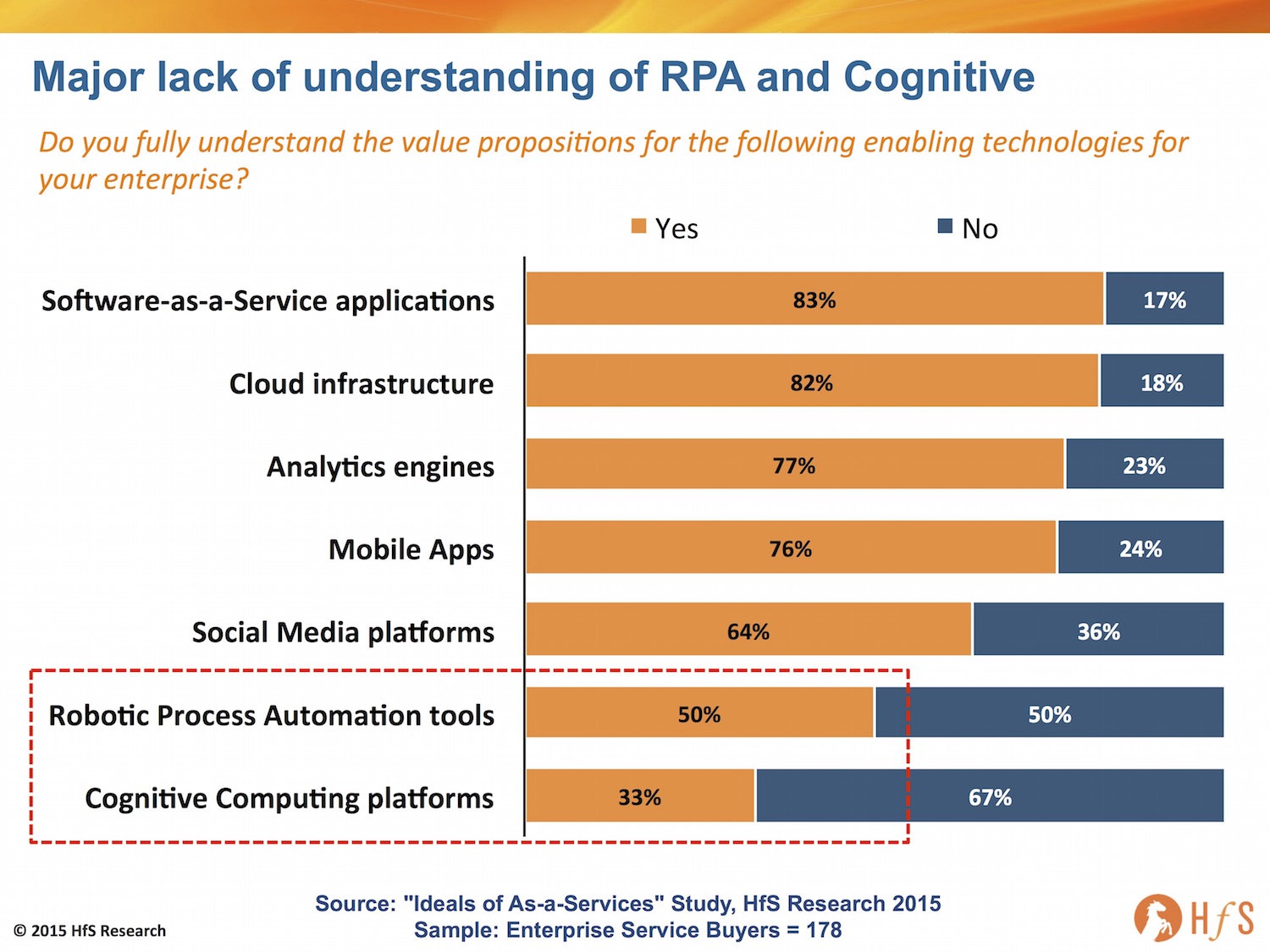
When we questioned the understanding of today’s technology enablers with 178 experienced service buyers, the results are quite alarming – and telling:
Click to Enlarge
Despite being the most hyped technology to hit the services market in the last three years, only 50% of service buyers actually understand what Robotic Process Automation is? And only a third grasp what cognitive computing platforms are? How many more millions need to be spent on these newfangled cognitive/autonomic platforms until the people who are their prospective customers actually understand what the hell they are? How many more millions do these providers, analysts and advisors need to spend on stroking each others’ egos at expensively assembled boondoggles, before they realize their actual prospective customers haven’t got a bloody clue what they are talking about? How many more millions are going to be spent on marketing campaigns that just leave us scratching our heads, confused as to what is actually being sold?
Some vain suggestions to get us back to something closely resembling reality
Invest in executives who can hold meaningful conversations with your clients. “We’re just not talking to the right people,” confined one service provider leader to me recently. We quickly came to the conclusion this was because his firm had not recruited the right people to have the right conversations with the right level of people. This is where service providers and advisors have to invest, if they are going to make it past this era of BS. Too many are skimping it with cheaper kids and inexperienced sales people who just don’t have the chops and years of experience on the client side, to get them to open up about their challenges and create interest in hiring them. We’re not just selling a software product here, we’re selling services to address fundamental business pain points. So waste less money on meaningless marketing and ineffective sales people, and find the talent which can hold the conversations you need to be successful. Be unafraid to change the failing recruitment model in this business – there are hoards of really smart, articulate, experienced people out there. Otherwise, you will probably fail.
Kill the PowerPoint. I can’t believe I am still talking about this one, but it’s got even worse in most cases. And the PowerPoint’s got even more canned and scripted. It’s become an excuse not to have a meaningful conversation. It’s become the glitz the ineffective sales guys can hide behind to avoid the meaningful conversations.
Start with the solution and get to the point. People will immediately resonate with you, when you articulate what you are trying to talk to them about. Never be afraid of the blindingly obvious – if people understand what you are talking about, you will get their attention. “Our solution can take out 40% of cost, like we already have for xxxx”… or “We can fix your manual processes in six months with our revolutionary new automation tool and here’s how we’ve done it”. Or “We are the leader for high value solutions in healthcare, or banking and this is why” etc. Don’t amble on with a dull build up to sound clever, and really avoid the canned Nascar slide, when it’s clearly a hodge-podge of logos of everyone who’s had some vague connection with you. It’s cheesy. And tone down the incessant use of flashy terminology – we all know it by now. Let’s revert to more plain English, please.
Bring real personalities into play, not sales people. As we discussed last week, the focus of work today is about increasingly about enjoying who you’re working with. People want to engage with people with charisma, who actually want to create relationships, not the old school sales rep who are “only selling”. We’re all in the relationship business and need to create long term relationships with our clients and partners, whether or not they buy from us today. People are still buying from people – especially as the technology becomes more and more commonplace. There is always a lot more forgiveness factor from clients for a sloppy transition or an over-budget implementation, where the relationships are true and strong. We might be in the era where technology is at the center of our world, but this means the real differentiation is with the people applying the technology.
The Bottom-line: We have to fix our bullsh*t problem, or this industry will fade into irrelevance
We’re in the business of helping clients run their operations more productively – that’s never changed. We’re not in the business of trying to be the smartest guy in the room. And we’re certainly not in the business of creating the largest array of pre-scripted canned marketing hype. It’s time to get back to basics, focus on the people we have fronting our capabilities and making sure our clients understand us – and are engaged with us. If we’re not, we might as well go home now, as others are coming along who are changing the conversation and having the meaningful dialog.
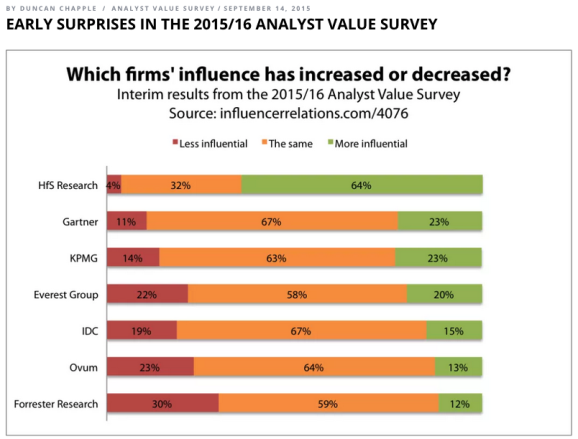
The main man who tracks the influencers, Duncan Chapple, gives us a little sneak preview into how this year’s Analyst Value Survey is chugging along, with several hundred research buyers already sharing their views:
Click to access article
If you haven’t yet had your chance to share your opinions of which analysts are doing (or not doing ) it for you, do spend a few minutes completing the 2015/16 Kea Company Analyst Value Survey by clicking here.
Duncan Chapple leads Kea Company’s Influencer Relations Practice (Click for Bio)
It seems the “freemium” model we’ve adopted at HfS over the last six years is really having an impact. It’s our view that top insights shouldn’t be stuffed behind a firewall. Clients will pay for premium data, indepth analyst strategy session and in-depth competitive landscape reports, but when it comes to insights, viewpoints, or just some plain old entertainment, why hide it?
Freemium isn’t disruptive, it’s the way forward for an analyst industry, much of which refuses to break out of its stale model. If people stop reading research and genuine insights, we might as well all pack up and go home now, so let’s promote what we do, not hide it.
Having a prolific analyst team beat the As-a-Service drum every day is the real reason for our continual impact – they keep the views fresh, varied and unvarnished, while maintaining that personal touch, which is what we’re all about at HfS.
Thanks for those who have voted for us (so far), we really appreciate your support and feedback. If you would like to share your views on what you would like to see more (or less) from us, do email us here.
Accenture buying Cloud Sherpas unveils the value of As-a-Service talent
Accenture has added considerable strength to its already-strong position in Salesforce services with the addition of Cloud Sherpas for an undisclosed amount (press estimates have been $350-$400 Million) coming on the back of previous Salesforce services acquisitions of Tquila and ClientHouse GmbH. In addition, there are added capabilities in ServiceNow and Google, but the lion’s share of the Cloud Sherpas acquisition is in the Salesforce implementation domain, where we see the most medium-term growth opportunity for ambitious As-a-Service providers in the customer centricity solutions arena.
HfS views the success of this acquisition tied to Accenture’s capability to integrate its capabilities across operations, consulting and systems integration and to use the core training and certification methodologies of Cloud Sherpas to transform Accenture’s own ability to grow Salesforce consulting, implementation and management talent.
However, if it only focuses on the low-hanging fruit – the systems integration – Accenture will fail to reap the full benefits of the investment, hence it is critical how it integrates the Cloud Sherpas talent across the core Accenture divisions, especially Accenture Operations and consulting. Accenture also needs to follow the mantra that As-a-Service is ultimately about empowering the customer, not the consultant.
In short, we believe this move not only consolidates Accenture’s already-strong position in Salesforce services, but also keeps out competitors from muscling into the space at a critical time, namely Deloitte, Capgemini and IBM.
As-a-Service can provide tremendous growth at scale potential like legacy ERP did, but the skill requirements are different
SaaS platforms like Salesforce and Workday might not be like traditional ERP platforms, but the commonality is still one of scale and skill. The difference is simply the type of skill requirement needed. With traditional ERP, enterprises need constant teams of engineers to mold the platforms to the business needs of the enterprise, whereas, with SaaS, they need teams of process and technical professionals to mold the enterprise to the SaaS standards and processes and make them effective. This is why we’re seeing the global professional services giants eying teams of talented consultants and delivery staff who can do more than merely implement these popular platforms and respond to the customers’ demands to have a post go-live partner.
The capability onus shifts firmly from the back office to middle/front offices to unleash future value
Ultimately, the enterprise will need less IT programmers to develop out a SaaS platform, but will increasingly need process experts and transformational minds to help them make maximum benefit from the SaaS functionality. The onus is shifting from back office engineering skills to middle/front office data science, design thinking capabilitles.
The real battleground in As-a-Service is emerging within business functions where there is no ceiling for innovation. With a process like payroll, for example, most enterprises can purchase the services they need to get the job done and provide the data they need to make decisions – they know what good looks like and can get there relatively quickly with the right As-a-Service provider.
Where this ceiling for innovation is limitless, is in processes such as sales and marketing, where the technology platform is the enabler for ambitious firms constantly pivoting to keep ahead of their customer demand and market shifts. Other functions with a high innovation potential include finance, workforce management and supply chain, where enterprises have a constant need to act decisively on data, not simply collect it and store it somewhere. This is where ambitious As-a-Service providers can gain an edge in the market, by investing in talent that help clients really achieve ongoing business value from SaaS, as opposed to simply deploying armies of programmers to keep the lights on. This is why KPMG bought out Towers Watson’s Workday practice earlier this year – and Accenture has now added to its global SaaS delivery strengths with this significant investment of Cloud Sherpas.
As-a-Service has to be all about empowering the client, not the consultant
This is why leading As-a-Service providers are finding themselves in a rat-race to absorb talent that can not only deliver the bread-and-butter execution of process and technology implementation, but also help their clients post “go live” to work with them unto perpetuity to help them be effective and competitive in their industries. Simply put, the future growth in services is tied to many of the leading SaaS platforms that are being adopted aggressively by enterprises, such as Salesforce, Workday, ServiceNow, SAP Successfactors, NetSuite, and so on.
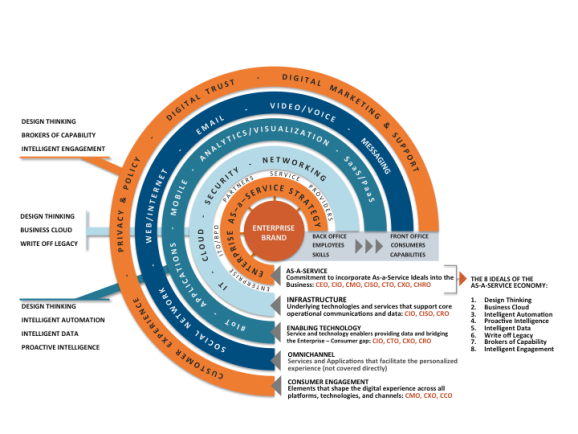
However, the critical factor the likes of Accenture, KPMG, Deloitte, IBM et al. need to understand is they have to do more than sell a COE of expensive consultants to slap in the platforms. Enterprises are investing in SaaS to free themselves up from the shackles of legacy technology and have operations that can keep pace with the needs of the front office: in other words, they need to be able to help their clients receive operations As-a-Service:
Click to Enlarge
Why Accenture/Cloud Sherpas is a strong fit in terms of talent empowerment and scale for managed Salesforce-based services
For Cloud Sherpas, we believed that having depth across the breadth of all the components of the Salesforce Customer Success Platform was a looming challenge as our recent discussions with clients have shown that they want that breadth but saw Cloud Sherpas as much more specialized in the Sales and Marketing Clouds than the other components. These clients were telling us that they were increasingly looking for support and coordination across the full Salesforce offering and that they expect their service providers to be able to bring them not just implementation, but also consulting and management skills to support their business needs.
They aren’t looking for single product implementation partners in 2015, as they may have in years past, but their needs are more comprehensive, so for Cloud Sherpas this meant that they would have to invest further in consulting depth, in addition to product implementation capabilities to meet this evolving demand as Salesforce revenue itself was up 24% in Q2 2016 YoY. The other challenge we had noted was that Cloud Sherpas was not as developed in providing ongoing managed services post implementation, both for application or business process delivery around Salesforce, than other leading service providers.
Simply put, Cloud Sherpas has grown its business to the ~$200 million level largely more through one-off implementations than in the provision of post go-live ongoing support. At HfS, we believe the firm was beginning to plateau at this level and needed access to global resources to grow the business to a broader level, both in terms of scale and geographic presence. Many Salesforce clients have indicated to us they want to shift more and more of the tasks around Salesforce management over to others to run and support the platform, and this would also have required a significant investment and shift in focus for Cloud Sherpas. In short, this is a good a time as any for Cloud Sherpas to make a strategic market move, and merging with Accenture is a very realistic and practical move for the firm.
Both of these challenges for Cloud Sherpas are also strengths for Accenture, with its breadth of Salesforce platform coverage and its extensive management services capabilities. However, the challenges for Accenture are different. Even with the largest pool of Salesforce-certified talent, Accenture was still resource constrained especially as clients (including many we spoke with) looking to broaden the depth of their Salesforce deployments and to transform their operations. Part of this challenge is simply being able to recruit and train staff with the right technical and business process skills to enable Salesforce to be not just operational, but a generally effective platform for clients seeking better access to customer data, more responsive marketing campaigns and enabling sales and marketing teams to approach business problems more creatively.
Accenture was especially short relative to its size in access to higher level certified architects and building a training environment for certifications that could keep pace with demand. Those as it turns out were both strengths of Cloud Sherpas who as a SaaS services start-up had built the specific Salesforce (as well as ServiceNow and Google environments) team development programs and processes that Accenture was lacking. Accenture had the scale and the global delivery network to support their clients but now needed the accelerants for growth to match client demand. HfS also believes that Accenture needed to also give greater internal visibility to Salesforce and other cloud platforms than had been the case because as big as these capabilities have grown they are still dwarfed internally by the team around SAP, Oracle and other solutions. Buying Cloud Sherpas therefore not only adds to the capabilities to grow the practice faster but also adds ~1,100 members to the team across Salesforce, Google and ServiceNow including roughly 600 in Salesforce services alone. Like when Accenture purchased Procurian for procurement services BPO back in 2013, HfS believes that the acquisition of Cloud Sherpas acts as an internal organization change agent within Accenture. The need to make the business case of the acquisition concentrates the organization on a shared goal and allows for the re-shaping of resource pools and organizational models that can’t be as easily undertaken just with organic growth. In the case of Salesforce Services, this organizational change is manifested in the decision to create the Cloud First Group to incorporate all of the focused SaaS design, implementation and delivery resources in one place and to further elevate its internal position to the client teams and the leadership of the Technology Growth Platform.
Therefore, when we look at two challenges that we had identified for each of Cloud Sherpas and Accenture around Salesforce services, we believe that barring any visibility into the actual financial structures of the deal, these challenges are well addressed by this coming together.
The Bottom-line: Competitor response is critical, otherwise Accenture will continue to lead the Salesforce As-a-Service market
We believe Accenture not only solidifies its position at the forefront of the market, but it also keeps out its competitors by tying up one the most attractive specialists in Salesforce delivery. Rather like its acquisition of Procurian in 2013 tied up the Procurement-as-a-Service market, Accenture is banking on Cloud Sherpas having a similar impact in Salesforce services: take a stranglehold position as the market is quickly maturing.
The big question, now, is whether Accenture’s core competitors in Salesforce services have the appetite – and depth of funds – to make a play for other specialist Salesforce providers such as Acumen, Appirio and Bluewolf. Deloitte is consistently avoiding being a managed services provider – preferring its role as consulting partner; KPMG is flirting with it, but seems more enamoured with building a service delivery world for large enterprises around Workday, while IBM sold off its CRM BPO services to Concentrix and needs to make a similar move to Accenture here, if it really wants to be more serious that an SI player in the space. HP could be a wildcard, with its strong CRM BPO business and Salesforce relationship, provided it can quickly get past its recent restructuring to make a strategic investment in this area. Capgemini is another contender here, with excellent technical implementation capability, but its BPO services are much more centered around finance and supply chain, that customer centricity.
HfS readers can click here to download a freemium copy of our new POV “Accenture buying Cloud Sherpas unveils the value of As-a-Service Talent” authored by Charles Sutherland and Phil Fersht
We’ve been a having a great time helping the Nasscom team pull together this year’s BPM Summit agenda and speaker lineup. And how could you fail with the theme “The Emerging Digital Economy: Thrive, Survive or Die”?
So get over to Bangalore this Thursday and Friday where you can mingle with the HfS team, a whole plethora of service provider leaders, advisors and buyer executives, where we will attempt to unravel the mystery, hype, excitement and confusion surrounding the BPM industry. And you can find out just why this picture fits in with the HfS vision for the future of the workplace…
Find out what’s making Chandra, Vishal, Tiger and TK strut their stuff in Bangalore this week…
The BMP Masala Dosa Reality: Great product, Weak Message
My recent experience of dosas, one of Southern India’s favorite food snacks, typifies the potential and shortcomings of India’s BPM (Business Process Management/Outsourcing) industry. The product is fantastic once you experience it, but, as a Westerner, you probably haven’t got a bloody clue what you are actually buying.
“It’s a bit spicy, sir” was the response, when I asked what the Mysore Masala dosa actually was. At that stage, I just took the plunge, but a little more description of why this food product is very tasty and will meet my desired hunger-fulfillment outcome, would have really helped close that deal.
This scenario isn’t a million miles from the typical experiences of dealing with an Indian-heritage business process service provider….
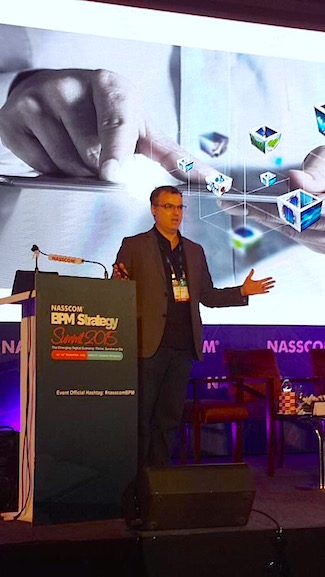
Coming back from the excellently well-attended and content rich 2015 NASSCOM BPM strategy summit in Bangalore this past week, I find myself feeling conflicted between excitement and frustration for the future of Indian-centric business process management / operations services.
My excitement
Execution is better than ever. India-based process delivery is getting really good. The tiresome client whining about poor execution and failed promises is become fainter than ever, with the vast majority now proudly talking about how smoothly their offshore operations are running. At HfS, we don’t need to visit India to get this feedback, but seeing so many operations up-close is always a good refresher to reinforce the progress being made.
India has massive potential to lead the world in process delivery centered on analytics and robotic process automation. This was, personally, my biggest reinforcement. India delivery is all about passion for processes, getting them executed and doing smart things to make them run better and throw off meaningful data. Most of the analytics and automation needs of today’s BPM deals are not rocket science – it’s making sure insurance claims, invoice generation, order management, credit and collections etc remove unnecessary manual steps, produce the outcomes clients want at lower cost of delivery. Most of the competent BPMs are now deploying bots in their centers alongside their staff, leveraging many of today’s off-the shelf tools, such as Automation Anywhere, Blue Prism and UiPath. And they’re pretty damn good at it.
BPM providers have a real permission to play as As-a-Service providers. Barely 2-3 years’ ago, most industry folks assumed a service provider had to be a serious purveyor of IT services and business processes to be taken seriously as a one-stop-shop for Business-process-as-a-Service solutions. Analysts and advisors clamoured for the pureplay BPMs to merge with the IT services shops lacking business process capability, in order to get ahead of the emerging wave of solutions that have cloud-based technology platforms powering the processes. Today, that assumption is a fallacy, as the confidence in public cloud from most enterprises shifts the service provider differentiation from IT to process excellence. Noone questions the competence of a professional provider to host as-a-service platforms, such as a Netsuite, Workday, Blackline, Coupa, Salesforce (or homemade solutions) – the onus shifts to said provider’s ability to provide the bread-and-butter fulfillment, the analytics, process automation and creative services to deliver their clients outcomes and achieve attractive cost-reduction targets.
Big is no longer beautiful as the new wave of BPM deals emerge. Many of the leading BPM service providers have become endowed this year with bulging pipelines of potential new business – the only headache for them being that most of these new potential deals are coming from the next layer down (in size) of buyer, and from buyers wanting narrower scope of delivery. Moreover, buyers are getting fed so much information about cool things such as digital, analytics and robotics, they are demanding a lot more complexity from providers, than merely a simple lift-shift-transition of staff, at minimal business risk. Simply put, most of the new deals are just not as appealing from an economics perspective, and it’s much more effort to cobble together a winning solution. However, for the ambitious service providers, there’s a lot of business out there to keep them growing and drive them toward building integrated As-a-Service solutions.
My frustration
Lack of decisiveness. It always baffles me why many Indian-heritage providers can see that’s happening staring them in the face, but, instead of aggressively getting ahead of the change, they opt to play it safe and copy what everyone is doing. I was disappointed with the approach of many of the service providers refraining from hammering home their distinctiveness, instead opting for the canned messages that, quite frankly, said little of their differentiation, beyond the fact they were quite good.
Very poor positioning of analytics and automation. These capabilities must be front and center, aligned to industry and horizontal process acumen. Instead, most of the BPM providers seem to have forgotten that analytics is the most important differentiator, and plop in automation as a one-slider towards the back of the sales deck. There is an obsession with following the messages of the IT services firms (which spend loads more on marketing hype), than focusing on real process capability, which is really what they are selling. If I want to buy digital technology platforms, am I really going to call up a BPM firm? And if I want process excellence, am I really going to call my local app testing extraordinaire? C’mon people, let’s get a reality check here. Indian BPM firms range from average to very bloody good at managing data and automating basic process delivery. This is where they need to focus.
Automation paranoia must cease. While I would agree there is a genuine move toward FTE elimination in customer call center services, through smarter automation and better tech (which has been going on for about 30 years now), when you get into the rest of the back office world, most automation is about streamlining elements of the processes, not replacing entire FTE roles. These soft-savings are offset by creating more capacity for staff to focus on interpreting data, proactively addressing client needs, adding genuine value to the service delivery. Now, if there are staff who only ever do the most basic of transactional processing, there will likely be some work for that individual on a less sophisticated client engagement, or that staff member may simply need a career rethink – most people really don’t want to do boring transactional office jobs anymore. Net-net by embracing new automation technology and proactively upping the value of the service delivery, will only grow demand for India-centric delivery, not reduce it. True, the influx of new BPM staff hiring will (and already is) gradually decrease, but this is what happens when industries mature and growth slows to a more sedate pace. This is just basic economics. If the Indian-heritage service providers fail to embrace automation effectively, they will get hit hard by those as-a-service providers which are making RPA native to their delivery without even an afterthought.
Too many heads buried in the sand. Most of the Indian BPM industry seems to have talked itself in a comfort zone, that, quite frankly, doesn’t exist. We’ve seen many once-great service brands tank alarmingly quickly because they failed to get ahead of industry dynamics, opting to rest on their laurels. I hate to say it, but several of the Indian-heritage BPMs are falling worryingly into that trap. There needs to be a jolt somewhere to shift this mindset, or this industry could slip into insignificance very quickly. From my conversations, many folks just don’t seem worried about their firms’ inabilities to integrate services across P&Ls, or a clear lack of any direction. Many folks just seem to think that these disruptions will affect their successors at some distant point in the future, and do not really need to do much about addressing them today.
The Bottom-line: The Indian BPM industry is not doing itself justice and must wake up to smell the roses
I am not in the business of providing false hope – if I was, I’d probably go back to consulting. I truly believe India is very good at bringing together a wonderful story around analytics, process excellence and automation – where clients can receive great quality, low cost process solutions… delivered As-a-Service. But there really needs to be genuine focus on three things to achieve this:
Invest in smaller deals that have common process elements. Indian BPMs need to invest in effective as-a-service platforms by picking up an array of smaller client deals and building something robust that can scale and become profitable over time. As the mega deals continue to slow, this is the only way forward for most of the BPM providers. They need to pick the processes where they really want to play and make a concerted medium-term investment plan to create their As-a-Service platform for future growth. This may mean taking on 15-20 new clients on modest margins to build that platform, but that is the only way forward – build the solution first and stop customizing deals for clients that have little scalability or reliability.
Invest in proper marketing. The disease of commissioning cardboard white papers nobody reads; producing mimicked meaningless messaging than means nothing to anyone; hours spent with out-of -touch legacy analysts who impact nobody, has, let’s face it, reached news depth of affliction. We are in the process of boring ourselves out of existence, and – most worryingly – turning off clients. The whole BPM industry is crying out for a facelift and a fresh series of conversations that reflect reality, not fluff.
Move on from “BPM” as the brand, as effective BPM is now the table-stakes. While I commend the Nasscom folks for creating an alternative to the dreaded “BPO”, BPM is more of an interim term, in my opinion, to the eventual As-a-Service end-state. It just doesn’t mean a helluva lot, and in today’s market, effective business process management is par for the course – it’s the staple solution you buy. The real value today is in the services that can be delivered with the BPM to make them really effective.
Just when you thought IBM’s Global Business Services was cratering into an As-a-Sleep state, having sold-off its call center business exactly two years’ ago, Big Blue’s next-gen services star is once again shining, with the acquisition of one of the finest up-and-coming specialist Workday services firms in the market: Meteorix.
Every HR head wants a Workday rollout… and every SI wants a SaaS services acquisition
There is a clear scramble for talent which can implement and support popular SaaS platforms, such as Workday, not completely unlike what happened with specialist consulting firms supporting the ERPs in the ’90s and 2000s, such as SAP, Oracle, Peoplesoft et al. Specialist SaaS services providers supporting SaaS products, such as Workday, Salesforce, SAP SuccessFactors, NetSuite, ServiceNow and Google apps, are now in hot demand as ambitious global service providers seek to avoid the commodity trap of legacy software maintenance, which can still generate revenues, but not at the growth rates of past years.
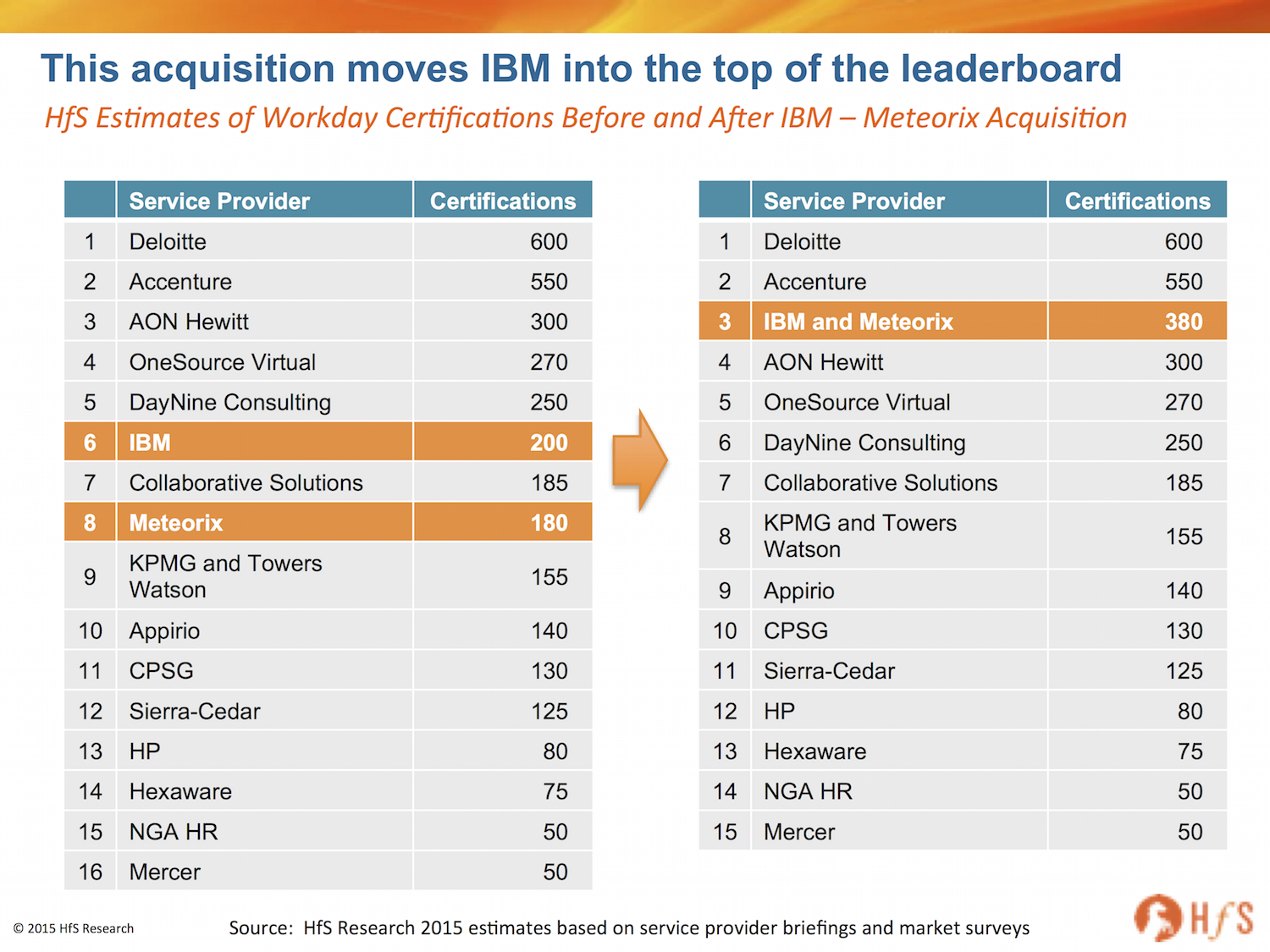
As HfS, we estimate this has set IBM back something between $80-$100m and adds 180 certified Workday consultants to IBM’s stable. This creates the third biggest Workday services player in the market, with a total of 380 certified Workday consultants and elevates IBM into the coveted Winner’s Circle of Workday service providers (please note this is numbers of certified Workday consultants only):
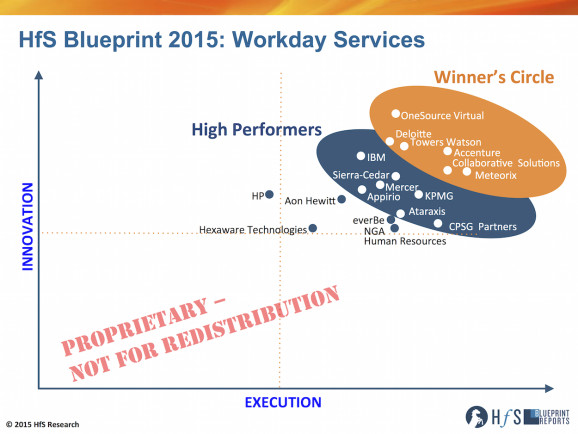
IBM has acquired one of the leading up-and-coming Workday services specialists, which leads the industry for execution capability for Workday clients:
Click to Enlarge
Positives of the acquisition:
Adds considerable scarce talent in a hot market. Not dissimilar to the recent Accenture acquisition of Cloud Sherpas, these SaaS services takeovers are all about the large providers hoarding scarce As-a-Service talent. This deal effectively doubles IBM’s share of certified billable Workday consultants and gives it greater scale and capability to compete with the likes of Deloitte, Accenture, AON Hewitt and OneSource Virtual on large Workday deals. Meteorix staff brings an excellent client culture, collaborative reputation and great array of new clients – different from the pedigree HR transformation talent KPMG recently acquired from Towers Watson, but nonetheless great practical implementers and practitioners of Workday. Our recent Blueprint report reveals that 60% of Meteorix’s customers are in on-going “post-production support” state, one of the critical ingredients behind this deal: acquiring talent that drives the business transformative needs far beyond the initial implementation and go-live activities.
Empowers IBM’s ambitions to control core enterprise data. Being the service provider which controls the creation and interpretation of critical enterprise data, especially the knowledge of the global workforce, really creates a client stickiness that could be more powerful than ever before. Integrated SaaS suites, like Workday, have this capability to enable truly integrate data repositories – hence the trusted service provider of record will be in a very powerful future position to service its clients and deepen its footprints.
Prevents other disruptive As-a-Service providers entering the market. Unlike Salesforce, which has a much more mature ecosystem of service partners, there is a feasting on the small band of worthy specialists in the Workday arena, and they could all be swallowed up by the large players in a couple of years. There are really only a small number of attractive potential acquisitions left in this space after this acquisition which boast genuine scale in numbers, most notably OneSource Virtual, DayNine and Collaborative Solutions. In many respects, not making an acquisition of this ilk could have been more damaging to IBM’s ambitions in Workday world…
Adds considerable services methodology to the IBM capability library. Meteorix has already build more than 1000 reusable integrations into Workday. If IBM can effectively leverage these into its global practices, there is some serious scope for scaling and expanding its Workday business.
Adds real North American depth and entry into the lucrative higher education market. While Meteorix was not strong with multiple vertical industry depth, it does bring capability in the hugely lucrative US higher education market, upon which IBM can capitalize. It also negates IBM’s need to partner with Sierra-Cedar in this sector and go after the space solo. What’s more, Meteorix’s North American bench is well complimented by IBM’s resources across Europe and Asia, even though most Workday demands tend to be confined to the North American market at present. There is also the opportunity for IBM’s practitioners to share their considerable years of SAP HR knowledge, that tend to span much broader global engagements across Europe and Asia/Pac, to where many Workday clients are hoping to expand their platform next beyond North America.
Mid-market focus and scale potential. Meteorix has tended to play in the upper-middle market space, which can provide a great platform to target enterprise level clients. Not dissimilar to the ADP strategy of building the competency in the mid-market before scaling the solutions to move up, IBM has a great opportunity to do this with its new Meteorix talent and IP. There is a huge amount of intellectual property to leverage – the key is to retain the talent and train it to work with higher end enterprise clients – and charge higher-end billable rates!
Potential negatives of the acquisition:
Retaining the new staff. IBM will really need to work hard to create the right culture for its new found talent. This is its first significant services acquisition for some time and it needs to make this work. Meteorix had a very distinct culture, which needs to be nurtured and not suffocated under Big Blue doctrine.
Lack of a SaaS-centric services practice. Accenture’s acquisition of Cloud Sherpas is being integrated with its Cloud First approach, where consultants are trained to implement – and then provide – ongoing support for cloud clients. IBM needs to create something similar with Meteorix to avoid merely being a glorified systems integrator for Workday. The cardinal sin with SaaS is forgetting that SaaS is about empowering the end customer, not the consultant, and this is something IBM’s GBS group needs to work hard at creating. All the major SIs, like IBM, have made billions over the years selling IT programmers to stitch together legacy ERP platforms, which is not the case with true SaaS platforms like Workday. IBM must ensure it instills and develops the business insights and skills for its clients, well beyond the go-live moment, if it truly wants to create deep analytical tentacles with its key clients. Again, As-a-Service is about empowering the client, not the consultant…
Click to Enlarge
Enterprise-enabling Meteorix’s methodologies. While this should be a major strength, this could also be a major weakness of IBM fails to nurture it’s IP and talent and grow its client base across both the mid-tier and enterprise domains. With its determined focus to develop its Watson offerings and cognitive computing capabilities, there must be considerable focus on investing in the “Born in the Cloud” clients of the future, and not just today’s resource-laden legacy enterprises.
Creating strong Workday capability across both HR and Financial Management domains. The speed at which Workday’s Financial Management modules are being evaluated and implemented is really beginning to pick up, and it’s vital for the multifunctional providers, such as Accenture, Deloitte and KPMG to develop delivery and transformation skills across both HR and finance Workday domains. While encouraging to see IBM being affiliated as a Workday FM partner, it’s important to see the firm develop comprehensive Workday delivery skills across both domains long-term.
The Bottom-line: IBM makes its As-a-Service claim, but the hard work starts now
Just when it really seemed that IBM’s services strategy was simply to tie everything, in some way, to Watson, this acquisition is a refreshing reassurance that Big Blue is still very serious about competing for today’s enterprise services with the leading global characters. Now the real hard work is adapting to the new enterprise services culture of empowering the client and building genuine repeatable, scalable methodologies for the future. It’s also about creating platformized solutions for the F500 of 3-5 years’ time and not simply catering to the needs of monolithic enterprises today. We believe IBM recognizes its challenges and is making measured strategies to get ahead of them. However, recognizing is one thing, addressing, making sacrifices and ultimately succeeding is quite another…
So what are you doing on Guy Fawkes’ night? Well, rather than blowing up Parliament, why don’t we start with the legacy analyst business?
With the swirl of social media, free information and business model disruption in the technology world, everyone assumed the traditional analyst world would follow suit. We thought there would be a plethora of new generation analyst boutiques cropping up to challenge the old model. Some tried, and most have failed. A few linger on in their death throes, but the revolution we thought would happen – let’s face it – never really did. Except in one corner—right here at HfS.
I’ll be presenting on Research-as-a-Service and how HfS is changing the face of the analyst industry
As we look around the industry, we see the same old legacy analyst houses producing their useless charts and dull, turgid research just as they did a decade ago. Few subscribers actually read the stuff, but technology vendors still fund these firms because they have few other outlets to justify their existence.
Here at HfS, we’ve been fortunately enough not to be beset by legacy contracts and the dirty vendor dollar to give to industry a very different analyst model – one where we are unafraid to make our research widely accessible to the world with our freemium model and call out the real trends that are happening to our industry (as opposed to regurgitating the same old marketing fluff that turns off the smart buyers). In short, we’ve thrived because of our huge global community, our continuous demand data from our readers and a team of great people and analysts who love the freedom of Research-as-a-Service.
This is where the real fireworks will be on the 5th November…
I’m pleased that I’ll be in London on November 5th to share our story as I keynote the Analyst Relations Forum. My keynote, Thriving in a Market that Refuses to Change: Research-as-a-Service, will look at how HfS has fought to transform a conservative industry that has been slow to change.
I’ll also be having a fireside chat with Wipro’s dynamic new CMO, Naveen Rajdev, and we’ll also hear from Accenture’s popular Managing Director for Global Analyst Relations, Allen Valahu, about what it’s been like to work with a multitude of analysts over the last two decades and what they would like to see in the future (see full agenda for the menu of analytical delights).
We are providing 10 free tickets for those who hurry to register! Sorry—all gone!
We have made special arrangements for ten free tickets to the event (with promotional code JoinPhilFersht) – first come, first served! Sorry—all gone! But we also have arranged for a $124 discount (with promotional code ARForumKeynoteHfS) for those who did not manage to register in time.









 India has massive potential to lead the world in process delivery centered on analytics and robotic process automation. This was, personally, my biggest reinforcement. India delivery is all about passion for processes, getting them executed and doing smart things to make them run better and throw off meaningful data. Most of the analytics and automation needs of today’s BPM deals are not rocket science – it’s making sure insurance claims, invoice generation, order management, credit and collections etc remove unnecessary manual steps, produce the outcomes clients want at lower cost of delivery. Most of the competent BPMs are now deploying bots in their centers alongside their staff, leveraging many of today’s off-the shelf tools, such as Automation Anywhere, Blue Prism and UiPath. And they’re pretty damn good at it.