

Posted in : Absolutely Meaningless Comedy, Employee Experience, The Great Resignation
Why you may regret going back to the office…
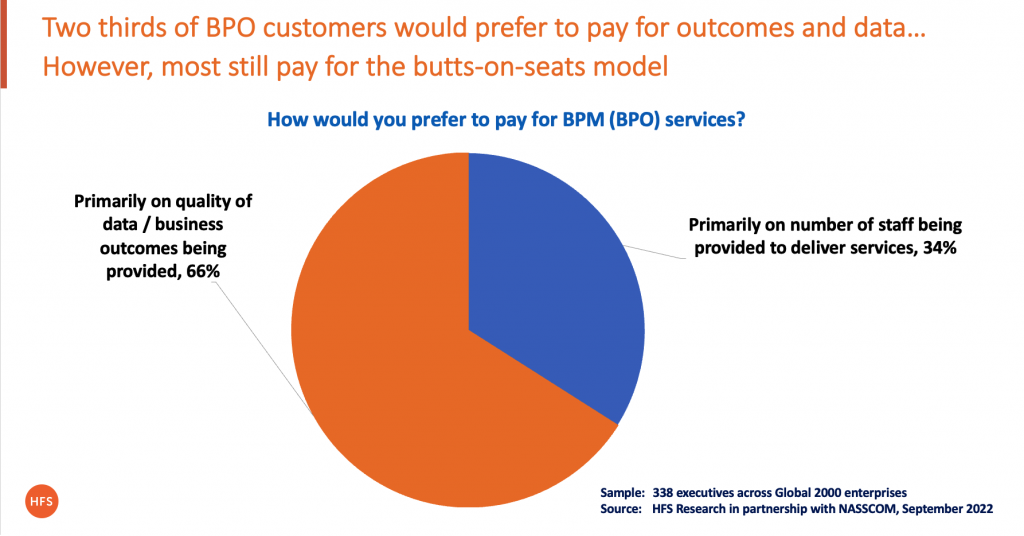
Two thirds of BPO customers want to pay for achieving business outcomes… only a third for butts-on-seats
Today’s current “effort-based” BPO (BPM) services model is failing, but there is hope that this industry can course-correct its outmoded ways of behaving, with two-thirds of enterprise leaders preferring an outcome-based approach. Here’s why:
The economics of the current services model are capitulating
About 90% of business process outsourcing engagements are still largely priced and valued on low-cost labor. Moreover, that labor is becoming increasingly costly as inflation deeply kicks in and the talent supply drains away – especially at the lower-income levels. Service providers will walk away from many of their clients as they simply can’t make the numbers work to deliver their contracted services effectively and profitably. It’s becoming a painful race to the bottom… a zero-sum game that could see the BPO industry rapidly consolidate – and even shrink – if enterprises and their service partners cannot change how they engage with each other.
Our new research, which we will be presenting at the NASSCOM’s Business Process Innovation Showcase next month (see details), is revealing an industry primed for some fundamental changes as the current “effort-based” model becomes more and more misaligned for clients seeking better data, better performance, and much more dynamic partnerships to help them operate effectively in the current climate:
The purposes of client and provider must be aligned, or the relationship ultimately fails
When engagements are priced on the number of people, there is very little incentive to explore new methods of creating value, such as automation, AI, quality data, etc. The service provider is incentivized to maintain/increase the staffing levels, not invest in programs to reduce manual dependencies. Enterprises need to pay for performance, not effort if they ultimately want to benefit from sharing a common purpose with their provider. Net-net enterprises and their service partners must be motivated to achieve the same goals if they want to enjoy a long-term, mutually beneficial relationship.
Why legacy many services engagements become bad business deals
So what incentive does the provider have to become more effort-efficient if they will be penalized financially? The short answer is that there is no incentive, which is why many services engagements move to different service providers when contracts end. In most cases, it’s preferable for the incumbent provider to lose the business rather than cannibalize its own revenues with that client.
The sad reality is that the enterprise client just lost a service partner which has years of experience running their institutional processes – which could probably have automated the crap out of them and delivered a game-changing scenario. But they just had no financial incentive to do so. So the cycle continues, and that same client has to go through the same dog-and-pony show with another provider for the next 5-10 years. They still have the same crappy operations that will remain crappy with another partner, which also has little incentive but to deliver the same crap to maintain the effort levels as bloated as possible, to keep the business as profitable for themselves.
So what needs to change to get the focus on value versus effort?
Clients and suppliers need to jump to a new S-curve of value creation where the client pays for the performance, not just the effort (See Exhibit below). Performance should be measured based on some attribute of business value, not just cost and efficiency. Business value can be defined in terms of working capital optimization, speed-to-market, improvement in business metrics (e.g., DSO or DPO), customer/employee satisfaction (e.g., NPS score), or procurement spend reduction.
Most services relationships get stuck at stage 1 and start witnessing diminishing returns because you just cannot keep squeezing the lemon for more juice. In a performance-driven relationship, the supplier and client share the risk and reward while providing services at the lowest cost possible starts to become a given.
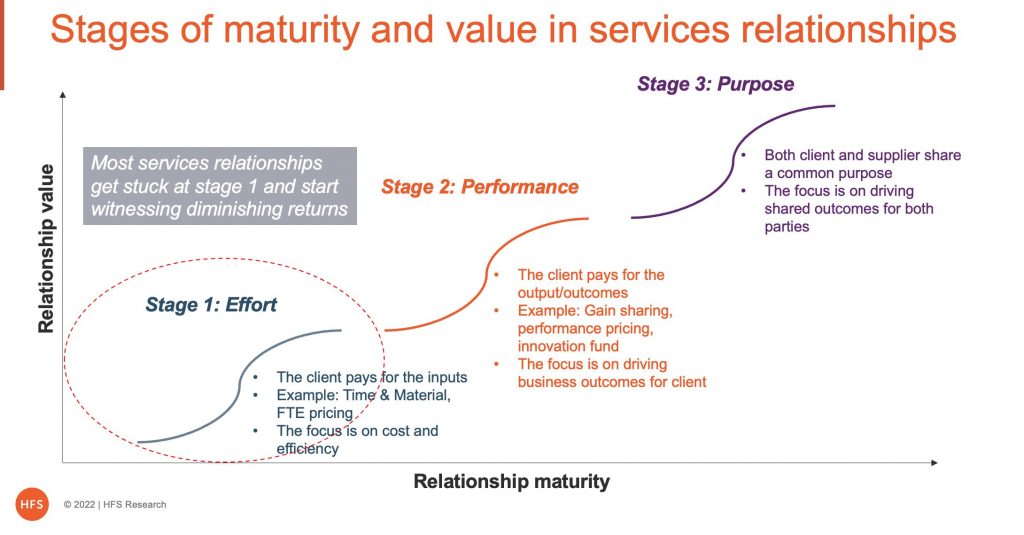
Most sourcing advisory consultants describe a gain-sharing approach at this stage, but be careful as gain-sharing can drive opposite behavior than initially envisaged. A “pay-for-performance” pricing is often more practical. This is how it works:
- Identify the desired outcome for a potential relationship by milestone
- Supplier proposes fixed service fees to implement milestone
- X% of Supplier fixed fees “at risk” for non-performance
- Supplier earns a “performance bonus” (up to Y% of fixed fees) if it exceeds project Savings Target
This pay-for-performance pricing is simple, transparent, and mutually beneficial as the service provider is incentivized to create value, it is relatively straightforward to track and measure, and the buyer payouts cannot be so huge that they can cause budgetary issues.
A gain share model backed with an “innovation fund” is also a better idea than pure gain sharing. Here the supplier (and buyer) commits to a pool of money to drive innovation. A joint innovation council identifies potential projects and uses the innovation fund. The supplier recovers its investment using a gain-share approach with a potential upside if the project is a huge success and a downside if it fails.
Finding a common purpose in a relationship can convert it into a growth engine for both parties
The most mature relationships are not based on math on some complex savings calculations but on a shared drive or goal (see stage 3 above). This is where co-creation happens. When combined with the supplier’s experience and technology, the buyer’s data and real-life business context create a unique solution that can be taken to the market jointly, with both parties sharing the potential windfall. Suppliers struggle to develop innovative solutions in a vacuum, and co-creation allows buyers to drive the partnership toward revenue creation. Purpose-driven associations rely on each other’s strengths to build a strategic, mutually beneficial relationship. A recent example is where bp and Microsoft formed a strategic partnership to drive digital energy innovation and advance net zero goals. Microsoft would further bp’s digital transformation with Azure, while bp would supply Microsoft with renewable energy to help meet the company’s 2025 renewable energy goals.
Bottomline: There is no pricing nirvana in IT and business services. But pricing structures should evolve as the relationship matures from effort to performance to purpose
Each pricing structure – input or effort based (e.g., FTE-based), output-based (e.g., price per transaction processed), or outcome-based (e.g., gain sharing, pay-for-performance, innovation fund) has its pros and cons. It generally makes sense to start a new relationship with some effort-based pricing to establish the baselines and build trust, but then it is time to move on to pay for value.
Where we are seeing most progress toward performance-based relationships is when the CEO gets involved to learn the nuances and value of moving towards areas of common purpose that can also involve other entities in that industry ecosystem. The challenge for service providers is to have leaders capable of developing C-suite relationships and changing that age-old master-servant conversation to one of common purpose to create mutual value.
Posted in : Business Data Services, Business Process Outsourcing (BPO), Buyers' Sourcing Best Practices, IT Outsourcing / IT Services, OneEcosystem, OneOffice, Uncategorized
Goodbye Top Ten and Hello HFS Horizons!
The world of enterprise innovation has changed dramatically since pre-pandemic days, and we – at HFS – have redefined how we evaluate service providers and tech suppliers to reflect the value ambitious enterprises are demanding in today’s business environment.
Today, we’re officially launching “HFS Horizons’ to align the performance of today’s service providers and tech suppliers with the outcomes they help their clients define, the great experiences their clients enjoy, and the synergies their clients are developing across their ecosystem partners to create new sources of value:

So why is it time to phase out the HFS Top 10?
When we introduced the famous HFS Top 10 over four years ago, the whole purpose was for our analysts to put a stake in the ground and produce something relevant to support enterprise decision-making. We wanted to differentiate HFS from our competitors by producing a relevant decision-making support tool for enterprise leaders, not marketing fodder for vendor press releases.
Fast-forward four years, and the analyst industry hasn’t changed a bit – we are still subjected to Magic Quadrants, Waves, and Peaks developed solely for the paid inclusion in supplier sales decks and press releases. While some are pretty decent, there are so many that miss key suppliers, lack the integrity of customer references (if they do any at all), and are scored largely on how well the vendor wows them in a briefing and at their fancy conferences.
Moreover, by lumping so many suppliers into the top right of their charts, the analyst has essentially made many of them “winners” to make it easier to sell more licenses to eager marketers. As a result, the HFS Top Ten has become hugely popular as the one decision tool that enterprise buyers really trust to access deep profiles of suppliers across many dimensions of innovation, execution, voice of the customer, and OneOffice alignment.
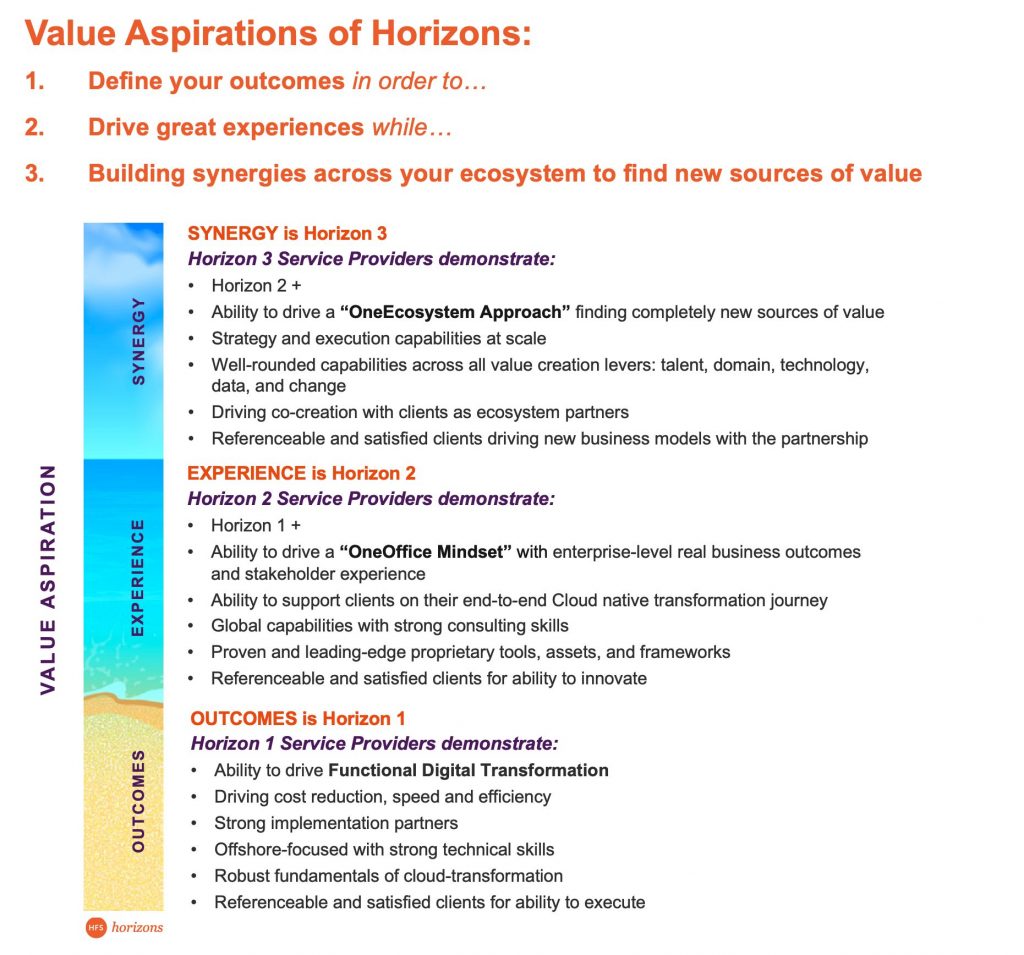
However, like all good things, we need to evolve with the times, and while we want to build on the integrity and depth of the Top Ten research, we strongly feel it is time to align supplier performance across the three horizons of innovation: Outcomes, Experiences and Synergy:
While the rest of the analyst industry persists in looking in the rearview mirror at the world, we’re determined to keep looking forward
We need to stay true to our reputation of being unafraid to challenge and disrupt ourselves and keep looking forward. The best time to retire a product is when it is successful!
So how will Horizons reports work?
HFS Horizons reports will be completely aligned with our vision for enterprise innovation and will paint the supplier landscape across:
- Horizon 1: Outcomes (based on functional digital transformation)
- Horizon 2: Experiences (based on a OneOffice mindset)
- Horizon 3: Synergy (based on a OneEcosystem approach)
Instead of ranking based on execution, innovation, and customer satisfaction; we will be evaluating suppliers based on the “Why, What, How, and So What” of enterprise innovation:
- Why? – The value proposition
- What? – The solutions and capabilities
- How? – The Go-to-Market strategy and investments
- So What? – The market impact in terms of mindshare and wallet share
While customer feedback will continue to be a critical ingredient for Horizonsassessment, we will also expand our data sources to understand employee experience and partner experience. HFS will invest and rely on its own proprietary data sources more heavily versus supplier-provided information
- Beyond supplier-provided client references, we will survey relevant clients in our own network leveraging HFS Pulse
- We will also reach out to employees directly (and anonymously) to understand their perceptions on their employers
- In addition to client references, we will also ask for partner references
The HFS Horizons reports will be governed by an agile research process:
- No laborious RFI responses. The value is in conversations. Essential data requirements will be shared as an appendix to the briefings
- Customer references are recommended but not mandatory. We have in-depth network of clients who are willing to talk to us to provide unvarnished feedback
- There is no opt-out. Sharing information and briefings with analysts is helpful and recommended, but we will leverage our network to assess suppliers.
HFS Horizons report will also allow us to be more inclusive where there are 20+ suppliers in a market
If you have questions on the new HFS Horizons reports and how you can get included, please email [email protected]
Posted in : Automation, Business Process Outsourcing (BPO), Buyers' Sourcing Best Practices, Consulting, Customer Experience, Employee Experience, HFS Horizons, IT Outsourcing / IT Services, OneEcosystem, OneOffice
HFS makes a dash for the Ash… Ashish Chaturvedi joins the analyst dream team

Ashish Chaturvedi and wife Sampada holidaying in Goa earlier this year
Who was it who once said, “The time to expand your business is when everyone else is standing still”?
I think it was actually me once in some pub blowing my own trumpet. But in any case, that is exactly what we are focused on at HFS as we expand our global team and research coverage, with a 4th analyst addition in just the last six weeks. Joining us today is a terrific chap with real energy, research pedigree, and a long-proven reputation in the industry: Ashish Chaturvedi, who will drive our coverage in retail and supply chain, in addition to many areas that bleed into them. Ashish is taking on a global Practice Leader role for HFS, based out of Bangalore, where he previously worked as a Principal Analyst and Program Lead for sourcing advisor ISG.
So let’s dig into more about him and what his plans are for HFS…
Phil Fersht, CEO HFS Research: Welcome to HFS, Ashish! So, what gets you up in the morning?
Ashish Chaturvedi, Practice Leader, HFS Research: I might sound philosophical here, Phil, but it’s the desire to make my life meaningful. At a personal level, it’s how well I can play the role of a husband and father. On the professional front, it’s about how I can be a better analyst. The following keeps my dopamine level up – reading, reflecting, interacting, connecting (the dots), and producing (research).
You’ve been an analyst most of your career, Ashish. What do you like most about it? And what do you find most frustrating about the analyst industry that you would change if you could?
There are many positive aspects, but if I need to point out one thing I love about being an analyst, it’s the magnitude of impact we have on the enterprise and IT provider business. From choosing the right technology stack and implementation partner to shaping a firm’s go-to-market strategy, the world relies on us.
About the not-so-likable aspect, most research outputs right now provide a balanced and diplomatic view v/s being direct and decisive. I firmly believe that putting a wrapper around your ‘research’ dilutes the meaning and messaging. One more change I would like to see is restoring the balance between education-oriented v/s marketable research. Over the last decade, it has become disproportionately skewed towards the latter.
And why do you think you’ll bring something a little different to the analyst industry at HFS? What will you be writing about? What is it you care about?
I highly regard HFS for its fearless brand of research, Phil. Moreover, it has one of the most diverse research offerings in the analyst industry. I think this bodes well with my aspirations and goals. So, the intention is to conduct more holistic research and be more clear, direct, and specific. I plan to spend most of my capacity on decoding the future supply chain (across industries) and covering the advancements in the global retail sector. Additionally, from a technology per se, I would focus on disruptive technologies and their impact on various industries.
So, finally, Ashish, what do you think we’ll be talking about in a year? Can many of today’s enterprises survive if they don’t change their legacy habits? Many firms have changed little since the pandemic (even moving backward), while others are rethinking their whole business and IT strategy to embrace the future…
I’d certainly like to run you through the past year’s highlights (of my research). Talk about what’s changed in my coverage space and comment on the short- and long-term impact of that change. I’d also like to take you through a report card mentioning technologies that lived or not lived up to the hype and progress made by enterprises, providers, and software vendors in the supply chain and retail space.
Coming onto the second part of your question, I think enterprises require three things to succeed in the market – Education, Intent, and Purpose. If any of these three are missing, you are bound to fail, which happens with 95% of enterprises. Let’s look at a real-world example around one of these – ‘lack of education’ – I regularly witness enterprises equating (digital) transformation with cloud migration and equating cloud migration with a lift-and-shift approach to the cloud. They eventually fall way short of expected outcomes. Let’s decode this:
First, Transformation does not mean Cloud migration. It also includes aspects like supply chain visibility, internal systems talking to each other, an agile workforce working in a DevSecOps model, and automating your IT processes.
Second, Cloud migration does not mean Lift-and-shift. To reap the benefits of cloud migration, you need to do much more than just moving workloads to the cloud. An enterprise needs to assess and work on its current IT landscape – some applications might have to be rewritten to make them cloud-native and composable, the technical workforce needs to be working in an effective set-up like a squad-based configuration, high-grade quality engineering processes need to be in place, application consolidation is required to the selected technology stack, and the core needs to be modernized. There are multiple other aspects.
Here, we analysts have a massive responsibility to impart the proper knowledge.
Welcome to HFS, Ashish – we can’t wait to read your keen insights!
Thank you, Phil! It’s an honor to be working with one of the most passionate and capable bunch of analysts in the industry.

With daughter Kavya
Posted in : Customer Experience, Digital Transformation, Outsourcing Heros, Retail, Supply Chain
Employees are bored and fearless to move, but see real potential if their leaders realize its no longer 2005
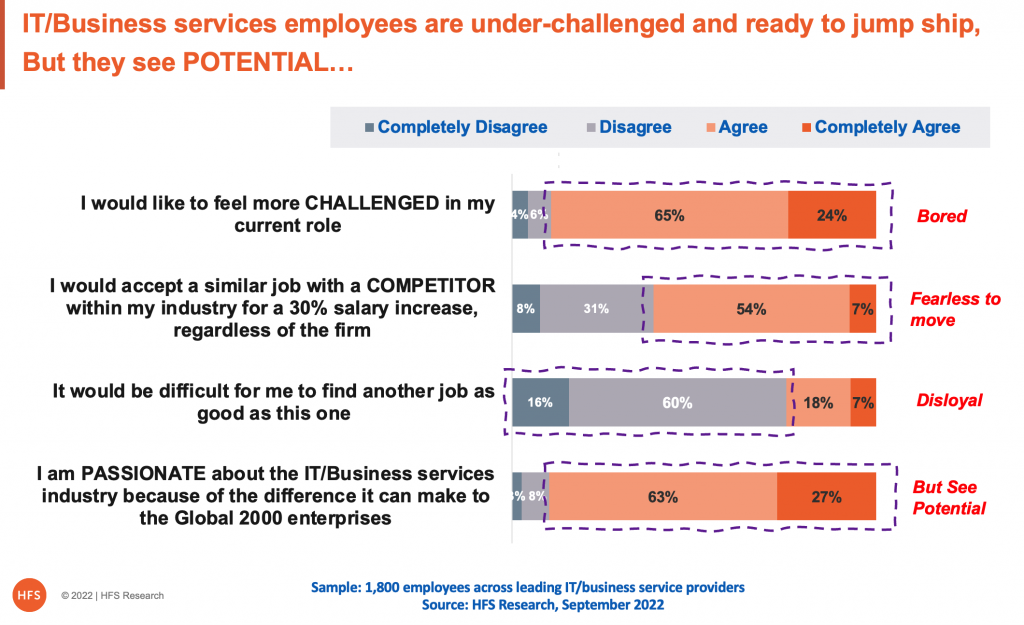
Our new IT/business services talent study, covering the experiences of 1800 services staff across major regions and the leading 16 service providers, reveals why attrition has been running at the 30% level (and that is only what is officially reported) and showing few signs of slowing, despite a worsening economy and the threat of recession.
As you can see, close to 9 out of 10 staff want to feel more challenged (and are bored), 61% will jump to a competitor for a pay hike, and 75% believe they can easily find a job as good as the one they currently have. The only saving grace for the IT and Business services industry is that 90% of employees are passionate about the impact they can have on enterprise clients.
There is salvation, folks, and it holds real potential if service provider leaders can get their heads out of the sand and challenge both their clients and their staff to raise the value of their partnerships.
This industry is at a pivot point, and winning the talent war is the only way to survive
Simply put, there aren’t enough skilled workers out there to deliver billions of dollars of services, and most of these service providers still have a prehistoric mindset of routine work being cranked out in cube farms by zombie staff willing to work for low wages. Well, those days are pretty much over, and those service providers that fail to become more attractive places to work, with challenging work to deliver, will quickly fall away in the emerging environment, which will not be for the faint-hearted. If they can’t keep their workers and have them deliver more value to their clients, they will end up in a zero-sum race to the bottom and likely lose business because their clients will not tolerate the attrition and the impact on delivery quality.
The problem with the services industry is that when companies provide outsourced services for enterprise customers, it’s most often the monotonous tasks the customer can offload at scale, such as application testing, infrastructure monitoring, accounts payables or receivables.
Even sexier-sounding work, such as content moderation for social media sites or product support services is usually very tedious after a while, especially when the services worker is just instructed to follow a standard operating procedure without any incentives to use judgment, creativity, analytical skill, or common sense. It’s no wonder staff are quitting in droves in search of something more challenging when there is so much demand for workers to perform elsewhere. Now that next job may turn out no more challenging than their current gig, but if there’s 30% more money for doing it, why not?
Service provider leaders must stop blaming entitled staff and become better employers
Now we can moan and groan about the attitude and self-entitlement of some Gen-Zs and Millennials who have no loyalty, don’t care about longevity on their CVs, etc., but put yourself in their position: you’re ambitious, and other companies are offering you more challenging work, more money, and are simply more exciting places to work. Why would you want to suffer a life of soul-crushing work for a company that still operates the same way it did 15-20 years ago? And can you blame staff for preferring to work from home than suffer from the monotony of a stuffy cube kingdom where most of the management isn’t even there? Let’s be blunt: it’s often the management who have become self-entitled, not the staff. The problem ultimately lies with bad leadership, not bad working attitudes.
The Bottom-line: The services industry has a huge opportunity to increase its value to enterprises, but its leadership must radically change old habits
Our new research shows that enterprise clients are willing to pay for more than just routine work delivered, with two-thirds declaring they would shift to an outcomes-based model. So why aren’t they? It’s simply a two-way proposition: service providers need to demonstrate they have the capability to take on higher-value work, and they need to convince and demonstrate to their clients that they have the workforce and leadership skills to do just that.
Quite simply, the conversation regarding what constitutes value needs to change – enterprises need to be convinced to pay for value than mere effort… is it really that hard? Seems to me that many service providers lack the leadership talent to have that conversation… and need to address that asap.
When 90% of services workers are passionate about IT/business services and are clearly wanting to take on more challenging and interesting work, we have a huge opportunity. When service providers have multi-year agreements to get down and dirty with the institutional processes of a client, isn’t this a wonderful opportunity to upsell them new work, new ideas, and new ways to excite their staff? When the trust is already there, what is stopping IT and business services from moving up the value chain and helping enterprise customers desperately need more support from smart talent who understands their challenges?
This is a leadership challenge to recognize where the industry will fade away and make big changes to take their firms in a new direction. We’re already operating in a cut-throat global environment where the very stability of our economies, businesses, and livelihoods are under an unprecedented assault. We can either rise up to these challenges and find new sources of value or struggle to stay afloat as the mayhem subsumes us.
Posted in : Business Process Outsourcing (BPO), Buyers' Sourcing Best Practices, Customer Experience, Employee Experience, IT Outsourcing / IT Services, Talent and Workforce
Automation doesn’t dictate why we do things; It must dictate how we do them
10 years since HFS introduced RPA to the industry (see link), and we’re finally focusing on automation as a value-lever that drives business outcomes, as opposed to mere cost takeout in the back office.
The pandemic has shifted the automation focus from creating efficiencies in the back office to delivering immediate business impact, where talent shortages can be overcome, where digital workflows can operate despite broken supply chains, and where businesses can find new opportunities in their virtual and hyperconnected ecosystems.
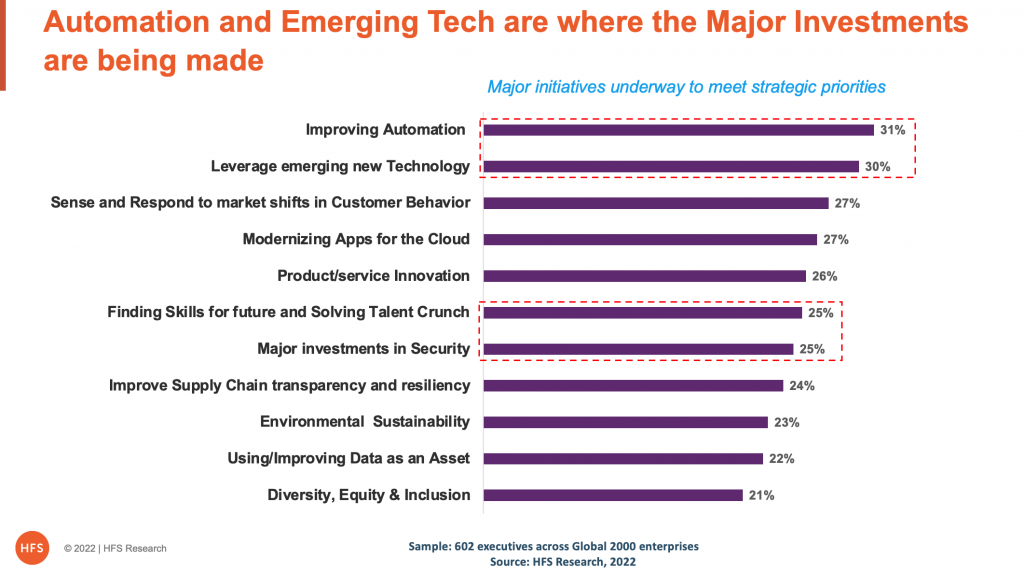
Our recent pulse data of 602 enterprises proves beyond doubt that automation is the number one initiative currently underway to support enterprises in meeting their strategic priorities:
Why automation finds so many problems that really need solving
While so many organizations are facing well-documented problems with talent retention, this is only sixth in the order or priorities behind the race to implement emerging technology, cater to changing consumer needs, and modernize apps for the cloud.
This tells us that automation is becoming so increasingly important to businesses as it helps solve so many of these endemic problems being caused by labor shortages, wage inflation, and poorly integrated systems, workflows, and processes. Simply put, if you get better at automating, you’re solving a lot of these other problems at the same time.
Automation is a discipline and a mindset
Smart business leaders have realized that automation is a mindset and a discipline that needs to be ingrained into every business practice. It is not why we do things; it’s how we do them. Automation makes what we have function effectively without needing constant human attention and manual workarounds. And the better we understand automation, the more autonomous it can become to drive genuine artificial intelligence interactions and processes in the future. AI and automation are becoming increasingly synonymous as we figure out how automation can really work within a business operation.
If there’s one thing the pandemic taught us, it’s been the necessity to re-think processes to get the data; what should be added, eliminated, and simplified across our workflows to source this critical data. And there is simply no option but to plan to design processes in the cloud using web-architected applications. In this virtual economy, our global talent must come together to create a borderless, completely digital business ecosystem where we can connect with other organizations that share common goals and purposes. This is the true environment for real “digital transformation” in action.
The Bottom-line: Most enterprises are only at the start of the real automation journey
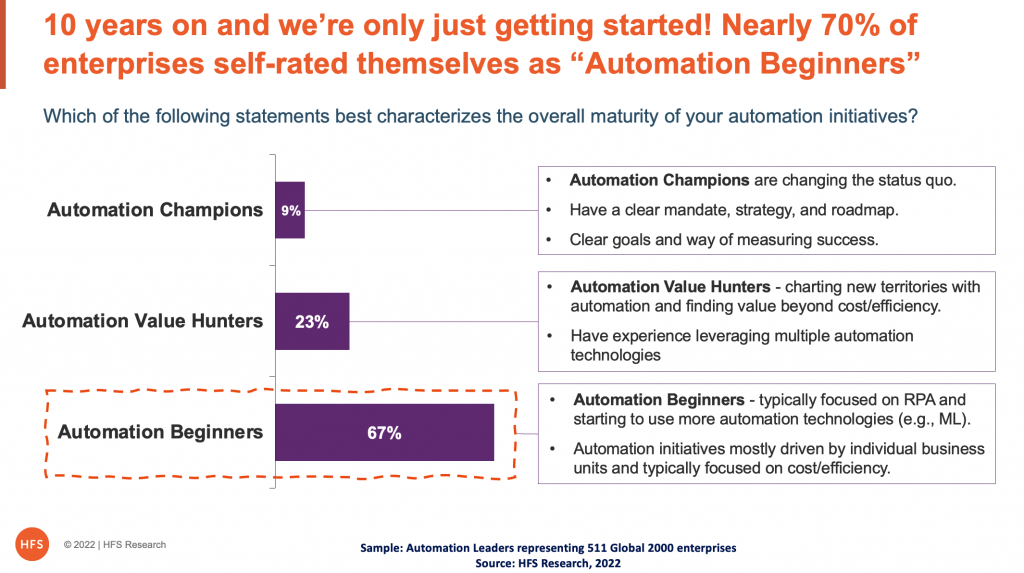
As I reflect on our research covering over 500 automation leaders of major enterprises, what hits me the most is that 70% admit they are still novices. It seems the more they learn, the more they realize they need to know. We’re only at the start of a long journey for the majority of today’s ambitious organizations, and selecting the right partners along the way to help them design, implement and learn from automations across their businesses is so important. As one CIO delightedly pointed out to me recently: “I’ll keep finding automation ’till I die”… now that’s the attitude that is changing the whole approach to automation as the new IT mindset.
Posted in : Artificial Intelligence, Automation, Buyers' Sourcing Best Practices, Cloud Computing, Cybersecurity, Digital Transformation, OneEcosystem, OneOffice, Robotic Process Automation, Talent and Workforce, Uncategorized
The HFS Horizons revolution kicks off with Cloud Native Transformation
At HFS, we have redefined how we evaluate service providers and tech suppliers to reflect the value ambitious enterprises demand in today’s business environment with our new HFS Horizons. Now we’re excited to share the first-ever Horizons Report—on Cloud Native Transformation.
Cloud Native Horizons aligns the performance of today’s service providers with driving the functional building blocks of technology transformation (Horizon 1), creating the business transformation experiences their clients enjoy (Horizon 2), and the Cloud Native synergies their clients are developing across their ecosystem partners to create new sources of value (Horizon 3). And it’s all summed up in this picturesque new HFS Horizons landscape, which positions the leading service providers within the three horizons that their customer engagements typically demonstrate:
HFS Horizons – Cloud Native Transformation, 2022

Note: All service providers within a “Horizon” are listed alphabetically
According to the Horizon report co-author Tom Reuner, “There is a fundamental disconnect in how the industry discusses organizations moving toward the cloud. The supply side is evangelizing technology and capabilities with containerization and Kubernetes as the focal point for that marketing noise. Conversely, the buy side is struggling to capture the value of their cloud investments, as very few clients have a well-defined cloud transformation strategy at an organizational level, which can lead to transformations done in silos. Only by aligning technology transformation to business objectives will organizations get closer to capturing value from their investments. Thus, we need to reset the discussions on cloud native transformation.”
Some additional excerpts from the report:
- The market noise around cloud remains deafening. Despite all the noise, the journey toward cloud native remains challenging. For many organizations, costs spiraled out of control, and the harsh lessons of ineffective controls are sinking in. Often, a change of provider has accompanied the realization of these challenges. Too often, the industry leads with capabilities and technology jargon rather than providing clarity on what broader strategic outcomes should be and how to deliver on them. We must confront the new operational complexity that moving toward becoming cloud native entails. To help, HFS is launching a new Horizons study on cloud native transformation (CNT) to learn from the experiences of organizations that have not only moved workloads into the cloud but also transformed their operating—or even business—model.
- The inaugural HFS Horizons: Cloud Native Transformation, 2022 report examines the capabilities of 20 IT service providers and management consultancies (in alphabetical order: Accenture, Capgemini, Cognizant, Deloitte, EPAM, EY, Genpact, HCLTech, IBM, Infosys, KPMG, LTI, Mphasis, PWC, TCS, Tech Mahindra, UST, Virtusa, Wipro, and Zensar) offering differentiated approaches to meeting the transformation needs of clients. This research effort will assess how well service providers are helping their clients to envision and deliver cloud native transformation outcomes.
- We assessed and rated the transformation capabilities of these service providers across a defined series of value propositions, innovation capabilities, go-to-market strategies, and market impact.
- This report also includes detailed profiles of each service provider, outlining their placement, provider facts, as well as detailed strengths and opportunities.
HFS subscribers can download the report here
(available free for a limited time).
Posted in : Cloud Computing, HFS Horizons, OneEcosystem, OneOffice
Outsourcing will shine or fail as we combat this global assault on our stability

The assault on everything we once knew as stable is now in full throttle, choking the very life out of businesses whose leaders are struggling to find immediate answers to many emerging problems. There has never been a time when third-party help has been so needed to help businesses drowning in spiraling inflation, wages and energy costs, crippled by attrition, tormented by cyber criminals and new compliance regulations, and under massive pressure to drive down operating costs. Net-net, enterprises are desperately in need of access to skills and capabilities just to keep their business operations viable as they fight this global assault on their survival.
Outsourcing is going through its most significant pivot-point to help enterprises with this plethora of crises
The whole focus on pricing and scoping outsourcing engagements is being completely rethought, as are the strategies of the leading service providers to support them. The IT and BPO services industry is reaching its most defining moment since Jack Welch doubled down on India in the 1990s.
The challenge facing outsourcers is three-fold:
- The Great Resignation is over… keeping hold of key client-facing and delivery staff is now under extreme client scrutiny. Every organization has suffered from attrition since the post-Covid economic boom, with employees jumping jobs for large pay hikes or pursuing their “dreams” in start-ups, where most got hired from the comfort of their living rooms. Most providers got a free “attrition pass” for a little while, but the Great Resignation is now behind us (we will reveal data on this very soon). If you can’t keep hold of your talent now, you’re in real trouble as a services firm. Enterprise customers are walking away from providers whose delivery quality is falling apart from staff turnover.
- Smaller deals and price competition are forcing innovative engagement models. Enterprise clients are demanding engagements at similar pricing levels from pre-inflation days. The sheer number of competitive service providers is piling pressure on them to stay price competitive to win engagements while maintaining their profit margins. In addition, most enterprise customers are demanding smaller-sized engagements to deal with focused areas in immediate need of support, such as cyber, app modernization, cloud migration, customer and sales support, data management, etc. While smaller deals make it even harder for providers to benefit from scaling people on the engagement, it also opens the door for performance-level pricing that involves more automation, SaaS delivery, and better data integration. Hence, providers that have a strong capability to deliver services with less need for people-effort are in a position to offer creative pricing that rewards performance, not merely effort (you must read our earlier piece on this). The key is to convince enterprise customers to de-link pricing from simply provision of effort and align it with the delivery of services, provision of data, and (where appropriate) provision of innovation that creates new value for the client over and above the existing baseline of services.
- Big “consolidation deals” are back on the table, but select them carefully, as bad client moves could cripple you. For larger multitower multi-year areas, we are seeing an increased appetite for larger deals that take advantage of economies of scale, vendor consolidation, and commitment to pre-inflationary pricing. UK firms, for example, are especially concerned about inflationary pressures and how this impacts services pricing, with many trying to get IT services contracts locked in quickly at pre-inflation rates. In short, we are actually seeing interest from enterprise customers in longer-term deals to protect themselves from the unpredictable economy. We are also seeing a similar appetite for large ‘consolidation’ deals in industries struggling in the current economy, such as financial services, mortgage brokering, consumer packaged goods, real estate, etc. Any services provider worth its salt has a bulging pipeline and selecting the enterprises to build long-term partnerships with has never been as crucial. The consolidation deals come with real margin pressures and can suck up precious resources from the onset, so investing in the right clients is critical for future growth and development.
So what must outsourcers do to thrive (not fade away) in today’s market?
Invest in technology but sell services. Many services firms have been talking about Business Process as a Service (BPaaS) for years, while others have made software investments and attempted to resell licenses to customers and bundle their services on top. The stark reality is that enterprise customers do not want to buy technology products from services firms – and services firms are not good at selling technology products either (requires a completely different channel and capability set).
The answer actually lies in services firms building technology-enabled service delivery themselves but only exposing and charging their customer for the services they consume or data/outcomes they need. For example, if a services firm wants to provide customer support services to smaller-scale enterprises, it could build its own CX platform that utilizes digital assistants, automates workflows, runs smart analytics etc., which all contribute to the enterprise client receiving efficient, low-cost services and the data they need to make decisions. If the provider has to partner with an expensive CRM platform, it is stuck with only making revenues from providing the people-effort, and has little incentive to automate to drive down costs and improve workflows. Hence the service provider can differentiate themselves by selling cost-effective services and providing the data its clients need. Why should their clients care about the people-effort being provided if they get exactly what they want at a price they are happy to pay? This is why we have been defining the emerging market for Business Data Services as the new generation of BPM, where enterprises pay for outcomes and data.
Control attrition, which is critical to stay in the game. If service providers can’t keep their workers and have them deliver more value to their clients, they will end up in a zero-sum race to the bottom, and many are already losing business because their clients are not tolerating the attrition and the impact on delivery quality. Net-net, we are in a war to retain people to keep our businesses functioning, and this is likely to be the case for several years to come as people reject employers who fail to develop them, pay them well, and offer them career expansion. This is especially the case for staff working in operational roles, whether it’s part of a shared services organization or a professional services firm. Smart service providers are getting ahead of this with increased investments in their talent development efforts, wage increases across the board, and announcements of plans to open new service delivery centers in locations with pools of concentrated talent that can be fast-tracked into their model. We are also seeing several service providers target talent from community colleges and high schools, where they can offer them their own development experience that is highly relevant to their clients’ needs. Most importantly, service providers must invest in training their managers to develop their staff effectively in today’s hybrid work environment. The old style of “check the box” management that may have worked in the old factory model is failing.
“Taking the people” with the deal is becoming more attractive. We can go back to my very first blog (here) on BPO value in 2007, and we were droning on about moving to standard processes and new technologies back then to make outsourcing add value beyond labor savings. Fast-forward 15 years, throw in a two-year pandemic, spiraling inflation, chronic attrition, a military conflict in Europe, and a desperate need from enterprises to hurry into functioning virtual models and supply chains, and enterprises need more help than ever from third-party outsourcers and their armies of millions of staff to keep their businesses moving forward. Outsourcing deals that involve talent moving to the service provider, many of whom may actually welcome their new employer, are looking a lot more appealing to many service providers in today’s environment. While most engagements are fairly small ($5m-$20m TCV), there are a few major consolidation deals under discussion where a lot of people transition is in play. Expect these to increase as recessionary pressures bite in the coming months, especially in Europe.
The Bottom-line: We’ve reached a make-or-break time in outsourcing history… those that invest in the right relationships, the right tech, and inspire their talent will win
Enterprise customers are quickly evaluating what talent is core to their differentiation and then determining whether they have the ability to attract, retain and develop it themselves or whether they are better placed (and the risk lower) to partner with a service provider. The latter option is becoming increasingly attractive in this recessionary economy and shortage of available talent.
Conversely, service providers are more hungry than ever to take on people they can integrate into their model to mitigate their own attrition risks and cement deeper and far more strategic relationships with their key clients. The main question now is whether the right firms are engaging with the right service providers to achieve mutual medium and long-term success. Those that get these new relationship decisions right to stay in the game will emerge as the leaders in their business ecosystems.
Posted in : Analytics and Big Data, Automation, Business Data Services, Business Process Outsourcing (BPO), IT Outsourcing / IT Services, Talent and Workforce
re:Invent or re:Position? AWS tries to ‘out Google’ Google on the importance of your data strategy

As HFS reflects on last week’s AWS re:Invent event, it becomes increasingly clear that the firm could lose steam as the migration to the cloud, as a technology platform, gives way to the cloud’s role in making data a business asset.
While AWS’ growth numbers are still holding up, there could be significant changes on the horizon as Google Cloud Platform (GCP) makes up lost ground with its approach to a data-centric cloud environment. In addition, cool kids on the block like Snowflake and Databricks are changing the narrative from commodity cloud to data-driven cloud.
The fact that AWS forced HFS to digest these proceedings online speaks volumes for AWS’ preference to have only analysts in-person who will sing their praises, repeat their rhetoric, and refrain from challenging them. Why risk analysts who dare to talk to enterprises and question the logic of where (and why) they are spending vast amounts of their money with a half-baked cloud vision?
If you move your existing crap into the cloud, you’ll end up with even worse crap… and less than 50% of cloud native transformations are currently successful
AWS continues to cash in by bolstering its commodity cloud offerings and pouring funds into a morass of new products. The result is the significant complexity for enterprise customers to navigate this portfolio and piles pressure on them to seek out increased support from partners with both domain and data experience.
Our research shows that migrating to the cloud is costing enterprises many billions a year, and that cost continues to rise as many enterprises move too fast and fail to fix their underlying data infrastructures. Throw in the massive wage hikes, attrition and skills shortages in the tech space, and the cost of migrating your critical data into the cloud becomes unconscionable, especially at a time when most CFOs are freezing spending in anticipation of a very challenging economic period.
Net-net, you can’t migrate processes and workflows that don’t get you the data you need until you’ve fixed them first. If you move your existing crap into the cloud, you end up with even worse crap, and you just wasted a lot of time and money in the bargain. And you don’t even need to survey what enterprise buyers are spending – you just need to examine the huge growth numbers enjoyed by the majority of consultants and IT services providers in recent years, cashing in on rushed and poorly prepared cloud migrations.
The move away from “all in on hyperscalers” is more a threat to AWS’s bottom line than it is to either of its notable competitors, Azure or Google Cloud, as hosting data, facilitating compute, and managing web storage is now a commodity whose costs-to-ROI is being questioned (although nicely) not as the “move to the cloud” but the “move to hybrid.”
As noted in HFS’s recent Cloud Native Transformation Horizons study, “The buy side is struggling to capture the value of their cloud investments, as very few enterprise customers have a well-defined cloud transformation strategy at an organizational level, which can lead to transformations done in silos.” The results are showing that less than 50% of cloud native transformations are a success…
HFS views Google Cloud Platform as a refreshing future for enterprises considering their cloud migration more strategically to address data in the domain context
The “Cloud” is quickly becoming a commodity platform. Adopting a cloud-native mindset is about leveraging multi and hybrid cloud solutions to deliver business outcomes, empowering employees, customers and partners, all the while managing costs. While AWS is the current leader in the hyperscaler market, it’s clearly feeling the pressure as GCP closes the gap.
HFS has repeatedly been documenting the importance of data. From “forget apps, it’s about the data” to a view on “data is your strategy,” and on modernization, there are many articles where we’ve done deep dives into the importance of data, automation, analysis, visualization, implementation, governance, and partnering to deliver results. We firmly believe that data is crucial to building, maintaining, and growing a robust, resilient ecosystem.
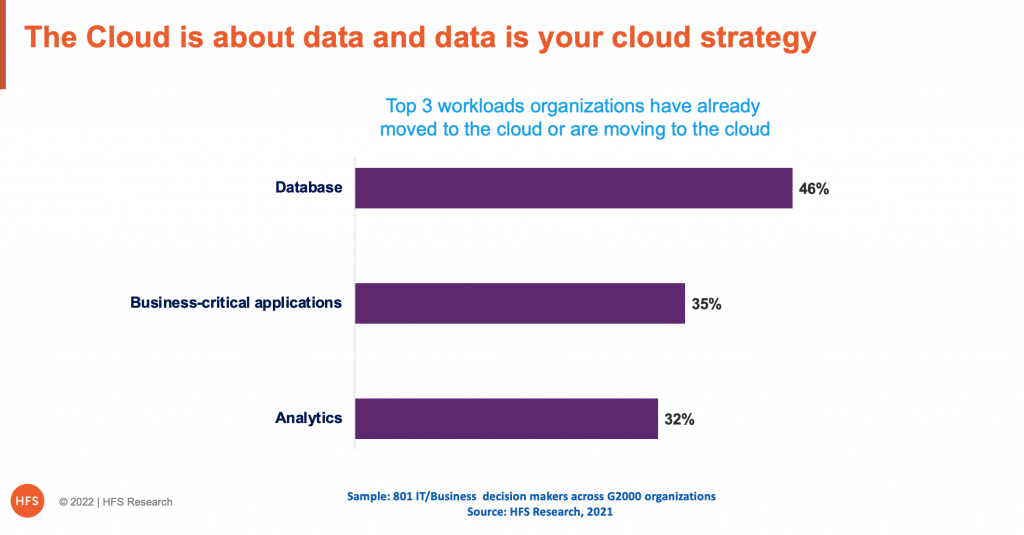
In fact, we flagged this in our HFS Pulse data from early 2021, where Global 2000 firms cited databases as the top workload being moved to the cloud:
The importance of data isn’t new… it’s your business strategy more than ever
To be a truly autonomous organization that operates in the cloud, the principles of OneOffice hold truer than ever: workflows need to execute in real-time between customers and employees – and engage partners in your ecosystem. OneOffice is about understanding and discovering the data you must have to win in your market – right now in real-time – as the market environment keeps changing.
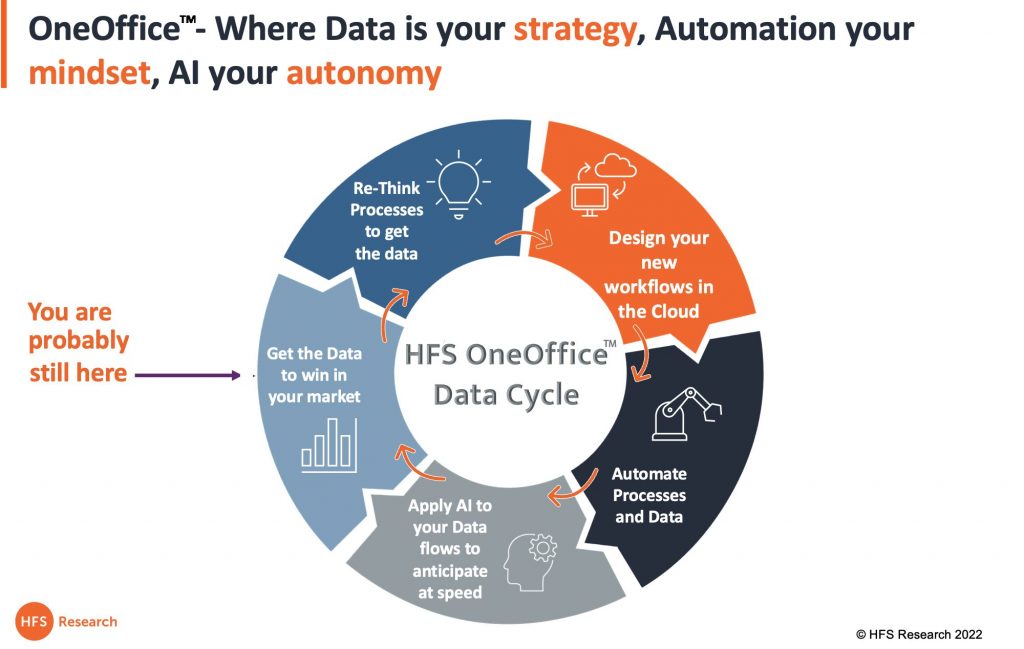
Google has been an advocate of data for years and tied this theme from their data center to Google Apps used by millions of firms. Yet, if a vendor (ahem, AWS) believes they can win with data, they really must improve how they tell their story if they want to expand their services and revenue opportunities further. And this is where we see GCP closing in fast on AWS – hence the attempt at re:Invent in which AWS attempted to re:Position itself as a data leader as well, which is so critical to the datacycle that drives OneOffice:
Five steps you must take to get the data you need into the cloud
Moving data into the cloud has to be both a business transformation and a technical exercise. You can’t keep separating the worlds of business and IT any longer if you want your workflows to be executed autonomously in the cloud. Business executives must identify the data they need to be effective in making decisions and work with their IT counterparts to build a data structure that can be effectively migrated and operated in a cloud environment:
- Get data to win in your market. This is where you must align your data needs to deliver on business strategy. This is where you clarify your vision and purpose. Do you know what your customers’ needs are? Is your supply chain effective in sensing and responding to these needs? Can your cash flow support immediate critical investments? Do you have a handle on your staff attrition?
- Re-think processes to get this data. Then you must re-think what should be added, eliminated, or simplified across your workflows to source this critical data. Do your processes get you the data you need from your customers, employers, and partners?
- Design your new workflows to be executed in the cloud to deliver the data. There is simply no option but to have a plan to design processes in the cloud over three-tier web-architected applications. In the Work-from-Anywhere Economy, our global talent has to come together to create our borderless, completely digital business. This is the true environment for real digital transformation in action. This means you can’t migrate processes that don’t get you the data you need until you’ve fixed them first. If you move your existing crap into the cloud, you end up with even worse crap and just wasted a lot of time and money into the bargain.
- Automate processes and data. Automation is not your strategy. It is the necessary discipline to ensure your processes provide the data – at speed – to achieve your business outcomes. Hence you have to approach all future automation in the cloud if you want your processes to run effectively end-to-end. This is where you need to ensure connectors, APIs, patches, screen scrapes, and RPA fixes not only support a digital workflow but will scale in the cloud. Many of these patched-up process chains become brittle and fall over in a scaling situation if the code is weak. We’ve seen billions of dollars wasted on botched cloud migrations in recent years because underlying data infrastructures were not addressed effectively, and bad processes became even less effective or completely dysfunctional.
- Apply AI to data flows to anticipate at speed. Once you have successfully automated processes in the cloud, it is easy to administer AI solutions to deliver at speed in self-improving feedback loops. This is where you apply digital assistants, computer vision, machine learning, augmented reality, and other techniques to refine the efficacy of your data. AI is how we engage with our data to refine ourselves as digital organizations where we only want a single office to operate with agility to do things faster, cheaper, and more streamlined than we ever thought possible. AI helps us predict and anticipate how to beat our competitors and delight our customers, reaching both outside and inside of our organizations to pull the data we need to make critical decisions at speed. In short, automation and AI go hand in hand… AI is what enables a well-automated set of processes to function autonomously with little need for constant human oversight and intervention.
Being a leader in data is more than having lots of storage, compute, and add-on SKUs
Connecting data workloads across multi and hybrid clouds, cloud data warehouses, data lakes, and applications is the world we live in. the orchestration of these is crucial and a focal point of projects from the Cloud Native Computing Foundation to Kubernetes.
While both firms are active in the CNCF and have solutions that support K8S, AWS is the more clunky of the two. To be successful, data must flow across internet, storage, and servers; thus, the configuration must be simple to implement and maintain. AWS growth is its own weakness here as tools like managing IP domains to microservices, containers, and Kubernetes are being driven by Google’s efforts ahead of AWS.
The orchestration of data is a prime example. With regards to orchestration, the EKS (AWS version of Kubernetes) has been considered so poor that firms like Red Hat have come to their customer rescue with Red Hat Open Shift for AWS (ROSA). AWS continues to improve its EKS, but it is substantially behind GCP and its customers are leaning on third parties to deliver these solutions.
Domain experience is key and AWS needs partners to deliver this – and they may be disintermediated as a result
AWS is the first to market leader. Our hat is off down for the efforts they put into developing the hyperscaler market. But as the pioneer, much like every innovator they now have a dilemma of how to stay in front while watching both Azure and GCP create more functional solutions for enterprise customers to build their business upon. As GCP continues to ramp the number of certified engineers and experts in core cloud-native solutions like Kubernetes, AWS has found it critical to shoring up partnerships to attempt to lock out the young Turk.
However, while enabling partners to develop and improve on your technology and bring its products in larger domain and ecosystem projects, it opens the door to being disintermediated. A case in point that AWS to rushing to address is AWS outposts. With the rise of hybrid Cloud and the extension of public Cloud, AWS is seeing customers retreat from its hyperscaler services to diversify and reduce costs. Integration firms are partnering with competing compute and data solutions to bring in stateless cloud solutions optimized for the customer domain, not the IT.
We see AWS as a very strong player when it comes to partnerships from a revenue perspective, but GCP is emerging when data is top of mind for enterprises. Partners are leveraging the AWS brand to boost revenues as the complexity of AWS is a challenge for even the most sophisticated organization. With the industry reaching this cloud-data pivot point, the door is wide open for these partners to increase their revenue streams by offering domain expertise, complex integration, and long-term support services. AWS’s own industry solutions lack real drawing power without these partners. And some partners, like IBM, bring tools such as Red Hat Open Shift for AWS (ROSA) that are sorely needed by customers to orchestrate hybrid and multi-cloud solutions.
Data holds the keys to cloud supremacy and AWS knows they are in for a real fight with Google
In Adam Selipsky’s keynote, he brings up the importance of data early (about 15 minutes in for those watching at home). Based on his keynote, “data is the center applications, processes, [and] business decisions. And is the cornerstone of almost every organization’s digital transformation.” Going on to the need for tools, integration, governance, and visualization. Much like what HFS has proposed (and re-iterated recently) as data being your strategic level for everything you do.
In the keynote, Mr. Selipsky spent most of his time on AWS investments across the data modernization value chain of data storage, compute, load management, analytics, governance, and visualization. Several key products to manage, visualize and forecast data were announced; while these are much needed to round out the AWS data story, they also add more SKUs that customers will need help determining how these new solutions map to their ability to implement, train, and manage.
Organizations are being asked to put all their eggs in one basket to take advantage of AWS’s data story as painted by Adam and Swami Sivasubramian (AWS VP Data & ML). And in many cases, while AWS has the first mover advantage, the power, and tools of Google’s Big Query, Cloud Dataflow, and Data Studio.
Key messages from Google Cloud Next that must have shaken AWS
At Google Cloud Next, they announced strategic partnerships with Accenture and HCLTech. These partnerships build on how services firms can merge hyperscalers’ capabilities with the domain-centric intellectual property of services providers. Customers like Snap, T-Mobile, and Wayfair continue to put their trust in Google Cloud’s expertise in data analytics, artificial intelligence, and machine learning and expand the ongoing partnership. Further, Rite Aid signed up with Google Cloud for a multi-year technology partnership that will help its customers with expanded and personalized access to the company’s pharmacists, an enhanced online experience, and intelligent decision-support systems—powered via Google Cloud technologies.
Google is very clear on how data is core to its DNA, and the firm is bringing its knowledge and expertise to market with partners. In fact, many of the mergers and acquisitions of IBM, Accenture, Capgemini, and more are of firms with GCP practices. Data and multi-cloud, delivered through proven user applications to the masses, is clearly the future to democratize decision-making in ways that companies only dreamed up. Making data easy to find and action is bringing velocity to Google – and the likes of Databricks and Snowflake – that can’t be ignored.
We listened to AWS: what we liked and didn’t like
What fell flat (or at least was left in ambiguity):
- Cloud costs are important. In Adam Selipsky’s keynote, he made a show of AWS’s focus on customer, domain, and ESG values. However, he quickly moved to the defensive as less than 10 minutes in he began arguing the Cloud is cheaper to run on than traditional data centers. Citing company examples like Carrier, Gilead, and others and their savings. While these data points may be valid in aggregate, there is little detail or scope on how or what costs were saved – e.g., were they supporting or mission-critical workloads or solutions? The proof is in the data, and that really wasn’t on offer.
- Data is critical, and the lens to analyze hyperscalers is changing completely. AWS wants to be your data partner – but hasn’t really appreciated the complexity of migrating that data to the solutions. Hence the need to lean on the development of a more robust partner ecosystem.
- Millions of choices and crazy product fragmentation. AWS is becoming Baskin-Robbins, with more flavors and choices. Hey, it’s great to have a choice, but there comes a point with too much choice, too many overlapping features and a need to carefully evaluate the pros and cons of each becomes more of a burden than a blessing. For instance, AWS offers 13 databases (8 purpose build (proprietary) and five relation data engines), 12 analytics tools, and 19 AI/ML SKUs! AWS’s increasingly fragmented product catalog is creating challenges for customers and their partners to implement and support.
- AWS focused on technical outcomes, leaving business cases to customers and partners. From Elastic Fabric Adapters to Graviton chips to Redshift product names made up a cluster of new choices that will need to be educated, trained, and validated. AWS focused on what they must buy, not why they are building these.
- AWS’s data democratization story comes up short. Amazon DataZone was pitched as a solution for data users across an organization to deliver market insights. While creation, tagging and governance were strengths, the usability and collaboration components lacked the functionality of Google’s Looker, which offers broader integration with more industry solutions and visualization tools.
What we liked and feel AWS can continue to build on:
- AWS recognizes that data is the cornerstone. re:Invent has joined the data is critical bandwagon. AWS is getting much sharper on its messaging about how it aspires to be a trusted partner in developing solutions for developing data as an asset in the Cloud. With AWS Aurora, they are taking the fight to Microsoft and Oracle, pushing open-source SQL (PostgreSQL-based) solution that has the functionality with lower overhead and costs.
- AWS is improving the marketing of its portfolio to partners. AWS celebrated its software and services ecosystem. This is needed, given how complex the AWS product and marketplace have become. Customers need their trusted partners to help them sort through the AWS offerings to help them choose the right solution for their business.
- Data security got major props. AWS has realized to be a valid place for data, it needs robust security. It has offered some interesting solutions about AWS Security Lake with both its own and partner (Cisco, Snowflake, Palo Alto Networks, etc.) solutions. But how will these security solutions allow for multi-cloud solutions?
- AWS is becoming a marketplace for cloud solution. As Siemens showed in their part of the keynote, they recognize AWS reach to resell their software solutions. By moving their code to AWS, they can drive new revenues streams and provide the market with industry-centric solutions.
- Supply chain tools and insights. AWS Supply Chain Insights is a very interesting solution to see how your ecosystem is working to address data from multiple companies into a singular view for businesses to address inventory, supplier management, and customer outcomes.
The Bottom Line: Objects in the rear-view mirror, may appear closer than they are. In AWS’s rear-view mirror is Google…
As AWS pivots its story from scale, storage, and cloud servers to data the firm further validates Google’s relentless focus on data for the past several years.
AWS has ridden the cloud wave into this very dominant position in the market, but as we have seen, this race has many more cycles to run as we face a deep European recession and an uncertain US market as enterprises grapple with multiple headwinds. Cost is king, and the focus will be on data-driven value as opposed to mere commodity compute. AWS must avoid resting on its laurels if it’s going to keep the likes of Google from eating into its market share with its deep, deep resources and second-mover advantage.
The complexity and large number of choices the average user must now navigate to deploy, manage, and govern AWS investments is creating an opportunity for customers and the global IT Services market to reinvest in their relationships with Google to drive data, multi-cloud orchestration, and user application integration.
Honestly, there was lots to unpack at re:Invent. We, like millions, peered in for hours on the internet, and saw some very cool innovations coming from AWS. However, once compared with a quick ‘google’ to those of Azure or GCP, it lost a fair bit of its innovative luster.
Look out AWS, GCP is coming for you. And it’s coming fast in this choppy, demanding, data-obsessed, and hyperconnected business environment.
Posted in : Analytics and Big Data, Artificial Intelligence, Automation, Business Data Services, Buyers' Sourcing Best Practices, Cloud Computing, Consulting, Customer Experience, Data Science, Employee Experience, Global Business Services, IT Outsourcing / IT Services, Metaverse, OneEcosystem, OneOffice, Process Discovery, Process Mining, Robotic Process Automation, SaaS, PaaS, IaaS and BPaaS, Uncategorized
New HFS Horizons Report! Healthcare Payer Service Providers are all about the right fit
In October 2022, HFS said goodbye to the Top 10’s and welcomed HFS Horizons, a forward-looking construct to evaluate service providers. Our first industry-focused horizon report is the healthcare payer service provider report that was published in November 2022. This report helps healthcare enterprise buyers make high-confidence buying and partnering decisions in the context of the specific challenges they are attempting to address.
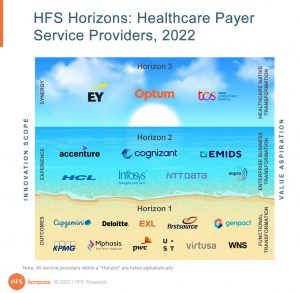
Note: All service providers within a “Horizon” are listed alphabetically
A healthy list of 21 service providers evaluated
The service providers were evaluated across four dimensions – Why, What, How and So What – to arrive at a comprehensive conclusion categorizing service providers into three horizons: supporting Functional Transformation (Horizon 1), driving Enterprise Business Transformation at scale (Horizon 2), and leveraging deep healthcare expertise to craft Domain-Specific Transformation (Horizon 3).
The HFS Horizons report is about matching service provider capabilities to enterprise buyer needs
This study aids health plans, government agencies, and self-insured employers to understand the forward-looking capabilities that service providers will bring to bear.
The Healthcare Horizon report is an effort to help healthcare enterprise buyers evaluate service providers fit for the challenges they face as the market needs evolve. It shines a light on where the puck will be for enterprise buyers and the ability of service providers to meet the puck where it will be instead of where it is.
Unlike a ranking study, each Horizon reflects a set of capabilities aligned to a set of industry challenges that require addressing. It’s a practical tool for making high-confidence buying and partnering decisions.
The Healthcare Horizons Report boldly indicates how healthcare funding is shifting and its implications for service providers
Funding for healthcare in the US has been shifting from fully funded commercial insurance to self-insured employer and government programs steadily for several years. Governments (state and federal) and large employers have become the largest underwriters of medical risk.
Consequently, traditional health insurance companies are changing from financial institutions to service providers. This fundamental shift will continue to strengthen co-opetition between health plans and service providers, requiring a different solution portfolio and go-to-market to address the evolving needs of a reconfigured market.
Healthcare provider choices are driven by health insurance. In 2020, enrollment in self-insured employers surpassed enrollment in plans underwritten by health insurers. Self-insured employers will likely seek direct-to-provider contracts both for primary and acute care to drive improved employee productivity instead of just reactive care. The shift in this market dynamic could make a positive change in aligning HCPs to health vs. just volume-driven sick care.
Vertical integrations mean new opportunities for service providers
The shifting markets are forcing healthcare enterprises (health plans and providers) and new entrants to create new business models that require a new level of vertical integration. Integrated delivery networks or IDNs, such as Kaiser Permanente and UPMC, have shown that the power of vertical integration through proliferation across the healthcare ecosystem has been limited.
However, a new wave of vertical integration is reimagining how synergies could redefine the value proposition. This will require service providers to rethink their solution portfolio and go to market.
The Healthcare Horizons report includes service providers with heritages across IT services, BPO, consultancy, and healthcare
The 21 service providers covered in the healthcare horizon report, alphabetically, are Accenture, Capgemini, Cognizant, Deloitte, EMIDS, EXL, EY, Firstsource, Genpact, HCL, Infosys, KPMG, Mphasis, NTT DATA, Optum, PWC, TCS, UST, Virtusa, Wipro, and WNS.
This report includes detailed profiles of each service provider, outlining their placement, provider facts, as well as detailed strengths and opportunities.
HFS subscribers can download the report here
(available free for a limited time).
Posted in : Business Data Services, Business Process Outsourcing (BPO), Healthcare, Healthcare and Outsourcing, HFS Horizons, IT Outsourcing / IT Services, OneEcosystem, OneOffice
