The intersection of Artificial Intelligence (AI) and personalization in HR / HCM offers the opportunity to significantly elevate service delivery, and therefore employee and manager satisfaction and engagement. It also highlights the looming challenge of getting the mix right between human and machine or “bot”-based HR. These critical topics were discussed during our recent Digital HR webcast.
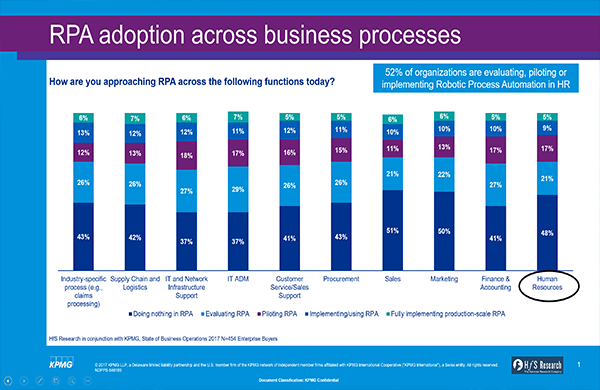
The evidence? Our annual “State of Operations and Outsourcing” study of 454 major global enterprises, conducted with KPMG, just revealed that 52% of enterprises are already evaluating, piloting or implementing robotic process automation (“RPA”) solutions for HR processes. HR executives: Like it or not, the new world of HR Tech automation has arrived, and you need a definitive strategy to deal with it.
How are enterprises approaching RPA in the HR domain today?
We already know that “science” has for years been leveraged in the recruiting domain in the form of assessments that predict the best talent, culture fit, leadership potential, retention likelihood, etc. And with the initial wave of HR chatbots or digital HR assistants converging with many new personalization capabilities to further enhance the user experience, the range of potential use cases linking these two themes for enterprise benefit is only limited by one’s creativity and understanding of operational HR.
Here is a small sampling of what HR Tech buyers will likely see from their vendor partners, and in many cases, sooner than one might expect. HfS Research just published a detailed POV (point of view) with more examples under the categories listed below. It can be accessed here.
HR Tech vendor Beta / early release capabilities
Slackbots: SAP SuccessFactors is now testing “Slackbots.” These chatbots use their new technology partner Slack’s messaging tool within a performance review module to manage various process-related communications and tasks. HR Tech vendors like Zenefits and BambooHR, popular with smaller and medium-sized businesses, also integrate with Slack.
Sourcing bots: Crowded Inc. is a startup sourcing technology provider with a bot that asks questions of software developers applying for a job, and uses their responses to complete an application vs. making them type in the information themselves. TextRecruit is a California startup with a recruiting chatbot named Ari that organizations can use to field questions from job seekers. This allows recruiters to prioritize questions from actual candidates. Finally, Fama, founded in 2015, uses natural-language processing to scan news stories, social media and deeper web content for indications of a higher-than-acceptable risk profile in candidates.
Heavy usage bots: And multiple new chatbots from global ERP and HCM platform company Ramco Systems, and one from Boston startup Talla, are designed to respond to various, typically predictable and common employee HR questions and issues in real time. And if appropriate, the new (digital) HR staff initiates an approval or notification process. Bot-driven PTO-related interactions seem popular with both software vendors.
Right around the corner
HR admin chatbots: Extending the heavy usage bots theme, this category refers to Q&A capabilities using text messages and messaging applications (e.g., Slack), in concert with AI (e.g., natural language processing and machine learning), to manage many of the routine questions that come into HR, Payroll and Benefits departments every day. These include “I joined last week, when is my first check?”, “Our baby is due next week, how can I adjust my Benefits coverage?”, and “How do I know if a planned leave of absence is eligible for FMLA (Family Medical Leave Act) coverage?” These chatbots accept and answer questions in a flow of natural language and provide links to appropriate forms, workflows or content.
Highly personalized onboarding experiences: Given that mentors and courses don’t address much of the social side of getting acclimated, the convergence of personalization and AI will soon lead to having particular colleagues being alerted to welcome the newbie because they have a college or town of residence in common, or the same former company, or similar interests or career goals. This capability should be right around the corner given that all the relevant data is available between the corporate HRMS and tapping into pretty standard social media.
Likely a bit further out (2018/2019)
Reporting line and team member matching: HR Tech platforms can also be expected to make recommendations about who someone should report to, or which team they should join, based on analyzing where that employee tended to be most successful in the past, specifically from a behavioral, personality type or cultural compatibility perspective. Anyone who’s been in the workforce for some time knows there are certain types of bosses – and teams — that bring out the best in them, and others that do not.
Further out still? We shall see
Span of control alerts: An “HR” or organizational design issue that occasionally surfaces for C-suite residents is the span of control of their direct reports and one level below that, as it can get unwieldy at times. Compounding this, what if there was higher than average employee retention risk in the particular department where a manager’s span of control (number of direct reports) was already way above average? If the HR bot could let the senior manager or C-level executive know all this, it would be an example of the Bot leveraging two things: KPI info on desirable span of control for different roles, and as above, one of the humans on the HR staff for complementary consultative support around viable options.
Bottom line
Continuing advances and the obvious momentum building within the Digital HR (including AI in HR) arena highlight three important calls to action: (1) the need for a very symbiotic relationship between human and bot HR staff; (2) the need for crafting a vision for this relationship “asap” and (3) the need to bring together HR Tech customers, vendors and representative end-users, along with HR practitioner and corporate culture experts (and ultimately, perhaps legal advisors) to start developing best practices for this new and exciting frontier.
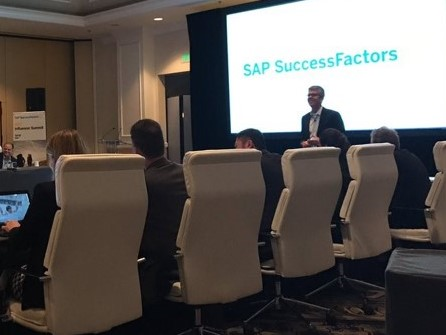
The SAP SuccessFactors Influencer Summit, held in California recently, was an opportunity to see up-close-and-personal how the major HR Tech vendor views the concept of transparency, as not all players in this space view it the same way. It was, in a word, refreshing. Mike Ettling, company president, set the tone early by reminding participants what the company committed to the year before so they can be held accountable. Presentations were also ”open kimono” about execution areas they want to be better at in the next year, sharing many plans in detail – not just product plans and strategies (staples at such events) but spending hours on areas like delivery, support and even data centers (partly under NDA due to being within the earnings quiet period).
Throughout the event, speakers offered bold and somewhat surprising statements, and not always ones that blanketly served the software vendor’s interests. Ettling, for example, stated, “no one will be logging into HR Systems in five years time”. Other executives highlighted some subtle aspects of digital disruption; e.g., “it’s all about cloud adoption” (implication: not product adoption), and “trust is central to everything we do” (a great word for a company you’re taking a major journey with, and one which conveys product quality without saying those words).
As to Ettling’s proclamation about what is essentially the “no platform HR Tech platform” in five years, it led to a discussion of one of the company’s product strategy pillars, “Conversational HR.” The concept is to enable your employees to use interaction channels and platforms such as Slack, plus HR bots and “intelligent services” that connect and predict application actions and are embedded into daily work. Intelligent services are designed to transform HR operations through targeted analytics and machine learning, and cutting across relevant business processes. They were announced in August 2015 and there are 40 predefined intelligent services today; e.g., change of manager, employee department or job. This results in delivering a user experience that’s outside the traditional walls of both system modules and singular HR processes, and also involves linking HR and non-HR data. Also of note, SAP SF is now integrating Slack with its Continuous Performance Management functionality so employees and managers interact around, versus execute a process.
Improving the customer experience
The emphasis on usability and the customer experience was evident throughout; e.g., it’s fairly unusual to hear targets like this from an HR Tech vendor: Unlimited scalability, 99.9% availability and 80% of support cases resolved within 2 days. And the company has learned more about “attention to detail” in the mobile experience from its collaboration with Apple. I was also impressed with seeing plans to bring the customer support function into the digital era and make it a more engaging, tailored experience; e.g., by using such mechanisms as guided answers and even a tool for customers to easily schedule 1-to-1 “expert sessions” at a mouse click.
A “Peer Match” capability is now also being leveraged by the base. This is the company’s direct, peer-to-peer connection tool that allows SAP SuccessFactors’ customers to connect and share experiences with their counterparts within other SAP SF customers, from implementation to best practices to thought leadership. More than 227 “advisors” have self-registered and have made 200 connections in short order. Frankly, actively participating in a customer community (and sharing lessons learned for example) is one of the major benefits enjoyed by HR Tech customers of the cloud model, as you are on the same software instance and version. One other example of the customer experience focus is the new Digital Boardroom soon to be in production. It is touch-(boardroom) screen, dynamic, visual, based on multi-sourced data, and SAP SF’s HR Department was the design partner.
Fast take-up of newer capabilities
Continuing the theme of transparency, we learned that 260+ SAP SF customers have enabled or are using Continuous Performance Management: real-time coaching, feedback and learning even though it was more vision than seamless product capability when it was launched just two years ago. That is changing.
And beyond the vendor’s continuing product emphasis on candidate relationship management, internal mobility, better mid-market penetration and removing gender bias in decision making, two other interesting takeaways:
The “marketplace” concept is catching on in the HR Tech space, as now another vendor is making it easier to find and inter-operate with 3rd party apps that are innovative or focus on a specific area of HCM functionality. It’s a great marketing / PR tactic, as current/future competing products probably won’t find their way to the marketplace. 157 apps are available today.
Diversity really does matter to SAP SF, as highlighted in the anecdote shared about a developer asking: “How come in the org chart a blank image (for a vacant position) is always a man?”, thus bringing about a change in the vendor’s org chart.
Outstanding questions
While the presentations and sessions with experts and customers provided considerable information and insights, I’m left with a few additional questions:
Shouldn’t HR Tech vendors also be transparent about their product roadmap prioritization process, not just the roadmap itself?
How can change management be done effectively when you’re so focused on reducing deployment times?
Will SAP SF’s support of more flexible organizational structures cause similar issues that Workday customers experience when interfacing HCM with 3rd party Financial Systems?
Bottom Line:For more than 10 years, SuccessFactors has emphasized cool, innovative features, an engaging, consumer-like user experience – and in more recent years, rolling out a Core HR System and additional Talent Management components (e.g., recruiting and learning). Now, by also addressing issues like diversity and biased decision making, and by embracing and executing on the Conversational HR vision, SAP SuccessFactors is poised to weather uncertain times in general, and maintain its top-tier market position.
Just about 90% of CEOs who participated in a KPMG survey are concerned with the issue of changing customer loyalty, and the majority believe current their company’s products and services won’t be relevant to current customers in 3 years. That means they need innovation – now. They see technology (often referred to as “digital”) as an opportunity to move, but 85% of the surveyed CEOs feel they don’t have time to think about disruption and how to respond to it with innovation. This sets the scene for KPMG’s Analyst day recently in Boston. KPMG looks to bring purpose and passion for helping clients be successful in making innovation a part of the core of their businesses – through a diverse workforce, solutions, and collaboration.
With this backdrop, four themes stood out to us during the day about how KPMG is working with its clients:
A vision for “OneOffice” – work designed to address customer needs using “digital labor” and systems. Digital transformation is (finally) moving from the front office (customer touchpoints) to include the middle and back office (business functions and transactions) – and talk is moving from “how do we use ‘digital’” to “what problem do we want to solve for our customers and how do we use the possibilities of talent and technology to do it.” At HfS, we refer to this concept as “OneOfficeTM” – the need for businesses to break down silos in their organizations to create a more effective data and workflow for business outcomes, so this theme resonated with us.
As we are focused on “ making it real” and providing examples of where it is happening, we appreciated the story that KPMG told about a client they worked with to map out the customer experience. They registered a number of customers on an app and these customers recorded their experience in real-time, as did employees. KPMG captured the data in the Pathfinder tool and used it as input during a journey mapping session with employees from across the organization, front and back office, including a finance director, a customer service manager, and a valet. They talked through the points in time when the customers and employees had a poor experience and came up with ideas that were then prioritized for addressing through the client’s own innovation management approach. What stands out here is the breadth of people included in capturing the experience (customers and employees from different business units and IT) and the way the experience was captured (an app in real-time), which led to in-person workshops to map out various customer journeys and an action plan.
Additionally, staying true to the “ embedding innovation” theme, KPMG trained a number of the employees in departments throughout the client on the design thinking principles and methods used in the initiative. These people are networked as a COE. The team also has access to an analytics tool to continue to capture and analyze data on their journey.
2. A focus on defining and enabling the evolving role of workers and work. “Even in a digital world, humans are still the most important investment, the secret element of our brands, and the magic asset in the company,” said Robert Bolton, capturing the tone of the recent day. One example of a workforce transformation in progress was launched when a client started a discussion about the size and shape of the workforce of the future. This has led to questions such as “How do you know you have the right size?” “How does it have to change because of the advent of RPA and artificial intelligence?” “What are the impact on entry level jobs and the way those jobs provide a launching pad for careers?” “How does it impact learning, training, career paths?”
KPMG is not just working with clients to address these questions but shared its own experience in a changing workforce through the use of digital labor. For example, instead of having new hires who are eager, smart MBAs do mundane and repetitive audit work while they “pay their dues,” KPMG is able to automate much of that work and provide a more stimulating and challenging role for the talent they’re bringing on board. It’s changing the culture and employee work allocation models.
This area of “ digital labor” is one that the shared services and outsourcing group at KPMG is hearing a lot of questions about as well, according to the group’s global head, Dave Brown. Digital labor and cognitive are on the forefront of activity in evolving operating models and defining who (or what) does what. “Digital labor, simply put, is another form of outsourcing,” said Dave Brown.
4. Innovation starts with culture. Innovation needs to be a way of working in companies – it can’t just be siloed in one department or area. Key features of a culture that embrace innovation include diversity – of workforce and partner ecosystem; collaboration; and experimentation (these are also principles of design thinking). Having a culture and environment where it’s “OK to fail” is also a lynchpin of innovation. To provide a “space” and showcase for innovation, KPMG has broken ground for a new facility in Orlando to provide its clients and train its workforce with a multidisciplinary, hands-on, collaborative, high-tech experiential approach. And it’s partnering with the academic community to help develop (via technology, data sets, and case studies) the future workforce during the university years – for example, combining soft skills like teaming, collaboration, and critical thinking with critical technology skills for analytics and the subject matter expertise of accounting.
5. Deep investments in software to improve and automate complex processes. KPMG’s Spectrum unit created several “business intelligence engines” to automate and analyze several complex corporate processes like third party risk, contracts, and regulatory compliance like Automatic Exchange of Information (AEOI.) Beyond Spectrum, other tools KPMG discussed at the event include its KPMG Digital Responder, for security threat discovery and analysis and its KPMG FIRE regulatory reporting automation tool. While the KPMG teams mentioned a number of tools and IP throughout the day, and showcased a handful, a little of it felt “mysterious” – they were referenced by name and not explained or shown. These days when everyone is still exploring what digital really can do for them, showcasing case studies and tools can be really impactful in getting the message across.
What does this mean to you?
Digital transformation and innovation continue to dominate corporate boardrooms as buzzwords. But actually implementing requires a lot of complex detailed decisions that spur significant changes to the ways companies operate every day. What’s impressive about KPMG’s message is the firm’s ability to talk at the 100,000-foot strategy level but then dig into the last mile delivery details.
For clients that already work with KPMG, if you’re not seeing the kinds of messages the firm presented at the analyst day, then it’s time for a meeting with your account team. Talk about how some of KPMG’s new (and even not so new) techniques are being or could be, applied to your engagement. Don’t take it for granted that your account team will automatically propose new ideas so be proactive in asking for innovation.
For non-clients, take a look at Spectrum and other KPMG tools as stand-alone solutions. The Spectrum team told us they do sell the tools separately – they don’t just get embedded into larger services deals. This gives you the opportunity to get access to KPMG IP and operational expertise without having to exit any existing services engagements you have in place.
For an organization that candidly admits it was on the slower end of developing a stake in front office, its recent investments and acquisitions (a whopping 51 in the last 3 years) show that it’s quickly catching up, and also tying together the concepts of front, middle and back office nicely and in a forward-thinking way. Using their own interpretation of OneOffice, KPMG is forging ahead to help clients (and itself) break down the legacy barriers to become more intelligent and responsive client-centric enterprises.
This week we crossed the Atlantic to meet the cream of the crop of the utility industry in Miami for the International Utilities and Energy Conference, hosted by Accenture. A packed agenda entertained the brightest minds in the utility space from around the globe.
We were in for a surprise: from the first session to the closing key-note it was one big future-oriented gig, focusing on business value instead of enabling technology. No sales pitches from the provider (many providers can learn from this), zero bad jokes… and a highly engaged audience (yes, we are still talking about utility executives here) that wanted to smell, touch and work towards a better future with more and better client interaction. They all want to be more profitable but more important (for real) greener! Their customers demand it; the infrastructure is ripe for an upgrade, and so the question is, why not make it happen?
Fossil is the new uncool, and renewable energy (with loads of digital components for their clients) the new hipsters, the future of utilities!
Let us explain with a couple of fantastic examples that had a high impact on your peers at this week’s event. Over to you Derk!
Thanks, Bram. We had an interesting time for sure. Let me give you some quick pointers on the new, the unexpected and the future that headlined IUEC 2017.
A dizzying barrage of industry shattering disruptions thrown at attendants
As one Utility executive put it; the first day of the event was a succession of shock and awe, fear and nausea. Florida Power & Light CEO Eric Silagy set the stage immediately; the unstoppable force of renewables and how being clean is good business. It is a vision that not everyone dares to execute on as radically as Florida Power & Light, but they are doing it without hesitation. CEO Silagy provided an excellent example of lowering his customer’s bills by taking the most polluting oil and coal plants offline.
In this picture, you see a perfectly well-operating oil based power facility Florida Power & Light just blew up (after many people try to stop them) to build a far cleaner and more profitable (not only for them but also their clients) and this is just one of many examples. Don’t wait, just do it. There are always excuses, but just doing it will pay off in the end.
Further, he explained his strategy for relationship building with the regulators, being proactive and ahead of the curve and highlighted Florida Power & Light’s investments to build a more resilient infrastructure to deal with (the ever increasing) hurricanes’ ravaging effects in his service area.
Salim Ismail of ExO Works and Singularity University, talked about Exponential Organizations, and the drastic competitive forces these present in many markets. As electricity shifts from a scarce resource to an abundant resource, the dynamic of the market changes. Exponential organizations find business models to leverage abundance. Ismail explored Airbnb, GE and Ford’s journeys. One key takeaway that resonated with the audience is how innovation in large organizations is almost impossible. Innovation needs to be positioned at the edge, insulated from the internal organization. Large organizations have immune systems that attack any threats to the status quo, i.e. innovation. This is particularly relevant to utilities; being large, engineering-oriented and traditionally conservative organizations.
Accenture’s Digital guru Mark Sherwin brought his analogue chicken Penny to illustrate digital business models (his chickens and eggs turn out to be some of the world’s most expensive when factoring in the services he gets offered through digital channels to make his and the chicken’s life easier, from predictive food delivery to chicken hotels).
MIT professor George Westermann implored the audience to challenge pre-digital assumptions, as those hamper real transformation, reinforce the status quo and limit the ability to think outside the current frame of reference. Unintentionally providing great input for Design Thinking exercises.
Accenture’s Chief Strategy Officer Omar Abbosh shed light on disruptive forces over the last decades, from mainframes to IoT, AI, and Quantum Computing. He provided a great comparison of how he and Accenture’s leadership reinvented the strategy five years ago to rotate to “the new,” completely overhauling the organizational structure to change the culture, and how utilities are on a similar trajectory.
Vlogger and, more importantly, former monk Jay Shetty reflected on the Millennial mind, demystifying and busting myths. It turns out; millennials are not as scary as you might think. Jay called on the audience to incorporate four ‘Millennial mindsets’ (which are great for anyone by the way): the leadership of a coach, the fresh eyes of a child, community thinking and the mindset of a coder.
Missy Cummings, one of the first ever female US Navy’s fighter pilots and currently Duke professor of the Humans and Autonomy Laboratory Duke Robotics, talked about the highly relevant topic of drones and other unmanned vehicles and robotics’ potential in the utility industry. One of the key points she made addressing the fear robots will destroy jobs, is robotics and automation will likely create more jobs than destroying them, albeit different jobs requiring different skills, providing examples of people and robots working side by side in aviation.
It was time to evaluate all this and time to hit the Miami’s South Beach and more specifically Nikki Beach. The first feedback trickled in, and people had a lot to think about. Clearly, the platform that is IUEC worked.
Day two focused on more practical, “how to” examples and some great new research findings from Accenture and Bloomberg New Energy Finance about the industrialization of renewables, and Accenture’s global lead for Smart Grids Stephanie Jamison presented fascinating findings from a study of distributed generation (DG), focusing on business disruption of DG and the lack of clear forecasts utilities have around the impact of DG integration.
What stood out
At previous editions of IUEC, there were still reservations amongst executives about how fast digital and renewable energy would force change upon them. Those reservations are completely gone. Overall, utility executives have a positive outlook. Solid examples and cases are providing proof points and inspire the way forward, but there still a lot of work to be done.
A terrific event was wrapped up by living legend Clay Christensen, the godfather of disruptive innovation and Silicon Valley’s favorite guru. He gave the audience an excellent perspective and frame of reference of disruptive innovation and clues to shift capital investments to disruptive innovations to prevent becoming the next Blockbuster.
The Bottom Line
It is all about disruption and making a play instead of being played. Harvard Business School professor Christensen expressed his desperation for his industry – higher education – being disrupted with lightning speed by online learning and corporate universities. He did not worry too much about Harvard itself, but many universities are not that well funded and will be disrupted by new forms of learning leveraging technology. His response, without any hesitation, to a question about disruption in the utility industry was: “If you all pray for me, I will pray for you.”
From Derk and Bram; Godspeed, safe travels back home and until next time.
This is me jumping on the bandwagon with an opinion about the global WannaCry ransomware attack last Friday. As of my writing this, this attack hit over 200,000 companies, hospitals, universities, and other groups in more than 150 countries according to Europol. It’s been headline news.[1]
While bandwagon jumping generally has a bad connotation (doing or supporting something just because it’s hot at the moment,) security is one of the bandwagons you should proactively jump on. Right now. Really.
Security tools, services, articles, etc. are all popular because security attacks are popular – and increasing. So yes, if in the past you thought your passive following of whatever standards were placed in front of you was good enough, you need to break out of that rut and get proactive. Too often, standards aren’t keeping up with the changing threat landscape. You need to constantly search for new security tools, skills, and services to help you protect your firm, your employees, and your customers to achieve digital trust in the market.
In fact, the recent attack only brings findings from HfS’ recent Managed Security Services Blueprint into clearer perspective. We heard from both providers and security executives that effective security programs shared key characteristics:
Automation everywhere possible. There are too many threats and attempts for your security team to monitor them without automation – you’ll never collect the necessary data manually. Your automation investments need to include appropriate analytics to evaluate and find patterns in the data so your team can take appropriate next steps.
Investment in cognitive computing. Predictive analytics and cognitive computing investments for tomorrow aren’t negotiable. Today’s environments can collect and analyze, but you also need to be focused on systems that learn from current data to build predictive models and help you prevent attacks, not just respond to attacks as they happen.
Focus on employees and the human element. This takes two tracks: 1) Educate employees more often and more consistently about phishing and other techniques that attackers can use to get credentials and other sensitive information from workers to attack company systems. And 2) keep your security team’s skills up to date. The talent shortage in security is exacerbated by the skills gap – staying current on all security trends is daunting but necessary. And security teams are so overwhelmed already that it may seem they don’t have time for training. It’s time to evaluate your hiring and training for security to look for ways to bring in non-traditional talent and get them up to speed faster to ensure you’re protected.
Bottom Line: Treat security as your business, not as an enabler
Without effective security your business won’t survive – either your company systems will be brought down, or more likely, customers won’t want to do business with you if they see you as a threat to their own information security. The WannaCry ransomware attacks is another proof point that security threats are increasing in number, scope, and scale. Jump on the security bandwagon and follow practices of leading edge security practioners for effective programs.