Everyone is talking about how to get to the right strategy for omnichannel customer communications, yet no one really knows what it means. First of all, let’s just get it out there that omnichannel is one of those terms everyone loves to hate. It’s ubiquitous, it’s vague, and it’s a misnomer– “omni” is impossible and customers don’t think in terms of channels. That said, omnichannel is an aspirational goal pointing many service providers and enterprises in the right direction toward really getting customer experience right. So with that in mind, it has become my mission to dissect the subject, get past the hype, and figure out where the opportunities lie for the services industry.
The keys to creating an omnichannel experience are the following:
Non-creepy Individualization: “We know the name of your cat because we stalk your Facebook updates” (we’ve seen these creepy mistakes backfire bigtime). And please stop talking about customer “intimacy.” Customers don’t want you to be intimate with them, they just want to be acknowledged as individuals (especially those self-centered millennials), and for you to know their buying patterns and preferences. This is part of the Amazonization of the consumer experience that just isn’t going away anytime soon – and striking the right balance is essential.
Simplicity: Making it easy for the customer to do business with you is at the heart of customer satisfaction. More than anything, customers want want to be able to get information, interact, and buy products and services easily, without jumping through hoops. Our “one-click” ordering culture has raised the bar for the way we expect to get things done. Look at reservation systems for example—why should I have to call, sit on hold, and speak to a person when I could simply use an online scheduling system?
Consistency: Whether it’s about product pricing and discounting, visual design or cultural feel, it’s crucial to the omnichannel experience to have consistency across devices, physical experiences and interactions. Making a brand one that customers relate to and develop an affinity with goes a long way toward generating loyalty. Apple for example, has done this well with creating an in-store and online consistent experience as well as developed a culture that people want to be a part of.
Executing on these concepts is no easy task, involving many facets of the organization, and most companies are coming nowhere near these ideals. One of the biggest opportunities, and yet most troubling elements of this omnichannel notion is where contact center fits into the paradigm. The conversations consumers have with businesses are at the heart of creating a differentiated experience, but let’s face it, right now contact centers are not pivoting to be strategic differentiators. Most of us deal with this pain regularly in our personal lives. Just last week I called my bank with a simple question (which could have likely been answered via self-service), was transferred and repeated information 3 times before I even reached the right department. As much promise as there is for a utopian omnichannel world, most are struggling with the basics.
The Bottom-line: work on fixing broken customer service (keeping the goal of omnichannel in mind)
Contact center service providers are acutely aware of these opportunities and desperately trying to carve out an omnichannel story and capabilities. As we noted in our recent Contact Center Operations Blueprint, while many of the pilots and messages are spot on, client adoption is low and stories of omnichannel success are few and far between. Many buyers are just grappling with implementing digital channels, and a total redesign of customer experience is far too daunting. Service providers need to help their clients (with the goals of personalization, consistency and simplicity in mind), to start making some real changes in bite sized pieces to improve customer experience. Instead of trying to “delight and surprise” the customer at every turn, just taking some basic steps to make customers’ lives easier could go a long way. Omnichannel is the future of customer experience (or whatever the next buzzword that encapsulates a seamless customer journey may be), and one of the biggest steps toward that is a clear and focused contact center strategy.
My husband and I have three children, including twins with autism. Over the past few years we have become accustomed to thinking outside of the box and trying different approaches as parents. We’ve learned the importance of good planning to meet a desired outcome (often the hard way!). We have also had to unlearn many parenting techniques employed with our eldest child to best support the twins. Service providers have undergone a similar transition, as they battle with how best to support the high growth area of SaaS services compared with the requirements of the on premise world of yesteryear.
I’ve been an analyst for 20 years, a period dominated by legacy systems, on premise applications and a very strict view of the IT services Value Chain of Plan, Implement and Manage. Service providers and analysts alike list relevant services that should appear in each of these boxes to facilitate product development for service providers and market tracking for analysts. Since I started out as an analyst, I’ve tracked all sorts of services markets, from network professional services, to security services to application services. Jumping from topic to topic was never a major problem, as I applied the same basic principles of the IT service Value Chain to every area I covered. It was simply a case of coming up to speed on the new technology, understanding buyer needs, and identifying which service providers could throw a practice together to make money out of a growing hot trend. The Value Chain itself hardly altered. Sure, the specifics had to be tweaked but generally speaking service providers, analysts and buyers all knew exactly what you would get in each individual box:
Plan: this is the consulting phase of the engagement and includes a whole host of advice services for business strategy, deployment design, blueprinting, governance, security, regulatory compliance, and so on. It used to be a lengthy engagement, typically at least one year, as service provider and buyer teams tried to tick off every possible eventuality in the upcoming scary deployment phase.
Implement: this includes implementation, integration, testing, training, any customizations and so on. If the roadmap set out in the consulting phase was airtight, the implementation phase was as easy as pie. Of course this seldom happened, and tweaks were made as the project evolved. Typically this was a technical and tactical project with the focus on execution excellence in a cost effective way.
Manage: ah yes, the management phase. That thing that most enterprises don’t think they actually need or convinced that they can do it all in-house. But as all the markets I tracked evolved, management services inevitably became more important and in high demand. These were typically stale in nature, keeping the light on type of activities. I saw more proactive monitoring type of services in the network and security market, with some service providers independently making changes to improve network communication or security settings (shock, horror!) but I didn’t witness too much of this proactive engagement in the application services space.
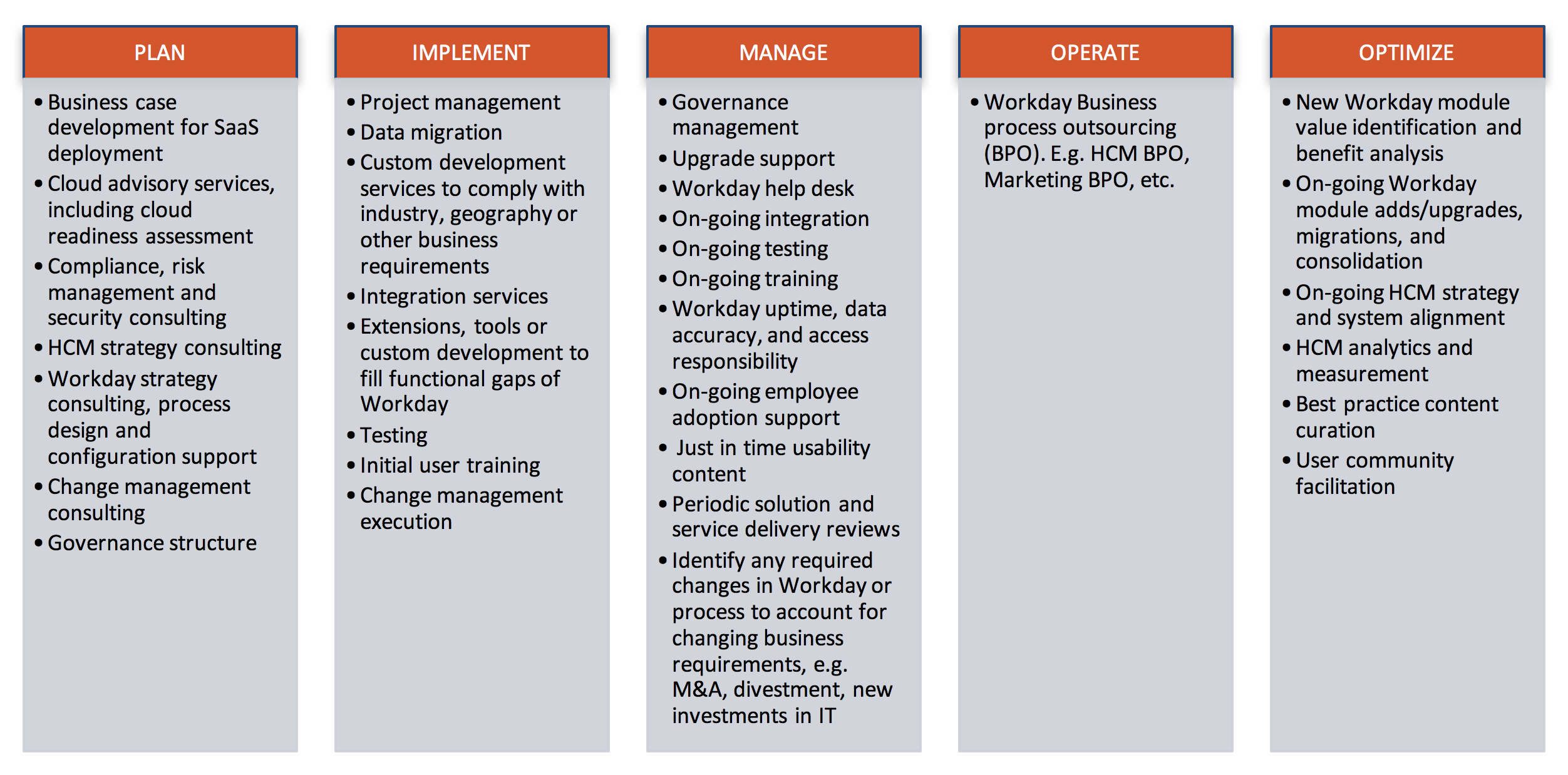
I still use an IT services Value Chain at HfS for the three main SaaS Blueprint reports I have authored: Workday, Salesforce and SuccessFactors services. It is useful because it outlines the main services that should be included in each IT service area. Here is our Workday Services Value Chain:
Exhibit 1: Workday Services Value Chain
Source: HfS Research June 2016
The silos still serve a purpose, if mainly an informative one – and frankly, this diagram wouldn’t look half as good without the pretty columns. But this illustrates the ‘what’ rather than the ‘how’ – and it’s the ‘how’ that is radically changing in the SaaS services market.
SaaS Services Requires a Different Approach
SaaS application adoption is changing IT service delivery requirements. The consulting phase remains an important first step because, as with most things in life, successful outcomes often rely on the best planning. But service providers can no longer just use the best brains and collaborative approach in the consulting phase – and then sweep them away to be replaced by technical teams that focus purely on specific module implementation. Moreover, consulting is no longer a drawn-out process. Buyers want fast deployments, with go-lives expected within a year. The implementation phase requires strong account management and project management teams who align all decisions to the desired business outcomes outlined in the planning stage. Management services increasingly look like consulting-as-a-service offerings, with users often purchasing a bundle of hours to use as they wish per month or year. Management services requests could be answered by remote assistance or they may require onsite work. As a result some service providers are investing in in-region delivery centers to be able to deploy consultants to client sites more easily.
In terms of skills and delivery the lines between the Value Chain phases are blurring. The best consultants have a deep understanding of organizational and technical issues that can arise in the deployment phase. Some service providers offer rotation programs for their consultants in implementation and management services as understanding both makes them more effective in their primary roles.
The Buyers Are The Eventual Winners
Buyers have finally had enough of being presented with a catalogue of services to select. They just want the solution to work and for the service provider to share best practice on running the relevant process. Enterprises are more mature about what they can demand from service providers, and they’re frankly not as easy to work with as they were 20 years ago. Several buyers I have spoken to in my Workday Services Blueprint, tell me that they insisted on interviewing the proposed delivery team during the service provider selection process. They want to meet the people they will be working with on a daily basis, as ultimately that relationship will determine the success of the project. Buyers are also demanding that service providers challenge them more. Something I hear regularly from buyers is: “I wish the service provider just said ‘No’ more”. SaaS is a relatively new adoption area and buyers rely on service providers to provide sound advice based on their experience. In addition, many of the HfS ideals of the As-a-Service economy are increasingly important to success, notably Collaborative Engagements, Design Thinking, Intelligent Automation, and of course helping clients to Write off Legacy.
Bottom Line: Unlearn or Fail
So can service providers unlearn their old engagement and delivery practices for on premise deployments and embrace the new IT services world of SaaS services? The leading service providers will, or indeed have been investing in this forecasted eventuality in recent years. To succeed they need to adopt new approaches, think outside of the box, and demonstrate real commitment to succeed (trust me, I know!).
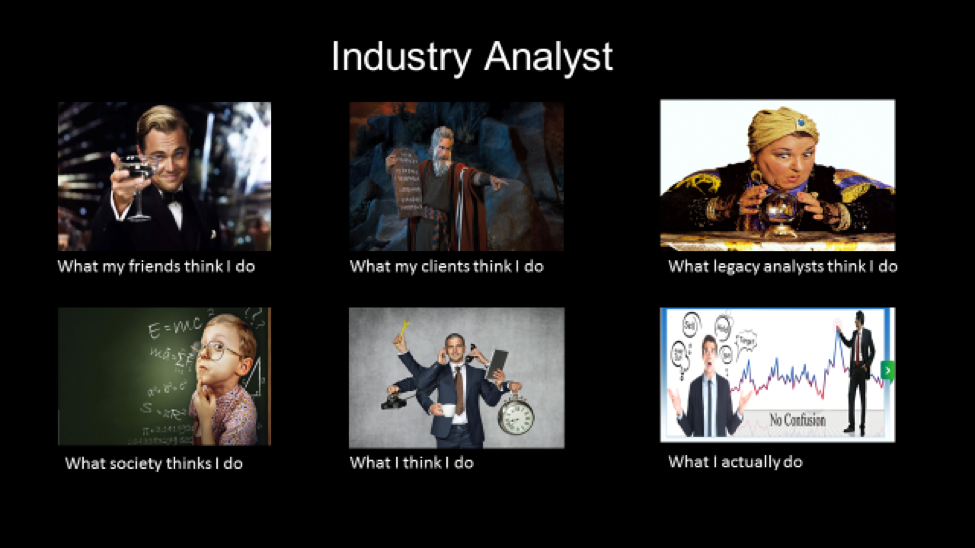
Being an industry analyst, our work differs greatly from day to day and as such, today more than ever, we are wearing an ever increasing number of hats and taking on more responsibilities. Although, rather like the transition to the As-a-Service Economy, which dominates our research at HfS, overcoming the specter of legacy is one our key concerns.
The scene: a dinner party with unknown persons. Polite small talk ultimately leads to the question, “So what do you do?” I suppress a sigh, take a fortifying sip of whatever is lying around and announce, “I’m an industry analyst” (or something along those lines). Now the response can vary dramatically here, the most common been “A what?”, “You work with numbers??” or, in more polite company, a vague “Oh…”. Following this I feel compelled to explain what I do. Now there is of course another, less savory, reaction to my announcement of employment, this often comes from those working in the industry and having had too much contact with legacy analysts of old who plied their trade in arrogance, assumptions and skepticism bordering on derision.
So back to the explanation, what do I actually do?
Well, it really depends on the day. Right now I’m blogging, whilst reading a press release and getting a tweet or two out (coffee is obviously a given). Last week I was sat in Blenheim Palace (google it!) enjoying a glass of wine, listening to an orchestra and speaking to some serious industry leaders in the BPO world. Other notable activities include consulting calls and strategy sessions with both buyers and service providers, Blueprint project briefings, Soundbite, PoV and Blueprint production, travel, events and more travel. Needless to say not many two days are the same, or, end at 17:30. This largely represents todays working environment. The ability to be flexible, work on the fly and multi-task have all become hygiene in the industry analyst world of today.
So back to these “legacy” analysts I mentioned earlier. The industry analyst community has garnered a checkered reputation in years gone by. The age of the pompous, overly and aggressively opinionated analysts are gone and in has come industry analyst 2.0. Who aim to work alongside industry, commentating on development and of course calling out bad practice, but ultimately assisting in educating the market and facilitating change as the industry moves towards the As-a-Service Economy.
So with this in mind, what does it mean to be an industry analyst in 2016?
At the end of the day it is content. Relevant, timely, accurate, consumable and thought provoking content. As analysts, we need to keep a continual eye on the pulse of the industry, all the while dodging the marcomm puffery from suppliers and getting to the overarching themes in the market. In addition, working with enterprise service buyers in formulating sourcing decisions in one’s field of analysis is key. The watch word here is “analysis”, not simply research. Research gets you to the door but real insight and analysis gets you invited to the party. Therefore, the most successful analysts in today’s world don’t only sit in an office working on single research projects but rather analyze, educate, track and engage the market with the goal been the betterment of industry.
This is a very odd confession, but I love market sizing and forecasting. Strong language, I know, but I just love it. I think it is the combination of attention to detail and precision calculation, coupled with the intellectual leaps of faith needed when assumption making. Starting with a blank sheet and a new market gives me the opportunity to spend hours on pure thought, and there are very few things that excite me that much (and only a couple of those are legal!) I just wanted to share a few of my thoughts about the market sizing and forecasting.
Sizing a Market – more about common sense than rocket science
There is sometimes a mystery that surrounds the market sizing process, that I don’t think is necessary. There are very few ways to size any market – and none of them are rocket science. The accuracy and quality of any market size is primarily dependant on the quality of sample being used, and the way you segment the market to create representative groups.
For example, if I were to size the market for business PCs in the US using a buy side model (sizing the market from companies actually buying the PCs), I would segment the market into company size, by industry and by geography – I am using PCs as an example because often product markets, particularly a ubiquitous one like the PC is more universally understood and has less problems. The sample in each segment would be interviewed (or use another source of primary data) to discover annual spend on PCs by each sample company. The sample portion would represent a quantifiable proportion of the segment, which if it were 10%, the market size for the segment would be 10 times the total spend of the sample. Then you add all the segments up to produce the market size. The main assumption you make is that the samples spending is representative of the segments, so it is crucial that you divide the market into segments where spending is more consistent, this is why segmenting by industry is often used as it is likely banks spend is more similar to each other than to, for example, an agricultural business.
The main source of inaccuracy is ensuring the responses are representative, which is why this method of sizing always needs a cross reference, usually with service provider revenues. This provides a check on any mis-sampling where by chance you sampled the only 30 utility companies that only upgraded their PCs once a decade. These problems appear when you have markets which are less saturated, like many services sectors, particularly outsourcing. For example, if only one utility company has signed up for an HR outsourcing deal, and your sample misses it, then your market size is shot, likewise if you stumble upon just the companies that outsourced in a market that has few deals, you’d skew the market upward.
Verifying signed deals and revenues with the suppliers in a market helps to rectify these types of errors, and can mean either using an estimation for the industry garnered from the demographics/service provider revenues, or enlarging the sample or looking for new data points to guide the market size.
This is why most market sizing models used by analysts start with supplier revenues – you build a list of known suppliers in the market, which for the PC market is fairly easy for the top 10. You estimate the specific market revenues from the financials, which you may cross check through interviews / feedback. Then, you build a probability model to fill in the gap, estimating the part of the market not covered by the providers that you know. Essentially saying what is the probability that I am missing a supplier in the top 5, top 10, top 25 and in the remainder. This is where the analyst needs to be honest about her or his knowledge of the market and be realistic about the likely number of smaller firms. Which is why having good demographics to build out a buy-side model helps set the parameters for the market – and helps to double check the probably.
It is these things that provide us forecasters with the biggest challenge, especially building a market sizing model that works in a fragmented (ad often hard to define) market like outsourcing, managed services or process automation. However, the saving grace is deal data, this gives another way of building the market size. You can estimate the annual revenue flow from each contract, segment it into service type and produce a market size. The issue here is again one of sampling, no database of contracts is complete. So we compare the data produced from the contracts with the vendor revenues and with the survey data to complete the picture. Hopefully producing an accurate market size!
Forecasting a Market – the joy is finding that consensus of inputs to perform one trendline
Market forecasting is a similar task in many respects to market sizing, but, for me, it is where most of the joy in the process comes. I suspect this is because you can draw on more information and it is about bringing together and distilling contrasting data into a simple trend.
The simple forecast method that is typically used for technology markets, is euphemistically called an assumption-based or judgement-based forecast. Largely, I tend to rely on a mixture of methods and tend to combine them.
For an outsourcing market, I would typically use a model that predicted the sales of a product from past data, generally a time series model. This provides a base trend line for the market, typically the market would accelerate or decelerate in line with the established trend for the particular market. This essentially extrapolates the existing trends, part of this process would also include looking at economic growth and making assumptions for how a particular market is likely to grow given the economic outlook.
The next stage would be to alter the predicted growth based on likely forthcoming events in the market. This tests the analysts and my knowledge of the marketplace mapping out the likely market drivers and inhibitors, quantifying their effects, weighting them by probability/strength of impact and summing the drivers and inhibitors to produce an overall market impact. Part of this equation is also the adjusting the forecast based on survey work, providing the forecast with direct input from the customers and suppliers. In the outsourcing markets, we also sample specialist advisors and consultants which can add another perspective – broader than a single client and, typically, more realistic (or is that cynical) than suppliers.
It is the balancing of the different factors and the bringing all the data together to produce a single growth rate that I find the most satisfying. A forecast at its best is a distillation of survey work, market data and analyst expertise, the marriage of the objective and subjective in as precise a way as possible.
The Bottom-line: There’s nothing more beautiful that quantifying that view of the market at that particular point in history and occasionally getting it right
The thing I love most about sizing and forecasting a market is that balance between fact and foresight. When people look back at historical forecasts, the size of the market at that particular point in time should always be solid, providing said forecast is doing their job properly. The forecast was simply what we all thought the market was going to do based on the available inputs we had at the time. It doesn’t matter if it was widely wrong, as long as the inputs were sound the the forecaster was not smoking something too dubious =)
However, if we really got (some of) those forecasts in line with what eventually happened, then we can die happy knowing we performed some genuine wizardry doing something that we loved to do.
I have been researching the notion of Intelligent Automation and, in particular, the rapid uptake of Robotic Process Automation (RPA) for more than 4 years. It was this work that eventually brought me to HfS. Over the years, I have made many good friends and acquantances in the automation community – and many of those good folks have graciously suggested I have become a spokesperson for this community. Yet, it is time to take a stance and declare: RPA is dead!
This is not meant to try to grandstand my esteemed colleague Phil, who’s eloquently stated that RPA 1.0 is a done discussion. Phil suggested: “We know what it is, we know what it can do, we know how it can augment operations and help digitize broken processes.” I rarely disagree with Phil, but I would argue that that broader market, outside of specialized services, technology and process areas, has no clue as to what RPA really is. We have no common reference points, we have no definitions, we have no clarity as to how successful deployments really are. What we have, is a set of reference technologies and respective case studies that demonstrate potentially significant efficiency gains, if implemented effectively. What we have is a set of innovative technology providers who use the term “RPA” to get a seat at the table to transform service delivery. However, to quote Lee Coulter, who chairs our Sourcing Executive Council, “In the context of automation we have a Tower of Bable; we have many languages, but we don’t really understand each other”.
RPA has dominated the conversation with industry novices and this needs to advance to the broader automation outlook
Yet, it is about much more than just semantic nuances. RPA currently is largely about the automation of tasks that can be implemted from the bottom up, then land and expand within enterprises. RPA is about rules-based processes. RPA is being delivered for specific accounts, often at sub-process levels, but does not sit at the heart of a delivery backbone. Nevertheless, RPA, for the wrong reasons, or just the lack of reference points, is the focal point for all the innovation that we at HfS tend to subsume under the notion of Intelligent Automation. However, if we move beyond the confines of the BPO and operations world, we see automation deployments at much larger scale – and beyond clearly defined processes. The current market development and opportunity in IT-centric automation scenarios in a lot more advanced, has more breadth and scale than business process centric scenarios, yet, in the discourse on Intelligent Automation these tend to get marginalized. It is in those IT-centric scenarios where the impact of Cognitive Computing and Artificial Intelligence is most pronounced. Yet, as an industry, we appear to be stuck in the “RPA” mindset, largely due to the heavy influx of marketing investments from the emerging RPA software suppliers which is influencing sourcing advisors and analysts new to the automation discussion.
Examples for a broader, more holistic approach to Intelligent Automation is Accenture’s artificial intelligence engine that provides an architecture abstraction layer for interacting with various autonomics services such as natural language processing and machine learning. Thus, underlying components can be swapped out according to client preferences or as new solutions become available, leveraging a broad autonomics ecosystem. Suffice it to say, not many providers have merged IT and operations like Accenture has done. But we also see a convergence of IT and business process centric scenarios starting to happen on a tool level. IPsoft and Arago trying to get traction in operations while the prominent RPA tool providers invest in analytical and cognitive capabilities. Thus, we are seeing virtual agents to gain traction of virtual agents in in operations and RPA tools in IT helpdesk use cases. These activities have to be reflected in the discussions on Intelligent Automation – not in isolated use cased but as part of a holistic strategy to scale out automation initives.
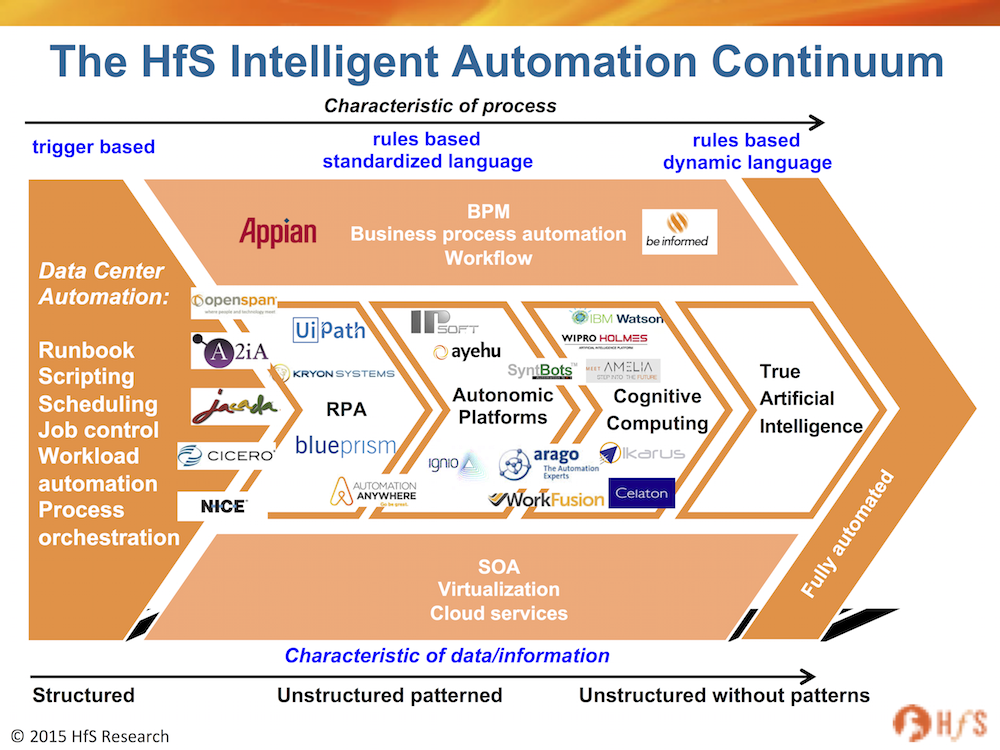
Therefore, as an industry, we really have to change the perspective. The focus should be on top down, the point of view of process owners and on taking a much more holistic point of view. That is what we had in mind when we launched the HfS Intelligent Automation Continuum back in 2015. All the approaches on the Continuum are both interdependent as well as over-lapping. Put in simple terms, life is complex. There is no such thing as a silver bullet or a turn-key solution. Intelligent Automation is about transformation. We have to wean ourselves off the drug that is task automation. Off course, it is prudent to automate low-hanging fruit. Though how do we optimize the processes after the effect of that drug starts to subside. Thus, we shouldn’t lose sight of the direction of travel. We at HfS call it the journey toward the As-a-Service Economy. Crucially, Intelligent Automation is just one building block among others along this journey.
Away from the headlines and away from the confines of business processes, we see some indications for market maturity as providers like Atos, TechMahindra and Hexaware start to standardize delivery on ServiceNow, linking it up with service orchestration engines that allow the plethora of Intelligent Automation tools to be plugged in. Put in simple terms, we see a much more holistic approach to Intelligent Automation. The crucial question is how do we cross fertilize all these approaches across the boundaries of trational and established business units? Flipping this to the client side, how are service provider supporting their clients with Intelligent Automation on their journey into the As-a-Service Economy? This is not about RPA alone anymore, but the broad notion of Intelligent Automation in all its complexity. To assess how far the industry has matured on this journey, HfS has just launched the RFI for the Intelligent Automation Blueprint to take stock where the industry really is at.
The Bottom-line: All the stakeholders in technology and operations need a much more effective education on the impact and potential of Intelligent Automation. Confining the discussion to “RPA only” is doing everyone a disservice
What I hope to hear in our discussions on that Blueprint is around broader notions of service orchestration, about integrating broad data sets, about moving beyond clearly structured processes. My gut tells me much of the future of Intelligent Automation will be about deep and unsupervised learning, about vertically-infused insights, about technologies for which we don’t even yet have monikers. To advance all those discussions, we urgently need a much more effective and actionable education of all the stakeholders. So once again I declare:”RPA is dead – long live Intelligent Automation.” But I want you to challenge me in that, be it to convince me that RPA is the best thing since sliced bread, deconstruct my arguments, unmask my assumptions. But most importantly I love hear about new approaches and new ideas.
Earlier this year, HfS Research and Accenture surveyed over 200 cybersecurity professionals around the globe to better understand how enterprises are securing their digital assets and dealing with increasingly sophisticated, and all too frequent, cyber attacks.
I recently had the opportunity to sit down with Bill Phelps, Managing Director, Accenture Security, to discuss our report. Bill was one of my co-collaborators in this research effort, and I was curious to get his take on both the survey and its implications for the cybersecurity sector moving forward.
Fred McClimans, Research Vice President, Digital Trust and Cybersecurity, HfS: So Bill, we spent several months surveying security professionals on a global scale—different verticals, different geographies, different size organizations—to really uncover what the state of cybersecurity and digital trust are today. What were your expectations when we first started and what surprised you coming out of the report?
Bill Phelps, Managing Director, Accenture Security: Fred, I was really excited about doing this report together because we were taking a new perspective looking at security through the lens of digital trust, not purely as a technical or an operational issue, and I think a lot of the findings reflect that. I think honestly one of the most amazing things was that our respondents said over a third of their management doesn’t see the value in the money they spend on security, and they are disengaged. So in spite of security being a front-page headline item almost every day of the week, we still have leadership in organizations that don’t make it a priority.
Fred: That was a bit of a surprise to me as well. I would have expected closer alignment between security operations and the executive management in these organizations.
Bill: The best CISOs I know spent the majority of their time with their business counterparts, and that typically creates a good alignment. But there are still a lot of what I think of as old school CISOs—very technical, very capable individuals who often came up through a technical track. They haven’t learned to engage with their business counterparts, and so the business counterparts don’t necessarily appreciate the value of the security organization and how it can team with them.
Fred: One of the elements that might be fueling closer alignment between CISOs and their business counterparts is the shift away from cybersecurity as a way to protect assets and more towards a way to develop assets that can be leveraged to create a greater feeling of digital trust for the enterprise and its consumers.
Bill: I think that’s absolutely right. I think that people have viewed security as a very tactical discipline. We know we have to authenticate users and prevent data breaches. When we are talking right now to CISOs, especially for global organizations, privacy and trust are coming up more in the agenda and it’s becoming more and more about the brand and about how organizations convey to their customers how seriously they take privacy and trust around the digital identity.
Fred: One of the things that came out of the report that was a bit surprising to me was the number of organizations that acknowledged they have had insider data theft over the prior 12 months, and in fact they expect that to increase for the next 12 to 18 months.
Bill: The reality is that the easiest person to steal information inadvertently or intentionally is an insider. They have the credentials. Perhaps more importantly they understand the value of the information. They have access to it. And I do believe that we are going to continue to see more of that until organizations not only have the right controls in place but have the right value system in place and can convey to their leaders and to their employees the importance and sensitivity of the information to the customers.
Fred: One of the things that was encouraging in the report was that while firewalls and encryption technologies are still core to cybersecurity, moving forward a lot of the CISOs said they see a lot more reliance on things like automation, analytics, and cognitive shifting into AI moving forward.
Bill: I think there are two things going on. One is better analytics around user behavior, around where information is flowing so that we can quickly spot anomalies and patterns. The second thing is what I call a rebirth or resurgence of the importance of identity management. And organizations are realizing that so many of the breaches are the result of a misuse of an identity.
In some cases it’s by a malicious insider and in other cases it’s by an insider who has been tricked. Sometimes it’s a stolen identity¾an identity that’s been acquired maliciously and is being used All of those can be addressed through better analytics but fundamentally they also need to be addressed through better management of those identities and we are seeing a huge uptick in interest in that.
Fred: From an identity management perspective there is also the possibility of blending behavior analytics with digital and physical security analytics. This combination has the potential to expose something that’s out of the norm from typical behavior, such as the right person, in the wrong location with the wrong credentials or at the wrong time of the day.
Bill: An interesting finding in the report was the immaturity of organization governance reporting lines¾who the CISO is working with. One of the places this manifests itself is the link between physical security and information security, or logical security. Many organizations have completely different cultures, reporting lines, accountability, budgets. If we bring them together we can answer these questions around why is somebody accessing the financial system in New York at 1:00 AM? Shouldn’t it raise a question? We can’t understand this simply through the information security systems, but as soon as we overlay the physical items it’s an obvious question.
Fred: Now you mentioned reporting structures. One of the surprises to me was that across the board there was a dissatisfaction with who cybersecurity professionals were reporting to.
Bill: First, I think it’s an indication of the immaturity of this area. We don’t know what the right answers are in many ways in information security. We are working through it and we know that some things don’t work. But in terms of reporting lines, I can say that roughly half of CISOs report to a CIO. Sometimes that’s a very good and positive relationship and sometimes it’s not. One of the reasons it’s not always a positive relationship is that the CISO and CIO have conflicting motivations. The CISO’s job is to protect the organization first and foremost while a CIO’s job is to deliver business functionality and business outcomes. If the CIO is under a great deal of budgetary pressure and time pressure and the CISO is saying you need to slow down and spend more money on the security of the code that is being delivered and the security of the architecture, you have a conflict. Sometimes that’s been rationalized, at other times it hasn’t, and I could give you similar examples with CISOs reporting to CEOs, CISOs reporting to COOs, CISOs reporting to CROs.
I also think that the autonomy of the CISO is critical as is their access to the senior level executives across the organization; but we don’t have a one size fits all in the organizational alignment yet.
Fred: In the report, we identified five gaps that are having a significant impact on the ability of CISOs to execute on their role within an organization. I’d like to walk through those gaps. The first gap is the talent gap – the requirement on the part of CISOs to fully staff the organization with the right number of bodies but also the right skill set, against the available talent pool in the market.
Bill: Of the five gaps, I would put talent as the second in importance. It’s clear from the findings of this research and from all of my discussions in the industry that we need talented security professionals, almost nothing else matters. Without them, we can’t configure the tools properly or communicate effectively to the business. And these are people that in many cases it takes time to develop. It’s not putting them through a brief certification program. It’s education plus on the job training and apprenticeship with professionals. We are not satisfying the demand for talent quickly enough and it’s one of the top things that comes up in every single discussion around security with my business clients.
Fred: One of the ways that some organizations are starting to address the talent gap is through automation; looking to lighten that level one burden for the individual and let them bump up to a level two in capability is a good step but it may also have a negative impact because the entry level position into the cybersecurity talent pool is now level two, not level one.
Bill: I think that’s true. Robotic Process Automation is a huge buzzword in IT right now and really valuable for automating tasks that are easier to teach people to do. But the toughest jobs to fill in security are those of seasoned individuals who know how to spot telltale behaviors, who know how to respond to the problem or the issue they haven’t seen before. So you need those people to train human labor, you need those people to train the robotics and the analytic system. So while there is a benefit to process automation, I’m not sure how much it’s going to help create the very talented senior level security professionals and as you pointed out it may even be a hindrance.
Fred: The second gap that we identified was around technology. One of the challenges we saw was just keeping pace with the technology that’s available out there.
Bill: The threat actors have very good talent and are not necessarily using expensive commercial software. Instead they use technology that is available via open source or on the dark net and they know it extremely well. The technology that’s being used to defend the organization many times comes off the shelf, is highly sophisticated and capable, but we don’t have the people who understand how to use it well. It is evolving very rapidly as the newest brightest shiniest object is funded by the venture capitalists or comes out as a feature from a large vendor.
I think what the research says, and what I have found is that you need to really make it simple. The problem in technology is that what we have we are not using well, not that we don’t have the latest technology.
Fred: Cybersecurity is an asymmetric battle today.
Bill: It is totally an asymmetric battle and there is no end in sight. I’d love to sit here and tell you that two to three years from now the defenders are going to catch up, but there are so many vulnerabilities in the environment. The attackers have a real advantage in their collaboration, in their understanding of the technology.
Fred: The third gap that we uncovered was what we are calling the parity gap – the differences between different capabilities that exist within an extended enterprise. To give an example of that we asked respondents to rank how secure they thought various business elements were. The sales organization: not that secure. IT: very secure. Customer support? Kind of in between.
Bill: This is one of the top challenges I see. We sit down with a CISO or a Chief Risk Officer and they explain how much they have invested in security in IT or in security education. And then I ask them if they know all the organizations in their supply chain, or if they recently acquired a company – have they assessed the security if the acquired organization. It completely comes down to this weakest link problem, and with computers and automation it’s not hard to find that weak link.
We think about so called security by obscurity, but when the adversaries are running scanners against the environment, they can quickly go through every single IP address. The idea that you can protect only a part of the organization really well is completely inadequate. So many of the major breaches we have seen have been the result of exactly that, compromising some obscure part of the ecosystem and using it as an entry point into the broader enterprise. It’s a huge problem.
Fred: When we asked CISOs what were the top inhibitors to complete enterprise cybersecurity and digital trust, one of the top inhibitors was lack of budget for either technology, or more importantly, for staffing and training.
Bill: My bias in this is that the security professionals are not doing an adequate job of educating the business. I have heard business executives, board members, and others all say a variation of “We are willing to spend the money. We have the money. But we need to understand where the money is being spent and the value that is being created”. I am not saying this is easy, but the security organizations are struggling to answer those questions. There is a cynicism that the money is not actually improving the problem.
Fred: That leads nicely into the fifth and final gap – the management gap. When we asked CISOs how they viewed the management’s position on cybersecurity, we saw a third of the respondents indicate they believed management views cybersecurity as an unnecessary cost.
Bill: We are still seeing cybersecurity in too many organizations as a discrete function, not as a value system and a part of the brand that is broadly embedded in the organization. I’ll use an example from the energy industry, which has embedded employee safety as a fundamental value. If you go to most of the oil exploration production companies, the first thing they will talk about or do is a safety minute. You have to sign something that says you understand their safety policy. We are so far from that in cybersecurity. In so many organizations, if you say “What are you doing Mr. Vice President of Sales for security?” You get a blank stare and they say, “Well, that’s the job of the CISO”.
We have a long way to go. In the most successful organizations, the CISO has become a peer of the business executives both in substance and in style. They spend a great deal of their time with the business. There is top down support for making security part of the culture, part of the brand and that’s where we are going.
You never want security to be an inhibitor. Security maturity and state-of-the-art starts with the alignment of the security function to the business. It starts with how security is perceived as enabling the business, enabling trust amongst the customers, the suppliers and the others within the organization. It’s asking “do we have enough of the sufficiently talented security people in our organization and are they respected by the business?” Then of course it comes down to specific capabilities in technology and things like that, but those are almost an outcome, not a starting point when I think about what the state-of-the-art looks like.
Fred: From Accenture’s perspective, how has this report affirmed your position on digital trust or shaped the way you view digital trust in cybersecurity moving forward?
Bill: I think it was tremendously validating for some of the direction that we were already taking, and I think in some ways may accelerate that. We are moving away from thinking about security as a technical issue to talking about it as a brand attribute, as something that is communicated to customers, and that’s a business value. So what does that mean in our business? It means we are selling to business executives. It means we are engaging with the broad business leadership in security. It means we are talking about digital trust not just about security. It means we are asking, “what do you want your customers to think about you in terms of whether or not they trust you, whether or not they are confident in your protection of their private sensitive information, whether it’s medical records or financial information or whatever?”
Fred: I think if your cybersecurity approach doesn’t reinforce the brand promise and your ability to deliver on that, you’re probably wasting your time.
Bill: You certainly are thinking it’s not valuable and that it’s a cost, not an investment. As soon as you start thinking about it as a brand attribute it becomes an investment.
Fred: Bill, I can’t thank you enough, and I look forward to following up again a few months down the road. We’ll see how this is playing out.
Bill: That’s great Fred. Thank you very much! I think this is some very exciting research.
Imagine if you have a clone which can do less interesting work for you, such as attending events, dialing conference calls, sitting in meetings, visiting doctors, meeting social obligations, etc. and can be present at different places while you are doing real work (for me, that’s reading a book or writing research in my study), how much productive you can be. Well, we don’t know whether we will have such human clones in our lifetime, but in engineering industry, digital clones are definitely beginning to appear.
Call it the digital clone, digital twin or digital thread, it is now possible to represent industrial products digitally – opening the door for amazing possibilities. It starts even before products are manufactured where all the data from design, analysis and manufacturing can be digitized and connected by a digital thread. This can lead to the construction of the digital clone or the digital twin of each manufactured product.
As Game of Thrones is driving the entertainment industry, the Game of Digital Clones will drive engineering services industry.
Take an example of industrial machinery operating in a manufacturing plant. Now a number of sensors can be placed on each machinery and its output can be simulated back to the digital clone. These sensors can track all machinery parameters such as vibration, temperature, humidity, etc. The exact behavior of the product can be simulated on the digital clone in the real time. Each industrial product is made of thousands of systems, subsystems, parts, and subparts. Imagine the ability to simulate behavior, not only at the product level, but at the system, subsystem part and even subpart level. What kind of insights and possibilities it can generate? And all this without stopping the products from working or tearing them down. All product information can be available, anywhere and anytime.
This will tell us when the product will need maintenance, when it can break, how it can react in changed circumstances, how it will be serviced, etc. All this intelligence can go back in designing better parts, better systems and subsystems and ultimately better products. Also, each OEMs have hundreds of tier 1 and tier 2 service providers and sharing this digital information with them can develop better products.
Initially, these digital clones use cases are largely for the optimization of existing products. However, this will be even more helpful in the innovation and design of new products. The digitalization of the whole process of design, testing and operation of new products, using digital clones, will significantly reduce the time from design to manufacture of new products. It can lead to challenge of some of assumptions we make while designing the products. Some of the engineering theories and best practices, which have stood the test of time for the lack of better data and experiments, can be significantly augmented with a digital clone model – this is about enhancing capabilities, not constraining them. And combine the digital twin with robotics, 3D printing, composites these are interesting possibilities awaiting us to say the least.
And digital clones don’t need to be confined to industrial machinery – cars, locomotives, planes, medical devices, turbines, pipelines, etc – any manufactured item can be digital cloned and improved. In fact, digital clones will move beyond products and vehicles to houses, buildings, factories – in the construction industry, they being applied in the form of BIM (Building Information Modelling). Governments are mandating construction of BIM, which will have details of all construction, plumbing, electricity etc at the granular level. Digital clones can be applied to whole towns or cities. We can go as far as privacy debate permits, but the possibilities are endless.
Manufacturing companies cannot play this Game of Clones themselves as their expertise is in manufacturing physical products, not developing software tools – they will need support in developing digital clones and exploring all possibilities it can bring with it, otherwise, they will be at a significant competitive disadvantage. Digital clones represent a golden opportunity for all consulting firms, IT service providers, engineering service providers and even BPO service providers. Like Game of Thrones, in Game of Clones, manufacturing companies will need all the help they can!
I think this is the most disruptive trend which is hitting manufacturing industry and this the backbone of Industry 4.0, the fourth industrial revolution. The combination of cheap sensors, storage, computing, analytics, and connectivity is enabling digital clones and Industry 4.0 now.
Considering its importance, our next two engineering services Blueprints will focus on uncovering this trend. This digital thread is driving adoption of PLM services and we will cover it in our recently launched HfS PLM Services Blueprint Study. In our next HfS Manufacturing As-a-Service study we will explore the digital clone and Industry 4.0 development in much greater details. If you are interested in participating these studies, please drop a line to [email protected]
On the closing note, engineering services providers which will not be ready to play Game of Clones will have to prepare for a long winter!
The rapid onset of Digital business models is having a number of implications for developing a service provider – client contract, including:
Lack of defined outcomes: Engagements are starting to have a more open ended nature: the end result is not clearly defined nor are the steps needed to get there. Experimentation and agility are key characteristics of many new engagements.;
Challenges of embracing new tech: Accelerating change driven by more and more emerging technologies that affect the operating environment of enterprises and service providers;
Setting future milestones: Plotting a detailed course of action (and relevant KPIs!) over multiple years has become virtually impossible: one simply cannot know what one needs in 2 years’ time, let alone look 5 years’ ahead
I see service providers and buyers struggle to deal with this new reality.
Existing commercial models and contracting practices are no longer viable to capture the outcome of the engagement, let alone the spirit of collaboration, co-innovation and partnership.
The old way of contracting is not sustainable and leads to sub-optimal results in a Digital, As-a-Service world. What should the sales process, the contract, governance, contract duration and responsibilities then look like?
The big issue here is trust. In a situation that calls for innovation and new ways of working, there is a double trust dilemma. It’s the classic “agency problem” times two: neither party has an information advantage in the relationship and aligning interests is very difficult in situations with a lot of moving parts and uncertainty about goals and how to get there. Trust requires mutual understanding of people’s and companies’ interests and culture. A huge part of trust is predictable behavior, knowing what to expect from the other. Understanding each other and customers’ customer is critical in creating mutually beneficial relationships.
In typical (legacy) engagements today, many parties have failed to contract in a way that cements trust.
Thick documents, dozens if not hundreds, of KPI’s to measure performance, and other metrics, which all create a (false) sense of certainty. This hasn’t been terribly effective, as business environments change and KPIs often don’t as they are part of the contract, and it is even less satisfying from a perspective of really solving business problems. Business cases are often based on a best estimate or just plain guesswork as the glass ball gets more foggy as tech driven change accelerates. Enter even more uncertainty, velocity and tech driven change and it becomes almost undoable to define the goals and terms of contracts.
So what is the way forward for contracting in an age of uncertainty and novelty?
HfS is going on an ambitious journey to answer the key questions:
What ways are there to tackle the double trust dilemma?
How to deal with the open-ended engagements?
With more risk involved, is there a tendency to share risks? If so, how does that work out, what works, what doesn’t
What ways of contracting are actually enabling innovation rather than hindering innovation, new ways of working, collaboration and co-investing?
One solution we are exploring is that of an “Uncertainty premium” for the service provider taking on more risk in new commercial constructs. This uncertainty premium could be in the form of an “Innovation bonus” which entails achieving innovation and/or cost savings (with the savings earmarked for innovation). This approach could then drive budget for additional innovative work, benefitting both parties. One increasingly popular measure is the introduction of Robotic Process Automation into an engagement – one oil and gas firm stipulated that if the service provider can hit a 20% saving, that 20% will be added to a budget earmarked for innovation projects. Another I’ve heard is along the same lines but with the savings being earmarked for more industry talent / SME’s to be paid for by the client, and so introducing more quality and higher value work into the engagement.
We have launched our research initiative recently with selected buyers and providers. We will report back to the industry in twofold: a report and a session at the HfS Buyers Convention in New York September 14-16 2016.
Any organization can quickly come up with a list of the top 50 partners with which they would love to work… identifying these opportunities really isn’t hard.
The real trick is to identify what you can offer and align these incentives with a company that fills one of your needs. Look for companies that might be able to bring in valuable customers and give you added credibility. The key is finding a partner with a similar vision who wants to find mutual value, “beyond the press release.” Chances are you are going to be working closely with these companies for extended periods of time, so it’s in everyone’s best interest to make sure the spirit, vision, and culture are all aligned.
Why are the strategic objectives so often forgotten in the hurry to get a deal done?
The stakes are always high: capital is always scarce, management always under pressure, and high-quality talent is in short supply. Challenging economic conditions so often compel those involved to ‘close the deal’ as quickly as they can. Whatever people say, the experience of partnerships is nearly always mixed; how often do partnerships take longer to negotiate and become harder to implement, than expected? We all know how people operate when they rush these things – they may look great on paper, but rarely deliver in practice.
Let’s face it; it’s time for a rethink and a fresh perspective on the structuring of strategic partnerships.
So here are ten questions to make your strategic partnership successful:
1. How does the partnership fit into the bigger strategic picture? The partnership may be significant in itself but should be seen in the context of other partnerships and other strategic activities. Are there under-exploited synergies or conflicting objectives?
2. Is everyone onboard? Cultural fit is often as important as financial fit and is often overlooked. Be sensitive to cultural differences – whether between organizations, industries or countries. The “softer issues” are often the most difficult to tackle, but the most lucrative when you get them right.
3. Are you afraid to iron out your differences? Identify the potential clashes between individuals, and any conflicting goals and ideas between you and your partner. Don’t just stay in the comfort zone; you need to deal with conflict upfront and find your common goals and outcomes.
4. How well do you really know your future partner? Anticipate and evaluate your partner’s value proposition – get inside their head. It will help avoid surprises and enable a solution that works for both parties.
5. How well have you defined and monitored KPIs for the partnership? It’s important that both parties agree on both “what” to measure but also “how” to measure it. Otherwise, you’ll struggle to call your partnership a success, or identify how to improve it.
6. How much ongoing evaluation and analysis are you doing? Continuous analysis and assessment or your partnership make you both more confident, agile and sensitive to differences in culture and approach, in addition to avoiding misunderstandings.
7. How positive and constructive are you in your negotiations? Framing the proposition in a positive, constructive manner makes a huge difference – ‘take-it-or-leave-it’ deals may appeal, but risk alienation and relationship breakdowns.
8. Are you prepared for disagreements? Establish review and dispute steps in the negotiation and implementation process early on – it avoids the potential for litigation and opens up new possibilities for challenge and improvement.
9. How many unanswered questions remain? Always raise questions or issues that have come from the analysis and preparation you have conducted – the path untrodden may have been paved with gold, or at least been an easier journey for all parties.
10. How much sponsorship with all stakeholders do you currently have? Communicating benefits along the way helps to keep up momentum and increase support with the parent companies – it also keeps spirits up when times get tough (which they will, at some point!).
Bottom-line: Creating a strategic partnership is wisdom and art combined. Like all areas of business, perception is still essential. It’s important to choose brands with an excellent reputation, but you also want to work with companies that will make good partners. When assessing a potential partner, look at which brands or individuals they’ve worked with in the past. Reach out to those brands or individuals and ask them how the partnership worked out. And don’t hesitate to reach out to those outside of your industry for a fresh perspective. It is ideal to cooperate with an organization that stays true to your key messages, goals, and demographics. Most of all, enjoy the ride. This “mini-MBA” will enrich your career forever!
We are all sick and tired of this conversation by now, so I’ll make this short and sweet (hmmm…. Maybe not so sweet). So now that the dust has settled what can we expect the impact of Brexit to have on the U.K. jobs market?
I’m going to steer intentionally away from the hyperbole here, as we’ve all heard way too much of that, and just focus on the raw facts. As someone with an Economics and stats background I like facts… (less sniggers in the back row please).
Let’s examine the bare facts behind this impending skills crisis:
UK job vacancies have increased 42% since 2013. Well, in the HRO world, we often speak about the mythical skills shortage. But what is the real situation in the U.K.? The revival of the economy, since the dark days of 2008, has created an obvious uplift in job vacancies. The UKCES Employer Skills Survey 2015 states that in 2015 there were 900,000 job vacancies in the U.K. (up from 600,000 in 2013), this 2015 figure represents 3.3% of total employment in the U.K. and indicates a considerable 42% increase compared to the number of vacancies reported in 2013. In addition, the percentage of organizations with vacancies has increased from 15% in 2013 to 19% in 2015.
Low growth in EU migrant workers moving to the UK. In the most recent ONS survey (U.K Labour Market: June 2016) we can see that at present we have 2.15 million EU nationals working in the U.K., this has grown from less than 500,000 in 2000 (year on year CAGR of 10%).
So from these figures it is plain to see that, yes there is a skills shortage and even with EU nationals “flooding” our borders and accounting for around 7.8% of the U. K’s workforce, there is still an increasing number of vacancies struggling to be filled.
So yes, right now the data would indicate that the U.K. is in desperate need for more talent and if that talent comes over from the EU, great.
In the short-to-medium term, the outlook for the UK skills market is bleak
Firstly, potential candidates from the EU looking to enter the U.K. will be discouraged by the uncertainty of free passage and working rights in the U.K, coupled with the lower real earnings in their home currency, due to reductions in the GBP/Euro exchange rate. Given the stated skills deficiency and the significant role EU migrants play, in the U.K. job markets, this is a less than ideal scenario.
In the long term, interest rates cuts, due to currency devaluation, should more than mitigate the potential fallout from Brexit and stimulate the U.K. economy. Now I know I’m getting dangerously close to the “what if” and deviating from the “hard facts”, but the empirical evidence of interest rate reduction effect on the U.K economy has been born out post the 2008 recession. This stimulus should further exacerbate the skills shortage already in place.
The Bottom-line: The immediate impacts of Brexit on the UK talent gap are all negative, however, with change often comes new opportunity
So where does this leave the U.K? Well, as can be seen from the evidence, the EU was contributing a significant amount of talent to the U.K. market, but even with this inflow it has still been insufficient to fill demand. Stifling EU talent inflow is only going to exacerbate the issue thereby leading to drastic measures whereby the government might be forced to falsely boost the U.K. job market through fiscal incentive. This represents a situation that no one, least of all, U.K. tax payers would appreciate.
Right now it would seem that to fill this skills gap the U.K. has to look further afield than the EU. Given the freedom Brexit would give the U.K. there could now be the opportunity for freer movement agreements with other English speaking nations including the U.S, Australia, Singapore, South Africa and India. Positively, within all these nations there is a substantial mix of both low, medium and high end talent available, the challenge lies in selling this to the U.K. public who have largely voted to leave the EU due to immigration concerns.