In the murky world of outsourcing advisory, there are many mysteries… such as why did TPI change its name to ISG, such as what do advisors need to do to top the IAOP advisor rankings, such as why Gartner never got in on the game.. and such as why big management consulting firms dabble in it, but desperately try not to use the term “outsourcing”…
But, perhaps, the biggest mystery of all has been the curious existence of a UK-based Alsbridge firm, which has long been widely-rumored not to be actually owned by its much larger US namesake. However, all this mystery finally unravelled itself recently when the Alsbridge mothership announced it was building its own organic European empire, and the company formerly known as “Alsbridge Europe” was spinning off on its own direction – and attempting to move further up the alphabet – sporting the name “Aecus“.
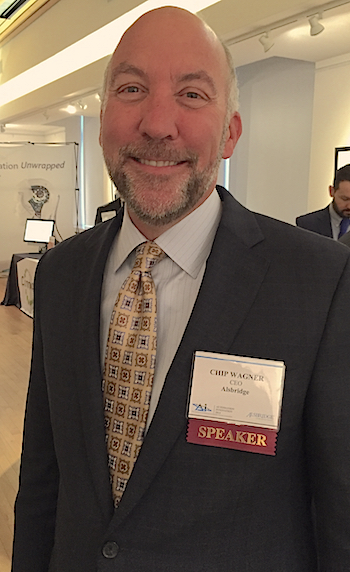
Still clear as mud? Well fear no more, as we caught up with Alsbridge CEO Chip Wagner to explain more about what’s been going on with all these name changes, spin-offs, takeovers and investments…
Phil Fersht (CEO, HfS Research): Chip – firstly, it’s great to have you on HfS – I believe this is the first time since you were appointed CEO.
Chip Wagner (CEO, Alsbridge): It is, Phil, and thanks for the invitation. Glad to be on HfS!
Phil: Chip, can you give us a quick download on what’s been happening with the firm since the investment made by LLR?
Chip Wagner is Chief Executive Officer, Alsbridge (Click for bio)
Chip: We have thoroughly enjoyed the two years since LLR invested in Alsbridge; they have been a fantastic owner and advisor. Shortly after the LLR investment, Alsbridge’s founder, Ben Trowbridge, left his CEO position in July 2013 and then moved on from the Board in July 2014.
After assuming the CEO role and later a position on the Board, I’ve been working with the team to push a number of initiatives that include changing our corporate culture, restructuring the organization, establishing a delivery center in India, launching a new service line to deliver ongoing vendor management, opening new offices in Canada and Germany, and expanding our UK presence. We’ve been busy and so far we’ve had great success experiencing 32% organic revenue growth, increasing EBITDA margin and hiring a group of all-stars to carry us forward into 2015.
Phil: So what’s different about Alsbridge these days?
Chip: As part of a rebranding initiative, we have embraced a new Alsbridge tagline of “Challenge the Future” for both our external clients and internal operations. We believe that smart businesses challenge everything – especially conventional thought, existing behaviors and perceived best practices.
From an internal perspective, we have managed to unlock potential in our team, strengthen accountability, introduce a much more transparent culture, and empower the talented people we have working for us. From an external perspective, we are evolving our service offerings, methodologies, tools and capabilities to advise clients on business and technology transformations that were unheard of just a few years ago. For example, we just helped a Fortune 100 retailer with over 5,000 locations cut their network spend by over 25% – $10M in one-time savings and over $45M annually – while simultaneously enhancing their security and analytics capabilities by moving to a next-generation Internet Protocol network. This was a massive change fraught with risk, but if you have the data and expertise to select the right partner, the right solution and manage the change, the results one can achieve these days are astounding.
Phil: It’s been well known in the industry about the legacy relationship you’ve had with Alsbridge UK and it now appears that you’ve changed your focus and are making your own investments in UK staff and resources. What’s the grand plan for Europe, Chip, and what future investments can we expect?
Chip: Our arrangement with Alsbridge PLC, as some are aware, was a brand sharing one, begun in 2005, and there were no cross shareholdings. They have opted to proceed on their own now as Aecus, an 18 person firm focused exclusively on the outsourcing/shared services advisory business in the UK. Perhaps they will continue to operate in this way, or perhaps they will be acquired by another entity. The pseudo franchise model in the UK made sense for us in the past, but it constrained our growth in this important market. We look forward to the opportunity to invest directly and bring our full suite of services and the capabilities of our 250+ strong firm to UK enterprises. Our investments in the UK complement our opening of an office in Germany in late 2013 and represent a step forward in providing European enterprises with an alternative to their current set of advisors.
Phil: Why do you see Europe as a core center of our focus when you have such a successful operation in the US? Do you believe the Alsbridge brand and reputation in Europe has real growth potential?
Chip: While there are strong players in any one niche, we see Europe as an underserved market. There is no single advisor that can provide clients with a holistic solution and unbiased advice across the gamut of hardware, network, IT services, software and business processes. I believe Alsbridge has a solid brand and reputation in Europe for outsourcing and shared services advisory. But I also believe that European enterprises need something more from their advisors, and that our services can deliver value where there is currently a void. Our focus on and success in delivering value to our clients has served us well in the US market and I believe the same will hold true in Europe.
Phil: And finally, Chip, how do you view the advisory industry taking shape in the next couple of years? Which firms will succeed and which could fail?
Chip: I wish I had a crystal ball to be able to predict who might win and who might struggle in the coming years. Some of our boutique competitors seem to be stagnant offering the same services at a lower cost rather than enhancing their value proposition, while others shift their focus to selling services to the vendor community or country development agencies. The Big 4 and even some of the traditional management consulting firms are investing in their sourcing advisory practices, but the depth of expertise varies widely among them and historically their interest in and commitment to the space has fluctuated. Growth rates, scale, diversity of offerings, and willingness to adapt the model may be indicators of who can thrive in the rapidly changing advisory landscape. An understanding of emerging technologies, tools for providing data-driven recommendations and the ability to help the client manage organizational change are more important than ever. We have actively worked to add breadth to our service offerings so as to be able to assist our CXO client base from many vantage points and in many ways.
Cloud is now ubiquitous with a whole set of new providers; traditional single enterprise data centers will likely be very scarce in less than ten years. Robotic process automation/autonomics is an oncoming, game changing force that will bring a step function change to enterprises and providers. Cognitive networks and the “Internet of Things” offer tantalizing promise and the specter of risk. In the advisory space, if you cannot fluently address this changing landscape for your clients, you will be marginalized, absorbed or otherwise cease to exist. For Alsbridge, it is all about helping our clients Challenge the Future!!
Phil: Thanks for clearing up the great mystery of Alsbridge Europe and giving us some insight into what you guys are up to, Chip. We’ll have to have you back on here soon =)
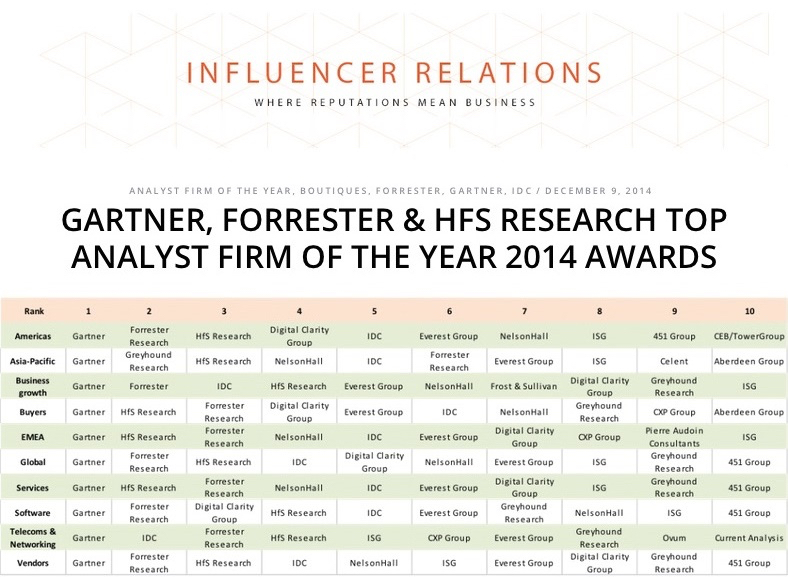
The Analyst Firm of the Year 2014 Awards combines the opinions of 1,100 worldwide users of analyst firms who voted in the Analyst Value Survey, led by the worldwide acclaimed analyst of the analysts, Duncan Chapple. It is the only credible study today conducted on the analyst firms, that incorporates the views of a very large, statistically-significant community of research consumers:
Click to Enlarge
Duncan and his colleagues deserve a lot of credit for their hard work reaching out into the industry of end users and vendors to get the real, unvarnished view of this world and educating the masses on who is really influencing and performing.
I also wanted to praise the hard work of the HfS analyst team for working so hard to get our voice and brand above the deluge of noise in today’s industry and making such long term commitments with us to get us where we are today.
You can read Duncan’s full post on the awards here.
In fact, it’s probably the first time anyone’s peered seriously into the telecom’s operations services space. And who better to do the peering that my perceptive peer Pareekh Jain…
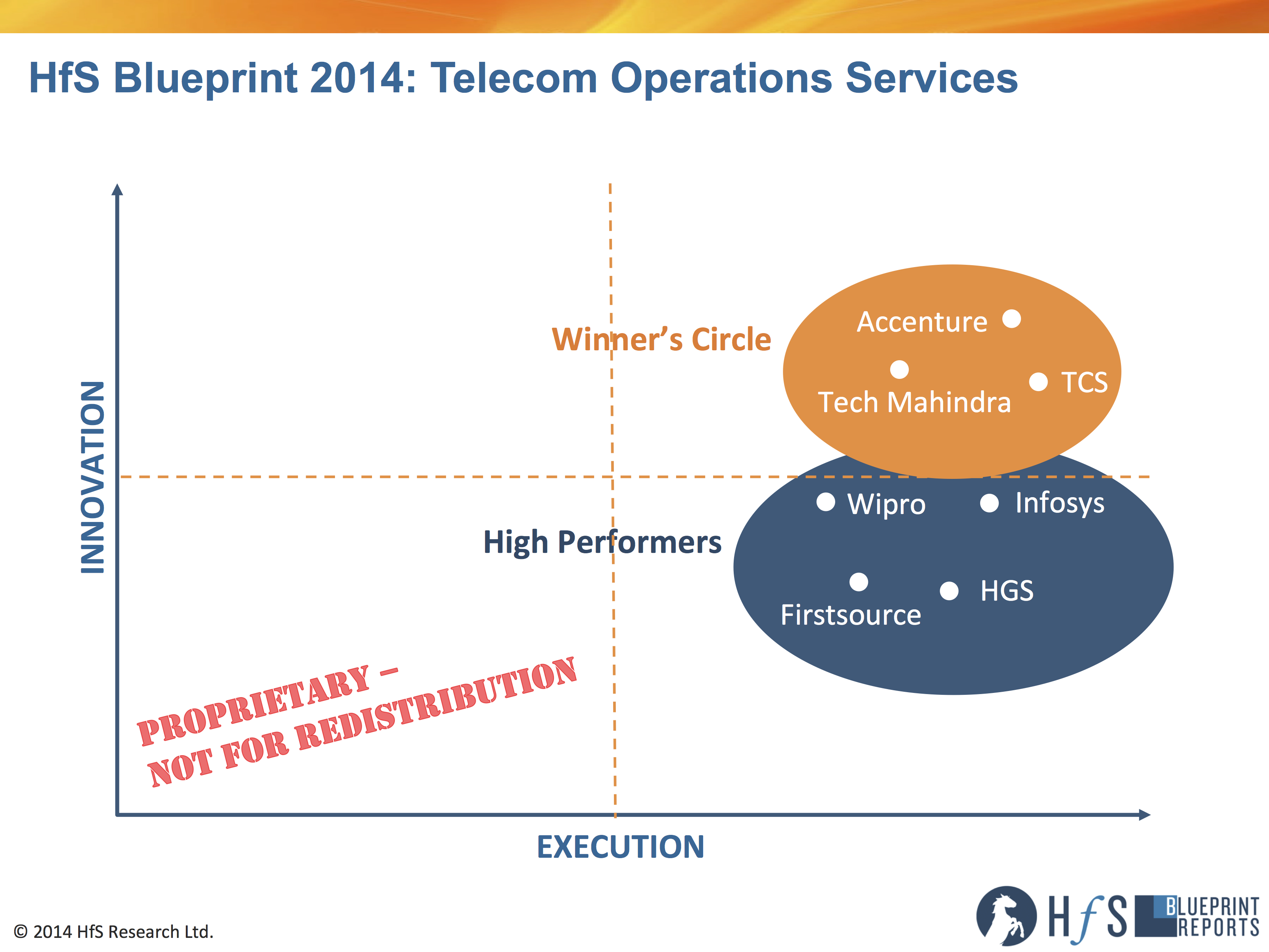
Click to Enlarge
Pareekh, how do you see this market evolving and what are the key drivers for telecom services?
We see telecom operations services evolving to the As-a-Service economy, where business processes of wireline and wireless operators across network, fulfillment, assurance, and billing are being delivered as BPaaS on specialized technology stack. Social, mobility, analytics, cloud, and automation (SMACA) solutions are driving this as-a-service transformation of telecom operations services across both wireline and wireless.
The telcos are facing four major challenges in their current operating environment. First, is the competition from the Over The Top (OTT) players such as Whatsapp, Skype, etc. which are denting the telcos’ revenue. Second, is new 4G/LTE rollouts for wireline operators and FTTx rollouts for wireline and broadband operators. Third, is high customer expectation of superior customer experience and support. Finally, is the rollout of new services.
SMACA solutions provided by telecom operations service providers can help telcos to mitigate these challenges by opex reduction, capex efficiency improvement, time to market improvement, churn reduction, omni-channel customer engagement and support, and helping telcos to offer predictable and agile services.
And how did the Blueprint analysis turn out?
Pareekh Jain is Principal Analyst, HfS (Click for Bio)
We focused our Blueprint analysis on the evaluation of SMACA solution capabilities of different telecom operations service providers.
This may sound clichéd, but we will call all seven service providers evaluated as winners. The reason is that we focused on evaluating SMACA capabilities and insisted on actual SMACA solution case studies in telecom operations services. We started with a long list of telecom operations service providers but realized that most of the service providers have not yet developed these offerings. Only seven service providers could withstand our scrutiny and evaluation. Ofcourse, there is relative positioning among these seven service providers.
There are three service providers in our Winner’s Circle – Accenture, TCS, and Tech Mahindra.
Four things are common across all three Winner’s circle service providers – telecom specific SMACA offerings, strong IT and BPO synergy validated by customer case studies, experience in delivering innovation or value beyond cost validated by customers, and strong and compelling digital vision exhibited by their initiatives, plans and PoCs.
The four High Performers in our study are Infosys, Wipro, HGS, and Firstsource. They are on the right path and will strengthen their telecom specific SMACA offerings and capabilities in coming months.
So what are your key takeaways from this study and what should we be watching for in the next few years?
We think there are three key takeaways from this study. First, the SMACA solutions are for real. Second, “design thinking” can be used as an innovation tool. Finally, the SMACA solutions can be leveraged in broadening client base and solution offerings.
Let us discuss each of them separately:
1. The SMACA solutions in Telecom operations services are for real. We are able to separate signals from noise by analyzing numerous case studies along with PoCs that convince us of the presence and applicability of SMACA in this market segment. The contract size for SMACA solutions is small today, but it has potential to become big in the future.
2. In telecom operations, HfS came across a number of examples of “design thinking,” where observation of frustration points amongst telcos’ external subscribers, and within a telco’s internal workforce led to the innovative solutions. As process improvement is running out of steam, “design thinking” can be source of value realization and emergence of new business and delivery models not only in telecom operations services but in whole “As-a-service” ecosystem.
3. There are about 700-800 telcos in the world, but only about 100 or so tier 1 telcos in selected countries have embraced outsourcing of operations services. Now there is an opportunity to provide services to tier 2 and tier 3 telcos too leveraging SMACA solutions. A few service providers have started to move up and expand their scope of services beyond IT and operations, offering network services and business advisory services leveraging SMACA. These were once the exclusive domain of telecom equipment providers and management consulting firms.
We will watching in coming months and years, how winners consolidate their positions and other service providers develop their SMACA offerings in telecom operations services. Also, as telecom operations services move towards “as-a-service,” we will be watching for “as-a-service” contracts, emergence of specialist service providers, and deployment of new business models.
Pareekh, thanks for taking the time to share your new research, another great effort from you! HfS readers can click here to view highlights of all our recent 19 HfS Blueprint reports.
HfS subscribers click here to access the new HfS Blueprint Report, “HfS Blueprint Report 2014: Telecom Operations Services“
So it turned out that there was a “Secret Santa” exchange going over the last few months, as Atos and Xerox worked out the terms of their exchange of Xerox’s IT Outsourcing business and an ongoing support contract for cash considerations of $1.05 Billion.
Yes indeed folks, two traditional incumbent service providers are getting active in a market that’s been caught in somewhat of a holding pattern for some time, with many grimly clinging onto their labor-driven models in denial that big changes are already in the works to disrupt their cosy legacy worlds. So let’s hear what the HfS analyst team thinks about it all…
The As-a-Service Economy beckons… and it’s time for the contenders to step up and get focused
HfS believes that this was a good move for both service providers as it allows for each to concentrate on their core offerings, while leaning on the other for ancillary capabilities (IT from Atos to Xerox, HR and F&A from Xerox to Atos). Both service providers have had a relationship for some time, especially with Xerox’s global BPO provision of services for Atos, and this will strengthen further now that there is no competitive overlap between their current offerings.
For Atos, unwrapping the present of Xerox’ ITO business greatly increases its presence in North America while raising the top line by $1.5 Billion + (not including $200M+ in contracts to serve Xerox). Traditional ITO is a scale game, and if it wants to take on the likes of CSC, Unisys, HP and IBM in North America more directly, this is way to gain a market and delivery presence with speed. We are confident that Atos will also be able to manage the integration of Xerox ITO (which was not especially integrated with Xerox BPO or Document Services to begin with) just as it has with several other recent ITO acquisitions, such as Bull and SIS.
For Xerox, the immediate present is in the form of cash and a greater clarity in its mission. Xerox is not suddenly technology-free, as long-standing offerings (e.g. Tolls and Fare Management) as well as new acquisitions (e.g. WDS) have their own integrated capabilities. Xerox BPO is also a significant technology user in the form of robotic process automation and analytics platforms, which won’t be impacted by this transaction either and they should continue to be integral to the capability strategy of Xerox. HfS also wants to see how Xerox will need to maintain and develop IT capabilities to further Business Platform As A Service (BPaaS) offerings but these will rest on a lightweight cloud infrastructure along with process redesign, SaaS-enablement, mobile enablement and analytics enablement that go beyond what is being offered by traditional ITO services.
So… what can we expect from both providers in 2015?
For Atos, the immediate goal is clear – to launch itself much more aggressively onto the US market, integrate the Xerox ITO business, increase brand awareness among US buyers and prove to the world it must be considered a leading global ITO service provider.
The billion-dollar question now is what Xerox may do with their cash in the post-holiday season. It’s been a while since its 2009 acquisition of ACS, and, to be frank, it hasn’t exactly set the BPO industry alight outside of its document management business. Now it has added funds and impetus to make a fresh play at the market in 2015.
Will the firm use it to pursue additional BPO capabilities in target markets such as healthcare by swallowing up the likes of an EXL, or will it pool the holiday cash with other savings and make a run at even larger targets, such as HP or IBM’s BPO units or really go for it by targeting Genpact? It’s also entirely possible that Xerox will play it more conservatively and invests in third parties with advanced technology such as HealthSpot or Emdeon, or goes after more businesses to digitize their business process operations, like WDS, which is actively disrupting the customer care market. Then it can keep the change to jingle for shareholder benefit as well.
The Bottom-line: Atos and Xerox are getting active, while several of their competitors are stuck in holding patterns
To summarize, this transaction focuses both service providers on their strengths and will help them be more effective in the emerging As-a-Service Economy. However, both have a lot of work to do – and fast – if they want to get ahead of the curve in today’s fast-evolving services market. Unlike several of their illustrious competitors, which have opted to stagnate and eek out whatever they can from their legacy businesses, at least Atos and Xerox and making aggressive moves in the right direction.
Vishal Sikka (pictured right) is CEO, Infosys Technologies
The most eye-opening personnel decision in the services industry this year has been the appointment of Vishal Sikka as Infosys CEO. I recently spent some time with Vishal and his executive team, along with some of the HfS crew, and we quickly noticed a marked uptick in their feverish enthusiasm for their business. Not only that – they seemed happy.
Was this really the same Infosys that was fighting to rediscover its mojo, or has it now got it back – in Vishal? Indeed they seem to – and at the heart of it is the infectious passion, energy and insightful curiosity of their new CEO. The one who personally ensured the bar stayed open for a few extra hours so he could spend more time just relaxing with his staff. But now we’re almost 6 months in, surely the honeymoon is over? It seems not, so let’s hear more from Vishal himself…
Phil Fersht (CEO, HfS Research): Good afternoon Vishal – and delighted you’re happy to talk to our HfS readers… so what do you think of your new firm?
Vishal Sikka (CEO, Infosys): There’s an incredible amount of energy, and an incredible amount of passion. Yet in many ways, I get the sense that we lost some confidence along the way, and part of the job I see at hand is to restore that. To a certain degree, that loss of confidence is something that affects us broadly in the services industry in India…following orders and doing what we’re told to do, rather than thinking about and finding problems.
Another thing that strikes me is the company’s massive scale. We have multiple delivery centers, such as in Pune and Bangalore, each with more than 25,000 people.
A third aspect of which I’m incredibly proud is Infosys’ emphasis on education. People see us as an outsourcing company, or a services company, or an application development company. But in reality, learning and education are at the heart of the company. On my first day on the job, I visited our university in Mysore, and learned that we can put together a world-class training program for essentially anything under the sun in less than three months. And we can then immediately, simultaneously train 16,000 people in-person and through online education. That’s an amazing asset.
Also, while most don’t realize this, Infosys does an incredible amount of design work and writes tons of code for commercial products such as major airplane parts, and machines for the oil and gas, automotive, and other industries.
Finally, one of the most extraordinary things about the company is our beautiful and energy efficient campuses. The ones in Silicon Valley have nothing on ours. You can see on YouTube or Google how gorgeous they are, with man made water wells and lakes. They are like huge cities, and we treat them like that. What you won’t see unless you visit is that our incredible infrastructure team has built the world’s highest rated sustainable building in Hyderabad. In the summertime, Hyderabad gets up to 47 degrees Celsius (116 Fahrenheit), but we don’t use any air conditioning. Instead, we cool the walls, and thus the air, with water, as that is the most efficient cooling method.
Phil: What do you think Infosys’ biggest challenge will be in 2015?
Vishal:Transforming ourselves culturally and operationally into a company driven by innovation, driven by delivering much more value add, more innovative services…what Prof. Mashelkar in India used to say, doing more with less for more. That requires a very serious change in mindset, in our offerings, and in our operational processes. It will be difficult, but we have to do it. And the good news is that we are already starting to see signs of success in using that approach.
Phil: There’s a big theme about the positioning around software at this event. Can you give us a bit more of your thinking around that and where you’d like to take it?
Vishal: We actually live in a software-defined world, in every industry and in every walk of life. But while the word software has somehow become associated with products, this is not the point. Infosys is a services company, and will remain a services company. The entire point of the economy around us is the “As-a-Service Economy“. And erstwhile product companies are looking to become services companies. So for us become a product company would completely miss the point. Our goal is to stay a services company and deliver, however we want to deliver more and more value using software, using IP, using reusability of components and capabilities across engagements. That is exceedingly important, and transformational. We do have many software assets, such as our Finacle banking suite and AssistEdge for customer service. But those software packages or products are surrounded by services.
Phil: There’s a very different mindset between a traditional software business and a traditional services business, Vishal, which you should know better than anyone with your SAP history. How are you going to approach that with Infosys? Are you going to try and find a meeting in the middle of these mindsets and cultures?
Vishal: Yes, we will be a services company that uses more and more software. Most other services-type industries have evolved into that. Think about healthcare. If you go to Stanford Hospital, you have a surgeon with a great context provided to him or her by Stanford. If the same surgeon showed up somewhere else, say in Kenya or India, it is still the same person but the surrounding context is completely different. On a recent flight back from China I watched the movie “Chef,” about a Michelin-star chef who ends up in a food truck. Again, it’s still the same person with the same capabilities, but in a different context. I think that the context we put around our people can be great amplifiers, can be great enablers for them to deliver tremendous non-linear value. Yet the mechanism of value is the service and the person who provides the service. So, it is not that we have become a product company, but more and more a high value delivering services company.
Phil: Let’s talk a little more about your idea of “Design Thinking”. You talked about thousands being trained on it. How far do you plan to take that?
Vishal: I’d like to take it as far as it can go, Phil. The whole exercise is about getting people to think openly about why a certain thing is not there. Customers come and tell me that they want this, they want advice from us on what they are doing and how they can do it better. They ask if we see something in their processes that can be done better. I recently spoke with a customer who asked about completely touch free invoicing. While he was focusing on the fact that his company has 40 percent touch free invoices, I said the real question was about the remaining 60 percent.
The reality is that companies don’t know what their problems are. It’s our job to be innovative and more open to helping our customers find and identify problems. And to become more confident that while we don’t know what tomorrow’s great problem or opportunity is going to be, we will help our customers find it. And then, of course, once we find it, our education, our knowledge, and our background gives us the tools to solve it. We’ll go after it and solve it together. Design thinking really is about that. In the 1950’s, when Polya wrote his book on problem solving, problem solving was the big deal in education. Now, I think it’s problem finding.
Phil: So Vishal… you’ve been ordained the emperor of the IT services business for one week. What the one big change would you make?
Vishal: Get the company, and the industry, to focus more on innovation. Today, most businesses see a tremendous disruption, a transformation, happening to their industry, to their company. They are interested in solving tomorrow’s problems, and that requires us to be problem finders, not just problem solvers. That requires us to become people who can help companies become innovative and relevant. My strong desire is to get the IT services industry out of this downward spiral of progressively lowering cost, jamming people into the supply chain faster and faster from worse and worse colleges, and shoving them into projects faster and faster. This is the wrong direction. Instead, doing more with less for more is a much better idea. That’s what I would love to do.
Phil: Vishal Sikka – thanks for your time today – and look forward to hearing from you in 2015.
(Vishal Sikka was appointed CEO of Infosys in June, 2014 – his bio can be accessed here)
10 years ago, you most likely checked your email once in the morning, once after lunch and once at the end of the day.
You actually spent your day being productive, writing reports, presentations, attending meetings that actually had agendas, going to client meetings that had been organized weeks’ ago. You might even have had time to read things and educate yourself… In short, you probably had some semblance of an organized work day, and there was a clear delineation between your work life and your own life.
And after work, you’d perhaps meet some colleagues for a drink and a bite to eat, then (heaven forbid) go to a karaoke bar or hit a dance floor. In those days we were physically social with each other. You interacted, you got stuff done, you had fun, you let your hair down occasionally.
Today, you probably wake up at 6.00am and wearily reach out to your mobile device to check your email, before you’ve had time to even think about anything else. And you’ll probably spend your entire day checking it at a minimum rate of once every 15 minutes, getting precious little work done, reacting to memos, getting added to meetings with no agendas (that you probably should never have been invited to in the first place) that have zero follow-through or real purpose.
That ppt deck you started at 6.45am has barely progressed, as you decide to check your LinkedIn updates for a third time that morning to see who else had viewed your profile, or join into electronic congress with someone who trusts you, even though you have no recollection of ever having met said person. It’s now 11.00am, and finally you’re ready to write your name on the front cover of that ppt deck, but then – lordy lord – you just realized you’d (gasp) forgotten to check your twitter feed all morning. A welling of fresh excitement bubbles up into your electronic life as you check out those three retweets from your late night tweeting bonanza, but this quickly extinguishes when you realize these weren’t done by actual people. Instead, you retweet a few articles your have no interest in reading, but it’ll look electronically cool that you might actually read stuff and have an opinion.
It’s now 11.30am and you’re just about to add your job title to your name on the intro slide, when you just have to check your email for the 17th time that morning. Oh boy – someone at work is having a rant about something. Quick, drop everything and spend the next 30 minutes carefully composing your angle to the issue before pushing “send”. Made it to lunch.. you run out for a sandwich, but you better take the mobile incase you get tagged in a critical Facebook post… Then, shock horror, some old colleagues from your previous job are having a get-together tonight and have invited you along. Weird – why would you want to seepeople? Better come up with a good excuse…
The afternoon meanders along with an orgy of more disorganized tele-meetings, a failed attempt at a videoconference from someome trying to be really “electronically social” (puke), a series of emails flying around that are all ignore-able, more LI updates that actually cause you to pause for a second with the thought “why do I keep checking these things?” (but you do anyway), the obligatory check-ins to twitter to parse around more crap you pretend to care about, before finally getting back to your ppt deck at 5.00pm, when you realize you hadn’t checked into your Facebook since lunchtime. Oh my god. A whole afternoon of pics of peoples’ kids, the obligatory narcissist who seems obsessed with updating their profile selfie every bloody week (and gets 75 ‘likes’), and the person who thinks you really need to know they just checked in for their DFW flight…
So evening arrives and you realize you’ve barely eaten all day, rather just guzzled coffee to jet-fuel your electronic fervour, when the dreaded email lands from your boss…”Hey, really looking forward to reviewing your slides”.
So there goes your evening – three hours on the couch to knock out this baby… thank god you didn’t accept that drinks invitation.
The Bottom-line: We need to get smarter about how we work and interact with each other
So where, oh where, did our lives go? Wasn’t the advent of the internet supposed to transform our lives? Well, that it did, but the question I’ll leave you with: did it change your life for the better?
In all seriousness, we’ve now reached a point in our Digital lives where we need to use it more smartly than we have been. The initial excitement, and buzz around social media and the availability of all these really cool communications technologies is now wearing off and we need to take a serious look at how it has impacted the way we work and interact with people.
What I love about our evolving Digital existence today is the ability to communicate with each other on so many channels, depending on the type of conversation, or the level of intimacy of the relationship. It’s also damn easy to track people down if you need to! However, many of us are falling into bad Digital habits where it can seriously impact the quality of our non-Digital lives – and even the quality of our work performance.
Think about it this way – when you get back from a week’s holiday, I bet you can clear your inbox in barely a morning. The very same inbox you probably would have spend that entire week spinning cycles over. We need to spend time focused on meaningful activities that add value to our lives, and less on the Digitally-driven crap that is sucking the time our of our week and the human interactions that used to mean so much…
Ugh… What are we doing? We hate predictions. Predictions are lame, predictions are cheesie, predictions are either wrong, or just so generic that they could be automated every year with a “substitute this big trend for this one” script.
Hey – that’s actually not a bad idea, so why not throw a bunch of trends from the HfS analyst team into a cognitive application, add some robotics technology to mix them up with some humanoid analyst mimicry, and see whether the outcome could quite feasibly have been the product of some big legacy analyst house.
So without further ado, here are 17 predictions that will all come true. Just for you…
1. Old-school outsourcing becomes heroic as digitization of process becomes the new political enemy of the corporate masses
Suddenly, labor-arbitrage deals are good things for society. At least jobs are being created somewhere in the world, as opposed to being eliminated altogether by robots. This shift from “Labor to Digital” takes center stage across the whole operations, consulting and professional services industry. Outsourcing will no longer be a dirty word, as enterprises realize the digitization and robotization of business and IT processes is the only real lever to pull to provide them with future value and efficiency. However, this will create a level of fear and uncertainty much more intense than the old worries about having your job shipped off to India. “I’ll be back” becomes the watch-word of anti-robotics protestors, as those haunting words from Arnie’s 1984 Orwellian classic come back to bite us.
2. “Autonabalism” becomes central to ambitious BPO service provider strategy
With Robotic Process Automation (RPA) becoming more central to the strategy of BPO service providers, we think 2015 will be the year that a few BPO service providers institutionalize their RPA capabilities and decide to cannibalize the revenues of their existing FTE contracts in order to encourage the end to end transformation of their own businesses. This strategic retrenchment using automation and cannibalizing revenues is what we refer to as “autonabalism”, and a few bold and forward thinking service providers will be undertaking this next year.
3. The emergence of the As-a-Service Economy will see several niche As-a-Service providers smash the old model
Those traditional providers which fail to autonabilize their models, will come under increasing threat from the emerging wave of specialist As-a-Service providers, which can deliver standard processes enriched with value-added services at much lower cost, and easier “plug and play” capability. Examples already include the likes of OneSource Virtual, Aasonn, Genfour, Bluewolf, Fruition, Symphony and CloudSherpas. We also predict that we will see new BPaaS-driven firms spring up that have not even be formed yet.
4. Focused service providers will decide definitively where they want to play to survive
5. Crowd-sourcing will play a role in the service delivery model for sourcing
In business functions like marketing and industry-specific health, where there are ad-hoc projects like product releases and surges of demand for processing such as enrollment periods, an enterprising buyer/service provider will experiment with a crowd-sourcing approach. It will allow vetted service delivery people who finish their assigned tasks early, have available time as a part-time worker, or want to apply their skills in a new way or prove what they can do, to match their skills and interest with a job or task that needs to get done.
6. Healthcare starts to live up to the concept of “patient-centered”
…with the help of service providers behind the scenes who bring experience, ideas, and practices from industries like retail and banking that have been steeped in online services, net promoter scores, and customer service indexes. As “e-Health” joins “ecommerce,” we’ll see some very specific analytics-based offerings emerge as a service that will be tied to helping health plans and providers with consumer and patient satisfaction and compliance.
7. A major global DiSaaSter will occur
A major enterprise blames its SaaS or outsourcing provider for a loss of data or information and either direct costs/valuation/brand loyalty loss. There will likely be a breakdown in personal leadership accountability on both sides of the relationship, (think SAP/Nike from the 90s and the recent hacking of Sony entertainment), and it will become big media: is SaaS safe? Is it delivering value and business differentiation or just more predictable revenue models to financial analysts and investors? Which will lead to:
8. Increased regulatory intervention in business
Led by the European Union and followed by Asia, governments will start to institute stricter Personal Identifiable information (PII), contract labor, and business operation outsourcing and offshoring laws to counteract the loss of control with the digitization of business and information “in the cloud.” This will make employers which are thoughtful both about how they use automation, do workforce strategy and planning, and deliver a good “employee experience,” the employers of choice as Western economies come back to stable growth and restless workers sick of being poorly treated and managed take the recent 5% GDP growth in the US as a sign it is OK to move on to the next firm. Which will lead to:
9. A major War for Talent as the legacy employment model continues to lose favor with an increasing army of talented workers
Today, workers can increasingly dictate their employment terms, with recession-induced personal financial planning discipline and regulatory changes like ObamaCare making it a lot easier for individuals to accept the old employment model just isn’t in their favor anymore. Organizations are left with the legacy talent least likely to take initiative and will be forced to make the investments in the remaining workers and automation solutions just to stay in business, but will rationalize partners and look to the service-oriented firms that are willing to flex with them to adapt to the ever changing economic conditions.
10. Talent development takes center stage for analytics differentiation
Instead of the latest and greatest BI tools, cloud-based proprietary analytics platforms, open source mashups, in-memory computing or the data visualization darling app of the day, the industry will finally realize that it is the talent – both at the client and service provider sides – that will ultimately impact the long-term success of analytics initiatives. Instead of boasting about the largest catalogues of predictive models, service providers will use their talent development investments and techniques as a source of differentiation. Developing capabilities at the intersection of data sciences, statistics and domain knowledge will also help service providers gradually move past the staff augmentation model of simply offering up resources to do siloed analysis tasks. Think beefed up analytics academies, significantly deeper relationships with academic institutions across global talent hubs to develop curricula that relates to actual business context, and innovative new models of hiring and training employees to become creative problem solvers. Client organizations will take advantage of service providers’ learning infrastructure by sending their own operations and management staff to take crash courses in how to do better self-serve analysis, and make better use of analytical insights generated by their service provider’s staff.
11. Social becomes a creepily-effective means of running customer service
By the end of 2015, we’ll start to see clearly defined service offerings around social care as a critical part of omni-channel CRM BPO. The move towards impacting the overall customer experience can no longer ignore the fact that consumers have their own preferred social channels that each brand has to have relevant presence in – not just to do cheesy marketing promotions, but take the opportunity to proactively service customers in these channels of their choice. Social CRM BPO won’t mean responding to a tweeted complaint by saying, ‘Please call us to resolve this offline’, as some service providers have started to do for their clients under the guise of ‘omni-channel’. With the use of increasingly sophisticated social listening and moderating tools, intelligent automated agents, 360 degree customer views, and analytics using multiple sources of data (call center, surveys, consumer databases, social, point of sale, etc.), you can expect the BPO agents of the near future to proactively respond to your Instagram of terrible airline food with resolution and support within the channel and device of your choosing.
12. Vertical-specific processes must move to BPaaS… or perish
BPO delivery of several vertical-specific processes are at a point where the ‘big bang’ cost and standardization benefits have been achieved, service provider staff have gained significant domain experience and understanding of industry workflows, and providers have made investments in introducing options for running them on modern business platforms, either internally developed or acquired. These are most often areas that client organizations view as non-core or non-critical, meaning they aren’t willing to invest in updating the underlying technology infrastructure for them vs. other core revenue-generating activities. Examples include claims administration and policy serving in insurance or payment processing, retail wealth management and retail origination in banking and financial services. 2015 will pose an inflection point for BPO clients to evaluate BPaaS delivery, or risk an increasingly stagnating value proposition as competitors access new sources of platform-driven cost reduction, standardization and flexibility.
13. SCM SaaS breathlessly enters the enterprise mix
We will close out 2015 talking about Supply Chain SaaS platforms in the same breathless manner in which we currently look at Salesforce and Workday in particular. The opportunities for increased agility, flexibility and reduced operating costs are too great in supply chain for this not to take root in a much more significant way in 2015. The set of SCM BPO service provider offerings around such a platform (or platforms) should be integral to the way that we evaluate service providers in our next SCM BPO Blueprint in 2015.
14. Engineering services finally evolves from niche to mainstream
There is a latent outsourcing potential in engineering services, but it is trapped inside clients’ shared service and captive centers. Now with the emergence of engineering analytics, M2M and IoT, service providers have better value propositions to offer engineering services in the third-party outsourcing model. We predict that top 6 India-centric service providers – TCS, Cognizant, Infosys, Wipro, HCL, and Tech Mahindra – will be interested in acquisitions of both captives and niche service providers in this space in 2015.
15. Consolidation among India-heritage service providers has to happen
In the As-a-Service Economy, service providers needs specialization to triumph scale. But for mid-tier broad-based service providers the “as-a-service” economy may be the end of the road, and they may well start cashing out to tier-1 service providers before it is too late. Our top prediction in this space is that Tech Mahindra might be interested in a BFSI acquisition which inches them closer to their internal target of $5 billion in 2015. We think Mphasis or Polaris might be a good target for Tech Mahindra. Virtusa is also an increasingly attractive ITO prospect with its grounding in the insurance sector and high growth potential. On the BPO side of the fence, EXL would make an attractive target for one of the larger service providers wanting more chops in the insurance industry and WNS has come off a good performance in 2014. There may also be some interesting developments with Genpact which could either acquire of be acquired to fuse more tech-enablement scale and skill to dovetail with its huge base of BPO clientel.
16. Wearables – watches and glasses – suddenly begin to displace smartphones as the interface of interest and intent
It has been a long time predicted, but 2015 will finally see this opportunity become reality. Driven by Apple’s iWatch, Sony and Google’s glasses – we’ll start to see real applications of extending data and compute more directly into our personal environments in a way that makes the 2 dimensional smartphone appear like a brick.
17. IoT becomes the new catch-all… and for good reason
Driven by the trend on wearables above coupled with ongoing attention to M2M, mobility, and a need to move Digital discussions down to a level of action from the lofty level of strategy, IoT will become the new call to action and not just for large scale field assets but also for, say, bridging the actions of mobile workforces with centralized systems. i.e. It becomes the UberMobile and marketing efforts get spent around pushing this message out.
Phew. If you made it this far, you’ve already got one foot into 2016…. Happy New Year!
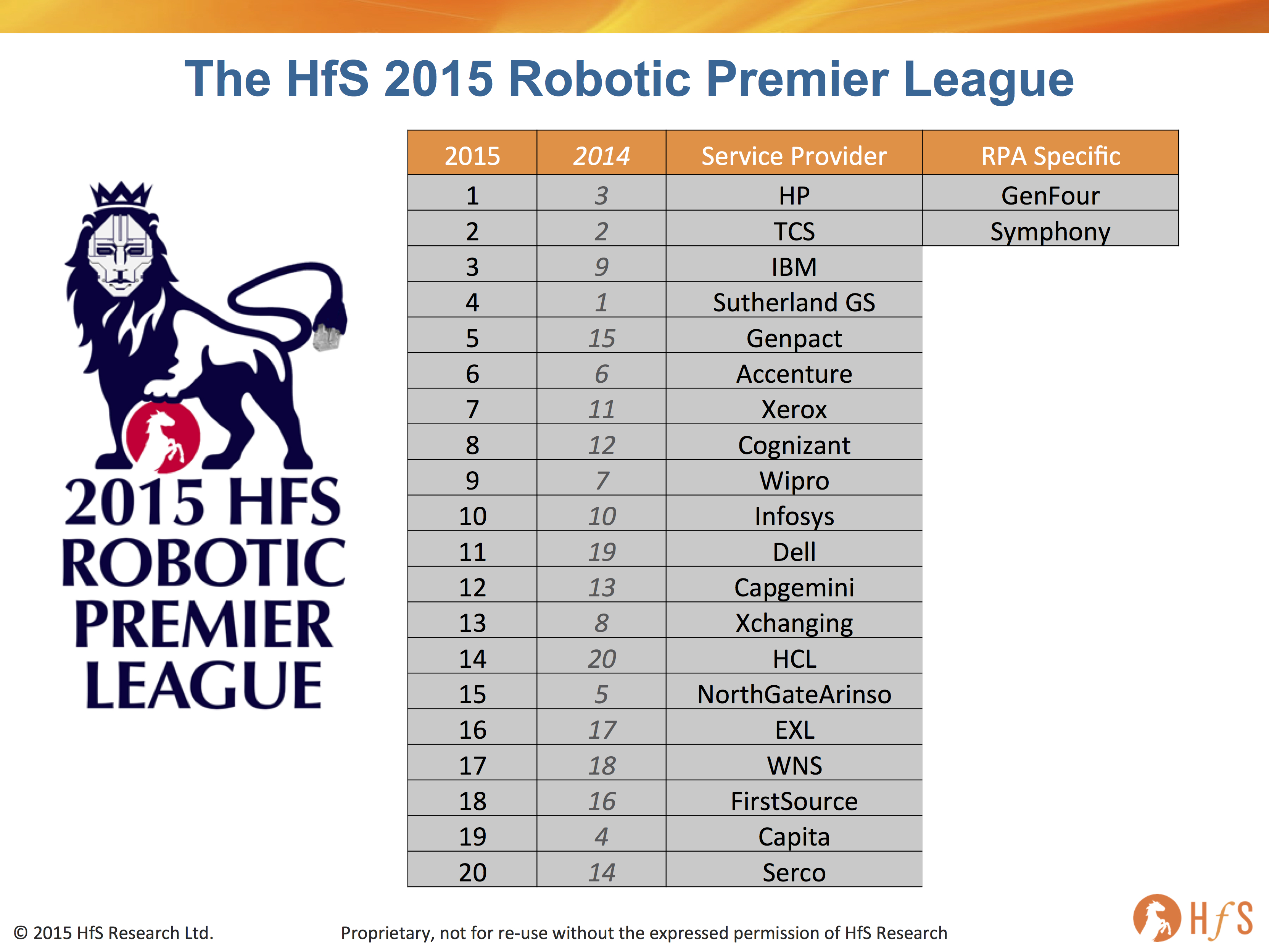
Back in April, we released the first Robotic Premier League Table to capture the “pre-season” placement of 20 different BPO service providers who were in the early stages of adopting robotic process automation (RPA). We shook up the market with what is still the most comprehensive assessment of the strategies, marketing and delivery of today’s emerging RPA capabilities. In fact, it’s the only comprehensive assessment of the strategies, marketing and delivery of RPA capabilities.
Well, eight months is a very long time in the fast-evolving world or process robotization, so we’ve decided to update our analysis and provide a new RPL table to start 2015 to account for the early activity and investments being made in the space.
For this release, our resident RPL Commissioner Charles Sutherland caught up with several dozen service providers to look at just how far their RPA capabilities had evolved since April…
Congratulations to HP, TCS, IBM, Sutherland Global Services and Genpact for topping the table this time around and for Genfour and Symphony Ventures in setting the standard for a new emerging category of RPA specific service providers.
To establish these positions, Charles assessed each service provider using the criteria developed in his HfS RPA Maturity Model.
Click to Enlarge
It is still early in the evolution of RPA inside the outsourcing services market. Service providers are industrializing their capabilities to meet current and future client requirements. By the time we release our next RPL later in 2015 we expect to see the level of standard capability across service providers to have significantly matured further and for RPA to be part of most major outsourcing deals across the market. In short, RPA is becoming an arrow in every ambitious service provider’s quiver.
Where Deepak hits the nail on the head, is how IT services executives are promoting themselves out of relevance in the India-heritage firms (which is not too dissimilar from practices we observe in many Western-heritage services firms too). In plain terms, we’ve got lazy and arrogant, we’ve developed a sense of entitlement, where all we need to do is print money from the profits of maintaining legacy enterprise practices.
I won’t regurgitate all of what Deepak discusses, but do have a think about the advice he leaves us with, for services executive worried about losing their relevance:
Learn a new skill – either back to code and processes in newer technologies, or in a completely different domain. This could take months or years, but it’s necessary
Invest and create alternate sources of income
Keep debt manageable so a job loss will leave you with at least a year’s expenses in the bank
Stay humble: the people who reported to you could be your next boss
The context here is simple: the enterprise services gravy train is slowing down for those executives who aren’t staying ahead of the curve, and when India’s largest and most profitable IT services provider TCS is looking to decrease its reliance on legacy labor, you know the tide is turning – and turning fast. Intense competition for low-cost offshore delivery is reaching its commoditization point, and executives need to decide whether to protect their dwindling turf, or re-invest in their own skills to make themselves more marketable and valuable to the industry.
Increased complexity drives huge opportunities for services growth
It’s like going to a dentist and not being able to see a digital X-ray of your teeth? Would you keep buying services from someone who hasn’t read a text book, or had some form of new skill development over the last decade? It’s the same with business IT services – providers need to be able to do more than deliver the same old technology services and processes at scale – they need to introduce better ways of doing things. The development of new technologies, tools, process standards and capabilities are creating a whole new wave of possibilities for enterprises to get ahead.
The technology/business services industry was built on complexity, where services firms profited massively on enterprises’ need for skills they didn’t possess, to develop technology apps and services, to design processes and better ways to do things. There was money to be made designing solutions – and also maintaining and tweaking them.
In short, we’ve thrived on new innovations and disruptions for the last five decades… from mainframes to Client/Servers to ERP to web-based architectures to cloud computing. The only difference, today, is the pace of change and innovation is considerably more aggressive – digital technologies such as mobility, analytics and social are generating new business value when legacy business processes (and practices) are dragged into a digital business environment, while new developments in robotic automation platforms are making it much easier to create fluid workflows for operations to become more efficient. On top of that, add the possibilities of artificial intelligence, cognitive applications and advanced data science, and you have a maelstrom of immense change and new complexity challenging the status quo of corporate systems and processes.
Doesn’t that spell O-P-P-O-R-T-U-N-I-T-Y?
Complacency is our biggest enemy
Have we really become this lazy… have we really become this bloated and content, that we don’t have the energy to learn new technologies, new business standards and processes? Do we really think today’s customers are going to spend their days on a valueless mediocre treadmill of maintaining legacy ERP products, persisting with poorly run process flows?
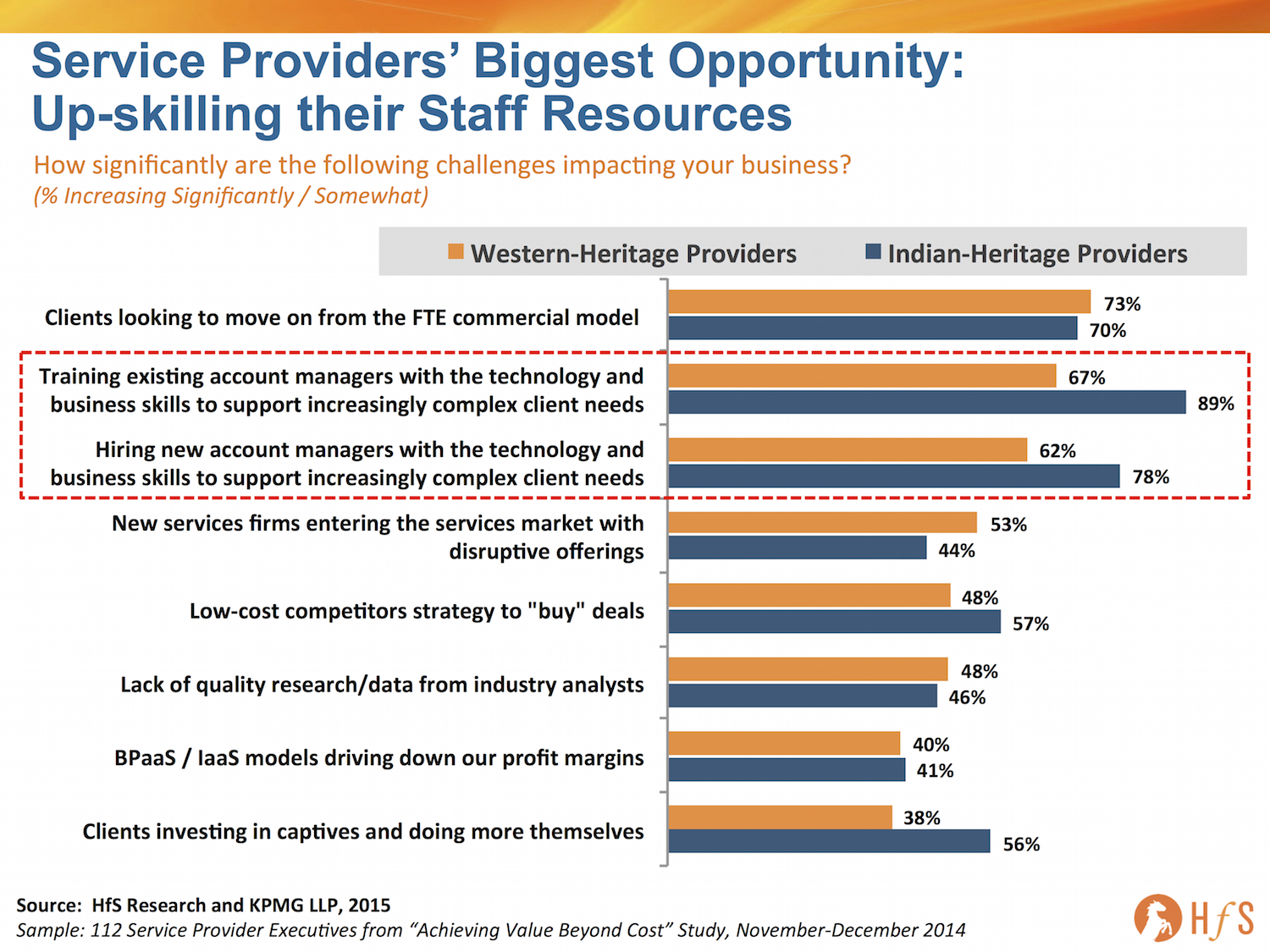
This brings us to the pivotal data findings from our soon-to-be released report “From Human to Digital, the Future of Global Business Services” that discusses the findings from our new study, conducted with KPMG, that covered 492 industry services stakeholders. During the study, we posed a very poignant question to the service provider executives taking part about the key challenges impacting their businesses:
Click to Enlarge
Technology acumen and global scale must be enabled with relevant services skills
While we can get overly excited about the emergence of robotics platforms and Digital solutions to create all sorts of disruptive possibilities for enterprises, without the skills to take advantage of them, they’re not going to deliver much value for clients. All the smart service providers will be providing all the technology bells and whistles to compliment their global scale by the end of 2015. These are quickly becoming table-stake components of delivery, and we are already seeing several clients RFP responses in the field where robotic process automation (for example) is included.
However, when the vast majority of Indian-heritage provider executives view up-skilling their account managers as their number one challenge, then this is a massive, massive issue. In fact, it’s the biggest issue facing global services today.
What they’re really saying here is that they simply do not have the skills their clients are increasingly demanding and they are really struggling to either bring it in fresh (78%) of develop the ones the have (89%).
But why can they not develop the ones they have? Because their legacy model of promoting staff to project manage teams of coders / transactional processors is leaving them with a skill-set completely unsuited to helping clients which need orthogonal thinking, analytical context and an ability to redesign processes. And while this critical challenge is clearly becoming a huge issue for the Indian-heritage firms, it’s also besetting two-thirds of the Western-heritage providers, many of whom claim to boast superior consultative acumen.
The Bottom-line: We need to see a unique blending of consulting and outsourcing acumen
What’s abundantly clear today is that proving scale, standard platforms and technology tools will only get you so far with clients. Without the bench of talent to enable clients to use these effectively, several providers are going to get quickly ejected from client engagements and relegated to providing transactional resources for the diminishing number of clients who only care about the low-cost legacy model.
So if they can’t hire in the talent or retrain what they have, then what, pray tell, is the answer here? Simple: create, partner or acquire consulting firms which can develop and adapt the right skills and methodology to make this work. There needs to be a coming-together of consulting and outsourcing service delivery, the likes of which we have yet to see at a broad scale in the services industry. It’s clear the outsourcing culture fosters standardization and stability, not orthogonal thinking and creativity. Finding a way to bridge the two is what is key here – and it’s not something that can happen overnight for many firms so embedded in their current cultures.
Consulting firms know how to make money out of corporate complexity and insecurity, while outsourcing providers are very good and developing sticky delivery models to manage their clients’ processes and operations. Clients now need both – and want these services on a regular, ongoing, plug-and-play As-a-Service model. They need to be able to go that services dentist and see that digital X-ray of themselves…


 So it turned out that there was a “Secret Santa” exchange going over the last few months, as Atos and Xerox worked out the terms of their exchange of Xerox’s IT Outsourcing business and an ongoing support contract for cash considerations of $1.05 Billion.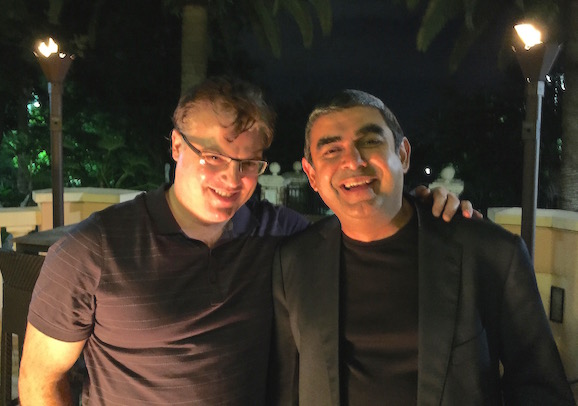
 10 years ago, you most likely checked your email once in the morning, once after lunch and once at the end of the day.

 I was recently inspired by a refreshingly simple and unvarnished blog on the