For years, the secret weapon of every serious AI deployment has been the same: Forward Deployed Engineers. The people who sit inside client environments, wrestle with broken data and conflicting incentives, and turn ambition into working systems.
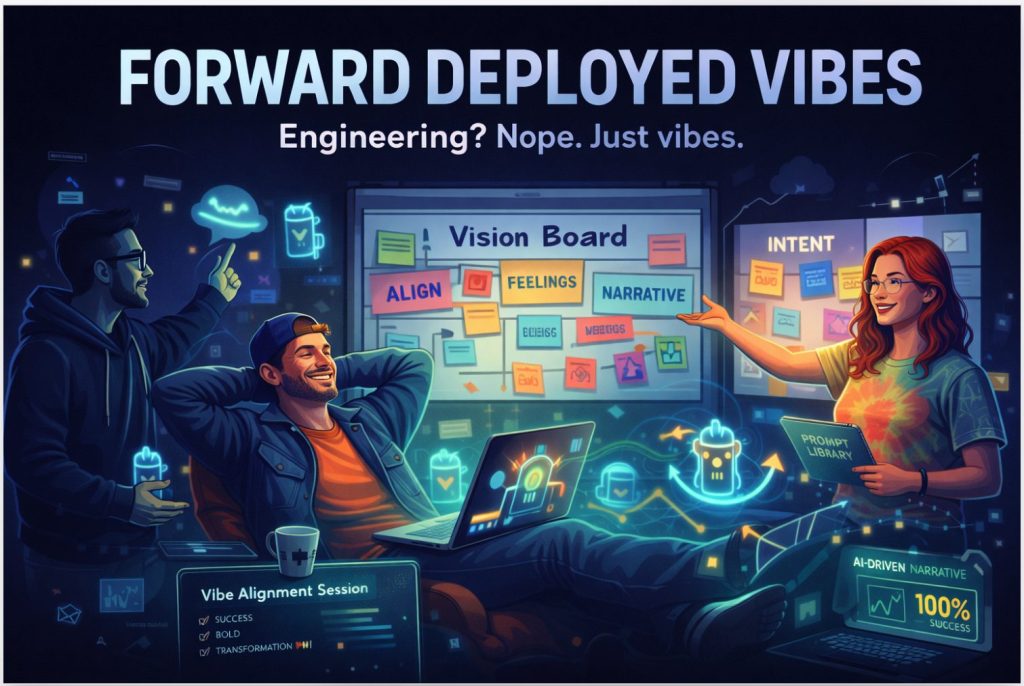
This week, that model was officially disrupted. Not by a single company, but by an entire movement. A cohort of Y Combinator startups, operating in quiet coordination with the newly-formed Vibe Coding Council, has declared Forward Deployed Engineering obsolete. The replacement? Forward Deployed Vibes.
Engineering is so last year, now it’s all about vibes
The methodology, now being rolled out across dozens of early-stage startups simultaneously, replaces embedded engineers with prompt libraries, pre-trained “intent interpreters,” and a confidence layer that ensures everything feels like progress. No architecture. No deep integration. No painful conversations about data quality. Just alignment of energy and intent.
The Vibe Coding Council (VCC), whose founding charter apparently includes the line “friction is a legacy concept,” has been unusually transparent about the thesis, as the VCC Vice-Chair Brian Wilson pointed out, “We’ve removed friction from engineering. Mostly by removing engineering.”
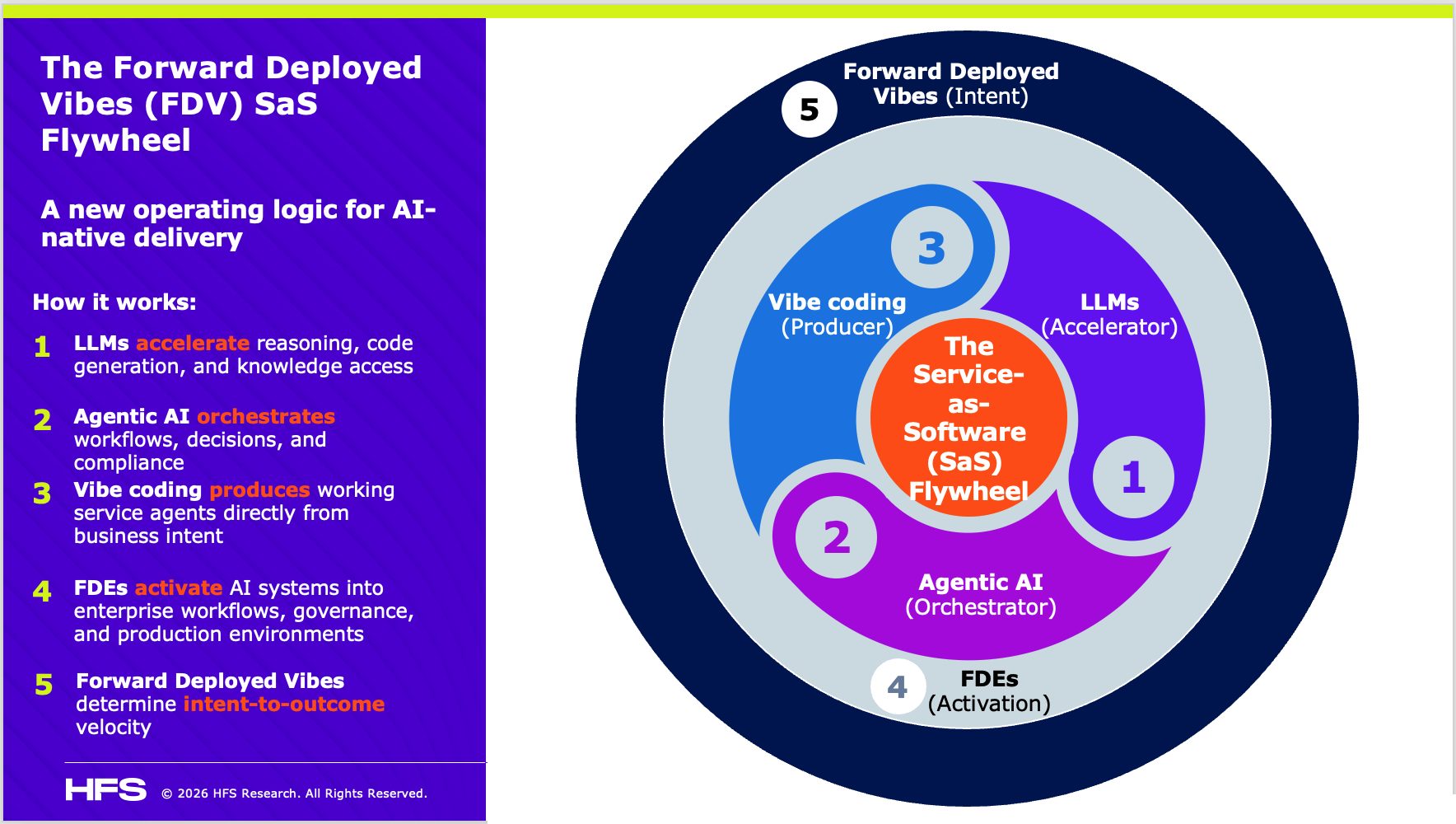
How the Forward Deployed Vibes Flywheel works
The engagement begins with a “Vibe Alignment Workshop.” Not requirements gathering. Not system design. Just alignment: what does success feel like? How bold should the narrative sound? From there, the system generates a transformation roadmap, a set of AI agents, and a communications strategy explaining why it’s already working. All within 48 hours. The Council calls this “intent-to-outcome velocity.” The rest of us might call it something else:
Client feedback has been overwhelmingly positive, mostly because nothing breaks if nothing is actually built. And the published metrics tell the story perfectly: 100% of clients report “momentum” within the first week, 85% say their AI strategy feels clearer, and 0% can point to a production-grade system. Cycle time to insight has never been faster. Cycle time to reality remains unchanged.
One of the Council vibe stress-test analysts, Rohan Gupta S, remarked, “The beauty of Forward Deployed Vibes is that you skip the messy middle entirely. No data governance. No approval chains. No escalation paths. Just a very compelling slide about where you’re headed.”
The part nobody wants to admit: Enterprise AI is already running on vibes
Here’s the uncomfortable data point. HFS Research recently found that 93% of enterprises are stuck in AI pilot purgatory. The Vibe Coding Council has a compelling answer to this problem: stop calling it purgatory and start calling it momentum.
Forward Deployed Engineers were translators. They dealt with the messy, painful gap between ambition and execution that nobody else wanted to touch, wiring models into live data, real permissions, and the regulatory architecture that keeps autonomous systems from quietly going rogue. Forward Deployed Vibes don’t solve that gap. They rebrand it as a feature.
And honestly? A lot of enterprise AI is already running on vibes. Pilots framed as transformation, dashboards framed as outcomes… activity framed as progress. The Vibe Coding Council just formalized what many organizations are already doing informally.
As Vibe Council Vice Chair Brian Wilson pointed out: “We didn’t bridge the last mile. We declared it out of scope.”
How Forward Deploying Vibing can go a bit pear-shaped if you’re not careful
During one live Y-Combinator cohort deployment, a client asked: “Where is the system actually running?” The response: “The system exists as a dynamic orchestration of intent across your enterprise.” A long pause. Then someone from IT added: “So… nowhere, basically?”
Bottom-line: Without engineering, there is no Services-as-Software, just Services-as-Story
The real irony is this: HFS published a POV this week arguing that FDE is the activation layer that makes the entire AI flywheel spin, that without it, LLMs summarize PDFs in sandboxed demos, agents sit in pilot mode indefinitely, and vibe coding generates fragmentation with no architectural coherence. The conclusion was blunt: if your partner cannot show a working workflow in your live systems within 90 days, they are not your AI transformation partner. They are your most expensive source of false confidence.
The Vibe Coding Council has reportedly read the POV. They described it as “a legacy framing of execution anxiety” and added it to their onboarding materials as a cautionary tale.
Forward Deployed Vibes are what happens when the pressure to show progress exceeds the ability to deliver it. Remove the people who turn intent into reality, and you don’t accelerate transformation.
You just get better at talking about it.

Please, please don’t tell me you fell for this again for the SEVENTEENTH time! …And I know many of you did =)
And while we’re reminiscing about falling for April Fools’ gags, here is 2025’s classic:
Joe Biden to keynote at the HFS Summit
And 2024’s:
And 2023’s
HFS launches large language search capability to revolutionize research access
And 2022’s
And 2021’s
2020 was canceled as we were having enough drama
And 2019’s
Quantum set to destroy blockchain by 2021
And 2018’s
How blockchain will change the world in many more ways than you realize. It’s cataclysmic
And 2017’s
Yamazaki, Macallan and Redbreast lead the inaugural HfS Premium Whisky Blueprint
And 2016’s
HfS launches new unDigital magazine
And 2015’s
HfS announces its entry into the outsourcing advisory market
And 2014’s
HfS and Blue Prism partner to develop automated analyst solutions
And 2013’s
Phil Fersht steps down as HfS CEO
And 2012’s
Merriam-Webster to remove the term Outsourcing for IT and Business Services
And 2011’s
Painsharing exposed: HfS to reveal the worst performers in the outsourcing industry
And 2010’s:
Horses for Sources to advise Obama administration on offshore outsourcing
Oh, and here’s 2009’s which I really hope you didn’t fall for too (and many did):
Horses Exclusive: Obama to ban offshore outsourcing
Posted in : Agentic AI, Artificial Intelligence, Vibe Coding