Value in enterprise AI is migrating from the model layer to the harness around it, and the providers who capture that value will be the ones who can prove they have run the harness on themselves.
IBM has done exactly that as Client Zero in its consulting business, moving beyond a platform on which work gets done to changing how work gets done, with AI woven into how decisions are made, how work moves across functions and how outcomes are measured. As we have argued, IBM has the trust, the stack and the moment, but it has to sell beyond the CIO, and at its October Analyst Council IBM acknowledged this and doubled down on its plans to make that happen.
The parts are strong, but a bazaar of parts does not sell itself
IBM’s real differentiator is not within its products, but in the lived experience of taking out 30% of the operating cost of a 115-year-old, 280,000-person enterprise, along with the playbook, assets and culture change that came with it. IBM CEO Arvind Krishna was clear that IBM will not be a monolith, with its pieces fitting together “like Lego blocks” so clients can take some capabilities from IBM and the rest from elsewhere. That openness is the right call, but it leaves IBM with work to do to prove that transformative deals are about far more than deploying technology.
Frontier models are commoditizing fast, and Krishna expects around 80% of tokens to run on open-weight models by 2030 with little lasting advantage left in the frontier models themselves. That does not make models less valuable, but it moves the value to the work around them, namely orchestration, context, governance and knowing what to change in the business first. This is where the IBM Experience comes in, because products open the door with the CIO, but the experience of assembling them inside a new operating model is what sells to the line of business.
The Enterprise AI Harness is the model IBM should be selling
Mapping IBM’s portfolio onto our Services-as-Software™ Enterprise Intelligence Model shows where this value is moving. Layers 1 and 2, compute and foundation models, are the commoditizing model layer, and IBM plays in both with hybrid cloud, OpenShift and Granite, but Krishna himself does not expect lasting advantage there. Layers 3 to 6 are the Enterprise AI Harness, where agent orchestration, OneOffice execution, activation and governance turn leadership’s strategic intent into measurable outcomes in performance, personalization, prediction and productivity.
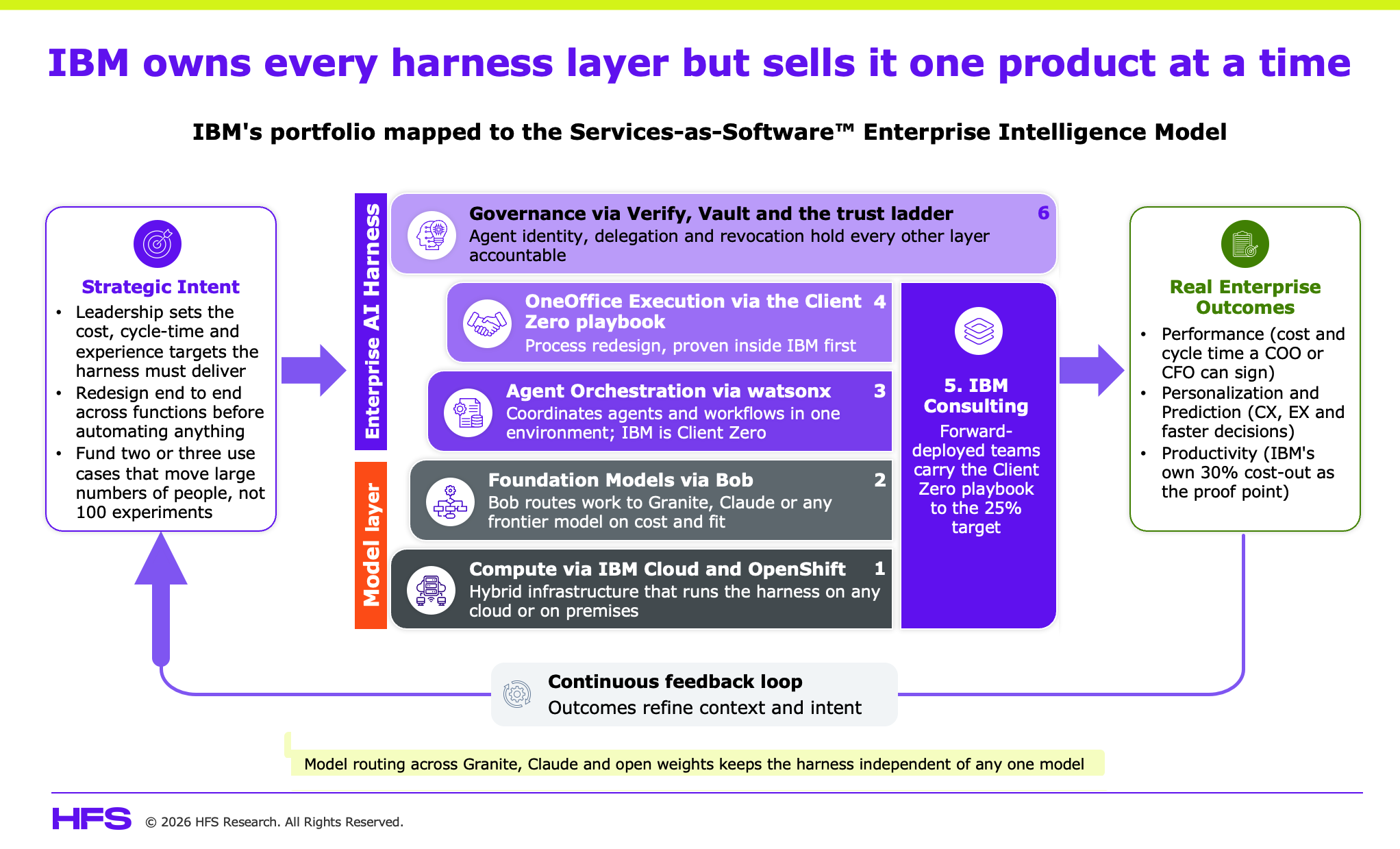
The graphic makes the point that IBM owns every harness layer but sells it one product at a time. watsonx sits in layer 3 as the orchestration layer coordinating agents and workflows into one operating environment, and IBM is already running its own harness on it, which is the Client Zero proof point. Bob, IBM’s AI-first development environment, sits in layer 2 as the distribution vehicle for Granite, Claude and other frontier models, which means IBM can route work to whichever model is best or cheapest for the task without betting the franchise on any one of them, and model routing is exactly the posture you want when 80% of tokens are heading to open weights.
IBM Consulting is the activation layer, deploying the whole harness through IBM’s own stack with forward-deployed teams that carry the Client Zero playbook into the client’s operating model. The end-to-end process redesign that IBM Senior Vice President of Transformation and Operations Joanne Wright describes below is OneOffice execution in layer 4, and IBM’s agent identity, delegation and revocation work is the governance in layer 6 that holds every other layer accountable. Sold one product at a time, watsonx, Bob and Consulting are three more stalls in the bazaar, but presented as the layers of one harness they become a single proposition that a COO or CFO can buy against a cost or cycle-time number.
The guides Client Zero brings to transformation
IBM’s internal transformation has delivered $4.5 billion of savings and roughly a 30% cut in operating costs over two and a half years, with another $1 billion on track for 2026. Wrightdescribed four lessons enterprises must learn to transform, and each one maps to a layer of the harness rather than to a product.
- Redesign before you automate. IBM refused to put AI on top of processes that weren’t fit for purpose, and it started too siloed, transforming procurement inside procurement and HR inside HR. The big gains came only when it went end to end across functions, which is OneOffice execution in practice.
- Measure through to the ledger. Teams deliver every two weeks and value is reconciled to the books every quarter, so the outcomes layer is a line item rather than a slide.
- Treat it as culture change, not a tech rollout. Every summer, all 280,000 employees are asked how they would use AI in their own jobs. Krishna ranks culture as the most important of his three priorities and says IBM is “maybe halfway” through.
- Measure three things, not one. Wright tracks cost, cycle time and experience for employees, partners and clients. Experience is the second measure of the IBM Experience, and it is the language the business buyer speaks.
The results are already visible inside IBM:
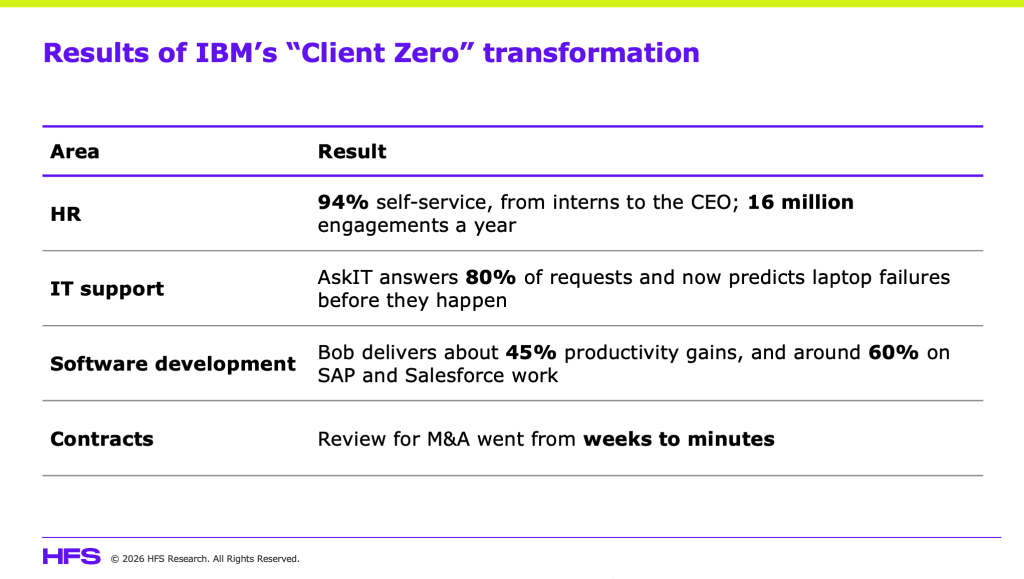
The AskIT story is one of the most compelling we have seen, because the IT support team that most resisted the change ended up starring in IBM’s video about it. They describe work that is now “more satisfying because we’re transforming the business.” That is the culture layer of the harness showing up in a help desk.
Industry proof points from travel, hospitality and logistics show value beyond cost and productivity
The travel, hospitality and logistics examples at the analyst day demonstrated value beyond cost savings, in businesses that run on operational decisions made in minutes rather than reports read once a day. Doubling down on industry expertise is one of the ways IBM intends to reach more line-of-business buyers, and it is the activation layer doing its job.
- Riyadh Air is one of IBM Consulting’s largest clients of the past two years. A new airline still carries the operational complexity of a global carrier, with 1,800 integrations across 75 core systems. Ground profitability forecasting, which usually takes 14 to 28 days, now takes 24 to 48 hours, and IBM wants to use engagements like this to grow revenue rather than only cut cost.
- A hotelier’s org chart was the real barrier. Krishna described a hotel group organized by geography, where each regional leader “nibbles at the edges.” Selling more rooms to people traveling for sporting events means working across brands and regions, so the organization has to change before AI pays off. That is the OneOffice execution argument, end to end and across silos.
- Recovering from operational shocks needs live data. Confluent’s flight rebooking scenario and its Australia Post logistics demo made the same point. An agent cannot rebook a passenger onto a seat that was taken half a second ago, so agents are only as good as how current their view of the business is.
- Agents as the front door. Krishna sees consumer brands splitting three ways, with some letting third-party agents become the interface, some experimenting outside the core business and some admitting only agents carrying the customer’s own permissions. Strong brands will protect their channel and weak ones will not have a choice. For airlines and hotels that is a distribution and loyalty decision for the CCO and CMO, not the CIO.
Selling the IBM experience is working, but IBM has barely started
Despite the progress, Client Zero has been sold to around 6% of IBM’s consulting client base, and the goal of one in four clients adopting the model leaves five questions IBM still has to answer.
- Who carries the token risk? IBM Consulting is on course to be IBM’s largest token consumer, and from November IBM will pass token consumption into the client’s bill of materials. IBM Consulting’s Global Offering & Growth leader, Andy Baldwin’s,logic is sound, since you can absorb $100 million of cloud cost but not $600 million, but most enterprises are not ready for this. Moving them onto a variable-cost model before they can forecast and govern consumption could topple programs quickly, so IBM should sell its FinOps guardrails (Apptio, Cloudability, Kubecost) together with the consumption model rather than after it.
- Is the experience repeatable? Wright estimates only about 50% of IBM’s own transformation has been done fully end to end. Our last POV asked what makes Client Zero externally repeatable across clients with different data, culture and operating models. The harness is the most credible answer, because a model with named layers can be installed and measured in a way that a culture story cannot.
- What makes IBM’s story different? “Everyone’s got a Client Zero story now,”Baldwin admitted, naming ServiceNow. IBM’s claim is that no one else has delivered as much value internally or turned it into as many reusable assets, and it needs to prove that with client results rather than internal ones.
- Can IBM staff it? The experience is delivered by forward-deployed teams of process and industry experts, engineers and customer success managers working on the platform, and IBM is reskilling 20,000 to 30,000 people this year. Going from 6% to 25% of clients means far more of these teams, and the activation layer is only as scalable as the people in it.
- Who answers for agents that act? AI is moving from assisting to acting, and once agents touch orders, payments and patient records, buyers want to know who did what and who is responsible. Krishna called AI control the next control point, much as the firewall was for networks, and IBM’s agent identity, delegation and revocation work (Verify, Vault and a proposed “trust ladder” of autonomy) is a real asset. Today it is pitched to security teams, but it should also be pitched to the risk, compliance and operations owners who sign off on agents acting in the business, because governance is the layer that holds the rest of the harness together.
Bottom line. A harness built for one company over two and a half years is a story, but a harness installed in 25% of clients is a business.
The story is already compelling, since IBM has the parts and was right to keep them open, but a bazaar of good products is still sold one product at a time to the CIO, and that is not how you get to one client in four. The IBM Experience, packaged as an Enterprise AI Harness with watsonx orchestrating, Bob routing the models and Consulting activating it inside the client’s operating model, can be sold to the CFO, the COO and the business owner on the hook for a cost or cycle-time number. That experience is the redesign playbook, the culture change, the outcome-based contract and the trust layer for agents that act, and none of it lives in the model layer.
For enterprise leaders, the advice is to follow Krishna and pick two or three use cases that move large numbers of people, such as software development, customer service and enterprise operations, instead of running 100 experiments. Redesign whole processes rather than slices, because IBM’s own lesson is that the value appeared only when it worked end to end across functions. And price the token risk before you sign, since outcome-based and consumption-based models are coming and you need to know who carries the variable cost before it scales.
Krishna expects the share of enterprises getting real value to rise from about 10% today to 25% by this time next year, the point at which everyone else has to follow. The more interesting question now is whether IBM’s activation layer can run faster than its own transformation did, because that is the difference between being the guide for this wave and being one more provider in the bazaar.
Posted in : Agentic AI, Analytics and Big Data, Anthropic, Artificial Intelligence, Business Process Outsourcing (BPO), Buyers' Sourcing Best Practices, Change Management, ChatGPT, Claude, Cloud Computing, Consulting, Cybersecurity, IT Outsourcing / IT Services, OneOffice, OpenAI